EP0949013A2 - Verfahren zur Herstellung von Haftvermittlerschichten - Google Patents
Verfahren zur Herstellung von Haftvermittlerschichten Download PDFInfo
- Publication number
- EP0949013A2 EP0949013A2 EP99106117A EP99106117A EP0949013A2 EP 0949013 A2 EP0949013 A2 EP 0949013A2 EP 99106117 A EP99106117 A EP 99106117A EP 99106117 A EP99106117 A EP 99106117A EP 0949013 A2 EP0949013 A2 EP 0949013A2
- Authority
- EP
- European Patent Office
- Prior art keywords
- adhesive
- plasma
- adhesion
- web
- coating
- Prior art date
- Legal status (The legal status is an assumption and is not a legal conclusion. Google has not performed a legal analysis and makes no representation as to the accuracy of the status listed.)
- Granted
Links
Images

Classifications
-
- B—PERFORMING OPERATIONS; TRANSPORTING
- B05—SPRAYING OR ATOMISING IN GENERAL; APPLYING FLUENT MATERIALS TO SURFACES, IN GENERAL
- B05D—PROCESSES FOR APPLYING FLUENT MATERIALS TO SURFACES, IN GENERAL
- B05D1/00—Processes for applying liquids or other fluent materials
- B05D1/62—Plasma-deposition of organic layers
Definitions
- the invention relates to a method for producing adhesion promoter layers a sheet material and the use of the adhesion promoter layers, in particular for adhesive tapes.
- adhesive layers on sheet-like materials for a variety different applications.
- Examples are packaging materials, Adhesive tapes or protective films, in which adhesion promoter layers in each case are provided in order to achieve sufficient strength of the layer composite.
- Adhesive tapes this is often particularly problematic since generally high Requirements for the adhesion between adhesive and backing material are made. Detachment of the adhesive from the backing should not occur when the adhesive tape is detached from the roll (before use) while removing the tape from any Surfaces (after use) take place.
- Adhesion-promoting layers also known as primers can, for example, as a wet chemical coating from solution (Solvent or water) are applied, followed by drying and / or networking is necessary.
- Another disadvantage of flame pretreatment is the high thermal stress on the treating materials, so that in particular temperature-sensitive materials cannot be treated or can only be treated to a limited extent.
- the low-pressure plasma pretreatment which is carried out with non-polymerizing gases (e.g. Noble gases, oxygen or nitrogen), it is generally possible better adhesion than with flame or corona treatment.
- non-polymerizing gases e.g. Noble gases, oxygen or nitrogen
- the high costs for the necessary vacuum equipment are problematic especially in the treatment of sheet materials.
- Low-pressure plasma polymerization has not yet been used for the industrial production of adhesion-promoting layers applied to sheet-like materials, although for resting substrates already processes for a multitude of different applications exist. Examples are the coating of plastic bottles with permeation barrier layers or the scratch-resistant coating of plastic surfaces. With web-shaped The use of low-pressure plasma polymerization has generally been materials so far not useful, since the deposition rates are too low, so that coating time of Minutes or hours. For this is the manufacture of coatings by means of low-pressure plasma polymerization in the case of sheet-like materials, in particular the production of adhesive layers, uneconomical.
- primers that are applied by wet chemistry usually brings high cost, since the priming of the web-like material means a complete additional coating process.
- the use of wet chemical primers is also problematic in the case of rough web-shaped ones Materials, since in these cases it is difficult to maintain a constant, even To achieve layer thickness.
- temperature-sensitive materials can only to be coated with wet chemical primers to a limited extent, since economical primer drying drying temperatures when processing sheet materials of at least 80 ° C is required.
- Another problem is when a certain layer, for example one Layer of adhesive, on a certain sheet material with none of the known methods can be brought to liability sufficiently well.
- the object of the invention is to avoid the disadvantages of the prior art, at least diminish.
- it is the object of the invention in the case of adhesive layers
- Significant increase in adhesion to sheet-like materials achieve the increase in adhesion must be long-term stable, no solvents to be used and the process and the adhesion-promoting layers should be harmless to health and the environment.
- the task is solved by a method for producing adhesion promoter layers on sheet-like materials, as is characterized in more detail in the main claim.
- the subclaims relate to particularly advantageous embodiments of the Procedure.
- the invention relates to the use of the adhesion promoter layers, especially with adhesive tapes.
- the invention relates to a method for producing adhesive layers on a web-shaped material, characterized in that the preferably almost or completely transparent adhesive layers by means of low-pressure plasma polymerization can be applied to the web-shaped material by the web-like material is continuously passed through a plasma zone in which a low-pressure plasma is present, which is due to electrical discharge, in particular kHz, MHz or GHz discharge is generated.
- Important process parameters that affect the process of depositing the adhesive The monomers used control layers and thus the layer properties or carrier or additional gases, the gas or gas mixture pressure during the coating and the electrical discharge used for plasma excitation.
- the variation of Process parameters serve to optimize and adapt the adhesion promoter layers to the technical boundary conditions in the respective application. Especially can be selected by appropriate selection of the process parameters, as in the examples explains a significant increase in the deposition rate compared to the state of the Technology can be achieved so that coating times are less than 1 second surrender.
- Coating is preferably carried out at a gas pressure or gas mixture pressure of 10 -3 to 20 mbar.
- the coating times are shorter than one minute, in particular less than a second.
- the unwinding station of the web-like material, the rewinding station and the plasma zone is in a vacuum chamber (batch operation) or the sheet-like material is guided through the plasma zone by means of vacuum locks becomes what is known as so-called air-to-air operation.
- saturated hydrocarbons with chain lengths from C 1 to C 6 in particular methane, ethane or propane, and / or mono- or polyunsaturated hydrocarbons with chain lengths from C 1 to C 6 , preferably acetylene or ethylene, and / or or oxygen- or hetero-element-substituted compounds of the saturated or unsaturated hydrocarbons, such as, for example, ethylene oxide.
- Non-polymerizable gases such as. are preferably used as carrier or additional gases Noble gases, oxygen, hydrogen, nitrogen or compounds respectively Gas mixtures used.
- Additional and carrier gases are used to control the layer deposition and in particular to increase the uniformity and stability of the plasma.
- Adhesion promoter layers produced by the method with at least one-sided adhesive tapes to promote adhesion between the carrier and adhesive.
- a strong improvement in adhesion is particularly typical for the combination of sheet-like materials and adhesives based on acrylate.
- Various forms of electrical discharge can be used for plasma excitation become. This is preferably done by kHz, MHz or GHz discharge.
- Crucial for the selection of the form of excitation are the procedural boundary conditions, for example necessary coating speed or gas mixture pressure, during the coating.
- a particular advantage of the method compared to the prior art is the possibility the process of layer deposition and thus the adhesive effect of To be able to control coatings by varying the process parameters. This makes possible an optimal adaptation of the layer properties to the respective application.
- Another advantage of the novel process is the absence of solvents and the Possibility of using substances from a health or environmental point of view are to be avoided.
- An additional advantage of the process is the ability to use rough sheet materials to be coated evenly with adhesive layers.
- the thermal load on the sheet materials is due to the Low pressure plasma used low, so that in particular temperature sensitive Materials such as polyethylene, polypropylene or foams coated without damage can be.
- Another advantage is the high long-term stability of the new adhesive layers, because these are highly cross-linked and thermally stable due to the new process. In addition, these are insoluble in common solvents, so that their use, in particular to promote adhesion between sheet-like materials and wet-chemical applied Coatings, leads to very good results.
- the web-shaped material 1 is from an unwinding station 2 through the Plasma coating zone 3 moves.
- the plasma coating zone 3 through Limits 8 is separated from the rest of the vacuum chamber 7, monomers over a monomer feed 4 initiated.
- the plasma excitation and thus the fragmentation The monomers take place via a high-frequency alternating field between the electrodes 5 and 6 is created.
- Electrode 5 is designed as a grounded cooling roller and serves thus at the same time the transport of the sheet-like material 1.
- the web-like material 1 is fed to a winding station 9 after coating.
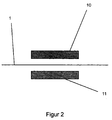
- Electrodes 10, 11 are formed flat and the web-like material 1 is non-contact passed through the electrode gap.
- the selection of the respective electrode arrangement depends on the specific application from. In the case of plasma excitation by means of GHz discharge, the electrodes are replaced by appropriate ones GHz couplings to replace.
- An adhesive layer is applied to a polyester film (Hostaphan RN 25 film from Hoechst AG, Frankfurt), transparent, 500 mm wide and with a thickness of 25 ⁇ m, by means of low-pressure plasma polymerization.
- the coating is carried out in a system corresponding to FIG. 1 with an acetylene flow of 500 sccm and an oxygen flow of 50 sccm at a process pressure of 0.5 mbar.
- the film is passed through the plasma zone (length 200 mm) at a speed of 100 m / min, so that a coating time of 0.12 sec results with a layer thickness of 130 nm.
- the plasma is excited by means of kHz discharge.
- a transparent acrylate adhesive (proprietary polymer made of 48% butyl acrylate, 48% ethylhexyl acrylate, 4% acrylic acid) is applied from solution to the adhesion-promoting layer (solvent acetone / petrol, adhesive applied after drying: 40 g / m 2 ).
- the adhesion between the adhesive and the carrier film is checked by an anchoring test.
- an adhesive strip with the adhesive layer according to the invention and a width of 20 mm is stuck onto a PVC plate and rolled on (steel roll, 80 mm diameter, 2 kg weight, is passed over the adhesive strip five times at approx. 10 m / min. and rolled up).
- the entire composite of adhesive strips with the adhesive layer and PVC plate according to the invention is then stored for 3 days at 40 ° C. and an air humidity below 75%.
- the adhesion between the carrier film and the adhesive is checked after storage by pulling off the test strip at a speed of 2400 mm / min at an angle of 180 ° or 90 °.
- the adhesion-promoting layer according to the invention increases the adhesion between the carrier film and the adhesive material significantly and surprisingly strongly and permanently, so that cohesive splitting of the adhesive material occurs during the test.
- the adhesion between the adhesive and the carrier film is therefore significantly better than in the case of comparative adhesive films in which, instead of the adhesion promoter layer according to the invention, wet chemical primers or a corona or flame pretreatment were used.
- the comparison adhesive strips an adhesive failure between the backing film and the adhesive was observed in all cases and thus a significantly poorer adhesion between the adhesive and the backing film.
- An adhesive layer is applied to a polypropylene film, transparent, 500 mm wide and with a thickness of 25 ⁇ m, by means of low-pressure plasma polymerisation.
- the coating is carried out in a system corresponding to FIG. 1 with an acetylene flow of 500 sccm at a process pressure of 3 mbar.
- the film is passed through the plasma zone (length 200 mm) at a speed of 50 m / min, so that there is a coating time of 0.24 sec with a layer thickness of 180 nm.
- the plasma is excited by means of MHz discharge.
- a transparent acrylate adhesive (proprietary polymer made from 47% butyl acrylate, 47% ethylhexyl acrylate, 6% acrylic acid) is applied from solution to the adhesion-promoting layer (solvent acetone / petrol, adhesive applied after drying: 40 g / m 2 ).
- the adhesion between the adhesive and the carrier film is checked by an anchoring test.
- adhesive strips with the adhesive layer according to the invention and a width of 20 mm are glued and rolled onto PVC plates (steel roll, 80 mm diameter, 2 kg weight, is rolled back and forth five times over the adhesive strip at approx. 10 m / min ).
- the entire composite of adhesive strips with the adhesive layer and PVC sheet according to the invention is then stored for 3 days at 40 ° C. and a humidity of 50% or 100%.
- the adhesion between the carrier film and the adhesive is checked after storage by removing the test strips at a speed of 2400 mm / min at an angle of 180 ° or 90 °.
- the adhesion-promoting layer according to the invention increases the adhesion between the carrier film and the adhesive material significantly and surprisingly strongly and permanently, so that cohesive splitting of the adhesive material occurs during the test.
- the adhesion between the adhesive and the carrier film is therefore significantly better than in the case of comparative adhesive films in which, instead of the adhesion promoter layer according to the invention, wet chemical primers or a corona or flame pretreatment were used.
- the comparison adhesive strips an adhesive failure between the backing film and the adhesive was observed in all cases and thus a significantly poorer adhesion between the adhesive and the backing film.
- An adhesive layer is applied to a polypropylene film, transparent, 500 mm wide and with a thickness of 25 ⁇ m, by means of low-pressure plasma polymerisation.
- the coating is carried out in a system corresponding to FIG. 1 with an ethylene flow of 1000 sccm at a process pressure of 0.5 mbar.
- the film is guided through the plasma zone (length 200 mm) at a speed of 20 m / min.
- the plasma is excited by means of kHz discharge.
- a transparent acrylate adhesive (proprietary polymer made of 47% butyl acrylate, 47% ethylhexyl acrylate, 6% acrylic acid) is applied from solution to the adhesive layer (solvent acetone / gasoline, adhesive applied after drying: 20 g / m 2 ).
- the adhesion between the adhesive and the carrier film is checked by an anchoring test.
- adhesive strips with the adhesive layer according to the invention and a width of 20 mm are glued and rolled onto PVC plates (steel roll, 80 mm diameter, 2 kg weight, is rolled back and forth five times over the adhesive strip at approx. 10 m / min ).
- the entire composite of adhesive strips with the adhesive layer and PVC sheet according to the invention is then stored for 3 days at 40 ° C. and a humidity of 50% or 100%.
- the adhesion between the carrier film and the adhesive is checked after storage by removing the test strips at a speed of 2400 mm / min at an angle of 180 ° or 90 °.
- the adhesion-promoting layer according to the invention increases the adhesion between the carrier film and the adhesive material significantly and surprisingly strongly and permanently, so that cohesive splitting of the adhesive material occurs during the test.
- the adhesion between the adhesive and the carrier film is therefore significantly better than in the case of comparative adhesive films in which, instead of the adhesion promoter layer according to the invention, wet chemical primers or a corona or flame pretreatment were used.
- the comparison adhesive strips an adhesive failure between the backing film and the adhesive was observed in all cases and thus a significantly poorer adhesion between the adhesive and the backing film.
- An adhesive layer is applied to a polypropylene film, transparent, 500 mm wide and with a thickness of 35 ⁇ m, by means of low-pressure plasma polymerization.
- the coating is carried out in a system corresponding to FIG. 1 with an acetylene flow of 500 sccm at a process pressure of 3 mbar.
- the film is passed through the plasma zone (length 200 mm) at a speed of 25 m / min, so that a coating time of 0.48 sec results with a layer thickness of 750 nm.
- the plasma is excited by means of pulsed MHz discharge at a pulse frequency of 10 3 Hz and a duty cycle of 0.3.
- a transparent acrylate adhesive (Primal PS 83 D, Rohm and Haas GmbH, Frankfurt) is applied from solution to the adhesion-promoting layer (solvent water, adhesive applied after drying: 20 g / m 2 ).
- solvent water adhesive applied after drying: 20 g / m 2 .
- the adhesion between the adhesive and the carrier film is checked by an anchoring test.
- adhesive strips with the adhesive layer according to the invention and a width of 20 mm are glued and rolled onto PVC plates (steel roll, 80 mm diameter, 2 kg weight, is rolled back and forth five times over the adhesive strip at approx. 10 m / min ).
- the entire composite of adhesive strips with the adhesive layer and PVC sheet according to the invention is then stored for 3 days at 40 ° C. and a humidity of 50% or 100%.
- the adhesion between the carrier film and the adhesive is checked after storage by removing the test strips at a speed of 2400 mm / min at an angle of 180 ° or 90 °.
- the adhesion-promoting layer according to the invention increases the adhesion between the carrier film and the adhesive material significantly and surprisingly strongly and permanently, so that cohesive splitting of the adhesive material occurs during the test.
- the adhesion between the adhesive and the carrier film is therefore significantly better than in the case of comparative adhesive films in which, instead of the adhesion promoter layer according to the invention, wet chemical primers or a corona or flame pretreatment were used.
- the comparison adhesive strips an adhesive failure between the backing film and the adhesive was observed in all cases and thus a significantly poorer adhesion between the adhesive and the backing film.
- An adhesive layer is applied to a foam carrier (Alveolit TEE 1000.8, Alveo AG, Lucerne, Switzerland), 300 mm wide and with a thickness of 600 ⁇ m, by means of low-pressure plasma polymerization.
- the coating is carried out in a system corresponding to FIG. 1 with an acetylene flow of 500 sccm and an argon flow of 50 sccm at a process pressure of 0.5 mbar.
- the film is passed through the plasma zone (length 200 mm) at a speed of 20 m / min, so that a coating time of 0.6 sec results.
- the plasma excitation takes place by means of kHz discharge.
- a transparent acrylate adhesive (proprietary polymer made of 47% butyl acrylate, 47% ethylhexyl acrylate, 6% acrylic acid) is applied from solution to the adhesive layer (solvent acetone / gasoline, adhesive applied after drying: 50 g / m 2 ).
- the adhesion between the adhesive and the carrier film is checked by an anchoring test.
- an adhesive strip with the adhesion promoter layer according to the invention width 20 mm
- the adhesive described is then stored in the drying cabinet at 40 ° C and a humidity of 50% for 3 days.
- the adhesion between the foam backing and the adhesive is checked after storage by pulling off the test strip.
- the adhesion-promoting layer according to the invention increases the adhesion between the carrier film and the adhesive material substantially and surprisingly strongly and permanently, so that cohesive splitting of the foam or detachment of the test strip occurs.
- the adhesion between the adhesive and the foam backing is thus significantly better than in comparison samples in which a corona or flame pretreatment was used instead of the adhesion promoter layer according to the invention. In the comparative samples, an adhesive failure between the foam backing and the adhesive and thus a clearly poor adhesion was observed in all cases.
- An adhesive layer is applied to a polypropylene film, transparent, 500 mm wide and with a thickness of 35 ⁇ m, by means of low-pressure plasma polymerization.
- the coating is carried out in a system corresponding to FIG. 1 with an acetylene flow of 500 sccm at a process pressure of 3 mbar.
- the film is passed through the plasma zone (length 200 mm) at a speed of 100 m / min.
- the plasma is excited by means of pulsed MHz discharge at a pulse frequency of 10 3 Hz and a duty cycle of 0.3.
- a rubber adhesive self-polymer made of 43% natural rubber, 3% Sillithin Z 86 white, 12% zinc oxide, 21% Escorez® 1202 (exon), 20% Escorez® 365 (exon), 0.4% AS MBI 2 PLV® (Bayer), 0.6% Sontal® (Bayer)
- the adhesion between the adhesive and the carrier film is checked by an anchoring test.
- adhesive strips with the adhesive layer according to the invention and a width of 20 mm are glued and rolled onto PVC plates (steel roll, 80 mm diameter, 2 kg weight, is rolled back and forth five times over the adhesive strip at approx. 10 m / min ).
- the entire composite of adhesive strips with the adhesive layer according to the invention and PVC sheet is then stored for 3 days at 40 ° C. and a humidity of 50%.
- the adhesion between the carrier film and the adhesive is checked after storage by removing the test strips at a speed of 2400 mm / min at an angle of 180 ° or 90 °.
- the adhesion-promoting layer according to the invention increases the adhesion between the backing film and adhesive mass significantly and surprisingly strongly and permanently, so that the test strips can be completely removed again.
- the adhesion between the adhesive and the carrier film is therefore significantly better than in the case of comparative adhesive films in which, instead of the adhesion promoter layer according to the invention, wet chemical primers or a corona or flame pretreatment were used.
- wet chemical primers or a corona or flame pretreatment were used.
- an adhesive failure between the backing film and the adhesive was observed in all cases and thus a significantly poorer adhesion between the adhesive and the backing film.
Landscapes
- Physics & Mathematics (AREA)
- Engineering & Computer Science (AREA)
- Plasma & Fusion (AREA)
- Adhesive Tapes (AREA)
- Laminated Bodies (AREA)
- Application Of Or Painting With Fluid Materials (AREA)
- Adhesives Or Adhesive Processes (AREA)
- Chemical Or Physical Treatment Of Fibers (AREA)
Abstract
Description
- Figur 1
- den Aufbau einer erfindungsgemäßen Vakuumbeschichtungsanlage und
- Figur 2
- eine alternative Anordnung der Elektroden aus Figur 1.
Claims (12)
- Verfahren zur Herstellung von Haftvermittlerschichten auf einem bahnförmigen Material, dadurch gekennzeichnet, daß
die Haftvermittlerschichten mittels Niederdruckplasmapolymerisation auf das bahnförmige Material aufgebracht werden, indem das bahnförmige Material kontinuierlich durch eine Plasmazone geführt wird, in der ein Niederdruckplasma vorhanden ist, das durch elektrische Entladung, insbesondere kHz-, MHz- oder GHz-Entladung, erzeugt wird. - Verfahren nach Anspruch 1, dadurch gekennzeichnet, daß
bei einem Gasdruck oder Gasgemischdruck von 10-3 bis 20 mbar beschichtet wird. - Verfahren nach den Ansprüchen 1 oder 2, dadurch gekennzeichnet, daß
gepulste elektrische Entladungen zur Erzeugung des Plasmas eingesetzt werden. - Verfahren nach den Ansprüchen 1 bis 3, dadurch gekennzeichnet, daß
das bahnförmige Material mit einer Geschwindigkeit von über 0,1 m/min, insbesondere größer 50 m/min, durch die Beschichtungszone bewegt wird. - Verfahren nach Anspruch 1 bis 4, dadurch gekennzeichnet, daß
die Beschichtungszeiten kürzer als eine Minute, insbesondere kleiner als eine Sekunde, sind. - Verfahren nach Anspruch 1 bis 5, dadurch gekennzeichnet, daß
sich die Abwickelstation des bahnförmigen Materials, die Aufwickelstation und die Plasmazone in einer Vakuumkammer befinden. - Verfahren nach Anspruch 1 bis 5, dadurch gekennzeichnet, daß
das bahnförmige Material mittels Vakuumschleusen durch die Plasmazone geführt wird. - Verfahren nach Anspruch 1 bis 7 dadurch gekennzeichnet, daß
zur Bildung des Niederdruckplasmas als Monomere gesättigte Kohlenwasserstoffe mit Kettenlängen von C1 bis C6, insbesondere Methan, Ethan oder Propan, und/oder einfach beziehungsweise mehrfach ungesättigte Kohlenwasserstoffe mit Kettenlängen von C1 bis C6, vorzugsweise Acetylen oder Ethylen, und/oder sauerstoff- oder heteroelementsubstituierte Verbindungen der gesättigten oder ungesättigten Kohlenwasserstoffe eingesetzt werden. - Verfahren nach Anspruch 1 bis 8 dadurch gekennzeichnet, daß
als Träger- oder Zusatzgase nicht-polymerisierbare Gase wie Edelgase, Sauerstoff, Wasserstoff, Stickstoff oder Verbindungen beziehungsweise Gasgemische eingesetzt werden. - Verfahren nach Anspruch 1 bis 9 dadurch gekennzeichnet, daß
die Haftvermittlerschichten nahezu oder völlig transparent sind. - Verfahren nach Anspruch 1 bis 10, dadurch gekennzeichnet, daß
als bahnförmige Materialien Kunstoffolien, Schaumträger, Gewebeträger, Vliesträger oder Papierträger eingesetzt werden. - Verwendung der mittels des Verfahrens nach einem der Ansprüche 1 bis 11 hergestellten Haftvermittlerschichten bei zumindest einseitigen Klebebändern zur Haftvermittlung zwischen Träger und Klebmasse.
Applications Claiming Priority (2)
| Application Number | Priority Date | Filing Date | Title |
|---|---|---|---|
| DE19815182A DE19815182A1 (de) | 1998-04-04 | 1998-04-04 | Verfahren zur Herstellung von Haftvermittlerschichten |
| DE19815182 | 1998-04-04 |
Publications (3)
| Publication Number | Publication Date |
|---|---|
| EP0949013A2 true EP0949013A2 (de) | 1999-10-13 |
| EP0949013A3 EP0949013A3 (de) | 2003-04-16 |
| EP0949013B1 EP0949013B1 (de) | 2005-06-08 |
Family
ID=7863624
Family Applications (1)
| Application Number | Title | Priority Date | Filing Date |
|---|---|---|---|
| EP99106117A Expired - Lifetime EP0949013B1 (de) | 1998-04-04 | 1999-04-01 | Verfahren zur Herstellung von Haftvermittlerschichten |
Country Status (4)
| Country | Link |
|---|---|
| US (1) | US6106904A (de) |
| EP (1) | EP0949013B1 (de) |
| DE (2) | DE19815182A1 (de) |
| ES (1) | ES2243021T3 (de) |
Cited By (3)
| Publication number | Priority date | Publication date | Assignee | Title |
|---|---|---|---|---|
| US6027777A (en) * | 1996-02-21 | 2000-02-22 | Alcare Co. Ltd. | Forming material |
| EP1129791A3 (de) * | 2000-03-01 | 2003-08-27 | Tesa AG | Verfahren zur Herstellung von antiadhäsiven Beschichtungen |
| EP1212785A4 (de) * | 1999-08-21 | 2004-07-28 | Lg Electronics Inc | Apparat für die kontinuierliche bildung einer polymerschicht auf einer metalloberfläche durch dc plasmapolymerisation |
Families Citing this family (2)
| Publication number | Priority date | Publication date | Assignee | Title |
|---|---|---|---|---|
| JP4746738B2 (ja) * | 2000-10-10 | 2011-08-10 | リンテック株式会社 | 耐放射線性粘着剤及びこれを用いた粘着製品 |
| WO2012066018A2 (en) * | 2010-11-16 | 2012-05-24 | Cuptronic Technology Ltd. | Metal coating of objects using plasma polymerisation |
Family Cites Families (5)
| Publication number | Priority date | Publication date | Assignee | Title |
|---|---|---|---|---|
| US3814983A (en) * | 1972-02-07 | 1974-06-04 | C Weissfloch | Apparatus and method for plasma generation and material treatment with electromagnetic radiation |
| DE3147986C2 (de) * | 1981-12-04 | 1992-02-27 | Leybold-Heraeus GmbH, 5000 Köln | Vorrichtung zur Erzeugung eines Mikrowellenplasmas für die Behandlung von Substraten, insbesondere zur Plasmapolymerisation von Monomeren |
| US4563388A (en) * | 1983-03-28 | 1986-01-07 | Minnesota Mining And Manufacturing Company | Polyolefin substrate coated with acrylic-type normally tacky and pressure-sensitive adhesive and a method of making same |
| DE3521625A1 (de) * | 1985-06-15 | 1986-12-18 | Leybold-Heraeus GmbH, 5000 Köln | Verfahren zum beschichten von substraten durch niederdruck-plasmapolymerisation von monomeren |
| DE69628441T2 (de) * | 1995-10-13 | 2004-04-29 | Dow Global Technologies, Inc., Midland | Verfahren zur herstellung von beschichteten kunststoffoberflächen |
-
1998
- 1998-04-04 DE DE19815182A patent/DE19815182A1/de not_active Withdrawn
-
1999
- 1999-03-25 US US09/276,341 patent/US6106904A/en not_active Expired - Lifetime
- 1999-04-01 ES ES99106117T patent/ES2243021T3/es not_active Expired - Lifetime
- 1999-04-01 DE DE59912131T patent/DE59912131D1/de not_active Expired - Lifetime
- 1999-04-01 EP EP99106117A patent/EP0949013B1/de not_active Expired - Lifetime
Cited By (3)
| Publication number | Priority date | Publication date | Assignee | Title |
|---|---|---|---|---|
| US6027777A (en) * | 1996-02-21 | 2000-02-22 | Alcare Co. Ltd. | Forming material |
| EP1212785A4 (de) * | 1999-08-21 | 2004-07-28 | Lg Electronics Inc | Apparat für die kontinuierliche bildung einer polymerschicht auf einer metalloberfläche durch dc plasmapolymerisation |
| EP1129791A3 (de) * | 2000-03-01 | 2003-08-27 | Tesa AG | Verfahren zur Herstellung von antiadhäsiven Beschichtungen |
Also Published As
| Publication number | Publication date |
|---|---|
| DE59912131D1 (de) | 2005-07-14 |
| DE19815182A1 (de) | 1999-10-14 |
| EP0949013A3 (de) | 2003-04-16 |
| US6106904A (en) | 2000-08-22 |
| ES2243021T3 (es) | 2005-11-16 |
| EP0949013B1 (de) | 2005-06-08 |
Similar Documents
| Publication | Publication Date | Title |
|---|---|---|
| EP3259325B1 (de) | Verfahren zur reduzierung der wickelspiegelklebrigkeit einer klebebandrolle | |
| DE3125786C2 (de) | Verfahren zur Vorbehandlung eines Polyolefinprodukts vor dem Überziehen | |
| EP1132195B1 (de) | Oberflächenbehandlung oder Beschichtung bahnförmiger Werkstoffe mittels eines indirekten atmosphärischen Plasmatrons | |
| DE69521746T2 (de) | Gasplasma polymerisierte selektive durchlässige membran | |
| EP1325509B1 (de) | Verfahren und vorrichtung zur behandlung von oberflächen mit hilfe eines glimmentladungs-plasmas | |
| EP0010632A1 (de) | Verfahren zur Oberflächenbehandlung von Kunststoffen und nach diesem Verfahren hergestellte Folie | |
| EP3415580B1 (de) | Verfahren zur simultanen plasmarandverkapselung von mindestens zwei klebebandseiten | |
| EP2151484A2 (de) | Verfahren zum Beschichten von bahnförmigen Trägermaterialien mit hohem Masseauftrag | |
| EP2147025B1 (de) | Verfahren und vorrichtung zur lösungsmittelfreien herstellung von acrylathaftklebemassen | |
| EP1132492A2 (de) | Plasmabehandelte bahnförmige Werkstoffe | |
| DE60007099T2 (de) | Verfahren zur oberflächenbehandlung von polymeren | |
| EP0084330B1 (de) | Mehrschichten-Flächengebilde | |
| EP1051266B1 (de) | Polare polymerartige beschichtung | |
| EP0436918B1 (de) | Verfahren zur Behandlung von Polyolefinfolien | |
| EP0949013B1 (de) | Verfahren zur Herstellung von Haftvermittlerschichten | |
| EP3215581A1 (de) | Verfahren zur indirekten plasmabehandlung von release-schichten | |
| DE102016220687A1 (de) | Plasmabehandlung einer Mehrlagenverklebung | |
| EP1581347B1 (de) | Substrat mit einer polaren plasmapolymerisierten schicht | |
| EP3271434B1 (de) | Niedertemperatur-plasmabehandlung | |
| EP1129791B1 (de) | Verfahren zur Herstellung von antiadhäsiven Beschichtungen | |
| EP3189110A1 (de) | Verfahren zur erhöhung der adhäsion zwischen der ersten oberfläche eines ersten bahnförmigen materials und einer ersten oberfläche eines zweiten bahnförmigen materials | |
| EP3215582A1 (de) | Plasmabehandlung von release-schichten | |
| EP3312253B1 (de) | Physikalische vorbehandlung zur filamenteinbindung | |
| EP1565309B1 (de) | Schaumstoff-formkörper mit dehäviser oberflächenausstattung | |
| DE10302067B4 (de) | Verfahren zur Herstellung eines Substrats mit erhöhter und stabbilisierter Oberflächenspannung und Verwendung derart hergestellter Folien |
Legal Events
| Date | Code | Title | Description |
|---|---|---|---|
| PUAI | Public reference made under article 153(3) epc to a published international application that has entered the european phase |
Free format text: ORIGINAL CODE: 0009012 |
|
| AK | Designated contracting states |
Kind code of ref document: A2 Designated state(s): AT BE CH CY DE DK ES FI FR GB GR IE IT LI LU MC NL PT SE |
|
| AX | Request for extension of the european patent |
Free format text: AL;LT;LV;MK;RO;SI |
|
| RAP1 | Party data changed (applicant data changed or rights of an application transferred) |
Owner name: TESA AG |
|
| PUAL | Search report despatched |
Free format text: ORIGINAL CODE: 0009013 |
|
| AK | Designated contracting states |
Designated state(s): AT BE CH CY DE DK ES FI FR GB GR IE IT LI LU MC NL PT SE |
|
| AX | Request for extension of the european patent |
Extension state: AL LT LV MK RO SI |
|
| 17P | Request for examination filed |
Effective date: 20031016 |
|
| AKX | Designation fees paid |
Designated state(s): DE ES FR GB IT |
|
| 17Q | First examination report despatched |
Effective date: 20040218 |
|
| RAP1 | Party data changed (applicant data changed or rights of an application transferred) |
Owner name: TESA AG |
|
| GRAP | Despatch of communication of intention to grant a patent |
Free format text: ORIGINAL CODE: EPIDOSNIGR1 |
|
| RIN1 | Information on inventor provided before grant (corrected) |
Inventor name: SELAFF, OLIVER Inventor name: LEIBER, JOERN, DR. Inventor name: BARGMANN, RENKE Inventor name: STROTMANN, MARKUS |
|
| GRAS | Grant fee paid |
Free format text: ORIGINAL CODE: EPIDOSNIGR3 |
|
| GRAA | (expected) grant |
Free format text: ORIGINAL CODE: 0009210 |
|
| AK | Designated contracting states |
Kind code of ref document: B1 Designated state(s): DE ES FR GB IT |
|
| REG | Reference to a national code |
Ref country code: GB Ref legal event code: FG4D Free format text: NOT ENGLISH |
|
| REF | Corresponds to: |
Ref document number: 59912131 Country of ref document: DE Date of ref document: 20050714 Kind code of ref document: P |
|
| GBT | Gb: translation of ep patent filed (gb section 77(6)(a)/1977) |
Effective date: 20050711 |
|
| REG | Reference to a national code |
Ref country code: ES Ref legal event code: FG2A Ref document number: 2243021 Country of ref document: ES Kind code of ref document: T3 |
|
| ET | Fr: translation filed | ||
| PLBE | No opposition filed within time limit |
Free format text: ORIGINAL CODE: 0009261 |
|
| STAA | Information on the status of an ep patent application or granted ep patent |
Free format text: STATUS: NO OPPOSITION FILED WITHIN TIME LIMIT |
|
| 26N | No opposition filed |
Effective date: 20060309 |
|
| PGFP | Annual fee paid to national office [announced via postgrant information from national office to epo] |
Ref country code: ES Payment date: 20070427 Year of fee payment: 9 |
|
| PGFP | Annual fee paid to national office [announced via postgrant information from national office to epo] |
Ref country code: GB Payment date: 20070426 Year of fee payment: 9 |
|
| PGFP | Annual fee paid to national office [announced via postgrant information from national office to epo] |
Ref country code: FR Payment date: 20070416 Year of fee payment: 9 |
|
| GBPC | Gb: european patent ceased through non-payment of renewal fee |
Effective date: 20080401 |
|
| REG | Reference to a national code |
Ref country code: FR Ref legal event code: ST Effective date: 20081231 |
|
| PG25 | Lapsed in a contracting state [announced via postgrant information from national office to epo] |
Ref country code: FR Free format text: LAPSE BECAUSE OF NON-PAYMENT OF DUE FEES Effective date: 20080430 |
|
| REG | Reference to a national code |
Ref country code: ES Ref legal event code: FD2A Effective date: 20080402 |
|
| PG25 | Lapsed in a contracting state [announced via postgrant information from national office to epo] |
Ref country code: GB Free format text: LAPSE BECAUSE OF NON-PAYMENT OF DUE FEES Effective date: 20080401 |
|
| PG25 | Lapsed in a contracting state [announced via postgrant information from national office to epo] |
Ref country code: ES Free format text: LAPSE BECAUSE OF NON-PAYMENT OF DUE FEES Effective date: 20080402 |
|
| PGFP | Annual fee paid to national office [announced via postgrant information from national office to epo] |
Ref country code: DE Payment date: 20120430 Year of fee payment: 14 |
|
| PGFP | Annual fee paid to national office [announced via postgrant information from national office to epo] |
Ref country code: IT Payment date: 20120424 Year of fee payment: 14 |
|
| PG25 | Lapsed in a contracting state [announced via postgrant information from national office to epo] |
Ref country code: DE Free format text: LAPSE BECAUSE OF NON-PAYMENT OF DUE FEES Effective date: 20131101 |
|
| REG | Reference to a national code |
Ref country code: DE Ref legal event code: R119 Ref document number: 59912131 Country of ref document: DE Effective date: 20131101 |
|
| PG25 | Lapsed in a contracting state [announced via postgrant information from national office to epo] |
Ref country code: IT Free format text: LAPSE BECAUSE OF NON-PAYMENT OF DUE FEES Effective date: 20130401 |