EP0949200A1 - Verfahren zur herstellung sich anpassender kohlenstoffbeschichtungen vom diamant-typ, harte kohlenstoffbeschichtung von diamant-typ, und dessen verwendung in einem porösen filtrationselement - Google Patents
Verfahren zur herstellung sich anpassender kohlenstoffbeschichtungen vom diamant-typ, harte kohlenstoffbeschichtung von diamant-typ, und dessen verwendung in einem porösen filtrationselement Download PDFInfo
- Publication number
- EP0949200A1 EP0949200A1 EP97926309A EP97926309A EP0949200A1 EP 0949200 A1 EP0949200 A1 EP 0949200A1 EP 97926309 A EP97926309 A EP 97926309A EP 97926309 A EP97926309 A EP 97926309A EP 0949200 A1 EP0949200 A1 EP 0949200A1
- Authority
- EP
- European Patent Office
- Prior art keywords
- diamond
- carbon
- coating
- hard
- coatings
- Prior art date
- Legal status (The legal status is an assumption and is not a legal conclusion. Google has not performed a legal analysis and makes no representation as to the accuracy of the status listed.)
- Withdrawn
Links
Images




Classifications
-
- C—CHEMISTRY; METALLURGY
- C23—COATING METALLIC MATERIAL; COATING MATERIAL WITH METALLIC MATERIAL; CHEMICAL SURFACE TREATMENT; DIFFUSION TREATMENT OF METALLIC MATERIAL; COATING BY VACUUM EVAPORATION, BY SPUTTERING, BY ION IMPLANTATION OR BY CHEMICAL VAPOUR DEPOSITION, IN GENERAL; INHIBITING CORROSION OF METALLIC MATERIAL OR INCRUSTATION IN GENERAL
- C23C—COATING METALLIC MATERIAL; COATING MATERIAL WITH METALLIC MATERIAL; SURFACE TREATMENT OF METALLIC MATERIAL BY DIFFUSION INTO THE SURFACE, BY CHEMICAL CONVERSION OR SUBSTITUTION; COATING BY VACUUM EVAPORATION, BY SPUTTERING, BY ION IMPLANTATION OR BY CHEMICAL VAPOUR DEPOSITION, IN GENERAL
- C23C16/00—Chemical coating by decomposition of gaseous compounds, without leaving reaction products of surface material in the coating, i.e. chemical vapour deposition [CVD] processes
- C23C16/44—Chemical coating by decomposition of gaseous compounds, without leaving reaction products of surface material in the coating, i.e. chemical vapour deposition [CVD] processes characterised by the method of coating
- C23C16/50—Chemical coating by decomposition of gaseous compounds, without leaving reaction products of surface material in the coating, i.e. chemical vapour deposition [CVD] processes characterised by the method of coating using electric discharges
- C23C16/511—Chemical coating by decomposition of gaseous compounds, without leaving reaction products of surface material in the coating, i.e. chemical vapour deposition [CVD] processes characterised by the method of coating using electric discharges using microwave discharges
-
- C—CHEMISTRY; METALLURGY
- C23—COATING METALLIC MATERIAL; COATING MATERIAL WITH METALLIC MATERIAL; CHEMICAL SURFACE TREATMENT; DIFFUSION TREATMENT OF METALLIC MATERIAL; COATING BY VACUUM EVAPORATION, BY SPUTTERING, BY ION IMPLANTATION OR BY CHEMICAL VAPOUR DEPOSITION, IN GENERAL; INHIBITING CORROSION OF METALLIC MATERIAL OR INCRUSTATION IN GENERAL
- C23C—COATING METALLIC MATERIAL; COATING MATERIAL WITH METALLIC MATERIAL; SURFACE TREATMENT OF METALLIC MATERIAL BY DIFFUSION INTO THE SURFACE, BY CHEMICAL CONVERSION OR SUBSTITUTION; COATING BY VACUUM EVAPORATION, BY SPUTTERING, BY ION IMPLANTATION OR BY CHEMICAL VAPOUR DEPOSITION, IN GENERAL
- C23C16/00—Chemical coating by decomposition of gaseous compounds, without leaving reaction products of surface material in the coating, i.e. chemical vapour deposition [CVD] processes
- C23C16/22—Chemical coating by decomposition of gaseous compounds, without leaving reaction products of surface material in the coating, i.e. chemical vapour deposition [CVD] processes characterised by the deposition of inorganic material, other than metallic material
- C23C16/26—Deposition of carbon only
Definitions
- the invention relates to diamond-like carbon coatings and to a method for producing such coatings from high-vacuum plasma of super high-frequency discharge (SHF) in the electron cyclotron resonance mode (ECR).
- SHF super high-frequency discharge
- ECR electron cyclotron resonance mode
- the diamond-like films which contain diamond phase inclusions in many instances, have been used in practice mainly because of their mechanical properties and optical characteristics: hardness, wear resistance, lower coefficient of friction with the majority of structural materials, high heat conductivity, low absorption in the visible spectral area, and high refractivity.
- the diamond-like films are used either as a medium for implementation of necessary structure members and devices in microchips and optically coupled electronic devices or as coatings for various uses such as protective, heat sink, decorative, and like coatings.
- the use of the diamond-like films in microchips and optically coupled electronic devices imposes specific requirements upon their electrical and physical properties and optical and electrical parameters such as electron emission, optical characteristics, luminescence, electric conductivity, and band gap.
- the degree of conformity of the diamond-like films (that ensures the exact follow-up of the microrelief of the support) and the ability to control the basic working parameters of the material without using other substances (such as doping, cladding, etc.) or sophisticated treatment (such as ion implanting, molecular beam epitaxy, vacuum sputtering, etc.) are decisive for forming structures that are based on the diamond-like films.
- diamond-like films are their use as protective coatings for optical devices that can function in various bands of electromagnetic radiation, which assumes that specific requirements should be imposed upon the optical characteristics of the material within the working spectral area, such as in the infrared range.
- filtering methods For purification of various liquids and gases from solid particles, filtering methods are used, which can have various modifications. The process basis for all these methods is the use of a filtering element that has pores dimensioned to fit a specific application.
- Filtering elements for purification from coarse particles may be prepared from coarse materials such as cloth, filtering paper, and the like and even from granular materials.
- a vital problem is the separation of suspensions and emulsions, and fine filters with a pore size of one nanometer (molecular membranes) to a few micrometers have to solve this problem.
- Such filtering elements are mainly prepared from polymer, ceramic, and cermet materials (including porous metals). While microporous filtering elements (which are frequently referred to as membranes) have comparatively low costs, they have a limited life because of the mechanical wear and clogging of the pores with fine contaminants during operation.
- the resistance of a filtering material to the mechanical wear is especially important for oil filtering when oil is prepared for processing.
- the production processes that are used to displace oil from the formation (mainly with water injection) require the use of surfactants to emulsify water and to form a suspension of clay particles and solid asphaltenes.
- surfactants to emulsify water and to form a suspension of clay particles and solid asphaltenes.
- the presence of these admixtures poses very serious problems in carrying out purification from the solid inclusions, dehydration and associated desalination of oil.
- Filters of mechanically strong microporous materials prove irreplaceable for purification of oil products such as fuels, lubricants, and waste products as well.
- Manipulation with the composition of the starting gas mixture by adding admixtures is a fairly popular method that is used to control the process of applying carbon coatings.
- the admixtures play various roles: from an organometal catalyst [4] to a chemically active halogen-containing admixture [5-7], which ensure the chemical transfer of carbon in methods similar to the hot filament method.
- organometal catalyst [4] to a chemically active halogen-containing admixture [5-7]
- These examples do not make use of the SHF plasma of the ECR discharge, which has ill inherent advantages, and the exact metering of components added to the mixture is a very difficult technical problem.
- the closest prior art is a method for producing a coating, which involves depositing the diamond-like carbon from the SHF plasma in the ECR discharge mode [8], wherein the support is positioned outside the effective range of the active plasma.
- This method allows the most significant disadvantage of the majority of the diamond-like film technologies to be eliminated.
- additional energy has to be used, which should be applied to the support as a high-frequency voltage.
- the plasma is formed in the area where the electron cyclotron conditions are met due to interaction of the SHF radiation with molecules of the starting plasma-forming gas, hydrogen, which is supplied directly to the active (ECR) zone.
- the carbon-containing component is supplied to a zone of a flow of atoms, ions, and electrons, which has been preliminarily formed afier passing through the ECR zone. Secondary processes of dissociation and ionization result in the carbon-containing molecules being decomposed and ionized.
- the flow of active particles is thus enriched with carbon that forms the diamond-like film when deposited onto a support.
- the method for forming the plasma flow as described above requires the use of hydrogen, and gaseous hydrocarbons such as methane, propane, acetylene are used as the carbon-containing components of the starting gas mixture.
- the carbon material of the coating is highly hydrogenated (up to 20% of hydrogen). In this case, hydrogen is not an admixture to carbon, but rather is the basic material of the coating is a chemical compound of carbon and hydrogen, which has a variable composition.
- Numerous types of the diamond-like films of various quality and composition are known [9-11], which largely differ in the physical characteristics depending on the method that is used for deposition of carbon to a solid support.
- the characteristic features of these films are as follows: a density of 1,500 to 2,800 kg/m 3 , absence of a clear-cut crystalline structure of the coating material (long-range ordering structures), weak photo luminescence and cathode luminescence, electric conductivity of 10 -10 -10 -8 S/m, conductivity activation energy of about 1 eV at a temperature from 0 to 400°C, a band gap of up to 2 eV, and non-conformity that results in the ironing out of the microrelief of the support surface.
- the closest prior art is a hard coating based on the diamond-like material having an amorphous structure, which contains inclusions of the diamond phase and no more than 20 atomic % of hydrogen and which is produced by the plasma chemical deposition from the SHF discharge in the ECR mode [12].
- One of the disadvantages of the coating is the fact that, owing to a comparative transparence of the coating material in the visible spectral area, absorption in the infrared range is significant because of the presence of hydrogen.
- the invention solves the problem of providing a hard conformal diamond-like carbon coating with an amorphous structure, which allows submicron size non-uniformity to be produced on its surface, which has low electric conductivity and high thermal conductivity, and which does not substantially contain hydrogen to be transparent in the infrared range, while having high hardness and density that are inherent in the diamond-like film.
- a method for producing a hard conformal diamond-like carbon coating involves conducting plasma chemical deposition of carbon to a support from a flow of active carbon-containing particles (radicals, atoms, ions), which is formed from starting carbon-containing reagents under the effect of SHF discharge in the electron cyclotron resonance mode.
- the support is positioned outside the effective range of the active plasma, and the deposition is carried out by using a starting reagent in the form of vapor of pure hydrocarbons the molecules of which contain atoms of highly negative chemical elements (oxygen, chlorine, etc.).
- Another object of the invention is to provide a hard conformal diamond-like carbon coating with an amorphous structure, which contains inclusions of the diamond phase in which the diamond-like material is pure carbon, i.e., an elemental substance.
- the coating according to the invention has high hardness and density and is practically opaque for the visible-range light, which does not show any significant absorption in the infrared range in the 2 to 25 ⁇ m waveband.
- the high conformity of the coating allows a porous material to be produced, having modified properties, e.g., improved wear resistance. It is, therefore, a third object of the invention to provide a porous filtering material in which a hard conformal diamond-like carbon coating, which is produced according to claim 1, is deposited to a porous support, the coating having high mechanical strength and hydrophobicity.
- the method according to the invention involves depositing a carbon coating from the SHF discharge plasma in the ECR mode by conducting the plasma decomposition of vapor of hydrocarbons containing carbon, hydrogen, and electrically negative components with a pressure in the working chamber that does not exceed 1 Pa to a support that is positioned outside the ECR zone, with an SHF power flow density ranging from 2 to 50 W/m 2 (from 0.2 to 5 W/cm2 in generally adopted units).
- the ECR mode is established in the SHF discharge plasma in a magnetic field.
- an active plasma area emerges in the ECR zone, which has a high-energy electron component that reacts with the support surface to decelerate growth of the carbon field and to cause material changes in its properties.
- the support is positioned outside the ECR zone. This division into the plasma-forming zone (into the areas of excitation, decomposition, and ionization of the gas) and the coating-forming zone prevents the direct effect of the high-energy electron component on the surface of the support and of the coating that is being formed and protects the support against the intensive electromagnetic radiation (by screening the support with the discharge zone).
- the distance at which the support shall be positioned with respect to the ECR zone for obtaining the preset conditions for carbon deposition depends on the linear velocity of the active particle flow and on kinetics of the relaxation processes. To determine this distance in a general case, a complicated kinetic problem has to be resolved, taking into account the processes of diffusion of the reagents in the radial direction, the volumetric recombination of the active particles, and the positive mass transfer in the directional flow of the active particles between the ECR zone and the support. It is, however, important, that a decrease in the rate of film growth is accompanied by an increase in uniformity of its deposition and in its conformity. The direct tests showed that when low pressures (0.01 to 1 Pa) were used, the distance from the ECR zone to the support can be as long as dozens of centimeters, yet the film would grow at a remarkable rate.
- the method according to the invention was used to prepare a series of test specimens of coatings on silicon, optical glasses, and porous cermet membranes (see Example D).
- a support was attached to a movable support holder that allowed the support to be moved around within the interior of a processing unit. The unit was sealed off and evacuated to a pressure of 2 ⁇ 10 -8 Pa.
- a working gas such as acetone vapor (Example A), isopropyl alcohol (Example B), or dichloromethane (Example C) was admitted to the system with a flow rate that ensured a pressure of 0.3 Pa with a constant evacuation rate. This technique allowed a directional flow of particles to be established through the ECR zone toward the support and then to the evacuation system. The SHF discharge was then fired.
- the support was moved and positioned at a preset distance.
- the rate of film growth that was obtained by varying the test conditions with the distance from the support to the ECR zone of 65 mm is 6 ⁇ m/h in the conventional units (compared to 1-2 ⁇ m/h for conventional prior art methods).
- the coatings that were obtained by using the above-described method were examined by the Raman spectroscopy and infrared spectroscopy, using the Fourier method (Fourier infrared spectroscopy), cathode luminescence, optical spectroscopy in the visible and UV ranges, as well as by plotting the electric conductivity versus temperature.
- Fig. 1 shows the combination dispersion spectra (Raman spectra) for the diamond-like coatings typical of the conventional deposition technique (1a) and for two coatings that were produced by using the above-described technique (1b and 1c). The intensities of the spectra were adjusted to bring them to the comparable measurement conditions.
- the cathode luminescence data can be used as an indicator of the presence of the diamond carbon in the coating (Fig. 2).
- the cathode luminescence spectrum of the diamond-like coating that was studied had a peak coinciding with the cathode luminescence peak in the spectrum of the diamond composite taken for the sake of comparison (compare Figs. 2a and 2b).
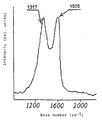
- Fig. 3 shows the combination dispersion spectrum (Raman spectrum) for a coating that was produced by using the method according to the invention with a pressure of 0.3 Pa from plasma of dichloromethane vapor (Example C).
- the spectrum has a band typical of the diamond-like film at 1570cm -1 , but there is also a peak at 1317 cm -1 . It is known that the Raman dispersion peak at 1332 cm -1 is characteristic of pure diamond, and oriented graphite (G-graphite) gives a band at 180 cm -1 .
- G-graphite oriented graphite
- the composition of the resulting carbon coating was examined by the Fourier infrared spectroscopy.
- the respective spectra are given in Fig. 4.
- This Figure shows a portion of a spectrum in which the absorption bands of the basic functional groups available in the material of the carbon coating.
- These data shows that, unlike the typical diamond-like films (Examples A and B), the coatings produced from dichloromethane (Example C) do not have functional groups CH 2 , CO, and OH. This results in the absence of an appreciable absorption within the range of 2 to 25 ⁇ m that was normally used for detecting infrared radiation. There is substantially no transmission in the visible area, and the resulting coating can be regarded as black.
- the gravimetry shows that the density of the diamond-like material of the coating in Example C is about 2900 kg/m 3 (graphite density is 2150 kg/m 3 and diamond density is 3300 kg/m 3 ). It is difficult to measure hardness of the carbon coatings because they are poorly adhesive to the majority of structural materials. We managed to obtain the data on the strength characteristics of the deposited coatings under mechanical loading by using special adhesion enhancement methods that do not have material bearing on this invention. These methods allow the lower limit of hardness for the coating material, which depends on the mechanical strength of the support, to be assessed. The data obtained for coatings on hard metals attest to the fact that hardness of the diamond-like carbon coatings, which is formed by the method according to the invention from the SHF discharge in the ECR mode, is higher than 25 GPa.
- the band gap for the carbonaceous material that forms the coating was determined by the size of the fringe of the optical absorption of the coating based on the optical spectroscopy.
- the band gap was as large as 3.5 eV. This band gap allows the blue glow to be produced in optically coupled devices incorporating the diamond-like coatings.
- the problem of providing a blue light-emitting element is one of the vital problems in optoelectronics today.
- Fig. 5 The temperature behavior of the electric conductivity of the resulting diamond-like coating is shown in Fig. 5 (a and b).
- Fig. 5c shows the data for a natural diamond.
- the diamond-like coating has the electric conductivity of 10 -14 S/m at room temperature, which is one order lower than similar diamond-like coatings (Fig. 5d).
- the electric conductivity material ly increases in the area of 350°C to 450°C (an increase by 11 orders!), with a temperature coefficient of more than 10 8 K -1 .
- this value for diamond does not exceed 10 6 K -1 (the same values are also typical of the diamond-like coatings produced by using prior art methods of Fig. 5d), it would be easy to estimate that the temperature coefficient for the electric conductivity of the coating that is produced by the method according to the invention is more than two orders higher than that for diamond. This allows the resulting carbonaceous material to be used for recording thermal radiation.
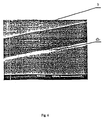
- FIG. 6 An electron microphotograph of the transversal cleavage of the support having the diamond-like coating produced by the method according to the invention is shown in Fig. 6.
- the photograph clearly shows high conformity of the film: a submicron scratch in the support surface is reproduced on the surface of a 10-micron film substantially without distortions. This attests to the fact that a microrelief of the support can be transferred to the surface of the coating that covers the support, which is important for certain applications, e.g., in forming active structures for microchip elements.
- This high degree of conformity of the coating allows the coating to be applied to a porous material to modiX properties of the material, primarily its wear resistance.
- a filtering material may be covered with a film of the diamond-like film that has high mechanical strength and also hydrophobicity. It should be also noted that when the method for deposition of the diamond-like film from the SHF discharge plasma is used, a thin-film diamond-like coating could be produced not only on the visible surface but also within the microscopic pores. As a result, a filtering element made of a porous material having the diamond-like coating is imparted high resistance to the mechanical wear. Moreover, high hydrophobicity of the coating assures an additional technical result, which, in certain applications, can be decisive. For instance, a filter having such a filtering element can let through non-polar liquids (e.g., oil and oil products) and still retain and separate water that is emulsified in these liquids.
- non-polar liquids e.g., oil and oil products
Landscapes
- Chemical & Material Sciences (AREA)
- Engineering & Computer Science (AREA)
- Materials Engineering (AREA)
- General Chemical & Material Sciences (AREA)
- Chemical Kinetics & Catalysis (AREA)
- Mechanical Engineering (AREA)
- Metallurgy (AREA)
- Organic Chemistry (AREA)
- Plasma & Fusion (AREA)
- Physics & Mathematics (AREA)
- Inorganic Chemistry (AREA)
- Chemical Vapour Deposition (AREA)
- Crystals, And After-Treatments Of Crystals (AREA)
- Nitrogen And Oxygen Or Sulfur-Condensed Heterocyclic Ring Systems (AREA)
Applications Claiming Priority (5)
| Application Number | Priority Date | Filing Date | Title |
|---|---|---|---|
| RU96110601/25A RU2099283C1 (ru) | 1996-06-05 | 1996-06-05 | Покрытие на основе алмазоподобного материала и способ его получения |
| RU96110600/25A RU2099282C1 (ru) | 1996-06-05 | 1996-06-05 | Способ получения конформного алмазоподобного углеродного покрытия |
| RU96110600 | 1996-06-05 | ||
| RU96110601 | 1996-06-05 | ||
| PCT/RU1997/000172 WO1997046484A1 (fr) | 1996-06-05 | 1997-06-05 | Procede de production de revetements conformes a base de carbone et de type diamant, revetement dur a base de carbone et de type diamant, et materiau de filtration poreux faisant appel a ces revetements |
Publications (1)
| Publication Number | Publication Date |
|---|---|
| EP0949200A1 true EP0949200A1 (de) | 1999-10-13 |
Family
ID=26653881
Family Applications (1)
| Application Number | Title | Priority Date | Filing Date |
|---|---|---|---|
| EP97926309A Withdrawn EP0949200A1 (de) | 1996-06-05 | 1997-06-05 | Verfahren zur herstellung sich anpassender kohlenstoffbeschichtungen vom diamant-typ, harte kohlenstoffbeschichtung von diamant-typ, und dessen verwendung in einem porösen filtrationselement |
Country Status (2)
| Country | Link |
|---|---|
| EP (1) | EP0949200A1 (de) |
| WO (1) | WO1997046484A1 (de) |
Cited By (16)
| Publication number | Priority date | Publication date | Assignee | Title |
|---|---|---|---|---|
| US7134381B2 (en) | 2003-08-21 | 2006-11-14 | Nissan Motor Co., Ltd. | Refrigerant compressor and friction control process therefor |
| US7146956B2 (en) | 2003-08-08 | 2006-12-12 | Nissan Motor Co., Ltd. | Valve train for internal combustion engine |
| US7228786B2 (en) | 2003-06-06 | 2007-06-12 | Nissan Motor Co., Ltd. | Engine piston-pin sliding structure |
| US7255083B2 (en) | 2002-10-16 | 2007-08-14 | Nissan Motor Co., Ltd. | Sliding structure for automotive engine |
| US7273655B2 (en) | 1999-04-09 | 2007-09-25 | Shojiro Miyake | Slidably movable member and method of producing same |
| US7284525B2 (en) | 2003-08-13 | 2007-10-23 | Nissan Motor Co., Ltd. | Structure for connecting piston to crankshaft |
| US7318514B2 (en) | 2003-08-22 | 2008-01-15 | Nissan Motor Co., Ltd. | Low-friction sliding member in transmission, and transmission oil therefor |
| US7322749B2 (en) | 2002-11-06 | 2008-01-29 | Nissan Motor Co., Ltd. | Low-friction sliding mechanism |
| US7406940B2 (en) | 2003-05-23 | 2008-08-05 | Nissan Motor Co., Ltd. | Piston for internal combustion engine |
| US7458585B2 (en) | 2003-08-08 | 2008-12-02 | Nissan Motor Co., Ltd. | Sliding member and production process thereof |
| US7500472B2 (en) | 2003-04-15 | 2009-03-10 | Nissan Motor Co., Ltd. | Fuel injection valve |
| US7572200B2 (en) | 2003-08-13 | 2009-08-11 | Nissan Motor Co., Ltd. | Chain drive system |
| WO2010012644A3 (de) * | 2008-07-31 | 2010-04-15 | Eads Deutschland Gmbh | Optischer partikeldetektor sowie detektionsverfahren |
| US7771821B2 (en) | 2003-08-21 | 2010-08-10 | Nissan Motor Co., Ltd. | Low-friction sliding member and low-friction sliding mechanism using same |
| US8096205B2 (en) | 2003-07-31 | 2012-01-17 | Nissan Motor Co., Ltd. | Gear |
| US8206035B2 (en) | 2003-08-06 | 2012-06-26 | Nissan Motor Co., Ltd. | Low-friction sliding mechanism, low-friction agent composition and method of friction reduction |
Families Citing this family (3)
| Publication number | Priority date | Publication date | Assignee | Title |
|---|---|---|---|---|
| US6015597A (en) * | 1997-11-26 | 2000-01-18 | 3M Innovative Properties Company | Method for coating diamond-like networks onto particles |
| US6265068B1 (en) * | 1997-11-26 | 2001-07-24 | 3M Innovative Properties Company | Diamond-like carbon coatings on inorganic phosphors |
| US6878419B2 (en) | 2001-12-14 | 2005-04-12 | 3M Innovative Properties Co. | Plasma treatment of porous materials |
Family Cites Families (4)
| Publication number | Priority date | Publication date | Assignee | Title |
|---|---|---|---|---|
| JPS63195266A (ja) * | 1987-02-10 | 1988-08-12 | Semiconductor Energy Lab Co Ltd | 炭素膜がコーティングされた時計 |
| US5271971A (en) * | 1987-03-30 | 1993-12-21 | Crystallume | Microwave plasma CVD method for coating a substrate with high thermal-conductivity diamond material |
| JPH0668152B2 (ja) * | 1988-01-27 | 1994-08-31 | 株式会社半導体エネルギー研究所 | 薄膜形成装置 |
| US5282899A (en) * | 1992-06-10 | 1994-02-01 | Ruxam, Inc. | Apparatus for the production of a dissociated atomic particle flow |
-
1997
- 1997-06-05 EP EP97926309A patent/EP0949200A1/de not_active Withdrawn
- 1997-06-05 WO PCT/RU1997/000172 patent/WO1997046484A1/ru not_active Ceased
Non-Patent Citations (1)
| Title |
|---|
| See references of WO9746484A1 * |
Cited By (20)
| Publication number | Priority date | Publication date | Assignee | Title |
|---|---|---|---|---|
| US7273655B2 (en) | 1999-04-09 | 2007-09-25 | Shojiro Miyake | Slidably movable member and method of producing same |
| US7255083B2 (en) | 2002-10-16 | 2007-08-14 | Nissan Motor Co., Ltd. | Sliding structure for automotive engine |
| US7322749B2 (en) | 2002-11-06 | 2008-01-29 | Nissan Motor Co., Ltd. | Low-friction sliding mechanism |
| US8152377B2 (en) | 2002-11-06 | 2012-04-10 | Nissan Motor Co., Ltd. | Low-friction sliding mechanism |
| US7500472B2 (en) | 2003-04-15 | 2009-03-10 | Nissan Motor Co., Ltd. | Fuel injection valve |
| US7406940B2 (en) | 2003-05-23 | 2008-08-05 | Nissan Motor Co., Ltd. | Piston for internal combustion engine |
| US7228786B2 (en) | 2003-06-06 | 2007-06-12 | Nissan Motor Co., Ltd. | Engine piston-pin sliding structure |
| US8096205B2 (en) | 2003-07-31 | 2012-01-17 | Nissan Motor Co., Ltd. | Gear |
| US8206035B2 (en) | 2003-08-06 | 2012-06-26 | Nissan Motor Co., Ltd. | Low-friction sliding mechanism, low-friction agent composition and method of friction reduction |
| US7458585B2 (en) | 2003-08-08 | 2008-12-02 | Nissan Motor Co., Ltd. | Sliding member and production process thereof |
| US7146956B2 (en) | 2003-08-08 | 2006-12-12 | Nissan Motor Co., Ltd. | Valve train for internal combustion engine |
| US8575076B2 (en) | 2003-08-08 | 2013-11-05 | Nissan Motor Co., Ltd. | Sliding member and production process thereof |
| US7284525B2 (en) | 2003-08-13 | 2007-10-23 | Nissan Motor Co., Ltd. | Structure for connecting piston to crankshaft |
| US7572200B2 (en) | 2003-08-13 | 2009-08-11 | Nissan Motor Co., Ltd. | Chain drive system |
| US7771821B2 (en) | 2003-08-21 | 2010-08-10 | Nissan Motor Co., Ltd. | Low-friction sliding member and low-friction sliding mechanism using same |
| US7134381B2 (en) | 2003-08-21 | 2006-11-14 | Nissan Motor Co., Ltd. | Refrigerant compressor and friction control process therefor |
| US7318514B2 (en) | 2003-08-22 | 2008-01-15 | Nissan Motor Co., Ltd. | Low-friction sliding member in transmission, and transmission oil therefor |
| US7650976B2 (en) | 2003-08-22 | 2010-01-26 | Nissan Motor Co., Ltd. | Low-friction sliding member in transmission, and transmission oil therefor |
| WO2010012644A3 (de) * | 2008-07-31 | 2010-04-15 | Eads Deutschland Gmbh | Optischer partikeldetektor sowie detektionsverfahren |
| US9557259B2 (en) | 2008-07-31 | 2017-01-31 | Eads Deutschland Gmbh | Optical particle detector and detection method |
Also Published As
| Publication number | Publication date |
|---|---|
| WO1997046484A1 (fr) | 1997-12-11 |
Similar Documents
| Publication | Publication Date | Title |
|---|---|---|
| EP0254560B1 (de) | Aus der Gasphase hergestellter Diamant, sowie Verfahren zu dessen Herstellung | |
| US5772760A (en) | Method for the preparation of nanocrystalline diamond thin films | |
| US4452679A (en) | Substrate with chemically modified surface and method of manufacture thereof | |
| Jiang et al. | The effect of substrate bias voltage on the nucleation of diamond crystals in a microwave plasma assisted chemical vapor deposition process | |
| US5620512A (en) | Diamond film growth from fullerene precursors | |
| JPS6171626A (ja) | グロー放電による硬質の炭素質膜の堆積方法及び該方法により堆積された膜を有する半導体デバイス | |
| WO1997013892A9 (en) | Improved method for the preparation of nanocrystalline diamond thin films | |
| US5849079A (en) | Diamond film growth argon-carbon plasmas | |
| CA2469739A1 (en) | Plasma treatment of porous materials | |
| Kim et al. | Characterization of amorphous hydrogenated carbon nitride films prepared by plasma-enhanced chemical vapor deposition using a helical resonator discharge | |
| Memming | Properties of polymeric layers of amorphous hydrogenated carbon produced by a plasma-activated chemical vapour deposition process I: Spectroscopic investigations | |
| Koidl et al. | Amorphous hydrogenated carbon films | |
| Saito et al. | Diamond-like carbon films prepared from CH4-H2-H2O mixed gas using a microwave plasma | |
| Aono et al. | Deposition of amorphous carbon nitride thin films using pressure-gradient RF magnetron sputtering and their chemical bonding structures | |
| Sun et al. | Properties and structures of diamond-like carbon film deposited using He, Ne, Ar/methane mixture by plasma enhanced chemical vapor deposition | |
| RU2105379C1 (ru) | Способ получения сплошной пленки с алмазоподобной структурой и устройство для его осуществления | |
| Liu et al. | Correlation of gas-phase composition with film properties in the plasma-enhanced chemical vapor deposition of hydrogenated amorphous carbon nitride films | |
| McNamara et al. | The effect of impurities on the IR absorption of chemically vapor deposited diamond | |
| Scharff et al. | Preparation of amorphous iC films by ion-assisted methods | |
| Kromka et al. | Role of polymers in CVD growth of nanocrystalline diamond films on foreign substrates | |
| RU2099282C1 (ru) | Способ получения конформного алмазоподобного углеродного покрытия | |
| EP0076562B1 (de) | Substrate mit chemisch modifizierter Oberfläche und Verfahren zu deren Herstellung | |
| Rostaing et al. | Highly homogeneous silica coatings for optical and protective applications deposited by PECVD at room temperature in a planar uniform distributed electron cyclotron resonance plasma reactor. | |
| Jubber et al. | Atom beam treatment of diamond films | |
| Novikov et al. | Deposition by reactive ion-plasma sputtering and characterization of C N thin films |
Legal Events
| Date | Code | Title | Description |
|---|---|---|---|
| PUAI | Public reference made under article 153(3) epc to a published international application that has entered the european phase |
Free format text: ORIGINAL CODE: 0009012 |
|
| 17P | Request for examination filed |
Effective date: 19981222 |
|
| AK | Designated contracting states |
Kind code of ref document: A1 Designated state(s): DE FR GB IT |
|
| STAA | Information on the status of an ep patent application or granted ep patent |
Free format text: STATUS: THE APPLICATION HAS BEEN WITHDRAWN |
|
| 18W | Application withdrawn |
Withdrawal date: 20010710 |