EP0949547A2 - Mehrschichtiges Volumenhologramm und Etikett zur Herstellung eines mehrschichtigen Volumenhologramms - Google Patents
Mehrschichtiges Volumenhologramm und Etikett zur Herstellung eines mehrschichtigen Volumenhologramms Download PDFInfo
- Publication number
- EP0949547A2 EP0949547A2 EP99107023A EP99107023A EP0949547A2 EP 0949547 A2 EP0949547 A2 EP 0949547A2 EP 99107023 A EP99107023 A EP 99107023A EP 99107023 A EP99107023 A EP 99107023A EP 0949547 A2 EP0949547 A2 EP 0949547A2
- Authority
- EP
- European Patent Office
- Prior art keywords
- volume hologram
- layer
- adhesive layer
- wavelength
- recorded
- Prior art date
- Legal status (The legal status is an assumption and is not a legal conclusion. Google has not performed a legal analysis and makes no representation as to the accuracy of the status listed.)
- Granted
Links
- 238000002360 preparation method Methods 0.000 title claims description 69
- 239000012790 adhesive layer Substances 0.000 claims abstract description 301
- 239000010410 layer Substances 0.000 claims abstract description 260
- 239000000126 substance Substances 0.000 claims abstract description 103
- 230000002633 protecting effect Effects 0.000 claims abstract description 75
- 239000000758 substrate Substances 0.000 claims abstract description 50
- 229920001296 polysiloxane Polymers 0.000 claims description 119
- 239000000178 monomer Substances 0.000 claims description 58
- 230000001070 adhesive effect Effects 0.000 claims description 49
- 150000001875 compounds Chemical class 0.000 claims description 49
- 239000000853 adhesive Substances 0.000 claims description 42
- NIXOWILDQLNWCW-UHFFFAOYSA-N acrylic acid group Chemical group C(C=C)(=O)O NIXOWILDQLNWCW-UHFFFAOYSA-N 0.000 claims description 36
- 239000004014 plasticizer Substances 0.000 claims description 36
- 239000003431 cross linking reagent Substances 0.000 claims description 17
- 235000007586 terpenes Nutrition 0.000 claims description 15
- 150000003505 terpenes Chemical class 0.000 claims description 14
- 229920003002 synthetic resin Polymers 0.000 claims description 10
- 239000000057 synthetic resin Substances 0.000 claims description 10
- 238000004132 cross linking Methods 0.000 claims description 9
- 229920001515 polyalkylene glycol Polymers 0.000 claims description 9
- 239000004094 surface-active agent Substances 0.000 claims description 9
- RSWGJHLUYNHPMX-UHFFFAOYSA-N Abietic-Saeure Natural products C12CCC(C(C)C)=CC2=CCC2C1(C)CCCC2(C)C(O)=O RSWGJHLUYNHPMX-UHFFFAOYSA-N 0.000 claims description 8
- KHPCPRHQVVSZAH-HUOMCSJISA-N Rosin Natural products O(C/C=C/c1ccccc1)[C@H]1[C@H](O)[C@@H](O)[C@@H](O)[C@@H](CO)O1 KHPCPRHQVVSZAH-HUOMCSJISA-N 0.000 claims description 8
- KHPCPRHQVVSZAH-UHFFFAOYSA-N trans-cinnamyl beta-D-glucopyranoside Natural products OC1C(O)C(O)C(CO)OC1OCC=CC1=CC=CC=C1 KHPCPRHQVVSZAH-UHFFFAOYSA-N 0.000 claims description 8
- 150000001491 aromatic compounds Chemical class 0.000 claims description 4
- 125000001153 fluoro group Chemical class F* 0.000 claims 1
- ZWEHNKRNPOVVGH-UHFFFAOYSA-N 2-Butanone Chemical compound CCC(C)=O ZWEHNKRNPOVVGH-UHFFFAOYSA-N 0.000 description 63
- XEKOWRVHYACXOJ-UHFFFAOYSA-N Ethyl acetate Chemical compound CCOC(C)=O XEKOWRVHYACXOJ-UHFFFAOYSA-N 0.000 description 63
- YXFVVABEGXRONW-UHFFFAOYSA-N Toluene Chemical compound CC1=CC=CC=C1 YXFVVABEGXRONW-UHFFFAOYSA-N 0.000 description 63
- 229920002799 BoPET Polymers 0.000 description 54
- -1 amine compounds Chemical class 0.000 description 54
- 150000002148 esters Chemical class 0.000 description 53
- 229920005989 resin Polymers 0.000 description 47
- 239000011347 resin Substances 0.000 description 47
- 239000000049 pigment Substances 0.000 description 45
- 239000000463 material Substances 0.000 description 44
- 239000000203 mixture Substances 0.000 description 36
- 150000001735 carboxylic acids Chemical class 0.000 description 33
- 239000000123 paper Substances 0.000 description 31
- FBPFZTCFMRRESA-FSIIMWSLSA-N D-Glucitol Natural products OC[C@H](O)[C@H](O)[C@@H](O)[C@H](O)CO FBPFZTCFMRRESA-FSIIMWSLSA-N 0.000 description 30
- 239000000600 sorbitol Substances 0.000 description 30
- 239000011248 coating agent Substances 0.000 description 29
- 238000000576 coating method Methods 0.000 description 29
- 229920000298 Cellophane Polymers 0.000 description 26
- 239000003795 chemical substances by application Substances 0.000 description 25
- XKRFYHLGVUSROY-UHFFFAOYSA-N Argon Chemical compound [Ar] XKRFYHLGVUSROY-UHFFFAOYSA-N 0.000 description 24
- 229920000915 polyvinyl chloride Polymers 0.000 description 23
- 239000004800 polyvinyl chloride Substances 0.000 description 23
- 230000003595 spectral effect Effects 0.000 description 23
- 239000003522 acrylic cement Substances 0.000 description 22
- 239000000243 solution Substances 0.000 description 22
- DOIRQSBPFJWKBE-UHFFFAOYSA-N dibutyl phthalate Chemical compound CCCCOC(=O)C1=CC=CC=C1C(=O)OCCCC DOIRQSBPFJWKBE-UHFFFAOYSA-N 0.000 description 20
- PPBRXRYQALVLMV-UHFFFAOYSA-N Styrene Chemical compound C=CC1=CC=CC=C1 PPBRXRYQALVLMV-UHFFFAOYSA-N 0.000 description 19
- 239000003999 initiator Substances 0.000 description 19
- DAKWPKUUDNSNPN-UHFFFAOYSA-N Trimethylolpropane triacrylate Chemical compound C=CC(=O)OCC(CC)(COC(=O)C=C)COC(=O)C=C DAKWPKUUDNSNPN-UHFFFAOYSA-N 0.000 description 18
- 229920001577 copolymer Polymers 0.000 description 17
- 229920000139 polyethylene terephthalate Polymers 0.000 description 17
- 239000005020 polyethylene terephthalate Substances 0.000 description 17
- IUVCFHHAEHNCFT-INIZCTEOSA-N 2-[(1s)-1-[4-amino-3-(3-fluoro-4-propan-2-yloxyphenyl)pyrazolo[3,4-d]pyrimidin-1-yl]ethyl]-6-fluoro-3-(3-fluorophenyl)chromen-4-one Chemical compound C1=C(F)C(OC(C)C)=CC=C1C(C1=C(N)N=CN=C11)=NN1[C@@H](C)C1=C(C=2C=C(F)C=CC=2)C(=O)C2=CC(F)=CC=C2O1 IUVCFHHAEHNCFT-INIZCTEOSA-N 0.000 description 16
- FBPFZTCFMRRESA-JGWLITMVSA-N D-glucitol Chemical compound OC[C@H](O)[C@@H](O)[C@H](O)[C@H](O)CO FBPFZTCFMRRESA-JGWLITMVSA-N 0.000 description 15
- MQIUGAXCHLFZKX-UHFFFAOYSA-N Di-n-octyl phthalate Chemical compound CCCCCCCCOC(=O)C1=CC=CC=C1C(=O)OCCCCCCCC MQIUGAXCHLFZKX-UHFFFAOYSA-N 0.000 description 15
- 125000001931 aliphatic group Chemical group 0.000 description 15
- 229920001223 polyethylene glycol Polymers 0.000 description 15
- NIXOWILDQLNWCW-UHFFFAOYSA-M Acrylate Chemical compound [O-]C(=O)C=C NIXOWILDQLNWCW-UHFFFAOYSA-M 0.000 description 14
- 239000002313 adhesive film Substances 0.000 description 14
- 230000001235 sensitizing effect Effects 0.000 description 13
- TXBCBTDQIULDIA-UHFFFAOYSA-N 2-[[3-hydroxy-2,2-bis(hydroxymethyl)propoxy]methyl]-2-(hydroxymethyl)propane-1,3-diol Chemical compound OCC(CO)(CO)COCC(CO)(CO)CO TXBCBTDQIULDIA-UHFFFAOYSA-N 0.000 description 12
- NIQCNGHVCWTJSM-UHFFFAOYSA-N Dimethyl phthalate Chemical compound COC(=O)C1=CC=CC=C1C(=O)OC NIQCNGHVCWTJSM-UHFFFAOYSA-N 0.000 description 12
- 239000004372 Polyvinyl alcohol Substances 0.000 description 12
- ATUOYWHBWRKTHZ-UHFFFAOYSA-N Propane Chemical compound CCC ATUOYWHBWRKTHZ-UHFFFAOYSA-N 0.000 description 12
- ZFOZVQLOBQUTQQ-UHFFFAOYSA-N Tributyl citrate Chemical compound CCCCOC(=O)CC(O)(C(=O)OCCCC)CC(=O)OCCCC ZFOZVQLOBQUTQQ-UHFFFAOYSA-N 0.000 description 12
- 229910052786 argon Inorganic materials 0.000 description 12
- 229920002451 polyvinyl alcohol Polymers 0.000 description 12
- LDHQCZJRKDOVOX-UHFFFAOYSA-N trans-crotonic acid Natural products CC=CC(O)=O LDHQCZJRKDOVOX-UHFFFAOYSA-N 0.000 description 12
- SMZOUWXMTYCWNB-UHFFFAOYSA-N 2-(2-methoxy-5-methylphenyl)ethanamine Chemical compound COC1=CC=C(C)C=C1CCN SMZOUWXMTYCWNB-UHFFFAOYSA-N 0.000 description 11
- LYCAIKOWRPUZTN-UHFFFAOYSA-N Ethylene glycol Chemical compound OCCO LYCAIKOWRPUZTN-UHFFFAOYSA-N 0.000 description 11
- 239000002202 Polyethylene glycol Substances 0.000 description 11
- 229920001451 polypropylene glycol Polymers 0.000 description 11
- YCKRFDGAMUMZLT-UHFFFAOYSA-N Fluorine atom Chemical compound [F] YCKRFDGAMUMZLT-UHFFFAOYSA-N 0.000 description 10
- 229910052731 fluorine Inorganic materials 0.000 description 10
- 239000011737 fluorine Substances 0.000 description 10
- CSCPPACGZOOCGX-UHFFFAOYSA-N Acetone Chemical compound CC(C)=O CSCPPACGZOOCGX-UHFFFAOYSA-N 0.000 description 9
- UHOVQNZJYSORNB-UHFFFAOYSA-N Benzene Chemical compound C1=CC=CC=C1 UHOVQNZJYSORNB-UHFFFAOYSA-N 0.000 description 9
- YMWUJEATGCHHMB-UHFFFAOYSA-N Dichloromethane Chemical compound ClCCl YMWUJEATGCHHMB-UHFFFAOYSA-N 0.000 description 9
- LFQSCWFLJHTTHZ-UHFFFAOYSA-N Ethanol Chemical compound CCO LFQSCWFLJHTTHZ-UHFFFAOYSA-N 0.000 description 9
- PEDCQBHIVMGVHV-UHFFFAOYSA-N Glycerine Chemical compound OCC(O)CO PEDCQBHIVMGVHV-UHFFFAOYSA-N 0.000 description 9
- CERQOIWHTDAKMF-UHFFFAOYSA-N Methacrylic acid Chemical compound CC(=C)C(O)=O CERQOIWHTDAKMF-UHFFFAOYSA-N 0.000 description 9
- OKKJLVBELUTLKV-UHFFFAOYSA-N Methanol Chemical compound OC OKKJLVBELUTLKV-UHFFFAOYSA-N 0.000 description 9
- 239000004743 Polypropylene Substances 0.000 description 9
- 239000002253 acid Substances 0.000 description 9
- 150000001298 alcohols Chemical class 0.000 description 9
- 239000011230 binding agent Substances 0.000 description 9
- IISBACLAFKSPIT-UHFFFAOYSA-N bisphenol A Chemical compound C=1C=C(O)C=CC=1C(C)(C)C1=CC=C(O)C=C1 IISBACLAFKSPIT-UHFFFAOYSA-N 0.000 description 9
- MTHSVFCYNBDYFN-UHFFFAOYSA-N diethylene glycol Chemical compound OCCOCCO MTHSVFCYNBDYFN-UHFFFAOYSA-N 0.000 description 9
- 239000007788 liquid Substances 0.000 description 9
- 239000011159 matrix material Substances 0.000 description 9
- 238000000034 method Methods 0.000 description 9
- 229920001084 poly(chloroprene) Polymers 0.000 description 9
- 229920002037 poly(vinyl butyral) polymer Polymers 0.000 description 9
- 229920000728 polyester Polymers 0.000 description 9
- 229920000642 polymer Polymers 0.000 description 9
- 229920001155 polypropylene Polymers 0.000 description 9
- 229920002689 polyvinyl acetate Polymers 0.000 description 9
- 239000011118 polyvinyl acetate Substances 0.000 description 9
- 229920001289 polyvinyl ether Polymers 0.000 description 9
- 239000004698 Polyethylene Substances 0.000 description 8
- 235000019646 color tone Nutrition 0.000 description 8
- 239000012948 isocyanate Substances 0.000 description 8
- 150000002513 isocyanates Chemical class 0.000 description 8
- 229920002545 silicone oil Polymers 0.000 description 8
- 229910019142 PO4 Inorganic materials 0.000 description 7
- ZJCCRDAZUWHFQH-UHFFFAOYSA-N Trimethylolpropane Chemical compound CCC(CO)(CO)CO ZJCCRDAZUWHFQH-UHFFFAOYSA-N 0.000 description 7
- 150000001252 acrylic acid derivatives Chemical class 0.000 description 7
- 230000003247 decreasing effect Effects 0.000 description 7
- 239000011521 glass Substances 0.000 description 7
- 235000021317 phosphate Nutrition 0.000 description 7
- 229920002554 vinyl polymer Polymers 0.000 description 7
- SOONNKHXNUDREF-UHFFFAOYSA-N 1-o-heptyl 2-o-nonyl benzene-1,2-dicarboxylate Chemical compound CCCCCCCCCOC(=O)C1=CC=CC=C1C(=O)OCCCCCCC SOONNKHXNUDREF-UHFFFAOYSA-N 0.000 description 6
- JAHNSTQSQJOJLO-UHFFFAOYSA-N 2-(3-fluorophenyl)-1h-imidazole Chemical compound FC1=CC=CC(C=2NC=CN=2)=C1 JAHNSTQSQJOJLO-UHFFFAOYSA-N 0.000 description 6
- INQDDHNZXOAFFD-UHFFFAOYSA-N 2-[2-(2-prop-2-enoyloxyethoxy)ethoxy]ethyl prop-2-enoate Chemical compound C=CC(=O)OCCOCCOCCOC(=O)C=C INQDDHNZXOAFFD-UHFFFAOYSA-N 0.000 description 6
- HCLJOFJIQIJXHS-UHFFFAOYSA-N 2-[2-[2-(2-prop-2-enoyloxyethoxy)ethoxy]ethoxy]ethyl prop-2-enoate Chemical compound C=CC(=O)OCCOCCOCCOCCOC(=O)C=C HCLJOFJIQIJXHS-UHFFFAOYSA-N 0.000 description 6
- XLLIQLLCWZCATF-UHFFFAOYSA-N 2-methoxyethyl acetate Chemical compound COCCOC(C)=O XLLIQLLCWZCATF-UHFFFAOYSA-N 0.000 description 6
- PZBLUWVMZMXIKZ-UHFFFAOYSA-N 2-o-(2-ethoxy-2-oxoethyl) 1-o-ethyl benzene-1,2-dicarboxylate Chemical compound CCOC(=O)COC(=O)C1=CC=CC=C1C(=O)OCC PZBLUWVMZMXIKZ-UHFFFAOYSA-N 0.000 description 6
- KUDUQBURMYMBIJ-UHFFFAOYSA-N 2-prop-2-enoyloxyethyl prop-2-enoate Chemical compound C=CC(=O)OCCOC(=O)C=C KUDUQBURMYMBIJ-UHFFFAOYSA-N 0.000 description 6
- ALKCLFLTXBBMMP-UHFFFAOYSA-N 3,7-dimethylocta-1,6-dien-3-yl hexanoate Chemical compound CCCCCC(=O)OC(C)(C=C)CCC=C(C)C ALKCLFLTXBBMMP-UHFFFAOYSA-N 0.000 description 6
- LEUWBMAQQQENOO-UHFFFAOYSA-N 4-(4-chlorophenyl)-6-methyl-2-oxo-3,4-dihydro-1h-pyridine-5-carboxylic acid Chemical compound C1C(=O)NC(C)=C(C(O)=O)C1C1=CC=C(Cl)C=C1 LEUWBMAQQQENOO-UHFFFAOYSA-N 0.000 description 6
- QZCLKYGREBVARF-UHFFFAOYSA-N Acetyl tributyl citrate Chemical compound CCCCOC(=O)CC(C(=O)OCCCC)(OC(C)=O)CC(=O)OCCCC QZCLKYGREBVARF-UHFFFAOYSA-N 0.000 description 6
- GOJCZVPJCKEBQV-UHFFFAOYSA-N Butyl phthalyl butylglycolate Chemical compound CCCCOC(=O)COC(=O)C1=CC=CC=C1C(=O)OCCCC GOJCZVPJCKEBQV-UHFFFAOYSA-N 0.000 description 6
- IRIAEXORFWYRCZ-UHFFFAOYSA-N Butylbenzyl phthalate Chemical compound CCCCOC(=O)C1=CC=CC=C1C(=O)OCC1=CC=CC=C1 IRIAEXORFWYRCZ-UHFFFAOYSA-N 0.000 description 6
- HEDRZPFGACZZDS-UHFFFAOYSA-N Chloroform Chemical compound ClC(Cl)Cl HEDRZPFGACZZDS-UHFFFAOYSA-N 0.000 description 6
- PYGXAGIECVVIOZ-UHFFFAOYSA-N Dibutyl decanedioate Chemical compound CCCCOC(=O)CCCCCCCCC(=O)OCCCC PYGXAGIECVVIOZ-UHFFFAOYSA-N 0.000 description 6
- VOWAEIGWURALJQ-UHFFFAOYSA-N Dicyclohexyl phthalate Chemical compound C=1C=CC=C(C(=O)OC2CCCCC2)C=1C(=O)OC1CCCCC1 VOWAEIGWURALJQ-UHFFFAOYSA-N 0.000 description 6
- KFZMGEQAYNKOFK-UHFFFAOYSA-N Isopropanol Chemical compound CC(C)O KFZMGEQAYNKOFK-UHFFFAOYSA-N 0.000 description 6
- ISWSIDIOOBJBQZ-UHFFFAOYSA-N Phenol Chemical compound OC1=CC=CC=C1 ISWSIDIOOBJBQZ-UHFFFAOYSA-N 0.000 description 6
- 239000005062 Polybutadiene Substances 0.000 description 6
- OFOBLEOULBTSOW-UHFFFAOYSA-N Propanedioic acid Natural products OC(=O)CC(O)=O OFOBLEOULBTSOW-UHFFFAOYSA-N 0.000 description 6
- 108010009736 Protein Hydrolysates Proteins 0.000 description 6
- SMWDFEZZVXVKRB-UHFFFAOYSA-N Quinoline Chemical compound N1=CC=CC2=CC=CC=C21 SMWDFEZZVXVKRB-UHFFFAOYSA-N 0.000 description 6
- YSMRWXYRXBRSND-UHFFFAOYSA-N TOTP Chemical compound CC1=CC=CC=C1OP(=O)(OC=1C(=CC=CC=1)C)OC1=CC=CC=C1C YSMRWXYRXBRSND-UHFFFAOYSA-N 0.000 description 6
- DOOTYTYQINUNNV-UHFFFAOYSA-N Triethyl citrate Chemical compound CCOC(=O)CC(O)(C(=O)OCC)CC(=O)OCC DOOTYTYQINUNNV-UHFFFAOYSA-N 0.000 description 6
- 238000000862 absorption spectrum Methods 0.000 description 6
- SAOKZLXYCUGLFA-UHFFFAOYSA-N bis(2-ethylhexyl) adipate Chemical compound CCCCC(CC)COC(=O)CCCCC(=O)OCC(CC)CCCC SAOKZLXYCUGLFA-UHFFFAOYSA-N 0.000 description 6
- BJQHLKABXJIVAM-UHFFFAOYSA-N bis(2-ethylhexyl) phthalate Chemical compound CCCCC(CC)COC(=O)C1=CC=CC=C1C(=O)OCC(CC)CCCC BJQHLKABXJIVAM-UHFFFAOYSA-N 0.000 description 6
- GKRVGTLVYRYCFR-UHFFFAOYSA-N butane-1,4-diol;2-methylidenebutanedioic acid Chemical compound OCCCCO.OC(=O)CC(=C)C(O)=O.OC(=O)CC(=C)C(O)=O GKRVGTLVYRYCFR-UHFFFAOYSA-N 0.000 description 6
- MVPPADPHJFYWMZ-UHFFFAOYSA-N chlorobenzene Chemical compound ClC1=CC=CC=C1 MVPPADPHJFYWMZ-UHFFFAOYSA-N 0.000 description 6
- LDHQCZJRKDOVOX-NSCUHMNNSA-N crotonic acid Chemical compound C\C=C\C(O)=O LDHQCZJRKDOVOX-NSCUHMNNSA-N 0.000 description 6
- 238000005520 cutting process Methods 0.000 description 6
- JHIVVAPYMSGYDF-UHFFFAOYSA-N cyclohexanone Chemical compound O=C1CCCCC1 JHIVVAPYMSGYDF-UHFFFAOYSA-N 0.000 description 6
- 230000032798 delamination Effects 0.000 description 6
- FBSAITBEAPNWJG-UHFFFAOYSA-N dimethyl phthalate Natural products CC(=O)OC1=CC=CC=C1OC(C)=O FBSAITBEAPNWJG-UHFFFAOYSA-N 0.000 description 6
- 229960001826 dimethylphthalate Drugs 0.000 description 6
- VJHINFRRDQUWOJ-UHFFFAOYSA-N dioctyl sebacate Chemical compound CCCCC(CC)COC(=O)CCCCCCCCC(=O)OCC(CC)CCCC VJHINFRRDQUWOJ-UHFFFAOYSA-N 0.000 description 6
- 238000003618 dip coating Methods 0.000 description 6
- YCZJVRCZIPDYHH-UHFFFAOYSA-N ditridecyl benzene-1,2-dicarboxylate Chemical compound CCCCCCCCCCCCCOC(=O)C1=CC=CC=C1C(=O)OCCCCCCCCCCCCC YCZJVRCZIPDYHH-UHFFFAOYSA-N 0.000 description 6
- 239000003822 epoxy resin Substances 0.000 description 6
- RTZKZFJDLAIYFH-UHFFFAOYSA-N ether Substances CCOCC RTZKZFJDLAIYFH-UHFFFAOYSA-N 0.000 description 6
- UHESRSKEBRADOO-UHFFFAOYSA-N ethyl carbamate;prop-2-enoic acid Chemical class OC(=O)C=C.CCOC(N)=O UHESRSKEBRADOO-UHFFFAOYSA-N 0.000 description 6
- LNEPOXFFQSENCJ-UHFFFAOYSA-N haloperidol Chemical compound C1CC(O)(C=2C=CC(Cl)=CC=2)CCN1CCCC(=O)C1=CC=C(F)C=C1 LNEPOXFFQSENCJ-UHFFFAOYSA-N 0.000 description 6
- LDHQCZJRKDOVOX-IHWYPQMZSA-N isocrotonic acid Chemical compound C\C=C/C(O)=O LDHQCZJRKDOVOX-IHWYPQMZSA-N 0.000 description 6
- VZCYOOQTPOCHFL-UPHRSURJSA-N maleic acid Chemical compound OC(=O)\C=C/C(O)=O VZCYOOQTPOCHFL-UPHRSURJSA-N 0.000 description 6
- 239000011976 maleic acid Substances 0.000 description 6
- LVHBHZANLOWSRM-UHFFFAOYSA-N methylenebutanedioic acid Natural products OC(=O)CC(=C)C(O)=O LVHBHZANLOWSRM-UHFFFAOYSA-N 0.000 description 6
- NBIIXXVUZAFLBC-UHFFFAOYSA-K phosphate Chemical compound [O-]P([O-])([O-])=O NBIIXXVUZAFLBC-UHFFFAOYSA-K 0.000 description 6
- 239000010452 phosphate Substances 0.000 description 6
- XNGIFLGASWRNHJ-UHFFFAOYSA-N phthalic acid Chemical compound OC(=O)C1=CC=CC=C1C(O)=O XNGIFLGASWRNHJ-UHFFFAOYSA-N 0.000 description 6
- JQCXWCOOWVGKMT-UHFFFAOYSA-N phthalic acid diheptyl ester Natural products CCCCCCCOC(=O)C1=CC=CC=C1C(=O)OCCCCCCC JQCXWCOOWVGKMT-UHFFFAOYSA-N 0.000 description 6
- 229920003229 poly(methyl methacrylate) Polymers 0.000 description 6
- 229920002857 polybutadiene Polymers 0.000 description 6
- 229920000647 polyepoxide Polymers 0.000 description 6
- 229920000573 polyethylene Polymers 0.000 description 6
- 229920001195 polyisoprene Polymers 0.000 description 6
- 239000004926 polymethyl methacrylate Substances 0.000 description 6
- 150000003839 salts Chemical class 0.000 description 6
- 238000005507 spraying Methods 0.000 description 6
- OKYDCMQQLGECPI-UHFFFAOYSA-N thiopyrylium Chemical class C1=CC=[S+]C=C1 OKYDCMQQLGECPI-UHFFFAOYSA-N 0.000 description 6
- VZCYOOQTPOCHFL-UHFFFAOYSA-N trans-butenedioic acid Natural products OC(=O)C=CC(O)=O VZCYOOQTPOCHFL-UHFFFAOYSA-N 0.000 description 6
- STCOOQWBFONSKY-UHFFFAOYSA-N tributyl phosphate Chemical compound CCCCOP(=O)(OCCCC)OCCCC STCOOQWBFONSKY-UHFFFAOYSA-N 0.000 description 6
- WEAPVABOECTMGR-UHFFFAOYSA-N triethyl 2-acetyloxypropane-1,2,3-tricarboxylate Chemical compound CCOC(=O)CC(C(=O)OCC)(OC(C)=O)CC(=O)OCC WEAPVABOECTMGR-UHFFFAOYSA-N 0.000 description 6
- 239000001069 triethyl citrate Substances 0.000 description 6
- VMYFZRTXGLUXMZ-UHFFFAOYSA-N triethyl citrate Natural products CCOC(=O)C(O)(C(=O)OCC)C(=O)OCC VMYFZRTXGLUXMZ-UHFFFAOYSA-N 0.000 description 6
- 235000013769 triethyl citrate Nutrition 0.000 description 6
- 125000000391 vinyl group Chemical group [H]C([*])=C([H])[H] 0.000 description 6
- STVZJERGLQHEKB-UHFFFAOYSA-N ethylene glycol dimethacrylate Chemical compound CC(=C)C(=O)OCCOC(=O)C(C)=C STVZJERGLQHEKB-UHFFFAOYSA-N 0.000 description 5
- 239000005038 ethylene vinyl acetate Substances 0.000 description 5
- 239000002736 nonionic surfactant Substances 0.000 description 5
- 239000005011 phenolic resin Substances 0.000 description 5
- 229920001200 poly(ethylene-vinyl acetate) Polymers 0.000 description 5
- 238000006116 polymerization reaction Methods 0.000 description 5
- 239000007787 solid Substances 0.000 description 5
- GRWFGVWFFZKLTI-IUCAKERBSA-N (-)-α-pinene Chemical compound CC1=CC[C@@H]2C(C)(C)[C@H]1C2 GRWFGVWFFZKLTI-IUCAKERBSA-N 0.000 description 4
- DLKQHBOKULLWDQ-UHFFFAOYSA-N 1-bromonaphthalene Chemical compound C1=CC=C2C(Br)=CC=CC2=C1 DLKQHBOKULLWDQ-UHFFFAOYSA-N 0.000 description 4
- CTQNGGLPUBDAKN-UHFFFAOYSA-N O-Xylene Chemical compound CC1=CC=CC=C1C CTQNGGLPUBDAKN-UHFFFAOYSA-N 0.000 description 4
- 239000003945 anionic surfactant Substances 0.000 description 4
- 239000003093 cationic surfactant Substances 0.000 description 4
- 230000000052 comparative effect Effects 0.000 description 4
- ZSWFCLXCOIISFI-UHFFFAOYSA-N cyclopentadiene Chemical compound C1C=CC=C1 ZSWFCLXCOIISFI-UHFFFAOYSA-N 0.000 description 4
- 238000005259 measurement Methods 0.000 description 4
- 230000003287 optical effect Effects 0.000 description 4
- 238000012545 processing Methods 0.000 description 4
- 239000008096 xylene Substances 0.000 description 4
- BUPRYTFTHBNSBD-UHFFFAOYSA-N (2,3,4-tribromophenyl) prop-2-enoate Chemical compound BrC1=CC=C(OC(=O)C=C)C(Br)=C1Br BUPRYTFTHBNSBD-UHFFFAOYSA-N 0.000 description 3
- HAYWJKBZHDIUPU-UHFFFAOYSA-N (2,4,6-tribromophenyl) 2-methylprop-2-enoate Chemical compound CC(=C)C(=O)OC1=C(Br)C=C(Br)C=C1Br HAYWJKBZHDIUPU-UHFFFAOYSA-N 0.000 description 3
- DGZZQOZXBPFEIY-UHFFFAOYSA-N (2,4,6-trichlorophenyl) 2-methylprop-2-enoate Chemical compound CC(=C)C(=O)OC1=C(Cl)C=C(Cl)C=C1Cl DGZZQOZXBPFEIY-UHFFFAOYSA-N 0.000 description 3
- IGHDIBHFCIOXGK-UHFFFAOYSA-N (4-chlorophenyl) prop-2-enoate Chemical compound ClC1=CC=C(OC(=O)C=C)C=C1 IGHDIBHFCIOXGK-UHFFFAOYSA-N 0.000 description 3
- OAKFFVBGTSPYEG-UHFFFAOYSA-N (4-prop-2-enoyloxycyclohexyl) prop-2-enoate Chemical compound C=CC(=O)OC1CCC(OC(=O)C=C)CC1 OAKFFVBGTSPYEG-UHFFFAOYSA-N 0.000 description 3
- QGKMIGUHVLGJBR-UHFFFAOYSA-M (4z)-1-(3-methylbutyl)-4-[[1-(3-methylbutyl)quinolin-1-ium-4-yl]methylidene]quinoline;iodide Chemical compound [I-].C12=CC=CC=C2N(CCC(C)C)C=CC1=CC1=CC=[N+](CCC(C)C)C2=CC=CC=C12 QGKMIGUHVLGJBR-UHFFFAOYSA-M 0.000 description 3
- 229920002818 (Hydroxyethyl)methacrylate Polymers 0.000 description 3
- FGTUGLXGCCYKPJ-SPIKMXEPSA-N (Z)-but-2-enedioic acid 2-[2-(2-hydroxyethoxy)ethoxy]ethanol Chemical compound OC(=O)\C=C/C(O)=O.OC(=O)\C=C/C(O)=O.OCCOCCOCCO FGTUGLXGCCYKPJ-SPIKMXEPSA-N 0.000 description 3
- SORHAFXJCOXOIC-CCAGOZQPSA-N (z)-4-[2-[(z)-3-carboxyprop-2-enoyl]oxyethoxy]-4-oxobut-2-enoic acid Chemical compound OC(=O)\C=C/C(=O)OCCOC(=O)\C=C/C(O)=O SORHAFXJCOXOIC-CCAGOZQPSA-N 0.000 description 3
- DQUWHUGMYSBESS-UHFFFAOYSA-N 1,1'-biphenyl;2-methylprop-2-enoic acid Chemical compound CC(=C)C(O)=O.C1=CC=CC=C1C1=CC=CC=C1 DQUWHUGMYSBESS-UHFFFAOYSA-N 0.000 description 3
- QJYBLGMKMPXOEI-UHFFFAOYSA-N 1,1'-biphenyl;prop-2-enoic acid Chemical compound OC(=O)C=C.C1=CC=CC=C1C1=CC=CC=C1 QJYBLGMKMPXOEI-UHFFFAOYSA-N 0.000 description 3
- MYWOJODOMFBVCB-UHFFFAOYSA-N 1,2,6-trimethylphenanthrene Chemical compound CC1=CC=C2C3=CC(C)=CC=C3C=CC2=C1C MYWOJODOMFBVCB-UHFFFAOYSA-N 0.000 description 3
- WSLDOOZREJYCGB-UHFFFAOYSA-N 1,2-Dichloroethane Chemical compound ClCCCl WSLDOOZREJYCGB-UHFFFAOYSA-N 0.000 description 3
- VDYWHVQKENANGY-UHFFFAOYSA-N 1,3-Butyleneglycol dimethacrylate Chemical compound CC(=C)C(=O)OC(C)CCOC(=O)C(C)=C VDYWHVQKENANGY-UHFFFAOYSA-N 0.000 description 3
- YHMYGUUIMTVXNW-UHFFFAOYSA-N 1,3-dihydrobenzimidazole-2-thione Chemical compound C1=CC=C2NC(S)=NC2=C1 YHMYGUUIMTVXNW-UHFFFAOYSA-N 0.000 description 3
- RYHBNJHYFVUHQT-UHFFFAOYSA-N 1,4-Dioxane Chemical compound C1COCCO1 RYHBNJHYFVUHQT-UHFFFAOYSA-N 0.000 description 3
- PGRNEGLBSNLPNP-UHFFFAOYSA-N 1,6-dichloro-3-methylhex-1-ene Chemical compound ClC=CC(C)CCCCl PGRNEGLBSNLPNP-UHFFFAOYSA-N 0.000 description 3
- OGBWMWKMTUSNKE-UHFFFAOYSA-N 1-(2-methylprop-2-enoyloxy)hexyl 2-methylprop-2-enoate Chemical compound CCCCCC(OC(=O)C(C)=C)OC(=O)C(C)=C OGBWMWKMTUSNKE-UHFFFAOYSA-N 0.000 description 3
- KTZVZZJJVJQZHV-UHFFFAOYSA-N 1-chloro-4-ethenylbenzene Chemical compound ClC1=CC=C(C=C)C=C1 KTZVZZJJVJQZHV-UHFFFAOYSA-N 0.000 description 3
- VOBUAPTXJKMNCT-UHFFFAOYSA-N 1-prop-2-enoyloxyhexyl prop-2-enoate Chemical compound CCCCCC(OC(=O)C=C)OC(=O)C=C VOBUAPTXJKMNCT-UHFFFAOYSA-N 0.000 description 3
- RSVZYSKAPMBSMY-UHFFFAOYSA-N 2,2,3,3-tetrafluoropropyl 2-methylprop-2-enoate Chemical compound CC(=C)C(=O)OCC(F)(F)C(F)F RSVZYSKAPMBSMY-UHFFFAOYSA-N 0.000 description 3
- VHJHZYSXJKREEE-UHFFFAOYSA-N 2,2,3,3-tetrafluoropropyl prop-2-enoate Chemical compound FC(F)C(F)(F)COC(=O)C=C VHJHZYSXJKREEE-UHFFFAOYSA-N 0.000 description 3
- GZBSIABKXVPBFY-UHFFFAOYSA-N 2,2-bis(hydroxymethyl)propane-1,3-diol;prop-2-enoic acid Chemical compound OC(=O)C=C.OC(=O)C=C.OC(=O)C=C.OC(=O)C=C.OCC(CO)(CO)CO GZBSIABKXVPBFY-UHFFFAOYSA-N 0.000 description 3
- DXUMYHZTYVPBEZ-UHFFFAOYSA-N 2,4,6-tris(trichloromethyl)-1,3,5-triazine Chemical compound ClC(Cl)(Cl)C1=NC(C(Cl)(Cl)Cl)=NC(C(Cl)(Cl)Cl)=N1 DXUMYHZTYVPBEZ-UHFFFAOYSA-N 0.000 description 3
- LEJBBGNFPAFPKQ-UHFFFAOYSA-N 2-(2-prop-2-enoyloxyethoxy)ethyl prop-2-enoate Chemical compound C=CC(=O)OCCOCCOC(=O)C=C LEJBBGNFPAFPKQ-UHFFFAOYSA-N 0.000 description 3
- HIXDQWDOVZUNNA-UHFFFAOYSA-N 2-(3,4-dimethoxyphenyl)-5-hydroxy-7-methoxychromen-4-one Chemical compound C=1C(OC)=CC(O)=C(C(C=2)=O)C=1OC=2C1=CC=C(OC)C(OC)=C1 HIXDQWDOVZUNNA-UHFFFAOYSA-N 0.000 description 3
- FMXXUKHMGCCUBZ-UHFFFAOYSA-N 2-(4-chlorophenoxy)ethyl prop-2-enoate Chemical compound ClC1=CC=C(OCCOC(=O)C=C)C=C1 FMXXUKHMGCCUBZ-UHFFFAOYSA-N 0.000 description 3
- XNWFRZJHXBZDAG-UHFFFAOYSA-N 2-METHOXYETHANOL Chemical compound COCCO XNWFRZJHXBZDAG-UHFFFAOYSA-N 0.000 description 3
- APJRQJNSYFWQJD-GGWOSOGESA-N 2-[(e)-but-2-enoyl]oxyethyl (e)-but-2-enoate Chemical compound C\C=C\C(=O)OCCOC(=O)\C=C\C APJRQJNSYFWQJD-GGWOSOGESA-N 0.000 description 3
- APJRQJNSYFWQJD-GLIMQPGKSA-N 2-[(z)-but-2-enoyl]oxyethyl (z)-but-2-enoate Chemical compound C\C=C/C(=O)OCCOC(=O)\C=C/C APJRQJNSYFWQJD-GLIMQPGKSA-N 0.000 description 3
- BSFGXKSEYOSQCV-UHFFFAOYSA-N 2-[2-(2-hydroxypropoxy)propoxy]propan-1-ol;phosphoric acid Chemical compound OP(O)(O)=O.CC(O)COC(C)COC(C)CO BSFGXKSEYOSQCV-UHFFFAOYSA-N 0.000 description 3
- HWSSEYVMGDIFMH-UHFFFAOYSA-N 2-[2-[2-(2-methylprop-2-enoyloxy)ethoxy]ethoxy]ethyl 2-methylprop-2-enoate Chemical compound CC(=C)C(=O)OCCOCCOCCOC(=O)C(C)=C HWSSEYVMGDIFMH-UHFFFAOYSA-N 0.000 description 3
- IJVRPNIWWODHHA-UHFFFAOYSA-N 2-cyanoprop-2-enoic acid Chemical compound OC(=O)C(=C)C#N IJVRPNIWWODHHA-UHFFFAOYSA-N 0.000 description 3
- ZNQVEEAIQZEUHB-UHFFFAOYSA-N 2-ethoxyethanol Chemical compound CCOCCO ZNQVEEAIQZEUHB-UHFFFAOYSA-N 0.000 description 3
- SVONRAPFKPVNKG-UHFFFAOYSA-N 2-ethoxyethyl acetate Chemical compound CCOCCOC(C)=O SVONRAPFKPVNKG-UHFFFAOYSA-N 0.000 description 3
- YBKWKURHPIBUEM-UHFFFAOYSA-N 2-methyl-n-[6-(2-methylprop-2-enoylamino)hexyl]prop-2-enamide Chemical compound CC(=C)C(=O)NCCCCCCNC(=O)C(C)=C YBKWKURHPIBUEM-UHFFFAOYSA-N 0.000 description 3
- IJSVVICYGLOZHA-UHFFFAOYSA-N 2-methyl-n-phenylprop-2-enamide Chemical compound CC(=C)C(=O)NC1=CC=CC=C1 IJSVVICYGLOZHA-UHFFFAOYSA-N 0.000 description 3
- GDHSRTFITZTMMP-UHFFFAOYSA-N 2-methylidenebutanedioic acid;propane-1,2-diol Chemical compound CC(O)CO.OC(=O)CC(=C)C(O)=O.OC(=O)CC(=C)C(O)=O GDHSRTFITZTMMP-UHFFFAOYSA-N 0.000 description 3
- SSONCJTVDRSLNK-UHFFFAOYSA-N 2-methylprop-2-enoic acid;hydrochloride Chemical compound Cl.CC(=C)C(O)=O SSONCJTVDRSLNK-UHFFFAOYSA-N 0.000 description 3
- PQHAQYRBYAWNHV-UHFFFAOYSA-N 2-naphthalen-1-yloxyethyl prop-2-enoate Chemical compound C1=CC=C2C(OCCOC(=O)C=C)=CC=CC2=C1 PQHAQYRBYAWNHV-UHFFFAOYSA-N 0.000 description 3
- CEXQWAAGPPNOQF-UHFFFAOYSA-N 2-phenoxyethyl 2-methylprop-2-enoate Chemical compound CC(=C)C(=O)OCCOC1=CC=CC=C1 CEXQWAAGPPNOQF-UHFFFAOYSA-N 0.000 description 3
- RZVINYQDSSQUKO-UHFFFAOYSA-N 2-phenoxyethyl prop-2-enoate Chemical compound C=CC(=O)OCCOC1=CC=CC=C1 RZVINYQDSSQUKO-UHFFFAOYSA-N 0.000 description 3
- HPSGLFKWHYAKSF-UHFFFAOYSA-N 2-phenylethyl prop-2-enoate Chemical compound C=CC(=O)OCCC1=CC=CC=C1 HPSGLFKWHYAKSF-UHFFFAOYSA-N 0.000 description 3
- SEILKFZTLVMHRR-UHFFFAOYSA-N 2-phosphonooxyethyl 2-methylprop-2-enoate Chemical compound CC(=C)C(=O)OCCOP(O)(O)=O SEILKFZTLVMHRR-UHFFFAOYSA-N 0.000 description 3
- VFZKVQVQOMDJEG-UHFFFAOYSA-N 2-prop-2-enoyloxypropyl prop-2-enoate Chemical compound C=CC(=O)OC(C)COC(=O)C=C VFZKVQVQOMDJEG-UHFFFAOYSA-N 0.000 description 3
- HBZFBSFGXQBQTB-UHFFFAOYSA-N 3,3,4,4,5,5,6,6,7,7,8,8,9,9,10,10,10-heptadecafluorodecyl 2-methylprop-2-enoate Chemical compound CC(=C)C(=O)OCCC(F)(F)C(F)(F)C(F)(F)C(F)(F)C(F)(F)C(F)(F)C(F)(F)C(F)(F)F HBZFBSFGXQBQTB-UHFFFAOYSA-N 0.000 description 3
- CCLNOPPXUSXSIY-UHFFFAOYSA-N 3,3-dibromopropyl 2-methylprop-2-enoate Chemical compound CC(=C)C(=O)OCCC(Br)Br CCLNOPPXUSXSIY-UHFFFAOYSA-N 0.000 description 3
- GXAZFDDOJOCXLO-UHFFFAOYSA-N 3,3-dibromopropyl prop-2-enoate Chemical compound BrC(Br)CCOC(=O)C=C GXAZFDDOJOCXLO-UHFFFAOYSA-N 0.000 description 3
- JJZNCUHIYJBAMS-UHFFFAOYSA-N 3-phenyl-2h-1,2-oxazol-5-one Chemical compound N1OC(=O)C=C1C1=CC=CC=C1 JJZNCUHIYJBAMS-UHFFFAOYSA-N 0.000 description 3
- FQMIAEWUVYWVNB-UHFFFAOYSA-N 3-prop-2-enoyloxybutyl prop-2-enoate Chemical compound C=CC(=O)OC(C)CCOC(=O)C=C FQMIAEWUVYWVNB-UHFFFAOYSA-N 0.000 description 3
- KTZOPXAHXBBDBX-FCXRPNKRSA-N 4-[(e)-but-2-enoyl]oxybutyl (e)-but-2-enoate Chemical compound C\C=C\C(=O)OCCCCOC(=O)\C=C\C KTZOPXAHXBBDBX-FCXRPNKRSA-N 0.000 description 3
- DBCAQXHNJOFNGC-UHFFFAOYSA-N 4-bromo-1,1,1-trifluorobutane Chemical compound FC(F)(F)CCCBr DBCAQXHNJOFNGC-UHFFFAOYSA-N 0.000 description 3
- JHWGFJBTMHEZME-UHFFFAOYSA-N 4-prop-2-enoyloxybutyl prop-2-enoate Chemical compound C=CC(=O)OCCCCOC(=O)C=C JHWGFJBTMHEZME-UHFFFAOYSA-N 0.000 description 3
- CDSULTPOCMWJCM-UHFFFAOYSA-N 4h-chromene-2,3-dione Chemical compound C1=CC=C2OC(=O)C(=O)CC2=C1 CDSULTPOCMWJCM-UHFFFAOYSA-N 0.000 description 3
- ZLQGITSKRNWIOT-UHFFFAOYSA-N 5-(dimethylamino)furan-2-carbaldehyde Chemical compound CN(C)C1=CC=C(C=O)O1 ZLQGITSKRNWIOT-UHFFFAOYSA-N 0.000 description 3
- PQJUJGAVDBINPI-UHFFFAOYSA-N 9H-thioxanthene Chemical compound C1=CC=C2CC3=CC=CC=C3SC2=C1 PQJUJGAVDBINPI-UHFFFAOYSA-N 0.000 description 3
- GJCOSYZMQJWQCA-UHFFFAOYSA-N 9H-xanthene Chemical compound C1=CC=C2CC3=CC=CC=C3OC2=C1 GJCOSYZMQJWQCA-UHFFFAOYSA-N 0.000 description 3
- HRPVXLWXLXDGHG-UHFFFAOYSA-N Acrylamide Chemical compound NC(=O)C=C HRPVXLWXLXDGHG-UHFFFAOYSA-N 0.000 description 3
- 239000004925 Acrylic resin Substances 0.000 description 3
- 229920000178 Acrylic resin Polymers 0.000 description 3
- NLHHRLWOUZZQLW-UHFFFAOYSA-N Acrylonitrile Chemical compound C=CC#N NLHHRLWOUZZQLW-UHFFFAOYSA-N 0.000 description 3
- 102220466910 Beta-2-microglobulin_D79P_mutation Human genes 0.000 description 3
- LAKGQRZUKPZJDH-GLIMQPGKSA-N C\C=C/C(=O)OCC(CO)(CO)COC(=O)\C=C/C Chemical compound C\C=C/C(=O)OCC(CO)(CO)COC(=O)\C=C/C LAKGQRZUKPZJDH-GLIMQPGKSA-N 0.000 description 3
- 229920002284 Cellulose triacetate Polymers 0.000 description 3
- 239000004709 Chlorinated polyethylene Substances 0.000 description 3
- KRKNYBCHXYNGOX-UHFFFAOYSA-K Citrate Chemical compound [O-]C(=O)CC(O)(CC([O-])=O)C([O-])=O KRKNYBCHXYNGOX-UHFFFAOYSA-K 0.000 description 3
- 239000004803 Di-2ethylhexylphthalate Substances 0.000 description 3
- PGIBJVOPLXHHGS-UHFFFAOYSA-N Di-n-decyl phthalate Chemical compound CCCCCCCCCCOC(=O)C1=CC=CC=C1C(=O)OCCCCCCCCCC PGIBJVOPLXHHGS-UHFFFAOYSA-N 0.000 description 3
- 239000004593 Epoxy Substances 0.000 description 3
- 229920000219 Ethylene vinyl alcohol Polymers 0.000 description 3
- 108010010803 Gelatin Proteins 0.000 description 3
- 244000043261 Hevea brasiliensis Species 0.000 description 3
- UFHFLCQGNIYNRP-UHFFFAOYSA-N Hydrogen Chemical compound [H][H] UFHFLCQGNIYNRP-UHFFFAOYSA-N 0.000 description 3
- WOBHKFSMXKNTIM-UHFFFAOYSA-N Hydroxyethyl methacrylate Chemical compound CC(=C)C(=O)OCCO WOBHKFSMXKNTIM-UHFFFAOYSA-N 0.000 description 3
- PEEHTFAAVSWFBL-UHFFFAOYSA-N Maleimide Chemical compound O=C1NC(=O)C=C1 PEEHTFAAVSWFBL-UHFFFAOYSA-N 0.000 description 3
- 229920000877 Melamine resin Polymers 0.000 description 3
- CERQOIWHTDAKMF-UHFFFAOYSA-M Methacrylate Chemical compound CC(=C)C([O-])=O CERQOIWHTDAKMF-UHFFFAOYSA-M 0.000 description 3
- NTIZESTWPVYFNL-UHFFFAOYSA-N Methyl isobutyl ketone Chemical compound CC(C)CC(C)=O NTIZESTWPVYFNL-UHFFFAOYSA-N 0.000 description 3
- UIHCLUNTQKBZGK-UHFFFAOYSA-N Methyl isobutyl ketone Natural products CCC(C)C(C)=O UIHCLUNTQKBZGK-UHFFFAOYSA-N 0.000 description 3
- NPKSPKHJBVJUKB-UHFFFAOYSA-N N-phenylglycine Chemical compound OC(=O)CNC1=CC=CC=C1 NPKSPKHJBVJUKB-UHFFFAOYSA-N 0.000 description 3
- YDMUKYUKJKCOEE-SPIKMXEPSA-N OC(=O)\C=C/C(O)=O.OC(=O)\C=C/C(O)=O.OCC(CO)(CO)CO Chemical compound OC(=O)\C=C/C(O)=O.OC(=O)\C=C/C(O)=O.OCC(CO)(CO)CO YDMUKYUKJKCOEE-SPIKMXEPSA-N 0.000 description 3
- BEAWHIRRACSRDJ-UHFFFAOYSA-N OCC(CO)(CO)CO.OC(=O)CC(=C)C(O)=O.OC(=O)CC(=C)C(O)=O Chemical compound OCC(CO)(CO)CO.OC(=O)CC(=C)C(O)=O.OC(=O)CC(=C)C(O)=O BEAWHIRRACSRDJ-UHFFFAOYSA-N 0.000 description 3
- IDRGFNPZDVBSSE-UHFFFAOYSA-N OCCN1CCN(CC1)c1ccc(Nc2ncc3cccc(-c4cccc(NC(=O)C=C)c4)c3n2)c(F)c1F Chemical compound OCCN1CCN(CC1)c1ccc(Nc2ncc3cccc(-c4cccc(NC(=O)C=C)c4)c3n2)c(F)c1F IDRGFNPZDVBSSE-UHFFFAOYSA-N 0.000 description 3
- 239000002033 PVDF binder Substances 0.000 description 3
- AMFGWXWBFGVCKG-UHFFFAOYSA-N Panavia opaque Chemical compound C1=CC(OCC(O)COC(=O)C(=C)C)=CC=C1C(C)(C)C1=CC=C(OCC(O)COC(=O)C(C)=C)C=C1 AMFGWXWBFGVCKG-UHFFFAOYSA-N 0.000 description 3
- OAICVXFJPJFONN-UHFFFAOYSA-N Phosphorus Chemical compound [P] OAICVXFJPJFONN-UHFFFAOYSA-N 0.000 description 3
- 239000004696 Poly ether ether ketone Substances 0.000 description 3
- 239000004952 Polyamide Substances 0.000 description 3
- 239000004695 Polyether sulfone Substances 0.000 description 3
- 239000004793 Polystyrene Substances 0.000 description 3
- UWHCKJMYHZGTIT-UHFFFAOYSA-N Tetraethylene glycol, Natural products OCCOCCOCCOCCO UWHCKJMYHZGTIT-UHFFFAOYSA-N 0.000 description 3
- WYURNTSHIVDZCO-UHFFFAOYSA-N Tetrahydrofuran Chemical compound C1CCOC1 WYURNTSHIVDZCO-UHFFFAOYSA-N 0.000 description 3
- OKKRPWIIYQTPQF-UHFFFAOYSA-N Trimethylolpropane trimethacrylate Chemical compound CC(=C)C(=O)OCC(CC)(COC(=O)C(C)=C)COC(=O)C(C)=C OKKRPWIIYQTPQF-UHFFFAOYSA-N 0.000 description 3
- XTXRWKRVRITETP-UHFFFAOYSA-N Vinyl acetate Chemical compound CC(=O)OC=C XTXRWKRVRITETP-UHFFFAOYSA-N 0.000 description 3
- 229920002433 Vinyl chloride-vinyl acetate copolymer Polymers 0.000 description 3
- NNLVGZFZQQXQNW-ADJNRHBOSA-N [(2r,3r,4s,5r,6s)-4,5-diacetyloxy-3-[(2s,3r,4s,5r,6r)-3,4,5-triacetyloxy-6-(acetyloxymethyl)oxan-2-yl]oxy-6-[(2r,3r,4s,5r,6s)-4,5,6-triacetyloxy-2-(acetyloxymethyl)oxan-3-yl]oxyoxan-2-yl]methyl acetate Chemical compound O([C@@H]1O[C@@H]([C@H]([C@H](OC(C)=O)[C@H]1OC(C)=O)O[C@H]1[C@@H]([C@@H](OC(C)=O)[C@H](OC(C)=O)[C@@H](COC(C)=O)O1)OC(C)=O)COC(=O)C)[C@@H]1[C@@H](COC(C)=O)O[C@@H](OC(C)=O)[C@H](OC(C)=O)[C@H]1OC(C)=O NNLVGZFZQQXQNW-ADJNRHBOSA-N 0.000 description 3
- GQPVFBDWIUVLHG-UHFFFAOYSA-N [2,2-bis(hydroxymethyl)-3-(2-methylprop-2-enoyloxy)propyl] 2-methylprop-2-enoate Chemical compound CC(=C)C(=O)OCC(CO)(CO)COC(=O)C(C)=C GQPVFBDWIUVLHG-UHFFFAOYSA-N 0.000 description 3
- CQHKDHVZYZUZMJ-UHFFFAOYSA-N [2,2-bis(hydroxymethyl)-3-prop-2-enoyloxypropyl] prop-2-enoate Chemical compound C=CC(=O)OCC(CO)(CO)COC(=O)C=C CQHKDHVZYZUZMJ-UHFFFAOYSA-N 0.000 description 3
- ULQMPOIOSDXIGC-UHFFFAOYSA-N [2,2-dimethyl-3-(2-methylprop-2-enoyloxy)propyl] 2-methylprop-2-enoate Chemical compound CC(=C)C(=O)OCC(C)(C)COC(=O)C(C)=C ULQMPOIOSDXIGC-UHFFFAOYSA-N 0.000 description 3
- JUDXBRVLWDGRBC-UHFFFAOYSA-N [2-(hydroxymethyl)-3-(2-methylprop-2-enoyloxy)-2-(2-methylprop-2-enoyloxymethyl)propyl] 2-methylprop-2-enoate Chemical compound CC(=C)C(=O)OCC(CO)(COC(=O)C(C)=C)COC(=O)C(C)=C JUDXBRVLWDGRBC-UHFFFAOYSA-N 0.000 description 3
- HVVWZTWDBSEWIH-UHFFFAOYSA-N [2-(hydroxymethyl)-3-prop-2-enoyloxy-2-(prop-2-enoyloxymethyl)propyl] prop-2-enoate Chemical compound C=CC(=O)OCC(CO)(COC(=O)C=C)COC(=O)C=C HVVWZTWDBSEWIH-UHFFFAOYSA-N 0.000 description 3
- LAKGQRZUKPZJDH-GGWOSOGESA-N [2-[[(e)-but-2-enoyl]oxymethyl]-3-hydroxy-2-(hydroxymethyl)propyl] (e)-but-2-enoate Chemical compound C\C=C\C(=O)OCC(CO)(CO)COC(=O)\C=C\C LAKGQRZUKPZJDH-GGWOSOGESA-N 0.000 description 3
- SWHLOXLFJPTYTL-UHFFFAOYSA-N [2-methyl-3-(2-methylprop-2-enoyloxy)-2-(2-methylprop-2-enoyloxymethyl)propyl] 2-methylprop-2-enoate Chemical compound CC(=C)C(=O)OCC(C)(COC(=O)C(C)=C)COC(=O)C(C)=C SWHLOXLFJPTYTL-UHFFFAOYSA-N 0.000 description 3
- HSZUHSXXAOWGQY-UHFFFAOYSA-N [2-methyl-3-prop-2-enoyloxy-2-(prop-2-enoyloxymethyl)propyl] prop-2-enoate Chemical compound C=CC(=O)OCC(C)(COC(=O)C=C)COC(=O)C=C HSZUHSXXAOWGQY-UHFFFAOYSA-N 0.000 description 3
- MPIAGWXWVAHQBB-UHFFFAOYSA-N [3-prop-2-enoyloxy-2-[[3-prop-2-enoyloxy-2,2-bis(prop-2-enoyloxymethyl)propoxy]methyl]-2-(prop-2-enoyloxymethyl)propyl] prop-2-enoate Chemical compound C=CC(=O)OCC(COC(=O)C=C)(COC(=O)C=C)COCC(COC(=O)C=C)(COC(=O)C=C)COC(=O)C=C MPIAGWXWVAHQBB-UHFFFAOYSA-N 0.000 description 3
- DHKHKXVYLBGOIT-UHFFFAOYSA-N acetaldehyde Diethyl Acetal Natural products CCOC(C)OCC DHKHKXVYLBGOIT-UHFFFAOYSA-N 0.000 description 3
- 150000001241 acetals Chemical class 0.000 description 3
- 230000021736 acetylation Effects 0.000 description 3
- 238000006640 acetylation reaction Methods 0.000 description 3
- 150000007513 acids Chemical class 0.000 description 3
- 239000002390 adhesive tape Substances 0.000 description 3
- 229920000180 alkyd Polymers 0.000 description 3
- 125000003368 amide group Chemical group 0.000 description 3
- 239000002280 amphoteric surfactant Substances 0.000 description 3
- QNQFYZMDBGPUMK-UHFFFAOYSA-N bis(1-methylcyclohexyl) hexanedioate Chemical compound C1CCCCC1(C)OC(=O)CCCCC(=O)OC1(C)CCCCC1 QNQFYZMDBGPUMK-UHFFFAOYSA-N 0.000 description 3
- QUZSUMLPWDHKCJ-UHFFFAOYSA-N bisphenol A dimethacrylate Chemical compound C1=CC(OC(=O)C(=C)C)=CC=C1C(C)(C)C1=CC=C(OC(=O)C(C)=C)C=C1 QUZSUMLPWDHKCJ-UHFFFAOYSA-N 0.000 description 3
- 230000000903 blocking effect Effects 0.000 description 3
- DQXBYHZEEUGOBF-UHFFFAOYSA-N but-3-enoic acid;ethene Chemical compound C=C.OC(=O)CC=C DQXBYHZEEUGOBF-UHFFFAOYSA-N 0.000 description 3
- OZQCLFIWZYVKKK-UHFFFAOYSA-N butane-1,3-diol 2-methylidenebutanedioic acid Chemical compound CC(O)CCO.OC(=O)CC(=C)C(O)=O.OC(=O)CC(=C)C(O)=O OZQCLFIWZYVKKK-UHFFFAOYSA-N 0.000 description 3
- JJFAJTXZGDAWTR-UHFFFAOYSA-N butyl 2-chloroprop-2-enoate Chemical compound CCCCOC(=O)C(Cl)=C JJFAJTXZGDAWTR-UHFFFAOYSA-N 0.000 description 3
- 125000004432 carbon atom Chemical group C* 0.000 description 3
- 150000001732 carboxylic acid derivatives Chemical class 0.000 description 3
- 239000005018 casein Substances 0.000 description 3
- BECPQYXYKAMYBN-UHFFFAOYSA-N casein, tech. Chemical compound NCCCCC(C(O)=O)N=C(O)C(CC(O)=O)N=C(O)C(CCC(O)=N)N=C(O)C(CC(C)C)N=C(O)C(CCC(O)=O)N=C(O)C(CC(O)=O)N=C(O)C(CCC(O)=O)N=C(O)C(C(C)O)N=C(O)C(CCC(O)=N)N=C(O)C(CCC(O)=N)N=C(O)C(CCC(O)=N)N=C(O)C(CCC(O)=O)N=C(O)C(CCC(O)=O)N=C(O)C(COP(O)(O)=O)N=C(O)C(CCC(O)=N)N=C(O)C(N)CC1=CC=CC=C1 BECPQYXYKAMYBN-UHFFFAOYSA-N 0.000 description 3
- 235000021240 caseins Nutrition 0.000 description 3
- 229920002678 cellulose Polymers 0.000 description 3
- 239000001913 cellulose Substances 0.000 description 3
- 239000013522 chelant Substances 0.000 description 3
- 125000004386 diacrylate group Chemical group 0.000 description 3
- 125000004177 diethyl group Chemical group [H]C([H])([H])C([H])([H])* 0.000 description 3
- OZLBDYMWFAHSOQ-UHFFFAOYSA-N diphenyliodanium Chemical compound C=1C=CC=CC=1[I+]C1=CC=CC=C1 OZLBDYMWFAHSOQ-UHFFFAOYSA-N 0.000 description 3
- BIAWWFZNZAIXRF-UHFFFAOYSA-N ditert-butyl 1-benzoylcyclohexa-3,5-diene-1,3-dicarboperoxoate Chemical compound C1C(C(=O)OOC(C)(C)C)=CC=CC1(C(=O)OOC(C)(C)C)C(=O)C1=CC=CC=C1 BIAWWFZNZAIXRF-UHFFFAOYSA-N 0.000 description 3
- KGGOIDKBHYYNIC-UHFFFAOYSA-N ditert-butyl 4-[3,4-bis(tert-butylperoxycarbonyl)benzoyl]benzene-1,2-dicarboperoxoate Chemical compound C1=C(C(=O)OOC(C)(C)C)C(C(=O)OOC(C)(C)C)=CC=C1C(=O)C1=CC=C(C(=O)OOC(C)(C)C)C(C(=O)OOC(C)(C)C)=C1 KGGOIDKBHYYNIC-UHFFFAOYSA-N 0.000 description 3
- 238000001035 drying Methods 0.000 description 3
- 239000000975 dye Substances 0.000 description 3
- DAOJMFXILKTYRL-UHFFFAOYSA-N ethane-1,2-diol;2-methylidenebutanedioic acid Chemical compound OCCO.OC(=O)CC(=C)C(O)=O.OC(=O)CC(=C)C(O)=O DAOJMFXILKTYRL-UHFFFAOYSA-N 0.000 description 3
- 238000006266 etherification reaction Methods 0.000 description 3
- CVUNPKSKGHPMSY-UHFFFAOYSA-N ethyl 2-chloroprop-2-enoate Chemical compound CCOC(=O)C(Cl)=C CVUNPKSKGHPMSY-UHFFFAOYSA-N 0.000 description 3
- HNPDNOZNULJJDL-UHFFFAOYSA-N ethyl n-ethenylcarbamate Chemical class CCOC(=O)NC=C HNPDNOZNULJJDL-UHFFFAOYSA-N 0.000 description 3
- 239000004715 ethylene vinyl alcohol Substances 0.000 description 3
- 238000002474 experimental method Methods 0.000 description 3
- 239000008273 gelatin Substances 0.000 description 3
- 229920000159 gelatin Polymers 0.000 description 3
- 235000019322 gelatine Nutrition 0.000 description 3
- 235000011852 gelatine desserts Nutrition 0.000 description 3
- 230000009477 glass transition Effects 0.000 description 3
- 238000010438 heat treatment Methods 0.000 description 3
- RZXDTJIXPSCHCI-UHFFFAOYSA-N hexa-1,5-diene-2,5-diol Chemical compound OC(=C)CCC(O)=C RZXDTJIXPSCHCI-UHFFFAOYSA-N 0.000 description 3
- 239000012943 hotmelt Substances 0.000 description 3
- 239000001257 hydrogen Substances 0.000 description 3
- 229910052739 hydrogen Inorganic materials 0.000 description 3
- 125000002887 hydroxy group Chemical group [H]O* 0.000 description 3
- 150000002460 imidazoles Chemical class 0.000 description 3
- IQPQWNKOIGAROB-UHFFFAOYSA-N isocyanate group Chemical group [N-]=C=O IQPQWNKOIGAROB-UHFFFAOYSA-N 0.000 description 3
- ZFSLODLOARCGLH-UHFFFAOYSA-N isocyanuric acid Chemical compound OC1=NC(O)=NC(O)=N1 ZFSLODLOARCGLH-UHFFFAOYSA-N 0.000 description 3
- QDLAGTHXVHQKRE-UHFFFAOYSA-N lichenxanthone Natural products COC1=CC(O)=C2C(=O)C3=C(C)C=C(OC)C=C3OC2=C1 QDLAGTHXVHQKRE-UHFFFAOYSA-N 0.000 description 3
- CDOSHBSSFJOMGT-UHFFFAOYSA-N linalool Chemical compound CC(C)=CCCC(C)(O)C=C CDOSHBSSFJOMGT-UHFFFAOYSA-N 0.000 description 3
- FPYJFEHAWHCUMM-UHFFFAOYSA-N maleic anhydride Chemical compound O=C1OC(=O)C=C1 FPYJFEHAWHCUMM-UHFFFAOYSA-N 0.000 description 3
- JDSHMPZPIAZGSV-UHFFFAOYSA-N melamine Chemical compound NC1=NC(N)=NC(N)=N1 JDSHMPZPIAZGSV-UHFFFAOYSA-N 0.000 description 3
- DZVCFNFOPIZQKX-LTHRDKTGSA-M merocyanine Chemical compound [Na+].O=C1N(CCCC)C(=O)N(CCCC)C(=O)C1=C\C=C\C=C/1N(CCCS([O-])(=O)=O)C2=CC=CC=C2O\1 DZVCFNFOPIZQKX-LTHRDKTGSA-M 0.000 description 3
- 150000002734 metacrylic acid derivatives Chemical class 0.000 description 3
- 229910052751 metal Inorganic materials 0.000 description 3
- 239000002184 metal Substances 0.000 description 3
- YDKNBNOOCSNPNS-UHFFFAOYSA-N methyl 1,3-benzoxazole-2-carboxylate Chemical compound C1=CC=C2OC(C(=O)OC)=NC2=C1 YDKNBNOOCSNPNS-UHFFFAOYSA-N 0.000 description 3
- AWJZTPWDQYFQPQ-UHFFFAOYSA-N methyl 2-chloroprop-2-enoate Chemical compound COC(=O)C(Cl)=C AWJZTPWDQYFQPQ-UHFFFAOYSA-N 0.000 description 3
- 125000002496 methyl group Chemical group [H]C([H])([H])* 0.000 description 3
- 229940043265 methyl isobutyl ketone Drugs 0.000 description 3
- SNVLJLYUUXKWOJ-UHFFFAOYSA-N methylidenecarbene Chemical compound C=[C] SNVLJLYUUXKWOJ-UHFFFAOYSA-N 0.000 description 3
- ZIUHHBKFKCYYJD-UHFFFAOYSA-N n,n'-methylenebisacrylamide Chemical compound C=CC(=O)NCNC(=O)C=C ZIUHHBKFKCYYJD-UHFFFAOYSA-N 0.000 description 3
- OMNKZBIFPJNNIO-UHFFFAOYSA-N n-(2-methyl-4-oxopentan-2-yl)prop-2-enamide Chemical compound CC(=O)CC(C)(C)NC(=O)C=C OMNKZBIFPJNNIO-UHFFFAOYSA-N 0.000 description 3
- YQCFXPARMSSRRK-UHFFFAOYSA-N n-[6-(prop-2-enoylamino)hexyl]prop-2-enamide Chemical compound C=CC(=O)NCCCCCCNC(=O)C=C YQCFXPARMSSRRK-UHFFFAOYSA-N 0.000 description 3
- CXOYJPWMGYDJNW-UHFFFAOYSA-N naphthalen-2-yl 2-methylprop-2-enoate Chemical compound C1=CC=CC2=CC(OC(=O)C(=C)C)=CC=C21 CXOYJPWMGYDJNW-UHFFFAOYSA-N 0.000 description 3
- 229920003052 natural elastomer Polymers 0.000 description 3
- 229920001194 natural rubber Polymers 0.000 description 3
- QIQXTHQIDYTFRH-UHFFFAOYSA-N octadecanoic acid Chemical compound CCCCCCCCCCCCCCCCCC(O)=O QIQXTHQIDYTFRH-UHFFFAOYSA-N 0.000 description 3
- 239000003921 oil Substances 0.000 description 3
- 150000001451 organic peroxides Chemical class 0.000 description 3
- 239000005022 packaging material Substances 0.000 description 3
- WRAQQYDMVSCOTE-UHFFFAOYSA-N phenyl prop-2-enoate Chemical compound C=CC(=O)OC1=CC=CC=C1 WRAQQYDMVSCOTE-UHFFFAOYSA-N 0.000 description 3
- 229910052698 phosphorus Inorganic materials 0.000 description 3
- 239000011574 phosphorus Substances 0.000 description 3
- XNGIFLGASWRNHJ-UHFFFAOYSA-L phthalate(2-) Chemical compound [O-]C(=O)C1=CC=CC=C1C([O-])=O XNGIFLGASWRNHJ-UHFFFAOYSA-L 0.000 description 3
- 229920003227 poly(N-vinyl carbazole) Polymers 0.000 description 3
- 229920000191 poly(N-vinyl pyrrolidone) Polymers 0.000 description 3
- 229920002647 polyamide Polymers 0.000 description 3
- 229920006122 polyamide resin Polymers 0.000 description 3
- 229920005668 polycarbonate resin Polymers 0.000 description 3
- 239000004431 polycarbonate resin Substances 0.000 description 3
- 229920006267 polyester film Polymers 0.000 description 3
- 229920001225 polyester resin Polymers 0.000 description 3
- 239000004645 polyester resin Substances 0.000 description 3
- 229920006393 polyether sulfone Polymers 0.000 description 3
- 229920002530 polyetherether ketone Polymers 0.000 description 3
- 229920013716 polyethylene resin Polymers 0.000 description 3
- 229920001721 polyimide Polymers 0.000 description 3
- 229920001228 polyisocyanate Polymers 0.000 description 3
- 239000005056 polyisocyanate Substances 0.000 description 3
- 229920000193 polymethacrylate Polymers 0.000 description 3
- 229920000098 polyolefin Polymers 0.000 description 3
- 229920002223 polystyrene Polymers 0.000 description 3
- 229920002742 polystyrene-block-poly(ethylene/propylene) -block-polystyrene Polymers 0.000 description 3
- 229920000346 polystyrene-polyisoprene block-polystyrene Polymers 0.000 description 3
- 229920005749 polyurethane resin Polymers 0.000 description 3
- 229920002981 polyvinylidene fluoride Polymers 0.000 description 3
- 159000000001 potassium salts Chemical class 0.000 description 3
- KCTAWXVAICEBSD-UHFFFAOYSA-N prop-2-enoyloxy prop-2-eneperoxoate Chemical compound C=CC(=O)OOOC(=O)C=C KCTAWXVAICEBSD-UHFFFAOYSA-N 0.000 description 3
- 239000001294 propane Substances 0.000 description 3
- 230000001681 protective effect Effects 0.000 description 3
- WVIICGIFSIBFOG-UHFFFAOYSA-N pyrylium Chemical compound C1=CC=[O+]C=C1 WVIICGIFSIBFOG-UHFFFAOYSA-N 0.000 description 3
- 230000010076 replication Effects 0.000 description 3
- PYWVYCXTNDRMGF-UHFFFAOYSA-N rhodamine B Chemical compound [Cl-].C=12C=CC(=[N+](CC)CC)C=C2OC2=CC(N(CC)CC)=CC=C2C=1C1=CC=CC=C1C(O)=O PYWVYCXTNDRMGF-UHFFFAOYSA-N 0.000 description 3
- 238000007789 sealing Methods 0.000 description 3
- 229920002050 silicone resin Polymers 0.000 description 3
- 229920002379 silicone rubber Polymers 0.000 description 3
- 239000004945 silicone rubber Substances 0.000 description 3
- 159000000000 sodium salts Chemical class 0.000 description 3
- 230000006641 stabilisation Effects 0.000 description 3
- 238000011105 stabilization Methods 0.000 description 3
- 230000000087 stabilizing effect Effects 0.000 description 3
- 229920003048 styrene butadiene rubber Polymers 0.000 description 3
- 229920000468 styrene butadiene styrene block copolymer Polymers 0.000 description 3
- 229920001935 styrene-ethylene-butadiene-styrene Polymers 0.000 description 3
- 229920002725 thermoplastic elastomer Polymers 0.000 description 3
- RLGKSXCGHMXELQ-ZRDIBKRKSA-N trans-2-styrylquinoline Chemical compound C=1C=C2C=CC=CC2=NC=1\C=C\C1=CC=CC=C1 RLGKSXCGHMXELQ-ZRDIBKRKSA-N 0.000 description 3
- ZIBGPFATKBEMQZ-UHFFFAOYSA-N triethylene glycol Chemical compound OCCOCCOCCO ZIBGPFATKBEMQZ-UHFFFAOYSA-N 0.000 description 3
- XZZNDPSIHUTMOC-UHFFFAOYSA-N triphenyl phosphate Chemical compound C=1C=CC=CC=1OP(OC=1C=CC=CC=1)(=O)OC1=CC=CC=C1 XZZNDPSIHUTMOC-UHFFFAOYSA-N 0.000 description 3
- YBYIRNPNPLQARY-UHFFFAOYSA-N 1H-indene Chemical compound C1=CC=C2CC=CC2=C1 YBYIRNPNPLQARY-UHFFFAOYSA-N 0.000 description 2
- TURITJIWSQEMDB-UHFFFAOYSA-N 2-methyl-n-[(2-methylprop-2-enoylamino)methyl]prop-2-enamide Chemical compound CC(=C)C(=O)NCNC(=O)C(C)=C TURITJIWSQEMDB-UHFFFAOYSA-N 0.000 description 2
- VQGHOUODWALEFC-UHFFFAOYSA-N 2-phenylpyridine Chemical compound C1=CC=CC=C1C1=CC=CC=N1 VQGHOUODWALEFC-UHFFFAOYSA-N 0.000 description 2
- HJKGBRPNSJADMB-UHFFFAOYSA-N 3-phenylpyridine Chemical compound C1=CC=CC=C1C1=CC=CN=C1 HJKGBRPNSJADMB-UHFFFAOYSA-N 0.000 description 2
- RRHGJUQNOFWUDK-UHFFFAOYSA-N Isoprene Chemical compound CC(=C)C=C RRHGJUQNOFWUDK-UHFFFAOYSA-N 0.000 description 2
- 229920001328 Polyvinylidene chloride Polymers 0.000 description 2
- MVNCAPSFBDBCGF-UHFFFAOYSA-N alpha-pinene Natural products CC1=CCC23C1CC2C3(C)C MVNCAPSFBDBCGF-UHFFFAOYSA-N 0.000 description 2
- 125000003118 aryl group Chemical group 0.000 description 2
- IJOOHPMOJXWVHK-UHFFFAOYSA-N chlorotrimethylsilane Chemical compound C[Si](C)(C)Cl IJOOHPMOJXWVHK-UHFFFAOYSA-N 0.000 description 2
- 239000003086 colorant Substances 0.000 description 2
- 150000002221 fluorine Chemical class 0.000 description 2
- 238000005286 illumination Methods 0.000 description 2
- 238000010030 laminating Methods 0.000 description 2
- XMGQYMWWDOXHJM-UHFFFAOYSA-N limonene Chemical compound CC(=C)C1CCC(C)=CC1 XMGQYMWWDOXHJM-UHFFFAOYSA-N 0.000 description 2
- 125000005395 methacrylic acid group Chemical group 0.000 description 2
- 239000003960 organic solvent Substances 0.000 description 2
- QMMOXUPEWRXHJS-UHFFFAOYSA-N pentene-2 Natural products CCC=CC QMMOXUPEWRXHJS-UHFFFAOYSA-N 0.000 description 2
- 239000003208 petroleum Substances 0.000 description 2
- 238000005498 polishing Methods 0.000 description 2
- 239000005033 polyvinylidene chloride Substances 0.000 description 2
- GRWFGVWFFZKLTI-UHFFFAOYSA-N rac-alpha-Pinene Natural products CC1=CCC2C(C)(C)C1C2 GRWFGVWFFZKLTI-UHFFFAOYSA-N 0.000 description 2
- 239000003784 tall oil Substances 0.000 description 2
- 238000012546 transfer Methods 0.000 description 2
- 239000002023 wood Substances 0.000 description 2
- WTARULDDTDQWMU-RKDXNWHRSA-N (+)-β-pinene Chemical compound C1[C@H]2C(C)(C)[C@@H]1CCC2=C WTARULDDTDQWMU-RKDXNWHRSA-N 0.000 description 1
- WTARULDDTDQWMU-IUCAKERBSA-N (-)-Nopinene Natural products C1[C@@H]2C(C)(C)[C@H]1CCC2=C WTARULDDTDQWMU-IUCAKERBSA-N 0.000 description 1
- PMJHHCWVYXUKFD-SNAWJCMRSA-N (E)-1,3-pentadiene Chemical compound C\C=C\C=C PMJHHCWVYXUKFD-SNAWJCMRSA-N 0.000 description 1
- DSSYKIVIOFKYAU-XCBNKYQSSA-N (R)-camphor Chemical compound C1C[C@@]2(C)C(=O)C[C@@H]1C2(C)C DSSYKIVIOFKYAU-XCBNKYQSSA-N 0.000 description 1
- QNRATNLHPGXHMA-XZHTYLCXSA-N (r)-(6-ethoxyquinolin-4-yl)-[(2s,4s,5r)-5-ethyl-1-azabicyclo[2.2.2]octan-2-yl]methanol;hydrochloride Chemical compound Cl.C([C@H]([C@H](C1)CC)C2)CN1[C@@H]2[C@H](O)C1=CC=NC2=CC=C(OCC)C=C21 QNRATNLHPGXHMA-XZHTYLCXSA-N 0.000 description 1
- WQONPSCCEXUXTQ-UHFFFAOYSA-N 1,2-dibromobenzene Chemical compound BrC1=CC=CC=C1Br WQONPSCCEXUXTQ-UHFFFAOYSA-N 0.000 description 1
- PDCBZHHORLHNCZ-UHFFFAOYSA-N 1,4-bis(trifluoromethyl)benzene Chemical compound FC(F)(F)C1=CC=C(C(F)(F)F)C=C1 PDCBZHHORLHNCZ-UHFFFAOYSA-N 0.000 description 1
- FPBWSPZHCJXUBL-UHFFFAOYSA-N 1-chloro-1-fluoroethene Chemical group FC(Cl)=C FPBWSPZHCJXUBL-UHFFFAOYSA-N 0.000 description 1
- LRTOHSLOFCWHRF-UHFFFAOYSA-N 1-methyl-1h-indene Chemical compound C1=CC=C2C(C)C=CC2=C1 LRTOHSLOFCWHRF-UHFFFAOYSA-N 0.000 description 1
- SQAINHDHICKHLX-UHFFFAOYSA-N 1-naphthaldehyde Chemical compound C1=CC=C2C(C=O)=CC=CC2=C1 SQAINHDHICKHLX-UHFFFAOYSA-N 0.000 description 1
- QQLIGMASAVJVON-UHFFFAOYSA-N 1-naphthalen-1-ylethanone Chemical compound C1=CC=C2C(C(=O)C)=CC=CC2=C1 QQLIGMASAVJVON-UHFFFAOYSA-N 0.000 description 1
- ZMYIIHDQURVDRB-UHFFFAOYSA-N 1-phenylethenylbenzene Chemical group C=1C=CC=CC=1C(=C)C1=CC=CC=C1 ZMYIIHDQURVDRB-UHFFFAOYSA-N 0.000 description 1
- VNOMEAQPOMDWSR-UHFFFAOYSA-N 2,2,2-trifluoro-1-phenylethanol Chemical compound FC(F)(F)C(O)C1=CC=CC=C1 VNOMEAQPOMDWSR-UHFFFAOYSA-N 0.000 description 1
- YHYCMHWTYHPIQS-UHFFFAOYSA-N 2-(2-hydroxyethoxy)-1-methoxyethanol Chemical compound COC(O)COCCO YHYCMHWTYHPIQS-UHFFFAOYSA-N 0.000 description 1
- ZDVRPKUWYQVVDX-UHFFFAOYSA-N 2-(trifluoromethyl)benzaldehyde Chemical compound FC(F)(F)C1=CC=CC=C1C=O ZDVRPKUWYQVVDX-UHFFFAOYSA-N 0.000 description 1
- FFCSRWGYGMRBGD-UHFFFAOYSA-N 3-iodoaniline Chemical compound NC1=CC=CC(I)=C1 FFCSRWGYGMRBGD-UHFFFAOYSA-N 0.000 description 1
- XOJWAAUYNWGQAU-UHFFFAOYSA-N 4-(2-methylprop-2-enoyloxy)butyl 2-methylprop-2-enoate Chemical compound CC(=C)C(=O)OCCCCOC(=O)C(C)=C XOJWAAUYNWGQAU-UHFFFAOYSA-N 0.000 description 1
- KWIUHFFTVRNATP-UHFFFAOYSA-N Betaine Natural products C[N+](C)(C)CC([O-])=O KWIUHFFTVRNATP-UHFFFAOYSA-N 0.000 description 1
- VEXZGXHMUGYJMC-UHFFFAOYSA-M Chloride anion Chemical compound [Cl-] VEXZGXHMUGYJMC-UHFFFAOYSA-M 0.000 description 1
- 241000723346 Cinnamomum camphora Species 0.000 description 1
- KWIUHFFTVRNATP-UHFFFAOYSA-O N,N,N-trimethylglycinium Chemical compound C[N+](C)(C)CC(O)=O KWIUHFFTVRNATP-UHFFFAOYSA-O 0.000 description 1
- WTARULDDTDQWMU-UHFFFAOYSA-N Pseudopinene Natural products C1C2C(C)(C)C1CCC2=C WTARULDDTDQWMU-UHFFFAOYSA-N 0.000 description 1
- XCPQUQHBVVXMRQ-UHFFFAOYSA-N alpha-Fenchene Natural products C1CC2C(=C)CC1C2(C)C XCPQUQHBVVXMRQ-UHFFFAOYSA-N 0.000 description 1
- 150000001413 amino acids Chemical class 0.000 description 1
- 229930006722 beta-pinene Natural products 0.000 description 1
- 229960003237 betaine Drugs 0.000 description 1
- 150000001649 bromium compounds Chemical class 0.000 description 1
- 229930008380 camphor Natural products 0.000 description 1
- 229960000846 camphor Drugs 0.000 description 1
- 150000007942 carboxylates Chemical class 0.000 description 1
- JJQZDUKDJDQPMQ-UHFFFAOYSA-N dimethoxy(dimethyl)silane Chemical compound CO[Si](C)(C)OC JJQZDUKDJDQPMQ-UHFFFAOYSA-N 0.000 description 1
- LTYMSROWYAPPGB-UHFFFAOYSA-N diphenyl sulfide Chemical compound C=1C=CC=CC=1SC1=CC=CC=C1 LTYMSROWYAPPGB-UHFFFAOYSA-N 0.000 description 1
- 230000000694 effects Effects 0.000 description 1
- OXZOLXJZTSUDOM-UHFFFAOYSA-N fluoro 2,2,2-trifluoroacetate Chemical compound FOC(=O)C(F)(F)F OXZOLXJZTSUDOM-UHFFFAOYSA-N 0.000 description 1
- LCWMKIHBLJLORW-UHFFFAOYSA-N gamma-carene Natural products C1CC(=C)CC2C(C)(C)C21 LCWMKIHBLJLORW-UHFFFAOYSA-N 0.000 description 1
- WGCNASOHLSPBMP-UHFFFAOYSA-N hydroxyacetaldehyde Natural products OCC=O WGCNASOHLSPBMP-UHFFFAOYSA-N 0.000 description 1
- 150000004694 iodide salts Chemical class 0.000 description 1
- 239000000314 lubricant Substances 0.000 description 1
- POPACFLNWGUDSR-UHFFFAOYSA-N methoxy(trimethyl)silane Chemical compound CO[Si](C)(C)C POPACFLNWGUDSR-UHFFFAOYSA-N 0.000 description 1
- BFXIKLCIZHOAAZ-UHFFFAOYSA-N methyltrimethoxysilane Chemical compound CO[Si](C)(OC)OC BFXIKLCIZHOAAZ-UHFFFAOYSA-N 0.000 description 1
- 150000003013 phosphoric acid derivatives Chemical class 0.000 description 1
- PMJHHCWVYXUKFD-UHFFFAOYSA-N piperylene Natural products CC=CC=C PMJHHCWVYXUKFD-UHFFFAOYSA-N 0.000 description 1
- 229920003023 plastic Polymers 0.000 description 1
- 239000004033 plastic Substances 0.000 description 1
- 229940068918 polyethylene glycol 400 Drugs 0.000 description 1
- 150000004756 silanes Chemical class 0.000 description 1
- 150000003871 sulfonates Chemical class 0.000 description 1
- 150000003467 sulfuric acid derivatives Chemical class 0.000 description 1
- 230000003746 surface roughness Effects 0.000 description 1
- 230000008961 swelling Effects 0.000 description 1
- CPUDPFPXCZDNGI-UHFFFAOYSA-N triethoxy(methyl)silane Chemical compound CCO[Si](C)(OCC)OCC CPUDPFPXCZDNGI-UHFFFAOYSA-N 0.000 description 1
- 239000005051 trimethylchlorosilane Substances 0.000 description 1
Images

Classifications
-
- G—PHYSICS
- G03—PHOTOGRAPHY; CINEMATOGRAPHY; ANALOGOUS TECHNIQUES USING WAVES OTHER THAN OPTICAL WAVES; ELECTROGRAPHY; HOLOGRAPHY
- G03H—HOLOGRAPHIC PROCESSES OR APPARATUS
- G03H1/00—Holographic processes or apparatus using light, infrared or ultraviolet waves for obtaining holograms or for obtaining an image from them; Details peculiar thereto
- G03H1/04—Processes or apparatus for producing holograms
- G03H1/18—Particular processing of hologram record carriers, e.g. for obtaining blazed holograms
-
- G—PHYSICS
- G03—PHOTOGRAPHY; CINEMATOGRAPHY; ANALOGOUS TECHNIQUES USING WAVES OTHER THAN OPTICAL WAVES; ELECTROGRAPHY; HOLOGRAPHY
- G03H—HOLOGRAPHIC PROCESSES OR APPARATUS
- G03H1/00—Holographic processes or apparatus using light, infrared or ultraviolet waves for obtaining holograms or for obtaining an image from them; Details peculiar thereto
- G03H1/02—Details of features involved during the holographic process; Replication of holograms without interference recording
- G03H1/024—Hologram nature or properties
- G03H1/0248—Volume holograms
-
- G—PHYSICS
- G03—PHOTOGRAPHY; CINEMATOGRAPHY; ANALOGOUS TECHNIQUES USING WAVES OTHER THAN OPTICAL WAVES; ELECTROGRAPHY; HOLOGRAPHY
- G03H—HOLOGRAPHIC PROCESSES OR APPARATUS
- G03H1/00—Holographic processes or apparatus using light, infrared or ultraviolet waves for obtaining holograms or for obtaining an image from them; Details peculiar thereto
- G03H1/02—Details of features involved during the holographic process; Replication of holograms without interference recording
- G03H1/0252—Laminate comprising a hologram layer
- G03H1/0256—Laminate comprising a hologram layer having specific functional layer
-
- G—PHYSICS
- G03—PHOTOGRAPHY; CINEMATOGRAPHY; ANALOGOUS TECHNIQUES USING WAVES OTHER THAN OPTICAL WAVES; ELECTROGRAPHY; HOLOGRAPHY
- G03H—HOLOGRAPHIC PROCESSES OR APPARATUS
- G03H1/00—Holographic processes or apparatus using light, infrared or ultraviolet waves for obtaining holograms or for obtaining an image from them; Details peculiar thereto
- G03H1/04—Processes or apparatus for producing holograms
- G03H1/18—Particular processing of hologram record carriers, e.g. for obtaining blazed holograms
- G03H2001/186—Swelling or shrinking the holographic record or compensation thereof, e.g. for controlling the reconstructed wavelength
-
- G—PHYSICS
- G03—PHOTOGRAPHY; CINEMATOGRAPHY; ANALOGOUS TECHNIQUES USING WAVES OTHER THAN OPTICAL WAVES; ELECTROGRAPHY; HOLOGRAPHY
- G03H—HOLOGRAPHIC PROCESSES OR APPARATUS
- G03H1/00—Holographic processes or apparatus using light, infrared or ultraviolet waves for obtaining holograms or for obtaining an image from them; Details peculiar thereto
- G03H1/22—Processes or apparatus for obtaining an optical image from holograms
- G03H1/2286—Particular reconstruction light ; Beam properties
- G03H2001/2289—Particular reconstruction light ; Beam properties when reconstruction wavelength differs form recording wavelength
-
- G—PHYSICS
- G03—PHOTOGRAPHY; CINEMATOGRAPHY; ANALOGOUS TECHNIQUES USING WAVES OTHER THAN OPTICAL WAVES; ELECTROGRAPHY; HOLOGRAPHY
- G03H—HOLOGRAPHIC PROCESSES OR APPARATUS
- G03H2250/00—Laminate comprising a hologram layer
- G03H2250/10—Laminate comprising a hologram layer arranged to be transferred onto a carrier body
-
- G—PHYSICS
- G03—PHOTOGRAPHY; CINEMATOGRAPHY; ANALOGOUS TECHNIQUES USING WAVES OTHER THAN OPTICAL WAVES; ELECTROGRAPHY; HOLOGRAPHY
- G03H—HOLOGRAPHIC PROCESSES OR APPARATUS
- G03H2250/00—Laminate comprising a hologram layer
- G03H2250/35—Adhesive layer
-
- G—PHYSICS
- G03—PHOTOGRAPHY; CINEMATOGRAPHY; ANALOGOUS TECHNIQUES USING WAVES OTHER THAN OPTICAL WAVES; ELECTROGRAPHY; HOLOGRAPHY
- G03H—HOLOGRAPHIC PROCESSES OR APPARATUS
- G03H2250/00—Laminate comprising a hologram layer
- G03H2250/44—Colour tuning layer
-
- G—PHYSICS
- G03—PHOTOGRAPHY; CINEMATOGRAPHY; ANALOGOUS TECHNIQUES USING WAVES OTHER THAN OPTICAL WAVES; ELECTROGRAPHY; HOLOGRAPHY
- G03H—HOLOGRAPHIC PROCESSES OR APPARATUS
- G03H2260/00—Recording materials or recording processes
- G03H2260/12—Photopolymer
Definitions
- the present invention relates to a volume hologram laminate and a label for preparation of the volume hologram laminate, particularly to a volume hologram laminate and a label for preparation of the volume hologram laminate suitable as a color filter in a mono-color or full-color hologram product or liquid crystalline optical element.
- a volume hologram laminate generally has a constitution in which an adhesive layer, a volume hologram layer, an adhesive layer and a transparent protecting layer are laminated in the described order on a substrate.
- the laminate has been used in applications for protecting label with a volume hologram layer, i.e. on a substrate such as an identification card, and also has been used as a color filter in a liquid crystalline optical element.
- color tones of image information reproduced actually from hologram are not agreed with recorded color tones.
- a reproduced wavelength not only for the case wherein a reproduced wavelength being agreed with a recorded wavelength but also for the case wherein a desirable reproduced wavelength being deviated from a recorded wavelength.
- an object of a first invention is to provide a volume hologram laminate and a label for preparation of a volume hologram laminate in which a desirable reproduced wavelength can be controlled and set optionally.
- an object of a second invention is to provide a volume hologram laminate and a label for preparation of the volume hologram laminate by which a desirable reproduced wavelength being obtained by controlling the shifted amount of the reproduced wavelength from a recorded wavelength.
- an object of a third invention is to provide a volume hologram laminate and a label for preparation of the volume hologram laminate by which a reproduced band of refracting light can be made wide and brilliant hologram can be obtained.
- a first invention consists of the following aspects.
- a volume hologram laminate according to a first aspect is one having a first adhesive layer, a volume hologram layer, a second adhesive layer and a surface protecting film formed on a substrate in the described order, characterized in that a substance for shifting a recorded wavelength to the volume hologram layer is contained in the first and/or the second adhesive layer(s) and in that a reproduced wavelength of hologram recorded in the volume hologram layer is controlled with shifting the substance between the layers or without shifting.
- a volume hologram laminate according to a second aspect is one having a first adhesive layer, a volume hologram layer, a second adhesive layer and a surface protecting film formed on a substrate in the described order, characterized in that a substance for shifting a recorded wavelength to the volume hologram layer is contained in either one of the first and the second adhesive layers, in that the substance is not contained in other adhesive layer, and in that a reproduced wavelength of hologram recording recorded in the volume hologram layer is controlled with shifting the substance between the layers.
- a volume hologram laminate according to a third aspect is one having a first adhesive layer, a volume hologram layer, a second adhesive layer and a surface protecting film formed on a substrate in the described order, characterized in that a substance for shifting a recorded wavelength to the volume hologram layer is contained in the first and in that the second adhesive layers and the substance is not shifted from the layers to the volume hologram layer.
- a volume hologram laminate is one having a first adhesive layer, a volume hologram layer, a second adhesive layer and a surface protecting film formed on a substrate in the described order, characterized in that a film for shifting a recorded wavelength is put between the first adhesive layer and the volume hologram layer or between the second adhesive layer and the volume hologram layer, in that a substance for shifting a recorded wavelength to the volume hologram layer is contained in one of the adhesive layers without the film, and in that a reproduced wavelength of hologram recorded in the volume hologram layer is controlled with shifting the substance between the respective adhesive layer and the film as well as between the adhesive layer and the volume hologram layer or without shifting.
- the above-mentioned adhesive layer is preferably a crosslinking type two component adhesive which is crosslinked at the time of use by addition of a crosslinking agent.
- the above-mentioned volume hologram layer comprises preferably a photopolymerizable compound, and the layer is recorded holographically.
- the above-mentioned substance for shifting a recorded wavelength comprises preferably at least one compound of a photopolymerizable compound constituting the volume hologram layer, a plasticizer and a surfactant, or a tackifier, and polyalkylene glycol.
- a label for preparation of a volume hologram laminate according to a fifth aspect is one having a first adhesive layer, a volume hologram layer, a second adhesive layer and a surface protecting film laminated on a release liner sheet in the described order, characterized in that a substance for shifting a recorded wavelength to the volume hologram layer is contained in the first and/or the second adhesive layer(s) and in that a reproduced wavelength of hologram recorded in the volume hologram layer is controlled with shifting the substance between the layers or without shifting.
- a label for preparation of a volume hologram laminate according to a sixth aspect is one having a first adhesive layer, a volume hologram layer, a second adhesive layer and a surface protecting film formed on a release liner sheet in the described order, characterized in that a substance for shifting a recorded wavelength to the volume hologram layer is contained in either one of the first and the second adhesive layers, in that the substance is not contained in other adhesive layer, and in that a reproduced wavelength of hologram recording recorded in the volume hologram layer is controlled with shifting the substance between the layers.
- a label for preparation of a volume hologram laminate according to a seventh aspect is one having a first adhesive layer, a volume hologram layer, a second adhesive layer and a surface protecting film formed on a release liner sheet in the described order, characterized in that a substance for shifting a recorded wavelength to the volume hologram layer is contained in the first and the second adhesive layers and in that the substance is not shifted from the layers to the volume hologram layer.
- a label for preparation of a volume hologram laminate according to a eighth aspect is one having a first adhesive layer, a volume hologram layer, a second adhesive layer and a surface protecting film formed on a release liner sheet in the described order, characterized in that a film for shifting a recorded wavelength is put between the first adhesive layer and the volume hologram layer or between the second adhesive layer and the volume hologram layer, in that a substance for shifting a recorded wavelength to the volume hologram layer is contained in one of the adhesive layers without the film, and in that a reproduced wavelength of hologram recorded in the volume hologram layer is controlled with shifting the substance between the respective adhesive layer and the film as well as between the adhesive layer and the volume hologram layer or without shifting.
- a first volume hologram laminate according to the invention is one having a first adhesive layer, a volume hologram layer, a second adhesive layer and a surface protecting film formed on a substrate in the described order, characterized in that a substance with a refractive index lower than that of the volume hologram layer for shifting a recorded wavelength is contained in the first and/or the second adhesive layer(s) and in that a reproduced wavelength of hologram recorded in the volume hologram layer is shifted to a short wavelength side.
- a refractive index of the above-mentioned substance for shifting a recorded wavelength is preferably at least 0.1 at 25°C lower than that of the volume hologram layer.
- the above-mentioned substance for shifting a recorded wavelength is preferably at least one of silicone type compounds and fluorine type compounds.
- a second volume hologram laminate according to the invention is one having a first adhesive layer, a volume hologram layer, a second adhesive layer and a surface protecting film formed on a substrate in the described order, characterized in that a substance with a refractive index higher than that of the volume hologram layer for shifting a recorded wavelength is contained in the first and/or the second adhesive layer(s) and in that a reproduced wavelength of hologram recorded in the volume hologram layer is shifted to a long wavelength side.
- a refractive index of the substance for shifting a recorded wavelength in the second volume hologram laminate according to the invention is preferably at least 0.06 at 25°C higher than that of the volume hologram layer.
- the substance for shifting a recorded wave length in the second volume hologram laminate according to the invention is preferably at least one of aromatic compounds, rosin type tackifiers, terpene type tackifiers and synthetic resin type tackifiers.
- the above-mentioned adhesive layer is preferably formed of a crosslinking type two component adhesive which is crosslinked at the time of use by addition of a crosslinking agent.
- the above-mentioned volume hologram layer comprises preferably a photopolymerizable compound, and the layer is recorded holographically.
- a first label for preparation of a volume hologram laminate according to the invention is one having a first adhesive layer, a volume hologram layer, a second adhesive layer and a surface protecting film formed on a release liner sheet in the described order, characterized in that a substance with a refractive index lower than that of the volume hologram layer for shifting a recorded wavelength is contained in the first and/or the second adhesive layer(s) and in that a reproduced wavelength of hologram recorded in the volume hologram layer is shifted to a short wavelength side.
- a second label for preparation of a volume hologram laminate according to the invention is one having a first adhesive layer, a volume hologram layer, a second adhesive layer and a surface protecting film laminated on a release liner sheet in the described order, characterized in that a substance with a refractive index higher than that of the volume hologram layer for shifting a recorded wavelength is contained in the first and/or the second adhesive layer(s) and in that a reproduced wavelength of hologram recorded in the volume hologram layer is shifted to a long wavelength side.
- a volume hologram laminate according to a third invention is one having a first adhesive layer, a volume hologram layer, a second adhesive layer and a surface protecting film formed on a substrate in the described order, characterized in that a (meth)acrylic monomer is contained in the first and/or the second adhesive layer(s), in that the volume hologram layer is recorded holographically with light having a single wavelength (monochromatic hologram), and a half band-width value of a respective reproduced wavelength range is 30nm or more.
- a volume hologram laminate according to the invention is one having a first adhesive layer, a volume hologram layer, a second adhesive layer and a surface protecting film formed on a substrate in the described order, characterized in that a (meth)acrylic monomer is contained in the first and/or the second adhesive layer(s), in that the volume hologram layer is color-recorded holographically with light having two or more wavelengths, and a half width value of a respective reproduced wavelength range is 20nm or more.
- the above-mentioned adhesive layer is preferably a crosslinking type two component adhesive which is crosslinked at the time of use by addition of a crosslinking agent.
- the above-mentioned volume hologram layer comprises preferably a photopolymerizable compound, and the layer is recorded holographically.
- a label for preparation of a volume hologram laminate according to the invention is one having a first adhesive layer, a volume hologram layer, a second adhesive layer and a surface protecting film formed on a release liner sheet in the described order, characterized in that a (meth)acrylic monomer is contained in the first and/or the second adhesive layer(s) and in that a half width value of respective reproduced wavelength range is 30nm or more and in that a volume hologram layer is recorded holographically with light having a single wavelength.
- a label for preparation of a volume hologram laminate according to the invention is one having a first adhesive layer, a volume hologram layer, a second adhesive layer and a surface protecting film formed on a release liner sheet in the described order, characterized in that a (meth)acrylic monomer is contained in the first and/or the second adhesive layer(s), in that a volume hologram layer is color-recorded holographically with light having two or more wavelengths, and in that a half width value of a respective reproduced wavelength range is 20nm or more.
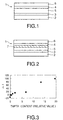
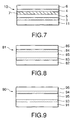
- Fig.1, Fig.2, Fig.8 and Fig.10 are cross-sectional views of volume hologram laminates according to the invention.
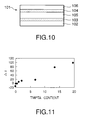
- Fig.3 and Fig.11 are drawings explaining relationships between an added amount of trimethylolpropane triacrylate in an adhesive layer and a shifted amount of a wavelength from a recorded wavelength in an obtained volume hologram layer.
- Fig.4 is a drawing explaining a relationship between an added amount of various polyethylene glycols having different molecular weights in an adhesive layer and a shifted amount of a wavelength from a recorded wavelength in an obtained volume hologram layer.
- Fig.5 is a drawing explaining a relationship between an added amount of various polypropylene glycols having different molecular weights in an adhesive layer and a shifted amount of a wavelength from a recorded wavelength in an obtained volume hologram layer.
- Fig.6, Fig.7 and Fig.9 are drawings explaining labels for preparation of volume hologram laminates according to the invention by means of cross-sectional views.
- volume hologram laminates according to the first to the third aspects of the first invention are shown in Fig.1 by means of cross-sectional views.
- reference numeral 1 denotes a volume hologram laminate
- reference numeral 2 denotes a substrate
- reference numeral 3 denotes a first adhesive layer
- reference numeral 4 denotes a second adhesive layer
- reference numeral 5 denotes a volume hologram layer
- reference numeral 6 denotes a surface protecting film.
- a volume hologram laminate according to the fourth aspect of the first invention is shown in Fig.2 by means of a cross-sectional view.
- reference numeral 7 denotes a film for shifting recorded wavelength and other identical numerals denote same meanings as in Fig.1.
- a film or a sheet comprising paper, synthetic paper, synthetic resin or metal can be used as the substrate 2 in the volume hologram laminate according to the first to the fourth aspects.
- the substrate can be shaped in various forms, for example, sheets such as a certificate for examination, cards such as an ID card, or pamphlets such as a passport. It is used as a substrate for attaching a volume hologram body in which a face picture or a landscape is recorded holographically in a mono-color or full-color mode.
- a glass substrate or an electrode layer in a liquid crystalline cell may be a substrate.
- volume hologram laminates according to the first to the fourth aspects are shown in Fig.1 and Fig.2 as a constitution in which a volume hologram layer 5 is formed on a substrate 2 via an adhesive layer 3. It may take, however, such a constitution that a volume hologram layer 5 is laminated on a substrate 2 via a both-side adhesive tape.
- the volume hologram layer 5 is prepared by coating a volume hologram recording material on a supporting film and thereafter recording interference stripes corresponding to wave front of light from an object to be recorded in a form of transparency modulation or refractive index modulation. For replication, it can be prepared easily by adhering a volume hologram original plate closely, exposing and developing.
- the volume hologram layer 5 is a photosensitive material for dry volume phase type hologram recording which comprises a matrix polymer, a photopolymerizable compound, a photopolymerization initiator, a sensitizing pigment, and if necessary a plasticizer and a surfactant.
- photopolymerizable compounds there may be mentioned photopolymerizable or photocrosslinkable monomers, oligomers and prepolymers having at least one ethylenic unsaturated bonding in a molecule structure described below and their mixtures.
- photopolymerizable or photocrosslinkable monomers for example, unsaturated carboxylic acids and their salts, esters of unsaturated carboxylic acids and aliphatic polyvalent alcohol compounds, as well as amide-bonded compounds of unsaturated carboxylic acids and aliphatic polyvalent amine compounds may be mentioned.
- unsaturated carboxylic acid monomers there may be mentioned acrylic acid, methacrylic acid, itaconic acid, crotonic acid, isocrotonic acid, maleic acid, and their halogen-substituted unsaturated carboxylic acids, such as chlorinated unsaturated carboxylic acids, brominated unsaturated carboxylic acids and fluorinated unsaturated carboxylic acids.
- salts of unsaturated carboxylic acids there may be mentioned sodium salts and potassium salts of the above-mentioned acids.
- ester monomers of aliphatic polyvalent alcohol compounds and unsaturated carboxylic acids the following compounds may be mentioned: as esters of acrylic acid, ethylene glycol diacrylate, triethylene glycol diacrylate, 1,3-butandiol diacrylate, tetramethylene glycol diacrylate, propylene glycol diacrylate, neopentyl glycol diacrylate, trimethylolpropane triacrylate, trimethylolpropane tri(acryloyloxypropyl)ether, trimethylolethane triacrylate, hexanediol diacrylate, 1,4-cyclohexanediol diacrylate, tetraethylene glycol diacrylate, pentaerythritol diacrylate, pentaerythritol triacrylate, pentaerythritol tetraacrylate, dipentaerythritol diacrylate, dipentaerythritol triacrylate, dipentaerythri
- esters of methacrylic acid there may be mentioned tetramehylene glycol dimethacrylate, triethylene glycol dimethacrylate, neopentyl glycol dimethacrylate, trimethylolpropane trimethacrylate, trimethylolethane trimethacrylate, ethylene glycol dimethacrylate, 1,3-butanediol dimethacrylate, hexanediol dimethacrylate, pentaerythritol dimethacrylate, pentaerythritol trimethacrylate, pentaerythritol tetramethacrylate, dipentaerythritol dimethacrylate, dipentaerythritol hexamethacrylate, sorbitol trimethacrylate, sorbitol tetramethacrylate, bis-[p-(3-methacryloxy-2-hydroxypropoxy)phenyl]dimethylmethane
- esters of itaconic acid there may be mentioned ethylene glycol diitaconate, propylene glycol diitaconate, 1,3-butanediol diitaconate, 1,4-butanediol diitaconate, tetramethylene glycol diitaconate, pentaerythritol diitaconate and sorbitol tetraitaconate etc.
- esters of crotonic acid there may be mentioned ethylene glycol dicrotonate, tetramethylene glycol dicrotonate, pentaerythritol dicrotonate and sorbitol tetracrotonate etc.
- esters of isocrotonic acid there may be mentioned ethylene glycol diisocrotonate, pentaerythritol diisocrotonate and sorbitol tetraisocrotonate etc.
- esters of maleic acid there may be mentioned ethylene glycol dimaleate, triethylene glycol dimaleate, pentaerythritol dimaleate and sorbitol tetramaleate etc.
- halogenated unsaturated carboxylic acids there may be mentioned 2,2,3,3-tetrafluoropropyl acrylate, 1H,1H,2H,2H-heptadecafluorodecyl acrylate, 2,2,3,3-tetrafluoropropyl methacrylate, 1H,1H,2H,2H-heptadecafluorodecyl methacrylate, 2,4,6-tribromophenyl methacrylate, dibromoneopentyl dimethacrylate (tradename: NK ESTER DBN; made by Shin Nakamura Kagaku Kogyo Co.
- dibromopropyl acrylate (tradename: NK ESTER A-DBP; made by Shin Nakamura Kagaku Kogyo Co. Ltd.), dibromopropyl methacrylate (tradename: NK ESTER DBP; made by Shin Nakamura Kagaku Kogyo Co. Ltd.), chloride methacrylate, 2,4,6-trichlorophenyl methacrylate, p-chlorostyrene, methyl-2-chloroacrylate, ethyl-2-chloroacrylate, n-butyl-2-chloroacrylate, tribromophenol acrylate and tetrabromophenol acrylate etc.
- amido monomers of unsaturated carboxylic acids and aliphatic polyvalent amine compounds there may be mentioned methylenebisacrylamide, methylenebismethacrylamide, 1,6-hexamethylenebisacrylamide, 1,6-hexamethylenebismethacrylamide,diethylenetriaminetrisacrylamide, xylylenebisacrylamide, xylylenebismethacrylamide, N-phenylmethacrylamide and diacetoneacrylamide etc.
- polyisocyanate compounds having two or more isocyanate groups in one molecular described in Japanese Patent Publication No. Sho 48-41708
- urethane acrylates described in Japanese Patent Laid-Open Publication No. Sho 51-37193, polyester acrylates, polyfunctional acrylates and methacrylates of epoxy resins and (math)acrylic acid etc. described in Japanese Patent Laid-Open Publication No. Sho 48-64183, Japanese Patent Publication No. Sho 49-43191 and Japanese Patent Publication No. Sho 52-30490, respectively.
- mono(2-acryloyloxyethyl)acid phosphate (tradename: LIGHTESTER PA, made by Kyoeisha Yushi Kagaku Kogyo Co. Ltd.), mono(2-methacryloyloxyethyl)acid phosphate (tradename: LIGHTESTER PM, made by Kyoeisha Yushi Kagaku Kogyo Co. Ltd.) as well as epoxyacrylate types such as tradename: RIPOXY VR-60 (made by Showa Kobunshi Co. Ltd.) and tradename: RIPOXY VR-90 (made by Showa Kobunshi Co. Ltd.).
- NK ESTER M-230G made by Shin Nakamura Kagaku Kogyo Co. Ltd.
- NK ESTER 23G made by Shin Nakamura Kagaku Kogyo Co. Ltd.
- triacrylates having the following structural formulae: (made by Toa Gosei Kagaku Kogyo Co. Ltd.; tradename: ARONIX M-315), (made by Toa Gosei Kagaku Kogyo Co. Ltd.; tradename: ARONIX M-325), as well as 2,2'-bis(4-acryloxydiethoxyphenyl)propane (made by Shin Nakamura Kagaku Kogyo Co. Ltd.; tradename: NK ESTER A-BPE-4) and tetramethylolmethane tetraacrylate (made by Shinnakamura Kagaku Kogyo Co. Ltd.; tradename: NK ESTER A-TMMT) etc.
- plasticizers to be added if necessary there may be mentioned polyvalent alcohols such as ethylene glycol, diethylene glycol, triethylene glycol, tetraethylene glycol, glycerol and trimethylolpropane; their derivatives in which terminal hidoroxyl group being blocked by etherification or acetylation; polyalkylene glycols such as polyethylene glycols having a weight average molecular weight of 200-2,000, preferably 200-600 and polypropylene glycols having a weight average molecular weight of 300-2,000, preferably 300-1,000; polyester type plasticizers, for example, phthalate type plasticizers such as dimethyl phthalate (DMP), diethyl phathalate (DEP), dibutyl phthalate (DBP), heptylnonyl phthalate (HNP), di-2-ethylhexyl phthalate (DOP), di-n-octyl phthalate (DNOP), di-i-octyl
- photopolymerization initiators belonging to initiators systems there may be exemplified 1,3-di(t-butyldioxylcarbonyl)benzophenone, 3,3',4,4'-tetrakis(t-butyldioxycarbonyl)benzophenone, N-phenylglycine, 2,4,6-tris(trichloromethyl)-s-triazine, 3-phenyl-5-isoxazolone, 2-mercaptobenzimidazole and imidazole dimers etc.
- the photopolymerization initiator is decomposed after hologram recording from the viewpoint of stabilization of recorded hologram.
- organic peroxide type initiators are preferable since they can be decomposed easily by ultraviolet irradiation.
- sensitizing pigments there may be exemplified thiopyrylium salt type pigments, merocyanine type pigments, quinoline type pigments, styrylquinoline type pigments, ketocoumarine type pigments, thioxanthene type pigments, xanthene type pigments, oxonol type pigments, cyanine dyestuffs, rhodamine dystuffs, thiopyrylium salt type pigments, pyrylium ion type pigments and diphenyl iodonium ion type pigments etc, which have absorption spectra in a wavelength range of 350-600nm. Also, sensitizing pigments having absorption spectra in a wavelength range of below 350nm or above 600nm may be used.
- polymethacrylates or their partial hydrolysates there may be mentioned polymethacrylates or their partial hydrolysates, polyvinyl acetate or its hydrolysates, polyvinyl alcohol or its partial acetalated compounds, triacetyl cellulose, polyisoprene, polybutadiene, polychloroprene, silicone rubber, polystyrene, polyvinyl butyral, polychloroprene, polyvinyl chloride, chlorinated polyethylene, chlorinated polypropylene, poly-N-vinylcarbazole or its derivatives, poly-N-vinylpyrrolidone or its derivatives, copolymer of styrene and maleic anhydride or its half esters, copolymers containing at least one of copolymerizable monomers such as acrylic acid, acrylate, methacrylic acid, methacrylate, acrylamide, acrylonitrile, ethylene, propylene, vinyl chloride and vinyl acetate as
- polyisoprene polybutadiene, polychloroprene
- polyvinyl alcohol polyvinyl acetal which is a partially acetalated compound of polyvinyl alcohol
- polyvinyl butyral polyvinyl acetate
- ethylene-vinyl acatate copolymer vinyl chloride-vinyl acetate copolymer and their mixtures.
- the matrix polymer has preferably a relatively low glass transition temperature for easy monomer shifting.
- the photopolymerizable compound (dye) is used in a proportion of 10-1,000 parts by weight, preferably 10-100 parts by weight, to 100 parts by weight of a binder resin.
- the photopolymerization initiator is used in a proportion of 1-10 parts by weight, preferably 5-10 parts by weight, to 100 parts by weight of a binder resin.
- the sensitizing pigment is used in a proportion of 0.01-1 parts by weight, preferably 0.01-0.5 parts by weight, to 100 parts by weight of a binder resin.
- photosensitive material components there may be mentioned various non-ionic surfactants, cationic surfactants and anionic surfactants.
- the hologram recording material is made into a coating solution with a solid content of 15%-25% by using acetone, methylethylketone, methylisobutylketone, cyclohexanone, benzene, toluene, xylene, chlorobenzene, tetrahydrofurane, methylcellosolve, ethylcellosolve, methylcellosolve acetate, ethyl cellosolve acetate, ethyl acetate, 1,4-dioxane, 1,2-dichloroethane, dichloromethane, chloroform, methanol, ethanol or isopropanol, or their mixtures.
- a thickness of the hologram recording layer is 0.1 ⁇ m-50 ⁇ m, preferably 5 ⁇ m-20 ⁇ m.
- OMNIDEX 352 and 706 made by DuPont Co. Ltd.
- adhesive layers 3 and 4 are explained.
- adhesive layers there may be mentioned acrylic resins, acrylate resins, or their copolymers, styrene-butadiene copolymers, natural rubbers, casein, gelatin, rosin esters, terpene resins, phenol type resins, styrene type resins, chromaneindene resins, polyvinyl ethers, silicone resins, as well as alpha-cyanoacrylate type, silicone type, maleimide type, styrol type, polyolefin type, resorsinol type, polyvinyl ether type and silicone type adhesives.
- the adhesive layers may be formed by using so-called crosslinking type two component adhesives which are crosslinked by addition of isocyanate type crosslinking agents or metallic chelate type crosslinking agents etc. at the time of use.
- adhesive layers there may be used heat-sealing agents, for example, ethylene-vinyl acetate copolymerized resins, polyamide resins, polyester resins, polyethylene resins, ethylene-isobutyl acrylate copolymerized resins, butyral resins, polyvinyl acetate and its copolymerized resins, cellulose derivatives, polymethyl methacrylate resins, polyvinyl ether resins, polyurethane resins, polycarbonate resins, polypropylene resins, epoxy resins, phenol resins, thermoplastic elastomers such as SBS, SIS, SEBS and SEPS, and reactive hot-melt type resins etc.
- a thickness of the adhesive layer may be 4 ⁇ m-20 ⁇ m.
- volume hologram color tones of image information reproduced actually from hologram become to change from color tones recorded holographically with the lapse of time.
- a substance which will swell a volume hologram layer and change hologram record may be bled or penetrated from an adjacent adhesive layer.
- hologram record may be shifted to a long wavelength side by swelling of the volume hologram layer.
- the adjacent adhesive layer does not contain a substance to change hologram record
- a transfer component contained in the volume hologram layer is shifted inversely into the adjacent adhesive layer.
- the volume hologram layer is contracted to shift the record to a short wavelength side.
- the component may be decreased as such by removal from the volume hologram layer with lapse of time, thus its reproduced wavelength is shifted to a short wavelength side.
- a substance for shifting a recorded wavelength similar to the shifting component contained in the volume hologram layer is also contained previously in the adhesive layer.
- a reproduced wavelength having few difference from the recorded wavelength can be obtained by suppressing change of the shifting component in the volume hologram layer.
- the reproduced wavelength can be controlled to a desirable reproduced wavelength by adjusting a content of the shifting component in the adhesive layer.
- a substance for shifting recorded wavelength is contained in either one of the first adhesive layer and the second adhesive layer and any substance for shifting recorded wavelength is not contained in other adhesive layer.
- the latter layer is to receive a shifted component from the volume hologram layer.
- a reproduced wavelength having few difference from the recorded wavelength can be obtained by suppressing change of the shifting component in the volume hologram layer.
- the reproduced wavelength can be controlled to the desirable reproduced wavelength by adjusting a content of a shifting component in the adhesive layer.
- volume hologram laminate according to the third aspect, contents of transfer components are balanced in the first adhesive layer, the second adhesive layer and the volume hologram layer in order not to produce shifting.
- a reproduced wavelength having few difference from the recorded wavelength can be obtained.
- a film for shifting recorded wavelength is contained between the first adhesive layer and the volume hologram layer or between the second adhesive layer and the volume hologram layer, and a substance for shifting recorded wavelength for the volume hologram layer is contained in the adhesive layer without the film.
- a reproduced wavelength having few difference from the recorded wavelength can be obtained by suppressing shifting between the said adhesive layers, the said film and the volume hologram layer, respectively.
- the reproduced wavelength can be controlled to a desirable reproduced wavelength by adjusting a content of the shifting component in the adhesive layer.
- the reproduced wavelength can be controlled by adjusting an amount of the photopolymerizable compound or the plasticizer to be added in the adhesive layer.
- the substance for shifting the recorded wavelength in the adhesive layer and the film for shifting the recorded wavelength are explained as follows.
- the shifting component i.e. the substance for shifting the recorded wavelength in the adhesive layer
- those photopolymerizable compounds and plasticizers described above for the constituting materials in the volume hologram layer may be mentioned.
- These shifting components may be, however, same as or different from the constituting materials in the volume hologram layer.
- rosin type tackifiers such as gum rosins, tall oil rosins, wood rosins, hydrogenated rosins, esterified rosins, dimerized rosins, limed rosins; terpene type tackifires such as terpene resins including cyclic terpenes such as ⁇ -pinene, ⁇ -pinene camphor and dipentene, terpene phenol resins and aromatic modified terpenes; as well as synthetic resin type tackifiers, for example, those having 5 carbon atoms obtained by polymerization of petroleum fractions such as synthetic resin type tackifiers mainly comprising isoprene, cyclopentadiene, 1,3-pentadiene 1-pentene copolymers, 2-pentene, dicyclopentadiene copolymer and 1,3-pentadiene, those having 9 carbon atoms obtained by polymerization
- surfactants added to the adhesive layer there may be exemplified primary amine salts, secondary amine salts, tertiary amine salts and quarternary amine salts as cationic surfactants; carboxylates, sulfates, sulfonates and phosphates as anionic surfactants, amino acid type amphoteric surfactants and betaine amphoteric surfactants as amphoteric surfactants as well as non-ionic surfactants.
- polyalkylene glycols there may be exemplified polyethylene glycol, polypropylene glycol, etc.
- the shifting component i.e. the substance for shifting recorded wavelength, contained in the adhesive layer
- the substance for shifting recorded wavelength contained in the adhesive layer it is preferable to select a substance having compatibility with the constituting components of the volume hologram layer. Also, the substance is required not to shift and destroy completely the recorded interference stripes or not to make reproduction of recording impossible.
- the shifting component i.e. the substance for shifting recorded wavelength, contained in the adhesive layer may be contained in the adhesive layer in an amount not to lose its tackifying property, such as 20% by weight or less. However, its content is appropriately set depending on the relationship with an amount of the shifting component in the volume hologram layer and on the relationship with desirable reproduced wavelength.
- the relationships between the content of the substance for shifting recorded wavelength in the adhesive layer and reproduced wavelength in the volume hologram layer may be determined by the following experimental methods.
- recording was carried out holographically on the hologram recording film by means of argon laser having a specified wavelength of 488nm. Thereafter, polyvinyl chloride film thereof was delaminated and the adhesive film was adhered on the hologram surface from the adhesive layer side.
- Fig. 3 The measured results are shown in Fig. 3 in which the concentration of TMPTA in a relative value is shown.
- the unit thereof is expressed in 10 -4 mol and an added amount per 1g of an acrylic adhesive.
- ⁇ is negative. Therefore, it is seen that unreacted monomers and plasticizers etc. were shifted from the volume hologram layer to the adhesive layer and the volume hologram layer was contracted to shift the reproduced wavelength to a short wavelength side. Further, if the added amount of TMPTA being increased, ⁇ is increased to shift the reproduced wavelength to a long wavelength side.
- recording was carried out holographically on the hologram recording film by means of argon laser having a specified wavelength of 488nm. Thereafter, its polyvinyl chloride film thereof was delaminated and the adhesive film was adhered on the hologram surface from the adhesive layer side.
- Fig.4 The measured results are shown in Fig.4. As shown in Fig.4, if the molecular weight of PEG is increased or if the added amount thereof is increased, ⁇ is increased and the reproduced wavelength was shifted to a short wavelength side.
- a shifted wavelength amount was measured by substituting PEG with PPG similar to the above-mentioned experiment for an added amount dependency of PEG.
- the measured results are shown in Fig.5.
- PPG showed similar effects to PEG, but it is seen that the wavelength was shifted most by PPG having a molecular weight of about 700-1,000.
- Table 1 the measured results about peak wavelength of spectral transparency immediately after laminating the adhesive layer on the hologram recording film are shown together. Further, the results of those tested on the hologram recording film without any adhesive film are shown together as "no" in the commercially available column. Units of wavelength in the Table are expressed in nm.
- the difference between the recorded wavelength and the reproduced wavelength can be decreased and also the reproduced wavelength can be controlled to the desirable wavelength by combining the hologram recording film and the adhesive film appropriately based on these measured data.
- the volume hologram laminate according to the fourth aspect has a film 7 for shifting recorded wavelength between the second adhesive layer 4 and the volume hologram layer 5 as shown in Fig.2.
- the film 7 for shifting recorded wavelength may be arranged between the volume hologram layer 5 and the first adhesive layer 3.
- the film 7 for shifting recorded wavelength is formed without any ingradients such as a photopolymerizing initiator or a sensitizing agent etc. and contains a shifting component such as a photopolymerizable compound, a plasiticizer and surface lubricant etc. similar to the volume hologram layer.
- a shifting component such as a photopolymerizable compound, a plasiticizer and surface lubricant etc.
- commercially available ones such as "OMNIDEX CTF films” made by DuPont Co. Ltd. may be exemplified.
- the substance for shifting recorded wavelength is diffused in the volume hologram layer.
- the substance has actions to enlarge distances between hologram interference stripes recorded therein, to shift the reproduced wavelength to a long wavelength side, and to enlarge diffraction wavelength characteristics.
- the second adhesive layer 4 does not necessarily contain any shifting component but the first adhesive layer 3 adjacent to the volume hologram layer 5 may contain the substance for shifting recorded wavelength as a shifting component similar to the first to third volume hologram laminates.
- the second adhesive layer 4 may contain the substance for shifting wavelength as a shifting component.
- the surface protecting film 6 in the volume hologram laminate according to the invention has a transparent property.
- polyethylene film polypropylene film, polyethylene fluoride type film, polyvinylidene fluoride film, polyvinyl chloride film, polyvinylidene chloride film, ethylene-vinyl alcohol film, polyvinyl alcohol film, polymethyl methacrylate film, polyether sulfone film, polyether ether ketone film, polyamide film, tetrafluoroethyleneperfluoroalkylvinyl ether copolymer film, polyester films such as polyethylene teraphthalate film and polyimide film etc.
- a film thickness is 2 ⁇ m-200 ⁇ m, preferably 10 ⁇ m-50 ⁇ m. ⁇ m
- the adhesive layer, the volume hologram layer and the surface protecting film are arranged on the substrate in the described order.
- a plasticizer is generally contained in the surface protecting film.
- the balance of the shifting component may be adjusted between the adhesive layer, the volume hologram layer and the surface protecting film respectively by the above-mentioned method.
- the surface protecting film may be subjected to hard-coating treatment if necessary with an object to increase protecting property of the surface protecting film.
- Hard-coating treatment may be carried out by coating silicone type, fluorine-containing silicone type, melamine alkyd type and urethane-acrylate type (ultraviolet curable type) agents by means of a dip coating, a spray coating or a roll coating to a film thickness of 1 ⁇ m-50 ⁇ m, preferably 3 ⁇ m-25 ⁇ m.
- a releasing treatment may be carried out on the surface or the hard-coated surface of the surface protective film 6.
- the releasing treatment may be carried out by dip coating, a spray coating or a roll coating of a fluorine type releasing agent, a silicone type releasing agent, a stearate type releasing agent or wax type releasing agent etc.
- the labels for preparation of a volume hologram laminates according to the fifth to the seventh aspects of the invention are used for preparation of the above-mentioned first to third volume hologram laminates.
- a first adhesive layer 3, a volume hologram layer 5, a second adhesive layer 4 and a surface protecting film 6 are laminated on a delaminating paper 11.
- the label for preparation of the volume hologram laminate according to the eighth aspect of the invention is used for preparation of the above-mentioned the fourth volume hologram laminate.
- a film 7 for shifting recorded wavelength is put between a volume hologram layer 5 and a second adhesive layer 4.
- a film 7 for shifting recorded wavelength is put between a volume hologram layer 5 and a second adhesive layer 4 but it may be arranged between a volume hologram layer 5 and a first adhesive layer 3.
- the delaminating paper 11 there may be used delaminating film which is subjected to a delaminating treatment by means of a fluorine type delaminating agent or a silicone type delaminating agent on a surface of a polyethylene terephthalate film, in addition to the conventionally used delaminating papers. Further, also on a surface not in the adhesive layer side of the delaminating paper, a delaminating treatment may be carried out in order to avoid blocking due to an adhesive bled out from the label side. Further, in order to delaminate the laminate from the delaminating paper in an appropriate size, the laminate may be subjected to a so-called half-cutting process, or the delaminating paper may have cutting parts such as perforations.
- a label 10 is laminated on a substrate from a first adhesive layer 3 side after delamination of a delamination paper 11, to prepare volume hologram laminates according to the first to the fourth aspects shown in Fig.1 and Fig.2.
- a volume hologram laminate according to the first or the second aspects of the second invention is shown in Fig.8 by means of a cross-sectional view.
- reference numeral 81 denotes a volume hologram laminate
- reference numeral 82 denotes a substrate
- reference numeral 83 denotes a first adhesive layer
- reference numeral 84 is a second adhesive layer
- reference numeral 85 denotes a volume hologram layer
- reference numeral 86 denotes a surface protecting film.
- a film or a sheet comprising paper, synthetic paper, synthetic resin or metal can be used.
- the substrate can be shaped in various forms, for example, sheets such as a certificate for examination, cards such as an ID card, or pamphlets such as a passport.
- a hologram body in which a mono-color or full-color image are recorded can be laminated onto a picture of personal features or landscapes.
- a glass substrate or an electrode layer in a liquid crystalline cell may be a substrate.
- volume hologram laminate according to the invention is shown in Fig.8.
- a volume hologram layer 85 is laminated on a substrate 82 via an adhesive layer 83. It may take, however, such a constitution that a volume hologram layer 85 is laminated on a substrate 82 via a both-side adhesive tape.
- the volume hologram layer 85 is prepared by coating a volume hologram recording material on a supporting film and thereafter recording interference stripes corresponding to wave front of light from an object to be recorded in a form of transparency modulation or refractive index modulation. It may be color-hologram by which two or more colors being reproduced, or may be mono-color hologram. For replication, it can be prepared easily by adhering a volume hologram original plate closely, exposing and developing.
- the volume hologram layer 85 is a photosensitive material for dry volume phase type hologram recording which comprises a matrix polymer, a photopolymerizable compound, a photopolymerization initiator, a sensitizing pigment, and if necessary a plasticizer and a surfactant.
- photopolymerizable compounds there may be mentioned photopolymerizable or photocrosslinkable monomers, oligomers and prepolymers having at least one ethylenic unsaturated bonding and their mixtures.
- unsaturated carboxylic acids and their salts, esters of unsaturated carboxylic acids and aliphatic polyvalent alcohol compounds, as well as amide-bonded compounds of unsaturated carboxylic acids and aliphatic polyvalent amine compounds may be mentioned.
- unsaturated carboxylic acid monomers there may be mentioned acrylic acid, methacrylic acid, itaconic acid, crotonic acid, isocrotonic acid, maleic acid, and their halogen-substituted unsaturated carboxylic acids, such as chlorinated unsaturated carboxylic acids, brominated unsaturated carboxylic acids and fluorinated unsaturated carboxylic acids.
- salts of unsaturated carboxylic acids there may be mentioned sodium salts and potassium salts of the above-mentioned acids.
- ester monomers of aliphatic polyvalent alcohol compounds and unsaturated carboxylic acids the following compounds may be mentioned: as acrylate esters, ethylene glycol diacrylate, triethylene glycol diacrylate, 1,3-butandiol diacrylate, tetramethylene glycol diacrylate, propylene glycol diacrylate, neopentyl glycol diacrylate, trimethylolpropane triacrylate, trimethylolpropane tri(acryloyloxypropyl)ether, trimethylolethane triacrylate, hexanediol diacrylate, 1,4-cyclohexanediol diacrylate, tetraethylene glycol diacrylate, pentaerythritol diacrylate, pentaerythritol triacrylate, pentaerythritol tetraacrylate, dipentaerythritol diacrylate, dipentaerythritol triacrylate, dipentaerythri
- esters of methacrylic acid there may be mentioned tetramethylene glycol dimethacrylate, triethylene glycol dimethacrylate, neopentyl glycol dimethacrylate, trimethylolpropane trimethacrylate, trimethylolethane trimethacrylate, ethylene glycol dimethacrylate, 1,3-butanediol dimethacrylate, hexanediol dimethacrylate, pentaerythritol dimethacrylate, pentaerythritol trimethacrylate, pentaerythritol tetramethacrylate, dipentaerythritol dimethacrylate, dipentaerythritol hexamethacrylate, sorbitol trimethacrylate, sorbitol tetramethacrylate, bis-[p-(3-methacryloxy-2-hydroxypropoxy)phenyl]dimethylmethane, bis-
- esters of itaconic acid there may be mentioned ethylene glycol diitaconate, propylene glycol diitaconate, 1,3-butanediol diitaconate, 1,4-butanediol diitaconate, tetramethylene glycol diitaconate, pentaerythritol diitaconate and sorbitol tetraitaconate etc.
- esters of crotonic acid there may be mentioned ethylene glycol dicrotonate, tetramethylene glycol dicrotonate, pentaerythritol dicrotonate and sorbitol tetracrotonate etc.
- esters of isocrotonic acid there may be mentioned ethylene glycol diisocrotonate, pentaerythritol diisocrotonate and sorbitol tetraisocrotonate etc.
- esters of maleic acid there may be mentioned ethylene glycol dimaleate, triethylene glycol dimaleate, pentaerythritol dimaleate and sorbitol tetramaleate etc.
- halogenated unsaturated carboxylic acids there may be mentioned 2,2,3,3-tetrafluoropropyl acrylate, 1H,1H,2H,2H-heptadecafluorodecyl acrylate, 2,2,3,3-tetrafluoropropyl methacrylate, 1H,1H,2H,2H-heptadecafluorodecyl methacrylate, 2,4,6-tribromophenyl methacrylate, dibromoneopentyl dimethacrylate (tradename: NK ESTER DBN; made by Shinnakamura Kagaku Kogyo Co.
- dibromopropyl acrylate (tradename: NK ESTER A-DBP, made by Shinnakamura Kagaku Kogyo Co. Ltd.), dibromopropyl methacrylate (tradename: NK ESTER DBP; made by Shinnakamura Kagaku Kogyo Co. Ltd.), chloride methacrylate, 2,4,6-trichlorophenyl methacrylate, p-chlorostyrene, methyl-2-chloroacrylate, ethyl-2-chloroacrylate, n-butyl-2-chloroacrylate, tribromophenol acrylate and tetrabromophenol acrylate etc.
- amido monomers of unsaturated carboxylic acids and aliphatic polyvalent amine compounds there may be mentioned methylenebisacrylamide, methylenebismehtacrylamide, 1,6-hexamethylenebisacrylamide, 1,6-hexamethylenebismethacrylamide,diethylenetriaminetrisacrylamide, xylylenebisacrylamide, xylylenebismethacrylamide, N-phenylmethacrylamide and diacetoneacrylamide etc.
- polyisocyanate compounds having two or more isocyanate groups in one molecular described in Japanese Patent Publication No. Sho 48-41708
- urethane acrylates described in Japanese Patent Laid-Open Publication No. Sho 51-37193, polyester acrylates, polyfunctional acrylates and methacrylates of epoxy resins and (math)acrylic acid etc. described in Japanese Patent Laid-Open Publication No. Sho 48-64183, Japanese Patent Publication No.Sho 49-43191 and Japanese Patent Publication No. Sho 52-30490, respectively.
- mono(2-acryloyloxyethyl)acid phosphate (tradename: LIGHTESTER PA, made by Kyoeisha Yushi Kagaku Kogyo Co. Ltd.), mono(2-methacryloyloxyethyl)acid phosphate (tradename: LIGHTESTER PM, made by Kyoeisha Yushi Kagaku Kogyo Co. Ltd.) as well as epoxyacrylate types such as tradename: RIPOXY VR-60 (made by Showa Kobunshi Co. Ltd.) and tradename: RIPOXY VR-90 (made by Showa Kobunshi Co. Ltd.).
- NK ESTER M-230G made by Shinnakamura Kagaku Kogyo Co. Ltd.
- tradename: NK ESTER 23G made by Shinnakamura Kagaku Kogyo Co. Ltd.
- triacrylates having the following structural formulae: (made by Toa Gosei Kagaku Kogyo Co. Ltd.; tradename: ARONIX M-315), (made by Toa Gosei Kagaku Kogyo Co. Ltd.; tradename: ARONIX M-325), as well as 2,2'-bis(4-acryloxydiethoxyphenyl)propane (made by Shinnakamura Kagaku Kogyo Co. Ltd.; tradename: NK ESTER A-BPE-4) and tetramethylolmethane tetraacrylate (made by Shinnakamura Kagaku Kogyo Co. Ltd.; tradename: NK ESTER A-TMMT) etc.
- plasticizers to be added if necessary there may be mentioned polyvalent alcohols such as ethylene glycol, diethylene glycol, triethylene glycol, tetraethylene glycol, glycerol and trimethylolpropane; their derivatives in which terminal hidoroxyl group being blocked by etherification or acetylation; polyalkylene glycols such as polyethylene glycols having a weight average molecular weight of 200-2,000, preferably 200-600 and polypropylene glycols having a weight average molecular weight of 300-2,000, preferably 300-1,000; polyester type plasticizers, for example, phthalate type plasticizers such as dimethyl phthalate (DMP), diethyl phathalate (DEP), dibutyl phthalate (DBP), heptylnonyl phthalate (HNP), di-2-ethylhexyl phthalate (DOP), di-n-octyl phthalate (DNOP), di-i-octyl
- photopolymerization initiators belonging to initiators systems there may be exemplified 1,3-di(t-butyldioxylcarbonyl)benzophenone, 3,3',4,4'-tetrakis(t-butyldioxycarbonyl)benzophenone, N-phenylglycine, 2,4,6-tris(trichloromethyl)-s-triazine, 3-phenyl-5-isoxazolone, 2-mercaptobenzimidazole and imidazole dimers etc.
- the photopolymerization initiator is decomposed after hologram recording from the viewpoint of stabilization of recorded hologram.
- organic peroxide type initiators are preferable since they can be decomposed easily by ultraviolet irradiation.
- sensitizing pigments there may be exemplified thiopyrylium salt type pigments, merocyanine type pigments, quinoline type pigments, styrylquinoline type pigments, ketocoumarine type pigments, thioxanthene type pigments, xanthene type pigments, oxonol type pigments, cyanine dyestuffs, rhodamine dystuffs, thiopyrylium salt type pigments, pyrylium ion type pigments and diphenyl iodonium ion type pigments etc, which have absorption spectra in a wavelength range of 350-600nm. Also, sensitizing pigments having absorption spectra in a wavelength range of below 350nm or above 600nm may be used.
- polymethacrylates or their partial hydrolysates there may be mentioned polymethacrylates or their partial hydrolysates, polyvinyl acetate or its hydrolysates, polyvinyl alcohol or its partial acetalated compounds, triacetyl cellulose, polyisoprene, polybutadiene, polychloroprene, silicone rubber, polystyrene, polyvinyl butyral, polychloroprene, polyvinyl chloride, chlorinated polyethylene, chlorinated polypropylene, poly-N-vinylcarbazole or its derivatives, poly-N-vinylpyrrolidone or its derivatives, copolymer of styrene and maleic anhydride or its half esters, copolymers containing at least one of copolymerizable monomers such as acrylic acid, acrylate, methacrylic acid, methacrylate, acrylamide, acrylonitrile, ethylene, propylene, vinyl chloride and vinyl acetate as
- polyisoprene polybutadiene, polychloroprene, polyvinyl alcohol, polyvinyl acetal which is a partially acetalated compound of polyvinyl alcohol, polyvinyl butyral, polyvinyl acetate, ethylene-vinyl acetate copolymer, vinyl chloride-vinyl acetate copolymer and their mixtures.
- the matrix polymer has preferably a relatively low glass transition temperature for easy monomer shifting.
- the photopolymerizable compound is used in a proportion of 10-1,000 parts by weight, preferably 10-100 parts by weight, to 100 parts by weight of a binder resin.
- the photopolymerization initiator is used in a proportion of 1-10 parts by weight, preferably 5-10 parts by weight, to 100 parts by weight of a binder resin.
- the sensitizing pigment is used in a proportion of 0.01-1 parts by weight, preferably 0.01-0.5 parts by weight, to 100 parts by weight of a binder resin.
- photosensitive material components there may be mentioned various non-ionic surfactants, cationic surfactants and anionic surfactants.
- the hologram recording material is made into a coating solution with a solid content of 15%-25% by using acetone, methylethylketone, methylisobutylketone, cyclohexanone, benzene, toluene, xylene, chlorobenzene, tetrahydrofurane, methylcellosolve, ethylcellosolve, methylcellosolve acetate, ethyl cellosolve acetate, ethyl acetate, 1,4-dioxane, 1,2-dichloroethane, dichloromethane, chloroform, methanol, ethanol or isopropanol, or their mixtures.
- a thickness of the hologram recording layer after dried is 0.1 ⁇ m-50 ⁇ m, preferably 5 ⁇ m-20 ⁇ m.
- OMNIDEX 352 and 706 made by DuPont Co. Ltd.
- adhesive layers 83 and 84 are explained.
- adhesive layers there may be mentioned acrylic resins, acrylate resins, or their copolymers, styrene-butadiene copolymers, natural rubbers, casein, gelatin, rosin esters, terpene resins, phenol type resins, styrene type resins, chromaneindene resins, polyvinyl ethers, silicone resins, as well as alpha-cyanoacrylate type, silicone type, maleimide type, styrol type, polyolefin type, resorsinol type, polyvinyl ether type and silicone type adhesives.
- the adhesive layers may be formed by using so-called crosslinking type two component adhesives which are crosslinked by addition of isocyanate type crosslinking agents or metallic chelate type crosslinking agents etc. at the time of use.
- adhesive layers there may be used heat-sealing agents, for example, ethylene-vinyl acetate copolymerized resins, polyamide resins, polyester resins, polyethylene resins, ethylene-isobutyl acrylate copolymerized resins, butyral resins, polyvinyl acetate and its copolymerized resins, cellulose derivatives, polymethyl methacrylate resins, polyvinyl ether resins, polyurethane resins, polycarbonate resins, polypropylene resins, epoxy resins, phenol resins, thermoplastic elastomers such as SBS, SIS, SEBS and SEPS, and reactive hot-melt type resins etc.
- a thickness of the adhesive layer may be 4 ⁇ m-20 ⁇ m.
- the first volume hologram laminate according to the invention is characterized in that a substance with a refractive index of at least 0.1 at 25°C lower than that of a volume hologram recording material in a volume hologram layer for shifting a recorded wavelength is contained in at least one of the adhesive layers 83 and 84.
- Refractive index of a volume hologram layer and “refractive index of a substance for shifting a wavelength” described herein are measured in accordance with JIS K7142 (a method of measuring refractive index of plastics) according to the following methods.
- a sample to be measured is laminated on a surface to be measured of an auxiliary glass for sample measurement at a thickness of about 100 ⁇ m. After drying well, the sample is arranged on a main prism of a sample table in a refractometer via an intermediate solution with the surface to be measured being directed downward. Then the auxiliary glass is adhered closely, to prepare for measurement.
- a refractive index of the volume hologram layer is that obtained by measuring as a film form of the volume hologram layer with used of an Abbe refractometer made by Atago Co. Ltd. That of the second volume hologram laminate described hereinafter is same. Further, a refractive index of the substance for shifting a recorded wavelength is obtained by measuring similarly a film consisting 100% of the substance.
- a refractive index according to the invention may be applied as at 25°C and 400-800mn. However, for comparison, refractive index measured at the identical wavelength should be of course used.
- the substances for shifting recorded wavelength those with a refractive index at least 0.1 lower than, preferably at least 0.13 lower than, that of the volume hologram recording layer.
- the refractive index thereof is generally about 1.5.
- silicone type compounds and fluorine type compounds with a refractive index of 1.4 or less as the substances for shifting recorded wavelength.
- silicone oils such as amino-modified silicone oils, epoxy-modified silicone oils, carboxyl-modified silicone oils, methacryl-modified silicone oils and fluorine-modified silicone oils.
- silicone oils such as amino-modified silicone oils, epoxy-modified silicone oils, carboxyl-modified silicone oils, methacryl-modified silicone oils and fluorine-modified silicone oils.
- KF96 L-1, refractive index: 1.382” all made by Shinetsu Kagaku Kogyo Co. Ltd. may be exemplified.
- silane compounds such as trimethylchlorosilane, methyltrimethoxysilane, methyltriethoxysilane, dimethyldimethoxysilane and trimethylmethoxysilane or their mixtures may be exemplified.
- fluorine type compounds there may be exemplified tetrafluoroacetic acid, chlorofluoroethylene, trifluoromethyl-benzaldehyde, 1,4-bistrifluoromethylbenzene, trifluoromethyl-benzylalcohol or their derivatives or mixtures.
- the second volume hologram laminate according to the invention is characterized in that a substance with a refractive index of at least 0.06, preferably 0.1, at 25°C higher than that of a volume hologram layer for shifting a recorded wavelength is contained in at least one of the adhesive layers 83 and 84.
- the refractive index thereof is generally about 1.5.
- aromatic compounds with a refractive index of 0.06 or more as the substances for shifting recorded wavelength there may be mentioned.
- aromatic compounds 3-phenylpyridine, 2-phenylpyridine, diphenyl sulfide, 1,1-diphenylethylene, 1'-acetonaphthone and 1-naphthoaldehyde may be exemplified.
- Their iodides and bromides may be used, such as 1-bromonaphthalene, 1,2-dibromobenzene and 3-iodoaniline.
- rosin type tackifiers there may be also used rosin type tackifiers, terpene type tackifiers and synthetic resin type tackifiers or their mixture exemplified above as adhesives for the above-mentioned adhesive layer, if they have a refractive index of 0.06 higher than that of the volume hologram layer.
- rosin type tackifiers there may be exemplified concretely gum rosins, tall oil rosins, wood rosins, hydrogenated rosins and polymerized rosins.
- terpene type tackifiers there may be exemplified concretely terpene resins containing ⁇ -pinene and aromatic modified terpenes.
- synthetic resin type tackifiers there may be exemplified concretely cyclopentadiene, styrene and xylene as such or in their copolymer forms.
- the substance for shifting a recorded wavelength is a substance which can be shifted from the adhesive layer to the volume hologram layer after added to the adhesive layer and constituted as a component of the volume hologram laminate.
- the substance is not limited to the above-mentioned substance for shifting a recorded wavelength, if the substance has the above-mentioned relationship with the refractive index in the volume hologram layer.
- a reproduced wavelength can be shifted to blue region wavelength from a recorded wavelength by using the substance for shifting a recorded wavelength with a refractive index of at least 0.1 lower than that of the volume hologram laminate. Also, the reproduced wavelength can be shifted to red from the recorded wavelength by using the substance for shifting a recorded wavelength with a refractive index of at least 0.06 higher than that of the volume hologram layer.
- An extent of shifting can be easily controlled by selecting appropriately a kind and an added amount of the substance for shifting a recorded wavelength.
- the obtained reproduced wavelength is shifted not to a long wavelength side and shifted to a short wavelength side even though it has a function to shift into the volume hologram layer and swell it.
- the detail reason thereof is not clear.
- the wavelength can be shifted to shorter wavelength, i.e., an optional blue region wavelength.
- the substance for shifting a recorded wavelength is dissolved and dispersed in an organic solvent together with the above-mentioned adhesive. After coating on a delaminating paper and drying, an adhesive layer is obtained.
- the substance may be added in the adhesive layer in an amount range of 0.1%-20% by weight, preferably 1%-7% by weight. If it is higher than 20% by weight, it is not preferable since it hinders an adhesive property.
- an extent of blue or red region wavelength shifting can be controlled better if shifting components other than the substance for shifting a recorded wavelength are not shifted between the first adhesive layer and/or the second adhesive layer and the volume hologram layer. Therefore, the shifting components may be balanced with the shifting component in the volume hologram layer by adding these components into the adhesive layer.
- these shifting components there may be mentioned photopolymerizable compounds and plasticizers described above as the constituting materials in the volume hologram layer.
- the shifting components to be contained in the adhesive layer may be different from photopolymerizable compounds and plasticizers described above as the constituting materials in the volume hologram layer.
- surfactants and polyalkylene glycol etc.
- the shifting components contained in the adhesive layer it is preferable to select a substance having compatibility with the constituting components of the volume hologram layer. Also, the substance is required not to shift into the volume hologram layer and destroy completely the recorded interference stripes or not to make reproduction of recording impossible.
- the shifting component i.e. the substance for shifting recorded wavelength, contained in the adhesive layer may be contained in the adhesive layer in an amount not to lose its adhesive property, such as 20% by weight or less. However, its content is appropriately set depending on the relationship with an amount of the shifting component in the volume hologram layer and on the relationship with desirable reproduced wavelength.
- the surface protecting film 86 in the volume hologram laminate according to the invention has a transparent property.
- polyethylene film polypropylene film, polyethylene fluoride type film, polyvinylidene fluoride film, polyvinyl chloride film, polyinylidene chloride film, ethylene-vinyl alcohol film, polyvinyl alcohol film, polymethyl methacrylate film, polyether sulfone film, polyether ether ketone film, polyamide film, tetrafluoroethyleneperfluoroalkylvinyl ether copolymer film, polyester films such as polyethylene teraphthalate film and polyimide film etc.
- a film thickness is 2 ⁇ m-200 ⁇ m, preferably 10 ⁇ m-50 ⁇ m.
- the adhesive layer, the volume hologram layer and the surface protecting film are arranged on the substrate in the described order.
- a plasticizer is generally contained in the surface protecting film.
- the balance of the shifting component may be adjusted between the adhesive layer, the volume hologram layer and the surface protecting film respectively by the above-mentioned method.
- the surface protecting film may be subjected to hard-coating treatment if necessary with an object to increase protecting property of the surface protecting film.
- Hard-coating treatment may be carried out by coating silicone type, fluorine-containing silicone type, melamine alkyd type and urethane-acrylate type (ultraviolet curable type) agents by means of a dip coating, a spray coating or a roll coating to a film thickness of 1 ⁇ m-50 ⁇ m, preferably 3 ⁇ m-25 ⁇ m.
- a releasing treatment may be carried out on the surface or the hard-coated surface of the surface protective film 86.
- the releasing treatment may be carried out by dip coating, a spray coating or a roll coating of a fluorine type releasing agent, a silicone type releasing agent, a stearate type releasing agent or wax type releasing agent etc.
- the volume hologram layer in the volume hologram laminate according to the invention may be recorded holographically by using a single recording wavelength or color-recorded holographically by using two or more wavelengths.
- Fig. 9 the cross-sectional laminar constitution is shown in Fig. 9.
- reference numeral 90 denotes a label for preparation of a volume hologram laminate
- reference numeral 91 denotes a delaminating paper
- other symbols identical to Fig.8 have identical meanings.
- the label for preparation of a volume hologram laminate according to the invention is used for preparation of the volume hologram laminates.
- a first adhesive layer 93, a volume hologram layer 95, a second adhesive layer 94 and a surface protecting film 96 are laminated on a delaminating paper 91.
- the delaminating paper 91 there may be used delaminating film which is subjected to a delaminating treatment by means of a fluorine type delaminating agent or a silicone type delaminating agent on a surface of a polyethylene terephthalate film, in addition to the conventionally used delaminating papers. Further, also on a surface not in the adhesive layer side of the delaminating paper, a delaminating treatment may be carried out in order to avoid blocking due to an adhesive bled out from the label side. Further, in order to delaminate the laminate from the delaminating paper in an appropriate size, the laminate may be subjected to a so-called half-cutting process, or the delaminating paper may have cutting parts such as perforations.
- a label 90 is laminated on a substrate from a first adhesive layer 93 side after delamination of a delamination paper 91, to prepare volume hologram laminates according to the first to the fourth aspects shown in Fig.8.
- a volume hologram laminate according to the third invention is shown in Fig.10 by means of a cross-sectional view.
- reference numeral 101 denotes a volume hologram laminate
- reference numeral 102 denotes a substrate
- reference numeral 103 denotes a first adhesive layer
- reference numeral 104 is a second adhesive layer
- reference numeral 105 denotes a volume hologram layer
- reference numeral 106 denotes a surface protecting film.
- a film or a sheet comprising paper, synthetic paper, synthetic resin or metal can be used as a substrate 102 in a volume hologram laminate according to the invention.
- the substrate can be shaped in various forms, for example, sheets such as a certificate for examination, cards such as an ID card, or pamphlets such as a passport. It is used as a substrate for attaching a volume hologram body in which a face picture or a landscape is recorded holographically in a mono-color or full-color mode.
- a glass substrate or an electrode layer in a liquid crystalline cell may be a substrate.
- the volume hologram laminate according to the invention is shown in Fig.10 as a constitution in which a volume hologram layer 105 is laminated on a substrate 102 via an adhesive layer 103. It may take, however, such a constitution that a volume hologram layer 105 is laminated on a substrate 102 via a both-side adhesive tape.
- the volume hologram layer 105 is prepared by coating a volume hologram recording material on a supporting film and thereafter recording interference stripes corresponding to wave front of light from an object to be recorded in a form of transparency modulation or refractive index modulation. It may be color-hologram by which two or more colors being reproduced, or may be mono-color hologram. For replication, it can be prepared easily by adhering a volume hologram original plate closely, exposing and developing.
- the volume hologram layer 105 is a photosensitive material for dry volume phase type hologram recording which comprises a matrix polymer, a photopolymerizable compound, a photopolymerization initiator, a sensitizing pigment, and if necessary a plasticizer and a surfactant.
- photopolymerizable compounds there may be mentioned photopolymerizable or photocrosslinkable monomers, oligomers and prepolymers having at least one ethylenic unsaturated bonding and their mixtures.
- unsaturated carboxylic acids and their salts, esters of unsaturated carboxylic acids and aliphatic polyvalent alcohol compounds, as well as amide-bonded compounds of unsaturated carboxylic acids and aliphatic polyvalent amine compounds may be mentioned.
- unsaturated carboxylic acid monomers there may be mentioned acrylic acid, methacrylic acid, itaconic acid, crotonic acid, isocrotonic acid, maleic acid, and their halogen-substituted unsaturated carboxylic acids, such as chlorinated unsaturated carboxylic acids, brominated unsaturated carboxylic acids and fluorinated unsaturated carboxylic acids.
- salts of unsaturated carboxylic acids there may be mentioned sodium salts and potassium salts of the above-mentioned acids.
- ester monomers of aliphatic polyvalent alcohol compounds and unsaturated carboxylic acids the following compounds may be mentioned: as esters of acrylic acid, ethylene glycol diacrylate, triethylene glycol diacrylate, 1,3-butandiol diacrylate, tetramethylene glycol diacrylate, propylene glycol diacrylate, neopentyl glycol diacrylate, trimethylolpropane triacrylate, trimethylolpropane tri(acryloyloxypropyl)ether, trimethylolethane triacrylate, hexanediol diacrylate, 1,4-cyclohexanediol diacrylate, tetraethylene glycol diacrylate, pentaerythritol diacrylate, pentaerythritol triacrylate, pentaerythritol tetraacrylate, dipentaerythritol diacrylate, dipentaerythritol triacrylate, dipentaerythri
- esters of methacrylic acid there may be mentioned tetramehylene glycol dimethacrylate, triethylene glycol dimethacrylate, neopentyl glycol dimethacrylate, trimethylolpropane trimethacrylate, trimethylolethane trimethacrylate, ethylene glycol dimethacrylate, 1,3-butanediol dimethacrylate, hexanediol dimethacrylate, pentaerythritol dimethacrylate, pentaerythritol trimethacrylate, pentaerythritol tetramethacrylate, dipentaerythritol dimethacrylate, dipentaerythritol hexamethacrylate, sorbitol trimethacrylate, sorbitol tetramethacrylate, bis-[p-(3-methacryloxy-2-hydroxypropoxy)phenyl]dimethylmethane
- esters of itaconic acid there may be mentioned ethylene glycol diitaconate, propylene glycol diitaconate, 1,3-butanediol diitaconate, 1,4-butanediol diitaconate, tetramethylene glycol diitaconate, pentaerythritol diitaconate and sorbitol tetraitaconate etc.
- esters of crotonic acid there may be mentioned ethylene glycol dicrotonate, tetramethylene glycol dicrotonate, pentaerythritol dicrotonate and sorbitol tetracrotonate etc.
- esters of isocrotonic acid there may be mentioned ethylene glycol diisocrotonate, pentaerythritol diisocrotonate and sorbitol tetraisocrotonate etc.
- esters of maleic acid there may be mentioned ethylene glycol dimaleate, triethylene glycol dimaleate, pentaerythritol dimaleate and sorbitol tetramaleate etc.
- halogenated unsaturated carboxylic acids there may be mentioned 2,2,3,3-tetrafluoropropyl acrylate, 1H,1H,2H,2H-heptadecafluorodecyl acrylate, 2,2,3,3-tetrafluoropropyl methacrylate, 1H,1H,2H,2H-heptadecafluorodecyl methacrylate, 2,4,6-tribromophenyl methacrylate, dibromoneopentyl dimethacrylate (tradename: NK ESTER DBN; made by Shin Nakamura Kagaku Kogyo Co.
- dibromopropyl acrylate (tradename: NK ESTER A-DBP; made by Shin Nakamura Kagaku Kogyo Co. Ltd.), dibromopropyl methacrylate (tradename: NK ESTER DBP; made by Shin Nakamura Kagaku Kogyo Co. Ltd.), chloride methacrylate, 2,4,6-trichlorophenyl methacrylate, p-chlorostyrene, methyl-2-chloroacrylate, ethyl-2-chloroacrylate, n-butyl-2-chloroacrylate, tribromophenol acrylate and tetrabromophenol acrylate etc.
- amido monomers of unsaturated carboxylic acids and aliphatic polyvalent amine compounds there may be mentioned methylenebisacrylamide, methylenebismethacrylamide, 1,6-hexamethylenebisacrylamide, 1,6-hexamethylenebismethacrylamide,diethylenetriaminetrisacrylamide, xylylenebisacrylamide, xylylenebismethacrylamide, N-phenylmethacrylamide and diacetoneacrylamide etc.
- polyisocyanate compounds having two or more isocyanate groups in one molecular described in Japanese Patent Publication No. Sho 48-41708
- urethane acrylates described in Japanese Patent Laid-Open Publication No. Sho 51-37193, polyester acrylates, polyfunctional acrylates and methacrylates of epoxy resins and (math)acrylic acid etc. described in Japanese Patent Laid-Open Publication No. Sho 48-64183, Japanese Patent Publication No. Sho 49-43191 and Japanese Patent Publication No. Sho 52-30490, respectively.
- mono(2-acryloyloxyethyl)acid phosphate (tradename: LIGHTESTER PA, made by Kyoeisha Yushi Kagaku Kogyo Co. Ltd.), mono(2-methacryloyloxyethyl)acid phosphate (tradename: LIGHTESTER PM, made by Kyoeisha Yushi Kagaku Kogyo Co. Ltd.) as well as epoxyacrylate types such as tradename: RIPOXY VR-60 (made by Showa Kobunshi Co. Ltd.) and tradename: RIPOXY VR-90 (made by Showa Kobunshi Co. Ltd.).
- NK ESTER M-230G made by Shinnakamura Kagaku Kogyo Co. Ltd.
- tradename: NK ESTER 23G made by Shinnakamura Kagaku Kogyo Co. Ltd.
- triacrylates having the following structural formulae: (made by Toa Gosei Kagaku Kogyo Co. Ltd.; tradename: ARONIX M-315), (made by Toa Gosei Kagaku Kogyo Co. Ltd.; tradename: ARONIX M-325), as well as 2,2'-bis(4-acryloxydiethoxyphenyl)propane (made by Shinnakamura Kagaku Kogyo Co. Ltd.; tradename: NK ESTER A-BPE-4) and tetramethylolmethane tetraacrylate (made by Shinnakamura Kagaku Kogyo Co. Ltd.; tradename: NK ESTER A-TMMT) etc.
- acrylic monomers and methacrylic monomers are referred to (meth)acrylic monomers.
- plasticizers to be added if necessary there may be mentioned polyvalent alcohols such as ethylene glycol, diethylene glycol, triethylene glycol, tetraethylene glycol, glycerol and trimethylolpropane; their derivatives in which terminal hidoroxyl group being blocked by etherification or acetylation; polyalkylene glycols such as polyethylene glycols having a weight average molecular weight of 200-2,000, preferably 200-600 and polypropylene glycols having a weight average molecular weight of 300-2,000, preferably 300-1,000; polyester type plasticizers, for example, phthalate type plasticizers such as dimethyl phthalate (DMP), diethyl phathalate (DEP), dibutyl phthalate (DBP), heptylnonyl phthalate (HNP), di-2-ethylhexyl phthalate (DOP), di-n-octyl phthalate (DNOP), di-i-octyl
- photopolymerization initiators belonging to initiators systems there may be exemplified 1,3-di(t-butyldioxylcarbonyl)benzophenone, 3,3',4,4'-tetrakis(t-butyldioxycarbonyl)benzophenone, N-phenylglycine, 2,4,6-tris(trichloromethyl)-s-triazine, 3-phenyl-5-isoxazolone, 2-mercaptobenzimidazole and imidazole dimers etc.
- the photopolymerization initiator is decomposed after hologram recording from the viewpoint of stabilization of recorded hologram.
- organic peroxide type initiators are preferable since they can be decomposed easily by ultraviolet irradiation.
- sensitizing pigments there may be exemplified thiopyrylium salt type pigments, merocyanine type pigments, quinoline type pigments, styrylquinoline type pigments, ketocoumarine type pigments, thioxanthene type pigments, xanthene type pigments, oxonol type pigments, cyanine dyestuffs, rhodamine dystuffs, thiopyrylium salt type pigments, pyrylium ion type pigments and diphenyl iodonium ion type pigments etc, which have absorption spectra in a wavelength range of 350-600nm. Also, sensitizing pigments having absorption spectra in a wavelength range of below 350nm or above 600nm may be used.
- polymethacrylates or their partial hydrolysates there may be mentioned polymethacrylates or their partial hydrolysates, polyvinyl acetate or its hydrolysates, polyvinyl alcohol or its partial acetalated compounds, triacetyl cellulose, polyisoprene, polybutadiene, polychloroprene, silicone rubber, polystyrene, polyvinyl butyral, polychloroprene, polyvinyl chloride, chlorinated polyethylene, chlorinated polypropylene, poly-N-vinylcarbazole or its derivatives, poly-N-vinylpyrrolidone or its derivatives, copolymer of styrene and maleic anhydride or its half esters, copolymers containing at least one of copolymerizable monomers such as acrylic acid, acrylate, methacrylic acid, methacrylate, acrylamide, acrylonitrile, ethylene, propylene, vinyl chloride and vinyl acetate as
- polyisoprene polybutadiene, polychloroprene, polyvinyl alcohol, polyvinyl acetal which is a partially acetalated compound of polyvinyl alcohol, polyvinyl butyral, polyvinyl acetate, ethylene-vinyl acetate copolymer, vinyl chloride-vinyl acetate copolymer and their mixtures.
- the matrix polymer has preferably a relatively low glass transition temperature for easy monomer shifting.
- the photopolymerizable compound is used in a proportion of 10-1,000 parts by weight, preferably 10-100 parts by weight, to 100 parts by weight of a binder resin.
- the photopolymerization initiator is used in a proportion of 1-10 parts by weight, preferably 5-10 parts by weight, to 100 parts by weight of a binder resin.
- the sensitizing pigment is used in a proportion of 0.01-1 parts by weight, preferably 0.01-0.5 parts by weight, to 100 parts by weight of a binder resin.
- photosensitive material components there may be mentioned various non-ionic surfactants, cationic surfactants and anionic surfactants.
- the hologram recording material is made into a coating solution with a solid content of 15%-25% by using acetone, methylethylketone, methylisobutylketone, cyclohexanone, benzene, toluene, xylene, chlorobenzene, tetrahydrofurane, methylcellosolve, ethylcellosolve, methylcellosolve acetate, ethyl cellosolve acetate, ethyl acetate, 1,4-dioxane, 1,2-dichloroethane, dichloromethane, chloroform, methanol, ethanol or isopropanol, or their mixtures.
- a thickness of the hologram recording layer after dried is 0.1 ⁇ m-50 ⁇ m, preferably 5 ⁇ m-20 ⁇ m.
- OMNIDEX 352 and 706 made by DuPont Co. Ltd.
- adhesive layers 103 and 104 are explained.
- adhesive layers there may be mentioned acrylic resins, acrylate resins, or their copolymers, styrene-butadiene copolymers, natural rubbers, casein, gelatin, rosin esters, terpene resins, phenol type resins, styrene type resins, chromaneindene resins, polyvinyl ethers, silicone resins, as well as alpha-cyanoacrylate type, silicone type, maleimide type, styrol type, polyolefin type, resorsinol type, polyvinyl ether type and silicone type adhesives.
- the adhesive layers may be formed by using so-called crosslinking type two component adhesives which are crosslinked by addition of isocyanate type crosslinking agents or metallic chelate type crosslinking agents etc. at the time of use.
- adhesive layers there may be used heat-sealing agents, for example, ethylene-vinyl acetate copolymerized resins, polyamide resins, polyester resins, polyethylene resins, ethylene-isobutyl acrylate copolymerized resins, butyral resins, polyvinyl acetate and its copolymerized resins, cellulose derivatives, polymethyl methacrylate resins, polyvinyl ether resins, polyurethane resins, polycarbonate resins, polypropylene resins, epoxy resins, phenol resins, thermoplastic elastomers such as SBS, SIS, SEBS and SEPS, and reactive hot-melt type resins etc.
- a thickness of the adhesive layer may be 4 ⁇ m-20 ⁇ m.
- the volume hologram laminate according to the invention is characterized in that a (meth) acrylic monomer is added in at least one of the adhesive layers 103 and 104.
- a (meth)acrylic monomers those having a low molecular weight of 100-5,000, particularly 100-2,000, may be used. If the molecular weight being lower than 100, those become volatile, which is not preferable. If the molecular weight being above 5,000, shifting to the adjacent layer is decreased, by which the object of adding may not be attained.
- (meth)acrylic monomers there may be mentioned acrylic monomers and methacrylic monomers described for the volume hologram layer.
- methoxypolyethylene glycol methacrylate weight average molecular weight: 400
- methoxydiethylene glycol (meth)acrylate methoxydiethylene glycol (meth)acrylate
- polyethylene glycol dlmethacrylate weight average molecular weight: 200
- trimethylolpropane tri(meth)acrylate may be exemplified.
- (meth)acrylic monomers it is preferable to select the substance compatible with constituting components of the volume hologram layer. Further, it is required not to destroy completely the recorded interference stripes by shifting into the volume hologram layer. Also, it is required not to make reproduction of recording impossible.
- the (meth)acrylic monomer is dissolved and dispersed in an organic solvent. After coating it on a delaminating paper and drying, an adhesive layer is obtained.
- the substance may be added in the adhesive layer in an amount of 2%-20% by weight, preferably 5%-15% by weight. If it is higher than 20% by weight, it is not preferable since it hinders an adhesive property.
- the adhesive layer wherein (meth)acrylic monomer being added is laminated on the volume hologram layer, (meth)acrylic monomer is shifted to the holographically recorded volume hologram layer and swells the volume hologram layer.
- the obtained reproduced wavelength can be shifted to a long wavelength side.
- it can be controlled to a desirable reproduced wavelength under a bright line of an illuminating light origin.
- the relationships between the content of the substance for shifting recorded wavelength and reproduced wavelength in the volume hologram layer may be determined by the following experimental methods.
- recording was carried out holographically on the hologram recording film by means of argon laser having a specified wavelength of 488nm. Thereafter, its polyvinyl chloride film was delaminated and the adhesive film was adhered on the hologram surface from the adhesive layer side.
- Fig.11 The measured results are shown in Fig.11 in which an unit of TMPTA concentration is expressed in 10 -4 mol, which is an added amount per 1g of an acrylic adhesive.
- ⁇ is negative. Therefore, it is seen that unreacted monomers and plasticizers etc. were shifted from the volume hologram layer to the adhesive layer and the volume hologram layer was contracted to shift the reproduced wavelength to a short wavelength side. Further, if the added amount of TMPTA being increased, ⁇ is increased to shift the reproduced wavelength to a long wavelength side.
- the volume hologram laminate according to the invention can be corresponded to the bright line of the illuminating light origin even though it has a narrow wavelength range. Thus, clear hologram can he obtained steadily.
- a content of the shifting components added in the first adhesive layer and/or the second adhesive layer is balanced with the content in the volume hologram layer, thus shifting components other than (meth)acrylic monomer are not occurred between both the adhesive layers and the volume hologram layer. Thereby, the reproduced wavelength can become more stable.
- shifting components there may be mentioned photopolymerizable compounds and plasticizers described above as the constituting materials in the volume hologram layer.
- (meth)acrylic monomer it may be added with consideration of the added amount of the above-mentioned one for (meth)acrylic monomer.
- tackifiers may be mentioned as the shifting components.
- the substance for shifting recorded wavelength contained in the adhesive layer it is preferable to select a substance having compatibility with the constituting components of the volume hologram layer. Also, the substance is required not to shift and destroy completely the recorded interference stripes or not to make reproduction of recording impossible.
- the shifting component i.e. (meth)acrylic monomer
- contained in the adhesive layer may be contained in the adhesive layer in an amount not to lose its adhesive property, such as 20% by weight or less.
- its content is appropriately set depending on the relationship with an amount of the shifting component in the volume hologram layer and on the relationship with desirable reproduced wavelength.
- the surface protecting film 106 in the volume hologram laminate according to the invention has a transparent property.
- polyethylene film polypropylene film, polyethylene fluoride type film, polyvinylidene fluoride film, polyvinyl chloride film, polyvinylidene chloride film, ethylene-vinyl alcohol film, polyvinyl alcohol film, polymethyl methacrylate film, polyether sulfone film, polyether ether ketone film, polyamide film, tetrafluoroethyleneperfluoroalkylvinyl ether copolymer film, polyester films such as polyethylene teraphthalate film and polyimide film etc.
- a film thickness is 2 ⁇ m-200 ⁇ m, preferably 10 ⁇ m-50 ⁇ m.
- the adhesive layer, the volume hologram layer and the surface protecting film are arranged on the substrate in the described order.
- a plasticizer is generally contained in the surface protecting film.
- the balance of the shifting component may be adjusted between the adhesive layer, the volume hologram layer and the surface protecting film respectively.
- the surface protecting film may be subjected to hard-coating treatment if necessary with an object to increase protecting property of the surface protecting film.
- Hard-coating treatment may be carried out by coating silicone type, fluorine-containing silicone type, melamine alkyd type and urethane-acrylate type (ultraviolet curable type) agents by means of a dip coating, a spray coating or a roll coating to a film thickness of 1 ⁇ m-50 ⁇ m, preferably 3 ⁇ m-25 ⁇ m.
- a releasing treatment may be carried out on the surface or the hard-coated surface of the surface protective film 106.
- the releasing treatment may be carried out by dip coating, a spray coating or a roll coating of a fluorine type releasing agent, a silicone type releasing agent, a stearate type releasing agent or wax type releasing agent etc.
- the volume hologram layer in the volume hologram laminate according to the invention may be recorded holographically by using a single recording wavelength or color-recorded holographically by using two or more wavelengths. Further, the reproduced wavelength can be shifted to the recorded wavelength by adding (meth)acrylic monomer in the adhesive layer.
- a half-width value of the obtained reproduced wavelength range can be set at 30nm or more, preferably 35nm or more. Also, in the case of color hologram recording at two or more wavelengths, a half-width value of the obtained reproduced wavelength range can be set at 20nm or more, preferably 25nm or more.
- the reproduced wavelength can be adjusted with the bright line wavelength of the illuminating light origin and also can be controlled.
- the reproduced band can be enlarged. Therefore, clear hologram image can be reproduced under the illuminating light origin.
- reference numeral 90 denotes a label for preparation of a volume hologram laminate
- reference numeral 91 denotes a delaminating paper.
- the label for preparation of a volume hologram laminate according to the invention is used for preparation of the above-mentioned volume hologram laminates.
- a first adhesive layer 93, a volume hologram layer 95, a second adhesive layer 94 and a surface protecting film 96 are laminated on a delaminating paper 91.
- the delaminating paper 91 there may be used delaminating film which is subjected to a delaminating treatment by means of a fluorine type delaminating agent or a silicone type delaminating agent on a surface of a polyethylene terephthalate film, in addition to the conventionally used delaminating papers. Further, also on a surface not in the adhesive layer side of the delaminating paper, a delaminating treatment may be carried out in order to avoid blocking due to an adhesive bled out from the label side. Further, in order to delaminate the laminate from the delaminating paper in an appropriate size, the laminate may be subjected to a so-called half-cutting process, or the delaminating paper may have cutting parts such as perforations.
- a label 90 is laminated on a substrate from a first adhesive layer 93 side after delamination of a delamination paper 91, to prepare volume hologram laminates according to the first to the fourth aspects shown in Fig.10.
- a solution of an adhesive having the following composition was coated to a dry film thickness of 15 ⁇ m by means of a comma coater; acrylic adhesive (made by Nippon Carbide Co. Ltd.; Nissetsu PE-118) 100 parts by weight methylethylketone 30 parts by weight toluene 15 parts by weight ethyl acetate 15 parts by weight isocyanate crosslinking agent (made by Nippon Carbide Co. Ltd.; Nissetsu CK-101) 2 parts by weight.
- Polyethylene terephthalate film made by Toray Co. Ltd.; Lumilar-T-60; a film thickness of 50 ⁇ m
- a solution of an adhesive having the following composition was coated to a dry film thickness of 15 ⁇ m by means of a comma coater; acrylic adhesive (made by Nippon Carbide Co. Ltd.; Nissetsu PE-118) 100 parts by weight methylethylketone 30 parts by weight toluene 15 parts by weight ethyl acetate 15 parts by weight trimethylolpropane triacrylate 3 parts by weight.
- a silicone separator B (made by Tokyo Cellophane Co. Ltd.; SP-PETO2; a film thickness of 50 ⁇ m) was laminated on it.
- Lippmann hologram was recorded on a hologram recording film (OMNIDEX 706M; made by DuPont Co. Ltd.) comprising a laminate of a polyethylene terephthalate film (PET film: 50 ⁇ m) / a hologram recording material / a polyvinyl chloride film by means of 488nm argon laser.
- a hologram recording film OTNIDEX 706M; made by DuPont Co. Ltd.
- the polyvinyl chloride film was delaminated from the hologram recording film obtained as above.
- the silicone separator A was also delaminated from the silicone separator A / the first adhesive layer / the silicone separator B obtained as above. Both were laminated, to obtain the PET film / the hologram recording material / the first adhesive layer / the silicone separator B.
- the PET film was delaminated from the said laminate.
- the silicone separator was delaminated from the transparent film / the second adhesive layer / the silicone separator obtained as above. Both were laminated, to obtain a volume hologram laminate label according to the present invention comprising the transparent protecting film / the second adhesive layer / the hologram recording material / the first adhesive layer / silicone separator B.
- the label was heated at 140°C for 15 minutes and evaluated for its spectral characteristics. There were found that its reproduced wavelength was 487nm, that ⁇ from the recorded wavelength was -1nm, and that their agreement was superior.
- a volume hologram laminate according to the invention was obtained similar to Example A1 except for the following points.
- the silicone separator A / the first adhesive layer / the silicone separator B in Example A1 were substituted with those obtained by coating a solution of an adhesive having the following composition on a silicone separator A (made by Tokyo Cellophane Co. Ltd.; SP-PETO5; a film thickness of 50 ⁇ m) to a dry film thickness of 15 ⁇ m by means of a comma coater; acrylic adhesive (made by Nippon Carbide Co.
- the label was heated at 140°C for 15 minutes and evaluated for its spectral characteristics. There were found that its reproduced wavelength was 510nm, that ⁇ from the recorded wavelength was -4nm, and that their agreement was superior.
- a volume hologram laminate according to the invention was obtained similar to Example A1 except for the following points.
- the silicone separator A / the first adhesive layer / the silicone separator B in Example A1 were substituted with those obtained by coating a solution of an adhesive having the following composition on a silicone separator A (made by Tokyo Cellophane Co. Ltd.; SP-PET05; a film thickness of 50 ⁇ m) to a dry film thickness of 15 ⁇ m by means of a comma coater; acrylic adhesive (made by Nippon Carbide Co.
- Nissetsu PE-118) 100 parts by weight methylethylketone 30 parts by weight toluene 15 parts by weight ethyl acetate 15 parts by weight terpene phenol resin (made by Yasuhara Chemical Co. Ltd.; YS POLYSTAR T-80) 4 parts by weight.
- Silicone separator B (made by Tokyo Cellophane Co. Ltd.; SP-PETO2; a film thickness of 50 ⁇ m) was laminated on it. The label was heated at 140°C for 15 minutes and evaluated for its spectral characteristics. There were found that its reproduced wavelength was 490nm, that ⁇ from the recorded wavelength was +2nm, and that their agreement was superior.
- a volume hologram laminate according to the invention was obtained similar to Example A1 except for the following points.
- the silicone separator A / the first adhesive layer / the silicone separator B in Example A1 were substituted with those obtained by coating a solution of an adhesive having the following composition on a silicone separator A (made by Tokyo Cellophane Co. Ltd.; SP-PETO5; a film thickness of 50 ⁇ m) to a dry film thickness of 15 ⁇ m by means of a comma coater; acrylic adhesive (made by Nippon Carbide Co.
- Silicone separator B (made by Tokyo Cellophane Co. Ltd.; SP-PETO2; a film thickness of 50 ⁇ m) was laminated on it. Further, Lippmann hologram was recorded by means of 514nm argon laser on a hologram recording film (OMNIDEX 706M; made by DuPont Co. Ltd.) comprising a laminate of a polyethylene terephthalate film (PET film: 50 ⁇ m) / a hologram recording material / a polyvinyl chloride film as a hologram recording film.
- OTNIDEX 706M made by DuPont Co. Ltd.
- the label was heated at 140°C for 15 minutes and evaluated for its spectral characteristics. There were found that its reproduced wavelength was 512nm, that ⁇ from the recorded wavelength was -2nm, and that their agreement was superior.
- a volume hologram laminate according to the invention was obtained similar to Example A1 except for the following points.
- the silicone separator A / the first adhesive layer / the silicone separator B in Example A1 were substituted with those obtained by coating a solution of an adhesive having the following composition on a silicone separator A (made by Tokyo Cellophane Co. Ltd.; SP-PETO5; a film thickness of 50 ⁇ m) to a dry film thickness of 15 ⁇ m by means of a comma coater; acrylic adhesive (made by Nippon Carbide Co.
- a volume hologram laminate according to the invention was obtained similar to Example A1 except for the following points.
- the silicone separator A / the first adhesive layer / the silicone separator B in Example A1 were substituted with those obtained by coating a solution of an adhesive having the following composition on a silicone separator A (made by Tokyo Cellophane Co. Ltd.; SP-PETO5; a film thickness of 50 ⁇ m) to a dry film thickness of 15 ⁇ m by means of a comma coater; acrylic adhesive (made by Nippon Carbide Co.
- Silicone separator B (made by Tokyo Cellophane Co. Ltd.; SP-PETO2; a film thickness of 50 ⁇ m) was laminated on it. The label was heated at 140°C for 15 minutes and evaluated for its spectral characteristics. There were found that its reproduced wavelength was 489nm, that ⁇ from the recorded wavelength was +1nm, and that their agreement was superior.
- a hologram recording film (HRF800x001; made by DuPont Co. Ltd.) comprising a laminate of a PET film / a hologram recording material / a PET film instead of the hologram recording film in Example A1 by means of three lasers having respective wavelengths of 476nm, 532nm and 647nm.
- the obtained hologram recording film was used similar to Example A1, to obtain a volume hologram laminate label according to the present invention which comprises the transparent protecting film / the second adhesive layer / the hologram recording material / the first adhesive layer / silicone separator B.
- the label was heated at 140°C for 15 minutes and evaluated for its spectral characteristics. There were found that reproduced wavelengths were 474nm, 535nm and 642nm, and that their agreement was superior.
- Lippmann hologram was recorded on a hologram recording film (OMNIDEX 706M; made by DuPont Co. Ltd.) comprising a laminate of a PET film / a hologram recording material / a polyvinyl chloride film by means of 488nm argon laser.
- the polyvinyl chloride film was delaminated from the hologram recording film obtained as above.
- the one separator was also delaminated from of an acrylic both-side adhesive sheet (made by Nitto Denko Co. Ltd.; MC2070) comprising a separator / an adhesive layer/ a PET film / an adhesive layer / a separator. Both were laminated, to obtain the PET film / the hologram recording material / the adhesive layer / the PET film / the adhesive layer / the separator.
- the PET film was delaminated from the said laminate.
- the laminate was laminated on an acrylic adhesive film (made by Lintec Co. Ltd.; FUJICLEAR 50PL SHIN) comprising a PET film / an adhesive layer, to obtain a volume hologram laminate label according to the present invention which comprises the PET film / the second adhesive layer / the hologram recording material / the first adhesive layer / the PET film / the adhesive layer / the silicone separator.
- the label was heated at 140°C for 15 minutes and evaluated for its spectral characteristics. There were found that its reproduced wavelength was 490nm and that their agreement was superior.
- volume hologram laminate In order to obtain reproduced wavelengths of 550nm (green) and 610nm (red) in a volume hologram laminate, the following volume hologram laminate was prepared.
- a solution of an adhesive having the following composition was coated immediately to a dry film thickness of 15 ⁇ m by means of a comma coater; acrylic adhesive (made by Nippon Carbide Co. Ltd.; Nissetsu PE-118) 110 parts by weight methylethylketone 30 parts by weight toluene 15 parts by weight ethyl acetate 15 parts by weight isocyanate crosslinking agent (made by Nippon Carbide Co. Ltd.; Nissetsu K-101) 16 parts by weight.
- Polyethylene terephthalate film made by Toray Co. Ltd.; Lumilar-T-60; a film thickness of 50 ⁇ m
- a solution of an adhesive having the following composition was coated immediately to a dry film thickness of 15 ⁇ m by means of a comma coater; acrylic adhesive (made by Nippon Carbide Co. Ltd.; Nissetsu PE-118) 100 parts by weight methylethylketone 30 parts by weight toluene 15 parts by weight ethyl acetate 15 parts by weight trimehylolpropane triacrylate 12 parts by weight.
- a silicone separator B (made by Tokyo Cellophane Co. Ltd.; SP-PETO2; a film thickness of 50 ⁇ m) was laminated on it.
- Lippmann hologram was recorded on a hologram recording film (OMNIDEX 706M; made by DuPont Co. Ltd.) comprising a laminate of a polyethylene terephthalate film (PET film: 50 ⁇ m) / a hologram recording material / a PET film by means of 458nm and 514nm argon lasers.
- OTNIDEX 706M polyethylene terephthalate film
- PET film 50 ⁇ m
- a hologram recording material / a PET film by means of 458nm and 514nm argon lasers.
- One PET film was delaminated from a laminate of a PET film / a film for shifting recorded wavelength / a PET film.
- the other PET film was also delaminated from the hologram recording film obtained as above. Both were laminated, to obtain the PET film / the film for shifting recorded wavelength / the hologram layer / the PET film layer, which were heated at 100°C for 15 minutes.
- the silicone separator A was delaminated from the silicone separator A / the second adhesive layer / the silicone separator B obtained as above. Both were laminated and thereafter the PET film at the film for shifting recorded wavelength was delaminated.
- the silicone separator was delaminated from the PET film / the first adhesive layer / the silicone separator obtained above. Both was laminated, to obtain a volume hologram laminate label according to the present invention comprising the PET film / the first adhesive layer / the film for shifting recorded wavelength / the hologram layer / the second adhesive layer / the silicone separator B.
- the label was left at the room temperature for 24 hours and evaluated for its spectral characteristics. There were found that reproduced wavelengths were 552nm and 613nm, and that they are almost agreed with desirable reproduced wavelengths.
- volume hologram laminate In order to obtain a reproduced wavelength of 550nm (green) in a volume hologram laminate, the following volume hologram laminate was prepared.
- a volume hologram laminate label was prepared similar to Example A9 except that Lippman hologram was recorded on a hologram recording film (OMNIDEX 706M; made by DuPont Co. Ltd.) comprising a laminate of a polyethylene terephthalate film (PET film: 50 ⁇ m) / a hologram recording material / a PET film by means of 514nm argon laser.
- a hologram recording film OLED 706M; made by DuPont Co. Ltd.
- the label was left at the room temperature for 24 hours and evaluated for its spectral characteristics. There were found that its reproduced wavelength was 553nm, and that it ia almost agreed with desirable reproduced wavelength.
- a transparent protecting film / a second adhesive layer / a silicone separator were prepared similar to Example A1.
- the silicone separator A / the first adhesive layer / the silicone separator B in Example A1 were altered in that TMPTA was not contained in the first adhesive layer in a coating solution.
- the solution was coated on the silicone separator A to a dry film thickness of 15 ⁇ m by means of a comma coater.
- a silicone separator B (made by Tokyo cellophane Co. Ltd.; SP-PETO2; a film thickness of 50 ⁇ m) was laminated on it, to obtain a laminate.
- Example A1 a volume hologram laminate label comprising a transparent protecting film / a second adhesive layer / a hologram recording material / a first adhesive layer / a silicone separator B was obtained.
- the label was heated at 140°C for 15 minutes and evaluated for its spectral characteristics. There were found that its reproduced wavelength was 462nm, which was much deviated from the recorded wavelength.
- a difference between the recorded color tone and the color tones of image information reproduced actually from hologram can be made less and the reproduced wavelength can be controlled to the desirable one.
- a solution of an adhesive having the following composition was coated immediately to a dry film thickness of 15 ⁇ m by means of a comma coater; acrylic adhesive (made by Nippon Carbide Co. Ltd.; Nissetsu PE-118) 100 parts by weight methylethylketone 30 parts by weight toluene 15 parts by weight ethyl acetate 15 parts by weight isocyanate crosslinking agent (made by Nippon Carbide Co. Ltd.; Nissetsu CK-101) 16 parts by weight.
- Polyethylene terephthalate film made by Toray Co. Ltd.; Lumilar-T-60; a film thickness of 50 ⁇ m
- a solution of an adhesive having the following composition was coated immediately to a dry film thickness of 15 ⁇ m by means of a comma coater; acrylic adhesive (made by Nippon Carbide Co. Ltd.; Nissetsu PE-118) 100 parts by weight methylethylketone 30 parts by weight toluene 15 parts by weight ethyl acetate 15 parts by weight silicone oil (made by Shinetsu Kagaku Co. Ltd.; KF-858; refractive index: 1.394) 3 parts by weight.
- a silicone separator B (made by Tokyo Cellophane Co. Ltd.; SP-PETO2; a film thickness of 50 ⁇ m) was laminated on it.
- Lippmann hologram was recorded on a hologram recording film (OMNIDEX 706; made by DuPont Co. Ltd.) comprising a laminate of a polyethylene terephthalate film (PET film: 50 ⁇ m) / a hologram recording material (refractive index: 1.522) / a polyvinyl chloride film by means of 514nm argon laser.
- a hologram recording film OTNIDEX 706; made by DuPont Co. Ltd.
- the polyvinyl chloride film was delaminated from the hologram recording film obtained as above.
- the silicone separator A was also delaminated from the silicone separator A / the first adhesive layer / the silicone separator B obtained as above. Both were laminated, to obtain the PET film / the hologram recording material / the first adhesive layer / the silicone separator B.
- the PET film was also delaminated from the said laminate.
- the silicone separator was delaminated from the transparent protecting film / the second adhesive layer / the silicone separator obtained as above. Both were laminated, to obtain a volume hologram laminate label according to the present invention comprising the transparent protecting film / the second adhesive layer / the hologram recording material / the first adhesive layer / silicone separator B.
- the label was heated at 140°C for 15 minutes and evaluated for its spectral characteristics. There were found that its reproduced wavelength was 455nm, that ⁇ from the recorded wavelength was -59nm, and that it shifted much to blue region wavelength.
- the silicone separator B was delaminated from the label and adhered on a black solid printing substrate. A clear hologram image could be reproduced, which was confirmed by observation with an illumination light origin at a blue bright line wavelength of 460nm.
- a solution of an adhesive having the following composition was coated immediately to a dry film thickness of 15 ⁇ m by means of a comma coater; acrylic adhesive (made by Nippon Carbide Co. Ltd.; Nissetsu PE-118) 100 parts by weight methylethylketone 30 parts by weight toluene 15 parts by weight ethyl acetate 15 parts by weight isocyanate crosslinking agent (made by Nippon Carbide Co. Ltd.; Nissetsu CK-101) 16 parts by weight.
- Polyethylene terephthalate film made by Toray Co. Ltd.; Lumilar-T-60; a film thickness of 50 ⁇ m
- a solution of an adhesive having the following composition was coated immediately to a dry film thickness of 15 ⁇ m by means of a comma coater; acrylic adhesive (made by Nippon Carbide Co. Ltd., Nissetsu PE-118) 100 parts by weight methylethylketone 30 parts by weight toluene 15 parts by weight ethyl acetate 15 parts by weight 1-bromonaphthalene (made by Junsei Chenical Co., Ltd., refractive index: 1.6576) 7 parts by weight.
- a silicone separator B (made by Tokyo Cellophane Co. Ltd.; SP-PET02; a film thickness of 50 ⁇ m) was laminated on it.
- Lippmann hologram was recorded on a hologram recording film (OMNIDEX 706M; made by DuPont Co. Ltd.) comprising a laminate of a polyethylene terephthalate film / a hologram recording material layer (refractive index: 1.522) / a PET by means of 488nm argon laser.
- OTNIDEX 706M hologram recording film
- a hologram recording material layer reffractive index: 1.522
- One of the PET films was delaminated from the hologram recording film obtained as above.
- the silicone separator A was also delaminated from the silicone separator A / the first adhesive layer / the silicone separator B obtained as above. Both were laminated, to obtain the PET film / the hologram recording material / the first adhesive layer / the silicone separator B.
- the PET film was also delaminated from the said laminate.
- the silicone separator was delaminated from the transparent film / the second adhesive layer / the silicone separator obtained as above. Both were laminated, to obtain a volume hologram laminate label according to the present invention comprising the transparent protecting film / the second adhesive layer / the hologram recording layer / the first adhesive layer / the silicone separator B.
- the label was heated at 140°C for 15 minutes and evaluated for its spectral characteristics. There were found that its reproduced wavelength was 558nm, that ⁇ from the recorded wavelength was +70nm, and that it shifted much to red region wavelength.
- the silicone separator B was delaminated from the label and adhered on a black solid printing substrate. A clear hologram image could be reproduced, which was confirmed by observation with an illumination light origin at a green bright line wavelength of 560nm.
- a label for preparation of a volume hologram laminate was prepared similar to Example B1 except that silicone oil (made by Shinetsu Kagaku Kogyo Co. Ltd.; KF-858; refractive index: 1.394) was omitted.
- the label was evaluated for its spectral characteristics similarly. There was found that its reproduced wavelength was 472nm.
- a label for preparation of a volume hologram laminate was prepared similar to Example B2 except that 1-bromonaphthalene was omitted.
- the label was evaluated for its spectral characteristics similarly. There was found that its reproduced wavelength was 452nm.
- volume hologram laminate and the label for preparation of the volume hologram laminate according to the invention a shifted amount of a reproduced wavelength from a recorded wavelength can be controlled and a desirable reproduced wavelength can be obtained.
- a solution of an adhesive having the following composition was coated immediately to a dry film thickness of 15 ⁇ m by means of a comma coater; acrylic adhesive (made by Nippon Carbide Co. Ltd.; Nissetsu PE-118) 100 parts by weight methylethylketone 30 parts by weight toluene 15 parts by weight ethyl acetate 15 parts by weight isocyanate crosslinking agent (made by Nippon Carbide Co. Ltd.; Nissetsu K-101) 16 parts by weight.
- Polyethylene terephthalate film made by Toray Co. Ltd.; Lumilar-T-60; a film thickness of 50 ⁇ m
- a solution of an adhesive having the following composition was coated immediately to a dry film thickness of 15 ⁇ m by means of a comma coater; acrylic adhesive (made by Nippon Carbide Co. Ltd.; Nissetsu PE-118) 100 parts by weight methylethylketone 30 parts by weight toluene 15 parts by weight ethyl acetate 15 parts by weight methoxypolyethylene glycol methacrylate (weight average molecular weight: 400; made by Shin Nakamura Kagaku Kogyo Co. Ltd.) 10 parts by weight.
- a silicone separator B (made by Tokyo Cellophane Co. Ltd.; SP-PET02; a film thickness of 50 ⁇ m) was laminated on it.
- Lippmann hologram was recorded on a hologram recording film (OMNIDEX 706M; made by DuPont Co. Ltd.) comprising a laminate of a polyethylene terephthalate film (PET film: 50 ⁇ m) / a hologram recording material / a polyvinyl chloride film by means of 488nm argon laser.
- a hologram recording film OTNIDEX 706M; made by DuPont Co. Ltd.
- the polyvinyl chloride film was delaminated from the hologram recording film obtained as above.
- the silicone separator A was also delaminated from the silicone separator A / the first adhesive layer / the silicone separator B obtained as above. Both were laminated, to obtain the PET film / the volume hologram layer / the first adhesive layer / the silicone separator B.
- the PET film was delaminated from the said laminate.
- the silicone separator was also delaminated from the transparent protecting film / the second adhesive layer / the silicone separator obtained as above. Both were laminated, to obtain a volume hologram laminate label according to the present invention comprising the transparent protecting film / the second adhesive layer / the hologram recording material / the first adhesive layer / silicone separator B.
- the label was heated at 140°C for 15 minutes and evaluated for its spectral characteristics. There were found that its reproduced wavelength was 498nm, that ⁇ from the recorded wavelength was +10nm, and that its half width was 43nm.
- a label for preparation of a volume hologram laminate was prepared similar to Example C1 except that methoxypolyethylene glycol methacrylate was omitted.
- the label was evaluated for its spectral characteristics similarly. There were found that its reproduced wavelength was 472nm and that its half width was 26nm.
- Color Lippmann hologram was recorded on a hologram recording film (HRF800x001; made by DuPont Co. Ltd.) comprising a PET film / a hologram recording material / a PET film instead of the hologram recording film in Example C1 by using three lasers having respective wavelengths of 476nm, 532nm and 647nm.
- HRF800x001 made by DuPont Co. Ltd.
- the obtained hologram recording film was used similar to Example C1, to obtain a volume hologram laminate label comprising a transparent protecting film / a second adhesive layer / a hologram recording material / a first adhesive layer / silicone separator B.
- the label was heated at 140°C for 15 minutes and evaluated for its spectral characteristics. There were found that its reproduced wavelengths were 487nm, 544nm and 655nm respectively, ⁇ s from the recorded wavelength were +12nm, +12nm, and +8nm, respectively, and that half widths thereof were 21nm, 23nm and 27nm, respectively.
- volume hologram laminate and the label for preparation of the volume hologram laminate according to the invention a desirable reproduced wavelength can be controlled and a reproduced band can be enlarged.
- a clear hologram image can be reproduced under an illuminating light origin.
Landscapes
- Physics & Mathematics (AREA)
- General Physics & Mathematics (AREA)
- Holo Graphy (AREA)
- Laminated Bodies (AREA)
Priority Applications (2)
| Application Number | Priority Date | Filing Date | Title |
|---|---|---|---|
| EP07020725A EP1876500A3 (de) | 1998-04-09 | 1999-04-09 | Volumenhologrammbeschichtung und Etikett zur Herstellung einer Volumenhologrammbeschichtung |
| EP07020726A EP1876501B1 (de) | 1998-04-09 | 1999-04-09 | Volumenhologrammbeschichtung und Etikett zur Herstellung einer Volumenhologrammbeschichtung |
Applications Claiming Priority (10)
| Application Number | Priority Date | Filing Date | Title |
|---|---|---|---|
| JP9734598 | 1998-04-09 | ||
| JP9734598 | 1998-04-09 | ||
| JP23861498 | 1998-08-25 | ||
| JP23861498 | 1998-08-25 | ||
| JP30867798A JP4297297B2 (ja) | 1998-10-29 | 1998-10-29 | 体積ホログラム積層体、および体積ホログラム積層体作製用ラベル |
| JP30867698 | 1998-10-29 | ||
| JP30867798 | 1998-10-29 | ||
| JP30867698 | 1998-10-29 | ||
| JP5716899 | 1999-03-04 | ||
| JP05716899A JP4293390B2 (ja) | 1998-10-29 | 1999-03-04 | 体積ホログラム積層体、および体積ホログラム積層体作製用ラベル |
Related Child Applications (2)
| Application Number | Title | Priority Date | Filing Date |
|---|---|---|---|
| EP07020725A Division EP1876500A3 (de) | 1998-04-09 | 1999-04-09 | Volumenhologrammbeschichtung und Etikett zur Herstellung einer Volumenhologrammbeschichtung |
| EP07020726A Division EP1876501B1 (de) | 1998-04-09 | 1999-04-09 | Volumenhologrammbeschichtung und Etikett zur Herstellung einer Volumenhologrammbeschichtung |
Publications (3)
| Publication Number | Publication Date |
|---|---|
| EP0949547A2 true EP0949547A2 (de) | 1999-10-13 |
| EP0949547A3 EP0949547A3 (de) | 1999-11-10 |
| EP0949547B1 EP0949547B1 (de) | 2008-01-09 |
Family
ID=27523344
Family Applications (3)
| Application Number | Title | Priority Date | Filing Date |
|---|---|---|---|
| EP07020725A Withdrawn EP1876500A3 (de) | 1998-04-09 | 1999-04-09 | Volumenhologrammbeschichtung und Etikett zur Herstellung einer Volumenhologrammbeschichtung |
| EP07020726A Expired - Lifetime EP1876501B1 (de) | 1998-04-09 | 1999-04-09 | Volumenhologrammbeschichtung und Etikett zur Herstellung einer Volumenhologrammbeschichtung |
| EP99107023A Expired - Lifetime EP0949547B1 (de) | 1998-04-09 | 1999-04-09 | Mehrschichtiges Volumenhologramm und Etikett zur Herstellung eines mehrschichtigen Volumenhologramms |
Family Applications Before (2)
| Application Number | Title | Priority Date | Filing Date |
|---|---|---|---|
| EP07020725A Withdrawn EP1876500A3 (de) | 1998-04-09 | 1999-04-09 | Volumenhologrammbeschichtung und Etikett zur Herstellung einer Volumenhologrammbeschichtung |
| EP07020726A Expired - Lifetime EP1876501B1 (de) | 1998-04-09 | 1999-04-09 | Volumenhologrammbeschichtung und Etikett zur Herstellung einer Volumenhologrammbeschichtung |
Country Status (3)
| Country | Link |
|---|---|
| US (1) | US6756157B2 (de) |
| EP (3) | EP1876500A3 (de) |
| DE (1) | DE69937920T2 (de) |
Cited By (4)
| Publication number | Priority date | Publication date | Assignee | Title |
|---|---|---|---|---|
| AU778414B2 (en) * | 2000-06-23 | 2004-12-02 | Dainippon Printing Co. Ltd. | Hologram transfer foil |
| WO2018206555A1 (de) * | 2017-05-09 | 2018-11-15 | Covestro Deutschland Ag | Kunststofffolie mit einer uv-härtenden klebeschicht für den schutz eines hologramms in einem photopolymer-folienverbund |
| WO2018206498A1 (de) * | 2017-05-09 | 2018-11-15 | Covestro Deutschland Ag | System aus zwei trocken übertragbaren uv-härtenden lackschichten für den schutz eines hologramms in einem photopolymer-folienverbund |
| US11267943B2 (en) | 2017-05-09 | 2022-03-08 | Covestro Deutschland Ag | Film structure containing a photopolymer layer for holographic exposure and a coating layer of high resistance |
Families Citing this family (12)
| Publication number | Priority date | Publication date | Assignee | Title |
|---|---|---|---|---|
| TW554025B (en) * | 2000-04-13 | 2003-09-21 | Lintec Corp | Adhesive compositions and adhesive optical elements using thereof |
| JP4821969B2 (ja) * | 2004-11-19 | 2011-11-24 | 大日本印刷株式会社 | レーザーマーキングホログラム及びホログラムレーザーマーキング方法 |
| EP1836539A1 (de) * | 2005-01-11 | 2007-09-26 | Kxo Ag | Objekt mit einem holographischen sicherheitsmerkmal und verfahren zur herstellung eines solchen merkmals |
| US8808945B2 (en) * | 2005-09-07 | 2014-08-19 | Dai Nippon Printing Co., Ltd. | Fabrication process for cholesteric liquid crystal media having a volume hologram |
| JP2007233143A (ja) * | 2006-03-02 | 2007-09-13 | Sony Corp | ホログラム記録媒体 |
| GB2475177B (en) | 2007-02-28 | 2011-07-20 | Dainippon Printing Co Ltd | Method of producing volume hologram laminate |
| CN102781667B (zh) * | 2010-04-19 | 2016-08-17 | 三菱树脂株式会社 | 叠层多孔膜、非水电解质二次电池用隔板、以及非水电解质二次电池 |
| EP2613318B1 (de) | 2012-01-05 | 2014-07-30 | Bayer Intellectual Property GmbH | Schichtaufbau mit einer Schutzschicht und einer belichteten Photopolymerschicht |
| TWI640428B (zh) | 2013-02-27 | 2018-11-11 | 拜耳材料科學股份有限公司 | 以丙烯酸酯為基底之保護塗層與黏著劑 |
| US10807757B2 (en) * | 2013-04-26 | 2020-10-20 | Avery Dennison Corporation | Method and apparatus for dispensing pressure sensitive adhesive labels onto a substrate |
| EP3166109A1 (de) | 2015-11-09 | 2017-05-10 | Covestro Deutschland AG | Kit-of-parts enthaltend versiegellungsschicht und photopolymer |
| CN114929486B (zh) * | 2020-01-07 | 2023-12-15 | 东洋纺Mc株式会社 | 能激光雕刻的柔性印刷原版 |
Family Cites Families (21)
| Publication number | Priority date | Publication date | Assignee | Title |
|---|---|---|---|---|
| JPS6440881A (en) * | 1987-08-07 | 1989-02-13 | Canon Kk | Hologram having protective layer |
| US4913990A (en) | 1987-10-20 | 1990-04-03 | Rallison Richard D | Method of tuning a volume phase recording |
| US4959283A (en) * | 1988-01-15 | 1990-09-25 | E. I. Du Pont De Nemours And Company | Dry film process for altering wavelength response of holograms |
| US5066525A (en) * | 1989-01-25 | 1991-11-19 | Central Glass Company, Limited | Laminated glass panel incorporating hologram sheet |
| JP2599469B2 (ja) * | 1989-11-16 | 1997-04-09 | 富士通株式会社 | ホログラムの接着方法 |
| DE4021908C2 (de) * | 1990-07-10 | 2002-04-25 | Gao Ges Automation Org | Verfahren zur Herstellung eines Substrats mit einem optisch variablen Element und Verwendung des Substrats |
| US5244775A (en) * | 1991-03-20 | 1993-09-14 | Hitachi, Ltd. | Method of manufacturing an optical disc |
| US5282066A (en) * | 1991-05-31 | 1994-01-25 | Hughes Aircraft Company | Multiple layer holograms |
| US5182180A (en) * | 1991-08-27 | 1993-01-26 | E. I. Du Pont De Nemours And Company | Dry film process for altering the wavelength of response of holograms |
| JPH064015A (ja) * | 1992-06-17 | 1994-01-14 | Nippon Paint Co Ltd | ホログラムの回折波長の調節方法 |
| JPH0656484A (ja) * | 1992-08-07 | 1994-03-01 | Nissan Motor Co Ltd | ホログラフィック積層ガラス |
| JPH06266271A (ja) * | 1993-03-10 | 1994-09-22 | Dainippon Printing Co Ltd | ホログラム記録シート |
| JP2849021B2 (ja) * | 1993-04-12 | 1999-01-20 | 日本ペイント株式会社 | 体積ホログラム記録用感光性組成物 |
| US5413863A (en) * | 1993-11-04 | 1995-05-09 | E. I. Du Pont De Nemours And Company | Recording medium with inproved adhesion to glass |
| US5415950A (en) * | 1993-11-08 | 1995-05-16 | E. I. Du Pont De Nemours And Company | Holographic flake pigment |
| US5631107A (en) * | 1994-02-18 | 1997-05-20 | Nippondenso Co., Ltd. | Method for producing optical member |
| US5725970A (en) * | 1994-11-07 | 1998-03-10 | E. I. Du Pont De Nemours And Company | Broad band reflection holograms and a dry process for making same |
| JPH095526A (ja) * | 1995-06-14 | 1997-01-10 | Asahi Glass Co Ltd | 重畳型ホログラム |
| EP1515199A3 (de) * | 1995-07-18 | 2010-07-21 | Dai Nippon Printing Co., Ltd. | Trägerplatte zur Aufnahme eines Hologramms, Methode zum Erzeugen eines Hologramms und holographisch aufgezeichneter Gegenstand |
| EP2253481A3 (de) * | 1996-09-19 | 2011-11-23 | Dai Nippon Printing Co., Ltd. | Mehrschichtiges Volumenhologramm und Etikett zur Herstellung eines mehrschichtigen Volumenhologramms |
| JPH1115358A (ja) * | 1997-06-25 | 1999-01-22 | Denso Corp | ホログラム |
-
1999
- 1999-04-09 EP EP07020725A patent/EP1876500A3/de not_active Withdrawn
- 1999-04-09 EP EP07020726A patent/EP1876501B1/de not_active Expired - Lifetime
- 1999-04-09 DE DE69937920T patent/DE69937920T2/de not_active Expired - Lifetime
- 1999-04-09 EP EP99107023A patent/EP0949547B1/de not_active Expired - Lifetime
- 1999-04-09 US US09/288,569 patent/US6756157B2/en not_active Expired - Lifetime
Cited By (8)
| Publication number | Priority date | Publication date | Assignee | Title |
|---|---|---|---|---|
| AU778414B2 (en) * | 2000-06-23 | 2004-12-02 | Dainippon Printing Co. Ltd. | Hologram transfer foil |
| WO2018206555A1 (de) * | 2017-05-09 | 2018-11-15 | Covestro Deutschland Ag | Kunststofffolie mit einer uv-härtenden klebeschicht für den schutz eines hologramms in einem photopolymer-folienverbund |
| WO2018206498A1 (de) * | 2017-05-09 | 2018-11-15 | Covestro Deutschland Ag | System aus zwei trocken übertragbaren uv-härtenden lackschichten für den schutz eines hologramms in einem photopolymer-folienverbund |
| CN110573968A (zh) * | 2017-05-09 | 2019-12-13 | 科思创德国股份有限公司 | 用于保护光致聚合物-膜复合结构中的全息图的由两个可干燥转移的uv-固化涂料层构成的体系 |
| CN110603495A (zh) * | 2017-05-09 | 2019-12-20 | 科思创德国股份有限公司 | 用于保护光致聚合物-膜复合结构中全息图的具有uv-固化的粘合剂层的塑料膜 |
| US11267943B2 (en) | 2017-05-09 | 2022-03-08 | Covestro Deutschland Ag | Film structure containing a photopolymer layer for holographic exposure and a coating layer of high resistance |
| CN110603495B (zh) * | 2017-05-09 | 2022-03-11 | 科思创德国股份有限公司 | 用于保护光致聚合物-膜复合结构中全息图的具有uv-固化的粘合剂层的塑料膜 |
| US11640136B2 (en) * | 2017-05-09 | 2023-05-02 | Covestro Deutschland Ag | System consisting of two UV-curing dry-transfer coating layers for the protection of a hologram in a photopolymer film composite |
Also Published As
| Publication number | Publication date |
|---|---|
| EP1876500A2 (de) | 2008-01-09 |
| US6756157B2 (en) | 2004-06-29 |
| DE69937920D1 (de) | 2008-02-21 |
| EP0949547B1 (de) | 2008-01-09 |
| EP0949547A3 (de) | 1999-11-10 |
| DE69937920T2 (de) | 2009-01-02 |
| EP1876500A3 (de) | 2009-04-22 |
| EP1876501B1 (de) | 2012-08-08 |
| EP1876501A3 (de) | 2009-05-06 |
| US20020015896A1 (en) | 2002-02-07 |
| EP1876501A2 (de) | 2008-01-09 |
Similar Documents
| Publication | Publication Date | Title |
|---|---|---|
| US6509076B1 (en) | Pressure-sensitive adhesive for pressure-sensitive adhesive layer in volume hologram laminate | |
| US7820263B2 (en) | Volume hologram laminate | |
| US6756157B2 (en) | Volume hologram laminate and label for preparation of volume hologram laminate | |
| AU778414B2 (en) | Hologram transfer foil | |
| US6706354B1 (en) | Volume hologram laminate, and label for preparation of volume hologram laminate | |
| US20030124436A1 (en) | Hologram transfer film | |
| JP4683597B2 (ja) | ホログラム転写箔 | |
| JP4270414B2 (ja) | 体積ホログラム積層体、および体積ホログラム積層体作製用ラベル | |
| JP2000137427A (ja) | 体積ホログラム積層体、および体積ホログラム積層体作製用ラベル | |
| JP4293390B2 (ja) | 体積ホログラム積層体、および体積ホログラム積層体作製用ラベル | |
| JP4100524B2 (ja) | 体積ホログラム積層体、および体積ホログラム積層体作製用ラベル | |
| JP4297297B2 (ja) | 体積ホログラム積層体、および体積ホログラム積層体作製用ラベル | |
| JP4172604B2 (ja) | 体積ホログラム積層体、および体積ホログラム積層体作製用ラベル | |
| JP4379752B2 (ja) | 体積ホログラム積層体作製用ラベル | |
| JP4662221B2 (ja) | 体積ホログラム積層体、および体積ホログラム積層体作製用ラベル | |
| JP4100523B2 (ja) | 体積ホログラム積層体、および体積ホログラム積層体作製用ラベル | |
| JP2000162948A (ja) | 体積型ホログラム積層体 |
Legal Events
| Date | Code | Title | Description |
|---|---|---|---|
| PUAI | Public reference made under article 153(3) epc to a published international application that has entered the european phase |
Free format text: ORIGINAL CODE: 0009012 |
|
| PUAL | Search report despatched |
Free format text: ORIGINAL CODE: 0009013 |
|
| AK | Designated contracting states |
Kind code of ref document: A2 Designated state(s): DE FR GB |
|
| AX | Request for extension of the european patent |
Free format text: AL;LT;LV;MK;RO;SI |
|
| AK | Designated contracting states |
Kind code of ref document: A3 Designated state(s): AT BE CH CY DE DK ES FI FR GB GR IE IT LI LU MC NL PT SE |
|
| AX | Request for extension of the european patent |
Free format text: AL;LT;LV;MK;RO;SI |
|
| 17P | Request for examination filed |
Effective date: 20000105 |
|
| AKX | Designation fees paid |
Free format text: DE FR GB |
|
| 17Q | First examination report despatched |
Effective date: 20021204 |
|
| 17Q | First examination report despatched |
Effective date: 20021204 |
|
| 17Q | First examination report despatched |
Effective date: 20021204 |
|
| GRAP | Despatch of communication of intention to grant a patent |
Free format text: ORIGINAL CODE: EPIDOSNIGR1 |
|
| GRAS | Grant fee paid |
Free format text: ORIGINAL CODE: EPIDOSNIGR3 |
|
| GRAA | (expected) grant |
Free format text: ORIGINAL CODE: 0009210 |
|
| AK | Designated contracting states |
Kind code of ref document: B1 Designated state(s): DE FR GB |
|
| REG | Reference to a national code |
Ref country code: GB Ref legal event code: FG4D |
|
| REF | Corresponds to: |
Ref document number: 69937920 Country of ref document: DE Date of ref document: 20080221 Kind code of ref document: P |
|
| ET | Fr: translation filed | ||
| PLBE | No opposition filed within time limit |
Free format text: ORIGINAL CODE: 0009261 |
|
| STAA | Information on the status of an ep patent application or granted ep patent |
Free format text: STATUS: NO OPPOSITION FILED WITHIN TIME LIMIT |
|
| 26N | No opposition filed |
Effective date: 20081010 |
|
| PGFP | Annual fee paid to national office [announced via postgrant information from national office to epo] |
Ref country code: GB Payment date: 20140422 Year of fee payment: 16 |
|
| PGFP | Annual fee paid to national office [announced via postgrant information from national office to epo] |
Ref country code: FR Payment date: 20140422 Year of fee payment: 16 Ref country code: DE Payment date: 20140418 Year of fee payment: 16 |
|
| REG | Reference to a national code |
Ref country code: DE Ref legal event code: R119 Ref document number: 69937920 Country of ref document: DE |
|
| GBPC | Gb: european patent ceased through non-payment of renewal fee |
Effective date: 20150409 |
|
| PG25 | Lapsed in a contracting state [announced via postgrant information from national office to epo] |
Ref country code: DE Free format text: LAPSE BECAUSE OF NON-PAYMENT OF DUE FEES Effective date: 20151103 Ref country code: GB Free format text: LAPSE BECAUSE OF NON-PAYMENT OF DUE FEES Effective date: 20150409 |
|
| REG | Reference to a national code |
Ref country code: FR Ref legal event code: ST Effective date: 20151231 |
|
| PG25 | Lapsed in a contracting state [announced via postgrant information from national office to epo] |
Ref country code: FR Free format text: LAPSE BECAUSE OF NON-PAYMENT OF DUE FEES Effective date: 20150430 |