EP0950641A2 - Tablettes et méthode pour la prévention ou la diminution de la formation de dépÔts dans les systèmes d'évacuation des eaux des ouvrages de construction - Google Patents
Tablettes et méthode pour la prévention ou la diminution de la formation de dépÔts dans les systèmes d'évacuation des eaux des ouvrages de construction Download PDFInfo
- Publication number
- EP0950641A2 EP0950641A2 EP99105768A EP99105768A EP0950641A2 EP 0950641 A2 EP0950641 A2 EP 0950641A2 EP 99105768 A EP99105768 A EP 99105768A EP 99105768 A EP99105768 A EP 99105768A EP 0950641 A2 EP0950641 A2 EP 0950641A2
- Authority
- EP
- European Patent Office
- Prior art keywords
- acid
- water
- stones
- drainage system
- depot
- Prior art date
- Legal status (The legal status is an assumption and is not a legal conclusion. Google has not performed a legal analysis and makes no representation as to the accuracy of the status listed.)
- Withdrawn
Links
Images

Classifications
-
- E—FIXED CONSTRUCTIONS
- E01—CONSTRUCTION OF ROADS, RAILWAYS, OR BRIDGES
- E01B—PERMANENT WAY; PERMANENT-WAY TOOLS; MACHINES FOR MAKING RAILWAYS OF ALL KINDS
- E01B1/00—Ballastway; Other means for supporting the sleepers or the track; Drainage of the ballastway
- E01B1/008—Drainage of track
-
- E—FIXED CONSTRUCTIONS
- E02—HYDRAULIC ENGINEERING; FOUNDATIONS; SOIL SHIFTING
- E02D—FOUNDATIONS; EXCAVATIONS; EMBANKMENTS; UNDERGROUND OR UNDERWATER STRUCTURES
- E02D31/00—Protective arrangements for foundations or foundation structures; Ground foundation measures for protecting the soil or the subsoil water, e.g. preventing or counteracting oil pollution
- E02D31/02—Protective arrangements for foundations or foundation structures; Ground foundation measures for protecting the soil or the subsoil water, e.g. preventing or counteracting oil pollution against ground humidity or ground water
-
- E—FIXED CONSTRUCTIONS
- E21—EARTH OR ROCK DRILLING; MINING
- E21F—SAFETY DEVICES, TRANSPORT, FILLING-UP, RESCUE, VENTILATION, OR DRAINING IN OR OF MINES OR TUNNELS
- E21F16/00—Drainage
- E21F16/02—Drainage of tunnels
Definitions
- the invention relates to depot stones for preventing or reducing the Formation of deposits, especially carbonate deposits, in one Building drainage system, processes for their production and their Use in methods to prevent or reduce education of deposits, especially carbonate deposits, in building drainage systems.
- the drainage systems are among building drainage systems of civil engineering structures, such as buildings, Buildings, train stations, airport facilities, tunnels, tunnels, caverns, Dams, dams, hydropower structures, earth dams, retaining walls, road structures, Wells or provisional construction pits and slope drainage systems to understand.
- civil engineering structures such as buildings, Buildings, train stations, airport facilities, tunnels, tunnels, caverns, Dams, dams, hydropower structures, earth dams, retaining walls, road structures, Wells or provisional construction pits and slope drainage systems to understand.
- drainage systems used here includes both "primary drainage systems” of a structure that contain elements which are no longer freely accessible after completion of the building, e.g. Dimpled sheets or strips, drainage mats, percolation packs around the Drainage lines around, openings of the drainage pipes (outside) and the like.
- secondary drainage systems included elements such as Drainage pipes (inside), inspection shafts, Sludge collector, supply lines, drainage lines and the like
- Type 1 the formation of deposits through natural carbonate or lime oversaturation. Carbonate or lime-saturated mountain water loses part of its CO 2 content when it enters a building drainage system and causes the formation of carbonate deposits as a result of an equilibrium reaction;
- Type 2 the formation of deposits by increasing the pH of the mountain water, as is caused, for example, by the contact of the ground and mountain water with alkaline building materials (concrete). This increases the pH of the groundwater and mountain water and leads to massive carbonate precipitation;
- Type 3 the formation of deposits, especially carbonate deposits, from carbonated mountain water in contact with concrete structures.
- Carbonated mountain water forms carbon dioxide gas bubbles as it flows towards the building as a result of the pressure relief. These cannot escape and flow together with the mountain water towards the cavity. An aggressive limescale-dissolving environment forms around the gas bubbles.
- calcium hydroxide is released from the cement matrix and excreted again when the mountain water enters the drainage system by escaping the excess CO 2 in the form of carbonate deposits.
- the object of the invention was therefore to provide a method for reducing or Prevention of the formation of deposits, especially carbonate deposits, to be found in building drainage systems that of the above meets a wide range of problems and not just primary ones and can use secondary drainage systems, but also technically is simple and economically feasible in cases where the resulting water quantity is not constant, but strong fluctuations and is subject to no corrosive interactions with the used building materials, for example the building waterproofing, which are usually made of polyvinyl chloride (PVC), polyethylene (PE) or polypropylene (PP) exist, the concrete, the steel reinforcement, the glass fiber anchors or the like.
- PVC polyvinyl chloride
- PE polyethylene
- PP polypropylene
- the invention relates to depot stones for Prevention or reduction of the formation of deposits, in particular Carbonate deposits, in a building drainage system, which featured are by a content of at least one water conditioning agent, optionally in a mixture with at least one carrier substance and / or binders, and optionally other customary additives, such as. Flow regulators, lubricants and / or preservatives.
- the depot stones according to the invention preferably have a homogeneous one or structured, in particular layered, structure and are preferred of any size and shape. They are preferably cast or pressed form, especially in the form of blocks or tablets, in front.
- the depot stones according to the invention preferably contain at least 10% by weight at least 25% by weight, particularly preferably 50 to 95% by weight Water conditioning agent and the rest of the carrier material and / or binder as well as any other usual additives, such as Flow regulating agent, Lubricants and / or preservatives.
- Water conditioning agent and the rest of the carrier material and / or binder as well as any other usual additives, such as Flow regulating agent, Lubricants and / or preservatives.
- the latter protect the depot stones before premature degradation (decomposition) by microorganisms, in particular Sulphate-reducing microorganisms such as those found in ground and mountain water can be included.
- the depot stones according to the invention can be used both in the primary and be used in the secondary building drainage system. At Contact of the groundwater and mountain water (leachate) with the Depot stones release the conditioning agent contained in them and thus protect the drainage system on the subsequent flow path before the formation of hard deposits (sintering). Through the specific composition and the amount of carrier substance in the depot stones the amount of conditioning agent can be dispensed in any Controlled way.
- the depot stones according to the invention contain as water conditioning agents preferably homopolymers, copolymers or terpolymers of saturated or unsaturated, one or more hydroxyl, oxo or amino groups containing mono-, di- and polycarboxylic acids and their salts, esters, Amides and anhydrides, oxidized carbohydrates, proteins and mixtures from that.
- Particularly preferred water conditioning agents are homopolymers, Copolymers or terpolymers of saturated or single or multiple unsaturated monocarboxylic acids, dicarboxylic acids or polycarboxylic acids, which have one or more hydroxyl, oxo or amino groups, of which Esters, salts, especially ammonium and alkali metal salts, amides, Imides and anhydrides, especially those of acrylic acid, methacrylic acid, Acrylamide, methacrylamide, maleic acid, maleic acid amide or imide, Maleic anhydride, ⁇ -amino succinic acid, ⁇ -amino succinic acid amide or -imide, ⁇ -amino succinic anhydride, itaconic acid (methylene succinic acid), Itaconic acid amide or imide, itaconic anhydride, ⁇ -aminoglutaric acid, ⁇ -aminoglutaric acid amide or imide, ⁇ -aminoglutaric acid anhydride
- Succinic amides are particularly suitable as water conditioning agents, Polysaccharides, polyoxycarboxylic acids and their copolymers, proteins, in particular polyamino succinic acid, polyacrylates, polymethacrylates, polyacrylamides, Copolymers of acrylic acid or methacrylic acid and acrylamide, sulfomethylated or sulfoethylated polyacrylamides, copolymers and terpolymers with acrylic acid and maleic acid ester, maleic anhydride polymers and copolymers or oxidized carbohydrates, these products individually or can be used in a mixture for the production of custodian stones.
- hydrophobic fats, waxes or are particularly well suited Resins, hydrocolloid formers such as metolose, hydroxypropylmethylcellulose and ethyl cellulose or fatty acids, especially lauric acid, hardened castor oil, Carnauba wax, microcrystalline cellulose or mixtures thereof optionally with a flow regulator such as colloidal silicon dioxide, a lubricant such as sucrose stearate and / or a preservative such as methyl paraben or butyl paraben.
- Resins such as metolose, hydroxypropylmethylcellulose and ethyl cellulose or fatty acids, especially lauric acid, hardened castor oil, Carnauba wax, microcrystalline cellulose or mixtures thereof optionally with a flow regulator such as colloidal silicon dioxide, a lubricant such as sucrose stearate and / or a preservative such as methyl paraben or butyl paraben.
- Particularly suitable deposit stones for the treatment of basic and Mountain waters with a pH of preferably 5 to 9 are those that have 10 up to 100 wt .-%, preferably 55 to 95 wt .-% polycarboxylic acid (preferably polymers based on acrylate and methacrylate) and 90 to 0 % By weight, preferably 45 to 5% by weight of carrier substance, preferably lauric acid, contain.
- Suitable depot stones For conditioning groundwater and mountain water with a pH value of preferably 8 to 12.5 are particularly suitable depot stones that 10 to 100% by weight, preferably 25 to 75% by weight, of polyaminosuccinic acid a molecular weight from 1000 to 5000, in particular from 1500 to 3000, and an ⁇ / ⁇ ratio of (20-50) :( 80-50), preferably 30:70, and 90 to 0% by weight, preferably 75 to 25% by weight of carrier substance, preferably Gelatin.
- the depot stones according to the invention can be produced using of casting processes or pressing processes.
- the casting process is characterized in that the water conditioning agent with the carrier and / or a binder a low melting point, preferably below 60 ° C in the desired one Mixing ratio while heating and the resulting Melt from the carrier substance and / or the binder with the therein dispersed water conditioner particles cools and forms under Formation of homogeneous deposit stones.
- This method uses as a carrier, preferably gelatin, hydrophobic fats, waxes or Resins or mixtures thereof.
- the pressing process for producing the depot stones according to the invention is characterized in that the water conditioning agent with powder Carrier substances and / or binders in the desired Mixing ratio dry mixes and the resulting dry mixture then pressed into shaped bodies.
- Hydrocolloid formers such as metolose, hydroxypropylmethyl cellulose are particularly suitable and ethyl cellulose, fatty acids, especially lauric acid, hardened castor oil, carnauba wax or microcrystalline cellulose or mixtures from that.
- the carrier substance Before or during the manufacture of the depot stones, the carrier substance preferably flow regulating agents, for example colloidal silicon dioxide, Lubricants, for example sucrose stearate, and / or preservatives, for example methyl paraben or butyl paraben.
- the preservatives protect the depot stones from premature biodegradation (Decomposition) by microorganisms, for example sulfate-reducing microorganisms, how they can occur anywhere in groundwater and mountain water.
- the depot stones according to the invention can also be conventional Hardness stabilizers, dispersants or sequestering agents are added, so that they also prevent new build-up of deposits caused by natural lime-saturated mountain water are formed, are protected.
- Contain ⁇ -amino succinic acid as water conditioning agent campaign particularly well for cement-related deposits and for Conditioning of mountain water with a high pH, preferably in the range from 8 to 12.5.
- polycarboxylic acid conditioning agents are suitable particularly good for conditioning mountain waters with lower pH values, preferably in the range of 5 to 10.
- the present invention relates to a method to prevent or reduce the formation of deposits, in particular Carbonate deposits, in a building drainage system, which is characterized in that the mountain or Groundwater water conditioning agent in the form of depot stones, such as they have been described above admits taking into account of the slope into the building drainage system.
- the depot stones according to the invention are in the primary and / or secondary drainage system is introduced while at existing structures added to the secondary drainage system become.
- the depot stones arranged in such quantities in the building drainage system that they are preferred at the water inlet point with small amounts of water inlet 0.5 to 50,000 ppm, preferably for medium amounts of water 0.5 to 5000 ppm and preferably at constant high water inflows 0.5 to 100 ppm water conditioning agent to the one overflowing Deliver ground or mountain water.
- the depot stones preferably in such a quantity and arrangement in the building drainage system introduced that at the end of the drainage system the water conditioning agent content in the mountain or groundwater is not less than 0.5 ppm.
- Deposit stones are particularly preferred of the type described above, used with drainage tiles, Bubble films, plastic sealing sheets or half-shells for water drainage are connected and brought into the building.
- the amount of water conditioning agent is added when performing the method according to the invention by the number and arrangement and the type and composition of the custodian stones depending on the End of the drainage system in the desired amount of water Controlled way.
- depot stones has proven to be particularly suitable, which as a water conditioning agent, polyaminosuccinic acid with a Molecular weight of 1000 to 5000 and an ⁇ / ⁇ ratio of (20-50) :-( 80-50), preferably polyamino succinic acid with a chain length n ⁇ 50, a molecular weight between 1500 and 3000 and an ⁇ / ⁇ ratio from 30:70 included.
- conditioning agent that is required to bring about a marked reduction or complete prevention of the formation of deposits, in particular carbonate deposits, in a drainage system.
- 2 ppm, ie 2 g of conditioning agent are sufficient for the successful treatment of 1 m 3 of groundwater and mountain water.
- the concentration of conditioning agent in the groundwater and mountain water is of course much higher in the immediate vicinity of the depot stones and can be over 50,000, particularly preferably over 5000 mg / l. However, it decreases on the subsequent flow path and should not be less than 0.5 mg / l at the end of the drainage system.
- the invention is suitable for conditioning the resulting basic and Mountain waters with pH values of 4.0 (measured in 1998 in the safety gallery of the Gotthard Road Tunnel) up to 12.5 (measured in 1980 during the Construction phase of the tunnel). After the conditioning according to the invention the resulting groundwater and mountain water usually at the end of the drainage system directed directly into a receiving water, since it is the corresponding one ecological requirements are sufficient.
- the water conditioning according to the invention is also suitable for drainage systems in their area the air humidity is very high and the temperature is low Tunnel structures can be up to 40 ° C. It is particularly suitable for extremely delicate building drainage systems that have a variety of ramifications and secondary arms, their conventional Conditioning would be very complex and costly.
- Conditioning does not involve any corrosive interactions the building materials used, such as the waterproofing of the building, which are usually made of PVC, PE or PP, the concrete that Steel reinforcement, the glass fiber anchors or the like. So that the durability the structure is not affected.
- the water conditioning according to the invention is not only technically easier, but also more economical than the conventional cleaning methods and conditioning by means of mechanical and electronically controlled dosing systems.
- Example 1 Process for conditioning groundwater and mountain water
- the conditioning agent is added to the elements of the drainage system via depot stones.
- the depot stones can only be laid out without much effort in the secondary, ie the accessible drainage system. Comprehensive protection of the drainage system is therefore only possible to a limited extent in existing buildings.
- the depot stones can also be installed in the primary drainage system. How long their effectiveness lasts depends on the water supply at the respective point and the amount of built-in depot stones. If necessary, openings can be installed that allow refilling of the depot stones. With an average water volume of 50 m 3 per running meter of drainage pipe and year, around 1kg of depot stones per running meter of drainage pipe are required if an effective time of 5 years is to be achieved.
- the proportion of carrier substances should expediently be ⁇ 50%.
- Example 2 Comparison test with sintering type 2; pH increase groundwater and mountain water
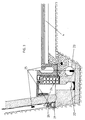
- FIG. 3 shows the road tunnel in the area of the sidewalk console.
- the designs of the left and right side of the tunnel are identical.
- the amount of mountain water, the water chemistry and the sintering strength in the two drainage pipes 23 of the tunnel differ only slightly.
- 23 were below in both drainage tubes the right and left sidewalk consoles of the road tunnel with depot stones different composition and their effectiveness for Mountain water assessed.
- the depot stones in the drain pipe 23 below the lane according to Chur, 80% consisted of powdered polycarboxylic acid (Polymer based on acrylate / methacrylate) with 20% lauric acid as carrier and were produced in the tabletting process.
- Polycarboxylic acid Polymer based on acrylate / methacrylate
- lauric acid 20% lauric acid as carrier
- this poly- ⁇ -aminosuccinic acid as a conditioning agent in depot stones at high pH values over 9 much better than with all other conditioning agents and in addition, this poly- ⁇ -aminosuccinic acid is in the water hazard class 0 (generally not hazardous to water), which is ecological Offers advantages.
- the national road tunnel Crapiere the A 13 is shown in section.
- To protect the insulation seepage line 21 from the formation of hard Deposits could, for example, be a conditioning agent via a dosing system be added in constant amounts in liquid form. At proper handling requires a reliable dosing system with appropriate equipment.
- you can use depot stones 25 are used. Custodian stones 25 are particularly suitable for Places where the amount of water is not very large, i.e. below 2 l / s lies in a drainage system section or the drainage system is dry at times.
- a drainage system usually consists of a large number of identical system sections, e.g. a single insulation drainage pipe. The depot stone remains in place during this dry period and maintains its effectiveness for months or years without going on Losing substance.
- Do the deposit stones also contain conventional hardness stabilizers, dispersants or sequestering agents, they are also very well protected against the formation of new deposits by natural lime-saturated Mountain water arise. Contain the depot stones poly- ⁇ -amino succinic acid they can be used particularly well with cement-related deposits. Wear especially in the construction phase, the period with the strongest sintering Depot stones with poly- ⁇ -amino succinic acid help to regenerate To prevent deposits.
- the depot stones can also be shared with others beforehand Building materials are connected and built into the structure. For This combination is suitable for drainage fleeces, bubble wrap, plastic half-shells for direct water drainage, plastic sealing sheets and the like.
Landscapes
- Engineering & Computer Science (AREA)
- Mining & Mineral Resources (AREA)
- Life Sciences & Earth Sciences (AREA)
- General Life Sciences & Earth Sciences (AREA)
- Structural Engineering (AREA)
- Civil Engineering (AREA)
- Paleontology (AREA)
- Hydrology & Water Resources (AREA)
- Environmental & Geological Engineering (AREA)
- Geology (AREA)
- General Engineering & Computer Science (AREA)
- Geochemistry & Mineralogy (AREA)
- Architecture (AREA)
- Curing Cements, Concrete, And Artificial Stone (AREA)
- Soil Conditioners And Soil-Stabilizing Materials (AREA)
- Lining And Supports For Tunnels (AREA)
- Solid-Sorbent Or Filter-Aiding Compositions (AREA)
Applications Claiming Priority (2)
| Application Number | Priority Date | Filing Date | Title |
|---|---|---|---|
| CH86498A CH689452C1 (de) | 1998-04-15 | 1998-04-15 | Verfahren zur Verhinderung von zementbedingten ablagerungen in einem Bauwerksentwaesserungssystem. |
| CH86498 | 1998-04-15 |
Publications (2)
| Publication Number | Publication Date |
|---|---|
| EP0950641A2 true EP0950641A2 (fr) | 1999-10-20 |
| EP0950641A3 EP0950641A3 (fr) | 2000-04-12 |
Family
ID=4196965
Family Applications (1)
| Application Number | Title | Priority Date | Filing Date |
|---|---|---|---|
| EP99105768A Withdrawn EP0950641A3 (fr) | 1998-04-15 | 1999-03-22 | Tablettes et méthode pour la prévention ou la diminution de la formation de dépôts dans les systèmes d'évacuation des eaux des ouvrages de construction |
Country Status (3)
| Country | Link |
|---|---|
| EP (1) | EP0950641A3 (fr) |
| CH (1) | CH689452C1 (fr) |
| DE (1) | DE29905245U1 (fr) |
Cited By (7)
| Publication number | Priority date | Publication date | Assignee | Title |
|---|---|---|---|---|
| DE102005056018A1 (de) * | 2005-11-14 | 2007-05-16 | Db Netz Ag | Verfahren und Anlage zur Vermeidung von Calciumcarbonatablagerungen (Versinterungen) in Entwässerungssystemen |
| DE102008005992A1 (de) | 2008-01-24 | 2009-07-30 | U.C.M. Heidelberg Gmbh | Verfahren zur Herabsetzung der Versinterung von Drainagerohren |
| CN107974875A (zh) * | 2017-12-01 | 2018-05-01 | 中铁二院工程集团有限责任公司 | 一种无损坎儿井功能的高速铁路地基加固结构及施工方法 |
| CN109488372A (zh) * | 2018-12-27 | 2019-03-19 | 湖南省交通规划勘察设计院有限公司 | 一种隧道排水装置及其排水方法 |
| US10239960B2 (en) | 2015-06-10 | 2019-03-26 | Rhodia Operations | Phosphonated polysaccharides and gels and process for making same |
| CN111287309A (zh) * | 2020-03-06 | 2020-06-16 | 佛山轨道交通设计研究院有限公司 | 一种地铁区间分离式废水泵房结构及其施工方法 |
| CN115711156A (zh) * | 2023-01-09 | 2023-02-24 | 贵州省交通规划勘察设计研究院股份有限公司 | 一种适用于大型岩溶通道的隧道导水结构及逆向施工方法 |
Families Citing this family (9)
| Publication number | Priority date | Publication date | Assignee | Title |
|---|---|---|---|---|
| DE50012009D1 (de) * | 1999-10-05 | 2006-03-30 | Zueblin Ag | Tunnelentwässerungseinrichtung |
| DE10101671A1 (de) | 2000-08-25 | 2002-03-14 | Bayer Ag | Verfahren zur Konditionierung stehender und fließender Wassersysteme |
| DE10114053C2 (de) * | 2000-10-09 | 2003-04-30 | Friedhelm Sieker | Straßenentwässerungssystem |
| FR2839111B1 (fr) * | 2002-04-29 | 2005-01-28 | Regie Autonome Transports | Systeme de paroi d'un ouvrage souterrain |
| AT413129B (de) * | 2003-10-27 | 2005-11-15 | Schretter & Cie | Verfahren zur verhinderung von kalkablagerungen in tunneldränagen |
| EP1724240B1 (fr) * | 2005-05-17 | 2010-06-23 | Marcel Christian Wegmüller | Procédé pour le traitement de l'eau d'infiltration dans les systèmes de drainage des tunnels |
| CH707484B1 (de) | 2013-01-24 | 2016-11-30 | Christian Wegmüller Marcel | Verfahren zur Verhinderung von Ablagerungen in Entwässerungssystemen. |
| CN111395066B (zh) * | 2020-04-28 | 2024-07-12 | 中铁二院工程集团有限责任公司 | 一种既有铁路路基地下排水系统重建结构及施工方法 |
| DE102022103878A1 (de) * | 2022-02-18 | 2023-08-24 | Wayss & Freytag Ingenieurbau Ag | Tunnelbauwerk |
Family Cites Families (5)
| Publication number | Priority date | Publication date | Assignee | Title |
|---|---|---|---|---|
| US2251080A (en) * | 1940-02-15 | 1941-07-29 | Taber Arthur Pratt | Sewer cartridge |
| JPS62180799A (ja) * | 1986-02-05 | 1987-08-08 | Nippon Nohyaku Co Ltd | 井戸用洗浄剤 |
| TW272942B (fr) * | 1993-02-10 | 1996-03-21 | Takeda Pharm Industry Co Ltd | |
| ES2123763T3 (es) * | 1993-02-17 | 1999-01-16 | Marcel Christian Wegmuller | Procedimiento para evitar la formacion de sedimentaciones en un sistema de drenaje de obras. |
| JP3384042B2 (ja) * | 1993-08-06 | 2003-03-10 | 日産化学工業株式会社 | スケール防止用錠剤 |
-
1998
- 1998-04-15 CH CH86498A patent/CH689452C1/de not_active IP Right Cessation
-
1999
- 1999-03-22 EP EP99105768A patent/EP0950641A3/fr not_active Withdrawn
- 1999-03-22 DE DE29905245U patent/DE29905245U1/de not_active Expired - Lifetime
Cited By (10)
| Publication number | Priority date | Publication date | Assignee | Title |
|---|---|---|---|---|
| DE102005056018A1 (de) * | 2005-11-14 | 2007-05-16 | Db Netz Ag | Verfahren und Anlage zur Vermeidung von Calciumcarbonatablagerungen (Versinterungen) in Entwässerungssystemen |
| DE102005056018B4 (de) * | 2005-11-14 | 2015-12-03 | Bgd Boden- Und Grundwasserlabor Gmbh Dresden | Verfahren und Anlage zur Vermeidung von Calciumcarbonatablagerungen (Versinterungen) in Entwässerungssystemen |
| DE102008005992A1 (de) | 2008-01-24 | 2009-07-30 | U.C.M. Heidelberg Gmbh | Verfahren zur Herabsetzung der Versinterung von Drainagerohren |
| US10239960B2 (en) | 2015-06-10 | 2019-03-26 | Rhodia Operations | Phosphonated polysaccharides and gels and process for making same |
| US10844140B2 (en) | 2015-06-10 | 2020-11-24 | Rhodia Operations | Phosphonated polysaccharides and gels and process for making same |
| CN107974875A (zh) * | 2017-12-01 | 2018-05-01 | 中铁二院工程集团有限责任公司 | 一种无损坎儿井功能的高速铁路地基加固结构及施工方法 |
| CN107974875B (zh) * | 2017-12-01 | 2023-09-22 | 中铁二院工程集团有限责任公司 | 一种无损坎儿井功能的高速铁路地基加固结构及施工方法 |
| CN109488372A (zh) * | 2018-12-27 | 2019-03-19 | 湖南省交通规划勘察设计院有限公司 | 一种隧道排水装置及其排水方法 |
| CN111287309A (zh) * | 2020-03-06 | 2020-06-16 | 佛山轨道交通设计研究院有限公司 | 一种地铁区间分离式废水泵房结构及其施工方法 |
| CN115711156A (zh) * | 2023-01-09 | 2023-02-24 | 贵州省交通规划勘察设计研究院股份有限公司 | 一种适用于大型岩溶通道的隧道导水结构及逆向施工方法 |
Also Published As
| Publication number | Publication date |
|---|---|
| DE29905245U1 (de) | 1999-06-17 |
| EP0950641A3 (fr) | 2000-04-12 |
| CH689452C1 (de) | 2004-11-30 |
| CH689452A5 (de) | 1999-04-30 |
Similar Documents
| Publication | Publication Date | Title |
|---|---|---|
| DE29905245U1 (de) | Depotsteine zur Verhinderung bzw. Verminderung der Bildung von Ablagerungen in Bauwerksentwässerungssystemen | |
| EP0638049B1 (fr) | Procede destinee a empecher la formation de depots dans un systeme de drainage de constructions | |
| EP0565987B1 (fr) | Corps moulé en béton avec une bonne résistance aux acides | |
| Hedin et al. | Designing and sizing passive mine drainage treatment systems | |
| CH661717A5 (de) | Verfahren und vorrichtung zum reinigen von abwaessern. | |
| CH639671A5 (de) | Verfahren zur stabilisierung waessriger loesungen von wasserloeslichen, durch polymerisation gelbildenden acrylmonomeren sowie anwendung des verfahrens. | |
| CH694022A5 (de) | Kalkschutzsteine und Verfahren zur Minimierung der Bildung von Ablagerungen in Bauwerksentwaesserungssystemen. | |
| DE1817606A1 (de) | Abdichtung ruhender Wasserhaltungen | |
| CH697239B1 (de) | Verfahren zur Konditionierung von Bergwässern in primären Entwässerungssystemen von Tunnelbauwerken. | |
| WO1995000264A1 (fr) | Procede de traitement de sols contamines et dispositif de mise en ×uvre dudit procede | |
| DE10227951B4 (de) | Verfahren zur Steuerung der Wasserqualität an offenen Gewässern | |
| EP2479148A1 (fr) | Procédé de réduction des coûts de rinçage de systèmes de drainage | |
| EP1724240B1 (fr) | Procédé pour le traitement de l'eau d'infiltration dans les systèmes de drainage des tunnels | |
| EP2100856B1 (fr) | Procédé de traitement biologique de l'eau | |
| DE2501312A1 (de) | Verfahren zur verbesserung der tragfaehigkeit und frostbestaendigkeit einer kohlen- und muellasche enthaltenden, fuer verkehrswege und sonstige schuettungen geeigneten masse | |
| DE102004030966B4 (de) | Verfahren zur multifunktionalen Steuerung der Wasserqualität an offenen Gewässern | |
| DE10044261A1 (de) | Vorrichtung und Verfahren zur Sanierung schwefelsaurer Kippen-Grundwasserleiter und zur Stabilisierung der Wasserqualität fremdwassergefluteter Tagebaurestlochseen | |
| CH686040A5 (de) | Verfahren zur Verhinderung von Ablagerungen in einem Bauwerksentw{sserungssystem. | |
| EP2948414B1 (fr) | Procédé permettant d'éviter la formation de dépôts dans des systèmes de drainage | |
| CH697163A5 (de) | Verfahren zur Konditionierung von Bergwasser in einem Tunnelentwässerungssystem. | |
| DE202005017464U1 (de) | Depotsteine zur Solvolyse Erdalkalimetall-enthaltender Inkrustation | |
| DE4446028C2 (de) | Verfahren und Anlage zum Stabilisieren eines Bodens mit Hilfe von Injektionen | |
| CH695612A5 (de) | Solvolyse Erdalkalimetall enthaltender Inkrustation. | |
| DE2039145C (de) | Verfahren zum Abdämmen von wasserhaltigen aufgelassenen Grubengängen | |
| DD229887A1 (de) | Verfahren zur reinigung schwermetallkontaminierten wassers |
Legal Events
| Date | Code | Title | Description |
|---|---|---|---|
| PUAI | Public reference made under article 153(3) epc to a published international application that has entered the european phase |
Free format text: ORIGINAL CODE: 0009012 |
|
| AK | Designated contracting states |
Kind code of ref document: A2 Designated state(s): AT CH DE FR GB IT LI |
|
| AX | Request for extension of the european patent |
Free format text: AL;LT;LV;MK;RO;SI |
|
| PUAL | Search report despatched |
Free format text: ORIGINAL CODE: 0009013 |
|
| AK | Designated contracting states |
Kind code of ref document: A3 Designated state(s): AT BE CH CY DE DK ES FI FR GB GR IE IT LI LU MC NL PT SE |
|
| AX | Request for extension of the european patent |
Free format text: AL;LT;LV;MK;RO;SI |
|
| 17P | Request for examination filed |
Effective date: 20000811 |
|
| AKX | Designation fees paid |
Free format text: AT CH DE FR GB IT LI |
|
| 17Q | First examination report despatched |
Effective date: 20030210 |
|
| STAA | Information on the status of an ep patent application or granted ep patent |
Free format text: STATUS: THE APPLICATION IS DEEMED TO BE WITHDRAWN |
|
| 18D | Application deemed to be withdrawn |
Effective date: 20030621 |