EP0951574B1 - Metall-keramisches konstruktionselement - sein aufbau und seine herstellung - Google Patents
Metall-keramisches konstruktionselement - sein aufbau und seine herstellung Download PDFInfo
- Publication number
- EP0951574B1 EP0951574B1 EP98901954A EP98901954A EP0951574B1 EP 0951574 B1 EP0951574 B1 EP 0951574B1 EP 98901954 A EP98901954 A EP 98901954A EP 98901954 A EP98901954 A EP 98901954A EP 0951574 B1 EP0951574 B1 EP 0951574B1
- Authority
- EP
- European Patent Office
- Prior art keywords
- ceramic
- preform
- alloy
- pressure
- volume
- Prior art date
- Legal status (The legal status is an assumption and is not a legal conclusion. Google has not performed a legal analysis and makes no representation as to the accuracy of the status listed.)
- Expired - Lifetime
Links
Images
Classifications
-
- C—CHEMISTRY; METALLURGY
- C22—METALLURGY; FERROUS OR NON-FERROUS ALLOYS; TREATMENT OF ALLOYS OR NON-FERROUS METALS
- C22C—ALLOYS
- C22C1/00—Making non-ferrous alloys
- C22C1/10—Alloys containing non-metals
- C22C1/1005—Pretreatment of the non-metallic additives
- C22C1/1015—Pretreatment of the non-metallic additives by preparing or treating a non-metallic additive preform
-
- C—CHEMISTRY; METALLURGY
- C04—CEMENTS; CONCRETE; ARTIFICIAL STONE; CERAMICS; REFRACTORIES
- C04B—LIME, MAGNESIA; SLAG; CEMENTS; COMPOSITIONS THEREOF, e.g. MORTARS, CONCRETE OR LIKE BUILDING MATERIALS; ARTIFICIAL STONE; CERAMICS; REFRACTORIES; TREATMENT OF NATURAL STONE
- C04B41/00—After-treatment of mortars, concrete, artificial stone or ceramics; Treatment of natural stone
- C04B41/45—Coating or impregnating, e.g. injection in masonry, partial coating of green or fired ceramics, organic coating compositions for adhering together two concrete elements
- C04B41/50—Coating or impregnating, e.g. injection in masonry, partial coating of green or fired ceramics, organic coating compositions for adhering together two concrete elements with inorganic materials
- C04B41/5053—Coating or impregnating, e.g. injection in masonry, partial coating of green or fired ceramics, organic coating compositions for adhering together two concrete elements with inorganic materials non-oxide ceramics
-
- C—CHEMISTRY; METALLURGY
- C04—CEMENTS; CONCRETE; ARTIFICIAL STONE; CERAMICS; REFRACTORIES
- C04B—LIME, MAGNESIA; SLAG; CEMENTS; COMPOSITIONS THEREOF, e.g. MORTARS, CONCRETE OR LIKE BUILDING MATERIALS; ARTIFICIAL STONE; CERAMICS; REFRACTORIES; TREATMENT OF NATURAL STONE
- C04B41/00—After-treatment of mortars, concrete, artificial stone or ceramics; Treatment of natural stone
- C04B41/45—Coating or impregnating, e.g. injection in masonry, partial coating of green or fired ceramics, organic coating compositions for adhering together two concrete elements
- C04B41/50—Coating or impregnating, e.g. injection in masonry, partial coating of green or fired ceramics, organic coating compositions for adhering together two concrete elements with inorganic materials
- C04B41/51—Metallising, e.g. infiltration of sintered ceramic preforms with molten metal
- C04B41/515—Other specific metals
- C04B41/5155—Aluminium
-
- C—CHEMISTRY; METALLURGY
- C04—CEMENTS; CONCRETE; ARTIFICIAL STONE; CERAMICS; REFRACTORIES
- C04B—LIME, MAGNESIA; SLAG; CEMENTS; COMPOSITIONS THEREOF, e.g. MORTARS, CONCRETE OR LIKE BUILDING MATERIALS; ARTIFICIAL STONE; CERAMICS; REFRACTORIES; TREATMENT OF NATURAL STONE
- C04B41/00—After-treatment of mortars, concrete, artificial stone or ceramics; Treatment of natural stone
- C04B41/80—After-treatment of mortars, concrete, artificial stone or ceramics; Treatment of natural stone of only ceramics
- C04B41/81—Coating or impregnation
- C04B41/85—Coating or impregnation with inorganic materials
- C04B41/87—Ceramics
-
- C—CHEMISTRY; METALLURGY
- C04—CEMENTS; CONCRETE; ARTIFICIAL STONE; CERAMICS; REFRACTORIES
- C04B—LIME, MAGNESIA; SLAG; CEMENTS; COMPOSITIONS THEREOF, e.g. MORTARS, CONCRETE OR LIKE BUILDING MATERIALS; ARTIFICIAL STONE; CERAMICS; REFRACTORIES; TREATMENT OF NATURAL STONE
- C04B41/00—After-treatment of mortars, concrete, artificial stone or ceramics; Treatment of natural stone
- C04B41/80—After-treatment of mortars, concrete, artificial stone or ceramics; Treatment of natural stone of only ceramics
- C04B41/81—Coating or impregnation
- C04B41/85—Coating or impregnation with inorganic materials
- C04B41/88—Metals
-
- C—CHEMISTRY; METALLURGY
- C22—METALLURGY; FERROUS OR NON-FERROUS ALLOYS; TREATMENT OF ALLOYS OR NON-FERROUS METALS
- C22C—ALLOYS
- C22C1/00—Making non-ferrous alloys
- C22C1/10—Alloys containing non-metals
- C22C1/1036—Alloys containing non-metals starting from a melt
-
- C—CHEMISTRY; METALLURGY
- C22—METALLURGY; FERROUS OR NON-FERROUS ALLOYS; TREATMENT OF ALLOYS OR NON-FERROUS METALS
- C22C—ALLOYS
- C22C1/00—Making non-ferrous alloys
- C22C1/10—Alloys containing non-metals
- C22C1/1036—Alloys containing non-metals starting from a melt
- C22C1/1057—Reactive infiltration
-
- C—CHEMISTRY; METALLURGY
- C22—METALLURGY; FERROUS OR NON-FERROUS ALLOYS; TREATMENT OF ALLOYS OR NON-FERROUS METALS
- C22C—ALLOYS
- C22C47/00—Making alloys containing metallic or non-metallic fibres or filaments
- C22C47/02—Pretreatment of the fibres or filaments
- C22C47/06—Pretreatment of the fibres or filaments by forming the fibres or filaments into a preformed structure, e.g. using a temporary binder to form a mat-like element
-
- C—CHEMISTRY; METALLURGY
- C23—COATING METALLIC MATERIAL; COATING MATERIAL WITH METALLIC MATERIAL; CHEMICAL SURFACE TREATMENT; DIFFUSION TREATMENT OF METALLIC MATERIAL; COATING BY VACUUM EVAPORATION, BY SPUTTERING, BY ION IMPLANTATION OR BY CHEMICAL VAPOUR DEPOSITION, IN GENERAL; INHIBITING CORROSION OF METALLIC MATERIAL OR INCRUSTATION IN GENERAL
- C23C—COATING METALLIC MATERIAL; COATING MATERIAL WITH METALLIC MATERIAL; SURFACE TREATMENT OF METALLIC MATERIAL BY DIFFUSION INTO THE SURFACE, BY CHEMICAL CONVERSION OR SUBSTITUTION; COATING BY VACUUM EVAPORATION, BY SPUTTERING, BY ION IMPLANTATION OR BY CHEMICAL VAPOUR DEPOSITION, IN GENERAL
- C23C28/00—Coating for obtaining at least two superposed coatings either by methods not provided for in a single one of groups C23C2/00 - C23C26/00 or by combinations of methods provided for in subclasses C23C and C25C or C25D
-
- C—CHEMISTRY; METALLURGY
- C23—COATING METALLIC MATERIAL; COATING MATERIAL WITH METALLIC MATERIAL; CHEMICAL SURFACE TREATMENT; DIFFUSION TREATMENT OF METALLIC MATERIAL; COATING BY VACUUM EVAPORATION, BY SPUTTERING, BY ION IMPLANTATION OR BY CHEMICAL VAPOUR DEPOSITION, IN GENERAL; INHIBITING CORROSION OF METALLIC MATERIAL OR INCRUSTATION IN GENERAL
- C23C—COATING METALLIC MATERIAL; COATING MATERIAL WITH METALLIC MATERIAL; SURFACE TREATMENT OF METALLIC MATERIAL BY DIFFUSION INTO THE SURFACE, BY CHEMICAL CONVERSION OR SUBSTITUTION; COATING BY VACUUM EVAPORATION, BY SPUTTERING, BY ION IMPLANTATION OR BY CHEMICAL VAPOUR DEPOSITION, IN GENERAL
- C23C28/00—Coating for obtaining at least two superposed coatings either by methods not provided for in a single one of groups C23C2/00 - C23C26/00 or by combinations of methods provided for in subclasses C23C and C25C or C25D
- C23C28/04—Coating for obtaining at least two superposed coatings either by methods not provided for in a single one of groups C23C2/00 - C23C26/00 or by combinations of methods provided for in subclasses C23C and C25C or C25D only coatings of inorganic non-metallic material
- C23C28/044—Coating for obtaining at least two superposed coatings either by methods not provided for in a single one of groups C23C2/00 - C23C26/00 or by combinations of methods provided for in subclasses C23C and C25C or C25D only coatings of inorganic non-metallic material coatings specially adapted for cutting tools or wear applications
-
- C—CHEMISTRY; METALLURGY
- C23—COATING METALLIC MATERIAL; COATING MATERIAL WITH METALLIC MATERIAL; CHEMICAL SURFACE TREATMENT; DIFFUSION TREATMENT OF METALLIC MATERIAL; COATING BY VACUUM EVAPORATION, BY SPUTTERING, BY ION IMPLANTATION OR BY CHEMICAL VAPOUR DEPOSITION, IN GENERAL; INHIBITING CORROSION OF METALLIC MATERIAL OR INCRUSTATION IN GENERAL
- C23C—COATING METALLIC MATERIAL; COATING MATERIAL WITH METALLIC MATERIAL; SURFACE TREATMENT OF METALLIC MATERIAL BY DIFFUSION INTO THE SURFACE, BY CHEMICAL CONVERSION OR SUBSTITUTION; COATING BY VACUUM EVAPORATION, BY SPUTTERING, BY ION IMPLANTATION OR BY CHEMICAL VAPOUR DEPOSITION, IN GENERAL
- C23C28/00—Coating for obtaining at least two superposed coatings either by methods not provided for in a single one of groups C23C2/00 - C23C26/00 or by combinations of methods provided for in subclasses C23C and C25C or C25D
- C23C28/04—Coating for obtaining at least two superposed coatings either by methods not provided for in a single one of groups C23C2/00 - C23C26/00 or by combinations of methods provided for in subclasses C23C and C25C or C25D only coatings of inorganic non-metallic material
- C23C28/048—Coating for obtaining at least two superposed coatings either by methods not provided for in a single one of groups C23C2/00 - C23C26/00 or by combinations of methods provided for in subclasses C23C and C25C or C25D only coatings of inorganic non-metallic material with layers graded in composition or physical properties
-
- F—MECHANICAL ENGINEERING; LIGHTING; HEATING; WEAPONS; BLASTING
- F16—ENGINEERING ELEMENTS AND UNITS; GENERAL MEASURES FOR PRODUCING AND MAINTAINING EFFECTIVE FUNCTIONING OF MACHINES OR INSTALLATIONS; THERMAL INSULATION IN GENERAL
- F16C—SHAFTS; FLEXIBLE SHAFTS; ELEMENTS OR CRANKSHAFT MECHANISMS; ROTARY BODIES OTHER THAN GEARING ELEMENTS; BEARINGS
- F16C33/00—Parts of bearings; Special methods for making bearings or parts thereof
- F16C33/02—Parts of sliding-contact bearings
- F16C33/04—Brasses; Bushes; Linings
- F16C33/043—Sliding surface consisting mainly of ceramics, cermets or hard carbon, e.g. diamond like carbon [DLC]
-
- B—PERFORMING OPERATIONS; TRANSPORTING
- B22—CASTING; POWDER METALLURGY
- B22F—WORKING METALLIC POWDER; MANUFACTURE OF ARTICLES FROM METALLIC POWDER; MAKING METALLIC POWDER; APPARATUS OR DEVICES SPECIALLY ADAPTED FOR METALLIC POWDER
- B22F2998/00—Supplementary information concerning processes or compositions relating to powder metallurgy
-
- C—CHEMISTRY; METALLURGY
- C22—METALLURGY; FERROUS OR NON-FERROUS ALLOYS; TREATMENT OF ALLOYS OR NON-FERROUS METALS
- C22C—ALLOYS
- C22C2204/00—End product comprising different layers, coatings or parts of cermet
Definitions
- Structural parts that are particularly stressed on the surface are generally parts whose surfaces are mechanically moved against one another, for example bearings, seals and brake elements or parts whose surfaces are exposed to particular temperature or corrosion loads.
- Steel is used in many applications or carbon fiber reinforced carbons for high performance applications such as racing cars.
- Aluminum-infiltrated SiC and Al 2 O 3 materials (PRIMEX) and reaction-formed Al 2 O 3 -Al components (DIMOX) are known as advantageous materials for these applications. Such materials are described in DE 44 47 130 A1 and the literature cited therein and in application DE 196 05 858.
- Such materials e.g. for use with tribological construction parts should be light, corrosion and oxidation resistant as well as wear resistant be and if possible have a temperature-independent coefficient of friction. High temperature resistance is particularly important for high-performance brake elements important. None of the known metal-ceramic materials is sufficient but the increasing demands, such as those for brake elements of high-speed trains or in aircraft construction.
- the improved materials PRIMEX and DIMOX also prove to be decisive Disadvantage a low melting point of the Al phase (660 ° C) and a strong tribomechanical change in properties at temperatures> 300 ° C that are quickly exceeded during longer braking.
- German patent application 1960858.9 describes a reaction-molded material in which the tribomechanical and tribochemical properties have been improved, but use as a high-performance braking element is problematic because of the low fracture toughness and breaking strength of the entire load-bearing part.
- Al was infiltrated in a preform consisting of TiO 2 whiskers at T> 800 ° C.
- the object of the invention is therefore a metal-ceramic construction element To provide the disadvantages of the known, especially tribological claimed, metal-ceramic construction parts not or only in has a much smaller degree.
- an open-pored ceramic pre-body (precursor) which has the porous preform at least of the surface layer and at least one which can be reduced by Al contains oxidic compound with volume fractions of 10 to 100% based on the dense material and Al 2 O 3 with 0 to 90% as well as optionally other non-oxidic compounds or elements and optionally metallic reinforcing elements and which is optionally connected to a carrier, liquid Al or Al Alloy pressed in, the oxidic compound accelerator in the form of an exothermically more active oxide, selected from FeO, Fe 2 O 3 , Fe 3 O 4 , NiO or MoO 3 or mixtures thereof in an amount of 10 to 50 vol .-%, based contains on the oxidizable compound reducible by Al and the reaction between Al and the metal oxide in the corresponding aluminide and Al 2 O 3 until at least one Al 2 O 3 -
- surface layer chosen here does not only include thin ones planar layers, but layers of any geometry, i.e. e.g. also the inner or outer area of a hollow cylinder, with layer thicknesses up to about 30 mm) and possibly one or more associated with it Transition layers and, if necessary, an associated carrier.
- the disadvantages of the known metal-ceramic Construction elements are present, are eliminated in that the Construction element obtained according to the invention on its surface in contains essential aluminides.
- Aluminides are intermetallic Al compounds. It was surprisingly found that the structure of the metal-ceramic construction element obtained according to the invention leads to high temperature resistance and the metal-ceramic Construction element has a relatively temperature-independent coefficient of friction. Another advantage is its light weight and high weight Oxidation stability.
- the proportion of Al 2 O 3 in the ceramic layer is adapted to the requirements of the metal-ceramic construction element.
- the ceramic layer preferably contains 10 to 90% by volume Al 2 O 3 , particularly preferably 30 to 70% by volume Al 2 O 3 .
- the metallic Al phase that runs through the metal-ceramic construction element can vary. It preferably has a proportion of 10 to 90% by volume, particularly preferably 30 to 70% by volume.
- the Al can be partially replaced by Mg.
- the thickness of the surface layer which in addition to Al 2 O 3 contains a metallic Al phase which is essentially present as an aluminide, can vary depending on the requirements, preferably it has a thickness of 0.2 to 30 mm. It particularly preferably has a thickness of 1 to 15 mm.
- the surface layer can additionally contain Al or Al alloy; especially when an increased thermal and electrical conductivity is required.
- the metal-ceramic construction element reinforcing and / or functional elements in its surface layer contained in the form of balls, platelets, whiskers and / or fibers.
- the proportion of reinforcing or / and functional elements in the metal-ceramic construction element depends on the desired material properties, preferably it is 5 to 50% by volume.
- the reinforcing or / and functional elements preferably consist of oxides, carbides, nitrides, borides or / and silicides.
- carbon, diamond, SiC, Si 3 N 4 , TiC, WC or / and ZrO 2 can be used.
- the reinforcing and / or functional elements contain or consist of coated or uncoated SiC, SiCB, SiCBN, Si 3 N 4 , Al 2 O 3 or / and mullite fibers.
- the structural element contains metallic reinforcing elements in the form of wires or rovings or wire mesh, knitted or wool, which either only pass through the surface layer or also parts or the entire component.
- the metallic reinforcement elements make up 5 to 60 vol .-% and can consist of the following metals or their alloys or intermetallic compounds: Al, Cu, Cr, Fe, Ni, Co, Si, Ti, Nd, Hf, Mo, V, W, Zr.
- These reinforcement elements which are preferably made of steel or hardenable steel, are not, or only insignificantly, superficially dissolved on the pressure casting (which can only improve the adhesion to the Al 2 O 3 / aluminide phase), so that they are not only able to stabilize the green (unsintered) preform, but also to make the body or the surface layer significantly more fracture-resistant after the reaction infiltration.
- the pressure casting which can only improve the adhesion to the Al 2 O 3 / aluminide phase
- With short die-casting times even aluminum wires, particularly high-strength aluminum alloy wires, can be retained in the part and make a significant contribution to the reinforcement.
- conventional squeeze casting or gas pressure infiltration which means longer infiltration times at temperatures above the Al melting point, the wires are completely or partially dissolved.
- the green precursor e.g. by thermolysis
- removable fibrous material such as a burnable or evaporable felt or fabric insert, for example made of textile or contains plastic that disappears during the pre-sintering of the precursor and leaves a corresponding open channel system (the negative form of the insert), which is filled with Al or Al alloy during the later pressure infiltration.
- the components of the metal-ceramic construction element are either distributed evenly in the layer, or the metal-ceramic construction element is built up in layers from layers.
- a gradient in the volume fraction of Al 2 O 3 and / or the aluminides can lead to advantageous material properties of the metal-ceramic construction element and, for example, make it possible to compensate for different coefficients of thermal expansion.
- the metallic phase that runs through the surface layer essentially comprises one or more aluminides and optionally aluminum or Al alloy.
- the aluminide can be a compound from Al and at least one of the metals Fe, Ni, Nb, Zr, Ti, Co, Mo, W, V or a mixture of such aluminides.
- the metal-ceramic construction element normally consists of at least one shift. But it can also consist of several different ones Layers are built up.
- the metal-ceramic construction element is connected to one or more further layers.
- These further layers can be made up of different materials, preferably they are made up of Al 2 O 3 and Al and aluminides. They facilitate the thermomechanically compatible transition to the carrier element, which forms the mechanical connection to the device, machine, disc brake plug, brake drum, vehicle, etc.
- the carrier element is preferably made of Al or Al alloy and, in addition to the thermomechanical connection function, also has the task of strengthening the metal-ceramic construction element, for example by spanning it (see types III and IV).
- the green body is a metallic support fabric or Contains reinforcing elements, the surface layer and optionally also the other layers and the support of an additional one metallic phase.
- the precursor can be manufactured in matrices using various ceramic shaping processes, such as tape casting, direct coagulation casting, gel casting, slip casting or dry pressing. Then it can be infiltrated with Al or Al alloy either in the green state or in pre-sintered form in the pressure, press or gas pressure form. If a green precursor is used, it is advantageous to increase the stability (especially for die casting with high infiltration rates) either by adding metallic particles (for example Al or aluminide-forming metals) or organic (optionally hardening) binders.
- various ceramic shaping processes such as tape casting, direct coagulation casting, gel casting, slip casting or dry pressing. Then it can be infiltrated with Al or Al alloy either in the green state or in pre-sintered form in the pressure, press or gas pressure form. If a green precursor is used, it is advantageous to increase the stability (especially for die casting with high infiltration rates) either by adding metallic particles (for example Al or aluminide-forming metals) or organic (optionally hardening) binders.
- metallic reinforcement elements in the green body, for example in the form of wires or rovings or wire mesh, knitted or wire wool or other wire-like structures, which can be done by shaking or pressing the dry ceramic powder as well as by slurry infiltration or slurry pressing. It is also possible to stabilize the precursor ceramic powder by means of a support mold made of metal that is open or perforated on one or more sides, for example by pressing the ceramic powder into such a mold, which is then inserted into the die-casting mold without presintering.
- This support form is preferably made of Al or Al alloy, but can also consist of steel or other metals. In the case of an Al form, the form can dissolve with slow pressure infiltration.
- the carrier element also consists of Al.
- a metal-ceramic construction element with a graduation is to be produced, there is already a gradient in the precursor.
- a number of green layers of different compositions produced as lamina can be placed on top of one another.
- the body obtained is also solidified with metallic reinforcing elements or with organic binders and optionally sintered at temperatures between 900 ° C and 1200 ° C.
- porous preform contains only oxides, sintering in air makes sense and is preferred. This connects the layers together. However, it is also possible to introduce the green layers into the casting device and to achieve the connection of the layers through the infiltration process with Al or Al alloys.
- the press casting process can be carried out using methods that are such as die casting, die casting or gas pressure infiltration become. Pressureless reaction infiltration is also possible if the necessary wetting requirements are created. However, the Die casting is the most suitable process.
- the oxidizable substances which can be reduced by Al contain at least one compound from the group CaO, Cr 2 O 3 , CuO, Cu 2 O, CoO, Co 2 O 3 , FeO, Fe 2 O 3 , Fe 3 O 4 , HfO 2 , Li 2 O, MnO, MgO, MoO 3 , Na 2 O, Nb 2 O, Nb 2 O 5 , NiO, SiO 2 , TiO, TiO 2 , V 2 O 5 , WO 3 , Y 2 O 3 , ZrO 2 , Mullite, Spinels, zirconates, titanates as well as ores containing Fe, Ti, Co, Ni, Zr, Si, Nb, in particular zirconium (ZrSiO 4 ) or ilmenite (FeTiO 3 ).
- the reducible metal oxides can also be partially replaced by the corresponding metals (and possibly additional Al 2 O 3 ) if the exothermic heat of reaction is to be reduced.
- exothermally more strongly active oxides selected from FeO, Fe 2 O 3 , Fe 3 O 4 , NiO and MoO 3 are added here as accelerators. This is particularly advantageous when using less exothermic substances, such as TiO 2 or Nb 2 O 5 .
- These accelerators are used in amounts of 10 to 50% by volume, based on the oxidizable compound which can be reduced by Al. Especially if a pre-body containing TiO 2 is preheated little and reaction-infiltrated at low Al temperatures (less than 750 ° C.), an addition of about 10 to 50 vol.% Fe 2 O 3 is advisable.
- the precursor used in the process according to the invention can be at room temperature be used in the process, preferably it is preheated, expedient to 200 ° C to 700 ° C. That in the invention Process used Al or the Al alloy is made according to the requirements at different temperatures above their melting temperature in the Pressed precursor, preferably at a temperature of 700 ° C to 1200 ° C, particularly preferably at 700 ° C to 900 ° C.
- the pressure used in the process according to the invention is at the others Process conditions adjusted.
- the Precursor can also be infiltrated without external pressure if the liquid Al or Al alloy wetted the precursor so well that the rate of infiltration is greater than the reaction rate.
- the press-in process can take place indefinitely, preferably it will Al or the Al alloy in 1 second to 20 minutes during die casting and mostly in less than 1 second (preferably 1/1000 second to 1 second) at Die-cast pressed into the precursor. If the desired reaction is not in sufficient amount has occurred during the die casting process, that can Construction element also annealed until complete implementation (reaction) become.
- the annealing treatment in an inert atmosphere, in a vacuum, is preferred or carried out in the air between 10 min and 24 h. It is essential that the reaction of Al with the or the reducible oxidic compounds in the desired extent can run at the temperature used and if necessary, a metallic support fabric is only insignificantly damaged.
- the annealing treatment can be shortened if you do a post-treatment in which an afterglow takes place due to friction. This is suitable are particularly suitable for rotationally symmetrical elements, e.g. Disc brakes.
- Another object of the present invention is one by the above available construction element described method.
- Yet another object of the present invention is a component which comprises a construction element as described above. How it is obvious to a person skilled in the art that it is not essential for the invention that the construction element runs through the entire component, but it is possible to target the construction element in those areas use, which are exposed to high loads in the intended use are.
- the structure and material combination is suitable the construction element described for other applications, where surfaces are subject to particular temperature and corrosion stresses where Al is no longer strong or stable, or at for whom the thermal expansion of Al is too high.
- Construction elements are, for example, brake elements, bearings, guide elements, Sliding rails, sliding contacts etc., but also heating elements or piston heads, Cylinder running surfaces, cylinder heads, cams on cam levers or - waves in engine construction.
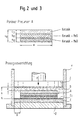
- FIG. 1 shows a porous precursor A
- FIG. 2 shows a porous precursor A
- Fig. 3 is a die casting device with introduced porous precursor A.
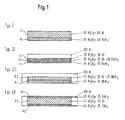
- Type I This type of metal-ceramic tribological element consists of two layers a 1 and c 1 .
- Layer c 1 consists of 50 vol.% Al 2 O 3 and 50 vol.% Aluminum.
- Layer a 1 consists of 60 vol.% Al 2 O 3 and 40 vol.% FeAl 3 (aluminide).
- Type II The layers c 1 , b 1 and a 1 are connected to the carrier made of 100% aluminum (100 Al).
- Layer c 1 consists of 50% by volume Al 2 O 3 and 50% by volume aluminum
- layer b 1 consists of 50% by volume Al 2 O 3 , 20% by volume aluminum and 30% by volume FeAl 3 (aluminide)
- layer a 1 consists of 65 vol.% Al 2 O 3 and 35 vol.% FeAl 3 (aluminide).
- Type III In this metal-ceramic tribological element, the layers a 1 and b 1 are enclosed by the support, which consists of 100% aluminum (100 Al).
- Layer b 1 consists of 55% by volume Al 2 O 3 , 20% by volume aluminum and 25% by volume NbAl 3 (aluminide).
- Layer a 1 consists of 65 vol.% Al 2 O 3 and 35 vol.% NbAl 3 (aluminide).
- Type IV In this type, the layer C 1 , which consists of 45% by volume Al 2 O 3 and 55% by volume aluminum, is connected on both sides to the layer a 1 , each consisting of 65% by volume Al 2 O 3 and 35 vol.% TiAl 3 (aluminide). These two layers are framed by a carrier made of 100% aluminum (100 Al).
- FIG. 1 show disk-shaped, mainly for construction elements suitable for tribological applications.
- the diameter can be between 1 and 100 cm.
- the surface layer is always loaded designated and with b, c etc. the transition layers to the carrier.
- a porous, predominantly ceramic precursor (A) is placed in a pressure die-casting chamber (F) with an inner diameter of 70 mm on a lower punch (D), with a porous intermediate body (C), for example made of fine-pored (pore diameter ⁇ 1 ⁇ m ) reaction-bound Al 2 O 3 (RBAO) can be interposed for air intake from the precursor.
- the intermediate body (C) should not be infiltrated by liquid aluminum.
- a non-wettable porous layer C 1 on C could be applied.
- Liquid Al (B) is then poured over the precursor (A) and pressed into the pores with the upper punch (E) at a pressure of 50 MPa and a temperature of 800 ° C. in 2 minutes.
- the ceramic While in the c 0 layers (c 01 - c 0i ) the ceramic is infiltrated with Al without reaction, the layers b 0 (b 01 - b 0i ) and a 0 (a 01 - a 0i ) are infiltrated with Al that in b 0 the existing reactive metal oxide (MeO) reacts with Al to Al 2 O 3 and the corresponding aluminide (MeAl), but unreacted Al still remains.
- the entire pore space is filled by the refractory aluminide reaction product.
- the indices 01, 02 ... 0i indicate that correspondingly graduated layers are built up, the Al content decreasing from the Al side (layer c upper part of the precursor), in b and a the aluminide content down to the nominal Aluminum content in the surface area of the layer increases.
- a powder mixture as in Example 1 was dried and then pressed uniaxially into annular disks with an outer / inner diameter of 60/35 mm and a height of 5 mm at 40 MPa and at 1250 ° C. in air for 10 min. presintered. Then the density was 57% TD.
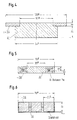
- Two ring disks preheated to 600 ° C. were then placed in the pressure casting device (FIG. 5) with spacers made of Al and at a pressure of 50 MPa and a temperature of 800 ° C. for about 1 min. pressure infiltrated (see also Fig. 5).
- the TiO 2 was then largely converted to an i-3A material.
- precursor mixtures were additionally produced with a TiO 2 / Al 2 O 3 volume ratio of 70/30 and 30/70 and from pure TiO 2 and after drying to form cylinders with a diameter of 20 mm and heights between 2 and 20 mm uniaxial pressed at 50 MPa and presintered at temperatures between 1100 and 1300 ° C.
- the densities of the precursors were then between 54 and 70% TD, with no closed porosity being found.
- 5 to 6 samples preheated to 400 ° C. were placed with 1 mm steel wire in the device from Example 2 (see also FIG. 6) and pressure infiltrated at temperatures between 700 and 800 ° C. with 50 MPa. After that, most of the samples were completely infiltrated.
- Samples with a TiO 2 / Al 2 O 3 ratio of 30/70 contained Al 2 O 3 , TiO 2 and TiAl 3 additionally on the outside, while those with a TiO 2 / Al 2 O 3 ratio of 70/30 additionally contained TiAl contained.
- the pure TiO 2 sample had also partially reacted to Al 2 O 3 and TiAl 3 , but it was riddled with many cracks, whereby the original dimensions of the cylinder had increased significantly.
- the dimensional change of the other samples was ⁇ 1% in each case.
- a 6-hour annealing at 630 ° C in vacuum led to the disappearance of the remaining TiO 2 X-ray reflections.
- Example 3 The same test series as in Example 3 were also carried out with Fe 2 O 3 -Al 2 O 3 and Nb 2 O 5 -Al 2 O 3 precursor mixtures, although the height of the cylinders was 5 mm and the presintering temperature was 1250 ° C (20 min.) was kept constant. The results showed that Fe 2 O 3 was almost completely converted to Al 2 O 3 + FeAl 3 (+ Al), while Nb 2 O 5 reacted only incompletely with Al.
- Powder mixtures of 70% by volume Al 2 O 3 (Gilox) and 30% by volume TiO 2 were attrited, dried and isostatically as in Example 1 to form hollow cylinders with inside / outside diameters 17/26 mm and heights between 15 and 20 mm at 100 MPa pressed and at 1250 ° C for 20 min. sintered in air. Then the density was 57% TD.
- These precursors were preheated to 950 ° C and then placed in a 20 ° C connecting rod die in the area of the connecting rod bearing.
- the mold was then filled at the side with gate speeds of 27 to 38 m / s with a pressure of 140 MPa (metal pressure on the piston) at 750 ° C with a Si-containing Al alloy within less than 1 s (the assumed infiltration time should be approx. 1/10 s, whereby the melting temperature should have dropped below 700 ° C).
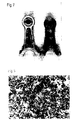
- the hollow cylinder in the bearing area [see FIG. 7, photo of the connecting rod before (right) and after (left) a one-sided grinding treatment] contained approx. 40% by volume Al 2 O 3 , approx. 40% by volume (TiAl 3 + Al ) and approx. 20 vol.% TiO 2 . See also micrograph in Fig. 8. Dark: Al 2 O 3 and TiO 2 , gray: TiAl 3 , light: Al.
- Example 5 40% by volume of Al 2 O 3 (Gilox) and 60% by volume of ilmenite (TiFeO 3 , CSIRO Clayton, Australia) were mixed for 10 min in water as in Example 1 and dried.
- the powder was then isostatically pressed into a 15 mm high cylinder with an inner / outer diameter of 17/26 mm at 600 MPa as in Example 5, with a double-layer steel wire mesh consisting of a mesh with a wire diameter of 0.063 mm and a mesh size of 0.1 mm supported by a coarser wire mesh with a diameter of 0.56 mm and a mesh size of 2 mm (Gekuplate 150 mesh / 10 mesh, GKD, Düren). The procedure was then as in Example 5.
- the wire mesh was then almost completely preserved, even the 0.063 mm wire was only partially dissolved by Al.
- the wire body which made up approx. 20 vol.% Of the cylinder, was surrounded by approx. 55 vol.% (Al 2 O 3 + Restilmenit) and approx. 40 vol.% Al and previously unidentified FeTi aluminide phases .
- Al-filled cracks could be seen in the part of the cylinder in which there was no wire mesh.
- the green body had been partially destroyed during the die casting process.
- Example 6 As in Example 6, a three-layer steel wire mesh (diameter 0.1 mm, mesh size 0.16 mm, from GKD, Düren) was placed in a green body made of 30% by volume TiO 2 , 15% by volume Fe 2 O 3 and 55 Vol .-% Al 2 O 3 (1 hour in water) isostatically introduced. This green body reinforced in this way was presintered at 1150 ° C. for 1 hour and then pressure-infiltrated as in Example 5. The wire mesh was then almost completely preserved and the entire i-3A body (connecting rod bearing) was free of tears.
- a three-layer steel wire mesh (diameter 0.1 mm, mesh size 0.16 mm, from GKD, Düren) was placed in a green body made of 30% by volume TiO 2 , 15% by volume Fe 2 O 3 and 55 Vol .-% Al 2 O 3 (1 hour in water) isostatically introduced. This green body reinforced in this way was presintered at 1150 ° C. for 1 hour and then pressure
- Fine ( ⁇ 1 ⁇ m) Nb 2 O 5 powder (Johnson Matthey, Düsseldorf, 1 h in water with TZP balls attracted) was with a steel stamp 43 mm in diameter in an open-top aluminum pot with 1 mm wall thickness and a Pressed in outer diameter of 45 mm and a height of 5 mm, so that the green density was approx. 55% TD.
- the pot filled in this way was placed in an Al 2 O 3 crucible with an internal diameter of 60 mm and then pressure-infiltrated with pure Al at 800 ° C. for 10 min with an argon pressure of 12 MPa. Then a cylindrical Al element was created, which contained a 43 mm wide and 4 mm thick surface layer of approx. 45 vol.% Al 2 O 3 and approx. 55 vol.% NbAl 3 in the center . Ie the precursor mold had survived the pressing process with the help of the stabilizing aluminum pot without changing the shape.
Landscapes
- Chemical & Material Sciences (AREA)
- Engineering & Computer Science (AREA)
- Materials Engineering (AREA)
- Organic Chemistry (AREA)
- Mechanical Engineering (AREA)
- Metallurgy (AREA)
- Ceramic Engineering (AREA)
- Inorganic Chemistry (AREA)
- Structural Engineering (AREA)
- Chemical Kinetics & Catalysis (AREA)
- General Engineering & Computer Science (AREA)
- Crystallography & Structural Chemistry (AREA)
- Manufacture Of Alloys Or Alloy Compounds (AREA)
Abstract
Description
- A:
- poröser, überwiegend keramischer Precursor
- B:
- Aluminium oder Al-Legierung
- C:
- poröse Unterlage zur Luftaufnahme (z.B. aus nicht infiltrierbarem RBAO, optimal)
- C1:
- nicht benetzbare poröse Schicht (optimal)
- D:
- Unterstempel
- E:
- Oberstempel
- F:
- Pressform (zylindrisch, rechteckig, etc.)
- a01, a02 ... a0i:
- poröse (20 bis 60 %) Keramikschicht aus Al2O3 und MeO, das vollständig zum Aluminid + Al2O3 reagiert und den Porenraum ausfüllt
- b01, b02 ... b0i:
- poröse Keramikschicht aus Al2O3 und MeO (MeO: reaktionsfähiges Metalloxid) und zusätzlichem Freiraum für Aluminium
- c01, c02 ... c0i:
- poröse Keramikschicht (Al2O3)
- a1, a2 ... ai:
- Keramik + Aluminid (Keramik: hier Al2O3)
- b1, b2 ... bi:
- Keramik + Al2O3 + Aluminid + Al
- c1, c2 ... ci:
- Keramik + Aluminium (Keramik: hier Al2O3)
- d:
- Dicke der Al-Deckplatte (optimal)
- g:
- Dicke der äußeren Ummantelung aus Aluminium (optimal)
- ho:
- Höhe des porösen Precursors
- h:
- Höhe des Triboelements
- w:
- Durchmesser bzw. Seitenlänge des Triboelements
Claims (14)
- Verfahren zur Herstellung eines Metall-keramischen Konstruktionselements, in dem man in einer Druck- oder Pressguss-Vorrichtung in einen offenporigen keramischen Vorkörper (Precursor), der die poröse Vorform mindestens der Oberflächenschicht aufweist und mindestens eine von Al reduzierbare oxidische Verbindung mit auf den dichten Werkstoff bezogenen Volumenanteilen von 10 bis 100 % und Al2O3 mit 0 bis 90 % sowie gegebenenfalls weitere nichtoxidische Verbindungen oder Elemente sowie gegebenenfalls metallische Verstärkungselemente enthält und der gegebenenfalls mit einem Träger verbunden ist, flüssiges Al oder Al-Legierung einpresst, wobei die oxidische Verbindung Beschleuniger in Form eines exotherm stärker aktiven Oxids, ausgewählt aus FeO, Fe2O3, Fe3O4, NiO oder MoO3 oder Gemischen derselben in einer Menge von 10 bis 50 Vol.-%, bezogen auf die von Al reduzierbare oxidische Verbindung enthält und die Reaktion zwischen Al und dem Metalloxid in das entsprechende Aluminid und Al2O3 bewirkt, bis sich mindestens eine Al2O3-haltige Oberflächenschicht, die von einer vorwiegend aus Aluminiden bestehenden Al-Phase durchzogen ist, und gegebenenfalls eine oder mehrere damit verbundene Übergangsschichten bildet.
- Verfahren nach Anspruch 1,
dadurch gekennzeichnet,
das die von Al reduzierbare oxidische Verbindung mindestens eine Verbindung aus der Gruppe Cr2O3, CuO, Cu2O, CoO, Co2O3, FeO, Fe2O3, Fe3O4, HfO2, Li2O, MnO, MgO, MoO3, Na2O, Nb2O, Nb2O5, NiO, SiO2, TiO, TiO2, V2O5, WO3, Y2O3, ZrO2, Mullite, Spinelle, Zirkonate, Titanate sowie Fe-, Ti-, Co-, Ni-, Zr-, Si-, Nb-haltige Erze, insbesondere Zirkon (ZrSiO4) oder Ilmenit (FeTiO3) enthält. - Verfahren nach Anspruch 1 oder 2,
dadurch gekennzeichnet, dass der Precursor auf 200 °C bis 700 °C vorgeheizt wird. - Verfahren nach einem der Ansprüche 1 bis 3,
dadurch gekennzeichnet, dass das Al oder die Al-Legierung bei einer Temperatur von 600 °C bis 1200 °C eingepresst wird. - Verfahren nach einem der Ansprüche 1 bis 4,
dadurch gekennzeichnet, dass das Al oder die Al-Legierung mit einem Druck von 1 bis 200 MPa eingepresst wird. - Verfahren nach einem der Ansprüche 1 bis 5,
dadurch gekennzeichnet, dass das Al oder die Al-Legierung in weniger als 20 Minuten eingepresst wird. - Verfahren nach einem der Ansprüche 1 bis 6,
dadurch gekennzeichnet, dass das Konstruktionselement nachgeglüht wird. - Verfahren nach einem der Ansprüche 1 bis 7,
dadurch gekennzeichnet, dass man den keramischen Vorkörper, der zu 20 bis 55 % offene Poren mit Durchmessern zwischen 0,1 und 10 µm enthält, nach konventionellen keramischen Verfahren formt. - Verfahren nach einem der Ansprüche 1 bis 8,
dadurch gekennzeichnet, dass man den keramischen Vorkörper durch eine mindestens teilweise offene metallische Stützform stabilisiert. - Verfahren nach einem der Ansprüche 8 und 9,
dadurch gekennzeichnet, dass man den Vorkörper bildet durch Formen eines Gemisches von Keramikpulver und einem faserförmigen Material und Entfernen des faserförmigen Materials vor der Infiltration mit Al oder Al-Legierung. - Verfahren nach Anspruch 10,
dadurch gekennzeichnet, dass das faserförmige Material durch Thermolyse entfernt wird. - Verfahren nach einem der Ansprüche 1 bis 11,
dadurch gekennzeichnet, dass man den keramischen Vorkörper bei Temperaturen zwischen 900 °C und 1300 °C sintert. - Verfahren nach Anspruch 1,
dadurch gekennzeichnet, dass die Vorformen der Übergangsschichten weniger Metalloxid und mehr Al2O3 enthalten als die Oberflächenvorform, wobei die mit dem Träger zu verbindende Übergangsschicht nur noch Al2O3 enthält. - Verfahren nach einem der Ansprüche 1 bis 13,
dadurch gekennzeichnet, dass das Konstruktionselement, insbesondere bei rotationssymmetrischer Form, zur Vervollständigung der Reaktion durch Reibung nachgeglüht wird.
Applications Claiming Priority (7)
| Application Number | Priority Date | Filing Date | Title |
|---|---|---|---|
| DE19700631 | 1997-01-10 | ||
| DE19700631 | 1997-01-10 | ||
| DE19723929 | 1997-06-06 | ||
| DE19723929 | 1997-06-06 | ||
| DE19750599A DE19750599A1 (de) | 1997-01-10 | 1997-11-14 | Metall-keramisches Konstruktionselement - sein Aufbau und seine Herstellung |
| DE19750599 | 1997-11-14 | ||
| PCT/EP1998/000102 WO1998030725A1 (de) | 1997-01-10 | 1998-01-09 | Metall-keramisches konstruktionselement - sein aufbau und seine herstellung |
Publications (2)
| Publication Number | Publication Date |
|---|---|
| EP0951574A1 EP0951574A1 (de) | 1999-10-27 |
| EP0951574B1 true EP0951574B1 (de) | 2001-11-28 |
Family
ID=27217020
Family Applications (1)
| Application Number | Title | Priority Date | Filing Date |
|---|---|---|---|
| EP98901954A Expired - Lifetime EP0951574B1 (de) | 1997-01-10 | 1998-01-09 | Metall-keramisches konstruktionselement - sein aufbau und seine herstellung |
Country Status (3)
| Country | Link |
|---|---|
| EP (1) | EP0951574B1 (de) |
| JP (1) | JP2001508832A (de) |
| WO (1) | WO1998030725A1 (de) |
Cited By (1)
| Publication number | Priority date | Publication date | Assignee | Title |
|---|---|---|---|---|
| WO2016187624A3 (en) * | 2015-05-21 | 2017-03-16 | Applied Materials, Inc. | Exothermic powders for additive manufacturing |
Families Citing this family (3)
| Publication number | Priority date | Publication date | Assignee | Title |
|---|---|---|---|---|
| US6022505A (en) * | 1997-02-20 | 2000-02-08 | Daimler-Benz Aktiengesellschaft | Process for manufacturing ceramic metal composite bodies, the ceramic metal composite body and its use |
| KR100321295B1 (ko) * | 1999-06-25 | 2002-03-18 | 박호군 | 세라믹스-알루미늄 복합체 및 그 제조방법 |
| EP1235995A1 (de) | 1999-12-01 | 2002-09-04 | CLAUSSEN, Nils | Verfahren zur herstellung metallkeramischer bremsscheiben |
Family Cites Families (4)
| Publication number | Priority date | Publication date | Assignee | Title |
|---|---|---|---|---|
| JPH01252741A (ja) * | 1988-04-01 | 1989-10-09 | Ube Ind Ltd | 繊維強化複合材料 |
| DE69109077T2 (de) * | 1991-01-31 | 1995-12-14 | Gen Electric | Aluminisieren von Gegenständen, geschützt durch ein thermisch gesperrtes Überzugssystem. |
| DE4447130A1 (de) * | 1994-12-29 | 1996-07-04 | Nils Claussen | Herstellung eines aluminidhaltigen keramischen Formkörpers |
| DE19605858A1 (de) * | 1996-02-16 | 1997-08-21 | Claussen Nils | Verfahren zur Herstellung von Al¶2¶O¶3¶-Aluminid-Composites, deren Ausführung und Verwendung |
-
1998
- 1998-01-09 WO PCT/EP1998/000102 patent/WO1998030725A1/de not_active Ceased
- 1998-01-09 JP JP53055398A patent/JP2001508832A/ja active Pending
- 1998-01-09 EP EP98901954A patent/EP0951574B1/de not_active Expired - Lifetime
Cited By (1)
| Publication number | Priority date | Publication date | Assignee | Title |
|---|---|---|---|---|
| WO2016187624A3 (en) * | 2015-05-21 | 2017-03-16 | Applied Materials, Inc. | Exothermic powders for additive manufacturing |
Also Published As
| Publication number | Publication date |
|---|---|
| EP0951574A1 (de) | 1999-10-27 |
| WO1998030725A1 (de) | 1998-07-16 |
| JP2001508832A (ja) | 2001-07-03 |
Similar Documents
| Publication | Publication Date | Title |
|---|---|---|
| DE68909061T2 (de) | Verfahren zur Herstellung von Verbundwerkstoffen mit Metall-Matrix. | |
| EP0790223A1 (de) | Verfahren zur Herstellung von Alumina-Aluminid-Composites, deren Ausführung und Verwendung | |
| EP0800495B1 (de) | Herstellung eines aluminidhaltigen keramischen formkörpers | |
| DE69017544T2 (de) | Verfahren zur Herstellung von Verbundwerkstoff-Körpern mit Metallmatrix durch ein Verfahren mit selbsterzeugtem Vakuum. | |
| EP0902771B1 (de) | Metall-keramik-formkörper und verfahren zu ihrer herstellung | |
| DE3877444T2 (de) | Verfahren zur herstellung eines keramik-/metall-waermespeichermaterials und entsprechendes produkt. | |
| DE68919652T2 (de) | Verfahren zum Formen von Makro-Verbundwerkstoff-Körpern und Makroprodukte daraus. | |
| DE68910272T2 (de) | Verfahren zur Herstellung von Verbundwerkstoff-Körpern mit Metallmatrix, enthaltend dreidimensional vernetzte Co-Matrizen und Produkte daraus. | |
| DE68910280T2 (de) | Verfahren mit verlorener Form zur Herstellung von Verbundstoff-Körpern mit Metallmatrix und Produkte daraus. | |
| DE19834571C2 (de) | Verfahren zur Herstellung von Körpern aus faserverstärkten Verbundwerkstoffen und Verwendung des Verfahrens | |
| EP0899251B1 (de) | Verfahren zur Herstellung eines Körpers mit einer porösen Matrix aus mindestens einem rekristallisiertem Werkstoff | |
| DE19706926C2 (de) | Verfahren zur Herstellung von Keramik-Metall-Verbundkörpern | |
| DE19710671C2 (de) | Verfahren zum Herstellen eines Bauteils sowie Verwendung eines derart hergestellten Bauteils | |
| DE68910274T2 (de) | Gerichtete Erstarrung von Verbundwerkstoff-Körpern mit Metallmatrix. | |
| EP1183120A1 (de) | Giesswerkzeug und verfahren zur herstellung eines bauteils | |
| DD301860A9 (de) | Methode zur Bildung von Metallmatrixverbundkoerpern durch ein Verfahren mit selbsterzeugtem Vakuum und nach diesem Verfahren hergestellte Produkte | |
| DD301878A9 (de) | Verfahren zur Formung von Metallmatrixverbundkoerpern durch ein spontanes Infiltrationsverfahren und dadurch hegestellte Produkte | |
| DE68917559T2 (de) | Verfahren zum Thermoformen von Verbundwerkstoff-Körpern. | |
| DE19750599A1 (de) | Metall-keramisches Konstruktionselement - sein Aufbau und seine Herstellung | |
| DE68913153T2 (de) | Verfahren zur Herstellung von Verbundwerkstoff-Körpern mit Metallmatrix durch freiwillige von aussen nach innen gerichtete Infiltration. | |
| DE19752776C1 (de) | Verfahren zur Herstellung eines Bauteils aus Al¶2¶0¶3¶/Titanaluminid-Verbundwerkstoff und dessen Verwendung | |
| DE68911559T2 (de) | Verbundkörper mit Metallmatrix und Verfahren zu ihrer Herstellung. | |
| DE68912523T2 (de) | Verfahren zur Reproduktion der inversen Form von Verbundwerkstoff-Körpern mit Metallmatrix. | |
| EP1390321B1 (de) | Metall-keramik-verbundwerkstoff und verfahren zu dessen herstellung | |
| WO1998030725A1 (de) | Metall-keramisches konstruktionselement - sein aufbau und seine herstellung |
Legal Events
| Date | Code | Title | Description |
|---|---|---|---|
| PUAI | Public reference made under article 153(3) epc to a published international application that has entered the european phase |
Free format text: ORIGINAL CODE: 0009012 |
|
| 17P | Request for examination filed |
Effective date: 19990702 |
|
| AK | Designated contracting states |
Kind code of ref document: A1 Designated state(s): DE FR GB IT |
|
| 17Q | First examination report despatched |
Effective date: 20000328 |
|
| GRAG | Despatch of communication of intention to grant |
Free format text: ORIGINAL CODE: EPIDOS AGRA |
|
| GRAG | Despatch of communication of intention to grant |
Free format text: ORIGINAL CODE: EPIDOS AGRA |
|
| GRAH | Despatch of communication of intention to grant a patent |
Free format text: ORIGINAL CODE: EPIDOS IGRA |
|
| GRAH | Despatch of communication of intention to grant a patent |
Free format text: ORIGINAL CODE: EPIDOS IGRA |
|
| GRAA | (expected) grant |
Free format text: ORIGINAL CODE: 0009210 |
|
| RIC1 | Information provided on ipc code assigned before grant |
Free format text: 7C 22C 47/00 A, 7C 22C 1/10 B, 7B 22F 7/02 B |
|
| AK | Designated contracting states |
Kind code of ref document: B1 Designated state(s): DE FR GB IT |
|
| PG25 | Lapsed in a contracting state [announced via postgrant information from national office to epo] |
Ref country code: GB Free format text: LAPSE BECAUSE OF FAILURE TO SUBMIT A TRANSLATION OF THE DESCRIPTION OR TO PAY THE FEE WITHIN THE PRESCRIBED TIME-LIMIT Effective date: 20011128 |
|
| PGFP | Annual fee paid to national office [announced via postgrant information from national office to epo] |
Ref country code: FR Payment date: 20011130 Year of fee payment: 5 |
|
| REG | Reference to a national code |
Ref country code: GB Ref legal event code: IF02 |
|
| REF | Corresponds to: |
Ref document number: 59802228 Country of ref document: DE Date of ref document: 20020110 |
|
| ET | Fr: translation filed | ||
| GBV | Gb: ep patent (uk) treated as always having been void in accordance with gb section 77(7)/1977 [no translation filed] |
Effective date: 20011128 |
|
| PLBE | No opposition filed within time limit |
Free format text: ORIGINAL CODE: 0009261 |
|
| STAA | Information on the status of an ep patent application or granted ep patent |
Free format text: STATUS: NO OPPOSITION FILED WITHIN TIME LIMIT |
|
| 26N | No opposition filed | ||
| PGFP | Annual fee paid to national office [announced via postgrant information from national office to epo] |
Ref country code: DE Payment date: 20030131 Year of fee payment: 6 |
|
| PG25 | Lapsed in a contracting state [announced via postgrant information from national office to epo] |
Ref country code: FR Free format text: LAPSE BECAUSE OF NON-PAYMENT OF DUE FEES Effective date: 20030930 |
|
| REG | Reference to a national code |
Ref country code: FR Ref legal event code: ST |
|
| PG25 | Lapsed in a contracting state [announced via postgrant information from national office to epo] |
Ref country code: DE Free format text: LAPSE BECAUSE OF NON-PAYMENT OF DUE FEES Effective date: 20040803 |
|
| PG25 | Lapsed in a contracting state [announced via postgrant information from national office to epo] |
Ref country code: IT Free format text: LAPSE BECAUSE OF NON-PAYMENT OF DUE FEES Effective date: 20050109 |