EP0952641B1 - Résonateur laser à l'état solide - Google Patents
Résonateur laser à l'état solide Download PDFInfo
- Publication number
- EP0952641B1 EP0952641B1 EP99302856A EP99302856A EP0952641B1 EP 0952641 B1 EP0952641 B1 EP 0952641B1 EP 99302856 A EP99302856 A EP 99302856A EP 99302856 A EP99302856 A EP 99302856A EP 0952641 B1 EP0952641 B1 EP 0952641B1
- Authority
- EP
- European Patent Office
- Prior art keywords
- resonator
- solid state
- state laser
- active region
- deformation
- Prior art date
- Legal status (The legal status is an assumption and is not a legal conclusion. Google has not performed a legal analysis and makes no representation as to the accuracy of the status listed.)
- Expired - Lifetime
Links
Images




Classifications
-
- H—ELECTRICITY
- H01—ELECTRIC ELEMENTS
- H01S—DEVICES USING THE PROCESS OF LIGHT AMPLIFICATION BY STIMULATED EMISSION OF RADIATION [LASER] TO AMPLIFY OR GENERATE LIGHT; DEVICES USING STIMULATED EMISSION OF ELECTROMAGNETIC RADIATION IN WAVE RANGES OTHER THAN OPTICAL
- H01S3/00—Lasers, i.e. devices using stimulated emission of electromagnetic radiation in the infrared, visible or ultraviolet wave range
- H01S3/05—Construction or shape of optical resonators; Accommodation of active medium therein; Shape of active medium
- H01S3/08—Construction or shape of optical resonators or components thereof
- H01S3/081—Construction or shape of optical resonators or components thereof comprising three or more reflectors
- H01S3/083—Ring lasers
Definitions
- This invention relates generally to solid state lasers and, more particularly, to micro-cylinder solid state lasers.
- a laser includes two basic components: an active region and an optical resonator.
- the active region When suitably pumped by an energy source, the active region generates light at a center wavelength determined by the active region material or its structure.
- the resonator which contains the active region and provides optical feedback for the stimulated emission of light, influences the special characteristics of the emitted light; e.g., its optical power, beam directionality and spectral properties.
- the resonator also determines the physical features of the laser such as its size and shape.
- Semiconductor lasers typically employ resonator mirrors in the form of either cleaved crystal facets (Fabry-Perot cavities), etched distributed feedback (DFB) gratings, etched distributed Bragg reflectors (DBRs), or a suitable combination of them.
- resonator mirrors in the form of either cleaved crystal facets (Fabry-Perot cavities), etched distributed feedback (DFB) gratings, etched distributed Bragg reflectors (DBRs), or a suitable combination of them.
- DBRs distributed Bragg reflectors
- the WG mode always impinges on the boundary at the same angle such that sin ⁇ ⁇ 1/n.
- the sense of rotation for a light ray propagating along a particular modal path is constant in time and fixed in space; e.g., it is either clockwise or counter clockwise along a given modal path, and it does not change its sense of rotation with time. See, for example, J. U. Noeckel et al., Optical Processes in Microcavities, R. K. Chang et al., Eds. (World Scientific Publishers, Singapore, 1995), Ch. 11 entitled Chaotic Light: A Theory of Asymmetric Resonant Cavities (hereinafter, Noeckel 95 ).
- resonators studied were asymmetric resonant cavities (ARCs), which are WG resonators with weak deformations from circular cylindrical (or spherical) symmetry.
- the ray dynamics of these deformed resonators is either partially or fully chaotic in the generic case. See, Noeckel 95, supra.
- ARCs asymmetric resonant cavities
- the trajectory of a subsequent ray which differs in launch conditions (i.e., starting point and launch angle) by even the smallest amount from an original ray, cannot be predicted from the launch conditions of the original ray.
- n refractive index materials
- the invention is defined in claim 1.
- a solid state laser comprises a cylindrical cavity resonator having a curved boundary and, located within the resonator, an active region which generates stimulated emission of radiation when suitably pumped.
- the effective refractive index of the resonator is sufficiently high (n > 2 and typically n > 3), and the curved boundary (i.e., the relevant cross-section) of the resonator is sufficiently deformed from circularity so as to support at least one librational mode.
- a librational mode is characterized by a sense of rotation that is not constant (or conserved) and by a modal path that is not confined to the vicinity of the resonator boundary.
- librational modes propagate along trajectories that pass through the central region of the resonator.
- the librational mode has a V-shape or a bow-tie shape, the latter being presently preferred for generating relatively high power, directional outputs.
- a quantum cascade (QC) laser having both a highly directional output emission and a three-order of magnitude increase in optical output power compared to conventional semiconductor microdisk, mid-infrared, QC lasers having circularly symmetric resonators.
- This embodiment of our laser operated in a bow-tie mode supported by an ARC defined approximately by a flattened quadrupolar distortion with a distortion parameter in the approximate range of 0.12 ⁇ ⁇ ⁇ 0.2.
- the distortion function is given by r( ⁇ ) ⁇ (1 + 2 ⁇ cos2 ⁇ ) 1/2
- other forms of distortion such as dipolar, bulging quadrupolar or octapolar, may also be useful in the context of generating librational modes.
- FIGs 1, 5 and 6 have not been drawn to scale.
- the symbol A stands for Angstroms
- electric current it stands for Amperes.
- a solid state, micro-cylinder laser 10 in accordance with one aspect of our invention comprises a cylindrical body 12 disposed on a support or pedestal 14.
- An active region 12.1 is included within the body.
- the active region When suitably pumped, the active region generates stimulated emission of radiation (light) at a center wavelength determined by the bandgap of the active region material (e.g., in semiconductor diode lasers) or by quantum confinement characteristics of the structure (e.g., in semiconductor quantum cascade (QC) lasers).
- Illustrative semiconductors include Group III-V, Group II-VI and Group IV-VI compound materials.
- the active region material is not limited to semiconductors; it could comprise other relatively high refractive index, solid state materials.
- the laser 10 is depicted as having a pair of electrodes or contacts 16 (on body 12) and 18 (on pedestal 14) so that the active region can be pumped by means of an electric current supplied by a voltage source (not shown) connected across the electrodes.
- a voltage source not shown
- other forms of pumping well known in the art may also be utilized; e.g., optical pumping, in which case the electrodes could be omitted or made transparent to the pumping radiation.
- the active region is disposed between an upper cladding region 12.2, on which electrode 12.2 is formed, and a lower cladding region 12.3 disposed on the pedestal 14.
- the cladding regions generally have a lower refractive index than the active region and thereby serve to confine most of the energy of the lasing modes to the active region; i.e., the light intensity decreases exponentially in the cladding regions.
- the boundary of body 12, or at least the boundary of active region 12.1 forms a cylindrical cavity resonator which is sufficiently deformed from circularity, and the effective refractive index of the resonator is sufficiently high, so that the resonator supports at least one librational mode (e.g. a V-shaped mode or a bow-tie mode as shown in FIGs. 5C and 5D, respectively) and provides a directional output beam.
- librational mode e.g. a V-shaped mode or a bow-tie mode as shown in FIGs. 5C and 5D, respectively
- the body 12 includes a solid state waveguide that strongly confines the light to the body12, then the effective refractive index would be essentially the average of the refractive indices of the layers making up the active and cladding regions (e.g., n ⁇ 3.5 for many Group III-V compound semiconductors).
- the body 12 contains no cladding layers and, therefore, the light penetrates significantly into air, then the effective refractive index would be lower. An illustration of the latter is found in C. Gmachl et al., IEEE J.
- a resonator with dipolar deformation could be particularly useful in supporting V-shaped modes.
- higher order deformations such as octapolar may also be useful.
- the curved boundary of the resonator be convex (i.e., at no point does the curvature of the relevant cross-section of the boundary change sign), but not precisely elliptical (the latter shape does not support librational modes).
- the curved boundary of the resonator may be convex (i.e., at no point does the curvature of the relevant cross-section of the boundary change sign), but not precisely elliptical (the latter shape does not support librational modes).
- the micro-cylinder laser 10 comprises a QC laser made of Group III-V compound semiconductors having a relatively high refractive index (i.e., n > 3.3) and the resonator is deformed from circularity approximately in accordance with the flattened quadrupolar equation (2).
- Deformation parameters ⁇ ⁇ 0.12, approximately, provide resonators which support librational modes, particularly bow-tie modes. Lasers operating in such modes have produced directional output beams at nearly 10 mW of optical power, more than three orders of magnitude greater than that of mid-infrared QC microdisk lasers having circular resonators.
- This example describes a Group III-V compound semiconductor, micro-cylinder, QC laser in accordance with one embodiment of our invention.
- Various materials, dimensions and operating conditions are provided by way of illustration only and, unless otherwise expressly stated, are not intended to limit the scope of the invention.
- the QC laser is particularly suited for two-dimensional micro-cylinder geometries. See, for example, J. Faist et al., Appl. Phys. Lett., Vol. 69, No. 17, pp. 2456-2458 (1996) and C. Gmachl et al., supra.
- This type of laser is based on a transition between quantized conduction band states of a cascaded InGaAs/InAlAs coupled quantum-well structure (intersubband transition).
- intersubband transition the selection rule of the optical transition allows light emission only in the two-dimensional plane with polarization normal to the quantum well layers; i.e., transverse magnetic (TM) polarization. Therefore, virtually no light is lost in the direction perpendicular to the resonator plane.
- the QC laser is a unipolar device based on only electron transport, unlike diode lasers.
- the surface does not cause excess, unwanted non-radiative surface recombination of electrons and holes.
- the wavelength of operation e.g., 3.5-13 ⁇ m
- the material used is a well understood semiconductor system.
- MBE molecular beam epitaxy
- the effective refractive index of the body 12 i.e., active region together with the cladding regions
- the heterostructure was ultimately shaped into the form of disk 12 and the substrate into the form of pedestal 14.
- the InGaAs/InAlAs active region is well known in the art and is considered a mature and virtually optimized design for high quality laser performance. More specifically, the active region included 25 cascaded stages of so-called three-well vertical radiative transition regions with matching electron injection/relaxation regions. See, J. Faist et al, Appl. Phys. Lett., Vol. 68, No. 26, pp. 3680-3682 (1996) and J. Faist et al., IEEE J. Quantum Electron ., Vol. 34, No. 2, pp. 336-343 (1998).
- the cladding regions 12.2 and 12.3 each comprised three sublayers: (1) a low doped InGaAs layer (Si doped to 2 x 10 17 cm -3 and 350 nm thick) adjacent the active region, (2) an inner, low doped InAlAs layer (itself actually two sublayers: a first sub-layer Si doped to 2 x 10 17 cm -3 and 300 nm thick; and a second sub-layer Si doped to 3 x 10 17 cm -3 and 400 nm thick), and an outer, highly doped InAlAs layer (Si doped to 7 x 10 18 cm -3 and 1000 nm thick).
- a low doped InGaAs layer Si doped to 2 x 10 17 cm -3 and 350 nm thick
- an inner, low doped InAlAs layer itself actually two sublayers: a first sub-layer Si doped to 2 x 10 17 cm -3 and 300 nm thick; and a second sub-layer Si doped to 3
- a two-dimensional gas (2DEG) was formed by a highly doped, thin portion (Si doped to 5 x 10 18 cm -3 and 8 nm thick) of the InAlAs layer close to the interface.
- 2DEG two-dimensional gas
- the entire waveguide, formed by the active region and the two cladding regions, was designed to be symmetric and such that the lasing mode (the lowest order TM mode) had little ( ⁇ 0.5%) overlap with the InP substrate/pedestal. Thus, the possible detrimental effects of coupling light into the substrate were strongly reduced.
- the geometry of the resonator was realized by optical lithography and wet chemical etching.
- the approximate flattened quadrupolar shape was obtained by starting from a photoresist pattern that was composed of two semi-circles connected by a rectangle. The samples were then etched in an aged solution of 1:1:10 HBr:HNO 3 :H 2 O until deep mesas were obtained. Due to the smoothing action of the etchant the straight section of the etch mask bends towards the curved parts rendering a quadrupole-like shape of the disk 12, as shown in FIG. 1B.
- We controlled the photolithographic and etching processes so that we were able to fabricate lasers with deformation parameters ranging from 0 to about 0.2 in ten steps of 0.02 each. For all such lasers the height of the disk was about 5.4 ⁇ m (i.e., the total thickness of the MBE layers), whereas the lengths of its major and minor axes were varied as discussed below.
- Electrode 16 non-alloyed Ti/Au
- electrode18 non-alloyed Ge/Au/Ag/Au
- the rim of the top electrode 16 had essentially the same distance from the edge of the disk 12 for all lasers (with the same length of the minor axis) and in all directions of ⁇ .
- the lasers were tested with their major axis oriented at 0°, 45° and 90° to the major orientation of the semiconductor crystal.
- the lasers were driven with current pulses (duration about 50 ns; repetition rate about 40 kHz) and the light output was measured using a cooled HgCdTe detector and a well known lock-in technique. To improve power output and avoid excess current heating the measurements were made at heat sink temperatures of 40° K-100° K. Nevertheless, the maximum pulsed operating temperature of the lasers was 270° K.
- the spectral properties were measured using a Fourier transform infrared (FTIR) spectrometer.
- FTIR Fourier transform infrared
- the lasers emitted light according to their symmetry into all quadrants of the two-dimensional laser plane.
- the small amount of light escaping vertical to the resonator plane results from diffraction and was measured integrated over the vertical extension.
- ⁇ 90° denotes the direction of the minor axis of the resonator
- FIG. 2 summarizes the results of the output power analysis.
- a striking result is the strong quasi-exponential) increase of the collected optical power with increasing deformation, as shown in the inset.
- the absolute power was also measured in some lasers with relatively high degrees of deformation.
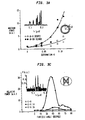
- our lasers with deformed resonators also exhibit strong directionality, as demonstrated by the far-field measurements shown in FIG. 3A and FIG. 3C.
- lasers with circular cylindrical resonators display no directionality of their output emission.
- FIG. 3B shows the calculated intensity pattern (the modulus squared of the electric field) for a WG mode in a deformed resonator with ⁇ ⁇ 0.06.
- FIG. 3C shows the actual angle-resolved far-field pattern (one quadrant) of one laser having a circular resonator and two lasers having resonators with approximately flattened quadrupolar deformation.
- the general ray motion is highly chaotic in most of the phase-space. Therefore, the likely scenario for generating directional emission is for the lasing modes to be associated with the small regions of stable, regular motion which still remain, as seen in a Poincare surface of section (SOS), not shown.
- SOS Poincare surface of section
- the second region is in the vicinity of a stable four-bounce periodic orbit with the shape of a bow-tie (FIG. 5D).
- the calculated intensity pattern for this mode is shown in FIG 3D.
- the increased deformation also influences the spectral properties of the laser, which further confirms the existence of two different modal regimes manifested so clearly in the different types of far-field patterns.
- Characteristic spectra are shown in the insets to FIGs. 3A and 3C. At relatively low deformations the data exhibit a complex, dense modal spectrum, which we interpret as the lasing of several WG modes. In addition, the lasers were multi-mode starting from the lasing threshold, with close mode spacing, ⁇ ⁇ 15 nm, and show up to 10 almost equally strong modes at the maximum optical power.
- the multi-mode behavior (including the weak side modes depicted in FIG. 3C, left inset) of the more highly deformed resonators is consistent with the emission from bow-tie modes.
- the expected theoretical value was calculated assuming that adjacent modes differ by one wavelength along the modal path of the bow-tie. This calculation yielded a mode spacing of 39.5 nm, in excellent agreement with the experiment considering the uncertainty in the effective refractive index.
- the bow-tie modes can easily be distinguished from the transverse modes of the diametral curved mirror Fabry-Perot resonator along the minor axis (length L) of the resonator.
- bow-tie modes originate from a period-doubling bifurcation of the diametral modes, leading to approximately twice the optical path length.
- this example shows that semiconductor micro-cylinder lasers with a flattened quadrupolar resonators, sufficiently deformed to support bow-tie lasing modes, have substantially improved power output and directionality. In the favorable directions of the far-field power increases ofup to three orders of magnitude have been obtained.
- micro-cylinder is not so restricted and is intended to embrace cylindrical resonators with a wide variety of aspect ratios; i.e., those which have relatively small diameters and are relatively thin, as well those which have larger diameters and are thicker.
- our invention also embraces a micro-cylinder resonator which has the shape of a modified stadium shown in FIG.
- a resonator which includes a central section 20 having essentially parallel sides 20.1 and, on each end thereof, a circular section 22 which is not a full hemisphere (i.e., each circular section subtends an angle ⁇ which is less than 180°).
- the dimensions of the resonator are determined, as with other embodiments of our invention, by Poincare surface-of-section analysis to identify those configurations which support librational modes.
Landscapes
- Physics & Mathematics (AREA)
- Electromagnetism (AREA)
- Engineering & Computer Science (AREA)
- Plasma & Fusion (AREA)
- Optics & Photonics (AREA)
- Semiconductor Lasers (AREA)
- Lasers (AREA)
Claims (18)
- Laser à solide comprenant
un résonateur cylindrique ayant une bordure courbée (12), et
une région active à solide (12.1) située dans ledit résonateur et susceptible de générer une émission de radiation stimulée lorsqu'elle est pompée convenablement, caractérisé en ce que
la forme de ladite bordure et l'indice de réfraction effectif dudit résonateur sont adaptés mutuellement pour prendre en charge au moins un mode librationnel (figures 5C, 5D) de ladite radiation. - Laser à solide selon la revendication 1 dans lequel ledit résonateur prend en charge un mode librationnel sélectionné parmi le groupe consistant en des modes papillon et des modes en forme de V.
- Laser à solide selon la revendication 1 dans lequel l'indice de réfraction effectif dudit résonateur est supérieur à approximativement deux.
- Laser à solide selon la revendication 3 dans lequel ledit résonateur comprend au moins une région de gaine (12.2, 12.3) adjacente à ladite région active et dans lequel l'indice de réfraction effectif dudit résonateur est supérieur à environ trois.
- Laser à solide selon la revendication 1 dans lequel ladite bordure a la forme d'une courbe convexe.
- Laser à solide selon la revendication 1 dans lequel ladite bordure dudit résonateur est déformée de la circularité approximativement selon la fonction de déformation quadripolaire
- Laser à solide selon la revendication 6 dans lequel k = 1 et la fonction de déformation est quadripolaire simple.
- Laser à solide selon la revendication 6 dans lequel k < 1 et la fonction de déformation est quadripolaire aplatie.
- Laser à solide selon la revendication 6 dans lequel k > 1 et la fonction de déformation est quadripolaire bombée.
- Laser à solide selon la revendication 1 dans lequel ladite région active comprend un matériau semi-conducteur.
- Laser à solide selon la revendication 10 dans lequel ladite région active comprend un matériau semi-conducteur à composés de groupes III à V.
- Laser à solide selon la revendication 11 dans lequel ladite région active comprend une région active à cascade quantique.
- Laser à solide selon la revendication 11 dans lequel la bordure dudit résonateur est déformée de la circularité approximativement selon une fonction quadripolaire aplatie
- Laser à solide selon la revendication 13 dans lequel ladite région active comprend une multiplicité de couches d'InGaAs et InAlAs.
- Laser à solide selon la revendication 1 dans lequel ledit résonateur (figure 6) comprend une section centrale (20) ayant essentiellement des côtés parallèles et, sur chaque extrémité de ceux-ci, une section circulaire (22) qui sous-tend un angle inférieur à 180°.
- Laser à solide selon la revendication 1 dans lequel
ladite région active est une région active à cascade quantique,
ledit résonateur comprend un corps semi-conducteur de forme cylindrique comprenant une paire de régions de gaine et ladite région active disposée entre lesdites régions de gaine, au moins ladite région active comprenant une multiplicité de couches d'InGaAs et InAlAs, ladite bordure étant une courbe convexe et formant ledit résonateur à cavité susceptible de prendre en charge des modes laser de radiation stimulée lorsque ladite région active est pompée convenablement,
ladite bordure étant déformée de la circularité approximativement selon une fonction quadripolaire aplatie r(ϕ)∝[1+2ε(cos2ϕ)]½, dans laquelle ε ≥ 0,12, de sorte que ledit résonateur prend en charge au moins un mode librationnel. - Laser à solide selon la revendication 16 dans lequel ladite déformation est suffisante audit résonateur pour prendre en charge au moins un mode librationnel papillon.
- Laser à solide selon la revendication 16 dans lequel ladite déformation est suffisante audit résonateur pour prendre en charge au moins un mode librationnel en forme de V.
Applications Claiming Priority (2)
| Application Number | Priority Date | Filing Date | Title |
|---|---|---|---|
| US63577 | 1993-05-19 | ||
| US09/063,577 US6134257A (en) | 1998-04-21 | 1998-04-21 | Solid state laser for operation in librational modes |
Publications (3)
| Publication Number | Publication Date |
|---|---|
| EP0952641A2 EP0952641A2 (fr) | 1999-10-27 |
| EP0952641A3 EP0952641A3 (fr) | 2003-04-16 |
| EP0952641B1 true EP0952641B1 (fr) | 2005-09-14 |
Family
ID=22050137
Family Applications (1)
| Application Number | Title | Priority Date | Filing Date |
|---|---|---|---|
| EP99302856A Expired - Lifetime EP0952641B1 (fr) | 1998-04-21 | 1999-04-13 | Résonateur laser à l'état solide |
Country Status (4)
| Country | Link |
|---|---|
| US (2) | US6134257A (fr) |
| EP (1) | EP0952641B1 (fr) |
| JP (1) | JP3494918B2 (fr) |
| DE (1) | DE69927201T2 (fr) |
Families Citing this family (46)
| Publication number | Priority date | Publication date | Assignee | Title |
|---|---|---|---|---|
| US6134257A (en) * | 1998-04-21 | 2000-10-17 | Lucent Technologies Inc. | Solid state laser for operation in librational modes |
| JP3658194B2 (ja) * | 1998-07-10 | 2005-06-08 | キヤノン株式会社 | リング共振器型レーザ |
| US6487232B1 (en) * | 1998-11-24 | 2002-11-26 | Agilent Technologies, Inc. | System and method for suppressing multimoding behavior of lasers |
| WO2001014929A1 (fr) * | 1999-08-23 | 2001-03-01 | The Arizona Board Of Regents Acting On Behalf Of The University Of Arizona | Dispositifs optoelectroniques integres hybrides |
| DE10108079A1 (de) * | 2000-05-30 | 2002-09-12 | Osram Opto Semiconductors Gmbh | Optisch gepumpte oberflächenemittierende Halbleiterlaservorrichtung und Verfahren zu deren Herstellung |
| WO2002052653A1 (fr) * | 2000-12-25 | 2002-07-04 | Lev Vasilievich Kozhitov | Dispositifs semi-conducteurs non planaires munis d'une couche active close cylindrique |
| US6483734B1 (en) | 2001-11-26 | 2002-11-19 | Hewlett Packard Company | Memory device having memory cells capable of four states |
| US7654140B2 (en) * | 2002-03-12 | 2010-02-02 | Cornell Research Foundation, Inc. | Heat pumped parametric MEMS device |
| US20040109692A1 (en) * | 2002-12-09 | 2004-06-10 | James Plante | FSO communication systems having high performance detectors |
| US7359418B2 (en) | 2003-02-13 | 2008-04-15 | Hamamatsu Photonics K.K. | Quantum cascade laser |
| JP4494721B2 (ja) * | 2003-02-13 | 2010-06-30 | 浜松ホトニクス株式会社 | 量子カスケードレーザ |
| US6882675B2 (en) * | 2003-04-15 | 2005-04-19 | Lucent Technologies Inc. | Optical resonators that include chaotic ray paths |
| US7535656B2 (en) | 2005-06-15 | 2009-05-19 | Daylight Solutions, Inc. | Lenses, optical sources, and their couplings |
| US7492806B2 (en) * | 2005-06-15 | 2009-02-17 | Daylight Solutions, Inc. | Compact mid-IR laser |
| US20100243891A1 (en) * | 2005-06-15 | 2010-09-30 | Timothy Day | Compact mid-ir laser |
| US7843283B2 (en) * | 2005-11-09 | 2010-11-30 | Cornell Research Foundation, Inc. | MEMS controlled oscillator |
| US7424042B2 (en) | 2006-09-22 | 2008-09-09 | Daylight Solutions, Inc. | Extended tuning in external cavity quantum cascade lasers |
| US7920608B2 (en) | 2007-03-12 | 2011-04-05 | Daylight Solutions, Inc. | Quantum cascade laser suitable for portable applications |
| US20090028197A1 (en) * | 2007-07-25 | 2009-01-29 | Daylight Solutions Inc | Fixed wavelength mid infrared laser source with an external cavity |
| US7668420B2 (en) * | 2007-07-26 | 2010-02-23 | Hewlett-Packard Development Company, L.P. | Optical waveguide ring resonator with an intracavity active element |
| US7848382B2 (en) * | 2008-01-17 | 2010-12-07 | Daylight Solutions, Inc. | Laser source that generates a plurality of alternative wavelength output beams |
| US8565275B2 (en) | 2008-04-29 | 2013-10-22 | Daylight Solutions, Inc. | Multi-wavelength high output laser source assembly with precision output beam |
| US9086375B2 (en) | 2008-04-29 | 2015-07-21 | Daylight Solutions, Inc. | Laser source with a large spectral range |
| FR2932616B1 (fr) * | 2008-06-13 | 2010-07-30 | Commissariat Energie Atomique | Dispositif laser d'emission d'onde terahertz |
| US8774244B2 (en) | 2009-04-21 | 2014-07-08 | Daylight Solutions, Inc. | Thermal pointer |
| RU2423764C1 (ru) * | 2009-12-07 | 2011-07-10 | Учреждение Российской академии наук Институт физики микроструктур РАН | Резонатор на модах шепчущей галереи с вертикальным выходом излучения |
| WO2011156033A2 (fr) | 2010-03-15 | 2011-12-15 | Daylight Solutions, Inc. | Source laser qui génère un faisceau de sortie changeant rapidement |
| US8335413B2 (en) | 2010-05-14 | 2012-12-18 | Daylight Solutions, Inc. | Optical switch |
| US8467430B2 (en) | 2010-09-23 | 2013-06-18 | Daylight Solutions, Inc. | Continuous wavelength tunable laser source with optimum orientation of grating and gain medium |
| US9225148B2 (en) | 2010-09-23 | 2015-12-29 | Daylight Solutions, Inc. | Laser source assembly with thermal control and mechanically stable mounting |
| US9042688B2 (en) | 2011-01-26 | 2015-05-26 | Daylight Solutions, Inc. | Multiple port, multiple state optical switch |
| US9059562B2 (en) | 2011-06-23 | 2015-06-16 | Daylight Solutions, Inc. | Control system for directing power to a laser assembly |
| US9093813B2 (en) | 2011-10-11 | 2015-07-28 | Daylight Solutions, Inc. | Mounting base for a laser system |
| US9496674B2 (en) | 2012-08-28 | 2016-11-15 | Daylight Solutions, Inc. | Rapidly tunable laser assembly |
| US9077137B2 (en) | 2013-03-08 | 2015-07-07 | Daylight Solutions, Inc. | Laser assembly with package beam pointing registration |
| US9147995B2 (en) | 2013-03-15 | 2015-09-29 | Daylight Solutions, Inc. | Rapidly tunable laser source assembly with long stroke grating mover |
| US9088126B2 (en) | 2013-10-17 | 2015-07-21 | The Trustees Of Princeton University | Single-mode quantum cascade lasers with enhanced tuning range |
| US10208902B2 (en) | 2013-10-23 | 2019-02-19 | Daylight Solutions, Inc. | Light source assembly with multiple, disparate light sources |
| US9791113B2 (en) | 2013-10-23 | 2017-10-17 | Daylight Solutions, Inc. | Light source assembly with multiple, disparate light sources |
| US11009217B2 (en) | 2013-10-23 | 2021-05-18 | Daylight Solutions, Inc. | Light source assembly with multiple, disparate light sources |
| RU2577787C2 (ru) | 2014-03-05 | 2016-03-20 | Юрий Георгиевич Шретер | Полупроводниковое светоизлучающее устройство с осью симметрии |
| DE102015108529A1 (de) | 2015-05-29 | 2016-12-01 | Osram Opto Semiconductors Gmbh | Halbleiterlaserdiode und Verfahren zur Herstellung einer Halbleiterlaserdiode |
| KR102384228B1 (ko) * | 2015-09-30 | 2022-04-07 | 삼성전자주식회사 | 반도체 레이저 공진기 및 이를 포함하는 반도체 레이저 소자 |
| KR102196386B1 (ko) * | 2019-07-10 | 2020-12-29 | 경북대학교 산학협력단 | 레이저 다이오드, 광 집적 소자, 및 이의 제조 방법 |
| JP7328656B2 (ja) * | 2020-05-11 | 2023-08-17 | 日本電信電話株式会社 | カオス振動発生装置 |
| CN114552349A (zh) * | 2020-11-24 | 2022-05-27 | 中国科学技术大学 | 椭圆柱形光学微谐振腔及椭圆柱形光学微谐振腔制备方法 |
Family Cites Families (6)
| Publication number | Priority date | Publication date | Assignee | Title |
|---|---|---|---|---|
| US4638485A (en) * | 1984-03-20 | 1987-01-20 | University Of Utah | Solid state vibrational lasers using F-center/molecular-defect pairs in alkali halides |
| US4829537A (en) * | 1986-12-01 | 1989-05-09 | Spectra-Physics, Inc. | Solid state lasers with spherical resonators |
| CA2068899C (fr) * | 1991-09-17 | 1997-06-17 | Samuel Leverte Mccall | Micro-resonateur a mode de chuchotement |
| US5351261A (en) * | 1993-04-14 | 1994-09-27 | At&T Bell Laboratories | Integrated optics |
| US5742633A (en) * | 1996-10-02 | 1998-04-21 | Yale University | Asymmetric resonant optical cavity apparatus |
| US6134257A (en) * | 1998-04-21 | 2000-10-17 | Lucent Technologies Inc. | Solid state laser for operation in librational modes |
-
1998
- 1998-04-21 US US09/063,577 patent/US6134257A/en not_active Expired - Lifetime
-
1999
- 1999-04-13 DE DE69927201T patent/DE69927201T2/de not_active Expired - Lifetime
- 1999-04-13 EP EP99302856A patent/EP0952641B1/fr not_active Expired - Lifetime
- 1999-04-20 JP JP11280899A patent/JP3494918B2/ja not_active Expired - Lifetime
-
2000
- 2000-06-12 US US09/591,716 patent/US6333944B1/en not_active Expired - Lifetime
Also Published As
| Publication number | Publication date |
|---|---|
| US6333944B1 (en) | 2001-12-25 |
| US6134257A (en) | 2000-10-17 |
| EP0952641A3 (fr) | 2003-04-16 |
| DE69927201D1 (de) | 2005-10-20 |
| JPH11330629A (ja) | 1999-11-30 |
| JP3494918B2 (ja) | 2004-02-09 |
| DE69927201T2 (de) | 2006-06-29 |
| EP0952641A2 (fr) | 1999-10-27 |
Similar Documents
| Publication | Publication Date | Title |
|---|---|---|
| EP0952641B1 (fr) | Résonateur laser à l'état solide | |
| McCall et al. | Whispering‐gallery mode microdisk lasers | |
| Gerard et al. | Quantum boxes as active probes for photonic microstructures: The pillar microcavity case | |
| Gmachl et al. | Long-wavelength (9.5-11.5/spl mu/m) microdisk quantum-cascade lasers | |
| Mawst et al. | Resonant self‐aligned‐stripe antiguided diode laser array | |
| Gianordoli et al. | Long-wavelength (/spl lambda/= 10/spl mu/m) quadrupolar-shaped GaAs-AlGaAs microlasers | |
| Mawst et al. | Antiresonant reflecting optical waveguide‐type, single‐mode diode lasers | |
| Gourley et al. | High‐efficiency TEM continuous‐wave (Al, Ga) As epitaxial surface‐emitting lasers and effect of half‐wave periodic gain | |
| US20030189963A1 (en) | Low threshold microcavity light emitter | |
| US5539759A (en) | Single mode laser with a passive antiguide region | |
| US6370179B1 (en) | Low threshold microcavity light emitter | |
| Madhan Raj et al. | Multiple micro-cavity laser with benzocyclobutene/semiconductor high reflective mirrors fabricated by CH 4/H 2-reactive ion etching | |
| US20070053397A1 (en) | Angled faceted emitter | |
| Shimokawa et al. | Continuous‐wave operation and mirror loss of a U‐shaped GaAs/AlGaAs laser diode with two totally reflecting mirrors | |
| Dikopoltsev et al. | Topological insulator VCSEL array | |
| US20160181470A1 (en) | High peak power quantum cascade superluminescent emitter | |
| Ou et al. | High‐power cw operation of InGaAs/GaAs surface‐emitting lasers with 45° intracavity micro‐mirrors | |
| Fang et al. | An InGaAs-GaAs strained layer single quantum-well ring laser with a reactive ion-etched tetragonal cavity | |
| Largent et al. | Fabrication of unstable resonator diode lasers | |
| Fang et al. | A corner reflector InGaAs-GaAs strained layer single quantum well coupled laser array | |
| Shinohara et al. | Long-path formation in a deformed microdisk laser | |
| Fallahi et al. | High power vertical external cavity surface emitting lasers and their applications | |
| Frateschi et al. | Analysis of nonplanar wave propagation through multilayered Bragg reflectors for folded cavity and vertical cavity surface emitting laser structures | |
| Mujagić et al. | Coherence and beam shaping in Quantum Cascade Lasers | |
| Moiseev et al. | Investigation of microlasers with broken rotational symmetry of the cavity and InGaAs/GaAs quantum well-dots in active region |
Legal Events
| Date | Code | Title | Description |
|---|---|---|---|
| PUAI | Public reference made under article 153(3) epc to a published international application that has entered the european phase |
Free format text: ORIGINAL CODE: 0009012 |
|
| AK | Designated contracting states |
Kind code of ref document: A2 Designated state(s): AT BE CH CY DE DK ES FI FR GB GR IE IT LI LU MC NL PT SE |
|
| AX | Request for extension of the european patent |
Free format text: AL;LT;LV;MK;RO;SI |
|
| RAP1 | Party data changed (applicant data changed or rights of an application transferred) |
Owner name: YALE UNIVERSITY Owner name: MAX-PLANCK-GESELLSCHAFT ZUR FOERDERUNG DER WISSEN Owner name: LUCENT TECHNOLOGIES INC. |
|
| PUAL | Search report despatched |
Free format text: ORIGINAL CODE: 0009013 |
|
| AK | Designated contracting states |
Designated state(s): AT BE CH CY DE DK ES FI FR GB GR IE IT LI LU MC NL PT SE |
|
| AX | Request for extension of the european patent |
Extension state: AL LT LV MK RO SI |
|
| 17P | Request for examination filed |
Effective date: 20031002 |
|
| 17Q | First examination report despatched |
Effective date: 20031104 |
|
| AKX | Designation fees paid |
Designated state(s): DE FR GB |
|
| GRAP | Despatch of communication of intention to grant a patent |
Free format text: ORIGINAL CODE: EPIDOSNIGR1 |
|
| GRAS | Grant fee paid |
Free format text: ORIGINAL CODE: EPIDOSNIGR3 |
|
| GRAA | (expected) grant |
Free format text: ORIGINAL CODE: 0009210 |
|
| AK | Designated contracting states |
Kind code of ref document: B1 Designated state(s): DE FR GB |
|
| REG | Reference to a national code |
Ref country code: GB Ref legal event code: FG4D |
|
| RIC1 | Information provided on ipc code assigned before grant |
Ipc: 7H 01S 5/30 B Ipc: 7H 01S 5/10 B Ipc: 7H 01S 3/06 A |
|
| REF | Corresponds to: |
Ref document number: 69927201 Country of ref document: DE Date of ref document: 20051020 Kind code of ref document: P |
|
| ET | Fr: translation filed | ||
| PLBE | No opposition filed within time limit |
Free format text: ORIGINAL CODE: 0009261 |
|
| STAA | Information on the status of an ep patent application or granted ep patent |
Free format text: STATUS: NO OPPOSITION FILED WITHIN TIME LIMIT |
|
| 26N | No opposition filed |
Effective date: 20060615 |
|
| REG | Reference to a national code |
Ref country code: FR Ref legal event code: CD Owner name: ALCATEL-LUCENT USA INC. Effective date: 20131122 |
|
| REG | Reference to a national code |
Ref country code: FR Ref legal event code: GC Effective date: 20140410 |
|
| REG | Reference to a national code |
Ref country code: FR Ref legal event code: RG Effective date: 20141015 |
|
| REG | Reference to a national code |
Ref country code: FR Ref legal event code: PLFP Year of fee payment: 18 |
|
| REG | Reference to a national code |
Ref country code: FR Ref legal event code: PLFP Year of fee payment: 19 |
|
| REG | Reference to a national code |
Ref country code: FR Ref legal event code: PLFP Year of fee payment: 20 |
|
| PGFP | Annual fee paid to national office [announced via postgrant information from national office to epo] |
Ref country code: DE Payment date: 20180420 Year of fee payment: 20 |
|
| PGFP | Annual fee paid to national office [announced via postgrant information from national office to epo] |
Ref country code: FR Payment date: 20180420 Year of fee payment: 20 |
|
| PGFP | Annual fee paid to national office [announced via postgrant information from national office to epo] |
Ref country code: GB Payment date: 20180418 Year of fee payment: 20 |
|
| REG | Reference to a national code |
Ref country code: DE Ref legal event code: R071 Ref document number: 69927201 Country of ref document: DE |
|
| REG | Reference to a national code |
Ref country code: GB Ref legal event code: PE20 Expiry date: 20190412 |
|
| PG25 | Lapsed in a contracting state [announced via postgrant information from national office to epo] |
Ref country code: GB Free format text: LAPSE BECAUSE OF EXPIRATION OF PROTECTION Effective date: 20190412 |