EP0952692A2 - Méthode de commande d'un système digital - Google Patents
Méthode de commande d'un système digital Download PDFInfo
- Publication number
- EP0952692A2 EP0952692A2 EP99890084A EP99890084A EP0952692A2 EP 0952692 A2 EP0952692 A2 EP 0952692A2 EP 99890084 A EP99890084 A EP 99890084A EP 99890084 A EP99890084 A EP 99890084A EP 0952692 A2 EP0952692 A2 EP 0952692A2
- Authority
- EP
- European Patent Office
- Prior art keywords
- clock
- frames
- digital
- frame
- radio telephone
- Prior art date
- Legal status (The legal status is an assumption and is not a legal conclusion. Google has not performed a legal analysis and makes no representation as to the accuracy of the status listed.)
- Granted
Links
Images

Classifications
-
- H—ELECTRICITY
- H04—ELECTRIC COMMUNICATION TECHNIQUE
- H04B—TRANSMISSION
- H04B7/00—Radio transmission systems, i.e. using radiation field
- H04B7/24—Radio transmission systems, i.e. using radiation field for communication between two or more posts
- H04B7/26—Radio transmission systems, i.e. using radiation field for communication between two or more posts at least one of which is mobile
- H04B7/2662—Arrangements for Wireless System Synchronisation
- H04B7/2671—Arrangements for Wireless Time-Division Multiple Access [TDMA] System Synchronisation
- H04B7/2678—Time synchronisation
- H04B7/2687—Inter base stations synchronisation
-
- H—ELECTRICITY
- H04—ELECTRIC COMMUNICATION TECHNIQUE
- H04B—TRANSMISSION
- H04B7/00—Radio transmission systems, i.e. using radiation field
- H04B7/24—Radio transmission systems, i.e. using radiation field for communication between two or more posts
- H04B7/26—Radio transmission systems, i.e. using radiation field for communication between two or more posts at least one of which is mobile
- H04B7/2662—Arrangements for Wireless System Synchronisation
- H04B7/2671—Arrangements for Wireless Time-Division Multiple Access [TDMA] System Synchronisation
- H04B7/2678—Time synchronisation
- H04B7/2687—Inter base stations synchronisation
- H04B7/2693—Centralised synchronisation, i.e. using external universal time reference, e.g. by using a global positioning system [GPS] or by distributing time reference over the wireline network
Definitions
- the invention relates to a method for controlling a digital system, which has a first transmission / switching system and an interface to a second digital transmission / switching system and digital, frame-summarized information is exchanged between the systems in both directions.
- the invention also relates in particular to a method for controlling the base station of a radio telephone system, such as a cordless or mobile radio system, in particular a GSM / CTS system with an interface to a digital fixed network, in particular an ISDN network.
- a radio telephone system such as a cordless or mobile radio system, in particular a GSM / CTS system with an interface to a digital fixed network, in particular an ISDN network.
- the invention also relates to a base station of a radio telephone system with an interface to a digital landline network, in particular an ISDN network, with a control unit, a high-frequency part and a local oscillator for the radio telephone system, in which the control unit has a frame counter, which a fast, the Frame is divided into short periods dividing counter clock is supplied.
- the known mobile radio systems e.g. GSM (Global System Mobile)
- GSM Global System Mobile
- the known mobile radio systems work according to the FDMA / TDMA procedure, i.e. according to frequency and time division multiplexing, the individual data bits being combined in frames in the sense of all time division multiplexing methods with digital data transmission.
- the data is sent in bursts, whereby international standards provide precise specifications with regard to the data and burst formats as well as with regard to frequency accuracy.
- the latter for example, is 0.05 ppm in the GSM system, the base stations generating an exact clock which is usually still synchronized in a PLL by a highly precise clock, for example a clock derived from a cesium standard.
- the clock generated in a local oscillator of the base station not only synchronizes the bit clock and the frame clock, but is also the reference for the transmission frequencies.
- the handsets are "slaves" in terms of clock, i.e. they synchronize with the base station when there is an existing connection.
- Cordless telephones and systems differ from mobile radio systems primarily in the cell size, which is, for example, in the range of up to approximately 300 m per base station.
- the base station of a cordless telephone system is generally connected via an interface to a fixed telephone network, in the case of conventional analog fixed networks via a corresponding two-wire connection, in the case of an ISDN network (Integrated Services Digital Network) via the standardized S o interface.
- digital landline networks such as the ISDN network, are to be considered, in which the data are also transmitted in digital form, the bits combined into frames.
- Digital landline networks differ in various respects with regard to the type of data transmission from mobile radio or cordless telephone systems, it being important for the present invention that the data are not only transmitted in frames of different lengths and with a different clock rate, but also that different requirements be placed on the clock accuracy.
- the clock accuracy in an ISDN system is fixed at only 50 or 100 ppm, whereas, as previously mentioned, 0.05 ppm is required in a GSM system.
- CTS Cordless Telephony System
- GSM 3.56 CTS Architecture Description
- GSM 2.56 CTS Service Description
- Nuremberg 10/11 Dec. 1997.
- the still different data and clock formats between DECT on the one hand and GSM on the other hand require the use of an interface converter in the base station connected to the fixed network.
- Formations according to the above-mentioned prior art are e.g. B. EP 0 690 641 A2, in which a micro-radio system based on GSM is described, but without addressing the problem of bit rate adaptation.
- EP 0 624 995 A1 describes a DECT private branch exchange, although it should be noted that the problem of bit rate adaptation is solved purely in terms of hardware in the DECT system.
- EP 0 727 882 A2 describes a method for a synchronous digital transmission system to add bytes to the bit stream or to omit bytes, which is made possible by counting the frame bytes arriving in a network node or by counting the transmitted frame bytes.
- the object of the invention is to solve the problem of different clock frequencies in the simplest possible way, i.e. with little effort on both hardware and software, the use of existing chipsets with the least possible modifications should also be allowed.
- the problem of different clock frequencies with different accuracy is to be solved in a system consisting of two transmission / switching systems as mentioned at the beginning.
- the object is achieved in that the duration of a plurality of frames of the digital landline system is measured using a radiotelephone-synchronous clock and if this period of time falls below or exceeds a desired value, the following frames of the radiotelephone system correspond to the detected deviation can be extended or shortened.
- the duration of the plurality of frames of the second system corresponds to the at least the smallest common multiple of the frame duration of the first and the frame duration of the second system.
- the measurement and correction according to the invention make it possible to compensate for the different bit rates of the two systems in a simple manner, and modifications to commercially available (GSM) chipsets and to software for base stations and cell phones are kept to a minimum.
- GSM commercially available
- the invention therefore takes a different path, which offers the advantage that it is very easy to implement, for. B. by an interrupt to read a counter reading.
- a divider is provided for the clock of the digital network or a multiple clock, which divides it into an output clock, the period of which is a common multiple of the frame duration in digital Fixed network and the frame duration in the radio telephone system, the output clock of the divider is used as a control signal for reading out the frame counter and the control unit is set up to lengthen or shorten the frames in the radio telephone system accordingly due to the difference in successive meter readings.
- the invention can be implemented particularly simply if the output clock of the divider is used to carry out an interrupt in the control unit.
- a base station for example a CTS / GSM cordless telephone system, has an interface S 0 to a digital fixed network, for example an ISDN network, also called an office header.
- a high-frequency part HFT is connected to an antenna ANT, so that there is a radio interface to a mobile part MPO.
- An essential part of the base station is formed by a control unit STE, which in principle carries out the data processing and also takes care of the baseband processing.
- a control unit STE which in principle carries out the data processing and also takes care of the baseband processing.
- the data arriving from the ISDN side on the one hand and from the CTS (GSM) side on the other hand in different frame formats are adapted in the required manner.
- the high-frequency part HFT receives its mother clock f FT from a local oscillator LOS, generally a quartz oscillator, to which the control unit STE can also supply an AFC signal, which is only indicated by dashed lines here, since it is not important for the invention.
- the local and accurate oscillator LOS is decisive for the transmission and reception frequencies used, ie the carrier frequencies are generated by multiplication or division from the frequency of the oscillator, which is for example 13 MHz.
- the operating cycle for the control unit STE on the CTS / GSM side is also derived from the output f FT of the oscillator LOS by division or multiplication, so that the bit and frame synchronization is also synchronized with the mother cycle f FT .
- the base station FIP also contains a divider DIV, the input of which is fed to the ISDN frame clock f NT with a period of 125 ⁇ s or another clock derived therefrom.
- the divider DIV divides the 125 ⁇ s clock f NT by 480, so that the output clock f IR of the divider is a 60ms clock.
- This clock fiR is fed to the control unit STE and used as a control signal to read out the counter reading of a frame counter FCC.
- the control signal can be used to trigger an interrupt on the controller or the signal processor in order to read out the counter reading.
- the frame counter FCC is used to measure the subdivision of the CTS / GSM frames into, for example, 10,000 subunits (each one eighth bit).
- the duration of a CTS / GSM frame is approximately 4.615ms
- the duration of an ISDN frame is 125 ⁇ s
- n 13 frames of the CTS / GSM system
- FCC frame counter
- the interrupt edge is the counter reading of the frame counter at any time, e.g. always counts up to 10,000 and then starts all over again, the same.
- the counter reading of the frame counter FCC changes, and the software adapts the CTS / GSM frames to the ISDN clock as quickly as possible before connecting to handsets.
- the correction value per CTS / GSM frame for the next time is then calculated on the basis of the averaged counter values in the 60 ms edge and a correction is carried out per frame if this is necessary.
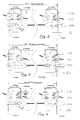
- FIGS. 2 to 4 The essence of the invention is also evident from FIGS. 2 to 4, to which reference is now made. Essentially, a period of 60 ms is considered, corresponding to 13 CTS frames or 480 ISDN frames. In all figures, the sequence of the CTS frames is shown in the first row, the frame counter or its clock in the second row, the sequence of the ISDN frames in the third row and the interrupt signal f IR in the fourth row.
- the situation can be seen from FIG. 2 if the ISDN system and the CTS system are "equally fast", i.e. run synchronously.
- the frame counter FCC counts with a clock rate of 1/8-CTS bit, that is approx. 462ns, whereby counting is always from 1 to 10,000. Since there is synchronicity, the counter reading ("1") is the same every time the counter is read, here every interrupt, and nothing can be done. Of course, the only difference is the difference in the counter readings, which is zero here, which would also be the case with a first counter reading of "333" and the same second counter reading.
- the case is that the ISDN system is "faster” than the CTS system.
- a counter reading "1" is read out, at the end of the 13th CTS frame, with the next 60 ms interrupt, a counter reading "9998". Therefore, the CTS frames must be accelerated by 3 * 1/8 bits per 60ms, i.e. three CTS frames are to be shortened each 1/8 bit within 60ms.
- FIG. 4 shows the adaptation of the CTS system to the ISDN system, here for example on the first CTS frame due to an early overflow of the counter as shown. Based on the situation in FIG. 3, this still has to be done in two of the 13 CTS frames. At the end of the 60 ms period, the counter reading is again the same, namely "1", as at the beginning; the correction has been made.
- the common time period here 60 ms
- the common time period is averaged over the two cycles.
- it is also possible, e.g. measure every 60 ms, collect a total of k measured values and then average over k, e.g. over 480ms, corresponding to k 8.
- Moving averages are also possible.
- the choice of the measurement duration or the type of averaging depends on the size of the expected clock deviations on the one hand and on the requirements for the signal quality on the other.
Landscapes
- Engineering & Computer Science (AREA)
- Computer Networks & Wireless Communication (AREA)
- Signal Processing (AREA)
- Mobile Radio Communication Systems (AREA)
- Synchronisation In Digital Transmission Systems (AREA)
- Selective Calling Equipment (AREA)
- Control Of Eletrric Generators (AREA)
Applications Claiming Priority (2)
| Application Number | Priority Date | Filing Date | Title |
|---|---|---|---|
| AT66598 | 1998-04-20 | ||
| AT0066598A AT411121B (de) | 1998-04-20 | 1998-04-20 | Verfahren zur steuerung eines digitalen systems |
Publications (3)
| Publication Number | Publication Date |
|---|---|
| EP0952692A2 true EP0952692A2 (fr) | 1999-10-27 |
| EP0952692A3 EP0952692A3 (fr) | 2005-03-09 |
| EP0952692B1 EP0952692B1 (fr) | 2007-10-03 |
Family
ID=3496593
Family Applications (1)
| Application Number | Title | Priority Date | Filing Date |
|---|---|---|---|
| EP99890084A Expired - Lifetime EP0952692B1 (fr) | 1998-04-20 | 1999-03-10 | Méthode de commande d'un système digital |
Country Status (3)
| Country | Link |
|---|---|
| EP (1) | EP0952692B1 (fr) |
| AT (2) | AT411121B (fr) |
| DE (1) | DE59914515D1 (fr) |
Family Cites Families (8)
| Publication number | Priority date | Publication date | Assignee | Title |
|---|---|---|---|---|
| EP0543327B1 (fr) * | 1991-11-20 | 1997-04-23 | Nec Corporation | Système synchrone de multiplexage optique |
| DE4315621A1 (de) * | 1993-05-11 | 1994-11-17 | Sel Alcatel Ag | Schnittstellenanordnung für den Anschluß von Basisstationen an eine Nebenstellenanlage |
| FI98429C (fi) * | 1993-08-12 | 1997-06-10 | Nokia Telecommunications Oy | CT2-puhelinjärjestelmä |
| DE69328176T2 (de) * | 1993-08-26 | 2000-12-21 | Hewlett-Packard Co., Palo Alto | Übertragungssystem |
| DE4332999C2 (de) * | 1993-09-28 | 1997-05-28 | Siemens Ag | Verfahren und Vorrichtung zum Erzeugen eines Systemaktes in Basisstationen eines mehrzellularen, drahtlosen Fernsprechsystems |
| EP0690641A3 (fr) * | 1994-06-30 | 1999-02-10 | Siemens Aktiengesellschaft | Système de radio mobile |
| EP0727887B1 (fr) * | 1995-02-16 | 2002-08-28 | Alcatel | Dispositif de justification pour système de transmission numérique synchrone |
| EP0829172B1 (fr) * | 1995-05-31 | 1999-09-22 | Siemens Aktiengesellschaft | Systeme de telecommunication cellulaire sans fil avec raccordement rnis |
-
1998
- 1998-04-20 AT AT0066598A patent/AT411121B/de not_active IP Right Cessation
-
1999
- 1999-03-10 EP EP99890084A patent/EP0952692B1/fr not_active Expired - Lifetime
- 1999-03-10 AT AT99890084T patent/ATE375037T1/de active
- 1999-03-10 DE DE59914515T patent/DE59914515D1/de not_active Expired - Lifetime
Also Published As
| Publication number | Publication date |
|---|---|
| ATA66598A (de) | 2003-02-15 |
| AT411121B (de) | 2003-09-25 |
| EP0952692B1 (fr) | 2007-10-03 |
| ATE375037T1 (de) | 2007-10-15 |
| DE59914515D1 (de) | 2007-11-15 |
| EP0952692A3 (fr) | 2005-03-09 |
Similar Documents
| Publication | Publication Date | Title |
|---|---|---|
| EP2013995B1 (fr) | Procede pour la synchronisation de modules d'une station de base | |
| AT515452B1 (de) | Zeitsynchronisation in einem Satellitennetzwerk | |
| DE60037008T2 (de) | Verfahren und vorrichtung zur synchronisierung | |
| DE69532982T2 (de) | Drahtloses Telefon | |
| EP2664087B1 (fr) | Procédé de synchronisation d'horloge d'une pluralité de modules | |
| DE69926857T2 (de) | Verfahren und Vorrichtung zur Steuerung einer Frequenz durch ein asynchrones Übertragungsnetzwerk und Funktelefonienetzwerk, das die Vorrichtung verwendet | |
| DE69123019T2 (de) | Taktlogik für tragbares Telefon im GSM System | |
| DE69532793T2 (de) | Digitales übertragungssystem mit zeitmultiplex-mehrfachzugriff und station für ein solches system | |
| DE10200039B4 (de) | Drahtloser Empfänger, Synchronisations- und Frequenzsteuerverfahren | |
| DE2149911C3 (de) | Schaltungsanordnung zur gegenseitigen Synchronisierung der in den Vermittlungsstellen eines PCM-Zeitmultiplexfernmeldenetzes vorgesehenen Amtstaktoszillatoren | |
| DE69708025T2 (de) | Frequenzgeneratorschaltung | |
| DE19630398C1 (de) | Verfahren zum Synchronisieren eines in einer Datenempfangsstation zu generierenden Taktsignals mit einem in einer Datensendestation verwendeten Taktsignal | |
| EP0363513B1 (fr) | Procedé et dispositif de réception d'un signal numérique binaire | |
| EP0256027B1 (fr) | Procede permettant le fonctionnement simultane de plusieurs terminaux sur un bloc de raccordement d'un reseau a large bande | |
| EP0963069B1 (fr) | Système de désynchronisation pour système de transmission digitale synchrone | |
| EP0952692B1 (fr) | Méthode de commande d'un système digital | |
| EP1079559A2 (fr) | Procédé et dispositif de synchronisation d'unités de système | |
| DE10028088A1 (de) | Stromdifferenzrelaiseinrichtung | |
| EP1024618B1 (fr) | Dispositif pour la synchronisation d'au moins un ensemble électronique à distance par un ensemble électronique central | |
| DE69918764T2 (de) | Kommunikationsvorrichtung mit phasenkontinuierlicher synchronisation auf eine externes netzwerk | |
| DE4333391C1 (de) | Testsystem für eine Regeneratoreinrichtung | |
| EP0952688B1 (fr) | Procédé de commande d'une station de base d'un système de téléphone radio | |
| DE69832667T2 (de) | Sende-Emfangs-Schaltung zur Verbindung einer Basisstation mit einer Steuerzentrale von Basisstationen nach der Norm DECT | |
| EP0374537B1 (fr) | Démultiplexeur avec circuit de réduction de la distorsion du temps d'attente | |
| DE3540572A1 (de) | Verfahren zur synchronisation eines empfaengers bei der digitalen datenuebertragung |
Legal Events
| Date | Code | Title | Description |
|---|---|---|---|
| PUAI | Public reference made under article 153(3) epc to a published international application that has entered the european phase |
Free format text: ORIGINAL CODE: 0009012 |
|
| AK | Designated contracting states |
Kind code of ref document: A2 Designated state(s): AT BE CH CY DE DK ES FI FR GB GR IE IT LI LU MC NL PT SE |
|
| AX | Request for extension of the european patent |
Free format text: AL;LT;LV;MK;RO;SI |
|
| PUAL | Search report despatched |
Free format text: ORIGINAL CODE: 0009013 |
|
| AK | Designated contracting states |
Kind code of ref document: A3 Designated state(s): AT BE CH CY DE DK ES FI FR GB GR IE IT LI LU MC NL PT SE |
|
| AX | Request for extension of the european patent |
Extension state: AL LT LV MK RO SI |
|
| 17P | Request for examination filed |
Effective date: 20050905 |
|
| AKX | Designation fees paid |
Designated state(s): AT DE FR GB |
|
| GRAP | Despatch of communication of intention to grant a patent |
Free format text: ORIGINAL CODE: EPIDOSNIGR1 |
|
| RAP1 | Party data changed (applicant data changed or rights of an application transferred) |
Owner name: SIEMENS HOME AND OFFICE COMMUNICATION DEVICES GMBH |
|
| GRAS | Grant fee paid |
Free format text: ORIGINAL CODE: EPIDOSNIGR3 |
|
| GRAA | (expected) grant |
Free format text: ORIGINAL CODE: 0009210 |
|
| AK | Designated contracting states |
Kind code of ref document: B1 Designated state(s): AT DE FR GB |
|
| REG | Reference to a national code |
Ref country code: GB Ref legal event code: FG4D Free format text: NOT ENGLISH |
|
| GBT | Gb: translation of ep patent filed (gb section 77(6)(a)/1977) |
Effective date: 20071016 |
|
| REF | Corresponds to: |
Ref document number: 59914515 Country of ref document: DE Date of ref document: 20071115 Kind code of ref document: P |
|
| ET | Fr: translation filed | ||
| PLBE | No opposition filed within time limit |
Free format text: ORIGINAL CODE: 0009261 |
|
| STAA | Information on the status of an ep patent application or granted ep patent |
Free format text: STATUS: NO OPPOSITION FILED WITHIN TIME LIMIT |
|
| 26N | No opposition filed |
Effective date: 20080704 |
|
| REG | Reference to a national code |
Ref country code: GB Ref legal event code: 732E Free format text: REGISTERED BETWEEN 20100506 AND 20100512 |
|
| REG | Reference to a national code |
Ref country code: FR Ref legal event code: PLFP Year of fee payment: 17 |
|
| PGFP | Annual fee paid to national office [announced via postgrant information from national office to epo] |
Ref country code: DE Payment date: 20150320 Year of fee payment: 17 |
|
| PGFP | Annual fee paid to national office [announced via postgrant information from national office to epo] |
Ref country code: GB Payment date: 20150319 Year of fee payment: 17 Ref country code: AT Payment date: 20150320 Year of fee payment: 17 Ref country code: FR Payment date: 20150319 Year of fee payment: 17 |
|
| REG | Reference to a national code |
Ref country code: DE Ref legal event code: R082 Ref document number: 59914515 Country of ref document: DE Representative=s name: MICHALSKI HUETTERMANN & PARTNER PATENTANWAELTE, DE Ref country code: DE Ref legal event code: R081 Ref document number: 59914515 Country of ref document: DE Owner name: GIGASET COMMUNICATIONS GMBH, DE Free format text: FORMER OWNER: GIGASET COMMUNICATIONS GMBH, 81379 MUENCHEN, DE |
|
| REG | Reference to a national code |
Ref country code: DE Ref legal event code: R119 Ref document number: 59914515 Country of ref document: DE |
|
| REG | Reference to a national code |
Ref country code: AT Ref legal event code: MM01 Ref document number: 375037 Country of ref document: AT Kind code of ref document: T Effective date: 20160310 |
|
| GBPC | Gb: european patent ceased through non-payment of renewal fee |
Effective date: 20160310 |
|
| REG | Reference to a national code |
Ref country code: FR Ref legal event code: ST Effective date: 20161130 |
|
| PG25 | Lapsed in a contracting state [announced via postgrant information from national office to epo] |
Ref country code: DE Free format text: LAPSE BECAUSE OF NON-PAYMENT OF DUE FEES Effective date: 20161001 Ref country code: GB Free format text: LAPSE BECAUSE OF NON-PAYMENT OF DUE FEES Effective date: 20160310 Ref country code: FR Free format text: LAPSE BECAUSE OF NON-PAYMENT OF DUE FEES Effective date: 20160331 |
|
| PG25 | Lapsed in a contracting state [announced via postgrant information from national office to epo] |
Ref country code: AT Free format text: LAPSE BECAUSE OF NON-PAYMENT OF DUE FEES Effective date: 20160310 |