EP0953220B1 - Puits thermique optiquement transparent pour le refroidissement d'un element d'un laser dans le sens de la longueur - Google Patents
Puits thermique optiquement transparent pour le refroidissement d'un element d'un laser dans le sens de la longueur Download PDFInfo
- Publication number
- EP0953220B1 EP0953220B1 EP97953214A EP97953214A EP0953220B1 EP 0953220 B1 EP0953220 B1 EP 0953220B1 EP 97953214 A EP97953214 A EP 97953214A EP 97953214 A EP97953214 A EP 97953214A EP 0953220 B1 EP0953220 B1 EP 0953220B1
- Authority
- EP
- European Patent Office
- Prior art keywords
- laser element
- oth
- laser
- etalon
- heat
- Prior art date
- Legal status (The legal status is an assumption and is not a legal conclusion. Google has not performed a legal analysis and makes no representation as to the accuracy of the status listed.)
- Expired - Lifetime
Links
- 238000001816 cooling Methods 0.000 title claims description 32
- BJQHLKABXJIVAM-UHFFFAOYSA-N bis(2-ethylhexyl) phthalate Chemical group CCCCC(CC)COC(=O)C1=CC=CC=C1C(=O)OCC(CC)CCCC BJQHLKABXJIVAM-UHFFFAOYSA-N 0.000 claims description 131
- 230000003287 optical effect Effects 0.000 claims description 73
- 239000000463 material Substances 0.000 claims description 64
- 238000000576 coating method Methods 0.000 claims description 63
- 239000011248 coating agent Substances 0.000 claims description 60
- 238000002310 reflectometry Methods 0.000 claims description 35
- 230000005855 radiation Effects 0.000 claims description 30
- 238000000034 method Methods 0.000 claims description 25
- 238000006243 chemical reaction Methods 0.000 claims description 17
- 238000005086 pumping Methods 0.000 claims description 9
- 239000007787 solid Substances 0.000 claims 3
- 239000007769 metal material Substances 0.000 claims 1
- 239000013078 crystal Substances 0.000 description 25
- 229910052594 sapphire Inorganic materials 0.000 description 15
- 239000010980 sapphire Substances 0.000 description 15
- 238000012546 transfer Methods 0.000 description 9
- 229910017502 Nd:YVO4 Inorganic materials 0.000 description 7
- 238000010521 absorption reaction Methods 0.000 description 6
- 230000003667 anti-reflective effect Effects 0.000 description 6
- 230000008901 benefit Effects 0.000 description 6
- 230000005540 biological transmission Effects 0.000 description 6
- 230000006378 damage Effects 0.000 description 6
- 230000008569 process Effects 0.000 description 5
- RYGMFSIKBFXOCR-UHFFFAOYSA-N Copper Chemical compound [Cu] RYGMFSIKBFXOCR-UHFFFAOYSA-N 0.000 description 4
- 229910052802 copper Inorganic materials 0.000 description 4
- 239000010949 copper Substances 0.000 description 4
- 238000009826 distribution Methods 0.000 description 4
- 238000010438 heat treatment Methods 0.000 description 4
- 239000004593 Epoxy Substances 0.000 description 3
- 238000004458 analytical method Methods 0.000 description 3
- 238000005229 chemical vapour deposition Methods 0.000 description 3
- 229910003460 diamond Inorganic materials 0.000 description 3
- 239000010432 diamond Substances 0.000 description 3
- 238000004519 manufacturing process Methods 0.000 description 3
- 229910003334 KNbO3 Inorganic materials 0.000 description 2
- 229910003327 LiNbO3 Inorganic materials 0.000 description 2
- 230000002411 adverse Effects 0.000 description 2
- 239000002131 composite material Substances 0.000 description 2
- 238000009792 diffusion process Methods 0.000 description 2
- 230000000694 effects Effects 0.000 description 2
- 239000003292 glue Substances 0.000 description 2
- 238000012986 modification Methods 0.000 description 2
- 230000004048 modification Effects 0.000 description 2
- TWNQGVIAIRXVLR-UHFFFAOYSA-N oxo(oxoalumanyloxy)alumane Chemical compound O=[Al]O[Al]=O TWNQGVIAIRXVLR-UHFFFAOYSA-N 0.000 description 2
- 230000009467 reduction Effects 0.000 description 2
- 230000003746 surface roughness Effects 0.000 description 2
- 239000002470 thermal conductor Substances 0.000 description 2
- 230000008646 thermal stress Effects 0.000 description 2
- 229910052782 aluminium Inorganic materials 0.000 description 1
- XAGFODPZIPBFFR-UHFFFAOYSA-N aluminium Chemical compound [Al] XAGFODPZIPBFFR-UHFFFAOYSA-N 0.000 description 1
- 239000006117 anti-reflective coating Substances 0.000 description 1
- 238000013459 approach Methods 0.000 description 1
- 230000000712 assembly Effects 0.000 description 1
- 238000000429 assembly Methods 0.000 description 1
- 230000000903 blocking effect Effects 0.000 description 1
- 239000006227 byproduct Substances 0.000 description 1
- 238000004364 calculation method Methods 0.000 description 1
- 238000004891 communication Methods 0.000 description 1
- 238000009833 condensation Methods 0.000 description 1
- 230000005494 condensation Effects 0.000 description 1
- 238000010276 construction Methods 0.000 description 1
- 238000007796 conventional method Methods 0.000 description 1
- 230000008878 coupling Effects 0.000 description 1
- 238000010168 coupling process Methods 0.000 description 1
- 238000005859 coupling reaction Methods 0.000 description 1
- 230000001186 cumulative effect Effects 0.000 description 1
- 238000013500 data storage Methods 0.000 description 1
- 238000005137 deposition process Methods 0.000 description 1
- 238000013461 design Methods 0.000 description 1
- 238000010586 diagram Methods 0.000 description 1
- 230000008030 elimination Effects 0.000 description 1
- 238000003379 elimination reaction Methods 0.000 description 1
- 239000010408 film Substances 0.000 description 1
- 230000017525 heat dissipation Effects 0.000 description 1
- 238000007726 management method Methods 0.000 description 1
- 239000013307 optical fiber Substances 0.000 description 1
- 230000001902 propagating effect Effects 0.000 description 1
- 229910052761 rare earth metal Inorganic materials 0.000 description 1
- 150000002910 rare earth metals Chemical class 0.000 description 1
- 238000011160 research Methods 0.000 description 1
- 239000004065 semiconductor Substances 0.000 description 1
- 229910000679 solder Inorganic materials 0.000 description 1
- 230000035882 stress Effects 0.000 description 1
- 239000000758 substrate Substances 0.000 description 1
- 239000010409 thin film Substances 0.000 description 1
- 229910001428 transition metal ion Inorganic materials 0.000 description 1
- LSGOVYNHVSXFFJ-UHFFFAOYSA-N vanadate(3-) Chemical compound [O-][V]([O-])([O-])=O LSGOVYNHVSXFFJ-UHFFFAOYSA-N 0.000 description 1
- 229910052727 yttrium Inorganic materials 0.000 description 1
- VWQVUPCCIRVNHF-UHFFFAOYSA-N yttrium atom Chemical compound [Y] VWQVUPCCIRVNHF-UHFFFAOYSA-N 0.000 description 1
Images



Classifications
-
- H—ELECTRICITY
- H01—ELECTRIC ELEMENTS
- H01S—DEVICES USING THE PROCESS OF LIGHT AMPLIFICATION BY STIMULATED EMISSION OF RADIATION [LASER] TO AMPLIFY OR GENERATE LIGHT; DEVICES USING STIMULATED EMISSION OF ELECTROMAGNETIC RADIATION IN WAVE RANGES OTHER THAN OPTICAL
- H01S3/00—Lasers, i.e. devices using stimulated emission of electromagnetic radiation in the infrared, visible or ultraviolet wave range
- H01S3/05—Construction or shape of optical resonators; Accommodation of active medium therein; Shape of active medium
- H01S3/06—Construction or shape of active medium
- H01S3/0627—Construction or shape of active medium the resonator being monolithic, e.g. microlaser
-
- H—ELECTRICITY
- H01—ELECTRIC ELEMENTS
- H01S—DEVICES USING THE PROCESS OF LIGHT AMPLIFICATION BY STIMULATED EMISSION OF RADIATION [LASER] TO AMPLIFY OR GENERATE LIGHT; DEVICES USING STIMULATED EMISSION OF ELECTROMAGNETIC RADIATION IN WAVE RANGES OTHER THAN OPTICAL
- H01S3/00—Lasers, i.e. devices using stimulated emission of electromagnetic radiation in the infrared, visible or ultraviolet wave range
- H01S3/02—Constructional details
- H01S3/04—Arrangements for thermal management
- H01S3/042—Arrangements for thermal management for solid state lasers
-
- H—ELECTRICITY
- H01—ELECTRIC ELEMENTS
- H01S—DEVICES USING THE PROCESS OF LIGHT AMPLIFICATION BY STIMULATED EMISSION OF RADIATION [LASER] TO AMPLIFY OR GENERATE LIGHT; DEVICES USING STIMULATED EMISSION OF ELECTROMAGNETIC RADIATION IN WAVE RANGES OTHER THAN OPTICAL
- H01S3/00—Lasers, i.e. devices using stimulated emission of electromagnetic radiation in the infrared, visible or ultraviolet wave range
- H01S3/05—Construction or shape of optical resonators; Accommodation of active medium therein; Shape of active medium
- H01S3/08—Construction or shape of optical resonators or components thereof
- H01S3/081—Construction or shape of optical resonators or components thereof comprising three or more reflectors
- H01S3/082—Construction or shape of optical resonators or components thereof comprising three or more reflectors defining a plurality of resonators, e.g. for mode selection or suppression
-
- H—ELECTRICITY
- H01—ELECTRIC ELEMENTS
- H01S—DEVICES USING THE PROCESS OF LIGHT AMPLIFICATION BY STIMULATED EMISSION OF RADIATION [LASER] TO AMPLIFY OR GENERATE LIGHT; DEVICES USING STIMULATED EMISSION OF ELECTROMAGNETIC RADIATION IN WAVE RANGES OTHER THAN OPTICAL
- H01S3/00—Lasers, i.e. devices using stimulated emission of electromagnetic radiation in the infrared, visible or ultraviolet wave range
- H01S3/10—Controlling the intensity, frequency, phase, polarisation or direction of the emitted radiation, e.g. switching, gating, modulating or demodulating
- H01S3/106—Controlling the intensity, frequency, phase, polarisation or direction of the emitted radiation, e.g. switching, gating, modulating or demodulating by controlling devices placed within the cavity
- H01S3/108—Controlling the intensity, frequency, phase, polarisation or direction of the emitted radiation, e.g. switching, gating, modulating or demodulating by controlling devices placed within the cavity using non-linear optical devices, e.g. exhibiting Brillouin or Raman scattering
- H01S3/109—Frequency multiplication, e.g. harmonic generation
-
- G—PHYSICS
- G02—OPTICS
- G02F—OPTICAL DEVICES OR ARRANGEMENTS FOR THE CONTROL OF LIGHT BY MODIFICATION OF THE OPTICAL PROPERTIES OF THE MEDIA OF THE ELEMENTS INVOLVED THEREIN; NON-LINEAR OPTICS; FREQUENCY-CHANGING OF LIGHT; OPTICAL LOGIC ELEMENTS; OPTICAL ANALOGUE/DIGITAL CONVERTERS
- G02F1/00—Devices or arrangements for the control of the intensity, colour, phase, polarisation or direction of light arriving from an independent light source, e.g. switching, gating or modulating; Non-linear optics
- G02F1/35—Non-linear optics
- G02F1/3501—Constructional details or arrangements of non-linear optical devices, e.g. shape of non-linear crystals
- G02F1/3503—Structural association of optical elements, e.g. lenses, with the non-linear optical device
-
- H—ELECTRICITY
- H01—ELECTRIC ELEMENTS
- H01S—DEVICES USING THE PROCESS OF LIGHT AMPLIFICATION BY STIMULATED EMISSION OF RADIATION [LASER] TO AMPLIFY OR GENERATE LIGHT; DEVICES USING STIMULATED EMISSION OF ELECTROMAGNETIC RADIATION IN WAVE RANGES OTHER THAN OPTICAL
- H01S2302/00—Amplification / lasing wavelength
-
- H—ELECTRICITY
- H01—ELECTRIC ELEMENTS
- H01S—DEVICES USING THE PROCESS OF LIGHT AMPLIFICATION BY STIMULATED EMISSION OF RADIATION [LASER] TO AMPLIFY OR GENERATE LIGHT; DEVICES USING STIMULATED EMISSION OF ELECTROMAGNETIC RADIATION IN WAVE RANGES OTHER THAN OPTICAL
- H01S2303/00—Pumping wavelength
-
- H—ELECTRICITY
- H01—ELECTRIC ELEMENTS
- H01S—DEVICES USING THE PROCESS OF LIGHT AMPLIFICATION BY STIMULATED EMISSION OF RADIATION [LASER] TO AMPLIFY OR GENERATE LIGHT; DEVICES USING STIMULATED EMISSION OF ELECTROMAGNETIC RADIATION IN WAVE RANGES OTHER THAN OPTICAL
- H01S3/00—Lasers, i.e. devices using stimulated emission of electromagnetic radiation in the infrared, visible or ultraviolet wave range
- H01S3/02—Constructional details
- H01S3/025—Constructional details of solid state lasers, e.g. housings or mountings
-
- H—ELECTRICITY
- H01—ELECTRIC ELEMENTS
- H01S—DEVICES USING THE PROCESS OF LIGHT AMPLIFICATION BY STIMULATED EMISSION OF RADIATION [LASER] TO AMPLIFY OR GENERATE LIGHT; DEVICES USING STIMULATED EMISSION OF ELECTROMAGNETIC RADIATION IN WAVE RANGES OTHER THAN OPTICAL
- H01S3/00—Lasers, i.e. devices using stimulated emission of electromagnetic radiation in the infrared, visible or ultraviolet wave range
- H01S3/02—Constructional details
- H01S3/04—Arrangements for thermal management
- H01S3/0401—Arrangements for thermal management of optical elements being part of laser resonator, e.g. windows, mirrors, lenses
-
- H—ELECTRICITY
- H01—ELECTRIC ELEMENTS
- H01S—DEVICES USING THE PROCESS OF LIGHT AMPLIFICATION BY STIMULATED EMISSION OF RADIATION [LASER] TO AMPLIFY OR GENERATE LIGHT; DEVICES USING STIMULATED EMISSION OF ELECTROMAGNETIC RADIATION IN WAVE RANGES OTHER THAN OPTICAL
- H01S3/00—Lasers, i.e. devices using stimulated emission of electromagnetic radiation in the infrared, visible or ultraviolet wave range
- H01S3/02—Constructional details
- H01S3/04—Arrangements for thermal management
- H01S3/0405—Conductive cooling, e.g. by heat sinks or thermo-electric elements
-
- H—ELECTRICITY
- H01—ELECTRIC ELEMENTS
- H01S—DEVICES USING THE PROCESS OF LIGHT AMPLIFICATION BY STIMULATED EMISSION OF RADIATION [LASER] TO AMPLIFY OR GENERATE LIGHT; DEVICES USING STIMULATED EMISSION OF ELECTROMAGNETIC RADIATION IN WAVE RANGES OTHER THAN OPTICAL
- H01S3/00—Lasers, i.e. devices using stimulated emission of electromagnetic radiation in the infrared, visible or ultraviolet wave range
- H01S3/05—Construction or shape of optical resonators; Accommodation of active medium therein; Shape of active medium
- H01S3/06—Construction or shape of active medium
- H01S3/0602—Crystal lasers or glass lasers
-
- H—ELECTRICITY
- H01—ELECTRIC ELEMENTS
- H01S—DEVICES USING THE PROCESS OF LIGHT AMPLIFICATION BY STIMULATED EMISSION OF RADIATION [LASER] TO AMPLIFY OR GENERATE LIGHT; DEVICES USING STIMULATED EMISSION OF ELECTROMAGNETIC RADIATION IN WAVE RANGES OTHER THAN OPTICAL
- H01S3/00—Lasers, i.e. devices using stimulated emission of electromagnetic radiation in the infrared, visible or ultraviolet wave range
- H01S3/05—Construction or shape of optical resonators; Accommodation of active medium therein; Shape of active medium
- H01S3/06—Construction or shape of active medium
- H01S3/0602—Crystal lasers or glass lasers
- H01S3/0604—Crystal lasers or glass lasers in the form of a plate or disc
-
- H—ELECTRICITY
- H01—ELECTRIC ELEMENTS
- H01S—DEVICES USING THE PROCESS OF LIGHT AMPLIFICATION BY STIMULATED EMISSION OF RADIATION [LASER] TO AMPLIFY OR GENERATE LIGHT; DEVICES USING STIMULATED EMISSION OF ELECTROMAGNETIC RADIATION IN WAVE RANGES OTHER THAN OPTICAL
- H01S3/00—Lasers, i.e. devices using stimulated emission of electromagnetic radiation in the infrared, visible or ultraviolet wave range
- H01S3/05—Construction or shape of optical resonators; Accommodation of active medium therein; Shape of active medium
- H01S3/06—Construction or shape of active medium
- H01S3/0602—Crystal lasers or glass lasers
- H01S3/0612—Non-homogeneous structure
-
- H—ELECTRICITY
- H01—ELECTRIC ELEMENTS
- H01S—DEVICES USING THE PROCESS OF LIGHT AMPLIFICATION BY STIMULATED EMISSION OF RADIATION [LASER] TO AMPLIFY OR GENERATE LIGHT; DEVICES USING STIMULATED EMISSION OF ELECTROMAGNETIC RADIATION IN WAVE RANGES OTHER THAN OPTICAL
- H01S3/00—Lasers, i.e. devices using stimulated emission of electromagnetic radiation in the infrared, visible or ultraviolet wave range
- H01S3/05—Construction or shape of optical resonators; Accommodation of active medium therein; Shape of active medium
- H01S3/08—Construction or shape of optical resonators or components thereof
- H01S3/081—Construction or shape of optical resonators or components thereof comprising three or more reflectors
- H01S3/0813—Configuration of resonator
- H01S3/0815—Configuration of resonator having 3 reflectors, e.g. V-shaped resonators
-
- H—ELECTRICITY
- H01—ELECTRIC ELEMENTS
- H01S—DEVICES USING THE PROCESS OF LIGHT AMPLIFICATION BY STIMULATED EMISSION OF RADIATION [LASER] TO AMPLIFY OR GENERATE LIGHT; DEVICES USING STIMULATED EMISSION OF ELECTROMAGNETIC RADIATION IN WAVE RANGES OTHER THAN OPTICAL
- H01S3/00—Lasers, i.e. devices using stimulated emission of electromagnetic radiation in the infrared, visible or ultraviolet wave range
- H01S3/05—Construction or shape of optical resonators; Accommodation of active medium therein; Shape of active medium
- H01S3/08—Construction or shape of optical resonators or components thereof
- H01S3/081—Construction or shape of optical resonators or components thereof comprising three or more reflectors
- H01S3/0813—Configuration of resonator
- H01S3/0816—Configuration of resonator having 4 reflectors, e.g. Z-shaped resonators
-
- H—ELECTRICITY
- H01—ELECTRIC ELEMENTS
- H01S—DEVICES USING THE PROCESS OF LIGHT AMPLIFICATION BY STIMULATED EMISSION OF RADIATION [LASER] TO AMPLIFY OR GENERATE LIGHT; DEVICES USING STIMULATED EMISSION OF ELECTROMAGNETIC RADIATION IN WAVE RANGES OTHER THAN OPTICAL
- H01S3/00—Lasers, i.e. devices using stimulated emission of electromagnetic radiation in the infrared, visible or ultraviolet wave range
- H01S3/09—Processes or apparatus for excitation, e.g. pumping
- H01S3/091—Processes or apparatus for excitation, e.g. pumping using optical pumping
- H01S3/094—Processes or apparatus for excitation, e.g. pumping using optical pumping by coherent light
- H01S3/0941—Processes or apparatus for excitation, e.g. pumping using optical pumping by coherent light of a laser diode
- H01S3/09415—Processes or apparatus for excitation, e.g. pumping using optical pumping by coherent light of a laser diode the pumping beam being parallel to the lasing mode of the pumped medium, e.g. end-pumping
-
- H—ELECTRICITY
- H01—ELECTRIC ELEMENTS
- H01S—DEVICES USING THE PROCESS OF LIGHT AMPLIFICATION BY STIMULATED EMISSION OF RADIATION [LASER] TO AMPLIFY OR GENERATE LIGHT; DEVICES USING STIMULATED EMISSION OF ELECTROMAGNETIC RADIATION IN WAVE RANGES OTHER THAN OPTICAL
- H01S3/00—Lasers, i.e. devices using stimulated emission of electromagnetic radiation in the infrared, visible or ultraviolet wave range
- H01S3/14—Lasers, i.e. devices using stimulated emission of electromagnetic radiation in the infrared, visible or ultraviolet wave range characterised by the material used as the active medium
- H01S3/16—Solid materials
- H01S3/1601—Solid materials characterised by an active (lasing) ion
- H01S3/1603—Solid materials characterised by an active (lasing) ion rare earth
- H01S3/1611—Solid materials characterised by an active (lasing) ion rare earth neodymium
-
- H—ELECTRICITY
- H01—ELECTRIC ELEMENTS
- H01S—DEVICES USING THE PROCESS OF LIGHT AMPLIFICATION BY STIMULATED EMISSION OF RADIATION [LASER] TO AMPLIFY OR GENERATE LIGHT; DEVICES USING STIMULATED EMISSION OF ELECTROMAGNETIC RADIATION IN WAVE RANGES OTHER THAN OPTICAL
- H01S3/00—Lasers, i.e. devices using stimulated emission of electromagnetic radiation in the infrared, visible or ultraviolet wave range
- H01S3/14—Lasers, i.e. devices using stimulated emission of electromagnetic radiation in the infrared, visible or ultraviolet wave range characterised by the material used as the active medium
- H01S3/16—Solid materials
- H01S3/163—Solid materials characterised by a crystal matrix
- H01S3/1671—Solid materials characterised by a crystal matrix vanadate, niobate, tantalate
-
- H—ELECTRICITY
- H01—ELECTRIC ELEMENTS
- H01S—DEVICES USING THE PROCESS OF LIGHT AMPLIFICATION BY STIMULATED EMISSION OF RADIATION [LASER] TO AMPLIFY OR GENERATE LIGHT; DEVICES USING STIMULATED EMISSION OF ELECTROMAGNETIC RADIATION IN WAVE RANGES OTHER THAN OPTICAL
- H01S3/00—Lasers, i.e. devices using stimulated emission of electromagnetic radiation in the infrared, visible or ultraviolet wave range
- H01S3/14—Lasers, i.e. devices using stimulated emission of electromagnetic radiation in the infrared, visible or ultraviolet wave range characterised by the material used as the active medium
- H01S3/16—Solid materials
- H01S3/163—Solid materials characterised by a crystal matrix
- H01S3/1671—Solid materials characterised by a crystal matrix vanadate, niobate, tantalate
- H01S3/1673—YVO4 [YVO]
Definitions
- the present invention relates to lasers, and particularly to cooling systems for elements of a solid-state laser.
- the fundamental components of a laser include an optical cavity, a gain medium situated therein, and an energy source for pumping the gain medium.
- a diode-pumped solid-state laser which includes a solid-state gain medium pumped by optical radiation from a laser diode.
- a variety of important applications have motivated research into diode-pumped solid-state lasers, including laser display systems, optical data storage, medical instrumentation, and communications.
- one particularly useful diode-pumped solid-state laser is a microlaser, which comprises a short element (i.e. less than about five mm) of solid-state gain medium positioned in a resonant cavity.
- the pump beam is supplied by a semiconductor diode laser, which pumps the solid-state gain medium to provide energy to support laser operation within the resonant cavity.
- Two opposing reflective surfaces define the resonant cavity within which the gain medium is disposed. The opposing reflective surfaces can be formed directly on opposing ends of the solid-state gain medium, and the resulting structure is compact and reliable.
- Optically-pumped solid-state lasers have many advantages relative to other lasers, including high efficiency, small size, and low cost.
- problems still exist; for example, high temperatures within any of the optical elements can adversely affect performance.
- heat is unavoidably produced during absorption of optical pumping radiation, and to a much lesser extent, heat is produced by absorption of lasant radiation.
- Temperature buildup is particularly a problem during continuous wave (cw) operation as opposed to pulsed operation, because there is no "off" part of the cycle to dissipate heat.
- cw continuous wave
- pulsed operation because there is no "off" part of the cycle to dissipate heat.
- significant heating of the lasing volume can occur, leading to destruction of the gain medium due to thermal stresses beyond the fracture limit of the gain medium.
- heating in some lasers can lead directly to poor efficiency and reduction of output power, and severe heating can cause an inability to achieve lasing operation.
- high temperatures increase the population at the lower laser level, causing a decrease in the population inversion between the upper laser level and the lower laser level, which reduces gain, increases the lasing threshold, and lowers efficiency of energy conversion.
- heating can cause optical distortion of the laser emission within the cavity due to thermal and stress-induced birefringence.
- an increase in laser temperature causes a significant reduction in emission cross-section and/or fluorescence lifetime.
- Nd:YVO 4 has a thermal conductivity of 5.2 W/m-°C, which is low compared with better thermal conductors such as copper (about 300 W/m-°C), sapphire (about 40 W/m-°C) and even YAG (about 19 W/m-°C).
- the physical distance between the lasing mode volume and the heat sink material greatly affects the temperature of the mode volume within the solid-state gain medium. As this distance is reduced, the temperature within the lasing volume can be more effectively controlled by the heat sink.
- One common method for cooling solid-state lasers uses a "side-cooled" configuration, in which the solid-state gain medium has a cylindrical rod shape and a heat sink is connected around the perimeter of the cylinder.
- a solid-state gain medium has a very short length.
- a 1.0 mm thick gain crystal has very little surface area around its perimeter, allowing only a small area to connect the heat sink and making it difficult to side cool effectively.
- effective side cooling can be difficult because the heat sink must be kept apart from the lasing mode volume (which is the source of heat) by a predetermined amount, in order to avoid optical diffraction losses from the aperture defined by the heat sink.
- the lasing spot diameter should be less than one-third of the lateral dimensions of the solid-state laser material, including the heat sink, to avoid diffraction losses to the beam passing therethrough; i. e. the solid-state laser material should have a diameter at least three times as large as the lasing mode diameter.
- heat must flow a significant distance through the solid-state laser material before reaching the heat sink, which can give rise to a large temperature difference between the lasing spot and the heat sink. This large temperature difference can be substantial (e.g. 200-300°C) and the resulting high temperature can severely diminish the laser's performance.
- each heat sink has an aperture to allow passage of a laser beam, so that the pump beam passes through the aperture on one of the heat sinks, and the laser emission passes through the aperture on the other heat sink.
- only one heat sink is utilized, which is positioned on the pump side.
- the apertures in the two heat sinks must be larger than the laser beam diameter in order to avoid diffraction losses, and therefore the distance the heat must flow is undesirably large.
- that aperture should have a diameter approximately three times the diameter of the laser emission. For example, in high power solid-state laser systems the lasing mode diameter can approach 400 ⁇ m, thus requiring heat sink aperture diameters greater than 1.2 mm.
- Nabors discloses a sapphire heat sink that is thermally coupled to a piece of solid-state Nd:YAG laser material (a "laser microchip") on the end opposite to the pumping end.
- the geometry of the sapphire heat sink was chosen to promote longitudinal heat flow and to minimize large-scale transverse thermal gradients and edge effects in the microchip laser, which tend to destablilize and smear out the spatial modes.
- the microchip laser's pump side is coated with a high-reflector dielectric stack that is highly reflective at the lasing wavelength of 1064 nm and highly transmitting for the 809 nm pump light.
- the back surface of the laser microchip that forms the output coupler has a reflectivity of 98% at 1064 nm, and is highly reflective of the pump light as well, and therefore, the laser cavity is defined solely within the gain medium.
- the first surface of the sapphire heat sink is not coated, and is adhered to the back surface of the Nd:YAG.
- the second surface of the sapphire heat sink is antireflection coated for 1064 nm.
- the Fresnel loss at that interface would unfortunately become very significant. After multiple passes through the interface, even a small Fresnel loss is multiplied enough during lasing operation that the cumulative losses can substantially reduce the laser's output power, increase the laser threshold, or even prevent lasing altogether.
- the increased intracavity loss is particularly disadvantageous for intracavity frequency-converted systems because an intracavity loss competes with the nonlinear conversion processes and thus reduces generation of the frequency-converted radiation.
- a gain medium it can be advantageous to cool a gain medium.
- a system that includes a nonlinear crystal to convert a laser emission to a second frequency it can be advantageous to cool the nonlinear crystal.
- side cooling systems similar to those used with a gain medium to cool nonlinear crystals from the side.
- side cooling systems introduce thermal gradients within the nonlinear crystal that can reduce conversion efficiency and cause amplitude instabilities.
- the thermal gradient associated with side cooling the nonlinear material may also require aggressive cooling that increases cooling system requirements and costs, and can lead to other problems, such as condensation on the heat sink which could lead to increased cost and complexity of the system.
- the longitudinal cooling system described herein provides an apparatus and method to cool elements within a solid-state laser and thereby provide more effective operation, particularly at high powers.
- the laser element comprises a solid-state gain medium and in that instance, more efficient lasing operation is provided by the reduced temperature.
- the longitudinal cooling system is particularly useful for thin solid-state laser materials having a thickness along the propagation axis of less than 5.0 mm, in which side cooling will have only limited effectiveness.
- the laser element comprises a nonlinear frequency conversion crystal, so that the cooling system provides a more symmetric temperature distribution within the crystal, thereby improving frequency conversion efficiency, helping to maintain a stable amplitude (i.e. avoid amplitude instabilities), and reducing cooling system requirements.
- the OTH can lend strength to the overall assembly because it is stronger and less susceptible to fractures than the laser element, which may comprise a fragile crystal.
- a longitudinally-cooled laser element assembly comprises an optically transparent heat sink (OTH) coupled to a laser element and a heat sink.
- An etalon structure including a first flat surface and a second, substantially parallel flat surface is formed in the laser element and/or the OTH. In some embodiments, the etalon is balanced by providing approximately equal reflectivities on the first and second flat surfaces.
- the longitudinally-cooled laser element assembly comprises a laser element having an etalon structure that includes a first flat surface and a second flat surface.
- An optically transparent heat sink (OTH) having higher thermal conductivity than the laser element is coupled to the first flat surface of the laser element at a first interface directly along the beam path in order to provide effective heat transfer from the laser element.
- a heat sink preferably comprising a high thermal conductivity material such as copper, is connected to the OTH to provide heat transfer from the OTH.
- the heat sink is situated as closely to the beam path as possible without blocking it or introducing substantial diffraction losses.
- the OTH effectively cools the laser element by drawing heat longitudinally from the laser element and conducting it through the OTH and to the heat sink where the heat is dissipated.
- the etalon structure reduces optical losses at the interfaces between the etalon surfaces and the adjoining material, whether it be an OTH or air.
- the etalon structure can assist in selecting the desired lasing mode.
- loss is further reduced by "balancing" the etalon so that the reflectivity at the interface between the OTH and the laser element is balanced by an approximately equal reflectivity on the side of the etalon opposite the interface. Because the reflectivities on both sides of the etalon are approximately equal, losses are substantially reduced.
- the reflectivity necessary to balance the etalon is created by a reflective dielectric coating on the opposite side and in other embodiments such reflectivity is created by connecting a material having a substantially equal index of refraction, such as a second OTH, to the opposite side.
- a material having a substantially equal index of refraction such as a second OTH
- the materials on either side of the etalon may have different indexes of refraction, and the etalon can be balanced by providing a coating at one or both of the interfaces with a reflectivity that compensates for the different indexes.
- the Fresnel loss may be low enough that the etalon may be left unbalanced, and in these embodiments the second flat surface may be coated for anti-reflection.
- the laser element comprises a gain medium
- the laser element comprises a nonlinear material.
- longitudinal cooling provides more uniform, symmetric temperature distribution within the nonlinear material (i.e. the reduced thermal gradients along the beam path).
- the symmetric temperature distribution provides more efficient frequency conversion.
- the heat transfer provided by the OTH allows the temperature of the nonlinear crystal to be maintained closer to the optimum phase matching temperature across the mode volume of the laser beam, which is important due to the finite phase matching temperature acceptance of certain frequency conversion processes in nonlinear crystals.
- more uniform temperature distribution within the nonlinear material avoids inconsistent phase retardation, which could otherwise reduce both efficiency and amplitude stability for some nonlinear processes.
- longitudinal cooling of nonlinear materials using OTHs improves the efficiency of frequency conversion and also helps to maintain a stable output amplitude (i.e. avoids amplitude instabilities in the converted beam).
- the outer surface of the OTH (i.e. the surface distal from the interface) can be coated with any necessary coatings instead of coating the laser element.
- the optical coating on that side of the laser element can be eliminated, and if the laser element uses an OTH on both sides, then the optical coatings on both sides can be eliminated.
- elimination of the optical coating on the laser element has cost benefits because the optical coating can be applied to the less expensive OTH rather than the more expensive laser element, thus transferring the risk of damage to the OTH and allowing the laser element to be handled without the special handling requirement of coated materials.
- the OTH materials are typically more robust (i.e. more durable) than the crystals sometimes used for laser elements, higher yields on coating runs for OTH material are possible with vacuum film deposition processes. Also, a more durable OTH material can stabilize and protect the more fragile solid-state gain medium from damage during manufacturing and subsequent use.
- an "etalon” structure is defined by a pair of opposing, parallel flat surfaces.
- the two flat surfaces of an etalon are highly parallel and very smooth, for example the surfaces may be parallel to less than ten arc-seconds and preferably less than five arc-seconds and have a surface roughness less than fifteen ⁇ rms and preferably five ⁇ rms.
- an etalon structure is formed by a laser element, and in other embodiments an etalon structure is formed by an optically transparent heat sink ("OTH").
- Etalons are typically used in laser cavities to spectrally filter the laser emission.
- a balanced etalon is an etalon in which the reflectivities at the two opposing parallel surfaces of the etalon are approximately equal.
- Eq. 2 approximates the effective reflectivity (R eff ) of the etalon at each ⁇ m : where, as a fractional percentage of incident power:
- Eq. 2 can be used to calculate the effective reflectivity of the mirror for resonant wavelengths.
- the effective reflectivity of the OTH for resonant wavelengths is calculated using Eq. 2 at 99.88%, and thus the effective reflectivity of the etalon differs from the loss at the highly reflective coating by only 0.02%.
- a round trip loss of about 2.38% is avoided, which has significant impact on laser performance particularly when intracavity frequency conversion processes are employed.
- Fig. 1 is an exploded, perspective view of a longitudinally-cooled laser assembly including a laser element 100 situated between a first OTH 110 and a second OTH 120.
- the laser element 100 may, for example, comprise a solid-state gain medium or a non-linear crystal.
- solid-state gain media include rare-earth doped materials including Nd 3+ , Er 3+ , Yb 3+ , Tm 3+ , or Ho 3+ doped materials or transition metal ion (e.g. Cr 4+ ) doped materials.
- nonlinear crystals include KTP, LiNbO 3 , and KNbO 3 .
- Another example of a laser element is a composite of materials such as a solid-state gain medium and a nonlinear crystal that together form a composite laser cavity, such as that described in U.S. Patent No. 5,574,740, assigned to the same assignee as herein.
- Some materials suitable for the OTHs 110 and 120 include sapphire (Al 2 O 3 ), diamond, and undoped (white) YAG, among other materials.
- the material selected for the OTHs should have a high optical transparency at the wavelength(s) where high transmission is desirable.
- the OTH material should have high thermal conductivity relative to the solid-state gain medium (i.e. a higher thermal conductivity than the gain medium); for example, sapphire would be appropriate for Nd:YVO 4 because the thermal conductivity of Nd:YVO 4 is 5.2 W/m-°C and the thermal conductivity of sapphire is 40 W/m-°C.
- the laser element 100 has a first smooth flat surface 105 formed on a first side and a second smooth flat surface 107 formed on a second, opposite side.
- the first and second flat surfaces 105 and 107 have an opposing, substantially parallel relationship so that together, the first and second flat surfaces 105 and 107 form an etalon.
- the two flat surfaces of the etalon are parallel to less than 10 arc-seconds and have a highly polished surface that exhibits a surface roughness of better than fifteen ⁇ rms and preferably five ⁇ rms.
- the first OTH 110 includes a first side 115 and a second side 117.
- the second side has a flat, smooth surface designed to fit closely with the first surface 105 of the laser element.
- the second side has a flatness sufficient for bonding to the first surface 105 by optical contact.
- the opposing sides 115 and 117 of the OTH are formed to etalon tolerances (i.e. parallel to less than 10 arc-seconds) and have highly polished surfaces.
- the first side 115 of the OTH may comprise a non-flat shape, for example the first side may comprise a curved shape (like a lens) or a flat surface angled with respect to the optical axis.
- the second OTH 120 may be identical in construction to the first OTH, and is bonded to the laser element in like manner.
- the second OTH 120 includes a first side 125 and a second side 127.
- the first side 125 of the OTH is designed to closely contact the second surface 107 of the laser element and preferably, the first side 125 of the second OTH has a flatness sufficient for bonding to the second surface 107 of the laser element by an optical contact.
- the second OTH comprises a material having approximately the same index of refraction as the first OTH; and preferably, the second OTH comprises the same type of material as the first OTH.
- the opposing sides 125 and 127 of the second OTH are formed to etalon tolerances (i.e. parallel to less than 10 arc-seconds) and have highly polished surfaces.
- any suitable bonding technique preferably optical contact, is used to bond the second side 117 of the first OTH to the first surface 105 of the laser element and the first side 125 of the second OTH to the second surface 107 of the laser element. Because it is usually unnecessary to optically coat the two surfaces, they can be bonded together by conventional optical contact methods rather than the more expensive (and lower yield) techniques.
- glue, epoxy, or diffusion bonding may be used to bond the OTH to the laser element.
- it may be useful or necessary to coat one of the two surfaces to be bonded together for example a coating at the interface between the two surfaces may be useful in order to reflect optical radiation at a predetermined wavelength. In such embodiments it is usually preferable to coat the OTH rather than the laser element due to the higher cost and more stringent handling requirements generally associated with coating a laser element.
- a first heat sink 130 including a first metallic section 132 is thermally coupled to the first OTH 110 by any available means, such as thermally conductive epoxy, solder or other means.
- a second heat sink 140 including a first metallic section 142 is thermally coupled to the second OTH 120.
- the metallic sections 132 and 142 have a high thermal conductivity, and therefore copper or aluminum are preferred materials.
- an aperture is provided in the metallic section of each heat sink in order to allow passage of optical radiation; specifically an aperture 135 is provided in the first heat sink 130 and an aperture 145 is provided in the second heat sink 140.
- Each aperture has an appropriate shape and a sufficient size to accommodate the laser radiation passing therethrough.
- the diameter of each aperture should be at least two to three times the widest diameter of the optical radiation passing therethrough, except for a pump beam focused into a solid-state gain medium, in which case the aperture need only be slightly larger than the widest diameter of the pump beam.
- each aperture 135 and 145 should be as small as possible.
- thermal considerations and optical losses can be balanced in order to design an aperture with the appropriate shape and size.
- the aperture is shown as circular, it could have other shapes.
- the metallic heat sink could be coupled anywhere on the exposed surfaces of the OTH, for example on the edge of the OTH rather than on its face.
- the heat sink could comprise air and therefore one or both of the metallic heat sinks could be eliminated so that the OTH is air-cooled, which would reduce cost.
- a fan may be utilized to more effectively cool the OTH.
- the metallic sections 132 and 142 have a high thermal conductivity to conduct heat to heat exchangers 150 and 160, which further dissipate the heat.
- a first heat exchanger 150 is thermally coupled to the first metallic section 132 and a second heat exchanger 160 is coupled to the second heat metallic section 142.
- the heat exchangers may be devices such as a fan and/or heat fins formed in the metallic sections or as a separate component, but for more effective cooling each heat exchanger comprises a thermoelectric cooler ("TEC").
- TEC thermoelectric cooler
- each TEC has sufficient cooling power to maintain its respective metallic heat sink at a substantially constant temperature throughout its volume.
- a single heat exchanger may be connected to both the first and second heat sinks.
- one or both of the heat exchangers may be omitted, and/or one or both of the metallic heat sinks may be omitted. For example, if the heat transfer requirements on one side are less than the other, the heat exchanger on that side may be omitted.
- Fig. 2 is a cross-sectional side view of a longitudinally-cooled laser assembly in which the first OTH 110 and the laser element 100 are bonded together at a first interface 210, and the second OTH 120 and the laser element 100 are bonded together at a second interface 220.
- the bonding at both interfaces is preferably by optical contact although other means, such as glue, epoxy, or diffusion bonding may be used.
- the first side 115 of the first OTH has a coating 230 formed thereon, which may be reflective, anti-reflective, or a combination of reflective and anti-reflective in order to transmit or reflect optical radiation at a predetermined wavelength as appropriate for the intended application.
- the second OTH 120 on its second side 125 has a coating 240 formed thereon, which may be reflective, anti-reflective, or a combination of the two in order to transmit or reflect optical radiation as appropriate for the intended application.
- the coatings 230 and 240 may comprise dielectric layers.
- coating one or both of the OTHs instead of the laser element is usually easier (and therefore less costly) from a manufacturing standpoint.
- coating one or both of the OTHs instead of the laser element reduces the risk of damage to the laser element which is typically more expensive and more fragile.
- heat flow is illustrated by arrows 250 and 260. Specifically, heat will flow longitudinally to the left as illustrated by arrows 250 and also to the right as illustrated by arrows 260.
- the heat generated in the laser element 100 by, for example absorption of optical radiation flows from the laser element, into the OTHs, and then into the heat sinks.
- Each OTH and heat sink should be designed to maximize heat flow from the laser element.
- the thickness of the OTH along the optical axis (which could be the optical axis of an optical cavity or simply the direction in which a beam is propagating) is chosen to minimize the thermal resistance (and associated temperature difference) between the laser material and heat sink, which has a higher thermal conductivity.
- R th l/kA
- l the distance between the lasing spot and the metallic heat sink
- k the thermal conductivity
- A the cross-sectional area in the plane perpendicular to the direction of heat flow.
- the optical scattering properties at the lasing wavelength should also be considered.
- the optical scattering is sufficiently low at near-infrared and visible wavelengths that scattering losses can be neglected for OTH thicknesses less than 500 ⁇ m.
- CVD Chemical Vapor Deposition
- diamond has a higher thermal conductivity, unfortunately it also has significant optical scattering properties at near infrared and visible wavelengths, which makes CVD diamond less desirable at those wavelengths than sapphire or white YAG.
- a first intracavity etalon 270 is defined between the first interface 210 and the second interface 220 by substantially flat, smooth, parallel surfaces.
- the interfaces 210 and 220 have approximately equal Fresnel losses.
- the first and second OTHs comprise identical materials so that their indexes of refraction are equal and therefore their Fresnel losses are equal.
- the first and second OTHs may comprise different materials having approximately equal indexes of refraction, which also provide approximately equal Fresnel losses.
- the first and second OTHs may comprise different materials having different indexes of refraction, and one or both of the interfaces 210 and 220 could include a coating formed to balance the Fresnel losses (i.e., provide approximately equal Fresnel losses) at the two interfaces 210 and 220.
- the etalon 270 is balanced, and therefore resonant optical radiation can pass through both interfaces 210 and 220 in the laser element with substantially no loss.
- the bonding methods used are identical at both interfaces so that each interface is as identical to the other as possible.
- a second etalon 280 is defined between the second interface 220 and the outer coating 240 on the second side of the second OTH.
- the second etalon 280 could be balanced (i.e., the outer coating 240 could be designed to balance the Fresnel loss at the second interface 220 at a predetermined wavelength).
- optical radiation at predetermined wavelengths can pass substantially loss-free through the first interface 210, the second interface 220, and the outer coating 240.
- a third etalon 290 is defined between the outer coating 230 of the first OTH and the first interface 210.
- the third etalon 290 may be balanced (i.e., the coating 230 may be designed to balance the Fresnel loss at the first interface 210 at a predetermined wavelength or wavelengths).
- optical radiation at predetermined wavelengths can pass substantially loss-free through the entire assembly, including the outer coating 230, the first interface 210, the second interface 220, and the outer coating 240.
- the outer coating 230 of the first OTH may be highly reflective (e.g. to form one mirror of a laser cavity), and in these embodiments the third etalon 290 substantially reduces the loss at the first interface 210 at resonant wavelengths, as described previously.
- the metallic heat sinks 132 and 142 are thermally coupled to draw heat longitudinally from the OTHs 110 and 120, and supply it to a heat exchanger 195 that is thermally coupled to both metallic heat sinks 132 and 142.
- Fig. 3 is a cross-sectional side view of an assembled single-sided laser element assembly in which the first OTH 110 and the laser element 100 are connected together at the first interface 210.
- the laser element 100 has the structure of an etalon 300 defined between the first interface 210 and the second flat surface 107.
- the etalon 300 is balanced, which means that the Fresnel loss at the interface 210 is approximately equal to the reflectivity at the surface 107.
- a coating 310 may be formed on the second surface 107 of the laser element. The coating 310 "balances" the Fresnel loss at the first interface 210.
- the coating 310 may, for example comprise a dielectric coating having a predetermined reflectivity at the wavelength of interest.
- the Fresnel loss may be low enough that, as discussed previously, the effective reflectivity (R eff ) according to Eq. 2 is still very small, and therefore the coating 310 may comprise an anti-reflective coating rather than a reflective coating.
- a Fresnel loss is defined as the reflective loss that occurs at an interface between two materials having different indexes of refraction.
- an optical beam will suffer a Fresnel loss that is directly related to the difference between the index of refraction of the OTH 110 and the index of refraction of the laser element 100.
- a thin film dielectric coating can be applied to the surface 107 to provide a reflectivity approximately equal to the Fresnel loss at the interface 210 at a predetermined wavelength. Because this reflectivity value approximates the Fresnel loss, a balanced etalon structure is formed between the first interface 210 and the coating 310, and as a result, optical radiation resonant with the balanced etalon passes substantially loss-free through both surfaces of the etalon.
- a second etalon 320 in the first OTH 120 between the first interface 210 and the outer coating 230 on the first side of the first OTH would be designed to balance the Fresnel loss at the first interface 210.
- both the second etalon 320 and the first etalon 300 may be implemented.
- the second etalon 320 may be implemented in the OTH while the first etalon 300 is not implemented in the laser element, and in these embodiments the distal surface 107 of the laser element may comprise an alternative shape such as a curved shape to provide focusing power or a flat angled surface to reflect predetermined wavelength(s).
- the outer coating 230 may be highly reflective, while the opposite side of the second etalon is highly transmissive.
- the outer coating 230 may comprise one of the end mirrors in a laser cavity.
- the second etalon 320 operates to substantially reduce the loss at the first interface 210 at resonant wavelengths, as described previously, even though the etalon 320 appears to be "unbalanced".
- the OTH may be utilized in a variety of configurations.
- a laser element could be cooled on one side
- a laser element could be cooled on both sides.
- the first laser element may be cooled on one or both sides and the second laser element may be cooled on one or both sides, or not at all.
- additional devices for cooling the laser element may be employed: for example, conventional side-cooling apparatus may be employed in addition to one or two OTHs.
- an OTH-cooled laser element may be situated externally from the cavity. The cooling provided by the OTHs is particularly useful at high powers, and can be very effective, particularly if the laser element is thin.
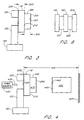
- Figs. 4 and 5 disclose exemplary embodiments of a solid-state laser in which intracavity laser elements are longitudinally-cooled cooled by an OTH.
- heat can be an unwanted byproduct of absorption of optical radiation from the pump source, absorption of laser emission, and frequency conversion, for example.
- the OTH is very effective at conducting away such heat.
- Fig. 4 is a schematic diagram of a laser including an optical cavity 400 defined between an front mirror 405, which is formed as part of the coating 230, and an back mirror 407.
- the laser element 100 comprises a solid-state gain medium 410 such as a Nd 3+ doped crystal or a Cr 4+ doped crystal situated within the optical cavity to provide a fundamental laser emission.
- One preferred gain medium 410 comprises Nd:YVO 4 .
- a nonlinear material 420 is also situated within the optical cavity to convert the fundamental laser emission to a converted frequency, which in the preferred embodiment is a doubled frequency. Examples of nonlinear optical materials include KTP, LiNbO 3 , and KNbO 3 .
- the microlaser shown in Fig. 4 can provide a high-power frequency-doubled output.
- the gain medium 410 is optically pumped by a pump source 430 such as a laser diode.
- the optical pump radiation 435 from the laser diode which diverges rapidly, may be focused into the gain medium 410, or the optical radiation may be delivered by an optical fiber.
- the laser diode may be situated closely enough to directly pump the gain medium without the need to focus the pump radiation (e.g. butt-coupled).
- the pump source 430 may comprise, for example a single laser diode, an array of laser diodes, or a laser diode bar.
- the front mirror 405, which is formed by the first optical coating 230, is highly reflective at the fundamental laser emission, and highly transmissive (anti-reflective) at the wavelength of the pump radiation.
- the front mirror 405 is formed by the first optical coating 230.
- the back mirror 407 may be formed directly on the surface of the nonlinear material and/or the coating 240 on the interior surface of the gain medium 410 and an interior coating 440 on an interior surface 445 of the nonlinear material may be coated for high transmission at the fundamental laser emission.
- the interior coating 240 may have a reflectivity approximately matching the reflectivity at the first interface 210 in order to balance the etalon formed by the gain medium 410.
- the interior surface 445 may comprise an angled reflector for the converted beam of laser radiation such as disclosed in US-A-5 761 227 filed December 5, 1996, entitled “Efficient Frequency Converted Laser".
- an angled reflector operates to reflect converted radiation from the optical cavity at an angle with respect to the optical axis of the cavity.
- Fig. 5 is an example of a laser including two doubled-sided longitudinally-cooled laser assemblies, including a first assembly 501 and a second assembly 502.
- An optical cavity 504 is defined between the front mirror 505 and an back mirror 507.
- the solid-state gain medium 410 is situated within the first assembly 501 in the optical cavity 504, and provides the fundamental laser emission.
- the nonlinear material 420 is situated in the second assembly 502 within the optical cavity, and is oriented to convert the fundamental laser emission to a converted frequency, preferably to a doubled frequency.
- the laser is pumped with optical radiation 435 from the pump source 430 (Fig. 4).
- the double-sided OTH configuration shown in Fig. 5 is very useful to dissipate the heat generated by high intensities within a high power laser; particularly, optical pumping at high intensities can generate a great deal of heat. Furthermore, although the absorption coefficient may be small, the high intensity of the fundamental laser emission can create significant heat. Also, the frequency conversion process generates heat in the nonlinear material. Cooling the gain medium 410 effectively using the double-sided OTH configuration as illustrated increases the lasing efficiency and prevents damage, and allows higher power operation to be maintained. Cooling the nonlinear material 420 using the double-sided OTH configuration ensures efficient, reliable frequency conversion.
- the solid-state gain medium 410 is situated between a first OTH 110a and a second OTH 120a.
- a etalon may be defined in each of the gain medium 410, the first OTH 110a and/or the second OTH 120a.
- a first etalon 270a is defined in the gain medium 410 between the OTHs: particularly, the first etalon 270a is defined between a first interface 210a and a second interface 220a.
- the first and second OTHs both comprise the same material -- sapphire, and therefore the etalon 270a is automatically balanced.
- the second OTH has an etalon structure, so that a second etalon 280a is defined between the interior-facing coating 240a and the interface 220a with the gain medium.
- the second etalon 280a may be balanced by designing an interior coating 240a with a reflectivity for the fundamental laser emission that matches the Fresnel loss at the second interface 220a.
- the interior coating 240a may be designed for antireflection.
- the first OTH 110a has an etalon structure, so that a third etalon 290a is defined between the coating 230a and the first interface 210a.
- the first, second, and third etalons may be employed in any combination, which allows the laser assembly to be designed to meet predetermined cost and performance criteria.
- one embodiment may include only the first etalon, and another embodiment may include only the second and third etalons.
- Another embodiment may include only the third etalon. It should be clear that the advantages provided by the etalon structure reduce loss at each surface of the assembly.
- the-nonlinear material 420 is situated between the first OTH 110b and the second OTH 120b.
- an etalon may be defined in each of the nonlinear material 420, the first OTH 110b and/or the second OTH 120b.
- a first etalon structure defines an etalon 270b between the OTHs: particularly, the etalon 270b is defined between a first interface 210b and a second interface 220b.
- both the first and second OTHs comprise sapphire or both comprise undoped YAG, and therefore the etalon 270b is balanced.
- the first OTH has an etalon structure, so that a second etalon 290b is defined in the first OTH 110b between the interior-facing coating 230b and the interface 210b with the nonlinear material.
- the second etalon 290b may be balanced by designing the interior coating 230b with a reflectivity for the fundamental laser emission that matches the Fresnel loss at the first interface 210b.
- the interior coating 230b may be designed for antireflection.
- the second OTH 120b has an etalon structure, so that a third etalon 280b is defined between the outer coating 240b and the second interface 220b.
- a first metallic heat sink 132a is thermally coupled to the first OTH 110a
- a second metallic heat sink 142a is thermally coupled to the second OTH 120a.
- the first and second metallic heat sinks 132a and 142a are thermally coupled to a heat exchanger 195a, which is preferably a thermoelectric cooler.
- a first metallic heat sink 132b is thermally coupled to the first OTH 110b
- a second metallic heat sink 142b is thermally coupled to the second OTH 120b.
- the first and second metallic heat sinks 132b and 142a are thermally coupled to a heat exchanger 195b, which is preferably a thermoelectric cooler.
- one of the metallic heat sinks in each assembly can be eliminated, which is particularly cost effective if the laser element is thin or if allowed by its heat transfer requirements.
- the first metallic heat sink 132a can be eliminated so that the first OTH 110a is air-cooled, while keeping the second metallic heat sink 142a for aggressive heat transfer.
- both of the metallic heat sinks can be eliminated so that the OTHs on both sides are air-cooled.
- the front mirror 505 is formed in the first optical coating 230a and the back mirror 507 is formed in the second optical coating 240b.
- Both the input and back mirrors include a coating that is highly reflective at the fundamental laser emission.
- the first optical coating 230a is transmissive (i.e. anti-reflective) at the pump wavelength
- the second optical coating 240b is transmissive (i.e. anti-reflective) at the converted wavelength.
- the interior facing surface of the second OTH 120a includes a coating 240a having high transmission at the fundamental laser emission.
- the interior facing surface of the first OTH 110b also includes a coating 230b having high transmission at the fundamental laser emission.
- the coating 230b on the interior-facing surface of the first OTH may be highly reflective at the converted wavelength.
- an interior surface 520 of the first OTH 110b may comprise an angled reflector for the converted beam of laser radiation such as disclosed in US-A-5 761 227 field December 5, 1996, entitled "Efficient Frequency Converted Laser". Such an angled reflector operates to reflect converted radiation from the optical cavity at an angle with respect to the optical axis of the cavity.
- an interior surface 522 of the second OTH 120a may comprise an angled reflector for the converted beam of laser radiation.
- Fig. 6 is a side view of an alternative embodiment of a laser element assembly in which a second laser element 600 and a third OTH 610 are added to the laser assembly that already includes the first OTH 110, the first laser element 100, and the second OTH 120.
- the third OTH is constructed like the first and second OTHs.
- the second laser element like the first laser element, may comprise a gain medium or a nonlinear material.
- the second laser element may comprise the same material as the first laser element, or it may be different.
- the first laser element may comprise a gain medium and the second laser element may comprise a nonlinear crystal.
- many OTHs can also provide structural strength because the OTHs are usually less susceptible to fracture than the crystals typically used for laser elements.
- etalons may be used with the embodiment of Fig. 6 to provide a low loss laser element assembly, and it is particularly useful if alternating structures in the assembly comprise an etalon.
- the first and second laser elements may each comprise an etalon structure, or in another example, the first, second, and third OTHs may each comprise etalons.
- additional laser elements or OTHs may comprise an etalon.
- all laser elements and all OTHs may comprise an etalon.
- both the first and second laser elements may comprise a gain medium, thereby providing an effective gain length equal to the sum of the thicknesses of the two gain medium elements while retaining the benefits of longitudinal cooling for both.
- additional laser elements may be alternated in like manner with the OTH: for example, a third laser element (not shown) may be coupled to the third OTH, a fourth OTH (not shown) may be coupled to the third laser element, and so forth for as many laser elements and OTHs as desired.
- the additional laser elements in such an assembly need not comprise the same material.
- one laser element may comprise a gain medium, and another may comprise a nonlinear material.
- one laser element may comprise one type of gain medium, and another laser element may comprise another type of gain medium.
- Fig. 7 is a graphical depiction that shows calculated variations in peak temperature (T max - T cool ) of the gain medium as a function of OTH thickness for an exemplary embodiment of a laser element assembly 501 (Fig. 5).
- the calculated values used to plot the graph are set forth in Table A. These values were calculated using a finite element analysis to solve thermal heat flow equations for an exemplary embodiment in which the laser element 410 (Fig. 5) is assumed to be 1 a.t. % Nd:YVO 4 with a thickness of 250 ⁇ m and a diameter of 3.0 mm.
- the laser element 410 is pumped by a laser diode that provides optical radiation 435 (Fig.
- the first and second OTHs 110a and 120a are assumed to be sapphire with equal thicknesses and a diameter of 4.0 mm.
- Both metallic heat sinks 132a and 142a are assumed to maintain a constant temperature of 20° C, and the second aperture 145 is assumed to have a diameter of 750 ⁇ m.
- the graph lines in Fig. 7 show variations in peak temperature (T max - T cool ) as a function of OTH thickness (in ⁇ m). Specifically, graph line 700 shows the calculated results if the diameter of the first aperture 135 is 500 ⁇ m, and graph line 710 shows the calculated results if the diameter of the first aperture 135 is 1000 ⁇ m. It should be noted that the analysis shown in the graph of Fig. 7 and the corresponding values in Table A have not been verified experimentally, and actual results for an implemented embodiment may vary.
- the OTHs on the side distal from the laser element may not be flat.
- one or more of the OTHs may have an angled shape or a curved shape, which may be convex or concave.
- a curved shape can be used to shape the lasing mode within the optical cavity, and the angled shape can be used to direct converted radiation from the optical cavity. Therefore, this invention is to be limited only by the following claims, which include all such embodiments and modifications when viewed in conjunction with the above specification and accompanying drawings.
Landscapes
- Physics & Mathematics (AREA)
- Electromagnetism (AREA)
- Engineering & Computer Science (AREA)
- Plasma & Fusion (AREA)
- Optics & Photonics (AREA)
- Nonlinear Science (AREA)
- Lasers (AREA)
Claims (32)
- Ensemble laser à refroidissement longitudinal situé dans une cavité laser (400, 504) définissant une trajectoire laser, comprenant :dans lequel au moins un élément dudit élément laser et dudit OTH a une structure d'étalon (115, 117, 105, 107) comprenant une première surface plate et une seconde surface plate constituée parallèlement à ladite première surface plate, ladite structure étalon étant configurée afin de réduire les pertes de Fresnel desdites surfaces dudit étalon.un élément laser (100) ;un dissipateur thermique à transparence optique (OTH) (110) relié directement à l'élément laser dans la direction de la trajectoire du laser afin d'absorber la chaleur (250) dans le sens longitudinal à partir de l'élément laser ;ledit OTH et ledit élément laser étant situés dans ladite cavité laser ; et
- Ensemble élément laser selon la revendication 1 dans lequel ledit élément laser est constitué d'un support de gain à semi-conducteur (410).
- Ensemble élément laser selon la revendication 1 dans lequel ledit élément laser est constitué d'un matériau non-linéaire (420).
- Ensemble élément laser selon la revendication 3 dans lequel ledit matériau non-linéaire est disposé pour assurer la conversion en fréquence dans ladite cavité laser.
- Ensemble élément laser selon la revendication 1 dans lequel ladite structure étalon est approximativement équilibrée.
- Ensemble élément laser selon la revendication 5 dans lequel ladite première surface plate et ladite seconde surface plate présentent des réflectivités approximativement égales de telle sorte que ladite structure étalon soit approximativement équilibrée, réduisant ainsi les pertes de Fresnel.
- Ensemble élément laser selon la revendication 5 dans lequel au moins une desdites surfaces dudit étalon comprend un revêtement (310) assurant une structure approximativement équilibrée, réduisant ainsi les pertes de Fresnel.
- Ensemble élément laser selon la revendication 4, comprenant en outre un dissipateur thermique (132) relié à l'OTH.
- Ensemble élément laser selon la revendication 8, comprenant en outre :dans lequel ledit dissipateur thermique (132) est constitué d'un matériau métallique.un refroidisseur thermoélectrique (150) relié audit dissipateur thermique ; et
- Ensemble élément laser selon la revendication 1, comprenant en outre :un second OTH (120) ayant une première face et une seconde face qui lui est opposée, ladite première face dudit second OTH étant reliée à ladite seconde surface dudit élément laser.
- Ensemble élément laser selon la revendication 10 dans lequel ledit premier OTH et ledit second OTH comprennent chacun une structure étalon configurée afin de réduire les pertes de Fresnel.
- Ensemble élément laser selon la revendication 10 dans lequel ledit élément laser comprend une structure étalon et lesdits premier et second OTH comportent des matériaux pratiquement identiques présentant des indices de réfraction pratiquement identiques tels que ladite structure étalon dudit élément laser est approximativement équilibrée.
- Ensemble élément laser selon la revendication 10 dans lequel ledit élément laser comprend une structure étalon et ledit premier OTH présente un premier indice de réfraction, ledit second OTH présente un second indice de réfraction et lesdits premier et second indices de réfraction sont pratiquement égaux de telle sorte que ledit étalon dudit élément laser est équilibré.
- Ensemble élément laser selon la revendication 1, comprenant en outre :dans lequel ledit second OTH, ledit second élément laser et ledit troisième OTH sont situés dans ladite cavité laser et directement dans la direction de la trajectoire laser de ladite cavité laser ; etun second OTH (120) ayant une première face plate et une seconde face plate qui lui est opposée, ladite première face plate dudit second OTH étant reliée audit élément laser ;un second élément laser (600) ayant une première surface plate reliée à ladite seconde face dudit second OTH et une seconde surface plate opposée à ladite première surface ;un troisième OTH (610) ayant une première face plate et une seconde face qui lui est opposée, ladite première face plate dudit troisième OTH étant reliée à ladite seconde surface dudit second élément laser ;
dans lequel au moins un élément dudit second OTH, dudit second élément laser et dudit troisième OTH présente une structure étalon incluant une première surface plate et une seconde surface plate constituées parallèlement à ladite première surface plate, ladite structure étalon étant configurée pour réduire les pertes de Fresnel desdites surfaces dudit étalon. - Ensemble élément laser selon la revendication 14 dans lequel ledit premier OTH, ledit second OTH et ledit troisième OTH comprennent chacun une structure étalon configurée pour réduire les pertes de Fresnel.
- Ensemble élément laser selon la revendication 14 dans lequel ledit premier élément laser et ledit second élément laser comprennent chacun une structure étalon configurée pour réduire les pertes de Fresnel.
- Ensemble élément laser selon la revendication 14 dans lequel lesdits premier, second et troisième OTH ont des indices de réfraction approximativement égaux, tels que lesdites première et seconde structures étalon sont approximativement équilibrées.
- Ensemble élément laser selon la revendication 1 comprenant en outre une source pompe (430) destinée à pomper ledit support de gain à semi-conducteur au moyen d'un rayonnement de pompage optique (435) afin d'exciter une émission laser à l'intérieur de ladite cavité laser.
- Ensemble élément laser selon la revendication 18 comprenant en outre un moyen (430) destiné au pompage d'extrémité dudit support de gain à semi-conducteur à l'aide d'un rayonnement de pompage optique (435).
- Ensemble élément laser selon la revendication 19 dans lequel ledit moyen de pompage d'extrémité est constitué d'une diode laser.
- Procédé de refroidissement longitudinal d'un élément laser (100) à l'intérieur d'une cavité laser (400, 504) définissant une trajectoire laser, comprenant les étapes consistant à :a) réaliser un dissipateur thermique à transparence optique (OTH) (110) relié à l'élément laser à l'intérieur de ladite cavité optique, ledit OTH et ledit élément laser étant situés directement dans la direction de ladite trajectoire laser, dans lequel au moins un des éléments de l'élément laser et de l'élément OTH a une structure étalon comprenant une première surface plate et une seconde surface plate en relation opposée, pratiquement parallèle, ladite structure étalon étant configurée pour réduire les pertes de Fresnel sur lesdites surfaces dudit étalon ;b) mettre en oeuvre ledit laser, en réduisant les pertes de Fresnel sur lesdites surfaces dudit étalon ;c) produire de la chaleur dans ledit élément laser et absorber ladite chaleur (250) dans le sens longitudinal à partir de l'élément laser et dans l'OTH ; etd) dissiper ladite chaleur à partir de l'OTH.
- Procédé selon la revendication 21 dans lequel l'étape a) comprend la mise en oeuvre d'un élément laser incluant un support de gain à semi-conducteur (410) et ladite étape b) comprend le pompage optique du support de gain à semi-conducteur.
- Procédé selon la revendication 21 dans lequel l'étape a) comprend la mise en oeuvre d'un élément laser incluant un matériau non-linéaire (420) et l'étape b) inclut la conversion de fréquence d'une émission laser fondamentale.
- Procédé selon la revendication 21 dans lequel l'élément laser inclut ladite structure étalon et dans lequel une interface entre l'élément laser et l'OTH présente une première réflectivité et comprend en outre l'étape consistant à :obtenir une seconde réflectivité (310) de l'élément laser approximativement équivalente à ladite première réflectivité de telle sorte que ledit élément laser constitue un étalon pratiquement équilibré.
- Procédé selon la revendication 21 dans lequel ladite étape d) comprend le refroidissement par air de l'OTH.
- Procédé selon la revendication 21 dans lequel ladite étape d) comprend la conduction thermique de la chaleur à partir de l'OTH au moyen d'un refroidisseur thermique métallique (132).
- Procédé selon la revendication 26 dans lequel ledit refroidisseur thermique métallique est relié pour conduire ladite chaleur vers un refroidisseur thermoélectrique (150) et comprenant en outre la dissipation de ladite chaleur dans ledit refroidisseur thermoélectrique.
- Procédé selon la revendication 1, comprenant en outre les étapes consistant à :e) réaliser un second OTH (120) relié audit élément laser, dans lequel au moins un des éléments dudit second OTH, dudit premier OTH et dudit élément laser a une structure étalon comprenant une première surface plate et une seconde surface plate en relation opposée, pratiquement parallèle ;f) permettre à une partie de ladite chaleur produite dans ledit élément laser de circuler à partir dudit élément laser et dans ledit second OTH ; etg) dissiper ladite chaleur à partir dudit second OTH.
- Procédé selon la revendication 28 dans lequel ledit élément laser comprend ladite structure étalon, et comprenant en outre l'étape consistant à obtenir un indice de réfraction dudit second OTH approximativement égal à un indice de réfraction dudit premier OTH de telle sorte que ledit élément laser constitue un étalon pratiquement équilibré.
- Procédé selon la revendication 28, comprenant en outre les étapes consistant à obtenir une première structure étalon dans ledit premier OTH et une seconde structure étalon dans ledit élément laser.
- Procédé selon la revendication 28 comprenant en outre les étapes consistant à :e) mettre en oeuvre un second élément laser (600) dans ladite cavité laser reliée audit second OTH à l'intérieur de ladite cavité laser, dans lequel au moins un des éléments dudit second élément laser, dudit second OTH, dudit premier OTH et dudit élément laser a une structure étalon comprenant une première surface plate et une seconde surface plate en relation opposée, pratiquement parallèle, ladite structure étalon étant configurée pour réduire les pertes de Fresnel ;f) produire de la chaleur dans ledit second élément laser et permettre à ladite chaleur générée dans ledit élément laser de circuler à partir dudit élément laser et dans ledit second OTH ; etg) dissiper ladite chaleur à partir dudit second OTH.
- Procédé selon la revendication 31, comprenant en outre les étapes consistant à obtenir une première structure étalon dans ledit premier OTH et une seconde structure étalon dans ledit second OTH.
Applications Claiming Priority (3)
| Application Number | Priority Date | Filing Date | Title |
|---|---|---|---|
| US08/784,051 US5796766A (en) | 1994-08-23 | 1997-01-17 | Optically transparent heat sink for longitudinally cooling an element in a laser |
| US784051 | 1997-01-17 | ||
| PCT/US1997/023029 WO1998032197A1 (fr) | 1997-01-17 | 1997-12-12 | Puits thermique optiquement transparent pour le refroidissement d'un element d'un laser dans le sens de la longueur |
Publications (2)
| Publication Number | Publication Date |
|---|---|
| EP0953220A1 EP0953220A1 (fr) | 1999-11-03 |
| EP0953220B1 true EP0953220B1 (fr) | 2002-03-13 |
Family
ID=25131197
Family Applications (1)
| Application Number | Title | Priority Date | Filing Date |
|---|---|---|---|
| EP97953214A Expired - Lifetime EP0953220B1 (fr) | 1997-01-17 | 1997-12-12 | Puits thermique optiquement transparent pour le refroidissement d'un element d'un laser dans le sens de la longueur |
Country Status (5)
| Country | Link |
|---|---|
| US (1) | US5796766A (fr) |
| EP (1) | EP0953220B1 (fr) |
| AU (1) | AU5701298A (fr) |
| DE (1) | DE69711085T2 (fr) |
| WO (1) | WO1998032197A1 (fr) |
Families Citing this family (38)
| Publication number | Priority date | Publication date | Assignee | Title |
|---|---|---|---|---|
| US6101201A (en) * | 1996-10-21 | 2000-08-08 | Melles Griot, Inc. | Solid state laser with longitudinal cooling |
| US6055815A (en) * | 1998-10-30 | 2000-05-02 | Litton Systems, Inc. | Temperature-controlled microchip laser assembly and associated submount assembly |
| US6385220B1 (en) | 1999-04-21 | 2002-05-07 | Gsi Lumonics Inc. | Laser clamping assembly and method |
| AU5168000A (en) * | 1999-05-26 | 2000-12-12 | Ii-Vi Incorporated | Improved optical contacting method and apparatus |
| US6215802B1 (en) * | 1999-05-27 | 2001-04-10 | Blue Sky Research | Thermally stable air-gap etalon for dense wavelength-division multiplexing applications |
| US6330256B1 (en) * | 2000-02-01 | 2001-12-11 | Raytheon Company | Method and apparatus for non-dispersive face-cooling of multi-crystal nonlinear optical devices |
| RU2177665C2 (ru) * | 2000-03-28 | 2001-12-27 | Сычугов Владимир Александрович | Микролазер с внутрирезонаторным удвоением частоты излучения |
| AU2001277396B2 (en) * | 2000-08-04 | 2006-01-19 | Bae Systems Australia Pty Ltd | An optical parametric oscillator and method of constructing same |
| AUPQ922000A0 (en) * | 2000-08-04 | 2000-08-31 | Bae Systems Australia Limited | Method of constructing an optical parametric oscillator |
| DE10061424A1 (de) * | 2000-12-09 | 2002-06-13 | Haas Laser Gmbh & Co Kg | Laserverstärkersystem |
| US6480515B1 (en) | 2000-12-15 | 2002-11-12 | Xerox Corporation | Optically transparent, heat conductive fluid heat sink |
| US6667999B2 (en) * | 2001-08-17 | 2003-12-23 | Textron Corporation | Cooling of high power laser systems |
| DE10204246B4 (de) * | 2002-02-02 | 2012-12-06 | Tesat-Spacecom Gmbh & Co.Kg | Festkörper-Laserverstärkersystem |
| IL149014A0 (en) * | 2002-04-07 | 2002-11-10 | Israel Atomic Energy Comm | Diamond-cooled solid state lasers |
| US6807345B2 (en) | 2002-05-28 | 2004-10-19 | Agilent Technologies, Inc. | Systems and methods for removing heat from opto-electronic components |
| US6845111B2 (en) * | 2002-09-20 | 2005-01-18 | Hrl Laboratories, Llc | Laser apparatus with improved thermal stress resistance |
| KR100531294B1 (ko) * | 2003-06-23 | 2005-11-28 | 엘지전자 주식회사 | 유기 el 소자 및 그 제조 방법 |
| US20050190805A1 (en) * | 2003-06-30 | 2005-09-01 | Scripsick Michael P. | Doped stoichiometric lithium niobate and lithium tantalate for self-frequency conversion lasers |
| KR100781255B1 (ko) * | 2003-07-18 | 2007-11-30 | 엘지전자 주식회사 | 레이저 냉각 장치 |
| DE20316550U1 (de) * | 2003-10-27 | 2005-03-10 | High Q Laser Production Gmbh | Laserelement mit laseraktivem Medium |
| US20050242301A1 (en) * | 2004-01-12 | 2005-11-03 | Advanced Light Technologies, Llc, A Corporation Of The State Of California | Targeted radiation treatment using a spectrally selective radiation emitter |
| US7352785B2 (en) * | 2004-04-30 | 2008-04-01 | Richard L. Fork | Solid state laser medium and laser medium heat transfer method |
| JP2005332989A (ja) * | 2004-05-20 | 2005-12-02 | Topcon Corp | レーザ発振装置 |
| JP2006186230A (ja) | 2004-12-28 | 2006-07-13 | Osaka Univ | 光増幅モジュール、光増幅器およびレーザ発振器 |
| US7430231B2 (en) * | 2005-04-29 | 2008-09-30 | Ningyi Luo | Vertical cavity surface emitting laser (VCSEL) arrays pumped solid-state lasers |
| US7542490B2 (en) * | 2006-04-25 | 2009-06-02 | R. J. Dwayne Miller | Reduction of surface heating effects in nonlinear crystals for high power frequency conversion of laser light |
| CN102484349B (zh) * | 2009-12-31 | 2015-12-16 | C2C晶芯科技公司 | 非线性晶体封装的方法及其在二极管泵浦固态激光器中的应用 |
| US8243764B2 (en) | 2010-04-01 | 2012-08-14 | Tucker Derek A | Frequency conversion of a laser beam using a partially phase-mismatched nonlinear crystal |
| US9077142B2 (en) * | 2011-03-15 | 2015-07-07 | Shanghai Jiao Tong University | Air-cooled laser device |
| US9515448B2 (en) | 2012-09-26 | 2016-12-06 | Raytheon Company | Microchip laser with single solid etalon and interfacial coating |
| EP2996211B1 (fr) * | 2014-09-09 | 2021-02-17 | Thorlabs Inc. | Milieu actif de laser et procédé de fabrication de celui-ci |
| US9312701B1 (en) * | 2015-07-16 | 2016-04-12 | Wi-Charge Ltd | System for optical wireless power supply |
| JP2017220652A (ja) | 2016-06-10 | 2017-12-14 | 大学共同利用機関法人自然科学研究機構 | レーザ装置とその製造方法 |
| US10401099B2 (en) | 2016-10-05 | 2019-09-03 | Raytheon Company | Transparent heat exchanger |
| JP6245587B1 (ja) | 2016-10-28 | 2017-12-13 | 大学共同利用機関法人自然科学研究機構 | レーザー部品 |
| RU2644448C1 (ru) * | 2016-11-21 | 2018-02-12 | Российская Федерация, от имени которой выступает Государственная корпорация по атомной энергии "Росатом" (Госкорпорация "Росатом") | Устройство для передачи светового излучения большой мощности |
| FR3074972B1 (fr) * | 2017-12-07 | 2020-10-16 | Commissariat Energie Atomique | Element d'un laser a disque comportant le milieu amplificateur et des moyens ameliores de refroidissement. |
| CN111952825B (zh) * | 2020-08-19 | 2023-01-13 | 科谱(宁波)科技有限公司 | 一种激光器的增益介质冷却装置 |
Family Cites Families (27)
| Publication number | Priority date | Publication date | Assignee | Title |
|---|---|---|---|---|
| US4809291A (en) * | 1984-11-26 | 1989-02-28 | Board Of Trustees, Of Leland Stanford Jr U. | Diode pumped laser and doubling to obtain blue light |
| US4739507A (en) * | 1984-11-26 | 1988-04-19 | Board Of Trustees, Stanford University | Diode end pumped laser and harmonic generator using same |
| US4872177A (en) * | 1985-05-01 | 1989-10-03 | Spectra-Physics | Laser diode pumped solid state laser |
| US4731787A (en) * | 1986-08-15 | 1988-03-15 | Board Of Trustees, Stanford University | Monolithic phasematched laser harmonic generator |
| US4797893A (en) * | 1987-06-09 | 1989-01-10 | Virgo Optics, Inc. | Microlaser system |
| US4879722A (en) * | 1987-07-27 | 1989-11-07 | Amoco Corporation | Generation of coherent optical radiation by optical mixing |
| US4879723A (en) * | 1987-07-27 | 1989-11-07 | Amoco Corporation | Intracavity generation of coherent optical radiation of optical mixing |
| US4791631A (en) * | 1987-08-31 | 1988-12-13 | International Business Machines Corporation | Wide tolerance, modulated blue laser source |
| US4953166A (en) * | 1988-02-02 | 1990-08-28 | Massachusetts Institute Of Technology | Microchip laser |
| US5115445A (en) * | 1988-02-02 | 1992-05-19 | Massachusetts Institute Of Technology | Microchip laser array |
| US4860304A (en) * | 1988-02-02 | 1989-08-22 | Massachusetts Institute Of Technology | Solid state microlaser |
| US4933947A (en) * | 1988-02-18 | 1990-06-12 | Amoco Corporation | Frequency conversion of optical radiation |
| US4847851A (en) * | 1988-05-19 | 1989-07-11 | University Of South Florida | Butt-coupled single transverse mode diode pumped laser |
| US5441803A (en) * | 1988-08-30 | 1995-08-15 | Onyx Optics | Composites made from single crystal substances |
| US4942582A (en) * | 1989-04-24 | 1990-07-17 | Spectra-Physics | Single frequency solid state laser |
| US4982405A (en) * | 1989-09-07 | 1991-01-01 | Massachusette Institute Of Technology | Coupled-cavity Q-switched laser |
| US5022745A (en) * | 1989-09-07 | 1991-06-11 | Massachusetts Institute Of Technology | Electrostatically deformable single crystal dielectrically coated mirror |
| US5063566A (en) * | 1990-04-30 | 1991-11-05 | Amoco Corporation | Internally-doubled, composite-cavity microlaser |
| US5070505A (en) * | 1990-04-30 | 1991-12-03 | Amoco Corporation | Self-doubling micro-laser |
| JPH04171779A (ja) * | 1990-11-05 | 1992-06-18 | Hoya Corp | 半導体レーザ励起固体ブルーレーザ装置 |
| US5164947A (en) * | 1991-02-28 | 1992-11-17 | Amoco Corporation | Single-frequency, frequency doubled laser |
| JPH04283977A (ja) * | 1991-03-12 | 1992-10-08 | Fuji Photo Film Co Ltd | レーザーダイオードポンピング固体レーザー |
| JPH04291976A (ja) * | 1991-03-20 | 1992-10-16 | Ricoh Co Ltd | Shg素子 |
| US5331650A (en) * | 1991-03-20 | 1994-07-19 | Ricoh Company, Ltd. | Light source device and optical pickup using light source device |
| US5363391A (en) * | 1992-04-24 | 1994-11-08 | Hughes Aircraft Company | Conductive face-cooled laser crystal |
| ATE193166T1 (de) * | 1993-08-26 | 2000-06-15 | Laser Power Corp | Tiefblauer mikrolaser |
| US5511085A (en) * | 1994-09-02 | 1996-04-23 | Light Solutions Corporation | Passively stabilized intracavity doubling laser |
-
1997
- 1997-01-17 US US08/784,051 patent/US5796766A/en not_active Expired - Lifetime
- 1997-12-12 WO PCT/US1997/023029 patent/WO1998032197A1/fr not_active Ceased
- 1997-12-12 EP EP97953214A patent/EP0953220B1/fr not_active Expired - Lifetime
- 1997-12-12 DE DE69711085T patent/DE69711085T2/de not_active Expired - Lifetime
- 1997-12-12 AU AU57012/98A patent/AU5701298A/en not_active Abandoned
Also Published As
| Publication number | Publication date |
|---|---|
| WO1998032197A1 (fr) | 1998-07-23 |
| EP0953220A1 (fr) | 1999-11-03 |
| US5796766A (en) | 1998-08-18 |
| DE69711085T2 (de) | 2002-10-31 |
| DE69711085D1 (de) | 2002-04-18 |
| AU5701298A (en) | 1998-08-07 |
Similar Documents
| Publication | Publication Date | Title |
|---|---|---|
| EP0953220B1 (fr) | Puits thermique optiquement transparent pour le refroidissement d'un element d'un laser dans le sens de la longueur | |
| US6101201A (en) | Solid state laser with longitudinal cooling | |
| US6134258A (en) | Transverse-pumped sLAB laser/amplifier | |
| US6339605B1 (en) | Active mirror amplifier system and method for a high-average power laser system | |
| US5574740A (en) | Deep blue microlaser | |
| US5774488A (en) | Solid-state laser with trapped pump light | |
| US6810060B2 (en) | High-average power active mirror solid-state laser with multiple subapertures | |
| EP1646117B1 (fr) | Amplificateur optique comprenant un matériaux de gain en plaque zig-zag pompé longitudinalement | |
| US6111900A (en) | Solid-state laser apparatus and method with second harmonic wave features | |
| EP1867012B1 (fr) | Laser a solide a tube a pompage lateral | |
| US20070297469A1 (en) | Cryogenically Cooled Solid State Lasers | |
| US6667999B2 (en) | Cooling of high power laser systems | |
| KR20060121900A (ko) | 다이오드 펌핑된 마이크로 레이저를 생산하기 위한 고밀도방법 | |
| EP0943167A1 (fr) | Laser a conversion de frequence | |
| EP0974177B1 (fr) | Appareil de cavite de pompage laser a plaque thermiquement ameliore et comportant un concentrateur integre | |
| US7724800B2 (en) | Power scaleable thin disk lasers | |
| US20190089120A1 (en) | Solid-state laser systems | |
| JP2000133863A (ja) | 固体レーザ装置 | |
| JP5424320B2 (ja) | 固体レーザ装置 | |
| WO2001067562A2 (fr) | Laser a conversion de frequence efficace a sortie monofaisceau | |
| US20240377111A1 (en) | Power-scalable cryogenic optical refrigerator | |
| US20060285571A1 (en) | Diode-pumped, solid-state laser with chip-shaped laser medium and heat sink | |
| WO1999060673A2 (fr) | Laser dope | |
| JP5007799B2 (ja) | 3次元ディスクレーザ | |
| Zapata et al. | High average power Yb: YAG laser |
Legal Events
| Date | Code | Title | Description |
|---|---|---|---|
| PUAI | Public reference made under article 153(3) epc to a published international application that has entered the european phase |
Free format text: ORIGINAL CODE: 0009012 |
|
| 17P | Request for examination filed |
Effective date: 19990716 |
|
| AK | Designated contracting states |
Kind code of ref document: A1 Designated state(s): DE FR GB NL |
|
| GRAG | Despatch of communication of intention to grant |
Free format text: ORIGINAL CODE: EPIDOS AGRA |
|
| 17Q | First examination report despatched |
Effective date: 20010625 |
|
| RAP1 | Party data changed (applicant data changed or rights of an application transferred) |
Owner name: MELLES GRIOT, INC. |
|
| GRAG | Despatch of communication of intention to grant |
Free format text: ORIGINAL CODE: EPIDOS AGRA |
|
| GRAH | Despatch of communication of intention to grant a patent |
Free format text: ORIGINAL CODE: EPIDOS IGRA |
|
| RIN1 | Information on inventor provided before grant (corrected) |
Inventor name: NELTE, SVEN, E. Inventor name: HARGIS, DAVID, E. |
|
| GRAH | Despatch of communication of intention to grant a patent |
Free format text: ORIGINAL CODE: EPIDOS IGRA |
|
| REG | Reference to a national code |
Ref country code: GB Ref legal event code: IF02 |
|
| GRAA | (expected) grant |
Free format text: ORIGINAL CODE: 0009210 |
|
| AK | Designated contracting states |
Kind code of ref document: B1 Designated state(s): DE FR GB NL |
|
| PG25 | Lapsed in a contracting state [announced via postgrant information from national office to epo] |
Ref country code: NL Free format text: LAPSE BECAUSE OF FAILURE TO SUBMIT A TRANSLATION OF THE DESCRIPTION OR TO PAY THE FEE WITHIN THE PRESCRIBED TIME-LIMIT Effective date: 20020313 Ref country code: FR Free format text: LAPSE BECAUSE OF FAILURE TO SUBMIT A TRANSLATION OF THE DESCRIPTION OR TO PAY THE FEE WITHIN THE PRESCRIBED TIME-LIMIT Effective date: 20020313 |
|
| REF | Corresponds to: |
Ref document number: 69711085 Country of ref document: DE Date of ref document: 20020418 |
|
| NLV1 | Nl: lapsed or annulled due to failure to fulfill the requirements of art. 29p and 29m of the patents act | ||
| PG25 | Lapsed in a contracting state [announced via postgrant information from national office to epo] |
Ref country code: GB Free format text: LAPSE BECAUSE OF NON-PAYMENT OF DUE FEES Effective date: 20021212 |
|
| EN | Fr: translation not filed | ||
| PLBE | No opposition filed within time limit |
Free format text: ORIGINAL CODE: 0009261 |
|
| STAA | Information on the status of an ep patent application or granted ep patent |
Free format text: STATUS: NO OPPOSITION FILED WITHIN TIME LIMIT |
|
| 26N | No opposition filed |
Effective date: 20021216 |
|
| GBPC | Gb: european patent ceased through non-payment of renewal fee | ||
| PGFP | Annual fee paid to national office [announced via postgrant information from national office to epo] |
Ref country code: DE Payment date: 20161213 Year of fee payment: 20 |
|
| REG | Reference to a national code |
Ref country code: DE Ref legal event code: R071 Ref document number: 69711085 Country of ref document: DE |