EP0953940A2 - Verfahren zur Umsetzung von numerischen Bildpixelwerten - Google Patents
Verfahren zur Umsetzung von numerischen Bildpixelwerten Download PDFInfo
- Publication number
- EP0953940A2 EP0953940A2 EP99303424A EP99303424A EP0953940A2 EP 0953940 A2 EP0953940 A2 EP 0953940A2 EP 99303424 A EP99303424 A EP 99303424A EP 99303424 A EP99303424 A EP 99303424A EP 0953940 A2 EP0953940 A2 EP 0953940A2
- Authority
- EP
- European Patent Office
- Prior art keywords
- values
- histogram
- log
- range
- transformed
- Prior art date
- Legal status (The legal status is an assumption and is not a legal conclusion. Google has not performed a legal analysis and makes no representation as to the accuracy of the status listed.)
- Withdrawn
Links
Images

Classifications
-
- G—PHYSICS
- G06—COMPUTING OR CALCULATING; COUNTING
- G06T—IMAGE DATA PROCESSING OR GENERATION, IN GENERAL
- G06T5/00—Image enhancement or restoration
- G06T5/90—Dynamic range modification of images or parts thereof
- G06T5/92—Dynamic range modification of images or parts thereof based on global image properties
-
- A—HUMAN NECESSITIES
- A61—MEDICAL OR VETERINARY SCIENCE; HYGIENE
- A61B—DIAGNOSIS; SURGERY; IDENTIFICATION
- A61B6/00—Apparatus or devices for radiation diagnosis; Apparatus or devices for radiation diagnosis combined with radiation therapy equipment
- A61B6/58—Testing, adjusting or calibrating thereof
- A61B6/581—Remote testing
-
- G—PHYSICS
- G06—COMPUTING OR CALCULATING; COUNTING
- G06T—IMAGE DATA PROCESSING OR GENERATION, IN GENERAL
- G06T5/00—Image enhancement or restoration
- G06T5/40—Image enhancement or restoration using histogram techniques
-
- G—PHYSICS
- G06—COMPUTING OR CALCULATING; COUNTING
- G06T—IMAGE DATA PROCESSING OR GENERATION, IN GENERAL
- G06T2207/00—Indexing scheme for image analysis or image enhancement
- G06T2207/10—Image acquisition modality
- G06T2207/10116—X-ray image
Definitions
- the present invention relates to digital imaging and, more particularly, to the conversion of a range of input pixel values to a different range of output pixel values representative of an image, such as an X-ray image.
- Discrete imaging devices such as digital X-ray imaging systems, employ a detector which divides regions of an image into individual picture elements, or pixels.
- the array or matrix of pixels defines, when viewed as an overall image, features of interest, such as internal anatomy of a subject positioned adjacent to the detector.
- features of interest such as internal anatomy of a subject positioned adjacent to the detector.
- the individual intensities of the pixels typically define the features of the image by imitating contrasts and textures obtainable through conventional film-based X-ray or imaging systems.
- the pixel intensity values are processed after acquisition by the detector.
- the detected pixel intensities are digitized in values which vary over a predetermined dynamic range of the detector and acquisition circuitry, such as 12 to 14 bits.
- these digitized values are representative of the quantity of X-rays received by each pixel during data acquisition.
- the pixel intensity values are scaled to map the values onto the dynamic range of a display device.
- the scaling process maps the dynamic range of the detector and acquisition circuitry onto the dynamic range of the display. The latter range may be substantially different from that of the upstream circuitry, such as on the order of 8 to 10 bits.
- logarithmic transformation of the digitized pixel values is useful in rendering an image which is understandable by attending physicians and technicians, performing the transformation prior to the dynamic range scaling can be problematic.
- histograms are often employed to analyze pixel intensity values.
- processing of histograms generated based on the transformed values can result in difficulties in identifying high and low limits of relevant portions of the detected data, rendering the dynamic range scaling difficult.
- the use of logarithmically transformed data prior to dynamic range scaling can also result in loss of accuracy for individual pixels in the image matrix.
- digitized values for a plurality of pixels of an image are converted from a first dynamic range to a second dynamic range for eventual display of the overall image.
- the input values, distributed over the first dynamic range are used to form a histogram representative of the number of pixels having predetermined digital intensity values.
- a lower limit of the relevant portion of the input data dynamic range is identified from the histogram.
- a transformed histogram is developed based upon the input value histogram.
- the transformed value histogram is used to determine a threshold value for the log-transformed image. Based upon this threshold value, an upper limit of the relevant portion of the input data range is identified from the transformed value histogram. With the lower and upper limits of the input value dynamic range thus identified, the input pixel values are mapped onto output values over the second dynamic range.
- the technique offers a computationally efficient approach to mapping of input and output dynamic ranges in image processing, particularly in digital X-ray systems.
- the useful range of the input values is identified and the mapping is performed over this useful range.
- the technique may be employed for individual images, thereby accommodating variations in intensity values for individual patients and individual images. The resulting images provide consistent appearance, facilitating comparison and interpretation of imaged features.
- Imaging system 10 includes a X-ray source 12 configured to emit a stream of X-rays 14.
- a subject such as a human body 16 is positioned between the X-ray source 12 and an image acquisition unit 18.
- Image acquisition unit 18 includes a detector 20 and an intensity encoding circuit 22. A portion of the X-rays emitted by the source 12 pass through the body and strike the detector 20.
- Detector 20 is configured to divide the surface receiving the X-rays into a matrix of discrete picture elements or pixels 24. Detector 20 outputs a stream of data signals representative of the intensity of radiation received by each of the discrete pixel locations.
- Intensity encoding circuit 22 receives the data signals from detector 20 and encodes the intensity levels in a data stream in which the intensity level or value of each pixel is assigned a digitized value over a predetermined dynamic range. For example, intensity encoding circuit 22 may digitize the intensity values over a dynamic range of 12 to 14 bits per pixel, providing 2 12 -2 14 different digitized intensity values potentially assignable to each pixel.
- Image processing unit 26 includes circuitry configured to process the digitized values and to render output data which can be displayed in a form comprehensible to an attending physician or technician.
- image processing unit 26 includes a decoding circuit 28, a correction circuit 30, a value conversion circuit 32, and a signal processing circuit 34.
- Decoding circuit 28 receives the digitized values from intensity encoding circuit 22 and partially decodes the information, such as by placing the pixel values in a desired order or sequence, as will be appreciated by those skilled in the art.
- Circuit 28 then transmits the decoded values to correction circuit 32 which performs corrections on the values, such as to produce digital intensity values which are linearly proportional to the quantity of X-rays received in each pixel location of detector 20 during the acquisition process.
- correction circuit 30 may perform various corrections on the values, such as to normalize the values to produce, optimum, consistent presentations of images acquired by the system, thereby compensating for such factors as the size of the patient, the composition of the tissues or structures of the body, the X-ray dosage, and so forth.
- Value conversion circuit 32 converts the digital intensity values from the range output by intensity encoding circuit 22 to a range appropriate for display, as summarized below. These converted values are then further processed by signal processing circuit 34, which may perform such functions as enhancing structural details, smoothing texture, and so forth. Signal processing circuit 34 then outputs values for the digitized image to a display/output device 36, typically including a monitor or printer capable of producing a discrete pixel image 38 representative of the features of interest within body 16.
- correction circuit 30 and value correction circuit 32 may be embodied in appropriate code within a general purpose or application-specific microprocessor or computer.
- the microprocessor or computer may serve to carry out other functions and signal processing operations beyond those described herein.
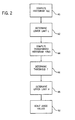
- Fig. 2 represents steps in exemplary control logic implemented by value conversion circuit 32 in determining the useful portion of the incoming digitized image pixel values and in converting or scaling these values to the dynamic range of downstream circuitry.
- value conversion circuit 32 receives the digitized signals representative of pixel intensities, a histogram h(x) is generated to determine pixel populations having individual intensity values over the full input dynamic range.
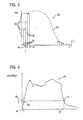
- a schematic illustration of a histogram of this type is illustrated in Fig. 3.
- the histogram 52 may be represented graphically by plotting intensity values 54 across a horizontal axis, and population counts 56 for each of the intensity values along a vertical axis.
- the resulting graphical representation forms bars 58 which define a distribution curve 60 in a stepwise manner.
- Each bar 58 has a width W such that the entire dynamic range is defined over the horizontal axis between a digitized value of zero bits to a maximum value of 2' - 1 bits, where "i" represents the number of bits in the input dynamic range. It should also be noted that the sum of the population counts for all of the intensity values equals the total population of the pixels considered in the image.
- value conversion circuit 32 analyzes the input values to determine the useful portion of the dynamic range over which the values lie. Thus, where variations in the acquisition process result in utilization of less than all of the input dynamic range, the converted values will nevertheless provide as much information as is available from the input values.
- circuit 32 determines the lower limit L of this useful range.
- This step is graphically represented in Fig. 3.
- reference numeral 62 indicates an exemplary lower limit L established by reference to histogram 52.
- the lower limit value is selected by locating an intensity value along the horizontal axis below which a desired percentage of the global pixel population falls. That is, beginning with an intensity value of zero, the pixel counts 56 of bars 58 for each intensity value are accumulated until the desired pixel population percentage is obtained. Once the percentage is reached, the lower limit is set at the next higher intensity value. In general, lower limit values corresponding to 0.5 to 1 percent of the global pixel population have been found to provide satisfactory results.
- a log-transformed histogram h(f(x)), defined as g(x), is calculated as indicated at step 44.
- An exemplary log-transformed histogram 64 is illustrated in Fig. 4.
- the log-transformed histogram may be smoothed using a low-pass filter technique, such as by local averaging of the population counts for each intensity value with the immediately preceding and succeeding population counts. Such filtering tends to smooth peaks and valleys which may occur in the histogram profile.
- a threshold value T is determined, as indicated at step 46 in Fig. 2.
- the threshold value T is located from the log-transformed histogram 64 by identifying a value of g(x), as indicated by reference numeral 66, at which the lower limit value T, indicated by numeral 62, intersects the log-transformed histogram, as indicated at intersection point 68 in Fig. 4.
- a verification comparison is preferably performed to determine whether a satisfactory portion of the dynamic range has been selected through use of the threshold value T.
- a comparison of the identified value 72 and a multiple of the lower limit value has been found to provide a satisfactory test of the width of the dynamic range. For example, if the value identified at 72 is determined to be less than 2L, the algorithm may be considered to have found a spurious feature of the histogram, requiring use of a different threshold value T. In such cases, the threshold value is reset to a lower value, such as 0.8T, and the foregoing procedure is performed using this reduced threshold to identify a value 72 further along the histogram 64.
- an upper limit value H for the useful portion of the input dynamic range is next determined.
- the value of H is set to a multiple of the value 72 determined as summarized above. It should be noted that this multiple need not be an integer multiple, and will, in general, differ for various types of modalities and subjects. For example, in digital X-ray imaging systems, the multiple of the value 72 used to set the upper limit H will differ in accordance with a need to view the skin/air interface, lung interstitium, or other details. By way of example, in chest radiographs, a multiple of 1.5 has provided good results over a range of images.
- value conversion circuit 32 next scales the pixel values from the input range to the output range as indicated at step 50 in Fig. 2.
- the value Output is the scaled output value for each pixel
- Input is the corresponding input value for the pixel
- b is the number of bits in the output dynamic range
- ⁇ is small number (less than or equal to 1.0, and typically 0.5) used to assure that the output value does not go below zero
- L and H are the lower and upper limit values, respectively.
- the brackets represent the operation of determining the largest integer value less than or equal to the real-valued quantity enclosed therein. Note that the transformation described by this equation reverses high and low pixel values, such that pixels receiving low input values will have high output values (resulting in inversion of light and dark pixels in the resulting image). This transformation is appropriate, for example, in images such as chest radiographs. However, as will be appreciated by those skilled in the art, other transformations which do not reverse high and low values may be appropriate in other applications.
- the foregoing method provides satisfactory conversion of input values to output values in a computationally efficient manner. Moreover, the procedure is readily adaptable to various imaging modalities, as well at to a wide variety of input and output circuitry having substantially different dynamic ranges. Finally, the method automatically accommodates variations in the bandwidth of the dynamic range actually utilized, even in particular images produced by a single imaging system or on a particular subject, providing more consistent and comparable images, and thereby facilitating image interpretation and analysis.
Landscapes
- Engineering & Computer Science (AREA)
- Physics & Mathematics (AREA)
- Health & Medical Sciences (AREA)
- Life Sciences & Earth Sciences (AREA)
- Theoretical Computer Science (AREA)
- General Physics & Mathematics (AREA)
- Medical Informatics (AREA)
- Heart & Thoracic Surgery (AREA)
- General Health & Medical Sciences (AREA)
- Pathology (AREA)
- Radiology & Medical Imaging (AREA)
- Biomedical Technology (AREA)
- Nuclear Medicine, Radiotherapy & Molecular Imaging (AREA)
- Molecular Biology (AREA)
- Surgery (AREA)
- Animal Behavior & Ethology (AREA)
- Optics & Photonics (AREA)
- Public Health (AREA)
- Veterinary Medicine (AREA)
- High Energy & Nuclear Physics (AREA)
- Biophysics (AREA)
- Image Processing (AREA)
- Apparatus For Radiation Diagnosis (AREA)
- Facsimile Image Signal Circuits (AREA)
Applications Claiming Priority (2)
| Application Number | Priority Date | Filing Date | Title |
|---|---|---|---|
| US09/070,486 US6714674B1 (en) | 1998-04-30 | 1998-04-30 | Method for converting digital image pixel values |
| US70486 | 1998-04-30 |
Publications (2)
| Publication Number | Publication Date |
|---|---|
| EP0953940A2 true EP0953940A2 (de) | 1999-11-03 |
| EP0953940A3 EP0953940A3 (de) | 2000-10-11 |
Family
ID=22095582
Family Applications (1)
| Application Number | Title | Priority Date | Filing Date |
|---|---|---|---|
| EP99303424A Withdrawn EP0953940A3 (de) | 1998-04-30 | 1999-04-30 | Verfahren zur Umsetzung von numerischen Bildpixelwerten |
Country Status (3)
| Country | Link |
|---|---|
| US (1) | US6714674B1 (de) |
| EP (1) | EP0953940A3 (de) |
| JP (1) | JP2000050075A (de) |
Cited By (2)
| Publication number | Priority date | Publication date | Assignee | Title |
|---|---|---|---|---|
| EP1411472A3 (de) * | 2002-10-18 | 2005-02-16 | Canon Kabushiki Kaisha | Gradationskonversion eines Bildes |
| CN1302436C (zh) * | 2002-11-07 | 2007-02-28 | 三星电子株式会社 | 对比度补偿的装置及其方法 |
Families Citing this family (3)
| Publication number | Priority date | Publication date | Assignee | Title |
|---|---|---|---|---|
| KR20030087692A (ko) * | 2002-05-09 | 2003-11-15 | 엘지전자 주식회사 | 플라즈마 디스플레이 패널의 다이나믹 레인지 확대방법 및이를 이용한 구동장치 |
| JP4389489B2 (ja) | 2003-05-06 | 2009-12-24 | ソニー株式会社 | 画像処理方法、および画像処理装置 |
| GB2588674B (en) * | 2019-11-01 | 2022-02-02 | Apical Ltd | Image processing |
Citations (3)
| Publication number | Priority date | Publication date | Assignee | Title |
|---|---|---|---|---|
| US5164993A (en) * | 1991-11-25 | 1992-11-17 | Eastman Kodak Company | Method and apparatus for automatic tonescale generation in digital radiographic images |
| EP0557099A1 (de) * | 1992-02-21 | 1993-08-25 | Canon Kabushiki Kaisha | Bildverarbeitungsgerät |
| WO1998037738A1 (en) * | 1997-02-21 | 1998-08-27 | Direct Radiography Corp. | Image data processing for digital x-ray detectors |
Family Cites Families (6)
| Publication number | Priority date | Publication date | Assignee | Title |
|---|---|---|---|---|
| US4950894A (en) * | 1985-01-25 | 1990-08-21 | Fuji Photo Film Co., Ltd. | Radiation image read-out method |
| JPH0792830B2 (ja) * | 1988-03-19 | 1995-10-09 | 富士写真フイルム株式会社 | 放射線画像情報読取方法 |
| GB8813514D0 (en) | 1988-06-08 | 1988-07-13 | Quantel Ltd | Image enhancement |
| US5305204A (en) * | 1989-07-19 | 1994-04-19 | Kabushiki Kaisha Toshiba | Digital image display apparatus with automatic window level and window width adjustment |
| JPH04271669A (ja) * | 1991-02-27 | 1992-09-28 | Matsushita Electric Ind Co Ltd | 階調補正装置 |
| US5633511A (en) * | 1995-12-22 | 1997-05-27 | Eastman Kodak Company | Automatic tone scale adjustment using image activity measures |
-
1998
- 1998-04-30 US US09/070,486 patent/US6714674B1/en not_active Expired - Lifetime
-
1999
- 1999-04-20 JP JP11111572A patent/JP2000050075A/ja not_active Withdrawn
- 1999-04-30 EP EP99303424A patent/EP0953940A3/de not_active Withdrawn
Patent Citations (3)
| Publication number | Priority date | Publication date | Assignee | Title |
|---|---|---|---|---|
| US5164993A (en) * | 1991-11-25 | 1992-11-17 | Eastman Kodak Company | Method and apparatus for automatic tonescale generation in digital radiographic images |
| EP0557099A1 (de) * | 1992-02-21 | 1993-08-25 | Canon Kabushiki Kaisha | Bildverarbeitungsgerät |
| WO1998037738A1 (en) * | 1997-02-21 | 1998-08-27 | Direct Radiography Corp. | Image data processing for digital x-ray detectors |
Cited By (3)
| Publication number | Priority date | Publication date | Assignee | Title |
|---|---|---|---|---|
| EP1411472A3 (de) * | 2002-10-18 | 2005-02-16 | Canon Kabushiki Kaisha | Gradationskonversion eines Bildes |
| US7433515B2 (en) | 2002-10-18 | 2008-10-07 | Canon Kabushiki Kaisha | Image processing apparatus and method for performing gradation conversion processing for an object image |
| CN1302436C (zh) * | 2002-11-07 | 2007-02-28 | 三星电子株式会社 | 对比度补偿的装置及其方法 |
Also Published As
| Publication number | Publication date |
|---|---|
| US6714674B1 (en) | 2004-03-30 |
| EP0953940A3 (de) | 2000-10-11 |
| JP2000050075A (ja) | 2000-02-18 |
Similar Documents
| Publication | Publication Date | Title |
|---|---|---|
| US6823090B2 (en) | Image processing apparatus and its method, program, and storage medium | |
| US9002134B2 (en) | Multi-scale image normalization and enhancement | |
| US6449390B1 (en) | Image processing apparatus and method therefor | |
| JPH09191408A (ja) | 画像アクティビティ測定を用いた階調スケールの自動調整法 | |
| US6778692B1 (en) | Image processing method and apparatus including image improving circuit | |
| US6356652B1 (en) | Visualization of diagnostically irrelevant zones in a radiographic image | |
| US9619893B2 (en) | Body motion detection device and method | |
| US6608915B2 (en) | Image processing method and apparatus | |
| US6215900B1 (en) | Image data processing for digital x-ray detectors | |
| US9595116B2 (en) | Body motion detection device and method | |
| JP2003284713A (ja) | 医用画像処理装置、画像処理パラメータの補正方法、プログラム、記憶媒体 | |
| US6714674B1 (en) | Method for converting digital image pixel values | |
| JP2001076141A (ja) | 画像認識方法および画像処理装置 | |
| WO2000032016A2 (en) | Method for automatic detection of region of interest for digital x-ray detectors using a filtered histogram | |
| US20030210831A1 (en) | Gradation conversion processing | |
| JP3814864B2 (ja) | 放射線画像の画像処理条件決定装置及び画像処理装置並びに放射線画像の画像処理条件決定方法及び画像処理方法 | |
| JP2004283281A (ja) | 画像処理装置及び画像処理方法 | |
| US8116545B2 (en) | Method and system for analysis of bone density | |
| US20050161617A1 (en) | Image processing method, apparatus, and program | |
| JP2929030B2 (ja) | デジタル放射線画像の撮影体位判別装置 | |
| JP2003516005A (ja) | デジタルレントゲン画像データ処理用加重反転トポグラフィー方法 | |
| JP2002330343A (ja) | 放射線画像処理装置、画像処理システム、放射線画像処理方法、記憶媒体、及びプログラム | |
| EP0654762B1 (de) | Darstellung von diagnostisch irrelevanten Gebieten in radiographischen Bildern | |
| JP2001325594A (ja) | 特徴量抽出装置、画像処理装置、画像処理システム、画像処理方法、及び記憶媒体 | |
| JP2000138952A (ja) | 解像力測定装置、方法及びコンピュータ読み取り可能な記憶媒体 |
Legal Events
| Date | Code | Title | Description |
|---|---|---|---|
| PUAI | Public reference made under article 153(3) epc to a published international application that has entered the european phase |
Free format text: ORIGINAL CODE: 0009012 |
|
| AK | Designated contracting states |
Kind code of ref document: A2 Designated state(s): DE FR NL |
|
| AX | Request for extension of the european patent |
Free format text: AL;LT;LV;MK;RO;SI |
|
| PUAL | Search report despatched |
Free format text: ORIGINAL CODE: 0009013 |
|
| AK | Designated contracting states |
Kind code of ref document: A3 Designated state(s): AT BE CH CY DE DK ES FI FR GB GR IE IT LI LU MC NL PT SE |
|
| AX | Request for extension of the european patent |
Free format text: AL;LT;LV;MK;RO;SI |
|
| 17P | Request for examination filed |
Effective date: 20010411 |
|
| AKX | Designation fees paid |
Free format text: DE FR NL |
|
| 17Q | First examination report despatched |
Effective date: 20071127 |
|
| STAA | Information on the status of an ep patent application or granted ep patent |
Free format text: STATUS: THE APPLICATION IS DEEMED TO BE WITHDRAWN |
|
| 18D | Application deemed to be withdrawn |
Effective date: 20080408 |