EP0954157A2 - Dispositif modem et procédé de communication de données - Google Patents
Dispositif modem et procédé de communication de données Download PDFInfo
- Publication number
- EP0954157A2 EP0954157A2 EP99104481A EP99104481A EP0954157A2 EP 0954157 A2 EP0954157 A2 EP 0954157A2 EP 99104481 A EP99104481 A EP 99104481A EP 99104481 A EP99104481 A EP 99104481A EP 0954157 A2 EP0954157 A2 EP 0954157A2
- Authority
- EP
- European Patent Office
- Prior art keywords
- signal
- modem
- communication
- information signal
- receiver side
- Prior art date
- Legal status (The legal status is an assumption and is not a legal conclusion. Google has not performed a legal analysis and makes no representation as to the accuracy of the status listed.)
- Granted
Links
Images




Classifications
-
- H—ELECTRICITY
- H04—ELECTRIC COMMUNICATION TECHNIQUE
- H04M—TELEPHONIC COMMUNICATION
- H04M11/00—Telephonic communication systems specially adapted for combination with other electrical systems
- H04M11/06—Simultaneous speech and data transmission, e.g. telegraphic transmission over the same conductors
Definitions
- the present invention relates to a modem apparatus for realizing data communications through a communication network such as a dial-up line, a dedicated line, etc. Also, the present invention relates to a data communication method using such a modem apparatus.
- V. 34 modem (33.6 kbps) has been widely used in accordance with Recommendation of ITU-T.
- data communications have been widely carried out along communication standard of T. 30ANEXF(so-called SUPER G3) using V. 34 modem.
- V.34 modem specified pre-protocols must be carried out until an image signal is transmitted after a line connection between the facsimile apparatuses on sender and receiver sides is established.
- a protocol for selecting a data communicable modulation mode from modulation modes such as V.34 half-duplex, V.34 full-duplex, and V.17 half-duplex
- a protocol for selecting a training parameter based on a line probing tone transmitted from the sender side there are included a protocol for transmitting a training signal from the sender side based on the selected training parameter, and a protocol for checking a receiving quality on the receiver side based on the received training signal.
- a protocol for selecting a suitable modem parameter based on the checked receiving quality.
- image data can be transmitted in approximately three seconds per sheet of paper of size A4. In such a case, however, extra time of about seven seconds is needed to carry out the aforementioned pre-protocols, and much communication time is wasted as compared with image transmission time.
- the modem parameter best suited to perform communications with a specific destination is stored at an actual image transmitting time. Then, the modem parameter stored is used in receiving and transmitting the image from/to the specific destination at the next time so as to shorten the pre-protocols.
- communication errors may occur in some cases at the time when the pre-protocols are shortened and the modem parameter is transmitted to the receiver side. This may be caused by the following reason. More specifically, the modulated transmitting signal is easily influenced by noise (impulse), and it is thereby difficult to detect the transmitting signal on the receiver side.
- An object of the present invention is to provide a modem apparatus, which can surely realize image receiving and transmitting even when pre-protocols are shortened.
- the present invention repeatedly transmits an information signal containing at least a modem parameter previously stored for each telephone number of the communication destination until it is confirmed that the communication destination receives the information signal.
- the pre-protocols such as exchange of parameter, etc.
- the transmission of modem parameter is repeated until it is confirmed that the communication destination receives the modem parameter, occurrence of communication errors can be avoided so that the shortened pre-protocols can be surely executed.
- the modem apparatus of the present invention is configured to repeatedly transmit an information signal including at least a modem parameter stored in advance for each telephone number of a communication destination until it is confirmed that the communication destination has received the information signal.
- a pre-protocol such as exchange of modem parameter can be simplified so that communication time can be shortened. Moreover, since the transmission of modem parameter is repeated until it is confirmed that the communication destination has received the information signal, occurrence of communication errors can be prevented and the shortened pre-protocol can be surely executed.
- the modem apparatus of the present invention is configured to receive an information signal, including at least a modem parameter stored in advance based on past communications, from a communication destination, and transmits a response signal indicating its reception acknowledgment to the communication destination.
- the communication destination since the communication destination can be notified of the reception of the modem parameter, the communication destination is moved to a next communication protocol after receiving the modem parameter. Therefore, a pre-protocol such as exchange of modem parameter can be simplified so that communication time can be shortened.
- the above-mentioned modem apparatus can be applied to a data communication apparatus, for example, a facsimile apparatus.
- a modem apparatus is preferably V.34 modem complying with Recommendation of ITU-T.
- the data communication method of the present invention comprises the steps of:
- a pre-protocol such as exchange of modem parameter can be simplified so that communication time can be shortened. Moreover, since the transmission of modem parameter from the sender side is repeated until it is confirmed that the receiver side has received the information signal, occurrence of communication errors can be prevented and the shortened pre-protocol can be surely executed.
- the sender side moves to a communication protocol for modem training complying with Recommendation V. 34 after repeating the transmission of the information signal predetermined times.
- the sender side which receives the first response signal when transmitting a protocol sync signal PPh complying with Recommendation V. 34, preferably returns to the step of transmitting the information signal, again.
- the transmission of modem parameter from the sender side is repeated until it is confirmed that the receiver side has received the modem parameter.
- the receiver side moves to the communication protocol for modem training when detecting the end of the transmission of the information signal.
- the sender side moves to the communication protocol for modem training after repeating the transmission of the information signal predetermined times.
- the receiver can move to the communication protocol for modem training in accordance with the sender side. As a result, the communication protocol for modem training can be surely executed.
- the receiver side moves to the communication protocol for modem training after the second response signal is transmitted and a predetermined period of time passes, wherein the receiver side transmits the first response signal again after the end of the communication protocol for modem training when the receiver side performs no detection of the end of the transmission of the information signal.
- the sender side which receives the first response signal when transmitting a protocol sync signal PPh, returns to the step of transmitting the information signal, again. Therefore, even when the receiver side performs no detection of the end of the transmission of said information signal, the communication protocol for modem training can be surely executed.
- the receiver side transmits the first response signal again when no normal end of the communication protocol for modem training is performed.
- the communication protocol for modem training can be surely executed.
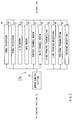
- FIG. 1 is a block diagram showing the configuration of a facsimile apparatus to which a modem apparatus according to the present invention is applied.
- a facsimile apparatus 10 comprises a network control section 12 for executing connection/disconnection with a communication network 11 such as a dial-up line, a dedicated line, etc.
- the network control section 12 controls a dialing and a calling relevant to the communication network 11.
- an original image is scanned by a scanning section 15.
- the scanning section 15 may be composed of, for example, a scanner for optically scanning the original image.
- An image signal of the scanned original image is coded to image data by a control section 16.
- the obtained image data is sent to the communication network 11 through a modem apparatus 17 according to the present invention.
- the sent image data is received from the communication network 11 through the modem apparatus 17.
- the received image data is decoded by the control section 16, thereafter being recorded in a recording section 18.
- the recorded image data is output as a copy document by a printer, etc.
- the modem apparatus 17 realizes modulation and demodulation in accordance with the facsimile communication protocol, which is specified by T.
- DSP digital signal processing section
- An operation section 19 is provided with input operation keys such as dial keys, start keys, etc., and a display unit such as a liquid crystal display for displaying arbitrary information.
- a memory 20 information is stored in accordance with a communication destination having a function for short protocol facsimile communications to be described later.
- a telephone number and a modem parameter for each communication destination are stored.
- a modem parameter includes a power reduction value indicative of signal power and a time value indicative of a training time, and carrier frequency selection for selectively setting either a high level or a low level.
- the modem parameter also includes preemphasis filter selection, symbol rate selection for selectively setting five levels of rates that are transmitted for an eye pattern, selection of a training constellation point, and a shoulder gain for data demodulation.
- FIG. 2 is a block diagram schematically showing the configuration of DSP 17a applied to the modem 17.
- the DSP 17a comprises a V.21 modem (300 bps, full duplex) 21 which is used in the communication protocol, which is specified by Recommendation V.21 of the ITU-T.
- a tonal transmission section 22 can sent various tonal signals in accordance with communication protocols.
- a tonal detection section identifies a tonal signal sent from a communication destination.
- DSP 17a also comprises an INFO modem (600 bps, full duplex) 25 which performs communications of INFO sequence, which is specified by Recommendation V.34, a control channel modem (1200 bps, full duplex) 26, which is specified by Recommendation V.34, and a main channel modem (2400 bps to 33.6 kbps, half duplex) 27, which is specified by Recommendation V.34.
- the INFO modem 25 is used in a start procedure in the communication protocol for line probing to be described later and a short protocol facsimile communication.
- the main channel modem 27 is used in communicating image data
- the control channel modem 26 is used in a communication protocol for selecting a modem parameter for a main channel modem 27 and in a communication protocol for a facsimile control signal.
- a line probing transmission section 28 transmits a line probing tone, which is specified by Recommendation V.34.
- the line probing tone is formed by combining 21 kinds of tonal signals of 150 Hz to 3750 Hz.
- a line probing reception section 29 receives the line probing tones sent from a communication destination, and executes a line inspection. In the line inspection, the line probing reception section 29 performs spectrum analysis on the received signals using the fast Fourier transform algorithm to select the optimal symbol rate and carrier frequency for the main channel modem 27 and select other modem parameters.
- a training transmission section 30 transmits training signals based on the modem parameter selected by the result of the line inspection.
- a training reception section 31 learns a filter coefficient of an adaptive equalizer to correct a line characteristic and inspects reception quality based on the training signals received from a communication destination.
- the modem function of DSP 17a is controlled by a modem control section 32.
- the modem control section 32 can control interface with the modem apparatus 17 and the control section 16.
- the facsimile apparatus 10 is used on a transmitter side.
- the line control section 12 performs a call.
- the line control section 12 checks whether or not a short protocol for the input telephone number is registered in memory 20. If registration is not made, a dial call is executed.
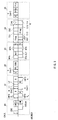
- a communication protocol 40 for selecting a modulation mode is carried out as shown in FIG. 3.
- a sender side transmits a caller number identification signal CNG, and a receiver side transmits a modified answer tone ANSam.
- the sender side transmits a call menu signal CM indicative of the functions of the sender modem, such as the modulation mode and communication protocol.
- the call menu signal is formed of a tonal pattern having a start bit "0" of one bit, data 8 bits, and a stop bit "1".
- the receiver side transmits a joint menu signal JM indicative of a common communication capability to the sender side based on the contents of the received signal CM.
- the sender side transmits a CJ signal, indicating an end of the communication protocol 40 for selecting a modulation mode, to the receiver side.
- V.21 modem Since the above-mentioned communication protocol using V.21 modem is known, the detailed explanation here will be omitted.
- the signals CM, JM and CJ are communicated through the V.21 modem, which are provided as standard in the sender and receiver sides.
- V.34 modem is selected as a modulation mode
- a facsimile communication is selected as a communication protocol
- a communication protocol 41 for a line probing is started.
- the sender transmits INFO0c indicating a communication capability, such as the preset modulation rate and carrier frequency for the V.34 modem, and line probing tones L1 and L2.
- the receiver side transmits INFO0a indicating the preset communication capability, and receives the line probing tones L1 and L2.
- modem parameters such as the optimal symbol rate, and a carrier, etc., by spectrum analysis.
- the receiver side selects a communicable training parameter based on the thus selected modem parameter and the contents of INFO0c and INFO0a.
- the selected training parameter is transmitted to the sender side by INFOh signal.
- INFO0c, INFO0a and INFOh are communicated through the INFO modems 25 on sender and receiver sides.
- this communication protocol 41 as response signals for accomplishing synchronization, there are used a tone B signal and a B (bar) signal (a phase shift signal of 180 degrees to the tone B signal), which is sent from the sender side, and a tone A signal and an A (bar) signal (a phase shift signal of 180 degrees to the tone A signal), which is sent from the receiver side.
- a communication protocol 42 for modem training is started.
- the sender side transmits training signals S, S (bar), PP and TRN in accordance with the training parameter specified by an INFOh signal.
- the receiver side receives the training signals and learns the filter coefficient of the adaptive equalizer and computes the optimal training time and noise power ratio SN.
- a communication protocol 43 for setting a modem parameter is started.
- the sender and receiver sides transmit protocol sync signals PPh and ALT and a modem parameter MPh each other.
- a preset modem parameter is bet. While, in the modem parameter signal MPh transmitted from the receiver side, a modem parameter selected based on the aforementioned line inspection and the SN ratio is set.
- the sender and receiver sides transmit a reception acknowledgment signal E. The exchange of the modem parameter signals MPh is carried out by the control channel modem 26.
- a communication protocol 44 for a facsimile control signal is started.
- a non-standard protocol signal NSF a non-standard protocol signal
- CSI station identification signal
- a digital identification signal DIS are transmitted from the receiver side.
- the non-standard protocol signal NSF the optimal training time is set.
- the sender side transmits a transmitter identification signal TSI and a digital command signal DCS.
- the receiver side transmits a reception preparation acknowledgment CFR.
- the communication protocol for the above facsimile control signal is executed using the control channel modem 26.
- a communication protocol 45 for image data is started through the main channel modem 27.
- communication is implemented based on the training parameter of the INFOh signal and the modem parameter signal MPh by using a modem parameter which satisfies both the sender and receiver sides.
- the sender side transmits protocol sync signals S, S (bar), PP and B1, and then transmits image data PIX.
- image data is received after compensating line distortion to utmost limit by using of the learned filter coefficient.
- normal facsimile communication is carried out based on Recommendation of the T.30 ANEXF of the ITU-T.
- a short protocol for input telephone number is registered in the memory 20 at the time of the aforementioned call.
- the line connection is established and a caller number identification signal CNG and a called station identification signal CSI are communicated.
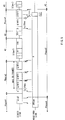
- a sender side transmits a quick tonal signal QTSD as shown in FIG. 4.
- the quick tonal signal QTSD triggers a transition to short protocol facsimile communication.
- the quick tonal signal QTSD is formed to have a repetition pattern of "00110011 ".
- the formation of such a tonal signal pattern can be clearly distinguished from a signal pattern "011110" of a flag sequence defined by Recommendation of T. 30 and a tonal pattern of the above-mentioned CM signal on the receiver side.
- the CM signal and the quick tonal signal QTSD are modulated based on the same system, whether the normal facsimile communication or the short protocol facsimile communication should be used can be easily determined by the same sequence.
- the receiver side receives the quick tonal signal QTSD, and then transmits a tone A signal.
- the sender side receives the tone A signal, and then transmits a tone B signal of 25 ms. Thereafter, the sender side transmits a QINFO signal including at least a modem parameter.
- the receiver side receives the QINFO signal, and then returns the A (bar) signal as a reception acknowledge. The receiver continues transmitting the tone A signal until transmitting the A (bar) signal.
- the sender side repeatedly transmits the QINFO signal arbitrary times until receiving the A (bar) signal from the receiver side.
- information such as a modem parameter, etc.
- the QINFO signal is transmitted twenty times at the maximum.
- the INFO modem 25 is used.
- the sender side which has detected the A (bar) signal, moves to the communication protocol for modem training after silence of 70 ms.
- this communication protocol 42 for modem training communications are performed based on the training parameter INFOh included in the QINFO signal and the optimal training time.
- the filter coefficient contained in the QINFO signal and the SN ratio are referred when the receiver side sets the modem parameter signal MPh.
- image data is finally sent to the receiver side by the communication protocol similar to the aforementioned normal facsimile communication.
- the use of the above-mentioned short protocol facsimile communication can shorten the pre-protocol prior to the transmission of image data, and omit waste of the total communication time as much as possible so as to realize rapid image data communication.
- a function mount flag which indicates that a short protocol facsimile communication function is provided, is set in the non-standard protocol signal NSF, which is to be transmitted from the receiver side.
- the sender side which has received the function mount flag, determines that the facsimile apparatus on the receiver side has the short protocol facsimile communication function, and a short protocol registration flag is set.
- the short protocol registration flag When the short protocol registration flag is set, information, such as a telephone number of the communication destination and a modem parameter, peculiar to the receiver side during communications is stored in the memory 20. If the short protocol facsimile communication function is provided in the facsimile apparatus of the communication destination, information such as a modem parameter is registered in the memory 20 by one image data communication every telephone number. As a result, short protocol facsimile communication can be carried out in image data communication from the next time.
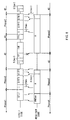
- the receiver side cannot receive a QINFO signal even though the QINFO signal is transmitted from the sender side twenty times at the maximum.
- the sender side ends the transmission of QINFO signal and moves to the communication protocol 42 for modem training after silence of 70 ms.
- the tone A signal is continued to be transmitted from the receiver side.
- the sender side which has finished the communication protocol 42 for modem training one-sidedly, moves to the communication protocol 43 for setting a modem parameter.
- the sender side receives the tone A signal continued to be transmitted from the receiver side.
- the sender side executes communication protocol phase 2 from the transmission of tone B signal again. If the sender side receives A (bar) by the re-execution, the sender side determines that the receiver side has received QINFO signal without fail, and executes the communication protocol similar to the normal facsimile communication. The communication protocol is thus repeated until the receiver side receives the QINFO signal, thereby making it possible to transmit tee QINFO signal to the receiver side without fail.
- the receiver side detects a carrier-off signal after transmitting the A (bar) signal.
- the receiver side When detecting the carrier-off signal, the receiver side moves to the communication protocol 42 for modem training. If the receiver side can not detect the carrier-off signal for a predetermined period of time (2000 ms in this case), the receiver side moves to the communication protocol 42 after passing a predetermined period of time.
- the sender side ends the transmission of QINFO signal, and moves to the communication protocol 42 for modem training after silence of 70 ms. Therefore, the communication protocol 42 for modem training is well carried out without receiving the A (bar) signal. Even if the sender side moves to the communication protocol 43 for setting a modem parameter, the communication protocol 43 for setting a modem parameter is surely performed without receiving the tone A signal.
- the receiver side cannot detect a carrier stop of the QINFO signal.
- the sender side which has finished the transmission of the QINOF signal, moves to the communication protocol 42 for modem training after silence of 70 ms.
- the receiver side cannot go to the communication protocol 42 for modem training. As a result, there is possibility that the communication protocol 42 for modem training will not be normally executed.
- the receiver side transmits the A (bar) signal, and then moves to the communication protocol 42 for modem training after passing 2000 ms. Thereafter, when the receiver side moves to the communication protocol 43 for setting a modem parameter, the receiver side transmits the tone A signal again.
- the sender side which has received the tone A signal during the communication protocol 43 for setting a parameter, performs communication protocol phase 2 from the transmission of tone B signal again. This makes it possible to normally execute the communication protocol 42 for modem training.
- the receiver side cannot normally receive training signals S, S (bar), PP, TRN.
- the tone A signal is transmitted from the receiver side. Therefore, the sender side, which has moved to the communication protocol 43 for setting a parameter, receives the tone A signal. As a result, communication protocol phase 2 is performed again from the transmission of tone B signal.
- modulation signals such as QINFO signal, which is difficult to detect, tone A signal, A (bar) signal, training signal, etc.
- communication phase 2 may be performed again from the transmission of tone B signal.
- the pre-protocol such as exchange of modem parameter can be shortened and such a short protocol can be surely realized at the same time. Therefore & communication time can be shortened and occurrence of communication errors can be prevented to a minimum.
Landscapes
- Engineering & Computer Science (AREA)
- Computer Networks & Wireless Communication (AREA)
- Signal Processing (AREA)
- Facsimile Transmission Control (AREA)
- Communication Control (AREA)
- Telephonic Communication Services (AREA)
Applications Claiming Priority (2)
| Application Number | Priority Date | Filing Date | Title |
|---|---|---|---|
| JP08864698A JP3321081B2 (ja) | 1998-04-01 | 1998-04-01 | データ通信方法、およびデータ通信装置 |
| JP8864698 | 1998-04-01 |
Publications (3)
| Publication Number | Publication Date |
|---|---|
| EP0954157A2 true EP0954157A2 (fr) | 1999-11-03 |
| EP0954157A3 EP0954157A3 (fr) | 2001-06-13 |
| EP0954157B1 EP0954157B1 (fr) | 2006-10-11 |
Family
ID=13948594
Family Applications (1)
| Application Number | Title | Priority Date | Filing Date |
|---|---|---|---|
| EP99104481A Expired - Lifetime EP0954157B1 (fr) | 1998-04-01 | 1999-03-05 | Dispositif modem et procédé de communication de données |
Country Status (5)
| Country | Link |
|---|---|
| US (1) | US6314170B1 (fr) |
| EP (1) | EP0954157B1 (fr) |
| JP (1) | JP3321081B2 (fr) |
| CA (1) | CA2266933C (fr) |
| DE (1) | DE69933501T2 (fr) |
Cited By (1)
| Publication number | Priority date | Publication date | Assignee | Title |
|---|---|---|---|---|
| EP0973323A4 (fr) * | 1997-11-05 | 2003-01-15 | Matsushita Graphic Communic | Dispositif de communication de donnees et procede de communication de donnees |
Families Citing this family (12)
| Publication number | Priority date | Publication date | Assignee | Title |
|---|---|---|---|---|
| JP3647188B2 (ja) * | 1997-03-03 | 2005-05-11 | キヤノン株式会社 | 通信装置 |
| JP3639705B2 (ja) * | 1997-11-18 | 2005-04-20 | キヤノン株式会社 | 通信装置及び通信方法 |
| US6912276B1 (en) * | 1999-04-12 | 2005-06-28 | Silicon Laboratories, Inc. | Modem on hold |
| USRE42661E1 (en) * | 1999-04-12 | 2011-08-30 | V-Dot Technologies, Llc | Method and apparatus for fast V.90 modem startup |
| US6819749B1 (en) * | 1999-04-12 | 2004-11-16 | Mindspeed Technologies, Inc. | Method and apparatus for fast V.90 modem startup |
| US7233996B2 (en) * | 2002-11-12 | 2007-06-19 | Intel Corporation | Mechanism to support multiple port configurations |
| US6985566B2 (en) * | 2003-01-28 | 2006-01-10 | Conexant Systems, Inc. | Point of sale modem for high-speed communications |
| US7502338B1 (en) * | 2003-12-19 | 2009-03-10 | Apple Inc. | De-emphasis training on a point-to-point connection |
| JP4537910B2 (ja) * | 2005-08-09 | 2010-09-08 | 株式会社リコー | ファクシミリ用モデム装置及びそれを用いたファクシミリ装置 |
| US8483108B2 (en) | 2006-07-24 | 2013-07-09 | Apple Inc. | Apparatus and methods for de-emphasis training on a point-to-point connection |
| JP2011101102A (ja) | 2009-11-04 | 2011-05-19 | Fuji Xerox Co Ltd | 画像通信装置 |
| US9743294B1 (en) * | 2017-03-16 | 2017-08-22 | Cognitive Systems Corp. | Storing modem parameters for motion detection |
Family Cites Families (7)
| Publication number | Priority date | Publication date | Assignee | Title |
|---|---|---|---|---|
| GB2169174B (en) | 1984-11-28 | 1989-06-01 | Canon Kk | Data communication apparatus |
| US5311578A (en) | 1992-05-07 | 1994-05-10 | At&T Bell Laboratories | Technique for automatic identification of a remote modem |
| US6122072A (en) * | 1993-12-06 | 2000-09-19 | Canon Kabushiki Kaisha | Data communication apparatus |
| JPH0818623A (ja) | 1994-04-26 | 1996-01-19 | Murata Mfg Co Ltd | モデム装置 |
| US6046825A (en) * | 1995-05-12 | 2000-04-04 | Canon Kabushiki Kaisha | Facsimile apparatus controlling communication in accordance with registered execution of the error correction mode |
| US5712977A (en) | 1995-09-18 | 1998-01-27 | Tdk Systems, Inc. | Method and apparatus for initial country selection in a universal modem with cable |
| JPH10336419A (ja) * | 1997-05-30 | 1998-12-18 | Canon Inc | ファクシミリ装置 |
-
1998
- 1998-04-01 JP JP08864698A patent/JP3321081B2/ja not_active Expired - Fee Related
-
1999
- 1999-03-04 US US09/262,334 patent/US6314170B1/en not_active Expired - Lifetime
- 1999-03-05 DE DE69933501T patent/DE69933501T2/de not_active Expired - Lifetime
- 1999-03-05 EP EP99104481A patent/EP0954157B1/fr not_active Expired - Lifetime
- 1999-03-24 CA CA002266933A patent/CA2266933C/fr not_active Expired - Fee Related
Cited By (2)
| Publication number | Priority date | Publication date | Assignee | Title |
|---|---|---|---|---|
| EP0973323A4 (fr) * | 1997-11-05 | 2003-01-15 | Matsushita Graphic Communic | Dispositif de communication de donnees et procede de communication de donnees |
| US6606375B2 (en) | 1997-11-05 | 2003-08-12 | Panasonic Communications Co., Ltd. | Data communication apparatus and data communication method |
Also Published As
| Publication number | Publication date |
|---|---|
| CA2266933A1 (fr) | 1999-10-01 |
| CA2266933C (fr) | 2002-07-09 |
| US6314170B1 (en) | 2001-11-06 |
| DE69933501T2 (de) | 2007-02-01 |
| JPH11289444A (ja) | 1999-10-19 |
| EP0954157A3 (fr) | 2001-06-13 |
| JP3321081B2 (ja) | 2002-09-03 |
| EP0954157B1 (fr) | 2006-10-11 |
| DE69933501D1 (de) | 2006-11-23 |
Similar Documents
| Publication | Publication Date | Title |
|---|---|---|
| US6831897B2 (en) | Data communication apparatus | |
| US6314170B1 (en) | Modem apparatus and data communication method | |
| US5751441A (en) | Communication method and communication terminal apparatus capable of full-duplex or half-duplex communication | |
| US6437870B1 (en) | Facsimile apparatus having V.8 protocol facility and facsimile communication method | |
| US6504919B1 (en) | Data transmission apparatus and data reception apparatus | |
| JPH1141433A (ja) | 通信装置 | |
| US7310160B2 (en) | Facsimile communication apparatus and method permitting reliable V.17 communication | |
| JPH08242352A (ja) | ファクシミリ装置の画像伝送制御方法 | |
| JP3302209B2 (ja) | データ通信装置 | |
| JP3967098B2 (ja) | ファクシミリ装置 | |
| JP3561385B2 (ja) | ファクシミリ装置の伝送方法 | |
| JP3486620B2 (ja) | データ通信装置 | |
| JP3380514B2 (ja) | データ通信装置及びファクシミリ装置 | |
| JP2652829B2 (ja) | ファクシミリ装置 | |
| JP3128464B2 (ja) | ファクシミリ通信方法 | |
| JP3806274B2 (ja) | データ送信装置及びデータ送信方法 | |
| JP3128463B2 (ja) | ファクシミリ通信方法 | |
| JPS63129747A (ja) | 画像通信装置 | |
| JPH08242221A (ja) | データ通信装置 | |
| JP2002044402A (ja) | ファクシミリ装置 | |
| JP2007251372A (ja) | 通信端末装置 | |
| JP2001257855A (ja) | ファクシミリ受信装置 |
Legal Events
| Date | Code | Title | Description |
|---|---|---|---|
| PUAI | Public reference made under article 153(3) epc to a published international application that has entered the european phase |
Free format text: ORIGINAL CODE: 0009012 |
|
| AK | Designated contracting states |
Kind code of ref document: A2 Designated state(s): DE FR GB |
|
| AX | Request for extension of the european patent |
Free format text: AL;LT;LV;MK;RO;SI |
|
| PUAL | Search report despatched |
Free format text: ORIGINAL CODE: 0009013 |
|
| AK | Designated contracting states |
Kind code of ref document: A3 Designated state(s): AT BE CH CY DE DK ES FI FR GB GR IE IT LI LU MC NL PT SE |
|
| AX | Request for extension of the european patent |
Free format text: AL;LT;LV;MK;RO;SI |
|
| 17P | Request for examination filed |
Effective date: 20010726 |
|
| AKX | Designation fees paid |
Free format text: DE FR GB |
|
| RAP1 | Party data changed (applicant data changed or rights of an application transferred) |
Owner name: PANASONIC COMMUNICATIONS CO., LTD. |
|
| 17Q | First examination report despatched |
Effective date: 20050429 |
|
| GRAP | Despatch of communication of intention to grant a patent |
Free format text: ORIGINAL CODE: EPIDOSNIGR1 |
|
| GRAS | Grant fee paid |
Free format text: ORIGINAL CODE: EPIDOSNIGR3 |
|
| GRAA | (expected) grant |
Free format text: ORIGINAL CODE: 0009210 |
|
| AK | Designated contracting states |
Kind code of ref document: B1 Designated state(s): DE FR GB |
|
| REG | Reference to a national code |
Ref country code: GB Ref legal event code: FG4D |
|
| REF | Corresponds to: |
Ref document number: 69933501 Country of ref document: DE Date of ref document: 20061123 Kind code of ref document: P |
|
| ET | Fr: translation filed | ||
| PLBE | No opposition filed within time limit |
Free format text: ORIGINAL CODE: 0009261 |
|
| STAA | Information on the status of an ep patent application or granted ep patent |
Free format text: STATUS: NO OPPOSITION FILED WITHIN TIME LIMIT |
|
| 26N | No opposition filed |
Effective date: 20070712 |
|
| PGFP | Annual fee paid to national office [announced via postgrant information from national office to epo] |
Ref country code: FR Payment date: 20130325 Year of fee payment: 15 Ref country code: DE Payment date: 20130227 Year of fee payment: 15 Ref country code: GB Payment date: 20130228 Year of fee payment: 15 |
|
| REG | Reference to a national code |
Ref country code: DE Ref legal event code: R119 Ref document number: 69933501 Country of ref document: DE |
|
| GBPC | Gb: european patent ceased through non-payment of renewal fee |
Effective date: 20140305 |
|
| REG | Reference to a national code |
Ref country code: FR Ref legal event code: ST Effective date: 20141128 |
|
| REG | Reference to a national code |
Ref country code: DE Ref legal event code: R119 Ref document number: 69933501 Country of ref document: DE Effective date: 20141001 |
|
| PG25 | Lapsed in a contracting state [announced via postgrant information from national office to epo] |
Ref country code: FR Free format text: LAPSE BECAUSE OF NON-PAYMENT OF DUE FEES Effective date: 20140331 Ref country code: GB Free format text: LAPSE BECAUSE OF NON-PAYMENT OF DUE FEES Effective date: 20140305 Ref country code: DE Free format text: LAPSE BECAUSE OF NON-PAYMENT OF DUE FEES Effective date: 20141001 |