EP0955646A2 - Induktives Bauelement - Google Patents
Induktives Bauelement Download PDFInfo
- Publication number
- EP0955646A2 EP0955646A2 EP99201338A EP99201338A EP0955646A2 EP 0955646 A2 EP0955646 A2 EP 0955646A2 EP 99201338 A EP99201338 A EP 99201338A EP 99201338 A EP99201338 A EP 99201338A EP 0955646 A2 EP0955646 A2 EP 0955646A2
- Authority
- EP
- European Patent Office
- Prior art keywords
- wires
- injection
- circumferentially
- mould
- providing
- Prior art date
- Legal status (The legal status is an assumption and is not a legal conclusion. Google has not performed a legal analysis and makes no representation as to the accuracy of the status listed.)
- Granted
Links
Images

Classifications
-
- H—ELECTRICITY
- H01—ELECTRIC ELEMENTS
- H01F—MAGNETS; INDUCTANCES; TRANSFORMERS; SELECTION OF MATERIALS FOR THEIR MAGNETIC PROPERTIES
- H01F17/00—Fixed inductances of the signal type
- H01F17/0006—Printed inductances
- H01F17/0033—Printed inductances with the coil helically wound around a magnetic core
-
- B—PERFORMING OPERATIONS; TRANSPORTING
- B29—WORKING OF PLASTICS; WORKING OF SUBSTANCES IN A PLASTIC STATE IN GENERAL
- B29C—SHAPING OR JOINING OF PLASTICS; SHAPING OF MATERIAL IN A PLASTIC STATE, NOT OTHERWISE PROVIDED FOR; AFTER-TREATMENT OF THE SHAPED PRODUCTS, e.g. REPAIRING
- B29C45/00—Injection moulding, i.e. forcing the required volume of moulding material through a nozzle into a closed mould; Apparatus therefor
- B29C45/14—Injection moulding, i.e. forcing the required volume of moulding material through a nozzle into a closed mould; Apparatus therefor incorporating preformed parts or layers, e.g. injection moulding around inserts or for coating articles
- B29C45/14639—Injection moulding, i.e. forcing the required volume of moulding material through a nozzle into a closed mould; Apparatus therefor incorporating preformed parts or layers, e.g. injection moulding around inserts or for coating articles for obtaining an insulating effect, e.g. for electrical components
-
- H—ELECTRICITY
- H01—ELECTRIC ELEMENTS
- H01F—MAGNETS; INDUCTANCES; TRANSFORMERS; SELECTION OF MATERIALS FOR THEIR MAGNETIC PROPERTIES
- H01F41/00—Apparatus or processes specially adapted for manufacturing or assembling magnets, inductances or transformers; Apparatus or processes specially adapted for manufacturing materials characterised by their magnetic properties
- H01F41/02—Apparatus or processes specially adapted for manufacturing or assembling magnets, inductances or transformers; Apparatus or processes specially adapted for manufacturing materials characterised by their magnetic properties for manufacturing cores, coils, or magnets
- H01F41/04—Apparatus or processes specially adapted for manufacturing or assembling magnets, inductances or transformers; Apparatus or processes specially adapted for manufacturing materials characterised by their magnetic properties for manufacturing cores, coils, or magnets for manufacturing coils
- H01F41/041—Printed circuit coils
- H01F41/046—Printed circuit coils structurally combined with ferromagnetic material
-
- H—ELECTRICITY
- H01—ELECTRIC ELEMENTS
- H01F—MAGNETS; INDUCTANCES; TRANSFORMERS; SELECTION OF MATERIALS FOR THEIR MAGNETIC PROPERTIES
- H01F41/00—Apparatus or processes specially adapted for manufacturing or assembling magnets, inductances or transformers; Apparatus or processes specially adapted for manufacturing materials characterised by their magnetic properties
- H01F41/02—Apparatus or processes specially adapted for manufacturing or assembling magnets, inductances or transformers; Apparatus or processes specially adapted for manufacturing materials characterised by their magnetic properties for manufacturing cores, coils, or magnets
- H01F41/04—Apparatus or processes specially adapted for manufacturing or assembling magnets, inductances or transformers; Apparatus or processes specially adapted for manufacturing materials characterised by their magnetic properties for manufacturing cores, coils, or magnets for manufacturing coils
- H01F41/12—Insulating of windings
Definitions
- the invention relates to a method of manufacturing an inductive element for SMD applications, which method includes the following steps:
- the invention also relates to an inductive element.
- inductive elements includes inter alia inductors, such as in particular power inductors, and inductance coils, as well as transformers, such as in particular power transformers.
- the invention more particularly aims at providing a method which enables inductive elements having improved electrical and magnetic properties to be manufactured.
- the invention also aims at providing an improved inductive element.
- the invention is based on the experimentally gained insight that deformation of the wires during the injection-moulding process is responsible for said drawbacks. This deformation is caused by the force with which the synthetic resin is squirted into the mould. Said undesirable deformation is substantially reduced, and sometimes even precluded, by securing the wires in the mould during the injection-moulding process.
- a preferred embodiment of the invention is characterized in that the injection-moulding device is provided with means for securing the wires in the mould. It is noted that, in principle, it is also possible to connect the wires to each other, for example by means of a piece of adhesive tape. However, this possibility requires an additional process step, namely the provision of the adhesive tape. In addition, it has been found that this solution is less satisfactory when synthetic resins are used which are squirted into the mould at a high temperature.
- a further preferred embodiment is characterized in that the means comprise at least one pair of elongated parts, which are provided in the mould and between which the wires are clamped.
- These parts may, for example, be embodied so as to be in the form of knives which, when the mould portions are closed, rest on the wires in a clamping manner. If one pair of this type of knives is used, the knives are preferably arranged in the mould in such a manner that approximately the center of the part of the wires to be circumferentially injection moulded is engaged in a clamping manner.
- a more refined modification of the last-mentioned embodiment of the method is characterized in accordance with the invention in that the means comprise at least two pairs of elongated parts, which are provided with teeth between which the wires are held, which teeth are distributed over said parts in such a manner that adjoining wires are not held by the same pair of parts.
- the creepage distance between adjoining wires is larger than in the last-mentioned embodiment. Consequently, the risk of problems caused by a short-circuit due to moisture is reduced.
- the wires form part of a lead frame whose transport strips are removed.
- the use of lead frames simplifies the positioning of the wires in the mould of the injection-moulding device.
- the wires are also connected to the adjoining wire or wires at the location where the parts of the injection-moulding device rest on the wires during the injection-moulding process. This precludes injection-moulding material from being squeezed out.
- These connections also referred to as "dam bars" must be interrupted after the synthetic resin has been provided.
- thermoplastic synthetic resin is circumferentially provided on the wires by injection moulding.
- a thermo-curing synthetic resin may alternatively be used.
- a thermoplastic synthetic resin based on liquid-crystalline polymers Said polymers can be readily injection moulded and have relatively good flame-extinguishing properties.
- the invention also relates to an inductive element which comprises a number of predominantly parallel electroconductive wires which are partly circumferentially provided with a synthetic resin by injection moulding, the injection moulded part of the wires being accommodated in a block-shaped, undivided core of a soft-magnetic material.
- a thermoplastic synthetic resin is used. If an undivided core (i.e. without connection surfaces) is used, then the homogeneity of the magnetic field generated during operation of the inductive element is optimal.
- the core is predominantly composed of a soft-magnetic ferrite material.
- Very suitable ferrite materials include MnZn and NiZn ferrite materials.
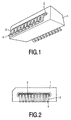
- Fig. 1 shows an elevational view of an inductive element in the form of an inductor.
- This inductive element comprises a block-shaped, undivided core (1) of a soft-magnetic ferrite material, which in this case consists of MnZn-ferrite.
- Said core 1 comprises a through-hole (2) through which ten wires (3) of tin-plated copper are passed. These wires are bent at their end portions (4) in such a manner that the inductive element can be soldered as an SMD-component onto a printed circuit board (PCB).
- PCB printed circuit board
- the wires are partly circumferentially covered with an electrically insulating synthetic resin, which in this case consists of a thermoplastic synthetic resin on the basis of liquid-crystalline polymers.
- Fig. 2 is a schematic, longitudinal sectional view of the inductive element shown in Fig. 1.
- Fig. 3-A shows a part of a lead frame (5) of tin-plated copper, which comprises ten substantially parallel wires (3) which are provided in the lead frame.
- the wires are connected at their ends (6) to the transport strips (7) of the lead frame (5).
- the wires (3) are also connected, at locations (8), to adjacent wires, the so-called "dam bars".
- a lead frame comprises a large number of these wire structures as shown in Fig. 3-A.
- the substantially parallel wires (3) are subsequently introduced into the mould of an injection-moulding device (not shown).
- the part of the wires to be circumferentially injection moulded is bounded by said "dam bars” (8).
- dam bars By virtue of the presence of these dam bars, the injection-moulding material is not extruded between the wires.
- the mould of the injection-moulding device comprises means for securing the wires during the injection-moulding process.
- These means in their simplest form, consist of two knives connected to the mould, between which the wires are clamped substantially in the middle.
- Fig. 3-B is a plan view of the lead frame after a part of the wires has been circumferentially injection moulded in accordance with the method of the invention.
- a layer (9) of a synthetic resin is provided which extends as far as the "dam bars" (8). Due to the presence of the knives, a channel (10) is formed in the layer (9), in which the wires (3) can be readily recognized.
- the "dam bars" (8) and the transport strips are removed from the lead frame.
- an undivided, block-shaped envelope of a soft-magnetic ferrite material (MnZn-ferrite) is slid over the circumferentially injection moulded wires.
- the free ends of the wires are bent in such a manner that a so-called gulf-wing is formed, which renders the resultant inductive element suitable for use as an SMD-element.
- the mould used for circumferentially injection moulding the wires comprises, in this case, two pairs of elongated parts for securing the wires. These parts are provided with teeth, which are distributed over the parts in such a manner that adjacent wires are not held by the same pair of parts.
- This method causes the creepage distance between adjoining wires to become longer. As a result, the risk of short-circuit problems during operation of the inductive element in moist conditions is small.
- the resultant circumferentially injection moulded structure is converted to an inductive element in the same manner as described hereinabove.
- inductive elements of the type manufactured in accordance with the inventive method generate, in operation, optimally homogeneous magnetic fields. Also the risk of electric short-circuits proves to be small.
Landscapes
- Engineering & Computer Science (AREA)
- Power Engineering (AREA)
- Manufacturing & Machinery (AREA)
- Microelectronics & Electronic Packaging (AREA)
- Mechanical Engineering (AREA)
- Injection Moulding Of Plastics Or The Like (AREA)
- Coils Or Transformers For Communication (AREA)
Priority Applications (1)
| Application Number | Priority Date | Filing Date | Title |
|---|---|---|---|
| EP19990201338 EP0955646B1 (de) | 1998-05-08 | 1999-04-29 | Induktives Bauelement |
Applications Claiming Priority (3)
| Application Number | Priority Date | Filing Date | Title |
|---|---|---|---|
| EP98201463 | 1998-05-08 | ||
| EP98201463 | 1998-05-08 | ||
| EP19990201338 EP0955646B1 (de) | 1998-05-08 | 1999-04-29 | Induktives Bauelement |
Publications (3)
| Publication Number | Publication Date |
|---|---|
| EP0955646A2 true EP0955646A2 (de) | 1999-11-10 |
| EP0955646A3 EP0955646A3 (de) | 2000-03-15 |
| EP0955646B1 EP0955646B1 (de) | 2003-10-08 |
Family
ID=26150298
Family Applications (1)
| Application Number | Title | Priority Date | Filing Date |
|---|---|---|---|
| EP19990201338 Expired - Lifetime EP0955646B1 (de) | 1998-05-08 | 1999-04-29 | Induktives Bauelement |
Country Status (1)
| Country | Link |
|---|---|
| EP (1) | EP0955646B1 (de) |
Cited By (2)
| Publication number | Priority date | Publication date | Assignee | Title |
|---|---|---|---|---|
| CN102662209A (zh) * | 2012-05-21 | 2012-09-12 | 东莞星海丰电子有限公司 | 一种注塑型超薄导光片的制备方法及制品 |
| CN119871790A (zh) * | 2025-02-18 | 2025-04-25 | 常州泰隆车辆配件有限公司 | 具有断料保护的铜导体注塑封装加工设备 |
Family Cites Families (2)
| Publication number | Priority date | Publication date | Assignee | Title |
|---|---|---|---|---|
| JPS58223306A (ja) * | 1982-06-22 | 1983-12-24 | Toko Inc | リ−ドレス型固定インダクタの製造方法 |
| JPS62161455A (ja) * | 1986-01-10 | 1987-07-17 | Yamaha Motor Co Ltd | 成形用金型のインサ−ト移動防止装置 |
-
1999
- 1999-04-29 EP EP19990201338 patent/EP0955646B1/de not_active Expired - Lifetime
Cited By (3)
| Publication number | Priority date | Publication date | Assignee | Title |
|---|---|---|---|---|
| CN102662209A (zh) * | 2012-05-21 | 2012-09-12 | 东莞星海丰电子有限公司 | 一种注塑型超薄导光片的制备方法及制品 |
| CN102662209B (zh) * | 2012-05-21 | 2014-03-26 | 东莞星海丰电子有限公司 | 一种注塑型超薄导光片的制备方法及制品 |
| CN119871790A (zh) * | 2025-02-18 | 2025-04-25 | 常州泰隆车辆配件有限公司 | 具有断料保护的铜导体注塑封装加工设备 |
Also Published As
| Publication number | Publication date |
|---|---|
| EP0955646B1 (de) | 2003-10-08 |
| EP0955646A3 (de) | 2000-03-15 |
Similar Documents
| Publication | Publication Date | Title |
|---|---|---|
| US6259345B1 (en) | Inductive element | |
| US5345670A (en) | Method of making a surface-mount power magnetic device | |
| CN103151139B (zh) | 电子部件及与该电子部件有关的方法 | |
| JP3593986B2 (ja) | コイル部品及びその製造方法 | |
| US20060038653A1 (en) | High current inductor and the manufacturing method | |
| CN1343996A (zh) | 电感器及制造电感器的方法 | |
| GB2296387A (en) | Low profile inductor/transformer component | |
| EP1644943A2 (de) | Formlose elektronische einrichtung und herstellungsverfahren | |
| JPH0564845B2 (de) | ||
| US11495396B2 (en) | Surface mount inductor | |
| JP2005505916A (ja) | コイル終端を伴う部品コア | |
| KR20020090856A (ko) | 인덕터 및 그 제조방법 | |
| EP0955646B1 (de) | Induktives Bauelement | |
| US6486763B1 (en) | Inductive component and method for making same | |
| US7140091B2 (en) | Manufacturing process for an inductive component | |
| US3047935A (en) | Method of making toroidal coils | |
| JPH0543453Y2 (de) | ||
| JPS5914618A (ja) | コイル装置 | |
| US8754734B2 (en) | Simplified inductive devices and methods | |
| JPH01287911A (ja) | チップ型インダクタの製造法 | |
| JP3064492B2 (ja) | 表面実装型線輪部品の製造方法 | |
| JP3055075B2 (ja) | インダクタ及びその製造方法 | |
| JPH03261114A (ja) | チップインダクタ | |
| KR100764555B1 (ko) | 인덕터 및 인덕터의 가압 성형 방법 | |
| CA2003628A1 (en) | Method of making a surface mountable electronic device |
Legal Events
| Date | Code | Title | Description |
|---|---|---|---|
| PUAI | Public reference made under article 153(3) epc to a published international application that has entered the european phase |
Free format text: ORIGINAL CODE: 0009012 |
|
| AK | Designated contracting states |
Kind code of ref document: A2 Designated state(s): DE FR GB NL |
|
| AX | Request for extension of the european patent |
Free format text: AL;LT;LV;MK;RO;SI |
|
| PUAL | Search report despatched |
Free format text: ORIGINAL CODE: 0009013 |
|
| AK | Designated contracting states |
Kind code of ref document: A3 Designated state(s): AT BE CH CY DE DK ES FI FR GB GR IE IT LI LU MC NL PT SE |
|
| AX | Request for extension of the european patent |
Free format text: AL;LT;LV;MK;RO;SI |
|
| RIC1 | Information provided on ipc code assigned before grant |
Free format text: 7H 01F 41/12 A, 7H 01F 41/04 B, 7H 01F 27/29 B, 7B 29C 45/14 B |
|
| 17P | Request for examination filed |
Effective date: 20000915 |
|
| AKX | Designation fees paid |
Free format text: DE FR GB NL |
|
| 17Q | First examination report despatched |
Effective date: 20011203 |
|
| GRAH | Despatch of communication of intention to grant a patent |
Free format text: ORIGINAL CODE: EPIDOS IGRA |
|
| GRAS | Grant fee paid |
Free format text: ORIGINAL CODE: EPIDOSNIGR3 |
|
| GRAA | (expected) grant |
Free format text: ORIGINAL CODE: 0009210 |
|
| AK | Designated contracting states |
Kind code of ref document: B1 Designated state(s): DE FR GB NL |
|
| REG | Reference to a national code |
Ref country code: GB Ref legal event code: FG4D |
|
| REF | Corresponds to: |
Ref document number: 69911839 Country of ref document: DE Date of ref document: 20031113 Kind code of ref document: P |
|
| ET | Fr: translation filed | ||
| PLBE | No opposition filed within time limit |
Free format text: ORIGINAL CODE: 0009261 |
|
| STAA | Information on the status of an ep patent application or granted ep patent |
Free format text: STATUS: NO OPPOSITION FILED WITHIN TIME LIMIT |
|
| 26N | No opposition filed |
Effective date: 20040709 |
|
| PGFP | Annual fee paid to national office [announced via postgrant information from national office to epo] |
Ref country code: NL Payment date: 20070426 Year of fee payment: 9 |
|
| PGFP | Annual fee paid to national office [announced via postgrant information from national office to epo] |
Ref country code: DE Payment date: 20070612 Year of fee payment: 9 |
|
| PGFP | Annual fee paid to national office [announced via postgrant information from national office to epo] |
Ref country code: GB Payment date: 20070425 Year of fee payment: 9 |
|
| PGFP | Annual fee paid to national office [announced via postgrant information from national office to epo] |
Ref country code: FR Payment date: 20070425 Year of fee payment: 9 |
|
| GBPC | Gb: european patent ceased through non-payment of renewal fee |
Effective date: 20080429 |
|
| NLV4 | Nl: lapsed or anulled due to non-payment of the annual fee |
Effective date: 20081101 |
|
| PG25 | Lapsed in a contracting state [announced via postgrant information from national office to epo] |
Ref country code: NL Free format text: LAPSE BECAUSE OF NON-PAYMENT OF DUE FEES Effective date: 20081101 Ref country code: DE Free format text: LAPSE BECAUSE OF NON-PAYMENT OF DUE FEES Effective date: 20081101 |
|
| REG | Reference to a national code |
Ref country code: FR Ref legal event code: ST Effective date: 20081231 |
|
| PG25 | Lapsed in a contracting state [announced via postgrant information from national office to epo] |
Ref country code: FR Free format text: LAPSE BECAUSE OF NON-PAYMENT OF DUE FEES Effective date: 20080430 |
|
| PG25 | Lapsed in a contracting state [announced via postgrant information from national office to epo] |
Ref country code: GB Free format text: LAPSE BECAUSE OF NON-PAYMENT OF DUE FEES Effective date: 20080429 |