EP0955770A1 - Procédé de conversion du format d'image - Google Patents
Procédé de conversion du format d'image Download PDFInfo
- Publication number
- EP0955770A1 EP0955770A1 EP98401092A EP98401092A EP0955770A1 EP 0955770 A1 EP0955770 A1 EP 0955770A1 EP 98401092 A EP98401092 A EP 98401092A EP 98401092 A EP98401092 A EP 98401092A EP 0955770 A1 EP0955770 A1 EP 0955770A1
- Authority
- EP
- European Patent Office
- Prior art keywords
- extended view
- motion
- frame
- frames
- process according
- Prior art date
- Legal status (The legal status is an assumption and is not a legal conclusion. Google has not performed a legal analysis and makes no representation as to the accuracy of the status listed.)
- Granted
Links
- 238000000034 method Methods 0.000 title claims abstract description 77
- 238000006243 chemical reaction Methods 0.000 title claims abstract description 16
- 230000033001 locomotion Effects 0.000 claims abstract description 100
- 238000001914 filtration Methods 0.000 claims description 23
- 239000013598 vector Substances 0.000 claims description 18
- 239000000203 mixture Substances 0.000 claims description 6
- PXFBZOLANLWPMH-UHFFFAOYSA-N 16-Epiaffinine Natural products C1C(C2=CC=CC=C2N2)=C2C(=O)CC2C(=CC)CN(C)C1C2CO PXFBZOLANLWPMH-UHFFFAOYSA-N 0.000 claims description 4
- 230000011218 segmentation Effects 0.000 claims description 3
- 230000000694 effects Effects 0.000 claims description 2
- 230000006870 function Effects 0.000 claims description 2
- 230000001955 cumulated effect Effects 0.000 claims 3
- 230000002123 temporal effect Effects 0.000 claims 1
- 230000015654 memory Effects 0.000 description 14
- 238000004458 analytical method Methods 0.000 description 3
- 238000004519 manufacturing process Methods 0.000 description 3
- 238000004364 calculation method Methods 0.000 description 2
- 238000005520 cutting process Methods 0.000 description 2
- 238000005429 filling process Methods 0.000 description 2
- 238000004091 panning Methods 0.000 description 2
- 238000009825 accumulation Methods 0.000 description 1
- 230000018109 developmental process Effects 0.000 description 1
- 230000008030 elimination Effects 0.000 description 1
- 238000003379 elimination reaction Methods 0.000 description 1
- 238000012804 iterative process Methods 0.000 description 1
- 230000003068 static effect Effects 0.000 description 1
Images

Classifications
-
- H—ELECTRICITY
- H04—ELECTRIC COMMUNICATION TECHNIQUE
- H04N—PICTORIAL COMMUNICATION, e.g. TELEVISION
- H04N7/00—Television systems
- H04N7/01—Conversion of standards, e.g. involving analogue television standards or digital television standards processed at pixel level
- H04N7/0117—Conversion of standards, e.g. involving analogue television standards or digital television standards processed at pixel level involving conversion of the spatial resolution of the incoming video signal
- H04N7/0122—Conversion of standards, e.g. involving analogue television standards or digital television standards processed at pixel level involving conversion of the spatial resolution of the incoming video signal the input and the output signals having different aspect ratios
Definitions
- the invention relates to a 4/3 to 16/9 TV format conversion process. It also relates to a converter for the implementation of this process.
- Figure 1a shows a frame of a virtual scene generated by a 4/3 camera and figure 1b one generated by a 16/9 camera.
- Figure 2 illustrates known ways to convert a 4/3 TV format to a 16/9 TV format :
- the simplest method consists of keeping the 4/3 format and filling the empty parts of the 1 6/9 frame by black bands, as shown on figure 2a.
- Another type of methods consists of distorting or cutting the 4/3 source frame in order to obtain a 16/9 frame :
- a last type of methods aims at creating the missing information on the borders by specific techniques :
- the object of the invention is to overcome the aforementioned drawbacks.
- the subject of the invention is a format conversion process for a video sequence made up of a succession of frames with a given format to convert these frames into frames with a larger format, characterized in that
- Another subject of the present invention is a format conversion process for a video sequence made up of a succession of frames of a given format to convert these frames into frames with a larger format, characterized in that this conversion is carried out in two passes, one to estimate the motion between successive frames and to built an extended view of the sequence with the frames compensated in motion, the other by positioning each frame of the sequence relatively to the extended view by taking into account the calculated motion and by completing it with extended view data corresponding to the larger format.
- the process is characterized in that the motion estimation is a global motion robust estimation based on an affine modelization of the 2D apparent motion.
- the process is characterized in that the motion estimation is based on the spatio-temporal gradients of the frame luminance.
- the invention also relates to a 16/9 television set characterized in that it comprises a converter implementing the format conversion process.
- This invention aims at generating a full 16/9 frame from a 4/3 format frame by using an extended view memory built from successive frames of the video plan.
- the claimed extended view generation process consists of accumulating successive 4/3 frames and mixing them to produce a bigger one, ideally at the 16/9 format or more. If the camera and the scene background are totally static, this process will produce a final frame with exactly the same size as the 4/3 frame. But as soon as the camera moves (and especially when a panning motion is applied), a larger part of the scene is seen through the successive frames of the video plan, and hence it is possible to produce a larger frame of the scene. If this larger frame is stored in an extended view memory, the 4/3 frame can be completed by this extended view to produce the 16/9 frame of the scene as if it was seen by a 16/9 camera.
- Reconstructing the missing parts of the 16/9 frame by using an extended view memory built from successive frames of the video plan allows to get 16/9 frames without distortion or false information, increasing the image quality.
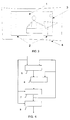
- Figure 3 shows the use of an extended memory to reconstruct the 16/9 frame.
- a 4/3 frame 1 which limits 2 are represented by dotted lines on the right and left side is related to the current frame which is to be enlarged.
- the 16/9 frame 3 is the reconstructed frame taking into account the data of the 4/3 current frame and neighboring frames in the sequence.
- an extended view memory 4 is used to memorize processed data from previous and following frames (when off-line configuration is used as explained hereafter). For example, part of the triangle appearing at the right of the 4/3 frame 3 can be completed in the extended view memory by using data from the next 4/3 frames data, only the relevant parts of this triangle, those corresponding to the 16/9 size, been displayed on the 16/9 frame.
- a typical extended view could be a large view of the scene filmed by a panning motion.
- the conversion is applied "on-line", that is in real-time, for instance directly on the TV set.
- the extended view is progressively up-dated along the video plan. Consequently, it is necessarily smaller at the beginning of the video plan than at the end, and the 16/9 frame is more and more filled as the extended view size increases.
- the conversion process is applied "off-line". This implies a delay in the generation of the 16/9 frame, which reduces the possibilities of using such a process directly on the TV set.
- the process should be preferably used as a post-production treatment.
- this type of extended view memory can be computed at the encoder and transmitted as it is to the decoder which has no more computation to perform.
- FIG. 4 illustrates the process for the on-line configuration and the algorithm is described hereafter.
- a first step 5 of the process carries out a motion estimation between the current frame data and the previous extended view data to provide motion data.
- a second step 6 processes the previous extended view data, by using these motion data (motion vectors), to calculate motion compensated extended view data.
- the third step 7 performs the extended view updating from these extended view data and the current frame data. These up-dated extended view data related to the current 4/3 frame are sent back to the first and second step to be used as previous extended view data when receiving the next current 4/3 frame.
- the fourth step 8 receives the current frame data and the updated extended view data to carry out the 16/9 frame filling to make available the current completed 16/9 frame.
- the extended view is the first source frame of the video plan. Then, given the previous extended view, a global motion estimation between this extended view and the current 4/3 source frame is performed by the first step 5.
- the affine modelization of the 2D apparent motion in a video sequence is chosen for being one of the best compromises between the computation complexity (only 6 parameters have to be identified) and the physical reality (that is the correct representation of the 2D apparent motion).
- the parameters are calculated for the whole frame. Given the coordinates x, y of a pixel, a motion vector is deduced from these parameters.
- the global motion estimation process is based on the spatio-temporal gradients of the frame luminance, which are linked to the 2D apparent motion by the "optic flow constraint equation".
- ⁇ l ⁇ , ⁇ l y and ⁇ l t are the estimated derivatives of the luminance function.
- ⁇ l ⁇ and ⁇ l y may be computed as the luminance difference between a pixel and his neighbour respectively on the same line and same column
- ⁇ l t may be computed as the luminance difference between a pixel and the corresponding one in the motion compensated neighbour frame.
- the basic problem of the motion model parameters estimation is to identify the dominant motion even if small areas in the frames have a different motion.
- the most adapted technique for solving this problem is a robust estimation method, which allows the elimination of erroneous samples in the estimation process.
- the chosen method is derived from the iteratively reweighted least squares.
- the variables ⁇ ( x,y ) are supposed to be distributed as an independent centered gaussian law of same variance for each pixel.
- the process is applied in a multiresolution way: a multiresolution pyramid of the two frames is firstly built ; then the estimation process is applied from the coarsest to the finest resolution, by using as initial estimate of the motion parameters at a given level the estimation from the coarser level.
- the initial global motion parameters vector ⁇ ⁇ 0 is set to :
- k be the current iteration number. From the current estimation of the motion parameters vector ⁇ ⁇ k-1 , a motion compensation of the extended view is achieved, and the spatio-temporal gradients maps are computed. The continuation of this process consists of progressively correcting the first estimate of q until this correction becomes low. For each pixel (x,y) and each iteration, a weighting coefficient wck(x,y) is evaluated:
- the weighted least squares method for the estimation of d ⁇ k consists of calculating the variation of the motion parameters relatively to the ones corresponding to the previous iteration, allowing to minimize the sum, on the whole frame, of the weighted squared error.
- the derivatives of the sum of the weighted squared errors relatively to each variable [parameter] are put equal to zero, giving six equations for six parameters.
- the variance of the noise is estimated again, taking into account only the weighted DFD, as giving better results : the mean value of the DFD, on the whole frame, being assumed to be equal to zero.
- the motion is taken equal to zero (the motion parameters vector is the null vector).
- the motion parameters vector is the null vector.
- This hypothesis corresponds to the low resolution frame where the motion can be considered as smaller.
- the calculation of ⁇ lt(x, y) corresponds to the difference in luminance between pixels of consecutive frames having the same coordinates (no motion).
- ⁇ lt(x, y) corresponds to the DFD or Displaced Frame Difference which is the luminance difference of the pixels linked by the motion vector. The greater this difference, the smaller the weighting coefficient, giving less weight to the pixels.
- the process is iterated until the amplitude of the estimated global motion parameters correction becomes lower than a given threshold.
- the resulting motion parameters vector ⁇ ⁇ is considered to be the robust estimation of the dominant motion parameters vector.
- the successive iterations allow to minimize the influence of the motion which is not predominant in the frame (usually the foreground) and the result corresponds to the global motion which is usually the one corresponding to the background.
- the previous extended view is motion-compensated with the estimated global motion parameters, in order to correctly superpose this extended view to the current 4/3 frame.
- the next step 7 consists of up-dating the motion compensated extended view by taking into account the current 4/3 frame. This step generates an up-dated version of the extended view from the previous extended view and the current 4/3 frame.
- the updated extended view which is explained thereunder, is then filled using data from the current 4/3 frame.
- the generation of an extended view of a video sequence is based on the accumulation of several views of a same rigid layer by motion compensating the successive frames of the sequence.
- an approach consists of segmenting, on a motion criterion, the successive frames to extract the different layers of the scene. This allows to isolate the background layer and to reject the other ones.
- This segmentation process is not necessary when performing the global motion estimation above described which allows to weight the areas where the motion is very different from the global motion (foreground areas).
- This global motion corresponds to the motion of the background layer.
- the background motion is predominant in the frame. A way to determining if this background motion is dominant is based on the estimated variance analysis. If the variance is too high, the process "motion estimation - extended view generation" is stopped and the format conversion is achieved using classical techniques.
- step 6 Two types of pixels are present :
- the next step 7 updates the extended view from the motion compensated extended view and the current 4/3 frame.
- the previous motion compensated extended frame will be denoted ExtFr n-1 , the current one (being built) ExtFr n ' and the current frame Fr n .
- a first means to update the extended frame is to use a first order filtering.
- the extended frame which is usually the background layer, is up-dated "on-line".
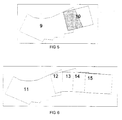
- Figure 5 shows a mixture of the previous extended frame with the current frame.
- the redundant pixels which are part of the previous extended frame 9 and the current frame 10 and in light gray are represented innovation pixels which are only part of the current frame.
- This approach only requires one extended frame memory and the current frame memory. This method takes into account all the pixels of the current frame but the successive filterings allow to reduce the weight of the pixels not corresponding to the background layer.
- a second means to update the extended view is to use a median filtering.
- This means consists of accumulating several source 4/3 frames after global motion compensation and median filtering for each pixel belonging to the layer.
- Figure 6 shows a mixture of the current layer frame 11 with successive frames 12, 13, 14, 15.
- the analysis window to calculate the current layer frame consists of 5 frames.
- Frames 12 to 15 are positioned relatively to the current layer frame 11.
- median filtering is performed, an odd number of frames is used to calculate the current layer frame.
- a filtering using a weighting coefficient ⁇ as described above, can be performed.
- the final 16/9 frame filling process can be carried out at step 8.
- the center part of the 16/9 frame is filled by the 4/3 frame.
- a mixing method as the filtering is performed, for instance the first order filtering described for up-dating the initial 16/9 frame. Of course, another mixing method can be used.
- the remaining empty parts of the 16/9 frame must be filled with one of the other techniques mentioned before.
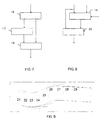
- FIGS 7 and 8 illustrate the process for the off-line configuration and the steps of the algorithm are described hereafter. Only differences with the on-line configuration are described.
- the process works in two passes. First, the extended view is built once from an analysis of the whole video plan (or a large part of it). Then the filling process is applied in a new pass, after this complete reconstruction, and the successive 16/9 frames are filled with the same and unique extended view.
- Figure 7 corresponds to the first pass, achieving the generation of the extended view.
- a first step 16 of the process carries out a motion estimation between successive 4/3 frames of the video plan. Successive global motion vectors are calculated and sent, with the 4/3 frames, to a second step 1 7 which performs motion compensation to the successive 4/3 frames. The successive motion compensated 4/3 frames and the successive global motion vectors are processed at step 18 which generates a complete extended view.
- Figure 8 corresponds to the second pass achieving the 4/3 to 16/9 conversion.
- First step 19 receives the current frame and the complete extended view calculated during the first pass to carry out motion compensation of the complete extended view, using global motion also calculated during the first pass.
- Second step 20 receives the current frame and the motion compensated extended view from the previous step to perform the filling of the current 4/3 frame.
- each frame of the sequence is motion-compensated relatively to the previous one, step 17, this succession of frames, adjusted in position, allowing to generate, step 18, the complete extended view.
- This up-dating of the extended view can be performed in the same way as in the on-line configuration:
- This filtering consists of accumulating several source 4/3 frames after global motion compensation and median filtering for each pixel belonging to the layer.
- the second pass allows to position the extended view relatively to the current 4/3 frame.
- This motion-compensation uses the global motion parameters which have been computed and stored during the first pass. Then the 16/9 frame filling is performed on the current 4/3 frame by using the data from the positioned extended view.
- Figure 9 shows a succession of 9 frames of a video plan, 21 to 29, the whole set being treated all together, during a first pass, to produce once the final extended view. It requires as many frame memories as the sequence contains and consequently is more memory consumary than the "on-line" approach.
- the duration to reconstruct the final extended view depends on the number of frames to be processed.
Landscapes
- Engineering & Computer Science (AREA)
- Computer Graphics (AREA)
- Multimedia (AREA)
- Signal Processing (AREA)
- Television Systems (AREA)
- Image Analysis (AREA)
Priority Applications (5)
| Application Number | Priority Date | Filing Date | Title |
|---|---|---|---|
| EP98401092A EP0955770B1 (fr) | 1998-05-06 | 1998-05-06 | Procédé de conversion du format d'image |
| DE69841158T DE69841158D1 (de) | 1998-05-06 | 1998-05-06 | Verfahren zum Umwandeln des Bildformates |
| CNB99106061XA CN1155234C (zh) | 1998-05-06 | 1999-04-29 | 电视节目画面格式转换方法及其使用的转换器 |
| JP12483499A JP4322349B2 (ja) | 1998-05-06 | 1999-04-30 | フレームフォーマット変換方法 |
| US09/303,370 US6421089B1 (en) | 1998-05-06 | 1999-04-30 | Frame format conversion process |
Applications Claiming Priority (1)
| Application Number | Priority Date | Filing Date | Title |
|---|---|---|---|
| EP98401092A EP0955770B1 (fr) | 1998-05-06 | 1998-05-06 | Procédé de conversion du format d'image |
Publications (2)
| Publication Number | Publication Date |
|---|---|
| EP0955770A1 true EP0955770A1 (fr) | 1999-11-10 |
| EP0955770B1 EP0955770B1 (fr) | 2009-09-16 |
Family
ID=8235359
Family Applications (1)
| Application Number | Title | Priority Date | Filing Date |
|---|---|---|---|
| EP98401092A Expired - Lifetime EP0955770B1 (fr) | 1998-05-06 | 1998-05-06 | Procédé de conversion du format d'image |
Country Status (5)
| Country | Link |
|---|---|
| US (1) | US6421089B1 (fr) |
| EP (1) | EP0955770B1 (fr) |
| JP (1) | JP4322349B2 (fr) |
| CN (1) | CN1155234C (fr) |
| DE (1) | DE69841158D1 (fr) |
Cited By (1)
| Publication number | Priority date | Publication date | Assignee | Title |
|---|---|---|---|---|
| WO2008078236A1 (fr) * | 2006-12-21 | 2008-07-03 | Koninklijke Philips Electronics N.V. | Système, procédé, et support lisible par ordinateur, et interface utilisateur destinés à afficher un rayonnement lumineux |
Families Citing this family (4)
| Publication number | Priority date | Publication date | Assignee | Title |
|---|---|---|---|---|
| JP2001292387A (ja) * | 2000-04-07 | 2001-10-19 | Yamashita Engineering Manufacture Inc | 画像処理装置および方法、ならびに記録媒体 |
| JP2008028880A (ja) * | 2006-07-25 | 2008-02-07 | Sony Corp | 画像処理装置および方法、並びにプログラム |
| CN107093201B (zh) * | 2010-09-13 | 2021-02-12 | 巴里·林恩·詹金斯 | 传输和控制包括渲染的几何、纹理和光照数据的流交互媒体 |
| CN113689534B (zh) * | 2021-10-25 | 2022-03-01 | 腾讯科技(深圳)有限公司 | 物理特效渲染方法、装置、计算机设备和存储介质 |
Citations (10)
| Publication number | Priority date | Publication date | Assignee | Title |
|---|---|---|---|---|
| US5045939A (en) * | 1989-07-06 | 1991-09-03 | Matsushita Electric Industrial Co., Ltd. | Apparatus utilizing motion detector for converting a maximum motion portion of a wide screen tv signal to a normal screen tv signal |
| EP0514819A2 (fr) * | 1991-05-23 | 1992-11-25 | Hitachi, Ltd. | Récepteur de télévision à grand écran avec fonction de conversion du rapport d'image et méthode d'affichage d'une portion agrandie |
| US5168362A (en) * | 1990-05-01 | 1992-12-01 | Sony Corporation | Apparatus for displaying standard aspect ratio television signal on wide aspect ratio display screen |
| US5218436A (en) * | 1990-01-24 | 1993-06-08 | Hitachi, Ltd. | Processing circuit for a plurality of different TV signals |
| US5220423A (en) * | 1990-03-13 | 1993-06-15 | Sony Corporation | Apparatus for controlling display of an image on a large aspect ratio television screen |
| US5243421A (en) * | 1990-10-05 | 1993-09-07 | Hitachi, Ltd. | Signal processor for a wide televison receiver |
| US5262856A (en) | 1992-06-04 | 1993-11-16 | Massachusetts Institute Of Technology | Video image compositing techniques |
| US5287188A (en) * | 1992-01-07 | 1994-02-15 | Thomson Consumer Electronics, Inc. | Horizontal panning for wide screen television |
| EP0592136A2 (fr) * | 1992-10-09 | 1994-04-13 | Sony Corporation | Génération et enregistrement d'images |
| EP0734155A1 (fr) * | 1995-03-20 | 1996-09-25 | SHARP Corporation | Dispositif de détection de déplacement de trame, appareil de prises de vues et d'enregistrement vidéo avec mode panoramique |
-
1998
- 1998-05-06 EP EP98401092A patent/EP0955770B1/fr not_active Expired - Lifetime
- 1998-05-06 DE DE69841158T patent/DE69841158D1/de not_active Expired - Lifetime
-
1999
- 1999-04-29 CN CNB99106061XA patent/CN1155234C/zh not_active Expired - Fee Related
- 1999-04-30 US US09/303,370 patent/US6421089B1/en not_active Expired - Lifetime
- 1999-04-30 JP JP12483499A patent/JP4322349B2/ja not_active Expired - Fee Related
Patent Citations (10)
| Publication number | Priority date | Publication date | Assignee | Title |
|---|---|---|---|---|
| US5045939A (en) * | 1989-07-06 | 1991-09-03 | Matsushita Electric Industrial Co., Ltd. | Apparatus utilizing motion detector for converting a maximum motion portion of a wide screen tv signal to a normal screen tv signal |
| US5218436A (en) * | 1990-01-24 | 1993-06-08 | Hitachi, Ltd. | Processing circuit for a plurality of different TV signals |
| US5220423A (en) * | 1990-03-13 | 1993-06-15 | Sony Corporation | Apparatus for controlling display of an image on a large aspect ratio television screen |
| US5168362A (en) * | 1990-05-01 | 1992-12-01 | Sony Corporation | Apparatus for displaying standard aspect ratio television signal on wide aspect ratio display screen |
| US5243421A (en) * | 1990-10-05 | 1993-09-07 | Hitachi, Ltd. | Signal processor for a wide televison receiver |
| EP0514819A2 (fr) * | 1991-05-23 | 1992-11-25 | Hitachi, Ltd. | Récepteur de télévision à grand écran avec fonction de conversion du rapport d'image et méthode d'affichage d'une portion agrandie |
| US5287188A (en) * | 1992-01-07 | 1994-02-15 | Thomson Consumer Electronics, Inc. | Horizontal panning for wide screen television |
| US5262856A (en) | 1992-06-04 | 1993-11-16 | Massachusetts Institute Of Technology | Video image compositing techniques |
| EP0592136A2 (fr) * | 1992-10-09 | 1994-04-13 | Sony Corporation | Génération et enregistrement d'images |
| EP0734155A1 (fr) * | 1995-03-20 | 1996-09-25 | SHARP Corporation | Dispositif de détection de déplacement de trame, appareil de prises de vues et d'enregistrement vidéo avec mode panoramique |
Cited By (1)
| Publication number | Priority date | Publication date | Assignee | Title |
|---|---|---|---|---|
| WO2008078236A1 (fr) * | 2006-12-21 | 2008-07-03 | Koninklijke Philips Electronics N.V. | Système, procédé, et support lisible par ordinateur, et interface utilisateur destinés à afficher un rayonnement lumineux |
Also Published As
| Publication number | Publication date |
|---|---|
| DE69841158D1 (de) | 2009-10-29 |
| JPH11341445A (ja) | 1999-12-10 |
| EP0955770B1 (fr) | 2009-09-16 |
| US6421089B1 (en) | 2002-07-16 |
| CN1239377A (zh) | 1999-12-22 |
| CN1155234C (zh) | 2004-06-23 |
| JP4322349B2 (ja) | 2009-08-26 |
Similar Documents
| Publication | Publication Date | Title |
|---|---|---|
| US5943445A (en) | Dynamic sprites for encoding video data | |
| Nakaya et al. | Iterative motion estimation method using triangular patches for motion compensation | |
| JP3614425B2 (ja) | 画像の一連の動きについての階層的推定方法 | |
| US6167164A (en) | One-dimensional signal adaptive filter for reducing blocking effect and filtering method | |
| Rongfu et al. | Content-adaptive spatial error concealment for video communication | |
| EP0799550B1 (fr) | Procede et systeme de codage d'images segmentees, et procede et systeme de decodage correspondants | |
| JP3847827B2 (ja) | 動きベクトル検出方法 | |
| US6229570B1 (en) | Motion compensation image interpolation—frame rate conversion for HDTV | |
| Jeon et al. | Coarse-to-fine frame interpolation for frame rate up-conversion using pyramid structure | |
| US20130064472A1 (en) | Method and Apparatus of High-Resolution Image Reconstruction Based on Multi-Frame Low-Resolution Images | |
| JPH07274044A (ja) | 時間可変フィルタ係数を用いたビデオ信号ノイズ低減システムおよびノイズ低減方法 | |
| US20070171987A1 (en) | Method for optical flow field estimation using adaptive Filting | |
| JP2010218548A (ja) | 仮想画像を合成する方法 | |
| Dubois | Motion-compensated filtering of time-varying images | |
| US20040091046A1 (en) | Method and system for video sequence real-time motion compensated temporal upsampling | |
| US5309237A (en) | Apparatus and method of compensating image-sequences for motion | |
| EP1159711B1 (fr) | Procede, dispositif et utilisation pour evaluer des images codees | |
| US6930728B2 (en) | Scan conversion apparatus | |
| US20040037471A1 (en) | Method for calculating an image interpolated between two images of a video sequence | |
| EP0955770B1 (fr) | Procédé de conversion du format d'image | |
| US7039107B1 (en) | Method and array for processing a digitized image with image points | |
| KR100243137B1 (ko) | 옵티컬 플로우를 예측하는 국부 이장방법 | |
| van Roosmalen et al. | Fast high quality interpolation of missing data in image sequences using a controlled pasting scheme | |
| US20050162565A1 (en) | Slow motion processing of digital video data | |
| Wang et al. | Comparison of block-based and mesh-based motion estimation algorithms |
Legal Events
| Date | Code | Title | Description |
|---|---|---|---|
| PUAI | Public reference made under article 153(3) epc to a published international application that has entered the european phase |
Free format text: ORIGINAL CODE: 0009012 |
|
| AK | Designated contracting states |
Kind code of ref document: A1 Designated state(s): DE FR GB IT |
|
| AX | Request for extension of the european patent |
Free format text: AL;LT;LV;MK;RO;SI |
|
| 17P | Request for examination filed |
Effective date: 20000505 |
|
| AKX | Designation fees paid |
Free format text: DE FR GB IT |
|
| 17Q | First examination report despatched |
Effective date: 20050803 |
|
| GRAP | Despatch of communication of intention to grant a patent |
Free format text: ORIGINAL CODE: EPIDOSNIGR1 |
|
| GRAS | Grant fee paid |
Free format text: ORIGINAL CODE: EPIDOSNIGR3 |
|
| GRAA | (expected) grant |
Free format text: ORIGINAL CODE: 0009210 |
|
| RAP1 | Party data changed (applicant data changed or rights of an application transferred) |
Owner name: THOMSON MULTIMEDIA |
|
| RIN1 | Information on inventor provided before grant (corrected) |
Inventor name: VIAL, JEAN-FRANCOIS Inventor name: GUILLOTEL, PHILIPPE Inventor name: FRANCOIS, EDOUARD |
|
| AK | Designated contracting states |
Kind code of ref document: B1 Designated state(s): DE FR GB IT |
|
| REG | Reference to a national code |
Ref country code: GB Ref legal event code: FG4D |
|
| REF | Corresponds to: |
Ref document number: 69841158 Country of ref document: DE Date of ref document: 20091029 Kind code of ref document: P |
|
| PLBE | No opposition filed within time limit |
Free format text: ORIGINAL CODE: 0009261 |
|
| STAA | Information on the status of an ep patent application or granted ep patent |
Free format text: STATUS: NO OPPOSITION FILED WITHIN TIME LIMIT |
|
| 26N | No opposition filed |
Effective date: 20100617 |
|
| PGFP | Annual fee paid to national office [announced via postgrant information from national office to epo] |
Ref country code: FR Payment date: 20110603 Year of fee payment: 14 |
|
| PGFP | Annual fee paid to national office [announced via postgrant information from national office to epo] |
Ref country code: GB Payment date: 20110523 Year of fee payment: 14 |
|
| PGFP | Annual fee paid to national office [announced via postgrant information from national office to epo] |
Ref country code: DE Payment date: 20110519 Year of fee payment: 14 Ref country code: IT Payment date: 20110517 Year of fee payment: 14 |
|
| GBPC | Gb: european patent ceased through non-payment of renewal fee |
Effective date: 20120506 |
|
| PG25 | Lapsed in a contracting state [announced via postgrant information from national office to epo] |
Ref country code: IT Free format text: LAPSE BECAUSE OF NON-PAYMENT OF DUE FEES Effective date: 20120506 |
|
| REG | Reference to a national code |
Ref country code: FR Ref legal event code: ST Effective date: 20130131 |
|
| REG | Reference to a national code |
Ref country code: DE Ref legal event code: R119 Ref document number: 69841158 Country of ref document: DE Effective date: 20121201 |
|
| PG25 | Lapsed in a contracting state [announced via postgrant information from national office to epo] |
Ref country code: FR Free format text: LAPSE BECAUSE OF NON-PAYMENT OF DUE FEES Effective date: 20120531 Ref country code: GB Free format text: LAPSE BECAUSE OF NON-PAYMENT OF DUE FEES Effective date: 20120506 |
|
| PG25 | Lapsed in a contracting state [announced via postgrant information from national office to epo] |
Ref country code: DE Free format text: LAPSE BECAUSE OF NON-PAYMENT OF DUE FEES Effective date: 20121201 |