EP0959190A2 - Wärmedämmelement - Google Patents
Wärmedämmelement Download PDFInfo
- Publication number
- EP0959190A2 EP0959190A2 EP99108797A EP99108797A EP0959190A2 EP 0959190 A2 EP0959190 A2 EP 0959190A2 EP 99108797 A EP99108797 A EP 99108797A EP 99108797 A EP99108797 A EP 99108797A EP 0959190 A2 EP0959190 A2 EP 0959190A2
- Authority
- EP
- European Patent Office
- Prior art keywords
- thermal insulation
- cover layers
- core plate
- insulation element
- element according
- Prior art date
- Legal status (The legal status is an assumption and is not a legal conclusion. Google has not performed a legal analysis and makes no representation as to the accuracy of the status listed.)
- Granted
Links
- 238000009413 insulation Methods 0.000 title claims description 39
- 239000006260 foam Substances 0.000 claims abstract description 14
- 239000000463 material Substances 0.000 claims abstract description 7
- 239000004814 polyurethane Substances 0.000 claims abstract description 5
- 239000011490 mineral wool Substances 0.000 claims description 12
- 239000000835 fiber Substances 0.000 claims description 10
- 239000004793 Polystyrene Substances 0.000 claims description 5
- KXGFMDJXCMQABM-UHFFFAOYSA-N 2-methoxy-6-methylphenol Chemical compound [CH]OC1=CC=CC([CH])=C1O KXGFMDJXCMQABM-UHFFFAOYSA-N 0.000 claims description 4
- 229920001568 phenolic resin Polymers 0.000 claims description 4
- 239000005011 phenolic resin Substances 0.000 claims description 4
- 229920005990 polystyrene resin Polymers 0.000 claims description 4
- 229920005749 polyurethane resin Polymers 0.000 claims description 4
- 239000000853 adhesive Substances 0.000 abstract description 2
- 230000001070 adhesive effect Effects 0.000 abstract description 2
- 229920002635 polyurethane Polymers 0.000 abstract 1
- 239000012774 insulation material Substances 0.000 description 5
- 230000002427 irreversible effect Effects 0.000 description 2
- 206010061218 Inflammation Diseases 0.000 description 1
- 238000004026 adhesive bonding Methods 0.000 description 1
- 230000005540 biological transmission Effects 0.000 description 1
- 238000010276 construction Methods 0.000 description 1
- 230000003111 delayed effect Effects 0.000 description 1
- 239000004794 expanded polystyrene Substances 0.000 description 1
- 230000009970 fire resistant effect Effects 0.000 description 1
- 238000010438 heat treatment Methods 0.000 description 1
- 230000004054 inflammatory process Effects 0.000 description 1
- 238000004519 manufacturing process Methods 0.000 description 1
- 238000000034 method Methods 0.000 description 1
- 229920002223 polystyrene Polymers 0.000 description 1
- 230000009467 reduction Effects 0.000 description 1
- 239000006228 supernatant Substances 0.000 description 1
- 239000013585 weight reducing agent Substances 0.000 description 1
Images
Classifications
-
- E—FIXED CONSTRUCTIONS
- E04—BUILDING
- E04B—GENERAL BUILDING CONSTRUCTIONS; WALLS, e.g. PARTITIONS; ROOFS; FLOORS; CEILINGS; INSULATION OR OTHER PROTECTION OF BUILDINGS
- E04B1/00—Constructions in general; Structures which are not restricted either to walls, e.g. partitions, or floors or ceilings or roofs
- E04B1/62—Insulation or other protection; Elements or use of specified material therefor
- E04B1/74—Heat, sound or noise insulation, absorption, or reflection; Other building methods affording favourable thermal or acoustical conditions, e.g. accumulating of heat within walls
- E04B1/76—Heat, sound or noise insulation, absorption, or reflection; Other building methods affording favourable thermal or acoustical conditions, e.g. accumulating of heat within walls specifically with respect to heat only
- E04B1/78—Heat insulating elements
- E04B1/80—Heat insulating elements slab-shaped
-
- E—FIXED CONSTRUCTIONS
- E04—BUILDING
- E04C—STRUCTURAL ELEMENTS; BUILDING MATERIALS
- E04C2/00—Building elements of relatively thin form for the construction of parts of buildings, e.g. sheet materials, slabs, or panels
- E04C2/02—Building elements of relatively thin form for the construction of parts of buildings, e.g. sheet materials, slabs, or panels characterised by specified materials
- E04C2/26—Building elements of relatively thin form for the construction of parts of buildings, e.g. sheet materials, slabs, or panels characterised by specified materials composed of materials covered by two or more of groups E04C2/04, E04C2/08, E04C2/10 or of materials covered by one of these groups with a material not specified in one of the groups
- E04C2/284—Building elements of relatively thin form for the construction of parts of buildings, e.g. sheet materials, slabs, or panels characterised by specified materials composed of materials covered by two or more of groups E04C2/04, E04C2/08, E04C2/10 or of materials covered by one of these groups with a material not specified in one of the groups at least one of the materials being insulating
- E04C2/296—Building elements of relatively thin form for the construction of parts of buildings, e.g. sheet materials, slabs, or panels characterised by specified materials composed of materials covered by two or more of groups E04C2/04, E04C2/08, E04C2/10 or of materials covered by one of these groups with a material not specified in one of the groups at least one of the materials being insulating composed of insulating material and non-metallic or unspecified sheet-material
-
- E—FIXED CONSTRUCTIONS
- E04—BUILDING
- E04B—GENERAL BUILDING CONSTRUCTIONS; WALLS, e.g. PARTITIONS; ROOFS; FLOORS; CEILINGS; INSULATION OR OTHER PROTECTION OF BUILDINGS
- E04B1/00—Constructions in general; Structures which are not restricted either to walls, e.g. partitions, or floors or ceilings or roofs
- E04B1/62—Insulation or other protection; Elements or use of specified material therefor
- E04B1/74—Heat, sound or noise insulation, absorption, or reflection; Other building methods affording favourable thermal or acoustical conditions, e.g. accumulating of heat within walls
- E04B1/76—Heat, sound or noise insulation, absorption, or reflection; Other building methods affording favourable thermal or acoustical conditions, e.g. accumulating of heat within walls specifically with respect to heat only
- E04B2001/7683—Fibrous blankets or panels characterised by the orientation of the fibres
Definitions
- the invention relates to a thermal insulation element for the insulation of Flat roofs and pitched roofs.
- Thermal insulation elements are laid on flat roofs and sloping roofs.
- the material thicknesses of the thermal insulation elements laid on flat roofs and sloping roofs have increased continuously as a result of legal requirements. These requirements serve to save heating energy.
- the current level of the required thermal insulation is defined by a heat transmission coefficient k D ⁇ 0.30 W / m 2 K.
- mineral wool insulation materials are predominantly installed on flat or sloping roofs. These mineral wool insulation materials are mainly applied to load-bearing roof shells, which mostly consist of profiled sheets for cost reasons.
- the insulation materials must have sufficient flexural tensile strength so that they can bridge the clear widths between the upper chords of the profiled sheets or are sufficiently load-bearing when cantilevered over an upper chord.
- the mineral wool insulation materials have bulk densities of more than 120 kg / m 3 , with an average of approx. 145 kg / m 3 being achieved.
- the basis weight is therefore more than 18.9 kg / m 2 .
- the use of large format elements with dimensions of 2 mx 1.2 m thus leads to a weight of more than 45 kg per element. Due to their weight, such elements lead to considerable loads on the craftsmen carrying out the laying.
- rigid foam panels made of expanded or extruded polystyrene, polyurethane or phenolic resin foam instead of the relatively heavy mineral wool insulation panels.
- these rigid foam panels only have bulk densities of 15 to 20 kg / m 3 , these panels are combustible and, under the influence of high temperatures in the component, tend to change shape, such as irreversible shrinkage or bowls.
- the invention has for its object to provide a sufficiently stable, in particular tread-resistant thermal insulation element for the insulation of flat roofs and flat-pitched roofs, which is easy to handle due to a low bulk density even with large-sized elements and the requirements in terms of Non-flammability met.
- a thermal insulation element which consists of a core plate with two large surfaces and top layers of mineral wool fibers arranged on the large surfaces, the core plate consisting of a material whose bulk density is lower than the bulk density of each top layer and the top layers are pressure-resistant in the direction of the surface normal of the large surfaces.
- thermal insulation element has the advantage that Use a relatively light core plate in combination with two pressure-resistant and fire-resistant cover layers elements with relatively low Weight are created, which is therefore easy to handle are, so that the laying of several layers can be dispensed with.
- the thermal insulation element according to the invention is therefore suitable for a Covering a flat roof or a flat-pitched roof with sufficiently large elements that allow rapid covering, i.e. in short Periods allowed, so that the requirements in terms of Bridging the top chords is fulfilled.
- the core plate consists of a rigid foam, such as expanded or extruded polystyrene, polyurethane or phenolic resin foam. These materials have a bulk density between 10 and 30 kg / m 3 , preferably between 15 and 20 kg / m 3.
- An 8 cm thick core plate with the dimensions 2 mx 1.2 m and a bulk density of 30 kg / m 3 then weighs accordingly 5.76 kg and is easy to handle, even with applied top layers, the top layers providing the necessary pressure resistance and fire resistance of the thermal insulation element.
- the cover layers are preferably non-positively with the core plate connected, whereby the gluing of the cover layers to the core plate as has proven advantageous.
- cover layers have fibers that predominantly at right angles to the large surfaces of the core plate are aligned.
- the hard foam core plate prevents the Sheets over the cavity between the upper chords of the profile sheets when Commit or other stresses are punched.
- the invention Arrangement of the fibers in the cover layers leads to a higher one Compressive strength or allows the bulk density for a given compressive strength of the mineral wool insulation boards as top layers, thereby reducing considerable cost reductions in the production of corresponding Have thermal insulation elements implemented.
- the Cover layers are at least 2 cm, preferably 3 cm thick, so that a effective protection against fire from above - flying flames and radiant heat - as is achieved in the event of a fire attack from below.
- cover layers can be both immediate Inflammation as well as the start of fire prevented or significantly delayed become.
- thermal decoupling of the cover layers made of mineral wool fibers from the core plate made of rigid foam which is thermal conditional irreversible change in shape of the rigid foam from expanded Polystyrene can be significantly reduced or prevented.
- the cover layers are preferably slightly laterally above the core plate forth.
- the supernatant of the Form cover layers in a range between 2 and 5 mm.
- the cover layers is relatively compressible, a joint-tight To allow laying of the thermal insulation elements.
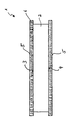
- the drawing shows a thermal insulation element 1 for the insulation of Flat roofs and pitched roofs.
- the thermal insulation element 1 consists of a core plate 2, which has two large surfaces 3 and 4. The large surfaces 3 and 4 run parallel to one another.
- a covering layer 5 is arranged on each large surface 3 and 4.
- the Cover layers 5 consist of mineral wool insulation panels, which individual fibers are produced in a manner known per se.
- the fibers are in the drawing indicated by the reference number 6 and run in substantially perpendicular to the large surfaces 3, 4 of the core plate 2.
- the core plate 2 consists of a rigid foam, such as expanded or extruded polystyrene, polyurethane or Phenolic resin foam.
- the large surfaces 3, 4 of the core plate 2 are with the Cover layers 5 glued.
- cover layers 5 laterally slightly over the The core plate 2 protrude, with the fibers aligned in parallel Flexibility of the cover layers 5 parallel to the large surfaces 3, 4 of the Allow core plate 2, whereas the cover layers 5 parallel to Surface normals of the surfaces 3, 4 have a high compressive strength.
- a thermal insulation element 1 described above can consist, for example, of a polystyrene rigid foam plate as the core plate 2 with a material thickness of 8 cm and a bulk density of 20 kg / m 3 .
- On this core plate 2 two cover layers of 3 cm material thickness are applied from mineral wool insulation boards, which have a bulk density of 150 kg / m 3 .
- the cover layers 5 are glued to the core plate 2 with an adhesive which has a weight of 1 kg / m 2 .
- Such a thermal insulation element 1 has a weight per unit area of 11.6 kg / m 2 .
- Compared to a conventional mineral wool insulation board with a normal basis weight of 20.6 kg / m 2 there is a 43% weight reduction, which means a significant simplification of handling.
Landscapes
- Engineering & Computer Science (AREA)
- Architecture (AREA)
- Physics & Mathematics (AREA)
- Civil Engineering (AREA)
- Structural Engineering (AREA)
- Acoustics & Sound (AREA)
- Electromagnetism (AREA)
- Building Environments (AREA)
- Cable Accessories (AREA)
- Thermistors And Varistors (AREA)
- Devices For Indicating Variable Information By Combining Individual Elements (AREA)
- Laminated Bodies (AREA)
Abstract
Description
Claims (9)
- Wärmedämmelement für die Dämmung von Flachdächern und flachgeneigten Dächern, bestehend aus einer Kernplatte (2) mit zwei großen Oberflächen (4, 5), und auf den großen Oberflächen (4, 5) angeordneten Deckschichten (5) aus Mineralwollefasern, wobei die Kernplatte (2) aus einem Material besteht, dessen Rohdichte geringer ist, als die Rohdichte jeder Deckschicht (5) und wobei die Deckschichten (5) in Richtung der Flächennormalen der großen Oberflächen (3, 4) druckfest sind.
- Wärmedämmelement nach Anspruch 1,
dadurch gekennzeichnet,
daß die Kernplatte (2) aus einem Hartschaum, wie beispielsweise expandiertem oder extrudiertem Polystyrol, Polyurethan oder Phenolharzschaum besteht. - Wärmedämmelement nach Anspruch 2,
dadurch gekennzeichnet,
daß die Kernplatte (2) eine Rohdichte zwischen 10 und 30 kg/m3, vorzugsweise zwischen 15 und 20 kg/m3 aufweist. - Wärmedämmelement nach Anspruch 1,
dadurch gekennzeichnet,
daß die Deckschichten (5) kraftschlüssig mit der Kernplatte (2) verbunden, insbesondere verklebt sind. - Wärmedämmelement nach Anspruch 1,
dadurch gekennzeichnet,
daß die Deckschichten (5) Fasern (6) aufweisen, die überwiegend rechtwinklig zu den großen Oberflächen (3, 4) der Kernplatte (2) ausgerichtet sind. - Wärmedämmelement nach Anspruch 1,
dadurch gekennzeichnet,
daß die Deckschichten (5) zumindest 2 cm, vorzugsweise 3 cm dick sind. - Wärmedämmelement nach Anspruch 1,
dadurch gekennzeichnet,
daß die Deckschichten (5) seitlich geringfügig über die Kernplatte (2) hervorstehen. - Wärmedämmelement nach Anspruch 7,
dadurch gekennzeichnet,
daß die Deckschichten (5) zumindest in ihrem Randbereich parallel zu den großen Oberflächen (3, 4) flexibel sind. - Wärmedämmelement nach Anspruch 7,
dadurch gekennzeichnet,
daß die Deckschichten (5) 2 bis 5 mm über den Rand der Kernplatte (2) überstehen.
Applications Claiming Priority (2)
| Application Number | Priority Date | Filing Date | Title |
|---|---|---|---|
| DE29808924U | 1998-05-16 | ||
| DE29808924U DE29808924U1 (de) | 1998-05-16 | 1998-05-16 | Wärmedämmelement |
Publications (3)
| Publication Number | Publication Date |
|---|---|
| EP0959190A2 true EP0959190A2 (de) | 1999-11-24 |
| EP0959190A3 EP0959190A3 (de) | 2000-02-23 |
| EP0959190B1 EP0959190B1 (de) | 2005-09-07 |
Family
ID=8057304
Family Applications (1)
| Application Number | Title | Priority Date | Filing Date |
|---|---|---|---|
| EP99108797A Expired - Lifetime EP0959190B1 (de) | 1998-05-16 | 1999-05-03 | Wärmedämmelement |
Country Status (4)
| Country | Link |
|---|---|
| EP (1) | EP0959190B1 (de) |
| AT (1) | ATE304091T1 (de) |
| DE (2) | DE29808924U1 (de) |
| DK (1) | DK0959190T3 (de) |
Cited By (1)
| Publication number | Priority date | Publication date | Assignee | Title |
|---|---|---|---|---|
| WO2014102713A1 (en) * | 2012-12-31 | 2014-07-03 | Rockwool International A/S | Rigid insulating panel |
Families Citing this family (4)
| Publication number | Priority date | Publication date | Assignee | Title |
|---|---|---|---|---|
| DE10104737A1 (de) * | 2001-02-02 | 2002-09-12 | Rommersbach Carmen | Bauplatte |
| PL204114B1 (pl) † | 2001-06-02 | 2009-12-31 | Rockwool Mineralwolle | Konstrukcja dachowa w płaskim i/lub płasko nachylonym ukształtowaniu oraz element izolacyjny do takiej konstrukcji |
| DE10261988B4 (de) * | 2002-07-19 | 2007-01-25 | Deutsche Rockwool Mineralwoll Gmbh + Co Ohg | Dämmschicht aus Mineralfasern |
| EP2136010A1 (de) * | 2008-06-17 | 2009-12-23 | Rockwool International A/S | Gebäudesystem für eine Gebäudekonstruktion |
Family Cites Families (4)
| Publication number | Priority date | Publication date | Assignee | Title |
|---|---|---|---|---|
| BE755178A (fr) * | 1969-09-04 | 1971-02-01 | Weinsheim Gmbh Chem Werke | Element de couverture prefabrique pour toitures plates |
| DK3693D0 (da) * | 1993-01-14 | 1993-01-14 | Rockwool Int | A method of producing a mineral fiber-insulating web, a plant for producing a mineral fiber web, and a mineral fiber-insulated plate |
| BE1009158A6 (nl) * | 1995-02-24 | 1996-12-03 | Cospi Naamloze Vennootschap | Verbindingselement voor isolerende panelen. |
| NL1002686C2 (nl) * | 1996-03-22 | 1997-09-23 | Isobouw Systems Bv | Samenstel voor het vormen van een dak alsmede dakelement voor een dergelijk samenstel. |
-
1998
- 1998-05-16 DE DE29808924U patent/DE29808924U1/de not_active Expired - Lifetime
-
1999
- 1999-05-03 DE DE59912514T patent/DE59912514D1/de not_active Expired - Lifetime
- 1999-05-03 EP EP99108797A patent/EP0959190B1/de not_active Expired - Lifetime
- 1999-05-03 AT AT99108797T patent/ATE304091T1/de not_active IP Right Cessation
- 1999-05-03 DK DK99108797T patent/DK0959190T3/da active
Cited By (1)
| Publication number | Priority date | Publication date | Assignee | Title |
|---|---|---|---|---|
| WO2014102713A1 (en) * | 2012-12-31 | 2014-07-03 | Rockwool International A/S | Rigid insulating panel |
Also Published As
| Publication number | Publication date |
|---|---|
| DE59912514D1 (de) | 2005-10-13 |
| DK0959190T3 (da) | 2006-01-16 |
| ATE304091T1 (de) | 2005-09-15 |
| DE29808924U1 (de) | 1998-09-03 |
| EP0959190B1 (de) | 2005-09-07 |
| EP0959190A3 (de) | 2000-02-23 |
Similar Documents
| Publication | Publication Date | Title |
|---|---|---|
| DE2135007C3 (de) | Konstruktionselement | |
| EP0940512A1 (de) | Plattenförmiges Brandschutzelement in Sandwich-Bauweise | |
| DE2721866A1 (de) | Wandelementenkonstruktion und wandelement | |
| WO2016091244A2 (de) | Paneelsystem für die erstellung von räumen | |
| DE10344755A1 (de) | Verwindungssichere Fussbodenplatte mit Oberflächenschicht und damit hergestellter Boden | |
| DE202010001675U1 (de) | Bodendämmplattensystem | |
| EP0959190B1 (de) | Wärmedämmelement | |
| DE69609981T2 (de) | Paneele | |
| EP0947638B1 (de) | Dämmplatte zur Verwendung an Aussenfassaden von Häusern | |
| DE2700416C3 (de) | Mehrschichtiges Verbundtragwerk | |
| DE3540455A1 (de) | Anorganische mehrschicht-leichtbauplatte | |
| DE202022101604U1 (de) | Inlay für Metalltüren | |
| AT503225B1 (de) | Holzbautafel | |
| DE20304627U1 (de) | Trockenbauwand | |
| DE3203314A1 (de) | Dachkonstruktion | |
| DE8617998U1 (de) | Plattenförmiges Verbundelement | |
| DE19833474A1 (de) | Holzbauelement | |
| DE1609312A1 (de) | Bauplatte aus gebundenen Mineralfasern | |
| DE7513144U (de) | Mehrschichtenverbundplatte | |
| EP2166166B1 (de) | Dämmelement und Verwendung eines Dämmelements | |
| DE202010012180U1 (de) | Dämmsystem | |
| DE3235252A1 (de) | Waermedaemmplatte | |
| EP0936063A2 (de) | Wärmedämmendes Verbundbauelement | |
| EP0187356A2 (de) | Dachelement mit hoher Luftschalldämmung | |
| CH693947A5 (de) | Feuerhemmende Sandwichplatte. |
Legal Events
| Date | Code | Title | Description |
|---|---|---|---|
| PUAI | Public reference made under article 153(3) epc to a published international application that has entered the european phase |
Free format text: ORIGINAL CODE: 0009012 |
|
| AK | Designated contracting states |
Kind code of ref document: A2 Designated state(s): AT BE CH CY DE DK ES FI FR GB GR IE IT LI LU MC NL PT SE |
|
| AX | Request for extension of the european patent |
Free format text: AL;LT;LV;MK;RO;SI |
|
| PUAL | Search report despatched |
Free format text: ORIGINAL CODE: 0009013 |
|
| AK | Designated contracting states |
Kind code of ref document: A3 Designated state(s): AT BE CH CY DE DK ES FI FR GB GR IE IT LI LU MC NL PT SE |
|
| AX | Request for extension of the european patent |
Free format text: AL;LT;LV;MK;RO;SI |
|
| RIC1 | Information provided on ipc code assigned before grant |
Free format text: 7E 04B 7/22 A, 7E 04D 13/16 B, 7E 04B 1/80 B, 7E 04B 7/20 B |
|
| 17P | Request for examination filed |
Effective date: 20000818 |
|
| AKX | Designation fees paid |
Free format text: AT BE CH CY DE DK ES FI FR GB GR IE IT LI LU MC NL PT SE |
|
| RAP1 | Party data changed (applicant data changed or rights of an application transferred) |
Owner name: DEUTSCHE ROCKWOOL MINERALWOLL GMBH & CO. OHG |
|
| 17Q | First examination report despatched |
Effective date: 20030514 |
|
| GRAP | Despatch of communication of intention to grant a patent |
Free format text: ORIGINAL CODE: EPIDOSNIGR1 |
|
| GRAS | Grant fee paid |
Free format text: ORIGINAL CODE: EPIDOSNIGR3 |
|
| GRAA | (expected) grant |
Free format text: ORIGINAL CODE: 0009210 |
|
| AK | Designated contracting states |
Kind code of ref document: B1 Designated state(s): AT BE CH CY DE DK ES FI FR GB GR IE IT LI LU MC NL PT SE |
|
| PG25 | Lapsed in a contracting state [announced via postgrant information from national office to epo] |
Ref country code: IT Free format text: LAPSE BECAUSE OF FAILURE TO SUBMIT A TRANSLATION OF THE DESCRIPTION OR TO PAY THE FEE WITHIN THE PRESCRIBED TIME-LIMIT;WARNING: LAPSES OF ITALIAN PATENTS WITH EFFECTIVE DATE BEFORE 2007 MAY HAVE OCCURRED AT ANY TIME BEFORE 2007. THE CORRECT EFFECTIVE DATE MAY BE DIFFERENT FROM THE ONE RECORDED. Effective date: 20050907 |
|
| REG | Reference to a national code |
Ref country code: GB Ref legal event code: FG4D Free format text: NOT ENGLISH |
|
| REG | Reference to a national code |
Ref country code: CH Ref legal event code: EP |
|
| REG | Reference to a national code |
Ref country code: IE Ref legal event code: FG4D Free format text: LANGUAGE OF EP DOCUMENT: GERMAN |
|
| REF | Corresponds to: |
Ref document number: 59912514 Country of ref document: DE Date of ref document: 20051013 Kind code of ref document: P |
|
| REG | Reference to a national code |
Ref country code: CH Ref legal event code: NV Representative=s name: HEPP, WENGER & RYFFEL AG |
|
| PG25 | Lapsed in a contracting state [announced via postgrant information from national office to epo] |
Ref country code: GR Free format text: LAPSE BECAUSE OF FAILURE TO SUBMIT A TRANSLATION OF THE DESCRIPTION OR TO PAY THE FEE WITHIN THE PRESCRIBED TIME-LIMIT Effective date: 20051207 |
|
| PG25 | Lapsed in a contracting state [announced via postgrant information from national office to epo] |
Ref country code: ES Free format text: LAPSE BECAUSE OF FAILURE TO SUBMIT A TRANSLATION OF THE DESCRIPTION OR TO PAY THE FEE WITHIN THE PRESCRIBED TIME-LIMIT Effective date: 20051218 |
|
| REG | Reference to a national code |
Ref country code: SE Ref legal event code: TRGR |
|
| REG | Reference to a national code |
Ref country code: DK Ref legal event code: T3 |
|
| PG25 | Lapsed in a contracting state [announced via postgrant information from national office to epo] |
Ref country code: PT Free format text: LAPSE BECAUSE OF FAILURE TO SUBMIT A TRANSLATION OF THE DESCRIPTION OR TO PAY THE FEE WITHIN THE PRESCRIBED TIME-LIMIT Effective date: 20060207 |
|
| GBT | Gb: translation of ep patent filed (gb section 77(6)(a)/1977) |
Effective date: 20060302 |
|
| PG25 | Lapsed in a contracting state [announced via postgrant information from national office to epo] |
Ref country code: AT Free format text: LAPSE BECAUSE OF NON-PAYMENT OF DUE FEES Effective date: 20060503 |
|
| PG25 | Lapsed in a contracting state [announced via postgrant information from national office to epo] |
Ref country code: MC Free format text: LAPSE BECAUSE OF NON-PAYMENT OF DUE FEES Effective date: 20060531 |
|
| ET | Fr: translation filed | ||
| PLBE | No opposition filed within time limit |
Free format text: ORIGINAL CODE: 0009261 |
|
| STAA | Information on the status of an ep patent application or granted ep patent |
Free format text: STATUS: NO OPPOSITION FILED WITHIN TIME LIMIT |
|
| 26N | No opposition filed |
Effective date: 20060608 |
|
| PG25 | Lapsed in a contracting state [announced via postgrant information from national office to epo] |
Ref country code: LU Free format text: LAPSE BECAUSE OF NON-PAYMENT OF DUE FEES Effective date: 20060503 |
|
| PG25 | Lapsed in a contracting state [announced via postgrant information from national office to epo] |
Ref country code: CY Free format text: LAPSE BECAUSE OF FAILURE TO SUBMIT A TRANSLATION OF THE DESCRIPTION OR TO PAY THE FEE WITHIN THE PRESCRIBED TIME-LIMIT Effective date: 20050907 |
|
| REG | Reference to a national code |
Ref country code: DE Ref legal event code: R082 Ref document number: 59912514 Country of ref document: DE Representative=s name: STENGER WATZKE RING INTELLECTUAL PROPERTY, DE |
|
| REG | Reference to a national code |
Ref country code: DE Ref legal event code: R082 Ref document number: 59912514 Country of ref document: DE Representative=s name: STENGER WATZKE RING INTELLECTUAL PROPERTY, DE Effective date: 20140801 Ref country code: DE Ref legal event code: R081 Ref document number: 59912514 Country of ref document: DE Owner name: ROCKWOOL INTERNATIONAL A/S, DK Free format text: FORMER OWNER: DEUTSCHE ROCKWOOL MINERALWOLL GMBH + CO OHG, 45966 GLADBECK, DE Effective date: 20140801 |
|
| REG | Reference to a national code |
Ref country code: GB Ref legal event code: 732E Free format text: REGISTERED BETWEEN 20150122 AND 20150128 |
|
| REG | Reference to a national code |
Ref country code: NL Ref legal event code: SD Effective date: 20150424 |
|
| REG | Reference to a national code |
Ref country code: FR Ref legal event code: PLFP Year of fee payment: 17 |
|
| REG | Reference to a national code |
Ref country code: CH Ref legal event code: PUE Owner name: ROCKWOOL INTERNATIONAL A/S, DK Free format text: FORMER OWNER: DEUTSCHE ROCKWOOL MINERALWOLL GMBH AND CO. OHG, DE |
|
| PGFP | Annual fee paid to national office [announced via postgrant information from national office to epo] |
Ref country code: DE Payment date: 20150428 Year of fee payment: 17 |
|
| REG | Reference to a national code |
Ref country code: FR Ref legal event code: PLFP Year of fee payment: 18 |
|
| PGFP | Annual fee paid to national office [announced via postgrant information from national office to epo] |
Ref country code: NL Payment date: 20160510 Year of fee payment: 18 |
|
| PGFP | Annual fee paid to national office [announced via postgrant information from national office to epo] |
Ref country code: CH Payment date: 20160511 Year of fee payment: 18 Ref country code: FI Payment date: 20160509 Year of fee payment: 18 |
|
| PGFP | Annual fee paid to national office [announced via postgrant information from national office to epo] |
Ref country code: SE Payment date: 20160511 Year of fee payment: 18 Ref country code: BE Payment date: 20160425 Year of fee payment: 18 Ref country code: DK Payment date: 20160510 Year of fee payment: 18 Ref country code: FR Payment date: 20160426 Year of fee payment: 18 |
|
| REG | Reference to a national code |
Ref country code: DE Ref legal event code: R119 Ref document number: 59912514 Country of ref document: DE |
|
| PG25 | Lapsed in a contracting state [announced via postgrant information from national office to epo] |
Ref country code: DE Free format text: LAPSE BECAUSE OF NON-PAYMENT OF DUE FEES Effective date: 20161201 |
|
| REG | Reference to a national code |
Ref country code: CH Ref legal event code: PL |
|
| REG | Reference to a national code |
Ref country code: SE Ref legal event code: EUG Ref country code: DK Ref legal event code: EBP Effective date: 20170531 |
|
| REG | Reference to a national code |
Ref country code: NL Ref legal event code: MM Effective date: 20170601 |
|
| PG25 | Lapsed in a contracting state [announced via postgrant information from national office to epo] |
Ref country code: FI Free format text: LAPSE BECAUSE OF NON-PAYMENT OF DUE FEES Effective date: 20170503 |
|
| PG25 | Lapsed in a contracting state [announced via postgrant information from national office to epo] |
Ref country code: LI Free format text: LAPSE BECAUSE OF NON-PAYMENT OF DUE FEES Effective date: 20170531 Ref country code: SE Free format text: LAPSE BECAUSE OF NON-PAYMENT OF DUE FEES Effective date: 20170504 Ref country code: CH Free format text: LAPSE BECAUSE OF NON-PAYMENT OF DUE FEES Effective date: 20170531 |
|
| REG | Reference to a national code |
Ref country code: FR Ref legal event code: ST Effective date: 20180131 |
|
| PG25 | Lapsed in a contracting state [announced via postgrant information from national office to epo] |
Ref country code: NL Free format text: LAPSE BECAUSE OF NON-PAYMENT OF DUE FEES Effective date: 20170601 |
|
| REG | Reference to a national code |
Ref country code: BE Ref legal event code: PD Owner name: ROCKWOOL INTERNATIONAL A/S; DK Free format text: DETAILS ASSIGNMENT: CHANGE OF OWNER(S), AFFECTATION / CESSION; FORMER OWNER NAME: DEUTSCHE ROCKWOOL MINERALWOLL GMBH & CO. OHG Effective date: 20141216 Ref country code: BE Ref legal event code: MM Effective date: 20170531 |
|
| PG25 | Lapsed in a contracting state [announced via postgrant information from national office to epo] |
Ref country code: DK Free format text: LAPSE BECAUSE OF NON-PAYMENT OF DUE FEES Effective date: 20170531 |
|
| PG25 | Lapsed in a contracting state [announced via postgrant information from national office to epo] |
Ref country code: FR Free format text: LAPSE BECAUSE OF NON-PAYMENT OF DUE FEES Effective date: 20170531 |
|
| PGFP | Annual fee paid to national office [announced via postgrant information from national office to epo] |
Ref country code: IE Payment date: 20180529 Year of fee payment: 20 |
|
| PG25 | Lapsed in a contracting state [announced via postgrant information from national office to epo] |
Ref country code: BE Free format text: LAPSE BECAUSE OF NON-PAYMENT OF DUE FEES Effective date: 20170531 |
|
| PGFP | Annual fee paid to national office [announced via postgrant information from national office to epo] |
Ref country code: GB Payment date: 20180529 Year of fee payment: 20 |
|
| REG | Reference to a national code |
Ref country code: GB Ref legal event code: PE20 Expiry date: 20190502 |
|
| REG | Reference to a national code |
Ref country code: IE Ref legal event code: MK9A |
|
| PG25 | Lapsed in a contracting state [announced via postgrant information from national office to epo] |
Ref country code: IE Free format text: LAPSE BECAUSE OF EXPIRATION OF PROTECTION Effective date: 20190503 |
|
| PG25 | Lapsed in a contracting state [announced via postgrant information from national office to epo] |
Ref country code: GB Free format text: LAPSE BECAUSE OF EXPIRATION OF PROTECTION Effective date: 20190502 |