EP0959417A2 - Datenbankverwaltungssystem - Google Patents
Datenbankverwaltungssystem Download PDFInfo
- Publication number
- EP0959417A2 EP0959417A2 EP99109696A EP99109696A EP0959417A2 EP 0959417 A2 EP0959417 A2 EP 0959417A2 EP 99109696 A EP99109696 A EP 99109696A EP 99109696 A EP99109696 A EP 99109696A EP 0959417 A2 EP0959417 A2 EP 0959417A2
- Authority
- EP
- European Patent Office
- Prior art keywords
- data
- database
- sharing
- database managing
- synchronous process
- Prior art date
- Legal status (The legal status is an assumption and is not a legal conclusion. Google has not performed a legal analysis and makes no representation as to the accuracy of the status listed.)
- Withdrawn
Links
Images























Classifications
-
- G—PHYSICS
- G06—COMPUTING OR CALCULATING; COUNTING
- G06F—ELECTRIC DIGITAL DATA PROCESSING
- G06F16/00—Information retrieval; Database structures therefor; File system structures therefor
- G06F16/20—Information retrieval; Database structures therefor; File system structures therefor of structured data, e.g. relational data
- G06F16/27—Replication, distribution or synchronisation of data between databases or within a distributed database system; Distributed database system architectures therefor
- G06F16/275—Synchronous replication
-
- G—PHYSICS
- G06—COMPUTING OR CALCULATING; COUNTING
- G06F—ELECTRIC DIGITAL DATA PROCESSING
- G06F16/00—Information retrieval; Database structures therefor; File system structures therefor
- G06F16/20—Information retrieval; Database structures therefor; File system structures therefor of structured data, e.g. relational data
- G06F16/23—Updating
- G06F16/2308—Concurrency control
-
- Y—GENERAL TAGGING OF NEW TECHNOLOGICAL DEVELOPMENTS; GENERAL TAGGING OF CROSS-SECTIONAL TECHNOLOGIES SPANNING OVER SEVERAL SECTIONS OF THE IPC; TECHNICAL SUBJECTS COVERED BY FORMER USPC CROSS-REFERENCE ART COLLECTIONS [XRACs] AND DIGESTS
- Y10—TECHNICAL SUBJECTS COVERED BY FORMER USPC
- Y10S—TECHNICAL SUBJECTS COVERED BY FORMER USPC CROSS-REFERENCE ART COLLECTIONS [XRACs] AND DIGESTS
- Y10S707/00—Data processing: database and file management or data structures
- Y10S707/99931—Database or file accessing
- Y10S707/99937—Sorting
-
- Y—GENERAL TAGGING OF NEW TECHNOLOGICAL DEVELOPMENTS; GENERAL TAGGING OF CROSS-SECTIONAL TECHNOLOGIES SPANNING OVER SEVERAL SECTIONS OF THE IPC; TECHNICAL SUBJECTS COVERED BY FORMER USPC CROSS-REFERENCE ART COLLECTIONS [XRACs] AND DIGESTS
- Y10—TECHNICAL SUBJECTS COVERED BY FORMER USPC
- Y10S—TECHNICAL SUBJECTS COVERED BY FORMER USPC CROSS-REFERENCE ART COLLECTIONS [XRACs] AND DIGESTS
- Y10S707/00—Data processing: database and file management or data structures
- Y10S707/99931—Database or file accessing
- Y10S707/99938—Concurrency, e.g. lock management in shared database
-
- Y—GENERAL TAGGING OF NEW TECHNOLOGICAL DEVELOPMENTS; GENERAL TAGGING OF CROSS-SECTIONAL TECHNOLOGIES SPANNING OVER SEVERAL SECTIONS OF THE IPC; TECHNICAL SUBJECTS COVERED BY FORMER USPC CROSS-REFERENCE ART COLLECTIONS [XRACs] AND DIGESTS
- Y10—TECHNICAL SUBJECTS COVERED BY FORMER USPC
- Y10S—TECHNICAL SUBJECTS COVERED BY FORMER USPC CROSS-REFERENCE ART COLLECTIONS [XRACs] AND DIGESTS
- Y10S707/00—Data processing: database and file management or data structures
- Y10S707/99951—File or database maintenance
- Y10S707/99952—Coherency, e.g. same view to multiple users
Definitions
- the present invention relates to a database managing system for making the same contents between parties which are ready to communicate, and particularly to a database managing system capable of reducing the amount of data transmitted or processed during a synchronous process.
- information processing devices have been in wide use, and it is not rare in recent years for one individual to own a plurality of information processing devices, for example, such as a high-performance information processing device like a desk-top personal computer and a portable information processing device like a portable information terminal.
- personal information for example, such as schedules and address book
- a master database is managed by the personal computer and the data of the master database are copied to the database (portable database) of the portable information processing device, thus carrying the personal information.
- upload and download are known. Specifically, when data are changed in the personal computer, the contents of the master database are copied to the portable information terminal (download). On the other hand, when data are changed in the portable information terminal, the contents of the portable database are copied to the personal computer (upload).
- Another example is a synchronous process employing a sum of sets.
- the contents of the both databases are compared at the time when communications are made between the two database managing devices, and a sum of sets, which contains all the information added to each database is created as a new database. Thereafter, the database thus created is stored in the both database managing devices.
- the database managing device X sends its contents "A + B” to the database managing device Y.
- the database managing device Y creates a sum of sets " A + B + C " of the data "A + B” received and its contents "A + C” and stores the sum of sets as a database.
- the database managing device Y then sends the contents of the database " A + B + C " back to the database managing device X.
- the contents of the database of the database managing device X are updated to " A + B + C ", which are the same as that of the database managing device Y.
- the conventional database managing device carrying out the described synchronous process has a problem that the data amount (communications volume) transmitted between the database managing devices in the synchronous process and the data amount computed in each database managing device are extremely large.
- all the contents of one of the databases are transmitted to the other database managing device regardless of the number of data updated.
- the data of all the 1000 items are sent even when only one item is changed.
- the communications volume transmitted between the database managing devices is increased.
- the contents of the database are replaced with the database on the sending side, and thus a change in data on the receiving side is lost.
- the data are deleted only in one of the devices, the data remain in the other device.
- the data are included again in a new database and are not deleted.
- the memory space required for storing the database is increased, and the communications volume in the synchronous process is further increased.
- each database managing device stores, per each data stored in the database, ID information for identifying the data and update information indicative of no change/correction/addition/deletion, and when the data are changed, the update information corresponding to the data is updated. Also, in the synchronous process, one database managing device informs the other database managing device the ID information and update information of all data.
- the database managing device on the receiving side searches through its database data corresponding to the data of the sending side based on the ID information received so as to compare the update information of the both sides.
- a change is made only on one side, unchanged data are replaced with the data changed.
- the data of one party are added to the database of the other party, and vice versa.
- a first object of the present invention is to provide a database managing device which is capable of carrying out a synchronous process with a small effort and a small amount of communications data without resulting in an increase in size of a database even when plural data corresponding to each other are independently updated.
- a second object of the present invention is to provide a database managing device in which a memory space required for storing the presence or absence of data change is small and the amount of data transmitted and processed in the synchronous process can be further reduced.
- a third object of the present invention is to provide a database managing device which is capable of carrying out the synchronous process with a small amount of communications data without resulting in an increase in size of a database even when plural data corresponding to each other are independently updated, and which is also capable of operating the synchronous process, and sharing setting and sharing release before and after the synchronous process, respectively, with a small effort.
- a database managing device of the present invention is for constituting a database system which includes a plurality of database managing devices and a synchronous process section for making a coincidence of corresponding data between databases respectively stored in the plurality of database managing devices which are ready to communicate, and in order to achieve the first object, the database managing device includes: at least one database; a state information storing section for storing state information indicative of a change in data which occurs in a non-synchronous period between a previous synchronous process and a next synchronous process, the state information storing section storing the state information per data corresponding to data of a database of another party; a collision detecting section for detecting in a synchronous process whether data changed in a pair of the corresponding data are plural based on state information of each data of the pair; and a priority side deciding section for deciding, when data changed are plural, which of the data should be given a priority before transmitting all contents of the plural data changed so that data contents on a non-priority side are replaced with data contents on a priority side by the synchronous
- a database managing device in accordance with another preferable embodiment of the present invention is for constituting the database system, and in order to achieve the second object, includes: at least one database; a sub set setting section for setting a sub set in the at least one database, the sub set being set as a sharing region with a database of another party; a state information storing section for storing state information with respect to data which had been contained in the sub set at least at a time when a previous synchronous process was finished, the state information including (a) update information indicative of whether the data had been updated in a non-synchronous period and (b) movement information indicative of whether the data had been moved in and out of the sub set in the non-synchronous period; and a state information update section for monitoring data whose corresponding state information is stored in the state information storing section so as to update respective state information of the data in the non-synchronous period.
- a database managing device in accordance with still another preferable embodiment of the present invention is for constituting the database system, and in order to achieve the second object, includes: at least one database; an order storing section for storing an order of data which are contained at least in a sharing region of the database managing device and for setting a same order of data with that of another party in a previous synchronous process; a corresponded order storing section for storing a corresponded order indicative a last position of the order in the previous synchronous process; and an order managing section for managing an order of data so that the corresponded order and an order before the corresponded order of the order stored in the order storing section are maintained in a non-synchronous period, and data newly contained in the sharing region in the non-synchronous period are placed after the corresponded order.
- each database managing device stores the correspondence as an order of data which are stored therein.
- the memory space required for storing the correspondence and the arithmetic volume in the synchronous process can be reduced, and it is also possible to reduce the amount of data transmitted and processed in the synchronous process.
- a database managing device in accordance with yet another preferable embodiment of the present invention is for constituting the database system, and in order to achieve the third object of the present invention, includes: a plurality of priority side deciding sections for deciding a priority side when data changed in the corresponding data are plural in a non-synchronous period, and for instructing the synchronous process section to replace data contents on a non-priority side with data contents on a priority side; and a selecting section for selecting one of the plurality of priority side deciding sections to be used, the selecting section making the selection at the time of sharing setting for specifying before the synchronous process the sharing regions, which store corresponding data, between the databases.
- each database managing device can refuse the use of an undesirable priority side deciding section, thus realizing a safer database system.
- a database managing device in accordance with still another preferable embodiment of the present invention is for constituting the database system, and in order to achieve the third object, includes: at least one database; and a priority side deciding section for deciding, when data changed in the corresponding data are plural in a non-synchronous period, a priority side based on a database managing device which instructed a start of the synchronous process or sharing setting, and the priority side deciding section for instructing the synchronous process section to replace data contents on a non-priority side with data contents on a priority side.
- a database system in accordance with the present embodiment is a system which is suitably adopted when there is a need to maintain the same contents of corresponding data between a plurality of databases, each of which can update its data independently, whose communications time is limited, for example, as in the case where personal information is managed by a plurality of database managing devices.
- the system structure may vary, and in the present embodiment, explanations will be given through the case where the system is composed of portable information terminals; namely, a database system which is composed of equivalent database managing devices.
- a database system 1 in accordance with the present embodiment includes information processing devices (database managing devices) 2 for storing databases, and each information processing device 2 is connected to a communications device (communications means) 3 for communicating with the other information processing device 2, and to a display device 4 and an input device 5 for performing input and output processes with the user.
- information processing devices database managing devices
- communications device communication means
- input device 5 for performing input and output processes with the user.
- the communications device 3 for example, is an interface such as a LAN interface or an RS232C interface, a modem, an IR ray transmitter, or a radio wave transmitter, and can communicate with the other communications device 3 via at least one of various communications media, such as a cable, a public telephone line network, an IR ray, and a radio wave in accordance with an instruction from the information processing device 2.
- the display device 4, for example, is a CRT display or a liquid crystal display, and can display various information such as database contents of the information processing device 2 and the results of operation on the database, in accordance with an instruction from the information processing device 2.
- the input device 5, for example, is a keyboard, a mouse, a pen, or a touch panel provided on the display device 4, and allows an input of user's instruction to the information processing device 2.
- the information processing device 2 in accordance with the present embodiment includes a communications section 21, connected to the communications device 3, for communicating with the other information processing device 2 via the communications device 3, a user operating section 22, connected to the display device 4 and the input device 5, constituting a user interface, a database managing section 23 storing database DB, a database processing section 24 for controlling the database managing section 23 in accordance with an instruction from the user operating section 22, and a synchronizing section 25 for controlling the communications section 21 and the database managing section 23 so as to perform a process associated with a synchronous operation with the other database DB.
- These members may be realized by hardware, or by functional blocks which are realized by execution of a predetermined program by a CPU.
- the database managing section 23 corresponds to a database
- state information storing means corresponds to order storing means, and corresponded order storing means of the claims
- database processing section 24 corresponds to state information update means and order managing means of the claims.
- the database DB is managed in the unit of a tip T, indicative of single data, and a bag F, which is a set of tips T
- the database managing section 23 includes a tip managing section 31 and a bag managing section (subset setting means) 32 for storing a database.
- the database processing section 24 includes a tip update processing section 41, a tip addition processing section 42, and a tip deletion processing section 43 for updating, adding, and deleting the tip T, respectively.
- the database processing section 24 also includes members associated with other operations of the database DB, for example, such as searching and displaying of the tip T, and changing of the relationship of inclusion between the tip T and the bag F.
- a bag F by searching a tip T which satisfies a predetermined condition, such as a tip T with predetermined contents, and select a predetermined tip T from displayed tips T and insert the tip T thus selected into a predetermined bag F.
- a predetermined condition such as a tip T with predetermined contents
- the synchronizing section 25 includes a synchronize processing section 51 for subjecting tips T to a synchronous process, a sharing setting processing section 52 for carrying out sharing setting (mentioned later) prior to the synchronous process, and a sharing release processing section 53 for releasing the sharing setting, for example, when the synchronous process is no longer required.
- the synchronize processing section 51 corresponds to synchronous process means, correspond means, judging means, inside-outside synchronous process means, priority side judging means, data contents synchronizing means, data adding means, added data correspond means, corresponded order update means, and first and second order deleting means of claims.
- the structures of the database processing section 24 and the synchronizing section 25 are closely associated with the data stored in the database managing section 23, and they are characterized by the operations which are heavily based on the data stored in the database managing section 23.
- the following explanations only deal with the structure of the database managing section 23, and the structures of the database processing section 24 and the synchronizing section 25 will be described in relation to their operations.
- the tip managing section 31 manages single data with a data structure called a "tip".
- Each tip T includes a tip ID for distinguishing itself from the other tips T in the database DB, and an attribute list LA containing single data.
- the attribute list LA stores a list in a combination of attribute name NA indicative of a type of attribute A, and attribute value VA indicative of a value of attribute A in the data stored in the tip T.
- each tip T corresponds to single address data.
- the address data are composed of three kinds of data, indicative of name, address, and phone number, respectively
- each tip T is defined as a set of three attributes A 1 through A 3 of the name, address, and phone number
- the attribute list LA of the tip T is represented by a list as shown in Fig. 4, in which combinations of attribute name NA and attribute value VA are listed in an orderly manner.
- the attribute list LA of a first tip stores, as attribute A 1 , a combination of attribute NA 1 "Name” and attribute value VA 2 "Adam Smith".
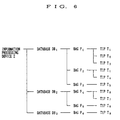
- the bag managing section 32 stores bags F contained in the database DB and the relationship of inclusion between each tip T and the bags F. As shown in Fig. 5, for example, in the case where a single information processing device 2 contains a plurality of databases DB 1 , DB 2 , and DB 3 , a relationship of information processing device 2 ⁇ database DB ⁇ bag F ⁇ tip T is established. The bag managing section 32 stores this relationship in the form of tree structure S as shown in Fig. 6.
- a tip T may be contained in a single bag F, as with the tip T 2 contained in the single bag F 1 , or contained in a plurality of bags, as with the tip T 1 in the bags F 1 and F 2 .
- the tip T 1 contained in a plurality of bags F 1 and F 2 can be represented as shown in Fig. 5.
- the entire tree structure S may be stored, or the tree structure S may be stored in the form of a plurality of lists by dividing it into a list of databases DB contained in the information processing device 2, a list of bags F per each database DB, and a list of tips T per each bag F.
- a list of databases DB contained in the information processing device 2 a list of bags F per each database DB
- a list of tips T per each bag F a list of tips T per each bag F.
- an ID is also given to each of the information processing device 2, the database DB, and the bag F to distinguish them from the others, and thus the lists of the information processing device 2, the database DB, and the bag F are stored as the lists of IDs.
- the database DB, and the bag F are stored in the form of lists, while a tip T contained in a certain bag F can be found immediately by referring to the lists, a bag F containing the tip T results in the worst case and it is required to search all the lists.
- a region (sharing region) subject to the synchronous process is determined in the unit of a bag F, and whether or not a tip T is shared between databases DB is determined by whether the tip T belongs to a bag (sharing bag SF), to which sharing has been set beforehand.
- an access to the other information processing device 2 via a device such as the communications device 3 is considerably slow as compared with the case where an access is made internally within the information processing device 2, and for this reason the time required for the synchronous process tends to be long. Therefore, there is a need to reduce the time required and the amount of data transferred between the information processing devices 2a and 2b.
- an internal access within the information processing device 2 is relatively fast, and thus there is no large increase in processing time even when the volume of processes in a period (non-synchronous period) between a previous synchronous process and a next synchronous process is increased.
- the bag managing section 32 in accordance with the present embodiment stores a dirty bit list LD composed of dirty bits D, each indicative of the state of each tip T in the non-synchronous period, so as to reduce the amount of data.
- the dirty bit list LD is managed such that the order of dirty bits D in one information processing device 2 is the same as that of the dirty bits D in the other information processing device 2 between corresponding tips T, and as will be described later, the dirty bit list LD also indicates a correspondence of tips T.
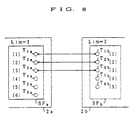
- the bag managing section 32 also stores a sink limit Lim indicative of the number of tips T which were made corresponded in the previous synchronous process, so that it is possible to judge whether the tips T corresponding to dirty bits D have already been made corresponded to the tips T of the sharing bag SF of the other information processing device 2.
- a dirty bit list LD a of the information processing device 2a stores dirty bits D 1a through D 6a , corresponding to tips T 1a through T 6a , respectively, in this order.
- a dirty bit list LD b stores dirty bits D 1b through D 3b , corresponding to tips T 1b through T 3b , respectively, and also dirty bits D 7b and D 8b , corresponding to tips T 7b and T 8b , respectively, in this order.
- the sink limit Lim is "3"
- tips T 4a through T 6a and tips T 7b and T 8b whose dirty bits D are stored after the third position of the lists are not made corresponded to the tips T of the sharing bag SF of the other party.
- Fig. 9 only shows one example of the storing method of the dirty bit list LD, in which a combination of a dirty bit D and a corresponding tip ID is stored in succession.
- the position of a dirty bit D in the dirty bit list LD will be referred to as a sink tag and represented by the number in a bracket [].
- corresponding data such as a dirty bit D and a tip T will be represented by the same subscript, for example, as in dirty bit D 1a and tip T 1a .
- the information stored in the information processing device 2a will be represented by the subscript "a", as in the tip T 1a , so as to distinguish it from the information stored in the information processing device 2b, to which the subscript "b" is given. Note that, when there is no need to indicate a correspondence of information, or when referring to information in general, the subscripts are omitted.
- the dirty bits D are created so that they correspond one by one to the tips T which have existed in a sharing bag SF even once during the non-synchronous period, and each dirty bit D includes an update parameter indicative of whether the corresponding tip T has been updated during the non-synchronous period, and a movement parameter indicative of whether the tip T has been moved in and out of the sharing bag SF during the non-synchronous period.
- the update parameter takes the value of either "m”, which indicates update, or "p”, which indicates maintain.
- the movement parameter takes the value of either "X”, which indicates still, or "I”, which indicates insert, or "O”, which indicates remove.
- X indicates that the tip T has been existing in the sharing bag SF since the last synchronous process
- I indicates that the tip T has been inserted or re-inserted into the sharing bag SF since the last synchronous process
- O indicates that the tip T has been removed or inserted once but later removed from the sharing bag SF since the last synchronous process.
- the movement parameter for example, as shown in Fig. 10, is stored as a combination of an addition bit BI, which indicates that the tip T has been added to the sharing bag SF, and a deletion bit BO, which indicates that the tip T has been deleted from the sharing bag SF.
- the dirty bit list LD and the sink limit Lim are provided per each combination of the sharing bag SF of one party and the sharing bag SF of the other party.
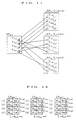
- the order and value of the dirty bits D, or the sink limit Lim may be different among the dirty bit lists LD ab , LD ac , and LD ad .
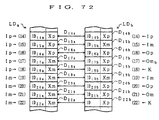
- a dirty bit D 2ab (having a value of Im) indicative of a tip T 2a is stored in the second position
- a dirty bit D 2ac (having a value of Xp) is stored in the first position.
- a dirty bit D 2b indicative of a tip T 2b is stored in the second position
- a dirty bit D 2c is stored in the first position in the dirty bit list LD c .
- the bag managing section 32 in accordance with the present embodiment also includes, in addition to the dirty bit lists LD, a sharing party list LS indicative of a sharing party of the sharing bag SF, per each sharing bag SF.
- a sharing party list LS indicative of a sharing party of the sharing bag SF, per each sharing bag SF.
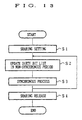
- the dirty bit list LD of each information processing device is updated based on an operation on the database DB during the non-synchronous period (S2).
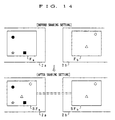
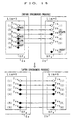
- the synchronous process is carried out, and as shown in Fig. 15, the number and the contents of the tips T of the sharing bags SF of the both parties are arranged referring to the dirty bit lists LD and the sink limits Lim, and the dirty bit lists LD and the sink limits Lim are also updated (S3).
- the use of sharing bags whose order is maintained by an intentional synchronous process as in S3 is very effective in the case where the communications line of the information processing devices 2a and 2b is connected and disconnected intermittently.
- the tip T can be contained in a plurality of bags F, a synchronous process regarding any sharing setting might change a tip T which belongs to a bag F playing no part in the synchronous process. Nonetheless, regardless of whether the synchronous process being carried out is associated with which of the sharing setting, the tip T is not inserted into or removed from a bag F other than the sharing bag SF.
- a release of sharing merely releases the correspondence between the sharing bags SF, and here it is not necessarily the case that the contents of the sharing bags SF coincide with each other.
- a synchronous process is carried out before sharing is released, either automatically or by an instruction of the user.
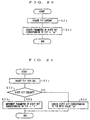
- sharing setting of a bag fused model is setting of sharing between bags F a and F b which have been existing already in the information processing devices 2a and 2b, respectively, and when the information processing devices 2a and 2b are ready to communicate, as shown in Fig. 16, the sharing setting processing section 52 of the information processing device 2a in S11 sends a sharing setting request to the information processing device 2b.
- the request includes a machine ID indicative of the information processing device 2a, a bag ID indicative of the bag F a of the information processing device 2a, and a bag ID indicative of the bag F b of the information processing device 2b to which the sharing is directed.
- the side which sends the sharing setting request will be referred to as a sharing setting promoting side
- the side which receives the sharing setting request will be referred to as a sharing setting receiving side.
- the sharing setting processing section 52 on the sharing setting promoting side registers, as sharing information, information analogous to the sharing setting request. Also, the sharing setting processing section 52 creates a sharing party list LS corresponding to the bag F a so as to register the bag ID of the other party. As a result, the bag F a becomes a sharing bag SF a . Also, a dirty bit list LD and a sink limit Lim, corresponding to a combination of the sharing bag SF a and the bag F b of the other party are created.
- the information processing device 2b on the sharing setting receiving side upon receiving the sharing setting request by the sharing setting processing section 52 in S13, registers sharing information based on the sharing setting request in S14.
- the sharing information includes a machine ID indicative of the information processing device 2b, a bag ID to be subjected to sharing in the information processing device 2a, a bag ID to be subjected to sharing in the information processing device 2b, and an option which is decided in the sharing setting.
- the sharing setting processing section 52 of the information processing device 2b registers the bag ID of the other party to a sharing party list LS corresponding to the bag F b so as to generate a sharing bag SF b , and create a dirty bit list LD and a sink limit Lim, corresponding to a combination of the sharing bag SF b and the sharing bag SF a of the other party.
- the information processing device 2 can select various options, such as whether a priority determining rule or download process is needed, or copying is required when a collision occurs in the synchronous process in S3, or a model adopted in the sharing release in S4, these options are set in the sharing setting stage, and the sharing setting request includes information indicative of such options, allowing the options to be set only in the sharing setting stage.
- the information processing device 2 can set an option at an arbitrary timing, there is a case where an option such as the priority determining rule is changed in accordance with an operation on one of the information processing devices 2, and undesirable setting is made for the user of the other information processing device 2.
- the option is changed only in the sharing setting stage when the information processing devices 2 are ready to communicate, thus avoiding such undesirable setting.
- the sharing setting receiving side may decide whether to proceed with sharing setting in accordance with the contents of the sharing setting request, for example, such as an option for sharing setting.
- the information processing device 2 on the sharing setting receiving side stores beforehand, for example, a sharing setting request which can be received, and decides whether to proceed with sharing setting based on the sharing setting request thus stored.
- the initial values of the dirty bit list LD and the sink limit Lim vary according to the correspondence of the tips T contained in the sharing bags SF a and SF b .
- the initial value of the sink limit Lim becomes 0, and the dirty bit D corresponding to each tip T is set to Insert Update "Im”.
- the sink limit Lim takes the value of the number of tips T which were successfully made corresponded, and the dirty bits D corresponding to the tips T are stored such that their orders are the same in the both dirty bit lists LD. Note that, when the contents of the tips of the both parties are the same, the values of the dirty bits D become Still Maintain "Xp", and when it is unknown whether the contents are the same, the values are set to Still Update "Xm".
- the model of sharing setting is not just limited to the bag fused model so that, as shown by the bag drawing model in Fig. 17, one of the sharing bags may be newly created in the sharing setting, or as shown by the new bag creating model in Fig. 18, a new sharing bag SF may be newly created for the information processing devices 2a and 2b.
- the process substantially similar to that of Fig. 16 is carried out, and the sharing information, dirty bit list LD, sink limit Lim, and sharing information are registered in each of the information processing devices 2a and 2b.
- the bag ID of the sharing bag SF is returned to the sharing setting promoting side when registering the sharing information, etc.
- the tip update processing section 41 receives the instruction from the user operating section 22 and updates the contents of the tips T in accordance with the instruction. Then, in S22, the update parameter is set to "m" with respect to the dirty bits D corresponding to the tips T. Note that, the values of the movement parameter remain unchanged.
- the tip T can belong to a plurality of sharing bags SF, and there is a case where the sharing bag SF is linked to a plurality of sharing bags SF. Therefore, in the information processing device as a whole, there may be a plurality of dirty bits D corresponding to the tip T. For this reason, all the dirty bits D corresponding to the tip T are searched and updated. Searching of corresponding dirty bits D may be carried out referring to all the dirty bit lists LD, or, in order to reduce the search time, by creating in advance and referring to a list of dirty bits D corresponding to the tip T.
- the dirty bit D is created with respect to a tip T which has belonged even once to the sharing bag SF during the non-synchronous period, and the dirty bit D is updated by monitoring the operation on the tip T. Therefore, for example, even when the tip T has been moved and does not currently exist in the sharing bag SF, it is ensured that the dirty bit D is updated.
- the tip addition processing section 42 controls the bag managing section 32 in accordance with an instruction from the user operating section 22 so that the tip T belongs to the sharing bag SF (S31). Further, the tip addition processing section 42 in S32 judges whether the dirty bit list LD indicative of the sharing bag SF contains a dirty bit D corresponding to the tip T.
- the tip addition processing section 42 in S33 sets the movement parameter of the dirty bit D to "I".
- the dirty bit D when the dirty bit D is not contained, it means that, for example, the tip T has never been contained in the sharing bag SF or the tip T has been newly created, and it indicates that whether the contents of the tip T have been updated or not during the non-synchronous period cannot be confirmed.
- the tip addition processing section 42 in S34 adds a dirty bit D with the value of "Im" indicative of the tip T to the dirty bit list LD on the position after the sink limit Lim, for example, on the last position of the dirty bit list LD. Note that, in the case where there are plural dirty bit lists LD corresponding to the sharing bag SF, the processes from S32 to S34 are carried out with respect to all the dirty bit lists LD.
- the tip deletion processing section 43 controls the bag managing section 32 in accordance with an instruction from the user operating section 22 so that the tip T is removed from the sharing bag SF (S41).
- the dirty bit D is maintained with respect to the tip T which has contained in the sharing bag SF even once during the non-synchronous period.
- the tip deletion processing section 43 in S42 updates the movement parameter of the dirty bit D corresponding to the tip T to "O" with respect to all the dirty bit lists LD indicative of the sharing bag SF. Note that, the update parameter remains unchanged.
- the sink limit Lim is the same as the length (number of dirty bits D) of the dirty bit list LD, and the corresponding dirty bits D a and D b are stored such that their orders are the same in their respective dirty bit lists LD. Also, the values of the dirty bits D are all set to "Xp".
- the tip update processing section 41, the tip addition processing section 42, and the tip deletion processing section 43 of each information processing device 2 update the dirty bit list LD.
- the values of the dirty bits D always indicate the states of the corresponding tips T during the non-synchronous period. Therefore, when the databases DB are independently updated, at the time immediately preceding a subsequent synchronous process, for example, as shown in Fig. 25, the dirty bit lists LD do not coincide with each other.
- the dirty bit D on the position indicated by the sink limit Lim, and the dirty bits D above the sink limit Lim are not deleted even when the corresponding tips T are deleted so that the same order is maintained during the non-synchronous period.
- the same order of the dirty bits D indicative of the corresponding tips T is maintained in the sharing bags SF a and SF b .
- the dirty bits D after the sink limit Lim indicate tips T which were newly added to the sharing bag SF during the non-synchronous period, and even when the dirty bits D, for example, such as dirty bits D 22 and D 27 , are stored on the same position, their respective tips T do not correspond to each other.
- Such dirty bits D after the sink limit Lim indicate either "Im” or "Om", wherein "Om” indicates that the newly inserted tip T into the sharing bag SF does not currently belong to the sharing bag SF. Also, in the case where the number of tips T added is different, the lengths of the dirty bit lists LD are also different.
- the synchronous process of S3 in Fig. 13 is carried out.
- the synchronize processing section 51 of each information processing device 2 deletes dirty bits D whose movement parameter is "O" from the dirty bits D after the sink limit Lim of the dirty bit list LD.
- the dirty bits D after the sink limit Lim only take the value of "Im" in the both dirty bit lists LD.
- the tips T corresponding to the dirty bits D with the movement parameter of "O" are not contained in the sharing bag SF in the preceding synchronous process and the current synchronous process. Therefore, it is not required to send the contents of these tips T to the other information processing device 2 regardless of the state of the sharing bag SF of the other party. As a result, by deleting these tips T, the number of dirty bits D transmitted between the information processing devices 2a and 2b can be reduced in the subsequent processes.
- the synchronize processing section 51 of one party in S52 receives the dirty bits D after the sink limit Lim of the other party so as to generate dirty bits D corresponding to the dirty bits D thus received.
- the information processing device 2b sends the number Y b of dirty bits D after the sink limit Lim b of the dirty bit list LD b , and the dirty bits D with the value of "Op" are inserted immediately after the sink limit Lim a of the dirty bit list LD a of the information processing device 2a in the same number as Y b sent from the information processing device 2b. Further, the information processing devices 2a and 2b increases their respective sink limits Lim by the number Y b .
- the dirty bits D corresponding to the tips T added in the information processing device 2b are also created in the information processing device 2a.
- the dirty bits D corresponding to the tips T added in the information processing device 2a are added to the information processing device 2b, thereby adjusting the sink limit Lim.
- the dirty bits D corresponding to the tips T of the information processing device 2a are ordered after the dirty bits D (such as T 27b and T 29b ), which have been added to the information processing device 2b, in both of the dirty bit lists LD a and LD b .
- the orders of corresponding dirty bits D coincide with each other between the dirty bit lists LD a and LD b .
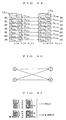
- the synchronize processing section 51 of each party in S53 decides whether the tip T corresponding to each dirty bit D should be given to the sharing bag SF, based on the dirty bits D transmitted between the information processing devices 2a and 2b. In the case where the movement parameters of the dirty bits D a and D b are different, it is judged whether the tip T b should be given to the sharing bag SF b using, for example, the priority rule as shown in Fig. 30. Note that, in Fig. 30, a priority is given towards the tip of the arrows.
- the dirty bit D in the dirty bit list LD is successively sent from the information processing device 2a to the information processing device 2b.
- the information processing device 2b compares the dirty bit D a received and a dirty bit D b of the dirty bit list LD b , whose positions are the same in the lists.
- the synchronize processing section 51 of the information processing device 2b judges, when the combination of movement parameters is either one of (X-X), (X-I), (I-I), (I-K), and (I-O) as shown in Fig. 31, that the tips T of the dirty bits D should be given to the sharing bag SF so that the tips T corresponding to the dirty bits D belong to their respective sharing bags SF. Also, the synchronize processing section 51 sets the movement parameters of the both parties to "X".
- the synchronize processing section 51 judges that the tips T is outside of the sharing bag SF so that the tips T of, for example, the both parties are removed from their respective sharing bags SF, and respective dirty bits D are set to No Effect "K". Note that, when the information processing devices 2a and 2b are operating normally, the combination of (X-K) does not result, so that this is judged as an error and an error process is carried out, in which the user is asked to send instructions, for example.
- Removing of the receiver's tips T or setting of dirty bits D may be carried out by the synchronize processing section 51 of the receiver by sending the dirty bits D before update, or by transmitting the result of judgement to the receiver.
- the receiver's dirty bits D and the tips T are specified by the dirty bits D or by the order of sending the results of judgement, and no special information for specifying the dirty bits D or the tips T is sent. Therefore, the amount of data transmitted in the inside-outside judgement is significantly small.
- all the dirty bits D of the dirty bit lists LD are set to have the movement parameter of either "X" or "K".
- the tips T whose movement parameter is not "X”, namely tips T which were judged to be outside of the sharing bag SF or tips T judged to be errors are not subjected to the tip synchronous process in S54 and S55, and priority judgement of the update parameter or sending of tip T contents is not carried out.
- the synchronous processing section 51 in S54 compares the update parameters of the dirty bits D of the both parties with respect to the tips T (whose movement parameter is "X") which have been judged to be within the sharing bag SF in the bag synchronization in S53 so as to determine respective priorities of the corresponding tips.
- the priority of the tips T is determined, as shown in Fig. 33, by the update parameter, and Update "m” is given a higher priority than Maintain "p", thus deciding whether the contents of the tips T should be transmitted and the direction of transmission.
- the synchronize processing section 51 compares the dirty bits D a and D b , and when the combination of update parameters is (p-p), judges that it is not required to sent the contents of the tips T. Also, when the combination is (p-m), it is judged that the update parameter "m" has the priority so as to judge that the contents of the tips T should be sent from the information processing device 2 of the priority side to the information processing device 2 of the non-priority side.
- the dirty bit lists LD have the values as shown in Fig. 32, a priority side is judged as shown in Fig. 35.
- a priority side is determined by a predetermined priority rule, for example, by referring to information other than the dirty bits D, such as the contents of tips T (update time or predetermined keyfield), the side which has instructed the synchronous process, the side which has promoted sharing setting, or the side which has been set beforehand, or by asking the user.
- the tips T collide the tips T are regarded as being different from each other, and the tips T of the other party may be added to the sharing bag SF of one party.
- each synchronize processing section 51 in S55 sends the contents of the tips T on the priority side to the non-priority side so that the contents of the tip T on the non-priority side are replaced with the contents of the tip T on the priority side.
- the contents of the tips on the both sides coincide and the update parameters of respective dirty bits D are set to "p".
- all the dirty bits D in the dirty bit lists LD are set to either "Xp" or "K".
- the dirty bits D are compared with each other between the information processing devices 2a and 2b, and the need to send the contents and the transmission direction are determined per tip T.
- the transmission of contents can be omitted.
- update of contents is monitored with respect to the tips T having the dirty bits D. Therefore, the transmission of contents can be omitted with respect to not only the tips T which have been neither moved nor updated but also the tips T which have existed in the sharing bag SF in the previous synchronous process and are existing in the sharing bag SF in the current synchronous process and which have not been updated during the non-synchronous period.
- the correspondence of the tips T is stored as the order of dirty bits D
- the correspondence can be stored without storing IDs indicative of the tips T of the other party.
- the corresponding tips T can be specified without sending the IDs, it is possible to reduce the amount of data transmitted between the information processing devices 2a and 2b when sending and receiving the dirty bits D, and the amount of memory required for storing the dirty bits D.
- the dirty bits D are created with respect to the tips T which have been contained even once in the sharing bag SF during the non-synchronous period.
- the dirty bits D are created with respect to the tips T which are contained in the sharing bag SF at the time the preceding synchronous process has finished.
- the dirty bits D are created with respect also to the tips T which are currently contained in the sharing bag SF, it is possible to increase the searching speed of the tips T which were newly inserted during the non-synchronous period, and to create a list of tips T contained in the sharing bag SF from the tree structure of Fig. 6 by extracting only the tips T whose dirty bits D have the movement parameters of either "X" or "I". As a result, the lists of the tips T can be deleted, thereby reducing the amount of memory.
- a first model (talk model), as shown in Fig. 38, respective sink managers 61 of the information processing devices 2a and 2b inquire their respective upper applications 62 about a priority side so that the priority side is independently decided by the information processing devices 2a and 2b.
- a second model selection solution model
- a third model automatic solution model
- no inquiries are made to the upper applications 62 and the priority side is decided based on a predetermined priority rule by the both sink managers 61.
- the sink manager 61 is part of the synchronize processing section 51 as shown in Fig. 1.
- the upper application 62 is an application for referring to the data of a database, such as an application for analyzing the data of a database, or an application for inquiring the user of the information processing device 2 about the priority side, and the upper application 62 can respond to the inquiry from the sink manager 61 by giving back the priority side.
- the method of selecting one information processing device 2 may be a one side selection model of the automatic solution model, which will be described later, such as the presence or absence of the upper application 62, and, for example, the promoting side of sharing setting.
- the model representing the method for deciding the priority side when the information processing devices 2 to be selected are different, there is a case where an undesired device is selected, and for this reason the method for selecting the information processing device 2 is set at the time of sharing setting.
- the talk model can be further divided, on the basis of the timing for solving the collision, into a negotiation solution model which solves a collision during the synchronous process in which the collision was detected, and an application solution model which disconnects the communications between the detection of the collision and the solution of the collision.
- the selection solution model can be divided into a client immediate model and a client delay model. Note that, as shown in Fig. 41, the negotiation solution model and the client immediate model are categorized into an immediate solution model in which the solution timing is in the synchronous process at the time of detection, and the application solution model and the client delay model are categorized into a delay solution model in which the solution timing is in the synchronous process after the detection of the collision.
- the sink manager 61 of the information processing device 2a presents the information required for deciding the priority side from the contents of its tips T and the information required for deciding the priority side from the contents of the other party's tips T to the upper application 62.
- the information processing device 2b information indicative of its tips T and the other party's tips T is presented to the upper application 62.
- the respective upper applications 62 of the information processing devices 2a and 2b independently decide the priority side.
- an information processing device 2 of one party with respect to an information processing device 2 (and its components) of the other party is arbitrarily referred to as a home device, and the information processing device 2 to be brought into communications with the home device is referred to as an addressee device (home device and addressee device are equivalent) .
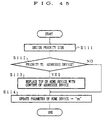
- the sink manager 61 of each party in S65 judges whether the priority sides of the bath parties coincide with each other. When there is a coincidence (YES in S65), in S66, it is judged whether the priority side is on a home device. If so, in S67, the sink manager 61 of the home device sends the contents of the tips T to the information processing device 2 of the other party (addressee device) so as to replace the contents of the tips T of the addressee device with the tips T thus sent. If the priority side is not on the home device, in S68, the home device receives the contents of the tips T of the addressee device so that the contents of the tips T of the home device are replaced with the contents thus received. As a result, the contents of the colliding pairs of tips T become the same.
- the sink manager 61 of the information processing device 2a is S69 presents the priority side as decided by the information processing device 2b to the upper application 62, together with the contents presented in S61.
- the sink manager 61 of the information processing device 2b in S70 presents the priority side as decided by the information processing device 2a to the upper application 62, together with the contents presented in S62. Thereafter, the processes after S63 are repeated and the priority side is reconsidered in the respective upper applications 62 of the both parties.
- the client immediate model is adopted, for example, as shown in Fig. 43, in one of the information processing devices 2 (home device), as in S61 of Fig. 42, the information indicative of the tips T and the tips T of the other party (addressee device) is presented to the upper application 62 (S81).
- the upper application 62 decides the priority side based on this information.
- the priority side is on the home device (YES in S83)
- the contents of the other party's tips T are replaced with the contents of the tips T of the home device.
- the priority is given to the addressee device (NO in S83)
- the contents of the tips T of the home device are replaced with the contents of the tips T of the addressee device in S85.
- the contents of the colliding pairs of tips T become the same.
- each sink manager 61 of the information processing devices 2a and 2b sets the update parameter of the dirty bits D corresponding to the tips T to Maintain "p", and the process is finished.
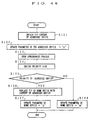
- the sink manager 61 of each party temporarily stops the synchronous process with respect to these tips T in S93, for example, by disconnecting the communications or by judging a collision of other tips T. Also, while the communications are disconnected, the respective sink managers 61 of the information processing devices 2a and 2b carry out, independently from each other, the collision solving process in accordance with an instruction of their respective upper applications 62, and the process is finished.
- the sink manager 61 of one party (home device) in S111 presents the contents of the tips T received in S91 from the other party (addressee device) to the upper application 62, together with the contents of its tips T so as to receive an instruction from the upper application 62 as to which party should be given a priority.
- the sink manager 61 of the home device in S113 replaces the contents of the tips T with the contents of the tips T of the addressee device, and in S114, sets the update parameter of the dirty bits D corresponding to these tips T to Update "m" and the process is finished.
- the sink manager 61 in S114 sets the update parameter of the dirty bits D corresponding to the tips T to Update "m" without carrying out the process of S113.
- the judgement of S112 is YES in the information processing device 2a, and the contents of the tips T of the information processing device 2a are replaced with the contents of the tips T of the information processing device 2b. Meanwhile, the judgement of S112 is NO in the information processing device 2b, and the contents of the tips T of the information processing device 2b are not changed.
- the process as shown in Fig. 46 is carried out. Namely, in S121, the sink manager 61 transfers and receives the contents of the tips T of the addressee device. Further, in S122, the update parameter of the dirty bits D of the addressee device corresponding to the tips T are changed to Maintain "p".
- the priority sides are decided after interruption of the synchronous process.
- the sink manager 61 of the home device in S126 replaces the contents of the tips T with the contents of the tips T of the addressee device received in S121.
- the update parameter of the dirty bits D corresponding to the tips T is set to Maintain "p" in S127 and the process is finished.
- the sink manager 61 of the home device sets the update parameter of the dirty bits D corresponding to the tips T to Update "m" (S128).
- the update parameter of the dirty bits D corresponding to the tips T is set to Maintain "p" in the addressee device.
- the automatic solution model can be roughly divided into a consecutive deciding model in which the priority side is decided per each pair of the colliding tips T, and the one side selection model in which one of the information processing devices 2 is set in advance to have the priority side at the start of the synchronous process.
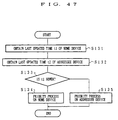
- An example of the former includes the method in which the priority side is judged based on partial contents of the tips T, for example, such as the last updated time. In such a case, for example, as shown in Fig. 47, in S131, the sink manager 61 of each party as shown in Fig. 40 obtains within its information processing device 2 the last updated time t1 of the tips T to be processed.
- the last updated time t2 of the other party's tips T corresponding to the tips T of the last updated time t1 is obtained. Further, in S133, it is judged in each device whether the last updated time t1 is newer than the last updated time t2 of the other party. In the case where the last updated time t1 is newer than the last updated time t2, the contents of the other party's tips T are replaced with the contents of the tips T of the last updated time t1 in S134. On the other hand, in the case where the last updated time t2 of the other party is newer, the contents of the tips T of the last updated time t1 are replaced with the contents of the other party's tips T in S135.
- the tips T which were updated most recently are given a priority.
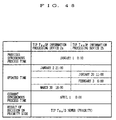
- the last updated time of the tip T 8a of the information processing device 2a is newer than the last updated time of the tip 8b of the information processing device 2b.
- the contents of the tip 8b are replaced with the content of the tip 8a .
- the criteria for deciding the priority side are not just limited to the last updated time, and the same effect can be obtained as long as the criteria used are part of the contents of the tips T.
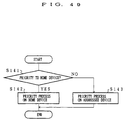
- the one side selection model of the automatic solution model for example, as shown in Fig. 49, it is judged in each device in S141 whether the priority side which was set before the start of the synchronous process is on the home device.
- the priority is given to the home device, in S142, the contents of the tips T of the addressee device are replaced with the contents of the tips T of the home device, and when the priority is given to the addressee device, in S143, the contents of the tips T of the home device are replaced with the contents of the tips T of the addressee device, thereby giving a priority to the tips T of a predetermined party.
- the priority side referred to in S141 is determined by any one of the following three models.
- the priority side is set in advance in the synchronous setting of S1 of Fig. 13, and the priority side thus set is stored as priority side information, and the priority is decided based on this priority side information.
- the priority side can be set by any method, and, for example, it may be set in accordance with an instruction of the user or of the upper application 62.
- the priority side is decided based on the side which promoted the sharing setting in the first model, and the second model can be further divided into a sharing setting promoting side priority model and a sharing setting receiving side priority model.
- the sharing setting promoting side priority model is suitably adopted in the case where, for example, the database system 1 composed of the information processing devices 2 always wants to give a priority to the client side of the client/server type, and the sharing setting promoting side is always given a priority regardless of the promoting side of the synchronous process or the contents of the tips T.
- the sharing setting receiving side priority model is suitably adopted in the case where, for example, the database system 1 always wants to give a priority to the server side, and the sharing setting receiving side is always given a priority. In either case, promoting of the sharing setting and specifying of the priority side can be instructed by the same operation, thus simplifying the operation compared with the case where these processes are instructed by different operations.
- the priority side is determined based on the promoting side of the synchronous process in S3 of Fig. 13, and the third model can be further divided into a synchronous process promoting side priority model and a synchronous process receiving side priority model.
- These models are used, for example, between equivalent information processing devices 2, wherein the former is used when the home device is to be given a priority and the latter is used when the addressee device is to be given a priority.
- promoting of synchronous process and specifying of the priority side can be instructed by the same operation, thus simplifying the operation compared with the case where these processes are instructed by different operations.
- the priority side can be changed depending on which information processing device 2 promotes the synchronous process.
- the tips T which have been subjected to change, such as addition/deletion/update are given the priority, and this change is reflected in the information processing device 2 of the other party.
- a priority to the side (priority side) which has been decided already before the start of the synchronous process with respect to all the pairs of tips T, such as the promoting side of the synchronous process or sharing setting, or a predetermined side , and for example, as shown in Fig.
- the synchronous process is a download (upload).
- the selection is instructed preferably as an option of the sharing setting in S1 of Fig. 13, as with the model for deciding the priority side.
- the dirty bit lists LD on the priority side are compressed in S151 as in S51 of Fig. 26. Further, in S152, the tips T which were added during the non-synchronous period are deleted from the sharing bag SF on the non-priority side. In S153, the dirty bits D corresponding to the tips T added on the priority side are added to the dirty bit lists LD of the non-priority side as in S52.
- the synchronize processing section 51 as shown in Fig. 1 carries out an inside-outside judgement based on the dirty bits D on the priority side, and the movement parameters of the dirty bits D are set to "X" or "K” in the dirty bit lists LD of the both parties, and the tips T are moved in accordance with the inside-outside judgement. Namely, when the movement parameters of the dirty bits D on the priority side are either "X" or "I", inside of the sharing bag SF is indicated. Thus, the tips T are left in the sharing bag SF, and the movement parameters of the dirty bits D of the both parties, corresponding to the tips T are set to "X".
- the contents of the tips T on the non-priority side are replaced with the contents of the tips T on the priority side based on the update parameters of the dirty bits D of the both parties. Specifically, when the update parameter on the priority side is Update "m”, the contents of the tips T are sent to the non-priority side. Also, even in the case where the update parameter on the priority side is Maintain "p”, when the update parameter on the non-priority side is Update "m”, the contents of the tips T on the non-priority side are replaced with the contents of the tips T on the priority side in the described manner. Note that, when the update parameters of the both parties are Maintain "p", the contents of the tips T are not transferred.
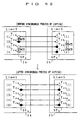
- Fig. 52 it is possible to adopt a model in which collided tips T are regarded as different tips T, and the tips T of one party are added to the sharing bag SF of the other party. Whether to adopt this model, as with the case of download, is specified as an option in the sharing setting.
- a dirty bit D 4ab for example "Op"
- a dirty bit D 4ab for example "Op”
- S162 in the dirty bit list LD a of the home device is created a new dirty bit D 4ba on the same position as that of a dirty bit D 4b of the addressee device.
- the contents of the tip T 4a are transferred to the information processing device 2b based on the newly created dirty bits D, and a new tip T 4ab corresponding to the tip T 4a is added to the sharing bag SF b . Also, in S164, a new tip T 4ba corresponding to the tip T 4b is added to the sharing bag SF a . As a result, it is possible to save all the contents of the updated tips T when the tips T collide.
- Fig. 52 and Fig. 53 explained the case where copying is carried out only when there is a collision of tips T.
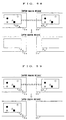
- Fig. 54 it is also possible as another option to adopt a model in which copying is carried out when at least one of the corresponding tips T is updated.
- the tips T are copied when at least one of tips T of the pair is changed. Therefore, copies of tips T are also made with respect to a pair of tips T 2a and T 2b and a pair of tips T 3a and T 3b , in which only one of the tips T was changed in each pair, thus saving all the contents of the tips T changed.
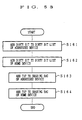
- the sharing release request of the home device includes information indicative of the sharing bags SF, for example, such as a combination of the bag IDs and the IDs of the other party, and information indicative of the sharing bags SF of the other party, corresponding to the sharing bags SF of the home device.
- the sharing release processing section 53 on the sharing release promoting side in S172 deletes sharing information provided in the sharing setting, for example, such as dirty bit lists LD and the sink limit Lim in accordance with the combination of bag IDs, and the bag IDs of the other party registered in the sharing party list LS.
- the sharing release processing section 53 deletes the sharing information stored therein based on the sharing release request received (S173, S174). Note that, in Fig. 55, the approval of the sharing party is not shown. However, as with sharing setting, whether to release the sharing may be decided by the sharing release receiving side in accordance with the contents of the sharing release request.
- the sharing bags SF a and SF b which had been shared between the information processing devices 2a and 2b become non-sharing bags F a and F b , respectively.
- the sharing release of the tip copying model when sharing release is instructed, only the sharing setting between the sharing bags SF a and SF b is released and the tips T contained in them remain in the bags F a and F b , respectively.
- the model of sharing release is not just limited to the tip copying model and a variety of other models can be adopted.
- a model tip unbalanced model
- a model tip erased model
- sharing may be released after the synchronous process when sharing release is instructed. In such a case, the integrity of the tips T can be maintained at the time of the sharing release without particularly instructing the synchronous process.
- an empty bag F from which the tips T have been removed, may be deleted.
- the model of the sharing release is set as an option in the sharing setting of S1 of Fig. 13.
- the tip deletion processing section 43 (see Fig. 1) carries out the process as shown in Fig. 61, instead of the process of Fig. 21. Namely, in S181, it is judged whether the dirty bits D corresponding to the tips T are after the sink limit Lim, and if the dirty bits D are after the sink limit Lim, they are deleted from the dirty bit list LD. If the dirty bits D are not after the sink limit Lim, the movement parameter of the dirty bits D is changed to "O" in S183, As a result, the process of S51 is not required in the synchronous process, thus reducing the time required.
- the dirty bits D associated with tips T which exist in the sharing bag SF only momentarily, for example, such as the tips T which are inserted by misoperation, can be immediately deleted from the dirty bit list LD.
- an increase in length of the dirty bit list LD can be suppressed, thus reducing the size of the memory required.
- Fig. 61 described the case where the dirty bit list LD is compressed when the tips T are removed. However, compression may be carried out at an arbitrary time in the non-synchronous period. In such a case, the dirty bits D which are placed after the sink limit Lim, for example, by the instruction of the upper application, and whose movement parameter is "O" are deleted from the dirty bit list LD. As a result, the dirty bits D of plural tips T can be deleted from the dirty bit list LD by a single process.
- each information processing device 2 set the movement parameter to Remove "O" with respect to the dirty bits D corresponding to the tips T.
- the dirty bits D are allocated to the tips T, it is required to hold the contents of the tips T until the next synchronous process is carried out and this may result in an increase in memory size required for each information processing device 2.
- the memory size which can be installed in a portable information processing device 2 is limited, and further it is not certain as to when communications are enabled and the synchronous process is carried out. Therefore, in such a information processing device 2, as described in the modification example below, it is preferable to adopt the managing method as shown in Fig. 64, instead of the managing method of the dirty bits D as shown in Fig. 19.
- the database managing section 23 corresponds to corresponded data information storing means as defined in claims
- the tip deletion processing section 43 corresponds to correspondence cancelling means, data deleting means, and deletion selecting means.
- the information processing device in accordance with the present modification example is capable of processing a tip deleting operation involving deletion of entity, a tip removing operation involving deletion of entity, and an entity deletion operation of the tips T outside the sharing bag SF.
- the dirty bits D corresponding to the tips T to be subjected to the operation is set to No Effect "K" regardless their previous values.
- the values of the dirty bits D are also set to No Effect "K”.
- the values of the dirty bits D can be represented by, for example, the bit BO and bit BI as shown in Fig. 10.
- the tip deletion processing section 43 of Fig. 1 controls the bag managing section 32 as in S41 of Fig. 22 so as to remove the tips T to be subjected to operation from the sharing bag SF (S201 in Fig. 65). Further, the tip deletion processing section in S202 sets the values of the movement parameter of the dirty bits D corresponding to the tips T to No Effect "K" with respect to all the dirty bit lists LD indicating the sharing bag SF. Also, in S203, the tip managing section 31 cancels the correspondence between the entity of the tips T (for example, file or data in the memory) and the dirty bits D in accordance with the instruction of the tip deletion processing section 43.
- the correspondence may be cancelled by reducing the number.
- the information processing device 2 carries out the same process as that of S202 and S203 of Fig. 65 so as to cancel the correspondence between the tips T and the dirty bits D.
- the tip deletion processing section 43 controls the tip managing section 31 so as to delete the entity of the tips T, thereby increasing the free space of the database managing section 23 in the information processing device 2. As a result, it is possible to reduce the memory size required for the database managing section 23 even when the non-synchronous period is long and a large number of tips T are deleted.
- the tip deletion processing section 43 holds the entity of the tips T and the correspondence as long as possible, for example, by moving the tips T to a specific bag F, and cancels the correspondence between the dirty bits D and the entity of the tips T at the time when there is a shortage of a free memory space by comparing the free memory space and a predetermined value.
- This allows the entity of the tips T and the correspondence to be held unless there is a shortage of a free memory space.
- the tip deletion processing section 43 may estimate and compare the possibility that the contents of the tips T will be transferred from the information processing device of the other party so as to cancel the correspondence in an order from the tip T having a low possibility of being transferred.
- a possibility may be estimated from, for example, the past history of the previous synchronous processes, or based on the user's operation on the information processing device 2 being used, for example, by estimating that the possibility of transfer is higher when the tips T are removed, rather than deleted.
- it is preferable to cancel the correspondence from the tips T which can be deleted by judging whether the entity of the tips T can be deleted, that is, whether the tips T are being referred to from other places.
- the amount of data transferred in the synchronous process can be reduced more efficiently for the tips T having a higher possibility of being transferred while maintaining a memory necessary for the operation of the information processing device 2.
- the movement parameter of the dirty bits D whose correspondence has been cancelled is set to No Effect "K", and as will be mentioned later, the dirty bits D are transmitted from the other information processing device 2 as required in the synchronous process.
- the integrity of the database DB of the database system 1 is maintained at the time when the synchronous process is carried out.
- the dirty bit lists LD are also updated in accordance with an operation on the tips T during the non-synchronous period.
- the dirty bits D are changed to No Effect "K".
- the dirty bit lists LD a and LD b contain the dirty bits D of No Effect "K".
- the dirty bits D are exchanged between the information processing devices 2a and 2b, and the inside-outside judgement (bag) synchronization of the tips T is carried out.
- the dirty bits D are changed to No Effect "K” as long as the entity of the tips T is deleted even with respect to the dirty bits D before the sink limit LD. Therefore, No Effect "K” is also included in the dirty bit lists LD a and LD b in which the dirty bits D a and D b have been made corresponded to each other between the information processing devices 2.
- the synchronize processing section 51 carries out the inside-outside judgement of tips T by the following rules, instead of the rule as shown in Fig. 31.
- the tips T corresponding to the dirty bits D are judged to be within the sharing bag SF, and the movement parameter is set to Still "X" in the dirty bits D of the both parties.
- the combination is (X-O), (O-K), (O-O), or (K-K)
- the tips T are judged to be outside of the sharing bag SF, and the movement parameters of the both parties are set to No Effect "K".
- the judgement of the combinations of the dirty bits D a and D b is carried out per combination, and the results of judgement are stored as a change in movement parameters and update parameters.
- the inside-outside judgement (bag) synchronous process of S53 is interrupted, for example, by disconnection of the communications, the synchronous process can be resumed without a problem.
- the tip deletion processing section 43 judges whether the entity of the tips T which have been placed outside of the sharing bag SF as a result of the synchronous process are referred to from the other places of the device, and when no reference is made, controls the tip control section 31 so as to delete the entity of the tips T.
- these tips T are data whose integrity is not required to be maintained between the databases DB, and the contents thereof are not transferred in the subsequent synchronous processes.
- the free memory space of the information processing device 2 can be increased without increasing the transfer volume of data in the synchronous process.
- the explanations are based on the case of deleting the entity of the tips T which are not made corresponded to each other between the databases DB.
- the entity of the tips T is not necessarily deleted at the time when the synchronous process is finished.
- the tip deletion processing section 43 can select whether to delete the entity in the information processing device 2 so that the setting is made as desired by the user. In such a case, the selection may be made per sharing setting, or with respect to all the sharing setting.
- the present modification example described the case where the value "K" indicative of No Effect is always used as the value of the dirty bits D in the non-synchronous period.
- whether to use No Effect "K” may be made selectable in accordance with the user's request.
- it is preferable that the time whether to use No Effect "K” is limited in the period in which the information processing devices 2 are in communications, for example, at the time of sharing setting, as with the case where the model for the sharing release is set. This prevents various troubles caused by different settings between the information processing devices 2 in the synchronous process.
- the dirty bit list LD of each party may be compressed during the non-synchronous period.
- the dirty bits D corresponding to the tips T are deleted from the dirty bit list LD regardless of whether the entity is deleted.
- the synchronize processing section 51 in the inside-outside judgement (bag) synchronization in S53 of Fig. 26 changes the update parameter on the Insert "I” side to Update “m” and sets the update parameter on the Remove “O” side to Maintain “p” ([17] ⁇ [21] in Fig. 72) , in addition to setting the movement parameters to Still "X".
- each of the information processing devices 2 constituting the database system 1 can create a bag F to be a subset of the database DB, and the information processing devices 2 are equivalent.
- a database system 11 includes an information processing device (database managing device) 12 which cannot set a subset.
- the database system 11 is suitably adopted when the system, for example, such as the database system of a client server type, is constituted by information processing devices 2 which are not equivalent.
- the information processing device 2 is realized, for example, as a desk-top computer which operates as a server, and the information processing device 12 is realized, for example, as a device, such as a portable information terminal, whose storage capacity for the database DB is smaller than that of the information processing device 2.
- the information processing device 12 has almost the same structure as the information processing device 2 of Fig. 1, except that a database managing section 23, as shown in Fig. 63, stores a single database DB as a single bag F, and as shown in Fig. 62, the bag F constituting the entire database DB of the information processing device 12 is shared with the bag F of the information processing device 2.
- the dirty bits D are compared between the information processing devices 2 and 12, and the need to transfer contents and the transfer direction are decided prior to the transfer of the tip T contents.
- the information processing device 2 can identify the tips T which have only been moved, based on the dirty bits D. As a result, it is ensured that the transfer of the contents of the tips T are prevented, and the amount of the data transferred in the synchronous process can be reduced.
- the correspondence of the tips T is stored as the order of the dirty bits D in the respective dirty bit lists LD of the both parties. Therefore, the state of the tips T can be grasped with a smaller memory space, and the amount of the data transmitted in the synchronous process can be reduced.
- the database system 11 having the above structure has its use in, for example, the case where the information processing device 12 to be a portable information terminal is distributed to each service person and all the address information required for service persons is managed by the information processing device 2 as a server which is provided in a company.
- the combinations of address information required for the service persons are different from one another, and in many cases, the service persons have common address information. Therefore, in the information processing device 2, by storing all the address information in the database DB, and by managing the combinations of the address information per service person in the forms of bags F, the information processing device 2 is able to manage each address information without disturbing the integrity, which is not the case, for example, when the address information per service person is stored in another database DB. Also, because the information processing device 12 only needs to store only one of the bags F of the information processing device 2, the memory capacity can be reduced compared with the case where the entire address information is stored.
- the explanations are based on the case where the tip T individually indicates an address. Yet, the data indicated by the tips T can be freely set depending on the use of the database. Also, the above explanation is based on the case where the tips T have the same attribute A, and the tips T having the same sharing party are gathered in the sharing bag SF. However, not limiting to this, it is possible for example to provide a sharing bag SF per combination of the sharing party and the application. For example, in the case where applications of address book, phone book, and mail address database exist, the tips T used in the address book have attributes which indicate name, phone number, mail address, address, and work place.
- the tips T used in the phone book have attributes which indicate name and phone number
- the tips T used in the mail address database have attributes which indicate name and mail address.
- the tips T are gathered in a bag F indicative the application used.
- the tips T used in the phone book also belong to a bag F indicative of the address book. In such a case, when renewing the entire address book, sharing setting is made with respect to the bag F indicative of the address book, and when changing only the bag F of the phone book, sharing setting is made with respect to the bag F and the synchronous process is carried out. In this manner, by allocating the bag F per application used, the synchronous process can be carried out per use.
- the correspondence is stored as the order of the dirty bits D.
- corresponding tips T may be specified by the information which indicates the tips T of the other party, for example, such as the tip ID.
- the tip ID indicates the tips T of the other party.
- it is required to send not only the dirty bits D but also the tip IDs of the other party, and this might result in an increase in the amount of transmitted data.
- the amount of data of the tip IDs of one party is increased as the size of the database DB is increased.
- the information processing devices are not equivalent, such as the information processing device 2 and the information processing device 12 in the Second Embodiment, the memory space required for storing the correspondence is increased in the information processing device 12 which requires a large reduction in the memory space, more so than the case of specifying the correspondence as the order of the dirty bits D.
- the correspondence of tips T is stored as the order of information associated with the tips T.
- the correspondence can be stored regardless of the size of the database DB of the other party and how the tips T are stored in that party.
- the order of dirty bits D is stored as the dirty bit list LD.
- the dirty bits D and the order are provided per combination of the sharing bag SF of one party and the sharing bag SF of the other party even when they correspond to the same tip T, and often the number of sharing parties cannot be predicted at the time when the database DB is created. For this reason, it is more preferable to provide the dirty bits D and the order separately from the contents of the tips T. When they are to be separately stored, information indicative of corresponding tips T is additionally required, and this increases the memory space required. Thus, by storing the correspondence in the order the dirty bits D are stored, the required memory space can be further reduced.
- the dirty bits D are provided per combination of the sharing bag SF of one party and the sharing bag SF of the other party.
- the dirty bit list LD dirty bits D
- the dirty bits D can be shared between a plurality of sharing bags SF.
- each information processing device 2 (12) is provided with the synchronous processing section 51.
- the components, such as the synchronous processing section 51 and the sharing setting processing section 52 which come into operation only when the information processing devices 2 (12) are in communications need to be provided only in one of the information processing devices.
- the synchronous processing section 51 may be separated into a part which detects the collision of tips T and a part which decides the priority side, and these parts may be separately provided in the information processing devices 2 (12). As long as these parts are combined at the time when the communications are made, the same effect can be obtained.
- the database managing device (2) in accordance with the present invention having at least one database is for constituting a database system (1, 11) which includes a plurality of database managing devices (2) and synchronous process means (synchronize processing section 51) for making a coincidence of corresponding data (tip T) between databases (DB) respectively stored in the plurality of database managing devices (2) which are ready to communicate.
- the database managing device (2) has the following means.
- state information storing means for storing state information indicative of a change in data which occurs in a non-synchronous period between a previous synchronous process and a next synchronous process, the state information storing means storing the state information per data corresponding to data of a database of another party; collision detecting means (synchronize processing section 51) for detecting in a synchronous process whether data changed in a pair of the corresponding data are plural based on state information of each data of the pair; and priority side deciding means (synchronize processing section 51) for deciding, when data changed are plural, which of the data should be given a priority before transmitting all contents of the plural data changed so that data contents on a non-priority side are replaced with data contents on a priority side by the synchronous process means.
- the change in data is a process which may affect other databases, and it indicates, for example, at least one of the following: contents update of data, addition or deletion of data, and a change in position of data in the database.
- At least the data of the database to be made corresponded to the data of a database of another party are each given state information, and such data are updated in accordance with an operation on the data in the non-synchronous period.
- the collision detecting means judges whether a collision of data has occurred with respect to a pair of data made corresponded to each other, based on the state information and the state information of another party before transmitting the contents of each data of the pair so as to make a coincidence of the contents of the data pair made corresponded to each other. Note that, even though whether a collision of data is detected with respect to which type of change depends on the change indicated by the state information, a collision of data can be detected with respect to at least the type of change which is indicated by the state information.
- the state information indicates a change in data in the non-synchronous period, and the amount of data of the state information is smaller than the contents of the data. Therefore, a collision of data can be detected with a smaller amount of data as compared with the case where the data contents are transmitted.
- the priority side deciding means decides the priority side of the data pair before transmitting the entire contents of the data, based on the database managing device which has been decided before the synchronous process, or, for example, the result of an inquiry to the user or the upper application, or partial contents of the data. Further, the synchronous process means replaces the data contents on a non-priority side with the data contents on a priority side.
- priority data is decided before transmitting the entire contents of the data, and the entire contents of the data are transmitted in one direction from the database managing device on the priority side to the database managing device on the non-priority side, thereby reducing the amount of data transmitted or processed between the database managing devices as compared with the case where the contents of the data are replaced by deciding the priority side after transmitting the entire contents of the data.
- the priority side is decided at the time of a collision of data, the number of data contained in the database does not increase even when the data are updated in a plurality of database managing devices. As a result, it is possible to reduce the memory size required for storing the database and the amount of data transmitted and processed in the synchronous process.
- the priority side deciding means decides the priority side by comparing respective partial contents of the plural data changed.
- the priority side deciding means decides the priority side based on partial contents of data, for example, such as the last updated time, thus reducing the amount of data transmitted and processed in the synchronous process as compared with the case where the entire contents of the data are transmitted.
- the priority side deciding means may make an inquiry, when data changed are plural, as to which data should be given a priority.
- the priority side deciding means makes an inquiry to the upper application or the user, etc., as to which data should be given a priority by presenting information indicative of a state of the collision or occurrence of the collision, for example, such as data contents or respective state information of the data, and the priority side deciding means decides the priority side based on the result of the inquiry.
- the information presented in the inquiry is smaller than the entire contents of the data, and the data contents and respective state information of the data in particular are not required to be newly transmitted from another database managing device, thus reducing the amount of data transmitted and processed in the synchronous process.
- the instruction of the user or the upper application is reflected in the decision making of the priority side, thus deciding the priority side more accurately.
- the database managing device may include priority side information storing means (database managing device 23) for storing, when the data changed are plural, priority side information indicative of which of the data should be given a priority, and the priority side deciding means may decide the priority side based on the priority side information.
- the priority side information may be set, provided that it is stored before the decision of the priority side is made, by the instruction of the user or the upper application, or, for example, based on the promoting side of the synchronous process or sharing setting.
- the priority side deciding means decides the priority side based on the priority side information.
- the amount of data transmitted and processed in the synchronous process can be reduced.
- the priority side deciding means when the priority side deciding means is provided in a plurality of database managing devices, there is a case where the priority sides decided by these synchronous process means do not coincide. In such a case, when the synchronous process means carries out the synchronous process based on the priority side decided by a certain database managing device, the contents of data decided to have priority sides in the other database managing devices are erased undesirably.
- detecting means for detecting a non-coincidence between the priority side decided by the priority side deciding means and a priority side specified by another party.
- the detecting means detects a non-coincidence of priority sides, and the data contents are prevented from being erased undesirably.
- an appropriate measure such as allowing each database managing device to decide the priority side again, and saving the entire data which were decided to have priority sides.
- the priority side deciding means decides the priority side by making an inquiry as to which of the data should be given a priority so as to instruct the priority side to the synchronous process means based on the priority side decided and a priority side specified by the another party, and disconnects communications with the another party between the inquiry and the instruction of the priority side.
- the communications are disconnected between the inquiry and the instruction of the priority side.
- the response time of the inquiry made by the database managing device is long, for example, as in the case where the user is not present, or the priority side is judged by complex arithmetics, it is possible to maintain the total communications time required for the synchronous process constant. As a result, the cost and the power consumption required for the communications can be reduced.
- the database managing device may also have an arrangement including, regardless of the arrangement of the priority side deciding means, sub set setting means (bag managing section 32) for setting a sub set (bag F) in the database, and the state information storing means may store the state information with respect to data which had been contained, at a time of the previous synchronous process, in the sub set which was shared with the database of another party.
- the sharing region can be set independently from the size of the database, and it is therefore not required to carry out the synchronous process with respect to data which do not require sharing without newly creating a database solely for sharing use.
- the amount of data transmitted and processed can be reduced without increasing the amount of memory required for storing the database.
- the database managing device may include sharing setting means (sharing setting processing section 52) for making a correspondence of sharing regions between the at least one database and the database of the another party.
- sharing region may be a sub set of the database, or the entire database.
- the sharing region may be set as a region which exists before sharing setting, such as the entire database or a sub set which already exists, or may be created as a new region by creating a sub set.
- the database managing device may include sharing releasing means (sharing release processing section 53) for cancelling a correspondence between sharing regions which are made corresponded to each other.
- the sharing releasing means may only cancel the correspondence so as to keep data in a sub set to be a sharing region or in the sharing region, or may delete data in the sub set or sharing region.
- the database managing device (2) in accordance with the present invention having at least one database, as described, is for constituting a database system (1, 11) which includes a plurality of database managing devices and synchronous process means (synchronize processing section 51) for making a coincidence of corresponding data (tip T) between databases (DB) respectively stored in the plurality of database managing devices which are ready to communicate.
- the database managing device (2) has the following means.
- sub set setting means bag managing section 32 for setting a sub set in the at least one database, the sub set being set as a sharing region with a database of another party
- state information storing means database managing section 23 for storing state information with respect to data which had been contained in the sub set at least at a time when a previous synchronous process was finished, the state information including (a) update information indicative of whether the data had been updated in a non-synchronous period between the previous synchronous process and a next synchronous process and (b) movement information indicative of whether the data had been moved in and out of the sub set in the non-synchronous period
- state information update means database processing section 24 for monitoring data whose corresponding state information is stored in the state information storing means so as to update respective state information of the data in the non-synchronous period.
- the state information indicates the state of each data in the non-synchronous process, and for this reason, when the timing of the synchronous process with the data of another party is different, the state information of data are stored as being different from one another even when the data are the same in the database.
- each database managing device is capable of deciding the timing of the synchronous process with the database managing device of another party regardless of the other database managing devices. Therefore, in many cases, the state information of each data is provided per party in communications. However, when the timing of the synchronous process is always the same, the state information of each data can be shared even when there are plural parties in communications.
- the state information storing means stores the state information of data which exist in the sub set at the time of the previous synchronous process. In the non-synchronous period, the state information is maintained even when the data do not exist in the sub set anymore, for example, by being moved or deleted. Further, as long as the state information is stored in the state information storing means, the state information update means updates the state information by monitoring data corresponding to the state information.
- the state information only needs to store data which were contained in the sub set at least at the time when the previous synchronous process was finished.
- the state information is composed of update information and movement information, and can be represented by a significantly small amount of data, for example, such as the data of 2 to 3 bits, which is considerably smaller than the contents of the data.
- the amount of data sent to another party from the database managing device can be reduced, thus obtaining the described effects.
- the synchronous process means preferably includes correspond means (synchronize processing section 51) for making a correspondence of data between the sharing region and a sharing region of the another party; and judging means (synchronize processing section 51) for judging, with respect to each pair of data made corresponded to each other, whether it is required to transmit contents of the data based on the state information stored in the state information storing means and information received from a database managing device of the another party.
- the judging means judges whether it is required to transmit data contents based on the state information stored at least in the state information storing means and the information received from the database managing device of another party.
- the judging means can judge whether to transmit the contents of data before transmitting the contents, based on information whose data amount is smaller than the contents of the data itself, such as information indicative of the presence or absence of update, or state information.
- information whose data amount is smaller than the contents of the data itself such as information indicative of the presence or absence of update, or state information.
- the judging means includes inside-outside judge synchronize means for setting the state information inside and outside of the sub set with respect to the each pair of data made corresponded to each other, the inside-outside judge synchronize means setting the state information inside the sub set when state information indicating that the data had been moved into and have been currently existing in the sub set is stored in at least one of the plurality of database managing devices, and when the state information of the database managing device indicates that the data are inside the sub set and the database managing device of the another party notifies that the data making up the each pair of data are inside the sharing region of the another party, and the inside-outside judge synchronize means setting the state information outside the sub set when otherwise.
- the inside-outside judge synchronize means judges whether the corresponding data pair exists in the sharing region based on the state information stored at least in the state information storing means of the described database managing device and the state information of another party, or the presence or absence of update so as to set the state information corresponding to the data pair, such as the state information or the state information of another party if it exists, inside or outside of the sub set.
- the synchronous process means can judge whether the data exist in the sharing region by information whose data amount is small, such as the state information or the presence or absence of update.
- the result of the judgement whether the data are inside or outside of the sub set is stored as state information per each data pair.
- the amount of data transmitted during the judgement is considerably smaller than the contents of the data itself, and the judgement for each data pair is finished in a very short period of time.
- the inside-outside judge synchronize means can restart the synchronous process without a problem regardless of whether the synchronous process was interrupted.
- the judging means includes priority side judging means (synchronize processing section 51) for judging which of each pair of corresponding data should be given a priority with respect to data which exist inside the sharing region and the sharing region of the another party at least after the synchronous process, the priority side judging means carrying out the judgement when state information respectively corresponding to the each pair of corresponding data indicate update, and when the database managing device of the another party notifies update of data making up the each pair of corresponding data; and data contents synchronize means (synchronize processing section 51) for replacing, when data to be given a priority is decided by the priority side judging means, contents of data on a non-priority side with contents of the data given a priority.
- priority side judging means synchronize processing section 51 for judging which of each pair of corresponding data should be given a priority with respect to data which exist inside the sharing region and the sharing region of the another party at least after the synchronous process, the priority side judging means carrying out the judgement when state information respectively corresponding to the each pair of corresponding data indicate update, and when
- the priority side judging means judges the priority side by deciding whether it is required to judge the priority side with respect to the data pair based on the state information stored at least in the state information storing means of the described database managing device and the state information of another party, or the presence or absence of update so as to judge the priority side, thus deciding whether it is required to carry out the priority side judgement with a considerably small amount of data.
- the data contents synchronize means replaces the contents of data on the non-priority side with the contents of data on the priority side.
- the amount of data transmitted can be significantly reduced as compared with the case where all the data of the database are transmitted. Further, to replace data, it is only required to send the data from one database managing device, and two-way communications are not required. As a result, the amount of data transmitted or processed in the synchronous process can be reduced.
- the contents of data have comparatively a large amount of data compared with the state information
- the data contents on the non-priority side are erased.
- the data contents on the priority side and the information, such as the state information, which the priority side judging means refers to are maintained.
- the synchronous process can be carried out without a problem. As a result, it is ensured that the integrity between the databases is maintained even in the database system in which the synchronous process may be interrupted.
- the priority side judging means when referring to data other than the state information, such as the data contents, there often is a case where the amount of data transmitted and the time required for the judgement is increased. In such a case, the priority side is judged only with respect to data which exist in the sharing region after the synchronous process. This reduces the time required for the judgement compared with the case where the priority side is judged with respect to all the data pairs.
- the judging means may include priority side judging means for judging which data should be given a priority with respect to data pairs which exist inside the sharing region and the sharing region of the another party after the synchronous process, the priority side judging means carrying out the judgement by identifying the data pairs based on setting by the inside-outside judge synchronize means, when state information respectively corresponding to the data pairs indicate update, and when the database managing device of the another party notifies update of data making up the data pairs; and data contents synchronize means (synchronize processing section 51) for replacing, when data to be given a priority is decided by the priority side judging means, contents of data on a non-priority side with contents of the data given a priority.
- priority side judging means for judging which data should be given a priority with respect to data pairs which exist inside the sharing region and the sharing region of the another party after the synchronous process
- the priority side judging means carrying out the judgement by identifying the data pairs based on setting by the inside-outside judge synchronize means, when state information respectively corresponding to the
- the priority side judging means can carry out the judgement of the priority side only with respect to data pairs which exist in the sharing region after the synchronous process. Further, the priority side judging means identifies the data pairs based on the result of judgement by the inside-outside judge synchronize means. Therefore, the judging time can be reduced compared with the case where the priority side is judged with respect to all the corresponding data pairs, or the case where whether data exist in the sharing region is judged separately from the judgement of the inside-outside judge synchronize means.
- the database managing device (2) in accordance with the present invention having at least one database, as described, is for constituting a database system (1, 11) which includes a plurality of database managing devices (2) and synchronous process means (synchronize processing section 51) for making a coincidence of corresponding data (tip T) between databases (DB) respectively stored in the plurality of database managing devices which are ready to communicate.
- the database managing device (2) has the following means.
- order storing means for storing an order of data which are contained at least in a sharing region (bag F) of the database managing device and for setting a same order of data with that of another party in a previous synchronous process
- corresponded order storing means for storing a corresponded order (sink limit Lim) indicative a last position of the order in the previous synchronous process
- order managing means for managing an order of data so that the corresponded order and an order before the corresponded order of the order stored in the order storing means are maintained in a non-synchronous period between the previous synchronous process and a next synchronous process, and data newly contained in the sharing region in the non-synchronous period are placed after the corresponded order.
- the orders of data are stored as being different from one another even with respect to the same single data within the database if the timing of the synchronous process with the data of another party is different.
- the order may be stored by any method as long as data can be specified on their positions, and, for example, data may be stored as an order of storing information indicative of the data, or information indicative of an order may be added per each data. Further, information indicative of data may be stored in the form of a list.
- the order storing means of each database managing device stores the order of data so that the orders of corresponding data are the same between the database managing devices. Also, the corresponded order storing means stores the last position of the data.
- the order managing means of each database managing device maintains the order of data even when the data corresponding to the order stored in the order managing means do not exist in the sharing region any more, for example, by being deleted or moved, provided that the order of the data is the same as or before the corresponded order. Also, the order of data is managed so that the data newly contained in the sharing region are placed after the corresponded order. As a result, the same orders of the corresponding data are maintained between order storing means of the database managing devices even in the non-synchronous period.
- each database managing device stores the correspondence as the order of data stored in the device.
- each database managing device can store the correspondence by the storing method which most suitable for the device, regardless of the method by which the data are stored in the other database managing devices.
- the memory space required for storing the correspondence and the arithmetic volume in the synchronous process can be reduced.
- the correspondence can be specified without transmitting the correspond information, and the amount of data transmitted or processed can be reduced compared with the case where the correspond information is transmitted.
- the synchronous process means carries out a synchronous process by communicating with a database managing device of the another party storing a database
- the synchronous process means includes: data adding means (synchronize processing section 51) for adding, with respect to data existing in the sharing region, data whose order stored in the order storing means is after the corresponded order to a sharing region of the another party; added data correspond means (synchronize processing section 51) for updating, with respect to data added to the sharing region of the another party, at least one of the order storing means and order storing means of the another party so that the order stored in the order storing means and an order stored in the order storing means of the another party are made coincided and are before respective orders of data which have not been made corresponded to each other between the both parties; and corresponded order updating means for updating the corresponded order.
- the data may be added to another party in a single process one by one or altogether at once.
- the data newly added to the sharing region in the non-synchronous period for example, by being newly created or moved to the sharing region are added to the sharing region of another database managing device in the synchronous process.
- the added data correspond means and the corresponded order updating means the order of added data and the corresponded order are controlled to be the same between the database managing devices. As a result, the data can be added without disturbing the order and the corresponded order between the database managing devices.
- first order deleting means for deleting from the order storing means data whose order is after the corresponded order and which are not contained in the sharing region.
- the order of data after the corresponded order not contained in the sharing region is deleted at an arbitrary timing, for example, during the non-synchronous period or during the synchronous process.
- the order corresponds to data which were deleted before the next synchronous process after being newly contained in the sharing region in the non-synchronous period, in which no synchronization with the database managing device of another party is allowed; namely, the order corresponds to data which are not reflected in the other database managing devices.
- second deleting means for deleting in the synchronous process an order corresponding to data which are not contained in the sharing region and the sharing region of the another party, the order being deleted from the order stored in the order storing means and from the order storing means of the another party.
- the order of data for example, such as the order corresponding to data which were deleted or moved out of the sharing region, which is not contained in any of the sharing regions at the time when the synchronous process is finished is deleted from the order storing means.
- the order storing means As a result, it is possible to reduce the memory space required for storing the order, and the arithmetic volume for managing the order, and the amount of data transmitted or subjected to arithmetics in the next synchronous process.
- the database managing device may include state information storing means (database managing section 23) for storing state information with respect to data which had been contained in the sharing region at least at a time when the previous synchronous process was finished, the state information including update information indicative of whether the data had been updated in the non-synchronous period; and state information update means (database processing section 24) for monitoring in the non-synchronous period data whose corresponding state information is stored in the state information storing means so as to update state information of the data, wherein the order storing means stores an order of the data as an order of storing state information corresponding to the data. Note that, whether the movement information is included in the state information is not significant as long as the state information includes the update information.
- each order is stored as an order of storing the state information.
- the memory space required for storage can be reduced, and it becomes easier to decide the order of transmitting the state information in the synchronous process.
- the database managing device may include sub set setting means for setting a sub set in the at least one database, the sub set being set as a sharing region with a database of another party, wherein the state information includes movement information indicative of whether the corresponding data have been moved in and out of the sub set in the non-synchronous period.
- the arrangement including the order storing means it is possible to reduce the memory space required for storage and it becomes easier to decide the order of transmitting the state information in the synchronous process.
- the arrangement including the sub set setting means it is possible to identify data which have only been moved, and the amount of data transmitted or processed in the synchronous process can be reduced.
- the synchronous process means in addition to the arrangement including the order storing means and the state information storing means, it is possible to include the synchronous process means, and the synchronous process means carries out a synchronous process by communicating with a database managing device of the another party storing the database, and the synchronous process means transmits state information of the corresponding data in an order in accordance with the order stored in the order storing means.
- the state information is transmitted in an order corresponding to the order stored in the order storing means.
- the correspondence can be transmitted only by transmitting the state information, thus reducing the amount of data transmitted or processed between the database managing devices.
- the synchronous process means comes into operation at the time when the database managing devices are ready to communicate.
- the synchronous process means is not required to be provided in all the database managing devices.
- the database managing device including the state information processing means, etc. is capable of reducing the amount of data transmitted or processed in the synchronous process even when the state information storing means, etc., is not provided in the database managing device of another party.
- the synchronous process means including the judging means is provided in the database managing device which is ready to communicate with the above database managing device, the described effects are sufficiently exhibited.
- the database managing device (2) in accordance with the present invention includes communications means (communications section 21), as described, for communicating with the database managing device (2) having the state information storing means, etc.; and synchronous process means (synchronize processing section 51) for making a coincidence of corresponding data (tip T) between databases (DB) of database managing devices, and the synchronous process means includes: correspond means (synchronize processing section 51) for making a correspondence between data inside a sharing region (bag F) of the database managing device and data inside a sharing region of the database managing device of another party; and judging means (synchronize processing section 51) for judging, with respect to each pair of data made corresponded to each other, whether it is required to transmit contents of the data based on state information stored in state information storing means of another party.
- the synchronous process means having the described arrangement in the case where the database managing device of another party includes the state information storing means, etc., carries out the synchronous process referring to the state information of the database managing device of another party. Therefore, as with the case where one of the database managing devices is provided with both the state information and the synchronous process means having the described arrangement, it is possible to reduce the amount of data transmitted between the database managing devices in the synchronous process and the amount of data processed in each database managing device.
- each of the database managing devices is required to maintain the contents of the data in the non-synchronous period even when the data have been removed or deleted from the sub set by being judged to be unnecessary by the respective users of the devices, and this may increase the memory space required to be installed in each database managing device.
- corresponded data information storing means database managing section 23
- correspondence cancelling means tip deletion processing section 43
- data deleting means for deleting contents of data which are not made corresponded to the state information.
- the information indicative of the presence or absence of the correspondence may be a part of the state information, or such information and the state information may be separately provided. Also, as long as the presence or absence of the correspondence can be judged, for example, only the combination of corresponding data and the state information, or only the combination without corresponding data may be stored. Meanwhile, the correspondence cancelling means may cancel the correspondence in accordance with an instruction of the user, or spontaneously in accordance with a free memory space. Also, whether data are not required or not can be judged by an instruction of the user of the database managing system, or by an access frequency to the data.
- the corresponded data information storing means stores whether there is a correspondence between data, which are not considered to be important in the database managing device, and the state information; namely, it is stored whether the data which are not contained in the sub set and the state information correspond to each other, and when the contents of the data are deleted, the correspondence between the data and the state information is cancelled.
- an appropriate measure can be taken, for example, such as the transmission of the contents of the data in the synchronous process.
- the amount of data transmitted in the synchronous process can be reduced. Therefore, the amount of data transmitted in the synchronous process can be reduced without losing the integrity between the databases and with a relatively small memory space.
- the correspondence cancelling means can cancel the correspondence without a problem even in a period, such as an arbitrary time in the non-synchronous period, in which communications with other database managing devices are not allowed.
- the transmission of the data contents can be omitted in the synchronous process when it is judged by the exchange of the state information that the transmission thereof is not necessary. Therefore, in order to reduce the amount of data transmitted in the synchronous process, it is preferable that the data contents and the correspondence are cancelled as late as possible. Meanwhile, when the contents of data are kept maintained, the free memory space is reduced, and this may cause a trouble in update and addition of data. On the other hand, when the data contents are deleted at earlier times, the free memory space can be made larger, but the amount of data transmitted in the synchronous period is increased.
- the correspondence cancelling means cancels the correspondence at a time when the amount of free memory space of the database managing device becomes not more than a predetermined threshold value.
- the threshold value may be the free memory space, or it may be set as a ratio of the free memory space to the memory space installed.
- the correspondence cancelling means cancels the correspondence and the data deleting means deletes the contents of the data whose correspondence have been cancelled.
- the required free memory space can be secured without unnecessarily increasing the amount of data transmitted in the synchronous process.
- the correspondence cancelling means may estimate and compare a possibility that contents of data judged to be unnecessary will be transferred from the database managing device of the another party in the next synchronous process so as to cancel the correspondence in an order from data having a small possibility of being transferred.
- the possibility that the data contents will be transferred may be judged from the history of the previous synchronous processes, or it may be estimated based on an operation on the database managing device by the user, such as the estimation that the possibility of transfer is higher when the data are removed compared with the case where the data are deleted.
- the inside-outside judge synchronize means it is preferable to include the corresponded data storing means, the correspondence cancelling means, and the data deleting means, and the synchronous process means, when a correspondence between state information which has been set inside the sub set by the inside-outside judge synchronize means and data is not stored in the corresponded data information storing means, receives contents of data corresponding to the data from the database managing device of the another party.
- the synchronous process means referring to the corresponded data information storing means, replaces the contents of data with the contents of data received from the database managing device of another party, when data which do not correspond to the state information are placed inside the sub set.
- the integrity of the data between the databases can be restored by the synchronous process.
- the data deleting means deletes the contents of data in the non-synchronous period.
- the memory space can also be reduced in the same manner even when the contents of data are deleted at the time when the synchronous process is finished.
- the database managing device (2) in accordance with the present invention having at least one database, as described, is for constituting a database system (1, 11) which includes a plurality of database managing devices and synchronous process means (synchronize processing section 51) for making a coincidence of corresponding data between databases (DB) respectively stored in the plurality of database managing devices which are ready to communicate, and the database managing device (2) includes: data deleting means (tip deletion processing section 43) for deleting, when the correspondence of data between the databases is cancelled, contents of the data from the at least one database at a time when the synchronous process is finished.
- the data whose correspondence was cancelled by the synchronous process are data whose integrity is not required to be maintained, and in the subsequent synchronous processes, the contents these data are not transferred.
- the data deleting means it is possible to increase the free memory space for the database managing device without increasing the amount of data transferred in the synchronous process.
- deletion selecting means for selecting whether data should be deleted by the data deleting means. Note that, when there exist plural correspondences of the sub sets between the databases, the selection may be made per correspondence or it may be set altogether.
- the judging means may also include inside region priority means (synchronize processing means 51) which gives a priority to contents of data of the each pair of data made corresponded to each other which exist inside respective sharing regions of the database managing device and the database managing device of the another party, rather than contents of data not existing in the sharing regions, irrespective of update information of the state information respectively corresponding to data of the each pair of data, the inside region priority means giving the priority when it is judged with respect to the each pair of data that the data exist in the respective sharing regions of the database managing device and the database managing device of the another party based on the state information stored in the state information storing means and the information received from the database managing device of the another party.
- inside region priority means synchronize processing means 51
- the inside-outside judge synchronize means having the described arrangements, and the inside region priority means changes update information of state information which was changed to be inside the sub set by the inside-outside judge synchronize means so that the update information indicates no update, and changes update information of state information which was not changed so that the update information indicates update.
- the inside region priority means updates the update information in accordance with the update of the movement information by the inside-outside judge synchronize means.
- the inside-outside judge synchronize means and the inside region priority means update the state information
- the amount of data transmitted between the database managing devices is considerably smaller than the contents of the data itself, and the result of judgement of each data pair is stored as the state information.
- the synchronous process can be restarted without a problem.
- the database managing device in which the synchronous process may be interrupted as in the case of the synchronous process by communications, it is ensured that the integrity between the databases is maintained.
- priority selecting means for selecting whether to bring the inside region priority means into operation.
- the database managing device (2) in accordance with the present invention having at least one database, as described, is for constituting a database system (1, 11) which includes a plurality of database managing devices, sharing setting means (sharing setting processing section 52) for specifying sharing regions (bag F), which store corresponding data (tip T), between databases (DB) before a synchronous process, and synchronous process means for making a coincidence of contents of corresponding data between the databases respectively stored in the plurality of database managing devices which are ready to communicate.
- the database managing device (2) has the following means.
- a plurality of priority side deciding means for deciding a priority side in a non-synchronous period between a previous synchronous process and a next synchronous process when data changed in the corresponding data are plural, and for instructing the synchronous process means to replace data contents on a non-priority side with data contents on a priority side; and selecting means (synchronize processing section 51) for selecting, at a time of sharing setting, one of the plurality of priority side deciding means to be used.
- the priority side is decided by the priority side deciding means which has been selected beforehand, and the contents of the data on the non-priority side are replaced with the contents of the data on the priority side.
- the priority side deciding means which decide the priority side by different rules, one is selected.
- the unnecessary data can be deleted with fewer operations.
- the priority side deciding means is selected at the time of the sharing setting in which the database managing devices are ready to communicate.
- the priority side deciding means which are agreed by the database managing devices can be used, and the database managing devices can refuse to use an undesirable priority side deciding means.
- a safer database managing system can be realized, as compared with the case where the selection is made at the time when the database managing devices are not in communications.
- copying means for adding the data changed to other databases in the non-synchronous period when data changed in the corresponding data are plural, and the selecting means selects one of (i) the plurality of priority side deciding means and (ii) the copying means.
- the selecting means selects the copying means at the time of the sharing setting, thus preventing unnecessary data from being deleted with certainty. As a result, the safety of the database managing device is further increased.
- the database managing device (2) in accordance with the present invention having at least one database, as described, is for constituting a database system (1, 11) which includes a plurality of database managing devices and synchronous process means (synchronize processing section 51) for making a coincidence of contents of corresponding data (tip T) between the databases (DB) respectively stored in the plurality of database managing devices which are ready to communicate, the synchronous process means making the correspondence based on instructions of the plurality of database managing devices.
- the database processing means (2) has the following means.
- priority side deciding means (synchronize processing section 51) for deciding, when data changed in the corresponding data are plural, a priority side in a non-synchronous period between a previous synchronous process and a next synchronous process based on a database managing device which instructed a start of the synchronous process, and the priority side deciding means for instructing the synchronous process means to replace data contents on a non-priority side with data contents on a priority side.
- the priority side deciding means may decide the priority side so that the priority side is given to the side (synchronous process promoting side) which instructed the start of the synchronous process, or to the side (synchronous process receiving side) which received the instruction for starting the synchronous process.
- the priority side can be changed depending on whether the database managing device instructs the start of the synchronous process, the priority side can be changed with fewer steps than the case where an inquiry of the priority side is made per synchronous process.
- the database managing devices can recognize, from the operation on the database, whether the data have been changed, thus instructing the start of the synchronous process. Therefore, the priority side can be appropriately decided even when the database managing devices are equivalent.
- the database managing device (2) in accordance with the present invention having at least one database, as described, is for constituting a database system (1, 11) which includes a plurality of database managing devices, sharing setting means (sharing setting processing section 52) for specifying sharing regions (bag F), which store corresponding data (tip T), between databases based on instructions of the plurality of database managing devices before a synchronous process, and synchronous process means (synchronous process section 51) for making a coincidence of the corresponding data between the databases respectively stored in the plurality of database managing devices which are ready to communicate.
- the database managing device (2) has the following means.
- priority side deciding means (synchronize processing section 51) for deciding, when data changed in the corresponding data are plural, a priority side of the plural data in a non-synchronous period between a previous synchronous process and a next synchronous process in accordance with a database managing device which instructed sharing setting, and the priority side deciding means for instructing the synchronous process means to replace data contents on a non-priority side with data contents on a priority side.
- the priority side deciding means may decide the priority side so that the priority side is on the side (sharing promoting side) which instructed sharing, or on the side (sharing receiving side) which received the instruction of the sharing setting.
- the priority side is decided based on the database managing device which instructed the synchronous process
- the number of data contained in the database can be maintained constant, and the step of reducing the number of individual data can be omitted, and the amount of data transmitted or processed in the synchronous process can be reduced.
- the priority side can be changed depending on the database managing device which instructs the sharing setting, the priority side can be changed with fewer steps than the case where the priority side is decided separately from the sharing setting.
- the described arrangements are suitable for the system in which the database managing device on the priority side can be fixed, for example, as in the case where a database system of a client/server type is structured from the database managing devices, and databases have the relationship of master and copy.
- the database managing device (2) in accordance with the present invention having at least one database, as described, is for constituting a database system (1, 11) which includes a plurality of database managing devices and synchronous process means (synchronize processing section 51) for making a coincidence of the corresponding data (tip T) between the databases (DB) respectively stored in the plurality of database managing devices which are ready to communicate, the synchronous process means making the correspondence based on instructions of the plurality of database managing devices.
- the database managing device (2) has the following means.
- priority side deciding means (synchronize processing section 51) for deciding, when data changed in the corresponding data are plural, a priority side by making an inquiry in a non-synchronous period between a previous synchronous process and a next synchronous process, and the priority side deciding means for instructing the synchronous process means to replace data contents on a non-priority side with data contents on a priority side.
- the priority side deciding means makes an inquiry to the upper application or the user as to which data should be given a priority, by presenting information indicative of a collision of data, or information indicative of a state of the data collision, for example, such as partial or entire contents of each data. Note that, the inquiry may be made per data or per synchronous process.
- the upper application or the user answers back by deciding the priority side based on the information presented, and instructs the synchronous process means to replace the data.
- the number of data contained in the database can be maintained constant, and the amount of data transmitted or processed in the synchronous process can be reduced. Also, when making an inquiry per synchronous process, the priority side can be decided with a single answer, and even when the inquiry is made per data, the priority side can be decided only by giving back the answer per collision of data. Thus, compared with the conventional technique in which the data changed are all maintained at the time of the data collision and the collided data are extracted and deleted after the synchronous process, the number of steps in the operation can be reduced.
- the communications time is increased as a response time between the inquiry by the priority side deciding means and the answer becomes long, for example, as in the case where the user is not present, or complex arithmetics are required for the upper application to decide the priority side.
- the communications fee required for the synchronous process may increase by a large amount.
- the communications line or the database managing devices are occupied while maintaining the communications line, they cannot be used for other purposes.
- the priority side deciding means disconnects communications with a database managing device of another party between the inquiry of the priority side and the replacement of data contents.
- the total communications time can be maintained constant regardless of the response time, and the communications time can be reduced compared with the case where the communications line is maintained during the response.
- the priority side deciding means may decide a priority side to be instructed to the synchronous process means based on the priority side decided and a priority side specified by the another party.
- the priority side deciding means decides the priority side based on not only the priority side decided within the device but also the priority side specified by other priority side deciding means.
- an appropriate priority side can be decided, for example, by reconsidering the priority side.
- the priority side deciding means may instruct the priority side decided to the synchronous process means when data changed in the corresponding data are plural and a priority side is not specified by a database managing device of the another party.
- the priority side deciding means may also decide a priority side when at least single data is changed in the corresponding data.
- the priority side deciding means also decides the priority side when at least one of the data is changed in the same manner as in a collision of data. Therefore, if the priority side has not been changed, the contents of the data on the non-priority side can be restored to the state before the update, thus ensuring download and upload.
- the database managing device (2) in accordance with the present invention having at least one database, as described, is for constituting a database system (1, 11) which includes a plurality of database managing devices and synchronous process means (synchronize processing section 51) for making a coincidence of corresponding data (tip T) between databases (DB) respectively stored in the plurality of database managing devices which are ready to communicate.
- the database managing device (2) has the following means.
- sharing setting means for specifying before a synchronous process a sharing region which stores the corresponding data between the databases
- the sharing setting means may newly create a sub set to be the sharing region in at least one of databases to which sharing was instructed.
- a sub set which already exists may be specified, or the entire database may be specified, or alternatively a sub set may be created by the entire database.
- the sharing region can be specified independently from the size of the database, and it is not required to newly create the database only for sharing use.
- the memory space required for the database managing device can be reduced, and in the synchronous process, the amount of data transmitted or processed between the database managing devices can be reduced.
- whether to carry out the synchronous process can be decided by whether the data are contained in the sharing region, compared with the case where whether to carry out the synchronous process is specified per data, the number of steps in the sharing setting can be reduced.
- the sub set is created in at least one of the databases, in the sharing setting, it is possible to make a correspondence between the sharing regions without instructing the database managing device which does not have corresponding data to create a new sub set, thereby further reducing the number of steps in the sharing setting.
- the database managing device (2) in accordance with the present invention having at least one database, as described, is for constituting a database system (1, 11) which includes a plurality of database managing devices and synchronous process means (synchronize processing section 51) for making a coincidence of corresponding data (tip T) between databases (DB) respectively stored in database managing devices which are ready to communicate.
- the database managing device (2) has the following means.
- sharing setting means for specifying a sharing region (bag F), which stores the corresponding data, between the databases at a time before the synchronous process, and the sharing setting means instructs, after sharing setting, the synchronous process means to carry out a synchronous process between sharing regions made corresponded to each other.
- the synchronous process is also carried out at the time of the sharing setting.
- the contents of the sharing regions can be made coincided without especially instructing the synchronous process.
- the database managing device (2) in accordance with the present invention having at least one database, as described, is for constituting a database system (1, 11) which includes a plurality of database managing devices, sharing setting means (sharing setting processing section 52) for specifying sharing regions (bag F), which store corresponding data (tip T), between databases based on instructions of the plurality of database managing devices before a synchronous process, and synchronous process means (synchronize processing section 51) for making a coincidence of the corresponding data between the databases respectively stored in the plurality of database managing devices which are ready to communicate.
- the database managing device (2) has the following means.
- sharing releasing means for canceling a correspondence between the sharing regions specified by the sharing setting means, and the sharing releasing means instructs, before sharing release, the synchronous process means to carry out a synchronous process between the sharing regions made corresponded to each other.
- the synchronous process is also carried out at the time of the sharing setting.
- the sharing can be released prior to the sharing setting without especially instructing the synchronous process while maintaining the coincided state of the contents between the sharing regions.
- the database managing device (2) in accordance with the present invention having at least one database, as described, is for constituting a database system (1, 11) which includes a plurality of database managing devices, sharing setting means (sharing setting processing section 52) for specifying sharing regions (bag F), which store corresponding data (tip T), between databases before a synchronous process, and synchronous process means (synchronize processing section 51) for making a coincidence of the corresponding data between the databases respectively stored in the plurality of database managing devices which are ready to communicate.
- the database managing device (2) has the following means.
- sharing releasing means for cancelling a correspondence between the sharing regions specified by the sharing setting means, and the sharing releasing means deletes data contained in at least one of the sharing regions.
- the sharing releasing means may cancel the data with respect to all the sharing regions.
- all the data in the sharing region are made corresponded with the data in the sharing region of another party, and the contents of the data are transferred in accordance with the presence or absence of a change in data of respective parties.
- the amount of data transferred or processed is increased as the number of data contained in the sharing region is increased.
- the corresponding data remain in their respective database managing devices.
- the amount of data of the whole database system tend to be large compared with the amount before the sharing setting.
- the sharing setting is released at the time when the synchronous process is not required.
- the sharing region is prevented from being increased unnecessarily, and the amount of data transmitted or processed in the sharing setting can be reduced.
- the sharing setting it is possible to delete data which are contained in at least one of the sharing regions, without instructing deletion of data in the sharing region. As a result, the amount of data contained in the whole database system can be reduced without increasing the number of steps in the operation.
- the sharing releasing means may delete no data in one of the sharing regions whose correspondence is to be cancelled, and delete data in the other of the sharing regions.
- the database managing device (2) in accordance with the present invention having at least one database, as described, is for constituting a database system (1, 11) which includes a plurality of database managing devices, sharing setting means (sharing setting processing section 52) for specifying sharing regions (bag F), which store corresponding data (tip T), between databases based on instructions of the plurality of database managing devices before a synchronous process, and synchronous process means (synchronize processing section 51) for making a coincidence of the corresponding data between the databases respectively stored in the plurality of database managing devices which are ready to communicate, and the database managing device (2) includes sharing releasing means (sharing release processing section 53) for cancelling a correspondence of the sharing regions (bag F) specified by the sharing setting means, and the sharing releasing means deletes at least one of sub sets (bag F) to be the sharing regions.
- sharing setting processing section 52 for specifying sharing regions (bag F), which store corresponding data (tip T), between databases based on instructions of the plurality of database managing devices before a synchronous process
- synchronous process means synchronize processing section 51
- the sharing setting can be cancelled at the time when the synchronous process is not required. As a result, it is possible to prevent the sharing region from being increased unnecessarily, and the amount of data transmitted or processed in the synchronous process can be reduced. Further, the number of sharing regions can be reduced at least by one without instructing the deletion of the sharing region. As a result, it is possible to reduce the memory space required in each database managing device without complicating the operations.
- the database managing device (2) in accordance with the present invention having at least one database, as described, is for constituting a database system (1, 11) which includes a plurality of database managing devices, sharing setting means (sharing setting processing section 52) for specifying sharing regions (bag F), which store corresponding data (tip T), between databases based on instructions of the plurality of database managing devices before a synchronous process, and synchronous process means (synchronize processing section 51) for making a coincidence of the corresponding data between the databases respectively stored in the plurality of database managing devices which are ready to communicate.
- the database managing device (2) has the following means.
- a plurality of different sharing releasing means (sharing release processing section 53) including at least one of the sharing releasing means having the described arrangement; and selecting means for making a selection, at a time of sharing setting, as to which of the plurality of sharing releasing means should be used.
- the sharing setting is cancelled at the time when the synchronous process is not required.
- the sharing region is prevented from being increased unnecessarily, and the amount of data transmitted or processed in the synchronous process can be reduced.
- the sharing releasing means deletes data or the sharing region at least one of the database managing devices. Therefore, in the event where each database managing device can specify the sharing releasing means independently, there is a case where the data or sharing region is deleted undesirably by the sharing releasing means of another party.
- the time the sharing releasing means is selected is limited to the time of the sharing setting, allowing the use of the sharing releasing means which is agreed by the database managing devices.
- each database managing device can reject the use of an undesirable sharing releasing means, and a safer database system is realized, as compared with the case where the selection is made independently by the database managing devices.
- the database managing device may be realized by hardware, or, as described below, by execution of a predetermined program by a computer. Namely, a program for operating a computer in the same manner as the operations of the components of the above-described database managing device is recorded on a recording medium such as a CD-ROM or a floppy disk for distribution, or alternatively, such a program is executed by a computer by transmitting the program via a communications line. As a result, the computer operates as the database managing device, and the same effect as that of the described database managing device is obtained.
Landscapes
- Engineering & Computer Science (AREA)
- Databases & Information Systems (AREA)
- Theoretical Computer Science (AREA)
- Computing Systems (AREA)
- Data Mining & Analysis (AREA)
- Physics & Mathematics (AREA)
- General Engineering & Computer Science (AREA)
- General Physics & Mathematics (AREA)
- Information Retrieval, Db Structures And Fs Structures Therefor (AREA)
- Information Transfer Between Computers (AREA)
- Hardware Redundancy (AREA)
Applications Claiming Priority (6)
| Application Number | Priority Date | Filing Date | Title |
|---|---|---|---|
| JP13578698A JP3501944B2 (ja) | 1998-05-18 | 1998-05-18 | データベース管理装置、および、そのプログラムが記録された記録媒体 |
| JP13578298 | 1998-05-18 | ||
| JP13578298 | 1998-05-18 | ||
| JP13578698 | 1998-05-18 | ||
| JP703499 | 1999-01-13 | ||
| JP00703499A JP3501968B2 (ja) | 1998-05-18 | 1999-01-13 | データベース管理装置、および、そのプログラムが記録された記録媒体 |
Publications (2)
| Publication Number | Publication Date |
|---|---|
| EP0959417A2 true EP0959417A2 (de) | 1999-11-24 |
| EP0959417A3 EP0959417A3 (de) | 2006-09-27 |
Family
ID=27277447
Family Applications (1)
| Application Number | Title | Priority Date | Filing Date |
|---|---|---|---|
| EP99109696A Withdrawn EP0959417A3 (de) | 1998-05-18 | 1999-05-17 | Datenbankverwaltungssystem |
Country Status (2)
| Country | Link |
|---|---|
| US (1) | US6493725B1 (de) |
| EP (1) | EP0959417A3 (de) |
Cited By (3)
| Publication number | Priority date | Publication date | Assignee | Title |
|---|---|---|---|---|
| US6581075B1 (en) * | 2000-12-28 | 2003-06-17 | Nortel Networks Limited | System and method for database synchronization |
| EP1239380A3 (de) * | 2001-03-06 | 2006-07-12 | Sharp Kabushiki Kaisha | Informationsverwaltungsgerät welches Datenkoherenz beibehält und Aufzeichnungsmedium welches ein Datenbankkoherenzprogramm speichert |
| CN109542961A (zh) * | 2018-10-19 | 2019-03-29 | 中国平安财产保险股份有限公司 | 数据存储方法、装置、计算机设备和存储介质 |
Families Citing this family (28)
| Publication number | Priority date | Publication date | Assignee | Title |
|---|---|---|---|---|
| US6360100B1 (en) | 1998-09-22 | 2002-03-19 | Qualcomm Incorporated | Method for robust handoff in wireless communication system |
| EP1433086A4 (de) * | 2001-09-26 | 2006-07-26 | Emc Corp | Effizientes verwalten grosser dateien |
| US7337193B1 (en) * | 2002-05-02 | 2008-02-26 | Palmsource, Inc. | Determining priority between data items |
| US8001081B1 (en) | 2002-05-31 | 2011-08-16 | Access Co., Ltd. | Determining priority between data items in shared environments |
| JP4077329B2 (ja) * | 2003-01-31 | 2008-04-16 | 株式会社東芝 | トランザクション処理システム、並行制御方法及びプログラム |
| US7668541B2 (en) | 2003-01-31 | 2010-02-23 | Qualcomm Incorporated | Enhanced techniques for using core based nodes for state transfer |
| JP2004265193A (ja) * | 2003-03-03 | 2004-09-24 | Canon Inc | 情報処理方法、情報処理装置、サーバ装置の制御方法、サーバ装置 |
| US20070061375A1 (en) * | 2005-09-09 | 2007-03-15 | Douglas Brown | System and method for managing a plurality of database systems |
| US9104689B2 (en) * | 2004-03-17 | 2015-08-11 | International Business Machines Corporation | Method for synchronizing documents for disconnected operation |
| JP4042759B2 (ja) * | 2005-05-17 | 2008-02-06 | コニカミノルタビジネステクノロジーズ株式会社 | データファイル管理装置,データファイル管理プログラム及び該プログラムを記録した記録媒体 |
| US9736752B2 (en) | 2005-12-22 | 2017-08-15 | Qualcomm Incorporated | Communications methods and apparatus using physical attachment point identifiers which support dual communications links |
| US8509799B2 (en) | 2005-09-19 | 2013-08-13 | Qualcomm Incorporated | Provision of QoS treatment based upon multiple requests |
| US8982778B2 (en) | 2005-09-19 | 2015-03-17 | Qualcomm Incorporated | Packet routing in a wireless communications environment |
| US9066344B2 (en) | 2005-09-19 | 2015-06-23 | Qualcomm Incorporated | State synchronization of access routers |
| US9078084B2 (en) | 2005-12-22 | 2015-07-07 | Qualcomm Incorporated | Method and apparatus for end node assisted neighbor discovery |
| US8983468B2 (en) | 2005-12-22 | 2015-03-17 | Qualcomm Incorporated | Communications methods and apparatus using physical attachment point identifiers |
| US7739234B1 (en) * | 2005-12-15 | 2010-06-15 | Teradata Us, Inc. | Techniques for synchronizing data store tables |
| US9083355B2 (en) | 2006-02-24 | 2015-07-14 | Qualcomm Incorporated | Method and apparatus for end node assisted neighbor discovery |
| US9155008B2 (en) | 2007-03-26 | 2015-10-06 | Qualcomm Incorporated | Apparatus and method of performing a handoff in a communication network |
| US8830818B2 (en) | 2007-06-07 | 2014-09-09 | Qualcomm Incorporated | Forward handover under radio link failure |
| US9094173B2 (en) | 2007-06-25 | 2015-07-28 | Qualcomm Incorporated | Recovery from handoff error due to false detection of handoff completion signal at access terminal |
| WO2009060266A1 (en) * | 2007-11-06 | 2009-05-14 | Telefonaktiebolaget L M Ericsson (Publ) | Lightweight directory access protocol (ldap) collision detection mechanism and method |
| WO2010032301A1 (ja) * | 2008-09-18 | 2010-03-25 | パイオニア株式会社 | 画像共有制御装置、画像共有システム、画像共有制御方法、そのプログラム、および、そのプログラムを記録した記録媒体 |
| US8250040B2 (en) * | 2009-06-15 | 2012-08-21 | Microsoft Corporation | Storage or removal actions based on priority |
| US8615241B2 (en) | 2010-04-09 | 2013-12-24 | Qualcomm Incorporated | Methods and apparatus for facilitating robust forward handover in long term evolution (LTE) communication systems |
| US8332433B2 (en) | 2010-10-18 | 2012-12-11 | Verisign, Inc. | Database synchronization and validation |
| US9165080B2 (en) * | 2010-12-22 | 2015-10-20 | International Business Machines Corporation | Systems and methods for creating scalable presence subscriptions in federated presence environments |
| US9532324B2 (en) * | 2013-03-07 | 2016-12-27 | Panasonic Intellectual Property Management Co., Ltd. | Communication device and method of determining communication method |
Family Cites Families (12)
| Publication number | Priority date | Publication date | Assignee | Title |
|---|---|---|---|---|
| JP3266351B2 (ja) * | 1993-01-20 | 2002-03-18 | 株式会社日立製作所 | データベース管理システムおよび問合せの処理方法 |
| US5684984A (en) * | 1994-09-29 | 1997-11-04 | Apple Computer, Inc. | Synchronization and replication of object databases |
| JPH096693A (ja) | 1995-06-22 | 1997-01-10 | Toshiba Corp | 情報処理方法 |
| US5765172A (en) * | 1996-01-23 | 1998-06-09 | Dsc Communications Corporation | System and method for verifying integrity of replicated databases |
| US5926816A (en) * | 1996-10-09 | 1999-07-20 | Oracle Corporation | Database Synchronizer |
| US6044381A (en) * | 1997-09-11 | 2000-03-28 | Puma Technology, Inc. | Using distributed history files in synchronizing databases |
| JP4072834B2 (ja) | 1996-11-19 | 2008-04-09 | シャープ株式会社 | データベース管理装置 |
| CN1160970C (zh) * | 1997-05-09 | 2004-08-04 | 美国阿尔卡塔尔资源有限合伙公司 | 可以进行快速数据库同步的通信系统和方法 |
| US6073141A (en) * | 1997-11-25 | 2000-06-06 | International Business Machine Corporation | System and method for synchronizing local versions of database |
| JP3534596B2 (ja) * | 1997-12-05 | 2004-06-07 | 富士通株式会社 | インテリジェントネットワーク内のデータベースの同期方法と装置 |
| US6081806A (en) * | 1998-01-15 | 2000-06-27 | Inventec Corporation | Computer database synchronization method |
| US6226650B1 (en) * | 1998-09-17 | 2001-05-01 | Synchrologic, Inc. | Database synchronization and organization system and method |
-
1999
- 1999-05-14 US US09/311,302 patent/US6493725B1/en not_active Expired - Fee Related
- 1999-05-17 EP EP99109696A patent/EP0959417A3/de not_active Withdrawn
Non-Patent Citations (1)
| Title |
|---|
| No Search * |
Cited By (4)
| Publication number | Priority date | Publication date | Assignee | Title |
|---|---|---|---|---|
| US6581075B1 (en) * | 2000-12-28 | 2003-06-17 | Nortel Networks Limited | System and method for database synchronization |
| EP1239380A3 (de) * | 2001-03-06 | 2006-07-12 | Sharp Kabushiki Kaisha | Informationsverwaltungsgerät welches Datenkoherenz beibehält und Aufzeichnungsmedium welches ein Datenbankkoherenzprogramm speichert |
| CN109542961A (zh) * | 2018-10-19 | 2019-03-29 | 中国平安财产保险股份有限公司 | 数据存储方法、装置、计算机设备和存储介质 |
| CN109542961B (zh) * | 2018-10-19 | 2024-05-03 | 中国平安财产保险股份有限公司 | 数据存储方法、装置、计算机设备和存储介质 |
Also Published As
| Publication number | Publication date |
|---|---|
| EP0959417A3 (de) | 2006-09-27 |
| US6493725B1 (en) | 2002-12-10 |
Similar Documents
| Publication | Publication Date | Title |
|---|---|---|
| EP0959417A2 (de) | Datenbankverwaltungssystem | |
| US7107323B2 (en) | System and method of file distribution for a computer system in which partial files are arranged according to various allocation rules | |
| US7007144B2 (en) | Method, apparatus, and computer readable medium for managing back-up | |
| US9026996B2 (en) | Providing assistance in making change decisions in a configurable managed environment | |
| JP4437870B2 (ja) | 分散型トランザクション処理システムと方法 | |
| JP3526474B2 (ja) | ネットワークにおける配布情報管理システム | |
| JPH11120048A (ja) | クライアント/サーバ分散システムにおけるデータキャッシング装置及び方法並びにデータキャッシングプログラムを記録した媒体 | |
| CN111198845B (zh) | 一种数据迁移方法、可读存储介质及计算设备 | |
| CN106095483A (zh) | 服务的自动化部署方法及装置 | |
| JP3367385B2 (ja) | 分散トランザクション整合方法及びプログラムを記録した機械読み取り可能な記録媒体 | |
| JP2001175460A (ja) | プログラム配付管理システム | |
| JPH10320490A (ja) | 複合ワークフロー管理システム | |
| EP1061455A1 (de) | Datenbankverwaltungseinrichtung | |
| US8775622B2 (en) | Computer-based cluster management system and method | |
| JP3842549B2 (ja) | 情報収集システム、情報収集方法及び記憶媒体 | |
| JPH05250239A (ja) | コンピュータネットワークシステム | |
| JP3501944B2 (ja) | データベース管理装置、および、そのプログラムが記録された記録媒体 | |
| JP3501943B2 (ja) | データベース管理装置、および、そのプログラムが記録された記録媒体 | |
| JP3471203B2 (ja) | ネットワークシステム | |
| JP2009265743A (ja) | ウェブアプリケーション管理システム、ウェブアプリケーション管理方法およびプログラム | |
| JP3166676B2 (ja) | ダウンロードによるファイル断片化防止装置及び方法 | |
| JP3412921B2 (ja) | データ処理システム及びコンピュータ及び遠隔ファイル処理方法 | |
| CN117194323B (zh) | 分布式存储系统的管理方法、装置和元数据服务器 | |
| JP2001325238A (ja) | 分散オブジェクトシステムにおける処理進捗状況表示方法 | |
| US7136879B2 (en) | System and method for read-only entity bean caching |
Legal Events
| Date | Code | Title | Description |
|---|---|---|---|
| PUAI | Public reference made under article 153(3) epc to a published international application that has entered the european phase |
Free format text: ORIGINAL CODE: 0009012 |
|
| AK | Designated contracting states |
Kind code of ref document: A2 Designated state(s): AT BE CH CY DE DK ES FI FR GB GR IE IT LI LU MC NL PT SE |
|
| AX | Request for extension of the european patent |
Free format text: AL;LT;LV;MK;RO;SI |
|
| PUAL | Search report despatched |
Free format text: ORIGINAL CODE: 0009013 |
|
| AK | Designated contracting states |
Kind code of ref document: A3 Designated state(s): AT BE CH CY DE DK ES FI FR GB GR IE IT LI LU MC NL PT SE |
|
| AX | Request for extension of the european patent |
Extension state: AL LT LV MK RO SI |
|
| AKX | Designation fees paid | ||
| STAA | Information on the status of an ep patent application or granted ep patent |
Free format text: STATUS: THE APPLICATION IS DEEMED TO BE WITHDRAWN |
|
| 18D | Application deemed to be withdrawn |
Effective date: 20070328 |
|
| REG | Reference to a national code |
Ref country code: DE Ref legal event code: 8566 |