EP0959444A1 - Verfahren und vorrichtung zur verfolgung und bilderfassung der dreidimensionalen position und orientierung eines gegenstandes sowie zur präsentation eines virtuellen raumes an diesen gegenstand - Google Patents
Verfahren und vorrichtung zur verfolgung und bilderfassung der dreidimensionalen position und orientierung eines gegenstandes sowie zur präsentation eines virtuellen raumes an diesen gegenstand Download PDFInfo
- Publication number
- EP0959444A1 EP0959444A1 EP97936893A EP97936893A EP0959444A1 EP 0959444 A1 EP0959444 A1 EP 0959444A1 EP 97936893 A EP97936893 A EP 97936893A EP 97936893 A EP97936893 A EP 97936893A EP 0959444 A1 EP0959444 A1 EP 0959444A1
- Authority
- EP
- European Patent Office
- Prior art keywords
- user
- segments
- orientation
- reference direction
- virtual environment
- Prior art date
- Legal status (The legal status is an assumption and is not a legal conclusion. Google has not performed a legal analysis and makes no representation as to the accuracy of the status listed.)
- Withdrawn
Links
Images


Classifications
-
- G—PHYSICS
- G01—MEASURING; TESTING
- G01S—RADIO DIRECTION-FINDING; RADIO NAVIGATION; DETERMINING DISTANCE OR VELOCITY BY USE OF RADIO WAVES; LOCATING OR PRESENCE-DETECTING BY USE OF THE REFLECTION OR RERADIATION OF RADIO WAVES; ANALOGOUS ARRANGEMENTS USING OTHER WAVES
- G01S5/00—Position-fixing by co-ordinating two or more direction or position line determinations; Position-fixing by co-ordinating two or more distance determinations
- G01S5/02—Position-fixing by co-ordinating two or more direction or position line determinations; Position-fixing by co-ordinating two or more distance determinations using radio waves
- G01S5/0247—Determining attitude
-
- A—HUMAN NECESSITIES
- A63—SPORTS; GAMES; AMUSEMENTS
- A63F—CARD, BOARD, OR ROULETTE GAMES; INDOOR GAMES USING SMALL MOVING PLAYING BODIES; VIDEO GAMES; GAMES NOT OTHERWISE PROVIDED FOR
- A63F13/00—Video games, i.e. games using an electronically generated display having two or more dimensions
-
- A—HUMAN NECESSITIES
- A63—SPORTS; GAMES; AMUSEMENTS
- A63F—CARD, BOARD, OR ROULETTE GAMES; INDOOR GAMES USING SMALL MOVING PLAYING BODIES; VIDEO GAMES; GAMES NOT OTHERWISE PROVIDED FOR
- A63F13/00—Video games, i.e. games using an electronically generated display having two or more dimensions
- A63F13/40—Processing input control signals of video game devices, e.g. signals generated by the player or derived from the environment
- A63F13/42—Processing input control signals of video game devices, e.g. signals generated by the player or derived from the environment by mapping the input signals into game commands, e.g. mapping the displacement of a stylus on a touch screen to the steering angle of a virtual vehicle
-
- G—PHYSICS
- G06—COMPUTING OR CALCULATING; COUNTING
- G06F—ELECTRIC DIGITAL DATA PROCESSING
- G06F3/00—Input arrangements for transferring data to be processed into a form capable of being handled by the computer; Output arrangements for transferring data from processing unit to output unit, e.g. interface arrangements
- G06F3/01—Input arrangements or combined input and output arrangements for interaction between user and computer
- G06F3/011—Arrangements for interaction with the human body, e.g. for user immersion in virtual reality
-
- G—PHYSICS
- G06—COMPUTING OR CALCULATING; COUNTING
- G06F—ELECTRIC DIGITAL DATA PROCESSING
- G06F3/00—Input arrangements for transferring data to be processed into a form capable of being handled by the computer; Output arrangements for transferring data from processing unit to output unit, e.g. interface arrangements
- G06F3/01—Input arrangements or combined input and output arrangements for interaction between user and computer
- G06F3/017—Gesture based interaction, e.g. based on a set of recognized hand gestures
-
- G—PHYSICS
- G06—COMPUTING OR CALCULATING; COUNTING
- G06F—ELECTRIC DIGITAL DATA PROCESSING
- G06F3/00—Input arrangements for transferring data to be processed into a form capable of being handled by the computer; Output arrangements for transferring data from processing unit to output unit, e.g. interface arrangements
- G06F3/01—Input arrangements or combined input and output arrangements for interaction between user and computer
- G06F3/048—Interaction techniques based on graphical user interfaces [GUI]
- G06F3/0481—Interaction techniques based on graphical user interfaces [GUI] based on specific properties of the displayed interaction object or a metaphor-based environment, e.g. interaction with desktop elements like windows or icons, or assisted by a cursor's changing behaviour or appearance
- G06F3/04815—Interaction with a metaphor-based environment or interaction object displayed as three-dimensional [3D], e.g. changing the user viewpoint with respect to the environment or object
-
- G—PHYSICS
- G09—EDUCATION; CRYPTOGRAPHY; DISPLAY; ADVERTISING; SEALS
- G09B—EDUCATIONAL OR DEMONSTRATION APPLIANCES; APPLIANCES FOR TEACHING, OR COMMUNICATING WITH, THE BLIND, DEAF OR MUTE; MODELS; PLANETARIA; GLOBES; MAPS; DIAGRAMS
- G09B23/00—Models for scientific, medical, or mathematical purposes, e.g. full-sized devices for demonstration purposes
- G09B23/28—Models for scientific, medical, or mathematical purposes, e.g. full-sized devices for demonstration purposes for medicine
-
- A—HUMAN NECESSITIES
- A63—SPORTS; GAMES; AMUSEMENTS
- A63F—CARD, BOARD, OR ROULETTE GAMES; INDOOR GAMES USING SMALL MOVING PLAYING BODIES; VIDEO GAMES; GAMES NOT OTHERWISE PROVIDED FOR
- A63F13/00—Video games, i.e. games using an electronically generated display having two or more dimensions
- A63F13/20—Input arrangements for video game devices
- A63F13/21—Input arrangements for video game devices characterised by their sensors, purposes or types
- A63F13/212—Input arrangements for video game devices characterised by their sensors, purposes or types using sensors worn by the player, e.g. for measuring heart beat or leg activity
-
- A—HUMAN NECESSITIES
- A63—SPORTS; GAMES; AMUSEMENTS
- A63F—CARD, BOARD, OR ROULETTE GAMES; INDOOR GAMES USING SMALL MOVING PLAYING BODIES; VIDEO GAMES; GAMES NOT OTHERWISE PROVIDED FOR
- A63F2300/00—Features of games using an electronically generated display having two or more dimensions, e.g. on a television screen, showing representations related to the game
- A63F2300/10—Features of games using an electronically generated display having two or more dimensions, e.g. on a television screen, showing representations related to the game characterized by input arrangements for converting player-generated signals into game device control signals
- A63F2300/1012—Features of games using an electronically generated display having two or more dimensions, e.g. on a television screen, showing representations related to the game characterized by input arrangements for converting player-generated signals into game device control signals involving biosensors worn by the player, e.g. for measuring heart beat, limb activity
-
- A—HUMAN NECESSITIES
- A63—SPORTS; GAMES; AMUSEMENTS
- A63F—CARD, BOARD, OR ROULETTE GAMES; INDOOR GAMES USING SMALL MOVING PLAYING BODIES; VIDEO GAMES; GAMES NOT OTHERWISE PROVIDED FOR
- A63F2300/00—Features of games using an electronically generated display having two or more dimensions, e.g. on a television screen, showing representations related to the game
- A63F2300/60—Methods for processing data by generating or executing the game program
- A63F2300/64—Methods for processing data by generating or executing the game program for computing dynamical parameters of game objects, e.g. motion determination or computation of frictional forces for a virtual car
-
- A—HUMAN NECESSITIES
- A63—SPORTS; GAMES; AMUSEMENTS
- A63F—CARD, BOARD, OR ROULETTE GAMES; INDOOR GAMES USING SMALL MOVING PLAYING BODIES; VIDEO GAMES; GAMES NOT OTHERWISE PROVIDED FOR
- A63F2300/00—Features of games using an electronically generated display having two or more dimensions, e.g. on a television screen, showing representations related to the game
- A63F2300/60—Methods for processing data by generating or executing the game program
- A63F2300/66—Methods for processing data by generating or executing the game program for rendering three dimensional images
-
- A—HUMAN NECESSITIES
- A63—SPORTS; GAMES; AMUSEMENTS
- A63F—CARD, BOARD, OR ROULETTE GAMES; INDOOR GAMES USING SMALL MOVING PLAYING BODIES; VIDEO GAMES; GAMES NOT OTHERWISE PROVIDED FOR
- A63F2300/00—Features of games using an electronically generated display having two or more dimensions, e.g. on a television screen, showing representations related to the game
- A63F2300/80—Features of games using an electronically generated display having two or more dimensions, e.g. on a television screen, showing representations related to the game specially adapted for executing a specific type of game
- A63F2300/8005—Athletics
-
- A—HUMAN NECESSITIES
- A63—SPORTS; GAMES; AMUSEMENTS
- A63F—CARD, BOARD, OR ROULETTE GAMES; INDOOR GAMES USING SMALL MOVING PLAYING BODIES; VIDEO GAMES; GAMES NOT OTHERWISE PROVIDED FOR
- A63F2300/00—Features of games using an electronically generated display having two or more dimensions, e.g. on a television screen, showing representations related to the game
- A63F2300/80—Features of games using an electronically generated display having two or more dimensions, e.g. on a television screen, showing representations related to the game specially adapted for executing a specific type of game
- A63F2300/8082—Virtual reality
Definitions
- the present invention relates to systems for determining user's position and orientation in space and is applicable to interactive computer games and training systems of university or military designation.
- the invention may be employed for improving health, in teaching and practicing correct performance of exercises and methods in sport games and dances by children and adults.
- Conventional systems for tracking and displaying a human body position in the course of movement employ mechanical means for tracking the position of a head and body parts, known as goniometers, which are designed to measure rotation angles of joints and to determine final positions, e.g. of a hand relative to a body, or a finger tip relative to a hand.
- goniometers mechanical means for tracking the position of a head and body parts, known as goniometers, which are designed to measure rotation angles of joints and to determine final positions, e.g. of a hand relative to a body, or a finger tip relative to a hand.
- the systems include Motion Capture Server from Polhemius, and Flock of Birds from Ascention Technology Corp., which comprise a plurality of circuit boards for processing measured movement parameters, a controller, an external timing circuit board, a communication circuit board, a keyboard and a monitor, a transmitter including three electromagnetic coils and a plurality of receivers, each also having a miniature triad of electromagnetic coils to detect magnetic fields emitted by the transmitter.
- Such systems is small in range, and their accuracy is a function of a distance between the transmitter and the receiver.
- the presence of foreign metal objects impairs the accuracy due to induced eddy currents.
- a system with dc magnetic fields is less sensitive to the presence of foreign metal objects, however, the magnetic resistance effect can interfere with the magnetic fields generated by the transmitter.
- the systems also suffer insufficient speed caused by time delays in establishing an analogue signal and the high noise level which gives rise to picture dancing on a screen.
- Another conventional system is an ultrasonic system for tracking a user's position and orientation in space, comprising a transmitter including a set of three transmitting electroacoustic transducers fixed on a supporting frame, receivers including sets of three microphones fixed on a supporting frame which is located on the user, for example, on a helmet with a display, a system for processing detected information and a system for displaying a synthesized image of the user ( ibid , pp.25-28).
- the user is located using the triangulation principle, and nine distance measurements are required to determine the user's position and orientation.
- the system necessitates a direct line-of-sight between the system transmitter and receivers.
- the poll frequency decreases, i.e. the speed of taking measurements which are required to provide a real-time representation of a moving object or parts thereof is reduced.
- the above discussed conventional systems relate to systems comprising absolute movement parameter sensors which measure a moveable object absolute position and orientation relative to a fixed coordinate system coupled to a transmitter.
- the systems also exist which comprise a relative motion parameter sensor.
- the merits of these systems are their straightforwardness and compactness.
- gloss used in virtual reality immersion systems comprising sensors for measuring some or all of the angles of rotation of finger joints.
- Such systems may further include an absolute three-dimensional movement and orientation sensor (a 3D sensor) for tracking the user's wrist movements.
- a Data Glove system with optical sensors from VPL ( ibid , pp.33-37) comprises optical fibers disposed on a light-weight elastic glove, and a 3D sensor.
- a standard configuration includes a pair of sensors attached to the external part of each finger to sense a bend in basic joints. The optical fibers are coupled to an optoelectronic interface.
- the sensor is designed so that in the case of zero bend in a joint, the light propagating through the fiber is not attenuated and, vise versa, a bend changes its amount which allows the indirect measurement of the joint rotation angle. Measurement data are translated into angle values using calibration constants and appropriate approximation equations.
- the problem with such systems is their inferior accuracy caused by errors accumulated under an open kinematic chain condition, and also their high cost.
- a system for presenting virtual reality to a user comprising a moveable platform assembly in the form of a spherical capsule with six degrees of freedom, inside of which the user is located, means for sensing a spherical platform position and a computer disposed in the interior of said capsule.
- a transmitter sends a platform position information to a receiver which, in turn, applies the received spherical platform angular position data to a host computer located outside the platform.
- a turning platform linear displacement information is provided to the host computer.
- a helmet-mounted display adjusts a virtual reality image based on the received platform displacement information.
- the conventional system however, has a sophisticated structure, while the adequacy extent of virtual environment simulation is insufficient.
- the system fails to provide a possibility of presenting a virtual environment image to a user in response to changes in the user's real position and orientation in space.
- Another object of the invention is to provide a user with the possibility to naturally and unrestrictedly move in space and interact with the virtual environment objects in the process of tracking the user's movements.
- the other object of the invention is to improve accuracy and adequacy of presenting virtual environment to a user in full conformity with changes in the user's position and orientation in the process of his or her movements in real environment.
- steps from (d) to (g) are repeated at predetermined intervals.
- the user's movements are displayed in real time or later, as needed, in accordance with the recorded data.
- the user's movements are preferably displayed in accordance with a required observation aspect or after additionally editing the obtained image of the user's movements.
- the reference directions are north-south directions of a geomagnetic field sensor and a direction of a local vertical sensor, or directions produced by the geostabilized reference direction sensors, or north-south and west-east directions, or directions produced by an external source of reference directions.
- said reference direction determining means is preferably at least one pair of spaced apart absolute coordinate sensors, said pair being disposed on at least one of the user's locomotor system segments.
- linear dimensions of the user's locomotor system segments on the basis of known proportions of a human body, using data of the user's height, and the linear dimensions of the user's locomotor system segments may be scaled for appropriately altering the user's dimensions relative to the displayed environment.
- a position of the manipulator is preferably determined on the basis of a position of the user's hand holding the manipulator, while an accurate orientation of the manipulator is determined using supplementary reference direction determining means disposed thereon.
- the basic junctions between the user's locomotor system segments are preferably selected from a hip joint, knee joints, mortis joints, shoulder joints, elbow joints, a junction between thoracic and lumbar spines and, additionally, foot joints and finger joints.
- a system for tracking a user's position and orientation in space comprising a plurality of movement parameter sensors disposed on the user's body parts, converting means for converting sensor signals into a required presentation form, a measured data processing unit having an input coupled to an output of the converting means, and a user's position and in-space orientation display unit connected to the measured data processing unit, said system in accordance with the invention further comprising: reference direction determining means disposed on at least one of user's locomotor system segments, a polling unit having poll channels connected to the movement parameter sensors and the reference direction determining means, an output of the polling unit being connected to an input of the converting means, the movement parameter sensors being relative rotation angle sensors disposed in the immediate vicinity of the basic junctions between user's locomotor system segments or on the segments as such.
- the system for position and orientation tracking comprises at least one means for user's interaction with virtual environment objects on which disposed is a supplementary reference direction determining means connected through a poll channel with the polling unit.
- the relative rotation angle sensor is a fiber optics sensor or a strain gage.
- the reference direction determining means is based on a geomagnetic field sensor and a local vertical sensor, eg. a gravitation sensor or a gyro-stabilized reference direction sensor, or an artificial external source reference direction signal sensor.
- the system for position and orientation tracking preferably comprises storage means for storing the converted measured data for subsequently displaying the user's position and orientation in space, said storage means being connected through a data communication bus to the measured data processing unit; means for inputting optional data for constructing a mathematical simulation of a three-dimensional environment and a mathematical simulation of the user within it, connected to the measured data processing unit, and an image generating unit for generating an image at a required angle of view and editing the image, connected between an output of the measured data processing unit and an input the user's spatial position and orientation displaying unit.
- the aforementioned objects of the invention are also accomplished in a method for presenting virtual environment to a user in response to his or her movements in real environment, said method comprising the steps of:
- steps from d) to j) are repeated to display virtual environment changes in real time in response to the user's movements and interaction with virtual environment objects.
- Sequences of the user's position and orientation data may be recorded for subsequent use.
- the reference directions are preferably north-south directions of a geomagnetic field sensor and a direction of a vertical sensor, or north-south and west-east directions, or directions produced by geo-stabilized reference direction sensors, or directions produced by an external source of reference directions, or directions produced by at least one pair of spaced apart absolute coordinate sensors, said pair being disposed on at least one of user's locomotor system segments.
- linear dimensions of the user's locomotor system segments on the basis of known proportions of a human body, using data of the user's height, and the linear dimensions of the user's locomotor system segments may be scaled for appropriately altering the user's dimensions relative to the displayed environment.
- a position of the manipulator is preferably determined on the basis of a position of the user's hand holding the manipulator, while an accurate orientation of the manipulator is determined using a supplementary reference direction determining means disposed thereon.
- the basic junctions between the user's locomotor system segments are preferably selected from a hip joint, knee joints, mortis joints, shoulder joints, elbow joints, wrist joints, junctions between head and shoulders and between thoracic and lumbar spines and, additionally, foot joints and finger joints.
- a system for presenting virtual environment to a user moving in real environment comprising virtual environment image displaying means, means for producing a signal indicative of the direction of the user's field of view, means for producing a virtual environment image signal corresponding to the user's field of view, having an input connected to an output of the means for producing a signal indicative of the direction of the user's field of view, and an output connected to an input of the virtual environment image displaying means, wherein in accordance with the invention, said means for producing a signal indicative of the direction of the user's field of view further comprises: means for determining at least one angle between user's locomotor system segments adjacent to an appropriate junction of said segments; reference direction determining means disposed on at least one of the user's locomotor system segments; analogue-to-digit conversion means having inputs connected to outputs of said means for determining angles between the user's locomotor system segments and said reference direction determining means; a unit for constructing a simulation of a three-
- the relative rotation angle sensor is a strain gage or a fiber optics sensor.
- the reference direction determining means is preferably a geomagnetic field sensor and a local vertical sensor, or a gyro-stabilized reference direction sensor, or an external source reference direction signal sensor.
- a supplementary reference direction determining means disposed on the manipulator, an output of said supplementary reference direction determining means being connected to an input of said analogue-to-digit conversion means.
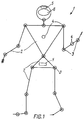
- Fig. 1 Schematically depicted in Fig. 1 is a user 1 having a locomotor system consisting of segments 2 with junctions 3.
- the junctions 3 of segments 2 simulate connections of bones with joints.
- the junctions like human or animal joints, have a different degree of freedom.
- the connections of a forearm and a shoulder, a shank and thigh may be simulated as a simple hinge joint with one degree of freedom, while the simulation of the connection of a shoulder with a shoulder blade in the shoulder joint, and a hip joint will require a hinge joint with a great number of degrees of freedom.
- Means for determining angles between the segments 2 are sensors 4 which track the position of the segments and their parts relative each other, the sensors being located on junctions 3 of the segments 2, and on the segments 2 as such.
- the sensors 4 serve for accurately tracking the user's movements, including measuring rotation angles of some segments relative their axes, for instance, of one end of the elbow segment relative to the other end thereof
- the elbow segment consists of two radiuses movable with respect to each other, which enables the rotation of one segment end relative to the other one over its axis.
- the sensors 4 may be fiber optics sensors or strain gages.
- the sensor 4 may be an angular and linear displacement measuring sensor composed of a transmitting section and a receiving section, responding to a variation in the electromotive force induced in the receiver circuit, which varies with variation in the angle between the segments.
- Reference direction determining means 5 is disposed on one of the segments 2 and designed for determining a segment orientation with respect to reference directions. Means 5 may be conveniently disposed on the parts which stay most stable at such standard user's movements as walking and running. It is recommended to locate the means on the pelvic part. When the user immerses in virtual reality, an orientation of the head can be more quickly and correctly tracked using a supplementary reference direction determining means secured on the head. In one embodiment, the reference direction determining means may be located on adjacent segments and determine their angular positions on the basis of their orientations with respect to reference directions.
- Means 6 for displaying virtual environment to a user is disposed on the user's head in front of the user's eyes.
- an embodiment of a system for tracking and displaying a user's position and orientation comprises a polling unit 7 which includes a master clock which specifies polling rate n of the sensors 4, polling rate m of the reference direction determining means 5, polling rate k of optional devices 8 for interaction with virtual environment objects (manipulators, joysticks, weapon simulators, etc.).
- Outputs of the polling unit 7 are connected to analogue-to-digit conversion means (ADC) 9 for converting analogue data received from the sensors 4, the optional devices 8 and the reference direction determining means 5 into digital data, e.g. having 8-byte value.
- ADC analogue-to-digit conversion means
- An output of the ADC 9 is coupled to an input of the storage unit 10 having storage cells the number of which is not less than ( n + m + k ).
- the storage unit 10 is coupled, via the polling unit 11, to a long-term memory unit 12 and a data preparation unit 13.
- the long-term memory unit 12 stores a time-variable user's position and orientation data in response to the user's actions for further employment for different purposes.
- an output of the long-term memory 12 may be coupled to an input of the data preparation unit 13 which smoothes the obtained data, excludes accidental errors and represents the data in a form acceptable for constructing a user's mathematical simulation.
- an input of the long-term memory unit may be connected to an input of the ADC provided the ADC is accordingly implemented.
- the elements 7, 9, 10 and 11 together may be referred to as an analogue-to-digit conversion means.
- An output of the data preparation unit 13 is coupled to an input of the unit 14 for constructing a mathematical simulation of a three-dimensional environment in which the user is to be displayed (or which is presented to the user) and a mathematical simulation of the user therein.
- Units 13 and 14 together may be referred to as measured and converted digital data processing means.
- an optional data input unit 15 which specifies an optional information of the user, the environment displayed, temporal relations between the user's movements and the dynamics of changes in the displayed environment.
- the information may include such optional information of the user as his or her height, weight, sex, age, etc.
- the user's mathematical simulation is computed for an average human with standard proportions.
- the unit 14 is composed of a unit 16 for determining orientation of a basic segment on which the reference direction determining means 5 is located with respect to the reference directions; a unit 17 for constructing a simulation of the user in general; a unit 18 for determining a bearing segment (segments) of the user; a unit 19 for positioning the user relative to a support in the computer-generated simulated environment.
- the output of the unit 14 is connected to the input of a unit 20 for generating an image at the required angle of view.
- An output of the unit 20 is connected to an input of a unit 21 for displaying a position and orientation of a simulated user positioned with respect to a support in the environment displayed.
- a system for presenting virtual environment to a user moving in real environment comprises the same elements 4, 5, 7 to 19 as in Fig.2, and differentiates over the system depicted in Fig.2 in that the output of the unit 14 is connected to an input of a user's field of view determining unit 22 and an input of a unit 23 for producing signals of a virtual environment image corresponding to the user's field of view.
- An output of the unit 22 is also coupled to the input of the virtual environment image signal producing unit 23.
- An output of the unit 23 is coupled to an input of the unit 24 for presenting the user with a virtual environment in which he or she is immersed in response to the user's position and orientation therein.
- a system for tracking and displaying a user's position and orientation illustrated in Fig.2, operates in the following manner.
- the sensors 4 and the reference direction determining means 5 are attached to a special body suit, such as an overall, or directly to the user at sites of the junctions 3 between the segments 2 and on the segments 2 as such.
- the body suit with a set of the sensors 4 and the means 5 should be light-weight, easily put on and off, and not restricting the user's movements.
- the sensors 4 are attached to the body suit so that when the user moves, i.e. the angles between the segments 2 vary or an end of a segment rotates with respect to the other end along the segment axis, some physical parameters change in the sensors.
- the physical parameters should change within predetermined ranges in response to the variation in angles between adjacent segments 2 from one extreme position to the other one.
- the system may include a primary and supplementary reference direction determining means 5 to determine an angle between the segment on which an appropriate means 5 is located and the reference directions.
- the primary reference direction determining means 5 is located on the segment which is taken as the basic segment. It is preferable to select the basic segment which is closer to the user's geometrical centre and the most stable at typical movements of a human, such as walking and running. These requirements are best met by the pelvic segment.
- the use may be made of the supplementary reference direction determining means 5 attached on the head to more accurately and quickly track tilts and turns of the head.
- Information from the sensors 4, the reference direction determining means 5 and optional devices 8 for interaction with virtual environment objects is applied to the ADC and updated in response to a polling signal generated by the clock generator of the polling unit 7. From the ADC 9, the information is applied to corresponding memory cells in the storage unit 10.
- the polling unit 11 polls the memory cells in the storage unit 10 and produces a data sequence defining the user's position and orientation, including data from the optional devices 8 relating to a particular (present) point in time, and provides the data to the long-term memory unit 12 for long-term storage.
- the data may be employed at any moment, it is only necessary to feed the data to the data preparation unit 13 for subsequent processing.
- data from the polling unit 11 is directly provided to the data preparation unit 13.
- the unit 13 smoothens the obtained data, deletes accidental errors, produces the required data sequence and presents the data in the required form to the unit 14 to construct a user's mathematical simulation.
- the unit 14 constructs a mathematical simulation of a three-dimensional environment in which the user is to be displayed, and a mathematical simulation of the user therein.
- an optional data of the user, the environment displayed, time relations between the user's movements and the dynamics of alterations in the environment displayed is fed into the unit 14.
- This information may contain such optional information of the user, as his or her height, weight, sex, age, etc.
- the mathematical simulation will be computed for an average human with standard proportions. If it is desired to produce the "Gulliver" effect with unnaturally big or small objects in the environment displayed, the input data of the proportions between the linear dimensions of the environment and objects therein and the user's linear dimensions is modified.
- a fast or slow time scale may be introduced into the environment displayed by changing the dynamics of the user's movements when entering data from the long-term memory 12. If the user's movement data is applied to the unit 13 in real time, the dynamics of the process flow in the displayed environment may be accelerated or slowed down.
- the primary segment construction and orientation unit 16 computes and constructs, based on the data received, a position and orientation of the basic segment on which the primary reference direction determining means is disposed with respect to reference directions.
- the reference directions are preferably the directions related with the Earth's geomagnetic field, north-south, west-east directions or a local vertical defined on the basis of the Earth's gravitational field and the north-south direction. These fields exist generally everywhere and are independent of the user.
- a special means like an electromagnetic compass and a horizontal or vertical gravitation sensor, an orientation of the user can be defined, and in particular, of that segment of the user's locomotor system on which the means is secured.
- an artificial field of reference directions may be generated by a dedicated means. It is vital to note that in this case it will be necessary only to define the user's orientation within this field without the need for determining an absolute distance to this means using triangulation algorithms that make having demand on computing power.
- the unit 17 for constructing a simulation of the user in general adds adjacent segments to the basic segments that have been constructed, using the modified data of the angles between them, and further adds subsequent adjacent segments to the constructed adjacent segments and so on up to the final segments.
- the unit 18 determines the user's bearing segment or segments. By way of example, if the user is moving along a horizontal flat surface, a bearing segment will be the lowermost one with respect to the local vertical, while a point of support will be the lowermost part of this segment.
- the unit 19 positions the user relative the support in the computer-generated environment.
- the user's simulation after being oriented is aligned with the user's support in the simulated environment so that to register a bearing portion of the user's bearing segment and a portion of the simulated environment which is the user's support at the present point in time.
- the user is moving, e.g. jumping, i.e. "in flight” for a time, he or she is positioned relative to the support using the most recent information of the user's dynamics. It should be noted that having complete information of variation in the angles between the segments in dynamics, even the user's heart rate and a force with which he or she has pushed away from the support may be computed.
- the information of the constructed simulation of the user in the simulated environment is applied to the input of the unit 20 for producing the image at a required angle of view, wherein the viewer's point of view is selected, the user's image at the required angle of view is computed, and, if necessary, the image is edited for subsequent display.
- the information is provided to the input of the unit 21 which displays the position and orientation of the simulated user positioned relative to the support in the displayed environment.
- the user himself or the outsiders may specify the aspect for viewing the dynamics of the user's movements. If desired, the user's movements can be viewed from above, from below, from the side, or from a changing point of view.
- the movements may be edited before displaying in accordance with some task.
- the user's movements may be displayed as a simplified stylized simulation or in any other form more close to realistic images with "rendering" complicated textures of clothes, skin, surrounding environment.
- substantially any computer can cope with the task, while in the latter case a relatively powerful computer with excellent graphic capabilities is required.
- the system in accordance with the invention operates in principle identically to that described with reference to Fig.2.
- the distinctive feature is that the unit 14 constructs a three-dimensional simulation of the environment displayed to the user, and a mathematical simulation of the user therein. From the output of the unit 14, the information of the constructed simulation of the user in the simulated environment is applied to an input of unit 22 for determining the user's field of view, and an input of the unit 23 for producing a virtual environment image. Using the information received from the unit 14, the unit 22 determines the user's field of view in the virtual environment, i.e. which part of the virtual environment the user could see at the present moment.
- the user's angle of view information is provided to the unit 23 for producing the virtual environment image.
- the unit 23 produces an image of that part of the virtual environment which the user could see in accordance with his or her position and orientation in the virtual environment computed in response to the movements in real environment.
- the signals are applied to the input of the unit 24 for presenting the user with the virtual environment in which he or she is immersed, in response to his or her position and orientation therein.
- the unit 24 may be any virtual environment displaying means: a monitor, a virtual helmet or goggles, including means 6 (Fig.1).
- the majority of conventional systems produce the user's simulation using absolute coordinates which are determined by the sensors located on the user.
- a position in space of the user in general is autodetected.
- the absolute coordinates will give a path of the user's movements.
- the environment is most commonly restricted by the limits of external sensors or emitters located over the perimeter of an active region of the user's actions.
- the invention in contrast, does not substantially restrict the active region of user's movements, as all that is needed for determining the user's position and orientation is located on the user himself.
- the reference direction determining means it is only important to provide an operation field for the reference direction determining means, while the user's movements in space are computed by a computer in accordance with the information of changing the angles between the segments and the user's orientation with respect to the reference directions. Changes in the environment may be computed on the basis of a number, dimension and direction of the user's steps.
- the steps dimension the angles between and the linear dimensions of the user's bearing segments at the instant of performing the step should be known. More particularly, to determine a human's step it is necessary to know the angle between the femoral bones of the left and right legs, the angle between the femoral bone and the shank of each leg, and the shank and thigh linear dimensions. In some cases it will be also useful to measure the angles between the foot and the shank, and between the foot and toes.
- the use may be made of the sensors mounted on the user's sole. For example, if a leg is a bearing one at some point in time, a contact closes in the sensor, and if the leg is lifted and hangs, the contact, on the contrary, opens.
- the sensor may also provide the information of the load carried by each leg. Based on the load carried by the leg in dynamics and the user's weight, the impetus obtained by the user and the path of the user's movement may be computed even for a jump.
- the data required for computing the movement path and physical characteristics of the user's movements can be also computed on the basis of the dynamics of changing the angles between the segments.
- a method and a system in accordance with the present invention provide a variety of entirely new possibilities which have been infeasible hitherto, in particular, an opportunity of conducting tests and competitions involving various movements, such as athletic and dancing, and for assessing the adequacy of responding to a proposed situation and in combats.
- the competitions could be conducted separated in time, for example, by taking data from the same user at different times. The data may be then assessed and compared both by a computer and by a human after viewing the movements for comparison.
- the competitions may be simultaneously conducted among a plurality of users. To this end, data is taken in real time from several users and used to compare the correctness of performing and responding to a situation, the response speed and the originality of movements.
- Such competitions may be conducted between the invented system users which are connected to the Internet or a dedicated network, while the users may be separated by a considerable distance.
- the user's position and orientation data written in memory may be further archived. It is possible to generate libraries of typical movements of a human or any chordates and unique movements written from prominent sportsmen and dancers.
- One of the basic advantages of the present invention is that the entire system of sensors is on a user. There is no necessity to determine absolute distances to reference points which are defined as the external sensor positions in the prior art systems.
- the invention ensures the determination of a user's position and orientation substantially in an unbounded environment having only a field of reference directions with respect to which the user may be oriented. Determination of reference directions anticipates, as described above, the determination of orientation of a segment on which reference direction determining means is located with respect to the reference directions.
- the most convenient reference directions are vector directions of the Earth's natural fields existing substantially everywhere irrespective of us.
- the two reference directions suggested are the north-south and west-east directions of the Earth's magnetic field, or e.g. the north-south direction and a local vertical defined by the Earth's gravitation field.
- the use may be made of reference direction artificial field emitters.
- the invention allows, using the stored data, a continuous or discrete movement to be accomplished towards different sides in time within the scope of data written in memory, as easily as in space.
- the present invention tracks the user's movements and presents virtual environment without resorting to sophisticated external devices
- the capabilities of existing computer systems can be extended and new fields of application can be found.
- a standard description of user's movements tracked may be produced for the employment in different systems.
- Such standard description of user's movements may be used, for example, as part of VRML (Virtual Reality Modeling Language), in animation and for generation of dedicated libraries.
- VRML Virtual Reality Modeling Language
- the majority of future computer applications could use the standards taking into account the possibility of controlling the program using the user's natural movements which are tracked by a method in accordance with the present invention.
- model movements are displayed to a user.
- the trainee should be provided with the possibility to retry, to select any aspect, dynamics of performing, and a scale.
- the user should endeavor to repeat the movements as correctly as possible.
- his or her movements should be stored, logged, so that to compare them with the model movements.
- the comparison of the model movements with the user's movements can be accomplished by different methods.
- the user himself may view the simultaneously displayed model movements and previously stored user's movements.
- a more interesting and promising possibility is the assessment of correctness of the user's movement by a computer or a skilled person.
- a computer can produce comments and recommendations after the comparison of the user's movements tracked through the user's position and orientation. The user will correct his or her movements until a required skill and accuracy are achieved. This process is like training by a master, although it does not involve corresponding expenditures and the schedule approval by the master.
- the feedback program generated by the best masters can be replicated in millions of copies, and everyone may resort to it at any convenient time.
- the present invention can be also used to monitor the measured physical loads on a user.
- a load is defined for a particular person in accordance with recommendations of a physician or a trainer.
- a computer can compute and recommend the system of loads for some period of time.
- the use can be made of data of past and chronic diseases, weight, height, sex, age, training purpose, degree of exercise and emotional stresses during a day.
- Dedicated preliminary tests may be conducted which involve monitoring the body response, for example, the degree of changing heart rate under dosed stresses.
- the computer may generate optimum recommendations for a definite time.
- the user will get to his or her training using the system of sensors which most completely track the user's movements so that data of loads on separate body parts can easily computed based on the information of movements. In such training, it would be useful to employ data from the user's heart rate sensors, and, if appropriate, the other physiological characteristics.
- a user is immersed in virtual environment and uses a training apparatus which allows the movements to be performed unrestrictedly, the user's exercise and emotional stress can be controlled by a downloaded program through changing the story, dynamics and the environment surrounding the user.
- the control may be accomplished through dosing a number of appearing enemies, the story intensity, the necessity to chase the enemy at a sufficient speed or to escape from dangerous places.
- Unnoticeable for the user such control allows, for example, the heart rate to be maintained within a predetermined range for a specified time period.
- the user should be brought to performing the task and completing the story. This would allow him or her to finish the training in the emotionally excited mood from the result achieved.
- Currently existing games fail to satisfy these principles.
- a player is mostly motionless, i.e. there is zero exercise stress at a high emotional stress which may lead to strains and depressions. Performed at the controlled exercise and emotional stresses, games and exercises can be excellent means against hypodynamia and nervous overstrains, and to promote the all-round harmonic habilitation of a person.
- the exercises with predetermined physical loads may be accomplished through the immersion into a particular, user-selected virtual environment.
- a computer program may simulate a running excursion over prominent places with a guide which would tell of places of interest and set the tempo of a walking or running excursion at a predetermined speed or at a speed variable of necessity. The excursion may be brought to an end after a predetermined load has been attained.
- data of previous exercises and loads may be written in the computer memory for subsequent modification of loads from an initial level to a level which is recommended as stable.
- Normal constant or daily variable stresses may be emotionally colored and accompanied by a new useful information. For better emotional coloring, a possibility may be provided to select the guide's sex or age, or to simulate the image of a prominent actor or politician.
- the loads may be controlled by a processor, the feedback being provided through headphones via the auditory channel.
- the processor may report of the necessity to change the general tempo of a load or loads on separate body parts. The decisions can be taken on the basis of the information received from the system for tracking a user's position and orientation in accordance with a load computation program.
Landscapes
- Engineering & Computer Science (AREA)
- Theoretical Computer Science (AREA)
- General Engineering & Computer Science (AREA)
- General Physics & Mathematics (AREA)
- Physics & Mathematics (AREA)
- Multimedia (AREA)
- Human Computer Interaction (AREA)
- Remote Sensing (AREA)
- Business, Economics & Management (AREA)
- Algebra (AREA)
- Mathematical Analysis (AREA)
- Mathematical Optimization (AREA)
- Mathematical Physics (AREA)
- Pure & Applied Mathematics (AREA)
- General Health & Medical Sciences (AREA)
- Educational Administration (AREA)
- Computational Mathematics (AREA)
- Chemical & Material Sciences (AREA)
- Health & Medical Sciences (AREA)
- Medicinal Chemistry (AREA)
- Radar, Positioning & Navigation (AREA)
- Educational Technology (AREA)
- Medical Informatics (AREA)
- Processing Or Creating Images (AREA)
- User Interface Of Digital Computer (AREA)
- Nitrogen And Oxygen Or Sulfur-Condensed Heterocyclic Ring Systems (AREA)
- Input From Keyboards Or The Like (AREA)
Applications Claiming Priority (5)
| Application Number | Priority Date | Filing Date | Title |
|---|---|---|---|
| RU96116414 | 1996-08-14 | ||
| RU96116415 | 1996-08-14 | ||
| RU96116414A RU2107328C1 (ru) | 1996-08-14 | 1996-08-14 | Способ отслеживания и отображения положения и ориентации пользователя в пространстве и система для осуществления способа |
| RU96116415A RU2106695C1 (ru) | 1996-08-14 | 1996-08-14 | Способ представления виртуального пространства пользователю и система для осуществления способа |
| PCT/RU1997/000251 WO1998007129A1 (en) | 1996-08-14 | 1997-08-07 | Method for following and imaging a subject's three-dimensional position and orientation, method for presenting a virtual space to a subject, and systems for implementing said methods |
Publications (2)
| Publication Number | Publication Date |
|---|---|
| EP0959444A1 true EP0959444A1 (de) | 1999-11-24 |
| EP0959444A4 EP0959444A4 (de) | 2005-12-07 |
Family
ID=26653888
Family Applications (1)
| Application Number | Title | Priority Date | Filing Date |
|---|---|---|---|
| EP97936893A Withdrawn EP0959444A4 (de) | 1996-08-14 | 1997-08-07 | Verfahren und vorrichtung zur verfolgung und bilderfassung der dreidimensionalen position und orientierung eines gegenstandes sowie zur präsentation eines virtuellen raumes an diesen gegenstand |
Country Status (6)
| Country | Link |
|---|---|
| US (1) | US6005548A (de) |
| EP (1) | EP0959444A4 (de) |
| JP (1) | JP2001504605A (de) |
| CN (1) | CN1168057C (de) |
| AU (1) | AU3954997A (de) |
| WO (1) | WO1998007129A1 (de) |
Cited By (12)
| Publication number | Priority date | Publication date | Assignee | Title |
|---|---|---|---|---|
| WO2001063320A1 (en) * | 2000-02-22 | 2001-08-30 | Aman James A | Method for representing real-time motion |
| WO2001029799A3 (en) * | 1999-10-20 | 2002-01-03 | Impulse Technology Ltd | Education system challenging a subject's physiologic and kinesthetic systems to synergistically enhance cognitive function |
| US6567116B1 (en) | 1998-11-20 | 2003-05-20 | James A. Aman | Multiple object tracking system |
| US6749432B2 (en) | 1999-10-20 | 2004-06-15 | Impulse Technology Ltd | Education system challenging a subject's physiologic and kinesthetic systems to synergistically enhance cognitive function |
| ES2234384A1 (es) * | 2003-02-05 | 2005-06-16 | Jesus Ciudad Colado | Procedimiento informatizado para simular virtualmente el toreo de salon. |
| WO2007087351A3 (en) * | 2006-01-24 | 2007-09-27 | Univ Carnegie Mellon | Method, apparatus, and system for computer-aided tracking, navigation, and motion teaching |
| US7483049B2 (en) | 1998-11-20 | 2009-01-27 | Aman James A | Optimizations for live event, real-time, 3D object tracking |
| WO2015054702A1 (en) * | 2013-10-11 | 2015-04-16 | Imsi Design, Llc | Method for calibrating the physical position and orientation of an eletronic device using device sensors only |
| DE102015003881A1 (de) * | 2015-03-26 | 2016-09-29 | Audi Ag | Verfahren zum Bereitstellen einer Simulation einer virtuellen Umgebung mit zumindest einem Teil eines Kraftfahrzeugs und Kraftfahrzeugsimulationsanordnung |
| WO2017197287A1 (en) * | 2016-05-12 | 2017-11-16 | Google Llc | System and method relating to movement in a virtual reality environment |
| CN111249691A (zh) * | 2018-11-30 | 2020-06-09 | 百度在线网络技术(北京)有限公司 | 一种基于形体识别的运动员训练方法和系统 |
| US12330047B2 (en) | 2019-09-06 | 2025-06-17 | Sports Data Labs, Inc. | System for generating simulated animal data and models |
Families Citing this family (463)
| Publication number | Priority date | Publication date | Assignee | Title |
|---|---|---|---|---|
| US8352400B2 (en) | 1991-12-23 | 2013-01-08 | Hoffberg Steven M | Adaptive pattern recognition based controller apparatus and method and human-factored interface therefore |
| US6722888B1 (en) * | 1995-01-20 | 2004-04-20 | Vincent J. Macri | Method and apparatus for tutorial, self and assisted instruction directed to simulated preparation, training and competitive play and entertainment |
| US6430997B1 (en) | 1995-11-06 | 2002-08-13 | Trazer Technologies, Inc. | System and method for tracking and assessing movement skills in multidimensional space |
| US6747632B2 (en) * | 1997-03-06 | 2004-06-08 | Harmonic Research, Inc. | Wireless control device |
| US20020036617A1 (en) * | 1998-08-21 | 2002-03-28 | Timothy R. Pryor | Novel man machine interfaces and applications |
| US6750848B1 (en) * | 1998-11-09 | 2004-06-15 | Timothy R. Pryor | More useful man machine interfaces and applications |
| US6720949B1 (en) * | 1997-08-22 | 2004-04-13 | Timothy R. Pryor | Man machine interfaces and applications |
| US6243106B1 (en) * | 1998-04-13 | 2001-06-05 | Compaq Computer Corporation | Method for figure tracking using 2-D registration and 3-D reconstruction |
| IL127569A0 (en) | 1998-09-16 | 1999-10-28 | Comsense Technologies Ltd | Interactive toys |
| US6369794B1 (en) * | 1998-09-09 | 2002-04-09 | Matsushita Electric Industrial Co., Ltd. | Operation indication outputting device for giving operation indication according to type of user's action |
| US6215498B1 (en) * | 1998-09-10 | 2001-04-10 | Lionhearth Technologies, Inc. | Virtual command post |
| US6607136B1 (en) | 1998-09-16 | 2003-08-19 | Beepcard Inc. | Physical presence digital authentication system |
| EP1116155A2 (de) | 1998-10-02 | 2001-07-18 | Comsense Technologies Ltd. | Karte zur interaktion mit einem computer |
| US7966078B2 (en) | 1999-02-01 | 2011-06-21 | Steven Hoffberg | Network media appliance system and method |
| JP4006873B2 (ja) * | 1999-03-11 | 2007-11-14 | ソニー株式会社 | 情報処理システム、情報処理方法及び装置、並びに情報提供媒体 |
| US7015950B1 (en) | 1999-05-11 | 2006-03-21 | Pryor Timothy R | Picture taking method and apparatus |
| US7113918B1 (en) * | 1999-08-01 | 2006-09-26 | Electric Planet, Inc. | Method for video enabled electronic commerce |
| JP3179769B2 (ja) * | 1999-09-07 | 2001-06-25 | コナミ株式会社 | 信号発生装置 |
| JP2001070640A (ja) | 1999-09-07 | 2001-03-21 | Konami Co Ltd | ゲーム機 |
| US8019609B2 (en) | 1999-10-04 | 2011-09-13 | Dialware Inc. | Sonic/ultrasonic authentication method |
| AU2001233019A1 (en) * | 2000-01-28 | 2001-08-07 | Intersense, Inc. | Self-referenced tracking |
| FR2805057B1 (fr) * | 2000-02-10 | 2002-05-03 | Renault | Procede et dispositif de presentation visuelle d'un espace virtuel a trois dimensions simulant un vehicule automobile |
| US6734834B1 (en) * | 2000-02-11 | 2004-05-11 | Yoram Baram | Closed-loop augmented reality apparatus |
| US7810037B1 (en) * | 2000-02-11 | 2010-10-05 | Sony Corporation | Online story collaboration |
| US8407595B1 (en) | 2000-02-11 | 2013-03-26 | Sony Corporation | Imaging service for automating the display of images |
| US7262778B1 (en) | 2000-02-11 | 2007-08-28 | Sony Corporation | Automatic color adjustment of a template design |
| US7328119B1 (en) * | 2000-03-07 | 2008-02-05 | Pryor Timothy R | Diet and exercise planning and motivation including apparel purchases based on future appearance |
| US6778866B1 (en) * | 2000-03-16 | 2004-08-17 | Ted S. Bettwy | Method and apparatus for learning specific body motion |
| KR100355815B1 (ko) * | 2000-04-11 | 2002-10-19 | 이지로보틱스 주식회사 | 다중 이동 로봇을 이용한 모션캡쳐 및 동작 애니메이션 장치 |
| IL136373A0 (en) * | 2000-05-25 | 2001-06-14 | Itpen Ltd Partnership Israel | Representation of three-dimensional bodies on computer screens and games involving such representations |
| US7330806B2 (en) * | 2000-08-08 | 2008-02-12 | Reohr Iii John | Virtualized network |
| US7117136B1 (en) * | 2000-08-18 | 2006-10-03 | Linden Research, Inc. | Input and feedback system |
| AU2001288811A1 (en) * | 2000-09-07 | 2002-03-22 | Neochi Llc | Method and system for simultaneously creating and using multiple virtual realityprograms |
| AU2001296773A1 (en) * | 2000-10-10 | 2002-04-22 | University Of Utah Research Foundation | Method and apparatus for monitoring dynamic systems using an integrated graphic display for the n-dimensional representations of critical functions |
| US6746247B2 (en) | 2000-12-27 | 2004-06-08 | Michael P. Barton | Choreographed athletic movement to music |
| US6646643B2 (en) | 2001-01-05 | 2003-11-11 | The United States Of America As Represented By The Secretary Of The Navy | User control of simulated locomotion |
| US8306635B2 (en) | 2001-03-07 | 2012-11-06 | Motion Games, Llc | Motivation and enhancement of physical and mental exercise, rehabilitation, health and social interaction |
| JP4708590B2 (ja) * | 2001-03-13 | 2011-06-22 | キヤノン株式会社 | 複合現実感システム、ヘッドマウントディスプレイ装置、複合現実感実現方法及びプログラム |
| US9219708B2 (en) | 2001-03-22 | 2015-12-22 | DialwareInc. | Method and system for remotely authenticating identification devices |
| US6798429B2 (en) * | 2001-03-29 | 2004-09-28 | Intel Corporation | Intuitive mobile device interface to virtual spaces |
| KR100393350B1 (ko) * | 2001-04-23 | 2003-08-02 | (주)가시오페아 | 가상경기 시스템 및 방법 |
| SE523098C2 (sv) * | 2001-06-19 | 2004-03-30 | Jan G Faeger | Anordning och förfarande för att i en reell omgivning skapa en virtuell företeelse |
| CA2451196A1 (en) * | 2001-06-19 | 2003-01-03 | Jan G. Faeger | A device and a method for creating an environment for a creature |
| US6569019B2 (en) * | 2001-07-10 | 2003-05-27 | William Cochran | Weapon shaped virtual reality character controller |
| US6758678B2 (en) | 2001-08-14 | 2004-07-06 | Disney Enterprises, Inc. | Computer enhanced play set and method |
| KR20030038883A (ko) * | 2001-11-07 | 2003-05-17 | 최창구 | 피에스디 센서를 이용한 모션 검출 장치 |
| US6990639B2 (en) | 2002-02-07 | 2006-01-24 | Microsoft Corporation | System and process for controlling electronic components in a ubiquitous computing environment using multimodal integration |
| JP4054585B2 (ja) * | 2002-02-18 | 2008-02-27 | キヤノン株式会社 | 情報処理装置および方法 |
| AU2003220185B2 (en) | 2002-03-12 | 2007-05-10 | Menache, Llc | Motion tracking system and method |
| US8260593B2 (en) * | 2002-09-18 | 2012-09-04 | Siemens Product Lifecycle Management Software Inc. | System and method for simulating human movement |
| CN100428218C (zh) * | 2002-11-13 | 2008-10-22 | 北京航空航天大学 | 一种实现通用虚拟环境漫游引擎的方法 |
| EP1627272B2 (de) * | 2003-02-04 | 2017-03-08 | Mako Surgical Corp. | Interaktives computerunterstütztes chirurgiesystem und verfahren |
| US20050267354A1 (en) * | 2003-02-04 | 2005-12-01 | Joel Marquart | System and method for providing computer assistance with spinal fixation procedures |
| WO2004070573A2 (en) * | 2003-02-04 | 2004-08-19 | Z-Kat, Inc. | Computer-assisted external fixation apparatus and method |
| US7009561B2 (en) * | 2003-03-11 | 2006-03-07 | Menache, Llp | Radio frequency motion tracking system and method |
| US8745541B2 (en) | 2003-03-25 | 2014-06-03 | Microsoft Corporation | Architecture for controlling a computer using hand gestures |
| US7665041B2 (en) | 2003-03-25 | 2010-02-16 | Microsoft Corporation | Architecture for controlling a computer using hand gestures |
| WO2005002677A2 (de) * | 2003-07-02 | 2005-01-13 | Gonzalez De Mendoza Y Kaeding | Simulations- und trainingskugel zur aufnahme von personen |
| US8600550B2 (en) * | 2003-12-12 | 2013-12-03 | Kurzweil Technologies, Inc. | Virtual encounters |
| US9841809B2 (en) * | 2003-12-12 | 2017-12-12 | Kurzweil Technologies, Inc. | Virtual encounters |
| US9971398B2 (en) * | 2003-12-12 | 2018-05-15 | Beyond Imagination Inc. | Virtual encounters |
| US20050130108A1 (en) * | 2003-12-12 | 2005-06-16 | Kurzweil Raymond C. | Virtual encounters |
| US9948885B2 (en) * | 2003-12-12 | 2018-04-17 | Kurzweil Technologies, Inc. | Virtual encounters |
| JP2005234217A (ja) * | 2004-02-19 | 2005-09-02 | Nisshin Flour Milling Inc | 小麦粉加工品製造技術を教授する小麦粉加工品製造技術教授装置及びプログラム |
| WO2005091113A2 (en) * | 2004-03-12 | 2005-09-29 | Vectronix Ag | Apparatus and method of determining 3d pedestrian motion by using projection planes |
| FR2868281B1 (fr) * | 2004-03-30 | 2023-06-23 | Commissariat Energie Atomique | Procede de determination des mouvements d'une personne. |
| US20050278157A1 (en) * | 2004-06-15 | 2005-12-15 | Electronic Data Systems Corporation | System and method for simulating human movement using profile paths |
| US9129077B2 (en) * | 2004-09-03 | 2015-09-08 | Siemen Product Lifecycle Management Software Inc. | System and method for predicting human posture using a rules-based sequential approach |
| WO2006027734A1 (en) * | 2004-09-09 | 2006-03-16 | Koninklijke Philips Electronics N.V. | System for the three-dimensional imaging of a moving joint |
| US20060109274A1 (en) * | 2004-10-28 | 2006-05-25 | Accelerated Pictures, Llc | Client/server-based animation software, systems and methods |
| US20060281061A1 (en) * | 2005-06-13 | 2006-12-14 | Tgds, Inc. | Sports Training Simulation System and Associated Methods |
| WO2007013833A1 (fr) * | 2005-09-15 | 2007-02-01 | Oleg Stanilasvovich Rurin | Procede et systeme pour visualiser des objets virtuels tridimensionnels |
| US20070142177A1 (en) * | 2005-09-26 | 2007-06-21 | Crucial Innovation, Inc. | Computerized method and system for fitting a bicycle to a cyclist |
| US20070078535A1 (en) * | 2005-09-30 | 2007-04-05 | Rockwell Automation Technologies, Inc. | System and method for identifying particularized equipment information of interest to varied users in an industrial automation environment |
| US7433741B2 (en) * | 2005-09-30 | 2008-10-07 | Rockwell Automation Technologies, Inc. | Hybrid user interface having base presentation information with variably prominent supplemental information |
| US7697827B2 (en) | 2005-10-17 | 2010-04-13 | Konicek Jeffrey C | User-friendlier interfaces for a camera |
| CN1991691B (zh) * | 2005-12-30 | 2012-07-04 | 财团法人工业技术研究院 | 交互式控制平台系统 |
| US7602301B1 (en) | 2006-01-09 | 2009-10-13 | Applied Technology Holdings, Inc. | Apparatus, systems, and methods for gathering and processing biometric and biomechanical data |
| CN102058976A (zh) * | 2006-05-04 | 2011-05-18 | 美国索尼电脑娱乐公司 | 用于跟踪环境中的用户操纵的系统 |
| WO2008014487A2 (en) * | 2006-07-28 | 2008-01-31 | Accelerated Pictures, Inc. | Scene organization in computer-assisted filmmaking |
| US7880770B2 (en) * | 2006-07-28 | 2011-02-01 | Accelerated Pictures, Inc. | Camera control |
| US8005238B2 (en) | 2007-03-22 | 2011-08-23 | Microsoft Corporation | Robust adaptive beamforming with enhanced noise suppression |
| TW200842692A (en) * | 2007-04-17 | 2008-11-01 | Benq Corp | An electrical device and a display method |
| US8088017B2 (en) * | 2007-05-15 | 2012-01-03 | United States Bowling Congress, Inc. | System and method for analyzing bowling ball motion |
| US8005237B2 (en) | 2007-05-17 | 2011-08-23 | Microsoft Corp. | Sensor array beamformer post-processor |
| RU2364436C2 (ru) * | 2007-06-18 | 2009-08-20 | Максим Алексеевич Васин | Способ тренировки и устройство для его осуществления |
| US7980141B2 (en) | 2007-07-27 | 2011-07-19 | Robert Connor | Wearable position or motion sensing systems or methods |
| US20100027839A1 (en) * | 2007-07-31 | 2010-02-04 | Think/Thing | System and method for tracking movement of joints |
| KR102597520B1 (ko) | 2007-09-26 | 2023-11-06 | 에이큐 미디어 인크 | 오디오-비주얼 내비게이션 및 통신 |
| US8629976B2 (en) * | 2007-10-02 | 2014-01-14 | Microsoft Corporation | Methods and systems for hierarchical de-aliasing time-of-flight (TOF) systems |
| TWI372645B (en) * | 2007-10-17 | 2012-09-21 | Cywee Group Ltd | An electronic game controller with motion-sensing capability |
| EP2203896B1 (de) * | 2007-10-26 | 2019-04-24 | Koninklijke Philips N.V. | Verfahren und system zur auswahl der anzeigekonfiguration einer dargestellten abbildung |
| US20090166684A1 (en) * | 2007-12-26 | 2009-07-02 | 3Dv Systems Ltd. | Photogate cmos pixel for 3d cameras having reduced intra-pixel cross talk |
| US8933876B2 (en) | 2010-12-13 | 2015-01-13 | Apple Inc. | Three dimensional user interface session control |
| US9035876B2 (en) | 2008-01-14 | 2015-05-19 | Apple Inc. | Three-dimensional user interface session control |
| US8571637B2 (en) | 2008-01-21 | 2013-10-29 | Biomet Manufacturing, Llc | Patella tracking method and apparatus for use in surgical navigation |
| CN101978374A (zh) | 2008-03-03 | 2011-02-16 | 耐克国际有限公司 | 交互式运动设备系统 |
| US20090270193A1 (en) * | 2008-04-24 | 2009-10-29 | United States Bowling Congress | Analyzing a motion of a bowler |
| DE102008027103A1 (de) * | 2008-06-06 | 2009-12-10 | Cairos Technologies Ag | System und Verfahren zur automatisierten Analyse eines Wettkampfverlaufes |
| US8385557B2 (en) | 2008-06-19 | 2013-02-26 | Microsoft Corporation | Multichannel acoustic echo reduction |
| US8325909B2 (en) | 2008-06-25 | 2012-12-04 | Microsoft Corporation | Acoustic echo suppression |
| US8203699B2 (en) | 2008-06-30 | 2012-06-19 | Microsoft Corporation | System architecture design for time-of-flight system having reduced differential pixel size, and time-of-flight systems so designed |
| US8231506B2 (en) | 2008-12-05 | 2012-07-31 | Nike, Inc. | Athletic performance monitoring systems and methods in a team sports environment |
| US8172722B2 (en) * | 2008-12-05 | 2012-05-08 | Nike, Inc. | Athletic performance monitoring systems and methods in a team sports environment |
| US8628453B2 (en) | 2008-12-05 | 2014-01-14 | Nike, Inc. | Athletic performance monitoring systems and methods in a team sports environment |
| US8681321B2 (en) | 2009-01-04 | 2014-03-25 | Microsoft International Holdings B.V. | Gated 3D camera |
| CN102341767A (zh) * | 2009-01-21 | 2012-02-01 | 佐治亚技术研究公司 | 使用运动捕获的角色动画控制接口 |
| US8267781B2 (en) * | 2009-01-30 | 2012-09-18 | Microsoft Corporation | Visual target tracking |
| US8577084B2 (en) * | 2009-01-30 | 2013-11-05 | Microsoft Corporation | Visual target tracking |
| US20100199228A1 (en) * | 2009-01-30 | 2010-08-05 | Microsoft Corporation | Gesture Keyboarding |
| US8448094B2 (en) | 2009-01-30 | 2013-05-21 | Microsoft Corporation | Mapping a natural input device to a legacy system |
| US20100199231A1 (en) | 2009-01-30 | 2010-08-05 | Microsoft Corporation | Predictive determination |
| US8588465B2 (en) | 2009-01-30 | 2013-11-19 | Microsoft Corporation | Visual target tracking |
| US7996793B2 (en) | 2009-01-30 | 2011-08-09 | Microsoft Corporation | Gesture recognizer system architecture |
| US8295546B2 (en) | 2009-01-30 | 2012-10-23 | Microsoft Corporation | Pose tracking pipeline |
| US8565476B2 (en) | 2009-01-30 | 2013-10-22 | Microsoft Corporation | Visual target tracking |
| US8577085B2 (en) * | 2009-01-30 | 2013-11-05 | Microsoft Corporation | Visual target tracking |
| US8682028B2 (en) * | 2009-01-30 | 2014-03-25 | Microsoft Corporation | Visual target tracking |
| US8294767B2 (en) | 2009-01-30 | 2012-10-23 | Microsoft Corporation | Body scan |
| US8565477B2 (en) | 2009-01-30 | 2013-10-22 | Microsoft Corporation | Visual target tracking |
| US8487938B2 (en) * | 2009-01-30 | 2013-07-16 | Microsoft Corporation | Standard Gestures |
| WO2010103482A2 (en) * | 2009-03-13 | 2010-09-16 | Primesense Ltd. | Enhanced 3d interfacing for remote devices |
| US8773355B2 (en) | 2009-03-16 | 2014-07-08 | Microsoft Corporation | Adaptive cursor sizing |
| US8988437B2 (en) | 2009-03-20 | 2015-03-24 | Microsoft Technology Licensing, Llc | Chaining animations |
| US9256282B2 (en) | 2009-03-20 | 2016-02-09 | Microsoft Technology Licensing, Llc | Virtual object manipulation |
| US9313376B1 (en) | 2009-04-01 | 2016-04-12 | Microsoft Technology Licensing, Llc | Dynamic depth power equalization |
| US8503720B2 (en) | 2009-05-01 | 2013-08-06 | Microsoft Corporation | Human body pose estimation |
| US8649554B2 (en) | 2009-05-01 | 2014-02-11 | Microsoft Corporation | Method to control perspective for a camera-controlled computer |
| US8340432B2 (en) | 2009-05-01 | 2012-12-25 | Microsoft Corporation | Systems and methods for detecting a tilt angle from a depth image |
| US8253746B2 (en) | 2009-05-01 | 2012-08-28 | Microsoft Corporation | Determine intended motions |
| US9498718B2 (en) | 2009-05-01 | 2016-11-22 | Microsoft Technology Licensing, Llc | Altering a view perspective within a display environment |
| US9377857B2 (en) | 2009-05-01 | 2016-06-28 | Microsoft Technology Licensing, Llc | Show body position |
| US9898675B2 (en) * | 2009-05-01 | 2018-02-20 | Microsoft Technology Licensing, Llc | User movement tracking feedback to improve tracking |
| US8638985B2 (en) | 2009-05-01 | 2014-01-28 | Microsoft Corporation | Human body pose estimation |
| US8942428B2 (en) | 2009-05-01 | 2015-01-27 | Microsoft Corporation | Isolate extraneous motions |
| US8181123B2 (en) | 2009-05-01 | 2012-05-15 | Microsoft Corporation | Managing virtual port associations to users in a gesture-based computing environment |
| US9015638B2 (en) | 2009-05-01 | 2015-04-21 | Microsoft Technology Licensing, Llc | Binding users to a gesture based system and providing feedback to the users |
| US8660303B2 (en) * | 2009-05-01 | 2014-02-25 | Microsoft Corporation | Detection of body and props |
| US20100295771A1 (en) * | 2009-05-20 | 2010-11-25 | Microsoft Corporation | Control of display objects |
| US8418085B2 (en) | 2009-05-29 | 2013-04-09 | Microsoft Corporation | Gesture coach |
| US8379101B2 (en) | 2009-05-29 | 2013-02-19 | Microsoft Corporation | Environment and/or target segmentation |
| US8320619B2 (en) | 2009-05-29 | 2012-11-27 | Microsoft Corporation | Systems and methods for tracking a model |
| US8744121B2 (en) | 2009-05-29 | 2014-06-03 | Microsoft Corporation | Device for identifying and tracking multiple humans over time |
| US8856691B2 (en) | 2009-05-29 | 2014-10-07 | Microsoft Corporation | Gesture tool |
| US9383823B2 (en) | 2009-05-29 | 2016-07-05 | Microsoft Technology Licensing, Llc | Combining gestures beyond skeletal |
| US8625837B2 (en) | 2009-05-29 | 2014-01-07 | Microsoft Corporation | Protocol and format for communicating an image from a camera to a computing environment |
| US9400559B2 (en) * | 2009-05-29 | 2016-07-26 | Microsoft Technology Licensing, Llc | Gesture shortcuts |
| US8542252B2 (en) | 2009-05-29 | 2013-09-24 | Microsoft Corporation | Target digitization, extraction, and tracking |
| US20100302138A1 (en) * | 2009-05-29 | 2010-12-02 | Microsoft Corporation | Methods and systems for defining or modifying a visual representation |
| US8693724B2 (en) | 2009-05-29 | 2014-04-08 | Microsoft Corporation | Method and system implementing user-centric gesture control |
| US8509479B2 (en) * | 2009-05-29 | 2013-08-13 | Microsoft Corporation | Virtual object |
| US9182814B2 (en) | 2009-05-29 | 2015-11-10 | Microsoft Technology Licensing, Llc | Systems and methods for estimating a non-visible or occluded body part |
| US8487871B2 (en) * | 2009-06-01 | 2013-07-16 | Microsoft Corporation | Virtual desktop coordinate transformation |
| US20100311512A1 (en) * | 2009-06-04 | 2010-12-09 | Timothy James Lock | Simulator with enhanced depth perception |
| US8390680B2 (en) | 2009-07-09 | 2013-03-05 | Microsoft Corporation | Visual representation expression based on player expression |
| US9159151B2 (en) | 2009-07-13 | 2015-10-13 | Microsoft Technology Licensing, Llc | Bringing a visual representation to life via learned input from the user |
| GB2471905B (en) * | 2009-07-17 | 2011-08-31 | Sony Comp Entertainment Europe | User interface and method of user interaction |
| US8264536B2 (en) * | 2009-08-25 | 2012-09-11 | Microsoft Corporation | Depth-sensitive imaging via polarization-state mapping |
| US9141193B2 (en) | 2009-08-31 | 2015-09-22 | Microsoft Technology Licensing, Llc | Techniques for using human gestures to control gesture unaware programs |
| US8508919B2 (en) * | 2009-09-14 | 2013-08-13 | Microsoft Corporation | Separation of electrical and optical components |
| US8330134B2 (en) | 2009-09-14 | 2012-12-11 | Microsoft Corporation | Optical fault monitoring |
| US8976986B2 (en) * | 2009-09-21 | 2015-03-10 | Microsoft Technology Licensing, Llc | Volume adjustment based on listener position |
| US8428340B2 (en) * | 2009-09-21 | 2013-04-23 | Microsoft Corporation | Screen space plane identification |
| US8760571B2 (en) | 2009-09-21 | 2014-06-24 | Microsoft Corporation | Alignment of lens and image sensor |
| US9014546B2 (en) | 2009-09-23 | 2015-04-21 | Rovi Guides, Inc. | Systems and methods for automatically detecting users within detection regions of media devices |
| US8452087B2 (en) | 2009-09-30 | 2013-05-28 | Microsoft Corporation | Image selection techniques |
| US8723118B2 (en) * | 2009-10-01 | 2014-05-13 | Microsoft Corporation | Imager for constructing color and depth images |
| US20110083108A1 (en) * | 2009-10-05 | 2011-04-07 | Microsoft Corporation | Providing user interface feedback regarding cursor position on a display screen |
| US8963829B2 (en) | 2009-10-07 | 2015-02-24 | Microsoft Corporation | Methods and systems for determining and tracking extremities of a target |
| US7961910B2 (en) | 2009-10-07 | 2011-06-14 | Microsoft Corporation | Systems and methods for tracking a model |
| US8564534B2 (en) | 2009-10-07 | 2013-10-22 | Microsoft Corporation | Human tracking system |
| US8867820B2 (en) | 2009-10-07 | 2014-10-21 | Microsoft Corporation | Systems and methods for removing a background of an image |
| US9400548B2 (en) * | 2009-10-19 | 2016-07-26 | Microsoft Technology Licensing, Llc | Gesture personalization and profile roaming |
| US20110099476A1 (en) * | 2009-10-23 | 2011-04-28 | Microsoft Corporation | Decorating a display environment |
| US8988432B2 (en) * | 2009-11-05 | 2015-03-24 | Microsoft Technology Licensing, Llc | Systems and methods for processing an image for target tracking |
| US8843857B2 (en) | 2009-11-19 | 2014-09-23 | Microsoft Corporation | Distance scalable no touch computing |
| US9244533B2 (en) | 2009-12-17 | 2016-01-26 | Microsoft Technology Licensing, Llc | Camera navigation for presentations |
| US20110150271A1 (en) | 2009-12-18 | 2011-06-23 | Microsoft Corporation | Motion detection using depth images |
| US20110151974A1 (en) * | 2009-12-18 | 2011-06-23 | Microsoft Corporation | Gesture style recognition and reward |
| US8320621B2 (en) | 2009-12-21 | 2012-11-27 | Microsoft Corporation | Depth projector system with integrated VCSEL array |
| US20110164032A1 (en) * | 2010-01-07 | 2011-07-07 | Prime Sense Ltd. | Three-Dimensional User Interface |
| US9019201B2 (en) * | 2010-01-08 | 2015-04-28 | Microsoft Technology Licensing, Llc | Evolving universal gesture sets |
| US8631355B2 (en) * | 2010-01-08 | 2014-01-14 | Microsoft Corporation | Assigning gesture dictionaries |
| US9268404B2 (en) * | 2010-01-08 | 2016-02-23 | Microsoft Technology Licensing, Llc | Application gesture interpretation |
| US8933884B2 (en) * | 2010-01-15 | 2015-01-13 | Microsoft Corporation | Tracking groups of users in motion capture system |
| US8334842B2 (en) | 2010-01-15 | 2012-12-18 | Microsoft Corporation | Recognizing user intent in motion capture system |
| US20110175918A1 (en) * | 2010-01-21 | 2011-07-21 | Cheng-Yun Karen Liu | Character animation control interface using motion capure |
| US8676581B2 (en) | 2010-01-22 | 2014-03-18 | Microsoft Corporation | Speech recognition analysis via identification information |
| US8265341B2 (en) | 2010-01-25 | 2012-09-11 | Microsoft Corporation | Voice-body identity correlation |
| US8864581B2 (en) * | 2010-01-29 | 2014-10-21 | Microsoft Corporation | Visual based identitiy tracking |
| US8891067B2 (en) * | 2010-02-01 | 2014-11-18 | Microsoft Corporation | Multiple synchronized optical sources for time-of-flight range finding systems |
| US8687044B2 (en) * | 2010-02-02 | 2014-04-01 | Microsoft Corporation | Depth camera compatibility |
| US8619122B2 (en) * | 2010-02-02 | 2013-12-31 | Microsoft Corporation | Depth camera compatibility |
| US8717469B2 (en) * | 2010-02-03 | 2014-05-06 | Microsoft Corporation | Fast gating photosurface |
| US8499257B2 (en) * | 2010-02-09 | 2013-07-30 | Microsoft Corporation | Handles interactions for human—computer interface |
| US8659658B2 (en) * | 2010-02-09 | 2014-02-25 | Microsoft Corporation | Physical interaction zone for gesture-based user interfaces |
| US8633890B2 (en) * | 2010-02-16 | 2014-01-21 | Microsoft Corporation | Gesture detection based on joint skipping |
| US8928579B2 (en) * | 2010-02-22 | 2015-01-06 | Andrew David Wilson | Interacting with an omni-directionally projected display |
| JP5499762B2 (ja) * | 2010-02-24 | 2014-05-21 | ソニー株式会社 | 画像処理装置、画像処理方法、プログラム及び画像処理システム |
| US9237294B2 (en) | 2010-03-05 | 2016-01-12 | Sony Corporation | Apparatus and method for replacing a broadcasted advertisement based on both heuristic information and attempts in altering the playback of the advertisement |
| US8422769B2 (en) | 2010-03-05 | 2013-04-16 | Microsoft Corporation | Image segmentation using reduced foreground training data |
| US8411948B2 (en) | 2010-03-05 | 2013-04-02 | Microsoft Corporation | Up-sampling binary images for segmentation |
| US8655069B2 (en) | 2010-03-05 | 2014-02-18 | Microsoft Corporation | Updating image segmentation following user input |
| US20110223995A1 (en) | 2010-03-12 | 2011-09-15 | Kevin Geisner | Interacting with a computer based application |
| US20110221755A1 (en) * | 2010-03-12 | 2011-09-15 | Kevin Geisner | Bionic motion |
| US8279418B2 (en) * | 2010-03-17 | 2012-10-02 | Microsoft Corporation | Raster scanning for depth detection |
| US8213680B2 (en) * | 2010-03-19 | 2012-07-03 | Microsoft Corporation | Proxy training data for human body tracking |
| US20110234481A1 (en) * | 2010-03-26 | 2011-09-29 | Sagi Katz | Enhancing presentations using depth sensing cameras |
| US8514269B2 (en) * | 2010-03-26 | 2013-08-20 | Microsoft Corporation | De-aliasing depth images |
| US8523667B2 (en) * | 2010-03-29 | 2013-09-03 | Microsoft Corporation | Parental control settings based on body dimensions |
| US9901828B2 (en) * | 2010-03-30 | 2018-02-27 | Sony Interactive Entertainment America Llc | Method for an augmented reality character to maintain and exhibit awareness of an observer |
| US8540571B2 (en) | 2010-03-31 | 2013-09-24 | Immersion Corporation | System and method for providing haptic stimulus based on position |
| US8605763B2 (en) | 2010-03-31 | 2013-12-10 | Microsoft Corporation | Temperature measurement and control for laser and light-emitting diodes |
| US9098873B2 (en) | 2010-04-01 | 2015-08-04 | Microsoft Technology Licensing, Llc | Motion-based interactive shopping environment |
| US9646340B2 (en) | 2010-04-01 | 2017-05-09 | Microsoft Technology Licensing, Llc | Avatar-based virtual dressing room |
| US8351651B2 (en) | 2010-04-26 | 2013-01-08 | Microsoft Corporation | Hand-location post-process refinement in a tracking system |
| US8379919B2 (en) | 2010-04-29 | 2013-02-19 | Microsoft Corporation | Multiple centroid condensation of probability distribution clouds |
| US8284847B2 (en) | 2010-05-03 | 2012-10-09 | Microsoft Corporation | Detecting motion for a multifunction sensor device |
| US8885890B2 (en) | 2010-05-07 | 2014-11-11 | Microsoft Corporation | Depth map confidence filtering |
| US8498481B2 (en) | 2010-05-07 | 2013-07-30 | Microsoft Corporation | Image segmentation using star-convexity constraints |
| US8457353B2 (en) | 2010-05-18 | 2013-06-04 | Microsoft Corporation | Gestures and gesture modifiers for manipulating a user-interface |
| US8803888B2 (en) | 2010-06-02 | 2014-08-12 | Microsoft Corporation | Recognition system for sharing information |
| US9008355B2 (en) | 2010-06-04 | 2015-04-14 | Microsoft Technology Licensing, Llc | Automatic depth camera aiming |
| US8751215B2 (en) | 2010-06-04 | 2014-06-10 | Microsoft Corporation | Machine based sign language interpreter |
| US9557574B2 (en) | 2010-06-08 | 2017-01-31 | Microsoft Technology Licensing, Llc | Depth illumination and detection optics |
| US8330822B2 (en) | 2010-06-09 | 2012-12-11 | Microsoft Corporation | Thermally-tuned depth camera light source |
| US8675981B2 (en) | 2010-06-11 | 2014-03-18 | Microsoft Corporation | Multi-modal gender recognition including depth data |
| US9384329B2 (en) | 2010-06-11 | 2016-07-05 | Microsoft Technology Licensing, Llc | Caloric burn determination from body movement |
| US8749557B2 (en) | 2010-06-11 | 2014-06-10 | Microsoft Corporation | Interacting with user interface via avatar |
| US8982151B2 (en) | 2010-06-14 | 2015-03-17 | Microsoft Technology Licensing, Llc | Independently processing planes of display data |
| US8558873B2 (en) | 2010-06-16 | 2013-10-15 | Microsoft Corporation | Use of wavefront coding to create a depth image |
| US8670029B2 (en) | 2010-06-16 | 2014-03-11 | Microsoft Corporation | Depth camera illuminator with superluminescent light-emitting diode |
| US8296151B2 (en) | 2010-06-18 | 2012-10-23 | Microsoft Corporation | Compound gesture-speech commands |
| US8381108B2 (en) | 2010-06-21 | 2013-02-19 | Microsoft Corporation | Natural user input for driving interactive stories |
| US8416187B2 (en) | 2010-06-22 | 2013-04-09 | Microsoft Corporation | Item navigation using motion-capture data |
| US9075434B2 (en) | 2010-08-20 | 2015-07-07 | Microsoft Technology Licensing, Llc | Translating user motion into multiple object responses |
| US8613666B2 (en) | 2010-08-31 | 2013-12-24 | Microsoft Corporation | User selection and navigation based on looped motions |
| US20120058824A1 (en) * | 2010-09-07 | 2012-03-08 | Microsoft Corporation | Scalable real-time motion recognition |
| US8437506B2 (en) | 2010-09-07 | 2013-05-07 | Microsoft Corporation | System for fast, probabilistic skeletal tracking |
| US8988508B2 (en) | 2010-09-24 | 2015-03-24 | Microsoft Technology Licensing, Llc. | Wide angle field of view active illumination imaging system |
| US8681255B2 (en) | 2010-09-28 | 2014-03-25 | Microsoft Corporation | Integrated low power depth camera and projection device |
| US8548270B2 (en) | 2010-10-04 | 2013-10-01 | Microsoft Corporation | Time-of-flight depth imaging |
| US9628755B2 (en) * | 2010-10-14 | 2017-04-18 | Microsoft Technology Licensing, Llc | Automatically tracking user movement in a video chat application |
| US9484065B2 (en) | 2010-10-15 | 2016-11-01 | Microsoft Technology Licensing, Llc | Intelligent determination of replays based on event identification |
| US9832528B2 (en) | 2010-10-21 | 2017-11-28 | Sony Corporation | System and method for merging network-based content with broadcasted programming content |
| US8592739B2 (en) | 2010-11-02 | 2013-11-26 | Microsoft Corporation | Detection of configuration changes of an optical element in an illumination system |
| US8866889B2 (en) | 2010-11-03 | 2014-10-21 | Microsoft Corporation | In-home depth camera calibration |
| CA2955632A1 (en) | 2010-11-10 | 2012-05-18 | Nike Innovate C.V. | Systems and methods for time-based athletic activity measurement and display |
| US8667519B2 (en) | 2010-11-12 | 2014-03-04 | Microsoft Corporation | Automatic passive and anonymous feedback system |
| US10726861B2 (en) | 2010-11-15 | 2020-07-28 | Microsoft Technology Licensing, Llc | Semi-private communication in open environments |
| US9349040B2 (en) | 2010-11-19 | 2016-05-24 | Microsoft Technology Licensing, Llc | Bi-modal depth-image analysis |
| US10234545B2 (en) | 2010-12-01 | 2019-03-19 | Microsoft Technology Licensing, Llc | Light source module |
| DE102010053582A1 (de) * | 2010-12-06 | 2012-06-06 | Northrop Grumman Litef Gmbh | System und Verfahren zur Überwachung von mechanisch gekoppelten Strukturen |
| US8872762B2 (en) * | 2010-12-08 | 2014-10-28 | Primesense Ltd. | Three dimensional user interface cursor control |
| US8553934B2 (en) | 2010-12-08 | 2013-10-08 | Microsoft Corporation | Orienting the position of a sensor |
| US8618405B2 (en) | 2010-12-09 | 2013-12-31 | Microsoft Corp. | Free-space gesture musical instrument digital interface (MIDI) controller |
| US8408706B2 (en) | 2010-12-13 | 2013-04-02 | Microsoft Corporation | 3D gaze tracker |
| US8920241B2 (en) | 2010-12-15 | 2014-12-30 | Microsoft Corporation | Gesture controlled persistent handles for interface guides |
| US9171264B2 (en) | 2010-12-15 | 2015-10-27 | Microsoft Technology Licensing, Llc | Parallel processing machine learning decision tree training |
| US8884968B2 (en) | 2010-12-15 | 2014-11-11 | Microsoft Corporation | Modeling an object from image data |
| US8448056B2 (en) | 2010-12-17 | 2013-05-21 | Microsoft Corporation | Validation analysis of human target |
| US8803952B2 (en) | 2010-12-20 | 2014-08-12 | Microsoft Corporation | Plural detector time-of-flight depth mapping |
| US8385596B2 (en) | 2010-12-21 | 2013-02-26 | Microsoft Corporation | First person shooter control with virtual skeleton |
| US9848106B2 (en) | 2010-12-21 | 2017-12-19 | Microsoft Technology Licensing, Llc | Intelligent gameplay photo capture |
| US8994718B2 (en) | 2010-12-21 | 2015-03-31 | Microsoft Technology Licensing, Llc | Skeletal control of three-dimensional virtual world |
| US9821224B2 (en) | 2010-12-21 | 2017-11-21 | Microsoft Technology Licensing, Llc | Driving simulator control with virtual skeleton |
| US9823339B2 (en) | 2010-12-21 | 2017-11-21 | Microsoft Technology Licensing, Llc | Plural anode time-of-flight sensor |
| US9123316B2 (en) | 2010-12-27 | 2015-09-01 | Microsoft Technology Licensing, Llc | Interactive content creation |
| US8488888B2 (en) | 2010-12-28 | 2013-07-16 | Microsoft Corporation | Classification of posture states |
| US9436286B2 (en) * | 2011-01-05 | 2016-09-06 | Qualcomm Incorporated | Method and apparatus for tracking orientation of a user |
| US9247238B2 (en) | 2011-01-31 | 2016-01-26 | Microsoft Technology Licensing, Llc | Reducing interference between multiple infra-red depth cameras |
| US8587583B2 (en) | 2011-01-31 | 2013-11-19 | Microsoft Corporation | Three-dimensional environment reconstruction |
| US8401242B2 (en) | 2011-01-31 | 2013-03-19 | Microsoft Corporation | Real-time camera tracking using depth maps |
| US8401225B2 (en) | 2011-01-31 | 2013-03-19 | Microsoft Corporation | Moving object segmentation using depth images |
| US8724887B2 (en) | 2011-02-03 | 2014-05-13 | Microsoft Corporation | Environmental modifications to mitigate environmental factors |
| CN107050852A (zh) * | 2011-02-11 | 2017-08-18 | 漳州市爵晟电子科技有限公司 | 一种游戏系统及其穿套式定点控制设备 |
| US8942917B2 (en) | 2011-02-14 | 2015-01-27 | Microsoft Corporation | Change invariant scene recognition by an agent |
| US8497838B2 (en) | 2011-02-16 | 2013-07-30 | Microsoft Corporation | Push actuation of interface controls |
| KR101767794B1 (ko) | 2011-02-17 | 2017-08-11 | 나이키 이노베이트 씨.브이. | 위치 맵핑 |
| US9551914B2 (en) | 2011-03-07 | 2017-01-24 | Microsoft Technology Licensing, Llc | Illuminator with refractive optical element |
| US9067136B2 (en) | 2011-03-10 | 2015-06-30 | Microsoft Technology Licensing, Llc | Push personalization of interface controls |
| US8571263B2 (en) * | 2011-03-17 | 2013-10-29 | Microsoft Corporation | Predicting joint positions |
| US8542112B2 (en) | 2011-03-25 | 2013-09-24 | Telenav, Inc. | Navigation system with physical activity safety mechanism and method of operation thereof |
| US9470778B2 (en) | 2011-03-29 | 2016-10-18 | Microsoft Technology Licensing, Llc | Learning from high quality depth measurements |
| US9842168B2 (en) | 2011-03-31 | 2017-12-12 | Microsoft Technology Licensing, Llc | Task driven user intents |
| US10642934B2 (en) | 2011-03-31 | 2020-05-05 | Microsoft Technology Licensing, Llc | Augmented conversational understanding architecture |
| US9760566B2 (en) | 2011-03-31 | 2017-09-12 | Microsoft Technology Licensing, Llc | Augmented conversational understanding agent to identify conversation context between two humans and taking an agent action thereof |
| US9298287B2 (en) | 2011-03-31 | 2016-03-29 | Microsoft Technology Licensing, Llc | Combined activation for natural user interface systems |
| US20130029681A1 (en) * | 2011-03-31 | 2013-01-31 | Qualcomm Incorporated | Devices, methods, and apparatuses for inferring a position of a mobile device |
| US8503494B2 (en) | 2011-04-05 | 2013-08-06 | Microsoft Corporation | Thermal management system |
| US8824749B2 (en) | 2011-04-05 | 2014-09-02 | Microsoft Corporation | Biometric recognition |
| US8620113B2 (en) | 2011-04-25 | 2013-12-31 | Microsoft Corporation | Laser diode modes |
| US8702507B2 (en) | 2011-04-28 | 2014-04-22 | Microsoft Corporation | Manual and camera-based avatar control |
| US9259643B2 (en) | 2011-04-28 | 2016-02-16 | Microsoft Technology Licensing, Llc | Control of separate computer game elements |
| US10671841B2 (en) | 2011-05-02 | 2020-06-02 | Microsoft Technology Licensing, Llc | Attribute state classification |
| US8888331B2 (en) | 2011-05-09 | 2014-11-18 | Microsoft Corporation | Low inductance light source module |
| US9137463B2 (en) | 2011-05-12 | 2015-09-15 | Microsoft Technology Licensing, Llc | Adaptive high dynamic range camera |
| US9064006B2 (en) | 2012-08-23 | 2015-06-23 | Microsoft Technology Licensing, Llc | Translating natural language utterances to keyword search queries |
| US8788973B2 (en) | 2011-05-23 | 2014-07-22 | Microsoft Corporation | Three-dimensional gesture controlled avatar configuration interface |
| US8760395B2 (en) | 2011-05-31 | 2014-06-24 | Microsoft Corporation | Gesture recognition techniques |
| US8526734B2 (en) | 2011-06-01 | 2013-09-03 | Microsoft Corporation | Three-dimensional background removal for vision system |
| US9594430B2 (en) | 2011-06-01 | 2017-03-14 | Microsoft Technology Licensing, Llc | Three-dimensional foreground selection for vision system |
| US8897491B2 (en) * | 2011-06-06 | 2014-11-25 | Microsoft Corporation | System for finger recognition and tracking |
| US9724600B2 (en) | 2011-06-06 | 2017-08-08 | Microsoft Technology Licensing, Llc | Controlling objects in a virtual environment |
| US9208571B2 (en) | 2011-06-06 | 2015-12-08 | Microsoft Technology Licensing, Llc | Object digitization |
| US10796494B2 (en) | 2011-06-06 | 2020-10-06 | Microsoft Technology Licensing, Llc | Adding attributes to virtual representations of real-world objects |
| US9098110B2 (en) | 2011-06-06 | 2015-08-04 | Microsoft Technology Licensing, Llc | Head rotation tracking from depth-based center of mass |
| US8597142B2 (en) | 2011-06-06 | 2013-12-03 | Microsoft Corporation | Dynamic camera based practice mode |
| US9013489B2 (en) | 2011-06-06 | 2015-04-21 | Microsoft Technology Licensing, Llc | Generation of avatar reflecting player appearance |
| US8929612B2 (en) * | 2011-06-06 | 2015-01-06 | Microsoft Corporation | System for recognizing an open or closed hand |
| US9597587B2 (en) | 2011-06-08 | 2017-03-21 | Microsoft Technology Licensing, Llc | Locational node device |
| US8881051B2 (en) | 2011-07-05 | 2014-11-04 | Primesense Ltd | Zoom-based gesture user interface |
| US9377865B2 (en) | 2011-07-05 | 2016-06-28 | Apple Inc. | Zoom-based gesture user interface |
| US9459758B2 (en) | 2011-07-05 | 2016-10-04 | Apple Inc. | Gesture-based interface with enhanced features |
| US9030498B2 (en) | 2011-08-15 | 2015-05-12 | Apple Inc. | Combining explicit select gestures and timeclick in a non-tactile three dimensional user interface |
| US8786730B2 (en) | 2011-08-18 | 2014-07-22 | Microsoft Corporation | Image exposure using exclusion regions |
| US9218063B2 (en) | 2011-08-24 | 2015-12-22 | Apple Inc. | Sessionless pointing user interface |
| US9557836B2 (en) | 2011-11-01 | 2017-01-31 | Microsoft Technology Licensing, Llc | Depth image compression |
| US9117281B2 (en) | 2011-11-02 | 2015-08-25 | Microsoft Corporation | Surface segmentation from RGB and depth images |
| US8854426B2 (en) | 2011-11-07 | 2014-10-07 | Microsoft Corporation | Time-of-flight camera with guided light |
| US8724906B2 (en) | 2011-11-18 | 2014-05-13 | Microsoft Corporation | Computing pose and/or shape of modifiable entities |
| US8509545B2 (en) | 2011-11-29 | 2013-08-13 | Microsoft Corporation | Foreground subject detection |
| US8803800B2 (en) | 2011-12-02 | 2014-08-12 | Microsoft Corporation | User interface control based on head orientation |
| US8635637B2 (en) | 2011-12-02 | 2014-01-21 | Microsoft Corporation | User interface presenting an animated avatar performing a media reaction |
| US9100685B2 (en) | 2011-12-09 | 2015-08-04 | Microsoft Technology Licensing, Llc | Determining audience state or interest using passive sensor data |
| US8879831B2 (en) | 2011-12-15 | 2014-11-04 | Microsoft Corporation | Using high-level attributes to guide image processing |
| US8971612B2 (en) | 2011-12-15 | 2015-03-03 | Microsoft Corporation | Learning image processing tasks from scene reconstructions |
| US8630457B2 (en) | 2011-12-15 | 2014-01-14 | Microsoft Corporation | Problem states for pose tracking pipeline |
| US8811938B2 (en) | 2011-12-16 | 2014-08-19 | Microsoft Corporation | Providing a user interface experience based on inferred vehicle state |
| US9342139B2 (en) | 2011-12-19 | 2016-05-17 | Microsoft Technology Licensing, Llc | Pairing a computing device to a user |
| CN103197757A (zh) * | 2012-01-09 | 2013-07-10 | 癸水动力(北京)网络科技有限公司 | 一种沉浸式虚拟现实系统及其实现方法 |
| US9720089B2 (en) | 2012-01-23 | 2017-08-01 | Microsoft Technology Licensing, Llc | 3D zoom imager |
| US9229534B2 (en) | 2012-02-28 | 2016-01-05 | Apple Inc. | Asymmetric mapping for tactile and non-tactile user interfaces |
| US8898687B2 (en) | 2012-04-04 | 2014-11-25 | Microsoft Corporation | Controlling a media program based on a media reaction |
| US9210401B2 (en) | 2012-05-03 | 2015-12-08 | Microsoft Technology Licensing, Llc | Projected visual cues for guiding physical movement |
| CA2775700C (en) | 2012-05-04 | 2013-07-23 | Microsoft Corporation | Determining a future portion of a currently presented media program |
| US9588582B2 (en) | 2013-09-17 | 2017-03-07 | Medibotics Llc | Motion recognition clothing (TM) with two different sets of tubes spanning a body joint |
| US9582072B2 (en) | 2013-09-17 | 2017-02-28 | Medibotics Llc | Motion recognition clothing [TM] with flexible electromagnetic, light, or sonic energy pathways |
| US10602965B2 (en) | 2013-09-17 | 2020-03-31 | Medibotics | Wearable deformable conductive sensors for human motion capture including trans-joint pitch, yaw, and roll |
| US10716510B2 (en) | 2013-09-17 | 2020-07-21 | Medibotics | Smart clothing with converging/diverging bend or stretch sensors for measuring body motion or configuration |
| US10321873B2 (en) | 2013-09-17 | 2019-06-18 | Medibotics Llc | Smart clothing for ambulatory human motion capture |
| KR101911133B1 (ko) | 2012-06-21 | 2018-10-23 | 마이크로소프트 테크놀로지 라이센싱, 엘엘씨 | 깊이 카메라를 이용한 아바타 구성 |
| US9836590B2 (en) | 2012-06-22 | 2017-12-05 | Microsoft Technology Licensing, Llc | Enhanced accuracy of user presence status determination |
| CN102755745A (zh) * | 2012-07-31 | 2012-10-31 | 曾珠峰 | 一种全身式仿真游戏设备 |
| US9696427B2 (en) | 2012-08-14 | 2017-07-04 | Microsoft Technology Licensing, Llc | Wide angle depth detection |
| CN105027030B (zh) | 2012-11-01 | 2018-10-23 | 艾卡姆有限公司 | 用于三维成像、映射、建网和界面连接的无线腕式计算和控制设备和方法 |
| US20140142442A1 (en) | 2012-11-19 | 2014-05-22 | Judy Sibille SNOW | Audio Feedback for Medical Conditions |
| CN102921158A (zh) * | 2012-12-07 | 2013-02-13 | 宋艳霞 | 一种太极拳训练装置 |
| US8882310B2 (en) | 2012-12-10 | 2014-11-11 | Microsoft Corporation | Laser die light source module with low inductance |
| US9857470B2 (en) | 2012-12-28 | 2018-01-02 | Microsoft Technology Licensing, Llc | Using photometric stereo for 3D environment modeling |
| US9251590B2 (en) | 2013-01-24 | 2016-02-02 | Microsoft Technology Licensing, Llc | Camera pose estimation for 3D reconstruction |
| CN103970258B (zh) * | 2013-01-28 | 2018-08-07 | 联想(北京)有限公司 | 穿戴式电子设备以及显示方法 |
| US9052746B2 (en) | 2013-02-15 | 2015-06-09 | Microsoft Technology Licensing, Llc | User center-of-mass and mass distribution extraction using depth images |
| US9940553B2 (en) | 2013-02-22 | 2018-04-10 | Microsoft Technology Licensing, Llc | Camera/object pose from predicted coordinates |
| US9253606B2 (en) | 2013-03-04 | 2016-02-02 | Here Global B.V. | Structure access characteristics determined from mobile unit data |
| US9135516B2 (en) | 2013-03-08 | 2015-09-15 | Microsoft Technology Licensing, Llc | User body angle, curvature and average extremity positions extraction using depth images |
| US9092657B2 (en) | 2013-03-13 | 2015-07-28 | Microsoft Technology Licensing, Llc | Depth image processing |
| US9274606B2 (en) | 2013-03-14 | 2016-03-01 | Microsoft Technology Licensing, Llc | NUI video conference controls |
| US9953213B2 (en) | 2013-03-27 | 2018-04-24 | Microsoft Technology Licensing, Llc | Self discovery of autonomous NUI devices |
| US9442186B2 (en) | 2013-05-13 | 2016-09-13 | Microsoft Technology Licensing, Llc | Interference reduction for TOF systems |
| US10042422B2 (en) | 2013-11-12 | 2018-08-07 | Thalmic Labs Inc. | Systems, articles, and methods for capacitive electromyography sensors |
| US11921471B2 (en) | 2013-08-16 | 2024-03-05 | Meta Platforms Technologies, Llc | Systems, articles, and methods for wearable devices having secondary power sources in links of a band for providing secondary power in addition to a primary power source |
| US20150124566A1 (en) | 2013-10-04 | 2015-05-07 | Thalmic Labs Inc. | Systems, articles and methods for wearable electronic devices employing contact sensors |
| US12504816B2 (en) | 2013-08-16 | 2025-12-23 | Meta Platforms Technologies, Llc | Wearable devices and associated band structures for sensing neuromuscular signals using sensor pairs in respective pods with communicative pathways to a common processor |
| US9462253B2 (en) | 2013-09-23 | 2016-10-04 | Microsoft Technology Licensing, Llc | Optical modules that reduce speckle contrast and diffraction artifacts |
| JP2015069895A (ja) * | 2013-09-30 | 2015-04-13 | パナソニックIpマネジメント株式会社 | 照明制御装置及び照明制御システム |
| US9443310B2 (en) | 2013-10-09 | 2016-09-13 | Microsoft Technology Licensing, Llc | Illumination modules that emit structured light |
| US9674563B2 (en) | 2013-11-04 | 2017-06-06 | Rovi Guides, Inc. | Systems and methods for recommending content |
| US9769459B2 (en) | 2013-11-12 | 2017-09-19 | Microsoft Technology Licensing, Llc | Power efficient laser diode driver circuit and method |
| US9508385B2 (en) | 2013-11-21 | 2016-11-29 | Microsoft Technology Licensing, Llc | Audio-visual project generator |
| CN104463947A (zh) * | 2013-11-25 | 2015-03-25 | 安徽寰智信息科技股份有限公司 | 一种人体骨骼建模方法 |
| WO2015081113A1 (en) | 2013-11-27 | 2015-06-04 | Cezar Morun | Systems, articles, and methods for electromyography sensors |
| US9135347B2 (en) | 2013-12-18 | 2015-09-15 | Assess2Perform, LLC | Exercise tracking and analysis systems and related methods of use |
| US9971491B2 (en) | 2014-01-09 | 2018-05-15 | Microsoft Technology Licensing, Llc | Gesture library for natural user input |
| US9996975B2 (en) * | 2014-03-18 | 2018-06-12 | Dreamworks Animation L.L.C. | Interactive multi-rider virtual reality ride system |
| US9880632B2 (en) | 2014-06-19 | 2018-01-30 | Thalmic Labs Inc. | Systems, devices, and methods for gesture identification |
| EP2988288A1 (de) * | 2014-08-22 | 2016-02-24 | Moog B.V. | Handstück für medizinischen Simulator |
| US10959666B2 (en) | 2015-01-12 | 2021-03-30 | Enbiomedic | Wearable hip joint-action detectors |
| JP5981591B1 (ja) * | 2015-03-17 | 2016-08-31 | 株式会社コロプラ | 没入型仮想空間でオブジェクト操作を制御するためのコンピュータ・プログラムおよびコンピュータ・システム |
| US20170003738A1 (en) * | 2015-06-15 | 2017-01-05 | Survios, Inc. | Systems and methods for immersive physical interaction with a virtual environment |
| US10095306B2 (en) * | 2015-06-15 | 2018-10-09 | Harman International Industries, Incorporated | Passive magnetic head tracker |
| US10198252B2 (en) | 2015-07-02 | 2019-02-05 | Microsoft Technology Licensing, Llc | Transformation chain application splitting |
| US10261985B2 (en) | 2015-07-02 | 2019-04-16 | Microsoft Technology Licensing, Llc | Output rendering in dynamic redefining application |
| US9733993B2 (en) | 2015-07-02 | 2017-08-15 | Microsoft Technology Licensing, Llc | Application sharing using endpoint interface entities |
| US9785484B2 (en) | 2015-07-02 | 2017-10-10 | Microsoft Technology Licensing, Llc | Distributed application interfacing across different hardware |
| US9658836B2 (en) | 2015-07-02 | 2017-05-23 | Microsoft Technology Licensing, Llc | Automated generation of transformation chain compatible class |
| US9860145B2 (en) | 2015-07-02 | 2018-01-02 | Microsoft Technology Licensing, Llc | Recording of inter-application data flow |
| US9733915B2 (en) | 2015-07-02 | 2017-08-15 | Microsoft Technology Licensing, Llc | Building of compound application chain applications |
| US9712472B2 (en) | 2015-07-02 | 2017-07-18 | Microsoft Technology Licensing, Llc | Application spawning responsive to communication |
| US10031724B2 (en) | 2015-07-08 | 2018-07-24 | Microsoft Technology Licensing, Llc | Application operation responsive to object spatial status |
| US10198405B2 (en) | 2015-07-08 | 2019-02-05 | Microsoft Technology Licensing, Llc | Rule-based layout of changing information |
| US10277582B2 (en) | 2015-08-27 | 2019-04-30 | Microsoft Technology Licensing, Llc | Application service architecture |
| US11562502B2 (en) | 2015-11-09 | 2023-01-24 | Cognex Corporation | System and method for calibrating a plurality of 3D sensors with respect to a motion conveyance |
| US10812778B1 (en) * | 2015-11-09 | 2020-10-20 | Cognex Corporation | System and method for calibrating one or more 3D sensors mounted on a moving manipulator |
| US10757394B1 (en) | 2015-11-09 | 2020-08-25 | Cognex Corporation | System and method for calibrating a plurality of 3D sensors with respect to a motion conveyance |
| US10055948B2 (en) | 2015-11-30 | 2018-08-21 | Nike, Inc. | Apparel with ultrasonic position sensing and haptic feedback for activities |
| CN118605029A (zh) | 2016-01-19 | 2024-09-06 | 奇跃公司 | 利用映像的增强现实系统和方法 |
| US10412280B2 (en) | 2016-02-10 | 2019-09-10 | Microsoft Technology Licensing, Llc | Camera with light valve over sensor array |
| US10257932B2 (en) | 2016-02-16 | 2019-04-09 | Microsoft Technology Licensing, Llc. | Laser diode chip on printed circuit board |
| US10462452B2 (en) | 2016-03-16 | 2019-10-29 | Microsoft Technology Licensing, Llc | Synchronizing active illumination cameras |
| NZ747815A (en) | 2016-04-26 | 2023-05-26 | Magic Leap Inc | Electromagnetic tracking with augmented reality systems |
| FR3052949B1 (fr) * | 2016-06-17 | 2019-11-08 | Alexandre Courtes | Procede et systeme de prise de vues a l'aide d'un capteur virtuel |
| US10037626B2 (en) * | 2016-06-30 | 2018-07-31 | Microsoft Technology Licensing, Llc | Interaction with virtual objects based on determined restrictions |
| WO2018022602A1 (en) | 2016-07-25 | 2018-02-01 | Ctrl-Labs Corporation | Methods and apparatus for predicting musculo-skeletal position information using wearable autonomous sensors |
| US12554325B2 (en) | 2016-07-25 | 2026-02-17 | Meta Platforms Technologies, Llc | Methods and apparatuses for low latency body state prediction based on neuromuscular data |
| WO2018022658A1 (en) | 2016-07-25 | 2018-02-01 | Ctrl-Labs Corporation | Adaptive system for deriving control signals from measurements of neuromuscular activity |
| US10489986B2 (en) | 2018-01-25 | 2019-11-26 | Ctrl-Labs Corporation | User-controlled tuning of handstate representation model parameters |
| US11331045B1 (en) | 2018-01-25 | 2022-05-17 | Facebook Technologies, Llc | Systems and methods for mitigating neuromuscular signal artifacts |
| EP3487402B1 (de) | 2016-07-25 | 2021-05-05 | Facebook Technologies, LLC | Verfahren und vorrichtung zum schliessen auf die absicht eines benutzers auf der grundlage von neuromuskulären signalen |
| US11337652B2 (en) | 2016-07-25 | 2022-05-24 | Facebook Technologies, Llc | System and method for measuring the movements of articulated rigid bodies |
| US11216069B2 (en) | 2018-05-08 | 2022-01-04 | Facebook Technologies, Llc | Systems and methods for improved speech recognition using neuromuscular information |
| US11179066B2 (en) | 2018-08-13 | 2021-11-23 | Facebook Technologies, Llc | Real-time spike detection and identification |
| CN107223271B (zh) * | 2016-12-28 | 2021-10-15 | 达闼机器人有限公司 | 一种显示数据处理方法及装置 |
| US10388077B2 (en) | 2017-04-25 | 2019-08-20 | Microsoft Technology Licensing, Llc | Three-dimensional environment authoring and generation |
| KR101880701B1 (ko) * | 2017-06-27 | 2018-07-20 | 이형준 | 가상현실 실시간 모션 시뮬레이터 |
| CN109419604A (zh) * | 2017-08-29 | 2019-03-05 | 深圳市掌网科技股份有限公司 | 基于虚拟现实的下肢康复训练方法和系统 |
| CN112040858B (zh) | 2017-10-19 | 2024-06-07 | 元平台技术有限公司 | 用于识别与神经肌肉源信号相关的生物结构的系统和方法 |
| US11314399B2 (en) | 2017-10-21 | 2022-04-26 | Eyecam, Inc. | Adaptive graphic user interfacing system |
| US10867054B2 (en) | 2017-11-14 | 2020-12-15 | Thomas STACHURA | Information security/privacy via a decoupled security accessory to an always listening assistant device |
| US10872607B2 (en) | 2017-11-14 | 2020-12-22 | Thomas STACHURA | Information choice and security via a decoupled router with an always listening assistant device |
| US10999733B2 (en) | 2017-11-14 | 2021-05-04 | Thomas STACHURA | Information security/privacy via a decoupled security accessory to an always listening device |
| US11100913B2 (en) | 2017-11-14 | 2021-08-24 | Thomas STACHURA | Information security/privacy via a decoupled security cap to an always listening assistant device |
| US10867623B2 (en) | 2017-11-14 | 2020-12-15 | Thomas STACHURA | Secure and private processing of gestures via video input |
| US11907423B2 (en) | 2019-11-25 | 2024-02-20 | Meta Platforms Technologies, Llc | Systems and methods for contextualized interactions with an environment |
| CN111902077B (zh) | 2018-01-25 | 2023-08-04 | 元平台技术有限公司 | 利用神经肌肉信号进行手部状态表示建模的校准技术 |
| US11961494B1 (en) | 2019-03-29 | 2024-04-16 | Meta Platforms Technologies, Llc | Electromagnetic interference reduction in extended reality environments |
| US11150730B1 (en) | 2019-04-30 | 2021-10-19 | Facebook Technologies, Llc | Devices, systems, and methods for controlling computing devices via neuromuscular signals of users |
| US11481030B2 (en) | 2019-03-29 | 2022-10-25 | Meta Platforms Technologies, Llc | Methods and apparatus for gesture detection and classification |
| US10937414B2 (en) | 2018-05-08 | 2021-03-02 | Facebook Technologies, Llc | Systems and methods for text input using neuromuscular information |
| US11493993B2 (en) | 2019-09-04 | 2022-11-08 | Meta Platforms Technologies, Llc | Systems, methods, and interfaces for performing inputs based on neuromuscular control |
| CN112074870A (zh) | 2018-01-25 | 2020-12-11 | 脸谱科技有限责任公司 | 重构的手部状态信息的可视化 |
| US10460455B2 (en) | 2018-01-25 | 2019-10-29 | Ctrl-Labs Corporation | Real-time processing of handstate representation model estimates |
| EP3743790A4 (de) | 2018-01-25 | 2021-03-17 | Facebook Technologies, Inc. | Handzustandsrekonstruktion auf der grundlage mehrerer eingaben |
| US12579768B2 (en) | 2018-01-25 | 2026-03-17 | Meta Platforms Technologies, Llc | Wearable electronic devices, extended reality systems including neuromuscular sensors, and methods for generating text from speech input and modifying the generated text based on neuromuscular data |
| WO2019148002A1 (en) | 2018-01-25 | 2019-08-01 | Ctrl-Labs Corporation | Techniques for anonymizing neuromuscular signal data |
| US10592001B2 (en) | 2018-05-08 | 2020-03-17 | Facebook Technologies, Llc | Systems and methods for improved speech recognition using neuromuscular information |
| EP3801743B1 (de) | 2018-05-25 | 2024-07-03 | Meta Platforms Technologies, LLC | Verfahren und vorrichtung zur bereitstellung von submuskulärer kontrolle |
| CN112261907A (zh) | 2018-05-29 | 2021-01-22 | 脸谱科技有限责任公司 | 表面肌电信号测量中降噪的屏蔽技术及相关系统和方法 |
| CN112585600A (zh) | 2018-06-14 | 2021-03-30 | 脸谱科技有限责任公司 | 使用神经肌肉标记进行用户识别和认证 |
| US11045137B2 (en) | 2018-07-19 | 2021-06-29 | Facebook Technologies, Llc | Methods and apparatus for improved signal robustness for a wearable neuromuscular recording device |
| US10905350B2 (en) | 2018-08-31 | 2021-02-02 | Facebook Technologies, Llc | Camera-guided interpretation of neuromuscular signals |
| CN109118910B (zh) * | 2018-09-07 | 2020-12-15 | 华南理工大学广州学院 | 一种直流电流方向检测装置 |
| EP3853698A4 (de) | 2018-09-20 | 2021-11-17 | Facebook Technologies, LLC | Neuromuskuläre texteingabe, schreiben und zeichnen in systemen mit erweiterter realität |
| EP3857342A4 (de) | 2018-09-26 | 2021-12-01 | Facebook Technologies, LLC. | Neuromuskuläre steuerung von physikalischen objekten in einer umgebung |
| EP3860527B1 (de) | 2018-10-05 | 2024-07-10 | Meta Platforms Technologies, LLC | Verwendung von neuromuskulären signalen zur verbesserten interaktion mit physikalischen objekten in einer umgebung der erweiterten realität |
| EP3886693A4 (de) | 2018-11-27 | 2022-06-08 | Facebook Technologies, LLC. | Verfahren und vorrichtung zur autokalibrierung eines tragbaren elektrodensensorsystems |
| CN109817031B (zh) * | 2019-01-15 | 2021-02-05 | 张赛 | 一种基于vr技术的肢体运动教学方法 |
| EP3921830A4 (de) | 2019-02-07 | 2022-11-02 | Thomas Stachura | Datenschutzvorrichtung für intelligente lautsprecher |
| US10905383B2 (en) | 2019-02-28 | 2021-02-02 | Facebook Technologies, Llc | Methods and apparatus for unsupervised one-shot machine learning for classification of human gestures and estimation of applied forces |
| US11287505B2 (en) | 2019-05-13 | 2022-03-29 | Cast Group Of Companies Inc. | Electronic tracking device and related system |
| US11145102B2 (en) | 2019-11-04 | 2021-10-12 | Volvo Car Corporation | Using a handheld device to recreate a human pose or align an object in an augmented reality or virtual reality environment |
| US11599257B2 (en) * | 2019-11-12 | 2023-03-07 | Cast Group Of Companies Inc. | Electronic tracking device and charging apparatus |
| US12089953B1 (en) | 2019-12-04 | 2024-09-17 | Meta Platforms Technologies, Llc | Systems and methods for utilizing intrinsic current noise to measure interface impedances |
| EP3832435A1 (de) * | 2019-12-06 | 2021-06-09 | XRSpace CO., LTD. | Bewegungsverfolgungssystem und -verfahren |
| CN112957726B (zh) * | 2021-02-01 | 2024-05-03 | 北京海天维景科技有限公司 | 一种虚拟运动场景的交互控制方法和装置 |
| US11868531B1 (en) | 2021-04-08 | 2024-01-09 | Meta Platforms Technologies, Llc | Wearable device providing for thumb-to-finger-based input gestures detected based on neuromuscular signals, and systems and methods of use thereof |
| CN113750529B (zh) * | 2021-09-13 | 2024-05-28 | 网易(杭州)网络有限公司 | 游戏中的方向指示方法、装置、电子设备及可读存储介质 |
| US12366923B2 (en) | 2022-09-26 | 2025-07-22 | Pison Technology, Inc. | Systems and methods for gesture inference using ML model selection |
| US12340627B2 (en) | 2022-09-26 | 2025-06-24 | Pison Technology, Inc. | System and methods for gesture inference using computer vision |
| US12366920B2 (en) | 2022-09-26 | 2025-07-22 | Pison Technology, Inc. | Systems and methods for gesture inference using transformations |
| TWI859589B (zh) | 2022-09-30 | 2024-10-21 | 財團法人工業技術研究院 | 量測卡、應用其之量測系統及量測方法 |
| US20240404171A1 (en) * | 2023-06-01 | 2024-12-05 | Apple Inc. | Synthesized hand texture |
| US12502110B2 (en) | 2023-10-24 | 2025-12-23 | Pison Technology, Inc. | Systems and methods for determining physiological state based on surface biopotentials |
Family Cites Families (15)
| Publication number | Priority date | Publication date | Assignee | Title |
|---|---|---|---|---|
| BE793543A (fr) * | 1971-12-30 | 1973-04-16 | Ibm | Methodes de codage de position de mecanismes |
| US4600919A (en) * | 1982-08-03 | 1986-07-15 | New York Institute Of Technology | Three dimensional animation |
| US4937444A (en) * | 1982-09-29 | 1990-06-26 | Vpl Research, Inc. | Optical flex sensor |
| US4988981B1 (en) * | 1987-03-17 | 1999-05-18 | Vpl Newco Inc | Computer data entry and manipulation apparatus and method |
| SE8801043D0 (sv) * | 1988-03-22 | 1988-03-22 | Orjan Strandberg | Genimator |
| US4856996A (en) * | 1988-06-24 | 1989-08-15 | Henson Jerry H | Cycling pedal stroke monitoring system |
| US5229756A (en) * | 1989-02-07 | 1993-07-20 | Yamaha Corporation | Image control apparatus |
| US5349533A (en) * | 1992-05-08 | 1994-09-20 | Lockheed Missiles & Space Company, Inc. | System and method for collision checking between solid objects and vectors |
| US5323174A (en) * | 1992-12-02 | 1994-06-21 | Matthew H. Klapman | Device for determining an orientation of at least a portion of a living body |
| DE69431929T2 (de) * | 1993-09-29 | 2003-08-21 | Sun Microsystems Inc | Verfahren und einrichtung zur anzeige einer virtuellen welt |
| US5490784A (en) * | 1993-10-29 | 1996-02-13 | Carmein; David E. E. | Virtual reality system with enhanced sensory apparatus |
| JP2552427B2 (ja) * | 1993-12-28 | 1996-11-13 | コナミ株式会社 | テレビ遊戯システム |
| US5580249A (en) * | 1994-02-14 | 1996-12-03 | Sarcos Group | Apparatus for simulating mobility of a human |
| WO1996021994A1 (en) * | 1995-01-11 | 1996-07-18 | Shaw Christopher D | Tactile interface system |
| RU2109336C1 (ru) * | 1995-07-14 | 1998-04-20 | Нурахмед Нурисламович Латыпов | Способ погружения пользователя в виртуальную реальность и устройство для его реализации |
-
1997
- 1997-08-07 CN CNB971982147A patent/CN1168057C/zh not_active Expired - Fee Related
- 1997-08-07 AU AU39549/97A patent/AU3954997A/en not_active Abandoned
- 1997-08-07 JP JP50962998A patent/JP2001504605A/ja not_active Ceased
- 1997-08-07 EP EP97936893A patent/EP0959444A4/de not_active Withdrawn
- 1997-08-07 WO PCT/RU1997/000251 patent/WO1998007129A1/ru not_active Ceased
- 1997-08-14 US US08/910,998 patent/US6005548A/en not_active Expired - Lifetime
Cited By (17)
| Publication number | Priority date | Publication date | Assignee | Title |
|---|---|---|---|---|
| US6707487B1 (en) | 1998-11-20 | 2004-03-16 | In The Play, Inc. | Method for representing real-time motion |
| US7483049B2 (en) | 1998-11-20 | 2009-01-27 | Aman James A | Optimizations for live event, real-time, 3D object tracking |
| US6567116B1 (en) | 1998-11-20 | 2003-05-20 | James A. Aman | Multiple object tracking system |
| US6749432B2 (en) | 1999-10-20 | 2004-06-15 | Impulse Technology Ltd | Education system challenging a subject's physiologic and kinesthetic systems to synergistically enhance cognitive function |
| WO2001029799A3 (en) * | 1999-10-20 | 2002-01-03 | Impulse Technology Ltd | Education system challenging a subject's physiologic and kinesthetic systems to synergistically enhance cognitive function |
| WO2001063320A1 (en) * | 2000-02-22 | 2001-08-30 | Aman James A | Method for representing real-time motion |
| ES2234384A1 (es) * | 2003-02-05 | 2005-06-16 | Jesus Ciudad Colado | Procedimiento informatizado para simular virtualmente el toreo de salon. |
| ES2234384B1 (es) * | 2003-02-05 | 2006-10-16 | Jesus Ciudad Colado | Equipo informatizado para simular virtualmente el toreo de salon. |
| US9082319B2 (en) | 2006-01-24 | 2015-07-14 | Carnegie Mellon University | Method, apparatus, and system for computer-aided tracking, navigation and motion teaching |
| WO2007087351A3 (en) * | 2006-01-24 | 2007-09-27 | Univ Carnegie Mellon | Method, apparatus, and system for computer-aided tracking, navigation, and motion teaching |
| WO2015054702A1 (en) * | 2013-10-11 | 2015-04-16 | Imsi Design, Llc | Method for calibrating the physical position and orientation of an eletronic device using device sensors only |
| DE102015003881A1 (de) * | 2015-03-26 | 2016-09-29 | Audi Ag | Verfahren zum Bereitstellen einer Simulation einer virtuellen Umgebung mit zumindest einem Teil eines Kraftfahrzeugs und Kraftfahrzeugsimulationsanordnung |
| DE102015003881B4 (de) | 2015-03-26 | 2024-07-11 | Audi Ag | Verfahren zum Bereitstellen einer Simulation einer virtuellen Umgebung mit zumindest einem Teil eines Kraftfahrzeugs und Kraftfahrzeugsimulationsanordnung |
| WO2017197287A1 (en) * | 2016-05-12 | 2017-11-16 | Google Llc | System and method relating to movement in a virtual reality environment |
| US10242505B2 (en) | 2016-05-12 | 2019-03-26 | Google Llc | System and method relating to movement in a virtual reality environment |
| CN111249691A (zh) * | 2018-11-30 | 2020-06-09 | 百度在线网络技术(北京)有限公司 | 一种基于形体识别的运动员训练方法和系统 |
| US12330047B2 (en) | 2019-09-06 | 2025-06-17 | Sports Data Labs, Inc. | System for generating simulated animal data and models |
Also Published As
| Publication number | Publication date |
|---|---|
| JP2001504605A (ja) | 2001-04-03 |
| EP0959444A4 (de) | 2005-12-07 |
| US6005548A (en) | 1999-12-21 |
| AU3954997A (en) | 1998-03-06 |
| CN1231753A (zh) | 1999-10-13 |
| WO1998007129A1 (en) | 1998-02-19 |
| CN1168057C (zh) | 2004-09-22 |
Similar Documents
| Publication | Publication Date | Title |
|---|---|---|
| EP0959444A1 (de) | Verfahren und vorrichtung zur verfolgung und bilderfassung der dreidimensionalen position und orientierung eines gegenstandes sowie zur präsentation eines virtuellen raumes an diesen gegenstand | |
| RU2107328C1 (ru) | Способ отслеживания и отображения положения и ориентации пользователя в пространстве и система для осуществления способа | |
| EP3459061B1 (de) | Verfolgung mehrerer gelenke mit kombination von eingebetteten sensoren und einem externen sensor | |
| US11586276B2 (en) | Systems and methods for generating complementary data for visual display | |
| US20210349529A1 (en) | Avatar tracking and rendering in virtual reality | |
| US11132533B2 (en) | Systems and methods for creating target motion, capturing motion, analyzing motion, and improving motion | |
| Waltemate et al. | Realizing a low-latency virtual reality environment for motor learning | |
| US20100208945A1 (en) | Method and system for selecting the viewing configuration of a rendered figure | |
| Yang et al. | 3-D markerless tracking of human gait by geometric trilateration of multiple Kinects | |
| Echeverria et al. | KUMITRON: Artificial intelligence system to monitor karate fights that synchronize aerial images with physiological and inertial signals | |
| RU2106695C1 (ru) | Способ представления виртуального пространства пользователю и система для осуществления способа | |
| US20260034435A1 (en) | Virtual reality interaction method and apparatus, system, storage medium, and electronic device | |
| Tisserand et al. | Preservation and gamification of traditional sports | |
| Dabnichki | Computers in sport | |
| CN119868928A (zh) | 乘船模拟场景下平衡训练数据处理方法及装置 | |
| JP2021099666A (ja) | 学習モデルの生成方法 | |
| JP7843583B2 (ja) | 動き評価システム、動き評価方法 | |
| Brownridge | Real-time motion capture for analysis and presentation within virtual environments | |
| Arsenault et al. | Wearable sensor networks for motion capture | |
| US12535679B1 (en) | Head-mounted display system | |
| US20240412386A1 (en) | Relative movement tracking with augmented reality | |
| Rubinshtein | Modeling movement of the lower human limbs by using IT technology | |
| CN121330146A (zh) | 一种实时反馈的交互式虚拟诊疗教学培训系统 | |
| Miller | Real-time Feedback in a Volumetric Display for Motor Learning Applications |
Legal Events
| Date | Code | Title | Description |
|---|---|---|---|
| PUAI | Public reference made under article 153(3) epc to a published international application that has entered the european phase |
Free format text: ORIGINAL CODE: 0009012 |
|
| 17P | Request for examination filed |
Effective date: 19990312 |
|
| AK | Designated contracting states |
Kind code of ref document: A1 Designated state(s): BE DE ES FR GB IE IT NL PT |
|
| RIC1 | Information provided on ipc code assigned before grant |
Ipc: 7A 63F 9/22 B Ipc: 7G 06F 161/00 B Ipc: 7G 06F 159/00 B Ipc: 7G 06F 17/00 B Ipc: 7G 09B 9/00 A |
|
| A4 | Supplementary search report drawn up and despatched |
Effective date: 20051026 |
|
| STAA | Information on the status of an ep patent application or granted ep patent |
Free format text: STATUS: THE APPLICATION IS DEEMED TO BE WITHDRAWN |
|
| 18D | Application deemed to be withdrawn |
Effective date: 20060425 |