EP0960602A2 - Dentalinstrument und Verfahren zu seiner Herstellung - Google Patents
Dentalinstrument und Verfahren zu seiner Herstellung Download PDFInfo
- Publication number
- EP0960602A2 EP0960602A2 EP99810349A EP99810349A EP0960602A2 EP 0960602 A2 EP0960602 A2 EP 0960602A2 EP 99810349 A EP99810349 A EP 99810349A EP 99810349 A EP99810349 A EP 99810349A EP 0960602 A2 EP0960602 A2 EP 0960602A2
- Authority
- EP
- European Patent Office
- Prior art keywords
- dental instrument
- depressions
- recesses
- majority
- area
- Prior art date
- Legal status (The legal status is an assumption and is not a legal conclusion. Google has not performed a legal analysis and makes no representation as to the accuracy of the status listed.)
- Withdrawn
Links
- 238000004519 manufacturing process Methods 0.000 title claims description 9
- 238000000034 method Methods 0.000 title claims description 6
- 239000002131 composite material Substances 0.000 claims abstract description 39
- 239000000463 material Substances 0.000 claims abstract description 22
- 238000001746 injection moulding Methods 0.000 claims abstract description 3
- 230000035515 penetration Effects 0.000 claims description 4
- 238000012360 testing method Methods 0.000 description 6
- 230000009467 reduction Effects 0.000 description 5
- 239000004809 Teflon Substances 0.000 description 4
- 229920006362 Teflon® Polymers 0.000 description 4
- 238000005259 measurement Methods 0.000 description 4
- 230000007246 mechanism Effects 0.000 description 4
- 239000000853 adhesive Substances 0.000 description 3
- 230000001070 adhesive effect Effects 0.000 description 3
- 239000011248 coating agent Substances 0.000 description 3
- 238000000576 coating method Methods 0.000 description 3
- 238000013461 design Methods 0.000 description 3
- 230000005484 gravity Effects 0.000 description 3
- 239000000126 substance Substances 0.000 description 3
- LFQSCWFLJHTTHZ-UHFFFAOYSA-N Ethanol Chemical compound CCO LFQSCWFLJHTTHZ-UHFFFAOYSA-N 0.000 description 2
- 229910000831 Steel Inorganic materials 0.000 description 2
- 230000010062 adhesion mechanism Effects 0.000 description 2
- 239000003795 chemical substances by application Substances 0.000 description 2
- 238000011161 development Methods 0.000 description 2
- 238000005516 engineering process Methods 0.000 description 2
- 229920001707 polybutylene terephthalate Polymers 0.000 description 2
- 238000012545 processing Methods 0.000 description 2
- 239000010959 steel Substances 0.000 description 2
- NRTOMJZYCJJWKI-UHFFFAOYSA-N Titanium nitride Chemical compound [Ti]#N NRTOMJZYCJJWKI-UHFFFAOYSA-N 0.000 description 1
- 238000005411 Van der Waals force Methods 0.000 description 1
- 230000009471 action Effects 0.000 description 1
- 230000009286 beneficial effect Effects 0.000 description 1
- 239000011230 binding agent Substances 0.000 description 1
- 230000015572 biosynthetic process Effects 0.000 description 1
- 230000000052 comparative effect Effects 0.000 description 1
- 238000002474 experimental method Methods 0.000 description 1
- 239000003292 glue Substances 0.000 description 1
- 230000006872 improvement Effects 0.000 description 1
- 238000007373 indentation Methods 0.000 description 1
- 239000002655 kraft paper Substances 0.000 description 1
- 238000003754 machining Methods 0.000 description 1
- 239000000203 mixture Substances 0.000 description 1
- 238000012986 modification Methods 0.000 description 1
- 230000004048 modification Effects 0.000 description 1
- 230000003287 optical effect Effects 0.000 description 1
- -1 polybutylene terephthalate Polymers 0.000 description 1
- 230000003014 reinforcing effect Effects 0.000 description 1
- 238000011160 research Methods 0.000 description 1
Images


Classifications
-
- A—HUMAN NECESSITIES
- A61—MEDICAL OR VETERINARY SCIENCE; HYGIENE
- A61C—DENTISTRY; APPARATUS OR METHODS FOR ORAL OR DENTAL HYGIENE
- A61C3/00—Dental tools or instruments
- A61C3/08—Tooth pluggers or hammers
-
- A—HUMAN NECESSITIES
- A61—MEDICAL OR VETERINARY SCIENCE; HYGIENE
- A61C—DENTISTRY; APPARATUS OR METHODS FOR ORAL OR DENTAL HYGIENE
- A61C3/00—Dental tools or instruments
Definitions
- the present invention relates to a dental instrument according to the preamble of claim 1 and a method its manufacture.
- the dentist usually helps himself by having the instruments wetted with low viscosity composite bonding and so this Stick outwitting. But this entails that Filling material is diluted and loses quality. Therefore this method is not supported in teaching and research.
- An object of the present invention is therefore a To specify the dental instrument in which the Adhesion properties to composites on another Are set.
- a Adhesion properties adjustment Dental instrument by choosing the appropriate material at least for the surface that is in with the composite Contact occurs, is possible and is also carried out however depending on the composition of the respective composite material. As a rule, it is convenient if the surface of the dental instrument from a Material with low surface tension exists. The Practice, however, teaches that, on the one hand, tools with e.g. B. Teflon surface is not suitable for all applications are or rejected by practitioners for other reasons and on the other hand the adhesion is not always or compared to all available composite materials has the desired quality.
- the wells can also be in the Horizontal section approximately square or polygonal be, preferably with rounded corners.
- the other Sections of the perimeter can also be curved or be irregularly shaped. This found in practice, beneficial effect of the wells carried out attributed to that in the wells when them through the composite material on the surface be closed, a closed airspace or a Air cushion forms that penetrates the composite material counteracts, especially under increased Pressure when modeling with the composite.
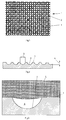
- Figure 1 shows a photograph of a surface 1, the one uniform arrangement of hemispherical micro-dimples 2 having. According to FIG. 2, the micro-dimples 2 have one Opening diameter 3 of 0.25 mm. The depth 4 of the Micro dimple is approximately 0.1 mm.
- FIG 3 shows schematically the situation when Composite material 5 is located on the surface 1.
- the Composite material seals the micro-dimple 2 so that an air cushion 6 forms in its interior.
- This Air cushion 6 prevents further penetration of the composite material 5 in the dimple 2, still favoring or reinforcing the high viscosity (e.g. in the range 18 to 1400 Pa * s) of the composite materials used today joins.
- the composite material is only open part of the surface 1 rests, here z. B. approx. 50%, namely the residual surface 7 between the micro-dimples 2, it is understandable that on the physical Mechanism based adhesion is significantly reduced.
- FIG 4 shows an embodiment of a surface of a dental instrument according to the invention in a top view.
- the surface 8 is here with a regular arrangement of micro-dimples 9 (see enlarged representation in Figure 5) almost completely covered: Practical trials have shown that, however is advantageous at the edge of a zone 10 of micro-dimples keep clear.
- This edge zone here has a width 11 of 0.05 mm to 0.1 mm.
- the edge zone prevents that is incomplete on the edge of the dental instrument trained micro-dimples are in which there is no Can form air cushions. Composit penetrate and pull threads.
- the edge zone also causes one higher resistance to wear.
- the micro-dimples have a horizontal cut square shape with rounded corners.
- the Edge length 12 is 0.15 mm
- the distance 13 between two Micro dimple 9 is 0.05 mm.
- Such dimples are advantageously produced with a laser.
- the depth the micro dimple 9 is approximately 0.05 mm.
- the corners of the square cross-section are with a radius of curvature 14 rounded by 0.02 mm.
- FIG. 6 shows a schematic sectional view.
- a sleeve 21 stands on the test specimen 20.
- a predetermined amount of the composite material 22 is located on the test specimen 20 within the sleeve 21.
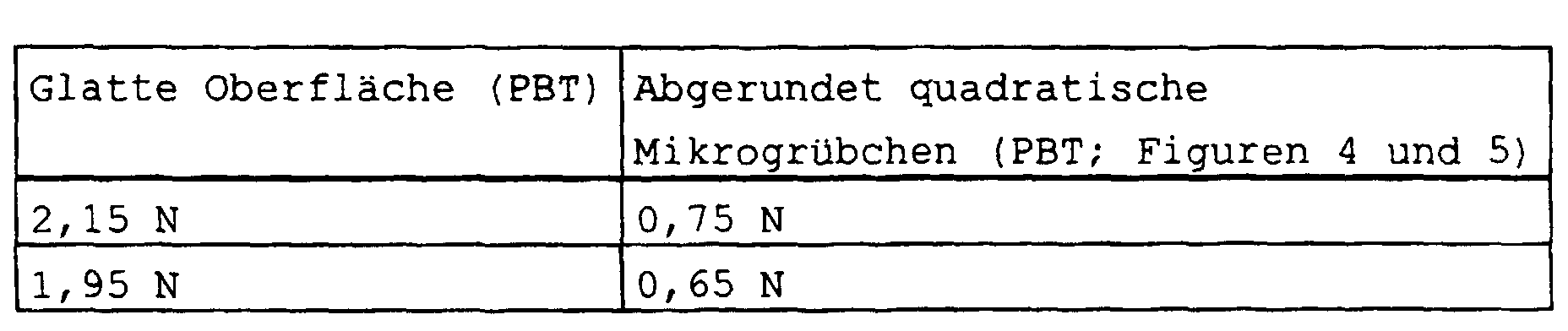
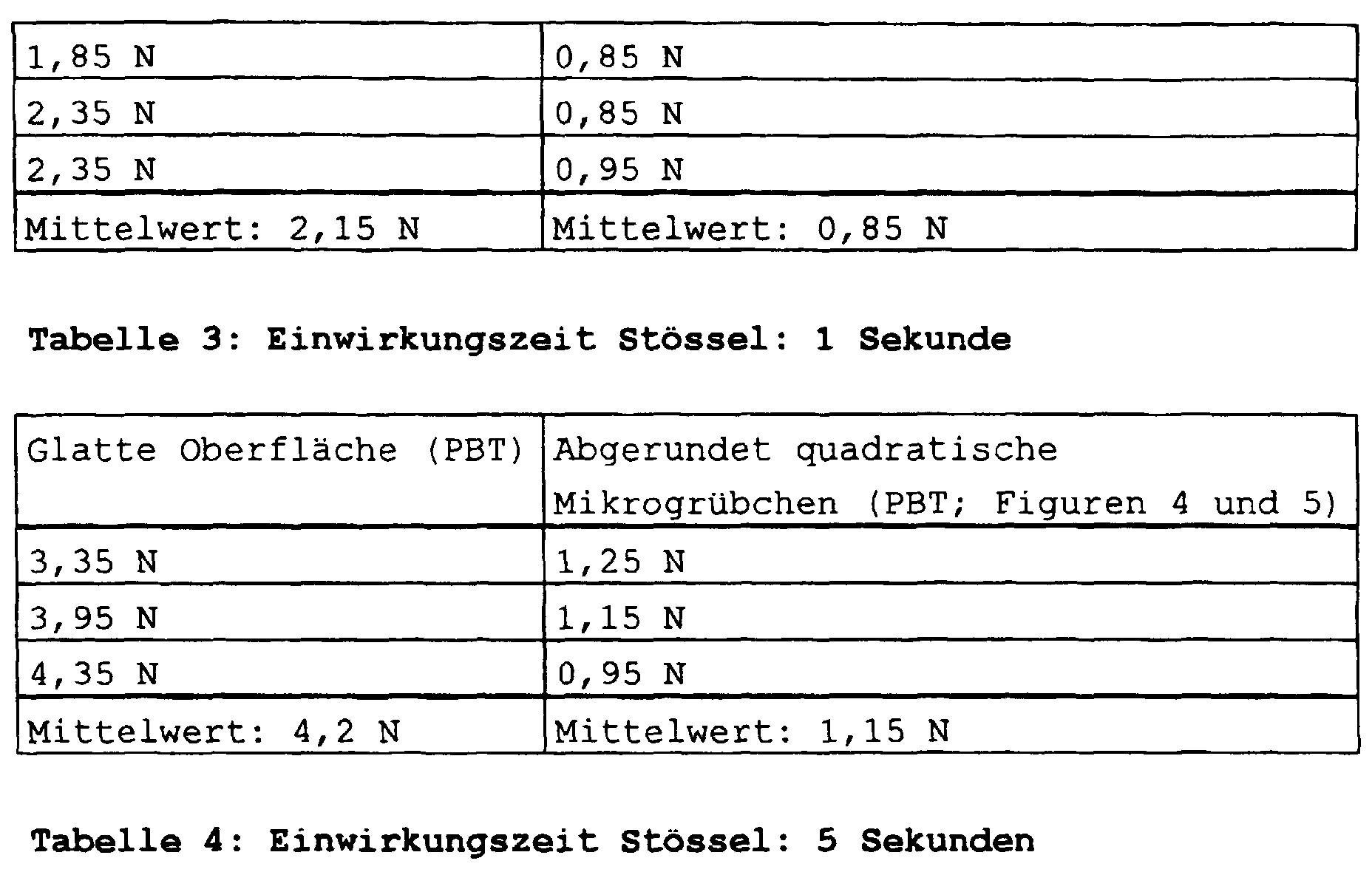
- a gravity tappet 23 fitted into the sleeve 21 is placed on this composite material for a certain time. Under its weight, the composite material 22 is pressed onto the surface 20.
- the weight of the gravity tappet (here 35 g corresponding to 0.35 N) must be subtracted from the measured force.
- the dental instrument 30 is at one end 31 as Spatula, designed as a tamper at the other end 32 (Figure 7).
- the spatula end 31 is shown enlarged in FIG. 8, Figure 9 shows an enlarged plan view of the Work surface 33 and Figure 10 is a side view of the Tip of the spatula end 31. It should be noted that the Work surface 33 as indicated in Figure 10 on both Sides of the tips 34 is formed.
- FIG. 11 shows an enlarged view of the end of the plug 32, at the Tip 36 the cambered plug surface 37 with micro-dimples is formed (top view in FIG. 12 and work surface alone further enlarged in Figure 13).
- the exemplary simple ones Cross sections (square with rounded corners, too due to the diameter of the laser beam; spherical) are particularly conceivable as examples are also other shapes like elliptical, oval or polygonal with 5, 6 or more corners.
- the dimples to differentiate, e.g. B. part circular, one Part polygonal and part triangular.
- the air cushion that prevents penetration of the composite material is particularly effective advantageously at least the vast majority of the wells so that the composite material the recesses are essentially airtight.
- the shape of the dimples on average perpendicular to the Surface can be varied widely. in the With regard to the air cushion, it is obvious on the one hand, not to choose too large an airspace, d. H. the Do not dimple too deep, so even at slight penetration of composite material high pressure rise in the air cushion results. On the other hand If the design is too flat, it could also happen that the Composite material is the reason for the Micro dimples touched.
- the determination of optimal geometries of the micro-dimples and their dimensioning is required basically simple experiments, possibly in Connection with adhesion measurements, and can be done by a specialist due to the presentation of this invention without problems be made.
Landscapes
- Health & Medical Sciences (AREA)
- Oral & Maxillofacial Surgery (AREA)
- Dentistry (AREA)
- Epidemiology (AREA)
- Life Sciences & Earth Sciences (AREA)
- Animal Behavior & Ethology (AREA)
- General Health & Medical Sciences (AREA)
- Public Health (AREA)
- Veterinary Medicine (AREA)
- Dental Prosthetics (AREA)
- Dental Preparations (AREA)
- Dental Tools And Instruments Or Auxiliary Dental Instruments (AREA)
Abstract
Description

Claims (10)
- Dentalinstrument (30), insbesondere zum Applizieren und/oder Modellieren von Zahnersatzmaterial, namentlich Composit-Material, dadurch gekennzeichnet, dass mindestens ein Arbeitsbereich (33, 37) der Oberfläche des Dentalinstrumentes (30) mit einer Anordnung von Vertiefungen (2, 9) bedeckt ist, um die Adhäsion von Zahnersatzmaterial am Arbeitsbereich (33, 37) zu verringern.
- Dentalinstrument (30) gemäss Anspruch 1, dadurch gekennzeichnet, dass die Mündungen mindestens der Mehrzahl und bevorzugt aller Vertiefungen (2, 9) an der Oberfläche einen geschlossenen Perimeter aufweisen, so dass durch auf der Oberfläche des Dentalinstrumentes (30) aufliegendes Zahnersatzmaterial (5, 22) diese Vertiefungen (2, 9) im wesentlichen luftdicht verschliessbar sind und in diesen dadurch ein Luftpolster (6) ausbildbar ist, das einem Eindringen von Zahnersatzmaterial in die Vertiefungen entgegenwirkt.
- Dentalinstrument gemäss einem der Ansprüchen 1 oder 2, dadurch gekennzeichnet, dass die Vertiefungen mindestens 30 %, bevorzugt 50 % und insbesondere bevorzugt mindestens 70 % der Fläche des Arbeitsbereichs (33, 37) ausmachen.
- Dentalinstrument (30) gemäss einem der Ansprüche 1 bis 3, dadurch gekennzeichnet, dass die Tiefe (4) mindestens der Mehrzahl der Vertiefungen (2, 9) mindestens 1/10, bevorzugt mindestens 1/4 und insbesondere bevorzugt mindestens 1/3 des mittleren Durchmessers der Mündungen zur Oberfläche beträgt.
- Dentalinstrument gemäss einem der Ansprüche 1 bis 4, dadurch gekennzeichnet, dass die Mehrzahl der Vertiefungen (2, 9) einen mittleren Durchmesser der Mündung zur Oberfläche des Dentalinstrumentes von < 1 mm, bevorzugt höchstens 0,5 mm und insbesondere bevorzugt höchstens 0,2 mm aufweisen.
- Dentalinstrument (30) gemäss einem der Ansprüche 1 bis 5, dadurch gekennzeichnet, dass die Mehrzahl der Vertiefungen (2, 9) mindestens im Bereich der Mündung zur Oberfläche (1) Rotationssymmetrie, bevorzugt mindestens dreizählig und insbesondere mindestens vierzählig, oder Kreissymmetrie aufweisen.
- Dentalinstrument (30) gemäss einem der Ansprüche 1 bis 6 dadurch gekennzeichnet, dass die Mehrzahl der Vertiefungen (2, 9) mindestens im Bereich der Mündung zur Oberfläche (1) im wesentlichen eine der folgenden Randformen aufweist: Polygon, insbesondere eines mit 3 bis 10 Ecken, mit geraden oder gebogenen, insbesondere nach aussen gebogenen Kanten und scharfen oder abgerundeten Ecken; Kreis; Ellipse; Oval.
- Dentalinstrument (30) gemäss einem der Ansprüche 1 bis 7, dadurch gekennzeichnet, dass der Arbeitsbereich (33, 37) mindestens zu einem wesentlichen Teil von einer Zone umgeben ist, die keine Vertiefung (2, 9) aufweist und eine Breite von mindestens 1/10, bevorzugt mindestens 1/4 des mittleren Durchmessers der Mündungen zur Oberfläche mindestens der Mehrzahl der Vertiefungen (2, 9) hat.
- Verfahren zur Herstellung eines Dentalinstrumentes (30) gemäss einem der Ansprüche 1 bis 8, dadurch gekennzeichnet, dass die Vertiefungen (2, 9) durch Einsenken mittels Laser ausgebildet werden.
- Verfahren zur Herstellung eines Dentalinstrumentes (30) gemäss einem der Ansprüche 1 bis 8, dadurch gekennzeichnet, dass mindestens eine Arbeitsfläche (33, 37) einschliesslich der Vertiefungen (2, 9), bevorzugt im wesentlichen das ganze Dentalinstrument (30), durch Spritzgiessen ausgebildet wird.
Applications Claiming Priority (2)
| Application Number | Priority Date | Filing Date | Title |
|---|---|---|---|
| CH114598 | 1998-05-25 | ||
| CH114598 | 1998-05-25 |
Publications (2)
| Publication Number | Publication Date |
|---|---|
| EP0960602A2 true EP0960602A2 (de) | 1999-12-01 |
| EP0960602A3 EP0960602A3 (de) | 2002-07-24 |
Family
ID=4203544
Family Applications (1)
| Application Number | Title | Priority Date | Filing Date |
|---|---|---|---|
| EP99810349A Withdrawn EP0960602A3 (de) | 1998-05-25 | 1999-04-26 | Dentalinstrument und Verfahren zu seiner Herstellung |
Country Status (2)
| Country | Link |
|---|---|
| US (1) | US6071122A (de) |
| EP (1) | EP0960602A3 (de) |
Families Citing this family (14)
| Publication number | Priority date | Publication date | Assignee | Title |
|---|---|---|---|---|
| US20020168612A1 (en) * | 2000-09-14 | 2002-11-14 | Novak Eugene J. | Bearing for dental handpiece |
| WO2002054970A2 (en) * | 2000-12-18 | 2002-07-18 | Dentsply International Inc. | Dental handpiece |
| US20020124443A1 (en) * | 2000-12-18 | 2002-09-12 | Dentsply Research & Development Corp. | Metal-to-metal connections |
| US20070031786A1 (en) * | 2002-02-25 | 2007-02-08 | Heil Donald J | Dental handpiece |
| US20030170589A1 (en) * | 2002-02-27 | 2003-09-11 | Novak Eugene J. | Dental handpiece with improved grease retention |
| US20070117064A1 (en) * | 2002-02-27 | 2007-05-24 | Novak Eugene J | Dental handpiece with improved grease retention |
| WO2003083266A1 (en) * | 2002-03-28 | 2003-10-09 | Dentsply International Inc. | Method for balancing the rotating turbine element of a dental handpiece |
| US20060191336A1 (en) * | 2002-03-28 | 2006-08-31 | Dentsply Research & Development Corp. | Method and apparatus for balancing the rotating elements of a dental handpiece |
| US6640815B1 (en) * | 2002-08-21 | 2003-11-04 | Gregory J. Rosen | Consumer usable popcorn kernel and/or husk removing dental instrument |
| BR0303954A (pt) * | 2002-10-10 | 2004-09-08 | Int Flavors & Fragrances Inc | Composição, fragrância, método para divisão de uma quantidade efetiva olfativa de fragrância em um produto sem enxague e produto sem enxague |
| US20050113282A1 (en) * | 2003-11-20 | 2005-05-26 | Parekh Prabodh P. | Melamine-formaldehyde microcapsule slurries for fabric article freshening |
| US20050112152A1 (en) * | 2003-11-20 | 2005-05-26 | Popplewell Lewis M. | Encapsulated materials |
| US20050130099A1 (en) | 2003-12-15 | 2005-06-16 | Kerrhawe Sa | Instrument for distributing restorative material on a tooth surface |
| US10327865B2 (en) | 2017-11-28 | 2019-06-25 | King Abdulaziz University | Composite restoration roller |
Citations (1)
| Publication number | Priority date | Publication date | Assignee | Title |
|---|---|---|---|---|
| DE9317896U1 (de) * | 1993-06-09 | 1994-03-03 | Gottschall, Peter, 88524 Uttenweiler | Instrument zum Handhaben eines Zahninlays |
Family Cites Families (8)
| Publication number | Priority date | Publication date | Assignee | Title |
|---|---|---|---|---|
| US449217A (en) * | 1891-03-31 | Poljshing-cone | ||
| US883592A (en) * | 1907-04-18 | 1908-03-31 | Theodore C Trigger | Dental cavity-impression tray. |
| FR1233300A (fr) * | 1958-08-09 | 1960-10-12 | Levier extracteur de racines à usage dentaire | |
| DE8418590U1 (de) * | 1984-06-20 | 1985-10-24 | Fath, Bruno, Dr.med., 8520 Erlangen | Teflonbeschichtung bei zahnärztlichen Füllinstrumenten |
| JPS61113442A (ja) * | 1984-11-09 | 1986-05-31 | 而至歯科工業株式会社 | 歯科用研摩ストリツプ |
| US4781590A (en) * | 1986-10-03 | 1988-11-01 | Anthony Horowitz | Dental instrument |
| US4919616A (en) * | 1989-08-25 | 1990-04-24 | Croll Theodore P | Dental spatula with display posts |
| US5267854A (en) * | 1992-05-06 | 1993-12-07 | Schmitt Rodney D | Miniature orthodontic appliance |
-
1999
- 1999-04-26 EP EP99810349A patent/EP0960602A3/de not_active Withdrawn
- 1999-05-06 US US09/306,394 patent/US6071122A/en not_active Expired - Fee Related
Patent Citations (1)
| Publication number | Priority date | Publication date | Assignee | Title |
|---|---|---|---|---|
| DE9317896U1 (de) * | 1993-06-09 | 1994-03-03 | Gottschall, Peter, 88524 Uttenweiler | Instrument zum Handhaben eines Zahninlays |
Also Published As
| Publication number | Publication date |
|---|---|
| US6071122A (en) | 2000-06-06 |
| EP0960602A3 (de) | 2002-07-24 |
Similar Documents
| Publication | Publication Date | Title |
|---|---|---|
| EP0960602A2 (de) | Dentalinstrument und Verfahren zu seiner Herstellung | |
| DE69726608T2 (de) | Schraubbares implantat | |
| DE3526335C2 (de) | ||
| DE112018005085T5 (de) | Messsystem und -verfahren zur räumlichen analyse der oralen implantatrestauration | |
| CH630251A5 (de) | Oberflaechenstruktur an verankerungselement eines knochenimplantates. | |
| DE202006020477U1 (de) | Verwendung eines Infiltranten zur Behandlung oder Prävention von Kariesläsionen | |
| DE112015000144B4 (de) | Pressformen eines Zahnersatzes aufweisend Keramik, wie Zirkoniumdioxid, mit einer aufgerauten Oberfläche | |
| DE102009059315A1 (de) | Hartmetallaufsatz für ein drehendes dentaltechnisches Instrument | |
| EP3659575A1 (de) | Photopolymerisierbare dentale komposite mit schneller aushärtung und geringer schrumpfspannung | |
| DE3213330A1 (de) | Elektrodenspitze fuer einen herzschrittmacher und verfahren zum herstellen derselben | |
| DE4130891A1 (de) | Zahnimplantat | |
| DE102013216855B4 (de) | Vorrichtung und Verfahren zur Herstellung von Formkörpern | |
| DE2255916A1 (de) | Schraubenimplantat fuer einen kieferknochen | |
| DE3408503A1 (de) | Stift zum einsatz in zahnwurzelkanal-kavitaeten | |
| DE212013000249U1 (de) | Dentalimplantat mit einem Mikro- und einem Makrogewinde | |
| DE102006018516A1 (de) | Implantat, insbesondere Kieferimplantat, mit unterschiedlichen Materialeigenschaften | |
| DE102017222363B3 (de) | Verfahren zur Erstellung eines Modells für einen Gliedmaßenstumpf zur Herstellung eines Prothesenschafts | |
| DE10201340A1 (de) | Knochen-Ersatzmaterial und Verfahren zu seiner Herstellung | |
| DE69830729T2 (de) | Mittel zum einbringen von füllmaterial während einer zahnbehandlung | |
| DE102012006152A1 (de) | Polymerisierbare Dentalkomposite mit verbesserten Gebrauchseigenschaften, Verfahren zur Einstellung der Gebrauchseigenschaften polymerisierbarer Dentalkompositen, und nach diesen Verfahren optimierte Dentalkomposite | |
| DE4214307A1 (de) | Polierverfahren fuer ein zahninstrument | |
| DE4123237C2 (de) | Füllung für einen Zahn | |
| DE102021124549A1 (de) | Taststift | |
| DE2004554C3 (de) | Vorrichtung zum Nachmessen der genauen Tiefe des lingualen Randes einer Beißplatte bei der Herstellung einer Zahnprothese für einen zahnlosen Unterkiefer, bzw. zur Überprüfung der Paßgenauigkeit des lingualen Randes einer Unterkieferprothese | |
| AT18275U1 (de) | Fräsrohling für ein dentalprodukt |
Legal Events
| Date | Code | Title | Description |
|---|---|---|---|
| PUAI | Public reference made under article 153(3) epc to a published international application that has entered the european phase |
Free format text: ORIGINAL CODE: 0009012 |
|
| AK | Designated contracting states |
Kind code of ref document: A2 Designated state(s): AT BE CH CY DE DK ES FI FR GB GR IE IT LI LU MC NL PT SE |
|
| AX | Request for extension of the european patent |
Free format text: AL;LT;LV;MK;RO;SI |
|
| PUAL | Search report despatched |
Free format text: ORIGINAL CODE: 0009013 |
|
| AK | Designated contracting states |
Kind code of ref document: A3 Designated state(s): AT BE CH CY DE DK ES FI FR GB GR IE IT LI LU MC NL PT SE |
|
| AX | Request for extension of the european patent |
Free format text: AL;LT;LV;MK;RO;SI |
|
| RIC1 | Information provided on ipc code assigned before grant |
Free format text: 7A 61C 3/00 A, 7A 61C 3/08 B |
|
| 17P | Request for examination filed |
Effective date: 20021114 |
|
| AKX | Designation fees paid |
Designated state(s): CH DE DK ES FR GB IT LI NL SE |
|
| 17Q | First examination report despatched |
Effective date: 20040225 |
|
| GRAP | Despatch of communication of intention to grant a patent |
Free format text: ORIGINAL CODE: EPIDOSNIGR1 |
|
| STAA | Information on the status of an ep patent application or granted ep patent |
Free format text: STATUS: THE APPLICATION IS DEEMED TO BE WITHDRAWN |
|
| 18D | Application deemed to be withdrawn |
Effective date: 20060221 |