EP0960908B1 - Mischungen von Copolymeren mit verbesserter Schmierwirkung - Google Patents
Mischungen von Copolymeren mit verbesserter Schmierwirkung Download PDFInfo
- Publication number
- EP0960908B1 EP0960908B1 EP99109843A EP99109843A EP0960908B1 EP 0960908 B1 EP0960908 B1 EP 0960908B1 EP 99109843 A EP99109843 A EP 99109843A EP 99109843 A EP99109843 A EP 99109843A EP 0960908 B1 EP0960908 B1 EP 0960908B1
- Authority
- EP
- European Patent Office
- Prior art keywords
- mixture
- ethylene
- structural units
- copolymers
- copolymer
- Prior art date
- Legal status (The legal status is an assumption and is not a legal conclusion. Google has not performed a legal analysis and makes no representation as to the accuracy of the status listed.)
- Expired - Lifetime
Links
Classifications
-
- C—CHEMISTRY; METALLURGY
- C10—PETROLEUM, GAS OR COKE INDUSTRIES; TECHNICAL GASES CONTAINING CARBON MONOXIDE; FUELS; LUBRICANTS; PEAT
- C10L—FUELS NOT OTHERWISE PROVIDED FOR; NATURAL GAS; SYNTHETIC NATURAL GAS OBTAINED BY PROCESSES NOT COVERED BY SUBCLASSES C10G OR C10K; LIQUIFIED PETROLEUM GAS; USE OF ADDITIVES TO FUELS OR FIRES; FIRE-LIGHTERS
- C10L10/00—Use of additives to fuels or fires for particular purposes
- C10L10/08—Use of additives to fuels or fires for particular purposes for improving lubricity; for reducing wear
-
- C—CHEMISTRY; METALLURGY
- C08—ORGANIC MACROMOLECULAR COMPOUNDS; THEIR PREPARATION OR CHEMICAL WORKING-UP; COMPOSITIONS BASED THEREON
- C08L—COMPOSITIONS OF MACROMOLECULAR COMPOUNDS
- C08L23/00—Compositions of homopolymers or copolymers of unsaturated aliphatic hydrocarbons having only one carbon-to-carbon double bond; Compositions of derivatives of such polymers
- C08L23/02—Compositions of homopolymers or copolymers of unsaturated aliphatic hydrocarbons having only one carbon-to-carbon double bond; Compositions of derivatives of such polymers not modified by chemical after-treatment
- C08L23/04—Homopolymers or copolymers of ethene
- C08L23/08—Copolymers of ethene
-
- C—CHEMISTRY; METALLURGY
- C10—PETROLEUM, GAS OR COKE INDUSTRIES; TECHNICAL GASES CONTAINING CARBON MONOXIDE; FUELS; LUBRICANTS; PEAT
- C10L—FUELS NOT OTHERWISE PROVIDED FOR; NATURAL GAS; SYNTHETIC NATURAL GAS OBTAINED BY PROCESSES NOT COVERED BY SUBCLASSES C10G OR C10K; LIQUIFIED PETROLEUM GAS; USE OF ADDITIVES TO FUELS OR FIRES; FIRE-LIGHTERS
- C10L1/00—Liquid carbonaceous fuels
- C10L1/10—Liquid carbonaceous fuels containing additives
- C10L1/14—Organic compounds
- C10L1/18—Organic compounds containing oxygen
- C10L1/192—Macromolecular compounds
- C10L1/195—Macromolecular compounds obtained by reactions involving only carbon-to-carbon unsaturated bonds
-
- C—CHEMISTRY; METALLURGY
- C08—ORGANIC MACROMOLECULAR COMPOUNDS; THEIR PREPARATION OR CHEMICAL WORKING-UP; COMPOSITIONS BASED THEREON
- C08L—COMPOSITIONS OF MACROMOLECULAR COMPOUNDS
- C08L2203/00—Applications
- C08L2203/40—Applications used as motor oil additive
-
- C—CHEMISTRY; METALLURGY
- C08—ORGANIC MACROMOLECULAR COMPOUNDS; THEIR PREPARATION OR CHEMICAL WORKING-UP; COMPOSITIONS BASED THEREON
- C08L—COMPOSITIONS OF MACROMOLECULAR COMPOUNDS
- C08L2205/00—Polymer mixtures characterised by other features
- C08L2205/02—Polymer mixtures characterised by other features containing two or more polymers of the same C08L -group
-
- C—CHEMISTRY; METALLURGY
- C10—PETROLEUM, GAS OR COKE INDUSTRIES; TECHNICAL GASES CONTAINING CARBON MONOXIDE; FUELS; LUBRICANTS; PEAT
- C10L—FUELS NOT OTHERWISE PROVIDED FOR; NATURAL GAS; SYNTHETIC NATURAL GAS OBTAINED BY PROCESSES NOT COVERED BY SUBCLASSES C10G OR C10K; LIQUIFIED PETROLEUM GAS; USE OF ADDITIVES TO FUELS OR FIRES; FIRE-LIGHTERS
- C10L1/00—Liquid carbonaceous fuels
- C10L1/10—Liquid carbonaceous fuels containing additives
- C10L1/14—Organic compounds
- C10L1/18—Organic compounds containing oxygen
- C10L1/192—Macromolecular compounds
- C10L1/195—Macromolecular compounds obtained by reactions involving only carbon-to-carbon unsaturated bonds
- C10L1/1955—Macromolecular compounds obtained by reactions involving only carbon-to-carbon unsaturated bonds homo- or copolymers of compounds having one or more unsaturated aliphatic radicals each having one carbon bond to carbon double bond, and at least one being terminated by an alcohol, ether, aldehyde, ketonic, ketal, acetal radical
-
- C—CHEMISTRY; METALLURGY
- C10—PETROLEUM, GAS OR COKE INDUSTRIES; TECHNICAL GASES CONTAINING CARBON MONOXIDE; FUELS; LUBRICANTS; PEAT
- C10L—FUELS NOT OTHERWISE PROVIDED FOR; NATURAL GAS; SYNTHETIC NATURAL GAS OBTAINED BY PROCESSES NOT COVERED BY SUBCLASSES C10G OR C10K; LIQUIFIED PETROLEUM GAS; USE OF ADDITIVES TO FUELS OR FIRES; FIRE-LIGHTERS
- C10L1/00—Liquid carbonaceous fuels
- C10L1/10—Liquid carbonaceous fuels containing additives
- C10L1/14—Organic compounds
- C10L1/18—Organic compounds containing oxygen
- C10L1/192—Macromolecular compounds
- C10L1/195—Macromolecular compounds obtained by reactions involving only carbon-to-carbon unsaturated bonds
- C10L1/196—Macromolecular compounds obtained by reactions involving only carbon-to-carbon unsaturated bonds derived from monomers containing a carbon-to-carbon unsaturated bond and a carboxyl group or salts, anhydrides or esters thereof homo- or copolymers of compounds having one or more unsaturated aliphatic radicals each having one carbon bond to carbon double bond, and at least one being terminated by a carboxyl radical or of salts, anhydrides or esters thereof
- C10L1/1963—Macromolecular compounds obtained by reactions involving only carbon-to-carbon unsaturated bonds derived from monomers containing a carbon-to-carbon unsaturated bond and a carboxyl group or salts, anhydrides or esters thereof homo- or copolymers of compounds having one or more unsaturated aliphatic radicals each having one carbon bond to carbon double bond, and at least one being terminated by a carboxyl radical or of salts, anhydrides or esters thereof mono-carboxylic
-
- C—CHEMISTRY; METALLURGY
- C10—PETROLEUM, GAS OR COKE INDUSTRIES; TECHNICAL GASES CONTAINING CARBON MONOXIDE; FUELS; LUBRICANTS; PEAT
- C10L—FUELS NOT OTHERWISE PROVIDED FOR; NATURAL GAS; SYNTHETIC NATURAL GAS OBTAINED BY PROCESSES NOT COVERED BY SUBCLASSES C10G OR C10K; LIQUIFIED PETROLEUM GAS; USE OF ADDITIVES TO FUELS OR FIRES; FIRE-LIGHTERS
- C10L1/00—Liquid carbonaceous fuels
- C10L1/10—Liquid carbonaceous fuels containing additives
- C10L1/14—Organic compounds
- C10L1/18—Organic compounds containing oxygen
- C10L1/192—Macromolecular compounds
- C10L1/195—Macromolecular compounds obtained by reactions involving only carbon-to-carbon unsaturated bonds
- C10L1/197—Macromolecular compounds obtained by reactions involving only carbon-to-carbon unsaturated bonds derived from monomers containing a carbon-to-carbon unsaturated bond and an acyloxy group of a saturated carboxylic or carbonic acid
- C10L1/1973—Macromolecular compounds obtained by reactions involving only carbon-to-carbon unsaturated bonds derived from monomers containing a carbon-to-carbon unsaturated bond and an acyloxy group of a saturated carboxylic or carbonic acid mono-carboxylic
Definitions
- the present invention relates to mixtures of oil-soluble copolymers of ethylene and further comonomers containing one or more hydroxyl groups and Copolymers of ethylene and ethylenically unsaturated compounds, and their Use to improve the lubricity of fuel oils.
- Mineral oils and mineral oil distillates which are used as fuel oils, contain in general 0.5 wt .-% and more sulfur, which in the combustion of the formation of Causes sulfur dioxide. To reduce the resulting environmental pollution reduce the sulfur content of fuel oils.
- the Diesel fuel standard EN 590 is currently enrolling in Germany maximum sulfur content of 500 ppm. In Scandinavia are already coming Fuel oils with less than 200 ppm and in exceptional cases with less than 50 ppm Sulfur for use. These fuel oils are usually produced by that hydrogenating the fractions obtained from the petroleum by distillation refined. Desulphurization also removes other substances that give the fuel oils a natural lubricating effect. About these substances include polyaromatic and polar compounds.
- DD-126 090 discloses lubricant-improving additives made from copolymers of ethylene and unsaturated carboxylic acid esters, preferably vinyl acetate, which the fuels in Amounts of 0.01 to 0.5 wt .-% are added.
- EP-A-0 743 974 discloses additives which improve the lubricating effect of fuel oils improve, and the mixtures of esters and copolymers of ethylene and Contain vinyl acetate.
- WO-95/33805 discloses the use of cold flow improvers as lubricity enhancers.
- EP-A-0 074 208 discloses middle and heavy distillates made with copolymers Ethylene and oxyalkylated acrylates or ethylene and vinyl esters saturated and unsaturated carboxylic acids are added.
- US 4,906,682 discloses cold flow improvers which are copolymers of ethylene and Contain vinyl acetate mixed with polyalkyl (meth) acrylates.
- US-4 015 063 discloses cold additives for crude and residual oils, the terpolymers from Include ethylene, vinyl acetate and vinyl carbinol.
- Another object of the invention are fuel oils that described Contain mixtures of copolymers.
- Another object of the invention is a method for improving the Lubricating effect of fuel oils while improving theirs Cold flow properties, characterized by the addition of the described Combinations of copolymers with fuel oils.
- the olefinically unsaturated compounds of which the non-ethylenic Derive structural units of the other comonomers in component A), it is preferably vinyl esters, acrylic esters, methacrylic esters, alkyl vinyl ethers and / or Alkenes, the hydroxyalkyl, hydroxyalkenyl, hydroxycycloalkyl or hydroxyaryl radicals wear. These residues contain at least one hydroxyl group attached to any one Place of the rest can be, but is preferably at the chain end ( ⁇ position).
- Suitable vinyl esters include 2-hydroxyethyl vinyl ester, hydroxypropyl vinyl ester, 3-hydroxypropyl vinyl ester and 4-hydroxybutyl vinyl ester.
- Suitable acrylic esters include hydroxyethyl acrylate, 2-hydroxypropyl acrylate, 3-hydroxypropyl acrylate, hydroxyisopropyl acrylate, 4-hydroxybutyl acrylate, diethylene glycol monoacrylate and glycerol monoacrylate as well as the corresponding esters of methacrylic acid.
- Suitable alkyl vinyl ethers include 2-hydroxyethyl vinyl ether, hydroxypropyl vinyl ether, hexanediol monovinyl ether, 4- (hydroxybutyl) vinyl ether, diethylene glycol monovinyl ether and cyclohexanedimethanol monovinyl ether.
- the alkenes are preferably monounsaturated Hydroxy hydrocarbons with 3 to 30 carbon atoms, especially 4 to 16 carbon atoms and especially 5 to 12 carbon atoms.
- the molar proportion of hydroxy-functionalized comonomers in the copolymer A) is preferably 0.5 to 15%, in particular 1 to 12%, especially 1 to 8%.
- the OH number of the copolymers is preferably between 1 and 500, in particular between 5 and 300 and especially between 10 and 200 mg KOH / g polymer.
- copolymers A) also contain at least one comonomer Hydroxyl groups. You can add more, for example one, two or three more contain olefinically unsaturated comonomers.
- olefinically unsaturated Comonomers are, for example, vinyl esters, acrylic acid, methacrylic acid, acrylic esters, Methacrylic esters, vinyl ethers or olefins.
- acrylic and Methacrylic esters are those with alcohols having 1 to 20 carbon atoms, in particular of methanol, ethanol, propanol, n-butanol, iso-butanol and tert-butanol.
- Especially preferred olefins are those with 3 to 10 carbon atoms, especially propene, Isobutylene, diisobutylene, norbornene, 4-methylpentene-1 and hexene.
- Particularly preferred are terpolymers of ethylene, a hydroxy-functionalized comonomer and either vinyl acetate or a vinyl ester of a neocarboxylic acid with 8 to 12 Carbon atoms. If the copolymers contain a further comonomer, the molar proportion thereof preferably up to 15%, in particular up to 12%.
- the olefinically unsaturated compounds of which the non-ethylenic Derive structural units of the other comonomers in component B), it is preferably vinyl esters, acrylic esters, methacrylic esters and / or alkyl vinyl ethers.
- R 1 represents a neoalkyl radical with 7 to 11 carbon atoms, in particular with 8, 9 or 10 carbon atoms.
- Suitable vinyl esters include vinyl acetate, vinyl propionate, 2-ethylhexyl vinyl ester, vinyl laurate, neononane, neodecanoic and neoundecanoic acid vinyl esters.
- Suitable acrylic esters include methyl acrylate, methyl methacrylate, ethyl acrylate and 2-ethylhexyl acrylate, as well as the corresponding esters of methacrylic acid.
- the comonomer content in copolymer B is between 5 and 25, preferably between 7 and 20 mol%.
- Component B is preferably so-called Flow improver, the middle distillates often to improve the Cold flow properties can be added.
- copolymers or terpolymers and their Mixtures can be used which, taken on their own, have the cold flow properties of Improve mineral oils or mineral oil distillates.
- suitable copolymers or terpolymers include:
- the melt viscosities of copolymers A) and B) at 140 ° C. are independent between 10 and 1000 mPas and especially between 15 and 500 mPas.
- Copolymers A and B are produced by known processes (cf. e.g. Ullmann's Encyclopedia of Technical Chemistry, 4th edition, vol. 19, pages 169 to 178). Polymerization in solution, in suspension, in the gas phase is suitable and high pressure bulk polymerization. It is preferable to use the High pressure bulk polymerization, preferably at pressures of 50 to 400 MPa 100 to 300 MPa and temperatures of 50 to 350 ° C, preferably 100 to 300 ° C, is carried out. The reaction of the comonomers is caused by radicals Initiators (radical chain starters) initiated. This class of substances includes e.g.
- Oxygen, hydroperoxides, peroxides and azo compounds such as cumene hydroperoxide, t-butyl hydroperoxide, dilauroyl peroxide, dibenzoyl peroxide, bis (2-ethylhexyl) peroxidicarbonate, t-butyl permaleinate, t-butyl perbenzoate, dicumyl peroxide, t-Butylcumyl peroxide, di- (t-butyl) peroxide, 2,2'-azobis (2-methylpropanonitrile), 2,2'-azobis (2-methylbutyronitrile).
- the initiators are used individually or as a mixture of two or more substances in amounts of 0.01 to 20 wt .-%, preferably 0.05 to 10 wt .-%, based on the comonomer mixture used.
- the desired melt viscosity of the copolymers A) and B) is given Composition of the comonomer mixture by varying the Reaction parameters pressure and temperature and optionally by adding Moderators hired.
- Hydrogen, saturated or unsaturated hydrocarbons e.g. Propane, aldehydes, e.g. propionaldehyde, n-butyraldehyde or isobutyraldehyde, ketones, e.g. Acetone, methyl ethyl ketone, Methyl isobutyl ketone, cyclohexanone or alcohols, e.g. Butanol, proven.
- the moderators in quantities up to to 20 wt .-%, preferably 0.05 to 10 wt .-%, based on the Comonomer mixture used.
- High pressure bulk polymerization is carried out in known high pressure reactors, e.g. Autoclaves or tube reactors are carried out batchwise or continuously, Tube reactors have proven particularly useful. Solvents such as aliphatic Hydrocarbons or hydrocarbon mixtures, benzene or toluene can in Reaction mixture may be included, although the solvent-free procedure has proven particularly successful.
- the mixture of the comonomers, the initiator and, if used, the Moderator a tubular reactor via the reactor inlet and a or fed several side branches.
- the comonomer streams can vary be composed (EP-B-0 271 738).
- copolymers containing Structural units derived from ethylene and vinyl alcohol are suitable.
- copolymers This type can be made by containing a copolymer Structural units that differ from ethylene and vinyl esters such as Derive vinyl acetate, partially or fully hydrolyzed.
- copolymers which are composed of ethylene and glycidyl residues Derive monomers such as glycidyl (meth) acrylate or glycidyl allyl ether after hydrolysis with water, alcohols such as methanol or glycol or amines such as Ammonia, methylamine, ethanolamine or diethanolamine used according to the invention become.
- oils can be improved in the manner according to the invention by adding ethylene copolymers which contain oxalkylated acid groups.
- Suitable ethylene copolymers are, for example, those with acrylic acid, methacrylic acid, itaconic acid, fumaric acid, maleic acid or maleic anhydride.
- these copolymers containing acid groups are oxalkylated on the acid groups with C 1 -C 10 -alkylene oxides.
- Preferred alkylene oxides are ethylene oxide, propylene oxide and butylene oxide.
- the oxyalkylation is preferably carried out using 0.5 to 10 mol, in particular 1 to 5 mol and especially 1 to 2 mol of alkylene oxide per mol of acid group.
- the mixtures of copolymers according to the invention are mineral oils or Mineral oil distillates in the form of solutions or dispersions containing 10 to 90% by weight, preferably 20-80% by weight containing mixtures.
- Appropriate solution or Dispersing agents are aliphatic and / or aromatic hydrocarbons or Hydrocarbon mixtures, e.g.
- Components A and B can mix the oils to be additized or added separately.
- the mixtures of copolymers according to the invention are used together with comb polymers.
- This is understood to mean polymers in which hydrocarbon radicals having at least 8, in particular at least 10, carbon atoms are bonded to a polymer backbone. They are preferably homopolymers whose alkyl side chains contain at least 8 and in particular at least 10 carbon atoms.
- at least 20%, preferably at least 30%, of the monomers have side chains (cf. Comb-like Polymers-Structure and Properties; NA Platé and VP Shibaev, J. Polym. Sci. Macromolecular Revs. 1974, 8, 117 ff).
- Suitable comb polymers are, for example, fumarate / vinyl acetate copolymers (cf. EP 0 153 176 A1), copolymers of a C 6 to C 24 ⁇ -olefin and an NC 6 to C 22 alkylmaleimide (cf. EP 0 320 766), also esterified olefin / maleic anhydride copolymers, polymers and copolymers of ⁇ -olefins and esterified copolymers of styrene and maleic anhydride.
- fumarate / vinyl acetate copolymers cf. EP 0 153 176 A1
- copolymers of a C 6 to C 24 ⁇ -olefin and an NC 6 to C 22 alkylmaleimide cf. EP 0 320 766
- esterified olefin / maleic anhydride copolymers polymers and copolymers of ⁇ -olefins and ester
- the mixing ratio (in parts by weight) of the mixtures according to the invention with Comb polymers is in each case 1:10 to 20: 1, preferably 1: 1 to 10: 1.
- the mixtures of Copolymers can be used in a mixture with other lubricity additives.
- Lubricity additives are preferably amphiphiles such as fatty alcohols, Fatty acids and dimer fatty acids and their esters and partial esters with glycols (according to DE-A-15 94 417), polyols such as glycerol (according to EP-A-0 680 506, EP-A-0 739 970) or hydroxyamines (according to WO-96/21709) have proven successful.
- the mixtures according to the invention are suitable, the lubricating properties and Cold flow properties of animal, vegetable or mineral oils as well as of to improve fuels containing alkanol.
- the required dosing rates are included significantly lower than would be expected from the effectiveness of the individual components. Because polymers B use these oils usually to improve the cold flow properties are added, the use of the mixtures according to the invention for a sufficient lubricating effect required dosage rate of component B strong lowered.
- the mixtures according to the invention are for use in Middle distillates are particularly suitable. Middle distillates are called especially those mineral oils that are obtained by distilling crude oil and boiling in the range of 120 to 450 ° C, for example kerosene, jet fuel, diesel and Heating oil.
- the mixtures of copolymers according to the invention are preferably used in middle distillates containing 0.5 wt .-% sulfur and less, in particular less than 200 ppm sulfur and in special cases less than Contain 50 ppm sulfur. These are generally such Middle distillates that have been subjected to hydrogenating refining and therefore contain only small proportions of polyaromatic and polar compounds that give them impart a natural lubricating effect.
- the mixtures according to the invention are further preferably used in such middle distillates, the 95% distillation points below 370 ° C, especially 350 ° C and in special cases below 330 ° C exhibit.
- the mixtures can be used alone or together with other additives e.g. with other pour point depressants or dewaxing aids, with Corrosion inhibitors, antioxidants, detergent additives, sludge inhibitors, Dehazers and additives to lower the cloud point.
- other additives e.g. with other pour point depressants or dewaxing aids, with Corrosion inhibitors, antioxidants, detergent additives, sludge inhibitors, Dehazers and additives to lower the cloud point.
- the vinyl acetate content is determined by pyrolysis of the polymer.
- 100 mg of the polymer with 200 mg of pure polyethylene are thermally split in a pyrolysis flask for 5 minutes at 450 C in a closed system under vacuum and the cracked gases are collected in a 250 ml round bottom flask.
- the cleavage product acetic acid is reacted with a NaJ / KJO 3 solution and the released iodine is titrated with Na 2 S 2 O 3 solution.
- the comonomer contents are given in% by weight.
- the hydroxy-functional comonomers are determined by determining the OH number by reacting the polymer with excess acetic anhydride and subsequent titration of the acetic acid formed with KOH.
- the viscosity is determined in accordance with ISO 3219 (B) with a Rotational viscometer (Haake RV 20) with plate-cone measuring system at 140 ° C.
- Vinylester V 140 [mPas] B1 32% vinyl acetate 140 B2 31% vinyl acetate + 8% neodecanoic acid vinyl ester 125 B3 30% vinyl acetate + 3% 4-methylpentene-1 179 B4 Mixture of equal parts B1 and B2 130 Characterization of the test oils: The boiling data are determined in accordance with ASTM D-86, the CFPP value in accordance with EN 116 and the cloud point in accordance with ISO 3015.
- Test oil 1 Test oil 2 Test oil 3 Test oil 4 Initial boiling point [° C] 198 182 163 165 20% [° C] 246 202 201 209 30% [° C] 260 208 227 233 90% [° C] 339 286 305 335 95% [° C] 355 302 320 355 Cloud Point [° C] -5 -29 1 -9.2 CFPP [° C] -7 -32 -2 -11 S content [ppm] 26 3 326 330 Density [g / cm 3 ] 0.832 0.819 0.841 0.851 Wear Scar [ ⁇ m] 564 609 571 598
- the lubricating effect of the additives was carried out using an HFRR device from PCS Instruments on additive oils at 60 ° C.
- the High Frequency Reciprocating Rig Test (HFRR) is described in D. Wei, H. Spikes, Wear, Vol. 111, No.2, p. 217, 1986. The results are reported as the coefficient of friction and wear scar. A low coefficient of friction (Friction) and a low Wear Scar show a good lubricating effect.
Landscapes
- Chemical & Material Sciences (AREA)
- Oil, Petroleum & Natural Gas (AREA)
- Organic Chemistry (AREA)
- Chemical Kinetics & Catalysis (AREA)
- Health & Medical Sciences (AREA)
- Engineering & Computer Science (AREA)
- Combustion & Propulsion (AREA)
- Medicinal Chemistry (AREA)
- Polymers & Plastics (AREA)
- Emergency Medicine (AREA)
- General Chemical & Material Sciences (AREA)
- Liquid Carbonaceous Fuels (AREA)
- Compositions Of Macromolecular Compounds (AREA)
- Addition Polymer Or Copolymer, Post-Treatments, Or Chemical Modifications (AREA)
- Lubricants (AREA)
Description
und
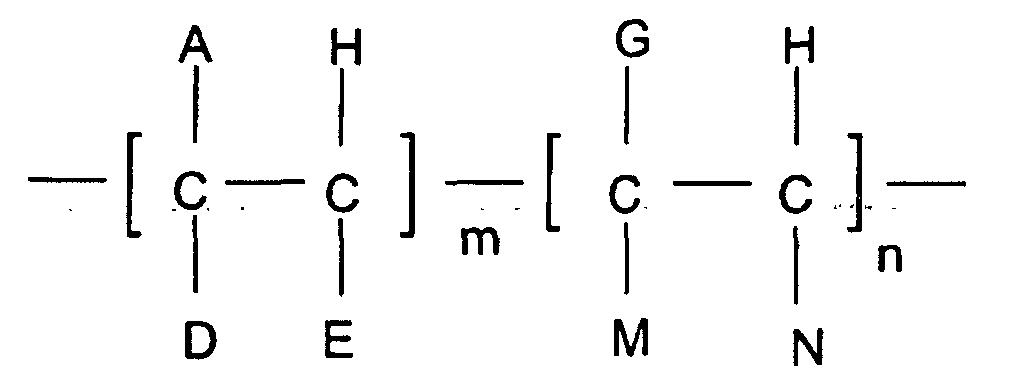
- A
- R', COOR', OCOR', R"-COOR' oder OR';
- D
- H, CH3, A oder R";
- E
- H oder A;
- G
- H, R", R"-COOR', einen Arylrest oder einen heterocyclischen Rest;
- M
- H, COOR", OCOR", OR" oder COOH;
- N
- H, R", COOR", OCOR, COOH oder einen Arylrest;
- R'
- eine Kohlenwasserstoffkette mit 8 bis 50 Kohlenstoffatomen;
- R"
- eine Kohlenwasserstoffkette mit 1 bis 10 Kohlenstoffatomen;
- m
- eine Zahl zwischen 0,4 und 1,0; und
- n
- eine Zahl zwischen 0 und 0,6.
| Charakterisierung der eingesetzten Additive A | ||||
| Beispiel Nr. | Vinylester | OH-Monomer | V140 [mPas] | OH-Zahl |
| A1 | 22 % Vinylacetat | 10 % HEMA | 97 | 43 |
| A2 | 22 % Vinylacetat | 6 % HEMA | 77 | 28 |
| A3 | 28 % Vinylacetat | 8 % HEMA | 171 | 38 |
| A4 | 25 % Vinylacetat | 5 % DMVC | 101 | 24 |
| A5 | 28 % VeoVa 10 | 9 % HEMA | 96 | 37 |
| HEMA = Hydroxyethylmethacrylat DMVC = Dimethylvinylcarbinol VEOVA 10 = Neodecansäurevinylester |
| Charakterisierung der eingesetzten Additive B | ||
| Beispiel Nr. | Vinylester | V140 [mPas] |
| B1 | 32 % Vinylacetat | 140 |
| B2 | 31 % Vinylacetat + 8 % Neodecansäurevinylester | 125 |
| B3 | 30 % Vinylacetat + 3 % 4-Methylpenten-1 | 179 |
| B4 | Mischung aus gleichen Teilen B1 und B2 | 130 |
| Charakterisierung der Testöle: Die Bestimmung der Siedekenndaten erfolgt gemäß ASTM D-86, die Bestimmung desCFPP-Werts gemäß EN 116 und die Bestimmung des Cloud Points gemäß ISO 3015. | ||||
| Testöl 1 | Testöl 2 | Testöl 3 | Testöl 4 | |
| Siedebeginn [°C] | 198 | 182 | 163 | 165 |
| 20 % [°C] | 246 | 202 | 201 | 209 |
| 30 % [°C] | 260 | 208 | 227 | 233 |
| 90 % [°C] | 339 | 286 | 305 | 335 |
| 95 % [°C] | 355 | 302 | 320 | 355 |
| Cloud Point [°C] | -5 | -29 | 1 | -9,2 |
| CFPP [°C] | -7 | -32 | -2 | -11 |
| S-Gehalt [ppm] | 26 | 3 | 326 | 330 |
| Dichte [g/cm 3 ] | 0,832 | 0,819 | 0,841 | 0,851 |
| Wear Scar [µm] | 564 | 609 | 571 | 598 |
| Wear Scar in Testöl 1 | ||||
| Dosierrate A | Dosierrate B | Wear Scar | Film | Friction |
| 200 ppm A1 | - | 560 | 16 % | 0,34 |
| 300 ppm A1 | - | 535 | 20 % | 0,28 |
| 400 ppm A1 | - | 238 | 91 % | 0,12 |
| - | 100 ppm B1 | 560 | 15 % | 0,35 |
| - | 300 ppm B1 | 550 | 17 % | 0,35 |
| 300 ppm A1 | 100 ppm B1 | 203 | 95 % | 0,12 |
| 200 ppm A1 | 100 ppm B1 | 285 | 87 % | 0,14 |
| 150 ppm A1 | 100 ppm B1 | 376 | 74 % | 0,23 |
| 400 ppm A3 | - | 408 | 58 % | 0,25 |
| 200 ppm A3 | 100 ppm B1 | 247 | 90 % | 0,13 |
| - | 300 ppm B3 | 565 | 15 % | 0,35 |
| 300 ppm A4 | - | 490 | 12 % | 0,36 |
| 150 ppm A4 | 100 ppm B1 | 227 | 92 % | 0,12 |
| Wear Scar in Testöl 2 | ||||
| Dosierrate | Dosierrate | Wear Scar | Film | Friction |
| 200 ppm A1 | - | 559 | 46 % | 0,28 |
| 300 ppm A1 | - | 435 | 75 % | 0,20 |
| 400 ppm A1 | - | 280 | 90 % | 0,17 |
| - | 100 ppm B1 | 595 | 20 % | 0,42 |
| - | 300 ppm B1 | 580 | 25 % | 0,40 |
| 200 ppm A1 | 100 ppm B1 | 350 | 82 % | 0,17 |
| 100 ppm A1 | 100 ppm B1 | 443 | 66 % | 0,19 |
| 800 ppm A5 | - | 371 | 69 % | 0,20 |
| 600 ppm A5 | 100 ppm B1 | 346 | 82 % | 0,16 |
| Wear Scar in Testöl 3 | ||||
| Dosierrate A2 | Dosierrate B2 | Wear Scar | Film | Friction |
| 200 ppm | - | 320 | 83 % | 0,15 |
| 200 ppm | - | 268 | 93 % | 0,15 |
| - | 200 ppm | 565 | 31 % | 0,22 |
| - | 300 ppm | 550 | 30 % | 0,23 |
| 150 ppm | 150 ppm | 259 | 94 % | 0,13 |
| 100 ppm | 100 ppm | 298 | 82 % | 0,14 |
| 100 ppm | 200 ppm | 272 | 93 % | 0,13 |
| 67 ppm | 133 ppm | 304 | 80 % | 0,14 |
| 60 ppm | 240 ppm | 288 | 83 % | 0,14 |
| Wear Scar in Testöl 4 | ||||
| Dosierrate A2 | Dosierrate B4 | Wear Scar | Film | Friction |
| - | 400 ppm | 470 | 48 % | 0,16 |
| 400 ppm | - | 310 | 89 % | 0,16 |
| 100 ppm | 300 ppm | 278 | 92 % | 0,15 |
| 200 ppm | 200 ppm | 265 | 93 % | 0,15 |
| 100 ppm | 200 ppm | 305 | 82 % | 0,17 |
- Solvent Naphtha
- aromatische Lösemittelgemische mit Siedebereich 180
- ®Shellsol AB
- bis 210°C
- ®Solvesso 150 ®Solvesso 200
- aromatisches Lösemittelgemisch mit Siedebereich 230 bis 287°C
- ®Exxsol
- Dearomatisierte Lösemittel in verschiedenen Siedebereichen, beispielsweise ®Exxsol D60: 187 bis 215°C
- ®ISOPAR (Exxon)
- isoparaffinische Lösemittelgemische in verschiedenen Siedebereichen, beispielsweise ®ISOPAR L: 190 bis 210°C
- ®Shellsol D
- hauptsächlich aliphatische Lösemittelgemische in verschiedenen Siedebereichen
Claims (12)
- Mischungen, enthaltendA) 10 bis 90 Gew.-% wenigstens eines Copolymers mit einer Schmelzviskosität bei 140°C von 10 bis 1000 mPas, enthaltend Struktureinheiten, die sich aus Ethylen ableiten und Struktureinheiten, die sich aus Vinylestern, Acrylestern, Methacrylestern, Alkylvinylethern und/oder Alkenen, die Hydroxyalkyl-, Hydroxyalkenyl-, Hydroxycycloalkyl- oder Hydroxyarylreste tragen, welche wenigstens eine Hydroxylgruppe, die an einer beliebigen Stelle des Restes stehen kann, ableiten
undB) 90 bis 10 Gew.-% wenigstens eines Copolymers, bestehend aus Struktureinheiten aus Ethylen und Struktureinheiten aus Vinylestern, olefinisch ungesättigten Ethern oder (Meth)Acrylsäureestern, wobei Copolymer B) auch ein Terpolymer ausgewählt aus der Gruppe Ethylen/Vinylacetat/Diisobutylen-, Ethylen/Vinylacetat/Isobutylen-, Ethylen-Vinylacetat-Hexen-Terpolymere, oder Terpolymere aus Ethylen, dem Vinylester einer oder mehrerer aliphatischer C2-C20-Monocarbonsäuren und 4-Methylpenten-1 sein kann. - Mischung nach Anspruch 1, dadurch gekennzeichnet, daß Komponente A) ein olefinisch ungesättigtes Comonomer der Formel 1 enthält
- Mischung nach Anspruch 1 und/oder 2, dadurch gekennzeichnet, daß Komponente A) ein olefinisch ungesättigtes Comonomer der Formel 2 enthält
- Mischung nach einem oder mehreren der Ansprüche 1 bis 3, dadurch gekennzeichnet, daß Komponente A) ein olefinisch ungesättigtes Comonomer der Formel 3 enthält
- Mischung nach einem oder mehreren der Ansprüche 1 bis 4, dadurch gekennzeichnet, daß Komponente A) als olefinisch ungesättigtes Comonomer ein Hydroxyalken mit 3 bis 30 Kohlenstoffatomen enthält.
- Mischung nach einem oder mehreren der Ansprüche 1 bis 5, dadurch gekennzeichnet, daß der molare Anteil des hydroxyfunktionalisierten Comonomeren am Copolymeren A) 0,5 bis 15 % beträgt.
- Mischung nach einem oder mehreren der Ansprüche 1 bis 6, dadurch gekennzeichnet, daß die Zahl der OH-Gruppen pro Molekül des Copolymeren A) zwischen 1 und 500 mg KOH/g Polymer liegt.
- Mischung nach einem oder mehreren der Ansprüche 1 bis 7, dadurch gekennzeichnet, daß die Copolymere B) Struktureinheiten enthalten, die sich von Verbindungen der Formel 4 ableiten
- Mischungen nach einem oder mehreren der Ansprüche 1 bis 8, dadurch gekennzeichnet, daß die Copolymere B) Struktureinheiten enthalten, die sich von Verbindungen der Formel (5) ableiten
- Mischungen nach einem oder mehreren der Ansprüche 1 bis 9, dadurch gekennzeichnet, daß die Copolymere B) Struktureinheiten enthalten, die sich von Verbindungen der Formel (6) ableiten
- Brennstofföle, enthaltend Mitteldestillate mit maximal 0,5 Gew.-% Schwefel und eine Mischung nach einem oder mehreren der Ansprüche 1 bis 10.
- Verfahren zur Herstellung von Mineralölen und Mineralöldestillaten mit verbesserter Schmierwirkung, dadurch gekennzeichnet, daß man den Ölen eine Mischung nach einem oder mehreren der Ansprüche 1 bis 10 zusetzt.
Applications Claiming Priority (2)
| Application Number | Priority Date | Filing Date | Title |
|---|---|---|---|
| DE19823565 | 1998-05-27 | ||
| DE19823565A DE19823565A1 (de) | 1998-05-27 | 1998-05-27 | Mischungen von Copolymeren mit verbesserter Schmierwirkung |
Publications (2)
| Publication Number | Publication Date |
|---|---|
| EP0960908A1 EP0960908A1 (de) | 1999-12-01 |
| EP0960908B1 true EP0960908B1 (de) | 2004-09-29 |
Family
ID=7869002
Family Applications (1)
| Application Number | Title | Priority Date | Filing Date |
|---|---|---|---|
| EP99109843A Expired - Lifetime EP0960908B1 (de) | 1998-05-27 | 1999-05-19 | Mischungen von Copolymeren mit verbesserter Schmierwirkung |
Country Status (7)
| Country | Link |
|---|---|
| US (1) | US6281292B1 (de) |
| EP (1) | EP0960908B1 (de) |
| JP (1) | JP2000026672A (de) |
| AT (1) | ATE277972T1 (de) |
| CA (1) | CA2272969A1 (de) |
| DE (2) | DE19823565A1 (de) |
| NO (1) | NO992519L (de) |
Families Citing this family (13)
| Publication number | Priority date | Publication date | Assignee | Title |
|---|---|---|---|---|
| DE19754555A1 (de) * | 1997-12-09 | 1999-06-24 | Clariant Gmbh | Verfahren zur Herstellung von Ethylen-Mischpolymerisaten und deren Verwendung als Zusatz zu Mineralöl und Mineralöldestillaten |
| EP0997517B1 (de) * | 1998-10-27 | 2004-01-14 | Clariant GmbH | Polymermischungen zur Verbesserung der Schmierwirkung von Mitteldestillaten |
| DE19927561C1 (de) * | 1999-06-17 | 2000-12-14 | Clariant Gmbh | Verwendung hydroxylgruppenhaltiger Copolymere zur Herstellung von Brennstoffölen mit verbesserter Schmierwirkung |
| DE10000649C2 (de) * | 2000-01-11 | 2001-11-29 | Clariant Gmbh | Mehrfunktionelles Additiv für Brennstofföle |
| EP1116780B1 (de) * | 2000-01-11 | 2005-08-31 | Clariant GmbH | Mehrfunktionelles Additiv für Brennstofföle |
| DE10012946B4 (de) * | 2000-03-16 | 2006-02-02 | Clariant Gmbh | Verwendung von öllöslichen Amphiphilen als Lösemittel für hydroxyfunktionelle Copolymere |
| DE10012947A1 (de) | 2000-03-16 | 2001-09-27 | Clariant Gmbh | Mischungen aus Carbonsäuren, deren Derivate und hydroxylgruppenhaltigen Polymeren, sowie deren Verwendung zur Verbesserung der Schmierwirkung von Ölen |
| JP4602509B2 (ja) * | 2000-04-24 | 2010-12-22 | 三洋化成工業株式会社 | 燃料油用保護膜形成向上剤及び燃料油組成物 |
| FR2827608B1 (fr) * | 2001-07-17 | 2004-01-16 | Elf Antar France | Polymeres a base d'olefine et d'alkylate d'alkenyle et leur utilisation comme additif multifonctionnel dans les carburants et les combustiles |
| DE10249292A1 (de) * | 2002-10-22 | 2004-05-13 | Rohmax Additives Gmbh | Polymerdispersionen mit geringer Viskosität und Verfahren zur Herstellung |
| DE10249295A1 (de) * | 2002-10-22 | 2004-05-13 | Rohmax Additives Gmbh | Polymerdispersionen mit hoher Stabilität und Verfahren zur Herstellung |
| CN101679707B (zh) * | 2007-05-15 | 2012-01-25 | 陶氏环球技术公司 | 共聚物混合物 |
| JP5584049B2 (ja) * | 2010-08-17 | 2014-09-03 | 株式会社Adeka | 潤滑油用極圧剤及びそれを含有する潤滑油組成物 |
Family Cites Families (25)
| Publication number | Priority date | Publication date | Assignee | Title |
|---|---|---|---|---|
| DE126090C (de) | ||||
| GB1047493A (de) | 1963-01-30 | |||
| GB1112788A (en) * | 1967-04-14 | 1968-05-08 | Shell Int Research | Lubricant compositions |
| US4015063A (en) * | 1974-11-11 | 1977-03-29 | Standard Oil Company (Indiana) | Crude oils and residual fuel oils containing a terpolymer of ethylene, vinyl ester, and dialkylvinyl carbinol |
| JPS5840391A (ja) * | 1981-09-03 | 1983-03-09 | Sumitomo Chem Co Ltd | 燃料油の低温流動性改良方法 |
| EP0153177B1 (de) | 1984-02-21 | 1991-11-06 | Exxon Research And Engineering Company | Mitteldestillat-Zusammensetzungen mit Fliesseigenschaften bei Kälte |
| JPH06873B2 (ja) * | 1984-07-23 | 1994-01-05 | 昭和電工株式会社 | 樹脂組成物 |
| DE3443475A1 (de) | 1984-11-29 | 1986-05-28 | Amoco Corp., Chicago, Ill. | Terpolymerisate des ethylens, verfahren zu ihrer herstellung und ihre verwendung |
| CA1271895A (en) | 1985-05-29 | 1990-07-17 | Wolfgang Payer | The use of ethylene terpolymers as additives in mineral oil and miniral oil distillates |
| DE3616056A1 (de) | 1985-05-29 | 1986-12-04 | Hoechst Ag, 65929 Frankfurt | Verwendung von ethylen-terpolymerisaten als additive fuer mineraloele und mineraloeldestillate |
| DE3613247C2 (de) * | 1986-04-19 | 1995-04-27 | Roehm Gmbh | Konzentrierte Emulsionen aus Ethylen-Vinylacetat-Copolymeren, Verfahren zu deren Herstellung und deren Verwendung als Stockpunktverbesserer |
| DE3625174A1 (de) | 1986-07-25 | 1988-01-28 | Ruhrchemie Ag | Verfahren zur verbesserung der fliessfaehigkeit von mineraloelen und mineraloeldestillaten |
| DE3640613A1 (de) | 1986-11-27 | 1988-06-09 | Ruhrchemie Ag | Verfahren zur herstellung von ethylen-mischpolymerisaten und deren verwendung als zusatz zu mineraloel und mineraloelfraktionen |
| DE3742630A1 (de) | 1987-12-16 | 1989-06-29 | Hoechst Ag | Polymermischungen fuer die verbesserung der fliessfaehigkeit von mineraloeldestillaten in der kaelte |
| DE3921279A1 (de) | 1989-06-29 | 1991-01-03 | Hoechst Ag | Verfahren zur verbesserung der fliessfaehigkeit von mineraloelen und mineraloeldestillaten |
| DE4020640A1 (de) | 1990-06-29 | 1992-01-02 | Hoechst Ag | Terpolymerisate des ethylens, ihre herstellung und ihre verwendung als additive fuer mineraloeldestillate |
| DE4040228A1 (de) | 1990-12-15 | 1992-06-17 | Hoechst Ag | Verfahren zur herstellung von ethylen-alkylcarbonsaeurevinylester-mischpoly- merisaten |
| DE4042206A1 (de) | 1990-12-29 | 1992-07-02 | Hoechst Ag | Terpolymerisate des ethylens, ihre herstellung und ihre verwendung als additive fuer mineraloeldestillate |
| GB9301119D0 (en) | 1993-01-21 | 1993-03-10 | Exxon Chemical Patents Inc | Fuel composition |
| GB9411614D0 (en) * | 1994-06-09 | 1994-08-03 | Exxon Chemical Patents Inc | Fuel oil compositions |
| CA2183180C (en) | 1994-12-13 | 2003-06-24 | Brian William Davies | Fuel oil compositions |
| GB9500460D0 (en) | 1995-01-10 | 1995-03-01 | Exxon Chemical Patents Inc | Fuel compositions |
| JP3379866B2 (ja) | 1995-04-24 | 2003-02-24 | 花王株式会社 | 軽油添加剤および軽油組成物 |
| DE19620119C1 (de) | 1996-05-18 | 1997-10-23 | Hoechst Ag | Terpolymerisate des Ethylens, ihre Herstellung und ihre Verwendung als Additive für Mineralöldestillate |
| DE19620118C1 (de) | 1996-05-18 | 1997-10-23 | Hoechst Ag | Terpolymerisate des Ethylens, ihre Herstellung und ihre Verwendung als Additive für Mineralöldestillate |
-
1998
- 1998-05-27 DE DE19823565A patent/DE19823565A1/de not_active Withdrawn
-
1999
- 1999-05-19 EP EP99109843A patent/EP0960908B1/de not_active Expired - Lifetime
- 1999-05-19 AT AT99109843T patent/ATE277972T1/de not_active IP Right Cessation
- 1999-05-19 DE DE59910623T patent/DE59910623D1/de not_active Expired - Fee Related
- 1999-05-25 JP JP11145443A patent/JP2000026672A/ja not_active Withdrawn
- 1999-05-26 CA CA002272969A patent/CA2272969A1/en not_active Abandoned
- 1999-05-26 US US09/320,230 patent/US6281292B1/en not_active Expired - Fee Related
- 1999-05-26 NO NO992519A patent/NO992519L/no not_active Application Discontinuation
Also Published As
| Publication number | Publication date |
|---|---|
| EP0960908A1 (de) | 1999-12-01 |
| DE59910623D1 (de) | 2004-11-04 |
| DE19823565A1 (de) | 1999-12-02 |
| ATE277972T1 (de) | 2004-10-15 |
| US6281292B1 (en) | 2001-08-28 |
| NO992519D0 (no) | 1999-05-26 |
| CA2272969A1 (en) | 1999-11-27 |
| JP2000026672A (ja) | 2000-01-25 |
| NO992519L (no) | 1999-11-29 |
Similar Documents
| Publication | Publication Date | Title |
|---|---|---|
| DE19757830C2 (de) | Brennstofföle mit verbesserter Schmierwirkung | |
| EP0922716B1 (de) | Verfahren zur Herstellung von Ethylen-Terpolymeren und deren Verwendung als Zusatz zu Mineralöl und Mineralöldestillaten | |
| EP0807642B1 (de) | Terpolymerisate des Ethylens, ihre Herstellung und ihre Verwendung als Additive für Mineralöldestillate | |
| EP0807643B1 (de) | Terpolymerisate des Ethylens, ihre Herstellung und ihre Verwendung als Additive für Mineralöldestillate | |
| EP0271738B1 (de) | Verfahren zur Herstellung von Ethylen-Mischpolymerisaten und deren Verwendung als Zusatz zu Mineralöl und Mineralölfraktionen | |
| EP1433836B1 (de) | Brennstofföle mit verbesserten Kälteeigenschaften | |
| EP0960908B1 (de) | Mischungen von Copolymeren mit verbesserter Schmierwirkung | |
| DE10012946B4 (de) | Verwendung von öllöslichen Amphiphilen als Lösemittel für hydroxyfunktionelle Copolymere | |
| EP0997517B1 (de) | Polymermischungen zur Verbesserung der Schmierwirkung von Mitteldestillaten | |
| EP1469019A1 (de) | Zusammensetzungen und ihre Verwendung als Additiv zur Verbesserung der Kaltfliesseigenschaften von Mitteldestillaten, sowie Brennstofföl enthaltend diese Zusammensetzungen | |
| EP1200539B1 (de) | Verwendung hydroxylgruppenhaltiger copolymere zur herstellung von brennstoffölen mit verbesserter schmierwirkung | |
| EP0890589B1 (de) | Lösungen oder Dispersionen auf Basis von Copolymere von Olefinen und ungesättigten Carbonsäureestern und ihre Verwendung als Mineralöladditive | |
| EP1473353A1 (de) | Demulgatoren für Mischungen aus Mitteldestillaten mit Brenstofföle pflanzlichen oder tierischen Ursprungs | |
| DE19729056C1 (de) | Fließverbesserer für Mineralöle | |
| EP0890633B1 (de) | Verwendung von Copolymeren aus Ethylen und ungesättigten Carbonsäureestern in Mitteldestillaten zur Verbesserung der Kaltfliesseigenschaften | |
| DE19927560A1 (de) | Hydroxygruppenhaltige Copolymere und ihre Verwendung zur Herstellung von Brennstoffölen mit verbesserter Schmierwirkung | |
| DE19816797C2 (de) | Verwendung von stickstoffhaltigen Ethylencopolymeren zur Herstellung von Brennstoffölen mit verbesserter Schmierwirkung | |
| DE3247753A1 (de) | Verwendung von ethylencopolymerisaten als mineraloeladditive | |
| DE19856270C2 (de) | Polymermischung zur Verbesserung der Schmierwirkung von Mitteldestillaten |
Legal Events
| Date | Code | Title | Description |
|---|---|---|---|
| PUAI | Public reference made under article 153(3) epc to a published international application that has entered the european phase |
Free format text: ORIGINAL CODE: 0009012 |
|
| AK | Designated contracting states |
Kind code of ref document: A1 Designated state(s): AT BE CH DE DK ES FI FR GB GR IT LI NL PT SE |
|
| AX | Request for extension of the european patent |
Free format text: AL;LT;LV;MK;RO;SI |
|
| 17P | Request for examination filed |
Effective date: 20000602 |
|
| AKX | Designation fees paid |
Free format text: AT BE CH DE DK ES FI FR GB GR IT LI NL PT SE |
|
| 17Q | First examination report despatched |
Effective date: 20010424 |
|
| GRAP | Despatch of communication of intention to grant a patent |
Free format text: ORIGINAL CODE: EPIDOSNIGR1 |
|
| RBV | Designated contracting states (corrected) |
Designated state(s): AT BE DE FI FR GB IT NL SE |
|
| GRAS | Grant fee paid |
Free format text: ORIGINAL CODE: EPIDOSNIGR3 |
|
| GRAA | (expected) grant |
Free format text: ORIGINAL CODE: 0009210 |
|
| AK | Designated contracting states |
Kind code of ref document: B1 Designated state(s): AT BE DE FI FR GB IT NL SE |
|
| REG | Reference to a national code |
Ref country code: GB Ref legal event code: FG4D Free format text: NOT ENGLISH |
|
| REG | Reference to a national code |
Ref country code: SE Ref legal event code: TRGR |
|
| REF | Corresponds to: |
Ref document number: 59910623 Country of ref document: DE Date of ref document: 20041104 Kind code of ref document: P |
|
| GBT | Gb: translation of ep patent filed (gb section 77(6)(a)/1977) |
Effective date: 20050116 |
|
| ET | Fr: translation filed | ||
| PLBE | No opposition filed within time limit |
Free format text: ORIGINAL CODE: 0009261 |
|
| STAA | Information on the status of an ep patent application or granted ep patent |
Free format text: STATUS: NO OPPOSITION FILED WITHIN TIME LIMIT |
|
| 26N | No opposition filed |
Effective date: 20050630 |
|
| PGFP | Annual fee paid to national office [announced via postgrant information from national office to epo] |
Ref country code: DE Payment date: 20060407 Year of fee payment: 8 |
|
| PGFP | Annual fee paid to national office [announced via postgrant information from national office to epo] |
Ref country code: SE Payment date: 20060413 Year of fee payment: 8 Ref country code: NL Payment date: 20060413 Year of fee payment: 8 Ref country code: GB Payment date: 20060413 Year of fee payment: 8 Ref country code: AT Payment date: 20060413 Year of fee payment: 8 |
|
| PGFP | Annual fee paid to national office [announced via postgrant information from national office to epo] |
Ref country code: FR Payment date: 20060414 Year of fee payment: 8 |
|
| PGFP | Annual fee paid to national office [announced via postgrant information from national office to epo] |
Ref country code: FI Payment date: 20060504 Year of fee payment: 8 |
|
| PGFP | Annual fee paid to national office [announced via postgrant information from national office to epo] |
Ref country code: BE Payment date: 20060515 Year of fee payment: 8 |
|
| PGFP | Annual fee paid to national office [announced via postgrant information from national office to epo] |
Ref country code: IT Payment date: 20060531 Year of fee payment: 8 |
|
| REG | Reference to a national code |
Ref country code: FR Ref legal event code: CD |
|
| BERE | Be: lapsed |
Owner name: *CLARIANT PRODUKTE DEUTSCHLAND G.M.B.H. Effective date: 20070531 |
|
| EUG | Se: european patent has lapsed | ||
| GBPC | Gb: european patent ceased through non-payment of renewal fee |
Effective date: 20070519 |
|
| PG25 | Lapsed in a contracting state [announced via postgrant information from national office to epo] |
Ref country code: NL Free format text: LAPSE BECAUSE OF NON-PAYMENT OF DUE FEES Effective date: 20071201 Ref country code: FI Free format text: LAPSE BECAUSE OF NON-PAYMENT OF DUE FEES Effective date: 20070519 |
|
| NLV4 | Nl: lapsed or anulled due to non-payment of the annual fee |
Effective date: 20071201 |
|
| PG25 | Lapsed in a contracting state [announced via postgrant information from national office to epo] |
Ref country code: AT Free format text: LAPSE BECAUSE OF NON-PAYMENT OF DUE FEES Effective date: 20070519 |
|
| REG | Reference to a national code |
Ref country code: FR Ref legal event code: ST Effective date: 20080131 |
|
| PG25 | Lapsed in a contracting state [announced via postgrant information from national office to epo] |
Ref country code: BE Free format text: LAPSE BECAUSE OF NON-PAYMENT OF DUE FEES Effective date: 20070531 |
|
| PG25 | Lapsed in a contracting state [announced via postgrant information from national office to epo] |
Ref country code: DE Free format text: LAPSE BECAUSE OF NON-PAYMENT OF DUE FEES Effective date: 20071201 |
|
| PG25 | Lapsed in a contracting state [announced via postgrant information from national office to epo] |
Ref country code: GB Free format text: LAPSE BECAUSE OF NON-PAYMENT OF DUE FEES Effective date: 20070519 |
|
| PG25 | Lapsed in a contracting state [announced via postgrant information from national office to epo] |
Ref country code: SE Free format text: LAPSE BECAUSE OF NON-PAYMENT OF DUE FEES Effective date: 20070520 |
|
| PG25 | Lapsed in a contracting state [announced via postgrant information from national office to epo] |
Ref country code: FR Free format text: LAPSE BECAUSE OF NON-PAYMENT OF DUE FEES Effective date: 20070531 |
|
| PG25 | Lapsed in a contracting state [announced via postgrant information from national office to epo] |
Ref country code: IT Free format text: LAPSE BECAUSE OF NON-PAYMENT OF DUE FEES Effective date: 20070519 |