EP0962594A2 - Taumittelsprühkörper zur stationären Ausbringung flüssigen Taumittels - Google Patents
Taumittelsprühkörper zur stationären Ausbringung flüssigen Taumittels Download PDFInfo
- Publication number
- EP0962594A2 EP0962594A2 EP99118535A EP99118535A EP0962594A2 EP 0962594 A2 EP0962594 A2 EP 0962594A2 EP 99118535 A EP99118535 A EP 99118535A EP 99118535 A EP99118535 A EP 99118535A EP 0962594 A2 EP0962594 A2 EP 0962594A2
- Authority
- EP
- European Patent Office
- Prior art keywords
- icing
- spray
- spray body
- icing agent
- lines
- Prior art date
- Legal status (The legal status is an assumption and is not a legal conclusion. Google has not performed a legal analysis and makes no representation as to the accuracy of the status listed.)
- Withdrawn
Links
Images



Classifications
-
- E—FIXED CONSTRUCTIONS
- E01—CONSTRUCTION OF ROADS, RAILWAYS, OR BRIDGES
- E01H—STREET CLEANING; CLEANING OF PERMANENT WAYS; CLEANING BEACHES; DISPERSING OR PREVENTING FOG IN GENERAL CLEANING STREET OR RAILWAY FURNITURE OR TUNNEL WALLS
- E01H10/00—Improving gripping of ice-bound or other slippery traffic surfaces, e.g. using gritting or thawing materials ; Roadside storage of gritting or solid thawing materials; Permanently installed devices for applying gritting or thawing materials; Mobile apparatus specially adapted for treating wintry roads by applying liquid, semi-liquid or granular materials
- E01H10/005—Permanently-installed devices for applying gritting or thawing materials, e.g. for spreading grit, for spraying de-icing liquids
-
- E—FIXED CONSTRUCTIONS
- E01—CONSTRUCTION OF ROADS, RAILWAYS, OR BRIDGES
- E01H—STREET CLEANING; CLEANING OF PERMANENT WAYS; CLEANING BEACHES; DISPERSING OR PREVENTING FOG IN GENERAL CLEANING STREET OR RAILWAY FURNITURE OR TUNNEL WALLS
- E01H10/00—Improving gripping of ice-bound or other slippery traffic surfaces, e.g. using gritting or thawing materials ; Roadside storage of gritting or solid thawing materials; Permanently installed devices for applying gritting or thawing materials; Mobile apparatus specially adapted for treating wintry roads by applying liquid, semi-liquid or granular materials
-
- C—CHEMISTRY; METALLURGY
- C10—PETROLEUM, GAS OR COKE INDUSTRIES; TECHNICAL GASES CONTAINING CARBON MONOXIDE; FUELS; LUBRICANTS; PEAT
- C10M—LUBRICATING COMPOSITIONS; USE OF CHEMICAL SUBSTANCES EITHER ALONE OR AS LUBRICATING INGREDIENTS IN A LUBRICATING COMPOSITION
- C10M2205/00—Organic macromolecular hydrocarbon compounds or fractions, whether or not modified by oxidation as ingredients in lubricant compositions
-
- C—CHEMISTRY; METALLURGY
- C10—PETROLEUM, GAS OR COKE INDUSTRIES; TECHNICAL GASES CONTAINING CARBON MONOXIDE; FUELS; LUBRICANTS; PEAT
- C10M—LUBRICATING COMPOSITIONS; USE OF CHEMICAL SUBSTANCES EITHER ALONE OR AS LUBRICATING INGREDIENTS IN A LUBRICATING COMPOSITION
- C10M2205/00—Organic macromolecular hydrocarbon compounds or fractions, whether or not modified by oxidation as ingredients in lubricant compositions
- C10M2205/02—Organic macromolecular hydrocarbon compounds or fractions, whether or not modified by oxidation as ingredients in lubricant compositions containing acyclic monomers
- C10M2205/024—Propene
-
- C—CHEMISTRY; METALLURGY
- C10—PETROLEUM, GAS OR COKE INDUSTRIES; TECHNICAL GASES CONTAINING CARBON MONOXIDE; FUELS; LUBRICANTS; PEAT
- C10M—LUBRICATING COMPOSITIONS; USE OF CHEMICAL SUBSTANCES EITHER ALONE OR AS LUBRICATING INGREDIENTS IN A LUBRICATING COMPOSITION
- C10M2205/00—Organic macromolecular hydrocarbon compounds or fractions, whether or not modified by oxidation as ingredients in lubricant compositions
- C10M2205/02—Organic macromolecular hydrocarbon compounds or fractions, whether or not modified by oxidation as ingredients in lubricant compositions containing acyclic monomers
- C10M2205/026—Butene
-
- C—CHEMISTRY; METALLURGY
- C10—PETROLEUM, GAS OR COKE INDUSTRIES; TECHNICAL GASES CONTAINING CARBON MONOXIDE; FUELS; LUBRICANTS; PEAT
- C10M—LUBRICATING COMPOSITIONS; USE OF CHEMICAL SUBSTANCES EITHER ALONE OR AS LUBRICATING INGREDIENTS IN A LUBRICATING COMPOSITION
- C10M2205/00—Organic macromolecular hydrocarbon compounds or fractions, whether or not modified by oxidation as ingredients in lubricant compositions
- C10M2205/02—Organic macromolecular hydrocarbon compounds or fractions, whether or not modified by oxidation as ingredients in lubricant compositions containing acyclic monomers
- C10M2205/028—Organic macromolecular hydrocarbon compounds or fractions, whether or not modified by oxidation as ingredients in lubricant compositions containing acyclic monomers containing aliphatic monomers having more than four carbon atoms
-
- C—CHEMISTRY; METALLURGY
- C10—PETROLEUM, GAS OR COKE INDUSTRIES; TECHNICAL GASES CONTAINING CARBON MONOXIDE; FUELS; LUBRICANTS; PEAT
- C10M—LUBRICATING COMPOSITIONS; USE OF CHEMICAL SUBSTANCES EITHER ALONE OR AS LUBRICATING INGREDIENTS IN A LUBRICATING COMPOSITION
- C10M2207/00—Organic non-macromolecular hydrocarbon compounds containing hydrogen, carbon and oxygen as ingredients in lubricant compositions
- C10M2207/28—Esters
- C10M2207/287—Partial esters
-
- C—CHEMISTRY; METALLURGY
- C10—PETROLEUM, GAS OR COKE INDUSTRIES; TECHNICAL GASES CONTAINING CARBON MONOXIDE; FUELS; LUBRICANTS; PEAT
- C10M—LUBRICATING COMPOSITIONS; USE OF CHEMICAL SUBSTANCES EITHER ALONE OR AS LUBRICATING INGREDIENTS IN A LUBRICATING COMPOSITION
- C10M2207/00—Organic non-macromolecular hydrocarbon compounds containing hydrogen, carbon and oxygen as ingredients in lubricant compositions
- C10M2207/28—Esters
- C10M2207/287—Partial esters
- C10M2207/288—Partial esters containing free carboxyl groups
-
- C—CHEMISTRY; METALLURGY
- C10—PETROLEUM, GAS OR COKE INDUSTRIES; TECHNICAL GASES CONTAINING CARBON MONOXIDE; FUELS; LUBRICANTS; PEAT
- C10M—LUBRICATING COMPOSITIONS; USE OF CHEMICAL SUBSTANCES EITHER ALONE OR AS LUBRICATING INGREDIENTS IN A LUBRICATING COMPOSITION
- C10M2207/00—Organic non-macromolecular hydrocarbon compounds containing hydrogen, carbon and oxygen as ingredients in lubricant compositions
- C10M2207/28—Esters
- C10M2207/287—Partial esters
- C10M2207/289—Partial esters containing free hydroxy groups
-
- C—CHEMISTRY; METALLURGY
- C10—PETROLEUM, GAS OR COKE INDUSTRIES; TECHNICAL GASES CONTAINING CARBON MONOXIDE; FUELS; LUBRICANTS; PEAT
- C10M—LUBRICATING COMPOSITIONS; USE OF CHEMICAL SUBSTANCES EITHER ALONE OR AS LUBRICATING INGREDIENTS IN A LUBRICATING COMPOSITION
- C10M2209/00—Organic macromolecular compounds containing oxygen as ingredients in lubricant compositions
- C10M2209/02—Macromolecular compounds obtained by reactions only involving carbon-to-carbon unsaturated bonds
- C10M2209/08—Macromolecular compounds obtained by reactions only involving carbon-to-carbon unsaturated bonds containing monomers having an unsaturated radical bound to a carboxyl radical, e.g. acrylate type
- C10M2209/084—Acrylate; Methacrylate
-
- C—CHEMISTRY; METALLURGY
- C10—PETROLEUM, GAS OR COKE INDUSTRIES; TECHNICAL GASES CONTAINING CARBON MONOXIDE; FUELS; LUBRICANTS; PEAT
- C10M—LUBRICATING COMPOSITIONS; USE OF CHEMICAL SUBSTANCES EITHER ALONE OR AS LUBRICATING INGREDIENTS IN A LUBRICATING COMPOSITION
- C10M2215/00—Organic non-macromolecular compounds containing nitrogen as ingredients in lubricant Compositions
- C10M2215/02—Amines, e.g. polyalkylene polyamines; Quaternary amines
- C10M2215/04—Amines, e.g. polyalkylene polyamines; Quaternary amines having amino groups bound to acyclic or cycloaliphatic carbon atoms
-
- C—CHEMISTRY; METALLURGY
- C10—PETROLEUM, GAS OR COKE INDUSTRIES; TECHNICAL GASES CONTAINING CARBON MONOXIDE; FUELS; LUBRICANTS; PEAT
- C10M—LUBRICATING COMPOSITIONS; USE OF CHEMICAL SUBSTANCES EITHER ALONE OR AS LUBRICATING INGREDIENTS IN A LUBRICATING COMPOSITION
- C10M2215/00—Organic non-macromolecular compounds containing nitrogen as ingredients in lubricant Compositions
- C10M2215/02—Amines, e.g. polyalkylene polyamines; Quaternary amines
- C10M2215/06—Amines, e.g. polyalkylene polyamines; Quaternary amines having amino groups bound to carbon atoms of six-membered aromatic rings
-
- C—CHEMISTRY; METALLURGY
- C10—PETROLEUM, GAS OR COKE INDUSTRIES; TECHNICAL GASES CONTAINING CARBON MONOXIDE; FUELS; LUBRICANTS; PEAT
- C10M—LUBRICATING COMPOSITIONS; USE OF CHEMICAL SUBSTANCES EITHER ALONE OR AS LUBRICATING INGREDIENTS IN A LUBRICATING COMPOSITION
- C10M2215/00—Organic non-macromolecular compounds containing nitrogen as ingredients in lubricant Compositions
- C10M2215/02—Amines, e.g. polyalkylene polyamines; Quaternary amines
- C10M2215/06—Amines, e.g. polyalkylene polyamines; Quaternary amines having amino groups bound to carbon atoms of six-membered aromatic rings
- C10M2215/064—Di- and triaryl amines
-
- C—CHEMISTRY; METALLURGY
- C10—PETROLEUM, GAS OR COKE INDUSTRIES; TECHNICAL GASES CONTAINING CARBON MONOXIDE; FUELS; LUBRICANTS; PEAT
- C10M—LUBRICATING COMPOSITIONS; USE OF CHEMICAL SUBSTANCES EITHER ALONE OR AS LUBRICATING INGREDIENTS IN A LUBRICATING COMPOSITION
- C10M2215/00—Organic non-macromolecular compounds containing nitrogen as ingredients in lubricant Compositions
- C10M2215/02—Amines, e.g. polyalkylene polyamines; Quaternary amines
- C10M2215/06—Amines, e.g. polyalkylene polyamines; Quaternary amines having amino groups bound to carbon atoms of six-membered aromatic rings
- C10M2215/064—Di- and triaryl amines
- C10M2215/065—Phenyl-Naphthyl amines
-
- C—CHEMISTRY; METALLURGY
- C10—PETROLEUM, GAS OR COKE INDUSTRIES; TECHNICAL GASES CONTAINING CARBON MONOXIDE; FUELS; LUBRICANTS; PEAT
- C10M—LUBRICATING COMPOSITIONS; USE OF CHEMICAL SUBSTANCES EITHER ALONE OR AS LUBRICATING INGREDIENTS IN A LUBRICATING COMPOSITION
- C10M2215/00—Organic non-macromolecular compounds containing nitrogen as ingredients in lubricant Compositions
- C10M2215/02—Amines, e.g. polyalkylene polyamines; Quaternary amines
- C10M2215/06—Amines, e.g. polyalkylene polyamines; Quaternary amines having amino groups bound to carbon atoms of six-membered aromatic rings
- C10M2215/066—Arylene diamines
-
- C—CHEMISTRY; METALLURGY
- C10—PETROLEUM, GAS OR COKE INDUSTRIES; TECHNICAL GASES CONTAINING CARBON MONOXIDE; FUELS; LUBRICANTS; PEAT
- C10M—LUBRICATING COMPOSITIONS; USE OF CHEMICAL SUBSTANCES EITHER ALONE OR AS LUBRICATING INGREDIENTS IN A LUBRICATING COMPOSITION
- C10M2215/00—Organic non-macromolecular compounds containing nitrogen as ingredients in lubricant Compositions
- C10M2215/02—Amines, e.g. polyalkylene polyamines; Quaternary amines
- C10M2215/06—Amines, e.g. polyalkylene polyamines; Quaternary amines having amino groups bound to carbon atoms of six-membered aromatic rings
- C10M2215/067—Polyaryl amine alkanes
-
- C—CHEMISTRY; METALLURGY
- C10—PETROLEUM, GAS OR COKE INDUSTRIES; TECHNICAL GASES CONTAINING CARBON MONOXIDE; FUELS; LUBRICANTS; PEAT
- C10M—LUBRICATING COMPOSITIONS; USE OF CHEMICAL SUBSTANCES EITHER ALONE OR AS LUBRICATING INGREDIENTS IN A LUBRICATING COMPOSITION
- C10M2215/00—Organic non-macromolecular compounds containing nitrogen as ingredients in lubricant Compositions
- C10M2215/02—Amines, e.g. polyalkylene polyamines; Quaternary amines
- C10M2215/06—Amines, e.g. polyalkylene polyamines; Quaternary amines having amino groups bound to carbon atoms of six-membered aromatic rings
- C10M2215/068—Amines, e.g. polyalkylene polyamines; Quaternary amines having amino groups bound to carbon atoms of six-membered aromatic rings having amino groups bound to polycyclic aromatic ring systems, i.e. systems with three or more condensed rings
-
- C—CHEMISTRY; METALLURGY
- C10—PETROLEUM, GAS OR COKE INDUSTRIES; TECHNICAL GASES CONTAINING CARBON MONOXIDE; FUELS; LUBRICANTS; PEAT
- C10M—LUBRICATING COMPOSITIONS; USE OF CHEMICAL SUBSTANCES EITHER ALONE OR AS LUBRICATING INGREDIENTS IN A LUBRICATING COMPOSITION
- C10M2215/00—Organic non-macromolecular compounds containing nitrogen as ingredients in lubricant Compositions
- C10M2215/08—Amides [having hydrocarbon substituents containing less than thirty carbon atoms]
-
- C—CHEMISTRY; METALLURGY
- C10—PETROLEUM, GAS OR COKE INDUSTRIES; TECHNICAL GASES CONTAINING CARBON MONOXIDE; FUELS; LUBRICANTS; PEAT
- C10M—LUBRICATING COMPOSITIONS; USE OF CHEMICAL SUBSTANCES EITHER ALONE OR AS LUBRICATING INGREDIENTS IN A LUBRICATING COMPOSITION
- C10M2215/00—Organic non-macromolecular compounds containing nitrogen as ingredients in lubricant Compositions
- C10M2215/08—Amides [having hydrocarbon substituents containing less than thirty carbon atoms]
- C10M2215/082—Amides [having hydrocarbon substituents containing less than thirty carbon atoms] containing hydroxyl groups; Alkoxylated derivatives
-
- C—CHEMISTRY; METALLURGY
- C10—PETROLEUM, GAS OR COKE INDUSTRIES; TECHNICAL GASES CONTAINING CARBON MONOXIDE; FUELS; LUBRICANTS; PEAT
- C10M—LUBRICATING COMPOSITIONS; USE OF CHEMICAL SUBSTANCES EITHER ALONE OR AS LUBRICATING INGREDIENTS IN A LUBRICATING COMPOSITION
- C10M2215/00—Organic non-macromolecular compounds containing nitrogen as ingredients in lubricant Compositions
- C10M2215/086—Imides [having hydrocarbon substituents containing less than thirty carbon atoms]
-
- C—CHEMISTRY; METALLURGY
- C10—PETROLEUM, GAS OR COKE INDUSTRIES; TECHNICAL GASES CONTAINING CARBON MONOXIDE; FUELS; LUBRICANTS; PEAT
- C10M—LUBRICATING COMPOSITIONS; USE OF CHEMICAL SUBSTANCES EITHER ALONE OR AS LUBRICATING INGREDIENTS IN A LUBRICATING COMPOSITION
- C10M2215/00—Organic non-macromolecular compounds containing nitrogen as ingredients in lubricant Compositions
- C10M2215/12—Partial amides of polycarboxylic acids
-
- C—CHEMISTRY; METALLURGY
- C10—PETROLEUM, GAS OR COKE INDUSTRIES; TECHNICAL GASES CONTAINING CARBON MONOXIDE; FUELS; LUBRICANTS; PEAT
- C10M—LUBRICATING COMPOSITIONS; USE OF CHEMICAL SUBSTANCES EITHER ALONE OR AS LUBRICATING INGREDIENTS IN A LUBRICATING COMPOSITION
- C10M2215/00—Organic non-macromolecular compounds containing nitrogen as ingredients in lubricant Compositions
- C10M2215/12—Partial amides of polycarboxylic acids
- C10M2215/122—Phtalamic acid
-
- C—CHEMISTRY; METALLURGY
- C10—PETROLEUM, GAS OR COKE INDUSTRIES; TECHNICAL GASES CONTAINING CARBON MONOXIDE; FUELS; LUBRICANTS; PEAT
- C10M—LUBRICATING COMPOSITIONS; USE OF CHEMICAL SUBSTANCES EITHER ALONE OR AS LUBRICATING INGREDIENTS IN A LUBRICATING COMPOSITION
- C10M2215/00—Organic non-macromolecular compounds containing nitrogen as ingredients in lubricant Compositions
- C10M2215/24—Organic non-macromolecular compounds containing nitrogen as ingredients in lubricant Compositions having hydrocarbon substituents containing thirty or more carbon atoms, e.g. nitrogen derivatives of substituted succinic acid
- C10M2215/26—Amines
-
- C—CHEMISTRY; METALLURGY
- C10—PETROLEUM, GAS OR COKE INDUSTRIES; TECHNICAL GASES CONTAINING CARBON MONOXIDE; FUELS; LUBRICANTS; PEAT
- C10M—LUBRICATING COMPOSITIONS; USE OF CHEMICAL SUBSTANCES EITHER ALONE OR AS LUBRICATING INGREDIENTS IN A LUBRICATING COMPOSITION
- C10M2215/00—Organic non-macromolecular compounds containing nitrogen as ingredients in lubricant Compositions
- C10M2215/24—Organic non-macromolecular compounds containing nitrogen as ingredients in lubricant Compositions having hydrocarbon substituents containing thirty or more carbon atoms, e.g. nitrogen derivatives of substituted succinic acid
- C10M2215/28—Amides; Imides
-
- C—CHEMISTRY; METALLURGY
- C10—PETROLEUM, GAS OR COKE INDUSTRIES; TECHNICAL GASES CONTAINING CARBON MONOXIDE; FUELS; LUBRICANTS; PEAT
- C10M—LUBRICATING COMPOSITIONS; USE OF CHEMICAL SUBSTANCES EITHER ALONE OR AS LUBRICATING INGREDIENTS IN A LUBRICATING COMPOSITION
- C10M2217/00—Organic macromolecular compounds containing nitrogen as ingredients in lubricant compositions
- C10M2217/04—Macromolecular compounds from nitrogen-containing monomers obtained otherwise than by reactions only involving carbon-to-carbon unsaturated bonds
- C10M2217/046—Polyamines, i.e. macromoleculars obtained by condensation of more than eleven amine monomers
-
- C—CHEMISTRY; METALLURGY
- C10—PETROLEUM, GAS OR COKE INDUSTRIES; TECHNICAL GASES CONTAINING CARBON MONOXIDE; FUELS; LUBRICANTS; PEAT
- C10M—LUBRICATING COMPOSITIONS; USE OF CHEMICAL SUBSTANCES EITHER ALONE OR AS LUBRICATING INGREDIENTS IN A LUBRICATING COMPOSITION
- C10M2217/00—Organic macromolecular compounds containing nitrogen as ingredients in lubricant compositions
- C10M2217/06—Macromolecular compounds obtained by functionalisation op polymers with a nitrogen containing compound
-
- C—CHEMISTRY; METALLURGY
- C10—PETROLEUM, GAS OR COKE INDUSTRIES; TECHNICAL GASES CONTAINING CARBON MONOXIDE; FUELS; LUBRICANTS; PEAT
- C10M—LUBRICATING COMPOSITIONS; USE OF CHEMICAL SUBSTANCES EITHER ALONE OR AS LUBRICATING INGREDIENTS IN A LUBRICATING COMPOSITION
- C10M2219/00—Organic non-macromolecular compounds containing sulfur, selenium or tellurium as ingredients in lubricant compositions
- C10M2219/04—Organic non-macromolecular compounds containing sulfur, selenium or tellurium as ingredients in lubricant compositions containing sulfur-to-oxygen bonds, i.e. sulfones, sulfoxides
- C10M2219/046—Overbased sulfonic acid salts
-
- C—CHEMISTRY; METALLURGY
- C10—PETROLEUM, GAS OR COKE INDUSTRIES; TECHNICAL GASES CONTAINING CARBON MONOXIDE; FUELS; LUBRICANTS; PEAT
- C10M—LUBRICATING COMPOSITIONS; USE OF CHEMICAL SUBSTANCES EITHER ALONE OR AS LUBRICATING INGREDIENTS IN A LUBRICATING COMPOSITION
- C10M2219/00—Organic non-macromolecular compounds containing sulfur, selenium or tellurium as ingredients in lubricant compositions
- C10M2219/06—Thio-acids; Thiocyanates; Derivatives thereof
- C10M2219/062—Thio-acids; Thiocyanates; Derivatives thereof having carbon-to-sulfur double bonds
- C10M2219/066—Thiocarbamic type compounds
-
- C—CHEMISTRY; METALLURGY
- C10—PETROLEUM, GAS OR COKE INDUSTRIES; TECHNICAL GASES CONTAINING CARBON MONOXIDE; FUELS; LUBRICANTS; PEAT
- C10M—LUBRICATING COMPOSITIONS; USE OF CHEMICAL SUBSTANCES EITHER ALONE OR AS LUBRICATING INGREDIENTS IN A LUBRICATING COMPOSITION
- C10M2219/00—Organic non-macromolecular compounds containing sulfur, selenium or tellurium as ingredients in lubricant compositions
- C10M2219/06—Thio-acids; Thiocyanates; Derivatives thereof
- C10M2219/062—Thio-acids; Thiocyanates; Derivatives thereof having carbon-to-sulfur double bonds
- C10M2219/066—Thiocarbamic type compounds
- C10M2219/068—Thiocarbamate metal salts
-
- C—CHEMISTRY; METALLURGY
- C10—PETROLEUM, GAS OR COKE INDUSTRIES; TECHNICAL GASES CONTAINING CARBON MONOXIDE; FUELS; LUBRICANTS; PEAT
- C10M—LUBRICATING COMPOSITIONS; USE OF CHEMICAL SUBSTANCES EITHER ALONE OR AS LUBRICATING INGREDIENTS IN A LUBRICATING COMPOSITION
- C10M2219/00—Organic non-macromolecular compounds containing sulfur, selenium or tellurium as ingredients in lubricant compositions
- C10M2219/08—Thiols; Sulfides; Polysulfides; Mercaptals
- C10M2219/082—Thiols; Sulfides; Polysulfides; Mercaptals containing sulfur atoms bound to acyclic or cycloaliphatic carbon atoms
- C10M2219/085—Thiols; Sulfides; Polysulfides; Mercaptals containing sulfur atoms bound to acyclic or cycloaliphatic carbon atoms containing carboxyl groups; Derivatives thereof
-
- C—CHEMISTRY; METALLURGY
- C10—PETROLEUM, GAS OR COKE INDUSTRIES; TECHNICAL GASES CONTAINING CARBON MONOXIDE; FUELS; LUBRICANTS; PEAT
- C10M—LUBRICATING COMPOSITIONS; USE OF CHEMICAL SUBSTANCES EITHER ALONE OR AS LUBRICATING INGREDIENTS IN A LUBRICATING COMPOSITION
- C10M2219/00—Organic non-macromolecular compounds containing sulfur, selenium or tellurium as ingredients in lubricant compositions
- C10M2219/10—Heterocyclic compounds containing sulfur, selenium or tellurium compounds in the ring
-
- C—CHEMISTRY; METALLURGY
- C10—PETROLEUM, GAS OR COKE INDUSTRIES; TECHNICAL GASES CONTAINING CARBON MONOXIDE; FUELS; LUBRICANTS; PEAT
- C10M—LUBRICATING COMPOSITIONS; USE OF CHEMICAL SUBSTANCES EITHER ALONE OR AS LUBRICATING INGREDIENTS IN A LUBRICATING COMPOSITION
- C10M2219/00—Organic non-macromolecular compounds containing sulfur, selenium or tellurium as ingredients in lubricant compositions
- C10M2219/10—Heterocyclic compounds containing sulfur, selenium or tellurium compounds in the ring
- C10M2219/102—Heterocyclic compounds containing sulfur, selenium or tellurium compounds in the ring containing sulfur and carbon only in the ring
-
- C—CHEMISTRY; METALLURGY
- C10—PETROLEUM, GAS OR COKE INDUSTRIES; TECHNICAL GASES CONTAINING CARBON MONOXIDE; FUELS; LUBRICANTS; PEAT
- C10M—LUBRICATING COMPOSITIONS; USE OF CHEMICAL SUBSTANCES EITHER ALONE OR AS LUBRICATING INGREDIENTS IN A LUBRICATING COMPOSITION
- C10M2219/00—Organic non-macromolecular compounds containing sulfur, selenium or tellurium as ingredients in lubricant compositions
- C10M2219/10—Heterocyclic compounds containing sulfur, selenium or tellurium compounds in the ring
- C10M2219/104—Heterocyclic compounds containing sulfur, selenium or tellurium compounds in the ring containing sulfur and carbon with nitrogen or oxygen in the ring
-
- C—CHEMISTRY; METALLURGY
- C10—PETROLEUM, GAS OR COKE INDUSTRIES; TECHNICAL GASES CONTAINING CARBON MONOXIDE; FUELS; LUBRICANTS; PEAT
- C10M—LUBRICATING COMPOSITIONS; USE OF CHEMICAL SUBSTANCES EITHER ALONE OR AS LUBRICATING INGREDIENTS IN A LUBRICATING COMPOSITION
- C10M2219/00—Organic non-macromolecular compounds containing sulfur, selenium or tellurium as ingredients in lubricant compositions
- C10M2219/10—Heterocyclic compounds containing sulfur, selenium or tellurium compounds in the ring
- C10M2219/104—Heterocyclic compounds containing sulfur, selenium or tellurium compounds in the ring containing sulfur and carbon with nitrogen or oxygen in the ring
- C10M2219/106—Thiadiazoles
-
- C—CHEMISTRY; METALLURGY
- C10—PETROLEUM, GAS OR COKE INDUSTRIES; TECHNICAL GASES CONTAINING CARBON MONOXIDE; FUELS; LUBRICANTS; PEAT
- C10M—LUBRICATING COMPOSITIONS; USE OF CHEMICAL SUBSTANCES EITHER ALONE OR AS LUBRICATING INGREDIENTS IN A LUBRICATING COMPOSITION
- C10M2219/00—Organic non-macromolecular compounds containing sulfur, selenium or tellurium as ingredients in lubricant compositions
- C10M2219/10—Heterocyclic compounds containing sulfur, selenium or tellurium compounds in the ring
- C10M2219/104—Heterocyclic compounds containing sulfur, selenium or tellurium compounds in the ring containing sulfur and carbon with nitrogen or oxygen in the ring
- C10M2219/108—Phenothiazine
-
- C—CHEMISTRY; METALLURGY
- C10—PETROLEUM, GAS OR COKE INDUSTRIES; TECHNICAL GASES CONTAINING CARBON MONOXIDE; FUELS; LUBRICANTS; PEAT
- C10M—LUBRICATING COMPOSITIONS; USE OF CHEMICAL SUBSTANCES EITHER ALONE OR AS LUBRICATING INGREDIENTS IN A LUBRICATING COMPOSITION
- C10M2223/00—Organic non-macromolecular compounds containing phosphorus as ingredients in lubricant compositions
- C10M2223/02—Organic non-macromolecular compounds containing phosphorus as ingredients in lubricant compositions having no phosphorus-to-carbon bonds
- C10M2223/04—Phosphate esters
- C10M2223/045—Metal containing thio derivatives
-
- C—CHEMISTRY; METALLURGY
- C10—PETROLEUM, GAS OR COKE INDUSTRIES; TECHNICAL GASES CONTAINING CARBON MONOXIDE; FUELS; LUBRICANTS; PEAT
- C10M—LUBRICATING COMPOSITIONS; USE OF CHEMICAL SUBSTANCES EITHER ALONE OR AS LUBRICATING INGREDIENTS IN A LUBRICATING COMPOSITION
- C10M2227/00—Organic non-macromolecular compounds containing atoms of elements not provided for in groups C10M2203/00, C10M2207/00, C10M2211/00, C10M2215/00, C10M2219/00 or C10M2223/00 as ingredients in lubricant compositions
-
- C—CHEMISTRY; METALLURGY
- C10—PETROLEUM, GAS OR COKE INDUSTRIES; TECHNICAL GASES CONTAINING CARBON MONOXIDE; FUELS; LUBRICANTS; PEAT
- C10M—LUBRICATING COMPOSITIONS; USE OF CHEMICAL SUBSTANCES EITHER ALONE OR AS LUBRICATING INGREDIENTS IN A LUBRICATING COMPOSITION
- C10M2227/00—Organic non-macromolecular compounds containing atoms of elements not provided for in groups C10M2203/00, C10M2207/00, C10M2211/00, C10M2215/00, C10M2219/00 or C10M2223/00 as ingredients in lubricant compositions
- C10M2227/06—Organic compounds derived from inorganic acids or metal salts
-
- C—CHEMISTRY; METALLURGY
- C10—PETROLEUM, GAS OR COKE INDUSTRIES; TECHNICAL GASES CONTAINING CARBON MONOXIDE; FUELS; LUBRICANTS; PEAT
- C10M—LUBRICATING COMPOSITIONS; USE OF CHEMICAL SUBSTANCES EITHER ALONE OR AS LUBRICATING INGREDIENTS IN A LUBRICATING COMPOSITION
- C10M2227/00—Organic non-macromolecular compounds containing atoms of elements not provided for in groups C10M2203/00, C10M2207/00, C10M2211/00, C10M2215/00, C10M2219/00 or C10M2223/00 as ingredients in lubricant compositions
- C10M2227/06—Organic compounds derived from inorganic acids or metal salts
- C10M2227/061—Esters derived from boron
-
- C—CHEMISTRY; METALLURGY
- C10—PETROLEUM, GAS OR COKE INDUSTRIES; TECHNICAL GASES CONTAINING CARBON MONOXIDE; FUELS; LUBRICANTS; PEAT
- C10M—LUBRICATING COMPOSITIONS; USE OF CHEMICAL SUBSTANCES EITHER ALONE OR AS LUBRICATING INGREDIENTS IN A LUBRICATING COMPOSITION
- C10M2227/00—Organic non-macromolecular compounds containing atoms of elements not provided for in groups C10M2203/00, C10M2207/00, C10M2211/00, C10M2215/00, C10M2219/00 or C10M2223/00 as ingredients in lubricant compositions
- C10M2227/06—Organic compounds derived from inorganic acids or metal salts
- C10M2227/061—Esters derived from boron
- C10M2227/062—Cyclic esters
-
- C—CHEMISTRY; METALLURGY
- C10—PETROLEUM, GAS OR COKE INDUSTRIES; TECHNICAL GASES CONTAINING CARBON MONOXIDE; FUELS; LUBRICANTS; PEAT
- C10M—LUBRICATING COMPOSITIONS; USE OF CHEMICAL SUBSTANCES EITHER ALONE OR AS LUBRICATING INGREDIENTS IN A LUBRICATING COMPOSITION
- C10M2227/00—Organic non-macromolecular compounds containing atoms of elements not provided for in groups C10M2203/00, C10M2207/00, C10M2211/00, C10M2215/00, C10M2219/00 or C10M2223/00 as ingredients in lubricant compositions
- C10M2227/06—Organic compounds derived from inorganic acids or metal salts
- C10M2227/063—Complexes of boron halides
-
- C—CHEMISTRY; METALLURGY
- C10—PETROLEUM, GAS OR COKE INDUSTRIES; TECHNICAL GASES CONTAINING CARBON MONOXIDE; FUELS; LUBRICANTS; PEAT
- C10M—LUBRICATING COMPOSITIONS; USE OF CHEMICAL SUBSTANCES EITHER ALONE OR AS LUBRICATING INGREDIENTS IN A LUBRICATING COMPOSITION
- C10M2227/00—Organic non-macromolecular compounds containing atoms of elements not provided for in groups C10M2203/00, C10M2207/00, C10M2211/00, C10M2215/00, C10M2219/00 or C10M2223/00 as ingredients in lubricant compositions
- C10M2227/06—Organic compounds derived from inorganic acids or metal salts
- C10M2227/065—Organic compounds derived from inorganic acids or metal salts derived from Ti or Zr
-
- C—CHEMISTRY; METALLURGY
- C10—PETROLEUM, GAS OR COKE INDUSTRIES; TECHNICAL GASES CONTAINING CARBON MONOXIDE; FUELS; LUBRICANTS; PEAT
- C10M—LUBRICATING COMPOSITIONS; USE OF CHEMICAL SUBSTANCES EITHER ALONE OR AS LUBRICATING INGREDIENTS IN A LUBRICATING COMPOSITION
- C10M2227/00—Organic non-macromolecular compounds containing atoms of elements not provided for in groups C10M2203/00, C10M2207/00, C10M2211/00, C10M2215/00, C10M2219/00 or C10M2223/00 as ingredients in lubricant compositions
- C10M2227/06—Organic compounds derived from inorganic acids or metal salts
- C10M2227/066—Organic compounds derived from inorganic acids or metal salts derived from Mo or W
-
- C—CHEMISTRY; METALLURGY
- C10—PETROLEUM, GAS OR COKE INDUSTRIES; TECHNICAL GASES CONTAINING CARBON MONOXIDE; FUELS; LUBRICANTS; PEAT
- C10M—LUBRICATING COMPOSITIONS; USE OF CHEMICAL SUBSTANCES EITHER ALONE OR AS LUBRICATING INGREDIENTS IN A LUBRICATING COMPOSITION
- C10M2229/00—Organic macromolecular compounds containing atoms of elements not provided for in groups C10M2205/00, C10M2209/00, C10M2213/00, C10M2217/00, C10M2221/00 or C10M2225/00 as ingredients in lubricant compositions
- C10M2229/02—Unspecified siloxanes; Silicones
-
- C—CHEMISTRY; METALLURGY
- C10—PETROLEUM, GAS OR COKE INDUSTRIES; TECHNICAL GASES CONTAINING CARBON MONOXIDE; FUELS; LUBRICANTS; PEAT
- C10M—LUBRICATING COMPOSITIONS; USE OF CHEMICAL SUBSTANCES EITHER ALONE OR AS LUBRICATING INGREDIENTS IN A LUBRICATING COMPOSITION
- C10M2229/00—Organic macromolecular compounds containing atoms of elements not provided for in groups C10M2205/00, C10M2209/00, C10M2213/00, C10M2217/00, C10M2221/00 or C10M2225/00 as ingredients in lubricant compositions
- C10M2229/04—Siloxanes with specific structure
-
- C—CHEMISTRY; METALLURGY
- C10—PETROLEUM, GAS OR COKE INDUSTRIES; TECHNICAL GASES CONTAINING CARBON MONOXIDE; FUELS; LUBRICANTS; PEAT
- C10M—LUBRICATING COMPOSITIONS; USE OF CHEMICAL SUBSTANCES EITHER ALONE OR AS LUBRICATING INGREDIENTS IN A LUBRICATING COMPOSITION
- C10M2229/00—Organic macromolecular compounds containing atoms of elements not provided for in groups C10M2205/00, C10M2209/00, C10M2213/00, C10M2217/00, C10M2221/00 or C10M2225/00 as ingredients in lubricant compositions
- C10M2229/04—Siloxanes with specific structure
- C10M2229/041—Siloxanes with specific structure containing aliphatic substituents
-
- C—CHEMISTRY; METALLURGY
- C10—PETROLEUM, GAS OR COKE INDUSTRIES; TECHNICAL GASES CONTAINING CARBON MONOXIDE; FUELS; LUBRICANTS; PEAT
- C10M—LUBRICATING COMPOSITIONS; USE OF CHEMICAL SUBSTANCES EITHER ALONE OR AS LUBRICATING INGREDIENTS IN A LUBRICATING COMPOSITION
- C10M2229/00—Organic macromolecular compounds containing atoms of elements not provided for in groups C10M2205/00, C10M2209/00, C10M2213/00, C10M2217/00, C10M2221/00 or C10M2225/00 as ingredients in lubricant compositions
- C10M2229/04—Siloxanes with specific structure
- C10M2229/042—Siloxanes with specific structure containing aromatic substituents
-
- C—CHEMISTRY; METALLURGY
- C10—PETROLEUM, GAS OR COKE INDUSTRIES; TECHNICAL GASES CONTAINING CARBON MONOXIDE; FUELS; LUBRICANTS; PEAT
- C10M—LUBRICATING COMPOSITIONS; USE OF CHEMICAL SUBSTANCES EITHER ALONE OR AS LUBRICATING INGREDIENTS IN A LUBRICATING COMPOSITION
- C10M2229/00—Organic macromolecular compounds containing atoms of elements not provided for in groups C10M2205/00, C10M2209/00, C10M2213/00, C10M2217/00, C10M2221/00 or C10M2225/00 as ingredients in lubricant compositions
- C10M2229/04—Siloxanes with specific structure
- C10M2229/043—Siloxanes with specific structure containing carbon-to-carbon double bonds
-
- C—CHEMISTRY; METALLURGY
- C10—PETROLEUM, GAS OR COKE INDUSTRIES; TECHNICAL GASES CONTAINING CARBON MONOXIDE; FUELS; LUBRICANTS; PEAT
- C10M—LUBRICATING COMPOSITIONS; USE OF CHEMICAL SUBSTANCES EITHER ALONE OR AS LUBRICATING INGREDIENTS IN A LUBRICATING COMPOSITION
- C10M2229/00—Organic macromolecular compounds containing atoms of elements not provided for in groups C10M2205/00, C10M2209/00, C10M2213/00, C10M2217/00, C10M2221/00 or C10M2225/00 as ingredients in lubricant compositions
- C10M2229/04—Siloxanes with specific structure
- C10M2229/044—Siloxanes with specific structure containing silicon-to-hydrogen bonds
-
- C—CHEMISTRY; METALLURGY
- C10—PETROLEUM, GAS OR COKE INDUSTRIES; TECHNICAL GASES CONTAINING CARBON MONOXIDE; FUELS; LUBRICANTS; PEAT
- C10M—LUBRICATING COMPOSITIONS; USE OF CHEMICAL SUBSTANCES EITHER ALONE OR AS LUBRICATING INGREDIENTS IN A LUBRICATING COMPOSITION
- C10M2229/00—Organic macromolecular compounds containing atoms of elements not provided for in groups C10M2205/00, C10M2209/00, C10M2213/00, C10M2217/00, C10M2221/00 or C10M2225/00 as ingredients in lubricant compositions
- C10M2229/04—Siloxanes with specific structure
- C10M2229/045—Siloxanes with specific structure containing silicon-to-hydroxyl bonds
-
- C—CHEMISTRY; METALLURGY
- C10—PETROLEUM, GAS OR COKE INDUSTRIES; TECHNICAL GASES CONTAINING CARBON MONOXIDE; FUELS; LUBRICANTS; PEAT
- C10M—LUBRICATING COMPOSITIONS; USE OF CHEMICAL SUBSTANCES EITHER ALONE OR AS LUBRICATING INGREDIENTS IN A LUBRICATING COMPOSITION
- C10M2229/00—Organic macromolecular compounds containing atoms of elements not provided for in groups C10M2205/00, C10M2209/00, C10M2213/00, C10M2217/00, C10M2221/00 or C10M2225/00 as ingredients in lubricant compositions
- C10M2229/04—Siloxanes with specific structure
- C10M2229/046—Siloxanes with specific structure containing silicon-oxygen-carbon bonds
-
- C—CHEMISTRY; METALLURGY
- C10—PETROLEUM, GAS OR COKE INDUSTRIES; TECHNICAL GASES CONTAINING CARBON MONOXIDE; FUELS; LUBRICANTS; PEAT
- C10M—LUBRICATING COMPOSITIONS; USE OF CHEMICAL SUBSTANCES EITHER ALONE OR AS LUBRICATING INGREDIENTS IN A LUBRICATING COMPOSITION
- C10M2229/00—Organic macromolecular compounds containing atoms of elements not provided for in groups C10M2205/00, C10M2209/00, C10M2213/00, C10M2217/00, C10M2221/00 or C10M2225/00 as ingredients in lubricant compositions
- C10M2229/04—Siloxanes with specific structure
- C10M2229/047—Siloxanes with specific structure containing alkylene oxide groups
-
- C—CHEMISTRY; METALLURGY
- C10—PETROLEUM, GAS OR COKE INDUSTRIES; TECHNICAL GASES CONTAINING CARBON MONOXIDE; FUELS; LUBRICANTS; PEAT
- C10M—LUBRICATING COMPOSITIONS; USE OF CHEMICAL SUBSTANCES EITHER ALONE OR AS LUBRICATING INGREDIENTS IN A LUBRICATING COMPOSITION
- C10M2229/00—Organic macromolecular compounds containing atoms of elements not provided for in groups C10M2205/00, C10M2209/00, C10M2213/00, C10M2217/00, C10M2221/00 or C10M2225/00 as ingredients in lubricant compositions
- C10M2229/04—Siloxanes with specific structure
- C10M2229/048—Siloxanes with specific structure containing carboxyl groups
-
- C—CHEMISTRY; METALLURGY
- C10—PETROLEUM, GAS OR COKE INDUSTRIES; TECHNICAL GASES CONTAINING CARBON MONOXIDE; FUELS; LUBRICANTS; PEAT
- C10M—LUBRICATING COMPOSITIONS; USE OF CHEMICAL SUBSTANCES EITHER ALONE OR AS LUBRICATING INGREDIENTS IN A LUBRICATING COMPOSITION
- C10M2229/00—Organic macromolecular compounds containing atoms of elements not provided for in groups C10M2205/00, C10M2209/00, C10M2213/00, C10M2217/00, C10M2221/00 or C10M2225/00 as ingredients in lubricant compositions
- C10M2229/04—Siloxanes with specific structure
- C10M2229/05—Siloxanes with specific structure containing atoms other than silicon, hydrogen, oxygen or carbon
-
- C—CHEMISTRY; METALLURGY
- C10—PETROLEUM, GAS OR COKE INDUSTRIES; TECHNICAL GASES CONTAINING CARBON MONOXIDE; FUELS; LUBRICANTS; PEAT
- C10M—LUBRICATING COMPOSITIONS; USE OF CHEMICAL SUBSTANCES EITHER ALONE OR AS LUBRICATING INGREDIENTS IN A LUBRICATING COMPOSITION
- C10M2229/00—Organic macromolecular compounds containing atoms of elements not provided for in groups C10M2205/00, C10M2209/00, C10M2213/00, C10M2217/00, C10M2221/00 or C10M2225/00 as ingredients in lubricant compositions
- C10M2229/04—Siloxanes with specific structure
- C10M2229/05—Siloxanes with specific structure containing atoms other than silicon, hydrogen, oxygen or carbon
- C10M2229/051—Siloxanes with specific structure containing atoms other than silicon, hydrogen, oxygen or carbon containing halogen
-
- C—CHEMISTRY; METALLURGY
- C10—PETROLEUM, GAS OR COKE INDUSTRIES; TECHNICAL GASES CONTAINING CARBON MONOXIDE; FUELS; LUBRICANTS; PEAT
- C10M—LUBRICATING COMPOSITIONS; USE OF CHEMICAL SUBSTANCES EITHER ALONE OR AS LUBRICATING INGREDIENTS IN A LUBRICATING COMPOSITION
- C10M2229/00—Organic macromolecular compounds containing atoms of elements not provided for in groups C10M2205/00, C10M2209/00, C10M2213/00, C10M2217/00, C10M2221/00 or C10M2225/00 as ingredients in lubricant compositions
- C10M2229/04—Siloxanes with specific structure
- C10M2229/05—Siloxanes with specific structure containing atoms other than silicon, hydrogen, oxygen or carbon
- C10M2229/052—Siloxanes with specific structure containing atoms other than silicon, hydrogen, oxygen or carbon containing nitrogen
-
- C—CHEMISTRY; METALLURGY
- C10—PETROLEUM, GAS OR COKE INDUSTRIES; TECHNICAL GASES CONTAINING CARBON MONOXIDE; FUELS; LUBRICANTS; PEAT
- C10M—LUBRICATING COMPOSITIONS; USE OF CHEMICAL SUBSTANCES EITHER ALONE OR AS LUBRICATING INGREDIENTS IN A LUBRICATING COMPOSITION
- C10M2229/00—Organic macromolecular compounds containing atoms of elements not provided for in groups C10M2205/00, C10M2209/00, C10M2213/00, C10M2217/00, C10M2221/00 or C10M2225/00 as ingredients in lubricant compositions
- C10M2229/04—Siloxanes with specific structure
- C10M2229/05—Siloxanes with specific structure containing atoms other than silicon, hydrogen, oxygen or carbon
- C10M2229/053—Siloxanes with specific structure containing atoms other than silicon, hydrogen, oxygen or carbon containing sulfur
-
- C—CHEMISTRY; METALLURGY
- C10—PETROLEUM, GAS OR COKE INDUSTRIES; TECHNICAL GASES CONTAINING CARBON MONOXIDE; FUELS; LUBRICANTS; PEAT
- C10M—LUBRICATING COMPOSITIONS; USE OF CHEMICAL SUBSTANCES EITHER ALONE OR AS LUBRICATING INGREDIENTS IN A LUBRICATING COMPOSITION
- C10M2229/00—Organic macromolecular compounds containing atoms of elements not provided for in groups C10M2205/00, C10M2209/00, C10M2213/00, C10M2217/00, C10M2221/00 or C10M2225/00 as ingredients in lubricant compositions
- C10M2229/04—Siloxanes with specific structure
- C10M2229/05—Siloxanes with specific structure containing atoms other than silicon, hydrogen, oxygen or carbon
- C10M2229/054—Siloxanes with specific structure containing atoms other than silicon, hydrogen, oxygen or carbon containing phosphorus
-
- C—CHEMISTRY; METALLURGY
- C10—PETROLEUM, GAS OR COKE INDUSTRIES; TECHNICAL GASES CONTAINING CARBON MONOXIDE; FUELS; LUBRICANTS; PEAT
- C10N—INDEXING SCHEME ASSOCIATED WITH SUBCLASS C10M RELATING TO LUBRICATING COMPOSITIONS
- C10N2010/00—Metal present as such or in compounds
- C10N2010/12—Groups 6 or 16
Definitions
- the invention relates to a de-icing agent spray body according to the preamble of claim 1.
- Stationary de-icing spray systems are known e.g. from EP-A-0 458 992. Bring these spraying systems a liquid de-icing agent, usually a NaCl solution, on a traffic route, including e.g. Streets, Bridges, aircraft runways, runways fall. It is applied using spray nozzles, e.g. in the Area of guardrails arranged to the side of the traffic route or are arranged in its surface, such as e.g. known from CH-A-658 411 or EP-A-0 461 295.
- a liquid de-icing agent usually a NaCl solution
- US-A-5 447 272 shows a stationary spray device in which a nozzle or pipe with multiple outlets for application of the de-icing agent is used.
- the facility arranges the de-icing tank, the pump and the nozzle or that Tube in a module. To apply one of the elaborate Are therefore appropriate area strong, far-reaching spray jets also required.
- the invention is therefore based on the object to create a spray body for the de-icing agent application, which does not have the disadvantages mentioned. Especially this should result in an output with as little as possible Danger of startling reactions from road users be created.
- the de-icing agent spray body according to the invention allows the creation of very fine rays.
- de-icing spray bodies also allow triggering and stopping the spray by actuation the de-icing medium pump for a predetermined period of time and, accordingly, makes it possible to dispense with the large number controllable valves of the systems according to the state of the art.
- the achieved through the small outlet openings Rays cause the de-icing agent to be applied for a period of time that is in the range of 10 seconds is up to 10 minutes or more, especially in the range from 30 seconds to 10 minutes or especially in the range from 30 seconds to 5 minutes.
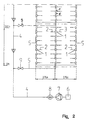
- FIG. 1 shows schematically a deicing agent spraying device on which the deicing agent spraying can be explained with the spray bodies according to the invention.
- Figure 1 shows a schematic top view of the lanes of a highway with six lanes.
- a large number of spray points 1 are shown on the road surface as spray means, which in this example are spray bodies set into the road surface, for example according to FIG. 3, so that vehicles can drive over them.
- each of the spray bodies 1 emits two de-icing spray jets 2, 3 or, as a further example, 2, 3 ′, which are emitted at an angle to the longitudinal direction of the respective lane.
- the spray bodies are supplied with the de-icing agent through lines 4 and 5, which run to the side of the roadway or in the roadway surface to the individual spray bodies.
- a de-icing tank 6 is provided for the de-icing agent, from which a pump 7 feeds the lines 4 and 5, which lead to the individual spray bodies 1.
- the width of a carriageway is 3.75 m and the distances a between the individual spray bodies are approximately 6 m to 10 m. If one assumes a distance a of 6 m, a traffic area of 607.5 m 2 is applied by 27 spray bodies 1, which corresponds to a ratio of square meters of traffic area per spray body of 22.5. If one assumes a distance a of 10 m, the corresponding ratio is 37.5. As a rule, a ratio of 15, in particular 20, to 40 will give good results.
- This large number of spray bodies differs significantly from the number used according to the prior art, in which each spray body has produced very extensive and powerful spray jets. According to the prior art, instead of the 27 spray bodies shown for the upper carriageway, only 14 conventional spray bodies would have been used.
- each spray jet 2,3 in the range of 1 to 4 meters, especially at 1.5 to 2.5 meters, and e.g. at approx. 2 Meters.
- the corresponding rays are very fine, practically invisible rays, which with high pressure be generated.
- the application rate per jet is in the range from only 0.1 liters / minute to 1 liter / minute, in particular 0.1 liters per minute to 0.8 liters per minute, but preferably in the range of 0.1 liters / minute to 0.5 Liters / minute.
- the rays so limited in quantity will be through a very fine discharge opening of each spray body, preferably produces a nozzle in the area is from 0.1 mm to 1 mm in diameter, but in particular in the range from 0.3 mm to 0.6 mm or 0.8 mm diameter.
- These fine rays are e.g. with a print in Spray body in front of the discharge opening, or nozzle, of approx. 8 up to 15 bar, in particular from 10 to 15 bar.
- the Feeding the spray body or nozzle body 1 with de-icing agent under this pressure takes place via lines 4 and 5.
- the line 4 as the main line can e.g.
- the Lines 5 to the respective subgroups of spray bodies 1 can even have an inner diameter of only 4 mm exhibit.
- the laying of lines 4 and 5 is done by the small line diameters accordingly simple and inexpensive.
- the line 4 can, as shown, as a ring line be carried out, with what at the ends of the dining line A-A the same pressure can prevail.
- a ring line also allows easy flushing of the same. Because of the small amount applied per unit of time of all spray points 1 can, however, only a simple, Line 4 not designed as a ring line is sufficient.
- the start and end of the application of the de-icing agent is carried out by commissioning or deactivating the pump 7.
- a considerably longer application time is achieved than with conventional systems, in which the application time was valve-controlled only 1-2 seconds .
- a spray duration of 10 seconds to 10 minutes or even more, in particular in the range from 30 seconds to 5 minutes, is used. The spray duration depends of course on the type of spray.
- the spraying time will be in the range of 30 seconds in order to apply a corresponding amount of the liquid de-icing agent solution, for example 20% NaCl solution.
- the spraying will take several minutes.
- the long application time is also favorable for the distribution of the de-icing agent, since changing wind conditions during the period have a positive influence on the distribution; air vortices caused by vehicles can also be used.
- check valves 8th be provided in the line 4 . These prevent a slope Liquid returns to pump 7 if it is not is in operation. On the check valves can also to be dispensed with if the liquid runs back it is asked for. It is usually preferred that the Lines 5 are free of de-icing agents. This also makes it easier Use of de-icing agents of various types, which for different temperature ranges can be used and are not compatible with each other. Even with the system according to Figure 1, controlled valves and / or Check valves are used if this depends Application for controlled spraying is desirable.
- Figure 3 shows schematically in section Spray body 1.
- the preferred spray body has a first portion 10 on which on the one hand a connection of the spray body for line 5 and on the other hand forms the ejection openings for the de-icing central beams 2 and 3.
- the ejection openings can be provided with nozzles 11 and 12 be, the nozzle opening in the range of 0.1 mm to 1 mm and preferably in the range of 0.3 mm to 0.6 mm or Is 0.8 mm to produce the desired fine rays.
- the spray body 1 with a pad 14 provided, each having a recess 15 and 16 for the has respective spray jet, and which as a support plate embedding the spray body in the topping Traffic area allowed.
- Part 10 and plate 14 can consist of two pieces as shown or also be made in one piece.
- Part 10 may e.g. out Metal or plastic exist and the plate 14 is made preferably made of plastic.
- plastic e.g. POM in question.
- the shown embodiment of the Spray body 1 allows inexpensive manufacture and also a low height h of e.g. only approx 30 mm or less. This allows easy installation also in road surfaces of bridges without risk of destruction the insulation layer or a problem-free one Installation in drainage asphalt.
- the spray bodies are only exemplary of the provision of the many Spray points shown. These can e.g. also as openings, or nozzles, can be provided in a line which on, on or in the lane, so practical an elongated spray body with a variety is used by nozzles.
- FIG. 4 schematically shows a section through one of the nozzles 11, 12 which are preferably used.
- the narrowest area has a diameter b of 0.1 to 1 mm, preferably 0.1 to 0.6, or 0.3 to 0.6 mm.
- the de-icing agent is pressurized under a pressure of 8 to 15 bar and generates the desired fine, practically invisible de-icing agent jets.
- a large number of such nozzles also only have a small outlet cross section, for example 100 nozzles with a diameter of 0.6 mm have a total cross-sectional area of approximately 28 mm 2 .
- a line with an inner diameter of 14 mm already has a cross-sectional area of approximately 154 mm 2 and can therefore feed a large number of spray points arranged along its length practically without any appreciable drop in pressure.
- Figures 5a and 5b show a rough schematic De-icing agent systems with a pump 7, which with the Not shown de-icing tank is connected, and with a Variety of spraying points 1, which are already mentioned thin lines 5 are fed.
- a feed line 17 and a bypass line 18 (Fig. 5b).
- check valves 19 provided in the case of Fig. 5a Pump at the lowest point of the slope Lines 4, 17, 18 arranged, in the case of Fig. 5b the highest point.
- the feed lines are designed so that on the one hand, the smallest possible cross-sections for use come on the other hand so that the feed line and / or the bypass line after the pump is turned off remain full so that the spray system after a new activation the pump as quickly as possible along the entire length sprays.
- the check valves can also be electrical Controllable valves are used to keep the fluid level in lines 4, 17, 18 when deactivated Keep pump.
Landscapes
- Engineering & Computer Science (AREA)
- Architecture (AREA)
- Civil Engineering (AREA)
- Structural Engineering (AREA)
- Nozzles (AREA)
- Road Paving Structures (AREA)
- Physical Or Chemical Processes And Apparatus (AREA)
- Buildings Adapted To Withstand Abnormal External Influences (AREA)
- Road Signs Or Road Markings (AREA)
- Distillation Of Fermentation Liquor, Processing Of Alcohols, Vinegar And Beer (AREA)
- Catching Or Destruction (AREA)
- Feeding, Discharge, Calcimining, Fusing, And Gas-Generation Devices (AREA)
- Special Spraying Apparatus (AREA)
- Road Paving Machines (AREA)
- Refuge Islands, Traffic Blockers, Or Guard Fence (AREA)
- Solid-Sorbent Or Filter-Aiding Compositions (AREA)
- Application Of Or Painting With Fluid Materials (AREA)
Abstract
Description
Claims (6)
- Taumittelsprühkörper (1) zum stationären Ausbringen eines flüssigen Taumittels auf eine Verkehrsfläche, dadurch gekennzeichnet, dass der Taumittelsprühkörper eine oder mehrere, vorzugsweise eine oder zwei, Auslassöffnungen mit einem Innendurchmesser im Bereich von 0,1 mm bis 1 mm, insbesondere im Bereich von 0,3 mm bis 0,8 mm und insbesondere im Bereich von 0,3 mm bis 0,6 mm aufweist.
- Taumittelsprühkörper nach Anspruch 1, dadurch gekennzeichnet, dass die Auslassöffnungen von Düsen (11, 12) gebildet sind.
- Taumittelsprühkörper (1) nach Anspruch 1 oder 2, dadurch gekennzeichnet, dass dieser einen Teil (10) aufweist, der zum Anschluss an eine Taumittelleitung (5) ausgestaltet ist und die Auslassöffnungen aufweist, und dass ein Auflageteller (14) vorgesehen ist, der zur Einbettung des Sprühkörpers in der Verkehrsfläche bestimmt ist.
- Taumittelsprühkörper nach Anspruch 1 oder 2, dadurch gekennzeichnet, dass dieser als langgestreckter Sprühkörper mit einer Vielzahl von Auslassöffnungen ausgestaltet ist.
- Taumittelsprühkörper nach Anspruch 4, dadurch gekennzeichnet, dass der Taumittelsprühkörper als zur Verlegung auf oder in der Verkehrsfläche, insbesondere einer Fahrbahn, bestimmte Leitung ausgestaltet ist.
- Taumittelsprühkörper nach einem der Ansprüche 1 bis 5, dadurch gekennzeichnet, dass dieser zum Anschluss an eine Taumittelsprüheinrichtung bestimmt ist.
Priority Applications (1)
| Application Number | Priority Date | Filing Date | Title |
|---|---|---|---|
| EP99118535A EP0962594A3 (de) | 1998-03-20 | 1998-03-20 | Taumittelsprühkörper zur stationären Ausbringung flüssigen Taumittels |
Applications Claiming Priority (2)
| Application Number | Priority Date | Filing Date | Title |
|---|---|---|---|
| EP99118535A EP0962594A3 (de) | 1998-03-20 | 1998-03-20 | Taumittelsprühkörper zur stationären Ausbringung flüssigen Taumittels |
| EP98105077A EP0947633B1 (de) | 1998-03-20 | 1998-03-20 | Verfahren und Vorrichtung zur stationären Ausbringung flüssigen Taumittels |
Related Parent Applications (1)
| Application Number | Title | Priority Date | Filing Date |
|---|---|---|---|
| EP98105077A Division EP0947633B1 (de) | 1998-03-20 | 1998-03-20 | Verfahren und Vorrichtung zur stationären Ausbringung flüssigen Taumittels |
Publications (2)
| Publication Number | Publication Date |
|---|---|
| EP0962594A2 true EP0962594A2 (de) | 1999-12-08 |
| EP0962594A3 EP0962594A3 (de) | 1999-12-22 |
Family
ID=8231626
Family Applications (2)
| Application Number | Title | Priority Date | Filing Date |
|---|---|---|---|
| EP98105077A Expired - Lifetime EP0947633B1 (de) | 1998-03-20 | 1998-03-20 | Verfahren und Vorrichtung zur stationären Ausbringung flüssigen Taumittels |
| EP99118535A Withdrawn EP0962594A3 (de) | 1998-03-20 | 1998-03-20 | Taumittelsprühkörper zur stationären Ausbringung flüssigen Taumittels |
Family Applications Before (1)
| Application Number | Title | Priority Date | Filing Date |
|---|---|---|---|
| EP98105077A Expired - Lifetime EP0947633B1 (de) | 1998-03-20 | 1998-03-20 | Verfahren und Vorrichtung zur stationären Ausbringung flüssigen Taumittels |
Country Status (17)
| Country | Link |
|---|---|
| US (1) | US6126083A (de) |
| EP (2) | EP0947633B1 (de) |
| JP (2) | JP4522581B2 (de) |
| KR (1) | KR100497696B1 (de) |
| AT (1) | ATE192521T1 (de) |
| AU (1) | AU2635399A (de) |
| CA (2) | CA2324948C (de) |
| DE (1) | DE59800142D1 (de) |
| DK (1) | DK0947633T3 (de) |
| ES (1) | ES2145635T3 (de) |
| GR (1) | GR3033423T3 (de) |
| HU (1) | HU224544B1 (de) |
| NO (1) | NO334397B1 (de) |
| PL (1) | PL198125B1 (de) |
| RU (1) | RU2239019C2 (de) |
| SI (1) | SI0947633T1 (de) |
| WO (1) | WO1999049142A1 (de) |
Cited By (1)
| Publication number | Priority date | Publication date | Assignee | Title |
|---|---|---|---|---|
| DE10260934A1 (de) * | 2002-12-20 | 2004-07-01 | Andreas Leonhard | Streuanlage für Treppen, Gehwege odgl. zur Unterbindung von Glatteisrutschen |
Families Citing this family (9)
| Publication number | Priority date | Publication date | Assignee | Title |
|---|---|---|---|---|
| KR100464356B1 (ko) * | 2002-09-16 | 2005-01-03 | 로얄정보기술 주식회사 | 도로의 결빙방지용 융빙액 분사장치 |
| CA2432502C (en) * | 2003-06-16 | 2011-04-19 | Robert Lanoie | Method and apparatus for safely cleaning a live equipment |
| US6955304B2 (en) * | 2003-10-06 | 2005-10-18 | Energy Absorption Systems, Inc. | Anti-icing spray assembly |
| US20060113401A1 (en) * | 2004-11-29 | 2006-06-01 | Energy Absorption Systems, Inc. | Anti-icing spray system |
| US7588195B2 (en) * | 2005-01-07 | 2009-09-15 | Louis Berkman Winter Products | Deicing apparatus |
| KR100715462B1 (ko) * | 2005-05-17 | 2007-05-07 | 신동헌 | 도로의 제설제 분출장치 |
| US9155926B2 (en) * | 2009-10-13 | 2015-10-13 | Thomas E. Mason | Drain nozzle |
| US20120205459A1 (en) * | 2011-02-10 | 2012-08-16 | Envirotech Services, Inc. | Road spray system and method |
| CA3016927C (en) * | 2017-09-08 | 2025-01-07 | F. Von Langsdorff Licensing Limited | Integrated pavement system for collecting and recycling de-icing fluid |
Family Cites Families (19)
| Publication number | Priority date | Publication date | Assignee | Title |
|---|---|---|---|---|
| FR18209E (fr) * | 1912-06-18 | 1914-02-28 | Henri Joseph Didier | Appareil supprimant la poussière soulevée par le passage des véhicules automobiles |
| GB288364A (en) * | 1927-01-05 | 1928-04-05 | William Mullard Stoddert Wyld | Improvements in apparatus for spraying tennis courts, sports grounds and other open places |
| US3403818A (en) * | 1966-09-30 | 1968-10-01 | Binks Res And Dev Corp | Portable airless sprayer |
| JPS55168519U (de) * | 1979-05-21 | 1980-12-03 | ||
| CH658411A5 (de) * | 1982-09-10 | 1986-11-14 | Boschung Mecatronic Ag | Elektromagnetisch steuerbares und kontrollierbares spruehventil fuer fluessigkeiten und anlage mit derartigen spruehventilen. |
| DE3236401A1 (de) * | 1982-10-01 | 1984-04-05 | Gewerkschaft Eisenhütte Westfalia, 4670 Lünen | Beduesungsstecker, insbesondere fuer die staubbekaempfung in bergbau-untertagebetrieben, und verfahren zum herstellen von beduesungssteckern |
| JPS6192206A (ja) * | 1984-10-11 | 1986-05-10 | 株式会社荏原製作所 | 融雪装置 |
| FR2574833B1 (fr) * | 1984-12-14 | 1987-01-09 | Lamy Perret Emile | Dispositif de nettoyage, d'arrosage et de desinfection des trottoirs urbains |
| DE3515896A1 (de) * | 1985-05-03 | 1986-11-06 | Parga Park- und Gartentechnik GmbH, 7127 Pleidelsheim | Bewaesserungsanlage fuer die aufbringung einer wasserschicht auf die fahrbahn einer versuchsstrecke |
| JPH0313612A (ja) * | 1989-06-12 | 1991-01-22 | Nippon Chikasui Kaihatsu Kk | 地下水熱利用消雪方法及びその装置 |
| DE59002576D1 (de) * | 1990-05-26 | 1993-10-07 | Boschung Mecatronic Ag Schmitt | Stationäre Taumittelsprüheinrichtung für Strassenfahrbahnen und Flugplätze. |
| DK0461295T3 (da) * | 1990-06-15 | 1994-03-21 | Boschung Mecatronic Ag | Sprøjtedysehoved ved en stationær indretning til udsprøjtning af frostvæske på køre-, rulle og start-/landingsbaner |
| JP2652273B2 (ja) * | 1990-12-28 | 1997-09-10 | 良喜 浅野 | 路面消雪装置における散水ノズルの散水量調節装置 |
| US5540383A (en) * | 1993-12-10 | 1996-07-30 | Potomac Rain Room, Inc. | Method and apparatus for spraying pressurized water |
| JP3373027B2 (ja) * | 1994-01-26 | 2003-02-04 | 日本道路株式会社 | 車輌走行コースへの散水装置 |
| US5447272A (en) * | 1994-02-22 | 1995-09-05 | Ask; Bernard J. | Automatic deicer spreader |
| JPH08269927A (ja) * | 1995-03-29 | 1996-10-15 | Nohmi Bosai Ltd | 道路の消霧システム |
| WO1997024969A1 (en) * | 1996-01-03 | 1997-07-17 | Alfredo Espinosa Macin | Water conserving low pressure shower head |
| JPH10272386A (ja) * | 1997-04-01 | 1998-10-13 | Ishiguro Imono Seisakusho:Kk | 散布ノズル及びこれを用いた路面凍結防止溶液の散布システム |
-
1998
- 1998-03-20 ES ES98105077T patent/ES2145635T3/es not_active Expired - Lifetime
- 1998-03-20 AT AT98105077T patent/ATE192521T1/de active
- 1998-03-20 DE DE59800142T patent/DE59800142D1/de not_active Expired - Lifetime
- 1998-03-20 DK DK98105077T patent/DK0947633T3/da active
- 1998-03-20 EP EP98105077A patent/EP0947633B1/de not_active Expired - Lifetime
- 1998-03-20 SI SI9830007T patent/SI0947633T1/xx unknown
- 1998-03-20 EP EP99118535A patent/EP0962594A3/de not_active Withdrawn
- 1998-10-14 US US09/172,012 patent/US6126083A/en not_active Expired - Lifetime
-
1999
- 1999-03-16 CA CA002324948A patent/CA2324948C/en not_active Expired - Lifetime
- 1999-03-16 AU AU26353/99A patent/AU2635399A/en not_active Abandoned
- 1999-03-16 JP JP2000538090A patent/JP4522581B2/ja not_active Expired - Lifetime
- 1999-03-16 PL PL342968A patent/PL198125B1/pl unknown
- 1999-03-16 HU HU0101251A patent/HU224544B1/hu active IP Right Grant
- 1999-03-16 WO PCT/IB1999/000445 patent/WO1999049142A1/de not_active Ceased
- 1999-03-16 KR KR10-2000-7010390A patent/KR100497696B1/ko not_active Expired - Lifetime
- 1999-03-16 RU RU2000126493A patent/RU2239019C2/ru active
- 1999-03-16 CA CA002558677A patent/CA2558677C/en not_active Expired - Lifetime
-
2000
- 2000-05-16 GR GR20000401113T patent/GR3033423T3/el unknown
- 2000-09-15 NO NO20004608A patent/NO334397B1/no not_active IP Right Cessation
-
2010
- 2010-02-22 JP JP2010036128A patent/JP2010159626A/ja active Pending
Cited By (1)
| Publication number | Priority date | Publication date | Assignee | Title |
|---|---|---|---|---|
| DE10260934A1 (de) * | 2002-12-20 | 2004-07-01 | Andreas Leonhard | Streuanlage für Treppen, Gehwege odgl. zur Unterbindung von Glatteisrutschen |
Also Published As
| Publication number | Publication date |
|---|---|
| NO20004608D0 (no) | 2000-09-15 |
| NO20004608L (no) | 2000-09-15 |
| RU2239019C2 (ru) | 2004-10-27 |
| KR20010042048A (ko) | 2001-05-25 |
| HUP0101251A3 (en) | 2001-09-28 |
| US6126083A (en) | 2000-10-03 |
| EP0962594A3 (de) | 1999-12-22 |
| KR100497696B1 (ko) | 2005-07-01 |
| GR3033423T3 (en) | 2000-09-29 |
| EP0947633B1 (de) | 2000-05-03 |
| SI0947633T1 (en) | 2000-08-31 |
| JP4522581B2 (ja) | 2010-08-11 |
| ATE192521T1 (de) | 2000-05-15 |
| PL342968A1 (en) | 2001-07-16 |
| WO1999049142A1 (de) | 1999-09-30 |
| ES2145635T3 (es) | 2000-07-01 |
| CA2324948A1 (en) | 1999-09-30 |
| DE59800142D1 (de) | 2000-06-08 |
| PL198125B1 (pl) | 2008-05-30 |
| AU2635399A (en) | 1999-10-18 |
| NO334397B1 (no) | 2014-02-24 |
| CA2558677A1 (en) | 1999-09-30 |
| HU224544B1 (hu) | 2005-10-28 |
| CA2324948C (en) | 2008-02-12 |
| JP2010159626A (ja) | 2010-07-22 |
| DK0947633T3 (da) | 2000-09-25 |
| JP2002507678A (ja) | 2002-03-12 |
| HUP0101251A2 (hu) | 2001-08-28 |
| CA2558677C (en) | 2009-10-20 |
| EP0947633A1 (de) | 1999-10-06 |
Similar Documents
| Publication | Publication Date | Title |
|---|---|---|
| DE3728508A1 (de) | Ultraweitwinkel-dueseneinheit fuer ein scheinwerferreinigungsgeraet | |
| EP0947633B1 (de) | Verfahren und Vorrichtung zur stationären Ausbringung flüssigen Taumittels | |
| DE2309801A1 (de) | Schaumerzeugungsduese | |
| WO2020239774A1 (de) | Druckkopfreinigungsvorrichtung für einen 3d-drucker und 3d-drucker mit einer druckkopfreinigungsvorrichtung sowie verwendung der druckkopfreinigungsvorrichtung und verfahren zur reinigung eines druckkopfes eines 3d-druckers | |
| DE2841384A1 (de) | Zerstaeuberkopf fuer farbspritzpistolen | |
| DE4334641A1 (de) | Spülfontäne für die Randbegrenzungseinrichtung einer Papiermaschine | |
| EP1034891B1 (de) | Reinigungsgerät und -verfahren | |
| AT412633B (de) | Vorrichtung zur reinigung von nutzfahrzeugen | |
| EP0458992B2 (de) | Stationäre Taumittelsprüheinrichtung für Strassenfahrbahnen und Flugplätze | |
| DE2844981A1 (de) | Verfahren und vorrichtung zur verbesserung der von einem niederdruck- rasensprenger gelieferten wasserverteilung | |
| EP0242543B1 (de) | Ventil, insbesondere in Dosierkartuschen für Flüssigkeitszerstäuber | |
| DE3036721C2 (de) | Ultraschall-Flüssigkeitszerstäuber | |
| EP0461295B1 (de) | Sprühdüsenkopf an einer stationären Taumittelsprüheinrichtung für Fahr-, Roll- und Start/Landebahnen | |
| DD298066A5 (de) | Verfahren zum behandeln von gegenstaenden mit einer fluessigkeit, sowie vorrichtung zur durchfuehrung des verfahrens | |
| DE2261674A1 (de) | Vorrichtung zum ansaugen und beimischen von zusatzstoffen in einen fluessigkeitsstrom | |
| WO2024103095A1 (de) | Vorrichtung zur nachbildung von regen für eine kraftfahrzeugteststrecke | |
| DE102007062671A1 (de) | Straßenoberflächen-Instandsetzungseinrichtung zur Reparatur von Fahrbahnoberflächen | |
| EP1502653B1 (de) | Düse zum Besprühen einer Fläche | |
| DE4423304C1 (de) | Airless-Spritzverfahren zur Herstellung von Markierungslinien auf Straßen und Vorrichtung zur Durchführung des Verfahrens | |
| CH683275A5 (de) | Einrichtung an einem Fahrzeug zum Auftragen von Markierungsfarbe als Tropfen auf eine Strassenoberfläche. | |
| DE102020102289A1 (de) | Vorrichtung und Verfahren zum Aufbringen einer Reinigungsflüssigkeit auf ein Fahrzeugteil | |
| DE10149981A1 (de) | Düsenanordnung für eine Waschanlage für Fahrzeugscheiben sowie Waschanlage mit einer solchen Düsenanordnung | |
| DE10115553C2 (de) | Düse zur Wasserabgabe im untertägigen Berg- und Tunnelbau | |
| EP2537985A1 (de) | Düse zur Abgabe von Sole | |
| EP3085835A1 (de) | Sprüheinsatz für einen sprinkler sowie sprinkler |
Legal Events
| Date | Code | Title | Description |
|---|---|---|---|
| PUAI | Public reference made under article 153(3) epc to a published international application that has entered the european phase |
Free format text: ORIGINAL CODE: 0009012 |
|
| PUAL | Search report despatched |
Free format text: ORIGINAL CODE: 0009013 |
|
| AC | Divisional application: reference to earlier application |
Ref document number: 947633 Country of ref document: EP |
|
| AK | Designated contracting states |
Kind code of ref document: A2 Designated state(s): AT BE CH DE DK ES FI FR GB GR IE IT LI LU MC NL PT SE |
|
| AX | Request for extension of the european patent |
Free format text: AL;LT;LV;MK;RO;SI |
|
| AK | Designated contracting states |
Kind code of ref document: A3 Designated state(s): AT BE CH DE DK ES FI FR GB GR IE IT LI LU MC NL PT SE |
|
| AX | Request for extension of the european patent |
Free format text: AL;LT;LV;MK;RO;SI |
|
| RTI1 | Title (correction) |
Free format text: STATIONARY DE-ICING SPRAY INSTALLATION FOR DISPENSING DE-ICING LIQUIDS |
|
| AKX | Designation fees paid | ||
| REG | Reference to a national code |
Ref country code: DE Ref legal event code: 8566 |
|
| STAA | Information on the status of an ep patent application or granted ep patent |
Free format text: STATUS: THE APPLICATION IS DEEMED TO BE WITHDRAWN |
|
| 18D | Application deemed to be withdrawn |
Effective date: 20000624 |