EP0962865A1 - Dateiverarbeitungsverfahren, dateiverarbeitungsanordnung und speichermedium - Google Patents
Dateiverarbeitungsverfahren, dateiverarbeitungsanordnung und speichermedium Download PDFInfo
- Publication number
- EP0962865A1 EP0962865A1 EP98947952A EP98947952A EP0962865A1 EP 0962865 A1 EP0962865 A1 EP 0962865A1 EP 98947952 A EP98947952 A EP 98947952A EP 98947952 A EP98947952 A EP 98947952A EP 0962865 A1 EP0962865 A1 EP 0962865A1
- Authority
- EP
- European Patent Office
- Prior art keywords
- data
- file
- sections
- storage medium
- compression
- Prior art date
- Legal status (The legal status is an assumption and is not a legal conclusion. Google has not performed a legal analysis and makes no representation as to the accuracy of the status listed.)
- Withdrawn
Links
Images



Classifications
-
- G—PHYSICS
- G11—INFORMATION STORAGE
- G11B—INFORMATION STORAGE BASED ON RELATIVE MOVEMENT BETWEEN RECORD CARRIER AND TRANSDUCER
- G11B20/00—Signal processing not specific to the method of recording or reproducing; Circuits therefor
- G11B20/10—Digital recording or reproducing
- G11B20/12—Formatting, e.g. arrangement of data block or words on the record carriers
- G11B20/1217—Formatting, e.g. arrangement of data block or words on the record carriers on discs
- G11B20/1252—Formatting, e.g. arrangement of data block or words on the record carriers on discs for discontinuous data, e.g. digital information signals or computer program data
-
- G—PHYSICS
- G06—COMPUTING OR CALCULATING; COUNTING
- G06F—ELECTRIC DIGITAL DATA PROCESSING
- G06F16/00—Information retrieval; Database structures therefor; File system structures therefor
- G06F16/10—File systems; File servers
- G06F16/11—File system administration, e.g. details of archiving or snapshots
- G06F16/113—Details of archiving
-
- G—PHYSICS
- G06—COMPUTING OR CALCULATING; COUNTING
- G06F—ELECTRIC DIGITAL DATA PROCESSING
- G06F16/00—Information retrieval; Database structures therefor; File system structures therefor
- G06F16/10—File systems; File servers
- G06F16/13—File access structures, e.g. distributed indices
-
- G—PHYSICS
- G06—COMPUTING OR CALCULATING; COUNTING
- G06F—ELECTRIC DIGITAL DATA PROCESSING
- G06F3/00—Input arrangements for transferring data to be processed into a form capable of being handled by the computer; Output arrangements for transferring data from processing unit to output unit, e.g. interface arrangements
- G06F3/06—Digital input from, or digital output to, record carriers, e.g. RAID, emulated record carriers or networked record carriers
- G06F3/0601—Interfaces specially adapted for storage systems
- G06F3/0602—Interfaces specially adapted for storage systems specifically adapted to achieve a particular effect
- G06F3/0608—Saving storage space on storage systems
-
- G—PHYSICS
- G06—COMPUTING OR CALCULATING; COUNTING
- G06F—ELECTRIC DIGITAL DATA PROCESSING
- G06F3/00—Input arrangements for transferring data to be processed into a form capable of being handled by the computer; Output arrangements for transferring data from processing unit to output unit, e.g. interface arrangements
- G06F3/06—Digital input from, or digital output to, record carriers, e.g. RAID, emulated record carriers or networked record carriers
- G06F3/0601—Interfaces specially adapted for storage systems
- G06F3/0628—Interfaces specially adapted for storage systems making use of a particular technique
- G06F3/0638—Organizing or formatting or addressing of data
- G06F3/0643—Management of files
-
- G—PHYSICS
- G06—COMPUTING OR CALCULATING; COUNTING
- G06F—ELECTRIC DIGITAL DATA PROCESSING
- G06F3/00—Input arrangements for transferring data to be processed into a form capable of being handled by the computer; Output arrangements for transferring data from processing unit to output unit, e.g. interface arrangements
- G06F3/06—Digital input from, or digital output to, record carriers, e.g. RAID, emulated record carriers or networked record carriers
- G06F3/0601—Interfaces specially adapted for storage systems
- G06F3/0668—Interfaces specially adapted for storage systems adopting a particular infrastructure
- G06F3/0671—In-line storage system
- G06F3/0673—Single storage device
- G06F3/0674—Disk device
-
- G—PHYSICS
- G11—INFORMATION STORAGE
- G11B—INFORMATION STORAGE BASED ON RELATIVE MOVEMENT BETWEEN RECORD CARRIER AND TRANSDUCER
- G11B20/00—Signal processing not specific to the method of recording or reproducing; Circuits therefor
- G11B20/00007—Time or data compression or expansion
-
- Y—GENERAL TAGGING OF NEW TECHNOLOGICAL DEVELOPMENTS; GENERAL TAGGING OF CROSS-SECTIONAL TECHNOLOGIES SPANNING OVER SEVERAL SECTIONS OF THE IPC; TECHNICAL SUBJECTS COVERED BY FORMER USPC CROSS-REFERENCE ART COLLECTIONS [XRACs] AND DIGESTS
- Y10—TECHNICAL SUBJECTS COVERED BY FORMER USPC
- Y10S—TECHNICAL SUBJECTS COVERED BY FORMER USPC CROSS-REFERENCE ART COLLECTIONS [XRACs] AND DIGESTS
- Y10S707/00—Data processing: database and file management or data structures
- Y10S707/99941—Database schema or data structure
- Y10S707/99942—Manipulating data structure, e.g. compression, compaction, compilation
Definitions
- the present invention generally relates to file processing methods, data processing apparatuses and storage mediums, and more particularly to a file processing method and a data processing apparatus which compress a file such as a dictionary file related to one or a plurality of dictionaries, encyclopedias and the like, store the compressed file in a storage medium and read the stored file from the storage medium, and to a storage medium which stores a file such as a compressed dictionary file.
- a file such as a dictionary file related to one or a plurality of dictionaries, encyclopedias and the like
- a dictionary file is made up of a dictionary data and a data related to index (hereinafter referred to as an index data).
- the dictionary data includes a data (hereinafter referred to as a text data) related to a text which explains the meaning of a word, a data (hereinafter referred to as an image data) related to an image showing an animal if the word describes the animal, for example, a data (hereinafter referred to as an audio data) related to a sound such as a singing of a bird if the word describes the bird, for example, and the like.
- the index is used to retrieve a desired dictionary data from the dictionary file, and is provided with respect to the dictionary data.
- the index is sometimes also referred to as a keyword.
- the index data includes a pointer related to a heading, a pointer related to an item, and the like,
- the data related to the heading includes a headword.
- the data related to the item includes a headword, comment, and the like.
- the text data and the index data are stored in the CD-ROM without being compressed.
- the amount of information included in the audio data and particularly the image data is large, and the audio data and the image data are respectively compressed according to appropriate compression techniques before being stored in the CD-ROM.
- a Japanese Laid-Open Patent Application No.9-26969 proposes a telephone directory retrieval system which employs a method similar to the above. However, this proposed method does not compress the index data. In the case of the telephone directory, the amount of information related to the index data is small compared to the amount of information related to the telephone number, family name, given name, corporate name and address which correspond to the dictionary data.
- Another object of the present invention is to provide a file processing method comprising a compressing step dividing data and index data with respect to the data into a plurality of sections, and compressing the sections to obtain a compressed file, and a storing step storing the compressed file in a storage medium together with address information of the sections after the compression.
- a file such as a dictionary file which is formed by data including an index, text of each item and the like.
- it is possible to carry out a file retrieval at a high speed by a relatively simple process, by expanding the compressed file for every section.
- each section has a fixed length, it becomes unnecessary to include address information prior to the compression in the compressed file, and the data compression efficiency can be improved.
- said storing step further stores address information prior to the compression in the storage medium, it is possible to carry out the data expansion at a high speed by setting the section to an appropriate length depending on the data type and section.
- the file processing method further comprises a restoring step reading the compressed file from the storage medium and expanding each of the sections, so as to restore the data and the index data, it is possible to improve the file retrieval speed by using an auxiliary storage unit capable of making a high-speed data access and storing the restored data and index data in the auxiliary storage unit.
- the compressing step uses a compression algorithm and a compression parameter which are common to the data and the index data of each of the sections, it is possible to simplify the data compression process and the data expansion process at the time of the data expansion by using the common compression algorithm and compression parameter. More particularly, it is possible to use the Huffman code, the universal code and the like as the compression algorithm.
- Still another object of the present invention is to provide a file processing method comprising a reading step reading a compressed file from a storage medium together with address information of each of a plurality of sections after compression, for each of the sections, said compressed file being obtained by dividing data and index data with respect to the data into the sections and compressing the sections, and a restoring step expanding the compressed file and restoring the data and the index data.
- a further object of the present invention is to provide a data processing apparatus comprising compressing means for dividing data and index data with respect to the data into a plurality of sections, and compressing the sections to obtain a compressed file, and storing means for storing the compressed file in a storage medium together with address information of the sections after the compression.
- it is possible to efficiently compress and store in the storage medium a file which is formed by data including an index, text of each item and the like.
- Another object of the present invention is to provide a data processing apparatus comprising reading means for reading a compressed file from a storage medium together with address information of each of a plurality of sections after compression, for each of the sections, said compressed file being obtained by dividing data and index data with respect to the data into the sections and compressing the sections, and restoring means for expanding the compressed file and restoring the data and the index data.
- Still another object of the present invention is to provide a storage medium which stores computer-readable information, comprising reading means for causing a computer to read a compressed file from a storage medium together with address information of each of a plurality of sections after compression, for each of the sections, said compressed file being obtained by dividing data and index data with respect to the data into the sections and compressing the sections, and restoring means for causing the computer to expand the compressed file and restore the data and the index data.
- a further object of the present invention is to provide a storage medium which stores computer-readable information, comprising a compressed file stored together with address information of each of a plurality of sections after compression, for each of the sections, said compressed file being obtained by dividing data and index data with respect to the data into the sections and compressing the sections, where said compressed file is compressed using a compression algorithm and a compression parameter which are common to the data and the index data of each of the sections.
- a storage medium which stores computer-readable information, comprising a compressed file stored together with address information of each of a plurality of sections after compression, for each of the sections, said compressed file being obtained by dividing data and index data with respect to the data into the sections and compressing the sections, where said compressed file is compressed using a compression algorithm and a compression parameter which are common to the data and the index data of each of the sections.
- Another object of the present invention is to provide a storage medium which stores computer-readable information, including a program which causes a computer to carry out a compressing procedure for dividing dictionary data and index data with respect to the dictionary data into a plurality of sections, and compressing the sections to obtain a compressed dictionary file, and a storing procedure for storing the compressed dictionary file in the storage medium together with address information of the sections after the compression. According to the present invention, it is possible to retrieve the file at a high speed by carrying out a relatively simple process.
- Still another object of the present invention is to provide a computer-readable storage medium storing a compressed file comprising a compressed data region storing compressed data obtained by dividing data and index data with respect to the data into a plurality of sections and compressing the sections, and an address information region storing address information after compression of the sections, and a compression parameter region storing a compression parameter used for the compression. According to the present invention it is possible to retrieve the file by carrying out a relatively simple process.
- the present invention even in when the amount of information related to the index data is large even when compared with the amount of information related to the dictionary data, such as the case of the dictionary, encyclopedia and the like, it is possible to efficiently compress and store the file such as the dictionary file in the storage medium, and the file such as the compressed dictionary file can be accessed within a short time by carrying out the relatively simple process.
- FIG. 1 A description will be given of an embodiment of a file processing method according to the present invention and an embodiment of a data processing apparatus according to the present invention.
- This embodiment of the file processing method and this embodiment of the data processing apparatus employ an embodiment of a storage medium according to the present invention.
- the present invention is applied to a CD-ROM.
- the present invention is of course similarly applicable to optical information storage mediums other than the CD-ROM, magneto-optical storage mediums such as a magneto-optical disk, magnetic storage mediums such as a floppy disk, and various kinds of semiconductor memory devices.
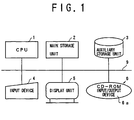
- FIG. 1 is a system block diagram showing the general construction of a computer system applied with this embodiment of the file processing method, and corresponds to this embodiment of the data processing apparatus.
- the computer system shown in FIG. 1 generally includes a central processing unit (CPU) 1, a main storage unit 2 made up of a random access memory (RAM) or the like, an auxiliary storage unit 3 made up of a hard disk drive or the like, an input device 4 made up of a keyboard, mouse or the like, a display unit 5, and a CD-ROM input/output device 6 made up of a CD-ROM drive or the like, which are coupled via a bus 9.
- CPU central processing unit
- main storage unit 2 made up of a random access memory (RAM) or the like
- an auxiliary storage unit 3 made up of a hard disk drive or the like
- an input device 4 made up of a keyboard, mouse or the like
- a display unit 5 a display unit 5
- CD-ROM input/output device 6 made up of a CD-ROM drive or the like, which
- the input device 4 is used to input instructions and data to the CPU 1.
- the CPU 1 carries out a process requested by a user by executing a program stored in the auxiliary storage unit 3 based on the instructions and data which are input.
- the program stored in the auxiliary storage unit 3 may be pre-installed or, may be loaded from a CD-ROM 6a which is loaded into the CD-ROM input/output device 6.
- the main storage unit 2 is used to temporarily store intermediate results of computing processes or the like carried out by the CPU 1, data used by the operations, and the like.
- the display unit 5 displays a result of the process carried out by the CPU 1, and messages urging the user to input an instruction or data. It is possible to connect a printer (not shown) which prints the result of the process carried out by the CPU 1 or the like, in place of the display unit 5 or in addition to the display unit 5.
- the file storing process generally includes a compression parameter computing process, a data compression process for compressing an index, text and the like, an address information computing process, a compressed file composing process, and a compressed file storing process.
- a program for causing the CPU 1 to carry out the file storing process is stored in the CD-ROM 6a, and that the CPU 1 reads this program from the CD-ROM 6a by a known method and loads this program into the auxiliary storage unit 3.
- the dictionary file related to the dictionary, encyclopedia or the like is transferred from a host unit (not shown) and is stored in the auxiliary storage unit 3 via the bus 9 or, read from a CD-ROM different from the CD-ROM 6a by the CD-ROM input/output device 6 and is stored in the auxiliary storage unit 3 via the bus 9.
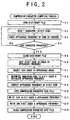
- FIG. 2 is a flow chart for explaining the compression parameter computing process carried out by the CPU 1.
- a step S1 makes access to the auxiliary storage unit 3 and opens a dictionary file.
- a step S2 reads 1 character, that is, a 16-bit code, for example, from the dictionary file.
- a step S3 counts an appearance frequency of the read 16-bit code by use of an appearance frequency counter within the CPU 1.
- a step S4 decides whether or not a last character of the dictionary file is processed, and the process returns to the step S2 if the decision result in the step S4 is NO.
- a step S5 closes the dictionary file.
- a step S6 sorts the 16-bit codes depending on the order of the appearance frequency, and a step S7 selects 1024 16-bit codes, for example, depending on the order of the appearance frequency.
- a step S8 decomposes the remaining non-selected 16-bit codes into 8-bit codes, and calculates the appearance frequency of the 8-bit code.
- a step S9 corrects the appearance frequency of the 8-bit code with respect to the appearance frequency of the 16-bit code, by setting the appearance frequency of the 8-bit code to approximately 1/2.
- a step S10 opens a compression parameter save file for the compression parameter in the auxiliary storage unit 3.
- a step S11 writes the 1024 16-bit codes and the appearance frequency thereof in the compression parameter save file.
- a step S12 writes 256 8-bit codes and the appearance frequency thereof in the compression parameter save file.
- a step S13 closes the compression parameter save file, and the process ends.
- FIG. 3 is a diagram showing the data structure of the compression parameter.
- the compression parameter in the case of a compression using the Huffman code, the compression parameter includes 256 kinds of appearance frequencies for each of the 1024 kinds of 16-bit codes, and 256 kinds of appearance frequencies for each of the 8-bit codes, for example.
- the appearance frequencies become data which are used to generate a Huffman tree.
- the compression parameter includes a try tree or data such as registered symbol examples and reference numbers thereof which are used to generate the try tree.
- FIG. 4 is a flow chart for explaining the data compression process and the address information computing process carried out by the CPU 1.
- a step S21 creates a conversion table, that is, a Huffman tree since this embodiment carries out a Huffman compression, based on the appearance frequencies of the 8-bit codes and the 16-bit codes.
- a step S22 opens the dictionary file within the auxiliary storage unit 3.
- a step S23 opens a compressed data save file for the compressed data and an address information save file for the address information, within the auxiliary storage unit 3.
- a step S24 reads 1 section from the dictionary file. This section may have a fixed length or a variable length, but in this embodiment, it is assumed for the sake of convenience that this section has a fixed length. This section is sometimes also referred to as a block.
- a step S25 computes the compressed data of 1 section using the Huffman tree.
- a step S26 adds an end code to the end of 1 section.
- a step S27 writes the compressed data in the compressed data save file.
- a step S28 computes the address information related to the address where the above described section is stored. For example, when the section has the fixed length, the address information is computed based on a section number which is assigned with respect to each section.
- a step S29 writes the address information in the address information save file.
- a step S30 decides whether or not a last section is processed, and the process returns to the step S24 if the decision result in the step S30 is NO. For example, it is possible to decide whether or not the last section is processed, based on a last section code which is added to the section number or the last section.
- a step S31 closes the save file for the compressed data and closes the address information save file.
- a step S32 closes the dictionary file, and the process ends.
- FIG. 5 is a flow chart for explaining the compressed file composing process and the compressed file storing process carried out by the CPU 1.
- a step S41 opens a compressed file within the auxiliary storage unit 3.
- a step S42 opens the compression parameter save file within the auxiliary storage unit 3, and a step S43 copies the compression parameter within the compression parameter save file to the compressed file.
- a step S44 closes the compression parameter save file.
- a step S45 opens the address information save file within the auxiliary storage unit 3, and a step S46 copies the address information in the address information save file to the compressed file.
- a step S47 closes the address information save file.
- a step S48 opens the compressed data save file within the auxiliary storage unit 3, and a step S49 copies the compressed data in the compressed data save file to the compressed file.
- a step S50 closes the compressed data save file.
- a step S51 stores, the compressed file in the CD-ROM 6a by the CD-ROM input/output device 6.
- a step S52 closes the compressed file, and the process ends.
- FIG. 6 is a diagram for explaining the composing of the compressed file with reference to 1a) the compression parameter computing process, 1b) the data compression process and the address information computing process, and 1c) the compressed file composing process and the compressed file storing process described above.
- (a) shows the compression parameter.
- the compression parameter is used to carry out the compression using the Huffman code.
- (b) shows the sections of the dictionary file. In this embodiment, each section is made up of 2 kbytes, for example, and each section is made up of a dictionary data and an index data.
- the dictionary data includes a text data related to a text which explains the meaning of a word, an image data related to an image showing an animal if the word describes the animal, for example, an audio data related to a sound such as a singing of a bird it the word describes the bird, for example, and the like.
- the index is used to retrieve a desired dictionary data from the dictionary file, and is provided with respect to the dictionary data.
- the index is sometimes also referred to as a keyword.
- the index data includes a pointer related to a heading, a pointer related to an item, and the like.
- the data related to the heading includes a headword. Further, the data related to the item includes a headword, comment, and the like.
- FIG. 6 shows the compressed data, in a state where each section has a fixed length or a variable length and is compressed. Furthermore, in FIG. 6, (d) shows the address information computed with respect to each section, and (e) shows the compressed file which is obtained by composing the address information and the compressed data and adding management information at a head of the compressed file.
- the management information includes information used when retrieving the compressed file, such as a dictionary file name, a dictionary file type, and a type of compression used for the dictionary file.
- the file retrieval process generally includes an index read process and a text read process, and is carried out by calling a data expansion process.
- a program for causing the CPU 1 to carry out the file retrieval process is stored in the CD-ROM 6a, and that the CPU 1 reads this program and the compressed file from the CD-ROM 6a by a known method and loads the read program and compressed file into the auxiliary storage unit 3.
- FIG. 7 is a flow chart for explaining the index read process carried out by the CPU 1.
- a step S61 sets address information of a most significant index, based on the index data input by the user via the input device 4.
- a step S62 calls the expansion process, and reads a routine for carrying out the expansion process from the program which is stored in the auxiliary storage unit 3 and causes the CPU 1 to carry out the file retrieval process, so as to expand the address of the most significant index within the compressed file.
- a step S63 acquires the address of a significant index, that is, the head character of the most significant index, based on the index data.
- a step S64 calls the expansion process, and expands the address of the significant index within the compressed file.
- a step S65 acquires the address of a less significant index in a next hierarchical layer, based on the index data.
- a step S66 calls the expansion process, and expands the address of the less significant index in the next hierarchical layer described above within the compressed file.
- a step S67 decides whether or not the expansion of the address of a least significant index has ended, and the process returns to the step S65 if the decision result in the step S67 is NO. On the other hand, the process ends if the decision result in the step S67 is YES.
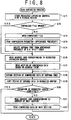
- FIG. 8 is a flow chart for explaining the data expansion process carried out by the CPU 1.
- the data expansion process is called by the index read process and the text read process.
- a step S71 stores the requested expansion address, data size and storage region in the auxiliary storage unit 3, based on the index data which is input by the user via the input device 4, so as to prepare a sufficiently large storage region within the auxiliary storage unit 3 with respect to the expanded data size.
- a step S72 decides whether or not the compressed file which is read from the CD-ROM 6a and loaded into the auxiliary storage unit 3 is open. If the decision result in the step S72 is NO, a step S73 opens the compressed file within the auxiliary storage unit 3.
- a step S74 reads the compression parameter from the compressed file, and reads the appearance frequency of the 8-bit code within the compression parameter, the 16-bit code within the compression parameter, and the appearance frequency of the 16-bit code.
- a step S75 creates a Huffman tree based on the appearance frequency of the 8-bit code and the appearance frequency of the 16-bit code, and the process advances to a step S76 which will be described later.
- a judging flag for judging whether the code is the 8-bit code or the 16-bit code is added to the data of the leaf of the Huffman tree.
- the step S76 reads the address information corresponding to the requested expansion address, from the compressed file.
- a step S77 reads the section of the corresponding compressed data from the compressed file, based on the address information.
- a step S78 expands the section of the compressed data by use of the Huffman tree.
- a step S79 copies the expanded data to the storage region described above, based on the judging flag which indicates whether the code is the 8-bit code or the 16-bit code. Further, a step S80 decides whether or not the expansion of the requested data size is completed with respect to the compressed file.
- a step S81 reads the address information corresponding to the expansion address of the next section, from the compressed file.
- the step S82 reads the section of the corresponding compressed data from the compressed file, based on the address information corresponding to the expansion address of this next section, and the process returns to the step S78. on the other hand, the process ends if the decision result in the step S80 is YES.
- FIG. 9 is a flow chart for explaining the text read process carried out by the CPU 1.
- a step S91 counts the items matching the index, within the expanded data, based on the index data input by the user via the input device 4.
- a step S92 sets a value of an item pointer of the index to the address, based on the input index data.
- a step S93 calls the expansion process, and reads a routine for carrying out the expansion process from the program which is stored within the auxiliary storage unit 3 and causes the CPU 1 to carry out the file retrieval process, so as to expand the text indicated by the item pointer within the compressed file, that is, to expand the dictionary data amounting to 1 section.
- a step S94 decides whether or not the dictionary data indicated by the item pointer has ended. If the decision result in the step S94 is NO, a step S95 sets the address of a next 1 section. In addition, a step S96 calls the expansion process, and expands the dictionary data amounting to this next 1 section indicated by the item pointer within the compressed file, and the process returns to the step S94. On the other hand, if the decision result in the step S94 is YES, a step S97 decides whether or not the process with respect to all of the items has ended, based on the input index data. The process returns to the step S92 if the decision result in the step S97 is NO. On the other hand, if the decision result in the step 97 is YES, a step S98 displays on the display unit 5 the dictionary data which is expanded for all of the items, and the process ends.
- step S98 displays the dictionary data which is expanded for each item on the display unit 5 each time the dictionary data is expanded for each item.
- the section has the fixed length.
- the data compression efficiency is satisfactory, and it is possible to restore the address information from the compressed file without the need to store the address information prior to the compression of the section in the compressed file.
- the section has the fixed length, and the section number is added to each section, thereby making it possible to calculate a relative position of each section with respect to another section.
- the section has a variable length
- the length of the section can be set appropriately depending on the kind of data and section, thereby eliminating the need to expand excess data.
- the section has the variable length
- one or more dictionary files may be stored in the CD-ROM 6a.
- a plurality of dictionary files related to a plurality of dictionaries, encyclopedias and the like are stored in the CD-ROM 6a, it is possible to specify the dictionary which is to be retrieved, using the dictionary file name or the dictionary tile type within the management information shown in (e) of FIG. 6.
- the embodiment described above employs the Huffman code for the data compression
- coding techniques other than the technique using the Huffman code, such as the technique using the universal code, as long as the employed data compression technique is capable of efficiently compressing the dictionary data using a common compression parameter for each of the sections.
- the data to be subjected to the data compression and expansion is not limited to the dictionary data, and includes data of a database including the index and data.
- the file retrieval process is carried out by copying the program for carrying out the file retrieval process and the compressed file to the auxiliary storage unit 3.
- the file retrieval process is carried out by copying the program for carrying out the file retrieval process and the compressed file to the auxiliary storage unit 3.
- the compression algorithm of the above described embodiment it is possible to improve the data compression efficiency compared to the normal data compression process using the Huffman code with 8 bits. As a result, it is possible to reduce the region of the compressed file stored in the storage medium such as the CD-ROM and the hard disk which is used as the auxiliary storage unit. Although the data compression efficiency is improved by this compression algorithm, the processing time required to expand the compressed file remains essentially unchanged from the processing time required to expand the compressed file compressed by the normal data compression process using the Huffman code.
- a time required to carry out the file retrieval process is made up of a seek time of the read unit (drive), a read time required to read the compressed file, and a time required to carry out the expansion process.
- the reduced region of the compressed file stored in the storage medium enables reduction of the seek time of the file retrieval process. Consequently, the file retrieval speed is improved. This effect of improving the file retrieval speed is becomes more notable as the hardware performance improves.
Landscapes
- Engineering & Computer Science (AREA)
- Theoretical Computer Science (AREA)
- General Engineering & Computer Science (AREA)
- Physics & Mathematics (AREA)
- General Physics & Mathematics (AREA)
- Human Computer Interaction (AREA)
- Signal Processing (AREA)
- Data Mining & Analysis (AREA)
- Databases & Information Systems (AREA)
- Compression, Expansion, Code Conversion, And Decoders (AREA)
- Information Retrieval, Db Structures And Fs Structures Therefor (AREA)
- Signal Processing For Digital Recording And Reproducing (AREA)
Applications Claiming Priority (3)
| Application Number | Priority Date | Filing Date | Title |
|---|---|---|---|
| JP28855997 | 1997-10-21 | ||
| JP28855997 | 1997-10-21 | ||
| PCT/JP1998/004736 WO1999021092A1 (en) | 1997-10-21 | 1998-10-20 | File processing method, data processing device, and storage medium |
Publications (2)
| Publication Number | Publication Date |
|---|---|
| EP0962865A1 true EP0962865A1 (de) | 1999-12-08 |
| EP0962865A4 EP0962865A4 (de) | 2004-11-24 |
Family
ID=17731828
Family Applications (1)
| Application Number | Title | Priority Date | Filing Date |
|---|---|---|---|
| EP98947952A Withdrawn EP0962865A4 (de) | 1997-10-21 | 1998-10-20 | Dateiverarbeitungsverfahren, dateiverarbeitungsanordnung und speichermedium |
Country Status (8)
| Country | Link |
|---|---|
| US (1) | US6721753B1 (de) |
| EP (1) | EP0962865A4 (de) |
| JP (1) | JP3770919B2 (de) |
| KR (1) | KR100495593B1 (de) |
| CN (2) | CN100535889C (de) |
| AU (1) | AU740957B2 (de) |
| CA (1) | CA2275391C (de) |
| WO (1) | WO1999021092A1 (de) |
Families Citing this family (14)
| Publication number | Priority date | Publication date | Assignee | Title |
|---|---|---|---|---|
| CN100535889C (zh) | 1997-10-21 | 2009-09-02 | 富士通株式会社 | 文件处理方法和数据处理装置 |
| KR100597513B1 (ko) | 1999-08-13 | 2006-07-10 | 후지쯔 가부시끼가이샤 | 파일 처리 방법, 데이터 처리 장치 및 기억 매체 |
| JP2003006216A (ja) * | 2001-06-26 | 2003-01-10 | Sony Corp | 情報処理装置および情報処理方法、記録媒体、プログラム、並びに電子出版用データ提供システム |
| KR20020008101A (ko) * | 2001-12-12 | 2002-01-29 | 주식회사 애니콤소프트웨어 | 데이터의 비트 인덱스 압축방법 |
| WO2006123429A1 (ja) | 2005-05-20 | 2006-11-23 | Fujitsu Limited | 情報検索方法、装置、プログラム、該プログラムを記録した記録媒体 |
| KR20080046345A (ko) | 2006-11-22 | 2008-05-27 | 삼성전자주식회사 | 휴대용 단말기의 메모리 절약 장치 및 방법 |
| US8843449B2 (en) | 2009-06-16 | 2014-09-23 | Bmc Software, Inc. | Unobtrusive copies of actively used compressed indices |
| US8706727B2 (en) * | 2009-06-19 | 2014-04-22 | Sybase, Inc. | Data compression for reducing storage requirements in a database system |
| US8694474B2 (en) * | 2011-07-06 | 2014-04-08 | Microsoft Corporation | Block entropy encoding for word compression |
| JP2016170750A (ja) * | 2015-03-16 | 2016-09-23 | 富士通株式会社 | データ管理プログラム、情報処理装置およびデータ管理方法 |
| JP6428936B2 (ja) | 2015-06-10 | 2018-11-28 | 富士通株式会社 | 情報処理装置、情報処理方法および情報処理プログラム |
| US9946462B1 (en) * | 2016-02-15 | 2018-04-17 | Seagate Technology Llc | Address mapping table compression |
| JP6794782B2 (ja) * | 2016-11-02 | 2020-12-02 | 富士通株式会社 | 情報処理装置、情報処理プログラム、及び情報処理方法 |
| CN107357854A (zh) * | 2017-06-28 | 2017-11-17 | 光大环境科技(中国)有限公司 | 数据存储的方法、装置及计算机存储介质 |
Family Cites Families (18)
| Publication number | Priority date | Publication date | Assignee | Title |
|---|---|---|---|---|
| GB8828796D0 (en) * | 1988-12-09 | 1989-01-18 | British Telecomm | Data compression |
| US5146221A (en) * | 1989-01-13 | 1992-09-08 | Stac, Inc. | Data compression apparatus and method |
| US5333313A (en) * | 1990-10-22 | 1994-07-26 | Franklin Electronic Publishers, Incorporated | Method and apparatus for compressing a dictionary database by partitioning a master dictionary database into a plurality of functional parts and applying an optimum compression technique to each part |
| JP2954749B2 (ja) * | 1991-07-19 | 1999-09-27 | 富士通株式会社 | データ圧縮方式 |
| JP3332954B2 (ja) | 1992-07-07 | 2002-10-07 | オリンパス光学工業株式会社 | 急速変形圧電アクチュエータおよび急速変形圧電アクチュエータを用いた内視鏡 |
| JPH0628150A (ja) * | 1992-07-08 | 1994-02-04 | Funai Techno Syst Kk | プログラム容量圧縮方法 |
| US5442350A (en) * | 1992-10-29 | 1995-08-15 | International Business Machines Corporation | Method and means providing static dictionary structures for compressing character data and expanding compressed data |
| US5649183A (en) * | 1992-12-08 | 1997-07-15 | Microsoft Corporation | Method for compressing full text indexes with document identifiers and location offsets |
| US5953723A (en) * | 1993-04-02 | 1999-09-14 | T.M. Patents, L.P. | System and method for compressing inverted index files in document search/retrieval system |
| JP3051014B2 (ja) * | 1993-12-27 | 2000-06-12 | ローム株式会社 | データ記憶装置及びデータシステム |
| JPH08167852A (ja) * | 1994-12-13 | 1996-06-25 | Fujitsu Ltd | データ圧縮方法及び装置 |
| JPH08241325A (ja) * | 1995-03-03 | 1996-09-17 | Matsushita Electric Ind Co Ltd | 電子辞書及びその製造方法並びにインデックス圧縮・伸長装置 |
| JPH08320648A (ja) * | 1995-05-24 | 1996-12-03 | Matsushita Electric Ind Co Ltd | ナビゲーション装置 |
| JPH0926969A (ja) * | 1995-07-10 | 1997-01-28 | Hitachi Maxell Ltd | 電話帳検索システム |
| JPH0926902A (ja) * | 1995-07-12 | 1997-01-28 | Fujikura Ltd | ファイル圧縮並びに復元方法 |
| JPH0969785A (ja) * | 1995-08-30 | 1997-03-11 | Toshiba Corp | データ圧縮方法及びデータ圧縮装置 |
| US6278992B1 (en) * | 1997-03-19 | 2001-08-21 | John Andrew Curtis | Search engine using indexing method for storing and retrieving data |
| CN100535889C (zh) | 1997-10-21 | 2009-09-02 | 富士通株式会社 | 文件处理方法和数据处理装置 |
-
1998
- 1998-10-20 CN CN03106774.3A patent/CN100535889C/zh not_active Expired - Fee Related
- 1998-10-20 AU AU94639/98A patent/AU740957B2/en not_active Ceased
- 1998-10-20 EP EP98947952A patent/EP0962865A4/de not_active Withdrawn
- 1998-10-20 US US09/319,742 patent/US6721753B1/en not_active Expired - Lifetime
- 1998-10-20 KR KR10-1999-7005642A patent/KR100495593B1/ko not_active Expired - Fee Related
- 1998-10-20 JP JP52369699A patent/JP3770919B2/ja not_active Expired - Lifetime
- 1998-10-20 CN CNB98801551XA patent/CN1148657C/zh not_active Expired - Fee Related
- 1998-10-20 CA CA002275391A patent/CA2275391C/en not_active Expired - Fee Related
- 1998-10-20 WO PCT/JP1998/004736 patent/WO1999021092A1/ja not_active Ceased
Also Published As
| Publication number | Publication date |
|---|---|
| WO1999021092A1 (en) | 1999-04-29 |
| KR20000069633A (ko) | 2000-11-25 |
| CN1148657C (zh) | 2004-05-05 |
| AU9463998A (en) | 1999-05-10 |
| US6721753B1 (en) | 2004-04-13 |
| CA2275391C (en) | 2005-12-06 |
| KR100495593B1 (ko) | 2005-06-16 |
| CA2275391A1 (en) | 1999-04-29 |
| CN1242846A (zh) | 2000-01-26 |
| CN100535889C (zh) | 2009-09-02 |
| CN1487448A (zh) | 2004-04-07 |
| EP0962865A4 (de) | 2004-11-24 |
| JP3770919B2 (ja) | 2006-04-26 |
| AU740957B2 (en) | 2001-11-15 |
Similar Documents
| Publication | Publication Date | Title |
|---|---|---|
| US7016908B2 (en) | File processing method, data processing apparatus and storage medium | |
| JP4053115B2 (ja) | 文書画像データの記憶制御方式 | |
| EP0293161B1 (de) | Zeichenverarbeitungssystem mit Funktion zur Prüfung von Rechtschreibung | |
| US5165030A (en) | Method and system for dynamic creation of data stream based upon system parameters and operator selections | |
| AU740957B2 (en) | File processing method, data processing apparatus and storage medium | |
| US5960449A (en) | Database system shared by multiple client apparatuses, data renewal method, and application to character processors | |
| US5566329A (en) | System and method for mutation of selected assignment operations on large data objects | |
| JP2002123410A (ja) | データ記憶装置 | |
| US6735600B1 (en) | Editing protocol for flexible search engines | |
| JPWO1999021092A1 (ja) | ファイル処理方法、データ処理装置及び記憶媒体 | |
| US6640225B1 (en) | Search method using an index file and an apparatus therefor | |
| JP2000339332A (ja) | 検索インデックスを記録した媒体、検索インデックス更新方法、その装置、そのプログラムを記録した媒体 | |
| EP1238330A2 (de) | Rangordnung von tabellenelementen unter benutzung einer maske | |
| JP3898717B2 (ja) | データ圧縮/復元装置およびデータ圧縮/復元方法 | |
| JP3325326B2 (ja) | 電子ファイリング装置 | |
| JPH0793485A (ja) | 画像ファイリング装置 | |
| JPH1166076A (ja) | データ派生装置及び方法、並びに、データ派生プログラムを格納した記憶媒体 | |
| JPH08235191A (ja) | 文書検索方法及び文書検索装置 | |
| JPH1097542A (ja) | 全文検索装置及び全文検索方法 | |
| JPH08129549A (ja) | 文書処理装置 | |
| JP3291501B2 (ja) | ネットワーク作成装置およびそのネットワーク作成方法 | |
| JPWO2001013237A1 (ja) | ファイル処理方法、データ処理装置及び記憶媒体 | |
| JP2003296368A (ja) | データベース探索装置および探索方法ならびに記憶媒体、プログラム | |
| JPH08272814A (ja) | 文字列検索装置 | |
| JP2005137015A (ja) | データ圧縮/復元装置およびデータ圧縮/復元方法 |
Legal Events
| Date | Code | Title | Description |
|---|---|---|---|
| PUAI | Public reference made under article 153(3) epc to a published international application that has entered the european phase |
Free format text: ORIGINAL CODE: 0009012 |
|
| 17P | Request for examination filed |
Effective date: 19990714 |
|
| AK | Designated contracting states |
Kind code of ref document: A1 Designated state(s): DE FR GB IT |
|
| A4 | Supplementary search report drawn up and despatched |
Effective date: 20041013 |
|
| RIC1 | Information provided on ipc code assigned before grant |
Ipc: 7G 06F 12/02 B Ipc: 7G 06F 17/30 B Ipc: 7G 11B 20/12 B Ipc: 7G 11B 20/00 B Ipc: 7G 06F 12/00 A |
|
| 17Q | First examination report despatched |
Effective date: 20050623 |
|
| 17Q | First examination report despatched |
Effective date: 20050623 |
|
| GRAP | Despatch of communication of intention to grant a patent |
Free format text: ORIGINAL CODE: EPIDOSNIGR1 |
|
| INTG | Intention to grant announced |
Effective date: 20160513 |
|
| STAA | Information on the status of an ep patent application or granted ep patent |
Free format text: STATUS: THE APPLICATION IS DEEMED TO BE WITHDRAWN |
|
| 18D | Application deemed to be withdrawn |
Effective date: 20160924 |