EP0964014B1 - Aromatische flüssigkristalline Polyester und daraus hergestellte Harzzusammensetzung - Google Patents
Aromatische flüssigkristalline Polyester und daraus hergestellte Harzzusammensetzung Download PDFInfo
- Publication number
- EP0964014B1 EP0964014B1 EP19990304476 EP99304476A EP0964014B1 EP 0964014 B1 EP0964014 B1 EP 0964014B1 EP 19990304476 EP19990304476 EP 19990304476 EP 99304476 A EP99304476 A EP 99304476A EP 0964014 B1 EP0964014 B1 EP 0964014B1
- Authority
- EP
- European Patent Office
- Prior art keywords
- liquid crystalline
- crystalline polyester
- temperature
- aromatic liquid
- group
- Prior art date
- Legal status (The legal status is an assumption and is not a legal conclusion. Google has not performed a legal analysis and makes no representation as to the accuracy of the status listed.)
- Expired - Lifetime
Links
- 0 *[N+](C[N+][N+](*)[O-])[O-] Chemical compound *[N+](C[N+][N+](*)[O-])[O-] 0.000 description 1
Classifications
-
- C—CHEMISTRY; METALLURGY
- C08—ORGANIC MACROMOLECULAR COMPOUNDS; THEIR PREPARATION OR CHEMICAL WORKING-UP; COMPOSITIONS BASED THEREON
- C08G—MACROMOLECULAR COMPOUNDS OBTAINED OTHERWISE THAN BY REACTIONS ONLY INVOLVING UNSATURATED CARBON-TO-CARBON BONDS
- C08G63/00—Macromolecular compounds obtained by reactions forming a carboxylic ester link in the main chain of the macromolecule
- C08G63/02—Polyesters derived from hydroxycarboxylic acids or from polycarboxylic acids and polyhydroxy compounds
- C08G63/60—Polyesters derived from hydroxycarboxylic acids or from polycarboxylic acids and polyhydroxy compounds derived from the reaction of a mixture of hydroxy carboxylic acids, polycarboxylic acids and polyhydroxy compounds
- C08G63/605—Polyesters derived from hydroxycarboxylic acids or from polycarboxylic acids and polyhydroxy compounds derived from the reaction of a mixture of hydroxy carboxylic acids, polycarboxylic acids and polyhydroxy compounds the hydroxy and carboxylic groups being bound to aromatic rings
-
- C—CHEMISTRY; METALLURGY
- C08—ORGANIC MACROMOLECULAR COMPOUNDS; THEIR PREPARATION OR CHEMICAL WORKING-UP; COMPOSITIONS BASED THEREON
- C08G—MACROMOLECULAR COMPOUNDS OBTAINED OTHERWISE THAN BY REACTIONS ONLY INVOLVING UNSATURATED CARBON-TO-CARBON BONDS
- C08G63/00—Macromolecular compounds obtained by reactions forming a carboxylic ester link in the main chain of the macromolecule
- C08G63/78—Preparation processes
- C08G63/80—Solid-state polycondensation
-
- Y—GENERAL TAGGING OF NEW TECHNOLOGICAL DEVELOPMENTS; GENERAL TAGGING OF CROSS-SECTIONAL TECHNOLOGIES SPANNING OVER SEVERAL SECTIONS OF THE IPC; TECHNICAL SUBJECTS COVERED BY FORMER USPC CROSS-REFERENCE ART COLLECTIONS [XRACs] AND DIGESTS
- Y10—TECHNICAL SUBJECTS COVERED BY FORMER USPC
- Y10T—TECHNICAL SUBJECTS COVERED BY FORMER US CLASSIFICATION
- Y10T428/00—Stock material or miscellaneous articles
- Y10T428/249921—Web or sheet containing structurally defined element or component
- Y10T428/249953—Composite having voids in a component [e.g., porous, cellular, etc.]
-
- Y—GENERAL TAGGING OF NEW TECHNOLOGICAL DEVELOPMENTS; GENERAL TAGGING OF CROSS-SECTIONAL TECHNOLOGIES SPANNING OVER SEVERAL SECTIONS OF THE IPC; TECHNICAL SUBJECTS COVERED BY FORMER USPC CROSS-REFERENCE ART COLLECTIONS [XRACs] AND DIGESTS
- Y10—TECHNICAL SUBJECTS COVERED BY FORMER USPC
- Y10T—TECHNICAL SUBJECTS COVERED BY FORMER US CLASSIFICATION
- Y10T428/00—Stock material or miscellaneous articles
- Y10T428/29—Coated or structually defined flake, particle, cell, strand, strand portion, rod, filament, macroscopic fiber or mass thereof
Definitions
- the present invention relates to an aromatic liquid crystalline polyester resin which is excellent in film molding property (film forming property) and a resin composition thereof.
- films produced from various polymers are essential in daily life.
- films such as high strength films, high elasticity films, oxygen barrier films, conductive films, heat-resistant films, light shielding films and the like.
- oxygen barrier films or water vapor barrier films are widely used in our life as wrapping materials irrespective of industrial use or private use.
- liquid crystalline polymers particularly, a thermotropic aromatic liquid crystalline polyester (hereinafter, sometimes abbreviated as LCP) is noticed, and film forming from this polyester is in investigation.
- LCP thermotropic aromatic liquid crystalline polyester
- films made of a liquid crystalline copolyester composed of PET/p-hydroxybenzoic acid (hereinafter, sometimes abbreviated as POB) having an aliphatic chain in the main chain Japanese Patent Application Publication (JP-B) No. 8-2974
- JP-B Japanese Patent Application Publication
- JP-B semi-aromatic liquid crystalline polyester
- films made of a wholly aromatic liquid crystalline polyester JP-A Nos.
- Wholly aromatic LCPs often require a processing temperature of over 300°C excepting PET/POB copolyesters and polyesters obtained by copolymerization of different aromatic hydroxycarboxylic acids (for example, Vectra series), and heat-resistant wholly aromatic liquid crystalline polyesters having a temperature of deflection under load (TDUL) of over 250°C sometimes require a further higher processing temperature of 350°C or more, therefore, an expensive and specific molding machine is necessary.
- TDUL temperature of deflection under load
- a wholly aromatic liquid crystalline polyester which has a molecular weight for sufficient mechanical strength and can be molded at a low temperature (320°C or lower) is disclosed in JP-B No. 63-3888 and a semi-aromatic liquid crystalline polyester is disclosed in JP-A No. 61-102234 and the like.
- film forming methods of the polyesters a method for film forming at a high shear rate is described in JP-A No. 2-3430, a film forming method using a ring die and the like is described in US-Patent No. 4975312 and WO 9015706.
- JP-A No. 2-3430 describes melt strength as one of technical factors in film formation. This reference describes about an aromatic liquid crystalline polyester resin derived from only an aromatic hydroxycarboxylic acid unit, and the melt strength is described as a factor for producing a film at a high shear rate, and there is no suggestion regarding other aromatic liquid crystalline polyester resins.
- LCP resin-based film materials having high gas barrier properties and processability at a low temperature of 320°C or lower still have a lot of problems for practical use.
- an object of the present invention is to provide an aromatic liquid crystalline polyester resin which has sufficient heat-resistance as a wrapping material and has improved low temperature processability, and can produce a film having excellent gas barrier property, and a resin composition thereof.
- the aromatic liquid crystalline polyester resin of the present invention is obtained from an aromatic hydroxycarboxylic acid, an aromatic dicarboxylic acid and an aromatic diol, by optimizing formulation ratio of the above-described three components, which results in a low temperature processable aromatic liquid crystalline polyester.
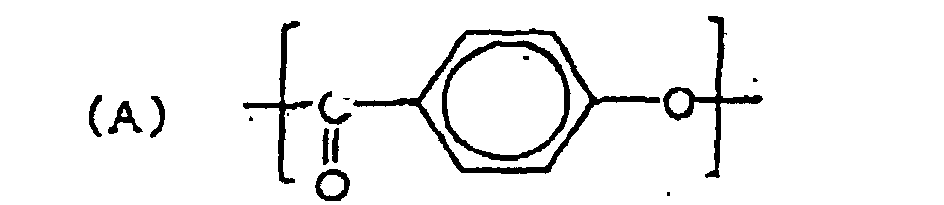
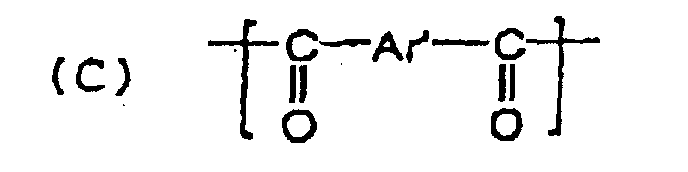
- the present invention provides an aromatic liquid crystalline polyester resin comprising an aromatic hydroxycarboxylic acid unit, an aromatic dicarboxylic acid unit and an aromatic diol unit, which comprises 30 to 80 mol% of the following repeating unit (A), 10 to 35 mol% of the following repeating unit (B) and 10 to 35 mol% of the following repeating unit (C): wherein Ar represents a divalent aromatic group, Ar' represents two or more groups selected from and the content of based on the total content of Ar' is 48 to 95 mol%, and which has a logarithmic viscosity of 1.5 dl/g or more, a flow temperature of 300°C or less, and a melt tension measured at a temperature higher than the flow temperature by 25°C or more of 1.0 g or more, the flow temperature being defined as the temperature (°C) at which the melt viscosity measured by a capillary type rheometer is 48,000 poise when a resin which has been melted by heating at a temperature raising rate of 4°C/
- an aromatic liquid crystalline polyester resin composition which comprises ( ⁇ ) an aromatic liquid crystalline polyester according to the invention as a continuous phase and ( ⁇ ) a copolymer having a group reactive with the aromatic liquid crystalline polyester as a dispersed phase, and which has a flow temperature of 300°C or less, the flow temperature being defined as the temperature (°C) at which the melt viscosity measured by a capillary type rheometer is 48,000 poise when a resin which has been melted by heating at a temperature raising rate of 4°C/min is extruded through a nozzle having an internal diameter of 1 mm and a length of 10 mm under a load of 100 kgf/cm 2 .
- the aromatic liquid crystalline polyester resin of the present invention is an aromatic liquid crystalline polyester resin comprising a copolymer containing an aromatic hydroxycarboxylic acid unit, an aromatic dicarboxylic acid unit and an aromatic diol unit, wherein the polyester resin contains the repeating unit (A) in an amount of 30 to 80 mol% based on the total amount of repeating units, has a logarithmic viscosity of 1.5 dl/g or more, has a flow temperature of 300°C or less, and exhibits a melt tension measured at a temperature higher than the flow temperature by 25°C or more of 1.0 g or more, and exhibits optically anisotropy (liquid crystallinity) in melting, excellent melt-moldability, chemical-resistance and mechanical property.
- A repeating unit
- the amount of the repeating unit (A) of less than 30 mol% based on the total amount of repeating units constituting the polymer is not used since then liquid crystallinity is weak.
- the aromatic liquid crystalline polyester resin of the present invention has a logarithmic viscosity ( ⁇ inh) defined by the following formula of 1.5 dl/g or more, more preferably 2.0 dl/g or more, further preferably 2.5 dl/g or more.
- ⁇ inh logarithmic viscosity
- the upper limit of ⁇ inh is preferably 10 dl/g or less, more preferably 8 dl/g or less.
- ⁇ inh (ln( ⁇ rel))/C
- ⁇ rel is called relative viscosity and represents the ratio of falling time of a polymer solution to falling time of a solvent between given marked lines in a capillary.
- C represents the concentration of a polymer solution, and unit thereof is g/dl.
- Viscosity is measured by an Ostwald viscometer using as a solvent 3,5-bis (trifluoromethyl)phenol at a polymer concentration of 0.1 g/dl and a temperature of 60°C.
- ⁇ inh is suitably 10 dl/g or less, more suitably 8 dl/g or less.
- ⁇ inh is lower than 1.5 dl/g, the molecular weight is low and problems of film forming property and mechanical strength may occur.
- the aromatic liquid crystalline polyester resin of the present invention has a flow temperature of 300°C or less, preferably from 230 to 295°C, further preferably from 240 to 290°C.
- a flow temperature of over 300°C is not preferable since the film forming processing temperature may exceed 320°C.
- the aromatic liquid crystalline polyester resin of the present invention exhibits a melt tension (hereinafter, sometimes abbreviated as "MT") measured at a temperature higher than the flow temperature by 25°C or more of 1.0 g or more, preferably 2 g or more, further preferably 4 g or more, under conditions of an internal diameter of 2.1 mm and a length of 8 mm of a capillary and a piston rate of 5 mm/min.
- MT melt tension
- the MT value is preferably 30 g or less, and more preferably 25 g or less. The less of the temperature dependency of the MT value, the more preferable of the film forming property.
- the aromatic liquid crystalline polyester resin of the present invention is an aromatic liquid crystalline polyester resin comprising 30 to 80 mol%, more preferably 40 to 70 mol% of the following repeating unit (A), 10 to 35 mol%, more preferably 15 to 30 mol% of the following repeating unit (B) and 10 to 35 mol%, more preferably 15 to 30 mol% of the following repeating unit (C), in the formula, Ar represents a divalent aromatic group, in the formula, Ar' represents two or more selected from and the content of based on the total of Ar' is 48 - 95 mole%.
- the ratio of repeating unit (A) is 30 to 80 mol%
- the aromatic liquid crystalline polyester resin may sometimes contains parts which are not melted by heating and accordingly melt-processability falls down, and when the ratio is less than 30 mol%, liquid crystallinity often becomes weak.
- the ratio of the repeating unit (B) is from 10 to 35 mol% and the ratio of the repeating unit (C) is from 10 to 35 mol% so that the aromatic liquid crystalline polyester resin exhibits well-balanced physical properties.
- Ar in the repeating unit (B) represents a divalent aromatic group, and preferably a group having 6 to 20 carbon atoms. More preferably, Ar includes:
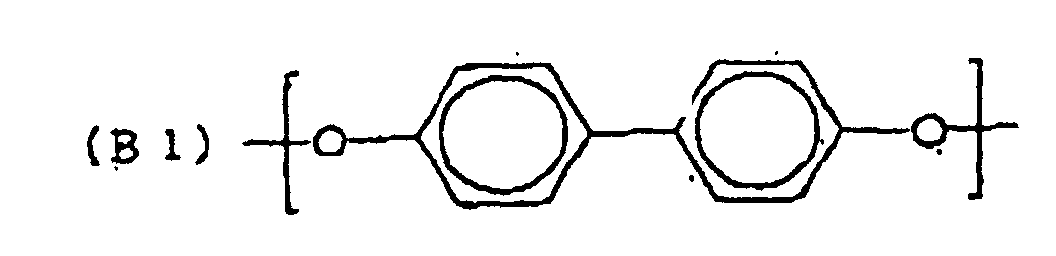
- repeating unit (B) particularly preferable is the following repeating unit (B1).
- This ratio of less than 48 mol% is not used.
- a ratio of less than 40 mol% is not used since then crystallinity may increase to make mold processing temperature higher.
- this ratio of over 95 mol% is not used since then treatment in the solid state polymerization may be difficult and film forming property may be low.
- the ratio of in Ar' in the repeating unit (C) of from 48 to 95 mol% is preferable from the standpoint of film forming property since then melt tension also increases. Further, in this case, molding (film forming) at a lower temperature becomes possible, and particularly it is also possible to obtain a thin film of 20 ⁇ m or less having oxygen barrier property and excellent water vapor barrier property.
- the repeating unit (C) is composed of 52 to 5 mol% of the following repeating unit (C1) and 48 to 95 mol% of the following repeating unit (C2). More preferably, the repeating unit (C) is composed of 52 to 6 mol% of the following repeating unit (C1) and 48 to 94 mol% of the following repeating unit (C2), further preferably, the repeating unit (C) is composed of 52 to 8 mol% of the following repeating unit (C1) and 48 to 92 mol% of the following repeating unit (C2).
- m-hydroxybenzoic acid, m-formyloxy benzoic acid, m-acetoxybenzoic acid, m-propionyloxybenzoic acid, methyl m-hydroxybenzoate, propyl m-hydroxybenzoate, phenyl m-hydroxybenzoate, benzyl m-hydroxybenzoate, methyl m-acetoxybenzoate, 6-hydroxy-2-naphthoic acid, 6-acetoxy-2-naphthoic acid, methyl 6-hydroxy-2-naphthoate, phenyl 6-hydroxy-2-naphthoate, or methyl 6-hydroxy-2-naphthoate can be used together within the range which does not exert significant influence on physical properties and processability (film forming property) of the resulting aromatic liquid crystalline polyester resin.
- Examples of the compound represented by the above-described formula (II) include 1,4-dihydroxybenzene, 1,3-dihydroxybenzene, 4,4'-dihydroxydiphenyl, 4,4'-dihydroxybenzophenone, 4,4'-dihydroxydiphenylmethane, 4,4'-dihydroxydiphenylethane, 4,4'-dihydroxydiphenyl ether, 2,2'-bis(4-hydroxyphenyl)propane, 4,4'-dihydroxydiphenylsulfone, 4,4'-dihydroxydiphenylsulfide, 2,6-dihydroxynaphthalene, 1,4-dihydroxynaphthalene, 2,7-dihydroxynaphthalene, and compounds obtained by substituting dihydroxy on these compounds by diacetoxy, dipropionyloxy or dibenzoyloxy, and further, compounds obtained by nuclear substitution by an alkyl group such as a methyl group, a tert-butyl group and the
- Preferable examples are selected from 1,4-dihydroxybenzene, 1,3-dihydroxybenzene, 4,4'-dihydroxydiphenyl, 4,4'-dihydroxydiphenyl ether, 2,6-dihydroxynaphthalene, 4,4'-dihydroxydiphenylmethane, and compounds obtained by substituting dihydroxy on these compounds by diacetoxy. Further preferable examples are selected from 1,3-dihydroxybenzene, 4,4'-dihydroxydiphenyl, 4,4'-dihydroxydiphenyl ether, and compounds obtained by substituting dihydroxy on these compounds by diacetoxy, and 4,4'-dihydroxydiphenyl or 4,4'-diacetoxydiphenyl is particularly preferable.
- the compounds represented by the above-described formula (III) are used in a mixture of two or more compounds differing at least in Ar' parts, and examples of such compounds include terephthalic acid, methyl terephthalate, ethyl terephthalate, propyl terephthalate, benzyl terephthalate, phenyl terephthalate, 2,6-dicarboxynaphthalene, 2,6-dimethyloxycarboxylnaphthalene, 2,6-diethyloxycarbonylnaphthalene, 2,6-dipropyloxycarbonylnaphthalene, 2,6-dibenzyloxycarbonylnaphthalene, 2,6-diphenyloxycarbonylnaphthalene, isophthalic acid, methyl isophthalate, ethyl isophthalate, propyl isophthalate, benzyl isophthalate and phenyl isophthalate.
- the molar ratio ((II):(III)) of a compound represented by the formula (II) to a compound represented by the formula (III) in charging is preferably (90 to 115):100, more preferably (100 to 110):100 from the viewpoints of polymer physical properties, particularly heat stability.
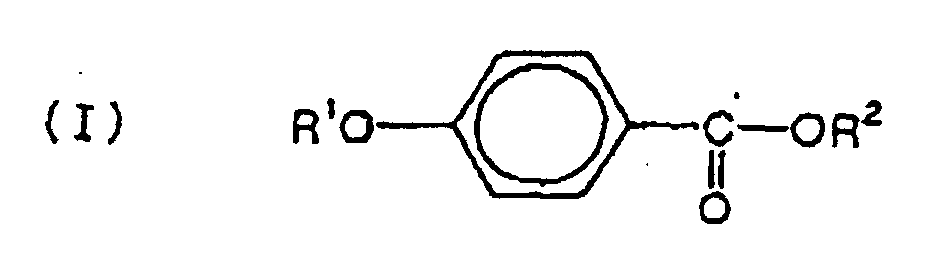
- a mixture composed of compounds represented by the formulae (I), (II) and (III) is polycondensed in a reaction vessel, and each compound can be charged into the reaction vessel either all together or in portion.
- the reaction can be conducted under atmosphere of an inert gas, for example, nitrogen, at normal pressure, reduced pressure or combination thereof, and batch-wise process, continuous process or combination thereof can be adopted.
- a reaction which converts such a compound into a compound which is easily polycondensed for example, esterification reaction using an acid anhydride such as acetic anhydride and the like
- the polycondensation reaction is conducted subsequently.
- the temperature of the polycondensation reaction in the present invention is preferably from 270 to 350°C, and more preferably from 280 to 330°C.
- the reaction temperature is lower than 270°C, progress of the reaction is slow, and when over 350°C, sub-reactions such as decomposition and the like tend to occur.
- Multi-stage reaction temperature may also be adopted, and if necessary, it is possible that an aromatic liquid crystalline polyester resin produced in the reaction is taken out in a molten state during the reaction or immediately after reaching to the maximum temperature.
- Heating of the reaction vessel is conducted by heat medium, gas or electric heater, and it is preferable that stirring axis, blades, baffle plate and the like are also heated for uniform heating.
- the reaction temperature of the last portion is referred to as the polycondensation temperature of the present invention.
- the time of the polycondensation reaction should be appropriately determined depending on the reaction conditions, and preferably it is from 0.5 to 5 hours at the above reaction temperature.
- the aromatic liquid crystalline polyester resin is taken out in a molten state, preferably under atmosphere of an inert gas such as nitrogen in view of the color of the resulting polymer. However, it can be taken out in air when moisture content is low.
- the device for taking out the aromatic liquid crystalline polyester resin of the present invention in a molten state known extruders, gear pumps are explainified, and a valve may also be sufficient. Since the taken out resin is solidified after somewhile, then, the resin is cut by a strand cutter and a sheet cutter, and pulverized according to the object. For treating a large amount of the resin in a short time, there is exemplified a method in which the resin is passed through a constant feeding apparatus and cooled by a double belt cooler as described in JP-A No. 6-256485 by the present applicant.
- the aromatic liquid crystalline polyester resin taken out in a molten state may sometimes be used as it is, it is preferable to carry out solid phase polymerization to remove unreacted raw materials, to increase molecular weight and to improve physical properties.
- the resulted aromatic liquid crystalline polyester resin is pulverized by a known grinder into a particle (powder) having an average particle size (according to Rosin-Rammlar method) of 3 mm or less, preferably 0.5 mm or less, further preferably from 0.1 to 0.4 mm, and solid phase polymerization is conducted by heat treatment under inert gas atmosphere with keeping the solid state of the particle.
- the polymerization rate differs and the diffusion rate of by-products resulted from reaction of raw materials also differs between at surface layer and at inner portion, consequently molecular weight distribution becomes broad and removal of materials which should be removed becomes insufficient, therefore, foaming and gas generation sometimes occur.
- the inert gas is selected from nitrogen, helium, argon and carbon dioxide, and among them, nitrogen is preferable.
- nitrogen is preferable.
- air, particularly oxygen is present, an aromatic liquid crystalline polyester is oxidized at a high temperature, and deterioration of physical properties and coloration tend to occur, therefore, the presence of oxygen is not preferable.
- a known drier, reaction apparatus, mixer, electric furnace and the like can be used, and a gas-flow type closed furnace is preferable.
- the form of the aromatic liquid crystalline polyester resin used in the present invention in usual molding processing is a powder or a pellet (granulated pellet) obtained after granulation of the resin in heat-melted condition by a twin screw extruder and the like, and a granulated pellet is more preferable.
- the above-mentioned liquid crystalline polyester can be preferably used for a liquid crystalline polyester resin composition comprising this liquid crystalline polyester ( ⁇ ) as continuous phase and a copolymer having a reactive group with the aromatic liquid crystalline polyester ( ⁇ ) as a dispersed phase.
- the flow temperature of this liquid crystalline polyester resin composition is 300 °C or less.
- glycidyl group is exemplified preferably.
- unsaturated carboxylic acid glycidyl ester and unsaturated glycidyl ether can be used preferably.
- unsaturated carboxylic acid glycidyl ester examples include glycidyl acrylate, glycidyl methacrylate, itaconic acid diglycidyl ester, butene tricarboxylic acid triglycidyl ester and p-styrene carboxylic acid glycidyl ester.
- unsaturated glycidyl ether examples include vinyl glycidyl ether and allyl glycidyl ether.
- the above copolymer having a reactive group with the aromatic liquid crystalline polyester ( ⁇ ), is a copolymer which contains preferably 0.1 to 30% by weight of unsaturated glycidyl carboxylate unit and/or unsaturated glycidyl ether unit.
- the above copolymer having a reactive group with the aromatic liquid crystalline polyester ( ⁇ ) may be either rubber or thermoplastic resin, and also may be a mixture of thermoplastic resin and rubber. When rubber is used, mold processing property and flexibility of the composition are excellent, and it is preferable.
- the copolymer ( ⁇ ) of the present invention has preferably a heat of fusion of less than 3J/g.
- Mooney viscosity of the copolymer ( ⁇ ) is suitably 3 to 70, more suitably 3 to 30, further suitably 4 to 25.
- the "Mooney viscosity” herein denotes a value measured by a 100°C, large rotor according to the JIS K6300.
- a "rubber” herein corresponds to a polymer having rubber elasticity in a room temperature disclosed in the new edition polymer dictionary (compiled by the Polymer Society, published in 1988 by Asakura Shoten).
- examples thereof include natural rubber, butadiene polymer, butadiene-styrene copolymer (including random copolymer, block copolymer (including SEBS rubber and SBS rubber), and graft copolymer), or hydrogenated products thereof, isoprene polymer, chlorobutadiene polymer, butadiene-acrylonitrile copolymer, isobutylene polymer, isobutylene-butadiene copolymer, isobutylene-isoprene copolymer, acrylate-ethylene containing copolymer rubber, ethylene-propylene copolymer rubber, ethylene-butene copolymer rubber, ethylene-propylene-styrene copolymer rubber, styrene-isoprene
- These rubber-like materials can be produced in any production method such as an emulsion polymerization method and a solution polymerization method, with any catalyst such as trialkylaluminum, lithium halide and nickel containing catalyst.
- Copolymers ( ⁇ ) of the present invention include the above-mentioned rubbers, having a functional group reactive with a liquid crystalline polyester (A).
- the (metha)acrylate is an ester obtained from an acrylic acid or methacrylic acid, and an alcohol.
- an alcohol having 1-8 carbon atoms is preferable.
- methyl acrylate, methyl methacrylate, n-butyl acrylate, n-butyl methacrylate, tert-butyl acrylate, tert-butyl methacrylate, 2-ethylhexyl acrylate, and 2-ethylhexyl methacrylate are preferable.
- These (metha)acrylates can be used alone or in combination of two or more.
- Component ratio of the above-mentioned (meth)acrylate-ethylene-unsaturated carboxylic acid glycidyl ester and/or unsaturated glycidyl ether copolymer rubber is preferably more than 40 but less than 97 weight %, more preferably 45 to 70 weight % of (meth)acrylate, preferably more than 3 but less than 50 weight %, more preferably 10 to 49 weight % of an ethylene unit, and preferably more than 0.1 but less than 30 weight %, more preferably 0.5 to 20 weight % of an unsaturated carboxylic acid glycidyl ester and/or unsaturated glycidyl ether unit.
- thermal stability and/or mechanical properties of the article such as a film and sheet become inferior sometimes, and it is not preferable.
- the above copolymer rubber can be produced in an ordinary method, such as bulk polymerization, emulsion polymerization and solution polymerization with a free radical initiator.
- An representative polymerization method is disclosed in the JP-B No. 46-45085 and JP-B-61-127709. That is, production can be conducted in the conditions of a 500 kg/cm 2 or more pressure, 40 to 300°C temperature in the presence of a polymerization initiator capable of generating a free radical.
- the rubber which can be used as a copolymer ( ⁇ ) of the present invention include an acryl rubber having a functional group, and a block copolymer rubber of vinyl aromatic hydrocarbon compound-conjugation diene compound which has a functional group reactive with a liquid crystalline polyester.
- alkyl acrylates represented by the above-mentioned general formula (3) include methyl acrylate, ethyl acrylate, propyl acrylate, butyl acrylate, pentyl acrylate, hexyl acrylate, actyl acrylate, 2-ethyl hexyl acrylate, nonyl acryalte, decyl acrylate, dodecyl acrylate and cyano ethyl acrylate.
- alkoxyalkyl acrylates represented by the above-menitoned general formula (4) include methoxy ethyl acrylate, ethoxy ethyl acrylate, butoxy ethyl acrylate and ethoxy propyl acrylate.
- One kind or two or more kinds thereof can be used as a main component of the acrylic rubber.
- unsaturated monomers examples include styrene, ⁇ -methyl styrene, acrylonitril, styrene halide, methacrylonitrile, acryl amide, methacryl amide, vinylnaphthalene, N-methylol acryl amide, vinyl acetate, vinyl chloride, vinylidene chloride, benzyl acrylate, methacrylic acid, itaconic acid, fumaric acid and maleic acid.
- Suitable ratio of acryl rubber having a functional group with liquid crystalline polyester is 40.0 - 99.9 % by weight of monomer selected at least one from the compound represented by the above general formula (3) - (5), 0.1 - 30.0 % by weight of unsaturated glycidyl carboxylate and/or unsaturated glycidyl ether, and 0.0 - 30.0 % by weight of unsaturated monomer which can copolymerize.with the monomer selected at least one from the compound represented by the above general formula (3) - (5), If the components ratio of this acryl rubber is within the above range, the heat resistance, impact resistance, and mold processing property of the composition are good, and it is preferable.
- the vinyl aromatic hydrocarbon compound/conjugated diene compound block copolymer rubber having epoxy group reactive with the liquid crystalline polyester include a rubber obtainable by epoxydating a block copolymer comprising sequences of a vinyl aromatic hydrocarbon compound (a) and sequences of a conjugated diene compound (b), and hydrogenated ruber of the above block copolymer.
- the vinyl aromatic hydrocarbon compound/ block copolymer and its hydrogenated product can be prepared by conventional method, for example, as described in JP-B-40-23798 and JP-A-59-133203.
- Vinyl aromatic hydrocarbon compounds include styrene, vinyl toluene, divinyl benzene, ⁇ -methylstyrene, p-methylstyrene and vinylnaphthalene. Among them, styrene is preferable.
- Conjugated diene compounds include butadiene, isoprene, piperylene, 1,3-pentadiene and 3-butyl-1,3-octadiene. Among them, butadiene and isoprene are preferable.
- a copolymer rubber of (metha)acrylate-ethylene-(unsaturated glycidyl carboxylate and/or unsaturated glycidyl ether) is used preferably.
- the rubber can be vulcanized as needed, and can be used as a vulcanized rubber.
- Vulcanization can be achieved by the use of a polyfunctional organic acid, a polyfunctional amine compound, or an imidazole compound. But vulcanization methods are not limited thereto.
- thermoplastic resin having an epoxy group examples include epoxy group containing ethylene copolymer comprising:
- Examples of the ethylenically unsaturated ester compound (c) include: vinyl ester of carboxylic acid, such as vinyl acetate, vinyl propionate; and alkyl ester of ⁇ , ⁇ -unsaturated carboxylic acid such as methyl acrylate, ethyl acrylate, butyl acrylate, methyl methacrylate, ethyl methacrylate, and butyl methacrylate.
- vinyl ester of carboxylic acid such as vinyl acetate, vinyl propionate
- alkyl ester of ⁇ , ⁇ -unsaturated carboxylic acid such as methyl acrylate, ethyl acrylate, butyl acrylate, methyl methacrylate, ethyl methacrylate, and butyl methacrylate.
- vinyl acetate, methyl acrylate and ethyl acrylate are preferable.
- the epoxy group containing ethylene copolymer examples include: a copolymer which consists of ethylene unit and glycidyl methacrylate unit; a copolymer which consists of ethylene unit, glycidyl methacrylate unit, and methyl acrylate unit; a copolymer which consists of ethylene unit, glycidyl methacrylate unit, and ethyl acrylate unit; and a copolymer which consists of ethylene unit, glycidyl methacrylate unit, and vinyl acetate unit.
- Melt index of the epoxy group containing ethylene copolymer (hereinafter may be called MFR; JIS K6760, 190 °C, 2.16kg load) is suitably 0.5-100g / 10 min., and more suitably 2-50g / 10 min., in view of mechanical physical properties of the composition, and the compatibility with liquid crystalline
- stiffness modulus is preferably in the range of 10-1300 kg/cm 2 , and more 20-1100 kg/cm 2 . When the stiffness modulus is outside this range, processing property or mechanical properties of the composition sometimes become insufficient.
- the epoxy group containing ethylene copolymer is prepared usually by high pressure radical polymerization method of copolymerizing an unsaturated epoxy compound and ethylene using a radical generating agent, at 500 to 4000 atmospheric pressure, and 100-300 °C, under existence or un-existence of suitable solvent and chain transfer agent. Moreover, it can be prepared also by the method of mixing unsaturated epoxy compound and radical generating agent in polyethylene, and carrying out molten graft copolymerization in extruder.
- the liquid crystalline polyester resin composition of the present invention comprises the above liquid crystalline polyester ( ⁇ ) and the above copolymer ( ⁇ ), where the liquid crystalline polyester ( ⁇ ) is a continuous phase and the copolymer having a reactive group with the aromatic liquid crystalline polyester ( ⁇ ) is a dispersed phase.
- liquid crystalline polyester When liquid crystalline polyester is not continuous phase, the gas barrier property, heat resistance, etc. of the film may fall remarkably, and it is not preferable.
- the resin composition comprising a copolymer having a functional group and a liquid crystalline polyester
- a reaction occurs between components ( ⁇ ) and ( ⁇ ) of the composition, while the component ( ⁇ ) forms continuous phase, and the component ( ⁇ ) minutely disperses, and thus, the mold processing property of the composition is improved.
- the flow temperature is 300 °C or less, preferably 220-295 °C, and more preferably 230-286 °C.
- film forming processing temperature may sometimes exceed 310 °C, and it is not preferable.
- the component ( ⁇ ) When the component ( ⁇ ) is less than 56.0 % by weight, the gas barrier property and heat resistance of molded articles, such as film or sheet obtained from this composition may become inferior, and it is not preferable. When the component ( ⁇ ) exceeds 99.9 % by weight, the mold processing property of the composition may fall down, and moreover, it becomes expensive in price, and it is not preferable.
- the flow temperature (FT2) of the liquid crystalline polyester resin composition of the present invention is higher than the temperature which is 20 °C lower than the flow temperature (FT1) of liquid crystalline polyester of component (a) ) of this composition, the mold processing property of the composition is improved, and it is preferable. It is more suitable that FT2 is higher than the temperature which is 10 °C lower than FT1. It is still suitable that FT2 is higher than FT1.
- the melt tension (MT) measured at a temperature of higher by 25 °C or more than the flow temperature is 1.5g or more, more preferably 2g or more, and further preferably 5g or more.
- MT melt tension
- cylinder setting temperature of kneading device is suitably 200-350 °C, more suitably 230-330 °C, and further suitably 230-310 °C.
- each component may be mixed uniformly beforehand, by a tumbling mixer or a Henschel mixer, and if necessary, each component can be fed separately and quantitatively into a kneader.
- An inorganic filler can be optionally added to the aromatic liquid crystalline polyester resin used in the present invention.
- examples of such inorganic filler include calcium carbonate, talc, clay, silica, magnesium carbonate, barium sulfate, titanium oxide, alumina, gypsum, glass flake, glass fiber, carbon fiber, alumina fiber, silica alumina fiber, aluminum borate whisker, potassium titanate fiber and the like.
- additives such as an organic filler, antioxidant, heat stabilizer, optical stabilizer, flame retardant, lubricant, antistatic agent, inorganic or organic coloring agent, preservative, crosslinking agent, foaming agent, fluorescent agent, surface smoothing agent, surface gloss improver, releasing improver like a fluorine resin, and the like can be further added, during production process or in the later processing process, to the aromatic liquid crystalline polyester resin used in the present invention.
- Formation of a film made of an aromatic liquid crystalline polyester resin in the present invention is not particularly restricted and can be conducted easily by a well-known method.
- a film can be obtained by a T die method in which a melted resin is extruded through a T die and wound, or an blown film forming method in which a melted resin is extruded in cylindrical form through an extruder equipped with a annular dice, cooled, and wound, or a film can also be obtained by further drawing uniaxially a sheet obtained by an injection molding method or an extrusion method.
- the aromatic liquid crystalline polyester resin is fed to a melt-kneading extruder equipped with a die having annular slit, and melt-kneading is conducted at a cylinder set temperature of 200 to 320°C, preferably 210 to 310°C, further preferably 220 to 310°C to extrude a cylindrical film upward or downward through the annular slit of the extruder.
- the clearance of the annular slit is from 0.1 to 5 mm, preferably from 0.2 to 2 mm, and the diameter of the annular slit is usually from 20 to 1000 mm, preferably from 25 to 600 mm.
- Draft is applied to the melt extruded cylindrical melted resin film in longitudinal direction (MD), and at the same time, the film is expanded in transverse direction (TD) which is perpendicular to the longitudinal direction by blowing air or inert gas, for example, a nitrogen gas from inside of this cylindrical film.
- MD melt extruded cylindrical melted resin film
- TD transverse direction
- preferable TD drawing magnification namely, blow ratio is from 1.5 to 15, and further preferably from 2.5 to 15.
- Preferable MD drawing magnification namely, draw ratio is from 1.5 to 40, and further preferably from 2.5 to 30.
- the blow ratio is (diameter of a cylindrical film) /(diameter of a dice), and the draw ratio if (surface area of an annular slit)/(sectional area of a film).
- the circumference of the expanded film is usually cooled air or inert gas, for example, a nitrogen gas and the like, then, taken up through nip rolls.
- inert gas for example, a nitrogen gas and the like
- blown film molding such conditions can be selected that a cylindrical melted film is expanded to obtain a cylinder having uniform thickness and having smooth surface, depending on the composition of the aromatic liquid crystalline polyester resin.
- the thickness of an aromatic liquid crystalline polyester resin layer in the present invention is not particularly restricted, and preferably from 1 to 500 ⁇ m, futher preferably from 1 to 200 ⁇ m.
- Flow temperature It is a index showing melt-flowability, and represents a temperature (°C) at which the melt viscosity measured by a capillary type rheometer (for example, Koka Flow Tester CFT-500 manufactured by Shimadzu Corp.) is 48,000 poise when a sample resin (about 2 g) which has been melted by heating at a temperature raising rate of 4°C/min is extruded through a nozzle having an internal diameter of 1 mm and a length of 10 mm under a load of 100 kgf/cm 2 .
- a capillary type rheometer for example, Koka Flow Tester CFT-500 manufactured by Shimadzu Corp.
- Transition temperature to liquid crystal It was given by endothermic peaks when heat behavior of a sample was measured using a differential type thermobalance (TAS-200 manufactured by Rigaku Co., Ltd.) under nitrogen flow at 70 ml/min with raising temperature at a rate of 10°C/min.
- weight reduction about 20 mg of a sample resin having a particle size of 250 ⁇ m or less was heated at a temperature raising rate of 10°C/min in nitrogen atmosphere and weight change up to 400°C was measured using a differential type thermobalance (TAS-200 manufactured by Rigaku K.K.), and weight reduction ratio (%) was calculated based on the original weight.
- TAS-200 manufactured by Rigaku K.K.
- Optical anisotropy of a sample resin in a molten state was given by heating a sample resin powder having a particle size of 250 ⁇ m or less placed on a heating stage at a rate of 25°C/min under polarized light and observing visually or recording the amount of transmitted light by an XY recorder.
- Melt viscosity About 10 g of a sample was charged into Capirograph 1B (manufactured by Toyo Seiki Seisaku-sho, Ltd.) using a capillary having an internal diameter of 0.5 mm and a length of 10 mm, and melt-viscosity was measured at temperature with a given shear rate (100 sec -1 , 1000 sec -1 ).
- Melt tension About 10 g of a sample was charged into Capirograph 1B (manufactured by Toyo Seiki Seisaku-sho, Ltd.) and the sample was taken up in string form using a capillary having an internal diameter of 2.095 mm and a length of 8.0 mm at an extruding rate of a piston of 5.0 mm/min with raising winding speed automatically by a speed changeable winding machine, and tension at break was measured.
- the melt tension is measured at a temperature higher than the flow temperature by 25°C or more, preferably at the lowest such temperature at which the melt tension is measurable.
- Oxygen gas permeability It was measured according to JIS K7126 A (differential pressure method) at a temperature of 20°C. The unit is cc/m 2 ⁇ 24 hr ⁇ 1 atm.
- Water vapor permeability Its was measured according to JIS Z0208 (cup method) at a temperature of 40°C and a relative humidity of 90%. The unit is cc/m 2 ⁇ 24 hr ⁇ 1 atm.
- the oxygen gas permeability and the water vapor permeability were calculated in terms of a film thickness of 25 ⁇ m.
- Light transmittance of a film was measured using a U-3500 type auto-recording spectrophotometer manufactured by Hitachi Ltd.
- Tensile strength of a film Measurement was conducted according to JIS K7127 (tensile test method of plastic film and sheet) using a dumbbell type sample piece at a sample number of 5 and a test speed of 5 mm/min.
- Film appearance was evaluated with eye observation. ⁇ : Film has uniform thickness, and no protruding portion of insufficient melting is observed. ⁇ : Film has un-uniform thickness, and protruding portion of insufficient melting is observed.
- This prepolymer was placed on an aluminum tray which was charged into a furnace in nitrogen atmosphere, heated from room temperature to 200°C over 1 hour under nitrogen atmosphere, and further heated up to 250°C over 8.5 hours and kept for 5 hours, then, cooled and taken out to obtain a polymer of an aromatic liquid crystalline polyester resin having a FT of 289°C (advanced polymer). In this stage, weight reduction was 1.3%.
- the resulted advanced polymer was melt-kneaded by a PCM-30 twin screw extruder manufacture by Ikegai Co.,Ltd. at a die head temperature of 310°C and a screw rotation of 80 rpm to obtain an aromatic liquid crystalline polyester resin pellet having a FT of 256°C.
- the melt tension of this resin pellet at 291°C (FT+35°C) was 1.6 g, and the logarithmic viscosity ( ⁇ inh) measured at 60°C was 2.53 dl/g.
- the melt-viscosity is shown in Table 1.
- the resulted aromatic liquid crystalline polyester resin pellet was made into a film using a Labo Plasto mill (manufactured by Toyo Seiki Seisaku-sho Ltd.) to which a twin screw extruder having a diameter of 30 mm ⁇ was installed and onto head portion of which a tublar die having a diameter of 25 mm ⁇ and a die gap of 0.75 mm was mounted, at a cylinder temperature of 275°C, a die head temperature of 276°C and a winding speed of 40 m/min, to obtain a film having a folding width of 150mm.
- melt-polymerization was conducted at 320°C for 2 hours, the stirring was terminated, and the polymer could be easily taken out in a molten state and there was little adhesion to the polymerization vessel and the stirring blade.
- This polymer had a FT of 220°C and exhibited optically anisotropic melt.
- the yield of the resulted polyester was 1592 g (99.5 % based on theoretical yield).
- the resulted advanced polymer was melt-kneaded by a PCM-30 twin screw extruder manufacture by Ikegai Co., Ltd. at a die head temperature of 293°C and a screw rotation of 80 rpm to obtain an aromatic liquid crystalline polyester resin pellet having a FT of 245°C.
- the melt tension of this resin pellet at 295°C (FT+50°C) was 1.4 g.
- the melt-viscosity is shown in Table 1.
- the resulted aromatic liquid crystalline polyester resin pellet was made into a film according to the same manner as in Example 1(4), at a cylinder temperature of 285°C, a die head temperature of 285°C and a winding speed of 10 m/min, to obtain a film having a folding width of 150 mm.
- the film forming was conducted stably, the film thickness was 30 to 35 ⁇ m, and appearance of the film was excellent and no protruding portion of insufficient melt was observed.
- Example 1(2) The same solid phase polymerization was conducted as in Example 1(2) except that "raising temperature up to 250°C over 8.5 hours” was changed to "raising temperature up to 260°C over 10 hours” to obtain an aromatic liquid crystalline polyester resin having a FT of 299°C (advanced polymer). In this stage, weight reduction was 1.4%.
- the resulted advanced polymer was melt-kneaded by a PCM-30 twin screw extruder manufacture by Ikegai Co., Ltd. at a die head temperature of 310°C and a screw rotation of 80 rpm to obtain an aromatic liquid crystalline polyester resin pellet having a FT of 279°C.
- the melt tension of this resin pellet at 309°C (FT+30°C) was 1.9 g.
- the melt-viscosity is shown in Table 1.
- the resulted aromatic liquid crystalline polyester resin pellet was made into a film according to the same manner as in Example 1(4), at a cylinder temperature of 310°C, a die head temperature of 310°C and a winding speed of 15 m/min, to obtain a film having a folding width of 150 mm.
- the bubble was stable, the film thickness was 25 to 30 ⁇ m, and the film appearance was excellent and no protruding portion of insufficient melt was observed.
- the temperature of the heat medium was kept at 300 to 310°C, and then, sampling was conducted at 1 hour, and the flow temperature was measured to find it was 235°C. After further reaction for 1 hour, then, the stirring was terminated.
- the polymer could be easily taken out in a molten state and there was little adhesion to the polymerization vessel and the stirring blade.
- the resulted polyester had a FT of 236°C, and the yield was 20.6 kg (98.1% based on theoretical yield), and endothermic peak accompanying liquid crystal transition was shown at a temperature of 265°C or more.
- the resulted polymer was pulverized by an ordinary crude grinding machine and a fine grinding machine to obtain a particle of 1.0 mm or less. This was treated in a furnace in nitrogen atmosphere for 5 hours at a final treating temperature of 260°C under nitrogen gas atmosphere, to obtain a polymer of an aromatic liquid crystalline polyester resin having a FT of 309°C (advanced polymer). In this stage, weight reduction was 1.3%.
- the resulted advanced polymer was melt-kneaded by a PCM-30 twin screw extruder manufacture by Ikegai Co., Ltd. at a die head temperature of 329°C and a screw rotation of 100 rpm to obtain an aromatic liquid crystalline polyester resin pellet having a FT of 269°C.
- the melt tension of this resin pellet at 319°C (FT+50°C) was 24 g, and the logarithmic viscosity ( ⁇ inh) measured at 60°C was 3.83 dl/g.
- the melt-viscosity is shown in Table 1.
- the resulted aromatic liquid crystalline polyester resin pellet was made into a film using the same apparatus as in Example 1(4) onto head portion of which a tubular die having a diameter of 25 mm ⁇ and a die gap of 0.75 mm had been amounted, at a cylinder temperature of 315°C, a die head temperature of 315°C and a winding speed of 5 to 40 m/min, to obtain a film having a folding width of 150 to 160 mm.
- the bubble was stable, the film thickness was 43 to 52 ⁇ m at a winding speed of 5 m/min, 10 to 17 ⁇ m at a winding speed of 30 m/min, and the film appearance was excellent and no protruding portion of insufficient melt was observed.
- the water vapor permeation rate of the film obtained at a winding speed of 5 m/min was 0.4 g/m 2 ⁇ 24 hr, and oxygen permeability was 2.6 cc/m 2 ⁇ 24hr ⁇ 1atm.
- the light transmittance at 600 nm of a film having a thickness of 4 to 6 ⁇ m was 50%.
- the strength of the film is shown in Table 2.
- the resulted advanced polymer was melt-kneaded by a twin screw extruder as in Example 1(3) at a die head temperature of 329°C and a screw rotation of 100 rpm to obtain a resin pellet having a FT of 324°C.
- the melt tension of this resin pellet at 354°C (FT+30°C) was 1.3 g.
- the melt-viscosity is shown in Table 1.
- the resulted aromatic liquid crystalline polyester resin pellet was tried to made into a film as the same manner with Example 1(4), at a cylinder temperature of 315°C and a die head temperature of 320°C, however, the pellet was not melted and a film could not be formed.
- the Dimroth condenser was exchanged with a Liebig condenser, and the temperature was raised at a rate of 1°C/min and kept at 320°C for about 2 hours to conduct polymerization with removing acetic acid and excess of acetic anhydride On the way of the polymerization, sampling was conducted at 1 hour of the polymerization, and the flow temperature was measured to find it was 223°C.
- the resulted polymer was melt-kneaded by a PCM-30 twin screw extruder manufactured by Ikegai Co.,Ltd. at a die head temperature of 300°C and a screw rotation of 100 rpm to obtain pellets having a FT of 255°C.
- the melt tension of the pellets at 295°C (FT+40°C) was 1.2 g.
- A-2 was melt-kneaded by a PCM-30 twin screw extruder manufacture by Ikegai Co.,Ltd. at a die head temperature of 293°C and a screw rotation of 80 rpm to obtain a pellet having a FT of 245°C.
- the melt tension of this resin pellet at 295°C (FT+50°C) was 1.4 g.
- A-3 was melt-kneaded by a PCM-30 twin screw extruder manufactured by Ikegai Co.,Ltd. at a die head temperature of 310°C and a screw rotation of 100 rpm to obtain a pellet having a FT of 279°C.
- the melt tension of this resin pellet at 309°C (FT+30°C) was 1.9 g.
- the Dimroth condenser was exchanged with a Liebig condenser, and the temperature was raised at a rate of 1°C/min and kept at 320°C for about 2 hours to conduct polymerization with removing acetic acid and excess of acetic anhydride On the way of the polymerization, sampling was conducted at 1 hour of the polymerization, and the flow temperature was measured to find it was 223°C.
- This prepolymer was placed on an aluminum tray which was charged into a furnace in nitrogen atmosphere. After replacing completely the inside of the furnace with nitrogen, then the furnace was heated from room temperature to 200°C over 1 hour under nitrogen atmosphere, and further heated up to 270°C over 12 hours (temperature raising rate was about 0.1 °C/min) and kept for 5 hours to conduct solid polymerization, then, cooled under nitrogen atmosphere and a solid polymerization powder was obtained (advanced polymer).
- the advanced polymer has a FT of 314°C and the logarithmic viscosity was 3.8 dl/g.
- the polymer is abbreviated as A-4.
- the polymer showed optical anisotropy in melt.
- A-4 was melt-kneaded by a TEX-30 twin screw extruder manufacture by Nihon Seiko Co.,Ltd. at a die head temperature of 315°C and a screw rotation of 200 rpm to obtain a pellet having a FT of 260°C.
- the melt tension of this resin pellet at 310°C (FT+50°C) was 10.3 g.
- the resulted aromatic liquid crystalline polyester resin composition was made into a film using a Labo Plasto mill (manufactured by Toyo Seiki Seisaku-sho Ltd.) to which a twin screw extruder having a diameter of 30 mm ⁇ was installed and onto head portion of which a tubular die having a diameter of 25 mm ⁇ and a die gap of 0.75 mm was mounted, at a cylinder temperature of 280-290 C, a die head temperature of 290°C and a winding speed of 20 m/min, to obtain a film having a folding width of 150mm.
- the stability of the film-forming process was good, the film thickness was 14 to 21 ⁇ m, and the film appearance of the film was excellent.
- the oxygen gas permeability was 5.7 cc/m 2 ⁇ 24hr ⁇ 1atm, and the water permeability was 0.46 g/m 2 ⁇ 24hr ⁇ 1atm.
- the resulted aromatic liquid crystalline polyester resin composition was made into a film using the same film forming apparatus of Example 5, at a cylinder temperature of 270-275 °C, a die head temperature of 275°C and a winding speed of 10 m/min, to obtain a film having a folding width of 150mm.
- the stability of the film-forming process was good, the film thickness was 28 to 33 ⁇ m, and the film appearance of the film was excellent.
- the resulted aromatic liquid crystalline polyester resin composition was made into a film using the same film forming apparatus of Example 5, at a cylinder temperature of 270-275 °C, a die head temperature of 276°C and a winding speed of 10 m/min, to obtain a film having a folding width of 150mm.
- the film forming stability was good, the film thickness was 25 to 30 ⁇ m, and the film appearance of the film was good.
- the resulted aromatic liquid crystalline polyester resin composition was made into a film using the same film forming apparatus of Example 5, at a cylinder temperature of 310 °C, a die head temperature of 310°C and a winding speed of 20 m/min, to obtain a film having a folding width of 150mm.
- the film forming stability was good, the film thickness was 15 to 22 ⁇ m, and the film appearance of the film was good.
- the polymer was melt kneaded by a PCM-30 twin screw extruder manufacture by Ikegai Co.,Ltd. at a die head temperature of 330°C and a screw rotation of 80 rpm to obtain a granulated pellet having a FT of 324°C.
- the melt tension (MT) (measured at FT+40°C) was 0.8 g.
- the resulted aromatic liquid crystalline polyester resin composition was attempted to be made into a film using the same film forming apparatus of Example 5, at a cylinder temperature of 305 °C, a die head temperature of 310°C, but the composition did not melt and any films could not be obtained.
- the aromatic liquid crystalline polyester resin and resin composition thereof of the present invention exhibits smaller temperature dependency of melt viscosity and tends to show wider molding processing temperature range as compared with a known wholly aromatic liquid crystalline polyester resin, and the melt tension thereof can be increased with suppressing increase in processing temperature, and film forming processability thereof is excellent.
- a film made of the aromatic liquid crystalline polyester resin has sufficient heat-resistance and improved low temperature molding processability as a wrapping material, and has an excellent gas barrier property, and further has little protruding portion of insufficient melt and the appearance thereof is excellent, therefore, it can be used as a film material for various wrapping uses such as food wrapping, drug wrapping, cosmetics wrapping, electric material wrapping and the like.
Landscapes
- Chemical & Material Sciences (AREA)
- Health & Medical Sciences (AREA)
- Chemical Kinetics & Catalysis (AREA)
- Medicinal Chemistry (AREA)
- Polymers & Plastics (AREA)
- Organic Chemistry (AREA)
- Polyesters Or Polycarbonates (AREA)
- Compositions Of Macromolecular Compounds (AREA)
Claims (19)
- Aromatisches, flüssigkristallines Polyesterharz, umfassend eine aromatische Hydroxycarbonsäure-Einheit, eine aromatische Dicarbonsäure-Einheit und eine aromatische Diol-Einheit, welches 30 bis 80 Mol-% der nachstehenden Wiederholungseinheit (A), 10 bis 35 Mol-% der nachstehenden Wiederholungseinheit (B) und 10 bis 35 Mol-% der nachstehenden Wiederholungseinheit (C) umfasst:
 wobei Ar einen zweiwertigen aromatischen Rest bedeutet, Ar' zwei oder mehrere aus
 ausgewählte Reste bedeutet, und der Gehalt an
 bezogen auf den Gesamtgehalt an Ar' 48 bis 95 Mol-% beträgt, und welches eine logarithmische Viskosität von 1,5 dl/g oder mehr, eine Fließtemperatur von 300°C oder weniger, und eine Schmelzspannung, gemessen bei einer Temperatur, die um 25°C oder mehr oberhalb der Fließtemperatur liegt von 1,0 g oder mehr aufweist, wobei die Fließtemperatur als die Temperatur (°C) definiert ist, bei der die mit einem Kapillar-Rheometer bestimmte Schmelzviskosität 48,000 Poise beträgt, wenn das Harz, welches durch Erwärmen bei einer Temperaturerhöhungsgeschwindigkeit von 4°C/min geschmolzen wurde, durch eine Düse mit einem Innendurchmesser von 1 mm und einer Länge von 10 mm unter eine Belastung von 100 kgf/cm2 extrudiert wird.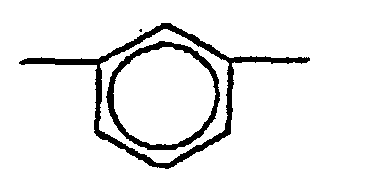
- Harz gemäß Anspruch 1, wobei die Wiederholungseinheit (B) die nachstehende Wiederholungseinheit (B1) ist:
- Harz gemäß Anspruch 1 oder 2, wobei die Wiederholungseinheit (C) 52 bis 5 Mol-% der nachstehenden Wiederholungseinheit (C1) und 48 bis 95 Mol-% der nachstehenden Wiederholungseinheit (C2) umfasst:

- Harz gemäß einem der Ansprüche 1 bis 3, wobei das Verhältnis η2/η1 der Schmelzviskosität (η1), gemessen bei einer Schergeschwindigkeit von 100 sek-1 oder 1000 sek-1 bei der Fließtemperatur des Harzes und der Schmelzviskosität (η2), gemessen bei der gleichen Schergeschwindigkeit wie η1 bei einer um 20°C höheren Temperatur als die Fließtemperatur, 0,10 bis 0,80 beträgt.
- Verfahren zur Herstellung eines aromatischen, flüssigkristallinen Polyesterharzes, umfassend die Schritte Einfüllen in ein Reaktionsgefäß von 30 bis 80 Mol-% einer Verbindung der nachstehenden Formel (I):wobei R1 ein Wasserstoffatom, eine Formylgruppe, Acetylgruppe, Propionylgruppe oder Benzoylgruppe bedeutet, und R2 ein Wasserstoffatom, eine Methylgruppe, Ethylgruppe, Propylgruppe, Benzylgruppe oder Phenylgruppe bedeutet, 10 bis 35 Mol-% einer Verbindung der nachstehenden Formel (II):
 wobei Ar' zwei oder mehrere aus
 ausgewählte Gruppen bedeutet und der Gehalt an
 bezogen auf den Gesamtgehalt an Ar' 48 bis 95 Mol-% beträgt, und R4 ein Wasserstoffatom, eine Methylgruppe, Ethylgruppe, Propylgruppe, Benzylgruppe oder Phenylgruppe bedeutet, Polykondensieren des eingefüllten Gemisches bei einer Temperatur von 270 bis 350°C, um ein aromatisches, flüssigkristallines Polyesterharz mit einer Fließtemperatur von 210°C oder mehr und um 30°C oder mehr unterhalb der Temperatur der Polykondensationsreaktion herzustellen, Entfernen des aromatischen, flüssigkristallinen Polyesterharzes in einem flüssigen Zustand aus dem Reaktionsgefäß und Verfestigen des Harzes, dann Pulverisieren des verfestigten Harzes in Teilchen mit einer Teilchengröße von 3 mm oder weniger und Behandeln des Pulvers bei einer Temperatur von 200 bis 310°C nach wie vor im festen Zustand unter einer Inertgasatmosphäre über 1 bis 24 Stunden, und Granulieren des Produkts in einem wärmegeschmolzenen Zustand in Pellets.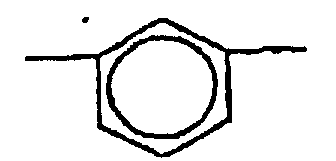
- Aromatische, flüssigkristalline Polyesterharzfolie, im Wesentlich bestehend aus einem aromatischen, flüssigkristallinen Polyesterharz nach einem der Ansprüche 1 bis 4.
- Aromatischer, flüssigkristalliner Polyesterharzfilm, erhältlich durch Blasformen eines aromatischen, flüssigkristallinen Polyesterharzes nach einem der Ansprüche 1 bis 4 bei einem Blasverhältnis (TD Streckvergrößerung) von 1,5 bis 15 und einem Streckverhältnis (MD Streckvergrößerung) von 1,5 bis 40.
- Verfahren zur Herstellung einer aromatischen, flüssigkristallinen Polyesterharzfolie, umfassend Verwenden eines aromatischen, flüssigkristallinen Polyesterharzes nach einem der Ansprüche 1 bis 4.
- Verfahren zur Herstellung einer aromatischen, flüssigkristallinen Polyesterharzfolie, umfassend Blasformen eines aromatischen, flüssigkristallinen Polyesterharzes nach einem der Ansprüche 1 bis 4 bei einem Blasverhältnis (TD Streckvergrößerung) von 1,5 bis 15 und einem Streckverhältnis (MD Streckvergrößerung) von 1,5 bis 40.
- Aromatische, flüssigkristalline Polyesterharzmasse, welche (α) einen aromatischen, flüssigkristallinen Polyester nach einem der Ansprüche 1 bis 4 als kontinuierliche Phase und (β) ein Copolymer mit einem mit dem aromatischen flüssigkristallinen Polyester reaktiven Rest als eine dispergierte Phase umfasst, und welche eine Fließtemperatur von 300°C oder weniger aufweist, wobei die Fließtemperatur als die Temperatur (°C) definiert ist, bei der die mit einem Kapillar-Rheometer gemessene Schmelzviskosität 48,000 Poise beträgt, wenn das Harz, das durch Erwärmen bei einer Temperaturerhöhungsgeschwindigkeit von 4°C/min geschmolzen wurde, durch eine Düse mit einem Innendurchmesser von 1 mm und einer Länge von 10 mm unter einer Belastung von 100 kgf/cm2 extrudiert wird.
- Masse gemäß Anspruch 10, wobei das Verhältnis Viskosität 2/Viskosität 1 0,20 bis 0,80 beträgt, wobei Viskosität 1 die Schmelzviskosität ist, die bei der Fließtemperatur mit einer Schergeschwindigkeit von 100 sek-1 oder 1000 sek-1 gemessen ist, und Viskosität 2 die Schmelzviskosität ist, die bei einer um 20°C höheren Temperatur als die Fließtemperatur mit der gleichen Schergeschwindigkeit wie die bei der Messung der Schmelzviskosität bei der Fließtemperatur verwendeten Schergeschwindigkeit gemessen wird.
- Masse gemäß Anspruch 10 oder 11, wobei die bei einer um mindestens 20°C höheren Temperatur als die Fließtemperatur gemessene Schmelzspannung 1,5 g oder mehr beträgt.
- Masse gemäß einem der Ansprüche 10 bis 12, welche durch Schmelzkneten von 56,0 bis 99,9 Gew.-% des aromatischen, flüssigkristallinen Polyesters (α) und 44,0 bis 0,1 Gew.-% des Copolymers (β) erhältlich ist.
- Masse gemäß einem der Ansprüche 10 bis 13, wobei der mit dem aromatischen, flüssigkristallinen Polyester reaktive Rest eine Oxazolylgruppe, Epoxygruppe oder Aminogruppe ist.
- Masse gemäß einem der Ansprüche 10 bis 14, wobei das Copolymer (β) ein Kautschuk mit einer Epoxygruppe ist.
- Masse gemäß einem der Ansprüche 10 bis 14, wobei das Copolymer (β) ein thermoplastisches Harz mit einer Epoxygruppe ist.
- Masse gemäß einem der Ansprüche 10 bis 16, wobei das Copolymer (β) 0,1 bis 30 Gew.-% einer ungesättigten Glycidylcarboxylateinheit und/oder einer ungesättigten Glycidylethereinheit umfasst.
- Folie einer aromatischen, flüssigkristallinen Polyesterharzmasse, umfassend eine aromatische, flüssigkristalline Polyesterharzmasse nach einem der Ansprüche 10 bis 17.
- Folie gemäß Anspruch 18, erhältlich durch Blasformen einer aromatischen flüssigkristallinen Polyesterharzzusammensetzung nach einem der Ansprüche 10 bis 17 bei einem Blasverhältnis (TD Streckvergrößerung) von 1,5 bis 15 und einem Streckverhältnis (MD Streckvergrößerung) von 1,5 bis 40.
Applications Claiming Priority (4)
| Application Number | Priority Date | Filing Date | Title |
|---|---|---|---|
| JP15925898 | 1998-06-08 | ||
| JP15925898 | 1998-06-08 | ||
| JP18458798 | 1998-06-30 | ||
| JP18458798 | 1998-06-30 |
Publications (3)
| Publication Number | Publication Date |
|---|---|
| EP0964014A2 EP0964014A2 (de) | 1999-12-15 |
| EP0964014A3 EP0964014A3 (de) | 2001-07-25 |
| EP0964014B1 true EP0964014B1 (de) | 2004-08-18 |
Family
ID=26486109
Family Applications (1)
| Application Number | Title | Priority Date | Filing Date |
|---|---|---|---|
| EP19990304476 Expired - Lifetime EP0964014B1 (de) | 1998-06-08 | 1999-06-08 | Aromatische flüssigkristalline Polyester und daraus hergestellte Harzzusammensetzung |
Country Status (4)
| Country | Link |
|---|---|
| US (1) | US6296930B1 (de) |
| EP (1) | EP0964014B1 (de) |
| CA (1) | CA2273664A1 (de) |
| DE (1) | DE69919450T2 (de) |
Families Citing this family (25)
| Publication number | Priority date | Publication date | Assignee | Title |
|---|---|---|---|---|
| FI991006L (fi) * | 1999-05-03 | 2000-11-04 | Optatech Oy | Uudet nestekiteiset polymeerit |
| JP4034019B2 (ja) * | 1999-11-18 | 2008-01-16 | ポリプラスチックス株式会社 | 液晶性ポリエステルの製造方法 |
| JP2001209039A (ja) * | 1999-11-18 | 2001-08-03 | Nitto Denko Corp | 液晶表示装置用表面保護フィルム及び該表面保護フィルムで保護された液晶表示装置並びに該表面保護フィルムを使用した液晶表示装置の表面保護方法 |
| JP4782273B2 (ja) * | 2000-07-28 | 2011-09-28 | 上野製薬株式会社 | 芳香族ジカルボン酸組成物およびそれを用いた液晶ポリエステル樹脂 |
| TWI256959B (en) * | 2000-07-31 | 2006-06-21 | Sumitomo Chemical Co | Aromatic liquid-crystalline polyester solution composition |
| JP2002036454A (ja) * | 2000-07-31 | 2002-02-05 | Sumitomo Chem Co Ltd | 積層体および容器 |
| JP2002341769A (ja) * | 2001-05-21 | 2002-11-29 | Sumitomo Chem Co Ltd | 表示ラベル |
| AT410942B (de) * | 2001-10-29 | 2003-08-25 | Fellinger Markus | Verfahren und vorrichtung zur erhöhung der grenzviskosität von polyester |
| KR100764045B1 (ko) * | 2004-03-10 | 2007-10-08 | 마츠시다 덴코 가부시키가이샤 | 금속 코팅 수지 성형물 및 그의 제조 방법 |
| US7803307B2 (en) * | 2004-06-07 | 2010-09-28 | Interplex Qlp, Inc. | Ultra high-temperature plastic package and method of manufacture |
| US7592413B2 (en) * | 2005-09-22 | 2009-09-22 | E. I. Du Pont De Nemours And Company | Manufacture of aromatic polyester |
| EP2118430A2 (de) * | 2007-01-25 | 2009-11-18 | Baker Hughes Incorporated | Drehwiderstandsbit |
| US9056950B2 (en) | 2010-07-23 | 2015-06-16 | Ticona Gmbh | Composite polymeric articles formed from extruded sheets containing a liquid crystal polymer |
| TWI487726B (zh) | 2011-11-15 | 2015-06-11 | Ticona Llc | 用於具有小尺寸公差之模製部件之低環烷之液晶聚合物組合物 |
| US8932483B2 (en) | 2011-11-15 | 2015-01-13 | Ticona Llc | Low naphthenic liquid crystalline polymer composition |
| TWI534253B (zh) | 2011-11-15 | 2016-05-21 | 堤康那責任有限公司 | 具有改良可燃性效能之富含環烷之液晶聚合物組合物 |
| WO2013074470A2 (en) | 2011-11-15 | 2013-05-23 | Ticona Llc | Fine pitch electrical connector and a thermoplastic composition for use therein |
| US8646994B2 (en) | 2011-11-15 | 2014-02-11 | Ticona Llc | Compact camera module |
| WO2014074227A1 (en) | 2012-11-09 | 2014-05-15 | Ticona Llc | Liquid crystalline polymer composition for films |
| CN113912988A (zh) | 2013-06-07 | 2022-01-11 | 提克纳有限责任公司 | 高强度热致液晶聚合物 |
| US9850343B2 (en) | 2013-07-31 | 2017-12-26 | Toray Industries, Inc. | Method for producing liquid crystalline polyester, and liquid crystalline polyester |
| CN110498913B (zh) * | 2018-05-16 | 2022-06-03 | 臻鼎科技股份有限公司 | 改性的液晶高分子聚合物、高分子膜及相应的制备方法 |
| KR102734010B1 (ko) | 2018-11-21 | 2024-11-25 | 삼성전자주식회사 | 액정 고분자, 복합체 조성물, 성형품, 전지 케이스, 및 전지 |
| CN115335437B (zh) | 2020-03-27 | 2024-12-06 | 富士胶片株式会社 | 聚合物薄膜及通信用基板 |
| WO2021213964A1 (en) * | 2020-04-21 | 2021-10-28 | Solvay Specialty Polymers Usa, Llc | Production process of polyester micropowders |
Family Cites Families (15)
| Publication number | Priority date | Publication date | Assignee | Title |
|---|---|---|---|---|
| US3975487A (en) | 1973-08-20 | 1976-08-17 | The Carborundum Company | Process for spinning high modulus oxybenzoyl copolyester fibers |
| DE3066823D1 (en) | 1979-06-25 | 1984-04-12 | Teijin Ltd | Biaxially oriented wholly aromatic polyester film and process for producing same |
| JPS61102234A (ja) | 1984-10-25 | 1986-05-20 | Asahi Chem Ind Co Ltd | ポリエステルフイルムの製造方法 |
| JPS6258378A (ja) | 1985-09-06 | 1987-03-14 | Fujitsu Ltd | 高速色デ−タ変換方式 |
| DE3736991A1 (de) | 1987-10-31 | 1989-05-11 | Bayer Ag | Thermotrope aromatische polyester mit hoher waermeformbestaendigkeit, verfahren zu ihrer herstellung und ihre verwendung zur herstellung von formkoerpern, filamenten, fasern und folien |
| US4942087A (en) * | 1987-12-28 | 1990-07-17 | Mitsui Petrochemical Industries, Ltd. | Films of wholly aromatic polyester and processes for preparation thereof |
| JPH0639533B2 (ja) | 1988-06-17 | 1994-05-25 | 株式会社クラレ | 全芳香族ポリエステルフイルム及びその製造方法 |
| JP2838119B2 (ja) | 1988-09-02 | 1998-12-16 | 住友化学工業株式会社 | 芳香族ポリエステルの製造法 |
| US5296542A (en) * | 1988-10-11 | 1994-03-22 | Amoco Corporation | Heat resistant polymers and blends of hydroquinone poly (isoterephthalates) containing residues of p-hydroxybenzoic acid |
| DE4235136A1 (de) | 1992-10-19 | 1994-04-21 | Bayer Ag | Thermoplastisch verarbeitbare thermotrope Massen |
| EP0672721B1 (de) * | 1994-03-16 | 2003-08-13 | Sumitomo Chemical Company Limited | Flüssigkristalline Polyesterharzzusammensetzung |
| EP0778867B1 (de) * | 1994-08-31 | 1999-09-15 | E.I. Du Pont De Nemours And Company | Flüssigkristalline harzzusammensetzung |
| EP0737707B1 (de) | 1995-04-12 | 2005-09-28 | Sumitomo Chemical Company, Limited | Folie aus einer flüssigkristallinen Polyesterzusammensetzung |
| EP0790279B2 (de) * | 1996-02-19 | 2007-07-18 | Sumitomo Chemical Company, Limited | Flüssigkristalline Polyesterharz-Zusammensetzung |
| US5767223A (en) * | 1996-07-29 | 1998-06-16 | Nippon Petrochemicals Company, Limited | Wholly-aromatic thermotropic liquid crystal polyester and sealing material for electric and electronic parts |
-
1999
- 1999-06-07 CA CA 2273664 patent/CA2273664A1/en not_active Abandoned
- 1999-06-08 DE DE1999619450 patent/DE69919450T2/de not_active Expired - Lifetime
- 1999-06-08 US US09/327,541 patent/US6296930B1/en not_active Expired - Fee Related
- 1999-06-08 EP EP19990304476 patent/EP0964014B1/de not_active Expired - Lifetime
Also Published As
| Publication number | Publication date |
|---|---|
| EP0964014A2 (de) | 1999-12-15 |
| US6296930B1 (en) | 2001-10-02 |
| CA2273664A1 (en) | 1999-12-08 |
| DE69919450T2 (de) | 2005-09-01 |
| EP0964014A3 (de) | 2001-07-25 |
| DE69919450D1 (de) | 2004-09-23 |
Similar Documents
| Publication | Publication Date | Title |
|---|---|---|
| US6296930B1 (en) | Aromatic liquid crystalline polyester resin and resin composition thereof | |
| US6376076B1 (en) | Aromatic liquid crystalline polyester resin and resin composition thereof | |
| US6528164B1 (en) | Process for producing aromatic liquid crystalline polyester and film thereof | |
| US7648748B2 (en) | Liquid crystalline resin composition for blow molding | |
| EP0672721B1 (de) | Flüssigkristalline Polyesterharzzusammensetzung | |
| CN1556823A (zh) | 具有高稳定性的各向异性熔体成型聚合物 | |
| CN111253716A (zh) | 颗粒混合物和射出成型体 | |
| JP2003012787A (ja) | 熱可塑性ポリエステル樹脂組成物およびそれからなるフィルム | |
| TW201249925A (en) | Method for producing liquid crystal polyester | |
| WO1987005919A1 (fr) | Film polyester a orientation biaxiale | |
| CN117343502B (zh) | 一种透明增韧的pet材料及其制备方法 | |
| US4371660A (en) | Anisotropic melt phase forming poly(ester-carbonate) derived from 6-hydroxy-2-napthoic acid, aromatic diol, organic compound capable of forming a carbonate linkage, and, optionally, other aromatic hydroxy-acid and carbocyclic dicarboxylic acid | |
| JP4576644B2 (ja) | 芳香族液晶性ポリエステルおよびその製造方法 | |
| JP2000063503A (ja) | 芳香族液晶性ポリエステル樹脂およびその製造方法、並びに、芳香族液晶性ポリエステル樹脂フィルムおよびその製造方法 | |
| JP2000080254A (ja) | 液晶ポリエステル樹脂組成物、並びに、液晶ポリエステル樹脂組成物フィルムおよびその製造方法 | |
| KR20130001686A (ko) | 액정 폴리에스테르의 제조 방법 | |
| JP4720306B2 (ja) | 液晶性樹脂繊維およびその製造方法 | |
| US5015723A (en) | Process for producing aromatic polyesters | |
| JP2001342243A (ja) | 芳香族液晶性ポリエステルフィルムおよびその製造方法 | |
| JPH02127424A (ja) | 芳香族ポリエステルの製造方法 | |
| JP2002012778A (ja) | 液晶性樹脂組成物、フィルム及びそれらの製造方法 | |
| JP4302638B2 (ja) | 非晶質全芳香族ポリエステルアミド | |
| JP3082223B2 (ja) | 液晶ポリエステル樹脂組成物 | |
| JP2830123B2 (ja) | 液晶ポリエステル樹脂組成物 | |
| JP2013075990A (ja) | 液晶性ポリマー、成形体および液晶性ポリマーの製造方法 |
Legal Events
| Date | Code | Title | Description |
|---|---|---|---|
| PUAI | Public reference made under article 153(3) epc to a published international application that has entered the european phase |
Free format text: ORIGINAL CODE: 0009012 |
|
| AK | Designated contracting states |
Kind code of ref document: A2 Designated state(s): DE FR GB IT |
|
| AX | Request for extension of the european patent |
Free format text: AL;LT;LV;MK;RO;SI |
|
| PUAL | Search report despatched |
Free format text: ORIGINAL CODE: 0009013 |
|
| AK | Designated contracting states |
Kind code of ref document: A3 Designated state(s): AT BE CH CY DE DK ES FI FR GB GR IE IT LI LU MC NL PT SE |
|
| AX | Request for extension of the european patent |
Free format text: AL;LT;LV;MK;RO;SI |
|
| 17P | Request for examination filed |
Effective date: 20020114 |
|
| AKX | Designation fees paid |
Free format text: DE FR GB IT |
|
| 17Q | First examination report despatched |
Effective date: 20021128 |
|
| GRAP | Despatch of communication of intention to grant a patent |
Free format text: ORIGINAL CODE: EPIDOSNIGR1 |
|
| GRAS | Grant fee paid |
Free format text: ORIGINAL CODE: EPIDOSNIGR3 |
|
| GRAA | (expected) grant |
Free format text: ORIGINAL CODE: 0009210 |
|
| AK | Designated contracting states |
Kind code of ref document: B1 Designated state(s): DE FR GB IT |
|
| REG | Reference to a national code |
Ref country code: GB Ref legal event code: FG4D |
|
| REF | Corresponds to: |
Ref document number: 69919450 Country of ref document: DE Date of ref document: 20040923 Kind code of ref document: P |
|
| RAP2 | Party data changed (patent owner data changed or rights of a patent transferred) |
Owner name: SUMITOMO CHEMICAL COMPANY, LIMITED |
|
| PLBE | No opposition filed within time limit |
Free format text: ORIGINAL CODE: 0009261 |
|
| STAA | Information on the status of an ep patent application or granted ep patent |
Free format text: STATUS: NO OPPOSITION FILED WITHIN TIME LIMIT |
|
| ET | Fr: translation filed | ||
| 26N | No opposition filed |
Effective date: 20050519 |
|
| PGFP | Annual fee paid to national office [announced via postgrant information from national office to epo] |
Ref country code: FR Payment date: 20100709 Year of fee payment: 12 |
|
| PGFP | Annual fee paid to national office [announced via postgrant information from national office to epo] |
Ref country code: IT Payment date: 20100619 Year of fee payment: 12 |
|
| PGFP | Annual fee paid to national office [announced via postgrant information from national office to epo] |
Ref country code: GB Payment date: 20100602 Year of fee payment: 12 Ref country code: DE Payment date: 20100602 Year of fee payment: 12 |
|
| GBPC | Gb: european patent ceased through non-payment of renewal fee |
Effective date: 20110608 |
|
| PG25 | Lapsed in a contracting state [announced via postgrant information from national office to epo] |
Ref country code: IT Free format text: LAPSE BECAUSE OF NON-PAYMENT OF DUE FEES Effective date: 20110608 |
|
| REG | Reference to a national code |
Ref country code: FR Ref legal event code: ST Effective date: 20120229 |
|
| REG | Reference to a national code |
Ref country code: DE Ref legal event code: R119 Ref document number: 69919450 Country of ref document: DE Effective date: 20120103 |
|
| PG25 | Lapsed in a contracting state [announced via postgrant information from national office to epo] |
Ref country code: FR Free format text: LAPSE BECAUSE OF NON-PAYMENT OF DUE FEES Effective date: 20110630 Ref country code: DE Free format text: LAPSE BECAUSE OF NON-PAYMENT OF DUE FEES Effective date: 20120103 |
|
| PG25 | Lapsed in a contracting state [announced via postgrant information from national office to epo] |
Ref country code: GB Free format text: LAPSE BECAUSE OF NON-PAYMENT OF DUE FEES Effective date: 20110608 |