EP0964142A2 - Système de commande pour système de recirculation du gaz d'échappement - Google Patents
Système de commande pour système de recirculation du gaz d'échappement Download PDFInfo
- Publication number
- EP0964142A2 EP0964142A2 EP99111170A EP99111170A EP0964142A2 EP 0964142 A2 EP0964142 A2 EP 0964142A2 EP 99111170 A EP99111170 A EP 99111170A EP 99111170 A EP99111170 A EP 99111170A EP 0964142 A2 EP0964142 A2 EP 0964142A2
- Authority
- EP
- European Patent Office
- Prior art keywords
- air flow
- intake
- flow rate
- correction factor
- exhaust
- Prior art date
- Legal status (The legal status is an assumption and is not a legal conclusion. Google has not performed a legal analysis and makes no representation as to the accuracy of the status listed.)
- Granted
Links
- 238000002485 combustion reaction Methods 0.000 title claims abstract description 26
- 238000012937 correction Methods 0.000 claims abstract description 220
- 230000001105 regulatory effect Effects 0.000 claims abstract description 33
- 239000002826 coolant Substances 0.000 claims abstract description 15
- 230000008859 change Effects 0.000 claims description 18
- 230000001419 dependent effect Effects 0.000 claims description 18
- 238000000034 method Methods 0.000 claims description 16
- 238000004064 recycling Methods 0.000 claims description 5
- 230000004044 response Effects 0.000 claims description 5
- 230000001276 controlling effect Effects 0.000 claims description 4
- 239000007789 gas Substances 0.000 description 43
- 230000006870 function Effects 0.000 description 20
- MWUXSHHQAYIFBG-UHFFFAOYSA-N Nitric oxide Chemical compound O=[N] MWUXSHHQAYIFBG-UHFFFAOYSA-N 0.000 description 18
- 238000002347 injection Methods 0.000 description 13
- 239000007924 injection Substances 0.000 description 13
- 230000014509 gene expression Effects 0.000 description 12
- 230000015654 memory Effects 0.000 description 11
- 238000012545 processing Methods 0.000 description 7
- 238000010586 diagram Methods 0.000 description 6
- 230000001960 triggered effect Effects 0.000 description 4
- XLYOFNOQVPJJNP-UHFFFAOYSA-N water Substances O XLYOFNOQVPJJNP-UHFFFAOYSA-N 0.000 description 4
- OKTJSMMVPCPJKN-UHFFFAOYSA-N Carbon Chemical compound [C] OKTJSMMVPCPJKN-UHFFFAOYSA-N 0.000 description 3
- 229910052799 carbon Inorganic materials 0.000 description 3
- 239000000446 fuel Substances 0.000 description 3
- IJGRMHOSHXDMSA-UHFFFAOYSA-N Atomic nitrogen Chemical compound N#N IJGRMHOSHXDMSA-UHFFFAOYSA-N 0.000 description 2
- 230000001133 acceleration Effects 0.000 description 2
- 238000010276 construction Methods 0.000 description 2
- 230000006866 deterioration Effects 0.000 description 2
- 230000006698 induction Effects 0.000 description 2
- 230000001052 transient effect Effects 0.000 description 2
- 230000007704 transition Effects 0.000 description 2
- 238000011144 upstream manufacturing Methods 0.000 description 2
- 238000010792 warming Methods 0.000 description 2
- 239000010718 automatic transmission oil Substances 0.000 description 1
- 230000015572 biosynthetic process Effects 0.000 description 1
- 238000006073 displacement reaction Methods 0.000 description 1
- 230000007613 environmental effect Effects 0.000 description 1
- 230000005764 inhibitory process Effects 0.000 description 1
- 239000010687 lubricating oil Substances 0.000 description 1
- 238000004519 manufacturing process Methods 0.000 description 1
- 230000007246 mechanism Effects 0.000 description 1
- 238000012986 modification Methods 0.000 description 1
- 230000004048 modification Effects 0.000 description 1
- 238000012544 monitoring process Methods 0.000 description 1
- 239000010705 motor oil Substances 0.000 description 1
- 229910052757 nitrogen Inorganic materials 0.000 description 1
- 239000003921 oil Substances 0.000 description 1
- 238000012360 testing method Methods 0.000 description 1
Images


Classifications
-
- F—MECHANICAL ENGINEERING; LIGHTING; HEATING; WEAPONS; BLASTING
- F02—COMBUSTION ENGINES; HOT-GAS OR COMBUSTION-PRODUCT ENGINE PLANTS
- F02D—CONTROLLING COMBUSTION ENGINES
- F02D21/00—Controlling engines characterised by their being supplied with non-airborne oxygen or other non-fuel gas
- F02D21/06—Controlling engines characterised by their being supplied with non-airborne oxygen or other non-fuel gas peculiar to engines having other non-fuel gas added to combustion air
- F02D21/08—Controlling engines characterised by their being supplied with non-airborne oxygen or other non-fuel gas peculiar to engines having other non-fuel gas added to combustion air the other gas being the exhaust gas of engine
-
- F—MECHANICAL ENGINEERING; LIGHTING; HEATING; WEAPONS; BLASTING
- F02—COMBUSTION ENGINES; HOT-GAS OR COMBUSTION-PRODUCT ENGINE PLANTS
- F02D—CONTROLLING COMBUSTION ENGINES
- F02D41/00—Electrical control of supply of combustible mixture or its constituents
- F02D41/0025—Controlling engines characterised by use of non-liquid fuels, pluralities of fuels, or non-fuel substances added to the combustible mixtures
- F02D41/0047—Controlling exhaust gas recirculation [EGR]
- F02D41/005—Controlling exhaust gas recirculation [EGR] according to engine operating conditions
-
- F—MECHANICAL ENGINEERING; LIGHTING; HEATING; WEAPONS; BLASTING
- F02—COMBUSTION ENGINES; HOT-GAS OR COMBUSTION-PRODUCT ENGINE PLANTS
- F02D—CONTROLLING COMBUSTION ENGINES
- F02D41/00—Electrical control of supply of combustible mixture or its constituents
- F02D41/0002—Controlling intake air
- F02D2041/0017—Controlling intake air by simultaneous control of throttle and exhaust gas recirculation
-
- F—MECHANICAL ENGINEERING; LIGHTING; HEATING; WEAPONS; BLASTING
- F02—COMBUSTION ENGINES; HOT-GAS OR COMBUSTION-PRODUCT ENGINE PLANTS
- F02D—CONTROLLING COMBUSTION ENGINES
- F02D41/00—Electrical control of supply of combustible mixture or its constituents
- F02D41/02—Circuit arrangements for generating control signals
- F02D41/18—Circuit arrangements for generating control signals by measuring intake air flow
- F02D41/187—Circuit arrangements for generating control signals by measuring intake air flow using a hot wire flow sensor
-
- F—MECHANICAL ENGINEERING; LIGHTING; HEATING; WEAPONS; BLASTING
- F02—COMBUSTION ENGINES; HOT-GAS OR COMBUSTION-PRODUCT ENGINE PLANTS
- F02M—SUPPLYING COMBUSTION ENGINES IN GENERAL WITH COMBUSTIBLE MIXTURES OR CONSTITUENTS THEREOF
- F02M26/00—Engine-pertinent apparatus for adding exhaust gases to combustion-air, main fuel or fuel-air mixture, e.g. by exhaust gas recirculation [EGR] systems
- F02M26/52—Systems for actuating EGR valves
- F02M26/53—Systems for actuating EGR valves using electric actuators, e.g. solenoids
- F02M26/54—Rotary actuators, e.g. step motors
-
- Y—GENERAL TAGGING OF NEW TECHNOLOGICAL DEVELOPMENTS; GENERAL TAGGING OF CROSS-SECTIONAL TECHNOLOGIES SPANNING OVER SEVERAL SECTIONS OF THE IPC; TECHNICAL SUBJECTS COVERED BY FORMER USPC CROSS-REFERENCE ART COLLECTIONS [XRACs] AND DIGESTS
- Y02—TECHNOLOGIES OR APPLICATIONS FOR MITIGATION OR ADAPTATION AGAINST CLIMATE CHANGE
- Y02T—CLIMATE CHANGE MITIGATION TECHNOLOGIES RELATED TO TRANSPORTATION
- Y02T10/00—Road transport of goods or passengers
- Y02T10/10—Internal combustion engine [ICE] based vehicles
- Y02T10/40—Engine management systems
Definitions
- the present invention relates to the improvements of an exhaust gas recirculation control system for an internal combustion engine, particularly to techniques for feedback-controlling an exhaust gas recirculation rate depending upon a flow rate of intake air flowing through an air-intake pipe on diesel engines.
- An exhaust-gas-recirculation control system is used to reduce NO x emissions from exhaust gases of the internal combustion engine by way of the fall of combustion temperature, caused by recycling of some of the inert exhaust gas back through an intake manifold.
- EGR system has been disclosed in Japanese Patent Provisional Publication No. 60-230555.
- EGR is useful to decrease the formation of NO x .
- undesiredly excessive EGR deteriorates combustion, thus dropping engine power output, and also reducing driveability of the vehicle.
- Japanese Patent Provisional Publication No. 59-74364 proposes to feedback-control a desired EGR rate on the basis of a detected value of an actual flow rate of intake air flowing through an intake-air pipe of an induction system of a diesel engine.
- an EGR rate or an EGR amount an opening of an EGR control valve
- engine temperature for example engine coolant temperature, automatic transmission oil temperature, or the like, a fuel-injection timing, atmospheric pressure, and so forth
- feed-back correction for the EGR rate depending on changes in an actual intake-air flow rate.
- an EGR rate is corrected depending on engine temperature such as engine coolant temperature
- an intake-air flow rate also varies owing to the corrected EGR rate.
- a typical method for correcting the opening of the EGR control valve a plurality of characteristic maps each showing the relationship among a basic intake-air flow rate and engine operating conditions such as engine speed and load, for each engine-coolant-temperature dependent EGR-control-valve-opening correction value, must be first prepared.
- a correction factor for the EGR control valve opening is calculated on the basis of a rate of the basic intake-air flow rate, which is interpolated and corrected by the engine-coolant-temperature dependent EGR-control-valve-opening correction value, to an actual intake-air flow rate (or the actual volume of air flowing into the engine cylinders) actually measured or detected by means of an air flow meter.
- a desired EGR control valve opening which is calculated on the basis of engine speed and load, is finally corrected by the calculated correction factor for the EGR control valve, to execute feedback control, so that the opening of the EGR control valve is adjusted toward the finally-corrected desired opening.
- a plurality of characteristic maps must be prepared for each engine coolant temperature and be stored in memories of an electronic control unit with a microcomputer, since the engine coolant temperature dependent EGR-control-valve-opening correction and the EGR control valve opening correction based on changes in the intake-air flow rate would be made independently of each other. This results in an undesirably large amount of data stored in the memories (containing a fixed-data memory and an operating-data memory). Additionally, there is the problem of more complicated interpolation and arithmetic calculations owing to a plurality of corrections made independently of each other. Furthermore, a plurality of characteristic maps different from each other for every sorts of internal combustion engines must be prepared. This induces the problem of reduced flexibility in different types of internal combustion engine.
- a first predetermined engine operating condition indicative parameter including at least one of engine speed and engine load
- a second predetermined engine operating condition indicative parameter the engine temperature, the fuel-injection timing, the atmospheric pressure or the like
- an exhaust gas recirculation control system for an internal combustion engine equipped with an exhaust-gas recirculation system that recycles part of inert exhaust gas back through the engine, comprises sensors detecting operating conditions of the engine, an air-flow meter detecting an actual intake-air flow rate, an exhaust-gas-recirculation passage adapted to connect an exhaust manifold with an intake manifold, an exhaust-gas-recirculation control valve device disposed in the exhaust-gas-recirculation passage for regulating an EGR rate, and a control unit configured to be electronically connected to the sensors and the exhaust-gas-recirculation control valve device for automatically regulating the EGR rate to a final desired EGR rate, the control unit comprising a basic EGR rate arithmetic-calculation section arithmetically calculating a basic EGR rate as a function of a first predetermined engine operating condition of the operating conditions, a first correction factor arithmetic-calculation section arithmetically calculating a first
- an exhaust gas recirculation control system for an internal combustion engine equipped with an exhaust-gas recirculation system that recycles part of inert exhaust gas back through the engine, comprises sensors detecting operating conditions of the engine, an air-flow meter detecting an actual intake-air flow rate, an exhaust-gas-recirculation passage adapted to connect an exhaust manifold with an intake manifold, an exhaust-gas-recirculation control valve device disposed in the exhaust-gas-recirculation passage for regulating an EGR rate, and a control unit configured to be electronically connected to the sensors and the exhaust-gas-recirculation control valve device for automatically regulating the EGR rate to a final desired EGR rate, the control unit comprising a basic EGR rate arithmetic-calculation section arithmetically calculating a basic EGR rate as a function of a first predetermined engine operating condition indicative parameter of the operating conditions, a first correction factor arithmetic-calculation section arithmetically calculating a first correction factor for the basic E
- an exhaust gas recirculation control system for executing exhaust-gas recirculation control, comprises a sensor means for detecting operating conditions of the engine, an air-flow meter for detecting an actual intake-air flow rate during EGR addition, an exhaust-gas-recirculation passage means for connecting an exhaust manifold with an intake manifold, an exhaust-gas-recirculation control valve means disposed in the exhaust-gas-recirculation passage means for regulating an EGR rate, and an EGR control means configured to be electronically connected to the sensor means and the exhaust-gas-recirculation control valve means for automatically regulating the EGR rate to a final desired EGR rate, the EGR control means comprising a basic EGR rate arithmetic-calculation section arithmetically calculating a basic EGR rate as a function of a first predetermined engine operating condition of the operating conditions, a first correction factor
- a method for controlling exhaust-gas recirculation of an internal combustion engine wherein the engine includes an exhaust-gas recirculation system recycling part of inert exhaust gas back through the engine and having an exhaust-gas-recirculation passage adapted to connect an exhaust manifold with an intake manifold and an exhaust-gas-recirculation control valve device disposed in the exhaust-gas-recirculation passage for regulating an EGR rate, sensors detecting operating conditions of the engine, an air-flow meter detecting an actual intake-air flow rate, and an electronic control unit configured to be electronically connected to the sensors and the exhaust-gas-recirculation control valve device for automatically regulating the EGR rate to a final desired EGR rate
- the method comprises arithmetically calculating a basic EGR rate as a function of a first predetermined engine operating condition of the operating conditions, arithmetically calculating a first correction factor for the basic EGR rate as a function of a second predetermined engine operating condition of the operating conditions except the first predetermined engine
- the exhaust gas recirculation control system of the invention is exemplified in an automotive diesel engine electronically connected to an electronic concentrated engine control system (ECCS) or an electronic engine control unit (ECU) being capable of monitoring various engine/vehicle parameters through a number of engine/vehicle sensors, to control various systems, such as an electronic fuel injection control system, an electronic ignition system, and to ensure that the exhaust emissions and fuel economy standards are maintained.
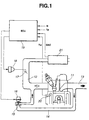
- the EGR control system of the embodiment includes an exhaust gas recirculation (abbreviated simply as "EGR") passage 14 which connects an air-intake passage or an intake manifold 12 with an exhaust-gas passage or an exhaust manifold 13 of the engine 11.
- EGR exhaust gas recirculation
- An EGR control valve 15 is fluidly disposed in the middle of the EGR passage 14.
- the EGR passage 13 and the EGR control valve 15 are provided to send some of the exhaust gas back through the intake manifold, thereby reducing the production of oxides of nitrogen (NO x ) at the exhaust system.
- the opening and closing of the EGR control valve 15 is controlled by means of an actuator 16.
- the EGR control valve 15 and the actuator 16 constructs an EGR control valve device.
- the actuator 16 usually comprises a stepper motor (also known as a "stepping motor” or a "step-servo motor”).
- the actuator (or the stepper motor) 16 is connected via a signal line to the output interface or a drive circuit of the ECU 19, so that the angular steps or essentially uniform angular movements of the actuator 16 can be obtained electromagnetically depending on a control signal or a drive signal which is output from the output interface of the ECU 19 and indicative of a desired opening of the EGR control valve 15. That is, the command value of the EGR-control-valve opening is arithmetically calculated as a desired number of angular steps of the step motor. By increasing the number of angular steps, the EGR control valve opening, simply the EGR valve opening, can be controlled substantially continually from the full-open position to the fully-closed position.
- a throttle valve 17 is disposed in the air-intake passage 12 upstream of the confluent point between the outlet port of the EGR passage 14 and the air-intake passage 12.
- the throttle valve 17 is usually comprised of a butterfly valve.
- the opening and closing of the throttle valve 17 is controlled by means of an actuator 18.
- the throttle valve 17 and the actuator 16 constructs a throttle valve device.
- the actuator 18 connected to the throttle valve 17 may comprise a stepper motor.
- the actuator 18 is connected via a signal line to the output interface of the ECU, so that the angular steps of the actuator 18 can be obtained electromagnetically depending on a control signal output from the output interface of the ECU 19.
- the throttle valve 17 may comprise a vacuum-operated butterfly-type throttle valve which is linked to a vacuum-operated mechanism which consists of a diaphragm unit and an electromagnetic solenoid valve, so that the angular position or the opening of the throttle valve 17 is adjusted by way of the vacuum fed into the diaphragm chamber of the diaphragm unit through the electromagnetic solenoid valve, the opening and closing of which can be electronically controlled in response to a control signal from the output interface of the ECU 19.
- the throttle valve 17 is operated at two operating modes, namely an open mode position and a closed mode position (see Fig. 7), depending on a desired EGR rate (MEGRM ⁇ KEGR1) primarily corrected by a first correction factor KEGR1 which will be fully described later.
- the EGR control valve 15 and the throttle valve 17 cooperate with each other to properly regulate the quantity of exhaust gas recirculated so that the amount of NO x is reduced at various engine operating conditions, such as at high loads, at low speeds, during starting and warming up from cold, or in a transient state (in presence of environmental variation) from low-land driving to high-land driving.
- the throttle valve 17 is shifted to a valve position as close to its closed position as possible in order to produce a negative pressure in the air-intake pipe downstream of the throttle valve 17, whereas the EGR control valve 15 is regulated or adjusted to a desired EGR control valve opening based on the certain engine operating condition.
- the throttle valve 17 is shifted to its full-open position corresponding to the open mode position.
- the differential pressure between a pressure in the exhaust system (simply an exhaust pressure) and a pressure in the induction system including the intake manifold and the collector is enlarged to the maximum, thereby facilitating recirculation of the exhaust gas.
- ECU electronice control unit
- the ECU 19 comprises a microcomputer containing a memory (ROM, RAM), an input/output interface (or input interface circuitry and output interface circuitry), and a central processing unit (CPU).
- the memory is generally designed to store informational data from the input and output interfaces, preprogrammed characteristic map data, and the results of ongoing arithmetic calculations.
- the input/output interface is the device that allow data to be transferred between input and output devices, CPU and the memory. Output signals from the input/output interface are amplified to operate electrical loads, namely the throttle valve actuator 18 and the EGR control valve actuator 16.
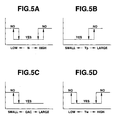
- the memory (ROM) prestores the characteristic maps shown in Figs. 5A - 5D, 6, 7 and 8.
- the output interface of the ECU 19 is connected to the throttle-valve actuator 18 and the EGR-control-valve actuator 16.
- the input interface of the ECU 19 is connected to various engine/vehicle sensors, for receiving an engine-speed indicative signal N, a basic fuel-injection amount indicative signal Tp, an engine temperature indicative signal Tw from an engine coolant temperature sensor (a water temperature sensor) 20, and an actual intake-air flow rate indicative signal QAC from an air-flow meter 21.
- the air-flow meter 21 comprises a hot-wire mass air flow meter which is located in the air-intake passage 12 upstream of the throttle valve 17.
- the air-flow meter 21 is provided for detecting an actual flow rate QAC of fresh air passing through an air cleaner (not shown).
- the engine speed data N and the basic fuel-injection amount indicative input information data Tp are generally used as fundamental engine operating parameters needed for determining the fuel-injection amount and fuel-injection timing.
- the input information data N and Tp are also used for determination of a desired EGR rate (MEGRM) and correction or compensation for the desired EGR rate (MEGRM).
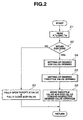
- FIGs. 2 and 3 there are shown EGR-control-valve-opening control routines executed by the EGR control system of the invention. These routines of Figs. 2 and 3 are cyclically executed as time-triggered interrupt routines to be triggered every predetermined intervals such as several milliseconds or several 10 milliseconds.
- step S1 of Fig. 2 the input information data, namely the engine speed data N, the basic fuel-injection amount data Tp, the actual intake-air flow rate data QAC, and the engine coolant temperature data Tw and the like are read.
- step S2 on the basis of the input information data N, Tp, QAC and Tw extracted, a test is made to determine whether these informational data are within respective EGR permission zones (see the zones or ranges indicated by "YES" in Figs. 5A - 5D).
- step S3 occurs.
- the throttle valve 17 is rapidly adjusted to the full-open position, whereas the EGR control valve 15 is rapidly adjusted to the fully-closed position, so as to inhibit EGR.
- step S2 when the answer to step S2 is in the affirmative (YES), that is, the processor of the ECU determines that the input informational data (N, Tp, QAC, Tw) are in the corresponding EGR permission zones, the procedure flows from step S2 through steps S4 and S5 to step S6.
- a desired opening (SEGR) of the EGR control valve 15 (a desired EGR valve opening) is properly set or determined in accordance with the sub-routine (see Figs. 3 or 9) needed to arithmetically calculate or compute the EGR valve opening.
- step S5 a desired opening of the throttle valve 17 is properly set or determined or retrieved from the preprogrammed or predetermined characteristic map (see Fig.
- step S6 the output interface of the ECU outputs control signals to the EGR-control-valve actuator 16 and the throttle-valve actuator 18, so that the desired EGR valve opening (SEGR) and the desired throttle valve opening are obtained.
- SEGR EGR valve opening
- Fig. 3 shows the EGR control sub-routine corresponding to step S4 of Fig. 2.
- a basic value (MEGRM) of the desired EGR rate (simply the basic EGR rate) is arithmetically calculated by way of retrieval from a preprogrammed three-dimensional characteristic map representative of the relationship among the engine speed N, the basic fuel-injection amount Tp (equivalent to the engine load), and the basic EGR rate MEGRM.
- the first correction factor KEGR1 which is used for primarily correcting or compensating for the basic EGR rate (MEGRM) on the basis of a predetermined operating parameter (such as the engine coolant temperature Tw) except engine speed and load, is derived or retrieved as a function f(Tw) of the engine coolant temperature Tw from a predetermined or preprogrammed two-dimensional characteristic map as shown in Fig. 6.
- a predetermined operating parameter such as the engine coolant temperature Tw
- Fig. 6 a predetermined or preprogrammed two-dimensional characteristic map as shown in Fig. 6.
- the first correction factor KEGR1 is defined as a coefficient with which the basic EGR rate MEGRM is multiplied, and thus the first correction factor KEGR1 is preprogrammed as a value less than or equal to "1".
- the engine coolant temperature Tw is used as the predetermined operating parameter except engine speed and load, which parameter is needed for determining the first correction factor KEGR1
- the other operating parameter such as fuel-injection timing, atmospheric pressure or the like may be used as the predetermined operating parameter except engine speed and load.
- the intake-air flow rate tends to vary owing to the EGR rate varied or primarily corrected or affected by the first correction factor KEGR1.
- a basic intake-air flow rate correction factor A is arithmetically calculated as a rate of change in a basic intake air flow rate (precisely a basic induced fresh-air flow rate per cylinder BQAC) based on the engine speed (N) and load (Tp), under a particular condition where a totally-induced gas flow rate (the induced fresh-air flow rate plus quantity of exhaust gas recirculated) is kept constant.
- the basic intake-air flow rate correction factor A is arithmetically calculated as a function f(MEGRM, KEGR1) on the basis of both the basic EGR rate MEGRM and the first correction factor KEGR1, from the following first expression (1) or the following second expression (2).
- the EGR rate is defined as a ratio of the exhaust-gas-recirculation amount (EGR amount) to the intake-air flow rate (the induced fresh-air flow rate)
- the first expression (1) is used.
- the EGR rate is defined as a ratio of the EGR amount (the quantity of exhaust gas recirculated) to the totally-induced gas flow rate (the induced fresh-air flow rate plus the EGR amount)
- the second expression (2) is used.
- the totally-induced gas flow rate (defined as the sum of an induced fresh-air flow rate per cylinder and an EGR amount per cylinder) varies as the EGR rate varies due to the first correction factor KEGR1.
- the rate of change in the totally-induced gas flow rate has a generally regular or steady tendency with respect to the rate of change in the EGR rate under such an operating condition that EGR is being added or diverted into the engine at least without deterioration of combustion.
- a volumetric-efficiency correction factor CQACC can be determined on the basis of the tendencies of the rate of change in the totally-induced gas flow rate, occurring due to changes in the EGR rate under the specified operating condition that EGR is being added or diverted into the engine at least without deterioration of combustion.
- the volumetric-efficiency correction factor CQACC means a volumetric-efficiency dependent intake-air flow rate correction factor corresponding to a change in the volumetric efficiency, taking place owing to the EGR rate varied or primarily corrected by the first correction factor KEGR1.
- a characteristic map for the volumetric-efficiency dependent intake-air flow rate correction factor CQACC is preprogrammed in the form of a two-dimensional characteristic map utilizing only the first correction factor KEGR1 as a parameter.
- the volumetric-efficiency dependent intake-air flow rate correction factor CQACC is represented as a function f(KEGR1) of the first correction factor KEGR1.
- the previously-discussed volumetric-efficiency correction factor CQACC is retrieved from the preprogrammed two-dimensional characteristic map, on the basis of the first correction factor KEGR1 obtained through step S12.
- a final correction factor Z for the basic intake-air flow rate BQAC is computed or calculated by the following expression (3).
- Z A ⁇ CQACC where A denotes the basic intake-air flow rate correction factor A, and CQACC denotes the volumetric-efficiency dependent intake-air flow rate correction factor.
- the final intake-air flow rate correction factor Z is defined as the product of the two correction factors A and CQACC.
- the basic intake-air flow rate BQAC is arithmetically calculated or estimated on the basis of two parameters used for arithmetic-calculation for the basic EGR rate MEGRM, namely the engine speed data N and the engine load data Tp (the basic fuel-injection amount indicative input information data) extracted through step S1.
- the same engine speed and load data as used for arithmetic-calculation for the basic EGR rate MEGRM is used.
- the basic intake-air flow rate BQAC corresponds to an intake-air flow rate obtained when EGR is executed at the basic EGR rate based on the same engine speed (N) and load (Tp). Therefore, the basic intake-air flow rate BQAC is retrieved as a function f(N, Tp) of the engine speed and load from the preprogrammed three-dimensional characteristic map showing the specified relationship among the engine speed N and the engine load Tp, and the basic intake-air flow rate BQAC.
- a second correction factor or a feedback correction factor KEGR2 for the basic EGR rate (MEGEM) is arithmetically calculated or estimated as a function f(QAC, BQACK) of the actual intake-air flow rate QAC measured or detected by the air-flow meter 21 and the corrected target intake-air flow rate BQACK.
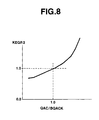
- the second correction factor KEGR2 is retrieved from a preprogrammed characteristic map representative of the relationship between the second correction factor KEGR2 and the ratio QAC/BQACK of the actual intake-air flow rate QAC to the corrected target intake-air flow rate BQACK.
- the second correction factor KEGR2 is designed to increase substantially proportionally as the ratio QAC/BQACK increases. This is because, under a particular condition where the EGR valve opening is fixed to a constant value, when the actual intake-air flow rate QAC exceeds the corrected target intake-air flow rate BQACK, the EGR rate tends to reduce. Also, as seen in Fig. 8, when the actual intake-air flow rate QAC is equal to the corrected target intake-air flow rate BQACK, that is, the ratio QAC/BQACK is 1.0, the second correction factor KEGR2 is set at 1.0.
- KEGR2 f(QAC/BQACK)
- KEGR2 f(QAC/BQACK, N)
- a final desired EGR rate MEGR is arithmetically calculated in accordance with the following expression (5).
- step S20 the desired EGR valve opening SEGR of the EGR control valve 15 is arithmetically calculated on the basis of the final desired EGR rate MEGR, the engine speed data N, and the engine load data Tp (the basic fuel-injection amount indicative data). That is, the desired EGR valve opening SEGR is preprogrammed as a function f(MEGR, N, Tp) of the three parameters MEGR, N and Tp.
- the control signal based on the desired EGR valve opening SEGR is output from the ECU 19 to the EGR-control-valve actuator 16, so that the actual opening of the EGR control valve 15 is adjusted to the desired EGR valve opening SEGR.
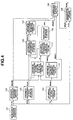
- Fig. 4 there is shown the simplified operational block diagram explaining a series of correction procedures containing the EGR-rate feedback correction (the estimation of second correction factor KEGR2) based on the result of comparison between the actual intake-air flow rate QAC and the corrected target intake air-flow rate BQACK.
- the engine operating conditions N, Tp, Tw, and the like.
- the basic EGR rate MEGRM is arithmetically calculated on the basis of first predetermined engine operating conditions (N, Tp) containing engine speed and load (see the block 103), and additionally the basic intake-air flow rate BQAC is arithmetically calculated or estimated on the basis of the same engine operating conditions (the same engine speed and load), so that the basic intake-air flow rate is determined by or interrelated with the basic EGR rate MEGRM (see the block 105).
- the first correction factor KEGR1 for the basic EGR rate MEGRM is arithmetically calculated on the basis of a certain engine operating condition or a second predetermined engine operating condition (such as the engine temperature Tw) except the previously-noted first predetermined engine operating conditions (N, Tp) containing engine speed and load (see the block 104).
- the basic intake-air flow rate correction factor A is arithmetically calculated on the basis of both the basic EGR rate MEGRM and the first correction factor KEGR1 (see the block 111), under a particular condition where a totally-induced gas flow rate (defined as the sum of the induced fresh-air flow rate and the exhaust-gas-recirculation amount) is kept constant, and at the same time the volumetric-efficiency dependent intake-air flow rate correction factor CQACC is arithmetically calculated on the basis of only the first correction factor KEGR1 (see the block 112) such that the volumetric-efficiency correction factor CQACC reflects the change in volumetric efficiency occurring owing to the EGR rate varied or primarily corrected by the first correction factor KEGR1.
- the final intake-air flow rate correction factor Z is arithmetically computed as the product of the two different intake-air flow rate correction factors A and CQACC (see the block 113).
- a so-called feedback correction is executed in such a manner as to arithmetically calculate the second correction factor KEGR2 (see the block 107), while comparing the corrected intake-air flow rate BQACK with the actual intake-air flow rate QAC detected by the air-flow meter 21 (see the block 102).
- the basic EGR rate MEGRM is finally corrected by both the first and second correction factors KEGR1 and KEGR2 to calculate the final desired EGR rate MEGR (see the block 108).
- the EGR valve opening command or the EGR-valve-opening control signal SEGR based on the engine speed (N) and load (Tp), and the final desired EGR rate MEGR, is output (see the block 109).
- the EGR valve opening of the EGR control valve 15 can be rapidly precisely corrected in response to the change in the intake-air flow rate occurring due to the change in the EGR rate, thus permitting the controlled quantity (the EGR rate) to be quickly precisely brought closer to the desired EGR rate, irrespective of the change in EGR rate and the change in the intake-air flow rate interrelated to each other.
- the required EGR rate (a) in the presence of the reduced effective opening of the EGR control valve 15 occurring owing to oil adhesion or carbon deposits adhered to the EGR control valve, (b) in the presence of the changes in intake-air flow rate occurring owing to positive and negative fluctuations in the throttle valve 17, (c) in the presence of the changes in intake-air flow rate occurring due to changes in air density, arising from changes in environment from low-land driving to high-land driving, or (d) in the presence of the delay in boost pressure on turbo-charged engines in a transition from normal-straight ahead driving to heavy vehicle acceleration.
- the estimation of the intake-air flow rate varied due to the EGR-rate correction based on the first correction factor KEGR1 can be easily precisely performed by a comparatively simple arithmetic expression utilizing the basic EGR rate MEGRM and the first correction factor KEGR1 and by the preprogrammed two-dimensional characteristic map utilizing only the first correction factor KEGR1 as a parameter.
- arithmetic load applied to the CPU employed within the ECU 19 can be effectively reduced.
- BQAC basic intake-air flow rate
- MEGRM basic EGR rate MEGRM
- the system estimates the change in intake-air flow rate, utilizing the basic EGR rate MEGRM, the basic intake-air flow rate BQAC and the first correction factor KEGR1, and additionally the EGR rate or the EGR valve opening is properly quickly corrected by the feedback correction factor KEGR2 as well as the first correction factor KEGR1 interrelatively in response to the change in intake-air flow rate occurring due to the change of EGR rate based on the first correction factor KEGR1.
- the conventional system has processed the engine coolant temperature dependent EGR-valve-opening correction (or the engine coolant temperature dependent EGR-rate correction) and the EGR-valve-opening correction (or the EGR-rate correction) based on changes in intake-air flow rate independently of each other.
- the engine-temperature dependent EGR-valve-opening correction (or the first EGR-rate correction KEGR1) and the EGR-valve-opening feedback correction (or the second EGR-rate feedback correction KEGR2) based on comparison (QAC/BQACK) between the actual intake-air flow rate (QAC) and the estimated intake-air flow rate (BQACK) are interrelatively simply executed as a series of EGR rate control procedures.
- the system of the invention (having simplified necessary EGR control programs and a small number of arithmetic calculations) is superior to the prior art system (having complicated necessary EGR control programs and a large number of arithmetic calculations) in data processing needed for EGR rate control or EGR-valve-opening control.
- the system of the invention enables the use of common arithmetic expressions and common characteristic maps even in different types of internal combustion engine, for example a different engine specification (a different displacement or the like), and thus brings enhanced flexibility.
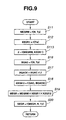
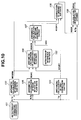
- the modified arithmetic processing shown in Fig. 9 is also executed as time-triggered interrupt routines to be triggered every predetermined intervals such as several milliseconds or several 10 milliseconds.
- the modified arithmetic processing of Fig. 9 is similar to the arithmetic processing of Fig. 3, except that steps S13, S14 and S15 included in the sub-routine shown in Fig. 3 are replaced with step S113 included in the sub-routine shown in Fig. 9.
- steps S13, S14 and S15 included in the sub-routine shown in Fig. 3 are replaced with step S113 included in the sub-routine shown in Fig. 9.
- Step S113 will be hereinafter described in detail with reference to the accompanying drawings, while detailed description of the other steps S11, S12, and S16 through S20, S13 and S14 will be omitted because the above description thereon seems to be self-explanatory.
Landscapes
- Engineering & Computer Science (AREA)
- Chemical & Material Sciences (AREA)
- Combustion & Propulsion (AREA)
- Mechanical Engineering (AREA)
- General Engineering & Computer Science (AREA)
- Exhaust-Gas Circulating Devices (AREA)
- Output Control And Ontrol Of Special Type Engine (AREA)
Applications Claiming Priority (4)
| Application Number | Priority Date | Filing Date | Title |
|---|---|---|---|
| JP16015298A JP3622506B2 (ja) | 1998-06-09 | 1998-06-09 | 内燃機関のegr制御装置 |
| JP16015298 | 1998-06-09 | ||
| JP16097198 | 1998-06-09 | ||
| JP16097198A JP3728930B2 (ja) | 1998-06-09 | 1998-06-09 | 内燃機関の排気還流制御装置 |
Publications (3)
| Publication Number | Publication Date |
|---|---|
| EP0964142A2 true EP0964142A2 (fr) | 1999-12-15 |
| EP0964142A3 EP0964142A3 (fr) | 2001-11-07 |
| EP0964142B1 EP0964142B1 (fr) | 2005-05-04 |
Family
ID=26486733
Family Applications (1)
| Application Number | Title | Priority Date | Filing Date |
|---|---|---|---|
| EP99111170A Expired - Lifetime EP0964142B1 (fr) | 1998-06-09 | 1999-06-08 | Système de commande pour système de recirculation du gaz d'échappement |
Country Status (3)
| Country | Link |
|---|---|
| US (1) | US6227182B1 (fr) |
| EP (1) | EP0964142B1 (fr) |
| DE (1) | DE69925066T2 (fr) |
Cited By (6)
| Publication number | Priority date | Publication date | Assignee | Title |
|---|---|---|---|---|
| EP1229228A3 (fr) * | 2001-02-01 | 2003-07-09 | Nissan Motor Co., Ltd. | Système de réglage rétroactif du rapport air-carburant pour un moteur à combustion interne |
| EP1156203A3 (fr) * | 2000-05-18 | 2003-10-15 | Nissan Motor Co., Ltd. | Commande d'un moteur Diesel |
| EP1672202A1 (fr) * | 2004-12-17 | 2006-06-21 | Delphi Technologies, Inc. | Méthode et appareil d'un système de recirculation de gaz d'échappement pour un moteur à combustion interne |
| EP1416138A3 (fr) * | 2002-11-01 | 2006-10-04 | Toyota Jidosha Kabushiki Kaisha | Système d'estimation du débit de recirculation de gaz d'échappement |
| CN103711599A (zh) * | 2013-12-29 | 2014-04-09 | 潍柴动力股份有限公司 | 一种实现egr控制的方法及装置 |
| CN112196678A (zh) * | 2019-07-08 | 2021-01-08 | 大众汽车股份公司 | 用于确定废气再循环率的至少一个适应值的方法 |
Families Citing this family (31)
| Publication number | Priority date | Publication date | Assignee | Title |
|---|---|---|---|---|
| US6463912B1 (en) * | 1998-04-22 | 2002-10-15 | Toyota Jidosha Kabushiki Kaisha | Intake air volume detection device for internal combustion engine |
| JP3656518B2 (ja) * | 2000-05-18 | 2005-06-08 | 日産自動車株式会社 | ディーゼルエンジンの制御装置 |
| US6508237B2 (en) * | 2001-01-29 | 2003-01-21 | Detroit Diesel Corporation | Exhaust gas recirculation transient smoke control |
| JP3904076B2 (ja) * | 2002-08-12 | 2007-04-11 | トヨタ自動車株式会社 | 内燃機関のegr制御装置 |
| US6820600B1 (en) | 2002-09-19 | 2004-11-23 | Detroit Deisel Corporation | Method for controlling an engine with an EGR system |
| WO2004027244A1 (fr) * | 2002-09-19 | 2004-04-01 | Detroit Diesel Corporation | Procede de commande d'un moteur au moyen d'un systeme egr |
| JP4157097B2 (ja) * | 2002-12-11 | 2008-09-24 | ボッシュ株式会社 | 排気ガス再循環装置 |
| US6802302B1 (en) | 2003-04-08 | 2004-10-12 | Cummins, Inc. | System for diagnosing EGR flow rate operation |
| JP4291624B2 (ja) * | 2003-05-27 | 2009-07-08 | トヨタ自動車株式会社 | 内燃機関の制御 |
| JP4120524B2 (ja) * | 2003-08-04 | 2008-07-16 | 日産自動車株式会社 | エンジンの制御装置 |
| US7006911B2 (en) * | 2003-11-04 | 2006-02-28 | Cummins, Inc. | Actuator control system |
| US7383820B2 (en) * | 2004-03-19 | 2008-06-10 | Ford Global Technologies, Llc | Electromechanical valve timing during a start |
| US7063076B1 (en) | 2005-05-16 | 2006-06-20 | Detroit Diesel Corporation | Method of smoke limiting engine |
| EP1770265A3 (fr) * | 2005-09-30 | 2011-02-23 | Honda Motor Co., Ltd. | Système de commande de régulation de gaz d'échappement pour un moteur à combustion interne |
| US20080078176A1 (en) * | 2006-10-02 | 2008-04-03 | International Engine Intellectual Property Company | Strategy for control of recirculated exhaust gas to null turbocharger boost error |
| US7469692B2 (en) * | 2006-12-29 | 2008-12-30 | Caterpillar Inc. | Exhaust gas recirculation system |
| FR2921433B1 (fr) * | 2007-09-25 | 2009-11-06 | Mann & Hummel Gmbh | Dispositif de mise en tourbillonnement et de melange de gaz d'echappement recycles dans la tubulure d'aspiration d'un moteur a combustion interne. |
| WO2009123753A1 (fr) | 2008-04-04 | 2009-10-08 | North Carolina State University | Inhibition de biofilms bactériens par des dérivés d'imidazole-phényle |
| US8108128B2 (en) * | 2009-03-31 | 2012-01-31 | Dresser, Inc. | Controlling exhaust gas recirculation |
| US8201442B2 (en) * | 2009-09-25 | 2012-06-19 | Cummins Inc. | System and method for estimating EGR mass flow rates |
| JP5043165B2 (ja) | 2010-08-27 | 2012-10-10 | 本田技研工業株式会社 | 内燃機関の制御装置 |
| JP5517110B2 (ja) * | 2010-10-29 | 2014-06-11 | 株式会社デンソー | 内燃機関のegr制御装置 |
| US8352158B2 (en) | 2011-11-21 | 2013-01-08 | Ford Global Technologies, Llc | Method and system for compensating engine thermal conditions |
| KR20140072616A (ko) * | 2012-12-05 | 2014-06-13 | 현대모비스 주식회사 | 캔 통신을 이용한 전동식 제동 시스템의 제어 방법 |
| CN104884771B (zh) * | 2012-12-26 | 2018-11-02 | 斗山英维高株式会社 | Egr控制方法及装置 |
| US9206756B2 (en) * | 2014-03-31 | 2015-12-08 | Cummins Inc. | Closed loop NOX reference management for DPF regeneration based on engine out particulate matter variation controller |
| US9587617B2 (en) | 2014-12-10 | 2017-03-07 | Cummins Inc. | Method of spark timing adjustment for an internal combustion engine |
| WO2018142510A1 (fr) * | 2017-02-01 | 2018-08-09 | 日産自動車株式会社 | Procédé de commande d'admission et dispositif de commande d'admission pour moteur à combustion interne |
| CN114562371B (zh) * | 2020-11-27 | 2023-04-28 | 长城汽车股份有限公司 | 车辆的最优废气再循环率的确定方法、装置、存储介质及车辆 |
| CN115559822B (zh) * | 2022-09-27 | 2024-08-20 | 东风汽车集团股份有限公司 | 目标egr率的控制方法 |
| CN115450774B (zh) * | 2022-10-08 | 2023-08-18 | 一汽解放汽车有限公司 | 天然气发动机废气再循环率确定方法、装置和计算机设备 |
Family Cites Families (14)
| Publication number | Priority date | Publication date | Assignee | Title |
|---|---|---|---|---|
| DE2849554C2 (de) * | 1978-11-15 | 1987-05-14 | Robert Bosch Gmbh, 7000 Stuttgart | Einrichtung zum Festlegen der Zusammensetzung des Gas-Inhalts von Zylindern bei Brennkraftmaschinen |
| JPS5974364A (ja) | 1982-10-19 | 1984-04-26 | Nippon Denso Co Ltd | デイ−ゼル機関用排気ガス再循環率制御装置 |
| JPS60230555A (ja) | 1984-04-27 | 1985-11-16 | Nissan Motor Co Ltd | デイ−ゼルエンジンの排気還流制御装置 |
| US4999781A (en) * | 1989-07-17 | 1991-03-12 | General Motors Corporation | Closed loop mass airflow determination via throttle position |
| US5520153A (en) * | 1995-04-28 | 1996-05-28 | Saturn Corporation | Internal combustion engine control |
| JP3603398B2 (ja) * | 1995-08-01 | 2004-12-22 | 日産自動車株式会社 | 内燃機関の制御装置 |
| JPH09203350A (ja) * | 1996-01-25 | 1997-08-05 | Toyota Motor Corp | ディーゼルエンジンの排気ガス再循環制御装置 |
| JP3365197B2 (ja) * | 1996-03-21 | 2003-01-08 | 日産自動車株式会社 | 内燃機関のegr制御装置 |
| GB2313927B (en) * | 1996-06-03 | 1999-06-23 | Nissan Motor | EGR control apparatus for internal combustion engine |
| JP3330287B2 (ja) * | 1996-09-17 | 2002-09-30 | トヨタ自動車株式会社 | 内燃機関の制御装置 |
| JP3805840B2 (ja) * | 1996-09-25 | 2006-08-09 | 富士重工業株式会社 | エンジンの制御装置 |
| US5765532A (en) * | 1996-12-27 | 1998-06-16 | Cummins Engine Company, Inc. | Cylinder pressure based air-fuel ratio and engine control |
| JP3551675B2 (ja) * | 1997-01-21 | 2004-08-11 | 日産自動車株式会社 | 内燃機関のegr制御装置 |
| US6098602A (en) * | 1999-01-15 | 2000-08-08 | Ford Global Technologies, Inc. | Exhaust gas recirculation system |
-
1999
- 1999-06-07 US US09/326,704 patent/US6227182B1/en not_active Expired - Lifetime
- 1999-06-08 EP EP99111170A patent/EP0964142B1/fr not_active Expired - Lifetime
- 1999-06-08 DE DE69925066T patent/DE69925066T2/de not_active Expired - Lifetime
Non-Patent Citations (1)
| Title |
|---|
| None |
Cited By (10)
| Publication number | Priority date | Publication date | Assignee | Title |
|---|---|---|---|---|
| EP1156203A3 (fr) * | 2000-05-18 | 2003-10-15 | Nissan Motor Co., Ltd. | Commande d'un moteur Diesel |
| EP1229228A3 (fr) * | 2001-02-01 | 2003-07-09 | Nissan Motor Co., Ltd. | Système de réglage rétroactif du rapport air-carburant pour un moteur à combustion interne |
| US6640775B2 (en) | 2001-02-01 | 2003-11-04 | Nissan Motor Co., Ltd. | Air-fuel ratio control system for internal combustion engine |
| EP1416138A3 (fr) * | 2002-11-01 | 2006-10-04 | Toyota Jidosha Kabushiki Kaisha | Système d'estimation du débit de recirculation de gaz d'échappement |
| EP1672202A1 (fr) * | 2004-12-17 | 2006-06-21 | Delphi Technologies, Inc. | Méthode et appareil d'un système de recirculation de gaz d'échappement pour un moteur à combustion interne |
| US7269497B2 (en) | 2004-12-17 | 2007-09-11 | Delphi Technologies, Inc. | Method and device for engine control in a motor vehicle |
| CN103711599A (zh) * | 2013-12-29 | 2014-04-09 | 潍柴动力股份有限公司 | 一种实现egr控制的方法及装置 |
| CN103711599B (zh) * | 2013-12-29 | 2016-06-08 | 潍柴动力股份有限公司 | 一种实现egr控制的方法及装置 |
| CN112196678A (zh) * | 2019-07-08 | 2021-01-08 | 大众汽车股份公司 | 用于确定废气再循环率的至少一个适应值的方法 |
| CN112196678B (zh) * | 2019-07-08 | 2023-01-10 | 大众汽车股份公司 | 用于确定废气再循环率的至少一个适应值的方法 |
Also Published As
| Publication number | Publication date |
|---|---|
| DE69925066T2 (de) | 2005-09-22 |
| US6227182B1 (en) | 2001-05-08 |
| EP0964142A3 (fr) | 2001-11-07 |
| DE69925066D1 (de) | 2005-06-09 |
| EP0964142B1 (fr) | 2005-05-04 |
Similar Documents
| Publication | Publication Date | Title |
|---|---|---|
| EP0964142B1 (fr) | Système de commande pour système de recirculation du gaz d'échappement | |
| US6230697B1 (en) | Integrated internal combustion engine control system with high-precision emission controls | |
| EP0965740B1 (fr) | Système de commande de turbocompresseur pour moteurs à combustion interne suralimentés, equipés d' un système de controle de recirculation de gaz d'èchappement | |
| US20040139949A1 (en) | Internal exhaust gas recirculation amount estimation system of internal combustion engines | |
| EP1229228B1 (fr) | Système de réglage rétroactif du rapport air-carburant pour un moteur à combustion interne | |
| US7717098B2 (en) | Controller of internal combustion engine | |
| JP3154038B2 (ja) | 内燃機関の吸気圧力推定装置及び燃料供給装置 | |
| JPS618443A (ja) | 空燃比制御装置 | |
| US20130133634A1 (en) | Controller for internal combustion engine | |
| JP3888024B2 (ja) | 排気ガス再循環装置 | |
| US6712053B2 (en) | Control system for internal combustion engine | |
| US5481462A (en) | Apparatus for determining an altitude condition of an automotive vehicle | |
| JP2007247445A (ja) | 内燃機関の吸気制御装置 | |
| JP2020051326A (ja) | 排気再循環制御装置 | |
| EP2290210A1 (fr) | Système de contrôle d'alimentation en carburant pour moteur à combustion interne | |
| JP4985005B2 (ja) | 内燃機関の制御装置 | |
| JP2528385B2 (ja) | 過給機付内燃機関の吸入空気量検出装置 | |
| JP2000110647A (ja) | エンジンの制御装置 | |
| JPH07293347A (ja) | 内燃機関の排気還流制御装置 | |
| JP3704726B2 (ja) | 内燃機関の制御装置 | |
| JPS618444A (ja) | 空燃比制御装置 | |
| JP2858285B2 (ja) | 内燃機関の燃料供給制御装置 | |
| JPH11173218A (ja) | エンジンのegr率推定装置 | |
| JPH08210195A (ja) | ディーゼル機関の排気還流制御装置 | |
| JP2000303895A (ja) | 内燃機関 |
Legal Events
| Date | Code | Title | Description |
|---|---|---|---|
| PUAI | Public reference made under article 153(3) epc to a published international application that has entered the european phase |
Free format text: ORIGINAL CODE: 0009012 |
|
| 17P | Request for examination filed |
Effective date: 19990608 |
|
| AK | Designated contracting states |
Kind code of ref document: A2 Designated state(s): AT BE CH CY DE DK ES FI FR GB GR IE IT LI LU MC NL PT SE |
|
| AX | Request for extension of the european patent |
Free format text: AL;LT;LV;MK;RO;SI |
|
| PUAL | Search report despatched |
Free format text: ORIGINAL CODE: 0009013 |
|
| AK | Designated contracting states |
Kind code of ref document: A3 Designated state(s): AT BE CH CY DE DK ES FI FR GB GR IE IT LI LU MC NL PT SE |
|
| AX | Request for extension of the european patent |
Free format text: AL;LT;LV;MK;RO;SI |
|
| AKX | Designation fees paid |
Free format text: DE FR GB |
|
| GRAP | Despatch of communication of intention to grant a patent |
Free format text: ORIGINAL CODE: EPIDOSNIGR1 |
|
| GRAS | Grant fee paid |
Free format text: ORIGINAL CODE: EPIDOSNIGR3 |
|
| GRAA | (expected) grant |
Free format text: ORIGINAL CODE: 0009210 |
|
| AK | Designated contracting states |
Kind code of ref document: B1 Designated state(s): DE FR GB |
|
| REG | Reference to a national code |
Ref country code: GB Ref legal event code: FG4D |
|
| REF | Corresponds to: |
Ref document number: 69925066 Country of ref document: DE Date of ref document: 20050609 Kind code of ref document: P |
|
| ET | Fr: translation filed | ||
| PLBE | No opposition filed within time limit |
Free format text: ORIGINAL CODE: 0009261 |
|
| STAA | Information on the status of an ep patent application or granted ep patent |
Free format text: STATUS: NO OPPOSITION FILED WITHIN TIME LIMIT |
|
| 26N | No opposition filed |
Effective date: 20060207 |
|
| REG | Reference to a national code |
Ref country code: FR Ref legal event code: PLFP Year of fee payment: 18 |
|
| REG | Reference to a national code |
Ref country code: FR Ref legal event code: PLFP Year of fee payment: 19 |
|
| REG | Reference to a national code |
Ref country code: FR Ref legal event code: PLFP Year of fee payment: 20 |
|
| PGFP | Annual fee paid to national office [announced via postgrant information from national office to epo] |
Ref country code: DE Payment date: 20180530 Year of fee payment: 20 |
|
| PGFP | Annual fee paid to national office [announced via postgrant information from national office to epo] |
Ref country code: FR Payment date: 20180511 Year of fee payment: 20 |
|
| PGFP | Annual fee paid to national office [announced via postgrant information from national office to epo] |
Ref country code: GB Payment date: 20180403 Year of fee payment: 20 |
|
| REG | Reference to a national code |
Ref country code: DE Ref legal event code: R071 Ref document number: 69925066 Country of ref document: DE |
|
| REG | Reference to a national code |
Ref country code: GB Ref legal event code: PE20 Expiry date: 20190607 |
|
| PG25 | Lapsed in a contracting state [announced via postgrant information from national office to epo] |
Ref country code: GB Free format text: LAPSE BECAUSE OF EXPIRATION OF PROTECTION Effective date: 20190607 |