EP0964267A2 - Méthode et système de sélection de la fréquence de recurrence d'impulsions - Google Patents
Méthode et système de sélection de la fréquence de recurrence d'impulsions Download PDFInfo
- Publication number
- EP0964267A2 EP0964267A2 EP99201848A EP99201848A EP0964267A2 EP 0964267 A2 EP0964267 A2 EP 0964267A2 EP 99201848 A EP99201848 A EP 99201848A EP 99201848 A EP99201848 A EP 99201848A EP 0964267 A2 EP0964267 A2 EP 0964267A2
- Authority
- EP
- European Patent Office
- Prior art keywords
- range
- pulse repetition
- doppler frequency
- target
- frequency
- Prior art date
- Legal status (The legal status is an assumption and is not a legal conclusion. Google has not performed a legal analysis and makes no representation as to the accuracy of the status listed.)
- Withdrawn
Links
Images

Classifications
-
- G—PHYSICS
- G01—MEASURING; TESTING
- G01S—RADIO DIRECTION-FINDING; RADIO NAVIGATION; DETERMINING DISTANCE OR VELOCITY BY USE OF RADIO WAVES; LOCATING OR PRESENCE-DETECTING BY USE OF THE REFLECTION OR RERADIATION OF RADIO WAVES; ANALOGOUS ARRANGEMENTS USING OTHER WAVES
- G01S13/00—Systems using the reflection or reradiation of radio waves, e.g. radar systems; Analogous systems using reflection or reradiation of waves whose nature or wavelength is irrelevant or unspecified
- G01S13/02—Systems using reflection of radio waves, e.g. primary radar systems; Analogous systems
- G01S13/06—Systems determining position data of a target
- G01S13/08—Systems for measuring distance only
- G01S13/10—Systems for measuring distance only using transmission of interrupted, pulse modulated waves
- G01S13/22—Systems for measuring distance only using transmission of interrupted, pulse modulated waves using irregular pulse repetition frequency
-
- G—PHYSICS
- G01—MEASURING; TESTING
- G01S—RADIO DIRECTION-FINDING; RADIO NAVIGATION; DETERMINING DISTANCE OR VELOCITY BY USE OF RADIO WAVES; LOCATING OR PRESENCE-DETECTING BY USE OF THE REFLECTION OR RERADIATION OF RADIO WAVES; ANALOGOUS ARRANGEMENTS USING OTHER WAVES
- G01S13/00—Systems using the reflection or reradiation of radio waves, e.g. radar systems; Analogous systems using reflection or reradiation of waves whose nature or wavelength is irrelevant or unspecified
- G01S13/87—Combinations of radar systems, e.g. primary radar and secondary radar
-
- G—PHYSICS
- G01—MEASURING; TESTING
- G01S—RADIO DIRECTION-FINDING; RADIO NAVIGATION; DETERMINING DISTANCE OR VELOCITY BY USE OF RADIO WAVES; LOCATING OR PRESENCE-DETECTING BY USE OF THE REFLECTION OR RERADIATION OF RADIO WAVES; ANALOGOUS ARRANGEMENTS USING OTHER WAVES
- G01S13/00—Systems using the reflection or reradiation of radio waves, e.g. radar systems; Analogous systems using reflection or reradiation of waves whose nature or wavelength is irrelevant or unspecified
- G01S13/66—Radar-tracking systems; Analogous systems
Definitions
- the present invention relates to radar tracking systems, and, more specifically, to systems which correct for eclipsing by transmitted pulses and/or cluttering of the Doppler frequency interval.
- SNR signal-to-noise ratio
- SCR signal-to-clutter ratio
- High PRF radars use PRFs sufficiently high so the target return is not masked by clutter returns to ensure a high SCR.
- This PRF must be greater than the full Doppler clutter bandwidth (4*Vr/ ⁇ ) plus the maximum target Doppler frequency of interest (2*Vt/ ⁇ ) where Vr is the radar's velocity, Vt is the target's velocity along the line of sight to the radar and ⁇ is the transmission wavelength of the radar.
- Range eclipsing is very severe when high PRFs are used since the transmitted pulse occurs at ranges of n*c/2*PRF where c is the velocity of light and n is an integer from 0 to infinity. Thus eclipsing occurs at each of these ranges over the interval covered by the transmitted pulse (c* ⁇ /2) where ⁇ is the time duration of the transmitted pulse which may result in an inadequate SNR.
- Low PRF radars use sufficiently low PRFs such that the range between pulses n*c/2*PRF greater than the greatest target range of interest. Then eclipsing of interest only occurs for ranges less than the short ranges covered by the pulsewidth (c* ⁇ /2). However, the clutter return now occurs around every PRF line (n*PRF) and the target return is quite likely to be masked by the clutter return yielding a poor SCR.
- medium PRF systems are often used to provide a compromise between these extremes.
- Current medium PRF radar systems use several PRFs to ensure seeing a target over a wide range interval and/or Doppler frequency interval (to avoid significant eclipsing of the target return signal by the transmitted pulse in the time domain and to avoid having clutter mask the desired target return in the frequency domain). They may process the returns from each PRF independently or integrate the returns of the different PRFs.
- This patent presents a method of rapidly and automatically selecting a PRF to yield no eclipsing and no clutter masking given the target range and target Doppler frequency are approximately known and given such a solution is realizable. This algorithm therefore permits higher target update rates since multiple PRFs need not be processed.
- An improved radar tracking system and a process of radar tracking inputs estimates of a target range and a range uncertainity swath from a first radar system into a second radar system along with a duty factor.
- the second radar system determines a set of zero eclipse intervals and respective ranges of range pulse repetition frequencies that solves a first set of equations.
- a usable range pulse repetition frequency is chosen from the results.
- an estimated target Doppler frequency region and a Doppler uncertainity swath is inputted into the second radar system.
- the second radar system is instructed to determine a set of clear Doppler frequency region intervals, and respective ranges of Doppler frequency pulse repetition frequencies by solving a second set of equations.
- a usable pulse repetition frequency is chosen that is present in at least one of the ranges of range pulse repetition frequencies and that is present in at least one of the ranges of Doppler frequency pulse repetition frequencies.
- the second radar system is then instructed to track the target using the usable pulse repetition frequency.
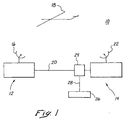
- a radar tracking system 10 comprises a first radar system 12 and a second radar system 14.
- the first radar system 12 has an antenna 16.
- the first radar system 12 tracks a target 18, estimates its range, and sends a signal 20 representing the target range estimate to the second radar system 14.
- Other embodiments of the invention may send additional target data signals (e.g., target velocity, acceleration, other characteristics) from the first radar system 12 to the second radar system 14.
- the second radar system 14 comprises an antenna 22, a CPU 24, and a manual input device 26.
- the CPU 24 receives the target range estimate signal 20 through a signal input device (not shown).
- the CPU 24 also receives manually inputted data 28 through the manual input device 26.
- the CPU 24 processes the target range estimate to determine a usable pulse repetition frequency ("PRF") for the second radar 14.
- Embodiments of the invention may use a zero eclipsing algorithm to determine a set of PRFs that permits an interval "n" to be a zero eclipse interval. A zero eclipse interval does not have the transmitter pulse occurring during the reception of the target signal.
- Embodiments of the invention may use a clear Doppler frequency algorithm to determine a set of PRFs that permits an interval "m" to be a clear Doppler frequency interval.
- a clear Doppler frequency has a clear Doppler region that is free of clutter bandwidth.
- the CPU 24 uses an combination of the zero eclipsing algorithm and the clear Doppler frequency algorithm.
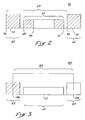
- a set of zero eclipsing PRF intervals can be determined over a range of intervals given the estimated target range, Rcue, desired duty factor, df, and half of the range uncertainty swath, dR.
- Signal 52 is the transmitted pulse at n
- Signal 54 is the transmitted pulse at n+1.
- the beginnings 56 and 58 of the signals 52 and 54 are separated by the interpulse period Rprf 60 of the PRF.
- the width 62 of the transmitted pulses is the df times the Rprf 60.
- An intervening receiver-on time 64 is between the pulses 52 and 54.
- the Rcue 66 is shown near the middle of the receiver-on time 64.
- a beginning 68 of the receiver-on time 64 is represented by equation (1) and the ending 70 of the receiver-on time 64 is represented by equation (2): Rcue - dR Rcue + dR + df * Rprf
- the zero eclipsing algorithm comprises equations which are solved to determine zero eclipsing intervals "n". Based on the time constraints of the algorithm, the inequalities (3) and (4) are true: Rcue - dR > n*Rprf + df*Rprf Rcue + dR + df*Rprf ⁇ (n+1)*Rprf wherein:
- the set of zero eclipsing intervals, n consists of all intervals for which the equations (6)-(8) hold true.
- the zero eclipsing algorithm then either selects, or assisting in manually selecting, a usable RPF.
- the instructions in the CPU 24 choose a usable RPF from the Fr RANGE having the lowest value of n.
- the instructions in the CPU 24 chose the lowest available PRF as the usable PRF.
- Some embodiments of the invention have an algorithm that tests to ensure that the usable RPF is above a minimum RPF for the second radar system 14. Additional embodiments of the invention may solicit a manual choice of the usable RPF from a generated list of zero eclipsing PRFs, the manual choice being inputted through the manual input device 26 ( Figure 1).
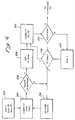
- the clear Doppler frequency algorithm determines a set of PRFs that permit a clear Doppler frequency interval "m" given the estimated target range, Rcue, desired duty factor, df, the Doppler uncertainty swath, ⁇ F , the center of a clear Doppler frequency region, fc, and the clutter bandwidth, Bwc.
- a PRF 102 has Bwc's 104 centered on the PRF's beginning end 106 and terminating end 108. Between the Bwc's 104 is a clear Doppler region 110, or the Doppler uncertainty swath, ⁇ F . At the middle 112 of the region 110 is the center of the clear Doppler frequency region, fc.
- the set of clear Doppler frequency region intervals, m consists of all the intervals for which the equations (9)-(11) hold true.
- the clear Doppler frequency algorithm selects a usable RPF from the set of Ff RANGEs .
- the instructions in the CPU 24 choose a usable RPF from the Ff RANGE having the lowest m.
- the algorithm chooses the lowest PRF in the Ff RANGE having the lowest m as the usable RPF.
- Some embodiments of the invention have an algorithm that tests to ensure that the usable RPF is above a minimum RPF for the second radar system 14. Additional embodiments of the invention may solicit a manual choice of the usable RPF from a generated list of clear Doppler frequency RPFs, the manual choice being inputted through the manual input device 26 ( Figure 1).
- the usable PRF is chosen from the intersection of an Fr RANGE and an Ff RANGE .
- the usable PRF is chosen from the lowest n Fr RANGE that has a matching PRF in any Ff RANGE wherein the Ff RANGE with matching PRF's are referred to as Ff RANGE matching ranges.
- the usable PRF is chosen from the lowest n Fr RANGE and the Ff RANGE matching range with the lowest m.
- the usable PRF is chosen from the lowest m Ff RANGE that has a matching PRF in any Fr RANGE , wherein the Fr RANGEs with matching PRF's are referred to as Fr RANGE matching ranges.
- the usable PRF is chosen from the lowest m Ff RANGE and the Fr RANGE matching range with the lowest n.
- the CPU 24 of the second radar system 14 (see Figure 1) is instructed to choose a usable PRF via a set instructions.
- Figure 4 shows a flow chart 200 that is an example of a set of instructions for choosing a usable PRF that is zero eclipsing.
- Figure 5 shows a flow chart 220 that is an example of a set of instructions for choosing a usable PRF that has a clear Doppler frequency region.
- the flow charts are linked so that the usable PRF is a member of the lowest zero eclipse interval and a member of the lowest matching clear Doppler frequency region. From the flow chart 200, it is commonly known in the art how to translate the set of instructions into any usable computer language, how to "hard wire" the instructions, or a combination thereof into the CPU 24.
- flow chart 200 starts with a step 202 of inputting target data comprising Rcue, Rdotcue, dR, and dF.
- Rdotcue is the velocity of the target.
- the target data is received from the first radar system and/or is inputted manually.
Landscapes
- Engineering & Computer Science (AREA)
- Radar, Positioning & Navigation (AREA)
- Remote Sensing (AREA)
- Computer Networks & Wireless Communication (AREA)
- Physics & Mathematics (AREA)
- General Physics & Mathematics (AREA)
- Radar Systems Or Details Thereof (AREA)
Applications Claiming Priority (2)
| Application Number | Priority Date | Filing Date | Title |
|---|---|---|---|
| US09/096,850 US6064331A (en) | 1998-06-11 | 1998-06-11 | Pulse repetition frequency section method and system |
| US96850 | 1998-06-11 |
Publications (2)
| Publication Number | Publication Date |
|---|---|
| EP0964267A2 true EP0964267A2 (fr) | 1999-12-15 |
| EP0964267A3 EP0964267A3 (fr) | 2000-07-19 |
Family
ID=22259390
Family Applications (1)
| Application Number | Title | Priority Date | Filing Date |
|---|---|---|---|
| EP99201848A Withdrawn EP0964267A3 (fr) | 1998-06-11 | 1999-06-10 | Méthode et système de sélection de la fréquence de recurrence d'impulsions |
Country Status (2)
| Country | Link |
|---|---|
| US (1) | US6064331A (fr) |
| EP (1) | EP0964267A3 (fr) |
Cited By (1)
| Publication number | Priority date | Publication date | Assignee | Title |
|---|---|---|---|---|
| EP2472285A1 (fr) * | 2010-12-30 | 2012-07-04 | Thales | Procédé d'amélioration des performances d'un radar en présence d'échos rétrodiffusés diffus |
Families Citing this family (10)
| Publication number | Priority date | Publication date | Assignee | Title |
|---|---|---|---|---|
| SE522651C2 (sv) * | 2002-06-14 | 2004-02-24 | Totalfoersvarets Forskningsins | Sätt och ett system för att genom bistatiska mätningar med från mål spridda signaler bestämma lägen för målen |
| US6621450B1 (en) | 2002-07-12 | 2003-09-16 | Lockheed Martin Corporation | Method of selecting a pulse repetition frequency to detect, track or search for a target |
| JP5635723B2 (ja) * | 2006-01-30 | 2014-12-03 | 富士通株式会社 | 目標検出装置およびシステム |
| JP2011520127A (ja) * | 2008-05-07 | 2011-07-14 | コロラド ステート ユニバーシティー リサーチ ファウンデーション | ネットワーク化された波形システム |
| JP4766404B2 (ja) * | 2008-10-28 | 2011-09-07 | トヨタ自動車株式会社 | レーダ装置 |
| KR101072485B1 (ko) * | 2011-06-24 | 2011-10-11 | 한국해양연구원 | 해상시설물에 설치되는 상용 레이더를 이용한 3차원 레이더 장치 |
| EP2977784B1 (fr) * | 2013-03-18 | 2018-08-01 | Panasonic Corporation | Dispositif radar |
| CN106443662B (zh) * | 2016-10-28 | 2018-12-11 | 上海无线电设备研究所 | 一种低重频体制下速度模糊时的目标稳健关联方法 |
| US9736845B1 (en) * | 2017-01-03 | 2017-08-15 | Network Performance Research Group Llc | Over the air signaling of dynamic frequency selection (DFS) operating parameters to client devices |
| RU2666783C1 (ru) * | 2017-09-06 | 2018-09-12 | Акционерное общество "Федеральный научно-производственный центр "Нижегородский научно-исследовательский институт радиотехники" | Способ и устройство защиты от "ангелов" при комплексировании рлс разных диапазонов |
Family Cites Families (13)
| Publication number | Priority date | Publication date | Assignee | Title |
|---|---|---|---|---|
| US2703399A (en) * | 1946-02-15 | 1955-03-01 | Everard M Williams | Apparatus for guiding and detonating missiles |
| US4143373A (en) * | 1977-09-21 | 1979-03-06 | Hughes Aircraft Company | Adaptive radar systems and methods therefor |
| US5185608A (en) * | 1980-12-29 | 1993-02-09 | Raytheon Company | All weather tactical strike system (AWISS) and method of operation |
| FR2599853B1 (fr) * | 1981-05-15 | 1989-03-31 | Thomson Csf | Procede de levee d'ambiguite en distance dans un radar pulse doppler, dispositif pour sa mise en oeuvre et radar comportant un tel dispositif |
| US4593286A (en) * | 1983-04-25 | 1986-06-03 | Westinghouse Electric Corp. | Method of operating an agile beam coherent radar |
| US5061934A (en) * | 1990-11-09 | 1991-10-29 | The United States Of America As Represented By The Secretary Of The Air Force | Hybrid clutter cancellation method and system for improved radar performance |
| US5173706A (en) * | 1991-04-16 | 1992-12-22 | General Electric Company | Radar processor with range sidelobe reduction following doppler filtering |
| DE4131141A1 (de) * | 1991-09-19 | 1993-03-25 | Telefunken Systemtechnik | Verfahren zur unterscheidung mindestens zweier ziele |
| US5546084A (en) * | 1992-07-17 | 1996-08-13 | Trw Inc. | Synthetic aperture radar clutter reduction system |
| US5430445A (en) * | 1992-12-31 | 1995-07-04 | Raytheon Company | Synthetic aperture radar guidance system and method of operating same |
| US5294933A (en) * | 1993-01-29 | 1994-03-15 | Westinghouse Electric Corp. | Wideband radar system utilizing adaptive interference canceler |
| US5440311A (en) * | 1993-08-06 | 1995-08-08 | Martin Marietta Corporation | Complementary-sequence pulse radar with matched filtering and Doppler tolerant sidelobe suppression preceding Doppler filtering |
| US5486830A (en) * | 1994-04-06 | 1996-01-23 | The United States Of America As Represented By The United States Department Of Energy | Radar transponder apparatus and signal processing technique |
-
1998
- 1998-06-11 US US09/096,850 patent/US6064331A/en not_active Expired - Fee Related
-
1999
- 1999-06-10 EP EP99201848A patent/EP0964267A3/fr not_active Withdrawn
Cited By (2)
| Publication number | Priority date | Publication date | Assignee | Title |
|---|---|---|---|---|
| EP2472285A1 (fr) * | 2010-12-30 | 2012-07-04 | Thales | Procédé d'amélioration des performances d'un radar en présence d'échos rétrodiffusés diffus |
| FR2970084A1 (fr) * | 2010-12-30 | 2012-07-06 | Thales Sa | Procede d'amelioration des performances d'un radar en presence d'echos retrodiffuses diffus |
Also Published As
| Publication number | Publication date |
|---|---|
| EP0964267A3 (fr) | 2000-07-19 |
| US6064331A (en) | 2000-05-16 |
Similar Documents
| Publication | Publication Date | Title |
|---|---|---|
| US10754008B2 (en) | Vehicle radar system that addresses doppler frequency shift and method of using the same | |
| EP1681583B1 (fr) | Procédé de radar de véhicule | |
| AU2004282851B2 (en) | Efficient technique for estimating elevation angle when using a broad beam for search in a radar | |
| US5977905A (en) | Target detection method and device for wideband unambiguous pulse Doppler radar | |
| US5923282A (en) | Radar system | |
| EP0557945B1 (fr) | Télémètre, détection et résolution dans un système radar à forme d'onde modulée en fréquence en pente multiple | |
| US5745071A (en) | Method and apparatus for precisely locating a resonant object | |
| EP0964267A2 (fr) | Méthode et système de sélection de la fréquence de recurrence d'impulsions | |
| US20070241955A1 (en) | System Having Two or More Sensors | |
| Southwell et al. | A matched filter for spaceborne GNSS-R based sea-target detection | |
| JP4668198B2 (ja) | レーダ装置 | |
| CN109490889A (zh) | 车载雷达以及判断车载雷达是否被遮挡的方法、装置 | |
| JP5204367B2 (ja) | 機体座標において目標に対する干渉角を決定するための方法および装置 | |
| EP0126032B1 (fr) | Dispositif pour l'identification et la suppression d'échos non désirés correspondant à une deuxième trace dans des systèmes radar | |
| US4375641A (en) | Method in a tracking radar to attain a large unambiguous range for detected targets by means of radar pulses with high repetition frequency | |
| GB2306262A (en) | FMCW vehicular radar | |
| WO2003096067A1 (fr) | Procedes et dispositifs pour detection de phase precise | |
| JP2007500856A (ja) | レーダ戻りデータを重み付ける方法および装置 | |
| JP2003502675A (ja) | レーダ装置 | |
| DE69935483T2 (de) | Verarbeitungsverfahren mit einer besonderen wellenform für einen unsynchronisierten koherenten, breitbandigen bistatischen radarbetrieb | |
| AU683689B2 (en) | Radar apparatus | |
| US7339519B2 (en) | Methods and apparatus for target radial extent determination using deconvolution | |
| JPS61140881A (ja) | パルス・レーダー装置 | |
| JPH06214023A (ja) | 回転アンテナを基礎にし合成絞りを備えたレーダー装置 | |
| CN116930944A (zh) | 一种针对tdma距离解模糊的脉冲相位编码方法 |
Legal Events
| Date | Code | Title | Description |
|---|---|---|---|
| PUAI | Public reference made under article 153(3) epc to a published international application that has entered the european phase |
Free format text: ORIGINAL CODE: 0009012 |
|
| AK | Designated contracting states |
Kind code of ref document: A2 Designated state(s): DE FR GB |
|
| AX | Request for extension of the european patent |
Free format text: AL;LT;LV;MK;RO;SI |
|
| PUAL | Search report despatched |
Free format text: ORIGINAL CODE: 0009013 |
|
| AK | Designated contracting states |
Kind code of ref document: A3 Designated state(s): AT BE CH CY DE DK ES FI FR GB GR IE IT LI LU MC NL PT SE |
|
| AX | Request for extension of the european patent |
Free format text: AL;LT;LV;MK;RO;SI |
|
| 17P | Request for examination filed |
Effective date: 20001227 |
|
| AKX | Designation fees paid |
Free format text: DE FR GB |
|
| STAA | Information on the status of an ep patent application or granted ep patent |
Free format text: STATUS: THE APPLICATION IS DEEMED TO BE WITHDRAWN |
|
| 18D | Application deemed to be withdrawn |
Effective date: 20050104 |