EP0964596B1 - Méthode d'allocation de fréquence utilisant les pertes de propagation - Google Patents
Méthode d'allocation de fréquence utilisant les pertes de propagation Download PDFInfo
- Publication number
- EP0964596B1 EP0964596B1 EP19990110958 EP99110958A EP0964596B1 EP 0964596 B1 EP0964596 B1 EP 0964596B1 EP 19990110958 EP19990110958 EP 19990110958 EP 99110958 A EP99110958 A EP 99110958A EP 0964596 B1 EP0964596 B1 EP 0964596B1
- Authority
- EP
- European Patent Office
- Prior art keywords
- mobile station
- cdma communication
- communication system
- base station
- frequency
- Prior art date
- Legal status (The legal status is an assumption and is not a legal conclusion. Google has not performed a legal analysis and makes no representation as to the accuracy of the status listed.)
- Expired - Lifetime
Links
- 238000000034 method Methods 0.000 title claims description 22
- 238000004891 communication Methods 0.000 claims description 69
- 230000005540 biological transmission Effects 0.000 claims description 43
- 230000002596 correlated effect Effects 0.000 description 4
- 238000010586 diagram Methods 0.000 description 4
- 238000010295 mobile communication Methods 0.000 description 3
- 238000013459 approach Methods 0.000 description 1
- 230000010267 cellular communication Effects 0.000 description 1
- 238000012986 modification Methods 0.000 description 1
- 230000004048 modification Effects 0.000 description 1
Images



Classifications
-
- H—ELECTRICITY
- H04—ELECTRIC COMMUNICATION TECHNIQUE
- H04W—WIRELESS COMMUNICATION NETWORKS
- H04W72/00—Local resource management
- H04W72/50—Allocation or scheduling criteria for wireless resources
- H04W72/54—Allocation or scheduling criteria for wireless resources based on quality criteria
- H04W72/542—Allocation or scheduling criteria for wireless resources based on quality criteria using measured or perceived quality
-
- H—ELECTRICITY
- H04—ELECTRIC COMMUNICATION TECHNIQUE
- H04W—WIRELESS COMMUNICATION NETWORKS
- H04W16/00—Network planning, e.g. coverage or traffic planning tools; Network deployment, e.g. resource partitioning or cells structures
- H04W16/14—Spectrum sharing arrangements between different networks
-
- H—ELECTRICITY
- H04—ELECTRIC COMMUNICATION TECHNIQUE
- H04W—WIRELESS COMMUNICATION NETWORKS
- H04W16/00—Network planning, e.g. coverage or traffic planning tools; Network deployment, e.g. resource partitioning or cells structures
- H04W16/24—Cell structures
- H04W16/32—Hierarchical cell structures
-
- H—ELECTRICITY
- H04—ELECTRIC COMMUNICATION TECHNIQUE
- H04W—WIRELESS COMMUNICATION NETWORKS
- H04W36/00—Hand-off or reselection arrangements
- H04W36/06—Reselecting a communication resource in the serving access point
-
- H—ELECTRICITY
- H04—ELECTRIC COMMUNICATION TECHNIQUE
- H04W—WIRELESS COMMUNICATION NETWORKS
- H04W64/00—Locating users or terminals or network equipment for network management purposes, e.g. mobility management
Definitions
- the present invention relates to a method of assigning a frequency from a base station to mobile stations in a CDMA (Code Division Multiple Access) communication system.
- CDMA Code Division Multiple Access
- the CDMA communication system are is expected to be the next-generation mobile communication system.
- the CDMA communication system is advantageous in that a plurality of adjacent base stations can share one frequency band.
- the cross-correlated values are not 0, then there is a possibility that when a mobile station A1 is present near a base station and a mobile station A2 is present far from the base station, depending on the ratio of transmission powers of the mobile stations A1, A2 at the time signals from the mobile stations A1, A2 arrive at the antenna of the base station, the correlated value (cross-corrected value) between the signal from the mobile station A1 and the code assigned to the mobile station A2 may be greater than the correlated value (autocorrelated value) between the signal from the mobile station A2 and the code assigned to the mobile station A2.
- the signal from the mobile station A2 cannot properly be demodulated. This could lead to a fatally dangerous situation where if the signal power sent from one mobile station and received by the antenna of a base station is much greater than the signal power sent from another mobile station and received by the antenna of the base station, then the base station is unable to decode signals other than the signal from the mobile station whose reception power is larger at the antenna of the base station.
- This problem is widely known as a near-far problem. In order to solve the problem, it is necessary to perform a transmission power control process on transmitters for equalizing signal powers from all the transmitters in input signals received by a receiver.
- a mobile communication system is operated by a sole network operator and a handoff is properly carried out as a mobile station moves, then communications are effected via a path whose transmission loss is smallest between the base station and the mobile station. It is thus possible to perform a transmission power control process in order to minimize the transmission power of the mobile station for thereby solving the near-far problem.
- Fig. 1 shows the assignment of four frequency channels to each of network operators A, B, C.
- the leaking power in an adjacent channel of a transmission signal from a mobile station causes a near-far problem to a frequency channel of another network operator.
- the leaking power in an adjacent channel of a transmission signal from a mobile station causes a near-far problem to a frequency channel fc4 of a network operator C and a frequency channel fb1 of a network operator B.
- Fig. 2 of the accompanying drawings shows CDMA communication systems provided by a plurality of network operators and located in one area. As shown in Fig. 2 , two network operators A, B provide respective CDMA communication systems in on area.
- the CDMA communication system provided by the network operator A has base stations (not shown) which communicate with mobile stations present in cells A1 - A7. It is assumed that the cells A1 - A7 overlap a cell B1 of a base station of the CDMA communication system provided by the network operator B, and that the frequency channels shown in Fig. 1 are assigned to each of the network operators A, B.
- ⁇ represents the position of the base station of the cell A1
- ⁇ represents the position of the base station of the cell B1
- ⁇ represents the position of the base station of the cell A4.
- each of the base stations control the transmission powers of mobile stations linked thereto, and the reception powers at the antenna of each of the base stations are controlled at a constant level at all times irrespective of the positions of the mobile stations. Specifically, if the distance between a mobile station and a base station linked thereto is large, then the transmission power of the mobile station is increased, and if the distance between a mobile station and a base station linked thereto is small, then the transmission power of the mobile station is reduced.
- a mobile station belonging to the CDMA communication system provided by the network operator A moves from the position ⁇ to the position ⁇ to the position ⁇
- the transmission power of the mobile station is first progressively increased from a low level to a maximum level at the position ⁇ .
- a handoff takes place from the base station of the cell A1 to the base station of the cell A4.
- the transmission power of the mobile station is gradually lowered.
- the transmission power of a mobile station in the cell A1 which uses the frequency channel fa4 changes as shown in Fig. 3a of the accompanying drawings.
- the reception power at the base station of the cell A1 in the position ⁇ and the reception power at the base station of the cell A4 in the position ⁇ change as shown in Fig. 3b of the accompanying drawings.
- the reception power at the base station of the cell A1 is constant, and when the mobile station is located between the position ⁇ and the position ⁇ , the reception power at the base station of the cell A1 is gradually reduced.
- the reception power at the base station of the cell A4 is gradually increased when the mobile station is located between the position ⁇ and the position ⁇ , and is constant when the mobile station is located between the position ⁇ and the position ⁇ .
- the reception powers are constant, the reception powers have the same level at the base stations of the cells A1, A4.
- the reception power in the frequency channel fb1 of the base station in the position ⁇ of the cell B1 of the network operator B is indicated by the solid-line curve in Fig. 3c of the accompanying drawings because of the leaking power in an adjacent channel from a mobile station.
- the conventional CDMA communication system has strict standards for the leaking power in an adjacent channel with respect to a transmitted signal from a mobile station, so that any interference which occurs with the base station of the cell when the mobile station is in the position ⁇ can be reduced to a level low enough not to cause practical problems to the CDMA communication system.
- the reception power in the frequency channel fb1 in the base station of the cell B1 at the time the mobile station has a transmission frequency channel fa3 is indicated by the dotted-line curve in Fig. 3c .
- the reception power in the frequency channel fb1 is low because the leaking power is exponentially reduced as the reception frequency channel is away from the transmission frequency channel.
- EP-A-0 544 095 discloses a method of assigning frequencies in cellular communication systems, wherein a cell is divided into a plurality of service coverage areas based on their distance from the base station and a frequency channel is assigned exclusively for adjacent service coverage areas.
- a base station measures a propagation loss over a channel between the base station and a mobile station. If the measured propagation loss is greater than a certain fixed value, then the base station determines that since the mobile station is present in a position distant from the base station, the mobile station may possibly interfere with a base station of another CDMA communication system.
- the base station assigns a frequency channel which is not adjacent to the frequency band assigned to the other CDMA communication system, to the mobile station which may possibly interfere with a base station of another CDMA communication system. Therefore, it is possible to reduce interference with a base station belonging to another network operator, without strict standards for the leaking power in an adjacent channel of a transmitted signal of a mobile station. Therefore, the consumption power requirement and size of the transmitter of the mobile station can be reduced.
- a frequency channel which is not adjacent to the frequency band assigned to another CDMA communication system is assigned to a mobile station whose transmission power level is greater than a certain fixed value.
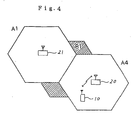
- a CDMA communication system has a mobile station 10 and a pair of base stations 20, 21.
- the base station 20 communicates with mobile stations in a cell A4, and the base station 21 communicates with mobile stations in a cell A1.
- the mobile station 10 moves in the cell A4, and hence communicates with the base station 20.
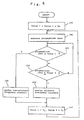
- step 101 value 1 and value 2 are set to V 0 .
- a base station measures a propagation loss in a channel established between the base station and each of the mobile stations.
- the base station can obtain a propagation loss by calculating the difference between a transmission power level of each of the mobile stations, which transmission power level is reported therefrom, and a reception power level of a signal received from each of the mobile stations by the base station.
- the base station can also obtain a propagation loss by calculating the difference between a reception power level of a signal received from the base station by each of the mobile stations, which reception power level is reported from the mobile station, and a transmission power level of the base station for each of the mobile stations.
- step 103 the base station decides whether the propagation loss with respect to a mobile station is greater than value 1 or not. If the propagation loss is greater than value 1 in step 103, then the base station assigns a frequency channel which is not adjacent to a frequency channel assigned to another CDMA communication system, to the mobile station in step 105. If the propagation loss is equal to or smaller than value 1 in step 103, the base station decides whether the propagation loss with respect to a mobile station is equal to or smaller than value 2 or not in step 104. If the propagation loss is greater than value 2 in step 104, the process is forwarded to step 103.
- step 104 If the propagation loss is equal to or smaller than value 2 in step 104, then the base station preferentially assigns a frequency channel which is adjacent to a frequency channel assigned to another CDMA communication system, to the mobile station in step 106. Finally, in step 107, value 1 is set to V 1 and value 2 is set to V 2 , then process is forwarded to step 102.
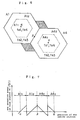
- the base station measures a propagation loss in a channel established between the base station and each of the mobile stations. Based on the measured propagation loss, the base station divides the mobile stations present in its own area into a plurality of groups. In Fig. 6 , the mobile stations are divided into two groups. While the mobile stations are shown as being grouped based on their positions in Fig. 6 , the mobile stations are actually grouped based on the propagation loses.
- the mobile stations in the cell A1 are divided into a group A1 1 and a group A1 2
- the mobile stations in the cell A4 are divided into a group A4 1 and a group A4 2
- the mobile stations whose propagation losses are equal to or smaller than a value are classified into the group A1 1 or A4 1
- the mobile stations whose propagation losses are greater than the value are classified into the group A1 2 or A4 2 .
- the mobile stations belonging to the groups A1 2 , A4 2 are assigned a frequency channel fa2 or fa3 in Fig.1 which is not adjacent to a frequency channel assigned to another network operator from among the frequency channels assigned to the CDMA communication system.
- the mobile stations belonging to the groups A1 1 , A4 1 are preferentially assigned a frequency channel fa1 or fa4 which is adjacent to a frequency channel assigned to another network operator.
- the base station of the cell A1 When the mobile station is in the position ⁇ , the base station of the cell A1 handles the mobile station as belonging to the group A1 1 , and preferentially assigns the frequency channel fa1 or fa4 to the mobile station.
- the base station of the cell A1 classifies the mobile station into the group A1 2 , and changes the frequency channel being used to fa2 or fa3.
- a handoff occurs from the base station of the cell A1 to the base station of the cell A4. At this time, the frequency channel being used is not changed and base station of the cell A4 handles the mobile station as belonging to group A4 2 .
- the base station of the cell A4 handles the mobile station as belonging to the group A4 1 , and preferentially changes the frequency channel being used to fa1 or fa4.
- the above frequency channel assignment makes it possible to reduce an upper limit for the reception power in the frequency channel fb1 in the base station of a cell B1 of a network operator B at the position ⁇ , to a level lower than the interference power indicated by the solid-line curve in Fig. 3c .
- a group to which a mobile station belongs is determined on the basis of a propagation loss over a channel with the mobile station, as measured by the base station.
- a group to which a mobile station belongs is determined on the basis of the transmission power level of the mobile station, rather than a propagation loss.
- the transmission power of the mobile station is controlled so as to be greater if the propagation loss is greater, and the transmission power of the mobile station is controlled so as to be smaller if the propagation loss is smaller. Therefore, the second embodiment can offer the same advantages as the first embodiment even though it employs the transmission power level of the mobile station.
- step 601 value 1 and value 2 are set to V 0 .
- a base station receives a transmission power level from a mobile station. The base station decides whether the transmission power level is greater than value 1 or not in step 603. If the transmission power level is greater than value 1 in step 603, then the base station assigns a frequency channel which is not adjacent to a frequency channel assigned to another CDMA communication system, to the mobile station in step 605. If the transmission power level is equal to or smaller than value 1 in step 603, the base station decides whether the transmission power level is equal to or smaller than value 2 or not in step 604. If the transmission power level is greater than value 2 in step 604, then the process is forwarded to step 603.
- step 604 If the transmission power level is equal to or smaller than value 2 in step 604, then the base station preferentially assigns a frequency channel which is adjacent to a frequency channel assigned to another CDMA communication system, to the mobile station in step 606. Finally, in step 607, value 1 is set to V 1 and value 2 is set to V 2 , then process is forwarded to step 602.
- the mobile stations in one cell are divided into two groups.
- the principles of the present invention are also applicable to CDMA communication systems where the mobile stations in one cell are divided into more than two groups.
Landscapes
- Engineering & Computer Science (AREA)
- Quality & Reliability (AREA)
- Computer Networks & Wireless Communication (AREA)
- Signal Processing (AREA)
- Mobile Radio Communication Systems (AREA)
Claims (8)
- Procédé d'assignation de fréquences dans des systèmes de communication CDMA fournissant des services dans la même zone lorsque des bandes de fréquences différentes sont assignées à chaque système de communication CDMA dans lequel une station de base (20, 21) d'un des systèmes de communication CDMA sélectionne un canal de fréquences à utiliser à partir de la bande de fréquences assignée et assigne le canal de fréquences sélectionné à une station mobile, comprenant les étapes consistant à :mesurer un affaiblissement de propagation sur une voie entre ladite station de base (20, 21) et une station mobile (10) présente dans une cellule de ladite station de base ;assigner un canal de fréquences qui n'est pas adjacent à la bande de fréquences assignée à un autre système de communication CDMA parmi les canaux de fréquences assignés audit système de communication CDMA à une station mobile dont l'affaiblissement de propagation est supérieur à une première valeur ; etassigner un canal de fréquences qui est adjacent à la bande de fréquences assignée à un autre système de communication CDMA parmi les canaux de fréquences assignés audit système de communication CDMA à une station mobile dont l'affaiblissement de propagation est égal ou inférieur à une seconde valeur.
- Procédé selon la revendication 1, dans lequel ladite étape consistant à mesurer un affaiblissement de propagation comprend l'étape consistant à :mesurer ledit affaiblissement de propagation sur la base de la différence entre le niveau de puissance de transmission d'une station mobile (10) rapporté à ladite station de base (20, 21) et le niveau de puissance de réception du signal transmis depuis ladite station mobile et reçu au niveau de ladite station de base (20, 21).
- Procédé selon la revendication 1, dans lequel ladite étape consistant à mesurer un affaiblissement de propagation comprend l'étape consistant à :mesurer ledit affaiblissement de propagation sur la base de la différence entre le niveau de puissance de réception au niveau de la station mobile (10) d'un signal en provenance de ladite station de base (20, 21) rapporté depuis ladite station mobile à ladite station de base et le niveau de puissance de transmission de ladite station de base à la station mobile (10).
- Procédé d'assignation de fréquences dans des systèmes de communication CDMA fournissant des services dans la même zone lorsque des bandes de fréquences différentes sont assignées à chaque système de communication CDMA dans lequel une station de base d'un des systèmes de communication CDMA sélectionne un canal de fréquences à utiliser à partir de la bande de fréquences assignée et assigne le canal de fréquences sélectionné à une station mobile (10), comprenant les étapes consistant à :indiquer le niveau de puissance de transmission de chaque station mobile de la station mobile (10) à une station de base (20, 21) respectivement ;assigner un canal de fréquences qui n'est pas adjacent à la bande de fréquences assignée à un autre système de communication CDMA parmi les canaux de fréquences assignés audit système de communication CDMA, à une station mobile (10) dont le niveau de puissance de transmission est supérieur à une première valeur ; etassigner un canal de fréquences qui est adjacent à la bande de fréquences assignée à un autre système de communication CDMA parmi les canaux de fréquences assignés audit système de communication CDMA à une station mobile (10) dont le niveau de puissance de transmission est égal ou inférieur à une seconde valeur.
- Système de communication CDMA comprenant :au moins une station mobile (10) ; etune pluralité de stations de base (20, 21) pour mesurer un affaiblissement de propagation sur une voie avec une station mobile présente dans une cellule de celle-ci, assigner un canal de fréquences qui n'est pas adjacent à la bande de fréquences assignée à un autre système de communication CDMA qui fournit des services dans la même zone que le système de communication CDMA parmi les canaux de fréquences assignés audit système de communication CDMA à une station mobile (10) dont l'affaiblissement de propagation est supérieur à une première valeur, et assigner un canal de fréquences qui est adjacent à la bande de fréquences assignée aux autre système de communication CDMA parmi les canaux de fréquences assignés audit système de communication CDMA, à une station mobile (10) dont l'affaiblissement de propagation est égal ou inférieur à une seconde valeur.
- Système de communication CDMA selon la revendication 5, dans lequel chacune desdites stations mobiles (10) comprend des moyens pour mesurer ledit affaiblissement de propagation sur la base de la différence entre le niveau de puissance de transmission d'une station mobile rapporté depuis ladite station mobile (10) à ladite station de base (20, 21) et le niveau de puissance de réception du signal transmis depuis ladite station mobile (10) et reçu au niveau de ladite station de base (20, 21).
- Système de communication CDMA selon la revendication 5, dans lequel chacune desdites stations mobiles (10) comprend des moyens pour mesurer ledit affaiblissement de propagation sur la base de la différence entre le niveau de puissance de réception au niveau de la station mobile (10) d'un signal en provenance de ladite station de base (20, 21) rapporté depuis ladite station mobile (10) à ladite station de base (20, 21) et le niveau de puissance de transmission de ladite station de base à la station mobile.
- Système de communication CDMA comprenant :au moins une station mobile (10) pour indiquer un niveau de puissance de transmission à une station de base ; etune pluralité de stations de base (20, 21) pour assigner un canal de fréquences qui n'est pas adjacent à la bande de fréquences assignée à un autre système de communication CDMA qui fournit des services dans la même zone que le système de communication CDMA parmi les canaux de fréquences assignés au système de communication CDMA à une station mobile (10) dont le niveau de puissance de transmission est supérieur à une première valeur, et assigner un canal de fréquences qui est adjacent à la bande de fréquences assignée à l'autre système de communication CDMA parmi les canaux de fréquences assignés audit système de communication CDMA à une station mobile (10) dont le niveau de puissance de transmission est égal ou inférieur à une seconde valeur.
Applications Claiming Priority (2)
| Application Number | Priority Date | Filing Date | Title |
|---|---|---|---|
| JP16072198 | 1998-06-09 | ||
| JP16072198A JP3107048B2 (ja) | 1998-06-09 | 1998-06-09 | Cdma通信システムおよびcdma通信システムおける周波数割り当て方法 |
Publications (3)
| Publication Number | Publication Date |
|---|---|
| EP0964596A2 EP0964596A2 (fr) | 1999-12-15 |
| EP0964596A3 EP0964596A3 (fr) | 2000-09-13 |
| EP0964596B1 true EP0964596B1 (fr) | 2009-08-12 |
Family
ID=15721042
Family Applications (1)
| Application Number | Title | Priority Date | Filing Date |
|---|---|---|---|
| EP19990110958 Expired - Lifetime EP0964596B1 (fr) | 1998-06-09 | 1999-06-08 | Méthode d'allocation de fréquence utilisant les pertes de propagation |
Country Status (6)
| Country | Link |
|---|---|
| US (1) | US6781974B1 (fr) |
| EP (1) | EP0964596B1 (fr) |
| JP (1) | JP3107048B2 (fr) |
| CN (1) | CN1186882C (fr) |
| DE (1) | DE69941241D1 (fr) |
| TW (1) | TW413983B (fr) |
Families Citing this family (17)
| Publication number | Priority date | Publication date | Assignee | Title |
|---|---|---|---|---|
| JP2001238252A (ja) * | 2000-02-25 | 2001-08-31 | Matsushita Electric Ind Co Ltd | 移動局装置、基地局装置および無線通信チャネル割り当て方法 |
| US6947748B2 (en) | 2000-12-15 | 2005-09-20 | Adaptix, Inc. | OFDMA with adaptive subcarrier-cluster configuration and selective loading |
| FR2821230B1 (fr) * | 2001-02-20 | 2003-04-11 | Mitsubishi Electric Inf Tech | Methode d'allocation de ressources de transmission |
| EP1261228B1 (fr) * | 2001-05-25 | 2005-04-06 | NTT DoCoMo, Inc. | Système de radiocommunications permettant de réduire l'interférence par rapport aux autres système de communications utilisant une bande de fréquence adjacente |
| US7555028B2 (en) * | 2002-05-03 | 2009-06-30 | Sprint Spectrum L.P. | Method and system for defining additional spread spectrum channels within a coverage area of an existing wireless network |
| US7769073B2 (en) * | 2002-05-03 | 2010-08-03 | Sprint Spectrum L.P. | Method and system using overlapping frequency bands in a hybrid frequency reuse plan |
| US7573851B2 (en) | 2004-12-07 | 2009-08-11 | Adaptix, Inc. | Method and system for switching antenna and channel assignments in broadband wireless networks |
| US20080219201A1 (en) * | 2005-09-16 | 2008-09-11 | Koninklijke Philips Electronics, N.V. | Method of Clustering Devices in Wireless Communication Network |
| EP1929814A2 (fr) * | 2005-09-16 | 2008-06-11 | Koninklijke Philips Electronics N.V. | Procede de mise en grappes de dispositifs dans un reseau de radiocommunications |
| US8179866B2 (en) * | 2005-10-03 | 2012-05-15 | Telefonaktiebolaget L M Ericsson (Publ) | Throughput optimized carrier allocation |
| CN101005324B (zh) * | 2006-01-18 | 2010-07-14 | 中兴通讯股份有限公司 | 一种频段信息搜集系统和方法 |
| JP4823756B2 (ja) * | 2006-04-27 | 2011-11-24 | 京セラ株式会社 | 移動体通信システム、基地局装置及び移動体通信システムの周波数割当方法 |
| CN101707779B (zh) * | 2009-11-23 | 2012-05-23 | 上海华为技术有限公司 | 资源分配方法、接入网设备及通信系统 |
| JP5462068B2 (ja) * | 2010-05-12 | 2014-04-02 | アダプティックス インコーポレイテッド | マルチキャリヤ通信システム(multi−carriercommunicationsystem)における適応キャリヤ割り当てと電力コントロール方法及び装置 |
| CN102932930B (zh) | 2011-08-10 | 2015-03-18 | 华为技术有限公司 | 资源调度方法及无线接入设备和通信系统 |
| JPWO2015060191A1 (ja) * | 2013-10-21 | 2017-03-09 | 京セラ株式会社 | 基地局及びプロセッサ |
| EP3668197B1 (fr) * | 2018-12-12 | 2021-11-03 | Rohde & Schwarz GmbH & Co. KG | Procédé et radio pour régler la puissance de transmission d'une transmission radio |
Family Cites Families (13)
| Publication number | Priority date | Publication date | Assignee | Title |
|---|---|---|---|---|
| JPH02224423A (ja) | 1989-02-27 | 1990-09-06 | Nippon Telegr & Teleph Corp <Ntt> | 無線周波数割当て方式 |
| US5185762A (en) * | 1991-05-15 | 1993-02-09 | Scs Mobilecom, Inc. | Spread spectrum microwave overlay with notch filter |
| JP2688297B2 (ja) | 1991-05-14 | 1997-12-08 | 三菱電機株式会社 | 移動体通信システム |
| DE69233003T2 (de) * | 1991-05-29 | 2004-01-22 | Nec Corp. | Kanalzuweisungsverfahren in Mobil-Kommunikationssystem |
| JPH05110504A (ja) | 1991-10-14 | 1993-04-30 | Nippon Telegr & Teleph Corp <Ntt> | コード分割多元接続方式 |
| DE69230716T2 (de) | 1991-11-25 | 2000-12-28 | Motorola, Inc. | Verringerte Interferenzstörungen durch Frequenzaufteilung in zellularen Kommunikationssystemen |
| JP2959288B2 (ja) | 1992-07-10 | 1999-10-06 | 松下電器産業株式会社 | 移動通信方法およびその装置 |
| JP3278932B2 (ja) | 1992-07-31 | 2002-04-30 | 株式会社明電舎 | 雨水ポンプ制御装置 |
| US6301242B1 (en) * | 1998-07-24 | 2001-10-09 | Xircom Wireless, Inc. | Communication system with fast control traffic |
| US5745484A (en) * | 1995-06-05 | 1998-04-28 | Omnipoint Corporation | Efficient communication system using time division multiplexing and timing adjustment control |
| US5787352A (en) | 1995-12-29 | 1998-07-28 | At&T Corp. | System and method for management of neighbor-channel interference with power control and directed channel assignment |
| US5884181A (en) * | 1996-01-19 | 1999-03-16 | Bell Communications Research, Inc. | Interference reduction in shared-frequency wireless communication systems |
| US6985456B2 (en) * | 2000-09-12 | 2006-01-10 | Sharp Laboratories Of America, Inc. | Method to reduce interference and increase effective capacity of power line networking systems |
-
1998
- 1998-06-09 JP JP16072198A patent/JP3107048B2/ja not_active Expired - Fee Related
-
1999
- 1999-05-28 TW TW88108832A patent/TW413983B/zh not_active IP Right Cessation
- 1999-06-03 US US09/324,930 patent/US6781974B1/en not_active Expired - Fee Related
- 1999-06-08 DE DE69941241T patent/DE69941241D1/de not_active Expired - Lifetime
- 1999-06-08 EP EP19990110958 patent/EP0964596B1/fr not_active Expired - Lifetime
- 1999-06-09 CN CNB991079868A patent/CN1186882C/zh not_active Expired - Fee Related
Also Published As
| Publication number | Publication date |
|---|---|
| JPH11355838A (ja) | 1999-12-24 |
| TW413983B (en) | 2000-12-01 |
| CN1186882C (zh) | 2005-01-26 |
| US6781974B1 (en) | 2004-08-24 |
| CN1238609A (zh) | 1999-12-15 |
| EP0964596A2 (fr) | 1999-12-15 |
| DE69941241D1 (de) | 2009-09-24 |
| EP0964596A3 (fr) | 2000-09-13 |
| JP3107048B2 (ja) | 2000-11-06 |
Similar Documents
| Publication | Publication Date | Title |
|---|---|---|
| EP0964596B1 (fr) | Méthode d'allocation de fréquence utilisant les pertes de propagation | |
| US6038220A (en) | Method and apparatus of forward traffic channel power control for CDMA wireless local loop system | |
| EP1793635B1 (fr) | Procede de support flexible d'un service non symetrique dans un systeme de communication mobile tdd a plusieurs porteuses | |
| EP1452062B1 (fr) | Procédé, système et terminal mobile pour l'utilisation optimale du spectre dans des systèmes cellulaires | |
| EP1161849B1 (fr) | Attribution de canaux utilisant des estimations de pertes de trajectoires ameliorees | |
| EP1145569B1 (fr) | Reseau de systemes et technique afferente de routage d'une information de transfert de cellule | |
| KR100493685B1 (ko) | 통신채널 선택용 기지국 장치 | |
| US7096019B2 (en) | Apparatus, and associated method, for allocating channels in a radio communication system responsive to mobile station movement | |
| US6564058B1 (en) | Cellular radio network | |
| WO1998038816B1 (fr) | Planification et attribution de frequences radioelectriques dans un environnement a spectre discontinu | |
| EP0819364B1 (fr) | Planification stabilisee de disposition des voies de commande grace a des canaux de trafic reserves a configuration dispersee | |
| EP1576742B1 (fr) | Procede et appareil permettant de determiner une puissance de transmission | |
| EP1269774B1 (fr) | Changement de domaine de frequences dans un systeme de communications | |
| US5903841A (en) | System and method for simplified handoff operation in a cellular mobile communication system | |
| JP2001503213A (ja) | 基地局およびセル方式移動無線システムのセル・カバレージ方法 | |
| US5369786A (en) | Enhanced power level usage in a radiotelephone system | |
| EP0509850A2 (fr) | Système de communication cellulaire mobile dans lequel la zone de service est réduite en réponse à la contamination du signal de commande | |
| WO1995006369A1 (fr) | Procede pour augmenter la capacite d'une station de base | |
| GB2377130A (en) | Handover criteria for mobile transceivers | |
| EP0967819B1 (fr) | Procédé de transferts d'appels dans un réseau cellulaire | |
| EP0512996B1 (fr) | Canaux vocaux divises en secteurs avec protection du lobe posterieur | |
| JPH0955974A (ja) | 移動通信装置 | |
| KR20000005989A (ko) | 씨디엠에이통신시스템및씨디엠에이통신시스템에서의주파수할당방법 | |
| GB2349043A (en) | Radio communications apparatus using fixed or mobile networks |
Legal Events
| Date | Code | Title | Description |
|---|---|---|---|
| PUAI | Public reference made under article 153(3) epc to a published international application that has entered the european phase |
Free format text: ORIGINAL CODE: 0009012 |
|
| AK | Designated contracting states |
Kind code of ref document: A2 Designated state(s): DE FR GB IT NL |
|
| AX | Request for extension of the european patent |
Free format text: AL;LT;LV;MK;RO;SI |
|
| PUAL | Search report despatched |
Free format text: ORIGINAL CODE: 0009013 |
|
| AK | Designated contracting states |
Kind code of ref document: A3 Designated state(s): AT BE CH CY DE DK ES FI FR GB GR IE IT LI LU MC NL PT SE |
|
| AX | Request for extension of the european patent |
Free format text: AL;LT;LV;MK;RO;SI |
|
| 17P | Request for examination filed |
Effective date: 20000803 |
|
| AKX | Designation fees paid |
Free format text: DE FR GB IT NL |
|
| 17Q | First examination report despatched |
Effective date: 20031201 |
|
| 17Q | First examination report despatched |
Effective date: 20031201 |
|
| APBN | Date of receipt of notice of appeal recorded |
Free format text: ORIGINAL CODE: EPIDOSNNOA2E |
|
| APBR | Date of receipt of statement of grounds of appeal recorded |
Free format text: ORIGINAL CODE: EPIDOSNNOA3E |
|
| APAF | Appeal reference modified |
Free format text: ORIGINAL CODE: EPIDOSCREFNE |
|
| APBT | Appeal procedure closed |
Free format text: ORIGINAL CODE: EPIDOSNNOA9E |
|
| GRAP | Despatch of communication of intention to grant a patent |
Free format text: ORIGINAL CODE: EPIDOSNIGR1 |
|
| RIC1 | Information provided on ipc code assigned before grant |
Ipc: H04W 16/14 20090101AFI20090121BHEP |
|
| GRAS | Grant fee paid |
Free format text: ORIGINAL CODE: EPIDOSNIGR3 |
|
| GRAA | (expected) grant |
Free format text: ORIGINAL CODE: 0009210 |
|
| RIN1 | Information on inventor provided before grant (corrected) |
Inventor name: TSUMURA, SOICHI |
|
| AK | Designated contracting states |
Kind code of ref document: B1 Designated state(s): DE FR GB IT NL |
|
| REG | Reference to a national code |
Ref country code: GB Ref legal event code: FG4D |
|
| REF | Corresponds to: |
Ref document number: 69941241 Country of ref document: DE Date of ref document: 20090924 Kind code of ref document: P |
|
| PLBE | No opposition filed within time limit |
Free format text: ORIGINAL CODE: 0009261 |
|
| STAA | Information on the status of an ep patent application or granted ep patent |
Free format text: STATUS: NO OPPOSITION FILED WITHIN TIME LIMIT |
|
| 26N | No opposition filed |
Effective date: 20100517 |
|
| REG | Reference to a national code |
Ref country code: GB Ref legal event code: 732E Free format text: REGISTERED BETWEEN 20141023 AND 20141029 |
|
| REG | Reference to a national code |
Ref country code: FR Ref legal event code: TP Owner name: LENOVO INNOVATIONS LIMITED (HONG KONG), HK Effective date: 20141119 |
|
| REG | Reference to a national code |
Ref country code: NL Ref legal event code: SD Effective date: 20150209 |
|
| REG | Reference to a national code |
Ref country code: FR Ref legal event code: PLFP Year of fee payment: 17 |
|
| PGFP | Annual fee paid to national office [announced via postgrant information from national office to epo] |
Ref country code: GB Payment date: 20150603 Year of fee payment: 17 Ref country code: DE Payment date: 20150602 Year of fee payment: 17 |
|
| PGFP | Annual fee paid to national office [announced via postgrant information from national office to epo] |
Ref country code: FR Payment date: 20150608 Year of fee payment: 17 Ref country code: NL Payment date: 20150609 Year of fee payment: 17 |
|
| PGFP | Annual fee paid to national office [announced via postgrant information from national office to epo] |
Ref country code: IT Payment date: 20150625 Year of fee payment: 17 |
|
| REG | Reference to a national code |
Ref country code: DE Ref legal event code: R119 Ref document number: 69941241 Country of ref document: DE |
|
| REG | Reference to a national code |
Ref country code: NL Ref legal event code: MM Effective date: 20160701 |
|
| GBPC | Gb: european patent ceased through non-payment of renewal fee |
Effective date: 20160608 |
|
| REG | Reference to a national code |
Ref country code: FR Ref legal event code: ST Effective date: 20170228 |
|
| PG25 | Lapsed in a contracting state [announced via postgrant information from national office to epo] |
Ref country code: DE Free format text: LAPSE BECAUSE OF NON-PAYMENT OF DUE FEES Effective date: 20170103 Ref country code: FR Free format text: LAPSE BECAUSE OF NON-PAYMENT OF DUE FEES Effective date: 20160630 |
|
| PG25 | Lapsed in a contracting state [announced via postgrant information from national office to epo] |
Ref country code: NL Free format text: LAPSE BECAUSE OF NON-PAYMENT OF DUE FEES Effective date: 20160701 Ref country code: GB Free format text: LAPSE BECAUSE OF NON-PAYMENT OF DUE FEES Effective date: 20160608 |
|
| PG25 | Lapsed in a contracting state [announced via postgrant information from national office to epo] |
Ref country code: IT Free format text: LAPSE BECAUSE OF NON-PAYMENT OF DUE FEES Effective date: 20160608 |