EP0965629B1 - Composé pour dispositif organique électroluminescent et dispositif organique électroluminescent - Google Patents
Composé pour dispositif organique électroluminescent et dispositif organique électroluminescent Download PDFInfo
- Publication number
- EP0965629B1 EP0965629B1 EP99304641A EP99304641A EP0965629B1 EP 0965629 B1 EP0965629 B1 EP 0965629B1 EP 99304641 A EP99304641 A EP 99304641A EP 99304641 A EP99304641 A EP 99304641A EP 0965629 B1 EP0965629 B1 EP 0965629B1
- Authority
- EP
- European Patent Office
- Prior art keywords
- substituted
- compound
- light
- group
- formula
- Prior art date
- Legal status (The legal status is an assumption and is not a legal conclusion. Google has not performed a legal analysis and makes no representation as to the accuracy of the status listed.)
- Expired - Lifetime
Links
Images


Classifications
-
- H—ELECTRICITY
- H10—SEMICONDUCTOR DEVICES; ELECTRIC SOLID-STATE DEVICES NOT OTHERWISE PROVIDED FOR
- H10K—ORGANIC ELECTRIC SOLID-STATE DEVICES
- H10K50/00—Organic light-emitting devices
- H10K50/10—OLEDs or polymer light-emitting diodes [PLED]
- H10K50/11—OLEDs or polymer light-emitting diodes [PLED] characterised by the electroluminescent [EL] layers
-
- C—CHEMISTRY; METALLURGY
- C07—ORGANIC CHEMISTRY
- C07C—ACYCLIC OR CARBOCYCLIC COMPOUNDS
- C07C211/00—Compounds containing amino groups bound to a carbon skeleton
- C07C211/43—Compounds containing amino groups bound to a carbon skeleton having amino groups bound to carbon atoms of six-membered aromatic rings of the carbon skeleton
- C07C211/57—Compounds containing amino groups bound to a carbon skeleton having amino groups bound to carbon atoms of six-membered aromatic rings of the carbon skeleton having amino groups bound to carbon atoms of six-membered aromatic rings being part of condensed ring systems of the carbon skeleton
- C07C211/61—Compounds containing amino groups bound to a carbon skeleton having amino groups bound to carbon atoms of six-membered aromatic rings of the carbon skeleton having amino groups bound to carbon atoms of six-membered aromatic rings being part of condensed ring systems of the carbon skeleton with at least one of the condensed ring systems formed by three or more rings
-
- C—CHEMISTRY; METALLURGY
- C09—DYES; PAINTS; POLISHES; NATURAL RESINS; ADHESIVES; COMPOSITIONS NOT OTHERWISE PROVIDED FOR; APPLICATIONS OF MATERIALS NOT OTHERWISE PROVIDED FOR
- C09B—ORGANIC DYES OR CLOSELY-RELATED COMPOUNDS FOR PRODUCING DYES, e.g. PIGMENTS; MORDANTS; LAKES
- C09B3/00—Dyes with an anthracene nucleus condensed with one or more carbocyclic rings
- C09B3/14—Perylene derivatives
- C09B3/18—Preparation from starting materials already containing the perylene nucleus
-
- C—CHEMISTRY; METALLURGY
- C09—DYES; PAINTS; POLISHES; NATURAL RESINS; ADHESIVES; COMPOSITIONS NOT OTHERWISE PROVIDED FOR; APPLICATIONS OF MATERIALS NOT OTHERWISE PROVIDED FOR
- C09K—MATERIALS FOR MISCELLANEOUS APPLICATIONS, NOT PROVIDED FOR ELSEWHERE
- C09K11/00—Luminescent materials, e.g. electroluminescent or chemiluminescent
- C09K11/06—Luminescent materials, e.g. electroluminescent or chemiluminescent containing organic luminescent materials
-
- H—ELECTRICITY
- H10—SEMICONDUCTOR DEVICES; ELECTRIC SOLID-STATE DEVICES NOT OTHERWISE PROVIDED FOR
- H10K—ORGANIC ELECTRIC SOLID-STATE DEVICES
- H10K85/00—Organic materials used in the body or electrodes of devices covered by this subclass
- H10K85/60—Organic compounds having low molecular weight
- H10K85/615—Polycyclic condensed aromatic hydrocarbons, e.g. anthracene
- H10K85/623—Polycyclic condensed aromatic hydrocarbons, e.g. anthracene containing five rings, e.g. pentacene
-
- H—ELECTRICITY
- H10—SEMICONDUCTOR DEVICES; ELECTRIC SOLID-STATE DEVICES NOT OTHERWISE PROVIDED FOR
- H10K—ORGANIC ELECTRIC SOLID-STATE DEVICES
- H10K85/00—Organic materials used in the body or electrodes of devices covered by this subclass
- H10K85/60—Organic compounds having low molecular weight
- H10K85/631—Amine compounds having at least two aryl rest on at least one amine-nitrogen atom, e.g. triphenylamine
- H10K85/633—Amine compounds having at least two aryl rest on at least one amine-nitrogen atom, e.g. triphenylamine comprising polycyclic condensed aromatic hydrocarbons as substituents on the nitrogen atom
-
- H—ELECTRICITY
- H10—SEMICONDUCTOR DEVICES; ELECTRIC SOLID-STATE DEVICES NOT OTHERWISE PROVIDED FOR
- H10K—ORGANIC ELECTRIC SOLID-STATE DEVICES
- H10K85/00—Organic materials used in the body or electrodes of devices covered by this subclass
- H10K85/60—Organic compounds having low molecular weight
- H10K85/631—Amine compounds having at least two aryl rest on at least one amine-nitrogen atom, e.g. triphenylamine
- H10K85/636—Amine compounds having at least two aryl rest on at least one amine-nitrogen atom, e.g. triphenylamine comprising heteroaromatic hydrocarbons as substituents on the nitrogen atom
-
- C—CHEMISTRY; METALLURGY
- C07—ORGANIC CHEMISTRY
- C07C—ACYCLIC OR CARBOCYCLIC COMPOUNDS
- C07C2603/00—Systems containing at least three condensed rings
- C07C2603/02—Ortho- or ortho- and peri-condensed systems
- C07C2603/54—Ortho- or ortho- and peri-condensed systems containing more than five condensed rings
-
- H—ELECTRICITY
- H10—SEMICONDUCTOR DEVICES; ELECTRIC SOLID-STATE DEVICES NOT OTHERWISE PROVIDED FOR
- H10K—ORGANIC ELECTRIC SOLID-STATE DEVICES
- H10K2102/00—Constructional details relating to the organic devices covered by this subclass
- H10K2102/10—Transparent electrodes, e.g. using graphene
- H10K2102/101—Transparent electrodes, e.g. using graphene comprising transparent conductive oxides [TCO]
- H10K2102/103—Transparent electrodes, e.g. using graphene comprising transparent conductive oxides [TCO] comprising indium oxides, e.g. ITO
-
- H—ELECTRICITY
- H10—SEMICONDUCTOR DEVICES; ELECTRIC SOLID-STATE DEVICES NOT OTHERWISE PROVIDED FOR
- H10K—ORGANIC ELECTRIC SOLID-STATE DEVICES
- H10K85/00—Organic materials used in the body or electrodes of devices covered by this subclass
- H10K85/30—Coordination compounds
- H10K85/321—Metal complexes comprising a group IIIA element, e.g. Tris (8-hydroxyquinoline) gallium [Gaq3]
-
- H—ELECTRICITY
- H10—SEMICONDUCTOR DEVICES; ELECTRIC SOLID-STATE DEVICES NOT OTHERWISE PROVIDED FOR
- H10K—ORGANIC ELECTRIC SOLID-STATE DEVICES
- H10K85/00—Organic materials used in the body or electrodes of devices covered by this subclass
- H10K85/60—Organic compounds having low molecular weight
- H10K85/649—Aromatic compounds comprising a hetero atom
- H10K85/654—Aromatic compounds comprising a hetero atom comprising only nitrogen as heteroatom
-
- H—ELECTRICITY
- H10—SEMICONDUCTOR DEVICES; ELECTRIC SOLID-STATE DEVICES NOT OTHERWISE PROVIDED FOR
- H10K—ORGANIC ELECTRIC SOLID-STATE DEVICES
- H10K85/00—Organic materials used in the body or electrodes of devices covered by this subclass
- H10K85/60—Organic compounds having low molecular weight
- H10K85/649—Aromatic compounds comprising a hetero atom
- H10K85/655—Aromatic compounds comprising a hetero atom comprising only sulfur as heteroatom
-
- H—ELECTRICITY
- H10—SEMICONDUCTOR DEVICES; ELECTRIC SOLID-STATE DEVICES NOT OTHERWISE PROVIDED FOR
- H10K—ORGANIC ELECTRIC SOLID-STATE DEVICES
- H10K85/00—Organic materials used in the body or electrodes of devices covered by this subclass
- H10K85/60—Organic compounds having low molecular weight
- H10K85/649—Aromatic compounds comprising a hetero atom
- H10K85/656—Aromatic compounds comprising a hetero atom comprising two or more different heteroatoms per ring
-
- H—ELECTRICITY
- H10—SEMICONDUCTOR DEVICES; ELECTRIC SOLID-STATE DEVICES NOT OTHERWISE PROVIDED FOR
- H10K—ORGANIC ELECTRIC SOLID-STATE DEVICES
- H10K85/00—Organic materials used in the body or electrodes of devices covered by this subclass
- H10K85/60—Organic compounds having low molecular weight
- H10K85/649—Aromatic compounds comprising a hetero atom
- H10K85/657—Polycyclic condensed heteroaromatic hydrocarbons
-
- H—ELECTRICITY
- H10—SEMICONDUCTOR DEVICES; ELECTRIC SOLID-STATE DEVICES NOT OTHERWISE PROVIDED FOR
- H10K—ORGANIC ELECTRIC SOLID-STATE DEVICES
- H10K85/00—Organic materials used in the body or electrodes of devices covered by this subclass
- H10K85/60—Organic compounds having low molecular weight
- H10K85/649—Aromatic compounds comprising a hetero atom
- H10K85/657—Polycyclic condensed heteroaromatic hydrocarbons
- H10K85/6576—Polycyclic condensed heteroaromatic hydrocarbons comprising only sulfur in the heteroaromatic polycondensed ring system, e.g. benzothiophene
-
- Y—GENERAL TAGGING OF NEW TECHNOLOGICAL DEVELOPMENTS; GENERAL TAGGING OF CROSS-SECTIONAL TECHNOLOGIES SPANNING OVER SEVERAL SECTIONS OF THE IPC; TECHNICAL SUBJECTS COVERED BY FORMER USPC CROSS-REFERENCE ART COLLECTIONS [XRACs] AND DIGESTS
- Y10—TECHNICAL SUBJECTS COVERED BY FORMER USPC
- Y10S—TECHNICAL SUBJECTS COVERED BY FORMER USPC CROSS-REFERENCE ART COLLECTIONS [XRACs] AND DIGESTS
- Y10S428/00—Stock material or miscellaneous articles
- Y10S428/917—Electroluminescent
Definitions
- the present invention relates to a compound for an organic electroluminescence (to be referred to as "EL" hereinafter) device for use in a flat panel or display, and a light-emitting device having a high brightness.
- EL organic electroluminescence
- an EL device using an organic substance is expected to be promising as a solid light-emitting inexpensive large-screen, full-color display device, and developments thereof are being made in many ways.
- an EL device is composed of a light-emitting layer and a pair of facing electrodes sandwiching the light-emitting layer.
- the light emission of an EL device is the following phenomenon.
- the cathode injects electrons into the light-emitting layer
- the anode injects holes into the light-emitting layer.
- the injected electrons recombine with the holes in the light-emitting layer, and their energy level shifts from a conduction band back to a valence bond band to release energy as light.
- the above organic EL device has a light-emitting layer containing a metal chelate complex and a hole-injecting layer containing an amine-based compound, and emits green light having a high brightness.
- the above organic EL device achieves nearly practically usable performance, since it accomplishes a brightness of 1,000 cd/m 2 and a maximum light emission efficiency of 1.5 lm/W at a DC voltage of 6 to 10 V.
- JP-A-2196885 discloses specific perylene derivatives as light emitting layers in an organic electroluminescent element.
- the present invention provides a compound suitable for use in an organic electroluminescence device, having the formula [1], wherein each of Ar 3 to Ar 10 are the same or different and represent a substituted or non-substituted aromatic monocyclic group, a substituted or non-substituted fused polycyclic group or a substituted or non-substituted aromatic heterocyclic group, or Ar 3 and Ar 4 and/or Ar 5 and Ar 6 and/or Ar 7 and Ar 8 and/or Ar 9 and Ar 10 , together with the nitrogen atom to which they are attached, together form a fused or non-fused, aromatic or non-aromatic heterocyclic ring.
- a light-emitting material suitable for an organic electroluminescence device which comprises a compound of the formula [1], as defined above.
- the light-emitting material of the invention contains at least one compound of the formula [1], as defined above, and at least one different compound which has the formula [2], wherein: Pe is a perylene residue; Ar 1 and Ar 2 are the same or different and each represents a substituted or non-substituted aryl group, a substituted or non-substituted fused polycyclic group or a substituted or non-substituted aromatic heterocyclic group or Ar 1 and Ar 2 , together with the nitrogen atom to which they are attached, together form a fused or non-fused, aromatic or non-aromatic, heterocyclic ring; and a is an integer of 2 to 12.
- the present invention provides an organic electroluminescence device comprising an anode and a cathode and, therebetween, an organic layer including at least one light-emitting layer, which light-emitting layer comprises a light-emitting material according to the invention.
- said organic layer further comprises at least one electron-injecting layer between the light-emitting layer and the cathode.
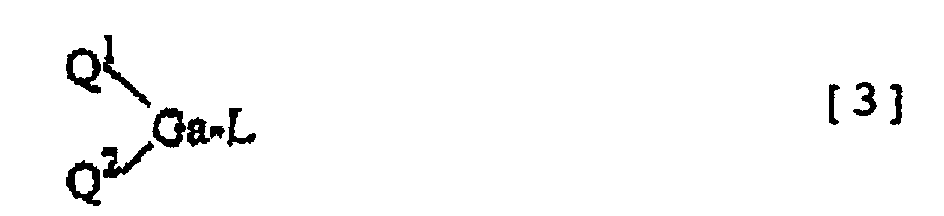
- the said light-emitting layer or the electron-injecting layer further comprises a compound of the formula [3] wherein Q 1 and Q 2 are the same or different and each is a substituted or non-substituted hydroxyquinoline derivative or a substituted or non-substituted hydroxybenzoquinoline derivative and L is a halogen atom, a substituted or non-substituted alkyl group, a substituted or non-substituted cycloalkyl group, a substituted or non-substituted aryl group, a substituted or non-substituted aromatic heterocyclic group, or a ligand of formula -OR in which R is a hydrogen atom, a substituted or non-substituted alkyl group, a substituted or non-substituted cycloalkyl group, a substituted or non-substituted aryl group, a substituted or non-substituted aromatic heterocyclic group
- a compound of formula (I), as defined above is used as a light emitting material in an organic electroluminescence device.
- the compound of formula (I) is used to emit red light.
- organic EL devices having light-emitting layers containing compounds of the formula [1] emit red light, have high light emission brightness and high light emission efficiency and have excellent light emission lives. Further, it has been found that an organic EL device having a light-emitting layer which contains a compound of the formula [1] and at least one hole-injecting layer which contains a compound of the formula [3] and is present between the light-emitting layer and a cathode can be a useful light-emitting device.
- the perylene residue in the formula [1] and a perylene residue in the formula [2] may have a substituent such as a halogen atom, a cyano group, a substituted or non-substituted alkyl group, a substituted or non-substituted alkoxy group, a substituted or non-substituted aryloxy group, a substituted or non-substituted alkylthio group, a substituted or non-substituted arylthio group, a substituted or non-substituted aryl group or a substituted or non-substituted aromatic heterocyclic group.
- a substituent such as a halogen atom, a cyano group, a substituted or non-substituted alkyl group, a substituted or non-substituted alkoxy group, a substituted or non-substituted aryloxy group, a substituted or non-
- each of Ar 1 to Ar 10 is independently a substituted or non-substituted phenyl group, a substituted or non-substituted fused polycyclic group or a substituted or non-substituted aromatic heterocyclic group.
- the substituted or non-substituted aryl group includes those phenyl groups having substituents.
- the substituted or non-substituted fused polycyclic group includes heterocyclic-group-free aromatic groups such as naphtyl, anthryl, phenanthryl, pirenyl, perylenyl and triphenyl, and it may have a substituent.
- the substituted or non-substituted aromatic heterocyclic group includes substituted or non-substituted aromatic heterocyclic groups having 2 to 3 carbon atoms.
- substituted and non-substituted aromatic heterocyclic groups include pyridyl, pyrazinyl, pyrimidinyl, pyridazinyl, triazinyl, indolinyl, quinolyl, acrydinyl, carbozolyl, furyl, thiophenyl, oxazolyl, oxadiazolyl, benzoxadiazolyl, thiazolyl, thiaziazolyl, benzothiazoyl, trizolyl, benzotriazolyl, imidazolyl and benzimidazolyl, and it may have a substituent.
- the aromatic monocyclic group and/or the fused polycyclic group is a non-heterocyclic group.
- Ar 1 and Ar 2 and/or Ar 3 and Ar 4 and/or Ar 5 and Ar 6 and/or Ar 7 and Ar 8 and/or Ar 9 and Ar 10 may, together with the nitrogen atom to which they are attached, together form a fused or non fused aromatic or non-aromatic heterocyclic ring.
- this ring include a pyrrolidine ring, a pyrazolidine ring, piperidine ring, a morpholine ring, piperazine ring, a tritian ring and the above aromatic heterocyclic groups.
- substituents are independently a hydrogen atom, a halogen atom, a cyano group, a nitro group, a substituted or non-substituted alkyl group, a substituted or non-substituted alkoxy group, a substituted or non-substituted aryloxy group, a substituted or non-substituted alkylthio group, a substituted or non-substituted aryl group, a substituted or non-substituted aromatic heterocyclic group or -NR 6 R 7 in which each of R 6 and R 7 is a substituted or non-substituted alkyl group, a substituted or non-substituted aryl group or a substituted or non-substituted aromatic heterocyclic group, provided that R 6 and R 7 may integrally bond to each other.
- the above substituted or non-substituted alkyl group includes alkyl groups having 1 to 30 carbon atoms such as methyl, ethyl, propyl, butyl, sec-butyl, tert-butyl, pentyl, hexyl, heptyl, octyl, stearyl, 2-phenylisopropyl, trichloromethyl, trifluoromethyl, benzyl, ⁇ -phenoxybenzyl, ⁇ , ⁇ -dimethylbenzyl, ⁇ , ⁇ -methylphenylbenzyl, ⁇ , ⁇ -ditrifluoromethylbenzyl, tripehnylmethyl and ⁇ -benzyloxybenzyl.
- alkyl groups having 1 to 30 carbon atoms such as methyl, ethyl, propyl, butyl, sec-butyl, tert-butyl, pentyl, hexyl, heptyl, o
- the substituted or non-substituted alkoxy group includes alkoxy groups having 1 to 20 carbon atoms such as methoxy, ethoxy, propoxy, n-butyoxy, t-butoxy, n-octyloxyl, t-octyloxy, 1,1,1-tetrafluoroethoxy, benzyloxy and octylphenoxy.
- the substituted or non-substituted alkylthio group includes methylthio, ethylthio, tert-butylthio, hexylthio, octylthio and trifluoromethylthio.
- the substituted or non-substituted aryloxy group includes phenoxy, 4-nitrophenoxy, tert-butylphenoxy, 3-fluorophenoxy, pentafluorophenyl and trifluoromethylphenoxy.
- the substituted or non-substituted arylthio group includes phenylthio, 4-methylphenylthio, tert-butylphenylthio, 3-fluorophenylthio, pentafluorophenylthio and 3-trifluoromethylphenylthio.
- the substituted or non-substituted aryl group includes phenyl, naphthyl, anthryl, phenanthryl, fluorenyl, pirenyl, perylenyl and triphenylenyl. These may have a substituent.
- -NR 6 R 7 examples include ethylamino, dimethylamino, dipropylamino, dibutylamino, benzylamino, dibenzylamino, (3-methylphenyl)amino, (4-methylphenyl)amino, phenylamino, phenylmethylamino, diphenylamino, ditolylamino, dipyridylamino, phenylthiophenylamino, dibiphenylamino, di(4-methylbiphenyl)amino, di(3-methylphenyl)amino, di(4-methylphenyl) amino, naphthylphenylamino and bis[4-( ⁇ , ⁇ '-dimethylbenzyl)phenyl]amino.
- alkyl, alkoxy and diphenylamino are preferred.
- Typical examples of the above combinations are shown in Table 1, such as a combination of structural isomers like Compounds (2) and (49) and a combination of Compounds (63) and (53).
- Examples of a combination of three compounds include combinations of three compounds in Table 1, such as a combination of isomers like Compounds (1), (2) and (49).
- the compound of the formula [1] or [2] which has a perylene ring has a high glass transition point and a high melting point and therefore has high durability (heat resistance) against Joule heat generated in an organic layer or an intermediate layer or between an organic layer and a metal electrode during the-light emission by an electric field.
- the above compound When used as a light-emitting material for an organic EL device, therefore, the above compound exhibits a high light emission brightness and is therefore advantageous for the lifetime of light emission.
- the compound of the present invention shall not be limited to substituents.
- the compound of the formula [1] or [2] can be produced, e.g., by the following method.
- halogenated perylene and an aromatic diamine compound are allowed to react in an inert solvent in the presence of a catalyst such as copper at 200°C for a long period of time.
- aminoperylene and a halogenated aryl compound are allowed to react in an inert solvent.
- a catalyst a copper powder, cuprous chloride, tin or stannous chloride is used.
- the solvent is selected from N,N-dimethylformamide or dimethylsulfoxide.
- the compounds of the formula [1] When the compounds of the formula [1] are used as light-emitting materials of organic EL devices, the devices exhibit a high light emission efficiency in a broad light emission region of red.
- Most of the compounds of the formula [2] have a melting point of 300°C or higher and have a high light emission brightness, and they are remarkably useful for producing devices having a long lifetime. Further, it is preferred to use a combination of the compound of the formula [1] with the compound of the formula [2]. In this case, it is particularly preferred to use the compound of the formula [2] in which a is 2.
- halogen atom the substituted or non-substituted alkyl group, the substituted or non-substituted aryl group and the substituted or non-substituted aromatic heterocyclic group included in the definition of L or R are the same as those explained with regard to the formula [1] or [2].
- examples of the substituted or non-substituted cycloalkyl group include cyclopentyl, cyclohexyl, cycloheptyl, cyclononyl and cyclodecanyl.
- specific examples of the compound of the formula [3] includes bis(2-methyl-8-hydroxyquinolinato)(1-naphtholato) gallium complex, bis(2-methyl-8-hydroxyquinolinato)(2-naphtholato) gallium complex, gallium bis(2-methyl-8-hydroxyquinolinato)(phenolato) gallium complex, bis(2-methyl-8-hydroxyauinolinato)(4-cyano-1-naphthaolato) gallium complex, bis(2,4-dimethyl-8-hydroxyquinolinato)(1-naphtholato) gallium complex, bis(2,5-dimethyl-8-hydroxyquinolinato)(2-naphtholato) gallium complex, bis(2-methyl-5-phenyl-8-hydroxyquinolinato)(phenolato) gallium complex, bis(2-methyl-5-cyano-8-hydroxyquinolinato)(4-cyano-1-naphtolato) gallium complex, bis(2-methyl-8-hydroxyquinolina
- An organic EL device is a device having a structure in which a mono- or multi-layered organic thin layer is formed between an anode and a cathode.
- a light-emitting layer is formed between the anode and the cathode.
- the light-emitting layer contains a light-emitting material, and in addition thereto, it may contain a hole-injecting material for transporting holes injected from the anode to the light-emitting material, or an electron-injecting material for transporting electrons injected from the cathode to the light-emitting material.
- the multi-layered organic EL device has one of laminated-layer structures, for example, of (anode/hole-injecting layer/light-emitting layer/cathode), (anode/light-emitting layer/electron-injecting layer/cathode) and (anode/bole-injecting layer/light-emitting layer/electron-injecting layer/cathode).
- the compound of the formula [1] provided by the present invention has intense fluorescence of red and exhibits excellent light emission by an electric field when it is in a solid state, and it can be therefore used as a light-emitting material.
- the light emitting material of the invention typically further comprises a host material, the content of the compound of the formula [1] being from 0.001 % to 50 % by weight, further effectively in the range of from 0.01 % by weight to 10 % by weight, based on the host material.
- Each of the above hole-injecting layer, light-emitting layer and electron-injecting layer may be formed of two or more layers.
- the host material is at least one selected from an electron-injecting material, a hole-injecting material and an electrically conductive polymer.
- Suitable electron-injecting materials include quinoline metal complex, benzoquinoline metal complex, benzoxazole metal complex, benzothiazole metal complex, benzoimidazole metal complex, benzotriazole metal complex, an imidazole derivative, an oxadiazole derivative, thiadiazole derivative and a triazole derivative, hole-injecting materials such as a stilbene derivative, a butadiene derivative, benzidine type triphenylamine derivative, a styrylamine type triphenylamine derivative, a diaminoanthracene type triphenylamine derivative and diaminophenanthrene type triphenylamine derivative, and electrically conductive polymers such as polyvinyl carbazole and polysilane.
- the light-emitting material or the dopant that can be used together with the compound of the formula [1] includes anthracene, naphthalene, phenanthrene, pyrene, tetracene, coronene, chrysene, fluorescein, perylene, phthaloperylene, naphthaloperylene, perinone, phthaoperinone, naphthaloperinone, diphenylbutadiene, tetraphenylbutadiene, coumarine, oxadiazole, aldazine, bisbenzoxazoline, bisstyryl, pyrazine, cyclopentadiene, quinoline metal complex, aminoquinoline metal complex, benzoquinoline metal complex, imine, diphenylethylene, vinyl anthracene, diaminocarbazole, pyran, thiopyran, polymethine, merocyanine, an imidazole-chel
- the light-emitting layer may contain a hole-injecting material or an electron-injecting material as required in addition to the light-emitting material and the dopant.
- the hole-injecting material is selected from compounds which are capable of injecting holes, have an excellent effect of injecting holes to a light-emitting layer or a light-emitting material, prevent the movement of excitons generated in a light-emitting layer to an electron-injecting layer or an electron-injecting material and have excellent thin film formability.
- the hole-injecting material examples include a phthalocyanine derivative, a naphthalocyanine derivative, a porphyrin derivative, triazole, imidazole, imidazolone, imidazolthione, pyrazoline, pyrazolone, tetrahydroimidazole, oxazole, oxadiazole, hydrazone, acylhydrazone, polyarylalkane, stilbene, butadiene, benzidine type triphenylamine, styrylamine type triphenylamine, diamine type triphenylamine, derivatives of these, polyvinylcarbazole, polysilane and an electrically conductive polymer.
- the hole-transporting material shall not be limited to the above materials.
- the hole-injecting material which is more effective is an aromatic tertiary amine derivative or a phthalocyanine derivative.
- the tertiary amine derivative include triphenylamine, tritolylamine, tolyldiphenylamine, N,N'-diphenyl-N,N'-(3-methylphenyl)-1,1'-biphenyl-4,4'-diamine, N,N,N',N'-(4-methylphenyl)-1,1'-phenyl-4,4'-diamine, N,N,N',N'-(4-methylphenyl)-1,1'-biphenyl-4,4'-diamine, N,N'-diphenyl-N,N'-dinaphthyl)-1,1'-biphenyl-4,4'-diamine, N,N'-(methylphenyl)-N,N'-diamine, N,N'-(methylphenyl)-
- phthalocyanine (Pc) derivative examples include phthalocyanine derivatives or naphthalocyanine derivatives such as H 2 Pc, CuPc, CoPc, NiPc, ZnPc, PdPc, FePc, MnPc, ClAlPc, ClGaPc, ClInPc, ClSnPc, Cl 2 SiPc, (HO)AlPc, (HO)GaPc, VOPc, TiOPc, MoOPc, and GaPc-O-GaPc.
- phthalocyanine (Pc) derivatives or naphthalocyanine derivatives such as H 2 Pc, CuPc, CoPc, NiPc, ZnPc, PdPc, FePc, MnPc, ClAlPc, ClGaPc, ClInPc, ClSnPc, Cl 2 SiPc, (HO)AlPc, (HO)GaPc, VOPc, TiOPc, MoOPc,
- the electron-injecting material is a material which is capable of injecting electrons, has the excellent effect of injecting electrons into a light-emitting layer or light-emitting material, prevents excitons generated in the light-emitting layer from moving into a hole-injecting zone and has excellent thin film formability.
- examples of the electron-injecting material include quinoline metal complex, oxadiazole, benzothiazole metal complex, benzoxazole metal complex, benzoimidazole metal complex, fluorenone, anthraquinodimethane, diphenoquinone, thiopyran dioxide, oxadiazole, thiaziazole, tetrazole, perylenetetracarboxylic acid, fluorenylidenemethane, anthraquinodimethane, anthrone and derivatives of these.
- the hole-injecting material may be sensitivity-increased by incorporating an electron-receiving material, and the electron-injecting material may be sensitivity-increased by incorporating an electron-donating material.
- metal complex compounds or nitrogen-containing five-membered ring derivatives are more effective electron-injecting materials.
- the compound of the formula [3] is preferred.
- metal complex compounds include lithium 8-hydroxyquinolinate, zinc bis(8-hydroxyquinolinate), copper bis(8-hydroxyquinolinate), manganese bis(8-hydroxyquinolinate), aluminum tris(8-hydroxyquinolinate), aluminum tris(2-methyl-8-hydroxyquinolinate), gallium tris(8-hydroxyquinolinate), beryllium bis(10-hydroxybenzo[h]quinolinate) and zinc bis[10-hydroxybenzo[h]quinolinate), although the metal complex compounds shall not be limited to these.
- nitrogen-containing five-membered derivative an oxazole, thiazole, thiadiazole, or triazole derivative is preferred.
- specific examples of the nitrogen-containing five-membered derivative include 2,5-bis(1-phenyl)-1,3,4-oxazole, dimethylPOPOP, 2,5-bis(1-phenyl)-1,3,4-thiazole, 2,5-bis(1-phenyl)-1,3,4-oxadiazole, 2-(4'-tert-butylphenyl)-5-(4"-biphenyl)1,3,4-oxadiazole, 2,5-bis(1-naphthyl)-1,3,4-oxadiazole, 1,4-bis[2-(5-phenyloxadiazolyl)]benzene, 1,4-bis[2-(5-phenyloxadiazolyl)-4-tert-butylbenzene], 2-(4'-tert-butylphenyl)-5
- the electrically conductive material used for the anode of the organic EL device is suitably selected from those materials having a work function of greater than 4 eV.
- the electrically conductive material includes carbon, aluminum, vanadium, iron, cobalt, nickel, tungsten, silver, gold, platinum, palladium, alloys of these, metal oxides such as tin oxide and indium oxide used for ITO substrates or NESA substrates, and organic electrically conductive polymers such as polythiophene and polypyrrole.
- the electrically conductive material used for the cathode is suitably selected from those having a work function of smaller than 4 eV.
- the electrically conductive material includes magnesium, calcium, tin, lead, titanium, yttrium, lithium, lithium fluoride, ruthenium, manganese and alloys of these.
- the alloys include magnesium/silver, magnesium/indium and lithium/aluminum, while the electrically conductive material shall not be limited to these.
- the ratio of components of the alloy is controlled depending upon a heating temperature, an atmosphere and a vacuum degree, and a proper ratio is selected.
- Each of the anode and the cathode may have a layer structure formed of two layers or more as required.
- At least one of the electrodes is desirably sufficiently transparent in the light emission wavelength region.
- the substrate is desirably transparent as well.
- the transparent electrode is produced from the above electrically conductive material by a deposition method or a sputtering method such that a predetermined light transmittance is secured.
- the electrode on the light emission surface side preferably has a light transmittance of at least 10 %.
- the substrate is not specially limited so long as it has adequate mechanical and thermal strength and has transparency.
- it is selected from glass substrates and substrates of transparent polymers such as a polyethylene substrate, a polyethylene substrate, a polyether sulfone substrate and a polypropylene substrate.
- the organic EL device When the organic EL device is formed of a multi-layered structure, a decrease in the brightness and the lifetime caused by quenching can be prevented. Further, at least two kinds of light-emitting materials, at least two kinds of doping materials, at least two kinds of hole-injecting materials for injecting carriers, and at least two kinds of electron-injecting materials may be used in combination each as required. Further, each of the hole-injecting layer, the light-emitting layer and the electron-injecting layer may be formed of two layers or more, a device structure is selected such that holes or electrons are efficiently injected from the electrodes and transported in layers.
- each layer can be formed by any one of dry film forming methods such as a vacuum deposition method, a sputtering method, a plasma method and an ion plating method and wet film forming methods such as a spin coating method, a dipping method and a flow coating method.
- the thickness of each layer is not specially limited, while each layer is required to have a proper thickness. When the layer thickness is too large, inefficiently, a high voltage is required to achieve predetermined emission of light. When the layer thickness is too small, the layer is liable to have a pinhole, etc., so that sufficient light emission brightness is hard to obtain when an electric field is applied.
- the thickness of each layer is preferably in the range of from 1 nm to 10 ⁇ m, more preferably 10 nm to 0.2 ⁇ m.
- material(s) for forming an intended layer is dissolved or dispersed in a proper solvent such as chloroform, tetrahydrofuran or dioxane, and a thin film is formed from the solution or dispersion.
- a proper solvent such as chloroform, tetrahydrofuran or dioxane
- the solvent shall not be limited to the above solvents.
- the above solution or dispersion for forming the layer may contain a proper polymer and a proper additive.
- the above polymer includes insulating resins such as polystyrene, polycarbonate, polyarylate, polyester, polyamide, polyurethane, polysulfone, polymethyl methacrylate, polymethyl acrylate and cellulose, photoconductive polymers such as poly-N-vinylcarbozole and polysilane, and electrically conductive polymers such as polythiophene and polypyrrole.
- the above additive includes an antioxidant, an ultraviolet absorbent and a plasticizer.
- the light-emitting layer may contain, in addition to the compound of the formula [1], at least one of a light-emitting material, a doping material, a hole-injecting material and an electron-injecting material.
- a protective layer may be formed on the surface of the device, or the device as a whole may be sealed with a silicone oil, or the like.
- the organic EL device When the compound of the present invention is used in a light-emitting layer of an organic EL device, and further, when the light-emitting layer is combined with the specified hole-injecting layer or the electron-injecting layer, the organic EL device can be improved in organic EL device characteristics such as light emission efficiency and maximum light emission brightness. Further, the organic EL device of the present invention is remarkably stable against heat and electric current and gives a practically usable light emission brightness at a low driving voltage, so that the deterioration which is a big problem of conventional devices can be remarkably decreased.
- the organic EL device of the present invention has significant industrial values since it can be adapted for a flat panel display of an on-wall television set, a flat light-emitting device, a light source for a copying machine or a printer, a light source for a liquid crystal display or a meter, a display signboard and a signal light.
- Compound (53) was dissolved in methylene chloride, and the solution was spin-coated on a cleaned glass substrate with an ITO electrode to form a hole-injecting type light-emitting layer having a thickness of 50 nm. Then, gallium bis(2-methyl-8-hydroxyquinolinate)(1-naphtolate) complex was vacuum-deposited to form an electron-injecting layer having a thickness of 40 nm, and an electrode having a thickness of 100 nm was formed thereon from a magnesium/silver alloy having a magnesium/silver mixing weight ratio of 10/1, to obtain an organic EL device.
- the light-emitting layer and the electron-injecting layer were formed by deposition under a vacuum of 10 -6 Torr at a substrate temperature of room temperature.
- the device showed a red light emission having a light emission brightness of 150 (cd/m 2 ) at a direct current voltage of 5 V, a maximum light emission brightness of 2,200 (cd/m 2 ) and a light emission efficiency of 0.40 (lm/W).
- 4,4'-bis[N-(1-naphthyl)-N-phenylamino]biphenyl( ⁇ -NPD) was vacuum-deposited on a cleaned glass substrate with an ITO electrode to form a hole-injecting layer having a thickness of 30 m.
- Compound (49) as a light-emitting material was vacuum-deposited to form a light-emitting layer having a thickness of 30 nm.
- gallium bis(2-methyl-8-hydroxyquinolinate)(phenolate) complex was vacuum-deposited to form an electron-injecting layer having a thickness of 30 nm.
- An electrode having a thickness of 100 nm was formed thereon from a magnesium/silver alloy having a magnesium/silver mixing weight ratio of 10/1, to obtain an organic EL device.
- the hole-injecting layer and the light-emitting layer were formed by deposition under a vacuum of 10 -6 Torr at a substrate temperature of room temperature.
- the device showed a red light emission having a light emission brightness of 200 (cd/m 2 ) at a direct current voltage of 5 V, a maximum light emission brightness of 5,000 (cd/m 2 ) and a light emission efficiency of 0.8 (lm/W).
- 4,4',4"-tris(N-(3-methylphenyl)-N-phenylamino)triphenylamine was vacuum-deposited on a cleaned glass substrate with an ITO electrode to form a hole-injecting layer having a thickness of 40 nm.
- ⁇ -NPD was vacuum-deposited to form a second hole-injecting layer having a thickness of 10 nm.
- Compound (61) was vacuum-deposited to form a light-emitting layer having a thickness of 30 nm.
- gallium bis(2-methyl-8-hydroxyquinolinate)(1-phenolate) complex was vacuum-deposited to form an electron-injecting layer having a thickness of 30 nm.
- An electrode having a thickness of 150 nm was formed thereon from an aluminum/lithium alloy having an aluminum/lithium mixing weight ratio of 25/1, to obtain an organic EL device.
- the hole-injecting layers and the light-emitting layer were formed by deposition under a vacuum of 10 -6 Torr at a substrate temperature of room temperature.
- the device showed a red light emission having a light emission brightness of 210 (cd/m 2 ) at a direct current voltage of 5 V, a maximum light emission brightness of 4,000 (cd/m 2 ) and a light emission efficiency of 0.6 (lm/W).
- An electrode having a thickness of 100 nm was formed thereon from a magnesium/silver alloy having a magnesium/silver mixing weight ratio of 10/1, to obtain an organic EL device.
- the hole-injecting layer and the light-emitting layer were formed by deposition under a vacuum of 10 -6 Torr at a substrate temperature of room temperature.
- the device showed a red light emission having a light emission brightness of 150 (cd/m 2 ) at a direct current voltage of 5 V, a maximum light emission brightness of 4,000 (cd/m 2 ) and a light emission efficiency of 0.6 (lm/W).
- 4,4',4"-tris(N-(3-methylphenyl)-N-phenylamino)triphenylamine was vacuum-deposited on a cleaned glass substrate with an ITO electrode to form a hole-injecting layer having a thickness of 40 nm. Then, ⁇ -NPD was vacuum-deposited to form a second hole-injecting layer having a thickness of 10 nm. Further, Compound (53) was vacuum-deposited to form a light-emitting layer having a thickness of 30 nm. Further, gallium bis(2-methyl-8-hydroxyquinolinate)(1-phenolate) complex was vacuum-deposited to form an electron-injecting layer having a thickness of 30 nm.
- An electrode having a thickness of 150 nm was formed thereon from an aluminum/lithium alloy having an aluminum/lithium mixing weight ratio of 25/1, to obtain an organic EL device.
- the hole-injecting layers and the light-emitting layer were formed by deposition under a vacuum of 10 -6 Torr at a substrate temperature of room temperature.
- the device showed a red light emission having a light emission brightness of 250 (cd/m 2 ) at a direct current voltage of 5 V, a maximum light emission brightness of 7,000 (cd/m 2 ) and a light emission efficiency of 0.7 (lm/W).
- An organic EL device was obtained in the same manner as in Example 2 except that the light-emitting layer was replaced with a 30 nm thick light-emitting layer formed by vapor-depositing Compound (2) and Compound (49) in a Compound (2)/Compound (49) weight ratio of 100/3.
- the organic EL device showed a red light emission having a light emission brightness of 500 (cd/m 2 ) at a direct current voltage of 5 V, a maximum light emission brightness of 8,100 (cd/m 2 ) and a light emission efficiency of 0.9 (lm/W).
- An organic EL device was obtained in the same manner as in Example 2 except that the light-emitting layer was replaced with a 30 nm thick light-emitting layer formed by vapor-depositing Compound (63) and Compound (61) in a Compound (63)/Compound (61) weight ratio of 100/5.
- the organic EL device showed a red light emission having a light emission brightness of 340 (cd/m 2 ) at a direct current voltage of 5 V, a maximum light emission brightness of 7,500 (cd/m 2 ) and a light emission efficiency of 1.0 (lm/W).
- An organic EL device was obtained in the same manner as in Example 2 except that the light-emitting layer was replaced with a 30 nm thick light-emitting layer formed by vapor-depositing Compound (49) and ⁇ -NPD in a Compound (49)/ ⁇ -NPD weight ratio of 5/100.
- the organic EL device showed an orange light emission having a light emission brightness of 420 (cd/m 2 ) at a direct current voltage of 5 V, a maximum light emission brightness of 12,000 (cd/m 2 ) and a light emission efficiency of 1.1 (lm/W).
- An organic EL device was obtained in the same manner as in Example 2 except that the light-emitting layer was replaced with a 30 nm thick light-emitting layer formed by vapor-depositing Compound (53) and gallium bis(2-methyl-8-hydroxyquinolinate)(phenolate) complex in a Compound (53)/gallium bis(2-methyl-8-hydroxyquinolinate) (phenolate) complex weight ratio of 1/100.
- the organic EL device showed an orange light emission having a light emission brightness of 450 (cd/m 2 ) at a direct current voltage of 5 V, a maximum light emission brightness of 14,000 (cd/m 2 ) and a light emission efficiency of 1.3 (lm/W).
- An organic EL device was obtained in the same manner as in Example 2 except that the light-emitting layer was replaced with a 30 nm thick light-emitting layer formed by vapor-depositing Compound (32) and Compound (49) in a Compound (32)/Compound (49) weight ratio of 100/1.
- the organic EL device showed a red light emission having a light emission brightness of 380 (cd/m 2 ) at a direct current voltage of 5 V, a maximum light emission brightness of 8,500 (cd/m 2 ) and a light emission efficiency of 0.9 (lm/W).
- An organic EL device was obtained in the same manner as in Example 2 except that the light-emitting layer was replaced with a 30 nm thick light-emitting layer formed by vapor-depositing Compound (35) and Compound (49) in a Compound (35)/Compound (49) weight ratio of 100/3.
- the organic EL device showed a red light emission having a light emission brightness of 550 (cd/m 2 ) at a direct current voltage of 5 V, a maximum light emission brightness of 9,500 (cd/m 2 ) and a light emission efficiency of 0.9 (lm/W).
- An organic EL device was obtained in the same manner as in Example 2 except that the light-emitting layer was replaced with a 30 nm thick light-emitting layer formed by vapor-depositing Compound (42) and Compound (53) in a Compound (42)/Compound (53) weight ratio of 100/3.
- the organic EL device showed a red light emission having a light emission brightness of 600 (cd/m 2 ) at a direct current voltage of 5 V, a maximum light emission brightness of 12,500 (cd/m 2 ) and a light emission efficiency of 1.1 (lm/W).
- An organic EL device was obtained in the same manner as in Example 2 except that the light-emitting layer was replaced with a 30 nm thick light-emitting layer formed by vapor-depositing Compound (40) and Compound (61) in a Compound (40)/Compound (61) weight ratio of 100/3.
- the organic EL device showed a red light emission having a light emission brightness of 500 (cd/m 2 ) at a direct current voltage of 5 V, a maximum light emission brightness of 10,500 (cd/m 2 ) and a light emission efficiency of 1.0 (lm/W).
- Compound (69) was vacuum-deposited on a cleaned glass substrate with an ITO electrode to form a hole-injecting type light emitting layer having a thickness of 50 nm. Then, a tris(8-hydroxyquinolinate) aluminum complex (Alq3) was vacuum-deposited to form an electron-injecting layer having a thickness of 30 nm. An electrode having a thickness of 100 nm was formed thereon from a magnesium/silver alloy having a magnesium/silver mixing weight ratio of 10/1, to obtain an organic EL device. The light emitting layer and the electron-injecting layer were deposited under vacuum at 10 -6 Torr at a substrate temperature of room temperature.
- the organic EL device showed an yellow light emission having a light emission brightness of 100 (cd/m 2 ) at a direct current voltage of 5 V, a maximum light emission brightness of 2,200 (cd/m 2 ) and a light emission efficiency of 0.2 (lm/W).
- the light emission surface of the device had many dark spots, and the light emission life of the device was a few hours.
- the organic EL devices obtained in the above Examples having the structure of at least 2 layers, showed a red light emission having a maximum light emission brightness of at least 4,000 (cd/m 2 ) and high light emission efficiency. Further, when the organic EL devices obtained in the above Examples were allowed to continuously emit light at (3 mA/cm 2 ), all the organic EL devices showed a stable light emission for more than 1,000 hours.
- the organic EL device according to the present invention accomplishes improvements in light emission efficiency and brightness, and achieves an increased device life. There is therefore no limitation to be imposed on the light-emitting material, dopant, hole-injecting material, electron-injecting material, sensitizer, resin and electrode material which are used in combination with it, nor is the method of producing the device limited.
- the organic EL device using the organic EL device material of the present invention as a light emitting material shows a red light emission. According to the present invention, there can be obtained an organic EL device which exhibits a high light emission brightness with a high light emission efficiency and a long light emission life as compared with conventional organic EL devices.
Landscapes
- Chemical & Material Sciences (AREA)
- Organic Chemistry (AREA)
- Engineering & Computer Science (AREA)
- Materials Engineering (AREA)
- Physics & Mathematics (AREA)
- Spectroscopy & Molecular Physics (AREA)
- Optics & Photonics (AREA)
- Electroluminescent Light Sources (AREA)
- Luminescent Compositions (AREA)
Claims (12)
- Composé approprié à une utilisation dans un dispositif organique électroluminescent, ayant la formule [1]dans laquelle Ar3 à Ar10 sont identiques ou différents et représentent chacun un groupe monocyclique aromatique substitué ou non substitué, un groupe polycyclique condensé substitué ou non substitué ou un groupe hétérocyclique aromatique substitué ou non substitué, ou Ar3 et Ar4 et/ou Ar5 et Ar6 et/ou Ar7 et Ar8 et/ou Ar9 et Ar10, conjointement avec l'atome d'azote auquel ils sont liés, forment ensemble un noyau hétérocyclique condensé ou non condensé, aromatique ou non aromatique.

- Composé selon la revendication 1, dans lequel le groupe monocyclique aromatique et/ou le groupe polycyclique condensé est un groupe non hétérocyclique.
- Matériau émettant de la lumière, approprié pour un dispositif organique électroluminescent, comprenant un composé selon la revendication 1 ou 2.
- Matériau selon la revendication 3, comprenant, en outre, un matériau hôte, la teneur en composé de formule [1] étant de 0,001 à 50 % en poids par rapport au matériau hôte.
- Matériau selon la revendication 3 ou 4, dans lequel le matériau hôte est au moins un matériau choisi parmi un matériau injectant des électrons, un matériau injectant des trous et un polymère électroconducteur.
- Matériau selon l'une des revendications 3 à 5, contenant au moins un composé de formule [1] tel que défini dans la revendication 1 ou 2 et au moins un composé différent ayant la formule [2]dans laquelle :
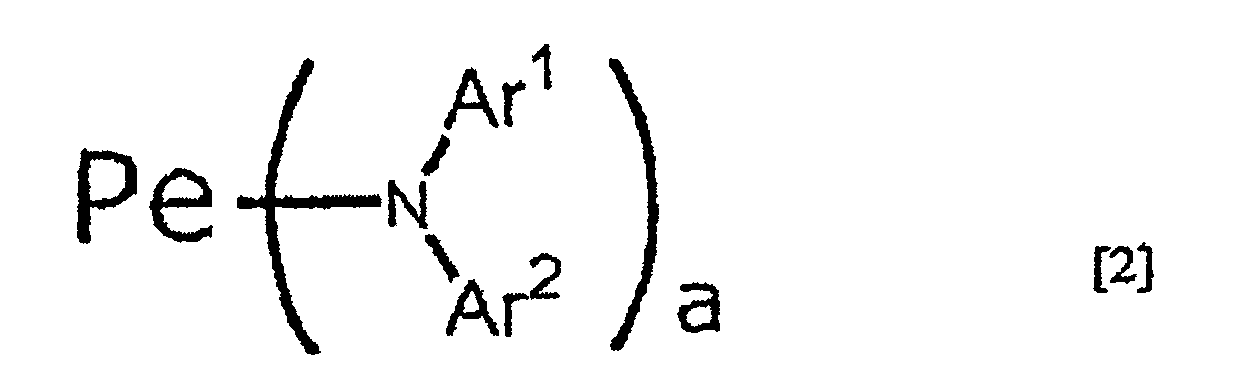 a est un nombre entier de 2 à 12.Pe est un résidu pérylène ;Ar1 et Ar2 sont identiques ou différents et représentent chacun un groupe aryle substitué ou non substitué, un groupe polycyclique condensé substitué ou non substitué ou un groupe hétérocyclique aromatique substitué ou non substitué, ou Ar1 et Ar2, conjointement avec l'atome d'azote auquel ils sont liés, forment ensemble un noyau hétérocyclique condensé ou non condensé, aromatique ou non aromatique ; et
 - Matériau selon la revendication 6, dans lequel le groupe polycyclique condensé dans la formule [2] est un groupe non hétérocyclique.
- Dispositif organique électroluminescent comprenant une anode et une cathode et, entre celles-ci, une couche organique comprenant au moins une couche émettant de la lumière, ladite couche émettant de la lumière comprenant un matériau émettant de la lumière selon l'une des revendications 3 à 7.
- Dispositif selon la revendication 8, dans lequel ladite couche organique comprend, en outre, au moins une couche injectant des électrons entre la couche émettant de la lumière et la cathode.
- Dispositif selon la revendication 8 ou 9, dans lequel la couche émettant de la lumière ou la couche injectant des électrons comprend, en outre, un composé de formule [3]dans laquelle Q1 et Q2 sont identiques ou différents et sont chacun un dérivé d'hydroxyquinoléine substitué ou non substitué ou un dérivé d'hydroxybenzoquinoléine substitué ou non substitué, et L est un atome d'halogène, un groupe alkyle substitué ou non substitué, un groupe cycloalkyle substitué ou non substitué, un groupe aryle substitué ou non substitué, un groupe hétérocyclique aromatique substitué ou non substitué ou un ligand de formule -OR dans laquelle R est un atome d'hydrogène, un groupe alkyle substitué ou non substitué, un groupe cycloalkyle substitué ou non substitué, un groupe aryle substitué ou non substitué, un groupe hétérocyclique aromatique substitué ou non substitué ou -O-Ga-Q3(Q4) dans lequel Q3 et Q4 sont identiques ou différents et ont les mêmes significations que Q1 et Q2.
- Utilisation d'un composé de formule (I), tel que défini dans la revendication 1 ou 2, en tant que matériau émettant de la lumière dans un dispositif organique électroluminescent.
- Utilisation selon la revendication 11, dans laquelle on utilise le composé de formule (I) pour émettre une lumière rouge.
Applications Claiming Priority (4)
| Application Number | Priority Date | Filing Date | Title |
|---|---|---|---|
| JP16645998 | 1998-06-15 | ||
| JP16645998 | 1998-06-15 | ||
| JP11745199 | 1999-04-26 | ||
| JP11745199 | 1999-04-26 |
Publications (2)
| Publication Number | Publication Date |
|---|---|
| EP0965629A1 EP0965629A1 (fr) | 1999-12-22 |
| EP0965629B1 true EP0965629B1 (fr) | 2003-01-15 |
Family
ID=26455560
Family Applications (1)
| Application Number | Title | Priority Date | Filing Date |
|---|---|---|---|
| EP99304641A Expired - Lifetime EP0965629B1 (fr) | 1998-06-15 | 1999-06-15 | Composé pour dispositif organique électroluminescent et dispositif organique électroluminescent |
Country Status (3)
| Country | Link |
|---|---|
| US (1) | US6329084B1 (fr) |
| EP (1) | EP0965629B1 (fr) |
| DE (1) | DE69904879T2 (fr) |
Families Citing this family (26)
| Publication number | Priority date | Publication date | Assignee | Title |
|---|---|---|---|---|
| US6329083B1 (en) * | 1997-11-05 | 2001-12-11 | Nec Corporation | Organic electroluminescent device containing a benzoperylene compound |
| US6921588B2 (en) * | 1999-12-15 | 2005-07-26 | Samsung Sdi Co., Ltd. | Organic electroluminescent device having high luminance efficiency |
| JP4067259B2 (ja) * | 2000-01-12 | 2008-03-26 | 富士フイルム株式会社 | 縮環多環式炭化水素化合物、発光素子材料およびそれを使用した発光素子 |
| JP4604312B2 (ja) * | 2000-06-13 | 2011-01-05 | チッソ株式会社 | ベンゾチオフェン誘導体、及びそれを用いた有機電界発光素子 |
| CN1259388C (zh) * | 2001-12-03 | 2006-06-14 | 东洋油墨制造株式会社 | 有机电致发光器件用组合物和使用该组合物的有机电致发光器件 |
| JP3825344B2 (ja) * | 2002-03-15 | 2006-09-27 | 富士写真フイルム株式会社 | 有機el素子及び有機elディスプレイ |
| WO2004046082A1 (fr) * | 2002-11-21 | 2004-06-03 | Fujitsu Limited | Compose violanthrene, compose isoviolanthrene, dispositif el organique et affichage el |
| US7368659B2 (en) * | 2002-11-26 | 2008-05-06 | General Electric Company | Electrodes mitigating effects of defects in organic electronic devices |
| EP2248870B1 (fr) * | 2002-11-26 | 2018-12-26 | Konica Minolta Holdings, Inc. | Elément organique électroluminescent et dispositif d'affichage et d'éclairage |
| US7063900B2 (en) | 2002-12-23 | 2006-06-20 | General Electric Company | White light-emitting organic electroluminescent devices |
| US7014925B2 (en) * | 2003-04-29 | 2006-03-21 | Canon Kabushiki Kaisha | Heterogeneous spiro compounds in organic light emitting device elements |
| JP4846276B2 (ja) * | 2005-06-14 | 2011-12-28 | 富士フイルム株式会社 | 有機電界発光素子 |
| US9112170B2 (en) * | 2006-03-21 | 2015-08-18 | Semiconductor Energy Laboratory Co., Ltd. | Light-emitting element, light-emitting device, and electronic device |
| KR20090040896A (ko) * | 2006-08-23 | 2009-04-27 | 이데미쓰 고산 가부시키가이샤 | 방향족 아민 유도체 및 이들을 이용한 유기 전기발광 소자 |
| JP5178088B2 (ja) * | 2006-09-07 | 2013-04-10 | キヤノン株式会社 | 有機発光装置 |
| EP1972625B1 (fr) * | 2007-03-20 | 2013-08-21 | Semiconductor Energy Laboratory Co., Ltd. | Dérivé d'oxadiazole et élément électroluminescent, dispositif électroluminescent et dispositif électronique utilisant le dérivé d'oxadiazole |
| JP4952321B2 (ja) * | 2007-03-20 | 2012-06-13 | 豊田合成株式会社 | サイドエアバッグ装置 |
| TW200925239A (en) * | 2007-12-03 | 2009-06-16 | Tetrahedron Technology Corp | Organic electroluminescence apparatus and material thereof |
| CN103107284A (zh) | 2007-12-28 | 2013-05-15 | 出光兴产株式会社 | 芳胺衍生物及使用该芳胺衍生物的有机电致发光元件 |
| EP2234038B1 (fr) * | 2009-03-26 | 2015-03-25 | EM Microelectronic-Marin SA | Transpondeur actif à très faible consommation électrique en mode de veille |
| US8273898B2 (en) | 2009-03-27 | 2012-09-25 | Semiconductor Energy Laboratory Co., Ltd. | Oxadiazole derivative, light-emitting element, display device, lighting device, and electronic device |
| JP6060530B2 (ja) * | 2012-06-12 | 2017-01-18 | ソニー株式会社 | 有機電界発光素子及び表示装置 |
| CN104583161B (zh) * | 2012-08-30 | 2016-12-14 | 巴斯夫欧洲公司 | 作为有机电子材料和染料的结构单元的方便制备的萘和苝衍生物 |
| CN109574911A (zh) * | 2018-11-27 | 2019-04-05 | 北京燕化集联光电技术有限公司 | 一种有机发光材料及其制备方法和其在器件中的应用 |
| CN109721526A (zh) * | 2018-11-27 | 2019-05-07 | 北京燕化集联光电技术有限公司 | 一种有机化合物及其制备方法和其在器件中的应用 |
| CN111153810B (zh) * | 2020-01-15 | 2020-11-13 | 合肥鼎材科技有限公司 | 一种化合物及其应用、包含该化合物的有机电致发光器件 |
Family Cites Families (5)
| Publication number | Priority date | Publication date | Assignee | Title |
|---|---|---|---|---|
| DE3400991A1 (de) | 1984-01-13 | 1985-07-18 | Basf Ag, 6700 Ludwigshafen | Verfahren zum flaechenmaessigen konzentrieren von licht und neue farbstoffe |
| JPH02196885A (ja) * | 1989-01-25 | 1990-08-03 | Asahi Chem Ind Co Ltd | 有機電界発光素子 |
| JPH0455493A (ja) * | 1990-06-22 | 1992-02-24 | Nec Corp | 有機薄膜el素子 |
| US6001284A (en) * | 1995-08-04 | 1999-12-14 | Toyo Ink Manufacturing Co., Ltd. | Organoelectroluminescence device material and organoelectroluminescence device for which the material is adapted |
| US6013383A (en) * | 1997-02-18 | 2000-01-11 | Motorola, Inc. | Organic electroluminescence device with improved hole transporting material |
-
1999
- 1999-06-15 DE DE69904879T patent/DE69904879T2/de not_active Expired - Fee Related
- 1999-06-15 EP EP99304641A patent/EP0965629B1/fr not_active Expired - Lifetime
- 1999-06-15 US US09/332,913 patent/US6329084B1/en not_active Expired - Fee Related
Also Published As
| Publication number | Publication date |
|---|---|
| US6329084B1 (en) | 2001-12-11 |
| DE69904879D1 (de) | 2003-02-20 |
| EP0965629A1 (fr) | 1999-12-22 |
| DE69904879T2 (de) | 2003-08-07 |
Similar Documents
| Publication | Publication Date | Title |
|---|---|---|
| EP0965629B1 (fr) | Composé pour dispositif organique électroluminescent et dispositif organique électroluminescent | |
| EP0934992B1 (fr) | Substance émettant de la lumière pour dispositif organique électroluminescent et dispositif organique électroluminescent | |
| EP0786926B1 (fr) | Substance émettant de la lumière pour dispositif organique électroluminescent, et dispositif organique électroluminescent pour lequel la substance est adaptée | |
| EP0765106B1 (fr) | Substance émettant de la lumière pour dispositif organique électroluminescent, et dispositif organique électroluminescent pour lequel la substance est adaptée | |
| EP0847228B1 (fr) | Substance pour dispositif organique électroluminescent et son utilisation | |
| EP1561794B1 (fr) | Materiau pour dispositif electroluminescent organique, et dispositif electroluminescent organique utilisant ledit materiau | |
| EP1612202B1 (fr) | Derive amine aromatique et element electroluminescent dans lequel il est utilise | |
| KR100868144B1 (ko) | 신규한 스티릴 화합물 및 유기 전기발광 소자 | |
| JP3666086B2 (ja) | 有機エレクトロルミネッセンス素子用発光材料およびそれを使用した有機エレクトロルミネッセンス素子 | |
| JP3924943B2 (ja) | 有機エレクトロルミネッセンス素子材料およびそれを使用した有機エレクトロルミネッセンス素子 | |
| JP2002265938A (ja) | 有機エレクトロルミネッセンス素子用材料およびそれを使用した有機エレクトロルミネッセンス素子 | |
| EP2025733A1 (fr) | Materiau pour element organique electroluminescent et element organique electroluminescent | |
| JP3994573B2 (ja) | 有機エレクトロルミネッセンス素子用材料およびそれを使用した有機エレクトロルミネッセンス素子 | |
| JP4306379B2 (ja) | 有機エレクトロルミネッセンス用素子材料およびそれを用いた有機エレクトロルミネッセンス素子 | |
| JPH11273860A (ja) | 有機エレクトロルミネッセンス用発光材料およびそれを使用した有機エレクトロルミネッセンス素子 | |
| JP3899698B2 (ja) | 有機エレクトロルミネッセンス素子材料およびそれを使用した有機エレクトロルミネッセンス素子 | |
| JP4380277B2 (ja) | 有機エレクトロルミネッセンス素子用材料およびそれを用いた有機エレクトロルミネッセンス素子 | |
| JP3945032B2 (ja) | 有機エレクトロルミネッセンス素子用発光材料およびそれを使用した有機エレクトロルミネッセンス素子 | |
| JP4211191B2 (ja) | 有機エレクトロルミネッセンス素子用材料およびそれを使用した有機エレクトロルミネッセンス素子 | |
| JPH1072581A (ja) | 有機エレクトロルミネッセンス素子用発光材料およびそれを使用した有機エレクトロルミネッセンス素子 | |
| JP2001207167A (ja) | 有機エレクトロルミネッセンス素子用発光材料およびそれを使用した有機エレクトロルミネッセンス素子 | |
| JP2002012861A (ja) | 有機エレクトロルミネッセンス素子用発光材料およびそれを使用した有機エレクトロルミネッセンス素子 | |
| JP2001011031A (ja) | 有機エレクトロルミネッセンス素子用化合物およびそれを使用した有機エレクトロルミネッセンス素子用発光材料 | |
| JP3508353B2 (ja) | 有機エレクトロルミネッセンス素子用発光材料およびそれを使用した有機エレクトロルミネッセンス素子 | |
| JP2000068058A (ja) | 有機エレクトロルミネッセンス素子用発光材料およびそれを使用した有機エレクトロルミネッセンス素子 |
Legal Events
| Date | Code | Title | Description |
|---|---|---|---|
| PUAI | Public reference made under article 153(3) epc to a published international application that has entered the european phase |
Free format text: ORIGINAL CODE: 0009012 |
|
| AK | Designated contracting states |
Kind code of ref document: A1 Designated state(s): DE FR GB |
|
| AX | Request for extension of the european patent |
Free format text: AL;LT;LV;MK;RO;SI |
|
| 17P | Request for examination filed |
Effective date: 20000203 |
|
| 17Q | First examination report despatched |
Effective date: 20000516 |
|
| AKX | Designation fees paid |
Free format text: DE FR GB |
|
| GRAG | Despatch of communication of intention to grant |
Free format text: ORIGINAL CODE: EPIDOS AGRA |
|
| GRAG | Despatch of communication of intention to grant |
Free format text: ORIGINAL CODE: EPIDOS AGRA |
|
| GRAG | Despatch of communication of intention to grant |
Free format text: ORIGINAL CODE: EPIDOS AGRA |
|
| GRAH | Despatch of communication of intention to grant a patent |
Free format text: ORIGINAL CODE: EPIDOS IGRA |
|
| GRAH | Despatch of communication of intention to grant a patent |
Free format text: ORIGINAL CODE: EPIDOS IGRA |
|
| GRAA | (expected) grant |
Free format text: ORIGINAL CODE: 0009210 |
|
| AK | Designated contracting states |
Kind code of ref document: B1 Designated state(s): DE FR GB |
|
| REG | Reference to a national code |
Ref country code: GB Ref legal event code: FG4D |
|
| REF | Corresponds to: |
Ref document number: 69904879 Country of ref document: DE Date of ref document: 20030220 Kind code of ref document: P |
|
| ET | Fr: translation filed | ||
| PLBE | No opposition filed within time limit |
Free format text: ORIGINAL CODE: 0009261 |
|
| STAA | Information on the status of an ep patent application or granted ep patent |
Free format text: STATUS: NO OPPOSITION FILED WITHIN TIME LIMIT |
|
| 26N | No opposition filed |
Effective date: 20031016 |
|
| PGFP | Annual fee paid to national office [announced via postgrant information from national office to epo] |
Ref country code: FR Payment date: 20050608 Year of fee payment: 7 |
|
| PGFP | Annual fee paid to national office [announced via postgrant information from national office to epo] |
Ref country code: DE Payment date: 20050609 Year of fee payment: 7 |
|
| PGFP | Annual fee paid to national office [announced via postgrant information from national office to epo] |
Ref country code: GB Payment date: 20050615 Year of fee payment: 7 |
|
| PG25 | Lapsed in a contracting state [announced via postgrant information from national office to epo] |
Ref country code: GB Free format text: LAPSE BECAUSE OF NON-PAYMENT OF DUE FEES Effective date: 20060615 |
|
| PG25 | Lapsed in a contracting state [announced via postgrant information from national office to epo] |
Ref country code: DE Free format text: LAPSE BECAUSE OF NON-PAYMENT OF DUE FEES Effective date: 20070103 |
|
| GBPC | Gb: european patent ceased through non-payment of renewal fee |
Effective date: 20060615 |
|
| REG | Reference to a national code |
Ref country code: FR Ref legal event code: ST Effective date: 20070228 |
|
| PG25 | Lapsed in a contracting state [announced via postgrant information from national office to epo] |
Ref country code: FR Free format text: LAPSE BECAUSE OF NON-PAYMENT OF DUE FEES Effective date: 20060630 |