EP0965824A2 - Gerät und Verfahren zur spektroskopischen Transmissions- und Reflexionsanalyse - Google Patents
Gerät und Verfahren zur spektroskopischen Transmissions- und Reflexionsanalyse Download PDFInfo
- Publication number
- EP0965824A2 EP0965824A2 EP99110543A EP99110543A EP0965824A2 EP 0965824 A2 EP0965824 A2 EP 0965824A2 EP 99110543 A EP99110543 A EP 99110543A EP 99110543 A EP99110543 A EP 99110543A EP 0965824 A2 EP0965824 A2 EP 0965824A2
- Authority
- EP
- European Patent Office
- Prior art keywords
- light
- slot
- fiber optic
- sample
- arrangement
- Prior art date
- Legal status (The legal status is an assumption and is not a legal conclusion. Google has not performed a legal analysis and makes no representation as to the accuracy of the status listed.)
- Granted
Links
Images

Classifications
-
- G—PHYSICS
- G01—MEASURING; TESTING
- G01J—MEASUREMENT OF INTENSITY, VELOCITY, SPECTRAL CONTENT, POLARISATION, PHASE OR PULSE CHARACTERISTICS OF INFRARED, VISIBLE OR ULTRAVIOLET LIGHT; COLORIMETRY; RADIATION PYROMETRY
- G01J3/00—Spectrometry; Spectrophotometry; Monochromators; Measuring colours
- G01J3/28—Investigating the spectrum
- G01J3/42—Absorption spectrometry; Double beam spectrometry; Flicker spectrometry; Reflection spectrometry
Definitions
- the present invention relates to a method and apparatus used for spectrometric transmittance and reflectance measurements and, in particular, NIR reflectance and transmittance measurements of fluids which undergo a change in transmissivity.
- the invention is particularly suited to the in situ analysis of chemical reactions which undergo significant changes during a batch manufacturing process.
- Spectrometric analysis is a non-invasive and non-destructive manner in which to determine both qualitative and quantitative properties of compositions.
- Infrared analysis and more particularly near-infrared (“NIR") analysis is particularly suited to the analysis of organic compounds.
- the infrared absorption spectrum is highly characteristic, and is sometimes referred to as the molecular fingerprint.
- the natural vibrational frequencies of molecules and crystals fall within the infrared range and therefore the infrared region is valuable for the study of the structure of matter.
- Certain molecular bonds are prone to vibrate when exposed to characteristic wavelengths of infrared light which causes the molecules to absorb infrared light.
- Near infrared spectroscopy takes advantage of this activity by measuring the absorption of an unknown sample at various wavelengths throughout the near infrared range.
- Infrared light which is either reflected from or transmitted through a sample exhibits a highly characteristic spectrum showing the absorption of the sample at various predetermined wavelengths.
- the wavelength and magnitude of the absorption, as revealed in a spectrograph (a graphical representation of the absorbance values), can be used to determine information about the molecular structure and composition of the sample.
- Infrared spectrometry has proven to be a valuable tool for analysis of a wide variety of products including milk, grains, oils, gasoline, alcohols, and pharmaceutical products.
- measuring devices used for infrared spectroscopy require a near infrared light source and a light detector contained in an instrument known as a spectrometer.
- Light which has been either reflected from or transmitted through a sample is broken down into narrow wavelength bands either before or after interaction with the sample.
- fiber optic cables transmit the light to and from the sample in a probe which provides an appropriate interface with the sample.
- the narrow wavelength bands are then directed to a light detector which then transmits a signal indicative of the intensity of the detected light.
- the signal is then analyzed or interpreted to yield absorbance data which in turn provides information about the constituent make-up of the sample.
- Absorbance measurements are generally of reflectance, transmittance or combined transmittance and reflectance. Reflectance measurements involve directing light at a sample and then collecting the light which is diffusely reflected or scattered either from the surface of a sample or from molecules or crystals contained within a sample. A portion of the light diffusely reflected from the sample is directed back to a light sensitive detector system where it is converted to a signal. In the detection operation, the output of the photodetectors is sampled to yield values which indicate the intensity of the reflected light at the narrow wavelength bands.
- the analysis of reflectance measurements involves scanning a standard, often in the form of a white reflective tile. The value of the signal generated from light reflected from the standard is compared with the light reflected from the sample to yield a value representing the absorbance of the sample. Reflectance measurements are routinely employed in the measurement of solids and non-Newtonian matter such as chemical powders and solid agricultural products.
- a second type of infrared analysis which is referred to as transmittance or transmission, involves directing infrared light at a sample and then measuring the unscattered light which has passed through the sample. Incident light which has passed directly through the sample without scattering is directed to a detector. The detector then generates a signal from which absorbance values of the substance being analyzed are determined. As in the case of reflectance measurements, an absorption spectrum can be created which sets forth the absorbance of the sample plotted as a function of wavelength. Transmittance measurements also require a standard or reference measurement which approximates 100 percent transmittal of light. Usually the reference measurement is taken with an empty sample cell or a cell containing a clear liquid.
- the value of the signal from light transmitted through the sample is compared with the value of the signal obtained from the standard to yield an absorbance value. Because of the limits in the sensitivity of the instruments, transmission absorption spectra are generally limited to samples which are relatively transparent to infrared light.
- a third, hybrid method of spectrometric measurement involves the simultaneous collection of both light diffusely reflected from and light transmitted through a sample.
- This measurement also involves providing an illuminating source which transmits infrared light to a probe immersed within the sample.
- Sample material can flow into a slot provided on the end of the probe and defined by a window and an opposite mirror.
- Light is transmitted from the probe through the window and then through the sample, where it impinges on the mirror. From the mirror, light is reflected back again through the sample and back through the window, where it is collected by suitable means, such as fiber optics, and directed to a detector.
- suitable means such as fiber optics
- some of the light from the illuminating source falls directly on matter suspended within the sample and consequently is scattered by the sample. A portion of the scattered light is reflected back to the collection optical fibers.
- the collection fibers capture both unscattered light which has been transmitted through the sample and light which has been diffusely reflected by the sample.
- a batch reaction can be measured during any stage of the reaction with a single process sample probe.
- a probe has one fiber optic bundle used for illumination and two fiber optic bundles used for collection.
- the process sample interface arrangement optimizes collection of light transmitted through the sample without scattering by one of the collection fiber optic bundles in the transmittance mode and optimizes collection of diffusely reflected light by the other collection fiber optic bundle in the reflectance mode.
- Adding the third fiber optic bundle (second collecting fiber optic bundle) to the instrument allows optimizing the collection of the diffusely reflected light when scattering is high and optimizing the collection of the transmitted light when scattering is low. This means that accurate measurements can be made over the entire duration of the reaction using a single probe and the apparatus has the advantage of decreasing the costs associated with installation of the apparatus on a reaction vessel.
- the instant invention involves an apparatus and method of light analysis, especially infrared analysis, designed for in situ monitoring of batch type reactions or processes.
- the apparatus according to the invention employs an infrared light source, a probe, a grating, an infrared light detector which generates a signal and a signal analyzer.
- Infrared light is directed from the light source to a sensing head of the probe by a fiber optic bundle.
- the probe contains optical fibers which collect light which has been either transmitted through or diffusely reflected from the sample and directs the light to a grating where the light is divided into its constituent wavelengths bands in the NIR range. From the grating, infrared light is directed towards a detection device which generates a signal in response to the intensity of the light.
- Signals from the detection device are analyzed according to either reflectivity or transmissivity algorithms.
- the respective algorithms are predetermined and involve different calibrations. They are dependant on the specific reaction or process which is to be monitored and measured and the criteria governing the algorithm is developed from historical data using analytical methods.
- the probe can function in both reflectance mode and a transmittance mode. The user employs a single probe and applies to the light collected by the probe the algorithm appropriate for the mode.
- a series of transmittance measurements of the sample material is made first.
- the signals generated in the spectrometer as a result are analyzed using a transmittance algorithm.
- transmittance measurements can not be made effectively because the intensity of light which is transmitted through the sample material is diminished to such a degree that it is difficult to obtain sufficient data to obtain reliable measurements from light which passes unscattered through the sample.
- measurement of the sample material is continued by measuring the reflectance of the sample. In this mode, the analysis of the signal is interpreted according to a reflectance algorithm. Because the instrument is switchable between modes, the probe used in connection with the transmission measurements can still be employed as the sample material radically changes its chemical and physical characteristics.
- the material which is to be measured is initially in an opaque state.
- a solid in powdered or crystallized form is introduced to a liquid to result in a thick slurry.
- reflectance measurements are made first and a reflectance algorithm is utilized.
- the mixture is then heated and stirred until it transforms to a transparent or translucent condition.
- Transmittance measurements are then made and analyzed according to the transmittance algorithm.
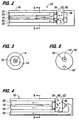
- the apparatus has a near-infrared (“NIR”) light source 10 which sends a continuous beam 11 of infrared light past a shutter 12 where it can impinge either on an end of an illuminating optical fiber bundle 14 or on an end of a reference optical fiber bundle 16.
- NIR near-infrared
- the light source 10, the shutter 12 and the respective fiber optic bundle ends are contained by an enclosure 13. Operation of the shutter 12 controls the NIR light source 10 to impinge on either the illuminating fiber bundle 14 or the reference fiber bundle 16.
- the shutter 12 is operated in response to a command from a central processing unit 20 located within an optical enclosure 26.
- the fiber optic bundle 14 provides a link or conduit to transmit infrared light from the NIR source 10 to a probe generally designated by reference numeral 18.
- the probe 18 provides an interface at a sample area or slot 22 with a sample material, which is to be analyzed.
- a first bundle 24 of collection optical fibers originates in probe 18 and terminates adjacent to an end of the fiber optic bundle 16 inside the optical enclosure 26 of the instrument.
- a second bundle 25 of collection optical fibers originates in the probe 18 and terminates inside the optical closure 26, adjacent to ends of the fiber optic bundles 16 and 24.
- the reference fiber optic bundle 16 transmits light from the light source 10 directly into the optical enclosure 26. The arrangement in this manner provides infrared light at a relevant value which can be compared against the light which interacts with the sample.
- the reference fiber bundle 16 also eliminates the need for a standard, such as a white tile, in the reflectance mode because the bundle can serve as a surrogate for a reflectance standard.
- the probe 18 comprises an outer cylindrical housing 30 which receives and surrounds the illuminating optical fiber bundle 14 and the collecting fiber bundles 24 and 25, all of which terminate adjacent to a window 34 at the slot 22.
- the window 34 is made of sapphire or other suitable material which is impervious to the sample material and can otherwise withstand the environment of the reaction chamber.
- the inner surface of the window 34 is in the form of a truncated cone and the fiber bundles 24 and 25 abut the center planar portion of the inner window surface.
- the distal end of the fiber bundle 25 is in the same plane as the distal ends of the fiber bundles 14 and 24 and is opposite to and spaced from the conical inner surface of the window 34.
- the outer surface of the window 34 which is planar, defines the inner side of the slot 22.
- Sapphire is characterized by good chemical inertness and excellent transmission properties, particularly for near-infrared wavelengths, and is the preferred material for the window.
- a minor 36 made of, for example, polished hastelloy, is positioned in axial alignment with the window 34 on a side of the slot 22 opposite to the window.
- the minor 36 can be formed of sapphire having a surface coated with an appropriate reflective material such as gold to reflect infrared light back to the collecting fiber bundle 24.
- the window 34 and the minor 36 partially define the slot 22, which is the location into which a sample material can flow and can be subjected to infrared light.
- the minor 36 is mounted in a fixed position with respect to the outer housing 30.
- the bottom of the slot 22 is defined by a flat surface, and the slot generally has a rectangular profile which allows fluid to freely pass into the sample area in a direction perpendicular to the axis of the probe 18.
- the window 34 which provides for the interface between the infrared light and the sample, caps and seals the probe 18.
- the distal end of the fiber optic bundle 24 is positioned to optimize collection of light transmitted directly through the sample without being scattered and the distal end of the fiber optic bundle 25 is positioned to optimize collection of light diffusely reflected by the sample.
- the first and second collection fiber bundles 24 and 25 have ends directed toward a mirror 68 through a beam selector 69, which may be a shutter mechanism.
- the beam selector 69 is controlled by the central processor 20 to pass to the minor 68 either the beam of light received from the fiber optic bundle 24, or the bean light received from the fiber optic bundle 25.
- Light transmitted through the fiber optic bundle 16 is also directed to the minor 68.
- the minor 68 will direct infrared light received back from the sample through one of the fiber optic bundles 24 or 25, or the infrared light transmitted directly from the source 10 through fiber optic bundle 16, to a grating 70.
- the grating 70 disperses the infrared light into a spectrum and directs specific wavelengths of light to a detector 72 as the grating oscillates relative to a beam of the light coming from the minor 68.
- a post-dispersive grating monochrometer is employed.
- the infrared light could be divided into wavelengths before interacting with the sample.
- Adjacent to the light path between the grating 70 and the detector 72 are standards 74 which can be periodically moved into the light path when the instrument is instructed by the central processing unit 20 to perform measurements using an algorithm for transmission measurements.
- the standards may be moved into the path of light in response to a command from a central processing unit 20 at predetermined times.
- the light Before reaching the detector 72, the light may also be filtered through an appropriate order sorter 76 so that higher order, or lower order wavelengths, are removed.
- the order sorter filters 76 are controlled by the central processing unit 20 to coordinate the interposition of the correct filter for the wavelength which is passing from the grating 70 to the detector 72.
- the detector transmits an electric signal representative of the intensity of the detected light.
- the electric signals generated by the detector 72 are transmitted to an analyzer which translates the signals into useful information regarding the absorbance properties of the sample.
- Application of an algorithm to the signals interprets quantitative and qualitative aspects of the sample. It is contemplated that other types of analysis could be employed, including artificial intelligence techniques or intuitive analysis by experts who can analyze graphical representations of the data by comparing the unknown data with the graphs of known compounds.
- the apparatus In order to operate the apparatus, the apparatus is first calibrated, and the constants of appropriate algorithms are determined. This operation involves making measurements of the process with the apparatus at a series of time intervals while simultaneously physically removing a sample of the material undergoing the process. The sample is then analyzed by traditional analytical chemistry methods, e.g., NMR, titration, or use of specific reagents. The results of the analytical tests are then correlated to infrared scans taken at the time the sample is removed, and a mathematical model is created. This procedure is referred to as the reference step and is repeated a number of iterations throughout several processes in order to obtain accurate data for a number of reference runs. For each given manufacturing process, a data base or a calibration sample set is created.
- a mathematical process is employed, such as a multi-variant regression analysis or multi linear regression, to correlate the spectral signature of the unknown sample to the known values and determine constants for an algorithm to analyze material being processed.
- the apparatus thus provides an output which may reflect both qualitative and quantitative information regarding the material.
- the measurement with the apparatus involves immersing the tip of the probe 18 into the sample which is undergoing either a chemical or physical change.
- the shutter 12 is opened and a full spectrum of near-infrared light is directed through the illuminating fiber bundle 14.
- the frill infrared spectrum is also directed through the reference fiber bundle 16.
- the absorbance values are determined by comparing the values of the signals generated by light received from the collection fiber bundles 24 or 25 with the values of the signals generated in response to light from the reference fiber bundle 16.
- the use of the reference fiber bundle 16 eliminates the need for measurements from both a reflective tile, as is customarily practiced in conventional reflectance measurements, and an empty sample chamber cell, as is used in conventional transmittance measurements.
- the probe 18 has a body in which the slot 22 for receiving the sample is defined.
- the illuminating fiber bundle 14 extends longitudinally through the probe 18, near the center of a transverse cross-section of the probe, as can be seen from Fig. 3.
- the first collection fiber bundle 24 is arranged in a ring or annulus around and adjacent to the illuminating fiber bundle 14, particularly at the window 34.
- the second collection fiber bundle 25 is arranged in a ring or annulus around the first collection fiber bundle 24 spaced from the illuminating fiber bundle 14, particularly at the window 34.
- Infrared light transmitted through the fiber optic bundle 14 will pass through the window 34 and enter the sample in the slot 22. Infrared light which passes through the sample in the slot and strikes the mirror 36 is reflected back toward the window 34. Transmitted light which passes through the sample without being scattered travels in a straight line through sample in both directions. As a result the transmitted unscattered light will be concentrated near the center of the window 34. The distal ends of the fibers of the fiber bundle 24 by being positioned near the center of the window are thus placed in an optimum position to receive the unscattered light transmitted through the sample.
- Scattering particles 80 in the sample will scatter reflected light in all directions and if there are scattering particles in the sample, some scattered light will be collected by the fiber optic bundle 24, but for samples which are highly transmissive, the intensity of the transmitted light collected by the fiber optic bundle 24 will be much greater than any scattered light which is collected by fiber bundle 24. Some of the light diffusely reflected by the sample will pass through the window 34 in a direction to be collected by the second collection fiber bundle 25 and transmitted into the enclosure 26. Because the unscattered light transmitted through the sample will be concentrated near the center of the window, little or no unscattered light is collected by the fiber bundle 25.
- the distal ends of the optical fibers in the bundle 24 are positioned to optimize the collection of unscattered light transmitted through the sample, and the distal ends of the optical fibers in the bundle 25 are positioned optimize the collection of diffusely reflected light.
- the instrument When the sample is highly transmissive, the instrument will be operated in the transmittance mode and the beam selector 69 will select the light transmitted through the fiber optic bundle 24 to be passed to the mirror 68.
- the instrument is operated in the reflectance mode and the beam selector 69 will select the beam transmitted through the fiber optic bundle 25 to be passed to the minor 68.
- the fiber bundles 24 and 25 could be used as illumination fiber optic bundles and the fiber bundle 14 used as a receiving fiber optic bundle.
- the proximal ends of the fiber bundles 24 and 25 would be brought into the enclosure 13 and the shutter 12 would be arranged to selectively introduce light from the light source into the bundle 24, the bundle 25 or the bundle 16.
- the fiber optic bundle 14 would receive light transmitted through or reflected from the sample and the proximal end of the fiber bundle 14 would emit light to be reflected from the mirror 68 to illuminate the grating 70.
- the probe is controlled to operate either in a transmittance mode or a reflectance mode.
- the beam switcher 69 is not required.
- a probe 18' has a body defining a slot 22' filled by a fluid sample which may contain particles 80.
- An illuminating fiber bundle 14' extends through the probe 18' along the length thereof and near the center of a transverse cross-section thereof to a window 34' on one side of the slot 22'.
- a window 82 is positioned on the opposite side of the slot 22' and in alignment with the window 34'.
- a distal end of a first collection fiber bundle 24' terminates at the window 82 to receive light entering the window and to transmit the light into the enclosure 26.
- a second collection fiber bundle 25' is arranged in a ring or annulus around the illumination fiber bundle 24', the distal end of each of the two bundles terminating at a window 34'.
- the windows 34' and 82 can comprise the same material as the window 34 of the embodiment of Figs. 2 and 3.
- Light from illuminating fiber bundle 14' passing through the sample without being scattered will pass through the window 82 and be collected by the first collection fiber bundle 24' to be transmitted into the enclosure 26. Some of the light from the illumination fiber bundle 14' which is diffusely reflected from the sample in the slot 22' will be transmitted through the window 34' and be collected by the second collection fiber bundle 25' and be transmitted into the enclosure 26.
- the probe has one fiber bundle which is optimally positioned to collect unscattered light transmitted through the sample for analyzing the sample in a transmittance mode and a second fiber optic bundle which is optimally positioned to collect light diffusely reflected from the sample for analysis of the sample in a reflectance mode without interference from unscattered light passing through sample.
- the alternative arrangement wherein the function of the illuminating and receiving fibers are reversed can also be applied to the embodiment of Figs. 4 and 5. In the alternative arrangements, there are two illuminating fiber optic bundles and one receiving fiber optic bundle.
Landscapes
- Physics & Mathematics (AREA)
- Spectroscopy & Molecular Physics (AREA)
- General Physics & Mathematics (AREA)
- Investigating Or Analysing Materials By Optical Means (AREA)
- Optical Measuring Cells (AREA)
Applications Claiming Priority (2)
| Application Number | Priority Date | Filing Date | Title |
|---|---|---|---|
| US09/098,539 US6137108A (en) | 1998-06-17 | 1998-06-17 | Instrument and method for spectroscopic analysis by reflectance and transmittance |
| US98539 | 1998-06-17 |
Publications (3)
| Publication Number | Publication Date |
|---|---|
| EP0965824A2 true EP0965824A2 (de) | 1999-12-22 |
| EP0965824A3 EP0965824A3 (de) | 2002-05-02 |
| EP0965824B1 EP0965824B1 (de) | 2010-01-27 |
Family
ID=22269753
Family Applications (1)
| Application Number | Title | Priority Date | Filing Date |
|---|---|---|---|
| EP99110543A Expired - Lifetime EP0965824B1 (de) | 1998-06-17 | 1999-06-01 | Gerät und Verfahren zur spektroskopischen Transmissions- und Reflexionsanalyse |
Country Status (4)
| Country | Link |
|---|---|
| US (1) | US6137108A (de) |
| EP (1) | EP0965824B1 (de) |
| JP (1) | JP4229529B2 (de) |
| DE (1) | DE69941970D1 (de) |
Cited By (3)
| Publication number | Priority date | Publication date | Assignee | Title |
|---|---|---|---|---|
| GB2390893A (en) * | 2002-07-15 | 2004-01-21 | Pcme Ltd | Method and apparatus for monitoring particles in a stack |
| WO2008034945A1 (en) * | 2006-09-20 | 2008-03-27 | Moventas Oy | Method and device for monitoring the condition of a medium |
| CN110763657A (zh) * | 2019-11-20 | 2020-02-07 | 江苏赛诺格兰医疗科技有限公司 | 用于反射材料反射率测试系统的光电数字转换系统 |
Families Citing this family (54)
| Publication number | Priority date | Publication date | Assignee | Title |
|---|---|---|---|---|
| AU5223899A (en) * | 1998-07-27 | 2000-02-21 | Ljl Biosystems, Inc. | Apparatus and methods for spectroscopic measurements |
| US6751576B2 (en) | 2000-03-10 | 2004-06-15 | Cognis Corporation | On-site agricultural product analysis system and method of analyzing |
| US8610645B2 (en) | 2000-05-12 | 2013-12-17 | Semiconductor Energy Laboratory Co., Ltd. | Display device |
| TW554638B (en) | 2000-05-12 | 2003-09-21 | Semiconductor Energy Lab | Light emitting device |
| US6549861B1 (en) | 2000-08-10 | 2003-04-15 | Euro-Celtique, S.A. | Automated system and method for spectroscopic analysis |
| US6539285B1 (en) * | 2000-08-11 | 2003-03-25 | Bruker Optik Gmbh | Method and apparatus for process control using fourier transform infrared spectroscopy |
| US6675030B2 (en) | 2000-08-21 | 2004-01-06 | Euro-Celtique, S.A. | Near infrared blood glucose monitoring system |
| US6765212B2 (en) * | 2001-02-12 | 2004-07-20 | Analytical Spectral Devices, Inc. | System and method for combining reflectance data |
| US7194369B2 (en) * | 2001-07-23 | 2007-03-20 | Cognis Corporation | On-site analysis system with central processor and method of analyzing |
| IL145649A0 (en) * | 2001-09-25 | 2002-06-30 | Nira Sciences Ltd | Method and apparatus for real-time dynamic chemical analysis |
| US7013173B2 (en) * | 2001-11-29 | 2006-03-14 | The Regents Of The University Of California | Optical probe with reference fiber |
| US6784988B2 (en) * | 2002-07-17 | 2004-08-31 | Hamilton Associates, Inc. | Apparatus and process for analyzing a stream of fluid |
| US6894779B2 (en) * | 2002-08-23 | 2005-05-17 | Coulter International Corp. | Apparatus for detecting back-scatter in a laser-based blood analysis system |
| US6743634B2 (en) * | 2002-08-23 | 2004-06-01 | Coulter International Corp. | Method and apparatus for differentiating blood cells using back-scatter |
| US6798508B2 (en) * | 2002-08-23 | 2004-09-28 | Coulter International Corp. | Fiber optic apparatus for detecting light scatter to differentiate blood cells and the like |
| US7248771B2 (en) * | 2003-06-16 | 2007-07-24 | Brigham Young University | Integrated sensor with electrical and optical single molecule sensitivity |
| US7149396B2 (en) * | 2003-06-16 | 2006-12-12 | The Regents Of The University Of California | Apparatus for optical measurements on low-index non-solid materials based on arrow waveguides |
| US7444053B2 (en) * | 2003-06-16 | 2008-10-28 | The Regents Of The University Of California | Integrated electrical and optical sensor for biomolecule analysis with single molecule sensitivity |
| US7255474B2 (en) * | 2003-07-28 | 2007-08-14 | Symyx Technologies, Inc. | Parallel infrared spectroscopy apparatus and method |
| US20050097021A1 (en) * | 2003-11-03 | 2005-05-05 | Martin Behr | Object analysis apparatus |
| WO2005062986A2 (en) | 2003-12-31 | 2005-07-14 | The University Of South Carolina | Thin-layer porous optical sensors for gases and other fluids |
| FR2870598B1 (fr) * | 2004-05-18 | 2006-07-14 | Total France Sa | Sonde de mesure de la lumiere dans un liquide, sonde de detection du seuil de floculation d'un milieu colloidal, procede de detection associe et application a la determination de la floculation des asphaltenes |
| US7224455B2 (en) * | 2004-05-28 | 2007-05-29 | Teledyne Technologies Incorporated | Measuring particulate matter in a fluid |
| AU2005270037B2 (en) * | 2004-07-02 | 2012-02-09 | The General Hospital Corporation | Endoscopic imaging probe comprising dual clad fibre |
| US20070201136A1 (en) | 2004-09-13 | 2007-08-30 | University Of South Carolina | Thin Film Interference Filter and Bootstrap Method for Interference Filter Thin Film Deposition Process Control |
| WO2006063094A1 (en) * | 2004-12-09 | 2006-06-15 | Caleb Brett Usa Inc. | In situ optical computation fluid analysis system and method |
| US7359060B2 (en) * | 2005-11-07 | 2008-04-15 | Thermo Electron Scientific Instruments Llc | Multi-mode sampling probes |
| EP1955046A1 (de) * | 2005-11-28 | 2008-08-13 | University of South Carolina | Verfahren zur beobachtung mit hoher geschwindigkeit aufgrund der verwendung multivariater optischer elemente |
| WO2007061436A1 (en) | 2005-11-28 | 2007-05-31 | University Of South Carolina | Self calibration methods for optical analysis system |
| WO2007064575A1 (en) | 2005-11-28 | 2007-06-07 | Ometric Corporation | Optical analysis system and method for real time multivariate optical computing |
| US20070166245A1 (en) | 2005-11-28 | 2007-07-19 | Leonard Mackles | Propellant free foamable toothpaste composition |
| US9170154B2 (en) | 2006-06-26 | 2015-10-27 | Halliburton Energy Services, Inc. | Data validation and classification in optical analysis systems |
| EP2078187A2 (de) | 2006-11-02 | 2009-07-15 | University of South Carolina | Optisches multianalyt-datenverarbeitungssystem |
| US8213006B2 (en) * | 2007-03-30 | 2012-07-03 | Halliburton Energy Services, Inc. | Multi-analyte optical computing system |
| EP2140238B1 (de) | 2007-03-30 | 2020-11-11 | Ometric Corporation | Messsysteme und -verfahren für inline-verfahren |
| WO2008121692A1 (en) | 2007-03-30 | 2008-10-09 | University Of South Carolina | Tablet analysis and measurement system |
| FR2922304B1 (fr) * | 2007-10-12 | 2009-11-20 | Sp3H | Dispositif de spectrometrie pour l'analyse d'un fluide |
| EP2215455B1 (de) * | 2007-11-02 | 2014-03-05 | Ceres, Inc. | Verfahren zur Formulierung eines NIR-Modells zur Verwendung bei der Biomassenverarbeitung |
| US8283633B2 (en) | 2007-11-30 | 2012-10-09 | Halliburton Energy Services, Inc. | Tuning D* with modified thermal detectors |
| EP2081017A1 (de) * | 2008-01-16 | 2009-07-22 | FOSS Analytical AB | Offset-Sonde |
| US8212213B2 (en) | 2008-04-07 | 2012-07-03 | Halliburton Energy Services, Inc. | Chemically-selective detector and methods relating thereto |
| CA2780107C (en) * | 2009-12-10 | 2017-02-14 | Foss Analytical A/S | Variable path length probe |
| WO2012031625A2 (en) | 2010-09-08 | 2012-03-15 | Foss Analytical Ab | Optical probe |
| KR101173091B1 (ko) | 2010-11-29 | 2012-08-10 | 한국지질자원연구원 | 지질암석 표품의 실내 분광반사율 측정 시스템 |
| US20150247210A1 (en) | 2014-02-28 | 2015-09-03 | Asl Analytical, Inc. | Methods for Continuous Monitoring and Control of Bioprocesses |
| US9360422B2 (en) * | 2014-05-13 | 2016-06-07 | Asl Analytical, Inc. | Near-infrared optical probe and associated disposable sheath |
| JP6361461B2 (ja) * | 2014-10-21 | 2018-07-25 | 住友電気工業株式会社 | プローブ |
| FR3048240B1 (fr) * | 2016-02-29 | 2018-04-13 | Cordouan Tech | Dispositif de caracterisation de particules dispersees dans un milieu liquide |
| US10761015B1 (en) * | 2019-09-18 | 2020-09-01 | Taiwan Redeye Biomedical Inc. | Handheld hemoglobin detecting device |
| WO2021193029A1 (ja) * | 2020-03-25 | 2021-09-30 | Phcホールディングス株式会社 | 細胞培養分析装置およびこれを用いた細胞培養分析方法、添加剤供給部材およびこれを備えた細胞培養分析装置、センサユニットおよびこれを備えた細胞培養分析装置 |
| US11460400B2 (en) * | 2020-07-07 | 2022-10-04 | Sakura Finetek U.S.A., Inc. | Use of IR spectroscopy to evaluate penetration of reagents into biological specimen |
| CN112945857B (zh) * | 2021-04-01 | 2025-05-13 | 天津津普利环保科技股份有限公司 | 一种外球式漫反射光谱测量装置 |
| CN114152595A (zh) * | 2021-08-31 | 2022-03-08 | 广东弓叶科技有限公司 | 一种双光源检测识别方法及系统 |
| JP2024173135A (ja) | 2023-06-02 | 2024-12-12 | 株式会社日立ハイテク | 分光測定装置およびその調整方法 |
Family Cites Families (12)
| Publication number | Priority date | Publication date | Assignee | Title |
|---|---|---|---|---|
| US3327584A (en) * | 1963-09-09 | 1967-06-27 | Mechanical Tech Inc | Fiber optic proximity probe |
| JPS57199943A (en) * | 1981-06-03 | 1982-12-08 | Hitachi Ltd | Measuring device for wetness of steam |
| US4827143A (en) * | 1986-03-26 | 1989-05-02 | Hitachi, Ltd. | Monitor for particles of various materials |
| US5044755A (en) * | 1989-03-03 | 1991-09-03 | Lt Industries | Probe for transmitting and receiving light from a sample |
| US5051551A (en) * | 1989-05-18 | 1991-09-24 | Axiom Analytical, Inc. | Immersion probe for infrared internal reflectance spectroscopy |
| US5261410A (en) * | 1991-02-07 | 1993-11-16 | Alfano Robert R | Method for determining if a tissue is a malignant tumor tissue, a benign tumor tissue, or a normal or benign tissue using Raman spectroscopy |
| US5311283A (en) * | 1991-09-05 | 1994-05-10 | The Dow Chemical Company | Fiber optic probe and method for detecting optically active materials |
| US5303036A (en) * | 1991-09-26 | 1994-04-12 | The Dow Chemical Company | Variable path length light transmission probe |
| US5526112A (en) * | 1993-03-05 | 1996-06-11 | Sahagen; Armen N. | Probe for monitoring a fluid medium |
| US5426713A (en) * | 1993-11-10 | 1995-06-20 | Nirsystems Incorporated | Fiber optic probe with truncated cone window block for infrared spectral analysis instrument |
| US5418615A (en) * | 1994-02-25 | 1995-05-23 | Axiom Analytical, Inc. | Probe for liquid sample analysis by light transmission |
| US5708273A (en) * | 1996-05-09 | 1998-01-13 | Foss Nirsystems, Inc. | Transflectance probe having adjustable window gap adapted to measure viscous substances for spectrometric analysis and method of use |
-
1998
- 1998-06-17 US US09/098,539 patent/US6137108A/en not_active Expired - Fee Related
-
1999
- 1999-06-01 DE DE69941970T patent/DE69941970D1/de not_active Expired - Lifetime
- 1999-06-01 EP EP99110543A patent/EP0965824B1/de not_active Expired - Lifetime
- 1999-06-15 JP JP16878199A patent/JP4229529B2/ja not_active Expired - Fee Related
Cited By (3)
| Publication number | Priority date | Publication date | Assignee | Title |
|---|---|---|---|---|
| GB2390893A (en) * | 2002-07-15 | 2004-01-21 | Pcme Ltd | Method and apparatus for monitoring particles in a stack |
| WO2008034945A1 (en) * | 2006-09-20 | 2008-03-27 | Moventas Oy | Method and device for monitoring the condition of a medium |
| CN110763657A (zh) * | 2019-11-20 | 2020-02-07 | 江苏赛诺格兰医疗科技有限公司 | 用于反射材料反射率测试系统的光电数字转换系统 |
Also Published As
| Publication number | Publication date |
|---|---|
| DE69941970D1 (de) | 2010-03-18 |
| JP2000009638A (ja) | 2000-01-14 |
| JP4229529B2 (ja) | 2009-02-25 |
| US6137108A (en) | 2000-10-24 |
| EP0965824A3 (de) | 2002-05-02 |
| EP0965824B1 (de) | 2010-01-27 |
Similar Documents
| Publication | Publication Date | Title |
|---|---|---|
| US6137108A (en) | Instrument and method for spectroscopic analysis by reflectance and transmittance | |
| EP0806653B1 (de) | Verfahren zur Analyse eines Materials, dessen optische Dichte sich ändert | |
| US6897951B2 (en) | Probe assemblies for Raman spectroscopy | |
| CN110546482B (zh) | 红外光谱学系统 | |
| US8400637B2 (en) | Signal processing for optical computing system | |
| US7944555B2 (en) | High-speed, rugged, time-resolved, Raman spectrometer for sensing multiple components of a sample and for diagnostics of pathological skin conditions such as cancer | |
| US5952660A (en) | Method of identifying post consumer or post industrial waste carpet utilizing a hand-held infrared spectrometer | |
| JP3574851B2 (ja) | 可視光及び/又は近赤外光を用いた乳房炎の有無を診断する方法及び装置 | |
| WO1999063328A1 (en) | Sensor utilizing raman spectroscopy for non-invasive monitoring of analytes in biological fluid and method of use | |
| KR100460972B1 (ko) | 핸드-헬드적외선분광계를사용한폐기카펫확인방법및장치 | |
| US6737649B2 (en) | Infrared analysis instrument with offset probe for particulate sample | |
| US5120979A (en) | Apparatus and method for analysis of a sample medium in a gap between a tube and a float | |
| US20100145199A1 (en) | Cancer Detection System | |
| US20240053200A1 (en) | Detection and identification of body fluid traces with stand-off raman spectroscopy | |
| EP0574601A1 (de) | Verbessertes Verfahren und Gerät für optische Zwischenwirkungs- und Durchlassungsvermögenmessungen | |
| US20250244234A1 (en) | Device for measuring elemental and molecular properties with hybrid electromagnetic waves | |
| JP2001041884A (ja) | 血液中成分濃度の測定装置 | |
| RU103924U1 (ru) | Датчик со смещенными каналами | |
| Liauw et al. | Putting fiber-optical spectroscopy to work: in-line optical spectroscopy has come of age, helping to increase profitability and safety. | |
| EP4370908A1 (de) | Vorrichtung zur messung elementarer und molekularer eigenschaften mit hybriden elektromagnetischen wellen | |
| Liu | Fiber-Optic Probes | |
| WO2024058733A1 (en) | Device for measuring elemental and molecular properties with hybrid electromagnetic waves |
Legal Events
| Date | Code | Title | Description |
|---|---|---|---|
| PUAI | Public reference made under article 153(3) epc to a published international application that has entered the european phase |
Free format text: ORIGINAL CODE: 0009012 |
|
| AK | Designated contracting states |
Kind code of ref document: A2 Designated state(s): AT BE CH CY DE DK ES FI FR GB GR IE IT LI LU MC NL PT SE Kind code of ref document: A2 Designated state(s): DE FR GB IT |
|
| AX | Request for extension of the european patent |
Free format text: AL;LT;LV;MK;RO;SI |
|
| PUAL | Search report despatched |
Free format text: ORIGINAL CODE: 0009013 |
|
| RIC1 | Information provided on ipc code assigned before grant |
Free format text: 7G 01J 3/42 A, 7G 01N 21/35 B, 7G 01N 21/27 B, 7G 01N 21/47 B, 7G 01N 21/49 B, 7G 01N 21/53 B |
|
| AK | Designated contracting states |
Kind code of ref document: A3 Designated state(s): AT BE CH CY DE DK ES FI FR GB GR IE IT LI LU MC NL PT SE |
|
| AX | Request for extension of the european patent |
Free format text: AL;LT;LV;MK;RO;SI |
|
| 17P | Request for examination filed |
Effective date: 20021031 |
|
| AKX | Designation fees paid |
Free format text: DE FR GB IT |
|
| 17Q | First examination report despatched |
Effective date: 20051109 |
|
| RAP1 | Party data changed (applicant data changed or rights of an application transferred) |
Owner name: FOSS NIRSYSTEMS, INC. |
|
| GRAP | Despatch of communication of intention to grant a patent |
Free format text: ORIGINAL CODE: EPIDOSNIGR1 |
|
| GRAS | Grant fee paid |
Free format text: ORIGINAL CODE: EPIDOSNIGR3 |
|
| GRAA | (expected) grant |
Free format text: ORIGINAL CODE: 0009210 |
|
| AK | Designated contracting states |
Kind code of ref document: B1 Designated state(s): DE FR GB IT |
|
| REG | Reference to a national code |
Ref country code: GB Ref legal event code: FG4D |
|
| REF | Corresponds to: |
Ref document number: 69941970 Country of ref document: DE Date of ref document: 20100318 Kind code of ref document: P |
|
| PGFP | Annual fee paid to national office [announced via postgrant information from national office to epo] |
Ref country code: FR Payment date: 20100630 Year of fee payment: 12 |
|
| PGFP | Annual fee paid to national office [announced via postgrant information from national office to epo] |
Ref country code: IT Payment date: 20100625 Year of fee payment: 12 |
|
| PGFP | Annual fee paid to national office [announced via postgrant information from national office to epo] |
Ref country code: GB Payment date: 20100625 Year of fee payment: 12 Ref country code: DE Payment date: 20100629 Year of fee payment: 12 |
|
| PLBE | No opposition filed within time limit |
Free format text: ORIGINAL CODE: 0009261 |
|
| STAA | Information on the status of an ep patent application or granted ep patent |
Free format text: STATUS: NO OPPOSITION FILED WITHIN TIME LIMIT |
|
| 26N | No opposition filed |
Effective date: 20101028 |
|
| GBPC | Gb: european patent ceased through non-payment of renewal fee |
Effective date: 20110601 |
|
| PG25 | Lapsed in a contracting state [announced via postgrant information from national office to epo] |
Ref country code: IT Free format text: LAPSE BECAUSE OF NON-PAYMENT OF DUE FEES Effective date: 20110601 |
|
| REG | Reference to a national code |
Ref country code: FR Ref legal event code: ST Effective date: 20120229 |
|
| REG | Reference to a national code |
Ref country code: DE Ref legal event code: R119 Ref document number: 69941970 Country of ref document: DE Effective date: 20120103 |
|
| PG25 | Lapsed in a contracting state [announced via postgrant information from national office to epo] |
Ref country code: DE Free format text: LAPSE BECAUSE OF NON-PAYMENT OF DUE FEES Effective date: 20120103 Ref country code: FR Free format text: LAPSE BECAUSE OF NON-PAYMENT OF DUE FEES Effective date: 20110630 |
|
| PG25 | Lapsed in a contracting state [announced via postgrant information from national office to epo] |
Ref country code: GB Free format text: LAPSE BECAUSE OF NON-PAYMENT OF DUE FEES Effective date: 20110601 |