EP0965891B1 - Bilderzeugungsverfahren - Google Patents
Bilderzeugungsverfahren Download PDFInfo
- Publication number
- EP0965891B1 EP0965891B1 EP99304758A EP99304758A EP0965891B1 EP 0965891 B1 EP0965891 B1 EP 0965891B1 EP 99304758 A EP99304758 A EP 99304758A EP 99304758 A EP99304758 A EP 99304758A EP 0965891 B1 EP0965891 B1 EP 0965891B1
- Authority
- EP
- European Patent Office
- Prior art keywords
- toner
- image
- forming method
- external additive
- particles
- Prior art date
- Legal status (The legal status is an assumption and is not a legal conclusion. Google has not performed a legal analysis and makes no representation as to the accuracy of the status listed.)
- Expired - Lifetime
Links
- 238000000034 method Methods 0.000 title claims description 114
- 239000002245 particle Substances 0.000 claims description 226
- 238000012546 transfer Methods 0.000 claims description 164
- 239000000654 additive Substances 0.000 claims description 110
- 230000000996 additive effect Effects 0.000 claims description 102
- 239000003431 cross linking reagent Substances 0.000 claims description 64
- 238000009826 distribution Methods 0.000 claims description 33
- 239000003086 colorant Substances 0.000 claims description 26
- 229920002554 vinyl polymer Polymers 0.000 claims description 23
- 229920006163 vinyl copolymer Polymers 0.000 claims description 17
- 238000010298 pulverizing process Methods 0.000 claims description 14
- 238000010557 suspension polymerization reaction Methods 0.000 claims description 13
- 239000012736 aqueous medium Substances 0.000 claims description 9
- 125000004185 ester group Chemical group 0.000 claims 4
- 229920005989 resin Polymers 0.000 description 93
- 239000011347 resin Substances 0.000 description 93
- 239000001993 wax Substances 0.000 description 81
- 239000010410 layer Substances 0.000 description 80
- 230000005291 magnetic effect Effects 0.000 description 54
- 239000011230 binding agent Substances 0.000 description 46
- 238000011161 development Methods 0.000 description 40
- 239000000178 monomer Substances 0.000 description 38
- 229920001577 copolymer Polymers 0.000 description 34
- -1 alcohol ester Chemical class 0.000 description 33
- 239000002609 medium Substances 0.000 description 32
- MYRTYDVEIRVNKP-UHFFFAOYSA-N 1,2-Divinylbenzene Chemical compound C=CC1=CC=CC=C1C=C MYRTYDVEIRVNKP-UHFFFAOYSA-N 0.000 description 30
- PPBRXRYQALVLMV-UHFFFAOYSA-N Styrene Chemical compound C=CC1=CC=CC=C1 PPBRXRYQALVLMV-UHFFFAOYSA-N 0.000 description 30
- 239000000203 mixture Substances 0.000 description 30
- WYURNTSHIVDZCO-UHFFFAOYSA-N Tetrahydrofuran Chemical compound C1CCOC1 WYURNTSHIVDZCO-UHFFFAOYSA-N 0.000 description 29
- 239000000123 paper Substances 0.000 description 29
- 238000006116 polymerization reaction Methods 0.000 description 27
- 238000011156 evaluation Methods 0.000 description 25
- 239000000463 material Substances 0.000 description 22
- 125000004432 carbon atom Chemical group C* 0.000 description 21
- 239000002253 acid Substances 0.000 description 20
- 239000000523 sample Substances 0.000 description 20
- 229920000642 polymer Polymers 0.000 description 18
- 239000003795 chemical substances by application Substances 0.000 description 17
- 239000000049 pigment Substances 0.000 description 17
- 230000009477 glass transition Effects 0.000 description 16
- 239000013013 elastic material Substances 0.000 description 15
- YLQBMQCUIZJEEH-UHFFFAOYSA-N tetrahydrofuran Natural products C=1C=COC=1 YLQBMQCUIZJEEH-UHFFFAOYSA-N 0.000 description 14
- OKTJSMMVPCPJKN-UHFFFAOYSA-N Carbon Chemical compound [C] OKTJSMMVPCPJKN-UHFFFAOYSA-N 0.000 description 13
- 229910052782 aluminium Inorganic materials 0.000 description 13
- 238000004140 cleaning Methods 0.000 description 13
- 239000006185 dispersion Substances 0.000 description 13
- XNGIFLGASWRNHJ-UHFFFAOYSA-N phthalic acid Chemical class OC(=O)C1=CC=CC=C1C(O)=O XNGIFLGASWRNHJ-UHFFFAOYSA-N 0.000 description 13
- 229920001225 polyester resin Polymers 0.000 description 13
- 239000004645 polyester resin Substances 0.000 description 13
- 229910052751 metal Inorganic materials 0.000 description 12
- 239000002184 metal Substances 0.000 description 12
- IISBACLAFKSPIT-UHFFFAOYSA-N bisphenol A Chemical class C=1C=C(O)C=CC=1C(C)(C)C1=CC=C(O)C=C1 IISBACLAFKSPIT-UHFFFAOYSA-N 0.000 description 11
- 238000004519 manufacturing process Methods 0.000 description 11
- 230000008569 process Effects 0.000 description 11
- 239000000047 product Substances 0.000 description 11
- 230000015572 biosynthetic process Effects 0.000 description 10
- 239000006229 carbon black Substances 0.000 description 10
- 229920001971 elastomer Polymers 0.000 description 10
- 150000002148 esters Chemical class 0.000 description 10
- 238000005227 gel permeation chromatography Methods 0.000 description 10
- 239000000696 magnetic material Substances 0.000 description 10
- 239000011572 manganese Substances 0.000 description 10
- 238000005259 measurement Methods 0.000 description 10
- 239000005060 rubber Substances 0.000 description 10
- YXFVVABEGXRONW-UHFFFAOYSA-N Toluene Chemical compound CC1=CC=CC=C1 YXFVVABEGXRONW-UHFFFAOYSA-N 0.000 description 9
- XAGFODPZIPBFFR-UHFFFAOYSA-N aluminium Chemical compound [Al] XAGFODPZIPBFFR-UHFFFAOYSA-N 0.000 description 9
- 239000000975 dye Substances 0.000 description 9
- 230000002093 peripheral effect Effects 0.000 description 9
- 239000000843 powder Substances 0.000 description 9
- 239000000243 solution Substances 0.000 description 9
- UQSXHKLRYXJYBZ-UHFFFAOYSA-N Iron oxide Chemical compound [Fe]=O UQSXHKLRYXJYBZ-UHFFFAOYSA-N 0.000 description 8
- 230000009471 action Effects 0.000 description 8
- 150000001875 compounds Chemical class 0.000 description 8
- 238000002844 melting Methods 0.000 description 8
- 230000000704 physical effect Effects 0.000 description 8
- 238000000926 separation method Methods 0.000 description 8
- 239000001052 yellow pigment Substances 0.000 description 8
- VYPSYNLAJGMNEJ-UHFFFAOYSA-N Silicium dioxide Chemical compound O=[Si]=O VYPSYNLAJGMNEJ-UHFFFAOYSA-N 0.000 description 7
- XLOMVQKBTHCTTD-UHFFFAOYSA-N Zinc monoxide Chemical compound [Zn]=O XLOMVQKBTHCTTD-UHFFFAOYSA-N 0.000 description 7
- 125000005233 alkylalcohol group Chemical group 0.000 description 7
- CQEYYJKEWSMYFG-UHFFFAOYSA-N butyl acrylate Chemical compound CCCCOC(=O)C=C CQEYYJKEWSMYFG-UHFFFAOYSA-N 0.000 description 7
- 229910052799 carbon Inorganic materials 0.000 description 7
- 125000000664 diazo group Chemical group [N-]=[N+]=[*] 0.000 description 7
- 230000000694 effects Effects 0.000 description 7
- 230000005684 electric field Effects 0.000 description 7
- 229910002804 graphite Inorganic materials 0.000 description 7
- 239000010439 graphite Substances 0.000 description 7
- 229910044991 metal oxide Inorganic materials 0.000 description 7
- 150000004706 metal oxides Chemical class 0.000 description 7
- 239000004945 silicone rubber Substances 0.000 description 7
- 239000002904 solvent Substances 0.000 description 7
- 125000000391 vinyl group Chemical group [H]C([*])=C([H])[H] 0.000 description 7
- PXHVJJICTQNCMI-UHFFFAOYSA-N Nickel Chemical compound [Ni] PXHVJJICTQNCMI-UHFFFAOYSA-N 0.000 description 6
- 239000004793 Polystyrene Substances 0.000 description 6
- 238000011088 calibration curve Methods 0.000 description 6
- 230000000052 comparative effect Effects 0.000 description 6
- XCJYREBRNVKWGJ-UHFFFAOYSA-N copper(II) phthalocyanine Chemical compound [Cu+2].C12=CC=CC=C2C(N=C2[N-]C(C3=CC=CC=C32)=N2)=NC1=NC([C]1C=CC=CC1=1)=NC=1N=C1[C]3C=CC=CC3=C2[N-]1 XCJYREBRNVKWGJ-UHFFFAOYSA-N 0.000 description 6
- 150000002430 hydrocarbons Chemical group 0.000 description 6
- 230000008018 melting Effects 0.000 description 6
- 238000002156 mixing Methods 0.000 description 6
- 239000003505 polymerization initiator Substances 0.000 description 6
- 229920002223 polystyrene Polymers 0.000 description 6
- 230000001105 regulatory effect Effects 0.000 description 6
- 229920002379 silicone rubber Polymers 0.000 description 6
- 239000003381 stabilizer Substances 0.000 description 6
- 238000012360 testing method Methods 0.000 description 6
- OSNILPMOSNGHLC-UHFFFAOYSA-N 1-[4-methoxy-3-(piperidin-1-ylmethyl)phenyl]ethanone Chemical compound COC1=CC=C(C(C)=O)C=C1CN1CCCCC1 OSNILPMOSNGHLC-UHFFFAOYSA-N 0.000 description 5
- YCKRFDGAMUMZLT-UHFFFAOYSA-N Fluorine atom Chemical compound [F] YCKRFDGAMUMZLT-UHFFFAOYSA-N 0.000 description 5
- 239000004677 Nylon Substances 0.000 description 5
- 239000004698 Polyethylene Substances 0.000 description 5
- GWEVSGVZZGPLCZ-UHFFFAOYSA-N Titan oxide Chemical compound O=[Ti]=O GWEVSGVZZGPLCZ-UHFFFAOYSA-N 0.000 description 5
- 238000005422 blasting Methods 0.000 description 5
- 239000011248 coating agent Substances 0.000 description 5
- 238000000576 coating method Methods 0.000 description 5
- 239000011737 fluorine Substances 0.000 description 5
- 229910052731 fluorine Inorganic materials 0.000 description 5
- 238000009472 formulation Methods 0.000 description 5
- 238000004898 kneading Methods 0.000 description 5
- 229920001778 nylon Polymers 0.000 description 5
- 230000003287 optical effect Effects 0.000 description 5
- 239000012188 paraffin wax Substances 0.000 description 5
- 235000019271 petrolatum Nutrition 0.000 description 5
- 239000005011 phenolic resin Substances 0.000 description 5
- 229920000573 polyethylene Polymers 0.000 description 5
- 239000007787 solid Substances 0.000 description 5
- XLYOFNOQVPJJNP-UHFFFAOYSA-N water Substances O XLYOFNOQVPJJNP-UHFFFAOYSA-N 0.000 description 5
- 239000011787 zinc oxide Substances 0.000 description 5
- OZAIFHULBGXAKX-UHFFFAOYSA-N 2-(2-cyanopropan-2-yldiazenyl)-2-methylpropanenitrile Chemical compound N#CC(C)(C)N=NC(C)(C)C#N OZAIFHULBGXAKX-UHFFFAOYSA-N 0.000 description 4
- SOGAXMICEFXMKE-UHFFFAOYSA-N Butylmethacrylate Chemical compound CCCCOC(=O)C(C)=C SOGAXMICEFXMKE-UHFFFAOYSA-N 0.000 description 4
- VTYYLEPIZMXCLO-UHFFFAOYSA-L Calcium carbonate Chemical compound [Ca+2].[O-]C([O-])=O VTYYLEPIZMXCLO-UHFFFAOYSA-L 0.000 description 4
- LFQSCWFLJHTTHZ-UHFFFAOYSA-N Ethanol Chemical compound CCO LFQSCWFLJHTTHZ-UHFFFAOYSA-N 0.000 description 4
- XEEYBQQBJWHFJM-UHFFFAOYSA-N Iron Chemical compound [Fe] XEEYBQQBJWHFJM-UHFFFAOYSA-N 0.000 description 4
- 229920000877 Melamine resin Polymers 0.000 description 4
- BAPJBEWLBFYGME-UHFFFAOYSA-N Methyl acrylate Chemical compound COC(=O)C=C BAPJBEWLBFYGME-UHFFFAOYSA-N 0.000 description 4
- 239000004952 Polyamide Substances 0.000 description 4
- FAPWRFPIFSIZLT-UHFFFAOYSA-M Sodium chloride Chemical compound [Na+].[Cl-] FAPWRFPIFSIZLT-UHFFFAOYSA-M 0.000 description 4
- KKEYFWRCBNTPAC-UHFFFAOYSA-N Terephthalic acid Chemical compound OC(=O)C1=CC=C(C(O)=O)C=C1 KKEYFWRCBNTPAC-UHFFFAOYSA-N 0.000 description 4
- 229920006311 Urethane elastomer Polymers 0.000 description 4
- 238000005054 agglomeration Methods 0.000 description 4
- 230000002776 aggregation Effects 0.000 description 4
- 150000008064 anhydrides Chemical class 0.000 description 4
- 239000008346 aqueous phase Substances 0.000 description 4
- TZCXTZWJZNENPQ-UHFFFAOYSA-L barium sulfate Chemical compound [Ba+2].[O-]S([O-])(=O)=O TZCXTZWJZNENPQ-UHFFFAOYSA-L 0.000 description 4
- 230000033228 biological regulation Effects 0.000 description 4
- 230000000903 blocking effect Effects 0.000 description 4
- 239000001506 calcium phosphate Substances 0.000 description 4
- OSGAYBCDTDRGGQ-UHFFFAOYSA-L calcium sulfate Chemical compound [Ca+2].[O-]S([O-])(=O)=O OSGAYBCDTDRGGQ-UHFFFAOYSA-L 0.000 description 4
- 239000000919 ceramic Substances 0.000 description 4
- HBHZKFOUIUMKHV-UHFFFAOYSA-N chembl1982121 Chemical compound OC1=CC=C2C=CC=CC2=C1N=NC1=CC=C([N+]([O-])=O)C=C1[N+]([O-])=O HBHZKFOUIUMKHV-UHFFFAOYSA-N 0.000 description 4
- 238000006243 chemical reaction Methods 0.000 description 4
- 230000001276 controlling effect Effects 0.000 description 4
- 238000004132 cross linking Methods 0.000 description 4
- 239000002612 dispersion medium Substances 0.000 description 4
- 239000010419 fine particle Substances 0.000 description 4
- 238000005469 granulation Methods 0.000 description 4
- 230000003179 granulation Effects 0.000 description 4
- 238000010438 heat treatment Methods 0.000 description 4
- 230000002209 hydrophobic effect Effects 0.000 description 4
- 230000002401 inhibitory effect Effects 0.000 description 4
- 235000013980 iron oxide Nutrition 0.000 description 4
- QQVIHTHCMHWDBS-UHFFFAOYSA-N isophthalic acid Chemical compound OC(=O)C1=CC=CC(C(O)=O)=C1 QQVIHTHCMHWDBS-UHFFFAOYSA-N 0.000 description 4
- 239000000155 melt Substances 0.000 description 4
- 239000003921 oil Substances 0.000 description 4
- 125000000962 organic group Chemical group 0.000 description 4
- 235000019809 paraffin wax Nutrition 0.000 description 4
- 229920002647 polyamide Polymers 0.000 description 4
- 238000006068 polycondensation reaction Methods 0.000 description 4
- 229920001451 polypropylene glycol Polymers 0.000 description 4
- 239000010935 stainless steel Substances 0.000 description 4
- 229910001220 stainless steel Inorganic materials 0.000 description 4
- 238000004381 surface treatment Methods 0.000 description 4
- 239000004094 surface-active agent Substances 0.000 description 4
- QORWJWZARLRLPR-UHFFFAOYSA-H tricalcium bis(phosphate) Chemical compound [Ca+2].[Ca+2].[Ca+2].[O-]P([O-])([O-])=O.[O-]P([O-])([O-])=O QORWJWZARLRLPR-UHFFFAOYSA-H 0.000 description 4
- ARCGXLSVLAOJQL-UHFFFAOYSA-N trimellitic acid Chemical compound OC(=O)C1=CC=C(C(O)=O)C(C(O)=O)=C1 ARCGXLSVLAOJQL-UHFFFAOYSA-N 0.000 description 4
- 235000014692 zinc oxide Nutrition 0.000 description 4
- LVOJOIBIVGEQBP-UHFFFAOYSA-N 4-[[2-chloro-4-[3-chloro-4-[(5-hydroxy-3-methyl-1-phenylpyrazol-4-yl)diazenyl]phenyl]phenyl]diazenyl]-5-methyl-2-phenylpyrazol-3-ol Chemical compound CC1=NN(C(O)=C1N=NC1=CC=C(C=C1Cl)C1=CC(Cl)=C(C=C1)N=NC1=C(O)N(N=C1C)C1=CC=CC=C1)C1=CC=CC=C1 LVOJOIBIVGEQBP-UHFFFAOYSA-N 0.000 description 3
- DBCAQXHNJOFNGC-UHFFFAOYSA-N 4-bromo-1,1,1-trifluorobutane Chemical compound FC(F)(F)CCCBr DBCAQXHNJOFNGC-UHFFFAOYSA-N 0.000 description 3
- 229920000178 Acrylic resin Polymers 0.000 description 3
- 239000004925 Acrylic resin Substances 0.000 description 3
- UHOVQNZJYSORNB-UHFFFAOYSA-N Benzene Chemical compound C1=CC=CC=C1 UHOVQNZJYSORNB-UHFFFAOYSA-N 0.000 description 3
- 229920002943 EPDM rubber Polymers 0.000 description 3
- LYCAIKOWRPUZTN-UHFFFAOYSA-N Ethylene glycol Chemical compound OCCO LYCAIKOWRPUZTN-UHFFFAOYSA-N 0.000 description 3
- PEDCQBHIVMGVHV-UHFFFAOYSA-N Glycerine Chemical compound OCC(O)CO PEDCQBHIVMGVHV-UHFFFAOYSA-N 0.000 description 3
- CTQNGGLPUBDAKN-UHFFFAOYSA-N O-Xylene Chemical compound CC1=CC=CC=C1C CTQNGGLPUBDAKN-UHFFFAOYSA-N 0.000 description 3
- DNIAPMSPPWPWGF-UHFFFAOYSA-N Propylene glycol Chemical compound CC(O)CO DNIAPMSPPWPWGF-UHFFFAOYSA-N 0.000 description 3
- XUIMIQQOPSSXEZ-UHFFFAOYSA-N Silicon Chemical class [Si] XUIMIQQOPSSXEZ-UHFFFAOYSA-N 0.000 description 3
- 229910021383 artificial graphite Inorganic materials 0.000 description 3
- 230000000712 assembly Effects 0.000 description 3
- 238000000429 assembly Methods 0.000 description 3
- 230000008859 change Effects 0.000 description 3
- ZLFVRXUOSPRRKQ-UHFFFAOYSA-N chembl2138372 Chemical compound [O-][N+](=O)C1=CC(C)=CC=C1N=NC1=C(O)C=CC2=CC=CC=C12 ZLFVRXUOSPRRKQ-UHFFFAOYSA-N 0.000 description 3
- 238000001816 cooling Methods 0.000 description 3
- 239000013078 crystal Substances 0.000 description 3
- 235000014113 dietary fatty acids Nutrition 0.000 description 3
- MTHSVFCYNBDYFN-UHFFFAOYSA-N diethylene glycol Chemical compound OCCOCCO MTHSVFCYNBDYFN-UHFFFAOYSA-N 0.000 description 3
- 239000008151 electrolyte solution Substances 0.000 description 3
- STVZJERGLQHEKB-UHFFFAOYSA-N ethylene glycol dimethacrylate Substances CC(=C)C(=O)OCCOC(=O)C(C)=C STVZJERGLQHEKB-UHFFFAOYSA-N 0.000 description 3
- 239000000194 fatty acid Substances 0.000 description 3
- 229930195729 fatty acid Natural products 0.000 description 3
- 150000004665 fatty acids Chemical class 0.000 description 3
- 238000002290 gas chromatography-mass spectrometry Methods 0.000 description 3
- 239000011521 glass Substances 0.000 description 3
- 229910052736 halogen Inorganic materials 0.000 description 3
- 150000002367 halogens Chemical class 0.000 description 3
- 229930195733 hydrocarbon Natural products 0.000 description 3
- 230000006872 improvement Effects 0.000 description 3
- 150000002484 inorganic compounds Chemical class 0.000 description 3
- 229910010272 inorganic material Inorganic materials 0.000 description 3
- JDSHMPZPIAZGSV-UHFFFAOYSA-N melamine Chemical compound NC1=NC(N)=NC(N)=N1 JDSHMPZPIAZGSV-UHFFFAOYSA-N 0.000 description 3
- CTIQLGJVGNGFEW-UHFFFAOYSA-L naphthol yellow S Chemical compound [Na+].[Na+].C1=C(S([O-])(=O)=O)C=C2C([O-])=C([N+]([O-])=O)C=C([N+]([O-])=O)C2=C1 CTIQLGJVGNGFEW-UHFFFAOYSA-L 0.000 description 3
- 229910021382 natural graphite Inorganic materials 0.000 description 3
- 229910052759 nickel Inorganic materials 0.000 description 3
- TWNQGVIAIRXVLR-UHFFFAOYSA-N oxo(oxoalumanyloxy)alumane Chemical compound O=[Al]O[Al]=O TWNQGVIAIRXVLR-UHFFFAOYSA-N 0.000 description 3
- PNJWIWWMYCMZRO-UHFFFAOYSA-N pent‐4‐en‐2‐one Natural products CC(=O)CC=C PNJWIWWMYCMZRO-UHFFFAOYSA-N 0.000 description 3
- 229920000728 polyester Polymers 0.000 description 3
- 229920001721 polyimide Polymers 0.000 description 3
- 229920000098 polyolefin Polymers 0.000 description 3
- 239000011148 porous material Substances 0.000 description 3
- 238000003825 pressing Methods 0.000 description 3
- 150000003839 salts Chemical class 0.000 description 3
- 229920002050 silicone resin Polymers 0.000 description 3
- XOLBLPGZBRYERU-UHFFFAOYSA-N tin dioxide Chemical compound O=[Sn]=O XOLBLPGZBRYERU-UHFFFAOYSA-N 0.000 description 3
- 229910001887 tin oxide Inorganic materials 0.000 description 3
- OGIDPMRJRNCKJF-UHFFFAOYSA-N titanium oxide Inorganic materials [Ti]=O OGIDPMRJRNCKJF-UHFFFAOYSA-N 0.000 description 3
- 229910000391 tricalcium phosphate Inorganic materials 0.000 description 3
- 235000019731 tricalcium phosphate Nutrition 0.000 description 3
- 229940078499 tricalcium phosphate Drugs 0.000 description 3
- 238000005406 washing Methods 0.000 description 3
- 239000008096 xylene Substances 0.000 description 3
- RFFLAFLAYFXFSW-UHFFFAOYSA-N 1,2-dichlorobenzene Chemical compound ClC1=CC=CC=C1Cl RFFLAFLAYFXFSW-UHFFFAOYSA-N 0.000 description 2
- UAJRSHJHFRVGMG-UHFFFAOYSA-N 1-ethenyl-4-methoxybenzene Chemical compound COC1=CC=C(C=C)C=C1 UAJRSHJHFRVGMG-UHFFFAOYSA-N 0.000 description 2
- GOXQRTZXKQZDDN-UHFFFAOYSA-N 2-Ethylhexyl acrylate Chemical compound CCCCC(CC)COC(=O)C=C GOXQRTZXKQZDDN-UHFFFAOYSA-N 0.000 description 2
- NIXOWILDQLNWCW-UHFFFAOYSA-N 2-Propenoic acid Natural products OC(=O)C=C NIXOWILDQLNWCW-UHFFFAOYSA-N 0.000 description 2
- JFMYRCRXYIIGBB-UHFFFAOYSA-N 2-[(2,4-dichlorophenyl)diazenyl]-n-[4-[4-[[2-[(2,4-dichlorophenyl)diazenyl]-3-oxobutanoyl]amino]-3-methylphenyl]-2-methylphenyl]-3-oxobutanamide Chemical compound C=1C=C(C=2C=C(C)C(NC(=O)C(N=NC=3C(=CC(Cl)=CC=3)Cl)C(C)=O)=CC=2)C=C(C)C=1NC(=O)C(C(=O)C)N=NC1=CC=C(Cl)C=C1Cl JFMYRCRXYIIGBB-UHFFFAOYSA-N 0.000 description 2
- KUDUQBURMYMBIJ-UHFFFAOYSA-N 2-prop-2-enoyloxyethyl prop-2-enoate Chemical compound C=CC(=O)OCCOC(=O)C=C KUDUQBURMYMBIJ-UHFFFAOYSA-N 0.000 description 2
- CSCPPACGZOOCGX-UHFFFAOYSA-N Acetone Chemical compound CC(C)=O CSCPPACGZOOCGX-UHFFFAOYSA-N 0.000 description 2
- 239000004215 Carbon black (E152) Substances 0.000 description 2
- HEDRZPFGACZZDS-UHFFFAOYSA-N Chloroform Chemical compound ClC(Cl)Cl HEDRZPFGACZZDS-UHFFFAOYSA-N 0.000 description 2
- JIGUQPWFLRLWPJ-UHFFFAOYSA-N Ethyl acrylate Chemical compound CCOC(=O)C=C JIGUQPWFLRLWPJ-UHFFFAOYSA-N 0.000 description 2
- YIVJZNGAASQVEM-UHFFFAOYSA-N Lauroyl peroxide Chemical compound CCCCCCCCCCCC(=O)OOC(=O)CCCCCCCCCCC YIVJZNGAASQVEM-UHFFFAOYSA-N 0.000 description 2
- VVQNEPGJFQJSBK-UHFFFAOYSA-N Methyl methacrylate Chemical compound COC(=O)C(C)=C VVQNEPGJFQJSBK-UHFFFAOYSA-N 0.000 description 2
- LMULDSDQRQVZMW-UHFFFAOYSA-N N-(5-chloro-2,4-dimethoxyphenyl)-4-[[5-(diethylsulfamoyl)-2-methoxyphenyl]diazenyl]-3-hydroxynaphthalene-2-carboxamide Chemical compound CCN(CC)S(=O)(=O)C1=CC=C(OC)C(N=NC=2C3=CC=CC=C3C=C(C=2O)C(=O)NC=2C(=CC(OC)=C(Cl)C=2)OC)=C1 LMULDSDQRQVZMW-UHFFFAOYSA-N 0.000 description 2
- CBENFWSGALASAD-UHFFFAOYSA-N Ozone Chemical compound [O-][O+]=O CBENFWSGALASAD-UHFFFAOYSA-N 0.000 description 2
- 239000004695 Polyether sulfone Substances 0.000 description 2
- 239000004642 Polyimide Substances 0.000 description 2
- 239000004721 Polyphenylene oxide Substances 0.000 description 2
- 229920001328 Polyvinylidene chloride Polymers 0.000 description 2
- NRCMAYZCPIVABH-UHFFFAOYSA-N Quinacridone Chemical compound N1C2=CC=CC=C2C(=O)C2=C1C=C1C(=O)C3=CC=CC=C3NC1=C2 NRCMAYZCPIVABH-UHFFFAOYSA-N 0.000 description 2
- 229920002125 Sokalan® Polymers 0.000 description 2
- 229910000831 Steel Inorganic materials 0.000 description 2
- MRQIXHXHHPWVIL-ISLYRVAYSA-N Sudan I Chemical compound OC1=CC=C2C=CC=CC2=C1\N=N\C1=CC=CC=C1 MRQIXHXHHPWVIL-ISLYRVAYSA-N 0.000 description 2
- 239000004809 Teflon Substances 0.000 description 2
- 229920006362 Teflon® Polymers 0.000 description 2
- QYKIQEUNHZKYBP-UHFFFAOYSA-N Vinyl ether Chemical compound C=COC=C QYKIQEUNHZKYBP-UHFFFAOYSA-N 0.000 description 2
- 150000007513 acids Chemical class 0.000 description 2
- 150000001252 acrylic acid derivatives Chemical class 0.000 description 2
- WNLRTRBMVRJNCN-UHFFFAOYSA-N adipic acid Chemical compound OC(=O)CCCCC(O)=O WNLRTRBMVRJNCN-UHFFFAOYSA-N 0.000 description 2
- 230000002411 adverse Effects 0.000 description 2
- PNEYBMLMFCGWSK-UHFFFAOYSA-N aluminium oxide Inorganic materials [O-2].[O-2].[O-2].[Al+3].[Al+3] PNEYBMLMFCGWSK-UHFFFAOYSA-N 0.000 description 2
- 229910003481 amorphous carbon Inorganic materials 0.000 description 2
- 229910021417 amorphous silicon Inorganic materials 0.000 description 2
- 239000007864 aqueous solution Substances 0.000 description 2
- 239000011324 bead Substances 0.000 description 2
- 239000001055 blue pigment Substances 0.000 description 2
- FUSUHKVFWTUUBE-UHFFFAOYSA-N buten-2-one Chemical compound CC(=O)C=C FUSUHKVFWTUUBE-UHFFFAOYSA-N 0.000 description 2
- UTOVMEACOLCUCK-PLNGDYQASA-N butyl maleate Chemical compound CCCCOC(=O)\C=C/C(O)=O UTOVMEACOLCUCK-PLNGDYQASA-N 0.000 description 2
- 229910000019 calcium carbonate Inorganic materials 0.000 description 2
- 239000004204 candelilla wax Substances 0.000 description 2
- 235000013868 candelilla wax Nutrition 0.000 description 2
- PZTQVMXMKVTIRC-UHFFFAOYSA-L chembl2028348 Chemical compound [Ca+2].[O-]S(=O)(=O)C1=CC(C)=CC=C1N=NC1=C(O)C(C([O-])=O)=CC2=CC=CC=C12 PZTQVMXMKVTIRC-UHFFFAOYSA-L 0.000 description 2
- 229910017052 cobalt Inorganic materials 0.000 description 2
- 239000010941 cobalt Substances 0.000 description 2
- GUTLYIVDDKVIGB-UHFFFAOYSA-N cobalt atom Chemical compound [Co] GUTLYIVDDKVIGB-UHFFFAOYSA-N 0.000 description 2
- 239000004020 conductor Substances 0.000 description 2
- 230000006866 deterioration Effects 0.000 description 2
- 238000001938 differential scanning calorimetry curve Methods 0.000 description 2
- 239000002270 dispersing agent Substances 0.000 description 2
- 238000001035 drying Methods 0.000 description 2
- 230000007613 environmental effect Effects 0.000 description 2
- 239000003822 epoxy resin Substances 0.000 description 2
- FJKIXWOMBXYWOQ-UHFFFAOYSA-N ethenoxyethane Chemical compound CCOC=C FJKIXWOMBXYWOQ-UHFFFAOYSA-N 0.000 description 2
- SUPCQIBBMFXVTL-UHFFFAOYSA-N ethyl 2-methylprop-2-enoate Chemical compound CCOC(=O)C(C)=C SUPCQIBBMFXVTL-UHFFFAOYSA-N 0.000 description 2
- 239000000284 extract Substances 0.000 description 2
- 238000000605 extraction Methods 0.000 description 2
- 239000000835 fiber Substances 0.000 description 2
- 238000010528 free radical solution polymerization reaction Methods 0.000 description 2
- UHOKSCJSTAHBSO-UHFFFAOYSA-N indanthrone blue Chemical compound C1=CC=C2C(=O)C3=CC=C4NC5=C6C(=O)C7=CC=CC=C7C(=O)C6=CC=C5NC4=C3C(=O)C2=C1 UHOKSCJSTAHBSO-UHFFFAOYSA-N 0.000 description 2
- 229910052738 indium Inorganic materials 0.000 description 2
- APFVFJFRJDLVQX-UHFFFAOYSA-N indium atom Chemical compound [In] APFVFJFRJDLVQX-UHFFFAOYSA-N 0.000 description 2
- 230000005764 inhibitory process Effects 0.000 description 2
- 239000012784 inorganic fiber Substances 0.000 description 2
- 229910052742 iron Inorganic materials 0.000 description 2
- SZVJSHCCFOBDDC-UHFFFAOYSA-N iron(II,III) oxide Inorganic materials O=[Fe]O[Fe]O[Fe]=O SZVJSHCCFOBDDC-UHFFFAOYSA-N 0.000 description 2
- 230000009191 jumping Effects 0.000 description 2
- 235000010187 litholrubine BK Nutrition 0.000 description 2
- 239000000314 lubricant Substances 0.000 description 2
- 239000006247 magnetic powder Substances 0.000 description 2
- 230000005389 magnetism Effects 0.000 description 2
- 230000005415 magnetization Effects 0.000 description 2
- 150000002734 metacrylic acid derivatives Chemical class 0.000 description 2
- NYGZLYXAPMMJTE-UHFFFAOYSA-M metanil yellow Chemical group [Na+].[O-]S(=O)(=O)C1=CC=CC(N=NC=2C=CC(NC=3C=CC=CC=3)=CC=2)=C1 NYGZLYXAPMMJTE-UHFFFAOYSA-M 0.000 description 2
- 230000004048 modification Effects 0.000 description 2
- 238000012986 modification Methods 0.000 description 2
- BDJRBEYXGGNYIS-UHFFFAOYSA-N nonanedioic acid Chemical compound OC(=O)CCCCCCCC(O)=O BDJRBEYXGGNYIS-UHFFFAOYSA-N 0.000 description 2
- 239000004745 nonwoven fabric Substances 0.000 description 2
- NZIDBRBFGPQCRY-UHFFFAOYSA-N octyl 2-methylprop-2-enoate Chemical compound CCCCCCCCOC(=O)C(C)=C NZIDBRBFGPQCRY-UHFFFAOYSA-N 0.000 description 2
- ANISOHQJBAQUQP-UHFFFAOYSA-N octyl prop-2-enoate Chemical compound CCCCCCCCOC(=O)C=C ANISOHQJBAQUQP-UHFFFAOYSA-N 0.000 description 2
- 239000003960 organic solvent Substances 0.000 description 2
- 239000012169 petroleum derived wax Substances 0.000 description 2
- 235000019381 petroleum wax Nutrition 0.000 description 2
- KJFMBFZCATUALV-UHFFFAOYSA-N phenolphthalein Chemical compound C1=CC(O)=CC=C1C1(C=2C=CC(O)=CC=2)C2=CC=CC=C2C(=O)O1 KJFMBFZCATUALV-UHFFFAOYSA-N 0.000 description 2
- IEQIEDJGQAUEQZ-UHFFFAOYSA-N phthalocyanine Chemical compound N1C(N=C2C3=CC=CC=C3C(N=C3C4=CC=CC=C4C(=N4)N3)=N2)=C(C=CC=C2)C2=C1N=C1C2=CC=CC=C2C4=N1 IEQIEDJGQAUEQZ-UHFFFAOYSA-N 0.000 description 2
- 229920003023 plastic Polymers 0.000 description 2
- 239000004033 plastic Substances 0.000 description 2
- 239000004584 polyacrylic acid Substances 0.000 description 2
- 229920006122 polyamide resin Polymers 0.000 description 2
- 229920005668 polycarbonate resin Polymers 0.000 description 2
- 239000004431 polycarbonate resin Substances 0.000 description 2
- 229920000647 polyepoxide Polymers 0.000 description 2
- 229920006393 polyether sulfone Polymers 0.000 description 2
- 229920006380 polyphenylene oxide Polymers 0.000 description 2
- 229920002635 polyurethane Polymers 0.000 description 2
- 239000004814 polyurethane Substances 0.000 description 2
- 239000005033 polyvinylidene chloride Substances 0.000 description 2
- 238000012545 processing Methods 0.000 description 2
- CYIDZMCFTVVTJO-UHFFFAOYSA-N pyromellitic acid Chemical compound OC(=O)C1=CC(C(O)=O)=C(C(O)=O)C=C1C(O)=O CYIDZMCFTVVTJO-UHFFFAOYSA-N 0.000 description 2
- 239000007870 radical polymerization initiator Substances 0.000 description 2
- 239000001054 red pigment Substances 0.000 description 2
- 230000002441 reversible effect Effects 0.000 description 2
- CXMXRPHRNRROMY-UHFFFAOYSA-N sebacic acid Chemical compound OC(=O)CCCCCCCCC(O)=O CXMXRPHRNRROMY-UHFFFAOYSA-N 0.000 description 2
- 229910052710 silicon Inorganic materials 0.000 description 2
- 239000010703 silicon Substances 0.000 description 2
- HBMJWWWQQXIZIP-UHFFFAOYSA-N silicon carbide Chemical compound [Si+]#[C-] HBMJWWWQQXIZIP-UHFFFAOYSA-N 0.000 description 2
- 229910010271 silicon carbide Inorganic materials 0.000 description 2
- 239000000377 silicon dioxide Substances 0.000 description 2
- 229910052814 silicon oxide Inorganic materials 0.000 description 2
- 229920002545 silicone oil Polymers 0.000 description 2
- 239000011780 sodium chloride Substances 0.000 description 2
- 239000010959 steel Substances 0.000 description 2
- 229920003048 styrene butadiene rubber Polymers 0.000 description 2
- 239000000126 substance Substances 0.000 description 2
- 239000000758 substrate Substances 0.000 description 2
- 239000002344 surface layer Substances 0.000 description 2
- 229920002803 thermoplastic polyurethane Polymers 0.000 description 2
- 229920001187 thermosetting polymer Polymers 0.000 description 2
- UJMBCXLDXJUMFB-UHFFFAOYSA-K trisodium;5-oxo-1-(4-sulfonatophenyl)-4-[(4-sulfonatophenyl)diazenyl]-4h-pyrazole-3-carboxylate Chemical compound [Na+].[Na+].[Na+].[O-]C(=O)C1=NN(C=2C=CC(=CC=2)S([O-])(=O)=O)C(=O)C1N=NC1=CC=C(S([O-])(=O)=O)C=C1 UJMBCXLDXJUMFB-UHFFFAOYSA-K 0.000 description 2
- 238000001132 ultrasonic dispersion Methods 0.000 description 2
- 238000001291 vacuum drying Methods 0.000 description 2
- UIYCHXAGWOYNNA-UHFFFAOYSA-N vinyl sulfide Chemical compound C=CSC=C UIYCHXAGWOYNNA-UHFFFAOYSA-N 0.000 description 2
- 229910000859 α-Fe Inorganic materials 0.000 description 2
- WRXCBRHBHGNNQA-UHFFFAOYSA-N (2,4-dichlorobenzoyl) 2,4-dichlorobenzenecarboperoxoate Chemical compound ClC1=CC(Cl)=CC=C1C(=O)OOC(=O)C1=CC=C(Cl)C=C1Cl WRXCBRHBHGNNQA-UHFFFAOYSA-N 0.000 description 1
- NJVOHKFLBKQLIZ-UHFFFAOYSA-N (2-ethenylphenyl) prop-2-enoate Chemical compound C=CC(=O)OC1=CC=CC=C1C=C NJVOHKFLBKQLIZ-UHFFFAOYSA-N 0.000 description 1
- JNYAEWCLZODPBN-JGWLITMVSA-N (2r,3r,4s)-2-[(1r)-1,2-dihydroxyethyl]oxolane-3,4-diol Chemical compound OC[C@@H](O)[C@H]1OC[C@H](O)[C@H]1O JNYAEWCLZODPBN-JGWLITMVSA-N 0.000 description 1
- QNRATNLHPGXHMA-XZHTYLCXSA-N (r)-(6-ethoxyquinolin-4-yl)-[(2s,4s,5r)-5-ethyl-1-azabicyclo[2.2.2]octan-2-yl]methanol;hydrochloride Chemical compound Cl.C([C@H]([C@H](C1)CC)C2)CN1[C@@H]2[C@H](O)C1=CC=NC2=CC=C(OCC)C=C21 QNRATNLHPGXHMA-XZHTYLCXSA-N 0.000 description 1
- BQCIDUSAKPWEOX-UHFFFAOYSA-N 1,1-Difluoroethene Chemical compound FC(F)=C BQCIDUSAKPWEOX-UHFFFAOYSA-N 0.000 description 1
- QLLUAUADIMPKIH-UHFFFAOYSA-N 1,2-bis(ethenyl)naphthalene Chemical compound C1=CC=CC2=C(C=C)C(C=C)=CC=C21 QLLUAUADIMPKIH-UHFFFAOYSA-N 0.000 description 1
- VDYWHVQKENANGY-UHFFFAOYSA-N 1,3-Butyleneglycol dimethacrylate Chemical compound CC(=C)C(=O)OC(C)CCOC(=O)C(C)=C VDYWHVQKENANGY-UHFFFAOYSA-N 0.000 description 1
- QOVCUELHTLHMEN-UHFFFAOYSA-N 1-butyl-4-ethenylbenzene Chemical compound CCCCC1=CC=C(C=C)C=C1 QOVCUELHTLHMEN-UHFFFAOYSA-N 0.000 description 1
- KTZVZZJJVJQZHV-UHFFFAOYSA-N 1-chloro-4-ethenylbenzene Chemical compound ClC1=CC=C(C=C)C=C1 KTZVZZJJVJQZHV-UHFFFAOYSA-N 0.000 description 1
- DMADTXMQLFQQII-UHFFFAOYSA-N 1-decyl-4-ethenylbenzene Chemical compound CCCCCCCCCCC1=CC=C(C=C)C=C1 DMADTXMQLFQQII-UHFFFAOYSA-N 0.000 description 1
- WJNKJKGZKFOLOJ-UHFFFAOYSA-N 1-dodecyl-4-ethenylbenzene Chemical compound CCCCCCCCCCCCC1=CC=C(C=C)C=C1 WJNKJKGZKFOLOJ-UHFFFAOYSA-N 0.000 description 1
- OZCMOJQQLBXBKI-UHFFFAOYSA-N 1-ethenoxy-2-methylpropane Chemical compound CC(C)COC=C OZCMOJQQLBXBKI-UHFFFAOYSA-N 0.000 description 1
- OEVVKKAVYQFQNV-UHFFFAOYSA-N 1-ethenyl-2,4-dimethylbenzene Chemical compound CC1=CC=C(C=C)C(C)=C1 OEVVKKAVYQFQNV-UHFFFAOYSA-N 0.000 description 1
- NVZWEEGUWXZOKI-UHFFFAOYSA-N 1-ethenyl-2-methylbenzene Chemical compound CC1=CC=CC=C1C=C NVZWEEGUWXZOKI-UHFFFAOYSA-N 0.000 description 1
- JZHGRUMIRATHIU-UHFFFAOYSA-N 1-ethenyl-3-methylbenzene Chemical compound CC1=CC=CC(C=C)=C1 JZHGRUMIRATHIU-UHFFFAOYSA-N 0.000 description 1
- LCNAQVGAHQVWIN-UHFFFAOYSA-N 1-ethenyl-4-hexylbenzene Chemical compound CCCCCCC1=CC=C(C=C)C=C1 LCNAQVGAHQVWIN-UHFFFAOYSA-N 0.000 description 1
- LUWBJDCKJAZYKZ-UHFFFAOYSA-N 1-ethenyl-4-nonylbenzene Chemical compound CCCCCCCCCC1=CC=C(C=C)C=C1 LUWBJDCKJAZYKZ-UHFFFAOYSA-N 0.000 description 1
- HLRQDIVVLOCZPH-UHFFFAOYSA-N 1-ethenyl-4-octylbenzene Chemical compound CCCCCCCCC1=CC=C(C=C)C=C1 HLRQDIVVLOCZPH-UHFFFAOYSA-N 0.000 description 1
- QEDJMOONZLUIMC-UHFFFAOYSA-N 1-tert-butyl-4-ethenylbenzene Chemical compound CC(C)(C)C1=CC=C(C=C)C=C1 QEDJMOONZLUIMC-UHFFFAOYSA-N 0.000 description 1
- SMZOUWXMTYCWNB-UHFFFAOYSA-N 2-(2-methoxy-5-methylphenyl)ethanamine Chemical compound COC1=CC=C(C)C=C1CCN SMZOUWXMTYCWNB-UHFFFAOYSA-N 0.000 description 1
- FWLHAQYOFMQTHQ-UHFFFAOYSA-N 2-N-[8-[[8-(4-aminoanilino)-10-phenylphenazin-10-ium-2-yl]amino]-10-phenylphenazin-10-ium-2-yl]-8-N,10-diphenylphenazin-10-ium-2,8-diamine hydroxy-oxido-dioxochromium Chemical compound O[Cr]([O-])(=O)=O.O[Cr]([O-])(=O)=O.O[Cr]([O-])(=O)=O.Nc1ccc(Nc2ccc3nc4ccc(Nc5ccc6nc7ccc(Nc8ccc9nc%10ccc(Nc%11ccccc%11)cc%10[n+](-c%10ccccc%10)c9c8)cc7[n+](-c7ccccc7)c6c5)cc4[n+](-c4ccccc4)c3c2)cc1 FWLHAQYOFMQTHQ-UHFFFAOYSA-N 0.000 description 1
- WYGWHHGCAGTUCH-UHFFFAOYSA-N 2-[(2-cyano-4-methylpentan-2-yl)diazenyl]-2,4-dimethylpentanenitrile Chemical compound CC(C)CC(C)(C#N)N=NC(C)(C#N)CC(C)C WYGWHHGCAGTUCH-UHFFFAOYSA-N 0.000 description 1
- WDQMWEYDKDCEHT-UHFFFAOYSA-N 2-ethylhexyl 2-methylprop-2-enoate Chemical compound CCCCC(CC)COC(=O)C(C)=C WDQMWEYDKDCEHT-UHFFFAOYSA-N 0.000 description 1
- WFUGQJXVXHBTEM-UHFFFAOYSA-N 2-hydroperoxy-2-(2-hydroperoxybutan-2-ylperoxy)butane Chemical compound CCC(C)(OO)OOC(C)(CC)OO WFUGQJXVXHBTEM-UHFFFAOYSA-N 0.000 description 1
- OMIGHNLMNHATMP-UHFFFAOYSA-N 2-hydroxyethyl prop-2-enoate Chemical compound OCCOC(=O)C=C OMIGHNLMNHATMP-UHFFFAOYSA-N 0.000 description 1
- KXGFMDJXCMQABM-UHFFFAOYSA-N 2-methoxy-6-methylphenol Chemical compound [CH]OC1=CC=CC([CH])=C1O KXGFMDJXCMQABM-UHFFFAOYSA-N 0.000 description 1
- JQXYBDVZAUEPDL-UHFFFAOYSA-N 2-methylidene-5-phenylpent-4-enoic acid Chemical compound OC(=O)C(=C)CC=CC1=CC=CC=C1 JQXYBDVZAUEPDL-UHFFFAOYSA-N 0.000 description 1
- RUMACXVDVNRZJZ-UHFFFAOYSA-N 2-methylpropyl 2-methylprop-2-enoate Chemical compound CC(C)COC(=O)C(C)=C RUMACXVDVNRZJZ-UHFFFAOYSA-N 0.000 description 1
- CFVWNXQPGQOHRJ-UHFFFAOYSA-N 2-methylpropyl prop-2-enoate Chemical compound CC(C)COC(=O)C=C CFVWNXQPGQOHRJ-UHFFFAOYSA-N 0.000 description 1
- FRIBMENBGGCKPD-UHFFFAOYSA-N 3-(2,3-dimethoxyphenyl)prop-2-enal Chemical compound COC1=CC=CC(C=CC=O)=C1OC FRIBMENBGGCKPD-UHFFFAOYSA-N 0.000 description 1
- UITKHKNFVCYWNG-UHFFFAOYSA-N 4-(3,4-dicarboxybenzoyl)phthalic acid Chemical compound C1=C(C(O)=O)C(C(=O)O)=CC=C1C(=O)C1=CC=C(C(O)=O)C(C(O)=O)=C1 UITKHKNFVCYWNG-UHFFFAOYSA-N 0.000 description 1
- JLBJTVDPSNHSKJ-UHFFFAOYSA-N 4-Methylstyrene Chemical compound CC1=CC=C(C=C)C=C1 JLBJTVDPSNHSKJ-UHFFFAOYSA-N 0.000 description 1
- DWDURZSYQTXVIN-UHFFFAOYSA-N 4-[(4-aminophenyl)-(4-methyliminocyclohexa-2,5-dien-1-ylidene)methyl]aniline Chemical compound C1=CC(=NC)C=CC1=C(C=1C=CC(N)=CC=1)C1=CC=C(N)C=C1 DWDURZSYQTXVIN-UHFFFAOYSA-N 0.000 description 1
- SNOYUTZWILESAI-UHFFFAOYSA-N 4-methylpent-1-en-3-one Chemical compound CC(C)C(=O)C=C SNOYUTZWILESAI-UHFFFAOYSA-N 0.000 description 1
- HRPVXLWXLXDGHG-UHFFFAOYSA-N Acrylamide Chemical compound NC(=O)C=C HRPVXLWXLXDGHG-UHFFFAOYSA-N 0.000 description 1
- NIXOWILDQLNWCW-UHFFFAOYSA-M Acrylate Chemical compound [O-]C(=O)C=C NIXOWILDQLNWCW-UHFFFAOYSA-M 0.000 description 1
- NLHHRLWOUZZQLW-UHFFFAOYSA-N Acrylonitrile Chemical compound C=CC#N NLHHRLWOUZZQLW-UHFFFAOYSA-N 0.000 description 1
- IJGRMHOSHXDMSA-UHFFFAOYSA-N Atomic nitrogen Chemical compound N#N IJGRMHOSHXDMSA-UHFFFAOYSA-N 0.000 description 1
- 239000004342 Benzoyl peroxide Substances 0.000 description 1
- OMPJBNCRMGITSC-UHFFFAOYSA-N Benzoylperoxide Chemical compound C=1C=CC=CC=1C(=O)OOC(=O)C1=CC=CC=C1 OMPJBNCRMGITSC-UHFFFAOYSA-N 0.000 description 1
- 229910001369 Brass Inorganic materials 0.000 description 1
- 229910000906 Bronze Inorganic materials 0.000 description 1
- KAKZBPTYRLMSJV-UHFFFAOYSA-N Butadiene Chemical group C=CC=C KAKZBPTYRLMSJV-UHFFFAOYSA-N 0.000 description 1
- UXVMQQNJUSDDNG-UHFFFAOYSA-L Calcium chloride Chemical compound [Cl-].[Cl-].[Ca+2] UXVMQQNJUSDDNG-UHFFFAOYSA-L 0.000 description 1
- OKTJSMMVPCPJKN-OUBTZVSYSA-N Carbon-13 Chemical group [13C] OKTJSMMVPCPJKN-OUBTZVSYSA-N 0.000 description 1
- REEFSLKDEDEWAO-UHFFFAOYSA-N Chloraniformethan Chemical compound ClC1=CC=C(NC(NC=O)C(Cl)(Cl)Cl)C=C1Cl REEFSLKDEDEWAO-UHFFFAOYSA-N 0.000 description 1
- VEXZGXHMUGYJMC-UHFFFAOYSA-M Chloride anion Chemical compound [Cl-] VEXZGXHMUGYJMC-UHFFFAOYSA-M 0.000 description 1
- RYGMFSIKBFXOCR-UHFFFAOYSA-N Copper Chemical compound [Cu] RYGMFSIKBFXOCR-UHFFFAOYSA-N 0.000 description 1
- FBPFZTCFMRRESA-FSIIMWSLSA-N D-Glucitol Natural products OC[C@H](O)[C@H](O)[C@@H](O)[C@H](O)CO FBPFZTCFMRRESA-FSIIMWSLSA-N 0.000 description 1
- FBPFZTCFMRRESA-JGWLITMVSA-N D-glucitol Chemical compound OC[C@H](O)[C@@H](O)[C@H](O)[C@H](O)CO FBPFZTCFMRRESA-JGWLITMVSA-N 0.000 description 1
- 239000001856 Ethyl cellulose Substances 0.000 description 1
- ZZSNKZQZMQGXPY-UHFFFAOYSA-N Ethyl cellulose Chemical compound CCOCC1OC(OC)C(OCC)C(OCC)C1OC1C(O)C(O)C(OC)C(CO)O1 ZZSNKZQZMQGXPY-UHFFFAOYSA-N 0.000 description 1
- JOYRKODLDBILNP-UHFFFAOYSA-N Ethyl urethane Chemical compound CCOC(N)=O JOYRKODLDBILNP-UHFFFAOYSA-N 0.000 description 1
- 108010010803 Gelatin Proteins 0.000 description 1
- 239000013032 Hydrocarbon resin Substances 0.000 description 1
- VEXZGXHMUGYJMC-UHFFFAOYSA-N Hydrochloric acid Chemical compound Cl VEXZGXHMUGYJMC-UHFFFAOYSA-N 0.000 description 1
- 229920002153 Hydroxypropyl cellulose Polymers 0.000 description 1
- DGAQECJNVWCQMB-PUAWFVPOSA-M Ilexoside XXIX Chemical compound C[C@@H]1CC[C@@]2(CC[C@@]3(C(=CC[C@H]4[C@]3(CC[C@@H]5[C@@]4(CC[C@@H](C5(C)C)OS(=O)(=O)[O-])C)C)[C@@H]2[C@]1(C)O)C)C(=O)O[C@H]6[C@@H]([C@H]([C@@H]([C@H](O6)CO)O)O)O.[Na+] DGAQECJNVWCQMB-PUAWFVPOSA-M 0.000 description 1
- 238000012695 Interfacial polymerization Methods 0.000 description 1
- LUWJPTVQOMUZLW-UHFFFAOYSA-N Luxol fast blue MBS Chemical compound [Cu++].Cc1ccccc1N\C(N)=N\c1ccccc1C.Cc1ccccc1N\C(N)=N\c1ccccc1C.OS(=O)(=O)c1cccc2c3nc(nc4nc([n-]c5[n-]c(nc6nc(n3)c3ccccc63)c3c(cccc53)S(O)(=O)=O)c3ccccc43)c12 LUWJPTVQOMUZLW-UHFFFAOYSA-N 0.000 description 1
- FYYHWMGAXLPEAU-UHFFFAOYSA-N Magnesium Chemical compound [Mg] FYYHWMGAXLPEAU-UHFFFAOYSA-N 0.000 description 1
- 239000004640 Melamine resin Substances 0.000 description 1
- CERQOIWHTDAKMF-UHFFFAOYSA-M Methacrylate Chemical compound CC(=C)C([O-])=O CERQOIWHTDAKMF-UHFFFAOYSA-M 0.000 description 1
- CERQOIWHTDAKMF-UHFFFAOYSA-N Methacrylic acid Chemical compound CC(=C)C(O)=O CERQOIWHTDAKMF-UHFFFAOYSA-N 0.000 description 1
- GYCMBHHDWRMZGG-UHFFFAOYSA-N Methylacrylonitrile Chemical compound CC(=C)C#N GYCMBHHDWRMZGG-UHFFFAOYSA-N 0.000 description 1
- 229920000459 Nitrile rubber Polymers 0.000 description 1
- 239000002033 PVDF binder Substances 0.000 description 1
- 239000004264 Petrolatum Substances 0.000 description 1
- OAICVXFJPJFONN-UHFFFAOYSA-N Phosphorus Chemical compound [P] OAICVXFJPJFONN-UHFFFAOYSA-N 0.000 description 1
- LGRFSURHDFAFJT-UHFFFAOYSA-N Phthalic anhydride Natural products C1=CC=C2C(=O)OC(=O)C2=C1 LGRFSURHDFAFJT-UHFFFAOYSA-N 0.000 description 1
- 229920002845 Poly(methacrylic acid) Polymers 0.000 description 1
- 229920005830 Polyurethane Foam Polymers 0.000 description 1
- 239000004372 Polyvinyl alcohol Substances 0.000 description 1
- OFOBLEOULBTSOW-UHFFFAOYSA-N Propanedioic acid Natural products OC(=O)CC(O)=O OFOBLEOULBTSOW-UHFFFAOYSA-N 0.000 description 1
- 229920000297 Rayon Polymers 0.000 description 1
- YGSDEFSMJLZEOE-UHFFFAOYSA-N Salicylic acid Natural products OC(=O)C1=CC=CC=C1O YGSDEFSMJLZEOE-UHFFFAOYSA-N 0.000 description 1
- 229910052581 Si3N4 Inorganic materials 0.000 description 1
- BCKXLBQYZLBQEK-KVVVOXFISA-M Sodium oleate Chemical compound [Na+].CCCCCCCC\C=C/CCCCCCCC([O-])=O BCKXLBQYZLBQEK-KVVVOXFISA-M 0.000 description 1
- 229920002472 Starch Polymers 0.000 description 1
- 229920007962 Styrene Methyl Methacrylate Polymers 0.000 description 1
- KDYFGRWQOYBRFD-UHFFFAOYSA-N Succinic acid Natural products OC(=O)CCC(O)=O KDYFGRWQOYBRFD-UHFFFAOYSA-N 0.000 description 1
- 229910001069 Ti alloy Inorganic materials 0.000 description 1
- WGLPBDUCMAPZCE-UHFFFAOYSA-N Trioxochromium Chemical compound O=[Cr](=O)=O WGLPBDUCMAPZCE-UHFFFAOYSA-N 0.000 description 1
- 229920001807 Urea-formaldehyde Polymers 0.000 description 1
- XTXRWKRVRITETP-UHFFFAOYSA-N Vinyl acetate Chemical compound CC(=O)OC=C XTXRWKRVRITETP-UHFFFAOYSA-N 0.000 description 1
- HCHKCACWOHOZIP-UHFFFAOYSA-N Zinc Chemical compound [Zn] HCHKCACWOHOZIP-UHFFFAOYSA-N 0.000 description 1
- 239000005083 Zinc sulfide Substances 0.000 description 1
- 241000665112 Zonitoides nitidus Species 0.000 description 1
- QROGIFZRVHSFLM-QHHAFSJGSA-N [(e)-prop-1-enyl]benzene Chemical compound C\C=C\C1=CC=CC=C1 QROGIFZRVHSFLM-QHHAFSJGSA-N 0.000 description 1
- KYIKRXIYLAGAKQ-UHFFFAOYSA-N abcn Chemical compound C1CCCCC1(C#N)N=NC1(C#N)CCCCC1 KYIKRXIYLAGAKQ-UHFFFAOYSA-N 0.000 description 1
- 239000003082 abrasive agent Substances 0.000 description 1
- 239000006061 abrasive grain Substances 0.000 description 1
- DPXJVFZANSGRMM-UHFFFAOYSA-N acetic acid;2,3,4,5,6-pentahydroxyhexanal;sodium Chemical compound [Na].CC(O)=O.OCC(O)C(O)C(O)C(O)C=O DPXJVFZANSGRMM-UHFFFAOYSA-N 0.000 description 1
- 230000006978 adaptation Effects 0.000 description 1
- 239000001361 adipic acid Substances 0.000 description 1
- 235000011037 adipic acid Nutrition 0.000 description 1
- 238000013019 agitation Methods 0.000 description 1
- 125000002723 alicyclic group Chemical group 0.000 description 1
- 125000001931 aliphatic group Chemical group 0.000 description 1
- 229920000180 alkyd Polymers 0.000 description 1
- XYLMUPLGERFSHI-UHFFFAOYSA-N alpha-Methylstyrene Chemical compound CC(=C)C1=CC=CC=C1 XYLMUPLGERFSHI-UHFFFAOYSA-N 0.000 description 1
- WNROFYMDJYEPJX-UHFFFAOYSA-K aluminium hydroxide Chemical compound [OH-].[OH-].[OH-].[Al+3] WNROFYMDJYEPJX-UHFFFAOYSA-K 0.000 description 1
- ILRRQNADMUWWFW-UHFFFAOYSA-K aluminium phosphate Chemical compound O1[Al]2OP1(=O)O2 ILRRQNADMUWWFW-UHFFFAOYSA-K 0.000 description 1
- 150000001408 amides Chemical class 0.000 description 1
- GHPGOEFPKIHBNM-UHFFFAOYSA-N antimony(3+);oxygen(2-) Chemical compound [O-2].[O-2].[O-2].[Sb+3].[Sb+3] GHPGOEFPKIHBNM-UHFFFAOYSA-N 0.000 description 1
- QFFVPLLCYGOFPU-UHFFFAOYSA-N barium chromate Chemical compound [Ba+2].[O-][Cr]([O-])(=O)=O QFFVPLLCYGOFPU-UHFFFAOYSA-N 0.000 description 1
- HEQCHSSPWMWXBH-UHFFFAOYSA-L barium(2+) 1-[(2-carboxyphenyl)diazenyl]naphthalen-2-olate Chemical compound [Ba++].Oc1ccc2ccccc2c1N=Nc1ccccc1C([O-])=O.Oc1ccc2ccccc2c1N=Nc1ccccc1C([O-])=O HEQCHSSPWMWXBH-UHFFFAOYSA-L 0.000 description 1
- POJOORKDYOPQLS-UHFFFAOYSA-L barium(2+) 5-chloro-2-[(2-hydroxynaphthalen-1-yl)diazenyl]-4-methylbenzenesulfonate Chemical compound [Ba+2].C1=C(Cl)C(C)=CC(N=NC=2C3=CC=CC=C3C=CC=2O)=C1S([O-])(=O)=O.C1=C(Cl)C(C)=CC(N=NC=2C3=CC=CC=C3C=CC=2O)=C1S([O-])(=O)=O POJOORKDYOPQLS-UHFFFAOYSA-L 0.000 description 1
- 239000002585 base Substances 0.000 description 1
- 239000000440 bentonite Substances 0.000 description 1
- 229910000278 bentonite Inorganic materials 0.000 description 1
- SVPXDRXYRYOSEX-UHFFFAOYSA-N bentoquatam Chemical compound O.O=[Si]=O.O=[Al]O[Al]=O SVPXDRXYRYOSEX-UHFFFAOYSA-N 0.000 description 1
- 235000019400 benzoyl peroxide Nutrition 0.000 description 1
- GCTPMLUUWLLESL-UHFFFAOYSA-N benzyl prop-2-enoate Chemical compound C=CC(=O)OCC1=CC=CC=C1 GCTPMLUUWLLESL-UHFFFAOYSA-N 0.000 description 1
- 239000010951 brass Substances 0.000 description 1
- 239000010974 bronze Substances 0.000 description 1
- 238000012662 bulk polymerization Methods 0.000 description 1
- CDQSJQSWAWPGKG-UHFFFAOYSA-N butane-1,1-diol Chemical compound CCCC(O)O CDQSJQSWAWPGKG-UHFFFAOYSA-N 0.000 description 1
- KDYFGRWQOYBRFD-NUQCWPJISA-N butanedioic acid Chemical compound O[14C](=O)CC[14C](O)=O KDYFGRWQOYBRFD-NUQCWPJISA-N 0.000 description 1
- JHIWVOJDXOSYLW-UHFFFAOYSA-N butyl 2,2-difluorocyclopropane-1-carboxylate Chemical compound CCCCOC(=O)C1CC1(F)F JHIWVOJDXOSYLW-UHFFFAOYSA-N 0.000 description 1
- 239000006227 byproduct Substances 0.000 description 1
- 238000001354 calcination Methods 0.000 description 1
- AXCZMVOFGPJBDE-UHFFFAOYSA-L calcium dihydroxide Chemical compound [OH-].[OH-].[Ca+2] AXCZMVOFGPJBDE-UHFFFAOYSA-L 0.000 description 1
- 239000000920 calcium hydroxide Substances 0.000 description 1
- 229910001861 calcium hydroxide Inorganic materials 0.000 description 1
- 229910000389 calcium phosphate Inorganic materials 0.000 description 1
- 235000011010 calcium phosphates Nutrition 0.000 description 1
- 159000000007 calcium salts Chemical class 0.000 description 1
- 235000012241 calcium silicate Nutrition 0.000 description 1
- 229910052918 calcium silicate Inorganic materials 0.000 description 1
- CJZGTCYPCWQAJB-UHFFFAOYSA-L calcium stearate Chemical compound [Ca+2].CCCCCCCCCCCCCCCCCC([O-])=O.CCCCCCCCCCCCCCCCCC([O-])=O CJZGTCYPCWQAJB-UHFFFAOYSA-L 0.000 description 1
- 235000013539 calcium stearate Nutrition 0.000 description 1
- 239000008116 calcium stearate Substances 0.000 description 1
- OYACROKNLOSFPA-UHFFFAOYSA-N calcium;dioxido(oxo)silane Chemical compound [Ca+2].[O-][Si]([O-])=O OYACROKNLOSFPA-UHFFFAOYSA-N 0.000 description 1
- ZCZLQYAECBEUBH-UHFFFAOYSA-L calcium;octadec-9-enoate Chemical compound [Ca+2].CCCCCCCCC=CCCCCCCCC([O-])=O.CCCCCCCCC=CCCCCCCCC([O-])=O ZCZLQYAECBEUBH-UHFFFAOYSA-L 0.000 description 1
- 229940073532 candelilla wax Drugs 0.000 description 1
- VNWKTOKETHGBQD-AKLPVKDBSA-N carbane Chemical group [15CH4] VNWKTOKETHGBQD-AKLPVKDBSA-N 0.000 description 1
- 229910021387 carbon allotrope Inorganic materials 0.000 description 1
- 239000011203 carbon fibre reinforced carbon Substances 0.000 description 1
- 150000001732 carboxylic acid derivatives Chemical class 0.000 description 1
- 239000004203 carnauba wax Substances 0.000 description 1
- 235000013869 carnauba wax Nutrition 0.000 description 1
- 239000012461 cellulose resin Substances 0.000 description 1
- 229910000420 cerium oxide Inorganic materials 0.000 description 1
- 239000012986 chain transfer agent Substances 0.000 description 1
- MRQIXHXHHPWVIL-UHFFFAOYSA-N chembl1397023 Chemical compound OC1=CC=C2C=CC=CC2=C1N=NC1=CC=CC=C1 MRQIXHXHHPWVIL-UHFFFAOYSA-N 0.000 description 1
- YOCIQNIEQYCORH-UHFFFAOYSA-M chembl2028361 Chemical compound [Na+].OC1=CC=C2C=C(S([O-])(=O)=O)C=CC2=C1N=NC1=CC=CC=C1 YOCIQNIEQYCORH-UHFFFAOYSA-M 0.000 description 1
- 229910000423 chromium oxide Inorganic materials 0.000 description 1
- HNEGQIOMVPPMNR-IHWYPQMZSA-N citraconic acid Chemical compound OC(=O)C(/C)=C\C(O)=O HNEGQIOMVPPMNR-IHWYPQMZSA-N 0.000 description 1
- 210000000078 claw Anatomy 0.000 description 1
- 238000004581 coalescence Methods 0.000 description 1
- 238000002485 combustion reaction Methods 0.000 description 1
- 239000002131 composite material Substances 0.000 description 1
- 238000010276 construction Methods 0.000 description 1
- 238000011109 contamination Methods 0.000 description 1
- 229910052802 copper Inorganic materials 0.000 description 1
- 239000010949 copper Substances 0.000 description 1
- KUNSUQLRTQLHQQ-UHFFFAOYSA-N copper tin Chemical compound [Cu].[Sn] KUNSUQLRTQLHQQ-UHFFFAOYSA-N 0.000 description 1
- 229920006037 cross link polymer Polymers 0.000 description 1
- KBLWLMPSVYBVDK-UHFFFAOYSA-N cyclohexyl prop-2-enoate Chemical compound C=CC(=O)OC1CCCCC1 KBLWLMPSVYBVDK-UHFFFAOYSA-N 0.000 description 1
- 230000006735 deficit Effects 0.000 description 1
- LSXWFXONGKSEMY-UHFFFAOYSA-N di-tert-butyl peroxide Chemical compound CC(C)(C)OOC(C)(C)C LSXWFXONGKSEMY-UHFFFAOYSA-N 0.000 description 1
- ZDLVUKNLGUZMAS-UHFFFAOYSA-N dibutyl hydrogen phosphate;ethyl 2-methylprop-2-enoate Chemical compound CCOC(=O)C(C)=C.CCCCOP(O)(=O)OCCCC ZDLVUKNLGUZMAS-UHFFFAOYSA-N 0.000 description 1
- BCJAMGWKHPTZEU-UHFFFAOYSA-N dibutyl hydrogen phosphate;ethyl prop-2-enoate Chemical compound CCOC(=O)C=C.CCCCOP(O)(=O)OCCCC BCJAMGWKHPTZEU-UHFFFAOYSA-N 0.000 description 1
- 150000001991 dicarboxylic acids Chemical class 0.000 description 1
- ZWDKULOBXUJNPU-UHFFFAOYSA-N diethyl hydrogen phosphate;ethyl 2-methylprop-2-enoate Chemical compound CCOC(=O)C(C)=C.CCOP(O)(=O)OCC ZWDKULOBXUJNPU-UHFFFAOYSA-N 0.000 description 1
- VFAWCJZNIUIZOC-UHFFFAOYSA-N diethyl hydrogen phosphate;ethyl prop-2-enoate Chemical compound CCOC(=O)C=C.CCOP(O)(=O)OCC VFAWCJZNIUIZOC-UHFFFAOYSA-N 0.000 description 1
- ZKHFUIIZFCSYQB-UHFFFAOYSA-N dimethyl hydrogen phosphate;ethyl prop-2-enoate Chemical compound CCOC(=O)C=C.COP(O)(=O)OC ZKHFUIIZFCSYQB-UHFFFAOYSA-N 0.000 description 1
- LDCRTTXIJACKKU-ARJAWSKDSA-N dimethyl maleate Chemical compound COC(=O)\C=C/C(=O)OC LDCRTTXIJACKKU-ARJAWSKDSA-N 0.000 description 1
- 229910001873 dinitrogen Inorganic materials 0.000 description 1
- 150000002009 diols Chemical class 0.000 description 1
- VPWFPZBFBFHIIL-UHFFFAOYSA-L disodium 4-[(4-methyl-2-sulfophenyl)diazenyl]-3-oxidonaphthalene-2-carboxylate Chemical compound [Na+].[Na+].[O-]S(=O)(=O)C1=CC(C)=CC=C1N=NC1=C(O)C(C([O-])=O)=CC2=CC=CC=C12 VPWFPZBFBFHIIL-UHFFFAOYSA-L 0.000 description 1
- HSXUHWZMNJHFRV-UHFFFAOYSA-L disodium;6-oxido-5-phenyldiazenyl-4-sulfonaphthalene-2-sulfonate Chemical compound [Na+].[Na+].OC1=CC=C2C=C(S([O-])(=O)=O)C=C(S([O-])(=O)=O)C2=C1N=NC1=CC=CC=C1 HSXUHWZMNJHFRV-UHFFFAOYSA-L 0.000 description 1
- 238000012674 dispersion polymerization Methods 0.000 description 1
- 238000004821 distillation Methods 0.000 description 1
- AFOSIXZFDONLBT-UHFFFAOYSA-N divinyl sulfone Chemical compound C=CS(=O)(=O)C=C AFOSIXZFDONLBT-UHFFFAOYSA-N 0.000 description 1
- 210000005069 ears Anatomy 0.000 description 1
- 239000002305 electric material Substances 0.000 description 1
- 230000005611 electricity Effects 0.000 description 1
- 238000007720 emulsion polymerization reaction Methods 0.000 description 1
- SEACYXSIPDVVMV-UHFFFAOYSA-L eosin Y Chemical compound [Na+].[Na+].[O-]C(=O)C1=CC=CC=C1C1=C2C=C(Br)C(=O)C(Br)=C2OC2=C(Br)C([O-])=C(Br)C=C21 SEACYXSIPDVVMV-UHFFFAOYSA-L 0.000 description 1
- MEGHWIAOTJPCHQ-UHFFFAOYSA-N ethenyl butanoate Chemical compound CCCC(=O)OC=C MEGHWIAOTJPCHQ-UHFFFAOYSA-N 0.000 description 1
- GFJVXXWOPWLRNU-UHFFFAOYSA-N ethenyl formate Chemical compound C=COC=O GFJVXXWOPWLRNU-UHFFFAOYSA-N 0.000 description 1
- UIWXSTHGICQLQT-UHFFFAOYSA-N ethenyl propanoate Chemical compound CCC(=O)OC=C UIWXSTHGICQLQT-UHFFFAOYSA-N 0.000 description 1
- 229940052303 ethers for general anesthesia Drugs 0.000 description 1
- PLYDMIIYRWUYBP-UHFFFAOYSA-N ethyl 4-[[2-chloro-4-[3-chloro-4-[(3-ethoxycarbonyl-5-oxo-1-phenyl-4h-pyrazol-4-yl)diazenyl]phenyl]phenyl]diazenyl]-5-oxo-1-phenyl-4h-pyrazole-3-carboxylate Chemical compound CCOC(=O)C1=NN(C=2C=CC=CC=2)C(=O)C1N=NC(C(=C1)Cl)=CC=C1C(C=C1Cl)=CC=C1N=NC(C(=N1)C(=O)OCC)C(=O)N1C1=CC=CC=C1 PLYDMIIYRWUYBP-UHFFFAOYSA-N 0.000 description 1
- 229920001249 ethyl cellulose Polymers 0.000 description 1
- 235000019325 ethyl cellulose Nutrition 0.000 description 1
- 229920006228 ethylene acrylate copolymer Polymers 0.000 description 1
- 125000000816 ethylene group Chemical group [H]C([H])([*:1])C([H])([H])[*:2] 0.000 description 1
- 239000005038 ethylene vinyl acetate Substances 0.000 description 1
- 230000005294 ferromagnetic effect Effects 0.000 description 1
- 239000000945 filler Substances 0.000 description 1
- 238000001914 filtration Methods 0.000 description 1
- 230000009970 fire resistant effect Effects 0.000 description 1
- 229920001973 fluoroelastomer Polymers 0.000 description 1
- 238000005755 formation reaction Methods 0.000 description 1
- 239000003574 free electron Substances 0.000 description 1
- 125000000524 functional group Chemical group 0.000 description 1
- 230000004927 fusion Effects 0.000 description 1
- 239000000499 gel Substances 0.000 description 1
- 239000008273 gelatin Substances 0.000 description 1
- 229920000159 gelatin Polymers 0.000 description 1
- 235000019322 gelatine Nutrition 0.000 description 1
- 235000011852 gelatine desserts Nutrition 0.000 description 1
- 239000001056 green pigment Substances 0.000 description 1
- 150000002357 guanidines Chemical class 0.000 description 1
- 229940083094 guanine derivative acting on arteriolar smooth muscle Drugs 0.000 description 1
- LNEPOXFFQSENCJ-UHFFFAOYSA-N haloperidol Chemical compound C1CC(O)(C=2C=CC(Cl)=CC=2)CCN1CCCC(=O)C1=CC=C(F)C=C1 LNEPOXFFQSENCJ-UHFFFAOYSA-N 0.000 description 1
- HTENFZMEHKCNMD-UHFFFAOYSA-N helio brilliant orange rk Chemical compound C1=CC=C2C(=O)C(C=C3Br)=C4C5=C2C1=C(Br)C=C5C(=O)C1=CC=CC3=C14 HTENFZMEHKCNMD-UHFFFAOYSA-N 0.000 description 1
- IUJAMGNYPWYUPM-UHFFFAOYSA-N hentriacontane Chemical compound CCCCCCCCCCCCCCCCCCCCCCCCCCCCCCC IUJAMGNYPWYUPM-UHFFFAOYSA-N 0.000 description 1
- ACCCMOQWYVYDOT-UHFFFAOYSA-N hexane-1,1-diol Chemical compound CCCCCC(O)O ACCCMOQWYVYDOT-UHFFFAOYSA-N 0.000 description 1
- LNCPIMCVTKXXOY-UHFFFAOYSA-N hexyl 2-methylprop-2-enoate Chemical compound CCCCCCOC(=O)C(C)=C LNCPIMCVTKXXOY-UHFFFAOYSA-N 0.000 description 1
- LNMQRPPRQDGUDR-UHFFFAOYSA-N hexyl prop-2-enoate Chemical compound CCCCCCOC(=O)C=C LNMQRPPRQDGUDR-UHFFFAOYSA-N 0.000 description 1
- 229920001519 homopolymer Polymers 0.000 description 1
- 229920006270 hydrocarbon resin Polymers 0.000 description 1
- 229910052739 hydrogen Inorganic materials 0.000 description 1
- 239000001257 hydrogen Substances 0.000 description 1
- 125000004435 hydrogen atom Chemical class [H]* 0.000 description 1
- 125000002887 hydroxy group Chemical group [H]O* 0.000 description 1
- 239000001863 hydroxypropyl cellulose Substances 0.000 description 1
- 235000010977 hydroxypropyl cellulose Nutrition 0.000 description 1
- KQSBZNJFKWOQQK-UHFFFAOYSA-N hystazarin Natural products O=C1C2=CC=CC=C2C(=O)C2=C1C=C(O)C(O)=C2 KQSBZNJFKWOQQK-UHFFFAOYSA-N 0.000 description 1
- 150000002460 imidazoles Chemical class 0.000 description 1
- 239000012535 impurity Substances 0.000 description 1
- 235000019239 indanthrene blue RS Nutrition 0.000 description 1
- 230000000977 initiatory effect Effects 0.000 description 1
- 229910052500 inorganic mineral Inorganic materials 0.000 description 1
- 239000011810 insulating material Substances 0.000 description 1
- 229940079865 intestinal antiinfectives imidazole derivative Drugs 0.000 description 1
- 150000002506 iron compounds Chemical class 0.000 description 1
- VBMVTYDPPZVILR-UHFFFAOYSA-N iron(2+);oxygen(2-) Chemical class [O-2].[Fe+2] VBMVTYDPPZVILR-UHFFFAOYSA-N 0.000 description 1
- PBOSTUDLECTMNL-UHFFFAOYSA-N lauryl acrylate Chemical compound CCCCCCCCCCCCOC(=O)C=C PBOSTUDLECTMNL-UHFFFAOYSA-N 0.000 description 1
- 229910052749 magnesium Inorganic materials 0.000 description 1
- 239000011777 magnesium Substances 0.000 description 1
- ZLNQQNXFFQJAID-UHFFFAOYSA-L magnesium carbonate Chemical compound [Mg+2].[O-]C([O-])=O ZLNQQNXFFQJAID-UHFFFAOYSA-L 0.000 description 1
- 239000001095 magnesium carbonate Substances 0.000 description 1
- 229910000021 magnesium carbonate Inorganic materials 0.000 description 1
- VTHJTEIRLNZDEV-UHFFFAOYSA-L magnesium dihydroxide Chemical compound [OH-].[OH-].[Mg+2] VTHJTEIRLNZDEV-UHFFFAOYSA-L 0.000 description 1
- 239000000347 magnesium hydroxide Substances 0.000 description 1
- 229910001862 magnesium hydroxide Inorganic materials 0.000 description 1
- 239000000395 magnesium oxide Substances 0.000 description 1
- CPLXHLVBOLITMK-UHFFFAOYSA-N magnesium oxide Inorganic materials [Mg]=O CPLXHLVBOLITMK-UHFFFAOYSA-N 0.000 description 1
- GVALZJMUIHGIMD-UHFFFAOYSA-H magnesium phosphate Chemical compound [Mg+2].[Mg+2].[Mg+2].[O-]P([O-])([O-])=O.[O-]P([O-])([O-])=O GVALZJMUIHGIMD-UHFFFAOYSA-H 0.000 description 1
- 239000004137 magnesium phosphate Substances 0.000 description 1
- 229910000157 magnesium phosphate Inorganic materials 0.000 description 1
- 229960002261 magnesium phosphate Drugs 0.000 description 1
- 235000010994 magnesium phosphates Nutrition 0.000 description 1
- AXZKOIWUVFPNLO-UHFFFAOYSA-N magnesium;oxygen(2-) Chemical compound [O-2].[Mg+2] AXZKOIWUVFPNLO-UHFFFAOYSA-N 0.000 description 1
- 239000006249 magnetic particle Substances 0.000 description 1
- FDZZZRQASAIRJF-UHFFFAOYSA-M malachite green Chemical compound [Cl-].C1=CC(N(C)C)=CC=C1C(C=1C=CC=CC=1)=C1C=CC(=[N+](C)C)C=C1 FDZZZRQASAIRJF-UHFFFAOYSA-M 0.000 description 1
- 229940107698 malachite green Drugs 0.000 description 1
- VZCYOOQTPOCHFL-UPHRSURJSA-N maleic acid Chemical compound OC(=O)\C=C/C(O)=O VZCYOOQTPOCHFL-UPHRSURJSA-N 0.000 description 1
- 239000011976 maleic acid Substances 0.000 description 1
- WPBNNNQJVZRUHP-UHFFFAOYSA-L manganese(2+);methyl n-[[2-(methoxycarbonylcarbamothioylamino)phenyl]carbamothioyl]carbamate;n-[2-(sulfidocarbothioylamino)ethyl]carbamodithioate Chemical compound [Mn+2].[S-]C(=S)NCCNC([S-])=S.COC(=O)NC(=S)NC1=CC=CC=C1NC(=S)NC(=O)OC WPBNNNQJVZRUHP-UHFFFAOYSA-L 0.000 description 1
- 230000007246 mechanism Effects 0.000 description 1
- 239000012528 membrane Substances 0.000 description 1
- 150000001247 metal acetylides Chemical class 0.000 description 1
- 150000002739 metals Chemical class 0.000 description 1
- 229920003145 methacrylic acid copolymer Polymers 0.000 description 1
- ADFPJHOAARPYLP-UHFFFAOYSA-N methyl 2-methylprop-2-enoate;styrene Chemical compound COC(=O)C(C)=C.C=CC1=CC=CC=C1 ADFPJHOAARPYLP-UHFFFAOYSA-N 0.000 description 1
- 229920000609 methyl cellulose Polymers 0.000 description 1
- XJRBAMWJDBPFIM-UHFFFAOYSA-N methyl vinyl ether Chemical compound COC=C XJRBAMWJDBPFIM-UHFFFAOYSA-N 0.000 description 1
- 239000001923 methylcellulose Substances 0.000 description 1
- 235000010981 methylcellulose Nutrition 0.000 description 1
- 239000004200 microcrystalline wax Substances 0.000 description 1
- 235000019808 microcrystalline wax Nutrition 0.000 description 1
- 235000010755 mineral Nutrition 0.000 description 1
- 239000011707 mineral Substances 0.000 description 1
- 239000012046 mixed solvent Substances 0.000 description 1
- 125000000896 monocarboxylic acid group Chemical group 0.000 description 1
- 150000002763 monocarboxylic acids Chemical class 0.000 description 1
- ZARXZEARBRXKMO-UHFFFAOYSA-N n,n-bis(ethenyl)aniline Chemical compound C=CN(C=C)C1=CC=CC=C1 ZARXZEARBRXKMO-UHFFFAOYSA-N 0.000 description 1
- VENDXQNWODZJGB-UHFFFAOYSA-N n-(4-amino-5-methoxy-2-methylphenyl)benzamide Chemical compound C1=C(N)C(OC)=CC(NC(=O)C=2C=CC=CC=2)=C1C VENDXQNWODZJGB-UHFFFAOYSA-N 0.000 description 1
- SLCVBVWXLSEKPL-UHFFFAOYSA-N neopentyl glycol Chemical compound OCC(C)(C)CO SLCVBVWXLSEKPL-UHFFFAOYSA-N 0.000 description 1
- 150000004767 nitrides Chemical class 0.000 description 1
- HILCQVNWWOARMT-UHFFFAOYSA-N non-1-en-3-one Chemical compound CCCCCCC(=O)C=C HILCQVNWWOARMT-UHFFFAOYSA-N 0.000 description 1
- LKEDKQWWISEKSW-UHFFFAOYSA-N nonyl 2-methylprop-2-enoate Chemical compound CCCCCCCCCOC(=O)C(C)=C LKEDKQWWISEKSW-UHFFFAOYSA-N 0.000 description 1
- MDYPDLBFDATSCF-UHFFFAOYSA-N nonyl prop-2-enoate Chemical compound CCCCCCCCCOC(=O)C=C MDYPDLBFDATSCF-UHFFFAOYSA-N 0.000 description 1
- 229920003986 novolac Polymers 0.000 description 1
- 229940065472 octyl acrylate Drugs 0.000 description 1
- 150000002894 organic compounds Chemical class 0.000 description 1
- 125000005375 organosiloxane group Chemical group 0.000 description 1
- BMMGVYCKOGBVEV-UHFFFAOYSA-N oxo(oxoceriooxy)cerium Chemical compound [Ce]=O.O=[Ce]=O BMMGVYCKOGBVEV-UHFFFAOYSA-N 0.000 description 1
- RVTZCBVAJQQJTK-UHFFFAOYSA-N oxygen(2-);zirconium(4+) Chemical compound [O-2].[O-2].[Zr+4] RVTZCBVAJQQJTK-UHFFFAOYSA-N 0.000 description 1
- HDBWAWNLGGMZRQ-UHFFFAOYSA-N p-Vinylbiphenyl Chemical compound C1=CC(C=C)=CC=C1C1=CC=CC=C1 HDBWAWNLGGMZRQ-UHFFFAOYSA-N 0.000 description 1
- FJKROLUGYXJWQN-UHFFFAOYSA-N papa-hydroxy-benzoic acid Natural products OC(=O)C1=CC=C(O)C=C1 FJKROLUGYXJWQN-UHFFFAOYSA-N 0.000 description 1
- WOTPFVNWMLFMFW-ISLYRVAYSA-N para red Chemical compound OC1=CC=C2C=CC=CC2=C1\N=N\C1=CC=C(N(=O)=O)C=C1 WOTPFVNWMLFMFW-ISLYRVAYSA-N 0.000 description 1
- 230000036961 partial effect Effects 0.000 description 1
- 238000005192 partition Methods 0.000 description 1
- UCUUFSAXZMGPGH-UHFFFAOYSA-N penta-1,4-dien-3-one Chemical class C=CC(=O)C=C UCUUFSAXZMGPGH-UHFFFAOYSA-N 0.000 description 1
- WXZMFSXDPGVJKK-UHFFFAOYSA-N pentaerythritol Chemical compound OCC(CO)(CO)CO WXZMFSXDPGVJKK-UHFFFAOYSA-N 0.000 description 1
- UWJJYHHHVWZFEP-UHFFFAOYSA-N pentane-1,1-diol Chemical compound CCCCC(O)O UWJJYHHHVWZFEP-UHFFFAOYSA-N 0.000 description 1
- GYDSPAVLTMAXHT-UHFFFAOYSA-N pentyl 2-methylprop-2-enoate Chemical compound CCCCCOC(=O)C(C)=C GYDSPAVLTMAXHT-UHFFFAOYSA-N 0.000 description 1
- ULDDEWDFUNBUCM-UHFFFAOYSA-N pentyl prop-2-enoate Chemical compound CCCCCOC(=O)C=C ULDDEWDFUNBUCM-UHFFFAOYSA-N 0.000 description 1
- 150000002978 peroxides Chemical class 0.000 description 1
- 229940066842 petrolatum Drugs 0.000 description 1
- 239000003208 petroleum Substances 0.000 description 1
- 229920001568 phenolic resin Polymers 0.000 description 1
- WRAQQYDMVSCOTE-UHFFFAOYSA-N phenyl prop-2-enoate Chemical compound C=CC(=O)OC1=CC=CC=C1 WRAQQYDMVSCOTE-UHFFFAOYSA-N 0.000 description 1
- 239000006253 pitch coke Substances 0.000 description 1
- 229920001490 poly(butyl methacrylate) polymer Polymers 0.000 description 1
- 229920001084 poly(chloroprene) Polymers 0.000 description 1
- 229920003229 poly(methyl methacrylate) Polymers 0.000 description 1
- 229920002285 poly(styrene-co-acrylonitrile) Polymers 0.000 description 1
- 229920002037 poly(vinyl butyral) polymer Polymers 0.000 description 1
- 229920000767 polyaniline Polymers 0.000 description 1
- 239000004417 polycarbonate Substances 0.000 description 1
- 229920000515 polycarbonate Polymers 0.000 description 1
- 229920006289 polycarbonate film Polymers 0.000 description 1
- 239000005020 polyethylene terephthalate Substances 0.000 description 1
- 229920000139 polyethylene terephthalate Polymers 0.000 description 1
- 239000009719 polyimide resin Substances 0.000 description 1
- 239000004926 polymethyl methacrylate Substances 0.000 description 1
- 229920001296 polysiloxane Polymers 0.000 description 1
- 229920005990 polystyrene resin Polymers 0.000 description 1
- 229920001343 polytetrafluoroethylene Polymers 0.000 description 1
- 239000004810 polytetrafluoroethylene Substances 0.000 description 1
- 239000011496 polyurethane foam Substances 0.000 description 1
- 229920005749 polyurethane resin Polymers 0.000 description 1
- 229920002689 polyvinyl acetate Polymers 0.000 description 1
- 239000011118 polyvinyl acetate Substances 0.000 description 1
- 229920002451 polyvinyl alcohol Polymers 0.000 description 1
- 235000019422 polyvinyl alcohol Nutrition 0.000 description 1
- 229920002102 polyvinyl toluene Polymers 0.000 description 1
- 229940114930 potassium stearate Drugs 0.000 description 1
- YLLIGHVCTUPGEH-UHFFFAOYSA-M potassium;ethanol;hydroxide Chemical compound [OH-].[K+].CCO YLLIGHVCTUPGEH-UHFFFAOYSA-M 0.000 description 1
- ANBFRLKBEIFNQU-UHFFFAOYSA-M potassium;octadecanoate Chemical compound [K+].CCCCCCCCCCCCCCCCCC([O-])=O ANBFRLKBEIFNQU-UHFFFAOYSA-M 0.000 description 1
- 238000002360 preparation method Methods 0.000 description 1
- 230000002265 prevention Effects 0.000 description 1
- BOQSSGDQNWEFSX-UHFFFAOYSA-N propan-2-yl 2-methylprop-2-enoate Chemical compound CC(C)OC(=O)C(C)=C BOQSSGDQNWEFSX-UHFFFAOYSA-N 0.000 description 1
- LYBIZMNPXTXVMV-UHFFFAOYSA-N propan-2-yl prop-2-enoate Chemical compound CC(C)OC(=O)C=C LYBIZMNPXTXVMV-UHFFFAOYSA-N 0.000 description 1
- RGBXDEHYFWDBKD-UHFFFAOYSA-N propan-2-yl propan-2-yloxy carbonate Chemical compound CC(C)OOC(=O)OC(C)C RGBXDEHYFWDBKD-UHFFFAOYSA-N 0.000 description 1
- NHARPDSAXCBDDR-UHFFFAOYSA-N propyl 2-methylprop-2-enoate Chemical compound CCCOC(=O)C(C)=C NHARPDSAXCBDDR-UHFFFAOYSA-N 0.000 description 1
- PNXMTCDJUBJHQJ-UHFFFAOYSA-N propyl prop-2-enoate Chemical compound CCCOC(=O)C=C PNXMTCDJUBJHQJ-UHFFFAOYSA-N 0.000 description 1
- 125000004805 propylene group Chemical group [H]C([H])([H])C([H])([*:1])C([H])([H])[*:2] 0.000 description 1
- 150000003242 quaternary ammonium salts Chemical class 0.000 description 1
- 235000012752 quinoline yellow Nutrition 0.000 description 1
- 239000004172 quinoline yellow Substances 0.000 description 1
- 229940051201 quinoline yellow Drugs 0.000 description 1
- IZMJMCDDWKSTTK-UHFFFAOYSA-N quinoline yellow Chemical compound C1=CC=CC2=NC(C3C(C4=CC=CC=C4C3=O)=O)=CC=C21 IZMJMCDDWKSTTK-UHFFFAOYSA-N 0.000 description 1
- 239000002964 rayon Substances 0.000 description 1
- 230000002829 reductive effect Effects 0.000 description 1
- 238000010992 reflux Methods 0.000 description 1
- PYWVYCXTNDRMGF-UHFFFAOYSA-N rhodamine B Chemical compound [Cl-].C=12C=CC(=[N+](CC)CC)C=C2OC2=CC(N(CC)CC)=CC=C2C=1C1=CC=CC=C1C(O)=O PYWVYCXTNDRMGF-UHFFFAOYSA-N 0.000 description 1
- 229920002631 room-temperature vulcanizate silicone Polymers 0.000 description 1
- 229960004889 salicylic acid Drugs 0.000 description 1
- 239000012488 sample solution Substances 0.000 description 1
- HQVNEWCFYHHQES-UHFFFAOYSA-N silicon nitride Chemical compound N12[Si]34N5[Si]62N3[Si]51N64 HQVNEWCFYHHQES-UHFFFAOYSA-N 0.000 description 1
- 239000002356 single layer Substances 0.000 description 1
- 238000009751 slip forming Methods 0.000 description 1
- 238000010583 slow cooling Methods 0.000 description 1
- 239000011734 sodium Substances 0.000 description 1
- 229910052708 sodium Inorganic materials 0.000 description 1
- VVNRQZDDMYBBJY-UHFFFAOYSA-M sodium 1-[(1-sulfonaphthalen-2-yl)diazenyl]naphthalen-2-olate Chemical compound [Na+].C1=CC=CC2=C(S([O-])(=O)=O)C(N=NC3=C4C=CC=CC4=CC=C3O)=CC=C21 VVNRQZDDMYBBJY-UHFFFAOYSA-M 0.000 description 1
- BTURAGWYSMTVOW-UHFFFAOYSA-M sodium dodecanoate Chemical compound [Na+].CCCCCCCCCCCC([O-])=O BTURAGWYSMTVOW-UHFFFAOYSA-M 0.000 description 1
- 229940082004 sodium laurate Drugs 0.000 description 1
- 229940067741 sodium octyl sulfate Drugs 0.000 description 1
- 239000001488 sodium phosphate Substances 0.000 description 1
- 229910000162 sodium phosphate Inorganic materials 0.000 description 1
- 229960000776 sodium tetradecyl sulfate Drugs 0.000 description 1
- KRZQYDMOEZDDGE-UHFFFAOYSA-N sodium;octan-1-olate Chemical compound [Na+].CCCCCCCC[O-] KRZQYDMOEZDDGE-UHFFFAOYSA-N 0.000 description 1
- WFRKJMRGXGWHBM-UHFFFAOYSA-M sodium;octyl sulfate Chemical compound [Na+].CCCCCCCCOS([O-])(=O)=O WFRKJMRGXGWHBM-UHFFFAOYSA-M 0.000 description 1
- SMECTXYFLVLAJE-UHFFFAOYSA-M sodium;pentadecyl sulfate Chemical compound [Na+].CCCCCCCCCCCCCCCOS([O-])(=O)=O SMECTXYFLVLAJE-UHFFFAOYSA-M 0.000 description 1
- UPUIQOIQVMNQAP-UHFFFAOYSA-M sodium;tetradecyl sulfate Chemical compound [Na+].CCCCCCCCCCCCCCOS([O-])(=O)=O UPUIQOIQVMNQAP-UHFFFAOYSA-M 0.000 description 1
- 239000006104 solid solution Substances 0.000 description 1
- 239000000600 sorbitol Substances 0.000 description 1
- 238000001179 sorption measurement Methods 0.000 description 1
- 238000005507 spraying Methods 0.000 description 1
- 239000008107 starch Substances 0.000 description 1
- 235000019698 starch Nutrition 0.000 description 1
- 239000007858 starting material Substances 0.000 description 1
- 238000003756 stirring Methods 0.000 description 1
- 238000003860 storage Methods 0.000 description 1
- VEALVRVVWBQVSL-UHFFFAOYSA-N strontium titanate Chemical compound [Sr+2].[O-][Ti]([O-])=O VEALVRVVWBQVSL-UHFFFAOYSA-N 0.000 description 1
- 229920001909 styrene-acrylic polymer Polymers 0.000 description 1
- 150000003440 styrenes Chemical class 0.000 description 1
- 150000005846 sugar alcohols Polymers 0.000 description 1
- 229920003002 synthetic resin Polymers 0.000 description 1
- 239000000057 synthetic resin Substances 0.000 description 1
- 239000011271 tar pitch Substances 0.000 description 1
- 229920001897 terpolymer Polymers 0.000 description 1
- SJMYWORNLPSJQO-UHFFFAOYSA-N tert-butyl 2-methylprop-2-enoate Chemical compound CC(=C)C(=O)OC(C)(C)C SJMYWORNLPSJQO-UHFFFAOYSA-N 0.000 description 1
- ISXSCDLOGDJUNJ-UHFFFAOYSA-N tert-butyl prop-2-enoate Chemical compound CC(C)(C)OC(=O)C=C ISXSCDLOGDJUNJ-UHFFFAOYSA-N 0.000 description 1
- TXEYQDLBPFQVAA-UHFFFAOYSA-N tetrafluoromethane Chemical compound FC(F)(F)F TXEYQDLBPFQVAA-UHFFFAOYSA-N 0.000 description 1
- 238000005979 thermal decomposition reaction Methods 0.000 description 1
- 230000000930 thermomechanical effect Effects 0.000 description 1
- 229920005992 thermoplastic resin Polymers 0.000 description 1
- 238000004448 titration Methods 0.000 description 1
- VZCYOOQTPOCHFL-UHFFFAOYSA-N trans-butenedioic acid Natural products OC(=O)C=CC(O)=O VZCYOOQTPOCHFL-UHFFFAOYSA-N 0.000 description 1
- ZIBGPFATKBEMQZ-UHFFFAOYSA-N triethylene glycol Chemical compound OCCOCCOCCO ZIBGPFATKBEMQZ-UHFFFAOYSA-N 0.000 description 1
- AAAQKTZKLRYKHR-UHFFFAOYSA-N triphenylmethane Chemical compound C1=CC=CC=C1C(C=1C=CC=CC=1)C1=CC=CC=C1 AAAQKTZKLRYKHR-UHFFFAOYSA-N 0.000 description 1
- RBKBGHZMNFTKRE-UHFFFAOYSA-K trisodium 2-[(2-oxido-3-sulfo-6-sulfonatonaphthalen-1-yl)diazenyl]benzoate Chemical compound C1=CC=C(C(=C1)C(=O)[O-])N=NC2=C3C=CC(=CC3=CC(=C2[O-])S(=O)(=O)O)S(=O)(=O)[O-].[Na+].[Na+].[Na+] RBKBGHZMNFTKRE-UHFFFAOYSA-K 0.000 description 1
- RYFMWSXOAZQYPI-UHFFFAOYSA-K trisodium phosphate Chemical compound [Na+].[Na+].[Na+].[O-]P([O-])([O-])=O RYFMWSXOAZQYPI-UHFFFAOYSA-K 0.000 description 1
- 150000003672 ureas Chemical class 0.000 description 1
- KOZCZZVUFDCZGG-UHFFFAOYSA-N vinyl benzoate Chemical compound C=COC(=O)C1=CC=CC=C1 KOZCZZVUFDCZGG-UHFFFAOYSA-N 0.000 description 1
- 229920001567 vinyl ester resin Polymers 0.000 description 1
- 229960000834 vinyl ether Drugs 0.000 description 1
- 230000000007 visual effect Effects 0.000 description 1
- 229910052725 zinc Inorganic materials 0.000 description 1
- 239000011701 zinc Substances 0.000 description 1
- LRXTYHSAJDENHV-UHFFFAOYSA-H zinc phosphate Chemical compound [Zn+2].[Zn+2].[Zn+2].[O-]P([O-])([O-])=O.[O-]P([O-])([O-])=O LRXTYHSAJDENHV-UHFFFAOYSA-H 0.000 description 1
- 229910000165 zinc phosphate Inorganic materials 0.000 description 1
- XOOUIPVCVHRTMJ-UHFFFAOYSA-L zinc stearate Chemical compound [Zn+2].CCCCCCCCCCCCCCCCCC([O-])=O.CCCCCCCCCCCCCCCCCC([O-])=O XOOUIPVCVHRTMJ-UHFFFAOYSA-L 0.000 description 1
- 229910052984 zinc sulfide Inorganic materials 0.000 description 1
- DRDVZXDWVBGGMH-UHFFFAOYSA-N zinc;sulfide Chemical compound [S-2].[Zn+2] DRDVZXDWVBGGMH-UHFFFAOYSA-N 0.000 description 1
- 229910001928 zirconium oxide Inorganic materials 0.000 description 1
Images


Classifications
-
- G—PHYSICS
- G03—PHOTOGRAPHY; CINEMATOGRAPHY; ANALOGOUS TECHNIQUES USING WAVES OTHER THAN OPTICAL WAVES; ELECTROGRAPHY; HOLOGRAPHY
- G03G—ELECTROGRAPHY; ELECTROPHOTOGRAPHY; MAGNETOGRAPHY
- G03G9/00—Developers
- G03G9/08—Developers with toner particles
- G03G9/0819—Developers with toner particles characterised by the dimensions of the particles
-
- G—PHYSICS
- G03—PHOTOGRAPHY; CINEMATOGRAPHY; ANALOGOUS TECHNIQUES USING WAVES OTHER THAN OPTICAL WAVES; ELECTROGRAPHY; HOLOGRAPHY
- G03G—ELECTROGRAPHY; ELECTROPHOTOGRAPHY; MAGNETOGRAPHY
- G03G13/00—Electrographic processes using a charge pattern
- G03G13/01—Electrographic processes using a charge pattern for multicoloured copies
- G03G13/013—Electrographic processes using a charge pattern for multicoloured copies characterised by the developing step, e.g. the properties of the colour developers
- G03G13/0133—Electrographic processes using a charge pattern for multicoloured copies characterised by the developing step, e.g. the properties of the colour developers developing using a step for deposition of subtractive colorant developing compositions, e.g. cyan, magenta and yellow
-
- G—PHYSICS
- G03—PHOTOGRAPHY; CINEMATOGRAPHY; ANALOGOUS TECHNIQUES USING WAVES OTHER THAN OPTICAL WAVES; ELECTROGRAPHY; HOLOGRAPHY
- G03G—ELECTROGRAPHY; ELECTROPHOTOGRAPHY; MAGNETOGRAPHY
- G03G15/00—Apparatus for electrographic processes using a charge pattern
- G03G15/01—Apparatus for electrographic processes using a charge pattern for producing multicoloured copies
- G03G15/0142—Structure of complete machines
- G03G15/0178—Structure of complete machines using more than one reusable electrographic recording member, e.g. one for every monocolour image
- G03G15/0189—Structure of complete machines using more than one reusable electrographic recording member, e.g. one for every monocolour image primary transfer to an intermediate transfer belt
-
- G—PHYSICS
- G03—PHOTOGRAPHY; CINEMATOGRAPHY; ANALOGOUS TECHNIQUES USING WAVES OTHER THAN OPTICAL WAVES; ELECTROGRAPHY; HOLOGRAPHY
- G03G—ELECTROGRAPHY; ELECTROPHOTOGRAPHY; MAGNETOGRAPHY
- G03G9/00—Developers
- G03G9/08—Developers with toner particles
- G03G9/0825—Developers with toner particles characterised by their structure; characterised by non-homogenuous distribution of components
-
- G—PHYSICS
- G03—PHOTOGRAPHY; CINEMATOGRAPHY; ANALOGOUS TECHNIQUES USING WAVES OTHER THAN OPTICAL WAVES; ELECTROGRAPHY; HOLOGRAPHY
- G03G—ELECTROGRAPHY; ELECTROPHOTOGRAPHY; MAGNETOGRAPHY
- G03G9/00—Developers
- G03G9/08—Developers with toner particles
- G03G9/0827—Developers with toner particles characterised by their shape, e.g. degree of sphericity
-
- G—PHYSICS
- G03—PHOTOGRAPHY; CINEMATOGRAPHY; ANALOGOUS TECHNIQUES USING WAVES OTHER THAN OPTICAL WAVES; ELECTROGRAPHY; HOLOGRAPHY
- G03G—ELECTROGRAPHY; ELECTROPHOTOGRAPHY; MAGNETOGRAPHY
- G03G9/00—Developers
- G03G9/08—Developers with toner particles
- G03G9/087—Binders for toner particles
- G03G9/08775—Natural macromolecular compounds or derivatives thereof
- G03G9/08782—Waxes
-
- G—PHYSICS
- G03—PHOTOGRAPHY; CINEMATOGRAPHY; ANALOGOUS TECHNIQUES USING WAVES OTHER THAN OPTICAL WAVES; ELECTROGRAPHY; HOLOGRAPHY
- G03G—ELECTROGRAPHY; ELECTROPHOTOGRAPHY; MAGNETOGRAPHY
- G03G9/00—Developers
- G03G9/08—Developers with toner particles
- G03G9/087—Binders for toner particles
- G03G9/08784—Macromolecular material not specially provided for in a single one of groups G03G9/08702 - G03G9/08775
- G03G9/08795—Macromolecular material not specially provided for in a single one of groups G03G9/08702 - G03G9/08775 characterised by their chemical properties, e.g. acidity, molecular weight, sensitivity to reactants
Definitions
- This invention relates to an image forming method of forming multi-color images or full-color images by electrophotography.
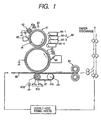
- a photosensitive drum which is an electrostatic latent image bearing member is electrostatically uniformly charged by means of a primary charging assembly, and imagewise exposure is carried out using laser light modulated by magenta image signals of an original, to form an electrostatic latent image on the photosensitive drum.
- the electrostatic latent image is developed by means of a magenta developing assembly holding a magenta toner, to form a magenta toner image.
- a transfer medium a recording sheet
- the magenta toner image formed on the photosensitive drum is transferred by means of a transfer charging assembly.
- the photosensitive drum on which the electrostatic latent image has been developed is de-charged by means of a residual charge eliminator, and is further cleaned through a cleaning means. Thereafter, it is again electrostatically charged by the primary charging assembly, and a cyan toner image is similarly formed.
- the cyan toner image is transferred to the transfer medium on which the magenta toner image has been transferred, and then a yellow toner image and a black toner image are successively formed and developed so that the four color toner images are transferred to the transfer medium.
- the transfer medium having these four color toner images is passed through fixing rollers so that they are fixed to the transfer medium by the action of heat and pressure. Thus, a full-color image is formed.
- the toners used in the color image forming method are required to have good melt properties and color-mixing properties when heat is applied at the time of fixing, and also to have a low melting point and sharp melt properties in a low melt viscosity. Use of such toners are preferred.
- a release agent such as silicone oil has been applied to the fixing rollers.
- Such an image forming method has caused such problems that the toner image fixing system in which the release agent such as silicone oil is applied to fixing rollers complicates the constitution of the main body, as a matter of course, and also the application of oil shortens the lifetime of fixing rollers acceleratingly.
- toner images formed by development in developing means are transferred onto a transfer medium, and the toner images, which are unfixed, are fixed by means of a fixing means. Thereafter, the transfer medium is discharged from the fixing means and is subsequently transported again to the transfer zone in such a state that it is turned upside down. Then, the toner images formed by development in developing means are transferred onto the transfer medium on the side opposite to the fixed image side, and the unfixed images are fixed by means of the fixing means, thus double-side color copying is completed.
- the paper may curl to cause a problem of paper jam during the transport.
- Another object of the present invention is to provide an image forming method that may less cause paper curl and may cause no paper jam during paper transport when paper is transported for double-side fixing.
- Still another object of the present invention is to provide an image forming method that may cause no blistered images due to low-temperature offset when toner images are fixed on cardboad.
- a further object of the present invention is to provide an image forming method that may cause no blank areas due to low-temperature offset when toner images are continuously fixed onto cardboad.
- the present invention provides an image forming method comprising;
- the present invention also provides an image forming method comprising;
- the present invention still also provides an image forming method comprising;
- the present invention is an image forming method characterized in that the amount of a cross-linking agent in each color toner is made larger in order from the recording sheet side. This broadens the latitude of low-temperature anti-offset properties. Hence, even when toner images are fixed on cardboad to which heat is hard to apply at the time of fixing, the toner layer which is closest to the recording sheet side stands weakly cross-linked to have a strong affinity for the recording sheet paper, making it possible to obtain images free of blistering or blank areas caused by low-temperature offset.
- the fixed toner layers of a multi-color or full-color image Due to such a constitution that the amount of a cross-linking agent in each color toner is made larger in order from the recording sheet side, the fixed toner layers of a multi-color or full-color image have a hard upper layer and a soft lower layer, so that the upper layer can be made to shrink in a small measure when its volume shrinkage is brought about by the natural cooling of toner binder after the heat-and-pressure fixing, making it possible to restrain the paper from curling.
- the cross-linking agent used in the present invention may include aromatic divinyl compounds such as divinylbenzene and divinylnaphthalene; carboxlates having two double bonds such as ethylene glycol diacrylate, ethylene glycol dimethacrylate and 1,3-butanediol dimethacrylate; divinyl compounds such as divinylaniline, divinyl ether, divinyl sulfide and divinyl sulfone; and compounds having three or more vinyl groups. Divinylbenzene is particularly preferred.
- the cross-linking agent may preferably be added in an amount of from 0.01 to 1.0 part by weight, and more preferably from 0.1 to 0.9 part by weight, based on 100 parts by weight of the vinyl polymer or vinyl copolymer.
- the amount of the cross-linking agent correlates with the content of THF-insoluble matter in a binder resin contained in each toner, and the proportion of THF-insoluble matter in the binder resin governs the degree of cross-linking of the binder resin of each toner
- the binder resin may preferably have THF(tetrahydrofuran)-insoluble matter in a content of 90% by weight or less, more preferably 70% by weight or less, and most preferably 65% by weight or less.
- the binder resin may preferably have THF-insoluble matter in a content of 30% by weight or less, more preferably 20% by weight or less, and most preferably 15% by weight or less.
- the THF-insoluble matter of the binder resin is defined to be a value measured in the following way.
- the content of THF-insoluble matter in binder resin at the stage of starting materials may change when the materials are melt-kneaded in the stage of toner production.
- the content of THF-soluble matter and THF-insoluble matter in the binder resin must be measured.
- the THF-soluble matter of the binder resin contained in the toner is determined by setting the toner on a Soxhlet extractor making use of toluene, and extracting toluene-soluble matter, which is separated using THF after the extract is solidified.
- the amount of the cross-linking agent added when the respective toners are produced may be adjusted, whereby the degree of cross-linking of the binder resin in each toner can be adjusted.
- the amount of the cross-linking agent becomes larger in the order of the toner images formed on the recording sheet, whereby the toners can be made to have a higher degree of cross-linking and a larger content of THF-insoluble matter as they come apart from the recording sheet.
- the toners are produced by a process having a kneading step therein, the polymer chains of cross-linked polymers in the binder resin are cut, and hence the content of THF-insoluble matter of the binder resin in each toner may become small.
- what also serves as the standard for estimating the quantity and effect of the cross-linking agent added is the quantity of high-molecular weight components of THF-soluble matter in addition to the quantity of THF-insoluble matter.
- one toner only is produced by a pulverization process having a kneading step therein, e.g., three color toners yellow toner, cyan toner and magenta toner are produced by polymerization and black toner only is produced by pulverization
- the content of THF-insoluble matter of the binder resin in the black toner may become -smaller than those of other toners even if the cross-linking agent is added in a larger quantity in the production of the binder resin of black toner than in the production of those of other three color toners.
- the binder resin in the black toner has a larger number-average molecular weight (Mn) than other color toners.
- Mn number-average molecular weight
- THF tetrahydrofuran
- THF sample solution is injected thereinto to make measurement.
- the molecular weight distribution ascribed to the sample is calculated from the relationship between the logarithmic value and number of count of a calibration curve prepared using several kinds of monodisperse polystyrene standard samples.
- the standard polystyrene samples used for the preparation of the calibration curve it is suitable to use samples with molecular weights of from 10 2 to 10 7 , which are available from Toso Co., Ltd.
- RI refractive index
- they may preferably comprise a combination of Shodex GPC KF-801, KF-802, KF-803, KF-804, KF-805, KF-806, KF-807 and KF-800P, available from Showa Denko K.K.; or a combination of TSKgel G1000H(H XL ), G2000H(H XL ), G3000H(H XL ), G4000H(H XL ), G5000H(H XL ), G6000H(H XL ), G7000H(H XL ) and TSK guard column, available from Toso Co., Ltd.
- the sample is prepared in the following way: The sample is put in tetrahydrofuran (THF), and is left for several hours, followed by thorough shaking so as to be well mixed with the THF (until coalescent matters of the sample has disappeared), which is further left standing for at least 12 hours. At this time, the sample is so allowed as to stand in THF for at least 24 hours in total. Thereafter, the solution having been passed through a sample-treating filter (pore size: 0.45 to 0.5 ⁇ m; for example, MAISHORI DISK-25-5, available from Toso Co., Ltd. or EKIKURO DISK 25CR, available from German Science Japan, Ltd., can be utilized) is used as the sample for GPC. The sample is so adjusted as to have resin components in a concentration of from 0.5 to 5 mg/ml.
- THF tetrahydrofuran
- the yellow toner, magenta toner and cyan toner used in the present invention may contain wax.
- the wax may preferably be a wax which is solid at room temperature.
- polymerization toners or pulverization toners There is no limitation by either polymerization toners or pulverization toners. Stated specifically, it may specifically include paraffin wax, polyolefin wax, Fischer-Tropsch wax, amide waxes, higher fatty acids, higher alcohol ester waxes, and derivatives thereof such as graft compounds or block compounds thereof.
- a and b each represent an integer of 0 to 4, provided that a + b is 4
- R 1 and R 2 each represent an organic group having 1 to 40 carbon atoms, provided that a difference in the number of carbon atoms between R 1 and R 2 is 10 or more
- n and m each represent an integer of 0 to 15, provided that n and m are not 0 at the same time.
- R 1 -COOR 2 wherein R 1 and R 2 each represent a hydrocarbon group having 1 to 40 carbon atoms; and R 1 and R 2 may have the number of carbon atoms which is the same or different from each other.
- R 1 OOC-(CH 2 ) n COOR 2 wherein R 1 and R 2 each represent a hydrocarbon group having 1 to 40 carbon atoms; n represents an integer of 2 to 20; and R 1 and R 2 may have the number of carbon atoms which is the same or different from each other.
- the ester wax preferably used in the present invention may have a melt viscosity measured at 100°C, of form 1 to 50 mPa ⁇ sec.
- the melt viscosity of the ester wax is measured by, e.g., using Viscotester VT500, manufactured by HAAKE Co. If the wax has a melt viscosity less than 1 mPa ⁇ sec, the high-temperature anti-offset properties may be less effective. If on the other hand the wax has a melt viscosity more than 50 mPa ⁇ sec, it may exude with difficulty at the time of fixing, resulting in a lowering of low-temperature fixing performance.
- the wax may preferably have a weight-average molecular weight (Mw) of from 300 to 1,500. If the wax has an Mw less than 300, it tends to be bared on the toner particle surfaces, and if it has an Mw more than 1,500, the low-temperature fixing performance may lower. In particular, those having an Mw within the range of from 400 to 1,250 are preferred.
- Mw/Mn weight-average molecular weight to number-average molecular weight
- the wax can have a sharper maximum peak of the DSC endothermic curve, so that the mechanical strength of the toner particles at room temperature is improved, and especially good toner performances can be obtained, showing sharp melt characteristics at the time of fixing.
- the molecular weights of the wax are measured by GPC under conditions shown below.
- Molecular weights are measured under conditions shown above. Molecular weights of the sample are calculated using a molecular weight calibration curve prepared from a monodisperse polystyrene standard sample. The calculated values are further calculated by converting the value in terms of polyethylene according to a conversion expression derived from the Mark-Houwink viscosity equation.
- wax may include the following compounds. (1) CH 3 (CH 2 ) 20 COO(CH 2 ) 21 CH 3 (2) CH 3 (CH 2 ) 17 COO(CH 2 ) 9 OOC(CH 2 ) 17 CH 3 (3) CH 3 (CH 2 ) 17 OOC(CH 2 ) 18 COO(CH 2 ) 17 CH 3
- the wax which may be used in the present invention may preferably be a compound having an endothermic main peak value (melting point) at 55 to 120°C, and more preferably 60 to 90°C, in the DSC endothermic curve as measured according to ASTM D3418-8.
- it may more preferably be a wax having a tangent takeoff temperature of the DSC curve, at 40°C or above. If the wax has an endothermic main peak at below 55°C, it may have so weak a self-cohesive power that it may constitute the insides or cores of toner particles with difficulty, and the wax may be deposited on the toner particle surfaces during the production of toner particles, tending to adversely affect developing performance in running tests.
- the wax has an endothermic main peak at above 120°C, it may exude with difficulty at the time of fixing, resulting in a lowering of the low-temperature fixing performance.
- the solubility into a polymerizable monomer composition may lower, so that the wax may become deposited while the polymerizable monomer composition is granulated in the aqueous medium into droplets having the size of toner particles, to undesirably make it difficult to continue the granulation.
- the wax may have the peak within the range of from 60 to 90°C, and most preferably from 60 to 85°C.
- the wax may also preferably have sharp melting properties such that the half-width of the endothermic main peak is within 10°C, and more preferably within 5°C.
- the wax may preferably be added in toner particles in an mount of from 5 to 30% by weight.
- the toner used in the present invention may preferably contain the wax in an mount of from 5 to 30% by weight.
- high-temperature anti-offset properties may be deteriorated, causing an offset phenomenon on the back-side images at the time of double-side fixing.
- coalescence of toner particles may be caused during granulation when produced by polymerization, tending to form toner particles having a broad particle size distribution. This may allow the wax not to be sufficiently encapsulated to make developing performance, transfer performance and blocking resistance poor. Accordingly, this may also result in inferior image uniformity.
- wax contained in the black toner used in the present invention may be the wax described above as used in the color toners, and may preferably be a wax having a DSC endothermic main peak at 60°C to 120°C. It may also preferably be a solid wax whose endothermic sub-peak in DSC is not present at 60°C or below. Use of a wax whose endothermic sub-peak in DSC is present at 60°C or below tends to cause a decrease in image density and also tends to cause a lowering of storage stability of the toner.
- the wax which may be used in the black toner according to the present invention may preferably have a ratio of weight-average molecular weight (Mw) to number-average molecular weight (Mn), (Mw/Mn), of from 1.0 to 2.0 as measured by the GPC described previously, having a very sharp molecular weight distribution.
- the use of such a wax having a very sharp molecular weight distribution achieves good low-temperature anti-offset properties and high-temperature anti-offset properties in oilless fixing and also brings about an improvement in blocking resistance.
- the combination of the above binder resin with the wax having a very sharp molecular weight distribution achieves both an appropriate gloss and the anti-offset properties in oilless fixing.
- the wax used in the black toner may preferably have a number-average molecular weight of from 350 to 2,000, and more preferably 400 to 1,000. This is preferred in view of the dispersibility in the binder resin, low-temperature anti-offset properties, high-temperature anti-offset properties, blocking resistance and many-sheet running performance.
- the wax used in the black toner may include low-molecular weight hydrocarbon waxes comprised of carbon and hydrogen, long-chain alkyl alcohol waxes having OH groups, long-chain alkyl carboxylic acid waxes having COOH groups, and ester waxes.
- the low-molecular weight hydrocarbon waxes may include petroleum waxes such as paraffin wax, microcrystalline wax and petrolatum; low-molecular weight polyolefin waxes such as low-molecular polyethylene; and polymethylene waxes such as Fischer-Tropsch wax.
- the petroleum waxes and low-molecular weight polyolefin waxes usually have a value of Mw/Mn of more than 2, and must be so purified as to have the value of Mw/Mn of from 1.0 to 2.0 and the DSC endothermic main peak at 60 to 120°C.
- the long-chain alkyl alcohol waxes may include mixtures of long-chain alkyl alcohol waxes having 20 to 200 carbon atoms.
- the long-chain alkyl carboxylic acid waxes may include mixtures of long-chain alkyl alcohol waxes having 20 to 200 carbon atoms.
- the ester waxes may include waxes obtained by purifying carnauba wax, waxes obtained by purifying candelilla wax, and waxes mainly composed of an ester compound of a long-chain alkyl alcohol having 15 to 45 carbon atoms and a long-chain alkyl carboxylic acid having 15 to 45 carbon atoms.
- low-molecular polyethylene having a sharp molecular weight distribution is particularly preferred.
- the wax may preferably be contained in an amount of from 0.5 to 8 parts by weight, and more preferably from 1 to 8 parts by weight, based on 100 parts by weight of the binder resin. This is preferred in view of low-temperature anti-offset properties and high-temperature anti-offset properties in oilless fixing, and gloss.
- a charge control agent may previously be added in toner particles.
- Positive charge control agents include Nigrosine dyes, triphenylmethane dyes, quaternary ammonium salts, guanidine derivatives, imidazole derivatives and amine compounds.
- Negative charge control agents include metal-containing salicylic acid copolymers, metal-containing monoazo dye compounds, urea derivatives, styrene-acrylic acid copolymers and styrene-methacrylic acid copolymers.
- black pigments may include carbon black, aniline black, non-magnetic ferrite and magnetite.
- Violet pigments may include Fast Violet B, and Methyl Violet Lake.
- Green pigments may include Pigment Green B, Malachite Green Lake, and Final Yellow Green G.
- the colorants used in the present invention are selected taking account of hue angle, chroma, brightness, weatherability, OHP transparency and dispersibility in toner particles.
- the colorant may usually be added in an an amount of from 1 to 20 parts by weight based on 100 parts by weight of the binder resin.
- a magnetic material used as the black colorant, it may be used in an amount of from 30 to 150 parts by weight based on 100 parts by weight of the binder resin, which is different from the amount of other colorant.
- Blue pigments may include C.I. 74100 (Metal-free Phthalocyanine Blue), C.I. 74160 (Phthalocyanine Blue) and C.I. 74180 (First Sky Blue).
- External additives may be added in the toners used in the present invention; for the purpose of providing various properties.
- the external additives may preferably have a particle diameter of not more than 1/10 of the volume-average diameter of the toner particles in view of their durability when added to the toners.
- This particle diameter of the external additives is meant to be an average particle diameter measured using an electron microscope by observing surfaces of toner particles.
- these properties-providing external additives for example, the following may be used.
- any of these external additives may preferably be used in an amount ranging from 0.1 part to 10 parts by weight, and more preferably from 0.1 part to 5 parts by weight, based on 100 parts by weight of the toner particles. These additives may be used alone or in combination.
- the toners used in the present invention may be either of polymerization toners and pulverization toners.
- polymerization processes for producing polymerization toners preferred are processes such as suspension polymerization, emulsion polymerization, interfacial polymerization, dispersion polymerization and bulk polymerization, which are carried out in aqueous mediums. Suspension polymerization is particularly preferred.
- toner particles may preferably have a pseudo-capsular structure as shown in Fig. 7, consisting of an outer layer (outer-layer resin), an inner layer (inner-layer resin) and the core or inner part (in islands) formed by the wax encapsulated in toner particles.
- suitable is a resin having polar groups and having a glass transition point of from 55 to 80°C and an acid value of from 1 to 35 mg KOH/g, and preferably from 5 to 35 mg KOH/g.
- the resin having polar groups is allowed to dissolve in the polymerizable monomer composition, and then the resulting polymerizable monomer composition is granulated in an aqueous medium into droplets with a size of toner particles. During the granulation, the resin gathers to the vicinities of surfaces of droplet particles to be formed into toner particles, and, through the subsequent step of polymerization and step of slow cooling, comes to form outer layers (shells) of toner particles in a preferable state.
- the glass transition point of the binder resin is measured using DSC-7, manufactured by Perkin Elmer Co., according to ASTM D3418-8.
- the temperature at the detecting portion of the device is corrected on the basis of the melting points of indium and zinc, and the calorie is corrected on the basis of the heat of fusion of indium.
- a sample is put in a pan made of aluminum and an empty pan is set as a control, making measurement at a rate of temperature rise of 10°C/min.
- the acid value of of the binder resin is measured according to JIS K-0070 in the following way.
- the resin having polar groups may preferably be added in an amount ranging from 1 to 20 parts by weight, and more preferably from 2.5 to 15 parts by weight, based on 100 parts by weight of the binder resin in toner. If it is in an amount less than 1 part by weight, the function as the outer layers of toner particles may lower, and, in an amount more than 20 parts by weight, the outer layers formed in the toner particles may be excess to tend to cause a lowering of charge stability of the toner.
- polyester resin or derivatives thereof are preferred.
- a typical polyester resin has compositions as shown below.
- the polyester resin may include ethylene glycol, propylene glycol, butanediol, diethylene glycol, triethylene glycol, pentanediol, hexanediol, neopentyl glycol, hydrogenated bisphenol A, a bisphenol derivative represented by the following Formula (I); wherein R represents an ethylene group or a propylene group, x and y are each an integer of 1 or more, and an average value of x + y is 2 to 10; and a diol represented by the following Formula (II). wherein R' represents an ethylene group or a propylene group, x and y are each an integer of 1 or more, and an average value of x + y is 2 to 10; and a diol represented by the following Formula (II). wherein R' represents
- It may also include polyhydric alcohols such as glycerol, pentaerythritol, sorbitol, sorbitan, and oxyalkylene ethers of novolak type phenolic resin; and polycarboxylic acids such as trimellitic acid, pyromellitic acid, benzophenonetetracarboxylic acid and anhydrides thereof.
- polyhydric alcohols such as glycerol, pentaerythritol, sorbitol, sorbitan, and oxyalkylene ethers of novolak type phenolic resin
- polycarboxylic acids such as trimellitic acid, pyromellitic acid, benzophenonetetracarboxylic acid and anhydrides thereof.
- a particularly preferred alcohol component of the polyester resin is the bisphenol derivative represented by the above Formula (I).
- the acid component may include phthalic acid, terephthalic acid, isophthalic acid, trimellitic acid and anhydrides thereof.
- the polymerizable monomer usable in forming toner particles by polymerization may include vinyl type polymerizable monomers, as exemplified by styrene; styrene derivatives such as ⁇ -methylstyrene, ⁇ -methylstyrene, o-methylstyrene, m-methylstyrene, p-methylstyrene, 2,4-dimethylstyrene, p-n-butylstyrene, p-tert-butylstyrene, p-n-hexylstyrene, p-n-octylstyrene, p-n-nonylstyrene, p-n-decylstyrene, p-n-dodecylstyrene, p-methoxystyrene and p-phenylstyrene; acrylate type polymeriz
- the inner layers of toner particles are constituted of a vinyl polymer formed of any of these vinyl type polymerizable monomers.
- vinyl type polymerizable monomers styrene polymers, styrene-acrylic copolymers or styrene-methacrylic copolymers are preferred in order to efficiently cover the wax that forms the inner part or the core.
- polymers or copolymers having a glass transition point of above 50°C to below 100°C are preferred.
- Those having a glass transition point of 50°C or below may make the toner have a high adhesion to fixing means such as fixing rollers, so that the transfer medium holding toner images thereon may be hard to separate from the fixing means, tending to cause a problem of fixing roller being wound around.
- the whole toner particles may have a low strength to tend to cause a lowering of transfer performance and developing performance in a many-sheet running test.
- those having a glass transition point of 100°C or above tend to cause a problem of faulty fixing.
- polymers or copolymers those having a main peak in the region of molecular weight of from 10,000 to 50,000 in gel permeation chromatography (GPC) are advantageous for encapsulating the wax at the inner part or core in a large quantity. If the polymer or copolymer constituting the inner layers has a molecular weight main peak at less than 10,000, the polymer or copolymer may have so weak a mutual action between molecular chains that it can not well cover the wax constituting the inner part or core, tending to cause a lowering of developing performance that is ascribable to the wax.
- GPC gel permeation chromatography
- the polymer or copolymer has a molecular weight main peak at more than 50,000, the polymer or copolymer may have so strong a mutual action between molecular chains that the wax may insufficiently exude to the toner particle surfaces at the time of heat-and-pressure fixing of toner images, tending to cause faulty fixing and low-temperature offset when fixing temperature is relatively low.
- the use of a polymer or copolymer having a main peak in the region of molecular weight of from 15,000 to 40,000 brings about very good developing performance because the toner particles can have a sufficient strength to exhibit superior triboelectric charging performance. Because of the sufficient strength of toner particles, the toner may hardly deteriorate even after running tests, so that stable transfer performance and developing performance can be maintained.
- Molecular weight of the sample is measured using 150C, available from Waters Co., with columns constituted of A-801, 802, 803, 804, 805, 806 and 807, available from Showa Denko K.K., connected in series, and using a calibration curve of reference polystyrene resin.
- the polymerization initiator may include azo or diazo type polymerization initiators such as 2,2'-azobis-(2,4-dimethylvaleronitrile), 2,2'-azobisisobutyronitrile), 1,1'-azobis-(cyclohexane-1-carbonitrile), 2,2'-azobis-4-methoxy-2,4-dimethylvaleronitrile and azobisisobutyronitrile; and peroxide type polymerization initiators such as benzoyl peroxide, methyl ethyl ketone peroxide, diisopropylperoxy carbonate, cumene hydroperoxide, 2,4-dichlorobenzoyl peroxide and lauroyl peroxide. Any of these polymerization initiators may be added in an amount of from 0.5 to 20% by weight based on the weight of the polymerizable monomers, and may be used alone or in combination.
- a chain transfer agent may be added.
- a dispersion stabilizer for the particles of the polymerizable monomer composition may be added.
- the dispersion stabilizer may include, e.g., finer powder of inorganic compounds such as tricalcium phosphate, magnesium phosphate, zinc phosphate, aluminum phosphate, calcium carbonate, magnesium carbonate, calcium hydroxide, magnesium hydroxide, aluminum hydroxide, calcium metasilicate, calcium sulfate, barium sulfate, bentonite, silica and alumina.
- the inorganic compounds when used, those commercially available may be used as they are.
- fine particles of the inorganic compound may be formed in the dispersion medium.
- an aqueous sodium phosphate solution and an aqueous calcium chloride solution may be mixed under high-speed agitation.
- the toner particles are produced by polymerization
- the surfaces of colorants may be subjected to hydrophobic treatment using materials free from polymerization inhibition, effecting surface modification.
- most dye type colorants and carbon black have the polymerization inhibitory action, hence care must be taken when used.
- a preferable method for the surface treatment of the dyes may include a method in which polymerizable monomers are previously polymerized in the presence of any of these dyes.
- the resulting colored polymer may be added to the polymerizable monomer composition.
- the carbon black besides the same treatment as the above for the dyes, it may be treated with a material capable of reacting with surface functional groups of the carbon black, as exemplified by organosiloxane.
- the toner particles are produced by polymerization, attention must be paid to polymerization inhibitory action or aqueous-phase transfer properties inherent in the magnetic materials.
- the surfaces of magnetic materials may preferably beforehand be subjected to surface modification (e.g., hydrophobic treatment using materials free from polymerization inhibition).
- the temperature may be raised at the latter half of the polymerization reaction, and also the aqueous medium may be removed in part at the latter half of the reaction or after the reaction has been completed, in order to remove unreacted polymerizable monomers, by-products and so forth that may cause a smell when toner images are fixed.
- the toner particles formed are collected by washing and filtration, followed by drying.
- water may preferably be used as the dispersion medium in an amount of from 300 to 3,000 parts by weight based on 100 parts by weight of the polymerizable monomer composition.
- toners by polymerization it is preferable to previously measure the endothermic main peak temperature of the wax, measure the glass transition temperature of the resin having polar groups and calculate from the composition and compositional ratio of the polymerizable monomers the theoretical glass transition temperature of the polymer or copolymer to be formed.
- the heating treatment may preferably be made at a temperature higher by at least 5°C (preferably higher by 5 to 20°C) than the endothermic main peak temperature of the wax, higher by at least 5°C (preferably higher by 5 to 20°C) than the glass transition temperature of the resin having polar groups which is added to the polymerizable monomer composition, and higher by at least 5°C (preferably higher by 7.5 to 30°C) than the theoretical glass transition point of the polymer or copolymer to be synthesized.
- the toners used in the present invention may each have a weight-average particle diameter (D4) of from 4 ⁇ m to 8 ⁇ m and a coefficient of variation (A) of 35% or less as calculated by the following expression.
- Toners having a weight-average particle diameter smaller than 4 ⁇ m are not preferable because such toners may cause fog and image non-uniformity due to faulty transfer.
- Toners having a weight-average particle diameter larger than 8 ⁇ m tend to melt-adhere to the surfaces of the photosensitive member and transfer medium.
- Toners having a coefficient of variation (A) in number distribution above 35% may make such tendency higher.
- Coefficient of variation A [Sn/D1] ⁇ 100 wherein Sn represents a standard deviation in the number distribution of toner particles, and D1 represents a number-average particle diameter ( ⁇ m) of the toner particles.
- the average particle diameter and particle size distribution of the toners can be measured by various means such as Coulter counter Model TA-II or Coulter Multisizer (manufactured by Coulter Electronics, Inc.). In the present invention, they are measured with Coulter Multisizer (manufactured by Coulter Electronics, Inc.).
- An interface manufactured by Nikkaki K.K.
- Nikkaki K.K. that outputs number distribution and volume distribution and a personal computer PC9801 (manufactured by NEC) are connected.
- an electrolytic solution an aqueous solution of about 1% NaCl is prepared using first-grade sodium chloride. For example, ISOTON R-II (available from Coulter Scientific Japan Co.) may be used.
- Measurement is made by adding as a dispersant from 0.1 to 5 ml of a surface-active agent (preferably alkylbenzenesulfonate) to from 100 to 150 ml of the above aqueous electrolytic solution, and further adding from 2 to 20 mg of a sample to be measured.
- a surface-active agent preferably alkylbenzenesulfonate
- the electrolytic solution in which the sample has been suspended is subjected to dispersion for about 1 minute to about 3 minutes in an ultrasonic dispersion machine.
- Volume and number of toner with particle diameters of 20 ⁇ m or larger are measured with the above Coulter Multisizer, using an aperture of 100 ⁇ m as its aperture, and the volume distribution and volume distribution are calculated.
- volume-based, weight-average particle diameter (D4) determined from the volume distribution and the number-based, number-average particle diameter (D1) determined from the number distribution are determined.
- the toner produced by polymerization may preferably have an average circularity of from 0.920 to 0.995 in circularity frequency distribution of the toner as measured with a flow type particle image analyzer.
- the toner in combination with the preferable particle diameters of toner as described previously, the toner can be improved in developing performance and transfer performance in a well balanced state and also can greatly be improved in the matching to image forming apparatus.
- the toner when the toner is made to have a weight-average particle diameter D4 as small as 4 to 8 ⁇ m, the reproducibility is improved in the development of contour portions of images, in particular, character images and line patterns.
- the toner when the toner is made to have an average circularity of from 0.920 to 0.995, preferably from 0.950 to 0.995, and more preferably from 0.970 to 0.990 in its circularity frequency distribution, the toner having a small particle diameter can greatly be improved in transfer performance, which has ever been difficult to do so, and also can greatly be improved in the developability for low-potential latent images. Such tendencies are very effectively appear especially when minute spot latent images of a digital type are developed or when toner images are transferred many times through the intermediate transfer member to form a full-color image, also bringing about the good matching to image forming apparatus.
- the circularity standard deviation of circularity frequency distribution of the toner may be controlled to be less than 0.040, preferably less than 0.035, and more preferably from 0.015 to less than 0.035. This can bring about a great improvement of properties relating to developing performance.
- Average circularity c which means an average value of circularity frequency distribution and circularity distribution SDc are calculated from the following expression where the circularity at a partition point i of particle size distribution (a central value) is represented by ci, and the frequency by f ci .
- treatment made at a temperature within the range of 5°C plus-minus the glass transition point Tg of the toner particles is effective especially in order to lessen particle surface pores of 10 nm or larger radius, so that the inorganic fine powder can function effectively and transfer efficiency can be improved.
- Comonomers for constituting styrene copolymers may include monocarboxylic acids having a double bond and derivatives thereof as exemplified by acrylic acid, methyl acrylate, ethyl acrylate, butyl acrylate, dodecyl acrylate, octyl acrylate, 2-ethylhexyl acrylate, phenyl acrylate, methacrylic acid, methyl methacrylate, ethyl methacrylate, butyl methacrylate, octyl methacrylate, acrylonitrile, methacrylonitrile and acrylamide; and dicarboxylic acids having a double bond and derivatives thereof as exemplified by maleic acid, butyl maleate, methyl maleate and dimethyl maleate.
- Such a colorant may be in a content of 12 parts by weight or less, and preferably from 0.5 to 9 parts by weight, based on 100 parts by weight of the binder resin.
- the binder resin for magnetic pulverization toner can be formed by, e.g., adding a monomer solution having one or more kinds of a styrene monomer, an acrylic monomer, maleic half ester, divinylbenzene and a radical polymerization initiator having a 10-hour half-temperature of 100°C or above, which solution is added dropwise in an organic solvent to carry out solution polymerization.
- the amount of the cross-linking agent such as divinylbenzene, the type and amount of the radical polymerization initiator, the addition rate of the monomer solution and the polymerization temperature may be controlled to form the binder resin having the prescribed molecular weight distribution and having THF-insoluble matter in a content of 5% by weight or less.
- the magnetic material of the magnetic pulverization toners may include metal oxides containing element such as iron, cobalt, nickel, copper, magnesium, manganese, aluminum or silicon. In particular, those composed mainly of iron oxide such as triiron tetraoxide or ⁇ -iron oxide are preferred. From the viewpoint of controlling charge quantity of the magnetic black toner, it may also contain silicon element, aluminum or other metal element.
- the magnetic material may have a BET specific surface area, as measured by nitrogen gas adsorption, of from 2 to 30 m 2 /g, and particularly from 3 to 30 m 2 /g. Also, a magnetic material having a Mohs hardness of from 5 to 7 is preferred.
- the magnetic particles may preferably have a number-average particle diameter of from 0.05 to 1.0 ⁇ m, more preferably from 0.1 to 0.6 ⁇ m, and still more preferably from 0.1 to 0.4 ⁇ m.
- the magnetic material may preferably be contained in an amount of from 30 to 200 parts by weight, and more preferably from 50 to 150 parts by weight, based on 100 parts by weight of the binder resin. If it is in an amount less than 30 parts by weight, the toner, when used in a developing assembly making use of magnetic force to transport the toner, may have a low transport performance, tending to make a developer layer uneven on the developer carrying member to tend to cause uneven images. Also, a decrease in image density tends to occur which is caused by an increase in triboelectricity of the magnetic black toner. If on the other hand it is in an amount more than 200 parts by weight, the fixing performance may lower and also it may become difficult to make the gloss higher.
- a developer having a cyan toner, a developer having a magenta toner, a developer having a yellow toner and a developer having a black toner are put into developing assemblies 44-1, 44-2, 44-3 and 44-4, respectively.
- Electrostatic latent images formed by exposure 43 on an photosensitive member 41 electrostatically charged are developed by a magnetic brush development system or non-magnetic one-component development system to form toner images of respective colors on the photosensitive member 41.
- the photosensitive member 41 is a photosensitive drum or photosensitive belt having a photoconductive insulating material layer formed of a-Se, CdS, ZnO 2 , OPC or a-Si.
- the photosensitive member 41 is driven rotatively by means of a drive system (not shown) in the direction of an arrow.
- a photosensitive member having an amorphous silicon photosensitive layer or an organic photosensitive layer is preferably used.
- the organic photosensitive layer may be of a single-layer type in which the photosensitive layer contains a charge generating material and a charge transporting material in the same layer, or may be a function-separated photosensitive layer comprised of a charge transport layer and a charge generation layer.
- a multi-layer type photosensitive layer comprising a conductive substrate and the charge generation layer and the charge transport layer which are superposed on the substrate in this order is one of preferred examples.
- binder resins for the organic photosensitive layer polycarbonate resins, polyester resins or acrylic resins have an especially good transfer performance and cleaning performance, and may hardly cause faulty cleaning, melt-adhesion of toner to the photosensitive member and filming of external additives.
- a charging roller 42 is constituted basically of a mandrel 42b and a conductive elastic layer 42a that forms the periphery of the former.
- the charging roller 42 is brought into pressure contact with the surface of the photosensitive member 41 and is rotated according as the photosensitive member 41 is rotated.
- the charging process may preferably be performed under conditions of a roller contact pressure of 5 to 500 g/cm, and an AC voltage of 0.5 to 5 kVpp, an AC frequency of 50 Hz to 5 kHz and a DC voltage of ⁇ 0.2 to ⁇ 1.5 kV when a voltage formed by superimposing an AC voltage on a DC voltage, and a DC voltage of from ⁇ 0.2 to ⁇ 5 kV when a DC voltage is used.
- a charging means other than the charging roller there is a method making use of a charging blade and a method making use of a conductive brush. These contact charging means have the effect of, e.g., making high voltage unnecessary and making ozone less occur.
- the toner image on the photosensitive member 41 is transferred to an intermediate transfer member 45 to which a voltage (e.g., ⁇ 0.1 to ⁇ 5 kV) is applied.
- a voltage e.g., ⁇ 0.1 to ⁇ 5 kV
- the surface of the photosensitive member 41 after transfer is cleaned by a cleaning means 49 having a cleaning blade 48.
- the intermediate transfer member 45 is comprised of a pipe-like conductive mandrel 45b and a medium-resistance elastic material layer 45a formed on its periphery.
- the mandrel 45b may comprise a plastic pipe provided thereon with a conductive coating.
- the medium-resistance elastic material layer 45a is a solid or foamed-material layer made of an elastic material such as silicone rubber, Teflon rubber, chloroprene rubber, urethane rubber or EPDM (ethylene-propylene-diene terpolymer) in which a conductivity-providing agent such as carbon black, zinc oxide, tin oxide or silicon carbide has been mixed and dispersed to adjust electrical resistance (volume resistivity) to a medium resistance of from 10 5 to 10 11 ⁇ cm.
- an elastic material such as silicone rubber, Teflon rubber, chloroprene rubber, urethane rubber or EPDM (ethylene-propylene-diene terpolymer) in which a conductivity-providing agent such as carbon black, zinc oxide, tin oxide or silicon carbide has been mixed and dispersed to adjust electrical resistance (volume resistivity) to a medium resistance of from 10 5 to 10 11 ⁇ cm.
- the intermediate transfer member 45 is provided in contact with the bottom part of the photosensitive member 41, being axially supported in parallel to the photosensitive member 41, and is driven rotatively at the same peripheral speed as the photosensitive member 41 in the anti-clockwise direction as shown by an arrow.
- the first-color toner image formed and held on the surface of the photosensitive member 41 is, while it is passed through the transfer nip portion where the photosensitive member 41 and the intermediate transfer member 45 come into contact, transferred intermediately sequencially to the periphery of the intermediate transfer member 45 by the aid of the electric filed formed at the transfer nip portion by a transfer bias applied to the intermediate transfer member 45.
- the intermediate transfer member and the transfer roller may be formed of commonly available materials.
- the elastic layer of the transfer roller may be made to have a volume resistivity set smaller than the volume resistivity of the elastic layer of the intermediate transfer member, whereby the voltage applied to the transfer roller can be lessened, good toner images can be formed on the transfer medium and also the transfer medium can be prevented from being wound around the intermediate transfer member.
- the elastic layer of the intermediate transfer member may preferably have a volume resistivity at least 10 times the volume resistivity of the elastic layer of the transfer roller.
- the hardness of the intermediate transfer member and transfer roller is measured according to JIS K-6301.
- the intermediate transfer member used in the present invention may preferably be constituted of an elastic layer with a hardness in the range of from 10 to 40 degrees.
- the transfer roller may preferably have an elastic layer with a hardness higher than the hardness of the elastic layer of the intermediate transfer member and has a value of from 41 to 80 degrees, in order to prevent the transfer medium from being wound around the intermediate transfer member. If the intermediate transfer member and the transfer roller have a reverse hardness, a concave may be formed on the transfer roller side to tend to cause the transfer medium to wind around the intermediate transfer member.
- a transfer belt 47 is provided beneath the intermediate transfer member 45.
- the transfer belt 47 is stretched over two rollers provided in parallel to the axis of the intermediate transfer member 45, i.e., a bias roller 47a and a tension roller 47c, and is driven by a drive means (not shown).
- the transfer belt 47 is so constructed as to be movable in the directions of an arrow on the side of the bias roller 47a around the tension roller 47c so that it can become contact with or separate from the intermediate transfer member 45 upward or downward in the direction of the arrow.
- a desired secondary transfer bias is applied by a secondary transfer bias source 47d.
- the tension roller 47c is grounded.
- a rubber belt comprising a thermosetting urethane elastomer in which carbon black has been dispersed so as to be controlled to have a thickness of about 300 ⁇ m and a volume resistivity of 10 8 to 10 12 ⁇ cm (at the time of application of 1 kV) and the surface of which is further covered with a fluororubber of 20 ⁇ m thick so as to be controlled to have a volume resistivity of 10 15 ⁇ cm (at the time of application of 1 kV). It has the shape of a tube 80 mm long and 300 mm wide in external size.
- the transfer belt 47 described above is elongated by about 5% with tension applied by the aid of the bias roller 47a and tension roller 47c.
- the transfer medium 46 is transported to a fixing assembly 81 constituted basically of a heat roller provided internally with a heating element such as a halogen heater and an elastic material pressure roller brought into contact therewith under pressure, and is passed between the heat roller and the pressure roller, thus the toner images superimposed are heat-and-pressure fixed to the transfer medium, as shown in Fig. 8.
- a fixing assembly 81 constituted basically of a heat roller provided internally with a heating element such as a halogen heater and an elastic material pressure roller brought into contact therewith under pressure, and is passed between the heat roller and the pressure roller, thus the toner images superimposed are heat-and-pressure fixed to the transfer medium, as shown in Fig. 8.
- a fixing assembly 81 constituted basically of a heat roller provided internally with a heating element such as a halogen heater and an elastic material pressure roller brought into contact therewith under pressure, and is passed between the heat roller and the pressure roller, thus the toner images superimposed are heat-and-pressure fixed to the transfer medium, as shown in Fig. 8.
- a developing method making use of a one-component developer (toner) will be described below.
- one-component developing methods such as magnetic one-component development and non-magnetic one-component development may be used. Their details will be described with reference to some drawings, but not necessarily limited to these. First, magnetic one-component development will be described with reference to Fig. 2.
- substantially the right-half periphery of a developing sleeve 51 always comes in contact with the toner stock inside a toner container 52.
- the toner in the vicinity of the surface of the developing sleeve is attracted to and carried on the surface of the developing sleeve by the action of magnetic force and/or electrostatic force, the magnetic force being produced by a magnetism generating means 53 internally provided with the developing sleeve.
- the developing sleeve 51 is rotatively driven, the magnetic toner layer formed on the surface of the developing sleeve 51 passes through the position of a regulation member 54, while the toner is formed into a regulated layer as a thin-layer magnetic toner T1 with a uniform thickness at every portion.
- the magnetic toner is electrostatically charged chiefly by the frictional contact between the developing sleeve surface and the magnetic toner standing in the vicinity thereof in the toner stock, as the developing sleeve 51 is rotated.
- the developing sleeve 51 is rotated, the thin-layer surface of the magnetic toner carried on the developing sleeve 51 is moved toward the side of a latent image bearing member 55 and is passed through a developing zone A at which the latent image bearing member 55 and the developing sleeve 51 come nearest.
- the magnetic toner of the magnetic toner thin layer formed on the developing sleeve 51 flies by the aid of DC and AC electric fields formed by direct current and alternating current voltages applied across the latent image bearing member 55 and the developing sleeve 51 by a voltage applying means 56, and reciprocates (at a gap ⁇ ) between the surface of the latent image bearing member 55 and the surface of the developing sleeve 51.
- the magnetic toner on the side of the developing sleeve 51 is selectively transferred and attracted to the surface of the latent image bearing member 55 in accordance with potential patterns of electrostatic latent images, so that toner images T2 are successively formed.
- the regulation member 54 serving as a toner thin-layer forming means used in the assembly shown in Fig. 2 is a doctor blade such as a metallic blade or a magnetic blade provided at a certain distance from the developing sleeve 51.
- a doctor blade such as a metallic blade or a magnetic blade provided at a certain distance from the developing sleeve 51.
- a rigid roller or sleeve formed of metal, resin or ceramic may be used, and a magnetism generating means may be provided on the inside thereof.
- an elastic blade or elastic roller (not shown) may also be used which is elastically brought into contact with the surface of the developing sleeve (toner carrying member) by elastic force.
- a toner thin-layer coating means may particularly preferably be used in which the regulation member comes into touch with the toner carrying member under an elastic force to apply the toner into thin layer.
- the elastic blade or the elastic roller it is possible to use rubber elastic materials such as silicone rubber, urethane rubber and NBR; synthetic resin elastic materials such as polyethylene terephthalate, or metal elastic materials such as stainless steel, steel and phosphor bronze, as well as composite materials thereof.
- the part coming into touch with the sleeve may preferably be made of the rubber elastic material or resin elastic material.
- resin or rubber may preferably be stuck to, or applied on, the metal elastic material so as to touch the part coming into contact with the developing sleeve.
- the quality of the material for the elastic blade or elastic roller is greatly concerned in the charging of the toner.
- an organic or inorganic substance may be added to, may be melt-mixed in, or may be dispersed in, the elastic material.
- the charging performance of toner can be controlled by adding metal oxide, metal powder, ceramic, carbon allotrope, whisker, inorganic fibers, dye, pigment or surface- active agent.
- a metal oxide such as silica, alumina, titania, tin oxide, zirconium oxide or zinc oxide, carbon black, and a charge control agent commonly used in toners may preferably be incorporated therein.
- those positively chargeable with ease such as urethane, polyamide, nylon and melamine may preferably be selected.
- those negatively chargeable with ease such as urethane resin, silicone, polyester, fluorine resin (e.g., Teflon) and polyimide may preferably be selected.
- FIG. 3 An example in which the elastic blade is used is shown in Fig. 3.
- An elastic blade 63 is, at its upper side base portion, fixedly held on the side of a developer container and is so provided that its blade inner face side (or its outer face side in the case of the adverse direction) is, at its lower side, brought into touch with the surface of the developing sleeve 62 under an appropriate elastic pressure in such a state that it is deflected against the elasticity of the blade in the forward direction or backward direction of the rotation of the developing sleeve. According to such construction, a toner layer can be formed which is stabler and thinner even against environmental variations and is dense.
- the toner tends to be so excessively charged that it tends to melt-adhere to the developing sleeve or elastic blade.
- the toner used in the developing method of the present invention can preferably be used because it has a superior releasability and has a stable triboelectric chargeability.
- the layer thickness of the magnetic toner layer formed on the developing sleeve may preferably be made smaller than the gap ⁇ between the latent image bearing member and the developing sleeve.
- the layer thickness of the magnetic toner layer may be regulated in such an extent that part of a large number of ears of the magnetic toner constituting the magnetic toner layer comes into contact with the surface of the latent image bearing member.
- the developing sleeve is rotated at a peripheral speed of from 100 to 200% with respect to the latent image bearing member.
- the alternating bias voltage applied by a voltage applying means 56 may preferably be applied at a peak-to-peak voltage of 0.1 kV or above, preferably from 0.2 to 3.0 kV, and more preferably from 0.3 to 2.0 kV.
- the alternating bias may be applied at a frequency of from 0.5 to 5.0 kHz, preferably from 1.0 to 3.0 kHz, and more preferably from 1.5 to 3.0 kHz.
- As the waveform of the alternating bias rectangular waveform, sine waveform, sawtooth waveform and triangle waveform can be used.
- An asymmetrical AC bias having different time for which forward/backward voltages are applied may also be used. It is also preferable to superimpose a DC bias.
- any abrasive grains may be used.
- the shaped particles usable are various rigid body spheres comprised of a metal such as stainless steel, aluminum, steel, nickel or brass, or various rigid body spheres such as ceramic, plastic or glass beads.
- the shaped particles may preferably be spherical or rotary ellipsoidal particles having substantially curved surfaces and a major axis/minor axis ratio of from 1 to 2 (preferably from 1 to 1.5, and more preferably from 1 to 1.2).
- the shaped particles used for the blasting of the developing sleeve surface may preferably be those having a diameter (or length) of from 20 to 250 ⁇ m).
- shaped blasting particles may preferably be larger than shapeless blasting particles, and may particularly preferably from 1 to 20 times, and more preferably from 1.5 to 9 times, the latter.
- At least one of treating time and treating particle impact force may preferably be made less than that of blasting with shapeless particles.
- the graphite which may be used in the present invention may preferably have a particle diameter of from 0.5 ⁇ m to 10 ⁇ m.
- Conductive amorphous carbon is commonly defined as "an aggregate of crystallites produced by subjecting hydrocarbons or carbon-containing compounds to combustion or thermal decomposition in an insufficiently air-supplied state". It has come into wide use especially because it has superior electrical conductivity, can be incorporated into polymeric materials to impart conductivity thereto and can attain any desired electrical conductance to a certain extent by controlling its amount when added.
- Conductive amorphous carbon which may be used in the present invention may preferably be those having a particle diameter of from 10 ⁇ m to 80 ⁇ m, and more preferably from 15 ⁇ m to 40 ⁇ m.
- FIG. 4 shows an apparatus for developing an electrostatic latent image formed on a latent image bearing member.
- Reference numeral 75 denotes the latent image bearing member, on which latent images are formed by an electrophotographic processing means or electrostatic recording means (not shown).
- Reference numeral 74 denotes a developing sleeve, which is comprised of a non-magnetic sleeve made of aluminum or stainless steel.
- an alternating electric field or a development bias formed by superimposing a DC electric field to an alternating electric field may be applied across the developing sleeve 74 and the latent image bearing member 75 through a bias applying means 56, whereby the toner can be moved easily from the developing sleeve surface to the latent image bearing member surface and images with a much better quality can be formed.
- bias applying means 56 may be applied across the developing sleeve 74 and the latent image bearing member 75 through a bias applying means 56, whereby the toner can be moved easily from the developing sleeve surface to the latent image bearing member surface and images with a much better quality can be formed.
- Fig. 5 shows the constitution of an oilless fixing assembly which enables the double-side fixing which may be used in the present invention.
- the fixing roller 129 is provided with a heat-generating means halogen heater 136 and the pressure roller 130 is similarly provided with a heater 137 so that the heat can be applied on the both sides.
- the temperature of the pressure roller is detected by a thermistor 138 brought into contact with the pressure roller 130.
- the halogen heaters 136 and 37 are controlled by a control unit 139, and the temperature of the fixing roller 129 and the temperature of the pressure roller 130 is so controlled as to be kept at about 170°C.
- the fixing roller 129 and the pressure roller 130 are pressed against each other at a total pressure of about 40 kg by means of a pressing mechanism (not shown).
- Fig. 6 schematically illustrates the constitution of an example of an image forming apparatus for forming full-color images by electrophotography.
- the image forming apparatus shown in Fig. 6 is used as a full-color copying machine or a full-color printer.
- the full-color copying machine it has, as shown in Fig. 6, a digital color-image reader section at the top and a digital color-image printer section at a lower part.
- a photosensitive drum 1 as an image bearing member has a photosensitive layer having, e.g., an organic photoconductor, and is supported rotatably in the direction of an arrow.
- a pre-exposure lamp 11 a corona charging assembly 2, a laser exposure optical system 3, a potential sensor 12, four different color developing assemblies 4Y, 4C, 4M and 4B, a detecting means 13 for detecting the quantity of light on the drum, a transfer member 5 and a cleaner 6 are provided.
- monochromatic fixed images or multi-color fixed images can be formed by selecting either a monochromatic mode or a multi-color mode.
- the yellow toner, cyan toner, magenta toner and black toner thus obtained, the content of THF-insoluble matter, the number-average particle diameter (Mn) of THF-soluble matter, the ratio of weight-average particle diameter (Mw) to number-average particle diameter (Mn) (Mw/Mn) and the content of cross-linking agent unit per 100 parts by weight of binder resin in toner were measured to obtain the results shown in Table 1.
- Images formed at the initial stage and on the 100th sheet in the environment of low temperature/low humidity were evaluated according to the following evaluation criteria by examining any blistering within the area of 3 cm x 3 cm at the middle portion of the images.
- A3-size paper of 80 g/m 2 in basis weight images were continuously reproduced on 100 sheets in the environment of normal temperature/normal humidity (25°C/60%RH) to make evaluation on paper curl. Paper with images at the initial stage and on the 100th sheet was put on a flat place, and the height at the most curled portion among the four corners of the paper was measured to make evaluation on the paper curl.
- a yellow toner, a cyan toner, a magenta toner and a black toner were produced in the same manner as in Example 1 except that the black toner was produced by suspension polymerization in the manner as described above, using a polymerizable monomer composition comprised of the following.
- a yellow toner, a cyan toner, a magenta toner and a black toner were produced in the same manner as in Example 1 except that the cross-linking agent was changed to ethylene glycol acrylate. Evaluation was made in the same manner as in Example 1.
- a yellow toner, a cyan toner, a magenta toner and a black toner were produced in the same manner as in Example 1 except that the amount of the cross-linking agent added in the yellow toner was changed to 3.0 parts by weight, the amount of the cross-linking agent added in the cyan toner to 2.5 parts by weight, the amount of the cross-linking agent added in the magenta toner to 2.4 parts by weight, and the amount of the cross-linking agent added in the black toner to 0.1 part by weight. Evaluation was made in the same manner as in Example 1.
Landscapes
- Physics & Mathematics (AREA)
- General Physics & Mathematics (AREA)
- Spectroscopy & Molecular Physics (AREA)
- Developing Agents For Electrophotography (AREA)
- Color Electrophotography (AREA)
Claims (62)
- Bildgebungsverfahren, umfassend:wobeiBildung eines ersten, elektrostatischen, latenten Bildes auf einem Element zum Tragen eines latenten Bildes, Entwicklung des ersten, elektrostatischen, latenten Bildes mittels Verwendung eines ersten Toners zur Erzeugung eines ersten Tonerbildes auf dem Element zum Tragen des latenten Bildes und Übertragung des ersten Tonerbildes auf ein zwischengeschaltetes Übertragungselement,Bildung eines zweiten, elektrostatischen, latenten Bildes auf dem Element zum Tragen eines latenten Bildes, Entwicklung des zweiten, elektrostatischen, latenten Bildes mittels Verwendung eines zweiten Toners zur Erzeugung eines zweiten Tonerbildes auf dem Element zum Tragen des latenten Bildes und Übertragung des zweiten Tonerbildes auf ein zwischengeschaltetes Übertragungselement,Bildung eines dritten, elektrostatischen, latenten Bildes auf dem Element zum Tragen eines latenten Bildes, Entwicklung des dritten, elektrostatischen, latenten Bildes mittels Verwendung eines dritten Toners zur Erzeugung eines dritten Tonerbildes auf dem Element zum Tragen des latenten Bildes und Übertragung des dritten Tonerbildes auf ein zwischengeschaltetes Übertragungselement,Übertragung der auf dem zwischengeschalteten Übertragungselement übereinander gelegten Tonerbilder auf ein Aufzeichnungsblatt in der Reihenfolge erstes Tonerbild, zweites Tonerbild und drittes Tonerbild, von der Oberfläche des zwischengeschalteten Übertragungselementes aus gezählt, undFixierung unter Anwendung von Hitze und Druck der auf dem Aufzeichnungsblatt übereinander gelegten Tonerbilder auf das Aufzeichnungsblatt in der Reihenfolge drittes Tonerbild, zweites Tonerbild und erstes Tonerbild, von der Oberfläche des Aufzeichnungsblattes aus gezählt, mit Hilfe einer Fixiereinrichtung unter Verwendung von Hitze und Druck zur Erzeugung eines Mehrfarbbildes oder Vollfarbbildes auf dem Aufzeichnungsblatt,die Toner, die das erste Tonerbild, das zweite Tonerbild und das dritte Tonerbild erzeugen, jeweils ein Vinylpolymer, das mit einem Quervernetzungsmittel quervernetzt ist, oder ein Vinylcopolymer, das mit einem Quervernetzungsmittel quervernetzt ist, enthalten, die Menge des Quervernetzungsmittel im dritten Toner, zweiten Toner und ersten Toner in dieser Reihenfolge vergrößert wird,der erste Toner ein Farbtoner ist, der ausgewählt ist aus der Gruppe, bestehend aus einem gelben Toner mit gelben Tonerteilchen und einem externen Zusatz, einem cyanblauen Toner mit cyanblauen Tonerteilchen und einem externen Zusatz und einem magentaroten Toner mit magentaroten Tonerteilchen und einem externen Zusatz,der zweite Toner ein Farbtoner ist, der ausgewählt ist aus der Gruppe, bestehend aus einem gelben Toner mit gelben Tonerteilchen und einem externen Zusatz, einem cyanblauen Toner mit cyanblauen Tonerteilchen und einem externen Zusatz und einem magentaroten Toner mit magentaroten Tonerteilchen und einem externen Zusatz,der dritte Toner ein Farbtoner ist, der ausgewählt ist aus der Gruppe, bestehend aus einem gelben Toner mit gelben Tonerteilchen und einem externen Zusatz, einem cyanblauen Toner mit cyanblauen Tonerteilchen und einem externen Zusatz und einem magentaroten Toner mit magentaroten Tonerteilchen und einem externen Zusatz, undder erste Toner, der zweite Toner und der dritte Toner Farben aufweisen, die sich von einander unterscheiden.
- Bildgebungsverfahren nach Anspruch 1, worin das Quervernetzungsmittel in einer Menge von 0,01 Gewichtsteilen bis 1,0 Gewichtsteilen, bezogen auf 100 Gewichtsteile des Vinylpolymers oder Vinylcopolymers, enthalten ist.
- Bildgebungsverfahren nach Anspruch 1, worin das Quervernetzungsmittel in einer Menge von 0,1 Gewichtsteilen bis 0,9 Gewichtsteilen, bezogen auf 100 Gewichtsteile des Vinylpolymers oder Vinylcopolymers, enthalten ist.
- Bildgebungsverfahren nach Anspruch 1, worin der erste Toner, der zweite Toner und der dritte Toner Toner sind, die durch Suspensionspolymerisation in einem wässrigen Medium hergestellt wurden.
- Bildgebungsverfahren nach Anspruch 1, worin der erste Toner, der zweite Toner und der dritte Toner jeweils einen gewichtsmittleren Teilchendurchmesser von 4 µm bis 8 µm aufweisen.
- Bildgebungsverfahren nach Anspruch 1, worin der erste Toner, der zweite Toner und der dritte Toner jeweils einen Variationskoeffizienten von 35% oder weniger in der Zahlenverteilung aufweisen.
- Bildgebungsverfahren nach Anspruch 1, worin der erste Toner, der zweite Toner und der dritte Toner jeweils eine mittlere Kugelförmigkeit von 0,920 bis 0,995 aufweisen.
- Bildgebungsverfahren nach Anspruch 1, worin der erste Toner, der zweite Toner und der dritte Toner jeweils eine mittlere Kugelförmigkeit von 0,950 bis 0,995 aufweisen und eine Standardabweichung der Kugelförmigkeit von weniger als 0,040 zeigen.
- Bildgebungsverfahren nach Anspruch 1, worin der erste Toner, der zweite Toner und der dritte Toner jeweils eine mittlere Kugelförmigkeit von 0,950 bis 0,995 aufweisen und eine Standardabweichung der Kugelförmigkeit von 0,015 bis 0,035 zeigen.
- Bildgebungsverfahren nach Anspruch 1, worin der erste Toner, der zweite Toner und der dritte Toner jeweils ein Wachs enthalten.
- Bildgebungsverfahren nach Anspruch 10, worin das Wachs ein Esterwachs ist.
- Bildgebungsverfahren nach Anspruch 10, worin das Wachs in einer Menge von 5 Gew.-% bis 30 Gew.-% im Toner enthalten ist.
- Bildgebungsverfahren, umfassend:wobeiBildung eines ersten, elektrostatischen, latenten Bildes auf einem Element zum Tragen eines latenten Bildes, Entwicklung des ersten, elektrostatischen, latenten Bildes mittels Verwendung eines ersten Toners zur Erzeugung eines ersten Tonerbildes auf dem Element zum Tragen des latenten Bildes und Übertragung des ersten Tonerbildes auf ein Aufzeichnungsblatt,Bildung eines zweiten, elektrostatischen, latenten Bildes auf dem Element zum Tragen eines latenten Bildes, Entwicklung des zweiten, elektrostatischen, latenten Bildes mittels Verwendung eines zweiten Toners zur Erzeugung eines zweiten Tonerbildes auf dem Element zum Tragen des latenten Bildes und Übertragung des zweiten Tonerbildes auf ein Aufzeichnungsblatt,Bildung eines dritten, elektrostatischen, latenten Bildes auf dem Element zum Tragen eines latenten Bildes, Entwicklung des dritten, elektrostatischen, latenten Bildes mittels Verwendung eines dritten Toners zur Erzeugung eines dritten Tonerbildes auf dem Element zum Tragen des latenten Bildes und Übertragung des dritten Tonerbildes auf ein Aufzeichnungsblatt, undFixierung unter Anwendung von Hitze und Druck der auf dem Aufzeichnungsblatt übereinander gelegten Tonerbilder auf das Aufzeichnungsblatt in der Reihenfolge erstes Tonerbild, zweites Tonerbild und drittes Tonerbild, von der Oberfläche des Aufzeichnungsblattes aus gezählt, mit Hilfe einer Fixiereinrichtung unter Verwendung von Hitze und Druck zur Erzeugung eines Mehrfarbbildes oder Vollfarbbildes auf dem Aufzeichnungsblatt,die Toner, die das erste Tonerbild, das zweite Tonerbild und das dritte Tonerbild erzeugen, jeweils ein Vinylpolymer, das mit einem Quervernetzungsmittel quervernetzt ist, oder ein Vinylcopolymer, das mit einem Quervernetzungsmittel quervernetzt ist, enthalten, die Menge des Quervernetzungsmittel im ersten Toner, zweiten Toner und dritten Toner in dieser Reihenfolge vergrößert wird,der erste Toner ein Farbtoner ist, der ausgewählt ist aus der Gruppe, bestehend aus einem gelben Toner mit gelben Tonerteilchen und einem externen Zusatz, einem cyanblauen Toner mit cyanblauen Tonerteilchen und einem externen Zusatz und einem magentaroten Toner mit magentaroten Tonerteilchen und einem externen Zusatz,der zweite Toner ein Farbtoner ist, der ausgewählt ist aus der Gruppe, bestehend aus einem gelben Toner mit gelben Tonerteilchen und einem externen Zusatz, einem cyanblauen Toner mit cyanblauen Tonerteilchen und einem externen Zusatz und einem magentaroten Toner mit magentaroten Tonerteilchen und einem externen Zusatz,der dritte Toner ein Farbtoner ist, der ausgewählt ist aus der Gruppe, bestehend aus einem gelben Toner mit gelben Tonerteilchen und einem externen Zusatz, einem cyanblauen Toner mit cyanblauen Tonerteilchen und einem externen Zusatz und einem magentaroten Toner mit magentaroten Tonerteilchen und einem externen Zusatz, undder erste Toner, der zweite Toner und der dritte Toner Farben aufweisen, die sich von einander unterscheiden.
- Bildgebungsverfahren nach Anspruch 13, worin das Quervernetzungsmittel in einer Menge von 0,01 Gewichtsteilen bis 1,0 Gewichtsteilen, bezogen auf 100 Gewichtsteile des Vinylpolymers oder Vinylcopolymers, enthalten ist.
- Bildgebungsverfahren nach Anspruch 13, worin das Quervernetzungsmittel in einer Menge von 0,1 Gewichtsteilen bis 0,9 Gewichtsteilen, bezogen auf 100 Gewichtsteile des Vinylpolymers oder Vinylcopolymers, enthalten ist.
- Bildgebungsverfahren nach Anspruch 13, worin der erste Toner, der zweite Toner und der dritte Toner Toner sind, die durch Suspensionspolymerisation in einem wässrigen Medium hergestellt wurden.
- Bildgebungsverfahren nach Anspruch 13, worin der erste Toner, der zweite Toner und der dritte Toner jeweils einen gewichtsmittleren Teilchendurchmesser von 4 µm bis 8 µm aufweisen.
- Bildgebungsverfahren nach Anspruch 13, worin der erste Toner, der zweite Toner und der dritte Toner jeweils einen Variationskoeffizienten von 35% oder weniger in der Zahlenverteilung aufweisen.
- Bildgebungsverfahren nach Anspruch 13, worin der erste Toner, der zweite Toner und der dritte Toner jeweils eine mittlere Kugelförmigkeit von 0,920 bis 0,995 aufweisen.
- Bildgebungsverfahren nach Anspruch 13, worin der erste Toner, der zweite Toner und der dritte Toner jeweils eine mittlere Kugelförmigkeit von 0,950 bis 0,995 aufweisen und eine Standardabweichung der Kugelförmigkeit von weniger als 0,040 zeigen.
- Bildgebungsverfahren nach Anspruch 13, worin der erste Toner, der zweite Toner und der dritte Toner jeweils eine mittlere Kugelförmigkeit von 0,950 bis 0,995 aufweisen und eine Standardabweichung der Kugelförmigkeit von 0,015 bis 0,035 zeigen.
- Bildgebungsverfahren nach Anspruch 13, worin der erste Toner, der zweite Toner und der dritte Toner jeweils ein Wachs enthalten.
- Bildgebungsverfahren nach Anspruch 22, worin das Wachs ein Esterwachs ist.
- Bildgebungsverfahren nach Anspruch 22, worin das Wachs in einer Menge von 5 Gew.-% bis 30 Gew.-% im Toner enthalten ist.
- Bildgebungsverfahren, umfassend:wobeiBildung eines ersten, elektrostatischen, latenten Bildes auf einem Element zum Tragen eines latenten Bildes, Entwicklung des ersten, elektrostatischen, latenten Bildes mittels Verwendung eines ersten Toners zur Erzeugung eines ersten Tonerbildes auf dem Element zum Tragen des latenten Bildes und Übertragung des ersten Tonerbildes auf ein zwischengeschaltetes Übertragungselement,Bildung eines zweiten, elektrostatischen, latenten Bildes auf dem Element zum Tragen eines latenten Bildes, Entwicklung des zweiten, elektrostatischen, latenten Bildes mittels Verwendung eines zweiten Toners zur Erzeugung eines zweiten Tonerbildes auf dem Element zum Tragen des latenten Bildes und Übertragung des zweiten Tonerbildes auf ein zwischengeschaltetes Übertragungselement,Bildung eines dritten, elektrostatischen, latenten Bildes auf dem Element zum Tragen eines latenten Bildes, Entwicklung des dritten, elektrostatischen, latenten Bildes mittels Verwendung eines dritten Toners zur Erzeugung eines dritten Tonerbildes auf dem Element zum Tragen des latenten Bildes und Übertragung des dritten Tonerbildes auf ein zwischengeschaltetes Übertragungselement,Bildung eines vierten, elektrostatischen, latenten Bildes auf dem Element zum Tragen eines latenten Bildes, Entwicklung des vierten, elektrostatischen, latenten Bildes mittels Verwendung eines vierten Toners zur Erzeugung eines vierten Tonerbildes auf dem Element zum Tragen des latenten Bildes und Übertragung des vierten Tonerbildes auf ein zwischengeschaltetes Übertragungselement,Übertragung der auf dem zwischengeschalteten Übertragungselement übereinander gelegten Tonerbilder auf ein Aufzeichnungsblatt in der Reihenfolge erstes Tonerbild, zweites Tonerbild, drittes Tonerbild und viertes Tonerbild, von der Oberfläche des zwischengeschalteten Übertragungselementes aus gezählt, undFixierung unter Anwendung von Hitze und Druck der auf dem Aufzeichnungsblatt übereinander gelegten Tonerbilder auf das Aufzeichnungsblatt in der Reihenfolge viertes Tonerbild, drittes Tonerbild, zweites Tonerbild und erstes Tonerbild, von der Oberfläche des Aufzeichnungsblattes aus gezählt, mit Hilfe einer Fixiereinrichtung unter Verwendung von Hitze und Druck zur Erzeugung eines Mehrfarbbildes oder Vollfarbbildes auf dem Aufzeichnungsblatt,die Toner, die das erste Tonerbild, das zweite Tonerbild, das dritte Tonerbild und das vierte Tonerbild erzeugen, jeweils ein Vinylpolymer, das mit einem Quervernetzungsmittel quervernetzt ist, oder ein Vinylcopolymer, das mit einem Quervernetzungsmittel quervernetzt ist, enthalten, die Menge des Quervernetzungsmittel im vierten Toner, dritten Toner, zweiten Toner und ersten Toner in dieser Reihenfolge vergrößert wird,der erste Toner ein Farbtoner ist, der ausgewählt ist aus der Gruppe, bestehend aus einem gelben Toner mit gelben Tonerteilchen und einem externen Zusatz, einem cyanblauen Toner mit cyanblauen Tonerteilchen und einem externen Zusatz, einem magentaroten Toner mit magentaroten Tonerteilchen und einem externen Zusatz und einem schwarzen Toner mit schwarzen Tonerteilchen und einem externen Zusatz,der zweite Toner ein Farbtoner ist, der ausgewählt ist aus der Gruppe, bestehend aus einem gelben Toner mit gelben Tonerteilchen und einem externen Zusatz, einem cyanblauen Toner mit cyanblauen Tonerteilchen und einem externen Zusatz, einem magentaroten Toner mit magentaroten Tonerteilchen und einem externen Zusatz und einem schwarzen Toner mit schwarzen Tonerteilchen und einem externen Zusatz,der dritte Toner ein Farbtoner ist, der ausgewählt ist aus der Gruppe, bestehend aus einem gelben Toner mit gelben Tonerteilchen und einem externen Zusatz, einem cyanblauen Toner mit cyanblauen Tonerteilchen und einem externen Zusatz, einem magentaroten Toner mit magentaroten Tonerteilchen und einem externen Zusatz und einem schwarzen Toner mit schwarzen Tonerteilchen und einem externen Zusatz,der vierte Toner ein Farbtoner ist, der ausgewählt ist aus der Gruppe, bestehend aus einem gelben Toner mit gelben Tonerteilchen und einem externen Zusatz, einem cyanblauen Toner mit cyanblauen Tonerteilchen und einem externen Zusatz, einem magentaroten Toner mit magentaroten Tonerteilchen und einem externen Zusatz und einem schwarzen Toner mit schwarzen Tonerteilchen und einem externen Zusatz, undder erste Toner, der zweite Toner, der dritte Toner und der vierte Toner Farben aufweisen, die sich von einander unterscheiden.
- Bildgebungsverfahren nach Anspruch 25, worin das Quervernetzungsmittel in einer Menge von 0,01 Gewichtsteilen bis 1,0 Gewichtsteilen, bezogen auf 100 Gewichtsteile des Vinylpolymers oder Vinylcopolymers, enthalten ist.
- Bildgebungsverfahren nach Anspruch 25, worin das Quervernetzungsmittel in einer Menge von 0,1 Gewichtsteilen bis 0,9 Gewichtsteilen, bezogen auf 100 Gewichtsteile des Vinylpolymers oder Vinylcopolymers, enthalten ist.
- Bildgebungsverfahren nach Anspruch 25, worin der erste Toner, der zweite Toner, der dritte Toner und der vierte Toner Toner sind, die durch Suspensionspolymerisation in einem wässrigen Medium hergestellt wurden.
- Bildgebungsverfahren nach Anspruch 25, worin der erste Toner ein Pulverisierungstoner ist und der zweite Toner, der dritte Toner und der vierte Toner Toner sind, die durch Suspensionspolymerisation in einem wässrigen Medium hergestellt wurden
- Bildgebungsverfahren nach Anspruch 29, worin der erste Toner der schwarze Toner mit schwarzen Tonerteilchen und einem externen Zusatz ist.
- Bildgebungsverfahren nach Anspruch 25, worin der zweite Toner, der dritte Toner und der vierte Toner jeweils einen gewichtsmittleren Teilchendurchmesser von 4 µm bis 8 µm aufweisen.
- Bildgebungsverfahren nach Anspruch 25, worin der erste Toner, der zweite Toner, der dritte Toner und der vierte Toner jeweils einen gewichtsmittleren Teilchendurchmesser von 4 µm bis 8 µm aufweisen.
- Bildgebungsverfahren nach Anspruch 25, worin der zweite Toner, der dritte Toner und der vierte Toner jeweils einen Variationskoeffizienten von 35% oder weniger in der Zahlenverteilung aufweisen.
- Bildgebungsverfahren nach Anspruch 25, worin der erste Toner, der zweite Toner, der dritte Toner und der vierte Toner jeweils einen Variationskoeffizienten von 35% oder weniger in der Zahlenverteilung aufweisen.
- Bildgebungsverfahren nach Anspruch 25, worin der zweite Toner, der dritte Toner und der vierte Toner jeweils eine mittlere Kugelförmigkeit von 0,920 bis 0,995 aufweisen.
- Bildgebungsverfahren nach Anspruch 25, worin der erste Toner, der zweite Toner, der dritte Toner und der vierte Toner jeweils eine mittlere Kugelförmigkeit von 0,920 bis 0,995 aufweisen.
- Bildgebungsverfahren nach Anspruch 25, worin der zweite Toner, der dritte Toner und der vierte Toner jeweils eine mittlere Kugelförmigkeit von 0,950 bis 0,995 aufweisen und eine Standardabweichung der Kugelförmigkeit von weniger als 0,040 zeigen.
- Bildgebungsverfahren nach Anspruch 25, worin der erste Toner, der zweite Toner, der dritte Toner und der vierte Toner jeweils eine mittlere Kugelförmigkeit von 0,950 bis 0,995 aufweisen und eine Standardabweichung der Kugelförmigkeit von weniger als 0,040 zeigen.
- Bildgebungsverfahren nach Anspruch 25, worin der zweite Toner, der dritte Toner und der vierte Toner jeweils eine mittlere Kugelförmigkeit von 0,950 bis 0,995 aufweisen und eine Standardabweichung der Kugelförmigkeit von 0,015 bis 0,035 zeigen.
- Bildgebungsverfahren nach Anspruch 25, worin der erste Toner, der zweite Toner, der dritte Toner und der vierte Toner jeweils eine mittlere Kugelförmigkeit von 0,950 bis 0,995 aufweisen und eine Standardabweichung der Kugelförmigkeit von 0,015 bis 0,035 zeigen.
- Bildgebungsverfahren nach Anspruch 25, worin der erste Toner, der zweite Toner, der dritte Toner und der vierte Toner jeweils ein Wachs enthalten.
- Bildgebungsverfahren nach Anspruch 41, worin das Wachs in einer Menge von 5 Gew.-% bis 30 Gew.-% im Toner enthalten ist.
- Bildgebungsverfahren nach Anspruch 25, worin der zweite Toner, der dritte Toner und der vierte Toner jeweils ein Wachs enthalten und das Wachs ein Esterwachs ist.
- Bildgebungsverfahren, umfassend:wobeiBildung eines ersten, elektrostatischen, latenten Bildes auf einem Element zum Tragen eines latenten Bildes, Entwicklung des ersten, elektrostatischen, latenten Bildes mittels Verwendung eines ersten Toners zur Erzeugung eines ersten Tonerbildes auf dem Element zum Tragen des latenten Bildes und Übertragung des ersten Tonerbildes auf ein Aufzeichnungsblatt,Bildung eines zweiten, elektrostatischen, latenten Bildes auf dem Element zum Tragen eines latenten Bildes, Entwicklung des zweiten, elektrostatischen, latenten Bildes mittels Verwendung eines zweiten Toners zur Erzeugung eines zweiten Tonerbildes auf dem Element zum Tragen des latenten Bildes und Übertragung des zweiten Tonerbildes auf ein Aufzeichnungsblatt,Bildung eines dritten, elektrostatischen, latenten Bildes auf dem Element zum Tragen eines latenten Bildes, Entwicklung des dritten, elektrostatischen, latenten Bildes mittels Verwendung eines dritten Toners zur Erzeugung eines dritten Tonerbildes auf dem Element zum Tragen des latenten Bildes und Übertragung des dritten Tonerbildes auf ein Aufzeichnungsblatt,Bildung eines vierten, elektrostatischen, latenten Bildes auf dem Element zum Tragen eines latenten Bildes, Entwicklung des vierten, elektrostatischen, latenten Bildes mittels Verwendung eines vierten Toners zur Erzeugung eines vierten Tonerbildes auf dem Element zum Tragen des latenten Bildes und Übertragung des vierten Tonerbildes auf ein Aufzeichnungsblatt, undFixierung unter Anwendung von Hitze und Druck der auf dem Aufzeichnungsblatt übereinander gelegten Tonerbilder auf das Aufzeichnungsblatt in der Reihenfolge erstes Tonerbild, zweites Tonerbild, drittes Tonerbild und viertes Tonerbild, von der Oberfläche des Aufzeichnungsblattes aus gezählt, mit Hilfe einer Fixiereinrichtung unter Verwendung von Hitze und Druck zur Erzeugung eines Mehrfarbbildes oder Vollfarbbildes auf dem Aufzeichnungsblatt,die Toner, die das erste Tonerbild, das zweite Tonerbild, das dritte Tonerbild und das vierte Tonerbild erzeugen, jeweils ein Vinylpolymer, das mit einem Quervernetzungsmittel quervernetzt ist, oder ein Vinylcopolymer, das mit einem Quervernetzungsmittel quervernetzt ist, enthalten, die Menge des Quervernetzungsmittel im ersten Toner, zweiten Toner, dritten Toner und vierten Toner in dieser Reihenfolge vergrößert wird,der erste Toner ein Farbtoner ist, der ausgewählt ist aus der Gruppe, bestehend aus einem gelben Toner mit gelben Tonerteilchen und einem externen Zusatz, einem cyanblauen Toner mit cyanblauen Tonerteilchen und einem externen Zusatz, einem magentaroten Toner mit magentaroten Tonerteilchen und einem externen Zusatz und einem schwarzen Toner mit schwarzen Tonerteilchen und einem externen Zusatz,der zweite Toner ein Farbtoner ist, der ausgewählt ist aus der Gruppe, bestehend aus einem gelben Toner mit gelben Tonerteilchen und einem externen Zusatz, einem cyanblauen Toner mit cyanblauen Tonerteilchen und einem externen Zusatz, einem magentaroten Toner mit magentaroten Tonerteilchen und einem externen Zusatz und einem schwarzen Toner mit schwarzen Tonerteilchen und einem externen Zusatz,der dritte Toner ein Farbtoner ist, der ausgewählt ist aus der Gruppe, bestehend aus einem gelben Toner mit gelben Tonerteilchen und einem externen Zusatz, einem cyanblauen Toner mit cyanblauen Tonerteilchen und einem externen Zusatz, einem magentaroten Toner mit magentaroten Tonerteilchen und einem externen Zusatz und einem schwarzen Toner mit schwarzen Tonerteilchen und einem externen Zusatz,der vierte Toner ein Farbtoner ist, der ausgewählt ist aus der Gruppe, bestehend aus einem gelben Toner mit gelben Tonerteilchen und einem externen Zusatz, einem cyanblauen Toner mit cyanblauen Tonerteilchen und einem externen Zusatz, einem magentaroten Toner mit magentaroten Tonerteilchen und einem externen Zusatz und einem schwarzen Toner mit schwarzen Tonerteilchen und einem externen Zusatz, undder erste Toner, der zweite Toner, der dritte Toner und der vierte Toner Farben aufweisen, die sich von einander unterscheiden.
- Bildgebungsverfahren nach Anspruch 44, worin das Quervernetzungsmittel in einer Menge von 0,01 Gewichtsteilen bis 1,0 Gewichtsteilen, bezogen auf 100 Gewichtsteile des Vinylpolymers oder Vinylcopolymers, enthalten ist.
- Bildgebungsverfahren nach Anspruch 44, worin das Quervernetzungsmittel in einer Menge von 0,1 Gewichtsteilen bis 0,9 Gewichtsteilen, bezogen auf 100 Gewichtsteile des Vinylpolymers oder Vinylcopolymers, enthalten ist.
- Bildgebungsverfahren nach Anspruch 44, worin der erste Toner, der zweite Toner, der dritte Toner und der vierte Toner Toner sind, die durch Suspensionspolymerisation in einem wässrigen Medium hergestellt wurden.
- Bildgebungsverfahren nach Anspruch 44, worin der erste Toner, der zweite Toner und der dritte Toner Toner sind, die durch Suspensionspolymerisation in einem wässrigen Medium hergestellt wurden, und der vierte Toner ein Pulverisierungstoner ist.
- Bildgebungsverfahren nach Anspruch 48, worin der vierte Toner der schwarze Toner mit schwarzen Tonerteilchen und einem externen Zusatz ist.
- Bildgebungsverfahren nach Anspruch 44, worin der erste Toner, der zweite Toner und der dritte Toner jeweils einen gewichtsmittleren Teilchendurchmesser von 4 µm bis 8 um aufweisen.
- Bildgebungsverfahren nach Anspruch 44, worin der erste Toner, der zweite Toner, der dritte Toner und der vierte Toner jeweils einen gewichtsmittleren Teilchendurchmesser von 4 µm bis 8 µm aufweisen.
- Bildgebungsverfahren nach Anspruch 44, worin der erste Toner, der zweite Toner und der dritte Toner jeweils einen Variationskoeffizienten von 35% oder weniger in der Zahlenverteilung aufweisen.
- Bildgebungsverfahren nach Anspruch 44, worin der erste Toner, der zweite Toner, der dritte Toner und der vierte Toner jeweils einen Variationskoeffizienten von 35% oder weniger in der Zahlenverteilung aufweisen.
- Bildgebungsverfahren nach Anspruch 44, worin der erste Toner, der zweite Toner und der dritte Toner jeweils eine mittlere Kugelförmigkeit von 0,920 bis 0,995 aufweisen.
- Bildgebungsverfahren nach Anspruch 44, worin der erste Toner, der zweite Toner, der dritte Toner und der vierte Toner jeweils eine mittlere Kugelförmigkeit von 0,920 bis 0,995 aufweisen.
- Bildgebungsverfahren nach Anspruch 44, worin der erste Toner, der zweite Toner und der dritte Toner jeweils eine mittlere Kugelförmigkeit von 0,950 bis 0,995 aufweisen und eine Standardabweichung der Kugelförmigkeit von weniger als 0,040 zeigen.
- Bildgebungsverfahren nach Anspruch 44, worin der erste Toner, der zweite Toner, der dritte Toner und der vierte Toner jeweils eine mittlere Kugelförmigkeit von 0,950 bis 0,995 aufweisen und eine Standardabweichung der Kugelförmigkeit von weniger als 0,040 zeigen.
- Bildgebungsverfahren nach Anspruch 44, worin der erste Toner, der zweite Toner und der dritte Toner jeweils eine mittlere Kugelförmigkeit von 0,950 bis 0,995 aufweisen und eine Standardabweichung der Kugelförmigkeit von 0,015 bis 0,035 zeigen.
- Bildgebungsverfahren nach Anspruch 44, worin der erste Toner, der zweite Toner, der dritte Toner und der vierte Toner jeweils eine mittlere Kugelförmigkeit von 0,950 bis 0,995 aufweisen und eine Standardabweichung der Kugelförmigkeit von 0,015 bis 0,035 zeigen.
- Bildgebungsverfahren nach Anspruch 44, worin der erste Toner, der zweite Toner, der dritte Toner und der vierte Toner jeweils ein Wachs enthalten.
- Bildgebungsverfahren nach Anspruch 60, worin das Wachs in einer Menge von 5 Gew.-% bis 30 Gew.-% im Toner enthalten ist.
- Bildgebungsverfahren nach Anspruch 44, worin der erste Toner, der zweite Toner und der dritte Toner jeweils ein Wachs enthalten und das Wachs ein Esterwachs ist.
Applications Claiming Priority (2)
| Application Number | Priority Date | Filing Date | Title |
|---|---|---|---|
| JP17123098 | 1998-06-18 | ||
| JP17123098 | 1998-06-18 |
Publications (3)
| Publication Number | Publication Date |
|---|---|
| EP0965891A2 EP0965891A2 (de) | 1999-12-22 |
| EP0965891A3 EP0965891A3 (de) | 2000-12-06 |
| EP0965891B1 true EP0965891B1 (de) | 2003-04-16 |
Family
ID=15919465
Family Applications (1)
| Application Number | Title | Priority Date | Filing Date |
|---|---|---|---|
| EP99304758A Expired - Lifetime EP0965891B1 (de) | 1998-06-18 | 1999-06-17 | Bilderzeugungsverfahren |
Country Status (3)
| Country | Link |
|---|---|
| US (1) | US6051350A (de) |
| EP (1) | EP0965891B1 (de) |
| DE (1) | DE69906880T2 (de) |
Families Citing this family (19)
| Publication number | Priority date | Publication date | Assignee | Title |
|---|---|---|---|---|
| JP3982096B2 (ja) * | 1998-04-10 | 2007-09-26 | コニカミノルタビジネステクノロジーズ株式会社 | フルカラー現像用トナーおよびフルカラー画像形成方法 |
| DE60039947D1 (de) * | 1999-08-02 | 2008-10-02 | Canon Kk | Toner und Verfahren zu seiner Herstellung sowie Bildherstellungsverfahren |
| JP3609974B2 (ja) | 2000-02-14 | 2005-01-12 | コニカミノルタビジネステクノロジーズ株式会社 | 一成分フルカラー現像方法 |
| JP3900785B2 (ja) * | 2000-03-30 | 2007-04-04 | コニカミノルタホールディングス株式会社 | 画像形成方法及び画像形成装置とそれに用いられる現像用トナー |
| JP4144167B2 (ja) * | 2000-07-17 | 2008-09-03 | コニカミノルタホールディングス株式会社 | 静電荷像現像用トナー及び画像形成方法 |
| JP3997724B2 (ja) | 2001-04-26 | 2007-10-24 | コニカミノルタホールディングス株式会社 | 静電荷像現像用トナーを用いた画像形成方法 |
| US6859633B2 (en) * | 2002-01-16 | 2005-02-22 | Canon Kabushiki Kaisha | Integral-type process cartridge and developing-assembly unit including non-magnetic one-component toner |
| US7041420B2 (en) * | 2003-12-23 | 2006-05-09 | Xerox Corporation | Emulsion aggregation toner having novel surface morphology properties |
| JP3960318B2 (ja) * | 2004-03-12 | 2007-08-15 | コニカミノルタビジネステクノロジーズ株式会社 | カラー画像形成装置 |
| KR101011113B1 (ko) * | 2005-06-30 | 2011-01-25 | 캐논 가부시끼가이샤 | 토너 및 토너의 제조 방법 |
| JP4995268B2 (ja) * | 2007-04-09 | 2012-08-08 | キヤノン株式会社 | トナー |
| JP5473725B2 (ja) * | 2009-04-15 | 2014-04-16 | キヤノン株式会社 | 磁性トナー |
| US8426094B2 (en) | 2010-05-31 | 2013-04-23 | Canon Kabushiki Kaisha | Magnetic toner |
| US8614044B2 (en) | 2010-06-16 | 2013-12-24 | Canon Kabushiki Kaisha | Toner |
| US8778585B2 (en) | 2010-09-16 | 2014-07-15 | Canon Kabushiki Kaisha | Toner |
| JP5868165B2 (ja) | 2011-12-27 | 2016-02-24 | キヤノン株式会社 | 現像装置及び現像方法 |
| JP6024208B2 (ja) * | 2012-05-25 | 2016-11-09 | 株式会社リコー | トナーセット、現像剤セット、及び画像形成装置 |
| JP6194660B2 (ja) * | 2012-09-28 | 2017-09-13 | 三菱ケミカル株式会社 | 画像形成方法及び画像形成装置 |
| US20150185648A1 (en) * | 2013-12-26 | 2015-07-02 | Canon Kabushiki Kaisha | Toner |
Family Cites Families (8)
| Publication number | Priority date | Publication date | Assignee | Title |
|---|---|---|---|---|
| JPS59174854A (ja) * | 1983-03-25 | 1984-10-03 | Konishiroku Photo Ind Co Ltd | 熱ローラ定着用静電荷像現像用トナー |
| JPS63301967A (ja) * | 1987-06-02 | 1988-12-08 | Ricoh Co Ltd | 静電荷像現像用液体現像剤 |
| US4828950A (en) * | 1987-12-28 | 1989-05-09 | Eastman Kodak Company | Method for making multi-color reproductions on plain bond paper |
| JP2826854B2 (ja) * | 1989-11-30 | 1998-11-18 | 株式会社リコー | 静電荷像用液体現像剤 |
| JP3131754B2 (ja) * | 1993-01-20 | 2001-02-05 | キヤノン株式会社 | 静電荷像現像用トナー及び該トナー用樹脂組成物の製造方法 |
| EP0726503B1 (de) * | 1995-02-10 | 2003-11-19 | Canon Kabushiki Kaisha | Bilderzeugungsverfahren und -gerät |
| JP2981831B2 (ja) * | 1995-02-16 | 1999-11-22 | 花王株式会社 | フルカラー電子写真用トナー及び画像形成方法 |
| JP3521373B2 (ja) * | 1996-03-29 | 2004-04-19 | コニカミノルタホールディングス株式会社 | フルカラー電子写真用トナーキット |
-
1999
- 1999-06-17 US US09/334,652 patent/US6051350A/en not_active Expired - Lifetime
- 1999-06-17 DE DE69906880T patent/DE69906880T2/de not_active Expired - Lifetime
- 1999-06-17 EP EP99304758A patent/EP0965891B1/de not_active Expired - Lifetime
Also Published As
| Publication number | Publication date |
|---|---|
| EP0965891A3 (de) | 2000-12-06 |
| EP0965891A2 (de) | 1999-12-22 |
| DE69906880D1 (de) | 2003-05-22 |
| DE69906880T2 (de) | 2003-12-04 |
| US6051350A (en) | 2000-04-18 |
Similar Documents
| Publication | Publication Date | Title |
|---|---|---|
| US5840457A (en) | Magnetic black toner and multi-color or full-color image forming method | |
| EP0965891B1 (de) | Bilderzeugungsverfahren | |
| EP0743563B1 (de) | Toner für die Entwicklung elektrostatischer Bilder, Element eines Apparates und Bilderzeugungsverfahren | |
| US5679490A (en) | Toner for developing electrostatic images, and process for producing the same | |
| JP3227381B2 (ja) | 静電荷像現像用トナー、装置ユニット及び画像形成方法 | |
| US6337169B1 (en) | Toner and image forming method using the toner | |
| EP0880080B1 (de) | Toner zur Entwicklung elektrostatischer Bilder und Bildaufzeichnungsverfahren | |
| US6002903A (en) | Toner for developing electrostatic image, apparatus unit and image forming method | |
| EP0967527B1 (de) | Toner und Bildherstellungsverfahren | |
| JP3332721B2 (ja) | 静電荷像現像用トナー | |
| EP0875794A2 (de) | Bilderzeugungsverfahren | |
| EP1096324B1 (de) | Trockentoner, Verfahren zu dessen Herstellung, Bildherstellungsverfahren | |
| JP4006136B2 (ja) | 画像形成方法 | |
| JP2001109197A (ja) | イエロートナー及びフルカラー画像形成方法 | |
| JP3227397B2 (ja) | 画像形成方法 | |
| JPH10339966A (ja) | 画像形成方法 | |
| JP2004126233A (ja) | 画像形成方法、トナー及び二成分現像剤 | |
| JP2000010377A (ja) | 画像形成方法 | |
| JP2002328488A (ja) | 重合トナーの製造方法 | |
| JP2001249493A (ja) | 画像形成方法および画像形成に用いられるトナー | |
| JP2002214837A (ja) | 画像形成方法およびトナー | |
| HK1012065B (en) | Toner for developing electrostatic image, apparatus unit and image forming method | |
| HK1008900B (en) | Magnetic black toner and multi-color or full-color image forming method |
Legal Events
| Date | Code | Title | Description |
|---|---|---|---|
| PUAI | Public reference made under article 153(3) epc to a published international application that has entered the european phase |
Free format text: ORIGINAL CODE: 0009012 |
|
| AK | Designated contracting states |
Kind code of ref document: A2 Designated state(s): DE FR GB IT |
|
| AX | Request for extension of the european patent |
Free format text: AL;LT;LV;MK;RO;SI |
|
| PUAL | Search report despatched |
Free format text: ORIGINAL CODE: 0009013 |
|
| AK | Designated contracting states |
Kind code of ref document: A3 Designated state(s): AT BE CH CY DE DK ES FI FR GB GR IE IT LI LU MC NL PT SE |
|
| AX | Request for extension of the european patent |
Free format text: AL;LT;LV;MK;RO;SI |
|
| 17P | Request for examination filed |
Effective date: 20010426 |
|
| AKX | Designation fees paid |
Free format text: DE FR GB IT |
|
| GRAH | Despatch of communication of intention to grant a patent |
Free format text: ORIGINAL CODE: EPIDOS IGRA |
|
| GRAH | Despatch of communication of intention to grant a patent |
Free format text: ORIGINAL CODE: EPIDOS IGRA |
|
| GRAH | Despatch of communication of intention to grant a patent |
Free format text: ORIGINAL CODE: EPIDOS IGRA |
|
| GRAA | (expected) grant |
Free format text: ORIGINAL CODE: 0009210 |
|
| AK | Designated contracting states |
Designated state(s): DE FR GB IT |
|
| REG | Reference to a national code |
Ref country code: GB Ref legal event code: FG4D |
|
| REF | Corresponds to: |
Ref document number: 69906880 Country of ref document: DE Date of ref document: 20030522 Kind code of ref document: P |
|
| ET | Fr: translation filed | ||
| PLBE | No opposition filed within time limit |
Free format text: ORIGINAL CODE: 0009261 |
|
| STAA | Information on the status of an ep patent application or granted ep patent |
Free format text: STATUS: NO OPPOSITION FILED WITHIN TIME LIMIT |
|
| 26N | No opposition filed |
Effective date: 20040119 |
|
| REG | Reference to a national code |
Ref country code: FR Ref legal event code: PLFP Year of fee payment: 17 |
|
| PGFP | Annual fee paid to national office [announced via postgrant information from national office to epo] |
Ref country code: DE Payment date: 20150630 Year of fee payment: 17 Ref country code: GB Payment date: 20150626 Year of fee payment: 17 |
|
| PGFP | Annual fee paid to national office [announced via postgrant information from national office to epo] |
Ref country code: IT Payment date: 20150611 Year of fee payment: 17 |
|
| PGFP | Annual fee paid to national office [announced via postgrant information from national office to epo] |
Ref country code: FR Payment date: 20150626 Year of fee payment: 17 |
|
| REG | Reference to a national code |
Ref country code: DE Ref legal event code: R119 Ref document number: 69906880 Country of ref document: DE |
|
| GBPC | Gb: european patent ceased through non-payment of renewal fee |
Effective date: 20160617 |
|
| REG | Reference to a national code |
Ref country code: FR Ref legal event code: ST Effective date: 20170228 |
|
| PG25 | Lapsed in a contracting state [announced via postgrant information from national office to epo] |
Ref country code: DE Free format text: LAPSE BECAUSE OF NON-PAYMENT OF DUE FEES Effective date: 20170103 Ref country code: FR Free format text: LAPSE BECAUSE OF NON-PAYMENT OF DUE FEES Effective date: 20160630 |
|
| PG25 | Lapsed in a contracting state [announced via postgrant information from national office to epo] |
Ref country code: GB Free format text: LAPSE BECAUSE OF NON-PAYMENT OF DUE FEES Effective date: 20160617 |
|
| PG25 | Lapsed in a contracting state [announced via postgrant information from national office to epo] |
Ref country code: IT Free format text: LAPSE BECAUSE OF NON-PAYMENT OF DUE FEES Effective date: 20160617 |