EP0966054A1 - Protonleitendepolymer-Batterie und Herstellungsverfahren - Google Patents
Protonleitendepolymer-Batterie und Herstellungsverfahren Download PDFInfo
- Publication number
- EP0966054A1 EP0966054A1 EP99106813A EP99106813A EP0966054A1 EP 0966054 A1 EP0966054 A1 EP 0966054A1 EP 99106813 A EP99106813 A EP 99106813A EP 99106813 A EP99106813 A EP 99106813A EP 0966054 A1 EP0966054 A1 EP 0966054A1
- Authority
- EP
- European Patent Office
- Prior art keywords
- positive electrode
- active material
- electrode active
- derivatives
- polymer
- Prior art date
- Legal status (The legal status is an assumption and is not a legal conclusion. Google has not performed a legal analysis and makes no representation as to the accuracy of the status listed.)
- Withdrawn
Links
- 229920001940 conductive polymer Polymers 0.000 title claims description 16
- 238000000034 method Methods 0.000 title description 10
- 239000007774 positive electrode material Substances 0.000 claims abstract description 100
- 229920000642 polymer Polymers 0.000 claims abstract description 67
- 239000002019 doping agent Substances 0.000 claims abstract description 34
- 239000011159 matrix material Substances 0.000 claims abstract description 29
- 239000007784 solid electrolyte Substances 0.000 claims abstract description 22
- 150000001450 anions Chemical class 0.000 claims abstract description 19
- 229920001577 copolymer Polymers 0.000 claims abstract description 12
- 229920000172 poly(styrenesulfonic acid) Polymers 0.000 claims abstract description 10
- 229940005642 polystyrene sulfonic acid Drugs 0.000 claims abstract description 10
- CHRJZRDFSQHIFI-UHFFFAOYSA-N 1,2-bis(ethenyl)benzene;styrene Chemical compound C=CC1=CC=CC=C1.C=CC1=CC=CC=C1C=C CHRJZRDFSQHIFI-UHFFFAOYSA-N 0.000 claims abstract description 8
- DZSVIVLGBJKQAP-UHFFFAOYSA-N 1-(2-methyl-5-propan-2-ylcyclohex-2-en-1-yl)propan-1-one Chemical compound CCC(=O)C1CC(C(C)C)CC=C1C DZSVIVLGBJKQAP-UHFFFAOYSA-N 0.000 claims abstract description 8
- KRHYYFGTRYWZRS-UHFFFAOYSA-M Fluoride anion Chemical compound [F-] KRHYYFGTRYWZRS-UHFFFAOYSA-M 0.000 claims abstract description 8
- BFKJFAAPBSQJPD-UHFFFAOYSA-N tetrafluoroethene Chemical group FC(F)=C(F)F BFKJFAAPBSQJPD-UHFFFAOYSA-N 0.000 claims abstract description 8
- 239000003792 electrolyte Substances 0.000 claims description 65
- 239000007787 solid Substances 0.000 claims description 57
- 229920000767 polyaniline Polymers 0.000 claims description 50
- 239000007773 negative electrode material Substances 0.000 claims description 37
- 150000001875 compounds Chemical class 0.000 claims description 26
- 125000004433 nitrogen atom Chemical group N* 0.000 claims description 26
- 239000004020 conductor Substances 0.000 claims description 23
- 229910052757 nitrogen Inorganic materials 0.000 claims description 22
- 239000000126 substance Substances 0.000 claims description 11
- 125000003118 aryl group Chemical group 0.000 claims description 10
- 229920000547 conjugated polymer Polymers 0.000 claims description 10
- 239000000463 material Substances 0.000 claims description 10
- 125000002887 hydroxy group Chemical group [H]O* 0.000 claims description 8
- -1 quinone compound Chemical class 0.000 claims description 7
- AZQWKYJCGOJGHM-UHFFFAOYSA-N para-benzoquinone Natural products O=C1C=CC(=O)C=C1 AZQWKYJCGOJGHM-UHFFFAOYSA-N 0.000 claims description 6
- 150000004057 1,4-benzoquinones Chemical class 0.000 claims description 3
- 125000003277 amino group Chemical group 0.000 claims description 3
- PYKYMHQGRFAEBM-UHFFFAOYSA-N anthraquinone Natural products CCC(=O)c1c(O)c2C(=O)C3C(C=CC=C3O)C(=O)c2cc1CC(=O)OC PYKYMHQGRFAEBM-UHFFFAOYSA-N 0.000 claims description 3
- 150000004056 anthraquinones Chemical class 0.000 claims description 3
- 229920000128 polypyrrole Polymers 0.000 claims description 3
- 239000008151 electrolyte solution Substances 0.000 description 31
- 229920000557 Nafion® Polymers 0.000 description 30
- 239000000243 solution Substances 0.000 description 30
- 125000004122 cyclic group Chemical group 0.000 description 23
- 239000000843 powder Substances 0.000 description 19
- 238000005259 measurement Methods 0.000 description 14
- 238000007254 oxidation reaction Methods 0.000 description 14
- DTQVDTLACAAQTR-UHFFFAOYSA-N Trifluoroacetic acid Chemical compound OC(=O)C(F)(F)F DTQVDTLACAAQTR-UHFFFAOYSA-N 0.000 description 11
- 238000006722 reduction reaction Methods 0.000 description 11
- 239000002253 acid Substances 0.000 description 10
- 230000007246 mechanism Effects 0.000 description 10
- 238000006479 redox reaction Methods 0.000 description 10
- 239000002002 slurry Substances 0.000 description 10
- 230000003647 oxidation Effects 0.000 description 9
- 238000010828 elution Methods 0.000 description 8
- 239000010408 film Substances 0.000 description 8
- QJGQUHMNIGDVPM-UHFFFAOYSA-N nitrogen group Chemical group [N] QJGQUHMNIGDVPM-UHFFFAOYSA-N 0.000 description 8
- 230000009467 reduction Effects 0.000 description 8
- 230000000052 comparative effect Effects 0.000 description 7
- 239000007772 electrode material Substances 0.000 description 7
- OKTJSMMVPCPJKN-UHFFFAOYSA-N Carbon Chemical compound [C] OKTJSMMVPCPJKN-UHFFFAOYSA-N 0.000 description 6
- 239000011230 binding agent Substances 0.000 description 6
- 229910052799 carbon Inorganic materials 0.000 description 6
- 238000010586 diagram Methods 0.000 description 6
- 238000006116 polymerization reaction Methods 0.000 description 6
- 239000002904 solvent Substances 0.000 description 6
- 230000002269 spontaneous effect Effects 0.000 description 6
- LFQSCWFLJHTTHZ-UHFFFAOYSA-N Ethanol Chemical compound CCO LFQSCWFLJHTTHZ-UHFFFAOYSA-N 0.000 description 5
- 239000011149 active material Substances 0.000 description 5
- 229920005989 resin Polymers 0.000 description 5
- 239000011347 resin Substances 0.000 description 5
- JOXIMZWYDAKGHI-UHFFFAOYSA-N toluene-4-sulfonic acid Chemical compound CC1=CC=C(S(O)(=O)=O)C=C1 JOXIMZWYDAKGHI-UHFFFAOYSA-N 0.000 description 5
- 238000006243 chemical reaction Methods 0.000 description 4
- 230000000694 effects Effects 0.000 description 4
- 230000002427 irreversible effect Effects 0.000 description 4
- 230000027756 respiratory electron transport chain Effects 0.000 description 4
- 238000007650 screen-printing Methods 0.000 description 4
- 238000010521 absorption reaction Methods 0.000 description 3
- 239000006229 carbon black Substances 0.000 description 3
- 238000003795 desorption Methods 0.000 description 3
- 230000006866 deterioration Effects 0.000 description 3
- 238000003411 electrode reaction Methods 0.000 description 3
- 239000011521 glass Substances 0.000 description 3
- 238000002156 mixing Methods 0.000 description 3
- 230000004048 modification Effects 0.000 description 3
- 238000012986 modification Methods 0.000 description 3
- BASFCYQUMIYNBI-UHFFFAOYSA-N platinum Chemical compound [Pt] BASFCYQUMIYNBI-UHFFFAOYSA-N 0.000 description 3
- 150000003839 salts Chemical class 0.000 description 3
- 238000010408 sweeping Methods 0.000 description 3
- IJGRMHOSHXDMSA-UHFFFAOYSA-N Atomic nitrogen Chemical compound N#N IJGRMHOSHXDMSA-UHFFFAOYSA-N 0.000 description 2
- UFHFLCQGNIYNRP-UHFFFAOYSA-N Hydrogen Chemical compound [H][H] UFHFLCQGNIYNRP-UHFFFAOYSA-N 0.000 description 2
- AFVFQIVMOAPDHO-UHFFFAOYSA-N Methanesulfonic acid Chemical compound CS(O)(=O)=O AFVFQIVMOAPDHO-UHFFFAOYSA-N 0.000 description 2
- 239000002033 PVDF binder Substances 0.000 description 2
- QAOWNCQODCNURD-UHFFFAOYSA-N Sulfuric acid Chemical compound OS(O)(=O)=O QAOWNCQODCNURD-UHFFFAOYSA-N 0.000 description 2
- 238000000576 coating method Methods 0.000 description 2
- 238000004090 dissolution Methods 0.000 description 2
- 229910052739 hydrogen Inorganic materials 0.000 description 2
- 239000001257 hydrogen Substances 0.000 description 2
- 150000002484 inorganic compounds Chemical class 0.000 description 2
- 229910010272 inorganic material Inorganic materials 0.000 description 2
- 239000007788 liquid Substances 0.000 description 2
- 150000002894 organic compounds Chemical class 0.000 description 2
- 229920002981 polyvinylidene fluoride Polymers 0.000 description 2
- 238000002203 pretreatment Methods 0.000 description 2
- 239000010409 thin film Substances 0.000 description 2
- 238000011282 treatment Methods 0.000 description 2
- ITMCEJHCFYSIIV-UHFFFAOYSA-N triflic acid Chemical compound OS(=O)(=O)C(F)(F)F ITMCEJHCFYSIIV-UHFFFAOYSA-N 0.000 description 2
- NMMLNKARHJCYHV-UHFFFAOYSA-N 2,3,5-trichlorobenzenesulfonic acid Chemical compound OS(=O)(=O)C1=CC(Cl)=CC(Cl)=C1Cl NMMLNKARHJCYHV-UHFFFAOYSA-N 0.000 description 1
- WBIQQQGBSDOWNP-UHFFFAOYSA-N 2-dodecylbenzenesulfonic acid Chemical compound CCCCCCCCCCCCC1=CC=CC=C1S(O)(=O)=O WBIQQQGBSDOWNP-UHFFFAOYSA-N 0.000 description 1
- VMSBGXAJJLPWKV-UHFFFAOYSA-N 2-ethenylbenzenesulfonic acid Chemical compound OS(=O)(=O)C1=CC=CC=C1C=C VMSBGXAJJLPWKV-UHFFFAOYSA-N 0.000 description 1
- LSNNMFCWUKXFEE-UHFFFAOYSA-M Bisulfite Chemical compound OS([O-])=O LSNNMFCWUKXFEE-UHFFFAOYSA-M 0.000 description 1
- LOUPRKONTZGTKE-WZBLMQSHSA-N Quinine Chemical class C([C@H]([C@H](C1)C=C)C2)C[N@@]1[C@@H]2[C@H](O)C1=CC=NC2=CC=C(OC)C=C21 LOUPRKONTZGTKE-WZBLMQSHSA-N 0.000 description 1
- 229910021607 Silver chloride Inorganic materials 0.000 description 1
- 150000007513 acids Chemical class 0.000 description 1
- 230000003213 activating effect Effects 0.000 description 1
- 238000001994 activation Methods 0.000 description 1
- 239000007864 aqueous solution Substances 0.000 description 1
- SRSXLGNVWSONIS-UHFFFAOYSA-N benzenesulfonic acid Chemical compound OS(=O)(=O)C1=CC=CC=C1 SRSXLGNVWSONIS-UHFFFAOYSA-N 0.000 description 1
- 229940092714 benzenesulfonic acid Drugs 0.000 description 1
- CSKNSYBAZOQPLR-UHFFFAOYSA-N benzenesulfonyl chloride Chemical compound ClS(=O)(=O)C1=CC=CC=C1 CSKNSYBAZOQPLR-UHFFFAOYSA-N 0.000 description 1
- QDHFHIQKOVNCNC-UHFFFAOYSA-N butane-1-sulfonic acid Chemical compound CCCCS(O)(=O)=O QDHFHIQKOVNCNC-UHFFFAOYSA-N 0.000 description 1
- 239000000919 ceramic Substances 0.000 description 1
- 229920006026 co-polymeric resin Polymers 0.000 description 1
- 230000021615 conjugation Effects 0.000 description 1
- 229940060296 dodecylbenzenesulfonic acid Drugs 0.000 description 1
- 238000005868 electrolysis reaction Methods 0.000 description 1
- 230000008030 elimination Effects 0.000 description 1
- 238000003379 elimination reaction Methods 0.000 description 1
- 239000000284 extract Substances 0.000 description 1
- 125000000524 functional group Chemical group 0.000 description 1
- 238000010438 heat treatment Methods 0.000 description 1
- 238000005342 ion exchange Methods 0.000 description 1
- 230000010220 ion permeability Effects 0.000 description 1
- 229940098779 methanesulfonic acid Drugs 0.000 description 1
- 150000007522 mineralic acids Chemical class 0.000 description 1
- 239000012457 nonaqueous media Substances 0.000 description 1
- 150000007524 organic acids Chemical class 0.000 description 1
- 235000005985 organic acids Nutrition 0.000 description 1
- 230000033116 oxidation-reduction process Effects 0.000 description 1
- 238000005502 peroxidation Methods 0.000 description 1
- 229910052697 platinum Inorganic materials 0.000 description 1
- 238000002360 preparation method Methods 0.000 description 1
- 230000008569 process Effects 0.000 description 1
- 230000005588 protonation Effects 0.000 description 1
- 150000003242 quaternary ammonium salts Chemical class 0.000 description 1
- 230000002441 reversible effect Effects 0.000 description 1
- 238000000926 separation method Methods 0.000 description 1
- 229910052709 silver Inorganic materials 0.000 description 1
- 239000004332 silver Substances 0.000 description 1
- HKZLPVFGJNLROG-UHFFFAOYSA-M silver monochloride Chemical compound [Cl-].[Ag+] HKZLPVFGJNLROG-UHFFFAOYSA-M 0.000 description 1
- 230000001629 suppression Effects 0.000 description 1
- 229920002554 vinyl polymer Polymers 0.000 description 1
- XLYOFNOQVPJJNP-UHFFFAOYSA-N water Substances O XLYOFNOQVPJJNP-UHFFFAOYSA-N 0.000 description 1
Images





Classifications
-
- H—ELECTRICITY
- H01—ELECTRIC ELEMENTS
- H01M—PROCESSES OR MEANS, e.g. BATTERIES, FOR THE DIRECT CONVERSION OF CHEMICAL ENERGY INTO ELECTRICAL ENERGY
- H01M4/00—Electrodes
- H01M4/02—Electrodes composed of, or comprising, active material
- H01M4/36—Selection of substances as active materials, active masses, active liquids
- H01M4/60—Selection of substances as active materials, active masses, active liquids of organic compounds
- H01M4/602—Polymers
- H01M4/604—Polymers containing aliphatic main chain polymers
-
- H—ELECTRICITY
- H01—ELECTRIC ELEMENTS
- H01M—PROCESSES OR MEANS, e.g. BATTERIES, FOR THE DIRECT CONVERSION OF CHEMICAL ENERGY INTO ELECTRICAL ENERGY
- H01M4/00—Electrodes
- H01M4/02—Electrodes composed of, or comprising, active material
- H01M4/36—Selection of substances as active materials, active masses, active liquids
- H01M4/60—Selection of substances as active materials, active masses, active liquids of organic compounds
-
- H—ELECTRICITY
- H01—ELECTRIC ELEMENTS
- H01M—PROCESSES OR MEANS, e.g. BATTERIES, FOR THE DIRECT CONVERSION OF CHEMICAL ENERGY INTO ELECTRICAL ENERGY
- H01M4/00—Electrodes
- H01M4/02—Electrodes composed of, or comprising, active material
- H01M4/36—Selection of substances as active materials, active masses, active liquids
- H01M4/60—Selection of substances as active materials, active masses, active liquids of organic compounds
- H01M4/602—Polymers
- H01M4/606—Polymers containing aromatic main chain polymers
-
- H—ELECTRICITY
- H01—ELECTRIC ELEMENTS
- H01M—PROCESSES OR MEANS, e.g. BATTERIES, FOR THE DIRECT CONVERSION OF CHEMICAL ENERGY INTO ELECTRICAL ENERGY
- H01M4/00—Electrodes
- H01M4/02—Electrodes composed of, or comprising, active material
- H01M4/36—Selection of substances as active materials, active masses, active liquids
- H01M4/60—Selection of substances as active materials, active masses, active liquids of organic compounds
- H01M4/602—Polymers
- H01M4/606—Polymers containing aromatic main chain polymers
- H01M4/608—Polymers containing aromatic main chain polymers containing heterocyclic rings
-
- H—ELECTRICITY
- H01—ELECTRIC ELEMENTS
- H01M—PROCESSES OR MEANS, e.g. BATTERIES, FOR THE DIRECT CONVERSION OF CHEMICAL ENERGY INTO ELECTRICAL ENERGY
- H01M4/00—Electrodes
- H01M4/02—Electrodes composed of, or comprising, active material
- H01M4/62—Selection of inactive substances as ingredients for active masses, e.g. binders, fillers
-
- H—ELECTRICITY
- H01—ELECTRIC ELEMENTS
- H01M—PROCESSES OR MEANS, e.g. BATTERIES, FOR THE DIRECT CONVERSION OF CHEMICAL ENERGY INTO ELECTRICAL ENERGY
- H01M4/00—Electrodes
- H01M4/02—Electrodes composed of, or comprising, active material
- H01M4/62—Selection of inactive substances as ingredients for active masses, e.g. binders, fillers
- H01M4/624—Electric conductive fillers
-
- H—ELECTRICITY
- H01—ELECTRIC ELEMENTS
- H01M—PROCESSES OR MEANS, e.g. BATTERIES, FOR THE DIRECT CONVERSION OF CHEMICAL ENERGY INTO ELECTRICAL ENERGY
- H01M4/00—Electrodes
- H01M4/02—Electrodes composed of, or comprising, active material
- H01M4/62—Selection of inactive substances as ingredients for active masses, e.g. binders, fillers
- H01M4/624—Electric conductive fillers
- H01M4/625—Carbon or graphite
-
- Y—GENERAL TAGGING OF NEW TECHNOLOGICAL DEVELOPMENTS; GENERAL TAGGING OF CROSS-SECTIONAL TECHNOLOGIES SPANNING OVER SEVERAL SECTIONS OF THE IPC; TECHNICAL SUBJECTS COVERED BY FORMER USPC CROSS-REFERENCE ART COLLECTIONS [XRACs] AND DIGESTS
- Y02—TECHNOLOGIES OR APPLICATIONS FOR MITIGATION OR ADAPTATION AGAINST CLIMATE CHANGE
- Y02E—REDUCTION OF GREENHOUSE GAS [GHG] EMISSIONS, RELATED TO ENERGY GENERATION, TRANSMISSION OR DISTRIBUTION
- Y02E60/00—Enabling technologies; Technologies with a potential or indirect contribution to GHG emissions mitigation
- Y02E60/10—Energy storage using batteries
-
- Y—GENERAL TAGGING OF NEW TECHNOLOGICAL DEVELOPMENTS; GENERAL TAGGING OF CROSS-SECTIONAL TECHNOLOGIES SPANNING OVER SEVERAL SECTIONS OF THE IPC; TECHNICAL SUBJECTS COVERED BY FORMER USPC CROSS-REFERENCE ART COLLECTIONS [XRACs] AND DIGESTS
- Y02—TECHNOLOGIES OR APPLICATIONS FOR MITIGATION OR ADAPTATION AGAINST CLIMATE CHANGE
- Y02P—CLIMATE CHANGE MITIGATION TECHNOLOGIES IN THE PRODUCTION OR PROCESSING OF GOODS
- Y02P70/00—Climate change mitigation technologies in the production process for final industrial or consumer products
- Y02P70/50—Manufacturing or production processes characterised by the final manufactured product
Definitions
- the present invention relates to a polymer battery having electrodes for fetching electrical energy due to electron transfers in oxidation-reduction reaction of compound and either a solid electrolyte or a gel-solid electrolyte, and a method of forming the same.
- FIG. 1 is a cross sectional elevation view illustrative of a structure of a conventional proton conductive polymer battery.
- the conventional proton conductive polymer battery has a positive electrode 102 on a positive collector 101, and a negative electrode 104 on a negative collector 103 as well as a separator through which the positive electrode 102 and the negative electrode 104 are combined with each other.
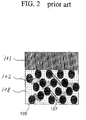
- FIG. 2 is a cross sectional elevation view illustrative of a conventional structure of the positive electrode on the positive collector.
- a positive- electrode 102 is provided on a positive collector 101.
- the positive electrode 102 comprises a positive electrode active material 106 and an electrically conductive material 107 as well as an electrolyte solution 108 into which the positive electrode active material 106 and the electrically conductive material 107 are immersed.
- a carbon black is available for the electrically conductive material 107.
- the positive electrode active material 106 comprises such a polymer that only absorption and desorption of proton contribute to an oxidation-reduction reaction.
- the positive electrode active material 106 is doped with a dopant for allowing the polymer of the positive electrode active material 106 to exhibit an electrical conductivity. Both organic compounds and inorganic compounds are available for the dopant to be doped into the positive electrode active material 106. The kinds of the available dopants are unlimited unless the doping is difficult. Solutions and non-solutions containing proton source materials are available for the electrolyte solution 108.
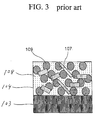
- FIG. 3 is a cross sectional elevation view illustrative of a conventional structure of the negative electrode on the negative collector.
- a negative electrode 104 is provided on a positive collector 101.
- the positive electrode 102 comprises a negative electrode active material 109 and an electrically conductive material 107 as well as an electrolyte solution 108 into which the negative electrode active material 109 and the electrically conductive material 107 are immersed.
- a carbon black is available for the electrically conductive material 107.
- the negative electrode active material 109 comprises such a polymer that only absorption and desorption of proton contribute to an oxidation-reduction reaction.
- the negative electrode active material 109 is doped with a dopant for allowing the polymer of the negative electrode active material 109 to exhibit an electrical conductivity.
- Both organic compounds and inorganic compounds are available for the dopant to be doped into the negative electrode active material 109.
- the kinds of the available dopants are unlimited unless the doping is difficult.
- Solutions and non-solutions containing proton source materials are available for the electrolyte solution 108.
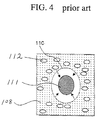
- FIG. 4 is a cross sectional elevation view illustrative of an elution of the negative electrode active material into the electrolytic solution in the conventional battery.
- the first present invention provides a positive electrode active material doped with a dopant comprising an anion having the same or similar molecular structure to a polymer matrix of at least one of a solid electrolyte and a gel solid electrolyte.
- the first present invention provides a positive electrode active material doped with a dopant comprising an anion having the same or similar molecular structure to a polymer matrix of at least one of a solid electrolyte and a gel solid electrolyte.
- the polymer matrix comprises one selected from the group consisting of poly-styrene-divinylbenzene and derivatives thereof, copolymers of sulfonated vinylethersulfonyl fluoride and tetrafluoroethylene and derivatives thereof, a polystyrenesulfonic acid and derivatives thereof, and a poly-2-acrylamide-2-methylpropanesulfonic acid and derivatives thereof.
- the dopant comprises one anion selected from the group consisting of poly-styrene-divinylbenzene and derivatives thereof, copolymers of sulfonated vinylethersulfonyl fluoride and tetrafluoroethylene and derivatives thereof, a polystyrenesulfonic acid and derivatives thereof, and a poly-2-acrylamide-2-methylpropanesulfonic acid and derivatives thereof.
- the positive electrode active material comprises a ⁇ -conjugated polymer including nitrogen atom.
- the ⁇ -conjugated polymer including nitrogen atom comprises one of polyaniline and derivatives thereof.
- the ⁇ -conjugated polymer including nitrogen atom comprises one of polyindole and derivatives thereof.
- the ⁇ -conjugated polymer including nitrogen atom comprises one of polymers having amino group and derivatives thereof.
- the positive electrode active material comprises a compound including nitrogen atom and having a quinoid structure.
- the compound including nitrogen atom and having a quinoid structure comprises a polymer having an aromatic ring in which at least a nitrogen atom is present.
- the polymer having the aromatic ring comprises a polymer selected from the group consisting of polypyrrole, polypyridine, polypyrimidine, and derivatives thereof.
- the positive electrode active material comprises a polymer compound having a hydroxyl group.
- the polymer compound having a hydroxyl group comprises a quinone compound derivative.
- the quinone compound derivative comprises one selected from anthraquinone derivatives and benzoquinone derivatives.
- the positive electrode active material comprises one selected from the group consisting of polyaniline, polyindole, nitropolyaniline and polydiaminoanthraquinone.
- the above novel positive electrode active material of the first present invention is applicable to a positive electrode comprising an electrolyte in one of a solid state consisting of a polymer matrix and a gel solid state consisting of the polymer matrix immersed with a solution ; a conductive material in the solid electrolyte ; and the positive electrode active material in the electrolyte.
- the above positive electrode is applicable to a proton conductive polymer battery comprising : a negative electrode on a negative collector ; and a positive electrode on a positive collector and the positive electrode and the negative electrode being separated by a separator, wherein the positive electrode has a structure of the above positive electrode.
- the positive electrode active material of the positive electrode comprises one selected from the group consisting of polyaniline, polyindole, nitropolyaniline and polydiaminoanthraquinone, and a negative electrode active material of the negative material comprises one selected from the group consisting of polypyridine and polypyrimidine.
- the second present invention provides a positive electrode active material doped with a dopant comprising an anion providing the positive electrode active material with a high chemical affinity to a polymer matrix of at least one of a solid electrolyte and a gel solid electrolyte.
- the above positive electrode active material of the second present invention is applicable to a positive electrode which comprises : an electrolyte in one of a solid state consisting of a polymer matrix and a gel solid state consisting of the polymer matrix immersed with a solution ; a conductive material in the solid electrolyte ; and the positive electrode active material in the electrolyte.
- the above positive electrode is also applicable to a proton conductive polymer battery comprising : a negative electrode on a negative collector ; and the positive electrode on a positive collector and the positive electrode and the negative electrode being separated by a separator.
- a positive electrode active material is doped with a dopant comprising an anion having a high chemical affinity to a polymer matrix of one of a solid electrolyte and a gel solid electrolyte.
- the positive electrode active material is applicable to the following proton conductive polymer battery.
- the polymers to be used for the positive and negative electrode active materials of the battery are selected from the group consisting of ⁇ -conjugated polymers including nitrogen atom, compounds including nitrogen atom and having the quinoid structure, polymer compounds having hydroxyl group, in consideration of a difference in oxidation-reduction potential between the positive electrode active martial and the negative electrode active material.
- the nitrogen atom containing ⁇ -conjugated polymer may comprise one selected from the group consisting of polyaniline and derivatives thereof, polyindole and derivatives thereof, and polymers having amino group and derivatives thereof
- the positive electrode active material comprises a compound including nitrogen atom and having a quinoid structure.
- the compound including nitrogen atom and having a quinoid structure may comprise a polymer having an aromatic ring in which at least a nitrogen atom is present.
- This polymer having the aromatic ring may comprise a polymer selected from the group consisting of polypyrrole, polypyridine, polypyrimidine, and derivatives thereof.
- the positive electrode active material may comprise a polymer compound having a hydroxyl group.
- This polymer compound having a hydroxyl group may comprise a quinone compound derivative.
- This quinone compound derivative may comprise one selected from anthraquinone derivatives and benzoquinone derivatives.
- the positive electrode active material comprises one selected from the group consisting of polyaniline, polyindole, nitropolyaniline and polydiaminoanthraquinone.
- the proton conductive polymer battery utilizes an electrical energy caused by electron transfers in oxidation-reduction reactions of the positive electrode active martial and the negative electrode active material, wherein only proton bonded with or absorbed with nitrogen atom of the positive and negative electrode material contributes to the electron transfers or only proton of hydroxyl group in conjugation in the case of the quinine compounds.
- the above positive and negative electrodes comprises the positive and negative electrode materials and the conductive material as well as the electrolyte in which the positive and negative electrode materials and the conductive material are immersed.
- the electrolyte is in a solid state or a gel solid state.
- the solid state electrolyte comprises a matrix like structure of polymers or a polymer matrix.
- the gel solid state electrolyte comprises a matrix like structure of polymers or a polymer matrix immersed in a solution such as an electrolyte solution.
- the polymer matrix comprises a substance which has a large chemical affinity with the positive electrode active material or has the same or similar molecular structure to an anion as a dopant as doped into the positive electrode active material.
- the polymer matrix may comprise a proton containing compound having a proton conductivity, for example, poly-styrene-divinylbenzene and derivatives thereof, copolymers of sulfonated vinylethersulfonyl fluoride and tetrafluoroethylene and derivatives thereof, a polystyrenesulfonic acid and derivatives thereof, and a poly-2-acrylamide-2-methylpropanesulfonic acid and derivatives thereof.
- a proton containing compound having a proton conductivity for example, poly-styrene-divinylbenzene and derivatives thereof, copolymers of sulfonated vinylethersulfonyl fluoride and tetrafluoroethylene and derivatives thereof, a polystyrenesulfonic acid and derivatives thereof, and a poly-2-acrylamide-2-methylpropanesulfonic acid and derivatives thereof.
- One of the commercially available copolymers is, for example, a
- a proton source material for example, inorganic acids such as sulfuric acid, or organic acids such as polyvinyl sulfonic acid.
- a proton source material for example, inorganic acids such as sulfuric acid, or organic acids such as polyvinyl sulfonic acid.
- other salts for increasing the conductivity for example, quaternary ammonium salts.
- the available proton source materials and salts to be added into the solid state electrolyte are not limited into particular substances but may, for example, be aqueous and non-aqueous solutions of acids such as a benzenesulfonic acid, a paratoluenesulfonic acid, benzenesulfonyl chloride, a dodecylbenzenesulfonic acid, a trifluoromethanesulfonic acid, a trifluoroacetic acid, a polyvinylsulfonic acid, a methanesulfonic acid, a trifluoromethanesulfonic acid, a 1-butanesulfonic acid, a 2,3,5-trichlorobenzenesulfonic acid, and a vinylphenylsulfonic acid.
- acids such as a benzenesulfonic acid, a paratoluenesulfonic acid, benzenesulfonyl chloride, a do
- the increase in concentration of proton allows increase in output power of the polymer battery.
- the increase in concentration of proton causes a problem in elation of the negative electrode active material. This elution deteriorates a cyclic property of the polymer battery. It is necessary to select the solid state electrolyte or gel solid state electrolyte in accordance with the use of the polymer battery.
- the dopant to be doped into the positive electrode active material comprises the anion which has the same or similar molecular structure to the polymer matrix of the solid state electrolyte or the gel solid state electrolyte, wherein the anion may correspond to such a substance that proton is excluded from the polymer matrix constituting the solid state electrolyte, whereby doping the positive electrode active material with the above dopant provides the positive electrode active material with a high affinity to the polymer matrix of the solid state electrolyte or the gel solid state electrolyte.
- the term "similar molecular structure” means, for example, to have the same functional group such as sulfonic group.
- the available doping rate, at which the above novel dopant is doped into the positive electrode active material is, for example, not less than 30% and more preferably not less than 50%.
- the above novel polymer battery in accordance with the present invention may be formed as follows, wherein polyaniline is the positive electrode active material, the copolymer is the dopant to be doped into the positive electrode active material, and polypyridine is the negative electrode active material.
- the positive electrode may be formed as follows. Undoped polyaniline powders are produced by a chemical polymerization. An alcohol solution of a copolymer resin is then added into the undoped polyaniline powders and optionally heated for doping the copolymer into the polyaniline powders. The doped polyaniline powders are further added with a conductive material such as carbon powders and a binder resin as well as an appropriate solvent for mixing the same to form a slurry. This slurry is applied on a collector by a screen-printing method and then dried to form a thin film having a predetermined thickness on the collector, whereby the positive electrode is formed.
- a conductive material such as carbon powders and a binder resin
- the following processes for the positive electrode are also available.
- the undoped polyaniline powders are added with the conductive material such as carbon powders and the binder resin as well as the suitable solvent for subsequent mixing the same to form the slurry.
- This slurry is coated on the collector thereby forming the positive electrode.
- This positive electrode is further vacuum-impregnated with above dopant-containing solution before a solvent is removed from the positive electrode whereby the dopant is doped into the positive electrode active material.
- the negative electrode may be formed as follows. Polypyridine powders are produced by a chemical polymerization. The undoped polypyridine powders are then added with the conductive material such as the carbon powders and the binder resin as well as the suitable solvent for mixing the same to form a slurry. This slurry is then coated on the negative electrode collector by a suitable coating method such as a screen-printing method.
- the positive and negative electrodes may optionally be subjected to an activation process for activating the positive and negative electrode active materials by applying a positive potential to the positive electrode active material and also applying a negative electrode to the negative electrode, before the positive and negative electrodes are combined through a separator.
- the positive and negative electrodes mainly include the positive and negative electrodes, for example, at not less than 40%, and more preferably not less than 80%.
- the positive electrode may be formed by the electrolytic polymerization in a solution containing the above novel dopant, whereby the positive electrode material is doped with the dopant. If the use of only the positive electrode active material is sufficient to obtain the required conductivity and the formability of the electrode, the conductive material and the binder resin are not essential.
- the collectors already known are available, which are made of a polymer distributed with conductive materials such as platinum and carbon black or made of a glass carbon.
- Solid state electrolyte layers are laminated on the positive and negative electrodes before the positive and negative electrodes are placed to sandwich a separator for subsequent heat treatment and pressure application so as to cause an osmosis of the solid electrolyte into the positive and negative electrode active materials, whereby the positive and negative electrodes are securely combined and the polymer battery is complicated.
- the separator may comprise an electrically insulating porous film such as a ceramic film, a glass film and various resin films.
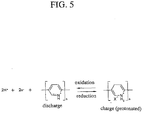
- the polymer battery has charge/discharge mechanisms shown in FIG. 5.
- This nitrogen containing quinoid compound shows a protonation of nitrogen which is protonated with the anion in the electrolyte.
- the compound becomes soluble with the solution as the conventional battery, an elution may be caused of the active material or the nitrogen containing quinoid compound from the electrode over time.
- the amount of the active material in the electrode is reduced thereby the characteristic of the battery is deteriorated.
- the capacity of the battery is reduced for every charge discharge cycles and also reduced by a spontaneous discharge in placing the battery.
- the solid state electrolyte in place of the liquid state electrolyte, then the compound is even protonated, whereby the solubility is zero or very low, for which reason the cyclic properties and the spontaneous discharge properties are improved.
- FIG. 6 is a diagram illustrative of differences current-voltage characteristics over cycles in a cyclic voltanometory measurement to the polypyridine as one kind of the nitrogen containing quinoid compounds in an electrolytic solution, for example, polyvinylsulfonic acid solution.
- an electrolytic solution for example, polyvinylsulfonic acid solution.
- the polypyridine is formed on the electrode, before a nafion® layer as the proton conductive solid state electrolyte is then formed so that the polypyridine is separated by the nafion® layer from the electrolytic solution.
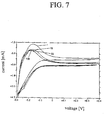
- FIG. 7 is a diagram illustrative of differences current-voltage characteristics over cycles in a cyclic voltanometory measurement to the polypyridine as one kind of the nitrogen containing quinoid compounds in an electrolytic solution, for example, polyvinylsulfonic acid solution.
- an electrolytic solution for example, polyvinylsulfonic acid solution.
- the polypyridine is formed on the electrode but no nation® layer as the proton conductive solid state electrolyte is then formed so that the polypyridine is in contact with the electrolytic solution.
- the solid state electrolyte When the solid state electrolyte is used, this results in a large contact resistance between the electrode and the solid state electrolyte as compared to when the electrolyte solution is used because a contact area between the solid state electrode and the solid state electrolyte is smaller than a contact area between the solid state electrode and the liquid state electrolyte.
- the electrode active material shows an ion-exchange directly to the solid state electrolyte, for which reason a sufficiently large contact area between the electrode and the electrolyte is important.
- the contact area between the electrode and the electrolyte is small and the contact resistance is high, this means that an internal impedance of the battery is high. This means it difficult to carry out high speed charge or discharge operations.
- the positive electrode active material is doped with the anion having the same or similar molecular structure to the polymer matrix of the solid state electrolyte so as to provide the positive electrode active material with an affinity to the solid state electrolyte, whereby the contact resistance between the positive electrode active material and the solid state electrolyte is reduced.
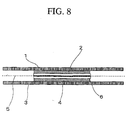
- FIG. 8 is a cross sectional elevation view illustrative of a novel polymer battery, wherein a positive electrode active material is a polyaniline doped with nafion®, herein after referred to as a doped polyaniline, whilst a negative electrode active material is polypyridine.
- a positive electrode active material is a polyaniline doped with nafion®, herein after referred to as a doped polyaniline
- a negative electrode active material is polypyridine.
- Each of the positive and negative electrode active materials is in a form of a thin film having a thickness of 50 micrometers.
- Those positive and negative electrode active materials are formed on conductive films as collectors 1 and 3.
- the solid state electrolyte films of nafion® are provided on the positive and negative electrode active materials.
- the positive and negative electrodes are combined through a separator 5 which comprises a porous film which is electrically insulative and has an ion-permeability and a
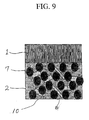
- FIG. 9 is a fragmentary cross sectional elevation view illustrative of a positive electrode of the battery.
- the positive electrode 2 is provided on the positive electrode collector 1.
- the positive electrode comprises a positive electrode active material 7, a conductive material 8, and a solid state electrolyte 10 in which the positive electrode active material 7 and the conductive material 8 are immersed.
- the positive electrode active material 7 is doped with a novel dopant.
- FIG. 10 is a fragmentary cross sectional elevation view illustrative of a negative electrode of the battery.
- the negative electrode 4 is provided on the negative electrode collector 3.
- the negative electrode comprises a negative electrode active material 9, a conductive material 8, and a solid state electrolyte 10 in which the negative electrode active material 9 and the conductive material 8 are immersed.
- the above battery is formed by three steps, preparation of electrodes, pre-treatments and assembling the battery.
- the positive and negative electrodes are formed as follows.
- the positive electrode active material 7 is the nafion® doped polyaniline.
- Undoped polyaniline powders are prepared by a chemical polymerization. The undoped polyaniline powders are then added with a alcohol solution including nafion® at a concentration of 5% for subsequent placing the undoped polyaniline powders at 70°C for 6 hours whereby the nafion® is doped into the polyaniline. The nafion® doped polyaniline powders are then cleaned and dried to obtain the positive electrode active material 7 doped with nafion® at 34%.
- 80 wt% of the nafion® doped polyaniline powders, 5 wt% of carbon powders as the conductive material and 15 wt% of polyvinylidene fluoride as a binder are added with a DMF solvent and mixed therewith to form a slurry.
- This slurry is then coated on the positive electrode collector 1 by a screen-printing method and then heated at 120°C for 30 minutes to dry the same, thereby to form a positive electrode of 2 ⁇ 2 cm 2 .
- the negative electrode active material 9 is polypyridine.
- Polypyridine powders are prepared by a chemical polymerization. 80 wt% of the polypyridine powders, 5 wt% of carbon powders as the conductive material and 15 wt% of polyvinylidene fluoride as a binder are added with a DMF solvent and mixed therewith to form a slurry. This slurry is then coated on the negative electrode collector 3 by a screen-printing method and then heated at 120°C for 30 minutes to dry the same, thereby to form a negative electrode of 2 ⁇ 2 cm 2 . Nafion® containing alcohol solution is dropped onto a glass plate to form two of a nafion® film having a thickness of 50 micrometers as the solid state electrolyte.
- the pre-treatment to the electrode active materials are carried as follows.
- FIG. 11 is a schematic view illustrative of a measurement cell to be used for electrochemical characteristics of the electrode active materials.
- 1 mol-PVSA solution 14 is used.
- a reference electrode 11 comprises a silver/silver chloride electrode.
- a working electrode 12 comprises a nafion® doped polyaniline electrode.
- An opposite electrode 13 comprises a platinum wire.
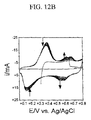
- FIGS. 12A and 12B are diagrams illustrative of cyclic voltamograms of the nafion® doped polyaniline electrode measured by the measurement cell of FIG. 11.
- a natural potential of the doped polyaniline electrode 12 is measured.
- the measured natural potential is about +0.35 V.
- the potential is swept from the natural potential up to +0.5V in oxidation side at a rate of 10 mV/sec., and subsequently the potential is swept up to +0.05 in the reduction side before the potential is again swept in the oxidation side.
- This potential sweeping operations are repeated in the range of +0.05V to +0.5V whereby the cyclic voltamogram of FIG. 12A is obtained.
- the potential is swept from the natural potential up to +0.8V in oxidation side at a rate of 10 mV/sec., and subsequently the potential is swept up to +0.05 in the reduction side before the potential is again swept in the oxidation side.
- This potential sweeping operations are repeated in the range of +0.05V to +0.8V whereby the cyclic voltamogram of FIG. 12B is obtained.
- FIG. 12B the reduction in the reduction side potential peak current by repeating the weeping operations is confirmed, wherein arrow marks show the reduction. This means that the oxidation-reduction reaction caused by a voltage of not less than +0.5V is irreversible reaction whereby the property of polyaniline is deteriorated.
- the oxidation peak in the vicinity of +0.4V is used for charge to the positive electrode whilst the reduction peak in the vicinity of +0.1V is used as the charge to the negative electrode. Since this active material has the natural potential of +0.35 V, the commencement of charge from the natural potential may cause application of such a voltage to the positive electrode as to cause the irreversible reaction. Similarly to the polyaniline of the positive electrode, the negative electrode is also subjected to the potential sweeping operations in the range of -0.3V to +0.4V thereby the cyclic voltamograms of FIGS. 6 and 7 being obtained.
- the battery is assembled as follows.
- the above positive and negative electrodes are placed to sandwich the separator 9 for application of a pressure of 10 kg/cm 3 for 10 minutes at 100°C, whereby the solid electrolyte 10 is immersed into the positive and negative electrodes. As a result, the solid state electrolyte is made into contact with the positive electrode active material and the negative electrode active material.
- FIG. 13 is a view illustrative of charge discharge mechanisms of the battery having the positive electrode active material made of the nafion® doped polyaniline.
- the oxidation reaction of polyaniline extracts electrons from the nitrogen atoms of the polyaniline, whereby protons bonded or coordinated with the nitrogen atoms are eliminated and released to the electrolytic solution, whereby the aromatic structure of the polyaniline is changed o the quinoid structure.
- This oxidation reaction is the charge mechanism of the positive electrode active material.
- the reduction reaction of the polyaniline causes that the polyaniline receives electrons from the positive electrode collector, whereby protons in the electrolytic solution are absorbed to nitrogen atoms of the polyaniline, so that the quinoid structure of the polyaniline is changed to the aromatic structure.
- This reduction reaction is the discharge mechanism of the positive electrode active material.
- the polyaniline in the aromatic structure is electrically insulative. However, the polyaniline is changed from the aromatic structure to the quinoid structure, this quinoid structured polyaniline shows the electron conductivity. Further oxidation of the polyaniline causes the anion in the electrolytic solution to be doped into the polyaniline whereby the polyaniline is again changed or returned to the electrically insulative state. However, as described above, this oxidation reaction in the solution is irreversible, for which reason if the second oxidation-reduction reaction is utilized, no desirable cyclic characteristics are obtainable.
- the present invention does never utilize the irreversible second oxidation-reduction reaction but does utilize the reversible first oxidation reduction reaction, or the charge discharge mechanisms by absorption and desorption of proton with electron transfers of the active material.
- FIG. 5 shows the oxidation reduction reaction mechanisms of the negative electrode.
- the nitrogen atoms of the polypyridine of the negative electrode active material is protonated. This reduction reaction is the charge mechanism of the negative electrode.
- the oxidation reaction is caused by elimination of proton from the protonated nitrogen atoms in the polypyridine. This oxidation reaction is the discharge mechanism of the negative electrode.
- the polypyridine in oxidized state is insoluble with the acid solution.
- the protonated polypyridine in reduced state is soluble with the acid solution.
- the electrolyte comprises an acid solution, cyclic charge discharge operations causes dissolution of the active material into the electrolytic solution, resulting in a deterioration in the cyclic characteristics of the battery.
- the electrolyte is the solid state to prevent dissolution of the protonated polypyridine.
- the oxidation reduction reactions are caused by proton which is transferred from the electrolyte in contact directly with the electrode active material, for which reason it is very important to reduce the contact resistance between the electrode active material and the electrolyte.
- the nafion® as the polymer matrix of the solid state electrolyte is also used as a dopant to be doped into the positive electrode active material, whereby the dopant is united with the electrolyte resulting in a reduction of the contact resistance between the positive electrode active material and the solid state electrolyte.
- the cyclic characteristics of the discharge capacity are measured.
- the battery is charged at 0.9V for 30 minutes for subsequent discontinuation of charging operation for 5 minutes before the battery is discharged at 0.1C to drop the voltage to 0.6V.
- Those charge and discharge operations are set as one cycle.
- the discharge capacities for every cycles are measured. As a result, after 12000 cycles of the charge discharge operations, the discharge capacity is reduced to 80% of the initial discharge capacity.
- the power characteristic of the battery is then measured.
- the battery is charged at 0.9V for 30 minutes for subsequent discontinuation of charging operation for 5 minutes before the battery is discharged under various conditions of 0.01C, 0.1C, 0.5C, 1C, and 10C.
- the measured discharge capacity in the discharge at 1C is 80% of the measured discharge capacity in the discharge at 0.1C.
- the measured discharge capacity in the discharge at 0.5C is 87% of the measured discharge capacity in the discharge at 0.1C.
- the direct current internal impedance of the battery is measured.
- the measured direct current internal impedance of the battery is 7 milliohms.
- a second embodiment according to the present invention will be described.
- a structural difference of the battery of this embodiment from the first embodiment is only in the use of polypyrimidine for the negative electrode active material in place of polypyridine.
- the remaining structures are the same as the first embodiment.
- An operational difference of the battery of this embodiment from the first embodiment is only in application of a charge voltage of 0.75V because the negative electrode reaction potential of polypyrimidine is higher by about 0.15V in oxidation side than polypyridine.
- a third embodiment according to the present invention will be described.
- a structural difference of the battery of this embodiment from the first embodiment is only in including trifluoroacetic acid (CF 3 COOH) as proton source material into the nafion® as the solid state electrolyte.
- the trifluoroacetic acid (CF 3 COOH) included in the solid state electrolyte is in contact with the negative electrode active material, for which reason the elation reaction of the negative electrode active material is suppressed whereby the deterioration in the cyclic characteristics of the battery is small.
- the CF 3 COOH is included in the solid state electrolyte, the proton concentration of the solid state electrolyte is large, whereby the battery power or the discharge capacity ratio is larger than that of the first embodiment. Addition of the CF 3 COOH in the solid state electrolyte allows the enlargement in power of the battery even the cyclic characteristics are slightly deteriorated.
- a paratoluenesulfonic acid solution or CF 3 COOH-propylene carbonate solution including proton source materials may be included into the electrolyte in order to obtain the same effects.
- a fourth embodiment according to the present invention will be described.
- a difference of this embodiment from the first embodiment is only in the doping method of doping nafion® into the positive electrode active material.
- the positive electrode is prepared and then vacuum-impregnated with a nafion® containing alcohol solution before a alcohol is removed from the positive electrode whereby the nafion® as dopant is doped into the positive electrode active material, whereby an adhesion between the positive electrode active material and the solid state electrolyte is improved.
- a fifth embodiment according to the present invention will be described.
- a structural difference of the battery of this embodiment from the first embodiment is only in the use of nitropolyaniline as the positive electrode active material.
- the remaining structures are the same as the first embodiment.
- the negative electrode reaction potential of nitropolyaniline is higher by about +0.15V in oxidation side than polyaniline.
- a sixth embodiment according to the present invention will be described.
- a structural difference of the battery of this embodiment from the first embodiment is only in the use of polydiaminoanthraquinone as the positive electrode active material.
- the remaining structures are the same as the first embodiment.
- the negative electrode reaction potential of polydiaminoanthraquinone is higher by about +0.2V in oxidation side than polyaniline.
- a seventh embodiment according to the present invention will be described.
- a structural difference of the battery of this embodiment from the first embodiment is only in the use of polystyrenesulfonic acid as the solid state electrolyte and also use of anion of polystyrenesulfonic acid as the dopant to be doped into the positive electrode active material.
- the remaining structures are the same as the first embodiment.
- a first comparative embodiment will be described.
- a structural difference of the battery of this first comparative embodiment from the first embodiment is only in use of paratoluenesulfonic acid as a supporting salt of the electrolytic solution in place of the nafion® solid state electrolyte.
- the polyaniline positive electrode and the polypyridine negative electrode are placed in the 3 mol paratoluenesulfonic acid solution to sandwich the separator thereby forming the battery.
- An operational difference of this the battery of this first comparative embodiment from the first embodiment is only in movement of proton through the paratoluenesulfonic acid solution.
- the electrolytic solution is directly contact with the negative electrode, for which reason in the charged state or the protonated state, an elution of polypyridine of the negative electrode active material into the electrolytic solution may be caused, resulting in a deterioration of the cyclic characteristics of the battery.
- a second comparative embodiment will be described.
- a structural difference of the battery of this second comparative embodiment from the first embodiment is only in use of nafion® as the solid state electrolyte and PVSA as the dopant to be doped into the positive electrode active material.
- the negative electrode is in contact with the solid state electrolyte, for which reason the elution of polypyridine is suppressed.
- the dopant of the positive electrode active material is different from the solid state electrolyte, for which reason a contact resistance between the positive electrode and the solid state electrolyte is large, whereby the internal impedance of the battery is also large and the power characteristic is also deteriorated.
- a third comparative embodiment will be described.
- a structural difference of the battery of this third comparative embodiment from the first embodiment is only in use of both nafion® as the solid state electrolyte and PVSA as the electrolytic solution.
- the positive electrode and the negative electrode are prepared in the same manners as in the first embodiment. Only the negative electrode is compression-bonded with the nafion® layer and the positive and negative electrodes are placed to sandwich the separator in the 3 mol PVSA solution.
- the negative electrode is in contact with the solid state electrolyte whereby the elution of polypyridine is suppressed, but a micro-defective portion of the nafion® layer may be formed through which the electrolytic solution is immersed into the negative electrode whereby the polypyridine of the negative electrode may be eluted over time.
- the cyclic characteristics are gradually deteriorated.
- the positive electrode is in contact with the electrolytic solution, for which reason proton is easily transferable between the positive electrode active material and the electrolytic solution. Since, however, the PVSA solution is included as the electrolytic solution, the leakage of the solution and dry up of the electrolytic solution are caused thereby the reliability is deteriorated. Number of cycle discharge capacity ratio internal impedance Ex.
Landscapes
- Chemical & Material Sciences (AREA)
- Chemical Kinetics & Catalysis (AREA)
- Electrochemistry (AREA)
- General Chemical & Material Sciences (AREA)
- Battery Electrode And Active Subsutance (AREA)
- Secondary Cells (AREA)
Applications Claiming Priority (2)
| Application Number | Priority Date | Filing Date | Title |
|---|---|---|---|
| JP9151998 | 1998-04-03 | ||
| JP10091519A JP2943792B1 (ja) | 1998-04-03 | 1998-04-03 | プロトン伝導型ポリマー電池およびその製造方法 |
Publications (1)
| Publication Number | Publication Date |
|---|---|
| EP0966054A1 true EP0966054A1 (de) | 1999-12-22 |
Family
ID=14028672
Family Applications (1)
| Application Number | Title | Priority Date | Filing Date |
|---|---|---|---|
| EP99106813A Withdrawn EP0966054A1 (de) | 1998-04-03 | 1999-04-06 | Protonleitendepolymer-Batterie und Herstellungsverfahren |
Country Status (3)
| Country | Link |
|---|---|
| US (1) | US6300015B1 (de) |
| EP (1) | EP0966054A1 (de) |
| JP (1) | JP2943792B1 (de) |
Cited By (3)
| Publication number | Priority date | Publication date | Assignee | Title |
|---|---|---|---|---|
| KR100413360B1 (ko) * | 2000-11-13 | 2004-01-03 | 엔이씨 도낀 가부시끼가이샤 | 프로톤 전도성 폴리머의 2차 전지 |
| US6899974B2 (en) | 2000-11-02 | 2005-05-31 | Nec Tokin Corporation | Secondary battery of proton conductive polymer |
| CN104781967A (zh) * | 2012-11-13 | 2015-07-15 | 日东电工株式会社 | 活性物质颗粒、蓄电装置用正极、蓄电装置以及活性物质颗粒的制造方法 |
Families Citing this family (28)
| Publication number | Priority date | Publication date | Assignee | Title |
|---|---|---|---|---|
| JP3471304B2 (ja) | 2000-09-18 | 2003-12-02 | Necトーキン株式会社 | インドール系化合物を用いた二次電池及びキャパシタ |
| JP4036279B2 (ja) * | 2001-10-09 | 2008-01-23 | よこはまティーエルオー株式会社 | プロトン伝導体及びこれを用いた燃料電池 |
| JP4812248B2 (ja) * | 2003-01-22 | 2011-11-09 | 日東電工株式会社 | 燃料電池 |
| JPWO2004070750A1 (ja) * | 2003-02-10 | 2006-05-25 | Tdk株式会社 | 固体電解コンデンサ及びその製造方法 |
| KR100540701B1 (ko) * | 2003-04-22 | 2006-01-11 | 엔이씨 도낀 가부시끼가이샤 | 전기 화학 셀 |
| KR100599677B1 (ko) * | 2003-10-31 | 2006-07-13 | 삼성에스디아이 주식회사 | 연료전지의 고분자 전해질막용 술폰화 폴리스티렌의제조방법 |
| JP2006049387A (ja) * | 2004-07-30 | 2006-02-16 | Nippon Chemicon Corp | 電気化学キャパシタ |
| JP2006049386A (ja) * | 2004-07-30 | 2006-02-16 | Nippon Chemicon Corp | 電気二重層キャパシタ |
| JP2006048974A (ja) * | 2004-07-30 | 2006-02-16 | Nippon Chemicon Corp | 電気化学素子用電極材料 |
| US7324329B2 (en) * | 2005-12-22 | 2008-01-29 | Giner, Inc. | Electrochemical-electrolytic capacitor and method of making the same |
| JPWO2008018410A1 (ja) * | 2006-08-07 | 2009-12-24 | 三菱瓦斯化学株式会社 | 燃料電池用電極およびその製造方法、並びに燃料電池 |
| WO2008092024A1 (en) * | 2007-01-24 | 2008-07-31 | Treadstone Technologies, Inc. | Electrochemical processor for hydrogen processing and power generation |
| JP5211623B2 (ja) * | 2007-10-05 | 2013-06-12 | 株式会社豊田中央研究所 | 蓄電デバイス |
| US20110059232A1 (en) * | 2009-09-07 | 2011-03-10 | Samsung Electro-Mechanics Co., Ltd. | Method for forming transparent organic electrode |
| EP2309572A1 (de) | 2009-10-06 | 2011-04-13 | Silver H-Plus Technology Co., Ltd. | Kunststoffelektrodenmaterial und Sekundärzelle damit |
| WO2014164150A1 (en) | 2013-03-11 | 2014-10-09 | Fluidic, Inc. | Integrable redox-active polymer batteries |
| US9269998B2 (en) | 2013-03-13 | 2016-02-23 | Fluidic, Inc. | Concave gas vent for electrochemical cell |
| WO2015106132A1 (en) | 2014-01-10 | 2015-07-16 | Arizona Board Of Regents On Behalf Of Arizona State University | Redox active polymer devices and methods of using and manufacturing the same |
| WO2015175556A1 (en) | 2014-05-13 | 2015-11-19 | Arizona Board Of Regents On Behalf Of Arizona State University | Redox active polymer devices and methods of using and manufacturing the same |
| WO2015175553A1 (en) | 2014-05-13 | 2015-11-19 | Arizona Board Of Regents On Behalf Of Arizona State University | Electrochemical energy storage devices comprising self-compensating polymers |
| KR20180100320A (ko) | 2016-01-07 | 2018-09-10 | 엔바으르 에네르즈 테크놀로즐레르 아. 스. | 리튬 배터리에서의 전도성 및 가요성 중합체의 사용 |
| US11228066B2 (en) | 2016-07-22 | 2022-01-18 | Form Energy, Inc. | Mist elimination system for electrochemical cells |
| JP2019521497A (ja) | 2016-07-22 | 2019-07-25 | ナントエナジー,インク. | 電気化学セル内の水分及び二酸化炭素管理システム |
| US10923723B1 (en) | 2017-05-11 | 2021-02-16 | Richard Carl Auchterlonie | Electro-conductive polymers of halogenated para-aminophenol, and electrochemical cells employing same |
| CN119481486A (zh) | 2018-06-29 | 2025-02-18 | 福恩能源公司 | 滚动膜片密封件 |
| CN112805868A (zh) | 2018-06-29 | 2021-05-14 | 福恩能源公司 | 金属空气电化学电池构架 |
| CN114207915A (zh) | 2019-06-28 | 2022-03-18 | 福恩能源公司 | 金属-空气电池组的设备架构 |
| WO2021226399A1 (en) | 2020-05-06 | 2021-11-11 | Form Energy, Inc. | Decoupled electrode electrochemical energy storage system |
Citations (3)
| Publication number | Priority date | Publication date | Assignee | Title |
|---|---|---|---|---|
| GB2124635A (en) | 1982-08-02 | 1984-02-22 | Raychem Ltd | Polymer composition |
| EP0108954A1 (de) * | 1982-10-20 | 1984-05-23 | Hitachi, Ltd. | Flache, in Schichten aufgebaute Polymer-Sekundärbatterie |
| US5002700A (en) * | 1988-08-30 | 1991-03-26 | Osaka Gas Company Limited | Permanently doped polyaniline and method thereof |
Family Cites Families (7)
| Publication number | Priority date | Publication date | Assignee | Title |
|---|---|---|---|---|
| US5023149A (en) * | 1984-06-14 | 1991-06-11 | University Patents, Inc. | Electrochemistry employing polyaniline |
| US4801195A (en) * | 1985-01-29 | 1989-01-31 | Nissan Motor Co., Ltd. | Variable light transmittance glass board functional as electrochromic cell |
| JP2765462B2 (ja) * | 1993-07-27 | 1998-06-18 | 日本電気株式会社 | 固体電解コンデンサおよびその製造方法 |
| DE69400568T2 (de) * | 1993-11-26 | 1997-02-20 | Nippon Electric Co | Herstellungsverfahren von einem Festelektrolytkondensator |
| US5756230A (en) * | 1996-06-20 | 1998-05-26 | Valence Technology, Inc. | Fluoropolymer blends for polymeric electrolyte and electrodes |
| JP2919371B2 (ja) * | 1996-08-16 | 1999-07-12 | 富山日本電気株式会社 | 固体電解コンデンサ及びその製造方法 |
| JP3111945B2 (ja) * | 1997-10-23 | 2000-11-27 | 日本電気株式会社 | ポリマー二次電池 |
-
1998
- 1998-04-03 JP JP10091519A patent/JP2943792B1/ja not_active Expired - Lifetime
-
1999
- 1999-04-05 US US09/285,795 patent/US6300015B1/en not_active Expired - Lifetime
- 1999-04-06 EP EP99106813A patent/EP0966054A1/de not_active Withdrawn
Patent Citations (3)
| Publication number | Priority date | Publication date | Assignee | Title |
|---|---|---|---|---|
| GB2124635A (en) | 1982-08-02 | 1984-02-22 | Raychem Ltd | Polymer composition |
| EP0108954A1 (de) * | 1982-10-20 | 1984-05-23 | Hitachi, Ltd. | Flache, in Schichten aufgebaute Polymer-Sekundärbatterie |
| US5002700A (en) * | 1988-08-30 | 1991-03-26 | Osaka Gas Company Limited | Permanently doped polyaniline and method thereof |
Cited By (8)
| Publication number | Priority date | Publication date | Assignee | Title |
|---|---|---|---|---|
| US6899974B2 (en) | 2000-11-02 | 2005-05-31 | Nec Tokin Corporation | Secondary battery of proton conductive polymer |
| EP1204156A3 (de) * | 2000-11-02 | 2007-09-05 | Nec Tokin Corporation | Sekundärbatterie mit protonenleitendem Polymer |
| KR100413360B1 (ko) * | 2000-11-13 | 2004-01-03 | 엔이씨 도낀 가부시끼가이샤 | 프로톤 전도성 폴리머의 2차 전지 |
| CN104781967A (zh) * | 2012-11-13 | 2015-07-15 | 日东电工株式会社 | 活性物质颗粒、蓄电装置用正极、蓄电装置以及活性物质颗粒的制造方法 |
| EP2908368A4 (de) * | 2012-11-13 | 2016-05-11 | Nitto Denko Corp | Aktivmaterialpartikel, positivelektrode für einen kondensator sowie herstellungsverfahren für kondensatorvorrichtung und aktivmaterialpartikel |
| US9882208B2 (en) | 2012-11-13 | 2018-01-30 | Nitto Denko Corporation | Particulate active material, power storage device positive electrode, power storage device, and production method for particulate active material |
| CN104781967B (zh) * | 2012-11-13 | 2018-12-11 | 日东电工株式会社 | 活性物质颗粒、蓄电装置用正极、蓄电装置以及活性物质颗粒的制造方法 |
| US10734645B2 (en) | 2012-11-13 | 2020-08-04 | Nitto Denko Corporation | Particulate active material, power storage device positive electrode, power storage device, and production method for particulate active material |
Also Published As
| Publication number | Publication date |
|---|---|
| JP2943792B1 (ja) | 1999-08-30 |
| US6300015B1 (en) | 2001-10-09 |
| JPH11288717A (ja) | 1999-10-19 |
Similar Documents
| Publication | Publication Date | Title |
|---|---|---|
| US6300015B1 (en) | Proton conductive polymer battery and method of forming the same | |
| EP1071148B1 (de) | Sekundärbatterie und Kondensator mit Indol-Polymerverbindung | |
| JP3039484B2 (ja) | ポリマー電池 | |
| US6869731B2 (en) | Electrolytic solution and electrochemical cell using the same | |
| US7537711B2 (en) | Electrically conductive polyaniline composition and method | |
| US5688614A (en) | Electrochemical cell having a polymer electrolyte | |
| Clemente et al. | Solid-state, polymer-based, redox capacitors | |
| EP0987775B1 (de) | Polymerelektrode, diese enthaltende Sekundärbatterie, und Herstellungsverfahren | |
| EP1204156A2 (de) | Sekundärbatterie mit protonenleitendem Polymer | |
| US6482299B1 (en) | Polymer gel electrode | |
| KR101056582B1 (ko) | 전기화학적 구조 소자용 층과 이의 제조방법 | |
| CN101111954A (zh) | 锂二次电池用正极材料 | |
| JP3701952B2 (ja) | セル電極およびこの電極を用いた電気化学セル | |
| WO2018162890A1 (en) | Composite electroactive materials for charge storage devices | |
| Panero et al. | On the use of ionically conducting membranes for the fabrication of laminated polymer-based redox capacitors | |
| JPH11288740A (ja) | ポリマー電池 | |
| JP3066426B2 (ja) | 電気化学素子及びその製造法 | |
| JPH082944B2 (ja) | 新規な半導性ないし導電性高分子 | |
| Park | Electrochemical Characteristics of Pseudocapacitor Using Aqueous Polymeric Gel Electrolyte | |
| JPS61277166A (ja) | 芳香族アミン重合体を電極活性材料とする可逆的電気化学的セル |
Legal Events
| Date | Code | Title | Description |
|---|---|---|---|
| PUAI | Public reference made under article 153(3) epc to a published international application that has entered the european phase |
Free format text: ORIGINAL CODE: 0009012 |
|
| 17P | Request for examination filed |
Effective date: 19990930 |
|
| AK | Designated contracting states |
Kind code of ref document: A1 Designated state(s): DE FR GB |
|
| AX | Request for extension of the european patent |
Free format text: AL;LT;LV;MK;RO;SI |
|
| AKX | Designation fees paid |
Free format text: DE FR GB |
|
| RAP1 | Party data changed (applicant data changed or rights of an application transferred) |
Owner name: NEC TOKIN CORPORATION |
|
| 17Q | First examination report despatched |
Effective date: 20071217 |
|
| STAA | Information on the status of an ep patent application or granted ep patent |
Free format text: STATUS: THE APPLICATION IS DEEMED TO BE WITHDRAWN |
|
| 18D | Application deemed to be withdrawn |
Effective date: 20131101 |