EP0966473B1 - Thiazolobenzoheterocycles, leur preparation et les medicaments les contenant - Google Patents
Thiazolobenzoheterocycles, leur preparation et les medicaments les contenant Download PDFInfo
- Publication number
- EP0966473B1 EP0966473B1 EP98912552A EP98912552A EP0966473B1 EP 0966473 B1 EP0966473 B1 EP 0966473B1 EP 98912552 A EP98912552 A EP 98912552A EP 98912552 A EP98912552 A EP 98912552A EP 0966473 B1 EP0966473 B1 EP 0966473B1
- Authority
- EP
- European Patent Office
- Prior art keywords
- formula
- trifluoromethyl
- radical
- dihydro
- alkyl
- Prior art date
- Legal status (The legal status is an assumption and is not a legal conclusion. Google has not performed a legal analysis and makes no representation as to the accuracy of the status listed.)
- Expired - Lifetime
Links
- 238000002360 preparation method Methods 0.000 title claims abstract description 10
- 239000003814 drug Substances 0.000 title claims abstract description 9
- 229940079593 drug Drugs 0.000 title abstract description 6
- 150000003254 radicals Chemical class 0.000 claims abstract description 61
- 238000000034 method Methods 0.000 claims abstract description 59
- 150000001875 compounds Chemical class 0.000 claims abstract description 55
- 125000004435 hydrogen atom Chemical group [H]* 0.000 claims abstract description 39
- 229910052757 nitrogen Inorganic materials 0.000 claims abstract description 35
- 125000000217 alkyl group Chemical group 0.000 claims abstract description 31
- 150000003839 salts Chemical class 0.000 claims abstract description 23
- NINIDFKCEFEMDL-UHFFFAOYSA-N Sulfur Chemical group [S] NINIDFKCEFEMDL-UHFFFAOYSA-N 0.000 claims abstract description 22
- 125000001997 phenyl group Chemical group [H]C1=C([H])C([H])=C(*)C([H])=C1[H] 0.000 claims abstract description 19
- BUGBHKTXTAQXES-UHFFFAOYSA-N Selenium Chemical group [Se] BUGBHKTXTAQXES-UHFFFAOYSA-N 0.000 claims abstract description 11
- 125000004433 nitrogen atom Chemical group N* 0.000 claims abstract description 10
- 229910052711 selenium Chemical group 0.000 claims abstract description 8
- 125000002541 furyl group Chemical group 0.000 claims abstract description 6
- 125000001544 thienyl group Chemical group 0.000 claims abstract description 6
- 125000002887 hydroxy group Chemical group [H]O* 0.000 claims abstract description 4
- 125000002023 trifluoromethyl group Chemical group FC(F)(F)* 0.000 claims abstract description 4
- 239000005864 Sulphur Substances 0.000 claims abstract 7
- -1 alkyl radical Chemical group 0.000 claims description 156
- IJGRMHOSHXDMSA-UHFFFAOYSA-N Atomic nitrogen Chemical compound N#N IJGRMHOSHXDMSA-UHFFFAOYSA-N 0.000 claims description 50
- SMWDFEZZVXVKRB-UHFFFAOYSA-N Quinoline Chemical compound N1=CC=CC2=CC=CC=C21 SMWDFEZZVXVKRB-UHFFFAOYSA-N 0.000 claims description 34
- 229920006395 saturated elastomer Polymers 0.000 claims description 23
- HBAQYPYDRFILMT-UHFFFAOYSA-N 8-[3-(1-cyclopropylpyrazol-4-yl)-1H-pyrazolo[4,3-d]pyrimidin-5-yl]-3-methyl-3,8-diazabicyclo[3.2.1]octan-2-one Chemical class C1(CC1)N1N=CC(=C1)C1=NNC2=C1N=C(N=C2)N1C2C(N(CC1CC2)C)=O HBAQYPYDRFILMT-UHFFFAOYSA-N 0.000 claims description 22
- FZODSPPOIHSJHT-UHFFFAOYSA-N C1=CCN2CSC3=CC=CC1=C32 Chemical compound C1=CCN2CSC3=CC=CC1=C32 FZODSPPOIHSJHT-UHFFFAOYSA-N 0.000 claims description 13
- 125000000623 heterocyclic group Chemical group 0.000 claims description 13
- RWRDLPDLKQPQOW-UHFFFAOYSA-N Pyrrolidine Chemical compound C1CCNC1 RWRDLPDLKQPQOW-UHFFFAOYSA-N 0.000 claims description 12
- 150000001412 amines Chemical class 0.000 claims description 11
- QVGXLLKOCUKJST-UHFFFAOYSA-N atomic oxygen Chemical compound [O] QVGXLLKOCUKJST-UHFFFAOYSA-N 0.000 claims description 9
- 125000005843 halogen group Chemical group 0.000 claims description 9
- 229910052760 oxygen Inorganic materials 0.000 claims description 9
- 239000001301 oxygen Substances 0.000 claims description 9
- YNAVUWVOSKDBBP-UHFFFAOYSA-N Morpholine Chemical compound C1COCCN1 YNAVUWVOSKDBBP-UHFFFAOYSA-N 0.000 claims description 8
- 125000005842 heteroatom Chemical group 0.000 claims description 8
- 230000007062 hydrolysis Effects 0.000 claims description 7
- 238000006460 hydrolysis reaction Methods 0.000 claims description 7
- 230000008569 process Effects 0.000 claims description 7
- 125000001424 substituent group Chemical group 0.000 claims description 7
- GLUUGHFHXGJENI-UHFFFAOYSA-N Piperazine Chemical compound C1CNCCN1 GLUUGHFHXGJENI-UHFFFAOYSA-N 0.000 claims description 6
- NQRYJNQNLNOLGT-UHFFFAOYSA-N Piperidine Chemical compound C1CCNCC1 NQRYJNQNLNOLGT-UHFFFAOYSA-N 0.000 claims description 6
- 229910052783 alkali metal Inorganic materials 0.000 claims description 6
- 125000005059 halophenyl group Chemical group 0.000 claims description 6
- SQJQPDGTZCRFBC-UHFFFAOYSA-N 6-(trifluoromethyl)-1,2,3,4-tetrahydroquinoline Chemical compound N1CCCC2=CC(C(F)(F)F)=CC=C21 SQJQPDGTZCRFBC-UHFFFAOYSA-N 0.000 claims description 5
- 150000007522 mineralic acids Chemical class 0.000 claims description 5
- 150000007524 organic acids Chemical class 0.000 claims description 5
- KXYNLLGPBDUAHW-UHFFFAOYSA-N quinolin-4-ylmethanol Chemical compound C1=CC=C2C(CO)=CC=NC2=C1 KXYNLLGPBDUAHW-UHFFFAOYSA-N 0.000 claims description 5
- HRYYGXILZUZAED-UHFFFAOYSA-N 6-(trifluoromethyl)-1,2,3,4-tetrahydroquinoxaline Chemical compound N1CCNC2=CC(C(F)(F)F)=CC=C21 HRYYGXILZUZAED-UHFFFAOYSA-N 0.000 claims description 4
- 125000004432 carbon atom Chemical group C* 0.000 claims description 4
- 235000005985 organic acids Nutrition 0.000 claims description 4
- ZMZDMBWJUHKJPS-UHFFFAOYSA-N hydrogen thiocyanate Natural products SC#N ZMZDMBWJUHKJPS-UHFFFAOYSA-N 0.000 claims description 3
- 150000002466 imines Chemical class 0.000 claims description 3
- BRNULMACUQOKMR-UHFFFAOYSA-N thiomorpholine Chemical compound C1CSCCN1 BRNULMACUQOKMR-UHFFFAOYSA-N 0.000 claims description 3
- 125000004206 2,2,2-trifluoroethyl group Chemical group [H]C([H])(*)C(F)(F)F 0.000 claims description 2
- DYBIQELZTJXUKA-UHFFFAOYSA-N 7-(trifluoromethyl)-3,4-dihydro-1h-quinoxalin-2-one Chemical compound N1CC(=O)NC2=CC(C(F)(F)F)=CC=C21 DYBIQELZTJXUKA-UHFFFAOYSA-N 0.000 claims description 2
- 125000005004 perfluoroethyl group Chemical group FC(F)(F)C(F)(F)* 0.000 claims description 2
- 125000005009 perfluoropropyl group Chemical group FC(C(C(F)(F)F)(F)F)(F)* 0.000 claims description 2
- 239000000546 pharmaceutical excipient Substances 0.000 claims description 2
- 125000000876 trifluoromethoxy group Chemical group FC(F)(F)O* 0.000 claims description 2
- TUJKJAMUKRIRHC-UHFFFAOYSA-N hydroxyl Chemical compound [OH] TUJKJAMUKRIRHC-UHFFFAOYSA-N 0.000 claims 2
- FRZHHNRTPPOKSI-UHFFFAOYSA-N [2-imino-6-(trifluoromethyl)-3-thia-1-azatricyclo[6.3.1.04,12]dodeca-4,6,8(12)-trien-11-yl]methanamine Chemical compound NCC1CCC2=CC(C(F)(F)F)=CC3=C2N1C(=N)S3 FRZHHNRTPPOKSI-UHFFFAOYSA-N 0.000 claims 1
- CIUQDSCDWFSTQR-UHFFFAOYSA-N [C]1=CC=CC=C1 Chemical compound [C]1=CC=CC=C1 CIUQDSCDWFSTQR-UHFFFAOYSA-N 0.000 claims 1
- 239000008194 pharmaceutical composition Substances 0.000 claims 1
- 125000005034 trifluormethylthio group Chemical group FC(S*)(F)F 0.000 claims 1
- 239000001257 hydrogen Substances 0.000 abstract description 5
- 229910052739 hydrogen Inorganic materials 0.000 abstract description 5
- 150000002391 heterocyclic compounds Chemical class 0.000 abstract description 2
- 239000000543 intermediate Substances 0.000 abstract 1
- YMWUJEATGCHHMB-UHFFFAOYSA-N Dichloromethane Chemical compound ClCCl YMWUJEATGCHHMB-UHFFFAOYSA-N 0.000 description 319
- XEKOWRVHYACXOJ-UHFFFAOYSA-N Ethyl acetate Chemical compound CCOC(C)=O XEKOWRVHYACXOJ-UHFFFAOYSA-N 0.000 description 298
- QTBSBXVTEAMEQO-UHFFFAOYSA-N Acetic acid Chemical compound CC(O)=O QTBSBXVTEAMEQO-UHFFFAOYSA-N 0.000 description 255
- 239000000243 solution Substances 0.000 description 161
- OKKJLVBELUTLKV-UHFFFAOYSA-N Methanol Chemical compound OC OKKJLVBELUTLKV-UHFFFAOYSA-N 0.000 description 159
- 239000000203 mixture Substances 0.000 description 154
- CSNNHWWHGAXBCP-UHFFFAOYSA-L Magnesium sulfate Chemical compound [Mg+2].[O-][S+2]([O-])([O-])[O-] CSNNHWWHGAXBCP-UHFFFAOYSA-L 0.000 description 153
- LFQSCWFLJHTTHZ-UHFFFAOYSA-N Ethanol Chemical compound CCO LFQSCWFLJHTTHZ-UHFFFAOYSA-N 0.000 description 148
- RTZKZFJDLAIYFH-UHFFFAOYSA-N Diethyl ether Chemical compound CCOCC RTZKZFJDLAIYFH-UHFFFAOYSA-N 0.000 description 136
- XLYOFNOQVPJJNP-UHFFFAOYSA-N water Chemical compound O XLYOFNOQVPJJNP-UHFFFAOYSA-N 0.000 description 115
- 238000002844 melting Methods 0.000 description 95
- 230000008018 melting Effects 0.000 description 95
- 239000007787 solid Substances 0.000 description 90
- VYPSYNLAJGMNEJ-UHFFFAOYSA-N Silicium dioxide Chemical compound O=[Si]=O VYPSYNLAJGMNEJ-UHFFFAOYSA-N 0.000 description 85
- WYURNTSHIVDZCO-UHFFFAOYSA-N Tetrahydrofuran Chemical compound C1CCOC1 WYURNTSHIVDZCO-UHFFFAOYSA-N 0.000 description 81
- 239000012153 distilled water Substances 0.000 description 76
- 229910052943 magnesium sulfate Inorganic materials 0.000 description 74
- 235000019341 magnesium sulphate Nutrition 0.000 description 74
- IAZDPXIOMUYVGZ-WFGJKAKNSA-N Dimethyl sulfoxide Chemical compound [2H]C([2H])([2H])S(=O)C([2H])([2H])[2H] IAZDPXIOMUYVGZ-WFGJKAKNSA-N 0.000 description 70
- 239000000741 silica gel Substances 0.000 description 70
- 229910002027 silica gel Inorganic materials 0.000 description 70
- 239000000047 product Substances 0.000 description 65
- XKRFYHLGVUSROY-UHFFFAOYSA-N Argon Chemical compound [Ar] XKRFYHLGVUSROY-UHFFFAOYSA-N 0.000 description 58
- 235000019441 ethanol Nutrition 0.000 description 52
- 239000003921 oil Substances 0.000 description 52
- 235000019198 oils Nutrition 0.000 description 52
- 239000000284 extract Substances 0.000 description 48
- VEXZGXHMUGYJMC-UHFFFAOYSA-N Hydrochloric acid Chemical compound Cl VEXZGXHMUGYJMC-UHFFFAOYSA-N 0.000 description 45
- WKBOTKDWSSQWDR-UHFFFAOYSA-N Bromine atom Chemical compound [Br] WKBOTKDWSSQWDR-UHFFFAOYSA-N 0.000 description 43
- GDTBXPJZTBHREO-UHFFFAOYSA-N bromine Substances BrBr GDTBXPJZTBHREO-UHFFFAOYSA-N 0.000 description 42
- 229910052794 bromium Inorganic materials 0.000 description 42
- 238000001914 filtration Methods 0.000 description 41
- UIIMBOGNXHQVGW-UHFFFAOYSA-M Sodium bicarbonate Chemical compound [Na+].OC([O-])=O UIIMBOGNXHQVGW-UHFFFAOYSA-M 0.000 description 40
- YLQBMQCUIZJEEH-UHFFFAOYSA-N tetrahydrofuran Natural products C=1C=COC=1 YLQBMQCUIZJEEH-UHFFFAOYSA-N 0.000 description 40
- ZNNZYHKDIALBAK-UHFFFAOYSA-M potassium thiocyanate Chemical compound [K+].[S-]C#N ZNNZYHKDIALBAK-UHFFFAOYSA-M 0.000 description 39
- 125000003118 aryl group Chemical group 0.000 description 38
- 229940116357 potassium thiocyanate Drugs 0.000 description 38
- HEMHJVSKTPXQMS-UHFFFAOYSA-M Sodium hydroxide Chemical compound [OH-].[Na+] HEMHJVSKTPXQMS-UHFFFAOYSA-M 0.000 description 37
- 239000012429 reaction media Substances 0.000 description 37
- 239000012074 organic phase Substances 0.000 description 35
- 238000000425 proton nuclear magnetic resonance spectrum Methods 0.000 description 33
- 125000000999 tert-butyl group Chemical group [H]C([H])([H])C(*)(C([H])([H])[H])C([H])([H])[H] 0.000 description 30
- 229910052786 argon Inorganic materials 0.000 description 29
- ZMXDDKWLCZADIW-UHFFFAOYSA-N N,N-Dimethylformamide Chemical compound CN(C)C=O ZMXDDKWLCZADIW-UHFFFAOYSA-N 0.000 description 27
- KFZMGEQAYNKOFK-UHFFFAOYSA-N Isopropanol Chemical compound CC(C)O KFZMGEQAYNKOFK-UHFFFAOYSA-N 0.000 description 26
- DTQVDTLACAAQTR-UHFFFAOYSA-N Trifluoroacetic acid Chemical compound OC(=O)C(F)(F)F DTQVDTLACAAQTR-UHFFFAOYSA-N 0.000 description 26
- 238000006243 chemical reaction Methods 0.000 description 26
- XDTMQSROBMDMFD-UHFFFAOYSA-N Cyclohexane Chemical compound C1CCCCC1 XDTMQSROBMDMFD-UHFFFAOYSA-N 0.000 description 24
- AFVFQIVMOAPDHO-UHFFFAOYSA-N Methanesulfonic acid Chemical compound CS(O)(=O)=O AFVFQIVMOAPDHO-UHFFFAOYSA-N 0.000 description 24
- 239000012043 crude product Substances 0.000 description 24
- 239000003208 petroleum Substances 0.000 description 24
- 239000000725 suspension Substances 0.000 description 24
- 238000004458 analytical method Methods 0.000 description 23
- 239000013078 crystal Substances 0.000 description 23
- 239000007864 aqueous solution Substances 0.000 description 22
- 238000000354 decomposition reaction Methods 0.000 description 22
- 239000011541 reaction mixture Substances 0.000 description 22
- CSCPPACGZOOCGX-UHFFFAOYSA-N Acetone Chemical compound CC(C)=O CSCPPACGZOOCGX-UHFFFAOYSA-N 0.000 description 21
- YXFVVABEGXRONW-UHFFFAOYSA-N Toluene Chemical compound CC1=CC=CC=C1 YXFVVABEGXRONW-UHFFFAOYSA-N 0.000 description 21
- 238000009835 boiling Methods 0.000 description 20
- 239000000460 chlorine Substances 0.000 description 20
- QGZKDVFQNNGYKY-UHFFFAOYSA-N Ammonia Chemical compound N QGZKDVFQNNGYKY-UHFFFAOYSA-N 0.000 description 18
- NLXLAEXVIDQMFP-UHFFFAOYSA-N Ammonium chloride Substances [NH4+].[Cl-] NLXLAEXVIDQMFP-UHFFFAOYSA-N 0.000 description 18
- 239000006071 cream Substances 0.000 description 18
- 229910000030 sodium bicarbonate Inorganic materials 0.000 description 18
- 235000017557 sodium bicarbonate Nutrition 0.000 description 18
- 238000003756 stirring Methods 0.000 description 18
- 239000006196 drop Substances 0.000 description 17
- 125000001495 ethyl group Chemical group [H]C([H])([H])C([H])([H])* 0.000 description 17
- 239000000706 filtrate Substances 0.000 description 17
- HEDRZPFGACZZDS-UHFFFAOYSA-N Chloroform Chemical compound ClC(Cl)Cl HEDRZPFGACZZDS-UHFFFAOYSA-N 0.000 description 16
- 238000004587 chromatography analysis Methods 0.000 description 16
- WFDIJRYMOXRFFG-UHFFFAOYSA-N Acetic anhydride Chemical compound CC(=O)OC(C)=O WFDIJRYMOXRFFG-UHFFFAOYSA-N 0.000 description 15
- FAPWRFPIFSIZLT-UHFFFAOYSA-M Sodium chloride Chemical compound [Na+].[Cl-] FAPWRFPIFSIZLT-UHFFFAOYSA-M 0.000 description 15
- 239000008346 aqueous phase Substances 0.000 description 15
- 239000002198 insoluble material Substances 0.000 description 15
- 239000002253 acid Substances 0.000 description 14
- 239000002904 solvent Substances 0.000 description 14
- VHUUQVKOLVNVRT-UHFFFAOYSA-N Ammonium hydroxide Chemical compound [NH4+].[OH-] VHUUQVKOLVNVRT-UHFFFAOYSA-N 0.000 description 13
- 230000009471 action Effects 0.000 description 13
- 235000011114 ammonium hydroxide Nutrition 0.000 description 13
- 238000010992 reflux Methods 0.000 description 13
- 238000001665 trituration Methods 0.000 description 13
- ZAFNJMIOTHYJRJ-UHFFFAOYSA-N Diisopropyl ether Chemical compound CC(C)OC(C)C ZAFNJMIOTHYJRJ-UHFFFAOYSA-N 0.000 description 12
- OFBQJSOFQDEBGM-UHFFFAOYSA-N Pentane Chemical compound CCCCC OFBQJSOFQDEBGM-UHFFFAOYSA-N 0.000 description 12
- 239000002609 medium Substances 0.000 description 12
- 229910052717 sulfur Inorganic materials 0.000 description 12
- NHQDETIJWKXCTC-UHFFFAOYSA-N 3-chloroperbenzoic acid Chemical compound OOC(=O)C1=CC=CC(Cl)=C1 NHQDETIJWKXCTC-UHFFFAOYSA-N 0.000 description 11
- 239000011593 sulfur Substances 0.000 description 11
- OKTJSMMVPCPJKN-UHFFFAOYSA-N Carbon Chemical compound [C] OKTJSMMVPCPJKN-UHFFFAOYSA-N 0.000 description 10
- 235000019502 Orange oil Nutrition 0.000 description 10
- 239000010502 orange oil Substances 0.000 description 10
- 239000012279 sodium borohydride Substances 0.000 description 10
- 229910000033 sodium borohydride Inorganic materials 0.000 description 10
- 238000001228 spectrum Methods 0.000 description 10
- CIHOLLKRGTVIJN-UHFFFAOYSA-N tert‐butyl hydroperoxide Chemical compound CC(C)(C)OO CIHOLLKRGTVIJN-UHFFFAOYSA-N 0.000 description 10
- 230000006978 adaptation Effects 0.000 description 9
- 229940098779 methanesulfonic acid Drugs 0.000 description 9
- 239000003960 organic solvent Substances 0.000 description 9
- 239000000843 powder Substances 0.000 description 9
- 230000009467 reduction Effects 0.000 description 9
- PEDCQBHIVMGVHV-UHFFFAOYSA-N Glycerine Chemical compound OCC(O)CO PEDCQBHIVMGVHV-UHFFFAOYSA-N 0.000 description 8
- JUJWROOIHBZHMG-UHFFFAOYSA-N Pyridine Chemical compound C1=CC=NC=C1 JUJWROOIHBZHMG-UHFFFAOYSA-N 0.000 description 8
- WGLPBDUCMAPZCE-UHFFFAOYSA-N Trioxochromium Chemical compound O=[Cr](=O)=O WGLPBDUCMAPZCE-UHFFFAOYSA-N 0.000 description 8
- 229910021529 ammonia Inorganic materials 0.000 description 8
- 230000003647 oxidation Effects 0.000 description 8
- 238000007254 oxidation reaction Methods 0.000 description 8
- 239000012047 saturated solution Substances 0.000 description 8
- YARUBIWFPWDUTP-UHFFFAOYSA-N 2-(chloromethyl)-6-(trifluoromethyl)quinoline Chemical compound N1=C(CCl)C=CC2=CC(C(F)(F)F)=CC=C21 YARUBIWFPWDUTP-UHFFFAOYSA-N 0.000 description 7
- QTBSBXVTEAMEQO-UHFFFAOYSA-M Acetate Chemical compound CC([O-])=O QTBSBXVTEAMEQO-UHFFFAOYSA-M 0.000 description 7
- DGAQECJNVWCQMB-PUAWFVPOSA-M Ilexoside XXIX Chemical compound C[C@@H]1CC[C@@]2(CC[C@@]3(C(=CC[C@H]4[C@]3(CC[C@@H]5[C@@]4(CC[C@@H](C5(C)C)OS(=O)(=O)[O-])C)C)[C@@H]2[C@]1(C)O)C)C(=O)O[C@H]6[C@@H]([C@H]([C@@H]([C@H](O6)CO)O)O)O.[Na+] DGAQECJNVWCQMB-PUAWFVPOSA-M 0.000 description 7
- DNIAPMSPPWPWGF-UHFFFAOYSA-N Propylene glycol Chemical compound CC(O)CO DNIAPMSPPWPWGF-UHFFFAOYSA-N 0.000 description 7
- MCQRPQCQMGVWIQ-UHFFFAOYSA-N boron;methylsulfanylmethane Chemical compound [B].CSC MCQRPQCQMGVWIQ-UHFFFAOYSA-N 0.000 description 7
- HRYZWHHZPQKTII-UHFFFAOYSA-N chloroethane Chemical compound CCCl HRYZWHHZPQKTII-UHFFFAOYSA-N 0.000 description 7
- 238000001816 cooling Methods 0.000 description 7
- 239000012442 inert solvent Substances 0.000 description 7
- CHDCQRAQRKICCM-UHFFFAOYSA-N n-[(4-methylphenyl)sulfonylmethyl]-4-(trifluoromethyl)aniline Chemical compound C1=CC(C)=CC=C1S(=O)(=O)CNC1=CC=C(C(F)(F)F)C=C1 CHDCQRAQRKICCM-UHFFFAOYSA-N 0.000 description 7
- 239000011734 sodium Substances 0.000 description 7
- 229910052708 sodium Inorganic materials 0.000 description 7
- 239000011780 sodium chloride Substances 0.000 description 7
- RYHBNJHYFVUHQT-UHFFFAOYSA-N 1,4-Dioxane Chemical compound C1COCCO1 RYHBNJHYFVUHQT-UHFFFAOYSA-N 0.000 description 6
- LRHPLDYGYMQRHN-UHFFFAOYSA-N N-Butanol Chemical compound CCCCO LRHPLDYGYMQRHN-UHFFFAOYSA-N 0.000 description 6
- 239000002585 base Substances 0.000 description 6
- 208000037265 diseases, disorders, signs and symptoms Diseases 0.000 description 6
- 206010013663 drug dependence Diseases 0.000 description 6
- HQKMJHAJHXVSDF-UHFFFAOYSA-L magnesium stearate Chemical compound [Mg+2].CCCCCCCCCCCCCCCCCC([O-])=O.CCCCCCCCCCCCCCCCCC([O-])=O HQKMJHAJHXVSDF-UHFFFAOYSA-L 0.000 description 6
- 230000007935 neutral effect Effects 0.000 description 6
- LAIZPRYFQUWUBN-UHFFFAOYSA-L nickel chloride hexahydrate Chemical compound O.O.O.O.O.O.[Cl-].[Cl-].[Ni+2] LAIZPRYFQUWUBN-UHFFFAOYSA-L 0.000 description 6
- MUMZUERVLWJKNR-UHFFFAOYSA-N oxoplatinum Chemical compound [Pt]=O MUMZUERVLWJKNR-UHFFFAOYSA-N 0.000 description 6
- 239000012071 phase Substances 0.000 description 6
- 229910003446 platinum oxide Inorganic materials 0.000 description 6
- 239000002244 precipitate Substances 0.000 description 6
- DYHSDKLCOJIUFX-UHFFFAOYSA-N tert-butoxycarbonyl anhydride Chemical compound CC(C)(C)OC(=O)OC(=O)OC(C)(C)C DYHSDKLCOJIUFX-UHFFFAOYSA-N 0.000 description 6
- VZGDMQKNWNREIO-UHFFFAOYSA-N tetrachloromethane Chemical compound ClC(Cl)(Cl)Cl VZGDMQKNWNREIO-UHFFFAOYSA-N 0.000 description 6
- QAEDZJGFFMLHHQ-UHFFFAOYSA-N trifluoroacetic anhydride Chemical compound FC(F)(F)C(=O)OC(=O)C(F)(F)F QAEDZJGFFMLHHQ-UHFFFAOYSA-N 0.000 description 6
- PYRLDVVMVBKTTQ-UHFFFAOYSA-N 6-(trifluoromethoxy)quinoline Chemical compound N1=CC=CC2=CC(OC(F)(F)F)=CC=C21 PYRLDVVMVBKTTQ-UHFFFAOYSA-N 0.000 description 5
- 208000014644 Brain disease Diseases 0.000 description 5
- 208000032274 Encephalopathy Diseases 0.000 description 5
- GUBGYTABKSRVRQ-QKKXKWKRSA-N Lactose Natural products OC[C@H]1O[C@@H](O[C@H]2[C@H](O)[C@@H](O)C(O)O[C@@H]2CO)[C@H](O)[C@@H](O)[C@H]1O GUBGYTABKSRVRQ-QKKXKWKRSA-N 0.000 description 5
- 239000001913 cellulose Substances 0.000 description 5
- 229920002678 cellulose Polymers 0.000 description 5
- 238000010908 decantation Methods 0.000 description 5
- 230000000694 effects Effects 0.000 description 5
- 238000000605 extraction Methods 0.000 description 5
- 238000005984 hydrogenation reaction Methods 0.000 description 5
- 239000008101 lactose Substances 0.000 description 5
- 239000000377 silicon dioxide Substances 0.000 description 5
- 239000000126 substance Substances 0.000 description 5
- QAOWNCQODCNURD-UHFFFAOYSA-N sulfuric acid Substances OS(O)(=O)=O QAOWNCQODCNURD-UHFFFAOYSA-N 0.000 description 5
- 239000000454 talc Substances 0.000 description 5
- 229910052623 talc Inorganic materials 0.000 description 5
- FZVYCWGVGYAURC-UHFFFAOYSA-N tert-butyl n-[4-(trifluoromethyl)phenyl]carbamate Chemical compound CC(C)(C)OC(=O)NC1=CC=C(C(F)(F)F)C=C1 FZVYCWGVGYAURC-UHFFFAOYSA-N 0.000 description 5
- HPGGPRDJHPYFRM-UHFFFAOYSA-J tin(iv) chloride Chemical compound Cl[Sn](Cl)(Cl)Cl HPGGPRDJHPYFRM-UHFFFAOYSA-J 0.000 description 5
- DNIAPMSPPWPWGF-GSVOUGTGSA-N (R)-(-)-Propylene glycol Chemical compound C[C@@H](O)CO DNIAPMSPPWPWGF-GSVOUGTGSA-N 0.000 description 4
- VHSCBEQRKQRFEK-UHFFFAOYSA-N 2-methyl-6-(trifluoromethyl)quinoline Chemical compound C1=C(C(F)(F)F)C=CC2=NC(C)=CC=C21 VHSCBEQRKQRFEK-UHFFFAOYSA-N 0.000 description 4
- VYDAVJPAOWNTQD-UHFFFAOYSA-N 3,3-difluoro-6-(trifluoromethyl)-2,4-dihydro-1h-quinolin-4-ol Chemical compound FC(F)(F)C1=CC=C2NCC(F)(F)C(O)C2=C1 VYDAVJPAOWNTQD-UHFFFAOYSA-N 0.000 description 4
- AUFOBVPAWVJPAF-UHFFFAOYSA-N 4-ethylsulfinyl-6-(trifluoromethyl)-1,2,3,4-tetrahydroquinoline Chemical compound C1=C(C(F)(F)F)C=C2C(S(=O)CC)CCNC2=C1 AUFOBVPAWVJPAF-UHFFFAOYSA-N 0.000 description 4
- WVDDGKGOMKODPV-UHFFFAOYSA-N Benzyl alcohol Chemical compound OCC1=CC=CC=C1 WVDDGKGOMKODPV-UHFFFAOYSA-N 0.000 description 4
- ROSDSFDQCJNGOL-UHFFFAOYSA-N Dimethylamine Chemical compound CNC ROSDSFDQCJNGOL-UHFFFAOYSA-N 0.000 description 4
- WSFSSNUMVMOOMR-UHFFFAOYSA-N Formaldehyde Chemical compound O=C WSFSSNUMVMOOMR-UHFFFAOYSA-N 0.000 description 4
- MHAJPDPJQMAIIY-UHFFFAOYSA-N Hydrogen peroxide Chemical compound OO MHAJPDPJQMAIIY-UHFFFAOYSA-N 0.000 description 4
- FYYHWMGAXLPEAU-UHFFFAOYSA-N Magnesium Chemical compound [Mg] FYYHWMGAXLPEAU-UHFFFAOYSA-N 0.000 description 4
- PCLIMKBDDGJMGD-UHFFFAOYSA-N N-bromosuccinimide Chemical compound BrN1C(=O)CCC1=O PCLIMKBDDGJMGD-UHFFFAOYSA-N 0.000 description 4
- 229910021627 Tin(IV) chloride Inorganic materials 0.000 description 4
- WPYMKLBDIGXBTP-UHFFFAOYSA-N benzoic acid Chemical compound OC(=O)C1=CC=CC=C1 WPYMKLBDIGXBTP-UHFFFAOYSA-N 0.000 description 4
- 229950005499 carbon tetrachloride Drugs 0.000 description 4
- 229910052801 chlorine Inorganic materials 0.000 description 4
- 208000035475 disorder Diseases 0.000 description 4
- DNJIEGIFACGWOD-UHFFFAOYSA-N ethanethiol Chemical compound CCS DNJIEGIFACGWOD-UHFFFAOYSA-N 0.000 description 4
- IIEWJVIFRVWJOD-UHFFFAOYSA-N ethyl cyclohexane Natural products CCC1CCCCC1 IIEWJVIFRVWJOD-UHFFFAOYSA-N 0.000 description 4
- 229910052500 inorganic mineral Inorganic materials 0.000 description 4
- 125000002496 methyl group Chemical group [H]C([H])([H])* 0.000 description 4
- 235000010755 mineral Nutrition 0.000 description 4
- 239000011707 mineral Substances 0.000 description 4
- BWHMMNNQKKPAPP-UHFFFAOYSA-L potassium carbonate Chemical compound [K+].[K+].[O-]C([O-])=O BWHMMNNQKKPAPP-UHFFFAOYSA-L 0.000 description 4
- UMJSCPRVCHMLSP-UHFFFAOYSA-N pyridine Natural products COC1=CC=CN=C1 UMJSCPRVCHMLSP-UHFFFAOYSA-N 0.000 description 4
- 230000028327 secretion Effects 0.000 description 4
- AQRLNPVMDITEJU-UHFFFAOYSA-N triethylsilane Chemical compound CC[SiH](CC)CC AQRLNPVMDITEJU-UHFFFAOYSA-N 0.000 description 4
- YSJHCVCAKHBQNH-UHFFFAOYSA-N 2-(ethylsulfanylmethyl)-6-(trifluoromethyl)quinoline Chemical compound C1=C(C(F)(F)F)C=CC2=NC(CSCC)=CC=C21 YSJHCVCAKHBQNH-UHFFFAOYSA-N 0.000 description 3
- RFKODPLTOAUYMS-UHFFFAOYSA-N 2-(ethylsulfonylmethyl)-1-oxido-6-(trifluoromethyl)quinolin-1-ium Chemical compound C1=C(C(F)(F)F)C=CC2=[N+]([O-])C(CS(=O)(=O)CC)=CC=C21 RFKODPLTOAUYMS-UHFFFAOYSA-N 0.000 description 3
- VNQHGJFATAACJQ-UHFFFAOYSA-N 2-(methylsulfonylmethyl)-6-(trifluoromethoxy)quinoline Chemical compound C1=C(OC(F)(F)F)C=CC2=NC(CS(=O)(=O)C)=CC=C21 VNQHGJFATAACJQ-UHFFFAOYSA-N 0.000 description 3
- OSSVXSIDCYHWTM-UHFFFAOYSA-N 2-(pyrrolidin-1-ylmethyl)-6-(trifluoromethyl)quinoline Chemical compound C1=CC2=CC(C(F)(F)F)=CC=C2N=C1CN1CCCC1 OSSVXSIDCYHWTM-UHFFFAOYSA-N 0.000 description 3
- ZWEHNKRNPOVVGH-UHFFFAOYSA-N 2-Butanone Chemical compound CCC(C)=O ZWEHNKRNPOVVGH-UHFFFAOYSA-N 0.000 description 3
- TZBBKZQYYWQKQA-UHFFFAOYSA-N 2-[[4-(4-fluorophenyl)piperazin-1-yl]methyl]-6-(trifluoromethyl)quinoline Chemical compound C1=CC(F)=CC=C1N1CCN(CC=2N=C3C=CC(=CC3=CC=2)C(F)(F)F)CC1 TZBBKZQYYWQKQA-UHFFFAOYSA-N 0.000 description 3
- FQTIAONYKGIELQ-UHFFFAOYSA-N 2-imino-8-trifluoromethoxy-4,5-dihydro -2h-thiazolo[3,4,5-de][1,4]benzothiazine Chemical compound S1CCN2C(=N)SC3=CC(OC(F)(F)F)=CC1=C23 FQTIAONYKGIELQ-UHFFFAOYSA-N 0.000 description 3
- WQKXLPANODUBKM-UHFFFAOYSA-N 2-methyl-1-oxido-6-(trifluoromethoxy)quinolin-1-ium Chemical compound C1=C(OC(F)(F)F)C=CC2=[N+]([O-])C(C)=CC=C21 WQKXLPANODUBKM-UHFFFAOYSA-N 0.000 description 3
- BCHAWNKTBSUQJR-UHFFFAOYSA-N 2-methyl-1-oxido-6-(trifluoromethyl)quinolin-1-ium Chemical compound C1=C(C(F)(F)F)C=CC2=[N+]([O-])C(C)=CC=C21 BCHAWNKTBSUQJR-UHFFFAOYSA-N 0.000 description 3
- OHPPATZVAKAYGQ-UHFFFAOYSA-N 2-methyl-6-(trifluoromethoxy)quinoline Chemical compound C1=C(OC(F)(F)F)C=CC2=NC(C)=CC=C21 OHPPATZVAKAYGQ-UHFFFAOYSA-N 0.000 description 3
- DMXQCLCXCCHMBY-UHFFFAOYSA-N 3,3-difluoro-6-(trifluoromethyl)-2,4-dihydro-1h-quinoline Chemical compound N1CC(F)(F)CC2=CC(C(F)(F)F)=CC=C21 DMXQCLCXCCHMBY-UHFFFAOYSA-N 0.000 description 3
- XUJFOSLZQITUOI-UHFFFAOYSA-N 4-(trifluoromethoxy)aniline Chemical compound NC1=CC=C(OC(F)(F)F)C=C1 XUJFOSLZQITUOI-UHFFFAOYSA-N 0.000 description 3
- DWUFEEMSAXFETC-UHFFFAOYSA-N 4-[[6-(trifluoromethyl)quinolin-2-yl]methyl]morpholine Chemical compound C1=CC2=CC(C(F)(F)F)=CC=C2N=C1CN1CCOCC1 DWUFEEMSAXFETC-UHFFFAOYSA-N 0.000 description 3
- 125000001255 4-fluorophenyl group Chemical group [H]C1=C([H])C(*)=C([H])C([H])=C1F 0.000 description 3
- SVPIRMFHGLFKDC-UHFFFAOYSA-N 4-methyl-n-[4-(trifluoromethoxy)phenyl]benzenesulfonamide Chemical compound C1=CC(C)=CC=C1S(=O)(=O)NC1=CC=C(OC(F)(F)F)C=C1 SVPIRMFHGLFKDC-UHFFFAOYSA-N 0.000 description 3
- LCGAVGPJGRKTCR-UHFFFAOYSA-N 6-(trifluoromethoxy)-1,2,3,4-tetrahydroquinoline Chemical compound N1CCCC2=CC(OC(F)(F)F)=CC=C21 LCGAVGPJGRKTCR-UHFFFAOYSA-N 0.000 description 3
- CJHGCIGFBKWVHO-UHFFFAOYSA-N 6-(trifluoromethoxy)-2,3-dihydro-1h-quinolin-4-one Chemical compound N1CCC(=O)C2=CC(OC(F)(F)F)=CC=C21 CJHGCIGFBKWVHO-UHFFFAOYSA-N 0.000 description 3
- ATRAOWHLGMMWJO-UHFFFAOYSA-N 6-(trifluoromethyl)-3,9-dithia-1-azatricyclo[6.3.1.04,12]dodeca-4(12),5,7-trien-2-imine Chemical compound S1CCN2C(=N)SC3=CC(C(F)(F)F)=CC1=C23 ATRAOWHLGMMWJO-UHFFFAOYSA-N 0.000 description 3
- XGIUZDRRVVIKIU-UHFFFAOYSA-N 7-(trifluoromethoxy)-3,4-dihydro-1h-quinoxalin-2-one Chemical compound N1CC(=O)NC2=CC(OC(F)(F)F)=CC=C21 XGIUZDRRVVIKIU-UHFFFAOYSA-N 0.000 description 3
- TWPWHKKTXVEKRF-UHFFFAOYSA-N 7-(trifluoromethoxy)-3,4-dihydro-2h-1,4-benzothiazine Chemical compound N1CCSC2=CC(OC(F)(F)F)=CC=C21 TWPWHKKTXVEKRF-UHFFFAOYSA-N 0.000 description 3
- YWCYNSIGXMVIDL-UHFFFAOYSA-N 7-(trifluoromethoxy)-3,4-dihydro-2h-1,4-benzoxazine Chemical compound N1CCOC2=CC(OC(F)(F)F)=CC=C21 YWCYNSIGXMVIDL-UHFFFAOYSA-N 0.000 description 3
- MPILQUMKANADSZ-UHFFFAOYSA-N 7-(trifluoromethoxy)-4h-1,4-benzothiazin-3-one Chemical compound N1C(=O)CSC2=CC(OC(F)(F)F)=CC=C21 MPILQUMKANADSZ-UHFFFAOYSA-N 0.000 description 3
- CPJABQUEXRYBLF-UHFFFAOYSA-N 7-(trifluoromethoxy)-4h-1,4-benzoxazin-3-one Chemical compound N1C(=O)COC2=CC(OC(F)(F)F)=CC=C21 CPJABQUEXRYBLF-UHFFFAOYSA-N 0.000 description 3
- UJTZRCMUIGTDTM-UHFFFAOYSA-N 7-(trifluoromethyl)-3,4-dihydro-2h-1,4-benzoselenazine Chemical compound N1CC[Se]C2=CC(C(F)(F)F)=CC=C21 UJTZRCMUIGTDTM-UHFFFAOYSA-N 0.000 description 3
- WIIHZGOYDVSZFM-UHFFFAOYSA-N 7-(trifluoromethyl)-3,4-dihydro-2h-1,4-benzothiazine Chemical compound N1CCSC2=CC(C(F)(F)F)=CC=C21 WIIHZGOYDVSZFM-UHFFFAOYSA-N 0.000 description 3
- RMJVBAADUXGCIF-UHFFFAOYSA-N 7-(trifluoromethyl)-4h-1,4-benzoselenazin-3-one Chemical compound N1C(=O)C[Se]C2=CC(C(F)(F)F)=CC=C21 RMJVBAADUXGCIF-UHFFFAOYSA-N 0.000 description 3
- XPTHJZLOPSJFGZ-UHFFFAOYSA-N 7-(trifluoromethyl)-4h-1,4-benzothiazin-3-one Chemical compound N1C(=O)CSC2=CC(C(F)(F)F)=CC=C21 XPTHJZLOPSJFGZ-UHFFFAOYSA-N 0.000 description 3
- ZCYVEMRRCGMTRW-UHFFFAOYSA-N 7553-56-2 Chemical group [I] ZCYVEMRRCGMTRW-UHFFFAOYSA-N 0.000 description 3
- ZAMOUSCENKQFHK-UHFFFAOYSA-N Chlorine atom Chemical compound [Cl] ZAMOUSCENKQFHK-UHFFFAOYSA-N 0.000 description 3
- LYCAIKOWRPUZTN-UHFFFAOYSA-N Ethylene glycol Chemical compound OCCO LYCAIKOWRPUZTN-UHFFFAOYSA-N 0.000 description 3
- 241000699670 Mus sp. Species 0.000 description 3
- KWYUFKZDYYNOTN-UHFFFAOYSA-M Potassium hydroxide Chemical compound [OH-].[K+] KWYUFKZDYYNOTN-UHFFFAOYSA-M 0.000 description 3
- KEAYESYHFKHZAL-UHFFFAOYSA-N Sodium Chemical compound [Na] KEAYESYHFKHZAL-UHFFFAOYSA-N 0.000 description 3
- 229920002472 Starch Polymers 0.000 description 3
- ATJFFYVFTNAWJD-UHFFFAOYSA-N Tin Chemical compound [Sn] ATJFFYVFTNAWJD-UHFFFAOYSA-N 0.000 description 3
- ZMANZCXQSJIPKH-UHFFFAOYSA-N Triethylamine Chemical compound CCN(CC)CC ZMANZCXQSJIPKH-UHFFFAOYSA-N 0.000 description 3
- KFRMKEKHKOEJAS-UHFFFAOYSA-N [6-(trifluoromethoxy)quinolin-2-yl]methanol Chemical compound C1=C(OC(F)(F)F)C=CC2=NC(CO)=CC=C21 KFRMKEKHKOEJAS-UHFFFAOYSA-N 0.000 description 3
- QTEYPPDYOKPMPG-UHFFFAOYSA-N [6-(trifluoromethyl)quinolin-2-yl]methanol Chemical compound C1=C(C(F)(F)F)C=CC2=NC(CO)=CC=C21 QTEYPPDYOKPMPG-UHFFFAOYSA-N 0.000 description 3
- MVEUOXSWEMTRRI-UHFFFAOYSA-N [7-(trifluoromethyl)-3,4-dihydro-2h-1,4-benzothiazin-2-yl]methanol Chemical compound C1=C(C(F)(F)F)C=C2SC(CO)CNC2=C1 MVEUOXSWEMTRRI-UHFFFAOYSA-N 0.000 description 3
- KXKVLQRXCPHEJC-UHFFFAOYSA-N acetic acid trimethyl ester Natural products COC(C)=O KXKVLQRXCPHEJC-UHFFFAOYSA-N 0.000 description 3
- 230000029936 alkylation Effects 0.000 description 3
- 238000005804 alkylation reaction Methods 0.000 description 3
- 239000012300 argon atmosphere Substances 0.000 description 3
- 239000012298 atmosphere Substances 0.000 description 3
- 230000015572 biosynthetic process Effects 0.000 description 3
- 230000006735 deficit Effects 0.000 description 3
- PQJJJMRNHATNKG-UHFFFAOYSA-N ethyl bromoacetate Chemical compound CCOC(=O)CBr PQJJJMRNHATNKG-UHFFFAOYSA-N 0.000 description 3
- 238000001704 evaporation Methods 0.000 description 3
- 230000008020 evaporation Effects 0.000 description 3
- 235000011187 glycerol Nutrition 0.000 description 3
- 208000028867 ischemia Diseases 0.000 description 3
- 150000002576 ketones Chemical class 0.000 description 3
- 235000019359 magnesium stearate Nutrition 0.000 description 3
- OEDUESLHJMZLLV-UHFFFAOYSA-N methyl 7-(trifluoromethyl)-3,4-dihydro-2h-1,4-benzothiazine-2-carboxylate Chemical compound C1=C(C(F)(F)F)C=C2SC(C(=O)OC)CNC2=C1 OEDUESLHJMZLLV-UHFFFAOYSA-N 0.000 description 3
- ZSLTXPKLMCAJMS-UHFFFAOYSA-N methyl 7-(trifluoromethyl)-4h-1,4-benzothiazine-2-carboxylate Chemical compound C1=C(C(F)(F)F)C=C2SC(C(=O)OC)=CNC2=C1 ZSLTXPKLMCAJMS-UHFFFAOYSA-N 0.000 description 3
- 230000002265 prevention Effects 0.000 description 3
- 125000006239 protecting group Chemical group 0.000 description 3
- 238000007363 ring formation reaction Methods 0.000 description 3
- 239000012312 sodium hydride Substances 0.000 description 3
- 229910000104 sodium hydride Inorganic materials 0.000 description 3
- 239000008107 starch Substances 0.000 description 3
- 235000019698 starch Nutrition 0.000 description 3
- 238000003786 synthesis reaction Methods 0.000 description 3
- SPFYTHPFHYZMFU-UHFFFAOYSA-N tert-butyl 4-ethylsulfanyl-6-(trifluoromethyl)-3,4-dihydro-2h-quinoline-1-carboxylate Chemical compound C1=C(C(F)(F)F)C=C2C(SCC)CCN(C(=O)OC(C)(C)C)C2=C1 SPFYTHPFHYZMFU-UHFFFAOYSA-N 0.000 description 3
- KWTSXDURSIMDCE-QMMMGPOBSA-N (S)-amphetamine Chemical compound C[C@H](N)CC1=CC=CC=C1 KWTSXDURSIMDCE-QMMMGPOBSA-N 0.000 description 2
- AVJKDKWRVSSJPK-UHFFFAOYSA-N 1-(4-fluorophenyl)piperazine Chemical compound C1=CC(F)=CC=C1N1CCNCC1 AVJKDKWRVSSJPK-UHFFFAOYSA-N 0.000 description 2
- RXQHDOYOZQZVKT-UHFFFAOYSA-N 1-oxido-6-(trifluoromethoxy)quinolin-1-ium Chemical compound FC(F)(F)OC1=CC=C2[N+]([O-])=CC=CC2=C1 RXQHDOYOZQZVKT-UHFFFAOYSA-N 0.000 description 2
- XYAPVSVTNAIPQE-UHFFFAOYSA-N 2-amino-5-(trifluoromethoxy)phenol Chemical compound NC1=CC=C(OC(F)(F)F)C=C1O XYAPVSVTNAIPQE-UHFFFAOYSA-N 0.000 description 2
- CBIDBSKNZQWMOR-UHFFFAOYSA-N 3,3-difluoro-4-hydroxy-6-(trifluoromethyl)-1,4-dihydroquinolin-2-one Chemical compound FC(F)(F)C1=CC=C2NC(=O)C(F)(F)C(O)C2=C1 CBIDBSKNZQWMOR-UHFFFAOYSA-N 0.000 description 2
- YYROPELSRYBVMQ-UHFFFAOYSA-N 4-toluenesulfonyl chloride Chemical compound CC1=CC=C(S(Cl)(=O)=O)C=C1 YYROPELSRYBVMQ-UHFFFAOYSA-N 0.000 description 2
- 208000030507 AIDS Diseases 0.000 description 2
- 208000024827 Alzheimer disease Diseases 0.000 description 2
- DHMQDGOQFOQNFH-UHFFFAOYSA-M Aminoacetate Chemical compound NCC([O-])=O DHMQDGOQFOQNFH-UHFFFAOYSA-M 0.000 description 2
- 206010001939 Aminoaciduria Diseases 0.000 description 2
- 206010002660 Anoxia Diseases 0.000 description 2
- 241000976983 Anoxia Species 0.000 description 2
- 208000019901 Anxiety disease Diseases 0.000 description 2
- 239000004342 Benzoyl peroxide Substances 0.000 description 2
- OMPJBNCRMGITSC-UHFFFAOYSA-N Benzoylperoxide Chemical compound C=1C=CC=CC=1C(=O)OOC(=O)C1=CC=CC=C1 OMPJBNCRMGITSC-UHFFFAOYSA-N 0.000 description 2
- KZMGYPLQYOPHEL-UHFFFAOYSA-N Boron trifluoride etherate Chemical compound FB(F)F.CCOCC KZMGYPLQYOPHEL-UHFFFAOYSA-N 0.000 description 2
- 0 CC(C)(C)OC(Nc1ccc(*)cc1*)=O Chemical compound CC(C)(C)OC(Nc1ccc(*)cc1*)=O 0.000 description 2
- VEXZGXHMUGYJMC-UHFFFAOYSA-M Chloride anion Chemical compound [Cl-] VEXZGXHMUGYJMC-UHFFFAOYSA-M 0.000 description 2
- OMFXVFTZEKFJBZ-UHFFFAOYSA-N Corticosterone Natural products O=C1CCC2(C)C3C(O)CC(C)(C(CC4)C(=O)CO)C4C3CCC2=C1 OMFXVFTZEKFJBZ-UHFFFAOYSA-N 0.000 description 2
- 206010012289 Dementia Diseases 0.000 description 2
- 206010012335 Dependence Diseases 0.000 description 2
- LCGLNKUTAGEVQW-UHFFFAOYSA-N Dimethyl ether Chemical compound COC LCGLNKUTAGEVQW-UHFFFAOYSA-N 0.000 description 2
- 206010014612 Encephalitis viral Diseases 0.000 description 2
- YCKRFDGAMUMZLT-UHFFFAOYSA-N Fluorine atom Chemical compound [F] YCKRFDGAMUMZLT-UHFFFAOYSA-N 0.000 description 2
- 201000004311 Gilles de la Tourette syndrome Diseases 0.000 description 2
- 208000023105 Huntington disease Diseases 0.000 description 2
- 208000033892 Hyperhomocysteinemia Diseases 0.000 description 2
- 206010021143 Hypoxia Diseases 0.000 description 2
- 208000021342 Isolated sulfite oxidase deficiency Diseases 0.000 description 2
- WHUUTDBJXJRKMK-VKHMYHEASA-N L-glutamic acid Chemical compound OC(=O)[C@@H](N)CCC(O)=O WHUUTDBJXJRKMK-VKHMYHEASA-N 0.000 description 2
- 201000005505 Measles Diseases 0.000 description 2
- 201000002169 Mitochondrial myopathy Diseases 0.000 description 2
- 208000026072 Motor neurone disease Diseases 0.000 description 2
- 208000001089 Multiple system atrophy Diseases 0.000 description 2
- JRNVZBWKYDBUCA-UHFFFAOYSA-N N-chlorosuccinimide Chemical compound ClN1C(=O)CCC1=O JRNVZBWKYDBUCA-UHFFFAOYSA-N 0.000 description 2
- RUKHQRMGOBOIQV-UHFFFAOYSA-N OCC1C=CC2=CC=CC3=C2N1CS3 Chemical compound OCC1C=CC2=CC=CC3=C2N1CS3 RUKHQRMGOBOIQV-UHFFFAOYSA-N 0.000 description 2
- 208000018737 Parkinson disease Diseases 0.000 description 2
- KFSLWBXXFJQRDL-UHFFFAOYSA-N Peracetic acid Chemical compound CC(=O)OO KFSLWBXXFJQRDL-UHFFFAOYSA-N 0.000 description 2
- 208000005374 Poisoning Diseases 0.000 description 2
- XBDQKXXYIPTUBI-UHFFFAOYSA-M Propionate Chemical compound CCC([O-])=O XBDQKXXYIPTUBI-UHFFFAOYSA-M 0.000 description 2
- 206010037742 Rabies Diseases 0.000 description 2
- 208000006289 Rett Syndrome Diseases 0.000 description 2
- FTALBRSUTCGOEG-UHFFFAOYSA-N Riluzole Chemical compound C1=C(OC(F)(F)F)C=C2SC(N)=NC2=C1 FTALBRSUTCGOEG-UHFFFAOYSA-N 0.000 description 2
- CDBYLPFSWZWCQE-UHFFFAOYSA-L Sodium Carbonate Chemical compound [Na+].[Na+].[O-]C([O-])=O CDBYLPFSWZWCQE-UHFFFAOYSA-L 0.000 description 2
- PPBRXRYQALVLMV-UHFFFAOYSA-N Styrene Chemical compound C=CC1=CC=CC=C1 PPBRXRYQALVLMV-UHFFFAOYSA-N 0.000 description 2
- QAOWNCQODCNURD-UHFFFAOYSA-L Sulfate Chemical compound [O-]S([O-])(=O)=O QAOWNCQODCNURD-UHFFFAOYSA-L 0.000 description 2
- 108700036932 Sulfite oxidase deficiency Proteins 0.000 description 2
- 206010043376 Tetanus Diseases 0.000 description 2
- 208000009205 Tinnitus Diseases 0.000 description 2
- 206010043994 Tonic convulsion Diseases 0.000 description 2
- 208000000323 Tourette Syndrome Diseases 0.000 description 2
- 208000016620 Tourette disease Diseases 0.000 description 2
- 208000030886 Traumatic Brain injury Diseases 0.000 description 2
- HEDRZPFGACZZDS-MICDWDOJSA-N Trichloro(2H)methane Chemical compound [2H]C(Cl)(Cl)Cl HEDRZPFGACZZDS-MICDWDOJSA-N 0.000 description 2
- BAPJBEWLBFYGME-UHFFFAOYSA-N acrylic acid methyl ester Natural products COC(=O)C=C BAPJBEWLBFYGME-UHFFFAOYSA-N 0.000 description 2
- 229910000288 alkali metal carbonate Inorganic materials 0.000 description 2
- 150000008041 alkali metal carbonates Chemical class 0.000 description 2
- XXROGKLTLUQVRX-UHFFFAOYSA-N allyl alcohol Chemical compound OCC=C XXROGKLTLUQVRX-UHFFFAOYSA-N 0.000 description 2
- 235000019270 ammonium chloride Nutrition 0.000 description 2
- 229940025084 amphetamine Drugs 0.000 description 2
- 206010002026 amyotrophic lateral sclerosis Diseases 0.000 description 2
- 230000007953 anoxia Effects 0.000 description 2
- 230000001398 anti-anorexic effect Effects 0.000 description 2
- 230000003474 anti-emetic effect Effects 0.000 description 2
- 230000002460 anti-migrenic effect Effects 0.000 description 2
- 239000001961 anticonvulsive agent Substances 0.000 description 2
- 239000002111 antiemetic agent Substances 0.000 description 2
- 229940111121 antirheumatic drug quinolines Drugs 0.000 description 2
- 230000036506 anxiety Effects 0.000 description 2
- 239000012736 aqueous medium Substances 0.000 description 2
- 125000004429 atom Chemical group 0.000 description 2
- 229940125717 barbiturate Drugs 0.000 description 2
- 229940049706 benzodiazepine Drugs 0.000 description 2
- 150000001557 benzodiazepines Chemical class 0.000 description 2
- 235000019400 benzoyl peroxide Nutrition 0.000 description 2
- 238000004061 bleaching Methods 0.000 description 2
- 239000002775 capsule Substances 0.000 description 2
- 229910052799 carbon Inorganic materials 0.000 description 2
- 125000002057 carboxymethyl group Chemical group [H]OC(=O)C([H])([H])[*] 0.000 description 2
- 239000003638 chemical reducing agent Substances 0.000 description 2
- 230000001684 chronic effect Effects 0.000 description 2
- 239000008119 colloidal silica Substances 0.000 description 2
- 239000012230 colorless oil Substances 0.000 description 2
- 230000002920 convulsive effect Effects 0.000 description 2
- 229920001577 copolymer Chemical class 0.000 description 2
- ORTQZVOHEJQUHG-UHFFFAOYSA-L copper(II) chloride Chemical compound Cl[Cu]Cl ORTQZVOHEJQUHG-UHFFFAOYSA-L 0.000 description 2
- OMFXVFTZEKFJBZ-HJTSIMOOSA-N corticosterone Chemical compound O=C1CC[C@]2(C)[C@H]3[C@@H](O)C[C@](C)([C@H](CC4)C(=O)CO)[C@@H]4[C@@H]3CCC2=C1 OMFXVFTZEKFJBZ-HJTSIMOOSA-N 0.000 description 2
- 238000002425 crystallisation Methods 0.000 description 2
- 230000008025 crystallization Effects 0.000 description 2
- 230000007850 degeneration Effects 0.000 description 2
- 238000010511 deprotection reaction Methods 0.000 description 2
- 239000003085 diluting agent Substances 0.000 description 2
- 201000010099 disease Diseases 0.000 description 2
- 210000003027 ear inner Anatomy 0.000 description 2
- 239000000839 emulsion Substances 0.000 description 2
- 230000002397 epileptogenic effect Effects 0.000 description 2
- HRKPCLGMYPVTMS-UHFFFAOYSA-N ethyl 2-[n-(4-methylphenyl)sulfonyl-4-(trifluoromethoxy)anilino]acetate Chemical compound C=1C=C(C)C=CC=1S(=O)(=O)N(CC(=O)OCC)C1=CC=C(OC(F)(F)F)C=C1 HRKPCLGMYPVTMS-UHFFFAOYSA-N 0.000 description 2
- ZPEIWGYPJKOCHP-UHFFFAOYSA-N ethyl 6-(trifluoromethyl)-1,2,3,4-tetrahydroquinoline-3-carboxylate Chemical compound C1=C(C(F)(F)F)C=C2CC(C(=O)OCC)CNC2=C1 ZPEIWGYPJKOCHP-UHFFFAOYSA-N 0.000 description 2
- LIWAQLJGPBVORC-UHFFFAOYSA-N ethylmethylamine Chemical compound CCNC LIWAQLJGPBVORC-UHFFFAOYSA-N 0.000 description 2
- 239000011737 fluorine Substances 0.000 description 2
- 229910052731 fluorine Inorganic materials 0.000 description 2
- 239000007789 gas Substances 0.000 description 2
- 239000000499 gel Substances 0.000 description 2
- 229930195712 glutamate Natural products 0.000 description 2
- 230000026030 halogenation Effects 0.000 description 2
- 238000005658 halogenation reaction Methods 0.000 description 2
- 230000003054 hormonal effect Effects 0.000 description 2
- 208000023399 hyperprolinemia Diseases 0.000 description 2
- 208000023692 inborn mitochondrial myopathy Diseases 0.000 description 2
- 239000003701 inert diluent Substances 0.000 description 2
- 230000005764 inhibitory process Effects 0.000 description 2
- 239000007924 injection Substances 0.000 description 2
- 238000002347 injection Methods 0.000 description 2
- 208000014674 injury Diseases 0.000 description 2
- 239000011630 iodine Substances 0.000 description 2
- 229910052740 iodine Inorganic materials 0.000 description 2
- 239000011777 magnesium Substances 0.000 description 2
- 229910052749 magnesium Inorganic materials 0.000 description 2
- 239000000155 melt Substances 0.000 description 2
- VNWKTOKETHGBQD-UHFFFAOYSA-N methane Chemical compound C VNWKTOKETHGBQD-UHFFFAOYSA-N 0.000 description 2
- GRWIABMEEKERFV-UHFFFAOYSA-N methanol;oxolane Chemical compound OC.C1CCOC1 GRWIABMEEKERFV-UHFFFAOYSA-N 0.000 description 2
- 230000007625 mitochondrial abnormality Effects 0.000 description 2
- 239000003706 n methyl dextro aspartic acid receptor stimulating agent Substances 0.000 description 2
- 230000004770 neurodegeneration Effects 0.000 description 2
- 208000015122 neurodegenerative disease Diseases 0.000 description 2
- 239000002581 neurotoxin Substances 0.000 description 2
- 231100000618 neurotoxin Toxicity 0.000 description 2
- 208000031237 olivopontocerebellar atrophy Diseases 0.000 description 2
- KHIWWQKSHDUIBK-UHFFFAOYSA-N periodic acid Chemical compound OI(=O)(=O)=O KHIWWQKSHDUIBK-UHFFFAOYSA-N 0.000 description 2
- 235000019271 petrolatum Nutrition 0.000 description 2
- 230000000144 pharmacologic effect Effects 0.000 description 2
- 125000005544 phthalimido group Chemical group 0.000 description 2
- BASFCYQUMIYNBI-UHFFFAOYSA-N platinum Chemical compound [Pt] BASFCYQUMIYNBI-UHFFFAOYSA-N 0.000 description 2
- 231100000572 poisoning Toxicity 0.000 description 2
- 230000000607 poisoning effect Effects 0.000 description 2
- 229920001223 polyethylene glycol Polymers 0.000 description 2
- 229920000036 polyvinylpyrrolidone Polymers 0.000 description 2
- 235000013855 polyvinylpyrrolidone Nutrition 0.000 description 2
- 229910000027 potassium carbonate Inorganic materials 0.000 description 2
- 125000002924 primary amino group Chemical group [H]N([H])* 0.000 description 2
- 150000003248 quinolines Chemical class 0.000 description 2
- 238000001953 recrystallisation Methods 0.000 description 2
- 210000001525 retina Anatomy 0.000 description 2
- 201000000980 schizophrenia Diseases 0.000 description 2
- 238000000926 separation method Methods 0.000 description 2
- 208000019116 sleep disease Diseases 0.000 description 2
- 208000022925 sleep disturbance Diseases 0.000 description 2
- JQWHASGSAFIOCM-UHFFFAOYSA-M sodium periodate Chemical compound [Na+].[O-]I(=O)(=O)=O JQWHASGSAFIOCM-UHFFFAOYSA-M 0.000 description 2
- 239000008247 solid mixture Substances 0.000 description 2
- 239000003381 stabilizer Substances 0.000 description 2
- 239000012258 stirred mixture Substances 0.000 description 2
- 208000024891 symptom Diseases 0.000 description 2
- 208000011580 syndromic disease Diseases 0.000 description 2
- 239000003826 tablet Substances 0.000 description 2
- 231100000886 tinnitus Toxicity 0.000 description 2
- VZCYOOQTPOCHFL-UHFFFAOYSA-N trans-butenedioic acid Natural products OC(=O)C=CC(O)=O VZCYOOQTPOCHFL-UHFFFAOYSA-N 0.000 description 2
- 230000008733 trauma Effects 0.000 description 2
- WJKHJLXJJJATHN-UHFFFAOYSA-N triflic anhydride Chemical compound FC(F)(F)S(=O)(=O)OS(=O)(=O)C(F)(F)F WJKHJLXJJJATHN-UHFFFAOYSA-N 0.000 description 2
- 235000015112 vegetable and seed oil Nutrition 0.000 description 2
- 239000008158 vegetable oil Substances 0.000 description 2
- 230000003612 virological effect Effects 0.000 description 2
- 238000005406 washing Methods 0.000 description 2
- 238000009736 wetting Methods 0.000 description 2
- VDMJCVUEUHKGOY-JXMROGBWSA-N (1e)-4-fluoro-n-hydroxybenzenecarboximidoyl chloride Chemical compound O\N=C(\Cl)C1=CC=C(F)C=C1 VDMJCVUEUHKGOY-JXMROGBWSA-N 0.000 description 1
- NWZSZGALRFJKBT-KNIFDHDWSA-N (2s)-2,6-diaminohexanoic acid;(2s)-2-hydroxybutanedioic acid Chemical compound OC(=O)[C@@H](O)CC(O)=O.NCCCC[C@H](N)C(O)=O NWZSZGALRFJKBT-KNIFDHDWSA-N 0.000 description 1
- MGRVRXRGTBOSHW-UHFFFAOYSA-N (aminomethyl)phosphonic acid Chemical compound NCP(O)(O)=O MGRVRXRGTBOSHW-UHFFFAOYSA-N 0.000 description 1
- FIARMZDBEGVMLV-UHFFFAOYSA-N 1,1,2,2,2-pentafluoroethanolate Chemical group [O-]C(F)(F)C(F)(F)F FIARMZDBEGVMLV-UHFFFAOYSA-N 0.000 description 1
- KPZGRMZPZLOPBS-UHFFFAOYSA-N 1,3-dichloro-2,2-bis(chloromethyl)propane Chemical compound ClCC(CCl)(CCl)CCl KPZGRMZPZLOPBS-UHFFFAOYSA-N 0.000 description 1
- NWEYGXQKFVGUFR-UHFFFAOYSA-N 1-methylsulfonylpropan-2-one Chemical compound CC(=O)CS(C)(=O)=O NWEYGXQKFVGUFR-UHFFFAOYSA-N 0.000 description 1
- UTQNKKSJPHTPBS-UHFFFAOYSA-N 2,2,2-trichloroethanone Chemical group ClC(Cl)(Cl)[C]=O UTQNKKSJPHTPBS-UHFFFAOYSA-N 0.000 description 1
- XYPISWUKQGWYGX-UHFFFAOYSA-N 2,2,2-trifluoroethaneperoxoic acid Chemical compound OOC(=O)C(F)(F)F XYPISWUKQGWYGX-UHFFFAOYSA-N 0.000 description 1
- HIXDQWDOVZUNNA-UHFFFAOYSA-N 2-(3,4-dimethoxyphenyl)-5-hydroxy-7-methoxychromen-4-one Chemical compound C=1C(OC)=CC(O)=C(C(C=2)=O)C=1OC=2C1=CC=C(OC)C(OC)=C1 HIXDQWDOVZUNNA-UHFFFAOYSA-N 0.000 description 1
- CQVKMVQRSNNAGO-UHFFFAOYSA-N 2-[4-formyl-3-methyl-n-(2-methylsulfonyloxyethyl)anilino]ethyl methanesulfonate Chemical compound CC1=CC(N(CCOS(C)(=O)=O)CCOS(C)(=O)=O)=CC=C1C=O CQVKMVQRSNNAGO-UHFFFAOYSA-N 0.000 description 1
- FKGGREQNDBXTCK-UHFFFAOYSA-N 2-amino-5-(trifluoromethoxy)phenol;hydrochloride Chemical compound Cl.NC1=CC=C(OC(F)(F)F)C=C1O FKGGREQNDBXTCK-UHFFFAOYSA-N 0.000 description 1
- GLVYLTSKTCWWJR-UHFFFAOYSA-N 2-carbonoperoxoylbenzoic acid Chemical compound OOC(=O)C1=CC=CC=C1C(O)=O GLVYLTSKTCWWJR-UHFFFAOYSA-N 0.000 description 1
- IGDLZDCWMRPMGL-UHFFFAOYSA-N 2-ethenylisoindole-1,3-dione Chemical compound C1=CC=C2C(=O)N(C=C)C(=O)C2=C1 IGDLZDCWMRPMGL-UHFFFAOYSA-N 0.000 description 1
- OSNQAKBPWQHQOX-UHFFFAOYSA-N 2-imino-8-trifluoromethoxy -2h,4h-thiazolo[3,4,5-de]quinoxalin-5(6h)-one Chemical compound N1C(=O)CN2C(=N)SC3=CC(OC(F)(F)F)=CC1=C23 OSNQAKBPWQHQOX-UHFFFAOYSA-N 0.000 description 1
- OCZZKYCPEDWQAS-UHFFFAOYSA-N 2-imino-8-trifluoromethoxy-2h,4h-thiazolo[5,4,3-ij]quinolin-6-one Chemical compound O=C1CCN2C(=N)SC3=CC(OC(F)(F)F)=CC1=C23 OCZZKYCPEDWQAS-UHFFFAOYSA-N 0.000 description 1
- WGPDUIZHFLILPE-UHFFFAOYSA-N 2-imino-8-trifluoromethyl-5,6-dihydro-2h,4h-thiazolo[5,4,3-ij]quinoline hydrochloride Chemical compound Cl.C1CCN2C(=N)SC3=CC(C(F)(F)F)=CC1=C23 WGPDUIZHFLILPE-UHFFFAOYSA-N 0.000 description 1
- QAXQBLCBVOXSFA-UHFFFAOYSA-N 2-methyl-6-(trifluoromethoxy)-1,2,3,4-tetrahydroquinoline Chemical compound FC(F)(F)OC1=CC=C2NC(C)CCC2=C1 QAXQBLCBVOXSFA-UHFFFAOYSA-N 0.000 description 1
- HQFKXHOMGKNFBV-UHFFFAOYSA-N 2-methyl-6-(trifluoromethyl)-1,2,3,4-tetrahydroquinoline Chemical compound FC(F)(F)C1=CC=C2NC(C)CCC2=C1 HQFKXHOMGKNFBV-UHFFFAOYSA-N 0.000 description 1
- IIVWHGMLFGNMOW-UHFFFAOYSA-N 2-methylpropane Chemical compound C[C](C)C IIVWHGMLFGNMOW-UHFFFAOYSA-N 0.000 description 1
- 125000003903 2-propenyl group Chemical group [H]C([*])([H])C([H])=C([H])[H] 0.000 description 1
- LJGHYPLBDBRCRZ-UHFFFAOYSA-N 3-(3-aminophenyl)sulfonylaniline Chemical compound NC1=CC=CC(S(=O)(=O)C=2C=C(N)C=CC=2)=C1 LJGHYPLBDBRCRZ-UHFFFAOYSA-N 0.000 description 1
- YNJSNEKCXVFDKW-UHFFFAOYSA-N 3-(5-amino-1h-indol-3-yl)-2-azaniumylpropanoate Chemical compound C1=C(N)C=C2C(CC(N)C(O)=O)=CNC2=C1 YNJSNEKCXVFDKW-UHFFFAOYSA-N 0.000 description 1
- BUQNPHOBMVKITJ-UHFFFAOYSA-N 3-chlorobenzenecarboperoxoic acid;dichloromethane Chemical compound ClCCl.OOC(=O)C1=CC=CC(Cl)=C1 BUQNPHOBMVKITJ-UHFFFAOYSA-N 0.000 description 1
- VTOJJPOMIFUECO-UHFFFAOYSA-N 3-thia-1-azatricyclo[6.3.1.04,12]dodeca-4,6,8(12),9-tetraen-10-ylmethanol Chemical compound S1CN2CC(=CC3=CC=CC1=C23)CO VTOJJPOMIFUECO-UHFFFAOYSA-N 0.000 description 1
- ZJAFQAPHWPSKRZ-UHFFFAOYSA-N 4-nitrobenzenecarboperoxoic acid Chemical compound OOC(=O)C1=CC=C([N+]([O-])=O)C=C1 ZJAFQAPHWPSKRZ-UHFFFAOYSA-N 0.000 description 1
- ODGIMMLDVSWADK-UHFFFAOYSA-N 4-trifluoromethylaniline Chemical compound NC1=CC=C(C(F)(F)F)C=C1 ODGIMMLDVSWADK-UHFFFAOYSA-N 0.000 description 1
- AWNDCSIGLLWKPU-UHFFFAOYSA-N 6-(trifluoromethoxy)-3,9-dithia-1-azatricyclo[6.3.1.04,12]dodeca-4(12),5,7-trien-2-imine hydrochloride Chemical compound Cl.S1CCN2C(=N)SC3=CC(OC(F)(F)F)=CC1=C23 AWNDCSIGLLWKPU-UHFFFAOYSA-N 0.000 description 1
- QGAPMMRLRCKWNU-UHFFFAOYSA-N 6-(trifluoromethoxy)-3-thia-1-azatricyclo[6.3.1.04,12]dodeca-4,6,8(12)-trien-2-imine hydrochloride Chemical compound Cl.C1CCN2C(=N)SC3=CC(OC(F)(F)F)=CC1=C23 QGAPMMRLRCKWNU-UHFFFAOYSA-N 0.000 description 1
- NDRCFMGLAMARKS-UHFFFAOYSA-N 6-(trifluoromethyl)-1,2,3,4-tetrahydroquinoline-3-carboxylic acid Chemical compound C1=C(C(F)(F)F)C=C2CC(C(=O)O)CNC2=C1 NDRCFMGLAMARKS-UHFFFAOYSA-N 0.000 description 1
- GOOHDBVPQYECMC-UHFFFAOYSA-N 6-(trifluoromethyl)-3-selena-1-azatricyclo[6.3.1.04,12]dodeca-4,6,8(12)-trien-2-imine hydrochloride Chemical compound Cl.C1CCN2C(=N)[se]C3=CC(C(F)(F)F)=CC1=C23 GOOHDBVPQYECMC-UHFFFAOYSA-N 0.000 description 1
- UQBUFTOWMWGWOP-UHFFFAOYSA-N 6-(trifluoromethyl)-3-thia-1,9-diazatricyclo[6.3.1.04,12]dodeca-4,6,8(12)-trien-2-imine Chemical compound N1CCN2C(=N)SC3=CC(C(F)(F)F)=CC1=C23 UQBUFTOWMWGWOP-UHFFFAOYSA-N 0.000 description 1
- KLAODPNNKQUCEQ-UHFFFAOYSA-N 9-chloro-6-(trifluoromethyl)-3-thia-1-azatricyclo[6.3.1.04,12]dodeca-4,6,8(12)-trien-2-imine Chemical compound N=C1SC=2C=C(C=C3C(CCN1C23)Cl)C(F)(F)F KLAODPNNKQUCEQ-UHFFFAOYSA-N 0.000 description 1
- DLOGFJXEGCTUIZ-UHFFFAOYSA-N 9-ethylsulfinyl-6-(trifluoromethyl)-3-thia-1-azatricyclo[6.3.1.04,12]dodeca-4,6,8(12)-trien-2-imine Chemical compound C1=C(C(F)(F)F)C=C2SC(=N)N3CCC(S(=O)CC)C1=C23 DLOGFJXEGCTUIZ-UHFFFAOYSA-N 0.000 description 1
- 239000000774 AMPA receptor agonist Substances 0.000 description 1
- 229940124118 AMPA receptor agonist Drugs 0.000 description 1
- 229940098747 AMPA receptor antagonist Drugs 0.000 description 1
- 239000000775 AMPA receptor antagonist Substances 0.000 description 1
- GUBGYTABKSRVRQ-XLOQQCSPSA-N Alpha-Lactose Chemical compound O[C@@H]1[C@@H](O)[C@@H](O)[C@@H](CO)O[C@H]1O[C@@H]1[C@@H](CO)O[C@H](O)[C@H](O)[C@H]1O GUBGYTABKSRVRQ-XLOQQCSPSA-N 0.000 description 1
- 208000006096 Attention Deficit Disorder with Hyperactivity Diseases 0.000 description 1
- 239000005711 Benzoic acid Substances 0.000 description 1
- 201000006474 Brain Ischemia Diseases 0.000 description 1
- CPELXLSAUQHCOX-UHFFFAOYSA-M Bromide Chemical compound [Br-] CPELXLSAUQHCOX-UHFFFAOYSA-M 0.000 description 1
- FYGAELJRMDBYQE-UHFFFAOYSA-N CS(O)(=O)=O.C1=CC=C2N=CCSC2=C1 Chemical compound CS(O)(=O)=O.C1=CC=C2N=CCSC2=C1 FYGAELJRMDBYQE-UHFFFAOYSA-N 0.000 description 1
- YGDUZMZDHWLSMR-UHFFFAOYSA-N CS(O)(=O)=O.S1C(=N)N2CCS(=O)(=O)C3=C2C1=CC(C(F)(F)F)=C3 Chemical compound CS(O)(=O)=O.S1C(=N)N2CCS(=O)(=O)C3=C2C1=CC(C(F)(F)F)=C3 YGDUZMZDHWLSMR-UHFFFAOYSA-N 0.000 description 1
- LRRLYPPECORWKM-UHFFFAOYSA-N Cc(cc1)cc2c1NCC(C(OC)=O)S2 Chemical compound Cc(cc1)cc2c1NCC(C(OC)=O)S2 LRRLYPPECORWKM-UHFFFAOYSA-N 0.000 description 1
- 206010008120 Cerebral ischaemia Diseases 0.000 description 1
- QDHHCQZDFGDHMP-UHFFFAOYSA-N Chloramine Chemical compound ClN QDHHCQZDFGDHMP-UHFFFAOYSA-N 0.000 description 1
- KZBUYRJDOAKODT-UHFFFAOYSA-N Chlorine Chemical compound ClCl KZBUYRJDOAKODT-UHFFFAOYSA-N 0.000 description 1
- VGCXGMAHQTYDJK-UHFFFAOYSA-N Chloroacetyl chloride Chemical compound ClCC(Cl)=O VGCXGMAHQTYDJK-UHFFFAOYSA-N 0.000 description 1
- KFYQZAGAORHBJY-UHFFFAOYSA-N Cl.C1=CCN2CSC3=CC=CC1=C32 Chemical compound Cl.C1=CCN2CSC3=CC=CC1=C32 KFYQZAGAORHBJY-UHFFFAOYSA-N 0.000 description 1
- DETIAUFLOQZJMU-UHFFFAOYSA-N Cl.S1CN2C(C=CC3=CC=CC1=C23)CO Chemical compound Cl.S1CN2C(C=CC3=CC=CC1=C23)CO DETIAUFLOQZJMU-UHFFFAOYSA-N 0.000 description 1
- 206010010904 Convulsion Diseases 0.000 description 1
- 206010013647 Drowning Diseases 0.000 description 1
- LVGKNOAMLMIIKO-UHFFFAOYSA-N Elaidinsaeure-aethylester Natural products CCCCCCCCC=CCCCCCCCC(=O)OCC LVGKNOAMLMIIKO-UHFFFAOYSA-N 0.000 description 1
- 206010014498 Embolic stroke Diseases 0.000 description 1
- VZCYOOQTPOCHFL-OWOJBTEDSA-N Fumaric acid Chemical compound OC(=O)\C=C\C(O)=O VZCYOOQTPOCHFL-OWOJBTEDSA-N 0.000 description 1
- 208000010496 Heart Arrest Diseases 0.000 description 1
- 208000016988 Hemorrhagic Stroke Diseases 0.000 description 1
- 208000013016 Hypoglycemia Diseases 0.000 description 1
- 208000001953 Hypotension Diseases 0.000 description 1
- 239000002841 Lewis acid Substances 0.000 description 1
- 201000009906 Meningitis Diseases 0.000 description 1
- 206010027260 Meningitis viral Diseases 0.000 description 1
- 206010027439 Metal poisoning Diseases 0.000 description 1
- 241001465754 Metazoa Species 0.000 description 1
- 241000699666 Mus <mouse, genus> Species 0.000 description 1
- 102000004868 N-Methyl-D-Aspartate Receptors Human genes 0.000 description 1
- 108090001041 N-Methyl-D-Aspartate Receptors Proteins 0.000 description 1
- HOKKHZGPKSLGJE-GSVOUGTGSA-N N-Methyl-D-aspartic acid Chemical compound CN[C@@H](C(O)=O)CC(O)=O HOKKHZGPKSLGJE-GSVOUGTGSA-N 0.000 description 1
- WHNWPMSKXPGLAX-UHFFFAOYSA-N N-Vinyl-2-pyrrolidone Chemical compound C=CN1CCCC1=O WHNWPMSKXPGLAX-UHFFFAOYSA-N 0.000 description 1
- 229910002651 NO3 Inorganic materials 0.000 description 1
- 208000012902 Nervous system disease Diseases 0.000 description 1
- 208000025966 Neurological disease Diseases 0.000 description 1
- 229910021586 Nickel(II) chloride Inorganic materials 0.000 description 1
- NHNBFGGVMKEFGY-UHFFFAOYSA-N Nitrate Chemical compound [O-][N+]([O-])=O NHNBFGGVMKEFGY-UHFFFAOYSA-N 0.000 description 1
- GRYLNZFGIOXLOG-UHFFFAOYSA-N Nitric acid Chemical compound O[N+]([O-])=O GRYLNZFGIOXLOG-UHFFFAOYSA-N 0.000 description 1
- 239000012425 OXONE® Substances 0.000 description 1
- 240000007817 Olea europaea Species 0.000 description 1
- MUBZPKHOEPUJKR-UHFFFAOYSA-N Oxalic acid Chemical compound OC(=O)C(O)=O MUBZPKHOEPUJKR-UHFFFAOYSA-N 0.000 description 1
- 229910019142 PO4 Inorganic materials 0.000 description 1
- KDLHZDBZIXYQEI-UHFFFAOYSA-N Palladium Chemical compound [Pd] KDLHZDBZIXYQEI-UHFFFAOYSA-N 0.000 description 1
- 239000005662 Paraffin oil Substances 0.000 description 1
- 239000002202 Polyethylene glycol Substances 0.000 description 1
- ZLMJMSJWJFRBEC-UHFFFAOYSA-N Potassium Chemical compound [K] ZLMJMSJWJFRBEC-UHFFFAOYSA-N 0.000 description 1
- 239000007868 Raney catalyst Substances 0.000 description 1
- NPXOKRUENSOPAO-UHFFFAOYSA-N Raney nickel Chemical compound [Al].[Ni] NPXOKRUENSOPAO-UHFFFAOYSA-N 0.000 description 1
- 229910000564 Raney nickel Inorganic materials 0.000 description 1
- DWAQJAXMDSEUJJ-UHFFFAOYSA-M Sodium bisulfite Chemical compound [Na+].OS([O-])=O DWAQJAXMDSEUJJ-UHFFFAOYSA-M 0.000 description 1
- 208000006011 Stroke Diseases 0.000 description 1
- 229930006000 Sucrose Natural products 0.000 description 1
- CZMRCDWAGMRECN-UGDNZRGBSA-N Sucrose Chemical compound O[C@H]1[C@H](O)[C@@H](CO)O[C@@]1(CO)O[C@@H]1[C@H](O)[C@@H](O)[C@H](O)[C@@H](CO)O1 CZMRCDWAGMRECN-UGDNZRGBSA-N 0.000 description 1
- GWEVSGVZZGPLCZ-UHFFFAOYSA-N Titan oxide Chemical compound O=[Ti]=O GWEVSGVZZGPLCZ-UHFFFAOYSA-N 0.000 description 1
- RTAQQCXQSZGOHL-UHFFFAOYSA-N Titanium Chemical compound [Ti] RTAQQCXQSZGOHL-UHFFFAOYSA-N 0.000 description 1
- HCHKCACWOHOZIP-UHFFFAOYSA-N Zinc Chemical compound [Zn] HCHKCACWOHOZIP-UHFFFAOYSA-N 0.000 description 1
- VVCWNSWGEQPBOW-UHFFFAOYSA-N [2-imino-6-(trifluoromethyl)-3,9-dithia-1-azatricyclo[6.3.1.04,12]dodeca-4(12),5,7-trien-10-yl]methanol methanesulfonic acid Chemical compound CS(O)(=O)=O.C1=C(C(F)(F)F)C=C2SC(=N)N3CC(CO)SC1=C23 VVCWNSWGEQPBOW-UHFFFAOYSA-N 0.000 description 1
- 125000002777 acetyl group Chemical group [H]C([H])([H])C(*)=O 0.000 description 1
- 239000013543 active substance Substances 0.000 description 1
- 150000001263 acyl chlorides Chemical class 0.000 description 1
- 150000001266 acyl halides Chemical class 0.000 description 1
- 230000010933 acylation Effects 0.000 description 1
- 238000005917 acylation reaction Methods 0.000 description 1
- 239000002671 adjuvant Substances 0.000 description 1
- 239000000443 aerosol Substances 0.000 description 1
- 238000013019 agitation Methods 0.000 description 1
- 230000001476 alcoholic effect Effects 0.000 description 1
- 150000001299 aldehydes Chemical class 0.000 description 1
- 229910001854 alkali hydroxide Inorganic materials 0.000 description 1
- 229910000102 alkali metal hydride Inorganic materials 0.000 description 1
- 150000008046 alkali metal hydrides Chemical class 0.000 description 1
- 150000008044 alkali metal hydroxides Chemical class 0.000 description 1
- VREFGVBLTWBCJP-UHFFFAOYSA-N alprazolam Chemical compound C12=CC(Cl)=CC=C2N2C(C)=NN=C2CN=C1C1=CC=CC=C1 VREFGVBLTWBCJP-UHFFFAOYSA-N 0.000 description 1
- 229940035676 analgesics Drugs 0.000 description 1
- 239000005557 antagonist Substances 0.000 description 1
- 239000000730 antalgic agent Substances 0.000 description 1
- 230000001773 anti-convulsant effect Effects 0.000 description 1
- 229940121363 anti-inflammatory agent Drugs 0.000 description 1
- 239000002260 anti-inflammatory agent Substances 0.000 description 1
- 229940124599 anti-inflammatory drug Drugs 0.000 description 1
- 230000003110 anti-inflammatory effect Effects 0.000 description 1
- 229940125681 anticonvulsant agent Drugs 0.000 description 1
- 229940125683 antiemetic agent Drugs 0.000 description 1
- 229960003965 antiepileptics Drugs 0.000 description 1
- 239000011260 aqueous acid Substances 0.000 description 1
- 239000006286 aqueous extract Substances 0.000 description 1
- SJSWRKNSCWKNIR-UHFFFAOYSA-N azane;dihydrochloride Chemical compound N.Cl.Cl SJSWRKNSCWKNIR-UHFFFAOYSA-N 0.000 description 1
- 235000010233 benzoic acid Nutrition 0.000 description 1
- 235000019445 benzyl alcohol Nutrition 0.000 description 1
- PUJDIJCNWFYVJX-UHFFFAOYSA-N benzyl carbamate Chemical class NC(=O)OCC1=CC=CC=C1 PUJDIJCNWFYVJX-UHFFFAOYSA-N 0.000 description 1
- 125000001797 benzyl group Chemical group [H]C1=C([H])C([H])=C(C([H])=C1[H])C([H])([H])* 0.000 description 1
- HTZCNXWZYVXIMZ-UHFFFAOYSA-M benzyl(triethyl)azanium;chloride Chemical compound [Cl-].CC[N+](CC)(CC)CC1=CC=CC=C1 HTZCNXWZYVXIMZ-UHFFFAOYSA-M 0.000 description 1
- 125000001584 benzyloxycarbonyl group Chemical group C(=O)(OCC1=CC=CC=C1)* 0.000 description 1
- 230000005540 biological transmission Effects 0.000 description 1
- KGBXLFKZBHKPEV-UHFFFAOYSA-N boric acid Chemical compound OB(O)O KGBXLFKZBHKPEV-UHFFFAOYSA-N 0.000 description 1
- 239000004327 boric acid Substances 0.000 description 1
- 210000004556 brain Anatomy 0.000 description 1
- KDPAWGWELVVRCH-UHFFFAOYSA-M bromoacetate Chemical compound [O-]C(=O)CBr KDPAWGWELVVRCH-UHFFFAOYSA-M 0.000 description 1
- 125000000484 butyl group Chemical group [H]C([*])([H])C([H])([H])C([H])([H])C([H])([H])[H] 0.000 description 1
- 230000000747 cardiac effect Effects 0.000 description 1
- 239000003054 catalyst Substances 0.000 description 1
- 206010008118 cerebral infarction Diseases 0.000 description 1
- 239000003610 charcoal Substances 0.000 description 1
- 239000003795 chemical substances by application Substances 0.000 description 1
- 150000001805 chlorine compounds Chemical class 0.000 description 1
- 125000002668 chloroacetyl group Chemical group ClCC(=O)* 0.000 description 1
- 239000011248 coating agent Substances 0.000 description 1
- 238000000576 coating method Methods 0.000 description 1
- 229940110456 cocoa butter Drugs 0.000 description 1
- 235000019868 cocoa butter Nutrition 0.000 description 1
- 238000004040 coloring Methods 0.000 description 1
- 238000004440 column chromatography Methods 0.000 description 1
- 210000001520 comb Anatomy 0.000 description 1
- 230000036461 convulsion Effects 0.000 description 1
- MLUCVPSAIODCQM-NSCUHMNNSA-N crotonaldehyde Chemical compound C\C=C\C=O MLUCVPSAIODCQM-NSCUHMNNSA-N 0.000 description 1
- MLUCVPSAIODCQM-UHFFFAOYSA-N crotonaldehyde Natural products CC=CC=O MLUCVPSAIODCQM-UHFFFAOYSA-N 0.000 description 1
- 229960003280 cupric chloride Drugs 0.000 description 1
- 125000004122 cyclic group Chemical group 0.000 description 1
- 230000001419 dependent effect Effects 0.000 description 1
- HPNMFZURTQLUMO-UHFFFAOYSA-N diethylamine Chemical compound CCNCC HPNMFZURTQLUMO-UHFFFAOYSA-N 0.000 description 1
- ZZVUWRFHKOJYTH-UHFFFAOYSA-N diphenhydramine Chemical group C=1C=CC=CC=1C(OCCN(C)C)C1=CC=CC=C1 ZZVUWRFHKOJYTH-UHFFFAOYSA-N 0.000 description 1
- 238000002845 discoloration Methods 0.000 description 1
- 239000002270 dispersing agent Substances 0.000 description 1
- 239000006185 dispersion Substances 0.000 description 1
- 238000004821 distillation Methods 0.000 description 1
- 239000008298 dragée Substances 0.000 description 1
- 239000003995 emulsifying agent Substances 0.000 description 1
- QACCCIVMWADWMN-UHFFFAOYSA-N ethane-1,2-diol;methoxymethane Chemical compound COC.OCCO QACCCIVMWADWMN-UHFFFAOYSA-N 0.000 description 1
- NTNZTEQNFHNYBC-UHFFFAOYSA-N ethyl 2-aminoacetate Chemical compound CCOC(=O)CN NTNZTEQNFHNYBC-UHFFFAOYSA-N 0.000 description 1
- IRSJDVYTJUCXRV-UHFFFAOYSA-N ethyl 2-bromo-2,2-difluoroacetate Chemical compound CCOC(=O)C(F)(F)Br IRSJDVYTJUCXRV-UHFFFAOYSA-N 0.000 description 1
- NYDXGDQZPDDDMR-UHFFFAOYSA-N ethyl 4-chloro-6-(trifluoromethyl)quinoline-3-carboxylate Chemical compound C1=CC(C(F)(F)F)=CC2=C(Cl)C(C(=O)OCC)=CN=C21 NYDXGDQZPDDDMR-UHFFFAOYSA-N 0.000 description 1
- LVGKNOAMLMIIKO-QXMHVHEDSA-N ethyl oleate Chemical compound CCCCCCCC\C=C/CCCCCCCC(=O)OCC LVGKNOAMLMIIKO-QXMHVHEDSA-N 0.000 description 1
- 229940093471 ethyl oleate Drugs 0.000 description 1
- 239000003889 eye drop Substances 0.000 description 1
- 229940012356 eye drops Drugs 0.000 description 1
- 239000007941 film coated tablet Substances 0.000 description 1
- 239000012530 fluid Substances 0.000 description 1
- 239000008098 formaldehyde solution Substances 0.000 description 1
- 125000002485 formyl group Chemical group [H]C(*)=O 0.000 description 1
- 239000012458 free base Substances 0.000 description 1
- 239000007903 gelatin capsule Substances 0.000 description 1
- 125000005456 glyceride group Chemical group 0.000 description 1
- 239000008187 granular material Substances 0.000 description 1
- 238000010438 heat treatment Methods 0.000 description 1
- 208000007386 hepatic encephalopathy Diseases 0.000 description 1
- IKDUDTNKRLTJSI-UHFFFAOYSA-N hydrazine monohydrate Substances O.NN IKDUDTNKRLTJSI-UHFFFAOYSA-N 0.000 description 1
- 150000004678 hydrides Chemical class 0.000 description 1
- XLYOFNOQVPJJNP-UHFFFAOYSA-M hydroxide Chemical compound [OH-] XLYOFNOQVPJJNP-UHFFFAOYSA-M 0.000 description 1
- 229920003063 hydroxymethyl cellulose Polymers 0.000 description 1
- 229940031574 hydroxymethyl cellulose Drugs 0.000 description 1
- 230000002218 hypoglycaemic effect Effects 0.000 description 1
- 230000035987 intoxication Effects 0.000 description 1
- 231100000566 intoxication Toxicity 0.000 description 1
- 208000020658 intracerebral hemorrhage Diseases 0.000 description 1
- 238000000185 intracerebroventricular administration Methods 0.000 description 1
- SURQXAFEQWPFPV-UHFFFAOYSA-L iron(2+) sulfate heptahydrate Chemical compound O.O.O.O.O.O.O.[Fe+2].[O-]S([O-])(=O)=O SURQXAFEQWPFPV-UHFFFAOYSA-L 0.000 description 1
- SUMDYPCJJOFFON-UHFFFAOYSA-N isethionic acid Chemical compound OCCS(O)(=O)=O SUMDYPCJJOFFON-UHFFFAOYSA-N 0.000 description 1
- JMMWKPVZQRWMSS-UHFFFAOYSA-N isopropanol acetate Natural products CC(C)OC(C)=O JMMWKPVZQRWMSS-UHFFFAOYSA-N 0.000 description 1
- 229940011051 isopropyl acetate Drugs 0.000 description 1
- GWYFCOCPABKNJV-UHFFFAOYSA-M isovalerate Chemical compound CC(C)CC([O-])=O GWYFCOCPABKNJV-UHFFFAOYSA-M 0.000 description 1
- 239000004922 lacquer Substances 0.000 description 1
- 208000008127 lead poisoning Diseases 0.000 description 1
- 230000003902 lesion Effects 0.000 description 1
- 150000007517 lewis acids Chemical class 0.000 description 1
- 239000007788 liquid Substances 0.000 description 1
- UBJFKNSINUCEAL-UHFFFAOYSA-N lithium;2-methylpropane Chemical compound [Li+].C[C-](C)C UBJFKNSINUCEAL-UHFFFAOYSA-N 0.000 description 1
- 210000004185 liver Anatomy 0.000 description 1
- 239000006210 lotion Substances 0.000 description 1
- 208000012866 low blood pressure Diseases 0.000 description 1
- 231100000053 low toxicity Toxicity 0.000 description 1
- 239000007937 lozenge Substances 0.000 description 1
- 239000000314 lubricant Substances 0.000 description 1
- VZCYOOQTPOCHFL-UPHRSURJSA-N maleic acid Chemical compound OC(=O)\C=C/C(O)=O VZCYOOQTPOCHFL-UPHRSURJSA-N 0.000 description 1
- AFVFQIVMOAPDHO-UHFFFAOYSA-M methanesulfonate group Chemical group CS(=O)(=O)[O-] AFVFQIVMOAPDHO-UHFFFAOYSA-M 0.000 description 1
- 125000001160 methoxycarbonyl group Chemical group [H]C([H])([H])OC(*)=O 0.000 description 1
- YDCHPLOFQATIDS-UHFFFAOYSA-N methyl 2-bromoacetate Chemical compound COC(=O)CBr YDCHPLOFQATIDS-UHFFFAOYSA-N 0.000 description 1
- GTCAXTIRRLKXRU-UHFFFAOYSA-N methyl carbamate Chemical class COC(N)=O GTCAXTIRRLKXRU-UHFFFAOYSA-N 0.000 description 1
- 239000002480 mineral oil Substances 0.000 description 1
- 235000010446 mineral oil Nutrition 0.000 description 1
- 238000002156 mixing Methods 0.000 description 1
- 239000002324 mouth wash Substances 0.000 description 1
- HXRAMSFGUAOAJR-UHFFFAOYSA-N n,n,n',n'-tetramethyl-1-[(2-methylpropan-2-yl)oxy]methanediamine Chemical compound CN(C)C(N(C)C)OC(C)(C)C HXRAMSFGUAOAJR-UHFFFAOYSA-N 0.000 description 1
- SLFVYFOEHHLHDW-UHFFFAOYSA-N n-(trifluoromethyl)aniline Chemical compound FC(F)(F)NC1=CC=CC=C1 SLFVYFOEHHLHDW-UHFFFAOYSA-N 0.000 description 1
- PNLUGRYDUHRLOF-UHFFFAOYSA-N n-ethenyl-n-methylacetamide Chemical compound C=CN(C)C(C)=O PNLUGRYDUHRLOF-UHFFFAOYSA-N 0.000 description 1
- XBXCNNQPRYLIDE-UHFFFAOYSA-M n-tert-butylcarbamate Chemical compound CC(C)(C)NC([O-])=O XBXCNNQPRYLIDE-UHFFFAOYSA-M 0.000 description 1
- 229940100662 nasal drops Drugs 0.000 description 1
- 230000001537 neural effect Effects 0.000 description 1
- 210000002569 neuron Anatomy 0.000 description 1
- 238000006386 neutralization reaction Methods 0.000 description 1
- QMMRZOWCJAIUJA-UHFFFAOYSA-L nickel dichloride Chemical compound Cl[Ni]Cl QMMRZOWCJAIUJA-UHFFFAOYSA-L 0.000 description 1
- 229910017604 nitric acid Inorganic materials 0.000 description 1
- 239000012457 nonaqueous media Substances 0.000 description 1
- 231100000252 nontoxic Toxicity 0.000 description 1
- 230000003000 nontoxic effect Effects 0.000 description 1
- 238000000655 nuclear magnetic resonance spectrum Methods 0.000 description 1
- 150000002895 organic esters Chemical class 0.000 description 1
- 150000004967 organic peroxy acids Chemical class 0.000 description 1
- 239000007800 oxidant agent Substances 0.000 description 1
- 229940124641 pain reliever Drugs 0.000 description 1
- 238000007911 parenteral administration Methods 0.000 description 1
- 235000011837 pasties Nutrition 0.000 description 1
- 125000005003 perfluorobutyl group Chemical group FC(F)(F)C(F)(F)C(F)(F)C(F)(F)* 0.000 description 1
- 230000009984 peri-natal effect Effects 0.000 description 1
- 230000000737 periodic effect Effects 0.000 description 1
- 150000004965 peroxy acids Chemical class 0.000 description 1
- 150000004968 peroxymonosulfuric acids Chemical class 0.000 description 1
- 239000000825 pharmaceutical preparation Substances 0.000 description 1
- 229940127557 pharmaceutical product Drugs 0.000 description 1
- 239000003186 pharmaceutical solution Substances 0.000 description 1
- 125000003884 phenylalkyl group Chemical group 0.000 description 1
- UYWQUFXKFGHYNT-UHFFFAOYSA-N phenylmethyl ester of formic acid Natural products O=COCC1=CC=CC=C1 UYWQUFXKFGHYNT-UHFFFAOYSA-N 0.000 description 1
- NBIIXXVUZAFLBC-UHFFFAOYSA-K phosphate Chemical compound [O-]P([O-])([O-])=O NBIIXXVUZAFLBC-UHFFFAOYSA-K 0.000 description 1
- 239000010452 phosphate Substances 0.000 description 1
- 238000000053 physical method Methods 0.000 description 1
- 239000006187 pill Substances 0.000 description 1
- 229910052697 platinum Inorganic materials 0.000 description 1
- 229910052700 potassium Inorganic materials 0.000 description 1
- 239000011591 potassium Substances 0.000 description 1
- TYJJADVDDVDEDZ-UHFFFAOYSA-M potassium hydrogencarbonate Chemical compound [K+].OC([O-])=O TYJJADVDDVDEDZ-UHFFFAOYSA-M 0.000 description 1
- OKBMCNHOEMXPTM-UHFFFAOYSA-M potassium peroxymonosulfate Chemical compound [K+].OOS([O-])(=O)=O OKBMCNHOEMXPTM-UHFFFAOYSA-M 0.000 description 1
- 239000002243 precursor Substances 0.000 description 1
- BDERNNFJNOPAEC-UHFFFAOYSA-N propan-1-ol Chemical compound CCCO BDERNNFJNOPAEC-UHFFFAOYSA-N 0.000 description 1
- 230000002685 pulmonary effect Effects 0.000 description 1
- 238000000746 purification Methods 0.000 description 1
- 230000000630 rising effect Effects 0.000 description 1
- YGSDEFSMJLZEOE-UHFFFAOYSA-M salicylate Chemical compound OC1=CC=CC=C1C([O-])=O YGSDEFSMJLZEOE-UHFFFAOYSA-M 0.000 description 1
- 229960001860 salicylate Drugs 0.000 description 1
- 238000011012 sanitization Methods 0.000 description 1
- 239000011669 selenium Substances 0.000 description 1
- CRDYSYOERSZTHZ-UHFFFAOYSA-M selenocyanate Chemical compound [Se-]C#N CRDYSYOERSZTHZ-UHFFFAOYSA-M 0.000 description 1
- 230000035939 shock Effects 0.000 description 1
- WXMKPNITSTVMEF-UHFFFAOYSA-M sodium benzoate Chemical compound [Na+].[O-]C(=O)C1=CC=CC=C1 WXMKPNITSTVMEF-UHFFFAOYSA-M 0.000 description 1
- 239000004299 sodium benzoate Substances 0.000 description 1
- 235000010234 sodium benzoate Nutrition 0.000 description 1
- 229910000029 sodium carbonate Inorganic materials 0.000 description 1
- BEOOHQFXGBMRKU-UHFFFAOYSA-N sodium cyanoborohydride Chemical compound [Na+].[B-]C#N BEOOHQFXGBMRKU-UHFFFAOYSA-N 0.000 description 1
- JVBXVOWTABLYPX-UHFFFAOYSA-L sodium dithionite Chemical compound [Na+].[Na+].[O-]S(=O)S([O-])=O JVBXVOWTABLYPX-UHFFFAOYSA-L 0.000 description 1
- 235000010267 sodium hydrogen sulphite Nutrition 0.000 description 1
- KEAYESYHFKHZAL-BJUDXGSMSA-N sodium-22 Chemical compound [22Na] KEAYESYHFKHZAL-BJUDXGSMSA-N 0.000 description 1
- LJRGBERXYNQPJI-UHFFFAOYSA-M sodium;3-nitrobenzenesulfonate Chemical compound [Na+].[O-][N+](=O)C1=CC=CC(S([O-])(=O)=O)=C1 LJRGBERXYNQPJI-UHFFFAOYSA-M 0.000 description 1
- KFZUDNZQQCWGKF-UHFFFAOYSA-M sodium;4-methylbenzenesulfinate Chemical compound [Na+].CC1=CC=C(S([O-])=O)C=C1 KFZUDNZQQCWGKF-UHFFFAOYSA-M 0.000 description 1
- 230000001954 sterilising effect Effects 0.000 description 1
- 238000004659 sterilization and disinfection Methods 0.000 description 1
- 239000003206 sterilizing agent Substances 0.000 description 1
- KDYFGRWQOYBRFD-UHFFFAOYSA-L succinate(2-) Chemical compound [O-]C(=O)CCC([O-])=O KDYFGRWQOYBRFD-UHFFFAOYSA-L 0.000 description 1
- 239000005720 sucrose Substances 0.000 description 1
- 150000003463 sulfur Chemical class 0.000 description 1
- 125000004434 sulfur atom Chemical group 0.000 description 1
- 239000000829 suppository Substances 0.000 description 1
- 238000001356 surgical procedure Methods 0.000 description 1
- 230000024587 synaptic transmission, glutamatergic Effects 0.000 description 1
- 239000006188 syrup Substances 0.000 description 1
- 235000020357 syrup Nutrition 0.000 description 1
- ZAVXXFATVKJUHA-UHFFFAOYSA-N tert-butyl 4-bromo-6-(trifluoromethyl)-3,4-dihydro-2h-quinoline-1-carboxylate Chemical compound FC(F)(F)C1=CC=C2N(C(=O)OC(C)(C)C)CCC(Br)C2=C1 ZAVXXFATVKJUHA-UHFFFAOYSA-N 0.000 description 1
- JDXNMTCYGNMQGW-UHFFFAOYSA-N tert-butyl 4-ethylsulfinyl-6-(trifluoromethyl)-3,4-dihydro-2h-quinoline-1-carboxylate Chemical compound C1=C(C(F)(F)F)C=C2C(S(=O)CC)CCN(C(=O)OC(C)(C)C)C2=C1 JDXNMTCYGNMQGW-UHFFFAOYSA-N 0.000 description 1
- DOXPKWRCSSTEEY-UHFFFAOYSA-N tert-butyl 4-oxo-6-(trifluoromethoxy)-2,3-dihydroquinoline-1-carboxylate Chemical compound FC(F)(F)OC1=CC=C2N(C(=O)OC(C)(C)C)CCC(=O)C2=C1 DOXPKWRCSSTEEY-UHFFFAOYSA-N 0.000 description 1
- ARWJXASFDWIMAV-UHFFFAOYSA-N tert-butyl 6-(trifluoromethoxy)-3,4-dihydro-2h-quinoline-1-carboxylate Chemical compound FC(F)(F)OC1=CC=C2N(C(=O)OC(C)(C)C)CCCC2=C1 ARWJXASFDWIMAV-UHFFFAOYSA-N 0.000 description 1
- ZXKOJSCHGAKGQH-UHFFFAOYSA-N tert-butyl n-[2-formyl-4-(trifluoromethyl)phenyl]carbamate Chemical compound CC(C)(C)OC(=O)NC1=CC=C(C(F)(F)F)C=C1C=O ZXKOJSCHGAKGQH-UHFFFAOYSA-N 0.000 description 1
- 238000002560 therapeutic procedure Methods 0.000 description 1
- 230000008719 thickening Effects 0.000 description 1
- 230000009424 thromboembolic effect Effects 0.000 description 1
- OGIDPMRJRNCKJF-UHFFFAOYSA-N titanium oxide Inorganic materials [Ti]=O OGIDPMRJRNCKJF-UHFFFAOYSA-N 0.000 description 1
- XJDNKRIXUMDJCW-UHFFFAOYSA-J titanium tetrachloride Chemical compound Cl[Ti](Cl)(Cl)Cl XJDNKRIXUMDJCW-UHFFFAOYSA-J 0.000 description 1
- VXUYXOFXAQZZMF-UHFFFAOYSA-N titanium(IV) isopropoxide Chemical compound CC(C)O[Ti](OC(C)C)(OC(C)C)OC(C)C VXUYXOFXAQZZMF-UHFFFAOYSA-N 0.000 description 1
- JOXIMZWYDAKGHI-UHFFFAOYSA-N toluene-4-sulfonic acid Chemical compound CC1=CC=C(S(O)(=O)=O)C=C1 JOXIMZWYDAKGHI-UHFFFAOYSA-N 0.000 description 1
- 238000011200 topical administration Methods 0.000 description 1
- 230000000699 topical effect Effects 0.000 description 1
- 125000004044 trifluoroacetyl group Chemical group FC(C(=O)*)(F)F 0.000 description 1
- WRECIMRULFAWHA-UHFFFAOYSA-N trimethyl borate Chemical compound COB(OC)OC WRECIMRULFAWHA-UHFFFAOYSA-N 0.000 description 1
- 125000002221 trityl group Chemical group [H]C1=C([H])C([H])=C([H])C([H])=C1C([*])(C1=C(C(=C(C(=C1[H])[H])[H])[H])[H])C1=C([H])C([H])=C([H])C([H])=C1[H] 0.000 description 1
- 238000007514 turning Methods 0.000 description 1
- 239000002966 varnish Substances 0.000 description 1
- 230000002792 vascular Effects 0.000 description 1
- 235000013311 vegetables Nutrition 0.000 description 1
- 239000003981 vehicle Substances 0.000 description 1
- 201000002498 viral encephalitis Diseases 0.000 description 1
Classifications
-
- C—CHEMISTRY; METALLURGY
- C07—ORGANIC CHEMISTRY
- C07D—HETEROCYCLIC COMPOUNDS
- C07D513/00—Heterocyclic compounds containing in the condensed system at least one hetero ring having nitrogen and sulfur atoms as the only ring hetero atoms, not provided for in groups C07D463/00, C07D477/00 or C07D499/00 - C07D507/00
- C07D513/02—Heterocyclic compounds containing in the condensed system at least one hetero ring having nitrogen and sulfur atoms as the only ring hetero atoms, not provided for in groups C07D463/00, C07D477/00 or C07D499/00 - C07D507/00 in which the condensed system contains two hetero rings
- C07D513/06—Peri-condensed systems
-
- A—HUMAN NECESSITIES
- A61—MEDICAL OR VETERINARY SCIENCE; HYGIENE
- A61P—SPECIFIC THERAPEUTIC ACTIVITY OF CHEMICAL COMPOUNDS OR MEDICINAL PREPARATIONS
- A61P25/00—Drugs for disorders of the nervous system
-
- A—HUMAN NECESSITIES
- A61—MEDICAL OR VETERINARY SCIENCE; HYGIENE
- A61P—SPECIFIC THERAPEUTIC ACTIVITY OF CHEMICAL COMPOUNDS OR MEDICINAL PREPARATIONS
- A61P25/00—Drugs for disorders of the nervous system
- A61P25/08—Antiepileptics; Anticonvulsants
-
- A—HUMAN NECESSITIES
- A61—MEDICAL OR VETERINARY SCIENCE; HYGIENE
- A61P—SPECIFIC THERAPEUTIC ACTIVITY OF CHEMICAL COMPOUNDS OR MEDICINAL PREPARATIONS
- A61P25/00—Drugs for disorders of the nervous system
- A61P25/28—Drugs for disorders of the nervous system for treating neurodegenerative disorders of the central nervous system, e.g. nootropic agents, cognition enhancers, drugs for treating Alzheimer's disease or other forms of dementia
-
- A—HUMAN NECESSITIES
- A61—MEDICAL OR VETERINARY SCIENCE; HYGIENE
- A61P—SPECIFIC THERAPEUTIC ACTIVITY OF CHEMICAL COMPOUNDS OR MEDICINAL PREPARATIONS
- A61P43/00—Drugs for specific purposes, not provided for in groups A61P1/00-A61P41/00
-
- A—HUMAN NECESSITIES
- A61—MEDICAL OR VETERINARY SCIENCE; HYGIENE
- A61P—SPECIFIC THERAPEUTIC ACTIVITY OF CHEMICAL COMPOUNDS OR MEDICINAL PREPARATIONS
- A61P9/00—Drugs for disorders of the cardiovascular system
Definitions
- the present invention relates to compounds of formula: their salts, their preparation processes and the drugs containing them.
- alkyl and alkoxy radicals and portions contain 1 to 6 carbon atoms in a straight or branched chain and halogen atoms are the bromine, chlorine, fluorine and iodine atoms.
- polyfluoroalkyl radicals mention may be made of trifluoromethyl radicals, 2,2,2-trifluoroethyl, 1,1,2,2-tetrafluoroethyl, perfluoroethyl, perfluoropropyl, perfluorobutyl.
- polyfluoroalkoxy radicals mention may be made of trifluoromethoxy radicals, perfluoroethoxy, 2,2,2-trifluoroethoxy, 1,1,2,2-tetrafluoroethoxy, 2,2,3,3,3-pentafluoropropoxy, perfluoropropoxy, perfluorobutoxy.
- polyfluoroalkythio radicals mention may be made of trifluoromethylthio radicals, perfluoroethylthio, perfluoropropylthio.
- Preferred polyfluoroalkyl, polyfluoroalkoxy and polyfluoroalkylthio radicals are the trifluoromethyl, trifluoromethoxy, pentafluoroethoxy and trifluoromethylthio radicals.
- heterocycle with 5 or 6 links saturated or unsaturated and comprising possibly another heteroatom chosen from nitrogen, oxygen and sulfur mention may be made of pyrrolidine, piperidine, piperazine, morpholine and thiomorpholine, these heterocycles being unsubstituted or substituted by a alkyl, phenyl, halophenyl or phenylalkyl radical.
- the invention also relates to the addition salts of the compounds of formula (I) with mineral or organic acids.
- R 1 represents a sulfur or selenium atom
- R 2 represents a hydrogen atom
- -R 3 -R 4 -R 5 - represents a chain of formula -CH 2 -CH 2 -CH 2 -, -CH (R 7 ) -CH 2 -CH 2 -, -CH 2 -CH 2 -CH (R 8 ) -, -CH 2 -CH (R 9 ) -CH 2 , -CH 2 - CH 2 -S-, -CH 2 -CH 2 -Se-, -CH 2 -CH 2 -O-, -CH 2 -CH 2 -CO-, -CH 2 -CH 2 -N (R 10 ) -, -CH 2 -CO-N (R 10 ) -, -CH 2 -CF 2 -CH 2 -, -CH 2 -CF 2 -CH (OH) -, -CH 2 -CH (R 13 )
- This reaction is generally carried out in the presence of bromine, chlorine, chloramide or cupric chloride, in an organic solvent such as acetic acid, at a temperature between 15 ° C and the temperature of boiling of the reaction medium.
- an alkali metal thiocyanate it is better to use potassium thiocyanate.
- selenocyanate alkali metal it is better to use potassium selenocyanate.
- the compounds of formula (I) for which R 2 represents an alkyl radical can be prepared by alkylation of a corresponding compound of formula (I) for which R 2 represents a hydrogen atom.
- This alkylation is carried out by any method making it possible to alkylate a function imine.
- a Ra-X derivative in which Ra represents an alkyl radical and X represents a reactive group such as a halogen atom (preferably chlorine, bromine or iodine) or a tosyloxy radical, within an inert organic solvent such as a lower aliphatic alcohol (ethanol, propanol, butanol for example), a ketone (acetone, methyl ethyl ketone for example) or dimethylformamide, in the presence of a base such as an alkali metal carbonate (potassium carbonate for example), at a temperature between 20 ° C and the boiling temperature of the medium reaction.
- a base such as an alkali metal carbonate (potassium carbonate for example)
- the compounds of formula (I) for which -R 3 -R 4 -R 5 - represents a chain of formula -CH 2 -CH 2 -CH (R 8 ) - and R 8 represents a hydroxy radical can be obtained by reduction of 'a compound of formula (I) corresponding to which -R 3 -R 4 -R 5 - represents a chain of formula -CH 2 -CH 2 -CO-.
- This reaction is carried out by any method making it possible to pass from a ketone to an alcohol.
- the compounds of formula (I) for which -R 3 -R 4 -R 5 - represents a chain of formula -CH 2 -CH 2 -SO-, -CH 2 -CH 2 -CH 2 -, -CH 2 -CH (R 13 ) -SO- or -CH 2 -CH (R 13 ) -SO 2 - can be prepared by oxidation of a corresponding compound of formula (I) for which -R 3 -R 4 -R 5 - represents a chain of formula -CH 2 -CH 2 -S- or -CH 2 -CH (R 13 ) -S-.
- This oxidation is carried out according to known methods for the oxidation of sulfur derivatives such as those described by M. HUDLICKY, Oxidations in Organic Chemistry, ACS Monograph, 186, 252-263 (1990).
- the operation is carried out by the action of an organic peracid or a salt of such an acid (percarboxylic or persulfonic acid, in particular perbenzoic acid, 3-chloroperbenzoic acid, 4-nitroperbenzoic acid, peracetic acid , pertrifluoroacetic acid, performic acid, monoperphthalic acid) or mineral peracids or a salt of such an acid (for example periodic or persulfuric acid), within an inert solvent such as chlorinated solvent (chloroform, dichloromethane for example), at a temperature between 0 and 25 ° C.
- chlorinated solvent chlorinated solvent
- hydrogen peroxide or a periodate within an inert solvent such as a lower aliphatic alcohol, water or a mixture of these solvents, at a temperature between 0 and 20 ° C. It is also possible to operate by means of tert-butyl hydroperoxide in the presence of titanium tetraisopropylate or of oxone R (potassium peroxymonosulfate) in a lower aliphatic alcohol or a water-alcohol mixture, at a temperature in the region of 25 ° C. .
- the compounds of formula (I) for which -R 3 -R 4 -R 5 - represents a chain of formula -CH (R 7 ) -CH 2 -CH 2 - in which R 7 represents a radical -CH 2 -NR 11 R 12 and R 2 represents a hydrogen atom can also be prepared by the action of an amine HNR 11 R 12 for which R 11 and R 12 have the same meanings as in formula (I) on a derivative of formula: in which R 1 and R 6 have the same meanings as in formula (I) followed by hydrolysis to release the imine.
- This reaction is generally carried out in an inert solvent such as chlorinated solvent (chloroform, dichloromethane for example), at a temperature between 0 and 50 ° C.
- the hydrolysis is preferably carried out at using an alkali metal carbonate (potassium carbonate for example), in an alcoholic medium, at a temperature close to 20 ° C.
- the derivatives of formula (III) can be obtained from the corresponding compounds of formula (I) for which -R 3 -R 4 -R 5 - represents a chain of formula -CH (R 7 ) -CH 2 -CH 2 - in which R 7 represents a radical -CH 2 OH and R 2 represents a hydrogen atom according to the following reaction scheme:
- R 1 and R 6 have the same meanings as in formula (I).
- This hydrogenation is generally carried out either by means of hydrogen, under a pressure of 2 to 12 bar, in an inert organic solvent such as than a lower aliphatic alcohol (methanol, ethanol for example) or tetrahydrofuran or a mixture of these solvents, in the presence of a catalyst of hydrogenation such as platinum oxide, at a temperature close to 20 ° C or by means of reducing agents such as sodium borohydride in the presence of nickel chloride or sodium cyanoborohydride, at within an alcohol (methanol or ethanol for example), at a temperature close to 20 ° C.
- an inert organic solvent such as than a lower aliphatic alcohol (methanol, ethanol for example) or tetrahydrofuran or a mixture of these solvents
- a catalyst of hydrogenation such as platinum oxide
- reducing agents such as sodium borohydride in the presence of nickel chloride or sodium cyanoborohydride, at within an alcohol (methanol or ethanol for example), at a temperature close to 20 °
- 4-polyfluoroalkylaniline, 4-polyfluoroalkoxyaniline and 4-polyfluoroalkylthioaniline are marketed or can be obtained by application or adaptation of the methods described in J. Org. Chem., 29, 1 (1964), and in US patents 3,920,444, US 2,436,100, DE 2,606,982, EP 205,821 and EP546391.
- R 6 , R 11 and R 12 have the same meanings as in formula (I).
- 2-methyl-6-polyfluoroalkylquinoline-1-oxide, 2-methyl-6-polyfluoroalkoxyquinoline-1-oxide or 2-methyl-6-polyfluoroalkylthioquinoline-1-oxide and 6-polyfluoroalkylquinoline-1-oxide, 6-polyfluoroalkoxyquinoline-1-oxide or 6-polyfluoroalkylthioquinoline-1-oxide can be obtained by oxidation of the corresponding quinolines, using an oxidizing agent such as 3-chloroperbenzoic acid, in an organic solvent inert such as a chlorinated solvent (chloroform, dichloromethane for example), to a temperature close to 20 ° C.
- an oxidizing agent such as 3-chloroperbenzoic acid
- organic solvent inert such as a chlorinated solvent (chloroform, dichloromethane for example)
- This reaction is generally carried out in an inert organic solvent such as an ether (tetrahydrofuran, dioxane for example), a chlorinated solvent (chloroform for example), in the presence of a base, at a temperature comprised between 20 ° C and the boiling temperature of the reaction medium.
- an inert organic solvent such as an ether (tetrahydrofuran, dioxane for example), a chlorinated solvent (chloroform for example
- a base at a temperature comprised between 20 ° C and the boiling temperature of the reaction medium.
- reactive derivative mention may be made of chloride, tosylate or mesylate.
- This reaction is generally carried out in an inert organic solvent such as a chlorinated solvent (chloroform, dichloromethane for example), in the presence a Lewis acid such as tin tetrachloride, tetrachloride titanium, boron trifluoride etherate, at a temperature ranging from -80 ° C to a temperature close to 20 ° C.
- Hydrolysis of phthalimido and the derivative acylated is generally carried out by means of an acid such as hydrochloric acid, in an aqueous medium, at a temperature between 20 ° C and the temperature of boiling of the reaction medium.
- the derivatives of formula (V) can be obtained by the action of formaldehyde and sodium p-toluenesulfinate and then a 4-polyfluoroalkylaniline, 4-polyfluoroalkoxyaniline or 4-polyfluoroalkythioaniline, in aqueous medium, in presence of hydrochloric acid, at a temperature close to 25 ° C.
- the Rb-CH CH 2 derivatives are marketed or can be obtained by application or adaptation of the methods described by ABARCA et al, Tetrahedron, 43 (1), 269-274 (1987); NEGISHI et al., Heterocycles, 18 spec. Issue, 117-22 (1982); REIJENDAM et al., Tetrahedron, 26, 1291 (1970); HACHIHAMA et al., Chem. Abstr., 44, 9720f (1950); TAGAKI et al., Tetrahedron Lett., 2587 (1974); Chem. Abstr., 65, 18503e (1966); Chem. Abstr., 71, 49326r (1969); Chem. Abstr., 63, 18119f (1965) and Chem. Abstr., 58, 8083b.
- the derivatives of formula (II) for which -R 3 -R 4 -R 5 - represents a chain of formula -CH 2 -CH 2 -CH (R 8 ) - and R 8 represents a radical -NR 11 R 12 in which R 11 represents a hydrogen atom and R 12 represents a radical -CO-alk can be obtained by acylation of a derivative of formula (II) corresponding for which R 11 and R 12 represent hydrogen atoms.
- This reaction is generally carried out by means of an acyl halide and, in particular, an acyl chloride or bromide, in an inert solvent such as tetrahydrofuran, at a temperature between 20 ° C and the boiling point of the reaction medium.
- an acyl halide and, in particular, an acyl chloride or bromide in an inert solvent such as tetrahydrofuran, at a temperature between 20 ° C and the boiling point of the reaction medium.
- the derivatives of formula (II) for which -R 3 -R 4 -R 5 - represents a chain of formula -CH 2 -CH 2 -CH (R 8 ) - and R 8 represents a radical -NR 11 R 12 in which R 11 represents an alkyl radical (2-6C) and R 12 represents an alkyl radical can be obtained by reduction of a derivative of formula (II) corresponding for which R 12 represents an alkyl radical and R 11 represents a radical -CO- alk.
- This reduction is generally carried out by means of the borane-sulfide complex of methyl, within tetrahydrofuran, at a temperature close to 20 ° C.
- This reduction is generally carried out by means of the borane-sulfide complex of methyl, within tetrahydrofuran, at a temperature close to 20 ° C.
- the derivatives of formula (II) for which -R 3 -R 4 -R 5 - represents a chain of formula -CH 2 -CH 2 -CH (R 8 ) - in which R 8 represents a radical -NR 11 R 12 , R 12 represents a hydrogen atom or an alkyl radical and R 11 represents a radical -CO-CF 3 can be obtained by the action of trifluoroacetic anhydride with a derivative of formula (II) corresponding for which -R 3 -R 4 - R 5 - represents a chain of formula -CH 2 -CH 2 -CH (R 8 ) - in which R 8 represents a radical -NR 11 R 12 , R 12 represents a hydrogen atom or an alkyl radical and R 11 represents a hydrogen atom.
- This reaction is generally carried out in pyridine, at a temperature close to -30 ° C.
- the derivatives of formula (II) for which -R 3 -R 4 -R 5 - represents a chain of formula -CH 2 -CH 2 -CH (R 8 ) - in which R 8 represents a radical -NR 11 R 12 or -S-alk can be obtained by the action of an HR 8 derivative for which R 8 represents a radical -NR 11 R 12 or -S-alk, R 11 , R 12 and alk having the same meanings as in formula (I ) on a derivative of formula: in which R 6 has the same meanings as in formula (I), Hal represents a halogen atom and preferably a chlorine or bromine atom and Re represents a tert-butyl radical then deprotection of the cyclic nitrogen.
- R 8 represents a radical -NR 11 R 12 this reaction is generally carried out in an alcohol (ethanol, methanol for example), at a temperature in the region of 20 ° C.
- R 8 represents a radical -S-alk
- this reaction is generally carried out within dimethylformamide, in the presence of an alkali metal hydride (preferably sodium hydride), at a temperature between 0 and 25 ° C.
- the deprotection is preferably carried out by means of trifluoroacetic acid, within dichloromethane, at a temperature in the region of 20 ° C.
- the derivatives of formula (VII) can be obtained by halogenation of a Tert-butyl 6-polyfluoroalkyl-1,2,3,4-tetrahydroquinoline-1-carboxylate or a tert-butyl 6-polyfluoroalkoxy-1,2,3,4-tetrahydroquinoline-1-carboxylate or a 6-polyfluoroalkylthio-1,2,3,4-tetrahydroquinoline-1-carbo Corresponding tert-butyl xylate.
- This halogenation is carried out by any method known to those skilled in the art which doesn't modify the rest of the molecule.
- the derivatives of formula (II) for which -R 3 -R 4 -R 5 - represents a chain of formula -CH 2 -CH 2 -CH (R 8 ) - in which R 8 represents a radical -SO-alk or -SO 2 -alk can be obtained by oxidation of a derivative of formula (II) corresponding for which -R 3 -R 4 -R 5 - represents a chain of formula -CH 2 -CH 2 -CH (R 8 ) - in which R 8 represents a radical -S-alk.
- This reaction is carried out by means of a reducing agent such as tetrahydroaluminate lithium, in an inert organic solvent such as tetrahydrofuran, at a temperature close to 20 ° C.
- a reducing agent such as tetrahydroaluminate lithium
- an inert organic solvent such as tetrahydrofuran
- the derivatives of formula (VIII) can be obtained from a derivative of formula: in which Re represents an OH, SH, SeH or NH radical (R 10 ), R 6 and R 10 have the same meanings as in formula (I), by application or adaptation of the methods described in the examples and by X. HUANG , Synthesis, 851-852 (1984), WC LUMMA et al., J. Med. Chem., 24, 93-101 (1981) and EJ JACOBSEN et al., J. Med. Chem., 39, 158-175 (1996).
- the derivatives of formula (IX) can be obtained by application or adaptation methods described by R. BELCHER et al., J. Chem. Soc., 3846 (1954); B.L. MYLARY, J. Med. Chem., 34, 108-122 (1991); D.W. COMBS and coll., J. Med. Chem., 35, 172-176 (1992), W.C. LUMMA et al., J. Med. Chem., 24, 93-101 (1981) and A.V. ZEIGER et al., J. Org. Chem., 42 (3), 542 (1977).
- the derivatives of formula (II) for which -R 3 -R 4 -R 5 - represents a chain of formula -CH 2 -CH 2 -CO- can be obtained by oxidation of a derivative of formula (II) corresponding for which -R 3 -R 4 -R 5 - represents a chain of formula -CH 2 -CH 2 -CH 2 -.
- This reaction is generally carried out using tert-butyl hydroperoxide and chromic anhydride in aqueous solution, in an inert solvent such as a chlorinated solvent (dichloromethane, chloroform for example), at a temperature close to 20 ° C.
- an inert solvent such as a chlorinated solvent (dichloromethane, chloroform for example)
- the nitrogen of the corresponding derivative of formula (II) for which -R 3 -R 4 -R 5 - represents a chain of formula -CH 2 -CH 2 -CH 2 is previously protected.
- the derivatives of formula (II) for which -R 3 -R 4 -R 5 - represents a chain of formula -CH 2 -CO-N (R 10 ) - can be obtained by the action of ethyl glycinate on a derivative of formula : in which R 6 has the same meanings as in formula (I) and Hal represents a halogen atom and in particular fluorine followed by reduction-cyclization.
- R 10 represents an alkyl radical, it is alkylated before reduction-cyclization.
- This reaction is carried out at a temperature between 20 ° C and the boiling temperature of the reaction medium.
- the reduction-cyclization is carried out in a single step by treatment with tin in the presence of hydrochloric acid, in aqueous ethanol, at the boiling temperature of the reaction medium or with Raney nickel.
- the alkylation is carried out the methods described above for the preparation of the compounds of formula (I) for which R 2 represents an alkyl radical.
- R 6 has the same meanings as in formula (I).
- the derivatives of formula (II) for which -R 3 -R 4 -R 5 - represents a chain of formula -CH 2 -CF 2 -CH 2 - can be obtained by reduction of a derivative of formula (II) corresponding to which -R 3 -R 4 -R 5 - represents a chain of formula -CH 2 -CF 2 -CH (OH) -.
- This reaction is generally carried out using triethylsilane and acid trifluoroacetic, at a temperature in the region of 20 ° C.
- the derivatives of formula (II) for which -R 3 -R 4 -R 5 - represents a chain of formula -CH 2 -CF 2 -CH (OH) - or -CH 2 -CH (R 13 ) -S in which R 13 represents an alkyl radical can be obtained by reduction of a derivative of formula: in which R 6 has the same meanings as in formula (I), -R 4 -R 5 -represents a radical -CF 2 -CH (OH) - or -CH (alk) -S and alk represents an alkyl radical.
- This reaction is generally carried out by means of the borane-methylsulfide complex, within toluene, at the boiling point of the reaction medium.
- the aldehydes (A) can be obtained by application or adaptation of the method described in Chem. Abstr., 107, 39815x.
- the derivatives of formula (II) for which -R 3 -R 4 -R 5 - represents a chain -CH 2 -CH (R 13 ) -S- or -CH 2 -CH (R 9 ) -CH 2 - for which R 13 and R 9 represent a radical -CH 2 OH can be obtained by reduction of a derivative of formula: in which R 6 has the same meanings as in formula (I) and R 5 represents a sulfur atom or a radical -CH 2 -.
- This reaction is preferably carried out using the borane-dimethylsulfide complex, in an inert solvent such as toluene or tetrahydrofuran, at the boiling point of the reaction medium.
- an inert solvent such as toluene or tetrahydrofuran
- the derivatives of formula (c) can be obtained as mentioned previously for derivatives of formula (B) using a bromoacetate alkyl instead of an alkyl 2-bromopropionate.
- Amino functions can for example be protected by phthalimido, methoxycarbonyl, ethoxycarbonyl radicals, t.butoxycarbonyle, allyloxycarbonyle, vinyloxycarbonyle, trichlorethoxycarbonyle, trichloroacetyl, trifluoroacetyl, chloroacetyl, trityl, benzhydryl, benzyl, allyl, formyl, acetyl, benzyloxycarbonyl or its substituted derivatives or in the form of tert-butyl or methyl carbamates then regenerated using trifluoroacetic acid or hydrochloric acid in tetrahydrofuran or benzyl carbamates then regenerated by hydrogenation after having implemented the method according to the invention.
- reaction mixtures obtained by the various methods described above are treated according to conventional physical methods (evaporation, extraction, distillation, chromatography, crystallization by example) or chemical (eg salt formation).
- the enantiomers of the compounds of formula (I) containing at least one site asymmetric can be obtained synthetically from chiral precursors or by resolution of the racemates, for example by chromatography on a chiral column according to W. H. PIRKLE et al., asymetric synthesis, vol 1, Academic Press (1983).
- the compounds of formula (I) in the form of the free base can optionally be transformed into addition salts with a mineral or organic acid, by the action of such an acid in an organic solvent such as an alcohol, a ketone, ether or chlorinated solvent.
- an organic solvent such as an alcohol, a ketone, ether or chlorinated solvent.
- salts may be cited addition salts with mineral or organic acids such as acetate, propionate, succinate, benzoate, fumarate, maleate, oxalate, methanesulfonate, isethionate, theophyllinacetate, salicylate, methylene-bis- ⁇ -oxynaphtoate, hydrochloride, sulfate, nitrate and phosphate.
- mineral or organic acids such as acetate, propionate, succinate, benzoate, fumarate, maleate, oxalate, methanesulfonate, isethionate, theophyllinacetate, salicylate, methylene-bis- ⁇ -oxynaphtoate, hydrochloride, sulfate, nitrate and phosphate.
- the compounds of formula (I) have pharmacological properties interesting. These compounds are anticonvulsants and interfere with glutamatergic transmission and are therefore useful for treating or preventing all ischemias (such as focal or global ischemia) following strokes such as thromboembolic and hemorrhagic stroke, cardiac arrest, low blood pressure, intervention cardiac, vascular or pulmonary surgery or severe hypoglycemia. They are also useful in the treatment of effects due to anoxia, whether perinatal or following drowning, high pressure or cerebro-spinal lesions.
- ischemias such as focal or global ischemia
- These compounds can also be used to treat or prevent the development of neurodegenerative diseases, HUNTINGTON chorea, ALZHEIMER's disease and other dementias, amyotrophic lateral sclerosis or other motor neuron diseases, olivo-pontocerebellar atrophy and PARKINSON's disease.
- These compounds can also be used for epileptogenic manifestations and / or convulsive, for the treatment of brain trauma or spinal, trauma related to degeneration of the inner ear (R. PUJOL et al., Neuroreport, 3, 299-302 (1992) or the retina (J.L. MONSINGER et al., Exp.
- These compounds are also useful for the prevention, tolerance and dependence on symptoms of abstinence from drugs, alcohol and inhibition addiction and dependence on opiates, barbiturates, amphetamine and benzodiazepines. They can also be used in the treatment of deficits related to mitochondrial abnormalities such as mitochondrial myopathy, LEBER syndrome, encephalopathy WERNICKE, RETT syndrome, homocysteinemia, hyperprolinemia, hydroxybutiric-amino aciduria, saturnine encephalopathy (intoxication chronic lead) and sulfite oxidase deficiency.
- mitochondrial abnormalities such as mitochondrial myopathy, LEBER syndrome, encephalopathy WERNICKE, RETT syndrome, homocysteinemia, hyperprolinemia, hydroxybutiric-amino aciduria, saturnine encephalopathy (intoxication chronic lead) and sulfite oxidase deficiency.
- mice CD1 are treated intravenously with the compounds to be tested in the medium saline, 10 minutes before being subjected to an electric shock (75mA; duration 0.04 second) using ocular electrodes. Normally this shock produces a tonic convulsion in untreated mice, characterized by member extension. If the tonic convulsion does not occur, the animal is considered protected. In this test, the compounds of formula (I) have a ED50 equal to or less than 6 mg / kg.
- the compounds of formula (I) have a low toxicity.
- Their LD 50 is greater than 15 mg / kg by the IV route in mice.
- the crude product is chromatographed on a silica gel column, eluting with ethyl acetate and leads to 0.6 g of a white solid.
- the latter is redissolved in the minimum amount of ethanol, then added with an excess of hydrochloric isopropanol (about 5 N).
- 6-trifluoromethoxy-1,2,3,4-tetrahydroquinoline can be prepared from as follows: 2.13 g of 6-trifluoromethoxyquinoline with 0.4 g of oxide of platinum in 25 ml of methanol are hydrogenated at a temperature close to from 20 ° C under a pressure of 5 to 3 bar for 1.5 hours. After filtration of the reaction medium, the organic phase is concentrated under pressure reduced (2 kPa) at 40 ° C, to yield a slightly brown oil.
- hydrochloric isopropanol approximately 5 N
- hydrochloric isopropanol approximately 5 N
- the base is obtained in the form of an oil.
- the 6-trifluoromethoxyquinoline can be prepared in the following manner: a mixture of 17.7 g of 4-trifluoromethoxyaniline, 33.7 g of sodium 3-nitrobenzenesulfonate is heated to a temperature in the region of 150 ° C. for 1 hour 20 minutes, 6 g of iron sulphate heptahydrate, 10 g of boric acid, 250 ml of glycerol and 60 ml of concentrated sulfuric acid. The reaction mixture is then poured onto ice, basified with a concentrated sodium hydroxide solution, then extracted with three times 300 ml of dichloromethane. The organic phase is washed with 100 ml of water, dried over magnesium sulfate and then concentrated under reduced pressure (2 kPa).
- Example 2 The procedure is as in Example 1 but starting with 3.5 g of bromine diluted in 10 ml of acetic acid, 5 g of potassium thiocyanate and 4.4 g of 6-trifluoromethyl-1,2,3,4 -tetrahydroquinoline in 40 ml of acetic acid.
- 6-trifluoromethyl-1,2,3,4-tetrahydroquinoline can be prepared as described in J. Chem. Soc. Perkin Trans., 1, (9), 1933-9 (1980).
- (R, S) -2-methyl-6-trifluoromethyl-1,2,3,4-tetrahydroquinoline can be prepared by operating as in Example 1 but starting from 2.1 g of 2-methyl-6- trifluoromethylquinoline and 0.2 g of platinum oxide in 15 ml of tetrahydrofuran. The hydrogenation is carried out under a pressure of 10 to 5 bar for 30 minutes.
- 2-methyl-6-trifluoromethylquinoline can be prepared as described in J. Pharm. Sci., 68 (3), 336-8 (1979).
- the levorotatory isomer of (R, S) -2-methyl-6-trifluoromethyl-1,2,3,4-tetrahydroquinoline can be prepared as follows: 11 g of (R, S) -2-methyl- 6-trifluoromethyl-1,2,3,4-tetrahydroquinoline are treated with 17.5 g of 2,3-di-O-benzoyl-L-tartaric acid in the minimum amount of ethyl acetate at around 50 ° C. , then the solution abandoned at a temperature in the region of 20 ° C. provides a solid.
- the dextrorotatory isomer of (R, S) -2-methyl-6-trifluoromethyl-1,2,3,4-tetrahydroquinoline can be prepared as follows: crystallization filtrates of 2,3-di-O- Benzoyl-L-tartrate of the levorotatory isomer of (R, S) -2-methyl-6-trifluoromethyl-1,2,3,4-tetrahydroquinoline of Example 4 are concentrated under reduced pressure. By treating the evaporation residue obtained with a dilute solution of sodium hydroxide and extraction with ethyl ether, 5.7 g of base are obtained, in the form of an oil.
- (R, S) -2-methylsulfonylmethyl-6-trifluoromethoxy-1,2,3,4-tetrahydroquinoline can be prepared by operating as in Example 1, but starting from 2.3 g of 2-methylsulfonylmethyl-6-trifluoromethoxyquinoline, 0.4 g of platinum oxide in 25 ml of a methanol-tetrahydrofuran mixture (50-50 in volumes). 2.2 g of (R, S) -2-methylsulfonylmethyl-6-trifluoromethoxy-1,2,3,4-tetrahydroquinoline are thus obtained as a white solid melting at 103 ° C.
- 2-methylsulfonylmethyl-6-trifluoromethoxyquinoline can be prepared as follows: to a solution of 4.6 g of 6-trifluoromethoxyquinoline-1-oxide in 3.8 ml of acetic anhydride the solution of 2.7 g is added of 1- (methylsulfonyl) propan-2-one in 10 ml of dimethyl ether ethylene glycol, stirred at a temperature in the region of 20 ° C for 20 hours, then around 60 ° C for 20 hours. The reaction medium is then added of 5 ml of methanol and brought to reflux for 1 hour. So he is poured over ice and then made alkaline with a concentrated hydroxide solution sodium.
- the brown precipitate which appears is extracted twice with 150 ml ethyl acetate.
- the organic phase is dried over magnesium sulfate and concentrated under reduced pressure (2 kPa) at 40 ° C, providing an oil brown which crystallizes quickly.
- the crystals are crushed in 10 ml ethanol and 2.3 g of 2-methylsulfonylmethyl-6-trifluoromethoxyquinoline are thus obtained in the form of a white solid, melting at 143 ° C.
- 6-trifluoromethoxyquinoline-1-oxide can be prepared as follows : to a solution of 8.9 g of 6-trifluoromethoxyquinoline in 200 ml dichloromethane, maintained at a temperature in the region of 20 ° C., is added 3-chloro-perbenzoic acid in two batches (7.2 g at the start and 3 g after 20 hours). The reaction medium is stirred for a further 4 hours after the second addition then concentrated under reduced pressure (2 kPa) at 20 ° C. The residue obtained is purified by chromatography on a column of silica gel in eluting with ethyl acetate then with a mixture of ethyl acetate and methanol (80-20 by volume). 8.8 g of 1-oxide of 6-trifluoromethoxyquinoline in the form of a light brown oil, which crystallizes into a solid melting at 72 ° C.
- (R, S) -6-trifluoromethoxy-1,2,3,4-tetrahydroquinoline-2-methanol can be prepared as in Example 1, but from 1.5 g of 2-hydroxymethyl-6-trifluoromethoxyquinoline and 0.3 g of platinum oxide in 15 ml of methanol. 1.4 g of (R, S) -6-trifluoromethoxy-1,2,3,4-tetrahydroquinoline-2-methanol are obtained as a clear oil, which crystallizes into a solid melting at 77 ° C.
- 6-trifluoromethoxyquinoline-2-methanol can be prepared in the following manner next: a solution of 9.2 g of 2-methyl-6-trifluoromethoxyquinoline-1-oxide in 35 ml of acetic anhydride, then concentrated under reduced pressure. The oil obtained is dissolved in 50 ml of dioxane, then 30 ml of distilled water and a solution are added concentrated sodium hydroxide (3 ml in addition to the amount necessary to neutralization). The reaction medium is brought to reflux for 1 hour, then concentrated dried up.
- the residue obtained is extracted with 400 ml of ethyl acetate, the organic phase is washed with 50 ml of distilled water and then dried over sulfate of magnesium and concentrated under reduced pressure (2 kPa) at 40 ° C.
- the residue obtained is chromatographed on a column of silica gel, eluting with a mixture of cyclohexane and ethyl acetate (50-50 by volume). We obtain thus 5.7 g of 6-trifluoromethoxyquinoline-2-methanol in the form of a whitish solid melting at 75 ° C.
- 2-methyl-6-trifluoromethoxyquinoline-1-oxide can be prepared from as follows: at the solution maintained at a temperature in the region of 20 ° C. 2.8 g of 2-methyl-6-trifluoromethoxyquinoline in 50 ml of dichloromethane 3-chloroperbenzoic acid is added in two batches (2.8 g at the start and 0.3 g after 1 hour). The reaction medium is stirred for another 19 hours after the second addition, then is washed with a dilute solution sodium hydrogencarbonate. The organic phase is then dried over magnesium sulfate and concentrated under reduced pressure (2 kPa) at 20 ° C. After trituration of the residue obtained in petroleum ether, we obtain 2.5 g of 2-methyl-6-trifluoromethoxyquinoline-1-oxide in the form of crystals whitish melts at 105 ° C.
- 2-methyl-6-trifluoromethoxyquinoline can be prepared as follows: a suspension of 70.8 g of 4-trifluoromethoxyaniline, 100 ml of concentrated hydrochloric acid, 99 g of 2,3,5,6 is brought to reflux -tetrachloro-1,4-benzoquinone in 100 ml of n-butanol and a solution of 34 g of crotonaldehyde in 40 ml of n-butanol is added dropwise over 3 hours, then continues to boil for 20 minutes and leaves to return to temperature close to 20 ° C.
- the neutral products are extracted with four times 400 ml of ethyl ether and eliminated, then the aqueous phase is made alkaline with 120 ml of concentrated sodium hydroxide solution.
- the oil appeared is extracted with three times 500 ml of ethyl ether, the organic phase is then washed with 100 ml of distilled water, then dried over magnesium sulfate and concentrated under reduced pressure (2 kPa) at 40 ° C.
- the residue obtained is chromatographed on a silica gel column, eluting with a mixture of cyclohexane and ethyl acetate (50-50 by volume), then is distilled at 100 ° C.
- Example 2 The procedure is as in Example 1 but from 2.2 g of bromine in 10 ml acetic acid, 3.09 g potassium thiocyanate and 3.2 g 6-trifluoromethoxy-2,3-dihydro- (1H) -quinoline-4-one in 35 ml of acetic acid.
- the organic phase is extracted with 170 ml of an aqueous acid solution hydrochloric approximately 0.1 N.
- the aqueous hydrochloric phase is alkalized with 4 ml of a 10 N sodium hydroxide solution and extracted three times with 100 ml ethyl acetate.
- the organic extracts are combined, washed with 100 ml distilled water, dried over magnesium sulfate and concentrated to dryness under reduced pressure (2 kPa) at 40 ° C.
- the crude product obtained is chromatographed on silica gel, eluting with a mixture of ethyl acetate and ether petroleum (80-20 by volume).
- the isolated yellow solid (0.3 g) is washed with a cold solution of petroleum ether and isopropyl ether (60-40 by volume), then is dried under reduced pressure (70 Pa) at 40 ° C.
- 6-trifluoromethoxy-2,3-dihydro- (1H) -quinoline-4-one can be prepared as follows: to a solution of 3.4 g of 4-oxo-6-trifluoromethoxy-3,4-dihydro - (2H) -quinoline-1- tert- butyl carboxylate in 60 ml of dichloromethane are added 10 ml of trifluoroacetic acid. After 3 hours at a temperature close to 20 ° C., the reaction medium is concentrated to dryness under reduced pressure. The residue is treated with a dilute solution of sodium hydrogencarbonate and extracted with ethyl ether.
- Tert- butyl 4-oxo-6-trifluoromethoxy-3,4-dihydro- (2H) -quinoline-1-carboxylate can be prepared as follows: to a stirred solution of 11.6 g of 6-trifluoromethoxy- Tert- butyl 3,4-dihydro- (2H) -quinoline-1-carboxylate in 120 ml of dichloromethane are added a first time 18.5 ml of a 70% aqueous solution of tert- butyl hydroperoxide and 0.095 g of chromic anhydride.
- the tert- butyl 6-trifluoromethoxy-3,4-dihydro-2H-quinoline-1-carboxylate can be prepared in the following manner: a solution of 11 g of 6-trifluoromethoxy is brought to the boil and kept at boiling for 16 hours -1,2,3,4-tetrahydroquinoline and 11.8 g of di-tert-butyl dicarbonate in 110 ml of tetrahydrofuran. To complete the reaction, 1.9 g of di-tert-butyl dicarbonate are added and the boiling is continued for 4 hours then concentrated under reduced pressure.
- the aqueous phase is extracted twice with 50 ml of dichloromethane and the combined organic extracts are dried over magnesium sulfate and concentrated to dryness under reduced pressure (2 kPa).
- the yellow oil obtained is chromatographed under nitrogen pressure (150 kPa) on 20 g of silica gel 20-45 ⁇ m contained in a column 2 cm in diameter, eluting with ethyl acetate.
- the product obtained (730 mg) is dissolved in 50 ml of absolute ethanol, then 100 ⁇ l of methanesulfonic acid are added.
- the yellow solid obtained is chromatographed under nitrogen pressure (150 kPa) on 60 g of 20-45 ⁇ m silica gel contained in a column of 2.5 cm in diameter, eluting with a mixture of ethyl acetate and methanol (80-20 by volume).
- the product obtained (3.3 g) is dissolved in 200 ml of absolute ethanol, then 0.8 ml of methanesulfonic acid is added. After 5 hours of stirring at 20 ° C, the solution is concentrated to dryness under pressure reduced (2 kPa).
- the product obtained is suspended in ether ethyl, separated by filtration, washed with ethyl ether and dried under reduced pressure (2 kPa) at 20 ° C.
- 7-trifluoromethoxy-3,4-dihydro-2H- [1,4] benzothiazine can be prepared in the following manner: to 19 ml of a solution of approximately 0.5 M of lithium tetrahydroaluminate in tetrahydrofuran, maintained under argon at 5 ° C., a solution of 2 g of 7-trifluoromethoxy-1H- [1,4] benzothiazine-3-one in 15 ml of anhydrous tetrahydrofuran is added dropwise over 15 minutes. The reaction mixture is then stirred for 2 hours at 20 ° C. The insoluble material is separated by filtration and washed with tetrahydrofuran.
- 7-trifluoromethoxy-1H- [1,4] benzothiazine-3-one can be prepared from as follows: to a suspension of 23 g of 2-amino-6-trifluoromethoxybenzothiazole in 230 ml of distilled water, 140 g of potassium hydroxide are added lozenges in portions of about 10 g. The mixture is then stirred for 16 hours at a temperature close to 20 ° C, then for 5 hours at reflux. After cooling to around 20 ° C., 30 g of bromoacetate are added. methyl then 30 ml of distilled water and the medium is stirred for 16 hours at the same temperature and then filtered.
- 2-amino-6-trifluoromethoxybenzothiazole can be prepared by the method described by L.M. YAGUPOL'SKII et al., Zh. Obshch. Khim., 33 (7), 2301 (1963).
- the product obtained is chromatographed under pressure nitrogen (150 kPa) on 25 g of 20-45 ⁇ m silica gel contained in a column 2 cm in diameter, first eluting with ethyl acetate then with a mixture of ethyl acetate and methanol (80-20 by volume).
- the product obtained (350 mg) is dissolved in 5 ml of absolute ethanol to which 95 ⁇ l of methanesulfonic acid are added. After 16 hours of agitation at 20 ° C, the precipitate which appears is recrystallized from ethanol.
- Example 2 The procedure is as in Example 1 but from 2.2 g of bromine in 10 ml acetic acid, 3 g of 7-trifluoromethyl-3,4-dihydro-2H- [1,4] benzothiazine and 2.9 g of potassium thiocyanate in 30 ml of acetic acid.
- the product obtained (3.74 g) is chromatographed under nitrogen pressure (150 kPa) on 50 g of 20-45 ⁇ m silica gel contained in a column 3 cm in diameter, eluting with a mixture of ethyl acetate and cyclohexane (50-50 in volumes).
- the product obtained is suspended in ether of petroleum, separated by filtration, washed with petroleum ether and dried under reduced pressure.
- 7-trifluoromethyl-3,4-dihydro-2H- [1,4] benzothiazine can be prepared in the following manner: the procedure is as in Example 14, but using 16 ml of a solution of lithium tetrahydroaluminate ( about 0.3 M) in tetrahydrofuran, 930 mg of 7-trifluoromethyl-1H- [1,4] benzothiazine-3-one in 10 ml of anhydrous tetrahydrofuran. The reaction mixture is then stirred for 16 hours at 20 ° C., slowly added with 2 ml of distilled water, and stirred for 1 hour at a temperature in the region of 20 ° C.
- the insoluble material is separated by filtration, washed with ethyl acetate and eliminated.
- the filtrate and the washing are combined, washed with distilled water, dried over magnesium sulfate and concentrated to dryness under reduced pressure (2 kPa).
- 7-trifluoromethyl-1H- [1,4] benzothiazine-3-one can be prepared in the following manner: the mixture is stirred for 2 hours at a temperature in the region of 20 ° C., a mixture of 7.9 g of (5- trifluoromethyl-2- tert -butoxycarbonylamino phenylsulfanyl) methyl acetate and 12 ml of trifluoroacetic acid in 15 ml of dichloromethane. The mixture is then concentrated to dryness under reduced pressure (2 kPa). The product obtained is suspended in isopropyl ether, filtered, rinsed with the same solvent, drained, dried under reduced pressure (2 kPa) at 20 ° C. 3.5 g of 7-trifluoromethyl-1H- [1,4] benzothiazine-3-one are thus obtained in the form of a light beige solid, melting at 168 ° C.
- Methyl (5-trifluoromethyl-2- tert -butoxycarbonylaminophenyl) sulfanyl acetate can be prepared as follows: to a solution of 20 g of tert- butyl 4-trifluoromethylphenylcarbamate in 300 ml of anhydrous tetrahydrofuran, maintained under an atmosphere of 'argon at a temperature below -20 ° C, 102 ml of a solution (about 1.5 M) of tert- butllithium in pentane are added dropwise over 30 minutes. The mixture is stirred for 3 hours 15 minutes at the same temperature, then 2.5 g of sulfur are added at -30 ° C.
- the mixture is stirred for 1.5 hours, allowing the temperature to gradually rise to 20 ° C., supplemented with 10.8 g of methyl bromoacetate, and stirred for 16 hours at a temperature in the region of 20 ° C.
- the mixture is extracted twice with ethyl acetate. The organic extracts are combined, dried over magnesium sulfate, and concentrated to dryness under reduced pressure (2 kPa).
- the product obtained (29.5 g) is chromatographed under nitrogen pressure (150 kPa) on 400 g of 20-45 ⁇ m silica gel contained in a column 6 cm in diameter, eluting with a mixture of cyclohexane and d 'ethyl acetate (90-10 by volume).
- Tert- butyl 4-trifluoromethylphenylcarbamate can be prepared in the following manner: a solution of 163 g of di- tert- butyldicarbonate in 100 ml of anhydrous tetrahydrofuran is poured in 10 minutes at 0 ° C onto a solution of 96 g of 4-trifluoromethylaniline in 750 ml of anhydrous tetrahydrofuran. The reaction medium is stirred at 80 ° C for 3 hours, then concentrated to dryness. A product is obtained which is redissolved in 300 ml of ethyl acetate. The solution is washed three times with distilled water, dried over magnesium sulfate and concentrated to dryness. 136 g of tert- butyl 4-trifluoromethylphenylcarbamate are thus obtained in the form of a white solid, melting at 121 ° C.
- the aqueous phase is extracted twice with 50 ml in total of ethyl acetate and the organic extracts are combined, dried over magnesium sulfate and concentrated to dryness under reduced pressure (2.2 kPa) at 60 ° vs.
- the product obtained (4.3 g) is chromatographed under nitrogen pressure (150 kPa) on 835 g of neutral silica gel 20-45 ⁇ m contained in a column 6.8 cm in diameter, eluting with a mixture of dichloromethane and methanol (98-2 by volume).
- (R, S) -4-phenyl-6-trifluoromethyl-1,2,3,4-tetrahydroquinoline can be prepared as follows: 4.7 g of tin tetrachloride are added dropwise over 5 minutes to -78 ° C to a suspension of 6.6 g of N-paratoluenesulfonylmethyl-4-trifluoromethylaniline in 100 ml of dichloromethane. The mixture is stirred for 10 minutes and a solution of 2.1 g of styrene in 50 ml of dichloromethane is added dropwise over 30 minutes at the same temperature.
- the mixture is stirred for 1 hour at -78 ° C and for 15 hours at a temperature in the region of 20 ° C, then it is neutralized with 100 ml of a saturated aqueous solution of sodium hydrogencarbonate.
- the aqueous phase is extracted twice with 100 ml in total of dichloromethane.
- the organic extracts are combined, washed twice with 100 ml of distilled water, dried over magnesium sulfate and concentrated to dryness under reduced pressure (2.2 kPa) at 60 ° C.
- the product obtained (5.6 g) is chromatographed under nitrogen pressure (150 kPa) on 1390 g of neutral silica gel 20-45 ⁇ m contained in a column of 6.8 cm in diameter, eluting with a mixture of cyclohexane and ethyl acetate (85-15 by volume).
- N-para-toluenesulfonylmethyl-4-trifluoromethylaniline can be prepared as follows: 26.75 g of a 37% aqueous formaldehyde solution are added to a solution of 53.4 g of sodium para-toluenesulfinate in 600 ml of distilled water. The mixture is stirred and a solution of 48.3 g of trifluoromethylaniline in 900 ml of a 0.033 N aqueous solution hydrochloric acid is added dropwise over 20 minutes at a temperature below 30 ° C.
- the organic extracts are eliminated and the aqueous phase is basified with 20 ml of ammonia to 28% then extracted 3 times with 45 ml in total of ethyl acetate.
- the extracts organics are combined, dried over magnesium sulfate and concentrated to dry under reduced pressure (2.2 kPa) at 60 ° C.
- the product obtained (0.44 g) is dissolved in 1 ml of ethanol and, after addition of 5 ml of hydrochloric ether 1.5 N, the mixture is kept for 1 hour at a similar temperature 5 ° C.
- the insoluble material which appears is separated by filtration, washed twice with 10 ml at total ethyl ether and dried under reduced pressure (0.13 kPa) at 60 ° C.
- (R, S) -4- (N-methyl-acetamido) -6-trifluoromethyl-1,2,3,4-tetrahydro-quinoline can be prepared as follows: 3.25 g of tin tetrachloride are added dropwise over 5 minutes at -78 ° C to a suspension of 1.65 g of N-para-toluenesulfonylmethyl-4-trifluoromethyl-aniline in 25 ml of dichloromethane. The mixture is stirred for 10 minutes and a solution of 0.5 g of N-methyl-N-vinyl acetamide in 15 ml of dichloromethane is added dropwise over 10 minutes at the same temperature.
- the mixture is stirred for 1 hour at -78 ° C and for 15 hours at a temperature in the region of 20 ° C.
- the insoluble material which has appeared is filtered off, washed twice with a total of 20 ml of dichloromethane, suspended in 20 ml of distilled water and the stirred mixture is neutralized with 60 ml of a saturated aqueous solution of sodium hydrogen carbonate. and extracted 3 times with a total of 70 ml of dichloromethane.
- the organic extracts are combined, washed twice with a total of 20 ml of distilled water, dried over magnesium sulfate and concentrated to dryness under reduced pressure (2.2 kPa) at 60 ° C.
- a solution of 0.86 g of bromine in 3.5 ml of acetic acid is added dropwise, over 10 minutes at a temperature below 30 ° C, to a solution of 1.25 g of (R, S) -6-trifluoromethyl-1,2,3,4-tetrahydroquinoline-4-methanol and 1.15 g of potassium thiocyanate in 20 ml of acetic acid.
- the mixture is stirred for 16 hours at a temperature in the region of 20 ° C., poured onto 30 g of ice and 30 ml of distilled water and extracted with 40 ml of dichloromethane.
- the organic extract is eliminated and the aqueous phase is basified with 30 ml of 28% ammonia then extracted 3 times with 60 ml in total of dichloromethane.
- the organic extracts are combined, dried over magnesium sulfate and concentrated to dryness under reduced pressure (2.2 kPa) at 60 ° C.
- the product obtained (1.09 g) is dissolved in 10 ml of methanol and, after addition of 15 ml of 1.2N hydrochloric ether, the mixture is stored for 1 hour at a temperature in the region of 5 ° C.
- the insoluble material which appears is separated by filtration, washed twice with 10 ml in total of ethyl ether and dried under reduced pressure (0.13 kPa) at 60 ° C.
- 0.56 g of the product obtained (out of the 0.9 g obtained in total) is suspended in 56 ml of distilled water at 50 ° C and, after addition of bleaching black and filtration, the filtrate is concentrated to dryness under reduced pressure (0.13 kPa) at 60 ° C.
- the product obtained (0.46 g) is suspended in 5 ml of acetone, filtered, washed twice with 6 ml in total of acetone and dried under reduced pressure (0.13 kPa) at 60 ° C.
- (R, S) -6-trifluoromethyl-1,2,3,4-tetrahydroquinoline-4-methanol can be prepared in the following manner: 16.25 g of tin tetrachloride are added dropwise over 5 minutes to -78 ° C to a suspension of 8.2 g of N-paratoluenesulfonylmethyl-4-trifluoromethylaniline in 125 ml of dichloromethane. The mixture is stirred for 10 minutes and a solution of 3.6 g of allyl alcohol in 75 ml of dichloromethane is added dropwise over 15 minutes at the same temperature.
- the mixture is stirred for 2 hours at -78 ° C and for 80 hours at a temperature close to 20 ° C and then neutralized with 500 ml of a saturated aqueous solution of sodium hydrogen carbonate.
- aqueous phase is extracted twice with 250 ml in total of dichloromethane.
- the organic extracts are combined, washed twice with 250 ml of distilled water in total, dried over magnesium sulfate and concentrated to dryness under reduced pressure (2 kPa) at 60 ° C.
- the product obtained (5.6 g) is chromatographed under nitrogen pressure (150 kPa) on 380 g of neutral silica gel 20-45 ⁇ m contained in a column 6.4 cm in diameter, eluting with a mixture of cyclohexane and ethyl acetate (50-50 by volume).
- a suspension of 1 g of product obtained (out of the 3.56 g obtained in total) in 60 ml of acetic acid is heated to boiling for 15 minutes, cooled and stored for 1 hour at a temperature in the region of 20 ° C. .
- the insoluble material is separated by filtration, washed twice with 6 ml in total of acetic acid, twice with 10 ml in total of ethyl ether and dried under reduced pressure (0.13 kPa) at 60 ° C.
- a solution of 0.4 g of bromine in 5 ml of acetic acid is added dropwise drop, in 5 minutes at a temperature close to 25 ° C, to a solution of 0.68 g of (R, S) -4- (1-pyrrolidinyl) -6-trifluoromethyl-1,2,3,4-tetrahydroquinoline and 0.53 g of potassium thiocyanate in 15 ml of acetic acid.
- the mixture is stirred for 4 hours at a temperature in the region of 20 ° C, poured over a mixture of 40 g of ice and 40 ml of distilled, alkalized water with 35 ml of 28% ammonia and extracted 3 times with 150 ml in total of dichloromethane.
- (R, S) -4- (1-pyrrolidinyl) -6-trifluoromethyl-1,2,3,4-tetrahydroquinoline can be prepared as follows: 11 ml of a 2 mol solution per liter in the tetrahydrofuran of the borane-methyl sulfide complex is added drip in 5 minutes at a temperature close to 20 ° C at a solution maintained under an argon atmosphere of 1.42 g of (R, S) -4- (2-oxopyrrolidin-1-yl) -6-trifluoromethyl-1,2,3,4-tetrahydroquinoline in 10 ml of anhydrous tetrahydrofuran.
- the mixture is stirred for 20 hours at the same temperature, slowly added with 20 ml of distilled water, stirred for 15 minutes and extracted 4 times with a total of 50 ml of dichloromethane.
- the organic extracts are combined, washed twice with a total of 20 ml of distilled water, dried over magnesium sulfate and concentrated to dryness under pressure reduced (2 kPa) at 30 ° C.
- the product obtained (1.25 g) is dissolved in 25 ml of dichloromethane and the solution is extracted 3 times with 30 ml in total of a 1N aqueous hydrochloric acid solution.
- aqueous extracts are combined, basified with 40 ml of a saturated aqueous solution sodium hydrogen carbonate and extracted 3 times with 60 ml in total of dichloromethane.
- the organic extracts are combined, washed with 20 ml of water distilled, dried over magnesium sulfate and concentrated to dryness under reduced pressure (2 kPa) at 30 ° C.
- 0.56 g of (R, S) -4- (1-pyrrolidinyl) -6-trifluoromethyl-1,2,3,4-tetrahydroquinoline is thus obtained in the form of a solid white melting at 99 ° C.
- La (R, S) -2-imino-6- (2-oxopyrrolidin-1-yl) -8-trifluoromethyl-5,6-dihydro-2H, 4H-thiazolo [5,4,3-ij] quinoline can be prepared as follows: a solution of 0.64 g of bromine in 5 ml of acetic acid is added dropwise drop, in 10 minutes at a temperature close to 25 ° C, to a solution of 1 g of (R, S) -4- (2-oxopyrrolidin-1-yl) -6-trifluoromethyl-1,2,3,4-tetrahydroquinoline and 0.85 g of potassium thiocyanate in 25 ml of acetic acid.
- the mixture is stirred for 3 hours at a temperature close to 20 ° C, poured over a mixture of 60 g of ice and 60 g of distilled water and extracted with 50 ml of dichloromethane. After decantation, the organic phase is eliminated and the aqueous phase is made alkaline with 75 ml of 28% ammonia and extracted 4 times with 200 ml in total of dichloromethane. The organic extracts are combined, washed with 50 ml of distilled water, dried over magnesium sulfate and concentrated to dryness under reduced pressure (2 kPa) at 30 ° C.
- La (R, S) -4- (2-oxopyrrolidin-1-yl) -6-trifluoromethyl-1,2,3,4-tetrahydroquinoline can be prepared as follows: 13 g tetrachloride of tin are added dropwise over 5 minutes at -78 ° C to a suspension 6.6 g of N-para-toluenesulfonylmethyl-4-trifluoromethylaniline in 100 ml of dichloromethane. The mixture is stirred for 10 minutes and a solution of 2.2 g of 1-vinyl-2-pyrrolidinone in 60 ml of dichloromethane is added dropwise over 10 minutes at the same temperature.
- the mixture is stirred for 2 hours at -78 ° C and for 1 hour at a temperature close to 20 ° C.
- the insoluble material which appears is separated by filtration, washed twice with a total of 100 ml of dichloromethane, suspended in 400 ml distilled water and 400 ml of dichloromethane and the stirred mixture is neutralized with 400 ml of a saturated aqueous solution of hydrogen carbonate sodium and filtered. After decantation, the aqueous phase is extracted 3 times with 600 ml in total of dichloromethane and the organic extracts are combined, washed with 200 ml of distilled water, dried over magnesium sulfate and concentrated to dryness under reduced pressure (2 kPa) at 60 ° C.
- a solution of 2.1 g of bromine in 10 ml of acetic acid is added dropwise, over 15 minutes at a temperature in the region of 25 ° C, to a solution of 2.93 g of 7-trifluoromethoxy-2,3 -dihydro-4H- [1,4] benzoxazine and 2.83 g of potassium thiocyanate in 40 ml of acetic acid.
- the mixture is stirred for 2 hours at a temperature in the region of 20 ° C., poured onto 40 g of ice, basified with 40 ml of 28% ammonia solution and extracted 3 times with 150 ml in total of ethyl acetate.
- the organic extracts are combined, dried over magnesium sulfate and concentrated to dryness under reduced pressure (2 kPa) at 60 ° C.
- the product obtained (3.1 g) is chromatographed under nitrogen pressure (150 kPa) on 30 g of neutral silica gel 20-45 ⁇ m contained in a column 2.5 cm in diameter, eluting with a mixture of ethyl acetate and methanol (95-5 by volume).
- the product obtained (0.8 g) is dissolved in 5 ml of ethanol and, after addition of 2 ml of 6.5N hydrochloric ethanol and storage for 1 hour at a temperature in the region of 5 ° C, the solid appeared is separated by filtration, washed with 2 ml of ethanol and dried under reduced pressure (0.13 kPa) at 60 ° C.
- 7-trifluoromethoxy-2,3-dihydro-4H [1,4] benzoxazine can be prepared as follows: 18 ml of a 0.5 M solution of lithium tetrahydroaluminate in tetrahydrofuran maintained under an inert atmosphere are added drop by drop over 35 minutes at a temperature in the region of 5 ° C., a solution of 3.49 g of 7-trifluoromethoxy-4H- [1,4] benzoxazine-3-one in 20 ml of anhydrous tetrahydofuran. The mixture is stirred for 1 hour at a temperature in the region of 20 ° C. then 15 ml of distilled water are added slowly while keeping the temperature below 15 ° C.
- the mixture is filtered and the filtrate is extracted 3 times with 150 ml in total of ethyl acetate.
- the organic extracts are combined, washed 3 times with 150 ml in total of distilled water, dried over magnesium sulfate and concentrated to dryness under reduced pressure (2.2 kPa) at 60 ° C.
- 7-trifluoromethoxy-4H- [1,4] benzoxazine-3-one can be prepared from as follows: a solution of 5.6 g of chloroacetyl chloride in 85 ml of chloroform is added dropwise over 30 minutes at a temperature close to 5 ° C to a solution of 9.85 g of 2-amino-5-trifluoromethoxyphenol and 9.8 g of triethylbenzylammonium chloride in 170 ml of chloroform containing in suspension 17.3 g of hydrogen carbonate sodium.
- the mixture is stirred for 1 hour at the same temperature, for 5 hours at boiling point, cooled to a temperature in the region of 20 ° C and dry concentrated under reduced pressure (2.2 kPa) at 60 ° C.
- the product obtained is suspended in 170 ml of distilled water and then the insoluble material is separated by filtration, washed 3 times with a total of 255 ml of distilled water and air dried.
- the product obtained (8.78 g) is chromatographed under nitrogen pressure (150 kPa) on 200 g of neutral silica gel 20-45 ⁇ m contained in a column 5.5 cm in diameter, eluting with dichloromethane. We obtain thus 3.49 g of 7-trifluoromethoxy-4H- [1,4] benzoxazine-3-one in the form of a yellow solid melting around 150 ° C.
- the 2-amino-5-trifluoromethoxyphenol can be prepared in the following manner: 12 g of tert-butyl N- (2-hydroxy-4-trifluoromethoxyphenyl) carbamate are added in 15 minutes at a temperature in the region of 25 ° C. to 225 ml of a 6.5 N solution of hydrochloric dioxane. The mixture is stirred for 3 hours at the same temperature and concentrated to dryness under reduced pressure (2.2 kPa) at 60 ° C. 9.85 g of 2-amino-5-trifluoromethoxyphenol hydrochloride are thus obtained in the form of a beige solid sublimating at 170 ° C.
- T-butyl N- (2-hydroxy-4-trifluoromethoxyphenyl) carbamate can be prepared as follows: 69 ml of a 1.5M solution of tert-butyllithium in pentane are added dropwise over 1 hour at -70 ° C to a solution maintained under an inert atmosphere of 12 g of N- (4-trifluoromethoxyphenyl) carbamate tert-butyl in 130 ml of anhydrous tetrahydrofuran. The mixture is stirred for 2 hours at -20 ° C, cooled to -70 ° C and 13.9 g of trimethyl borate are added dropwise over 15 minutes.
- (R, S) -6-trifluoromethyl-1,2,3,4-tetrahydroquinoline-2-methanol can be prepared as in Example 1, but starting from 6.4 g of 6-trifluoromethylquinoline-2-methanol and 0.5 g of platinum oxide in 60 ml of methanol.
- 6-trifluoromethylquinoline-2-methanol can be prepared as in Example 7, but from 45.5 g of 2-methyl-6-trifluoromethylquinoline-1-oxide in 200 ml of acetic anhydride. 6.4 g of 6-trifluoromethylquinoline-2-methanol in the form of a melting brownish solid at 85 ° C.
- the 2-methyl-6-trifluoromethylquinoline-1-oxide can be prepared as in Example 6 but from 10.5 g of 2-methyl-6-trifluoromethylquinoline and 41 g of 3-chloroperbenzoic acid in 200 ml dichloromethane.
- the organic phase is washed with 50 ml of distilled water, dried over magnesium sulfate and concentrated to dryness under reduced pressure (4 kPa) at 40 ° C.
- the crude product is chromatographed on a column of silica gel, eluting with a mixture of cyclohexane and ethyl acetate (50-50 by volume) to give 2.2 g of a pale yellow solid.
- 7-trifluoromethyl-3,4-dihydro-2H-benzo [b] [1,4] selenazine can be prepared as follows: to a suspension of 10.5 g of 7-trifluoromethyl-3,4-dihydro-2H-benzo [b] [1,4] selenazin-3-one in 255 ml of toluene on added drop by drop, under argon and at a temperature in the region of 20 ° C, 35.5 ml of a 2N solution in tetrahydrofuran of the borane-methylsulfide complex. The reaction medium is then brought to and maintained at boil for 1 hour 45 minutes.
- 2- (2- tert -butoxycarbonylamino-5-trifluoromethylphenylselanyl) ethyl acetate can be prepared as follows: to a solution of 14.47 g of N- [2- (2- tert -butoxycarbonylamino-5-trifluoromethylphenyldiselanyl) ) -4-trifluoromethylphenyl] tert- butyl carbamate in a mixture of 100 ml of ethanol and 150 ml of tetrahydrofuran, little by little, at a temperature in the region of 20 ° C and under argon, 1 g of tetrahydroborate sodium.
- the crude product is redissolved, at a temperature close to 20 ° C. and under argon, in 100 ml of dimethylformamide.
- 0.5 g of sodium tetrahydroborate is added little by little, then 3 g of ethyl bromoacetate.
- treatment is carried out with 200 ml of a solution of approximately 4 N of ammonium chloride and extracted with 2 times 100 ml of ethyl acetate.
- the combined organic phases are washed with 100 ml of distilled water, dried over magnesium sulfate and concentrated to dryness under reduced pressure (4 kPa) at 40 ° C.
- the tertiary butyl N- [2- (2- tert -butoxycarbonylamino-5-trifluoromethylphenyldiselanyl) -4-trifluoromethylphenyl] carbamate can be prepared as follows: to a solution of 42 g of tert- butyl 4-trifluoromethylphenylcarbamate in 300 ml of anhydrous tetrahydrofuran, maintained under an argon atmosphere at a temperature below -20 ° C, 200 ml of a solution (about 1.7 M) of tert- butllithium in the pentane. The mixture is stirred for 2 hours at the same temperature, then 13.5 g of selenium powder are added at -30 ° C.
- the mixture is stirred for 35 minutes at around -15 ° C., then 100 ml of saturated ammonium chloride solution are added and allowed to rise to around 20 ° C. It is then stirred at this temperature, in contact with air, for 18 hours, then extracted with 600 ml of ethyl ether. The organic phase is dried over magnesium sulfate and concentrated to dryness under reduced pressure (4 kPa) at 40 ° C. The product obtained is filtered through silica gel, eluting with a mixture of cyclohexane and ethyl acetate (65-35 by volume).
- the crude product is chromatographed on a column of silica gel, eluting with a mixture of cyclohexane and ethyl acetate (65-35 then 35-65 by volume) to give a yellow oil. This is redissolved in ethyl ether and added with a hydrochloric ether solution. The solid obtained is dissolved in isopropanol, then reprecipitated by addition of isopropyl acetate.
- 3,3-difluoro-6-trifluoromethyl-1,2,3,4-tetrahydro-4-quinolineol can be prepared as follows: to a suspension of 10.76 g of 3,3-difluoro-4-hydroxy-6-trifluoromethyl-1,2,3,4-tetrahydro-2-quinolinone in 250 ml of toluene is added dropwise, under argon and at a temperature near 20 ° C, 30 ml of borane-methylsulfide complex. The middle the reaction mixture is then brought to the boiling point for 1 hour and 10 minutes.
- 3,3-difluoro-4-hydroxy-6-trifluoromethyl-1,2,3,4-tetrahydrohydro-2-quinolineone can be prepared as follows: to a solution of 11.85 g of 3- (2 - tert -butoxycarbonylamino-5-trifluoromethylphenyl) -2,2-difluoro-3-hydroxypropanoate ethyl in 65 ml of dioxane 35 ml of hydrochloric dioxane are added approximately 6 N. After 18 hours at a temperature close to 20 ° C the medium the reaction is concentrated in vacuo, then the residue is treated with 50 ml of a saturated solution of sodium hydrogencarbonate and extracted with 200 ml of ethyl acetate.
- Ethyl 3- (2- tert -butoxycarbonylamino-5-trifluoromethy (phenyl) -2,2-difluoro-3-hydroxypropanoate can be prepared as follows: to a solution of 1.45 g of 2-formyl- 1.22 g of ethyl bromodifluoroacetate, 0.75 g of zinc powder and 0.3 g of iodine are added to the tert- butyl tert- butyl 4-trifluoromethylphenylaminocarboxylate in 10 ml of dioxane. The reaction medium is then sonicated for 3 hours. at a temperature rising from 30 to 50 ° C. After cooling to 0 ° C.
- Tert- butyl 2-formyl-4-trifluoromethylphenylaminocarboxylate can be prepared by the method described in CA 107: 39815x.
- Example 23 The procedure is as in Example 23 but starting from 1.55 g of bromine in 2 ml of acetic acid, 2.8 g of potassium thiocyanate and 2.3 g of 3,3-difluoro-6-trifluoromethyl- 1,2,3,4-tetrahydroquinoline in 30 ml of acetic acid.
- the crude product is chromatographed on a column of silica gel, eluting with a mixture of cyclohexane and ethyl acetate (50-50 by volume) to give approximately 0.35 g of a whitish solid melting at around 85 ° C. This is redissolved in ethyl ether and added with 0.1 ml of methanesulfonic acid.
- 3,3-difluoro-6-trifluoromethyl-1,2,3,4-tetrahydroquinoline can be prepared as follows: to a solution of 0.7 g of 3,3-difluoro-6-trifluoromethyl-1,2 , 3,4-tetrahydro-4-quinolinol in 15 ml of dichloromethane is added, under argon and at a temperature in the region of 20 ° C, 1 ml of triethylsilane and 3 ml of trifluoroacetic acid.
- reaction medium is stirred for 4 hours at the same temperature, poured onto ice, basified with a 20% ammonia solution and extracted twice with a mixture of ethyl acetate and ethyl ether.
- the organic extracts are combined, washed with a dilute solution of sodium chloride, dried over magnesium sulfate and concentrated to dryness under reduced pressure (4 kPa) at 40 ° C.
- Example 23 The procedure is as in Example 23 but starting with 2.93 g of bromine in 5 ml of acetic acid, 5.3 g of potassium thiocyanate and 3.7 g of 6-trifluoromethyl-1,2,3, 4-tetrahydroquinoxaline in 60 ml of acetic acid.
- the crude product is chromatographed on a column of silica gel, eluting with a mixture of ethyl acetate and methanol (95-5 by volume) to give approximately 1.8 g of a yellow oil. This is dissolved in ethyl ether and added with hydrochloric ether. After trituration of the solid obtained in ethyl ether, it is isolated by filtration, then redissolved in water.
- the solution is basified with 20% ammonia and extracted with 2 times 100 ml of ethyl acetate.
- the organic extracts are combined, washed with distilled water, dried over magnesium sulfate and concentrated to dryness under reduced pressure (4 kPa) at 40 ° C.
- the oily residue obtained is chromatographed on a column of silica gel, eluting with a mixture of tetrahydrofuran, cyclohexane and ethanol (59.7-40-0.3 by volume).
- 6-trifluoromethyl-1,2,3,4-tetrahydroquinoxaline can be prepared by method described by Rao et al., J. Heterocycl. Chem., (1973), 10 (2), 213-5.
- Example 23 The procedure is as in Example 23 but from 0.45 g of bromine in 2 ml acetic acid, 0.7 g of 2-hydroxymethyl-7-trifluoromethyl-3,4-dihydro-2H- [1,4] benzothiazine and 0.6 g of potassium thiocyanate in 10 ml of acid acetic.
- the product obtained is suspended in isopropyl ether and ethyl ether, separated by filtration, washed with isopropyl ether and dried under reduced pressure. 0.188 g of the product is dissolved in this way obtained (on 0.470 g obtained in total) in 15 ml of ethanol to which is added 0.044 ml of methanesulfonic acid.
- the solution is concentrated to dryness under reduced pressure (2 kPa) and the product is taken up in 10 ml of acetone, separated by filtration, washed with twice 5 ml acetone, dried 16 hours in a ventilated hood.
- 2-hydroxymethyl-7-trifluoromethyl-3,4-dihydro-2H- [1,4] benzothiazine can be prepared as follows: to a solution of 1.7 g of 2-methoxycarbonyl-7-trifluoromethyl-3,4-dihydro-2H- [1,4] benzothiazine in 50 ml of toluene and approximately 10 ml of tetrahydrofuran, maintained under argon, 6 ml of a solution of approximately 2 M of borane-dimethylsulfide complex is rapidly added in tetrahydrofuran.
- the reaction mixture is brought to reflux for 1 hour, then after returning to 20 ° C., is hydrolyzed with 70 ml of a saturated aqueous solution of sodium hydrogencarbonate and 40 ml ethyl acetate.
- the insoluble material is removed by filtration and the decanted filtrate, the organic phase is dried over magnesium sulfate and concentrated to dryness under reduced pressure (2 kPa).
- the yellow oil obtained is chromatographed on 35 g of 20-45 ⁇ m silica gel contained in a 2 cm column of diameter, eluting with a mixture of ethyl acetate and cyclohexane (75-25 by volume). 0.72 g of 2-hydroxymethyl-7-trifluoromethyl-3,4-dihydro-2H- [1,4] benzothiazine is thus obtained as a melting yellow solid at 80 ° C.
- 2-methoxycarbonyl-7-trifluoromethyl-3,4-dihydro-2H- [1,4] benzothiazine can be prepared as follows: the mixture is brought to about 45 ° C. 2.55 g of 2-methoxycarbonyl-7-trifluoromethyl-4H- [1,4] benzothiazine, 9 g of magnesium in turnings in 100 ml of methanol. After starting the reaction, the temperature rises to reflux and there maintains by itself. After returning to around 20 ° C., the reaction medium is diluted with 50 ml of methanol and the mixture is stirred for 16 hours at approximately 20 ° C. The cooled medium at around 0 ° C.
- 2-methoxycarbonyl-7-trifluoromethyl-4H- [1,4] benzothiazine can be prepared as follows: stirred for 24 hours at about 20 ° C, a mixture of 7.8 g of 2- (2- tert -butoxycarbonylamino-5-trifluoromethyl-phenylsulfanyl) -3-dimethylamino methyl acrylate, 10.3 g of trifluoroacetic acid and 80 ml of anhydrous dichloromethane. After concentration to dryness under reduced pressure, the residue is taken up in 200 ml of saturated aqueous sodium hydrogencarbonate solution and extracted with twice 200 ml of ethyl acetate.
- Methyl 2- (2- tert -butoxycarbonylamino-5-trifluoromethyl-phenylsulfanyl) -3-dimethylamino acrylate can be prepared as follows: a mixture, maintained under argon, of 10.95 g is heated at reflux for 7 hours (5-trifluoromethyl -2- tert -butoxycarbonylaminophenyl) sulfanyl methyl acetate, 15.5 g of tert -butoxy-bis (dimethylamino) methane and 300 ml of anhydrous dichloromethane. After returning to approximately 20 ° C.
- the filtrate of the solid previously obtained is concentrated to dryness under reduced pressure (2 kPa) and the product obtained is chromatographed under nitrogen pressure (150 kPa) on 75 g of 20-45 ⁇ m silica gel contained in a column of 2, 5 cm in diameter, eluting with a mixture of cyclohexane and ethyl acetate (80-20 by volume).
- 4.45 g of 2- (2 -tert -butoxycarbonylamino-5-trifluoromethyl-phenylsulfanyl) -3-methyl dimethylamino acrylate are thus recovered, in the form of a cream solid melting at 140 ° C.
- Example 23 The procedure is as in Example 23 but from 6.55 g of bromine in 20 ml acetic acid, 9.6 g of (R, S) -2-methyl-7-trifluoromethyl-3,4-dihydro-2H- [1,4] benzothiazine and 8.9 g of potassium thiocyanate in 100 ml of acid acetic.
- the product obtained is chromatographed under nitrogen pressure (150 kPa) on 120 g of 20-45 ⁇ m silica gel contained in a column of 3 cm in diameter, eluting with a mixture of ethyl acetate and cyclohexane (50-50 by volume).
- the product obtained (9.9 g) is dissolved in 150 ml of absolute ethanol to which 2.7 ml of acid are added methane. After 5 hours 30 minutes of stirring at approximately 20 ° C, the product is separated by filtration, washed with absolute ethanol and then with ether isopropyl, dried under reduced pressure.
- (R, S) -2-methyl-7-trifluoromethyl-3,4-dihydro-2H- [1,4] benzothiazine can prepare in the following way; to a mixture of 11.5 g of (R, S) -2-methyl-7-trifluoromethyl-2,4-dihydro- [1,4] benzothiazin-3-one in 320 ml of toluene, 44 ml of a solution of about 2 M of complex are added over 10 minutes borane-dimethylsulfide in tetrahydrofuran.
- the reaction medium is brought to reflux for 2 hours then, after returning to approximately 20 ° C., is thrown on 400 ml of saturated aqueous sodium hydrogen carbonate solution and 200 ml of distilled water.
- the product is extracted twice with 150 ml of acetate ethyl.
- the combined organic extracts are dried over magnesium sulfate, concentrated to dryness under reduced pressure and the product thus obtained is resuspended in petroleum ether, then separated by filtration, washed with petroleum ether, dried under reduced pressure.
- We thus obtain 9.60 g of (R, S) -2-methyl-7-trifluoromethyl-3,4-dihydro-2H- [1,4] benzothiazine in the form of a solid cream, melting at 112 ° C.
- (R, S) -2-methyl-7-trifluoromethyl-2,4-dihydro- [1,4] benzothiazin-3-one can be prepared as follows: stirred at around 20 ° C for 16 hours , a mixture of 30.1 g of (R, S) -2- (2- tert -butoxycarbonylamino-5-trifluoromethyl-phenylsulfanyl) -propionate ethyl, 43 g of trifluoroacetic acid and 90 ml of dichloromethane. The solvent is then removed by concentration under reduced pressure and replaced with 150 ml of tetrahydrofuran.
- Ethyl (R, S) -2- (2- tert -butoxycarbonylamino-5-trifluoromethyl-phenylsulfanyl) -propionate can be prepared as follows: to a solution of 20 g of tert- butyl 4-trifluoromethylphenylcarbamate in 260 ml of anhydrous tetrahydrofuran, maintained under an argon atmosphere at a temperature below -70 ° C, 100 ml of a solution (about 1.7 M) of tert- butllithium in pentane.
- the mixture is stirred for 3 hours 30 minutes at a temperature maintained around -20 ° C, then cooled to -70 ° C before adding 2.5 g of sulfur and allowing to rise to -20 ° C while maintaining it mixing for 1 hour.
- the temperature is again brought back to -50 ° C. and 13.95 g of ethyl (R, S) -2-bromopropionate are added all at once.
- the temperature is brought back to around 20 ° C. and this is stirred for 48 hours.
- After adding distilled water the mixture is extracted twice with ethyl acetate. The organic extracts are combined, dried over magnesium sulfate and concentrated to dryness under reduced pressure (2 kPa).
- (R, S) -dimethyl (6-trifluoromethyl-1,2,3,4-tetrahydroquinol-2-ylmethyl) amine can be prepared as follows: to a suspension of 1.4 g of dimethyl (6-trifluoromethylquinol -2-ylmethyl) amine and 0.23 g of nickel (II) chloride hexahydrate in 21 ml of methanol, 0.84 g of sodium tetrahydroborate is added under argon and at a temperature close to 20 ° C. minutes. After 18 hours and 21 hours of stirring at this temperature, 0.12 g of nickel (II) chloride hexahydrate and 0.42 g of sodium tetrahydroborate are added twice.
- the reaction medium is stirred for another 18 hours after the last addition and then concentrated under reduced pressure (4 kPa) at 40 ° C.
- the residue is taken up in 30 ml of a 10% hydrochloric acid solution, then basified with a 32% ammonia solution and extracted twice with a total of 150 ml of ethyl acetate.
- the organic extracts are combined, dried over magnesium sulfate and concentrated to dryness under reduced pressure (4 kPa) at 40 ° C.
- the crude product is chromatographed on a silica gel column, eluting with a mixture of dichloromethane and methanol (99-1 then 98-2 by volume).
- Dimethyl (6-trifluoromethylquinol-2-ylmethyl) amine can be prepared in the following way: a solution, in 20 ml of ethanol, of 1.9 is stirred at a temperature in the region of 20 ° C. g of 2-chloromethyl-6-trifluoromethylquinoline and 27.8 ml of an ethanolic solution at 36 g per liter of dimethylamine. The reaction medium is concentrated under reduced pressure (4 kPa) at 40 ° C. The residue is taken up in 30 ml of a 0.25 N sodium hydroxide solution, then extracted twice with a total of 45 ml of ethyl acetate.
- the organic extracts are combined, dried over magnesium sulfate and concentrated to dryness under reduced pressure (4 kPa) at 40 ° C.
- the crude product is chromatographed on a silica gel column, eluting with a mixture of cyclohexane and ethyl acetate (50-50 by volume).
- 2-chloromethyl-6-trifluoromethylquinoline can be prepared in the following manner following: one brings and maintains 24 hours at boiling point under argon a suspension of 52.75 g of 2-methyl-6-trifluoromethylquinoline, of 33.2 g of N-chlorosuccinimide and 1.1 g of benzoyl peroxide in 500 ml of tetrachloromethane. After cooling to around 20 ° C, the insoluble material is eliminated by filtration, washed with 20 ml of tetrachloromethane and the combined filtrates are concentrated under reduced pressure (4 kPa) at 40 ° C.
- Example 28 The procedure is as in Example 28 but starting with 1.47 g of bromine in 4.7 ml of acetic acid, 2.05 g of potassium thiocyanate and 2.5 g of (R, S) -ethylmethyl ( 6-trifluoromethyl-1,2,3,4-tetrahydroquinol-2-ylmethyl) amine in 25 ml of acetic acid and leaving to react for 70 hours.
- the crude product is chromatographed on a column of silica gel, eluting with a mixture of dichloromethane and methanol (98.75-1.25 by volume) to give an orange oil.
- (R, S) -ethylmethyl (6-trifluoromethyl-1,2,3,4-tetrahydroquinol-2-ylmethyl) amine can be prepared by operating as in Example 28, but starting from 3.4 g of ethylmethyl (6-trifluoromethylquinol-2-yl) amine, 3 times 0.52 g of nickel (II) chloride hexahydrate in 70 ml of methanol and 3 times 1.9 g of sodium tetrahydroborate, then hydrolyzed by 100 g of ice. The crude product is chromatographed on a column of silica gel, eluting with a mixture of dichloromethane and methanol (97.5-2.5 by volume).
- Ethylmethyl (6-trifluoromethylquinol-2-yl) amine can be prepared as follows: a solution of 3.5 g of 2-chloromethyl is stirred for 24 hours under nitrogen and at a temperature in the region of 20 ° C. -6-trifluoromethylquinoline and 2.67 g of ethylmethylamine in 35 ml of ethanol. 70 ml of distilled water are added to the reaction mixture, then extracted twice with a total of 105 ml of ethyl acetate and the combined organic extracts are dried over magnesium sulphate and concentrated to dryness under reduced pressure (4 kPa) at 40 ° C.
- Example 28 The procedure is as in Example 28 but starting with 1.13 g of bromine in 3 ml acetic acid, 1.6 g potassium thiocyanate and 2.8 g (R, S) -2- [4- (4-fluorophenyl) -piperazin-1-ylmethyl] -6-trifluoromethyl-1,2 , 3,4-tetrahydroquinoline in 13 ml of acetic acid.
- the crude product is chromatographed on silica gel column, eluting with a mixture of dichloromethane and methanol (99-1 by volume).
- La (R, S) -2- [4- (4-fluorophenyl) -piperazin-1-ylmethyl] -6-trifluoromethyl-1,2,3,4-tetrahydroquinoline can be prepared by operating as in the example 28, but from 4.4 g of 2- [4- (4-fluorophenyl) -piperazin-1-ylmethyl] -6-trifluoromethylquinoline, 9.4 g of nickel (II) chloride hexahydrate in 50 ml of methanol and 3.4 g of sodium tetrahydroborate. The gross product is chromatographed on a column of silica gel, eluting with dichloromethane.
- 2- [4- (4-fluorophenyl) -piperazin-1-ylmethyl] -6-trifluoromethylquinoline can be prepared as follows: stir for 70 hours, a temperature close to 20 ° C., a solution of 3 g of 2-chloromethyl-6-trifluoromethylquinoline and 6.6 g of 1- (4-fluorophenyl) -piperazine in 80 ml of ethanol. The reaction mixture is concentrated to dryness under pressure reduced (4 kPa) at 40 ° C. The residue is treated with 50 ml of distilled water and 10 ml 32% ammonia, then extracted twice with 150 ml total acetate ethyl.
- Example 28 The procedure is as in Example 28 but from 0.85 g of bromine in 5 ml acetic acid, 1.18 g of potassium thiocyanate and 1.5 g of (R, S) -2- (pyrrolidin-1-ylmethyl) -6-trifluoromethyl-1,2,3,4-tetrahydroquinoline in 16 ml of acetic acid.
- the crude product is chromatographed on a column of silica gel, eluting with a mixture of dichloromethane and methanol (99-1 by volume) to give a yellow oil. This is redissolved in ethyl ether, bleached with activated charcoal and then added of a hydrochloric isopropanol solution.
- (R, S) -2- (pyrrolidin-1-ylmethyl) -6-trifluoromethyl-1,2,3,4-tetrahydroquinoline can be prepared by operating as in Example 28, but starting from 2.5 g of 2- (pyrrolidin-1-ylmethyl) -6-trifluoromethylquinoline, 3 times 0.74 g of nickel (II) chloride hexahydrate in 40 ml of methanol and 3 times 2.7 g of sodium tetrahydroborate. The crude product is chromatographed on a column of silica gel, eluting with a mixture of dichloromethane and methanol (99-1 by volume).
- 2- (pyrrolidin-1-ylmethyl) -6-trifluoromethylquinoline can be prepared by operating as in Example 29, but starting with 3 g of 2-chloromethyl-6-trifluoromethylquinoline and 2.6 g of pyrrolidine in 30 ml of ethanol. The crude product obtained is chromatographed on a column of silica gel, eluting with a mixture of dichloromethane and methanol (99-1 by volume).
- Example 28 The procedure is as in Example 28 but from 0.64 g of bromine in 3.7 ml of acetic acid, 0.89 g of potassium thiocyanate and 1.2 g of (R, S) -2- (morpholin-4-ylméthyf) -6-trifluoromethyl-1,2,3,4-tetrahydroquinoline in 12 ml of acetic acid.
- the crude product is chromatographed on a column silica gel, eluting with a mixture of dichloromethane and methanol (99-1 by volume) to give a brown oil. This is redissolved in ethyl ether, discolored using activated charcoal then added with a hydrochloric isopropanol solution.
- (R, S) -2- (morpholin-4-ylmethyl) -6-trifluoromethyl-1,2,3,4-tetrahydroquinoline can be prepared by operating as in Example 28, but starting from 3.5 g of 2- (morpholin-4-ylmethyl) -6-trifluoromethylquinoline, 0.98 g of nickel (II) chloride hexahydrate in 50 ml of methanol and 3.6 g of sodium tetrahydroborate. The crude product is chromatographed on a column of silica gel, eluting with a mixture of dichloromethane and methanol (99-1 by volume).
- 2- (morpholin-4-ylmethyl) -6-trifluoromethylquinoline can be prepared by operating as in Example 29, but starting with 3 g of 2-chloromethyl-6-trifluoromethylquinoline and 3.18 g of morpholine in 30 ml of ethanol. The crude product obtained is chromatographed on a column of silica gel, eluting with a mixture of dichloromethane and methanol (97.5-2.5 by volume).
- (R, S) -2-ethylsulfonylmethyl-8-thiocyanato-6-trifluoromethyl-1,2,3,4-tetrahydroquinoline can be prepared as follows: add drop drop, at a temperature close to 20 ° C and under argon, 0.208 g of bromine diluted in 0.65 ml of acetic acid to a solution of 0.29 g of thiocyanate potassium and 0.4 g (R, S) -2-ethylsulfonylmethyl-6-trifluoromethyl-1,2,3,4-tetrahydroquinoline in 4 ml of acetic acid.
- (R, S) -2-ethylsulfonylmethyl-6-trifluoromethyl-1,2,3,4-tetrahydroquinoline can be prepared as follows: 1.3 g of 2-ethylsulfonylmethyl-6-trifluoromethylquinoline-1-oxide with 0.22 g of platinum oxide in 14 ml of a methanol-tetrahydrofuran mixture (50-50 by volume) are hydrogenated at a temperature in the region of 20 ° C under a pressure of 5 bar for 1.5 hours. After filtration of the reaction medium, the organic phase is concentrated under reduced pressure (4 kPa) at 40 ° C.
- 2-ethylsulfonylmethyl-6-trifluoromethylquinoline-1-oxide can be prepared as follows: to a solution, under argon and cooled to 5 ° C, 2 g of 2-ethylsulfanylmethyl-6-trifluoromethylquinoline in 80 ml of dichloromethane, 6.2 g of 3-chloroperbenzoic acid are added little by little (80% purity) and left to stir for 16 hours at a temperature close to 20 ° C. 100 ml of a saturated aqueous solution are then added sodium hydrogen carbonate as well as 30 ml of dichloromethane and continue stirring until the release of gas.
- the aqueous phase is extracted with 50 ml of dichloromethane and the combined organic extracts are dried over magnesium sulfate and concentrated dry under reduced pressure (4 kPa) at 20 ° C.
- the solid obtained is chromatographed on a column of silica gel, eluting with a mixture of dichloromethane and methanol (97.5-2.5 by volume). We thus obtain 1.3 g of 2-ethylsulfonylmethyl-6-trifluoromethylquinoline-1-oxide under form of yellow crystals melting at 166 ° C.
- the 2-ethylsulfanylmethyl-6-trifluoromethylquinoline can be prepared in the following manner: 1.2 g of a 60% hydride dispersion, to a suspension in 5 ml of dimethylformamide, under argon and cooled to 5 ° C sodium in mineral oil is added in 20 minutes a solution of 1.9 g of ethanethiol in 20 ml of dimethylformamide. The reaction medium is then stirred for 1 hour at around 20 ° C., then after cooling to around 5 ° C., is added over 1 hour to a solution of 6.7 g of 2-chloromethyl-6-trifluoromethylquinoline in 50 ml of dimethylformamide.
- the mixture is stirred for 16 hours at 20 ° C., then hydrolyzed at around 5 ° C. with 100 ml of distilled water. It is then extracted twice with a total of 75 ml of ethyl acetate and the combined organic extracts are dried over magnesium sulphate and concentrated to dryness under reduced pressure (4 kPa) at 40 ° C. The residue obtained is chromatographed on a column of silica gel, eluting with dichloromethane.
- a solution of 0.40 g of bromine is poured dropwise over 2 minutes in 1 ml of acetic acid on a suspension of 0.79 g of selenocyanate of potassium in 10 ml of acetic acid. After stirring approximately 1 hour 20 ° C, pouring a solution of 0.5 g of 6-trifluoromethyl-1,2,3,4-tetrahydroquinoline in 1 ml of acetic acid and the mixture is stirred for 3 hours at approximately 20 ° C. The reaction medium is then poured onto a mixture of 20 g of ice and 20 ml of distilled water. An insoluble material is removed by filtration, the filtrate is made alkaline.
- the extracts combined organics are dried over magnesium sulfate, filtered and concentrated dry under reduced pressure (2 kPa).
- the residue obtained is purified by chromatography on a column of silica gel, eluting with a mixture of dichloromethane and methanol (98.75-1.25 by volume).
- La (R, S) -4- [4- (4-fluorophenyl) piperazin-1-ylmethyl] -2-trifluoromethylcarbonylimino-8-trifluoromethoxy-5,6-dihydro-4H-thiazolo [5,4,3-ij] quinoline may be prepared as follows: to a solution of 0.54 g of (R, S) -2-trifluoromethylcarbonylimino-4-trifluoromethylsulfomethyl-8-trifluoromethoxy-5,6-dihydro-4H-thiazolo [5,4,3-ij ] quinoline in 10 ml of dichloromethane, maintained under argon and at approximately 0 ° C., a solution is added dropwise 0.36 g of 1- (4-fluorophenyl) piperazine in 3.6 ml of dichloromethane Anhydrous.
- the mixture is stirred for 15 minutes at a temperature close to 0 ° C. and then it is gradually allowed to return to a temperature in the region of 20 ° C. leaving to agitate thus 16 hours.
- the medium is hydrolyzed with 20 ml of distilled water, decanted and the aqueous phase is extracted once with 15 ml of dichloromethane.
- the combined organic extracts are dried over magnesium sulfate, concentrated to dryness under reduced pressure (2 kPa).
- the residue obtained is purified by chromatography on a column of silica gel, eluting with dicloromethane.
- (R, S) -2-trifluoromethylcarbonylimino-4-trifluoromethylsulfomethyl-8-trifluoromethoxy-5,6-dihydro-4H-thiazolo [5,4,3-ij] quinoline can be prepared from as follows: on a solution, maintained at -15 ° C under argon, of 2.5 ml of dichloromethane and 0.1 g of pyridine, a drop is poured in suspension of 0.304 g of (R, S) -2-trifluoromethylcarbonylimino-8-trifluoromethoxy-5,6-dihydro-4H-thiazolo [5,4,3-ij] quinoline-4-methanol in 2.5 ml of dichloromethane then a solution of 0.35 g of triflic anhydride in 2 ml dichloromethane.
- (R, S) -2-trifluoromethylcarbonylimino-8-trifluoromethoxy-5,6-dihydro-4H-thiazolo [5,4,3-ij] quinoline-4-methanol can be prepared as follows : on a suspension of 0.6 g of (R, S) -2-imino-8-trifluoromethoxy-5,6-dihydro-2H, 4H-thiazolo [5,4,3-ij] quinoline-4-methanol in 12 ml of dichloromethane anhydrous, maintained under argon and at a temperature close to 20 ° C, 1.26 g of trifluoroacetic anhydride are poured in dropwise and continues stirring for 5 hours at the same temperature.
- the middle is then neutralized with 1.5 ml of triethylamine then hydrolyzed with 25 ml of distilled water at a temperature close to 20 ° C.
- the aqueous phase is extracted with 20 ml of dichloromethane and the combined organic extracts are dried over sulfate magnesium, concentrated to dryness under reduced pressure (2 kPa).
- the residue obtained is purified by chromatography on a column of silica gel, eluting with a mixture of dichloromethane and methanol (99-1 by volume).
- (R, S) -6-trifluoromethyl-1,2,3,4-tetrahydroquinoline-3-methanol can be prepared as follows: on a suspension, kept under argon and at about 0 ° C, 0.38 g of lithium tetrahydroaluminate in 3.8 ml of anhydrous tetrahydrofuran, a solution of 2.73 g of ethyl 6-trifluoromethyl-1,2,3,4-tetrahydroquinoline-3-carboxylate is poured in 27 ml anhydrous tetrahydrofuran. The mixture is stirred for 1 hour 30 minutes at around 5 ° C. and then 16 hours at a temperature in the region of 20 ° C.
- the reaction medium is then cooled to around 5 ° C. and then hydrolyzed slowly with 30 ml of distilled water, and the product is extracted twice with 50 ml and then 25 ml of ethyl acetate.
- the combined organic extracts are dried over magnesium sulfate, filtered and concentrated to dryness under reduced pressure (2 kPa).
- the product obtained (2.2 g) is purified by chromatography on a column of silica gel, eluting with a mixture of dichloromethane and methanol (97.5-2.5 by volume).
- Ethyl 6-trifluoromethyl-1,2,3,4-tetrahydroquinoline-3-carboxylate can be prepared as follows: 30 g of 4-chloro-6-trifluoromethylquinoline-3-carboxylate ethyl with 2.1 g of 10% palladium on charcoal in 300 ml of acetic acid are hydrogenated at a temperature close to 20 ° C under a pressure of 5 bars for 16 hours. The reaction medium is poured onto 400 g of ice and made alkaline with an ammonia solution 28% aqueous up to a pH of 11. The product is extracted with 500 ml of acetate of ethyl and the organic extract is filtered through a bed of clarcel which is washed with some water.
- the aqueous phase of the filtrate is extracted with 250 ml of acetate of ethyl and the combined organic extracts are dried over magnesium sulfate, filtered and concentrated to dryness under reduced pressure (2 kPa).
- the residue obtained is purified by chromatography on a column of silica gel, eluting with dichloromethane. 3.1 g of 6-trifluoromethyl-1,2,3,4-tetrahydroquinoline-3-carboxylate are thus obtained ethyl in the form of yellow crystals fluorescent, melting at 69 ° C.
- Ethyl 4-chloro-6-trifluoromethylquinoline-3-carboxylate can be prepared according to C. J. Matson et al., J. Med. Chem., 22, (7), 816-823 (1979).
- Example 23 The procedure is as in Example 23 but starting with 1.1 g of bromine in 3.5 ml acetic acid, 1.6 g of 7-trifluoromethoxy-3,4-dihydro-1H-quinoxalin-2-one and 1.54 g of potassium thiocyanate in 20 ml of acetic acid.
- the product obtained (1.8 g) is purified by chromatography on a gel column silica eluting with a mixture of dichloromethane and methanol (99-1 in volumes).
- 7-trifluoromethoxy-3,4-dihydro-1H-quinoxalin-2-one can be prepared from as follows: on a suspension of 0.92 g of N- (2-nitro-4-trifluoromethoxyphenyl) glycinate ethyl, 1.36 g tin shot in 2.3 ml ethanol, poured dropwise, at a temperature in the region of 20 ° C, 3 ml 36% hydrochloric acid. The reaction medium is then heated for 2 hours at reflux then, after returning to a temperature in the region of 20 ° C, diluted with 6 ml of distilled water and neutralized with solid sodium carbonate.
- the product is extracted with 40 ml of ethyl acetate then the whole is filtered on a bed of clarcel, washed with 10 ml of ethyl acetate.
- the aqueous phase of the filtrate is then extracted with 10 ml of ethyl acetate and the combined organic extracts are dried over magnesium sulfate, filtered and concentrated to dryness under pressure reduced (2 kPa).
- the product obtained (0.7 g) is purified by chromatography on a silica gel column, eluting with a mixture of cyclohexane and ethyl acetate (75-25 by volume).
- 0.3 g of 7-trifluoromethoxy-3,4-dihydro-1H-quinoxalin-2-one is thus obtained as a solid light yellow melting at 140 ° C.
- Ethyl N- (2-nitro-4-trifluoromethoxyphenyl) glycinate can be prepared as follows: 17.3 g of 95% sulfuric acid, maintained, are added at 5 ° C, 4.7 g of ethyl N- (4-trifluoromethoxyphenyl) -N-tosylglycinate on which we run, drop by drop while maintaining a temperature between 5 ° and 10 ° C, a solution of 1.12 g of 94% nitric acid in 2 ml of 95% sulfuric acid. The mixture is stirred for 1 hour at 10 ° C. then stirred for 16 hours at a temperature in the region of 20 ° C.
- the reaction medium is hydrolyzed with 50 g of ice and extracted twice with 50 ml and 25 ml ethyl acetate.
- the combined organic extracts are dried over sulphate magnesium, filtered and concentrated to dryness under reduced pressure (2 kPa).
- the product obtained is purified by chromatography on a column of silica gel eluting with a mixture of cyclohexane and ethyl acetate (95-5 in volumes).
- 0.9 g of N- (2-nitro-4-trifluoromethoxyphenyl) glycinate is thus obtained ethyl in the form of an orange solid melting at 94 ° C.
- Ethyl N- (4-trifluoromethoxyphenyl) -N-tosylglycinate can be prepared as follows: on a suspension of 0.44 g of sodium hydride (60% in petroleum jelly oil) in 5 ml anhydrous tetrahydrofuran, maintained under argon, a solution of 3.31 g of N-tosyl-4-trifluoromethoxyaniline in 33 ml of anhydrous tetrahydrofuran is poured in dropwise, then the medium is diluted with 30 ml of anhydrous tetrahydrofuran.
- N-tosyl-4-trifluoromethoxyaniline can be prepared in the following manner : on a solution of 30 g of 4-trifluoromethoxyaniline in 170 ml of pyridine, maintained under argon at a temperature close to 20 ° C., is added by small fractions 32.2 g of p-toluenesulfonyl chloride and the mixture as well obtained is stirred for 16 hours at the same temperature. The reaction medium is hydrolyzed with 250 ml of distilled water and extracted twice with 250 ml and 125 ml ethyl acetate. The combined organic extracts are dried over sulphate magnesium, filtered, concentrated to dryness under reduced pressure (2 kPa).
- the separated organic extract is washed with distilled water, then with a saturated aqueous chloride solution of sodium, dried over magnesium sulfate, filtered and concentrated to dryness under reduced pressure (2 kPa).
- the product obtained (0.35 g) is dissolved in ethyl acetate, then about 0.55 ml of methanesulfonic acid is added 1.94 M in isopropanol.
- the precipitate is separated by filtration, washed with ethyl acetate and dried under reduced pressure at a temperature of 50 ° C.
- 4-ethylsulfinyl-6-trifluoromethyl-1,2,3,4-tetrahydroquinoline can be prepared as follows: to a solution of 2 g of 4-ethylsulfinyl-6-trifluoromethyl-1,2,3,4-tetrahydroquinoline -1- tert- butyl carboxylate in 25 ml of dichloromethane, 25 g of silica previously dried at 50 ° C. are added under reduced pressure for 2 hours. The mixture is concentrated to dryness under reduced pressure and the residue obtained is maintained at 50 ° C under reduced pressure for 72 hours. After returning to a temperature in the region of 20 ° C., the silica is taken up with tetrahydrofuran and separated by filtration.
- Tert- butyl 4-ethylsulfinyl-6-trifluoromethyl-1,2,3,4-tetrahydroquinoline-1-carboxylate can be prepared as follows: 4.9 g of a solution, maintained at around 5 ° C. Tert- butyl 4-ethylthio-6-trifluoromethyl-1,2,3,4-tetrahydroquinoline-1-carboxylate in 50 ml of dichloromethane 3.2 g of 3-chloroperbenzoic acid (80% purity) is added in several parts . The reaction medium is stirred for 20 hours at a temperature in the region of 20 ° C. then the insoluble material is removed by filtration and washed with dichloromethane.
- the organic filtrate is washed with a saturated aqueous solution of sodium hydrogencarbonate, then distilled water and dried over magnesium sulfate before being concentrated to dryness under reduced pressure (2 kPa).
- the residue obtained (5.11 g) is purified by chromatography on a column of silica gel, eluting with dichloromethane and then a mixture of dichloromethane and ethyl acetate (80-20 by volume).
- Tert- butyl 4-ethylthio-6-trifluoromethyl-1,2,3,4-tetrahydroquinoline-1-carboxylate can be prepared as follows: on a suspension, maintained under argon and at a temperature in the region of 0 ° C , 0.64 g of sodium hydride (purity 60% in petroleum jelly oil) in 35 ml of anhydrous dimethylformamide, a solution of 1 g of ethanethiol in 5 ml of dimethylformamide is poured dropwise.
- the (R, S) -4-ethylsulfonyl-6-trifluoromethyl-1,2,3,4-tetrahydroquinoline can be prepared in the following manner: a solution is stirred at a temperature in the region of 20 ° C. for 4 hours 1.9 g of (R, S) -4-ethylsulfonyl-6-trifluoromethyl-1,2,3,4-tetrahydroquinoline-1- tert- butyl carboxylate in 20 ml of dichloromethane, and 7.4 g of trifluoroacetic acid. The mixture is concentrated to dryness under reduced pressure and the residue obtained is taken up in ethyl acetate.
- (R, S) -4-ethylsulfonyl-6-trifluoromethyl-1,2,3,4-tetrahydroquinoline-1- tert- butyl carboxylate can be prepared as follows: in a solution, maintained at around 5 ° C., of 3.3 g of (R, S) -4-ethylthio-6-trifluoromethyl-1,2,3,4-tetrahydroquinoline-1- tert- butyl carboxylate in 40 ml of dichloromethane is added in several parts 7.8 g 3-chloroperbenzoic acid (purity 80%). The reaction medium is stirred for 20 hours at a temperature in the region of 20 ° C.
- the yellow oil obtained (0.5 g) is taken up in 5 ml of acetate ethyl, to which 1.5 ml of a 1.94 N solution of methanesulfonic acid is added in isopropanol.
- the precipitate obtained triturated in 5 ml of acetate of ethyl leads to 0.4 g of (R, S) -6-dimethylamino-2-imino-8-trifluoromethyl-5,6-dihydro-2H, 4H-thiazolo dimethanesulfonate [5,4,3-ij] quinoline under form of a white powder melting at 176 ° C.
- (R, S) -4-dimethylamino-6-trifluoromethyl-1,2,3,4-tetrahydroquinoline can be prepared as follows: on a solution of 2.5 g of (R, S) -4-dimethylamino -6-trifluoromethyl-1,2,3,4-tetrahydroquinoline-1- tert- butyl carboxylate in 25 ml of dichloromethane are added 5 ml of trifluoroacetic acid. After 18 hours at a temperature in the region of 20 ° C., the yellow solution obtained is concentrated to dryness under reduced pressure. The residue is treated with a dilute solution of sodium hydrogencarbonate and extracted with ethyl ether.
- Tert- butyl (R, S) -4-dimethylamino-6-trifluoromethyl-1,2,3,4-tetrahydroquinoline-1-carboxylate can be prepared as follows: on a solution of 2.5 g of ( R, S) -4-bromo-6-trifluoromethyl-1,2,3,4-tetrahydroquinoline-1- tert- butyl carboxylate in 25 ml of ethanol are added 3.5 ml of a solution 5.6 N of dimethylamine in ethanol. After 18 hours at a temperature in the region of 20 ° C., the reaction mixture is concentrated to dryness under reduced pressure.
- the beige solid obtained is taken up in ethyl acetate and the organic phase is washed with distilled water and then with a saturated solution of sodium chloride, dried over magnesium sulfate and concentrated to dryness under reduced pressure (2 kPa ) at 50 ° C. 1.5 g of fluid yellow oil are thus obtained, which is chromatographed on a column of silica gel, eluting with a mixture of petroleum ether and ethyl acetate (95-5 by volume).
- (R, S) -4-bromo-6-trifluoromethyl-1,2,3,4-tetrahydroquinoline-1-carboxylic acid tert -butyl may be prepared in the following way: a solution of 24.7 g of 6- tert- butyl trifluoromethyl-1,2,3,4-tetrahydroquinoline-1-carboxylate in 250 ml of carbon tetrachloride is irradiated with a 100 W lamp for 5 hours at reflux in the presence of 14.5 g of N -bromosuccinimide and 1 g of benzoyl peroxide.
- Example 2 The procedure is as in Example 1 but starting from 0.976 g of bromine diluted in 2 ml acetic acid, 1.81 g potassium thiocyanate and 1.7 g (R, S) -4-diethylamino-6-trifluoromethyl-1,2,3,4-tetrahydroquinoline in 20 ml acetic acid. 1.7 g of an orange oil are thus obtained, which is chromatographed. on a silica gel column, eluting with a mixture of acetate ethyl and petroleum ether (80-20 by volume).
- (R, S) -4-diethylamino-6-trifluoromethyl-1,2,3,4-tetrahydroquinoline can be prepared as in Example 40 but starting with 2.2 g of (R, S) -4- diethylamino-6-trifluoromethyl-1,2,3,4-tetrahydroquinoline-1- tert- butyl carboxylate in 20 ml of dichloromethane and 10 ml of trifluoroacetic acid. 1.53 g of (R, S) -4-diethylamino-6-trifluoromethyl-1,2,3,4-tetrahydroquinoline are thus obtained in the form of a brown oil used as it is in the following step.
- (R, S) -4-diethylamino-6-trifluoromethyl-1,2,3,4-tetrahydroquinoline-1- tert- butyl carboxylate can be prepared as in Example 40 but starting from 6 g of (R , S) -4-bromo-6-trifluoromethyl-1,2,3,4-tetrahydroquinoline-1- tert- butyl carboxylate in 60 ml of ethanol and 5.76 g of diethylamine.
- (R, S) -4-ethylmethylamino-6-trifluoromethyl-1,2,3,4-tetrahydroquinoline can be prepared as in Example 40 but starting from 3.5 g of (R, S) -4- tert- butyl ethylmethylamino-6-trifluoromethyl-1,2,3,4-tetrahydroquinoline-1-carboxylate, 10 ml of dichloromethane and 10 ml of trifluoroacetic acid.
- (R, S) -4-ethylmethylamino-6-trifluoromethyl-1,2,3,4-tetrahydroquinoline-1-carboxylic acid tert -butyl may be prepared as in Example 40 but from 7.5 g of (R, S) -4-bromo-6-trifluoromethyl-1,2,3,4-tetrahydroquinoline-1- tert- butyl carboxylate, 80 ml of ethanol and 5.8 g of ethylmethylamine.
- Example 42 The procedure is as in Example 42 but from 0.83 g of bromine diluted in 20 ml acetic acid, 1.52 g potassium thiocyanate and 1.6 g (R, S) -4-thiomorpholino-6-trifluoromethyl-1,2,3,4-tetrahydroquinoline in 15 ml acetic acid. 1.6 g of an orange meringue are thus obtained, which is chromatographed on a column of silica gel, eluting with a mixture ethyl acetate and petroleum ether (55-45 by volume).
- (R, S) -4-thiomorpholino-6-trifluoromethyl-1,2,3,4-tetrahydroquinoline can be prepared as in Example 40 but starting with 2.3 g of (R, S) -4- thiomorpholino-6-trifluoromethyl-1,2,3,4-tetrahydroquinoline-1- tert- butyl carboxylate in 25 ml of dichloromethane and 5 ml of trifluoroacetic acid. 1.6 g of (R, S) -4-thiomorpholino-6-trifluoromethyl-1,2,3,4-tetrahydroquinoline are thus obtained in the form of crystals, melting at 90 ° C.
- (R, S) -4-thiomorpholino-6-trifluoromethyl-1,2,3,4-tetrahydroquinoline-1- tert- butyl carboxylate can be prepared as in Example 40, but starting from 6 g of ( R, S) -4-bromo-6-trifluoromethyl-1,2,3,4-tetrahydroquinoline-1- tert- butyl carboxylate, 60 ml of ethanol and 3.3 g of thiomorpholine. 5.5 g of brown viscous oil are thus obtained, which partially crystallizes. After trituration in 120 ml of boiling pentane, the insoluble material is filtered and the mother liquors cooled to -15 ° C. allow white crystals to deposit.
- Example 42 The procedure is as in Example 42, but using a solution of 0.512 g potassium thiocyanate in 5 ml acetic acid, 1 ml solution 0.55 g of bromine in 2 ml of acetic acid and a solution of 0.55 g of (R, S) -4-trifluoroacetamido-6-trifluoromethyl-1,2,3,4-tetrahydroquinoline in 6 ml of acetic acid.
- La (R, S) -4-trifluoroacetamido-6-trifluoromethyl-1,2,3,4-tetrahydroquinoline can be prepared as follows: to a solution of 2 g of (R, S) -4-amino-6-trifluoromethyl-1,2,3,4-tetrahydroquinoline in 20 ml of pyridine cooled to around -30 ° C, is added dropwise 1.28 ml trifluoroacetic anhydride. After 30 minutes the reaction mixture is taken up in 150 ml of distilled water and extracted with 30 ml of dichloromethane.
- the organic phase is washed 3 times with 50 ml of distilled water and then with 20 ml of hydrochloric acid solution (1 N), then again twice with 50 ml of distilled water and finally with 20 ml of a saturated chloride solution sodium.
- the organic phase dried over magnesium sulfate and concentrated dry under reduced pressure (2 kPa) at 50 ° C, delivers 1.2 g of a beige solid, which is chromatographed on silica gel, eluting with a mixture of ether petroleum and ethyl acetate (80-20 by volume).
- (R, S) -4-amino-6-trifluoromethyl-1,2,3,4-tetrahydroquinoline can be prepared as follows: 5 g of (R, S) -4 are heated at reflux for 5 hours -phthalimido-6-trifluoromethyl-1,2,3,4-tetrahydroquinoline in solution in 50 ml of methanol in the presence of 1.4 ml of hydrazine hydrate. The reaction mixture is then taken up in water and the methanol is evaporated under reduced pressure. Extraction is carried out with ethyl acetate, washing with sodium hydroxide, then with a saturated solution of sodium chloride, then extraction 3 times with 35 ml in total of hydrochloric acid (1 N).
- aqueous phase is then basified with 20 ml of sodium hydroxide (10 N), then extracted with ethyl acetate, washed with distilled water, dried over magnesium sulfate and concentrated to dryness under reduced pressure (2 kPa ) at 60 ° C.
- (R, S) -4-phthalimido-6-trifluoromethyl-1,2,3,4-tetrahydroquinoline may be prepared as in Example 15, but from 16.25 g of tetrachloride tin, 8.25 g of N-para-toluenesulfonylmethyl-4-trifluoromethylaniline in 125 ml of dichloromethane, 4.35 g of N-vinylphthalimide in 60 ml of dichloromethane. 8.1 g of (R, S) -4-phthalimido-6-trifluoromethyl-1,2,3,4-tetrahydroquinoline are thus obtained in the form of a solid cream melting at 177 ° C.
- the medicaments according to the invention consist of a compound of formula (I) or a salt of such a compound, in the pure state or in the form of a composition in which it is associated with any other pharmaceutical product compatible, possibly inert or physiologically active.
- Medication according to the invention can be used orally, parenterally, rectally or topical.
- compositions for oral administration can be used tablets, pills, powders (gelatin capsules, cachets) or granules.
- the active principle according to the invention is mixed with one or more inert diluents, such as starch, cellulose, sucrose, lactose or silica, under a stream of argon.
- inert diluents such as starch, cellulose, sucrose, lactose or silica
- These compositions can also include substances other than diluents, for example one or more lubricants such as magnesium stearate or talc, a coloring, coating (dragees) or varnish.
- compositions for oral administration pharmaceutical solutions, suspensions, emulsions, syrups and elixirs acceptable containing inert diluents such as water, ethanol, glycerol, vegetable oils or paraffin oil.
- inert diluents such as water, ethanol, glycerol, vegetable oils or paraffin oil.
- These compositions may include substances other than diluents, for example example of wetting, sweetening, thickening, flavoring or stabilizers.
- the sterile compositions for parenteral administration can be of preferably aqueous or non-aqueous solutions, suspensions or emulsions.
- solvent or vehicle water, propylene glycol, polyethylene glycol, vegetable oils, in particular oil olive, injectable organic esters, for example ethyl oleate or other suitable organic solvents.
- These compositions can also contain adjuvants, in particular wetting, isotonizing agents, emulsifiers, dispersants and stabilizers. Sterilization can be do this in several ways, for example by sanitizing filtration, incorporating the composition of sterilizing agents, by irradiation or by heating. They can also be prepared in the form of solid compositions sterile which can be dissolved when used in water sterile or any other sterile injectable medium.
- compositions for rectal administration are suppositories or rectal capsules which contain, in addition to the active product, excipients such than cocoa butter, semi-synthetic glycerides or polyethylene glycols.
- compositions for topical administration may, for example, be creams, lotions, eye drops, mouthwashes, nose drops or aerosols.
- the compounds according to the invention are particularly useful for the treatment and / or prevention of conditions which require administration of an AMPA receptor antagonist or an antagonist of the NMDA receptor.
- These compounds are particularly useful for treating or prevent all ischemia and in particular cerebral ischemia, the effects due to anoxia, the development of neurodegenerative diseases, chorea HUNTINGTON, ALZHEIMER's disease and other dementias, amyotrophic lateral sclerosis or other motor neuron diseases, olivo-pontocerebellar atrophy, PARKINSON's disease, vis-à-vis epileptogenic and / or convulsive manifestations, brain trauma or spinal, trauma related to degeneration of the inner ear or retina, tinnitus, anxiety, depression, schizophrenia, TOURETTE syndrome, hepatic encephalopathies, sleep disturbances, attention deficit disorders, disorders hormonal conditions (excess HG or HL secretion, secretion of corticosterone), as analgesics, anti-inflammatories, anti-an
- the doses depend on the desired effect, the duration of the treatment and the route of administration used; they are generally between 10 mg and 300 mg daily orally for an adult with unit doses ranging from 5 mg to 50 mg of active substance.
- the doctor will determine the appropriate dosage dependent on age, weight and all other factors specific to the subject treat.
Landscapes
- Health & Medical Sciences (AREA)
- Organic Chemistry (AREA)
- Chemical & Material Sciences (AREA)
- Bioinformatics & Cheminformatics (AREA)
- Engineering & Computer Science (AREA)
- Veterinary Medicine (AREA)
- Medicinal Chemistry (AREA)
- Nuclear Medicine, Radiotherapy & Molecular Imaging (AREA)
- General Chemical & Material Sciences (AREA)
- Pharmacology & Pharmacy (AREA)
- Life Sciences & Earth Sciences (AREA)
- Animal Behavior & Ethology (AREA)
- General Health & Medical Sciences (AREA)
- Public Health (AREA)
- Chemical Kinetics & Catalysis (AREA)
- Neurology (AREA)
- Neurosurgery (AREA)
- Biomedical Technology (AREA)
- Pain & Pain Management (AREA)
- Cardiology (AREA)
- Hospice & Palliative Care (AREA)
- Psychiatry (AREA)
- Heart & Thoracic Surgery (AREA)
- Pharmaceuticals Containing Other Organic And Inorganic Compounds (AREA)
- Nitrogen And Oxygen Or Sulfur-Condensed Heterocyclic Ring Systems (AREA)
- Heterocyclic Carbon Compounds Containing A Hetero Ring Having Nitrogen And Oxygen As The Only Ring Hetero Atoms (AREA)
- Plural Heterocyclic Compounds (AREA)
- Quinoline Compounds (AREA)
- Nitrogen- Or Sulfur-Containing Heterocyclic Ring Compounds With Rings Of Six Or More Members (AREA)
- Thiazole And Isothizaole Compounds (AREA)
- Saccharide Compounds (AREA)
Description

ou bien R11 et R12 forment avec l'atome d'azote auquel ils sont rattachés un hétérocycle à 5 ou 6 chaínons, saturé ou insaturé et comportant éventuellement un autre hétéroatome choisi parmi azote, oxygène et soufre, cet hétérocycle étant non substitué ou substitué par un ou plusieurs substituants choisis parmi les radicaux alkyle, phényle, halogénophényle et phénylalkyle,
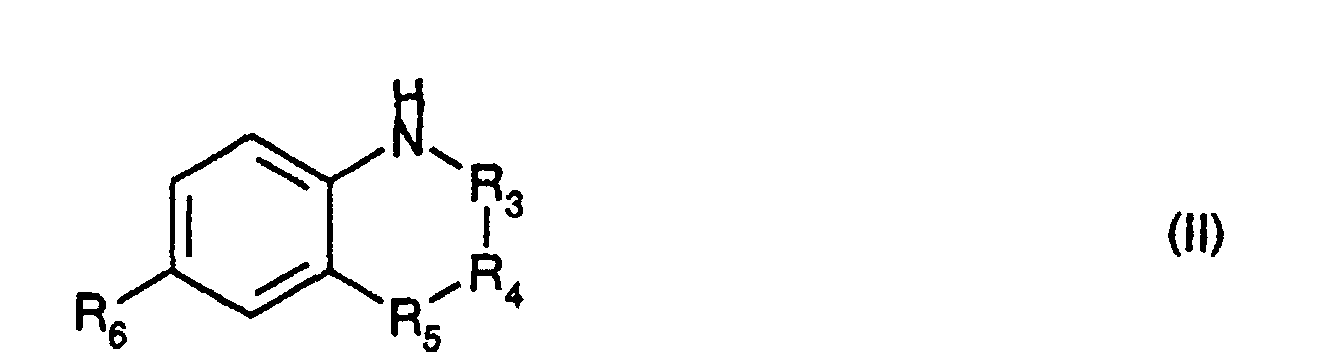


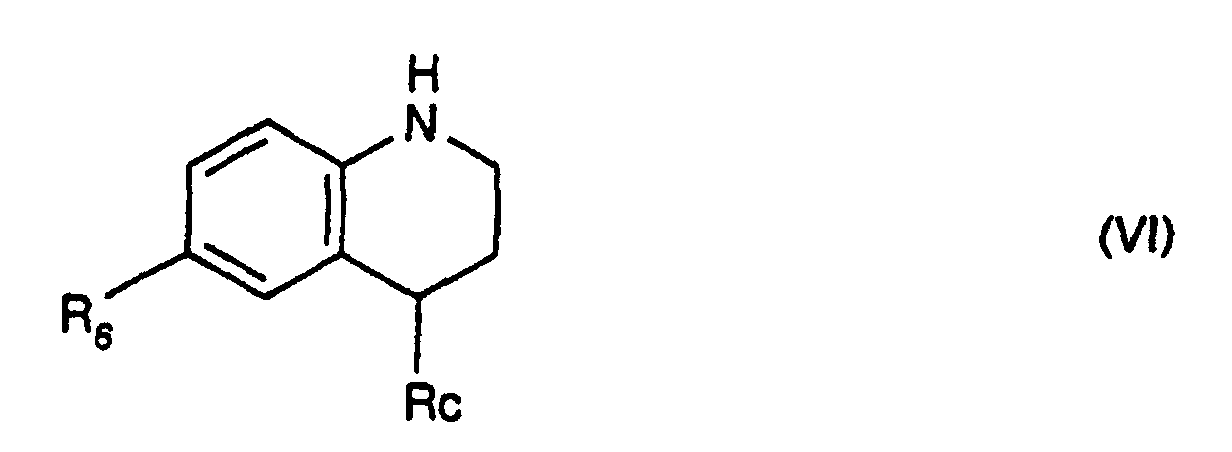

ou -SO2-alk peuvent être obtenus par oxydation d'un dérivé de formula (II) correspondant pour lequel -R3-R4-R5- représente une chaíne de formula -CH2-CH2-CH(R8)- dans laquelle R8 représente un radical -S-alk.

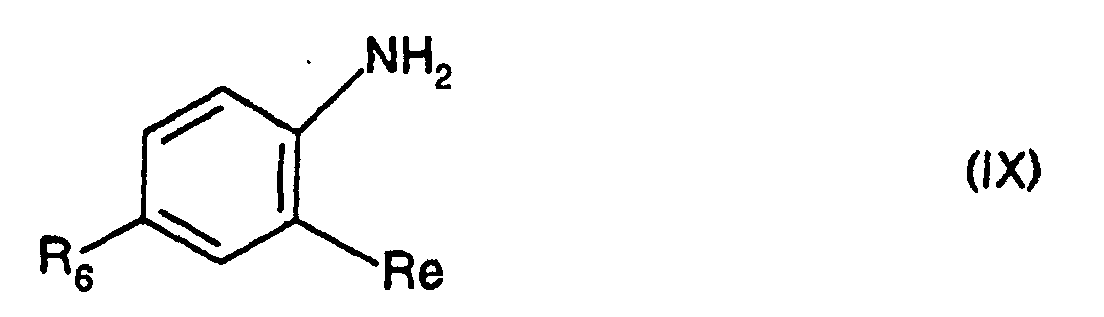


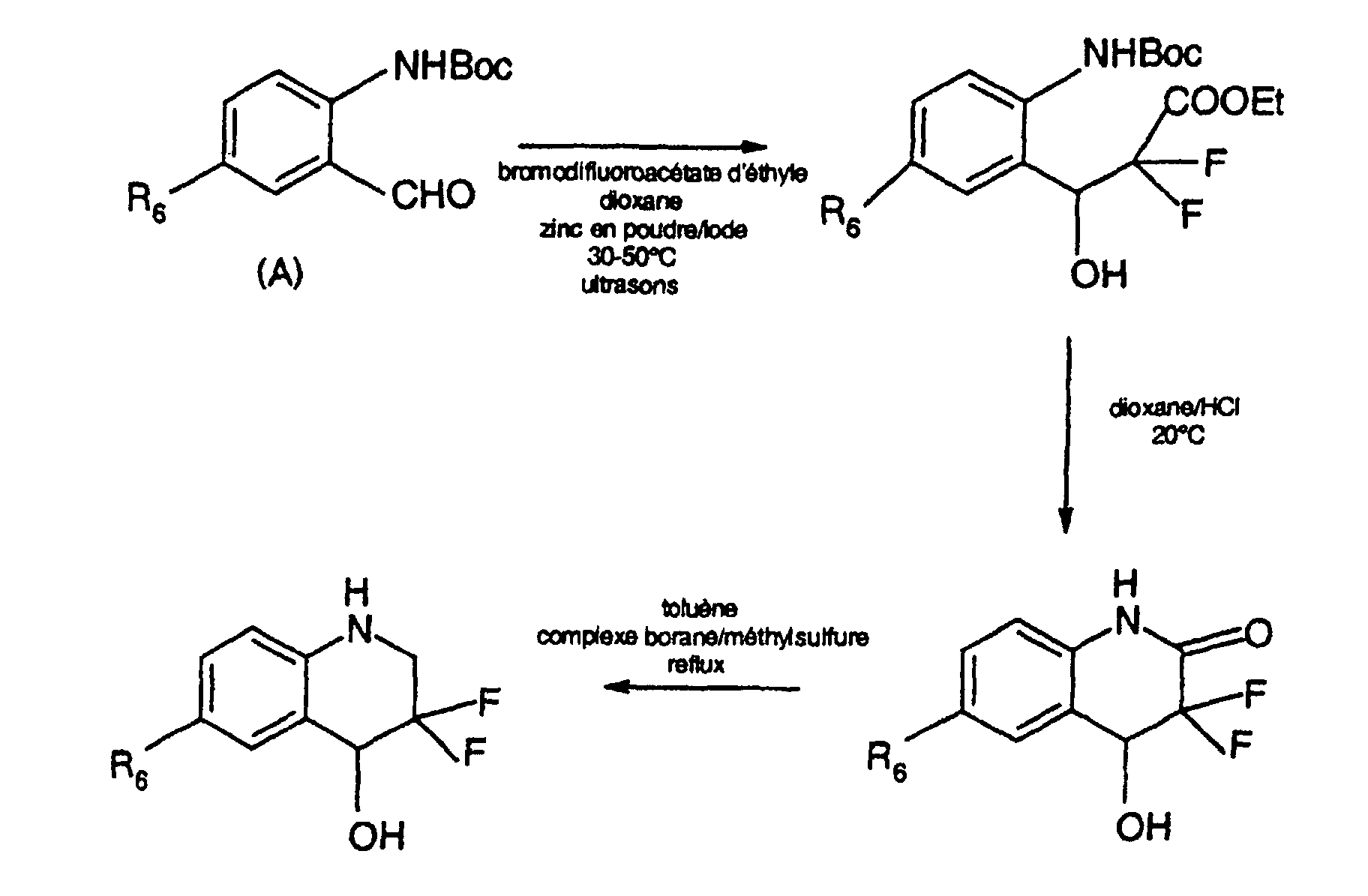
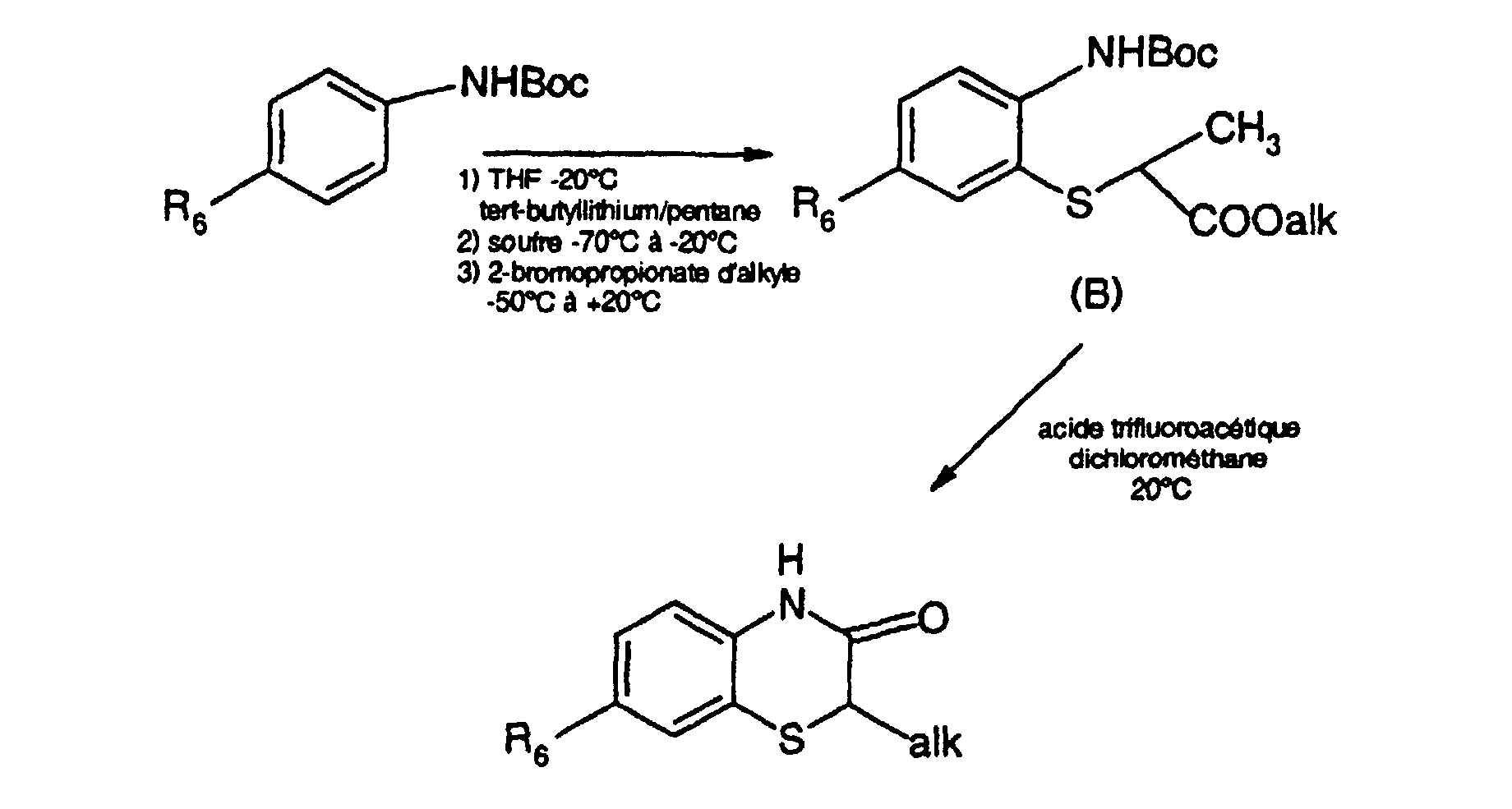
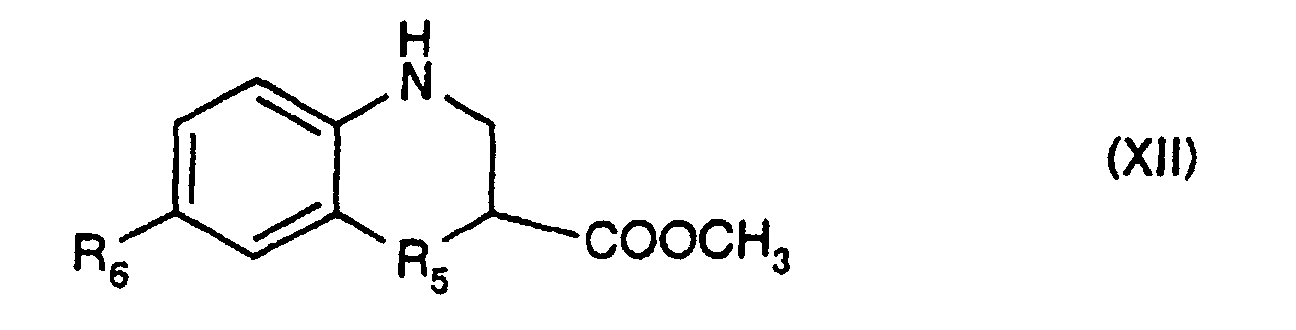

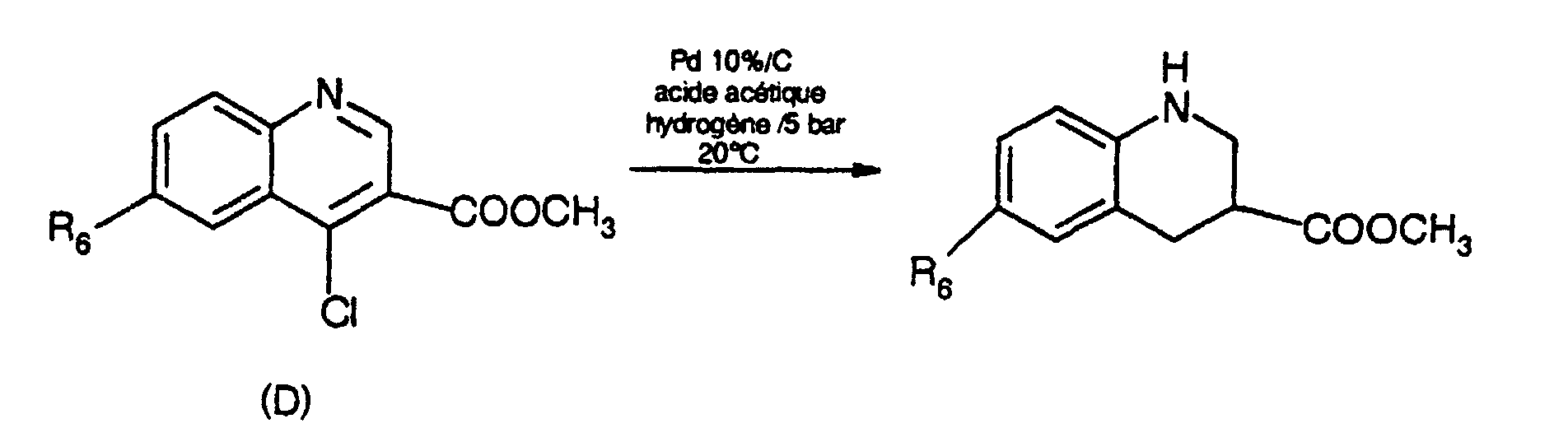
- Composé de formule (I) 50 mg
- Cellulose 18 mg
- Lactose 55 mg
- Silice colloïdale 1 mg
- Carboxyméthylamidon sodique 10 mg
- Talc 10 mg
- Stéarate de magnésium 1 mg
- Composé de formule (I) 50 mg
- Lactose 104 mg
- Cellulose 40 mg
- Polyvidone 10 mg
- Carboxyméthylamidon sodique 22 mg
- Talc 10 mg
- Stéarate de magnésium 2 mg
- Silice colloïdale 2 mg
- Mélange d'hydroxyméthylcellulose, glycérine, oxyde de titane (72-3,5-24,5) q.s.p. 1 comprimé pelliculé terminé à 245 mg
- Composé de formule (I) 10 mg
- Acide benzoïque 80 mg
- Alcool benzylique 0,06 ml
- Benzoate de sodium 80 mg
- Ethanol à 95 % 0,4 ml
- Hydroxyde de sodium 24 mg
- Propylène glycol 1,6 ml
- Eau q.s.p. 4 ml
Claims (15)
- Composé de formule :dans laquelle
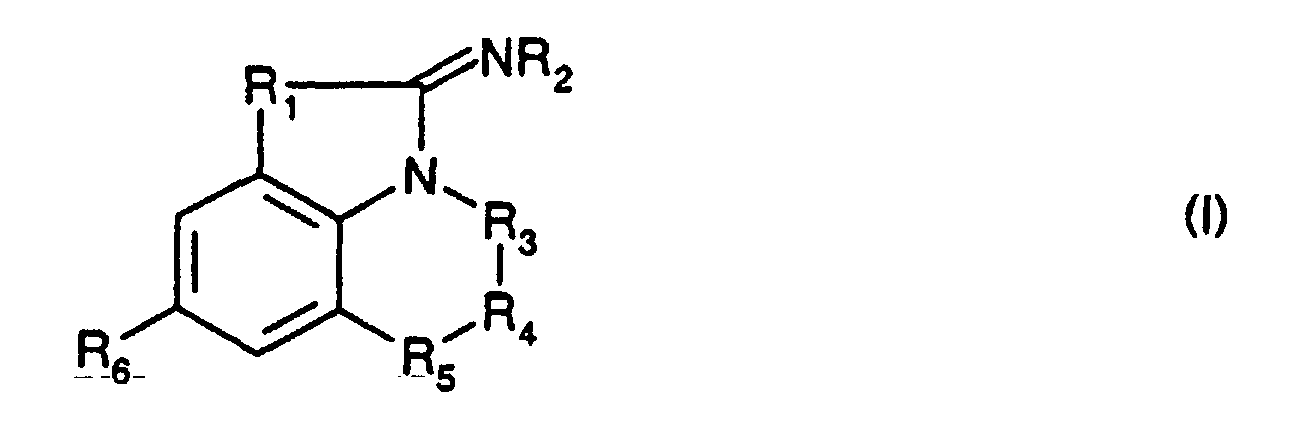 alk représente un radical alkyle,R1 représente un atome de soufre ou de sélénium,R2 représente un atome d'hydrogène ou un radical alkyle,-R3-R4-R5- représente une chaíne de formule -CH2-CH2-CH2-, -CH(R7)-CH2-CH2-, -CH2-CH2-CH(R8)-, -CH2-CH(R9)-CH2-, -CH2-CH2-S-, -CH2-CH2-SO-, -CH2-CH2-SO2-, -CH2-CH2-Se-, -CH2-CH2-O-, -CH2-CH2-CO-, -CH2-CH2-N(R10)-, -CH2-CO-N(R10)-, -CH2-CF2-CH2-, -CH2-CF2-CH(OH)-, -CH2-CH(R13)-S-, -CH2-CH(R13)-SO- ou -CH2-CH(R13)-SO2-,R6 représente un radical polyfluoroalkyle, polyfluoroalcoxy ou polyfluoroalkylthio,R7 représente un radical alkyle, -CH2OH, -CH2-SO2-alk ou -CH2-NR11R12,R8 représente un radical alkyle, hydroxy, -CH2OH, -NR11R12, -CH2-NR11R12, -S-alk, -SO-alk, -SO2-alk, thiényle, furyle, phényle ou phényle substitué par un substituant choisi parmi les atomes d'halogène et les radicaux alkyle et alcoxy,R9 représente un radical alkyle ou -CH2OH,R10 représente un atome d'hydrogène ou un radical alkyle,R11 représente un atome d'hydrogène ou un radical alkyle, -CO-alk ou -CO-CF3,R12 représente un atome d'hydrogène ou un radical alkyle,
ou bien R11 et R12 forment avec l'atome d'azote auquel ils sont rattachés un hétérocycle à 5 ou 6 chaínons, saturé ou insaturé et comportant éventuellement un autre hétéroatome choisi parmi azote, oxygène et soufre, cet hétérocycle étant non substitué ou substitué par un ou plusieurs substituants choisis parmi les radicaux alkyle, phényle, halogénophényle et phénylalkyle,R13 représente un radical alkyle ou -CH2OH,
étant entendu que les radicaux et portions alkyle et alcoxy contiennent 1 à 6 atomes de carbone en chaíne droite ou ramifiée,
leurs isomères, racémiques et énantiomères et leurs sels avec des acides minéraux ou organiques. - Composé de formule (I) selon la revendication 1 pour lequel R6 représente un radical polyfluoroalkyle choisi parmi les radicaux trifluorométhyle, 2,2,2-trifluoroéthyle, 1,1,2,2-tétrafluoroéthyle, perfluoroéthyle, perfluoropropyle, perfluorobutyle.
- Composé de formule (I) selon la revendication 1 pour lequel R6 représente un radical polyfluoroalcoxy choisi parmi les radicaux trifluorométhoxy, perfluoroéthoxy, 2,2,2-trifluoroéthoxy, 1,1,2,2-tétrafluoroéthoxy, 2,2,3,3,3-pentafluoropropoxy, perfluoropropoxy, perfluorobutoxy.
- Composé de formule (I) selon la revendication 1 pour lequel R6 représente un radical polyfluoroalkythio choisi parmi les radicaux trifluorométhylthio, perfluoroéthylthio, perfluoropropylthio.
- Composé de formule (I) selon l'une des revendications 1 à 4 pour lequel R11 et R12 forment avec l'atome d'azote auquel ils sont rattachés un hétérocycle à 5 ou 6 chaínons, saturé ou insaturé et comportant éventuellement un autre hétéroatome choisi parmi azote, oxygène et soufre choisi parmi la pyrrolidine, la pipéridine, la pipérazine, la morpholine et la thiomorpholine, ces hétérocycles étant non substitués ou substitués par un radical alkyle, phényle, halogénophényle ou phénylalkyle.
- Composé de formule (I) selon la revendication 1 pour lequel R1 représente un atome de soufre ou de sélénium, R2 représente un atome d'hydrogène ou un radical alkyle, -R3-R4-R5- représente une chaíne de formule -CH2-CH2-CH2-, -CH(R7)-CH2-CH2-, -CH2-CF2-CH(OH)-, -CH2-CH2-CH(R8)-, -CH2-CH2-CO, -CH2-CH2-S-, -CH2-CH2-SO-, -CH2-CH2-SO2-, R6 représente un radical polyfluoroalkyle, polyfluoroalcoxy ou polyfluoroalkylthio, R7 représente un radical alkyle, -CH2OH ou -CH2NR11R12, R8 représente un radical -NR11R12, -SO2-alk-, -SO-alk- ou phényle, R11 représente un atome d'hydrogène ou un radical alkyle ou acyle, R12 représente un atome d'hydrogène ou un radical alkyle, ou bien R11 et R12 forment avec l'atome d'azote auquel ils sont rattachés un hétérocycle à 5 ou 6 chaínons, saturé ou insaturé et comportant éventuellement un autre hétéroatome choisi parmi azote, oxygène ou soufre, étant entendu que les radicaux et portions alkyle et alcoxy contiennent 1 à 6 atomes de carbone en chaíne droite ou ramifiée et les radicaux acyle contiennent 2 à 6 atomes de carbone en chaíne droite ou ramifiée, leurs isomères, racémiques et énantiomères et leurs sels avec des acides minéraux ou organiques.
- Composé de formule (I) selon la revendication 1 choisi parmi les composés suivants :et leurs sels.-2-imino-8-trifluorométhoxy-5,6-dihydro-2H,4H-thiazolo[5,4,3-ij]quinoléine,-2-imino-8-trifluorométhyl-5,6-dihydro-2H,4H-thiazolo[5,4,3-ij]quinoléine,- (R,S)-2-imino-4-méthyl-8-trifluorométhyl-5,6-dihydro-2H,4H-thiazolo[5,4,3-ij]quinoléine et ses énantiomères,-2-imino-8-trifluorométhoxy-2H,4H-thiazolo[5,4,3-ij]quinoléine-6-one,- 2-imino-8-trifluorométhoxy-4,5-dihydro-2H-thiazolo-[3,4,5-de][1,4]benzothiazine-6,6-dioxyde,- (R,S)-2-imino-8-trifluorométhoxy-4,5-dihydro-2H-thiazolo-[3,4,5-de][1,4]benzothiazine-6-oxyde et ses énantiomères.- (R,S)-2-imino-8-trifluorométhyl-4,5-dihydro-2H-thiazolo[3,4,5-de][1,4]benzothiazine-6-oxyde et ses énantiomères,- 2-imino-8-trifluorométhyl-4,5-dihydro-2H-thiazolo[3,4,5-de][1,4]benzothiazine,- (R,S)-2-imino-6-phényl-8-trifluorométhyl-5,6-dihydro-2H,4H-thiazolo[5,4,3-ij]quinoléine et ses énantiomères,- 2-imino-8-trifluorométhoxy-4,5-dihydro-2H-thiazolo[3,4,5-d,e]-1,4-benzoxazine,- (R,S)-2-imino-8-trifluorométhyl-5,6-dihydro-2H,4H-thiazolo[5,4,3-ij]quinoléine-4-méthanol et ses énantiomères,- (R,S)-5,5-difluoro-6-hydroxy-2-imino-8-trifluorométhyl-5,6-dihydro-2H,4H-thiazolo[5,4,3-ij]quinoléine et ses énantiomères,- (R,S)-éthylméthyl(2-imino-8-trifluorométhyl-5,6-dihydro-2H,4H-thiazolo[5,4,3-ij]quinol-4-ylméthyl)amine et ses énantiomères,- 2-imino-8-trifluorométhyl-5,6-dihydro-2H,4H-sélénazolo[5,4,3-ij]quinoléine- (R,S)-2-imino-6-éthylsulfinyl-8-trifluorométhyl-5,6-dihydro-2H,4H-thiazolo[5,4,3-ij]quinoléine et ses énantiomères,- (R,S)-2-imino-6-éthylsulfonyl-8-trifluorométhyl-5,6-dihydro-2H,4H-thiazolo[5,4,3-ij]quinoléine et ses énantiomères
- Procédé de préparation des composés de formule (I) selon la revendication 1 pour lesquels R1 représente un atome de soufre ou de sélénium, R2 représente un atome d'hydrogène, -R3-R4-R5- représente une chaíne de formule -CH2-CH2-CH2-, -CH(R7)-CH2-CH2-, -CH2-CH2-CH(R8)-, -CH2-CH(R9)-CH2, -CH2-CH2-S-, -CH2-CH2-Se-, -CH2-CH2-O-, -CH2-CH2-CO-, -CH2-CH2-N(R10)-, -CH2-CO-N(R10)-, -CH2-CF2-CH2-, -CH2-CF2-CH(OH)-, -CH2-CH(R13)-S-, sour réserve que R8 ne représente pas un radical hydroxy caractérisé en ce que l'on fait réagir un thiocyanate de métal alcalin ou un sélénocyanate de métal alcalin sur un dérivé de formule:dans laquelle R6 représente un radical polyfluoroalkyle, polyfluoroalcoxy ou polyfluoroalkylthio, -R3-R4-R5- représente une chaíne de formule -CH2-CH2-CH2-, -CH(R7)-CH2-CH2-, -CH2-CH2-CH(R8)-, -CH2-CH(R9)-CH2, -CH2-CH2-S-, -CH2-CH2-Se-, -CH2-CH2-O-, -CH2-CH2-CO, -CH2-CH2-N(R10)-, -CH2-CO-N(R10)-, -CH2-CF2-CH2-, -CH2-CF2-CH(OH)-, -CH2-CH(R13)-S-, R7, R8, R9, R10 et R13 ont les mêmes significations que dans la revendication 1, sous réserve que R8 ne répresente pas un radical hydroxy, alkyle, -S-alk, -SO-alk ou SO2-alk isole le produit et le transforme éventuellement en sel.
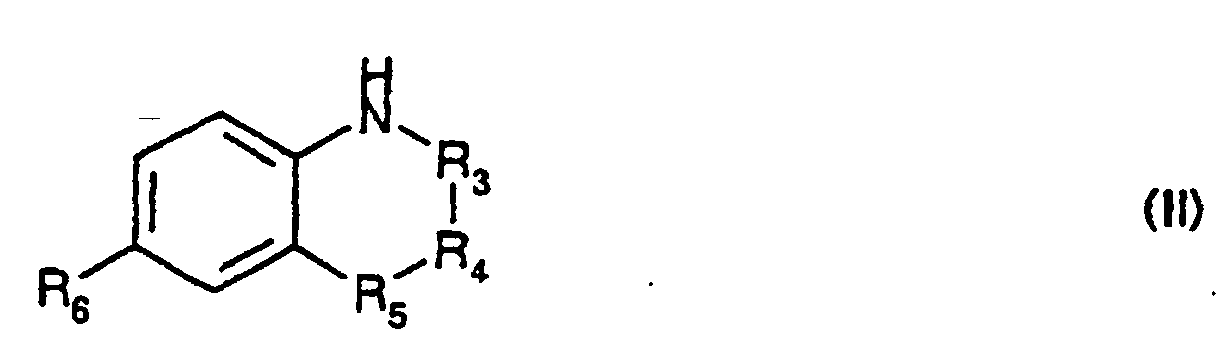
- Procédé de préparation des composés de formule (I) selon la revendication 1 pour lesquels R2 représente un radical alkyle caractérisé en ce que l'on alkyle un composé de formule (I) correspondant pour lequel R2 représente un atome d'hydrogène, isole le produit et le transforme éventuellement en sel.
- Procédé de préparation des composés de formule (I) selon la revendication 1 pour lesquels R2 représente un atome d'hydrogène ou un radical alkyle, -R3-R4-R5- représente une chaíne de formule -CH2-CH2-CH(R8)- et R8 représente un radical hydroxy caractérisé en ce que l'on réduit un composé de formule (I) correspondant pour lequel R2 représente un atome d'hydrogène ou un radical alkyle et -R3-R4-R5- représente une chaíne de formule -CH2-CH2-CO-, isole le produit et le transforme éventuellement en sel.
- Procédé de préparation des composés de formule (I) selon la revendication 1 pour lesquels R2 représente un atome d'hydrogène ou un radical alkyle et -R3-R4-R5- représente une chaíne de formule -CH2-CH2-SO-, -CH2-CH2-SO2-, -CH2-CH(R13)-SO- ou -CH2-CH(R13)-SO2- caractérisé en ce que l'on oxyde un composé de formule (I) correspondant pour lequel R2 représente un atome d'hydrogène ou un radical alkyle et -R3-R4-R5- représente une chaíne de formule -CH2-CH2-S- ou -CH2-CH(R13)-S-, isole le produit et le transforme éventuellement en sel.
- Procédé de préparation des composés de formule (I) selon la revendication 1 pour lesquels -R3-R4-R5- représente une chaíne de formule -CH(R7)-CH2-CH2- dans laquelle R7 représente un radical -CH2-NR11R12 et R2 représente un atome d'hydrogène caractérisé en ce que l'on fait réagir une amine HNR11R12 pour laquelle R11 et R12 ont les mêmes significations que dans la revendication 1 sur un dérivé de formule :dans laquelle R1 et R6 ont les mêmes significations que dans la revendication 1 suivie d'une hydrolyse pour libérer l'imine, isole le produit et le transforme éventuellement en sel.
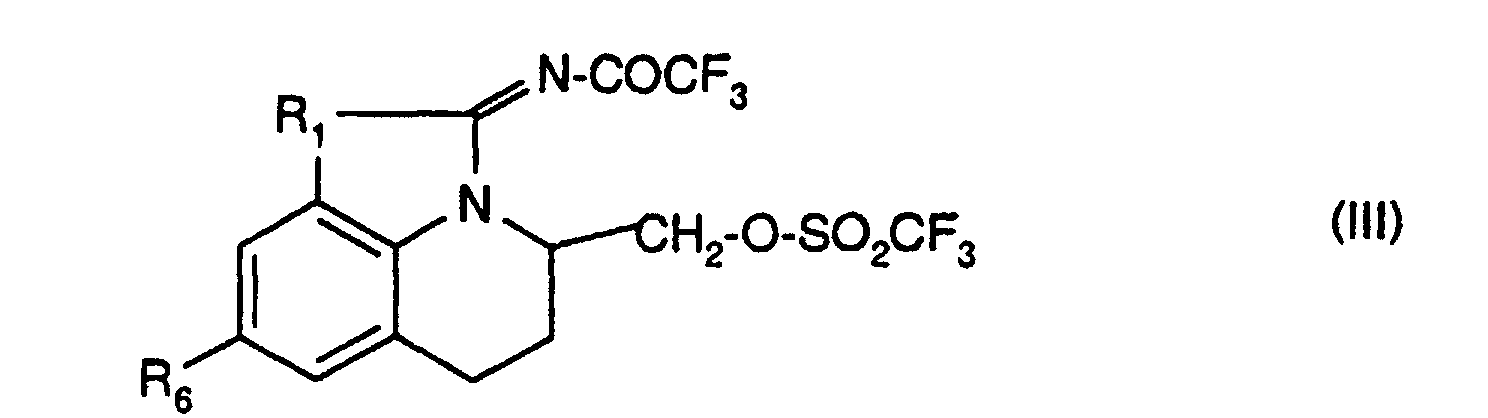
- Composé de formule :dans laquelle R6 a les mêmes significations que dans la revendication 1, -R3-R4-R5- représente une chaíne de formule -CH2-CH2-CH2-, -CH(R7)-CH2-CH2-, -CH2-CH2-CH(R8)-, -CH2-CH(R9)-CH2, -CH2-CH2-S-, -CH2-CH2-Se-, -CH2-CH2-O-, -CH2-CH2-CO-, -CH2-CH2-N(R10)-, -CH2-CO-N(R10)-, -CH2-CF2-CH2-, -CH2-CF2-CH(OH) ou -CH2-CH(R13)-S-, R8 représente un radical alkyle, -CH2-OH, -NR11R12, -CH2-NR11R12, thiényle, furyle, phényle ou phényle substitué par un substituant choisi parmi les atomes d'halogène et les radicaux alkyle et alcoxy, R7, R9, R10, R11, R12, R13 ont les mêmes significations que dans la revendication 1 à l'exception de la 6-trifluorométhyl-1,2,3,4-tétrahydroquinoléine, la 2-méthyl-6-trifluorométhoxy-1,2,3,4-quinoléine, la 6-trifluorométhyl-1,2,3,4-tétrahydroquinoxaline et la 2-oxo-7-trifluorométhyl-3,4-dihydroquinoxaline.

- A titre de médicament, les composés de formule (I) ainsi que leurs sels pharmaceutiquement acceptables, tels que défini aux revendications 1 à 7.
- Les compositions pharmaceutiques renfermant un médicament tel que défini à la revendication 14 et un excipient pharmaceutiquement compatible.
Applications Claiming Priority (3)
| Application Number | Priority Date | Filing Date | Title |
|---|---|---|---|
| FR9702436A FR2760237B1 (fr) | 1997-02-28 | 1997-02-28 | Thiazolobenzoheterocycles, leur preparation et les medicaments les contenant |
| FR9702436 | 1997-02-28 | ||
| PCT/FR1998/000376 WO1998038194A1 (fr) | 1997-02-28 | 1998-02-26 | Thiazolobenzoheterocycles, leur preparation et les medicaments les contenant |
Publications (2)
| Publication Number | Publication Date |
|---|---|
| EP0966473A1 EP0966473A1 (fr) | 1999-12-29 |
| EP0966473B1 true EP0966473B1 (fr) | 2002-07-24 |
Family
ID=9504307
Family Applications (1)
| Application Number | Title | Priority Date | Filing Date |
|---|---|---|---|
| EP98912552A Expired - Lifetime EP0966473B1 (fr) | 1997-02-28 | 1998-02-26 | Thiazolobenzoheterocycles, leur preparation et les medicaments les contenant |
Country Status (10)
| Country | Link |
|---|---|
| EP (1) | EP0966473B1 (fr) |
| JP (1) | JP4436460B2 (fr) |
| AT (1) | ATE221075T1 (fr) |
| AU (1) | AU6734598A (fr) |
| DE (1) | DE69806734T2 (fr) |
| DK (1) | DK0966473T3 (fr) |
| ES (1) | ES2180156T3 (fr) |
| FR (1) | FR2760237B1 (fr) |
| PT (1) | PT966473E (fr) |
| WO (1) | WO1998038194A1 (fr) |
Families Citing this family (2)
| Publication number | Priority date | Publication date | Assignee | Title |
|---|---|---|---|---|
| UA90269C2 (ru) | 2004-04-02 | 2010-04-26 | Мицубиси Танабе Фарма Корпорейшн | Тетрагидрохинолиновые производные и способ их получения |
| DE102005027168A1 (de) * | 2005-06-13 | 2006-12-14 | Merck Patent Gmbh | Tetrahydrochinoline |
Family Cites Families (6)
| Publication number | Priority date | Publication date | Assignee | Title |
|---|---|---|---|---|
| US3992378A (en) * | 1973-12-26 | 1976-11-16 | Eli Lilly And Company | Fluoralkyl quinoxadinediones |
| JPS55111406A (en) * | 1979-02-19 | 1980-08-28 | Takeda Chem Ind Ltd | Agent for controlling plant disease |
| DK160941C (da) * | 1988-06-28 | 1991-10-21 | Novo Nordisk As | Kondenserede 2,3-dihydroxypyraziner, fremgangsmaade til deres fremstilling og farmaceutiske praeparater, hvori forbindelserne indgaar |
| ES2067744T3 (es) * | 1989-06-09 | 1995-04-01 | Upjohn Co | Aminas heterociclicas con actividad sobre el sistema nervioso central. |
| PT509398E (pt) * | 1991-04-15 | 2002-02-28 | Aventis Pharma Gmbh | Quinoxalinas processo para a sua preparacao e sua utilizacao |
| EP0705835A1 (fr) * | 1994-09-01 | 1996-04-10 | Ciba-Geigy Ag | Quinoxaline-2,3-diones à anneau fusionné oxa- ou thiahétérocyclique |
-
1997
- 1997-02-28 FR FR9702436A patent/FR2760237B1/fr not_active Expired - Fee Related
-
1998
- 1998-02-26 DE DE69806734T patent/DE69806734T2/de not_active Expired - Lifetime
- 1998-02-26 DK DK98912552T patent/DK0966473T3/da active
- 1998-02-26 PT PT98912552T patent/PT966473E/pt unknown
- 1998-02-26 AT AT98912552T patent/ATE221075T1/de active
- 1998-02-26 EP EP98912552A patent/EP0966473B1/fr not_active Expired - Lifetime
- 1998-02-26 AU AU67345/98A patent/AU6734598A/en not_active Abandoned
- 1998-02-26 JP JP53738098A patent/JP4436460B2/ja not_active Expired - Fee Related
- 1998-02-26 WO PCT/FR1998/000376 patent/WO1998038194A1/fr not_active Ceased
- 1998-02-26 ES ES98912552T patent/ES2180156T3/es not_active Expired - Lifetime
Also Published As
| Publication number | Publication date |
|---|---|
| FR2760237A1 (fr) | 1998-09-04 |
| DE69806734T2 (de) | 2002-12-05 |
| PT966473E (pt) | 2002-12-31 |
| FR2760237B1 (fr) | 1999-04-16 |
| EP0966473A1 (fr) | 1999-12-29 |
| JP4436460B2 (ja) | 2010-03-24 |
| JP2001517214A (ja) | 2001-10-02 |
| ES2180156T3 (es) | 2003-02-01 |
| ATE221075T1 (de) | 2002-08-15 |
| DE69806734D1 (de) | 2002-08-29 |
| DK0966473T3 (da) | 2002-11-18 |
| WO1998038194A1 (fr) | 1998-09-03 |
| AU6734598A (en) | 1998-09-18 |
Similar Documents
| Publication | Publication Date | Title |
|---|---|---|
| EP0708778B1 (fr) | Derives d'imidazo [1,2-a]pyrazine-4-one/utiles comme antagonistes des recepteurs ampa et nmda | |
| EP0708774B1 (fr) | DERIVES D'IMIDAZO[1,2-a]PYRAZIN-4-ONE ANTAGONISTES DES RECEPTEURS AMPA ET NMDA | |
| EP0431991B1 (fr) | Nouveaux dérivés de benzonaphtyridine-1,8 leur préparation et les compositions qui les contiennent | |
| EP0662971B1 (fr) | DERIVES DE 5H,10H-IMIDAZO[1,2-a]INDENO[1,2-e]PYRAZINE-4-ONE, LEUR PREPARATION ET LES MEDICAMENTS LES CONTENANT | |
| CA2012343A1 (fr) | Derives du 1h, 3h-pyrrolo, (1,2-c) thiazolecarboxamide-7, leur preparation et les compositions pharmaceutiques qui les contiennent | |
| EP0752992B1 (fr) | DERIVES D'IMIDAZO[1,2-a]INDENO[1,2-e]PYRAZIN-4-ONE ET COMPOSITIONS PHARMACEUTIQUES LES CONTENANT | |
| EP1000067B1 (fr) | Thiazolobenzoheterocycles, leur preparation et les medicaments les contenant | |
| EP0752994A1 (fr) | DERIVES D'IMIDAZO[1,2-a]PYRAZIN-4-ONE, LEUR PREPARATION ET LES MEDICAMENTS LES CONTENANT | |
| EP0687178A1 (fr) | Application de derives de 2h-1,2,4-benzothiadiazine-3(4h)-one-1,1-dioxyde comme antagonistes non competitifs du recepteur nmda | |
| US6713468B2 (en) | Methods of using thiazolobenzoheterocycles | |
| EP0966473A1 (fr) | Thiazolobenzoheterocycles, leur preparation et les medicaments les contenant | |
| KR100491478B1 (ko) | 벤조[g]퀴놀린 유도체 | |
| FR2856065A1 (fr) | Nouveaux derives de benzothiazine et benzothiadiazine, leur procede de preparation et les compositions pharmaceutiques qui les contiennent. | |
| EP0772612A1 (fr) | Derives de 4-hydroxy-3-phenyl-indeno(1,2-b)pyridine-2(1h)-one comme nmda antagonistes | |
| FR2710062A1 (fr) | Dérivés d'acide 3,4-dihydro-2H-1,2,4-benzothiadiazine 1,1-dioxyde-3-carboxylique, leur préparation et les médicaments les contenant. | |
| FR2696457A1 (fr) | Dérivés de 3,4-dihydro-2H-1,2,4-benzothiadiazine 1,1-dioxyde, leur préparation et les médicaments les contenant. | |
| AU2004232475A1 (en) | Tricyclic indole derivatives and their use in the treatment of alzheimer's disease |
Legal Events
| Date | Code | Title | Description |
|---|---|---|---|
| PUAI | Public reference made under article 153(3) epc to a published international application that has entered the european phase |
Free format text: ORIGINAL CODE: 0009012 |
|
| 17P | Request for examination filed |
Effective date: 19990830 |
|
| AK | Designated contracting states |
Kind code of ref document: A1 Designated state(s): AT BE CH DE DK ES FI FR GB GR IE IT LI LU NL PT SE |
|
| GRAG | Despatch of communication of intention to grant |
Free format text: ORIGINAL CODE: EPIDOS AGRA |
|
| 17Q | First examination report despatched |
Effective date: 20010928 |
|
| GRAG | Despatch of communication of intention to grant |
Free format text: ORIGINAL CODE: EPIDOS AGRA |
|
| GRAG | Despatch of communication of intention to grant |
Free format text: ORIGINAL CODE: EPIDOS AGRA |
|
| GRAH | Despatch of communication of intention to grant a patent |
Free format text: ORIGINAL CODE: EPIDOS IGRA |
|
| GRAH | Despatch of communication of intention to grant a patent |
Free format text: ORIGINAL CODE: EPIDOS IGRA |
|
| GRAA | (expected) grant |
Free format text: ORIGINAL CODE: 0009210 |
|
| AK | Designated contracting states |
Kind code of ref document: B1 Designated state(s): AT BE CH DE DK ES FI FR GB GR IE IT LI LU NL PT SE |
|
| REF | Corresponds to: |
Ref document number: 221075 Country of ref document: AT Date of ref document: 20020815 Kind code of ref document: T |
|
| REG | Reference to a national code |
Ref country code: GB Ref legal event code: FG4D Free format text: NOT ENGLISH |
|
| REG | Reference to a national code |
Ref country code: CH Ref legal event code: EP |
|
| REG | Reference to a national code |
Ref country code: CH Ref legal event code: NV Representative=s name: KIRKER & CIE SA |
|
| REG | Reference to a national code |
Ref country code: IE Ref legal event code: FG4D Free format text: FRENCH |
|
| REF | Corresponds to: |
Ref document number: 69806734 Country of ref document: DE Date of ref document: 20020829 |
|
| REG | Reference to a national code |
Ref country code: GR Ref legal event code: EP Ref document number: 20020402582 Country of ref document: GR |
|
| GBT | Gb: translation of ep patent filed (gb section 77(6)(a)/1977) |
Effective date: 20021010 |
|
| REG | Reference to a national code |
Ref country code: DK Ref legal event code: T3 |
|
| REG | Reference to a national code |
Ref country code: PT Ref legal event code: SC4A Free format text: AVAILABILITY OF NATIONAL TRANSLATION Effective date: 20021023 |
|
| REG | Reference to a national code |
Ref country code: ES Ref legal event code: FG2A Ref document number: 2180156 Country of ref document: ES Kind code of ref document: T3 |
|
| PLBE | No opposition filed within time limit |
Free format text: ORIGINAL CODE: 0009261 |
|
| STAA | Information on the status of an ep patent application or granted ep patent |
Free format text: STATUS: NO OPPOSITION FILED WITHIN TIME LIMIT |
|
| 26N | No opposition filed |
Effective date: 20030425 |
|
| PG25 | Lapsed in a contracting state [announced via postgrant information from national office to epo] |
Ref country code: IT Free format text: LAPSE BECAUSE OF NON-PAYMENT OF DUE FEES;WARNING: LAPSES OF ITALIAN PATENTS WITH EFFECTIVE DATE BEFORE 2007 MAY HAVE OCCURRED AT ANY TIME BEFORE 2007. THE CORRECT EFFECTIVE DATE MAY BE DIFFERENT FROM THE ONE RECORDED. Effective date: 20050226 |
|
| PGRI | Patent reinstated in contracting state [announced from national office to epo] |
Ref country code: IT Effective date: 20091201 |
|
| PGFP | Annual fee paid to national office [announced via postgrant information from national office to epo] |
Ref country code: DK Payment date: 20110210 Year of fee payment: 14 Ref country code: IE Payment date: 20110210 Year of fee payment: 14 |
|
| PGFP | Annual fee paid to national office [announced via postgrant information from national office to epo] |
Ref country code: NL Payment date: 20110216 Year of fee payment: 14 Ref country code: FR Payment date: 20110218 Year of fee payment: 14 Ref country code: LU Payment date: 20110330 Year of fee payment: 14 Ref country code: IT Payment date: 20110217 Year of fee payment: 14 Ref country code: FI Payment date: 20110211 Year of fee payment: 14 Ref country code: SE Payment date: 20110211 Year of fee payment: 14 Ref country code: PT Payment date: 20110208 Year of fee payment: 14 Ref country code: AT Payment date: 20110126 Year of fee payment: 14 Ref country code: CH Payment date: 20110214 Year of fee payment: 14 Ref country code: DE Payment date: 20110223 Year of fee payment: 14 |
|
| PGFP | Annual fee paid to national office [announced via postgrant information from national office to epo] |
Ref country code: GR Payment date: 20110113 Year of fee payment: 14 |
|
| PGFP | Annual fee paid to national office [announced via postgrant information from national office to epo] |
Ref country code: ES Payment date: 20110315 Year of fee payment: 14 Ref country code: GB Payment date: 20110223 Year of fee payment: 14 |
|
| PGFP | Annual fee paid to national office [announced via postgrant information from national office to epo] |
Ref country code: BE Payment date: 20110722 Year of fee payment: 14 |
|
| BERE | Be: lapsed |
Owner name: S.A. *AVENTIS PHARMA Effective date: 20120228 |
|
| REG | Reference to a national code |
Ref country code: PT Ref legal event code: MM4A Free format text: LAPSE DUE TO NON-PAYMENT OF FEES Effective date: 20120827 |
|
| REG | Reference to a national code |
Ref country code: NL Ref legal event code: V1 Effective date: 20120901 |
|
| REG | Reference to a national code |
Ref country code: CH Ref legal event code: PL |
|
| GBPC | Gb: european patent ceased through non-payment of renewal fee |
Effective date: 20120226 |
|
| REG | Reference to a national code |
Ref country code: GR Ref legal event code: ML Ref document number: 20020402582 Country of ref document: GR Effective date: 20120905 |
|
| PG25 | Lapsed in a contracting state [announced via postgrant information from national office to epo] |
Ref country code: FI Free format text: LAPSE BECAUSE OF NON-PAYMENT OF DUE FEES Effective date: 20120226 Ref country code: CH Free format text: LAPSE BECAUSE OF NON-PAYMENT OF DUE FEES Effective date: 20120229 Ref country code: LI Free format text: LAPSE BECAUSE OF NON-PAYMENT OF DUE FEES Effective date: 20120229 Ref country code: SE Free format text: LAPSE BECAUSE OF NON-PAYMENT OF DUE FEES Effective date: 20120227 |
|
| REG | Reference to a national code |
Ref country code: DK Ref legal event code: EBP |
|
| REG | Reference to a national code |
Ref country code: IE Ref legal event code: MM4A |
|
| REG | Reference to a national code |
Ref country code: FR Ref legal event code: ST Effective date: 20121031 |
|
| PG25 | Lapsed in a contracting state [announced via postgrant information from national office to epo] |
Ref country code: IT Free format text: LAPSE BECAUSE OF NON-PAYMENT OF DUE FEES Effective date: 20120226 Ref country code: PT Free format text: LAPSE BECAUSE OF NON-PAYMENT OF DUE FEES Effective date: 20120827 Ref country code: GR Free format text: LAPSE BECAUSE OF NON-PAYMENT OF DUE FEES Effective date: 20120905 |
|
| REG | Reference to a national code |
Ref country code: AT Ref legal event code: MM01 Ref document number: 221075 Country of ref document: AT Kind code of ref document: T Effective date: 20120226 |
|
| REG | Reference to a national code |
Ref country code: DE Ref legal event code: R119 Ref document number: 69806734 Country of ref document: DE Effective date: 20120901 |
|
| PG25 | Lapsed in a contracting state [announced via postgrant information from national office to epo] |
Ref country code: BE Free format text: LAPSE BECAUSE OF NON-PAYMENT OF DUE FEES Effective date: 20120228 |
|
| PG25 | Lapsed in a contracting state [announced via postgrant information from national office to epo] |
Ref country code: FR Free format text: LAPSE BECAUSE OF NON-PAYMENT OF DUE FEES Effective date: 20120229 Ref country code: NL Free format text: LAPSE BECAUSE OF NON-PAYMENT OF DUE FEES Effective date: 20120901 Ref country code: GB Free format text: LAPSE BECAUSE OF NON-PAYMENT OF DUE FEES Effective date: 20120226 Ref country code: AT Free format text: LAPSE BECAUSE OF NON-PAYMENT OF DUE FEES Effective date: 20120226 Ref country code: IE Free format text: LAPSE BECAUSE OF NON-PAYMENT OF DUE FEES Effective date: 20120226 |
|
| PG25 | Lapsed in a contracting state [announced via postgrant information from national office to epo] |
Ref country code: DE Free format text: LAPSE BECAUSE OF NON-PAYMENT OF DUE FEES Effective date: 20120901 |
|
| REG | Reference to a national code |
Ref country code: ES Ref legal event code: FD2A Effective date: 20130708 |
|
| PG25 | Lapsed in a contracting state [announced via postgrant information from national office to epo] |
Ref country code: ES Free format text: LAPSE BECAUSE OF NON-PAYMENT OF DUE FEES Effective date: 20120227 |
|
| PG25 | Lapsed in a contracting state [announced via postgrant information from national office to epo] |
Ref country code: DK Free format text: LAPSE BECAUSE OF NON-PAYMENT OF DUE FEES Effective date: 20120229 |
|
| PG25 | Lapsed in a contracting state [announced via postgrant information from national office to epo] |
Ref country code: LU Free format text: LAPSE BECAUSE OF NON-PAYMENT OF DUE FEES Effective date: 20120226 |