EP0969072B1 - Technique pour l'isolation et la protection contre le feu de structures métalliques - Google Patents
Technique pour l'isolation et la protection contre le feu de structures métalliques Download PDFInfo
- Publication number
- EP0969072B1 EP0969072B1 EP19990112346 EP99112346A EP0969072B1 EP 0969072 B1 EP0969072 B1 EP 0969072B1 EP 19990112346 EP19990112346 EP 19990112346 EP 99112346 A EP99112346 A EP 99112346A EP 0969072 B1 EP0969072 B1 EP 0969072B1
- Authority
- EP
- European Patent Office
- Prior art keywords
- product
- fact
- technique according
- carder
- grinder
- Prior art date
- Legal status (The legal status is an assumption and is not a legal conclusion. Google has not performed a legal analysis and makes no representation as to the accuracy of the status listed.)
- Expired - Lifetime
Links
- 238000000034 method Methods 0.000 title claims description 35
- 238000009413 insulation Methods 0.000 title claims description 16
- 238000004079 fireproofing Methods 0.000 title claims 2
- 239000000463 material Substances 0.000 claims description 26
- XLYOFNOQVPJJNP-UHFFFAOYSA-N water Substances O XLYOFNOQVPJJNP-UHFFFAOYSA-N 0.000 claims description 23
- 239000002657 fibrous material Substances 0.000 claims description 14
- 239000000654 additive Substances 0.000 claims description 13
- XEEYBQQBJWHFJM-UHFFFAOYSA-N Iron Chemical compound [Fe] XEEYBQQBJWHFJM-UHFFFAOYSA-N 0.000 claims description 12
- 239000006185 dispersion Substances 0.000 claims description 11
- 239000003292 glue Substances 0.000 claims description 11
- 229910052500 inorganic mineral Inorganic materials 0.000 claims description 10
- 229910052751 metal Inorganic materials 0.000 claims description 9
- 239000002184 metal Substances 0.000 claims description 9
- FYYHWMGAXLPEAU-UHFFFAOYSA-N Magnesium Chemical compound [Mg] FYYHWMGAXLPEAU-UHFFFAOYSA-N 0.000 claims description 8
- 230000000295 complement effect Effects 0.000 claims description 8
- 239000000835 fiber Substances 0.000 claims description 8
- 239000011707 mineral Substances 0.000 claims description 7
- 229910052782 aluminium Inorganic materials 0.000 claims description 6
- 235000012216 bentonite Nutrition 0.000 claims description 6
- 239000004568 cement Substances 0.000 claims description 6
- 239000004927 clay Substances 0.000 claims description 6
- 229910052742 iron Inorganic materials 0.000 claims description 6
- 229910052749 magnesium Inorganic materials 0.000 claims description 6
- 239000011777 magnesium Substances 0.000 claims description 6
- 239000011490 mineral wool Substances 0.000 claims description 6
- 229920002554 vinyl polymer Polymers 0.000 claims description 6
- 230000004523 agglutinating effect Effects 0.000 claims description 5
- 229920000058 polyacrylate Polymers 0.000 claims description 5
- 150000004760 silicates Chemical class 0.000 claims description 5
- NIXOWILDQLNWCW-UHFFFAOYSA-N acrylic acid group Chemical group C(C=C)(=O)O NIXOWILDQLNWCW-UHFFFAOYSA-N 0.000 claims description 4
- 239000007864 aqueous solution Substances 0.000 claims description 4
- 239000000203 mixture Substances 0.000 claims description 4
- 239000000049 pigment Substances 0.000 claims description 4
- 239000011347 resin Substances 0.000 claims description 4
- 229920005989 resin Polymers 0.000 claims description 4
- 229910000831 Steel Inorganic materials 0.000 claims description 3
- 238000004873 anchoring Methods 0.000 claims description 3
- 239000004815 dispersion polymer Substances 0.000 claims description 3
- 239000010959 steel Substances 0.000 claims description 3
- 239000011248 coating agent Substances 0.000 claims description 2
- 238000000576 coating method Methods 0.000 claims description 2
- 230000000149 penetrating effect Effects 0.000 claims description 2
- 230000001681 protective effect Effects 0.000 claims description 2
- 239000002893 slag Substances 0.000 claims description 2
- 239000000126 substance Substances 0.000 claims description 2
- 238000004078 waterproofing Methods 0.000 claims description 2
- 239000012530 fluid Substances 0.000 claims 9
- 238000002791 soaking Methods 0.000 claims 3
- GWEVSGVZZGPLCZ-UHFFFAOYSA-N Titan oxide Chemical compound O=[Ti]=O GWEVSGVZZGPLCZ-UHFFFAOYSA-N 0.000 claims 2
- -1 aluminum silicates Chemical class 0.000 claims 2
- 229910052914 metal silicate Inorganic materials 0.000 claims 2
- BPQQTUXANYXVAA-UHFFFAOYSA-N Orthosilicate Chemical compound [O-][Si]([O-])([O-])[O-] BPQQTUXANYXVAA-UHFFFAOYSA-N 0.000 claims 1
- 238000009472 formulation Methods 0.000 claims 1
- 239000004408 titanium dioxide Substances 0.000 claims 1
- 239000000047 product Substances 0.000 description 47
- 239000007788 liquid Substances 0.000 description 17
- 238000009960 carding Methods 0.000 description 16
- 239000000853 adhesive Substances 0.000 description 14
- 230000001070 adhesive effect Effects 0.000 description 14
- 238000005507 spraying Methods 0.000 description 13
- 230000008901 benefit Effects 0.000 description 5
- 229910052910 alkali metal silicate Inorganic materials 0.000 description 4
- 229920000642 polymer Polymers 0.000 description 3
- 239000007921 spray Substances 0.000 description 3
- ISXSCDLOGDJUNJ-UHFFFAOYSA-N tert-butyl prop-2-enoate Chemical compound CC(C)(C)OC(=O)C=C ISXSCDLOGDJUNJ-UHFFFAOYSA-N 0.000 description 3
- QYLJIYOGHRGUIH-CIUDSAMLSA-N Arg-Ile Chemical compound CC[C@H](C)[C@@H](C(O)=O)NC(=O)[C@@H](N)CCCNC(N)=N QYLJIYOGHRGUIH-CIUDSAMLSA-N 0.000 description 2
- 241000909536 Gobiesocidae Species 0.000 description 2
- 229920006397 acrylic thermoplastic Polymers 0.000 description 2
- AZDRQVAHHNSJOQ-UHFFFAOYSA-N alumane Chemical compound [AlH3] AZDRQVAHHNSJOQ-UHFFFAOYSA-N 0.000 description 2
- 239000004411 aluminium Substances 0.000 description 2
- XAGFODPZIPBFFR-UHFFFAOYSA-N aluminium Chemical compound [Al] XAGFODPZIPBFFR-UHFFFAOYSA-N 0.000 description 2
- 230000000694 effects Effects 0.000 description 2
- 230000005484 gravity Effects 0.000 description 2
- 238000009434 installation Methods 0.000 description 2
- 239000012764 mineral filler Substances 0.000 description 2
- 230000004048 modification Effects 0.000 description 2
- 238000012986 modification Methods 0.000 description 2
- 238000005192 partition Methods 0.000 description 2
- 239000004014 plasticizer Substances 0.000 description 2
- 229920003229 poly(methyl methacrylate) Polymers 0.000 description 2
- 230000008569 process Effects 0.000 description 2
- 239000000243 solution Substances 0.000 description 2
- 125000000391 vinyl group Chemical group [H]C([*])=C([H])[H] 0.000 description 2
- 238000003466 welding Methods 0.000 description 2
- RNFJDJUURJAICM-UHFFFAOYSA-N 2,2,4,4,6,6-hexaphenoxy-1,3,5-triaza-2$l^{5},4$l^{5},6$l^{5}-triphosphacyclohexa-1,3,5-triene Chemical compound N=1P(OC=2C=CC=CC=2)(OC=2C=CC=CC=2)=NP(OC=2C=CC=CC=2)(OC=2C=CC=CC=2)=NP=1(OC=1C=CC=CC=1)OC1=CC=CC=C1 RNFJDJUURJAICM-UHFFFAOYSA-N 0.000 description 1
- 229920000178 Acrylic resin Polymers 0.000 description 1
- 239000004925 Acrylic resin Substances 0.000 description 1
- 239000011398 Portland cement Substances 0.000 description 1
- FAPWRFPIFSIZLT-UHFFFAOYSA-M Sodium chloride Chemical compound [Na+].[Cl-] FAPWRFPIFSIZLT-UHFFFAOYSA-M 0.000 description 1
- RJRPCMREZGLMKP-UHFFFAOYSA-N [Ti].O=C=O Chemical compound [Ti].O=C=O RJRPCMREZGLMKP-UHFFFAOYSA-N 0.000 description 1
- 230000009471 action Effects 0.000 description 1
- 230000004520 agglutination Effects 0.000 description 1
- 230000032683 aging Effects 0.000 description 1
- 239000011230 binding agent Substances 0.000 description 1
- 230000005540 biological transmission Effects 0.000 description 1
- 238000007664 blowing Methods 0.000 description 1
- 238000005260 corrosion Methods 0.000 description 1
- 230000007797 corrosion Effects 0.000 description 1
- 238000010586 diagram Methods 0.000 description 1
- 239000000945 filler Substances 0.000 description 1
- 239000003063 flame retardant Substances 0.000 description 1
- 238000005470 impregnation Methods 0.000 description 1
- 239000012212 insulator Substances 0.000 description 1
- 238000002955 isolation Methods 0.000 description 1
- 238000004519 manufacturing process Methods 0.000 description 1
- 238000004806 packaging method and process Methods 0.000 description 1
- 230000002093 peripheral effect Effects 0.000 description 1
- 239000012466 permeate Substances 0.000 description 1
- 238000002203 pretreatment Methods 0.000 description 1
- 230000002787 reinforcement Effects 0.000 description 1
- 239000011780 sodium chloride Substances 0.000 description 1
- 230000009897 systematic effect Effects 0.000 description 1
- 230000032258 transport Effects 0.000 description 1
- 238000005406 washing Methods 0.000 description 1
- 239000002699 waste material Substances 0.000 description 1
- 210000002268 wool Anatomy 0.000 description 1
Images


Classifications
-
- B—PERFORMING OPERATIONS; TRANSPORTING
- B05—SPRAYING OR ATOMISING IN GENERAL; APPLYING FLUENT MATERIALS TO SURFACES, IN GENERAL
- B05B—SPRAYING APPARATUS; ATOMISING APPARATUS; NOZZLES
- B05B7/00—Spraying apparatus for discharge of liquids or other fluent materials from two or more sources, e.g. of liquid and air, of powder and gas
- B05B7/14—Spraying apparatus for discharge of liquids or other fluent materials from two or more sources, e.g. of liquid and air, of powder and gas designed for spraying particulate materials
- B05B7/1404—Arrangements for supplying particulate material
- B05B7/1409—Arrangements for supplying particulate material specially adapted for short fibres or chips
-
- B—PERFORMING OPERATIONS; TRANSPORTING
- B05—SPRAYING OR ATOMISING IN GENERAL; APPLYING FLUENT MATERIALS TO SURFACES, IN GENERAL
- B05B—SPRAYING APPARATUS; ATOMISING APPARATUS; NOZZLES
- B05B7/00—Spraying apparatus for discharge of liquids or other fluent materials from two or more sources, e.g. of liquid and air, of powder and gas
- B05B7/14—Spraying apparatus for discharge of liquids or other fluent materials from two or more sources, e.g. of liquid and air, of powder and gas designed for spraying particulate materials
- B05B7/1404—Arrangements for supplying particulate material
- B05B7/1431—Arrangements for supplying particulate material comprising means for supplying an additional liquid
-
- B—PERFORMING OPERATIONS; TRANSPORTING
- B28—WORKING CEMENT, CLAY, OR STONE
- B28C—PREPARING CLAY; PRODUCING MIXTURES CONTAINING CLAY OR CEMENTITIOUS MATERIAL, e.g. PLASTER
- B28C5/00—Apparatus or methods for producing mixtures of cement with other substances, e.g. slurries, mortars, porous or fibrous compositions
- B28C5/40—Mixing specially adapted for preparing mixtures containing fibres
- B28C5/404—Pre-treatment of fibres
-
- C—CHEMISTRY; METALLURGY
- C04—CEMENTS; CONCRETE; ARTIFICIAL STONE; CERAMICS; REFRACTORIES
- C04B—LIME, MAGNESIA; SLAG; CEMENTS; COMPOSITIONS THEREOF, e.g. MORTARS, CONCRETE OR LIKE BUILDING MATERIALS; ARTIFICIAL STONE; CERAMICS; REFRACTORIES; TREATMENT OF NATURAL STONE
- C04B14/00—Use of inorganic materials as fillers, e.g. pigments, for mortars, concrete or artificial stone; Treatment of inorganic materials specially adapted to enhance their filling properties in mortars, concrete or artificial stone
- C04B14/38—Fibrous materials; Whiskers
-
- C—CHEMISTRY; METALLURGY
- C04—CEMENTS; CONCRETE; ARTIFICIAL STONE; CERAMICS; REFRACTORIES
- C04B—LIME, MAGNESIA; SLAG; CEMENTS; COMPOSITIONS THEREOF, e.g. MORTARS, CONCRETE OR LIKE BUILDING MATERIALS; ARTIFICIAL STONE; CERAMICS; REFRACTORIES; TREATMENT OF NATURAL STONE
- C04B28/00—Compositions of mortars, concrete or artificial stone, containing inorganic binders or the reaction product of an inorganic and an organic binder, e.g. polycarboxylate cements
- C04B28/02—Compositions of mortars, concrete or artificial stone, containing inorganic binders or the reaction product of an inorganic and an organic binder, e.g. polycarboxylate cements containing hydraulic cements other than calcium sulfates
-
- C—CHEMISTRY; METALLURGY
- C04—CEMENTS; CONCRETE; ARTIFICIAL STONE; CERAMICS; REFRACTORIES
- C04B—LIME, MAGNESIA; SLAG; CEMENTS; COMPOSITIONS THEREOF, e.g. MORTARS, CONCRETE OR LIKE BUILDING MATERIALS; ARTIFICIAL STONE; CERAMICS; REFRACTORIES; TREATMENT OF NATURAL STONE
- C04B30/00—Compositions for artificial stone, not containing binders
- C04B30/02—Compositions for artificial stone, not containing binders containing fibrous materials
-
- C—CHEMISTRY; METALLURGY
- C09—DYES; PAINTS; POLISHES; NATURAL RESINS; ADHESIVES; COMPOSITIONS NOT OTHERWISE PROVIDED FOR; APPLICATIONS OF MATERIALS NOT OTHERWISE PROVIDED FOR
- C09K—MATERIALS FOR MISCELLANEOUS APPLICATIONS, NOT PROVIDED FOR ELSEWHERE
- C09K21/00—Fireproofing materials
- C09K21/02—Inorganic materials
-
- C—CHEMISTRY; METALLURGY
- C21—METALLURGY OF IRON
- C21B—MANUFACTURE OF IRON OR STEEL
- C21B3/00—General features in the manufacture of pig-iron
- C21B3/04—Recovery of by-products, e.g. slag
- C21B3/06—Treatment of liquid slag
-
- C—CHEMISTRY; METALLURGY
- C23—COATING METALLIC MATERIAL; COATING MATERIAL WITH METALLIC MATERIAL; CHEMICAL SURFACE TREATMENT; DIFFUSION TREATMENT OF METALLIC MATERIAL; COATING BY VACUUM EVAPORATION, BY SPUTTERING, BY ION IMPLANTATION OR BY CHEMICAL VAPOUR DEPOSITION, IN GENERAL; INHIBITING CORROSION OF METALLIC MATERIAL OR INCRUSTATION IN GENERAL
- C23C—COATING METALLIC MATERIAL; COATING MATERIAL WITH METALLIC MATERIAL; SURFACE TREATMENT OF METALLIC MATERIAL BY DIFFUSION INTO THE SURFACE, BY CHEMICAL CONVERSION OR SUBSTITUTION; COATING BY VACUUM EVAPORATION, BY SPUTTERING, BY ION IMPLANTATION OR BY CHEMICAL VAPOUR DEPOSITION, IN GENERAL
- C23C4/00—Coating by spraying the coating material in the molten state, e.g. by flame, plasma or electric discharge
-
- C—CHEMISTRY; METALLURGY
- C23—COATING METALLIC MATERIAL; COATING MATERIAL WITH METALLIC MATERIAL; CHEMICAL SURFACE TREATMENT; DIFFUSION TREATMENT OF METALLIC MATERIAL; COATING BY VACUUM EVAPORATION, BY SPUTTERING, BY ION IMPLANTATION OR BY CHEMICAL VAPOUR DEPOSITION, IN GENERAL; INHIBITING CORROSION OF METALLIC MATERIAL OR INCRUSTATION IN GENERAL
- C23C—COATING METALLIC MATERIAL; COATING MATERIAL WITH METALLIC MATERIAL; SURFACE TREATMENT OF METALLIC MATERIAL BY DIFFUSION INTO THE SURFACE, BY CHEMICAL CONVERSION OR SUBSTITUTION; COATING BY VACUUM EVAPORATION, BY SPUTTERING, BY ION IMPLANTATION OR BY CHEMICAL VAPOUR DEPOSITION, IN GENERAL
- C23C4/00—Coating by spraying the coating material in the molten state, e.g. by flame, plasma or electric discharge
- C23C4/04—Coating by spraying the coating material in the molten state, e.g. by flame, plasma or electric discharge characterised by the coating material
-
- C—CHEMISTRY; METALLURGY
- C23—COATING METALLIC MATERIAL; COATING MATERIAL WITH METALLIC MATERIAL; CHEMICAL SURFACE TREATMENT; DIFFUSION TREATMENT OF METALLIC MATERIAL; COATING BY VACUUM EVAPORATION, BY SPUTTERING, BY ION IMPLANTATION OR BY CHEMICAL VAPOUR DEPOSITION, IN GENERAL; INHIBITING CORROSION OF METALLIC MATERIAL OR INCRUSTATION IN GENERAL
- C23C—COATING METALLIC MATERIAL; COATING MATERIAL WITH METALLIC MATERIAL; SURFACE TREATMENT OF METALLIC MATERIAL BY DIFFUSION INTO THE SURFACE, BY CHEMICAL CONVERSION OR SUBSTITUTION; COATING BY VACUUM EVAPORATION, BY SPUTTERING, BY ION IMPLANTATION OR BY CHEMICAL VAPOUR DEPOSITION, IN GENERAL
- C23C4/00—Coating by spraying the coating material in the molten state, e.g. by flame, plasma or electric discharge
- C23C4/04—Coating by spraying the coating material in the molten state, e.g. by flame, plasma or electric discharge characterised by the coating material
- C23C4/10—Oxides, borides, carbides, nitrides or silicides; Mixtures thereof
- C23C4/11—Oxides
-
- D—TEXTILES; PAPER
- D01—NATURAL OR MAN-MADE THREADS OR FIBRES; SPINNING
- D01G—PRELIMINARY TREATMENT OF FIBRES, e.g. FOR SPINNING
- D01G15/00—Carding machines or accessories; Card clothing; Burr-crushing or removing arrangements associated with carding or other preliminary-treatment machines
- D01G15/02—Carding machines
-
- E—FIXED CONSTRUCTIONS
- E04—BUILDING
- E04B—GENERAL BUILDING CONSTRUCTIONS; WALLS, e.g. PARTITIONS; ROOFS; FLOORS; CEILINGS; INSULATION OR OTHER PROTECTION OF BUILDINGS
- E04B1/00—Constructions in general; Structures which are not restricted either to walls, e.g. partitions, or floors or ceilings or roofs
- E04B1/62—Insulation or other protection; Elements or use of specified material therefor
- E04B1/92—Protection against other undesired influences or dangers
- E04B1/94—Protection against other undesired influences or dangers against fire
-
- C—CHEMISTRY; METALLURGY
- C04—CEMENTS; CONCRETE; ARTIFICIAL STONE; CERAMICS; REFRACTORIES
- C04B—LIME, MAGNESIA; SLAG; CEMENTS; COMPOSITIONS THEREOF, e.g. MORTARS, CONCRETE OR LIKE BUILDING MATERIALS; ARTIFICIAL STONE; CERAMICS; REFRACTORIES; TREATMENT OF NATURAL STONE
- C04B2111/00—Mortars, concrete or artificial stone or mixtures to prepare them, characterised by specific function, property or use
- C04B2111/00034—Physico-chemical characteristics of the mixtures
- C04B2111/00146—Sprayable or pumpable mixtures
- C04B2111/00155—Sprayable, i.e. concrete-like, materials able to be shaped by spraying instead of by casting, e.g. gunite
-
- C—CHEMISTRY; METALLURGY
- C04—CEMENTS; CONCRETE; ARTIFICIAL STONE; CERAMICS; REFRACTORIES
- C04B—LIME, MAGNESIA; SLAG; CEMENTS; COMPOSITIONS THEREOF, e.g. MORTARS, CONCRETE OR LIKE BUILDING MATERIALS; ARTIFICIAL STONE; CERAMICS; REFRACTORIES; TREATMENT OF NATURAL STONE
- C04B2111/00—Mortars, concrete or artificial stone or mixtures to prepare them, characterised by specific function, property or use
- C04B2111/00474—Uses not provided for elsewhere in C04B2111/00
- C04B2111/00482—Coating or impregnation materials
- C04B2111/00525—Coating or impregnation materials for metallic surfaces
-
- C—CHEMISTRY; METALLURGY
- C04—CEMENTS; CONCRETE; ARTIFICIAL STONE; CERAMICS; REFRACTORIES
- C04B—LIME, MAGNESIA; SLAG; CEMENTS; COMPOSITIONS THEREOF, e.g. MORTARS, CONCRETE OR LIKE BUILDING MATERIALS; ARTIFICIAL STONE; CERAMICS; REFRACTORIES; TREATMENT OF NATURAL STONE
- C04B2111/00—Mortars, concrete or artificial stone or mixtures to prepare them, characterised by specific function, property or use
- C04B2111/20—Resistance against chemical, physical or biological attack
- C04B2111/28—Fire resistance, i.e. materials resistant to accidental fires or high temperatures
-
- C—CHEMISTRY; METALLURGY
- C21—METALLURGY OF IRON
- C21B—MANUFACTURE OF IRON OR STEEL
- C21B2400/00—Treatment of slags originating from iron or steel processes
- C21B2400/02—Physical or chemical treatment of slags
- C21B2400/022—Methods of cooling or quenching molten slag
-
- Y—GENERAL TAGGING OF NEW TECHNOLOGICAL DEVELOPMENTS; GENERAL TAGGING OF CROSS-SECTIONAL TECHNOLOGIES SPANNING OVER SEVERAL SECTIONS OF THE IPC; TECHNICAL SUBJECTS COVERED BY FORMER USPC CROSS-REFERENCE ART COLLECTIONS [XRACs] AND DIGESTS
- Y02—TECHNOLOGIES OR APPLICATIONS FOR MITIGATION OR ADAPTATION AGAINST CLIMATE CHANGE
- Y02W—CLIMATE CHANGE MITIGATION TECHNOLOGIES RELATED TO WASTEWATER TREATMENT OR WASTE MANAGEMENT
- Y02W30/00—Technologies for solid waste management
- Y02W30/50—Reuse, recycling or recovery technologies
Definitions
- the present invention relates to an innovative technique for insulation and fire protection of metallic structures.
- the known technique for example in the sector metal structures must be suitably insulated to obey standards. It exists three types of insulation required: one that allows bridges and bulkheads to resist fire during a prescribed duration, for example during 60 ', called bridges and partitions A60, or for 30 ', called bridges and partitions A30; thermal insulation, able to preserve structures against temperature swings; insulation acoustics which aims to dampen the transmission of noises and / or vibrations in the surrounding areas.
- the surface finish of said insulation differs in according to their job; she too can be subdivided into three categories: refined if the surface treated must remain visible, gross in the case otherwise, waterproof if it is to be subjected to frequent washing.
- the insulation of structures metal is obtained by applying panels to them prefabricated rock wool whose density differs in depending on the job for which they are intended.
- a second drawback of the known technique is that the panels are mechanically anchored to the structures to protect with metal spikes or crampons, arranged with an average space of 25 or 30 cm. between one and the other; these constitute thermal bridges and sound which weaken the desired insulation.
- the operation of welding studs to structures metallic compromises the continuity of their processing anticorrosive surface which completely covers all their surfaces before their implementation. said treatment must therefore be reconstituted in each of its phases in correspondence of the stud welding, this which causes burdens in economic terms and time.
- a third drawback of the known technique is the discontinuity that inevitably occurs in correspondence of the perimeter of two adjacent panels and which represents a further source of dispersion thermal and sound.
- a fourth drawback of known insulating panels is represented by the fact that the panels are deformed over time, especially on board where they are subject to vibrations, which is why, from a situation of panel-structure adhesion, due to the warping of panels, detachments in which forms condensate occur, in especially in ships that experience large variations in external temperature, traveling from the seas of the north to the equator. Said condensate, in addition to reducing the insulation capacity, generates corrosion in metal structures behind the panels.
- a fifth disadvantage of known panels is the fact that since the insulation provided by the panels should influence, for example, the choice of power compressors of the packaging installation, because of what was said above, for the sake of caution, the insulation capacity of the panels is not practically not taken into account in the calculation of said compressors.
- the object of the present invention is to provide a technique based on a product able to adhere strongly to the metal structures to be insulated, which can adapt to the most diverse requirements, which presents a uniform finishing surface without solution of continuity, whose application is easy and economical, which gives reliable results, including space limited, which is light and easily adaptable to any eventuality and which can be reconstituted subsequently, in any time.
- the technique according to the present invention has been carried out; she understands the particular composition of a new fibrous product of an inorganic nature to spray by spraying it onto the surface of structures to be insulated, the innovations brought to a carding and defibrating machine for its production, composition of other pre-treatment products or coverage and the application process of said products.
- the required insulation is obtained metallic structures simply by spraying the product described on metal structures to be insulated.
- the product used is based on high slag furnace, with flaked fibers which, according to the present invention, are opened, carded, defibrated and crumbled in a special machine and, finally, they are mixed at the outlet with atomized water mixed with an adhesive; the product thus impregnated is projected by a spraying device on metal structures to be coated, after having treated them with a adhesive diluted in water using the same machine.
- the product obtained adapts perfectly to the surfaces to coating and, thanks to the adhesive it contains, it remains anchored to them.
- Similar systems are used in building with products containing synthetic binders or additives of an organic nature, for example resins in vinyl solution or dispersions, to be applied to the concrete or similar materials.
- synthetic binders or additives of an organic nature for example resins in vinyl solution or dispersions
- these products do not cannot be used in the naval field, where all the materials must be non-combustible when their thickness is greater than 2 mm.
- the structures to be insulated are metallic and the anchoring of applied products should be much more reliable than on dry land, since the structures are subject to vibrations and large jumps of temperature.
- Another benefit that is obtained by using the technique according to the present invention is a greater lightness of the product which, with the same benefits insulating than those of the panels used according to the known technique, has a lower weight.
- the main product used consists essentially of a fibrous material inorganic very crumbled, based on cement, wool mineral, expanded clay, silicates containing iron and magnesium and a small percentage of additives natural minerals with characteristics agglutination.
- This one is lighter than the previous one, with a density of around 120 Kg / m 3 .
- the product In order to maintain at the highest level possible, on the different points of the surface, the constancy of characteristics of the sprayed product, the product must be composed of very small fibers, also to have a smooth finish surface and uniform.
- a first group having two parallel, inclined trees upwards, which respectively support a reel and a screw feeder
- a second group having axes perpendicular to the first, designated as opening and carding group, in which the wheels are equipped with special shaped toothed crowns which provide the desired defibration, carding effect and maximum product crumbling.
- the carding and defibrating machine introduces the fibrous material in the upper part machine by means of a feed hopper. said material descends by gravity and falls on the reel and the screw feeder.
- the reel located at the top, according to the invention is equipped steel spikes that start to crumble the material.
- the screw feeder below is pushing the material forward, upward, until dropped inside the machine in the opening group and cardboard that breaks down the fibers, crumbling the material into small homogeneous parts, thanks to the toothed crowns provided for this purpose.
- the material is transported to the outlet, in first it is sucked, then it is blown, thanks to a jet of compressed air generated by a blower.
- the product obtained consisting of carded flakes and defibrated, is conveyed by air flow in a pipe discharge hose at the end of which is the sprayer.
- the carding and defibrating machine according to the invention is equipped tanks and an independent pump which sucks and pumps the liquid to be supplied to the sprayer by means of a separate independent conduit.
- the liquid will consist of a adhesive diluted with water which is directly sprayed to prepare the surface to be coated; in a second time, the adhesive diluted with water arrives at the device spraying with the fibrous product in such a way at the outlet, the diluted adhesive mixes with the carded, defibrated and crumbled fibrous product, which permeates and is prepared to be sprayed on the surface to coated.
- diluted adhesive can be replaced with a product additional adequate cover, also liquid, which is sprayed on the treated surfaces, always in using the same carding and defibrating machine, in this case, after stopping the delivery of the fibrous product.
- the output of the sprayer has also been modified to avoid the inconvenience of frequent bottlenecks produced with known perimeter jets.
- the spraying apparatus is made up by a flanged end, in the center of which is finds a single nozzle from which a jet of liquid comes out atomized, consisting of water mixed with glue from the independent pump, while through the bridle pass the carded, defibrated and crumbled flakes of product, arriving at a relatively low speed and are impregnated with liquid, then sprayed against structures to be insulated, adhering perfectly to them, thanks to the glue in the liquid and the adhesive previously applied.
- the product, water and glue backflows are controlled by valves located near the sprayer and so they can be adjusted by the operator even at a certain distance from the machine.
- the method of applying the fibrous product according to the present invention is as follows.
- Said adhesive which has the function of facilitating the successive adhesion of the material fibrous, includes a single component based on polymers pure acrylics in aqueous dispersion, preferably consisting of the following components, including percentages indicated refer to weight: 80% of dispersion of pure acrylic polymers, 2% additives various and 18% water.
- One of the many advantages of the material used according to the present invention is the fact that fibers absorb the liquid, but they then expel the amount in excess, causing the water to flow, which then evaporates and dried. Systematic control using thickness meters ensures that the product thickness scheduled according to the needs was deposited on the surfaces to be protected.
- the "firebreak" product is applied with thicknesses which depend on the required fire resistance and the type of surface, which can range from 20 mm. on reinforcements, at 40 mm. on smooth surfaces.
- the insulation thermal-acoustic is also sprayed until a thickness determined according to the requirements and which can vary, for example, between 15 mm. for thermal insulation only at 40 mm. for a soundproofing.
- a product complementary finishing which is a material transparent and hardening of the fibrous layer superficial.
- the latter consists of a impregnating, based on alkali silicates and polymers acrylics modified in aqueous solution, having an action optimal penetrating; it is preferably made up of the following components, including the percentages shown refer to weight: 2% polymer dispersion modified acrylics, 70% alkali silicates, 1% various additives, 27% water.
- a additional dispersion-based protection product vinyl polymers and. mineral fillers inorganic in aqueous solution; it is made up of preferably by the following components, including percentages indicated refer to weight: 18% of dispersion of vinyl polymers, 15% carbon dioxide titanium, 50% inorganic mineral fillers, 2% various additives, 15% water.
- This protective finish can be used even in the naval sector, although it contains polymers vinyl, since it is applied in one layer fine, less than 2 mm thick. prescribed.
- a complementary product consisting of a product consisting by a single component, based on fillers and pigments inorganic, in a vehicle composed of resins acrylic and plasticizers as well as water; of preferably, it consists of the following components, the percentages of which refer to the weight: 50% dispersion of inorganic charges and pigments, mainly oxides, 20% acrylic resins and plasticizers, 30% water.
- This waterproofing product has considerable flame retardant characteristics, very high elasticity and flexibility.
- the fibers of the material used for the technique according to the present invention have dimensions greater than 5 ⁇ in diameter and a coefficient between the length and the diameter that meets the safety requirements of European standards.
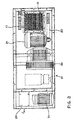
- Figures 1 and 2 illustrate the essential parts of the carding and defibrating machine according to the present invention, indicated with 10, respectively according to a section vertical and one horizontal. From the top, in direction of arrow A, we introduce the material fibrous in the upper part 11 of the carding and defibrating machine 10, by means of a feed hopper (not shown). Said material descends by gravity and falls on the reel 12 and on the screw feeder 13.
- the reel 12 is located above, on a shaft 14, tilted up.
- the reel 12 is equipped on its perimeter with spikes radial steel 15 which begins to crumble the material.
- the screw feeder 13, on a shaft 16 parallel to the shaft 14, is located below the reel 12 and grows the fibrous material forward, upward, up to the drop in a room 17 inside the machine.
- wheels 18 which constitute the opening and card group that defeats the fibers, crumbling the material into small parts homogeneous, thanks to toothed rings 19, provided at this effect, which are fitted on the axis of said wheels 18.
- the rotation of the wheels 18 is controlled by belts 20 powered by a motor 21.
- the toothed rings 19 are specifically illustrated in front view in Figure 5 and in section in the figure 6. They are characterized by long teeth 24 finger-shaped and which, with the rotation of the crowns 19 against each other, crumble, card and defibrate the material.
- the crumbled and carded material is then introduced into a lower thrust chamber 22, in which is located a wheel 23, on which are also fitted shaped toothed crowns 19.
- the wheel 23 channels the crumbled material in the direction of an internal pipe 25, slightly tilted upwards in the direction of the arrow B, material exit. Movement advancement of the fibrous material inside the pipe internal 25 is also and above all activated by a jet compressed air generated by a blower 26 which sucks fibers and pushes them by blowing them into the pipe delivery 28 to get them out of the machine defibrator in the direction of arrow C.
- Said delivery pipe 28 is connected to the outside to a flexible pipe 29, preferably having a diameter 50 mm .; it can even reach a length of 25 m.
- a flexible pipe 29 AT the end of said external flexible pipe 29 is the spraying apparatus 30, as shown schematically in the figure 4.
- the carding and defibrating machine 10 is equipped with tanks (not shown) and an independent pump 31 which sucks and pumps the liquid.
- a specific independent conduit 32 transports the liquid to the sprayer 30.
- the liquid can consist of an adhesive diluted with water or with a complementary roofing product.
- the adhesive diluted with water arrives at the device spraying by means of conduit 32 with the product fibrous which arrives at the spraying device by means of the flexible hose 29.
- the outlet of the spraying apparatus 30 was carried out with a flange end 33, in the center of which is located a single nozzle 34. From the central nozzle 34 is fan-shaped a jet of atomized liquid, consisting of water mixed with glue from conduit 32.
- valves 35, 36 located respectively on the duct 32 and on the pipe 29, near the sprayer 30 and so they can be adjusted by the operator during work, even at a certain distance from the machine.
Landscapes
- Chemical & Material Sciences (AREA)
- Engineering & Computer Science (AREA)
- Organic Chemistry (AREA)
- Materials Engineering (AREA)
- Ceramic Engineering (AREA)
- Structural Engineering (AREA)
- Metallurgy (AREA)
- Physics & Mathematics (AREA)
- Mechanical Engineering (AREA)
- Chemical Kinetics & Catalysis (AREA)
- Plasma & Fusion (AREA)
- Civil Engineering (AREA)
- Inorganic Chemistry (AREA)
- Architecture (AREA)
- Manufacturing & Machinery (AREA)
- Electromagnetism (AREA)
- Textile Engineering (AREA)
- Building Environments (AREA)
- Insulated Conductors (AREA)
- Fireproofing Substances (AREA)
Description
Claims (16)
- Technique pour l'isolation et la protection de structures métalliques contre le feu, caractérisée par le fait qu'elle est réalisée en projetant un produit fibreux de nature inorganique, à base de scories de haut fourneau sur les structures métalliques à isoler, ledit produit ayant des fibres en flocons qui sont ouvertes, cardées, défibrées et émiettées dans une machine carde-défibreuse spéciale (10) et en imprégnant le produit à la sortie, à l'aide d'un appareil de pulvérisation (30) avec un liquide atomisé constitué par un adhésif dilué dans de l'eau.
- Technique selon la revendication 1 caractérisée par le fait que dans la machine carde-défibreuse (10) sont prévus deux groupes de travail du matériau fibreux introduit dans la partie supérieure (11) de la machine (10), dont le premier groupe est constitué par deux arbres parallèles (14, 16) inclinés vers le haut qui supportent respectivement un dévidoir (12), situé au-dessus et un alimentateur à vis (13), ainsi qu'un deuxième groupe, ayant les axes perpendiculaires au premier, désigné comme groupe d'ouverture et carde, est constitué par des roues (18) placées dans une chambre (17), et que lesdites roues (18) ont, emboítées sur leur axe, des couronnes dentées façonnées spéciales (19) ayant de longues dents (24) en forme de doigts.
- Technique selon la revendication 1, caractérisée par le fait que le matériau à la sortie de la chambre (17) est introduit dans une chambre inférieure (22) de poussée dans laquelle une roue (23), sur laquelle sont emboítées des couronnes dentées façonnées (19), le dirige vers un tuyau interne (25), également grâce à un jet d'air comprimé engendré par une soufflante (26), matériau qui est ensuite dirigé, par courant d'air, dans un tuyau de refoulement (28) qui est connecté extérieurement à un tuyau flexible (29) à l'extrémité duquel se trouve l'appareil de pulvérisation (30), alors qu'une pompe indépendante (31) aspire d'un réservoir un liquide constitué par un adhésif dilué avec de l'eau et le pompe dans un conduit particulier indépendant (32) qui le transporte en même temps vers l'appareil de pulvérisation (30), imprégnant le matériau fibreux.
- Technique selon la revendication 1, caractérisée par le fait que le produit utilisé est constitué par un matériau fibreux inorganique à base de ciment, laine minérale, argile expansée, silicates contenant du fer et du magnésium, et par un faible pourcentage d'additifs minéraux naturels avec caractéristiques agglutinantes.
- Techniques selon les revendications 1 et 2, caractérisée par le fait que le dévidoir (12) est équipé de pointes en acier (15).
- Technique selon les revendications 1 et 4, caractérisée par le fait que le produit utilisé est constitué par les composants suivants, dont les pourcentages indiqués se réfèrent au poids: ciment 18%; laine minérale 60%, argile expansée 10%; silicates d'aluminium ou de métaux alcalins avec fer et magnésium 10%; additifs divers de minéraux naturels agglutinants, comme bentonites ou wollastonites, 2%, et que ledit produit a une densité de 190 Kg/m3 et qu'il est appliqué avec des épaisseurs allant de 20 mm. sur les renforts à 40 mm. sur les surfaces lisses.
- Technique selon les revendications 1 et 4, caractérisée par le fait que le produit utilisé est constitué par les composants suivants, dont les pourcentages indiqués se réfèrent au poids: ciment 15%; laine minérale 70%, argile expansée 7%; silicates d'aluminium ou de métaux alcalins avec fer et magnésium 7%; additifs divers de minéraux naturels agglutinants, comme bentonites ou wollastonites, 1%, et que ledit produit a une densité de 120 Kg/m3 et qu'il est appliqué avec des épaisseurs allant de 15 mm. à 40 mm.
- Technique selon la revendication 1, caractérisée par le fait que, au moyen de la machine carde-défibreuse (10), les surfaces à revêtir sont prétraitées avec un liquide constitué par un adhésif dilué dans de l'eau, en maintenant préalablement arrêté le refoulement du produit fibreux.
- Technique selon les revendications 1 et 3, caractérisée par le fait que dans le conduit (32) du liquide, l'adhésif dilué dans l'eau peut être remplacé par un produit complémentaire de couverture, lui aussi liquide, qui est pulvérisé sur les surfaces traitées toujours en utilisant la même machine (10), dans ce cas après avoir arrêté le refoulement du produit fibreux.
- Technique selon la revendication 1, caractérisée par le fait que l'appareil de pulvérisation (30) est constitué par une extrémité à bride (33), au centre de laquelle se trouve un seul gicleur (34) d'où sort en éventail un jet de liquide atomisé.
- Technique selon la revendication 1, caractérisée par le fait que les refoulements du produit et du liquide sont commandés par des soupapes (36, 35) situées à proximité de l'appareil de pulvérisation (30).
- Technique selon la revendication 1, caractérisée par le fait que l'adhésif est constitué par un seul composant à base de polymères acryliques purs en dispersion aqueuse, constitué par les composants suivants, dont les pourcentages indiqués se réfèrent au poids: 80% de dispersion de polymères acryliques purs, 2% d'additifs divers, 18% d'eau.
- Technique selon la revendication 1, caractérisée par le fait que, avec la même machine carde-défibreuse (10), on peut pulvériser un produit complémentaire de finition, constitué par un imprégnant, à base de silicates alcalins et polymères acryliques modifiés en solution aqueuse, ayant une action pénétrante optimale et qu'il est plus spécifiquement constitué par les composants suivants, dont les pourcentages indiqués se réfèrent au poids: 2% de dispersion de polymères acryliques modifiés, 70% de silicates alcalins, 1% d'additifs divers, 27% d'eau.
- Technique selon la revendication 1, caractérisée par le fait que, avec la même machine carde-défibreuse (10), on peut pulvériser un produit complémentaire de protection à base de dispersion de polymères vinyliques et de charges minérales inorganiques en solution aqueuse et que, de façon plus spécifique, il est constitué par les composants suivants, dont les pourcentages indiqués se réfèrent au poids: 18% de dispersion de polymères vinyliques, 15% de bioxyde de titane, 50% de charges minérales inorganiques, 2% d'additifs divers, 15% d'eau.
- Technique selon la revendication 1, caractérisée par le fait que, avec la même machine carde-défibreuse (10), on peut pulvériser un produit complémentaire imperméabilisant constitué par un seul composant, à base de charges et de pigments inorganiques, dans un véhicule composé par des résines acryliques et plastifiantes et de l'eau et que, de façon plus spécifique, il est constitué par les composants suivants, dont les pourcentages indiqués se réfèrent au poids: 50% de dispersion de charges et de pigments inorganiques, principalement oxydes, 20% de résines acryliques et plastifiantes, 30% d'eau.
- Technique selon la revendication 1, caractérisée par le fait que le procédé d'application du produit fibreux est le suivant: sur les surfaces à isoler on applique préalablement, à la main ou à l'aide de la même machine carde-défibreuse (10), une couche de matériau ancrant ou adhésif mélangé à de l'eau, avec une épaisseur de 0,01 mm., que l'on actionne ensuite la commande du refoulement du matériau fibreux, qui est cardé, défibré, effilé et émietté à l'intérieur de la machine (10), puis imprégné de liquide en correspondance de l'appareil de pulvérisation (30), que l'on ferme éventuellement le refoulement du matériau fibreux et que l'on pulvérise avec la même machine (10) un produit complémentaire.
Applications Claiming Priority (2)
| Application Number | Priority Date | Filing Date | Title |
|---|---|---|---|
| ITGE980059 | 1998-07-02 | ||
| IT98GE000059 IT1303620B1 (it) | 1998-07-02 | 1998-07-02 | Tecnica innovativa per l'isolamento e la protezione dal fuoco distrutture metalliche. |
Publications (2)
| Publication Number | Publication Date |
|---|---|
| EP0969072A1 EP0969072A1 (fr) | 2000-01-05 |
| EP0969072B1 true EP0969072B1 (fr) | 2003-11-26 |
Family
ID=11355181
Family Applications (1)
| Application Number | Title | Priority Date | Filing Date |
|---|---|---|---|
| EP19990112346 Expired - Lifetime EP0969072B1 (fr) | 1998-07-02 | 1999-06-28 | Technique pour l'isolation et la protection contre le feu de structures métalliques |
Country Status (3)
| Country | Link |
|---|---|
| EP (1) | EP0969072B1 (fr) |
| DE (1) | DE69913039D1 (fr) |
| IT (1) | IT1303620B1 (fr) |
Families Citing this family (2)
| Publication number | Priority date | Publication date | Assignee | Title |
|---|---|---|---|---|
| IT1314560B1 (it) * | 2000-12-06 | 2002-12-18 | Impresa Marinoni S R L | Fissaggio di telai per elementi di chiusura tagliafuoco e stagniall'acqua, a mezzo procedimento d'incollaggio. |
| CN113042240B (zh) * | 2021-04-27 | 2022-04-26 | 山东动向新材料科技有限公司 | 一种无机纤维自动化喷涂设备及方法 |
Family Cites Families (6)
| Publication number | Priority date | Publication date | Assignee | Title |
|---|---|---|---|---|
| SE383910B (sv) * | 1974-08-02 | 1976-04-05 | Sandell Bertil | Sett att tillverka betongkonstruktioner |
| US4095748A (en) * | 1975-07-04 | 1978-06-20 | Kanebo, Ltd. | Apparatus for mixing a cement slurry with a glass fiber |
| SE422427B (sv) * | 1977-10-17 | 1982-03-08 | Bertil Sandell | Sett att tillverka fiberarmerade byggnadskonstruktioner, ytbeleggningar och dylikt samt anordning for genomforande av settet |
| IT1122846B (it) * | 1978-09-25 | 1986-04-23 | Woellner Werke | Procedimento per isolare a spruzzo oggetti metallici e/o non metallici |
| US5401538A (en) * | 1992-04-16 | 1995-03-28 | W.R. Grace & Co.-Conn. | Sprayable portland cement-based fireproofing compositions |
| US5685903A (en) * | 1994-06-03 | 1997-11-11 | National Gypsum Company | Cementitious gypsum-containing compositions and materials made therefrom |
-
1998
- 1998-07-02 IT IT98GE000059 patent/IT1303620B1/it active IP Right Grant
-
1999
- 1999-06-28 EP EP19990112346 patent/EP0969072B1/fr not_active Expired - Lifetime
- 1999-06-28 DE DE69913039T patent/DE69913039D1/de not_active Expired - Lifetime
Also Published As
| Publication number | Publication date |
|---|---|
| EP0969072A1 (fr) | 2000-01-05 |
| ITGE980059A1 (it) | 2000-01-02 |
| ITGE980059A0 (it) | 1998-07-02 |
| IT1303620B1 (it) | 2000-11-15 |
| DE69913039D1 (de) | 2004-01-08 |
Similar Documents
| Publication | Publication Date | Title |
|---|---|---|
| EP0099801B1 (fr) | Procédé et dispositif pour la formation de feutre de fibres contenant un produit additionnel | |
| EP0835405B1 (fr) | Dispositif d'application d'un revetement interieur dans des tubes | |
| US5052756A (en) | Process for separation of asbestos-containing material and prevention of floating of dust | |
| US10259001B2 (en) | Water spray applied loose-fill insulation | |
| EP0195725B1 (fr) | Perfectionnement aux dispositifs de formation de fibres minérales au moyen de roues de centrifugation | |
| FR3038331A1 (fr) | Systeme et procede de projection de beton leger d'isolation | |
| EP0969072B1 (fr) | Technique pour l'isolation et la protection contre le feu de structures métalliques | |
| FR2923242A1 (fr) | Procede de projection en continu de beton de faible densite | |
| EP3491284B1 (fr) | Procede d'isolation et appareil obtenu | |
| EP0263029B1 (fr) | Produit isolant réalisé in-situ, fibres ou particules entrant dans sa composition et procédé de préparation | |
| EP0647505B1 (fr) | Procédé et installation de traitement de pièces métalliques revêtues ou non | |
| FR2477456A1 (fr) | Produit de decapement par jet | |
| BE1014429A3 (fr) | Procede et installation pour retirer , traiter et conditionner des matieres dangereuses. | |
| FR2947466A1 (fr) | Dispositif de projection d'une composition fibreuse ou pulverulente humidifiee comprenant des moyens pour homogeneiser la composition a projeter et procede de projection associe | |
| EP0271473B1 (fr) | Procédé pour appliquer un revêtement de parachèvement sur une face de parement d'un support poreux, en particulier une façade de béton cellulaire | |
| JPH05124398A (ja) | 塗膜剥離装置 | |
| FR2484054A1 (fr) | Revetement de protection mecanique d'un support metallique | |
| FR2580370A1 (fr) | Procede et installation pour le traitement et/ou le revetement des surfaces internes des tuyauteries | |
| FR3100138A1 (fr) | Pistolet pour projeter une couche isolante sur un plafond à l’aide d’un flux de liquide et procédé de production d’une telle couche isolante | |
| FR2509785A1 (en) | Consolidating walls of mine galleries - by simultaneous spraying with phenolic resin and chopped glass fibres using multicompartment spray gun | |
| EP0350420B1 (fr) | Ecran acoustique absorbant | |
| KR100528442B1 (ko) | 방수도막 형성용 스프레이 건 | |
| FR2719788A1 (fr) | Installation de décapage. | |
| FR2739039A1 (fr) | Procede et dispositif pour projeter sur une paroi une boue aqueuse pour former un revetement, et revetement ainsi obtenu | |
| FR2709257A1 (fr) | Procédé de nettoyage de bâtiment par très basse pression. |
Legal Events
| Date | Code | Title | Description |
|---|---|---|---|
| PUAI | Public reference made under article 153(3) epc to a published international application that has entered the european phase |
Free format text: ORIGINAL CODE: 0009012 |
|
| AK | Designated contracting states |
Kind code of ref document: A1 Designated state(s): DE ES FI FR |
|
| AX | Request for extension of the european patent |
Free format text: AL;LT;LV;MK;RO;SI |
|
| 17P | Request for examination filed |
Effective date: 20000629 |
|
| AKX | Designation fees paid |
Free format text: DE ES FI FR |
|
| GRAH | Despatch of communication of intention to grant a patent |
Free format text: ORIGINAL CODE: EPIDOS IGRA |
|
| GRAH | Despatch of communication of intention to grant a patent |
Free format text: ORIGINAL CODE: EPIDOS IGRA |
|
| GRAA | (expected) grant |
Free format text: ORIGINAL CODE: 0009210 |
|
| AK | Designated contracting states |
Kind code of ref document: B1 Designated state(s): DE ES FI FR |
|
| PG25 | Lapsed in a contracting state [announced via postgrant information from national office to epo] |
Ref country code: FI Free format text: LAPSE BECAUSE OF FAILURE TO SUBMIT A TRANSLATION OF THE DESCRIPTION OR TO PAY THE FEE WITHIN THE PRESCRIBED TIME-LIMIT Effective date: 20031126 |
|
| REF | Corresponds to: |
Ref document number: 69913039 Country of ref document: DE Date of ref document: 20040108 Kind code of ref document: P |
|
| PG25 | Lapsed in a contracting state [announced via postgrant information from national office to epo] |
Ref country code: DE Free format text: LAPSE BECAUSE OF FAILURE TO SUBMIT A TRANSLATION OF THE DESCRIPTION OR TO PAY THE FEE WITHIN THE PRESCRIBED TIME-LIMIT Effective date: 20040227 |
|
| PG25 | Lapsed in a contracting state [announced via postgrant information from national office to epo] |
Ref country code: ES Free format text: LAPSE BECAUSE OF FAILURE TO SUBMIT A TRANSLATION OF THE DESCRIPTION OR TO PAY THE FEE WITHIN THE PRESCRIBED TIME-LIMIT Effective date: 20040309 |
|
| PLBE | No opposition filed within time limit |
Free format text: ORIGINAL CODE: 0009261 |
|
| STAA | Information on the status of an ep patent application or granted ep patent |
Free format text: STATUS: NO OPPOSITION FILED WITHIN TIME LIMIT |
|
| 26N | No opposition filed |
Effective date: 20040827 |
|
| REG | Reference to a national code |
Ref country code: FR Ref legal event code: CD Ref country code: FR Ref legal event code: CA |
|
| PGFP | Annual fee paid to national office [announced via postgrant information from national office to epo] |
Ref country code: FR Payment date: 20080529 Year of fee payment: 10 |
|
| REG | Reference to a national code |
Ref country code: FR Ref legal event code: ST Effective date: 20100226 |
|
| PG25 | Lapsed in a contracting state [announced via postgrant information from national office to epo] |
Ref country code: FR Free format text: LAPSE BECAUSE OF NON-PAYMENT OF DUE FEES Effective date: 20090630 |