EP0969082A1 - Waschmittelteilchen - Google Patents
Waschmittelteilchen Download PDFInfo
- Publication number
- EP0969082A1 EP0969082A1 EP98959155A EP98959155A EP0969082A1 EP 0969082 A1 EP0969082 A1 EP 0969082A1 EP 98959155 A EP98959155 A EP 98959155A EP 98959155 A EP98959155 A EP 98959155A EP 0969082 A1 EP0969082 A1 EP 0969082A1
- Authority
- EP
- European Patent Office
- Prior art keywords
- detergent
- particle
- water
- particles
- detergent particles
- Prior art date
- Legal status (The legal status is an assumption and is not a legal conclusion. Google has not performed a legal analysis and makes no representation as to the accuracy of the status listed.)
- Granted
Links
- 0 CC(N(*)CC(*)O*)=O Chemical compound CC(N(*)CC(*)O*)=O 0.000 description 1
Images







Classifications
-
- C—CHEMISTRY; METALLURGY
- C11—ANIMAL OR VEGETABLE OILS, FATS, FATTY SUBSTANCES OR WAXES; FATTY ACIDS THEREFROM; DETERGENTS; CANDLES
- C11D—DETERGENT COMPOSITIONS; USE OF SINGLE SUBSTANCES AS DETERGENTS; SOAP OR SOAP-MAKING; RESIN SOAPS; RECOVERY OF GLYCEROL
- C11D17/00—Detergent materials or soaps characterised by their shape or physical properties
- C11D17/06—Powder; Flakes; Free-flowing mixtures; Sheets
-
- C—CHEMISTRY; METALLURGY
- C11—ANIMAL OR VEGETABLE OILS, FATS, FATTY SUBSTANCES OR WAXES; FATTY ACIDS THEREFROM; DETERGENTS; CANDLES
- C11D—DETERGENT COMPOSITIONS; USE OF SINGLE SUBSTANCES AS DETERGENTS; SOAP OR SOAP-MAKING; RESIN SOAPS; RECOVERY OF GLYCEROL
- C11D11/00—Special methods for preparing compositions containing mixtures of detergents
- C11D11/02—Preparation in the form of powder by spray drying
-
- C—CHEMISTRY; METALLURGY
- C11—ANIMAL OR VEGETABLE OILS, FATS, FATTY SUBSTANCES OR WAXES; FATTY ACIDS THEREFROM; DETERGENTS; CANDLES
- C11D—DETERGENT COMPOSITIONS; USE OF SINGLE SUBSTANCES AS DETERGENTS; SOAP OR SOAP-MAKING; RESIN SOAPS; RECOVERY OF GLYCEROL
- C11D17/00—Detergent materials or soaps characterised by their shape or physical properties
- C11D17/04—Detergent materials or soaps characterised by their shape or physical properties combined with or containing other objects
- C11D17/041—Compositions releasably affixed on a substrate or incorporated into a dispensing means
- C11D17/042—Water soluble or water disintegrable containers or substrates containing cleaning compositions or additives for cleaning compositions
- C11D17/044—Solid compositions
-
- C—CHEMISTRY; METALLURGY
- C11—ANIMAL OR VEGETABLE OILS, FATS, FATTY SUBSTANCES OR WAXES; FATTY ACIDS THEREFROM; DETERGENTS; CANDLES
- C11D—DETERGENT COMPOSITIONS; USE OF SINGLE SUBSTANCES AS DETERGENTS; SOAP OR SOAP-MAKING; RESIN SOAPS; RECOVERY OF GLYCEROL
- C11D17/00—Detergent materials or soaps characterised by their shape or physical properties
- C11D17/06—Powder; Flakes; Free-flowing mixtures; Sheets
- C11D17/065—High-density particulate detergent compositions
-
- C—CHEMISTRY; METALLURGY
- C11—ANIMAL OR VEGETABLE OILS, FATS, FATTY SUBSTANCES OR WAXES; FATTY ACIDS THEREFROM; DETERGENTS; CANDLES
- C11D—DETERGENT COMPOSITIONS; USE OF SINGLE SUBSTANCES AS DETERGENTS; SOAP OR SOAP-MAKING; RESIN SOAPS; RECOVERY OF GLYCEROL
- C11D3/00—Other compounding ingredients of detergent compositions covered in group C11D1/00
- C11D3/0005—Other compounding ingredients characterised by their effect
- C11D3/0052—Gas evolving or heat producing compositions
-
- C—CHEMISTRY; METALLURGY
- C11—ANIMAL OR VEGETABLE OILS, FATS, FATTY SUBSTANCES OR WAXES; FATTY ACIDS THEREFROM; DETERGENTS; CANDLES
- C11D—DETERGENT COMPOSITIONS; USE OF SINGLE SUBSTANCES AS DETERGENTS; SOAP OR SOAP-MAKING; RESIN SOAPS; RECOVERY OF GLYCEROL
- C11D3/00—Other compounding ingredients of detergent compositions covered in group C11D1/00
- C11D3/02—Inorganic compounds ; Elemental compounds
- C11D3/04—Water-soluble compounds
- C11D3/046—Salts
-
- C—CHEMISTRY; METALLURGY
- C11—ANIMAL OR VEGETABLE OILS, FATS, FATTY SUBSTANCES OR WAXES; FATTY ACIDS THEREFROM; DETERGENTS; CANDLES
- C11D—DETERGENT COMPOSITIONS; USE OF SINGLE SUBSTANCES AS DETERGENTS; SOAP OR SOAP-MAKING; RESIN SOAPS; RECOVERY OF GLYCEROL
- C11D3/00—Other compounding ingredients of detergent compositions covered in group C11D1/00
- C11D3/02—Inorganic compounds ; Elemental compounds
- C11D3/12—Water-insoluble compounds
Definitions
- Japanese Patent Laid-Open No. 5-247497 discloses a method of preparing a detergent composition having a high dissolubility, comprising, during the preparation of a crutcher slurry including zeolite, adding a citrate and spray-drying the mixture to obtain beads with improved strength, and applying a surfactant on the beads.
- Japanese Unexamined Patent Publication No. 3-504734 discloses a granular adsorbent including 45 to 75% by weight of zeolite, 1 to 6% by weight of a soap, 1 to 12% by weight of a polymer, 0 to 25% by weight of sodium sulfate, 0 to 5% by weight of a nonionic surfactant, and 10 to 24% by weight of water, and supporting a surfactant by its high adsorption ability, wherein the granular adsorbent by which the surfactant is supported has a good distributive behavior into the washing machine.
- an object of the present invention is to provide detergent particles having high-speed dissolubility capable of dissolving quickly in water after supplying the detergent particles in water, and a method for preparing the detergent particles, and a detergent composition comprising the detergent particles.
- the detergent particle as referred to in the present invention is a particle comprising a surfactant, a builder, and the like, and the detergent particles mean a collective thereof.
- the detergent composition means a composition comprising the detergent particles, and further comprising separately added detergent components other than the detergent particles (for instance, fluorescent dyes, enzymes, perfumes, defoaming agents, bleaching agents, bleaching activators, and the like).
- the bubble-releasing detergent particle having high-speed dissolubility by releasing a bubble described above is not limited to specified ones as to the particle shapes and structures, as long as it has pores (which may be a single pore or a plurality of pores) which can release a bubble having a given size.
- it may be a uni-core detergent particle which is explained in Section 4., or it may be a detergent particle other than the uni-core detergent particle, including, for example, a detergent particle in which the uni-core base particle is agglomerated (hereinafter referred to as "multi-core detergent particle" as described in Sections 6. and 7.).
- the bubble-releasing detergent particle constitutes 60% by weight or more, more preferably 80% by weight or more, of the detergent particles.
- the size of the pores can be measured as follows.
- carboxylic acid-based polymers such as a copolymer having a molecular weight of about several thousands to about 100,000 and represented by the following formula (I): wherein Z is an olefin having 1 to 8 carbon atoms, acrylic acid, methacrylic acid, itaconic acid, methallylsulfonic acid, or the like, which is a monomer copolymerizable with maleic acid (anhydride) or a maleate; m and n take such values that a molecular weight of the copolymer is several hundreds to 100,000; and M is Na, K, NH 4 , amine, or H; and/or a homopolymer having a molecular weight of about several thousands to about 100,000 represented by the formula (II): wherein p is a homopolymerizable monomer, exemplified by acrylic acid, methacrylic acid, maleic acid, or the like; q takes a value such that the molecular weight of the resulting homo
- water-soluble salt of (C) Component there can be included water-soluble inorganic salts typically exemplified by alkali metal salts, ammonium salts or amine salts of radicals such as carbonates, hydrogencarbonates, sulfates, sulfites, hydrogensulfates, phosphates, halides, or the like; and water-soluble organic acid salts having low-molecular weights such as citrates, fumarates, and the like.
- carbonates, sulfates, and sulfites are preferable.
- the inorganic salts are preferable because the pores in the detergent particle are further thermally expanded by causing hydration heat and dissolution heat by the reaction with water after preparation of the base particles, thereby accelerating the self-breakdown of the particle.
- the composition of the base particle is as follows.
- the water-insoluble inorganic compound of Component (A) is preferably from 20 to 90% by weight, more preferably from 30 to 75% by weight, most preferably from 40 to 70% by weight.
- the water-soluble polymer of Component (B) is preferably from 2 to 30% by weight, more preferably from 3 to 20% by weight, most preferably from 5 to 20% by weight.
- the water-soluble salts of Component (C) is preferably from 5 to 78% by weight, more preferably from 10 to 70% by weight, still more preferably from 10 to 67% by weight, particularly preferably from 20 to 60% by weight, most preferably from 20 to 55% by weight.
- surfactants and other auxiliary components suitably used in detergent compositions, such as fluorescent dyes, pigments and dyes.
- these water-insoluble inorganic compounds may be used alone or in combination of several kinds.
- aluminosilicates have an Si/Al (molar ratio) of 4.0 or less, preferably 3.3 or less.
- the measurement method for determining the structure of the base particle used in the present invention will be exemplified below.
- Each cell is charged with each base particle of two different states to conduct FT-IR/PAS measurement, and the structure of the base particle can be determined by comparing the measurement values.
- one FT-IR/PAS measurement is taken for the base particle in a state where the desired structure is retained, and another FT-IR/PAS measurement is taken for the comparative sample in which the base particle is in a uniform state by sufficiently grinding the base particle with an agate mortar.
- the FT-IR/PAS is measured, for instance, by using an infrared spectrometer "FTS-60A/896" (manufactured by Bio-Rad Laboratories), and the PAS cell includes an acoustic detector "Model 300" manufactured by MTEC Corporation.
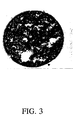
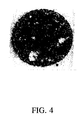
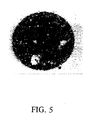
- Figures 2 to 6 each shows an SEM image of the base particle used in the present invention and EDS measurement results for Na, Al, Si and S.
- the illustrated base particle is Base Particle 1 of Examples.
- the anionic surfactant is preferably salts of esters obtained from an alcohol having 10 to 18 carbon atoms and sulfuric acid; salts of esters obtained from an alkoxylated product of an alcohol having 8 to 20 carbon atoms and sulfuric acid; alkylbenzenesulfonates; paraffinsulfonates; ⁇ -olefinsulfonates; salts of ⁇ -sulfonated fatty acids; salts of alkyl esters of ⁇ -sulfonated fatty acids; and salts of fatty acids.
- the linear alkylbenzenesulfonates of which an alkyl moiety has 10 to 14 carbon atoms, more preferably 12 to 14 carbon atoms are preferable.
- the counter ions a preference is given to the alkali metals and amines, and particularly sodium and/or potassium, monoethanolamine, and diethanolamine are preferable.
- the detergent particles of the present invention can be prepared by a method comprising the following Step (a) to Step (c):
- the temperature of the slurry is preferably from 30°C to 80°C, more preferably from 40° to 70°C.
- the temperature of the slurry is in the above range, it is preferable from the aspects of the dissolubility of the water-soluble components (B, C) and the liquid conveyability thereof with a pump.
- Step (b) comprises drying the slurry obtained in Step (a) to prepare base particles.
- the drying method of the slurry in order to allow the base particle to have pores capable of releasing a bubble of a desired size and also allow the base particle to have the localized structure of the components which are characteristic to the present invention, it is preferable that the slurry is instantaneously dried, and more preferably that spray-drying to form the resulting particle with a substantially spherical shape.
- the spray-drying tower may be either a countercurrent tower or concurrent tower, and the countercurrent tower is more preferable from the viewpoints of thermal efficiency and improvement in the particle strength of the base particles.
- the atomization device for the slurry may have any shapes of a pressure spray nozzle, a two-fluid spray nozzle, and a rotary wheel. From the viewpoint of having an average particle size of the resulting base particles of from 150 to 500 ⁇ m, preferably from 180 to 300 ⁇ m, the pressure spray nozzle is particularly preferable.
- the temperature of the high-temperature gas supplied to the drying tower is usually from 150° to 300°C, more preferably from 170° to 250°C.
- the temperature of the gas exhausted from the drying tower is usually from 70° to 125°C, more preferably from 80° to 115°C.
- Step (c) comprises supporting a surfactant to the base particles obtained in Step (b).
- the surfactant can be supported by the base particles by using known mixers in a batch process or continuous process.
- the method for supplying the base particles and the surfactant can be carried out, for instance, by the following various processes. Incidentally, each of the processes (1) to (3) is carried out with operating a mixer.
- surfactants which are present in the form of solids or pastes even when heated to a temperature within a practical temperature range, those surfactants can be added to the base particles in the form of a liquid mixture or aqueous solution by dispersing or dissolving the solid or paste-like surfactant in a low-viscosity surfactant, such as a nonionic surfactant, an aqueous solution of a nonionic surfactant or water, to prepare a liquid mixture or aqueous solution of surfactants.
- a low-viscosity surfactant such as a nonionic surfactant, an aqueous solution of a nonionic surfactant or water
- the surfactants which are present in the form of solids or pastes can be easily added to the base particles, thereby making it further advantageous in the preparation of the detergent particles comprising the unicore detergent particle.
- the mixing ratio of the low-viscosity surfactant or water to the solid or paste-like surfactant is preferably such that the resulting liquid mixture or aqueous solution has a viscosity in a sprayable range.
- the liquid mixture of surfactants which is easily sprayable can be obtained by adjusting its mixing ratio to 1:1.4 or less.
- Examples of the method for preparing the above liquid mixture include a method of supplying and mixing a solid or paste-like surfactant to a low-viscosity surfactant or water; or a method of neutralizing an acid precursor of a surfactant with an alkalizing agent (for instance, an aqueous sodium hydroxide or an aqueous potassium hydroxide) in a low-viscosity surfactant or water, to prepare a liquid mixture of surfactants.
- an alkalizing agent for instance, an aqueous sodium hydroxide or an aqueous potassium hydroxide
- the amount of the acid precursor of an anionic surfactant used is preferably from 0.5 to 30 parts by weight, more preferably from 1 to 20 parts, based on 100 parts by weight of the base particles.
- the amount of the acid precursor of an anionic surfactant used is in the above range, the uni-core properties of the particle in the detergent particles are likely to be maintained, and thereby the detergent particles show excellent high-speed dissolubility.
- the method for adding the acid precursor of an anionic surfactant it is preferable that those of a liquid state at an ambient temperature are supplied by spraying, and that those of a solid state at an ambient temperature can be added as a powder, or they may be supplied by spraying after melting the solid.
- the temperature of the detergent particles in the mixer is raised to a point where the powder melts.
- Concrete examples thereof include base materials showing metal ion capturing ability, such as zeolite and citrates; base materials showing alkalizing ability, such as sodium carbonate and potassium carbonate; base materials showing both metal ion capturing agent and alkalizing ability, such as crystalline silicates; and base materials enhancing ionic strength, such as sodium sulfate.
- metal ion capturing ability such as zeolite and citrates
- alkalizing ability such as sodium carbonate and potassium carbonate
- base materials showing both metal ion capturing agent and alkalizing ability such as crystalline silicates
- base materials enhancing ionic strength such as sodium sulfate.
- crystalline silicates disclosed in Japanese Patent Laid-Open No. 5-279013, column 3, line 17 to column 6, line 24 (in particular, those prepared by a method comprising calcinating and crystallizing at a temperature of 500° to 1000°C are preferable); Japanese Patent Laid-Open No. 7-89712, column 2, line 45 to column 9, line 34; and Japanese Patent Laid-Open No. 60-227895, page 2, lower right column, line 18 to page 4, upper right column, line 3 (particularly the silicates in Table 2 are preferable) can be used as powdery builders.
- the alkali metal silicates having an SiO 2 /M 2 O ratio, wherein M is an alkali metal, of from 0.5 to 3.2, preferably from 1.5 to 2.6 can be favorably used.
- the crystalline silicate compound When used, it is preferably used in admixture with fine powder other than the crystalline silicate compound for the purpose of preventing deterioration owing to agglomeration of the crystalline silicates by moisture absorption and CO 2 -absorption, and the like.
- the liquid materials include water-soluble polymers and fatty acids, which can be added in a state of aqueous solutions or a molten state.
- water-soluble polymer examples include carboxymethyl cellulose, polyethylene glycols, and polycarboxylates such as sodium polyacrylates and copolymers of acryl acid and maleic acid and salts thereof.
- the amount of the water-soluble polymer used is preferably from 0.5 to 10 parts by weight, more preferably from 1 to 8 parts by weight, particularly preferably from 2 to 6 parts by weight, based on 100 parts by weight of the detergent particles.
- the amount of the water-soluble polymer is in the above range, a powder showing excellent flowability and anti-caking properties can be obtained while the detergent particle contained in the detergent particles can maintain their uni-core property and have excellent high-speed dissolubility.
- the multi-core detergent particles have similar properties to those comprising the uni-core detergent particle described in Sections 4.2.3 through 4.2.7 above.
- the particle constituting the detergent composition which release a bubble from the inner portion of the particle of the size of one-tenth or more the particle size of the particle constituting the detergent composition occupies preferably 30% or more, more preferably 50% or more, still more preferably 80% or more, of the particle constituting the entire detergent composition.
- the detergent particles of the present invention were obtained by supporting a surfactant to Base Particles 1 in a proportion shown in Table 2. Twenty-three parts by weight of a nonionic surfactant shown in Table 2 were heated to a temperature of 50°C. Next, 100 parts by weight of Base Particles were supplied in Lödige Mixer (manufactured by Matsuzaka Giken Co., Ltd.; capacity: 20 liters; equipped with a jacket), and agitation was initiated with the mixer having a main axis (150 rpm) and a chopper (4,000 rpm). Incidentally, heated water of 60°C was supplied in the jacket at a flow rate of 10 liters/minute. To the above mixer, the nonionic surfactant was added in a period of 2 minutes, and thereafter the added mixture was agitated for 4 minutes, and the resulting mixture was discharged.
- Lödige Mixer manufactured by Matsuzaka Giken Co., Ltd.; capacity: 20 liters; equipped with a jacket
- the hollowness of the detergent particles was measured. As a result, it was found that pores with a pore size of 1/10 to 4/5 the particle size were found in 86% of the particle.
- the hollowness of the detergent particles was measured. As a result, it was found that pores with a pore size of 1/10 to 4/5 the particle size were found in 87% of the particle.
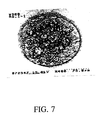
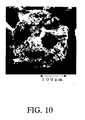
- An example of an SEM image of a split cross section when measuring the particle size and the pore size of an inner portion of the particle for the detergent particles is shown in Figure 12.
- Example 2 the dissolution behavior of the detergent particles was observed in the same manner as in Example 1. As a result, it was confirmed that a bubble with a size of 1/10 or more of the particle size was released from 89% of the particle (Here, an average value for size of a released bubble/particle size in the above 89% of the particle was 2.8/5.).
- the anti-caking properties of the detergent particles can be further improved, and the exudation of the nonionic surfactant can be further suppressed.
- the detergent particles of the present invention were obtained by adding to Base Particles 1, surfactants and other components in proportions shown in Table 2.
- the hollowness of the detergent particles was measured. As a result, it was found that pores with a pore size of 1/10 to 4/5 the particle size were found in 90% of the particle.
- Example 2 the dissolution behavior of the detergent particles was observed in the same manner as in Example 1. As a result, it was confirmed that a bubble with a size of 1/10 or more of the particle size was released from 88% of the particle (Here, an average value for size of a released bubble/particle size in the above 88% of the particle was 2.7/5.).
- an acid precursor of an anionic surfactant was used in such a manner that a nonionic surfactant was supplied into a mixer without mixing with the acid precursor, and thereafter an acid precursor of an anionic surfactant (dodecylbenzenesulfonic acid) was supplied into the mixer to obtain the detergent particles of the present invention.
- an acid precursor of an anionic surfactant dodecylbenzenesulfonic acid
- Base Particles 1 were used as the base particles.
- the detergent particles of the present invention were obtained by adding surfactants and other components to Base Particles 1 in proportions shown in Table 2.
- the hollowness of the detergent particles was measured. As a result, it was found that pores with a pore size of 1/10 to 4/5 the particle size were found in 86% of the particle.
- the detergent particles were obtained in the same manner as in Example 3 except for using as Base Particles particles classified between 125 ⁇ m-sieve opening and 180 ⁇ m-sieve opening by sieving Base Particles 1.
- the split cross section of the detergent particle was observed by SEM. As a result, it was confirmed that the detergent particle had a particle structure of the multi-core detergent particle. Moreover, the dissolution behavior of the detergent particles was observed in the same manner as in Example 1. As a result, it was confirmed that a bubble with a size of 1/10 or more of the particle size was released from 68% of the particle (Here, an average value for size of a released bubble/particle size in the above 68% of the particle was 1.5/10.).
- the detergent composition of the present invention was obtained by adding the enzyme granules to the detergent particles of Example 3 in a proportion shown in Table 3.
- the properties of the resulting detergent composition is shown in Table 3.
- Example 7 Example 8 Composition Detergent Particles 100 Parts (Example 3) 100 Parts (Example 6) Enzyme Granules 4 Parts 2 Parts Properties Average Particle Size [ ⁇ m] 245 260 Bulk Density [g/liter] 670 620 Sixty-Sec. Dissolution Rate [%] 96 91 Thirty-Sec. Dissolution Rate [%] 91 82
- the detergent composition of the present invention was obtained by adding the enzyme granules to the detergent particles of Example 6 in a proportion shown in Table 3.
- the properties of the resulting detergent composition is shown in Table 3.
- the enzyme in the enzyme granules in Table 3 is "Savinase 18T type W" manufactured by Novo Industry.
- detergent particles having high-speed dissolubility and a detergent composition comprising these detergent particles.
- a detergent composition comprising these detergent particles.
Landscapes
- Chemical & Material Sciences (AREA)
- Life Sciences & Earth Sciences (AREA)
- Engineering & Computer Science (AREA)
- Chemical Kinetics & Catalysis (AREA)
- Oil, Petroleum & Natural Gas (AREA)
- Wood Science & Technology (AREA)
- Organic Chemistry (AREA)
- Inorganic Chemistry (AREA)
- Detergent Compositions (AREA)
Priority Applications (1)
| Application Number | Priority Date | Filing Date | Title |
|---|---|---|---|
| DE69839180.2T DE69839180T3 (de) | 1997-12-10 | 1998-12-10 | Waschmittelteilchen |
Applications Claiming Priority (5)
| Application Number | Priority Date | Filing Date | Title |
|---|---|---|---|
| JP34001697 | 1997-12-10 | ||
| JP34001697 | 1997-12-10 | ||
| JP17521198 | 1998-06-22 | ||
| JP17521198 | 1998-06-22 | ||
| PCT/JP1998/005589 WO1999029830A1 (en) | 1997-12-10 | 1998-12-10 | Detergent particles |
Publications (4)
| Publication Number | Publication Date |
|---|---|
| EP0969082A1 true EP0969082A1 (de) | 2000-01-05 |
| EP0969082A4 EP0969082A4 (de) | 2003-01-15 |
| EP0969082B1 EP0969082B1 (de) | 2008-02-27 |
| EP0969082B2 EP0969082B2 (de) | 2013-10-16 |
Family
ID=26496545
Family Applications (1)
| Application Number | Title | Priority Date | Filing Date |
|---|---|---|---|
| EP98959155.7A Expired - Lifetime EP0969082B2 (de) | 1997-12-10 | 1998-12-10 | Waschmittelteilchen |
Country Status (12)
| Country | Link |
|---|---|
| US (2) | US6376453B1 (de) |
| EP (1) | EP0969082B2 (de) |
| JP (1) | JP3123757B2 (de) |
| KR (1) | KR100653152B1 (de) |
| CN (1) | CN1163581C (de) |
| AU (2) | AU1351299A (de) |
| DE (1) | DE69839180T3 (de) |
| ES (1) | ES2299220T5 (de) |
| ID (1) | ID22134A (de) |
| MY (1) | MY118203A (de) |
| TW (1) | TW460575B (de) |
| WO (2) | WO1999029829A1 (de) |
Cited By (5)
| Publication number | Priority date | Publication date | Assignee | Title |
|---|---|---|---|---|
| EP1115838A1 (de) * | 1998-09-25 | 2001-07-18 | The Procter & Gamble Company | Granulare waschmittelzusammensetzung mit verbesserter löslichkeit |
| US6602846B1 (en) | 1999-06-14 | 2003-08-05 | Kao Corporation | Method for producing single nucleus detergent particles |
| WO2004022694A1 (en) * | 2002-09-06 | 2004-03-18 | Kao Corporation | Detergent particles |
| WO2004022688A1 (en) * | 2002-09-06 | 2004-03-18 | Kao Corporation | Detergent particles |
| US6894019B2 (en) | 2000-12-18 | 2005-05-17 | Kao Corporation | Base particles and detergent particles |
Families Citing this family (31)
| Publication number | Priority date | Publication date | Assignee | Title |
|---|---|---|---|---|
| AU1351299A (en) | 1997-12-10 | 1999-06-28 | Kao Corporation | Detergent particles and method for producing the same |
| JP3412811B2 (ja) | 1999-05-27 | 2003-06-03 | 花王株式会社 | 洗剤粒子群の製法 |
| EP1041139B1 (de) | 1998-10-16 | 2004-12-22 | Kao Corporation | Verfahren zur herstellung von detergentteilchen |
| CN1163580C (zh) | 1998-12-28 | 2004-08-25 | 花王株式会社 | 表面活性剂载体颗粒的制造方法 |
| EP1146114A4 (de) * | 1999-01-18 | 2004-06-02 | Kao Corp | Waschmittelzusammensetzung mit hohem schüttgewicht |
| US6864221B1 (en) * | 1999-06-14 | 2005-03-08 | Kao Corporation | Granules for carrying surfactant and method for producing the same |
| WO2000077157A1 (fr) * | 1999-06-14 | 2000-12-21 | Kao Corporation | Composition de detergent |
| CN1170921C (zh) * | 1999-06-14 | 2004-10-13 | 花王株式会社 | 基本颗粒物和颗粒状洗涤剂 |
| JP3352977B2 (ja) * | 1999-06-15 | 2002-12-03 | 花王株式会社 | 固形状洗剤 |
| US6818605B1 (en) | 1999-06-16 | 2004-11-16 | Kao Corporation | Granulated detergent composition |
| DE60040462D1 (de) * | 1999-06-16 | 2008-11-20 | Kao Corp | Teilchenförmiges waschmitteladditiv |
| JP4116195B2 (ja) * | 1999-06-16 | 2008-07-09 | 花王株式会社 | 板状洗剤 |
| JP3516636B2 (ja) | 1999-06-16 | 2004-04-05 | 花王株式会社 | 粒状洗剤組成物 |
| CN1179032C (zh) * | 1999-06-16 | 2004-12-08 | 花王株式会社 | 洗涤剂粒子群 |
| CN1091357C (zh) * | 2000-06-23 | 2002-09-25 | 杨民杰 | 胶原肉蛋白干粉提取方法 |
| JP4573960B2 (ja) * | 2000-07-10 | 2010-11-04 | 花王株式会社 | 洗剤組成物 |
| US7142296B2 (en) | 2000-10-30 | 2006-11-28 | Sru Biosystems, Inc. | Method and apparatus for detecting biomolecular interactions |
| US6803222B2 (en) | 2000-11-22 | 2004-10-12 | Kao Corporation | Alkaline proteases |
| JP2003129099A (ja) * | 2001-10-24 | 2003-05-08 | Kao Corp | 衣料用粉末洗剤組成物 |
| DE10152161A1 (de) * | 2001-10-25 | 2003-05-15 | Henkel Kgaa | Mittel und Vorrichtung sowie Verfahren zu seiner Herstellung |
| JP4189213B2 (ja) * | 2002-08-30 | 2008-12-03 | 花王株式会社 | 洗剤粒子 |
| US8218052B2 (en) * | 2003-03-07 | 2012-07-10 | Iconix Video, Inc. | High frame rate high definition imaging system and method |
| DE102004011087A1 (de) * | 2004-03-06 | 2005-09-22 | Henkel Kgaa | Partikel umfassend diskrete, feinpartikuläre Tensidpartikel |
| ES2420761T3 (es) * | 2004-08-06 | 2013-08-26 | Kao Corporation | Procedimiento de producción de partículas de detergente de núcleo único |
| EP2045316A1 (de) * | 2007-09-24 | 2009-04-08 | The Procter and Gamble Company | Reinigungsmittelpartikel |
| EP2045315A1 (de) * | 2007-09-24 | 2009-04-08 | The Procter and Gamble Company | Geschirrspülverfahren |
| US8309505B2 (en) * | 2009-07-30 | 2012-11-13 | The Procter & Gamble Company | Hand dish composition in the form of an article |
| US8367596B2 (en) * | 2009-07-30 | 2013-02-05 | The Procter & Gamble Company | Laundry detergent compositions in the form of an article |
| JP2015143323A (ja) * | 2013-12-26 | 2015-08-06 | 花王株式会社 | 洗剤粒子群の製造方法 |
| CN108128857B (zh) * | 2017-12-29 | 2020-08-21 | 佛山市南海东方澳龙制药有限公司 | 一种维持禽畜饮水清洁的复合有机酸化剂及其应用 |
| WO2025108695A1 (en) | 2023-11-22 | 2025-05-30 | Unilever Ip Holdings B.V. | Laundry composition |
Family Cites Families (39)
| Publication number | Priority date | Publication date | Assignee | Title |
|---|---|---|---|---|
| US2364767A (en) * | 1944-12-12 | Detergent composition | ||
| US2874123A (en) * | 1954-09-07 | 1959-02-17 | Colgate Palmolive Co | Process for the preparation of granular compositions |
| NL269436A (de) * | 1960-09-23 | |||
| NL131792C (de) * | 1964-07-17 | |||
| US3454499A (en) * | 1966-04-05 | 1969-07-08 | Procter & Gamble | Process for preparing a crystalline uniformly sized granular detergent composition |
| US3450494A (en) * | 1967-07-18 | 1969-06-17 | Conrad J Gaiser | Amorphous sodium silicate having inherent binding properties and method of producing same |
| US3549541A (en) * | 1968-05-31 | 1970-12-22 | Colgate Palmolive Co | Enzyme carrying detergent particles |
| US3579299A (en) * | 1968-07-30 | 1971-05-18 | Philadelphia Quartz Co | Porous silicate |
| US3562171A (en) * | 1968-12-31 | 1971-02-09 | Procter & Gamble | Oxygen carrier for detergent compositions |
| JPS4835329B1 (de) * | 1969-12-03 | 1973-10-27 | ||
| US3926827A (en) † | 1973-03-29 | 1975-12-16 | Colgate Palmolive Co | Method for making detergent compositions |
| US4126563A (en) * | 1974-07-08 | 1978-11-21 | Graham Barker | Composition for treating fabrics, method for making and using the same |
| US4406808A (en) * | 1977-10-06 | 1983-09-27 | Colgate-Palmolive Company | High bulk density carbonate-zeolite built heavy duty nonionic laundry detergent |
| US5024778A (en) * | 1981-02-26 | 1991-06-18 | Colgate-Palmolive Company | Spray dried base beads for detergent compositions containing zeolite, bentonite and polyphosphate |
| US5080820A (en) * | 1981-02-26 | 1992-01-14 | Colgate-Palmolive Co. | Spray dried base beads for detergent compositions containing zeolite, bentonite and polyphosphate |
| DE3444960A1 (de) † | 1984-12-10 | 1986-06-12 | Henkel KGaA, 4000 Düsseldorf | Koerniges adsorptionsmittel |
| DE3617756C2 (de) * | 1985-05-29 | 1995-01-19 | Lion Corp | Verfahren zum Herstellen einer granularen Detergentien-Zusammensetzung mit hoher Schüttdichte |
| EP0229671B1 (de) * | 1986-01-17 | 1991-03-13 | Kao Corporation | Granuliertes Reinigungsmittel von hoher Dichte |
| CA1286563C (en) * | 1986-04-04 | 1991-07-23 | Jan Hendrik Eertink | Detergent powders and processes for preparing them |
| DE3818829A1 (de) * | 1988-06-03 | 1989-12-14 | Henkel Kgaa | Koerniges adsorptionsmittel mit verbessertem einspuelverhalten |
| JPH0819439B2 (ja) * | 1988-10-12 | 1996-02-28 | ライオン株式会社 | 高嵩密度粒状洗剤組成物 |
| JP3192470B2 (ja) * | 1991-05-17 | 2001-07-30 | 花王株式会社 | ノニオン活性剤含有粒状組成物の製造法 |
| JP3192469B2 (ja) * | 1991-05-17 | 2001-07-30 | 花王株式会社 | ノニオン洗剤粒子の製造方法 |
| MX9202828A (es) † | 1991-06-28 | 1992-12-01 | Colgate Palmolive Co | Composiciones detergentes secadas por rociado a base de zeolita y proceso para la preparacion de las mismas. |
| JP3172754B2 (ja) * | 1992-10-05 | 2001-06-04 | ライオン株式会社 | 高嵩密度粒状洗剤組成物 |
| US5443751A (en) * | 1993-03-05 | 1995-08-22 | Church & Dwight Co. Inc. | Powder detergent composition for cold water washing of fabrics |
| EP0639637A1 (de) * | 1993-08-17 | 1995-02-22 | The Procter & Gamble Company | Percarbonat-Bleichmittel enthaltende Waschmittelzusammensetzungen |
| GB9323300D0 (en) * | 1993-11-11 | 1994-01-05 | Unilever Plc | Detergent composition |
| JPH0873888A (ja) * | 1994-09-09 | 1996-03-19 | Lion Corp | 高嵩密度粒状洗剤組成物の製造方法 |
| JP3694063B2 (ja) * | 1995-05-31 | 2005-09-14 | 花王株式会社 | 高密度粒状洗剤組成物の製造方法 |
| JPH0913097A (ja) * | 1995-06-30 | 1997-01-14 | Lion Corp | 高嵩密度漂白洗剤の製造方法 |
| JP3008266B2 (ja) * | 1995-11-06 | 2000-02-14 | 花王株式会社 | 結晶性アルカリ金属ケイ酸塩顆粒の製造方法及び衣料用の高嵩密度粒状洗剤組成物 |
| CN1218500A (zh) | 1996-03-08 | 1999-06-02 | 普罗格特-甘布尔公司 | 包含仲烷基硫酸盐的附聚高密度洗涤剂组合物及其制法 |
| TW370561B (en) * | 1996-03-15 | 1999-09-21 | Kao Corp | High-density granular detergent composition for clothes washing |
| AU1351299A (en) | 1997-12-10 | 1999-06-28 | Kao Corporation | Detergent particles and method for producing the same |
| JP3071427B2 (ja) | 1998-10-09 | 2000-07-31 | 花王株式会社 | 酵素粒子 |
| JP3269616B2 (ja) | 1998-10-16 | 2002-03-25 | 花王株式会社 | 単核性洗剤粒子群の製法 |
| JP3617782B2 (ja) | 1998-12-25 | 2005-02-09 | 花王株式会社 | 高嵩密度洗剤組成物 |
| JP4063431B2 (ja) | 1998-12-28 | 2008-03-19 | 花王株式会社 | 高嵩密度洗剤粒子群 |
-
1998
- 1998-12-02 AU AU13512/99A patent/AU1351299A/en not_active Abandoned
- 1998-12-02 WO PCT/JP1998/005454 patent/WO1999029829A1/en not_active Ceased
- 1998-12-04 TW TW087120183A patent/TW460575B/zh not_active IP Right Cessation
- 1998-12-08 MY MYPI98005536A patent/MY118203A/en unknown
- 1998-12-10 DE DE69839180.2T patent/DE69839180T3/de not_active Expired - Lifetime
- 1998-12-10 US US09/355,032 patent/US6376453B1/en not_active Expired - Lifetime
- 1998-12-10 ES ES98959155.7T patent/ES2299220T5/es not_active Expired - Lifetime
- 1998-12-10 AU AU15055/99A patent/AU744709B2/en not_active Ceased
- 1998-12-10 ID IDW990783A patent/ID22134A/id unknown
- 1998-12-10 EP EP98959155.7A patent/EP0969082B2/de not_active Expired - Lifetime
- 1998-12-10 CN CNB98804045XA patent/CN1163581C/zh not_active Expired - Fee Related
- 1998-12-10 KR KR1019997007078A patent/KR100653152B1/ko not_active Expired - Fee Related
- 1998-12-10 WO PCT/JP1998/005589 patent/WO1999029830A1/ja not_active Ceased
- 1998-12-10 JP JP11530654A patent/JP3123757B2/ja not_active Expired - Fee Related
-
2002
- 2002-02-05 US US10/062,487 patent/US20020155977A1/en not_active Abandoned
Cited By (9)
| Publication number | Priority date | Publication date | Assignee | Title |
|---|---|---|---|---|
| EP1115838A1 (de) * | 1998-09-25 | 2001-07-18 | The Procter & Gamble Company | Granulare waschmittelzusammensetzung mit verbesserter löslichkeit |
| US6602846B1 (en) | 1999-06-14 | 2003-08-05 | Kao Corporation | Method for producing single nucleus detergent particles |
| US6894019B2 (en) | 2000-12-18 | 2005-05-17 | Kao Corporation | Base particles and detergent particles |
| EP1215277B2 (de) † | 2000-12-18 | 2009-11-25 | Kao Corporation | Trägerpartikel sowie Waschmittelteilchen |
| WO2004022694A1 (en) * | 2002-09-06 | 2004-03-18 | Kao Corporation | Detergent particles |
| WO2004022688A1 (en) * | 2002-09-06 | 2004-03-18 | Kao Corporation | Detergent particles |
| US7446085B2 (en) | 2002-09-06 | 2008-11-04 | Kao Corporation | Process for preparing detergent particles |
| KR100904970B1 (ko) * | 2002-09-06 | 2009-06-26 | 카오카부시키가이샤 | 세제 입자 |
| CN1678726B (zh) * | 2002-09-06 | 2010-10-06 | 花王株式会社 | 洗涤剂颗粒 |
Also Published As
| Publication number | Publication date |
|---|---|
| WO1999029829A1 (en) | 1999-06-17 |
| ES2299220T5 (es) | 2014-01-16 |
| JP3123757B2 (ja) | 2001-01-15 |
| EP0969082A4 (de) | 2003-01-15 |
| MY118203A (en) | 2004-09-30 |
| AU1505599A (en) | 1999-06-28 |
| ID22134A (id) | 1999-09-09 |
| DE69839180T2 (de) | 2009-02-19 |
| AU1351299A (en) | 1999-06-28 |
| EP0969082B2 (de) | 2013-10-16 |
| KR100653152B1 (ko) | 2006-12-01 |
| DE69839180T3 (de) | 2014-01-16 |
| TW460575B (en) | 2001-10-21 |
| WO1999029830A1 (en) | 1999-06-17 |
| CN1252095A (zh) | 2000-05-03 |
| CN1163581C (zh) | 2004-08-25 |
| US6376453B1 (en) | 2002-04-23 |
| EP0969082B1 (de) | 2008-02-27 |
| ES2299220T3 (es) | 2008-05-16 |
| KR20000070815A (ko) | 2000-11-25 |
| US20020155977A1 (en) | 2002-10-24 |
| DE69839180D1 (de) | 2008-04-10 |
| HK1026451A1 (en) | 2000-12-15 |
| AU744709B2 (en) | 2002-02-28 |
Similar Documents
| Publication | Publication Date | Title |
|---|---|---|
| US6376453B1 (en) | Detergent particles | |
| JPWO1999029830A1 (ja) | 洗剤粒子 | |
| EP1306424A1 (de) | Verfahren zur herstellung von körnern als träger für tenside | |
| AU768794B2 (en) | Particulate detergent composition containing zeolite | |
| EP1061126B1 (de) | Feste Formkörper Waschmittel | |
| EP1186651A1 (de) | TEILCHENFöRMIGES WASCHMITTEL | |
| US6864221B1 (en) | Granules for carrying surfactant and method for producing the same | |
| JP3422727B2 (ja) | 洗剤組成物 | |
| JPWO2000077159A1 (ja) | 洗剤添加用粒子群 | |
| JP3912986B2 (ja) | ベース顆粒群及び洗剤粒子群 | |
| US6849590B1 (en) | Process for producing granules for supporting surfactant | |
| CA2376221C (en) | Detergent composition containing zeolite map | |
| US6534474B1 (en) | Surfactant composition | |
| JPWO2000039265A1 (ja) | 界面活性剤担持用顆粒群の製法 | |
| JP4889870B2 (ja) | 衣料用粉末洗剤組成物 | |
| JP3881821B2 (ja) | 高嵩密度洗剤粒子群 | |
| JP2001123198A (ja) | 界面活性剤組成物 | |
| JPWO2000077160A1 (ja) | 洗剤粒子群 |
Legal Events
| Date | Code | Title | Description |
|---|---|---|---|
| PUAI | Public reference made under article 153(3) epc to a published international application that has entered the european phase |
Free format text: ORIGINAL CODE: 0009012 |
|
| 17P | Request for examination filed |
Effective date: 19990913 |
|
| AK | Designated contracting states |
Kind code of ref document: A1 Designated state(s): DE ES FR GB |
|
| A4 | Supplementary search report drawn up and despatched |
Effective date: 20021203 |
|
| AK | Designated contracting states |
Kind code of ref document: A4 Designated state(s): DE ES FR GB |
|
| 17Q | First examination report despatched |
Effective date: 20030304 |
|
| 17Q | First examination report despatched |
Effective date: 20030304 |
|
| GRAP | Despatch of communication of intention to grant a patent |
Free format text: ORIGINAL CODE: EPIDOSNIGR1 |
|
| GRAS | Grant fee paid |
Free format text: ORIGINAL CODE: EPIDOSNIGR3 |
|
| GRAA | (expected) grant |
Free format text: ORIGINAL CODE: 0009210 |
|
| AK | Designated contracting states |
Kind code of ref document: B1 Designated state(s): DE ES FR GB |
|
| REG | Reference to a national code |
Ref country code: GB Ref legal event code: FG4D |
|
| REF | Corresponds to: |
Ref document number: 69839180 Country of ref document: DE Date of ref document: 20080410 Kind code of ref document: P |
|
| REG | Reference to a national code |
Ref country code: ES Ref legal event code: FG2A Ref document number: 2299220 Country of ref document: ES Kind code of ref document: T3 |
|
| ET | Fr: translation filed | ||
| PLBI | Opposition filed |
Free format text: ORIGINAL CODE: 0009260 |
|
| 26 | Opposition filed |
Opponent name: UNILEVER PLC Effective date: 20081127 |
|
| PLAX | Notice of opposition and request to file observation + time limit sent |
Free format text: ORIGINAL CODE: EPIDOSNOBS2 |
|
| PLAF | Information modified related to communication of a notice of opposition and request to file observations + time limit |
Free format text: ORIGINAL CODE: EPIDOSCOBS2 |
|
| PLBB | Reply of patent proprietor to notice(s) of opposition received |
Free format text: ORIGINAL CODE: EPIDOSNOBS3 |
|
| PLCK | Communication despatched that opposition was rejected |
Free format text: ORIGINAL CODE: EPIDOSNREJ1 |
|
| APAH | Appeal reference modified |
Free format text: ORIGINAL CODE: EPIDOSCREFNO |
|
| APBM | Appeal reference recorded |
Free format text: ORIGINAL CODE: EPIDOSNREFNO |
|
| APBP | Date of receipt of notice of appeal recorded |
Free format text: ORIGINAL CODE: EPIDOSNNOA2O |
|
| PLAB | Opposition data, opponent's data or that of the opponent's representative modified |
Free format text: ORIGINAL CODE: 0009299OPPO |
|
| R26 | Opposition filed (corrected) |
Opponent name: UNILEVER PLC Effective date: 20081127 |
|
| APBQ | Date of receipt of statement of grounds of appeal recorded |
Free format text: ORIGINAL CODE: EPIDOSNNOA3O |
|
| APBU | Appeal procedure closed |
Free format text: ORIGINAL CODE: EPIDOSNNOA9O |
|
| PUAH | Patent maintained in amended form |
Free format text: ORIGINAL CODE: 0009272 |
|
| STAA | Information on the status of an ep patent application or granted ep patent |
Free format text: STATUS: PATENT MAINTAINED AS AMENDED |
|
| 27A | Patent maintained in amended form |
Effective date: 20131016 |
|
| AK | Designated contracting states |
Kind code of ref document: B2 Designated state(s): DE ES FR GB |
|
| REG | Reference to a national code |
Ref country code: DE Ref legal event code: R102 Ref document number: 69839180 Country of ref document: DE Effective date: 20131016 |
|
| REG | Reference to a national code |
Ref country code: ES Ref legal event code: DC2A Ref document number: 2299220 Country of ref document: ES Kind code of ref document: T5 Effective date: 20140116 |
|
| PGFP | Annual fee paid to national office [announced via postgrant information from national office to epo] |
Ref country code: GB Payment date: 20141210 Year of fee payment: 17 Ref country code: DE Payment date: 20141202 Year of fee payment: 17 Ref country code: ES Payment date: 20141111 Year of fee payment: 17 |
|
| PGFP | Annual fee paid to national office [announced via postgrant information from national office to epo] |
Ref country code: FR Payment date: 20141208 Year of fee payment: 17 |
|
| REG | Reference to a national code |
Ref country code: DE Ref legal event code: R119 Ref document number: 69839180 Country of ref document: DE |
|
| GBPC | Gb: european patent ceased through non-payment of renewal fee |
Effective date: 20151210 |
|
| REG | Reference to a national code |
Ref country code: FR Ref legal event code: ST Effective date: 20160831 |
|
| PG25 | Lapsed in a contracting state [announced via postgrant information from national office to epo] |
Ref country code: DE Free format text: LAPSE BECAUSE OF NON-PAYMENT OF DUE FEES Effective date: 20160701 Ref country code: GB Free format text: LAPSE BECAUSE OF NON-PAYMENT OF DUE FEES Effective date: 20151210 |
|
| PG25 | Lapsed in a contracting state [announced via postgrant information from national office to epo] |
Ref country code: FR Free format text: LAPSE BECAUSE OF NON-PAYMENT OF DUE FEES Effective date: 20151231 |
|
| REG | Reference to a national code |
Ref country code: ES Ref legal event code: FD2A Effective date: 20170127 |
|
| PG25 | Lapsed in a contracting state [announced via postgrant information from national office to epo] |
Ref country code: ES Free format text: LAPSE BECAUSE OF NON-PAYMENT OF DUE FEES Effective date: 20151211 |