EP0969420B1 - Procédé pour sécuriser la transmission de données de service à un terminal et dispositif pour la mise en oeuvre de ce procédé - Google Patents
Procédé pour sécuriser la transmission de données de service à un terminal et dispositif pour la mise en oeuvre de ce procédé Download PDFInfo
- Publication number
- EP0969420B1 EP0969420B1 EP99250182A EP99250182A EP0969420B1 EP 0969420 B1 EP0969420 B1 EP 0969420B1 EP 99250182 A EP99250182 A EP 99250182A EP 99250182 A EP99250182 A EP 99250182A EP 0969420 B1 EP0969420 B1 EP 0969420B1
- Authority
- EP
- European Patent Office
- Prior art keywords
- data
- terminal device
- postage
- checksum
- information
- Prior art date
- Legal status (The legal status is an assumption and is not a legal conclusion. Google has not performed a legal analysis and makes no representation as to the accuracy of the status listed.)
- Expired - Lifetime
Links
- 238000000034 method Methods 0.000 title claims description 31
- 238000012546 transfer Methods 0.000 title description 3
- 230000015654 memory Effects 0.000 claims description 54
- 238000004891 communication Methods 0.000 claims description 34
- 230000005540 biological transmission Effects 0.000 claims description 28
- 238000003860 storage Methods 0.000 claims description 15
- 238000012545 processing Methods 0.000 claims description 13
- 238000012432 intermediate storage Methods 0.000 claims description 5
- 238000004364 calculation method Methods 0.000 claims description 4
- 238000013478 data encryption standard Methods 0.000 description 8
- 230000015572 biosynthetic process Effects 0.000 description 6
- 238000010586 diagram Methods 0.000 description 6
- 238000009434 installation Methods 0.000 description 5
- 230000003139 buffering effect Effects 0.000 description 4
- 239000000969 carrier Substances 0.000 description 3
- 241000735234 Ligustrum Species 0.000 description 2
- 230000021917 activation of membrane attack complex Effects 0.000 description 2
- 230000006870 function Effects 0.000 description 2
- 238000013459 approach Methods 0.000 description 1
- 238000005266 casting Methods 0.000 description 1
- 238000012217 deletion Methods 0.000 description 1
- 230000037430 deletion Effects 0.000 description 1
- 238000011161 development Methods 0.000 description 1
- 230000018109 developmental process Effects 0.000 description 1
- 239000003822 epoxy resin Substances 0.000 description 1
- 238000007689 inspection Methods 0.000 description 1
- 229920000647 polyepoxide Polymers 0.000 description 1
- 238000007789 sealing Methods 0.000 description 1
- 238000012795 verification Methods 0.000 description 1
- 230000003936 working memory Effects 0.000 description 1
Images


Classifications
-
- G—PHYSICS
- G07—CHECKING-DEVICES
- G07B—TICKET-ISSUING APPARATUS; FARE-REGISTERING APPARATUS; FRANKING APPARATUS
- G07B17/00—Franking apparatus
- G07B17/00733—Cryptography or similar special procedures in a franking system
-
- G—PHYSICS
- G07—CHECKING-DEVICES
- G07B—TICKET-ISSUING APPARATUS; FARE-REGISTERING APPARATUS; FRANKING APPARATUS
- G07B17/00—Franking apparatus
- G07B17/00016—Relations between apparatus, e.g. franking machine at customer or apparatus at post office, in a franking system
- G07B17/0008—Communication details outside or between apparatus
-
- G—PHYSICS
- G07—CHECKING-DEVICES
- G07B—TICKET-ISSUING APPARATUS; FARE-REGISTERING APPARATUS; FRANKING APPARATUS
- G07B17/00—Franking apparatus
- G07B17/00185—Details internally of apparatus in a franking system, e.g. franking machine at customer or apparatus at post office
- G07B17/00314—Communication within apparatus, personal computer [PC] system, or server, e.g. between printhead and central unit in a franking machine
-
- G—PHYSICS
- G07—CHECKING-DEVICES
- G07B—TICKET-ISSUING APPARATUS; FARE-REGISTERING APPARATUS; FRANKING APPARATUS
- G07B17/00—Franking apparatus
- G07B17/00185—Details internally of apparatus in a franking system, e.g. franking machine at customer or apparatus at post office
- G07B17/00362—Calculation or computing within apparatus, e.g. calculation of postage value
-
- G—PHYSICS
- G07—CHECKING-DEVICES
- G07B—TICKET-ISSUING APPARATUS; FARE-REGISTERING APPARATUS; FRANKING APPARATUS
- G07B17/00—Franking apparatus
- G07B17/00459—Details relating to mailpieces in a franking system
- G07B17/00661—Sensing or measuring mailpieces
-
- G—PHYSICS
- G07—CHECKING-DEVICES
- G07B—TICKET-ISSUING APPARATUS; FARE-REGISTERING APPARATUS; FRANKING APPARATUS
- G07B17/00—Franking apparatus
- G07B17/00016—Relations between apparatus, e.g. franking machine at customer or apparatus at post office, in a franking system
- G07B17/0008—Communication details outside or between apparatus
- G07B2017/00153—Communication details outside or between apparatus for sending information
- G07B2017/00161—Communication details outside or between apparatus for sending information from a central, non-user location, e.g. for updating rates or software, or for refilling funds
-
- G—PHYSICS
- G07—CHECKING-DEVICES
- G07B—TICKET-ISSUING APPARATUS; FARE-REGISTERING APPARATUS; FRANKING APPARATUS
- G07B17/00—Franking apparatus
- G07B17/00016—Relations between apparatus, e.g. franking machine at customer or apparatus at post office, in a franking system
- G07B17/0008—Communication details outside or between apparatus
- G07B2017/00153—Communication details outside or between apparatus for sending information
- G07B2017/00169—Communication details outside or between apparatus for sending information from a franking apparatus, e.g. for verifying accounting
-
- G—PHYSICS
- G07—CHECKING-DEVICES
- G07B—TICKET-ISSUING APPARATUS; FARE-REGISTERING APPARATUS; FRANKING APPARATUS
- G07B17/00—Franking apparatus
- G07B17/00185—Details internally of apparatus in a franking system, e.g. franking machine at customer or apparatus at post office
- G07B17/00314—Communication within apparatus, personal computer [PC] system, or server, e.g. between printhead and central unit in a franking machine
- G07B2017/00354—Setting of date
-
- G—PHYSICS
- G07—CHECKING-DEVICES
- G07B—TICKET-ISSUING APPARATUS; FARE-REGISTERING APPARATUS; FRANKING APPARATUS
- G07B17/00—Franking apparatus
- G07B17/00185—Details internally of apparatus in a franking system, e.g. franking machine at customer or apparatus at post office
- G07B17/00362—Calculation or computing within apparatus, e.g. calculation of postage value
- G07B2017/0037—Calculation of postage value
-
- G—PHYSICS
- G07—CHECKING-DEVICES
- G07B—TICKET-ISSUING APPARATUS; FARE-REGISTERING APPARATUS; FRANKING APPARATUS
- G07B17/00—Franking apparatus
- G07B17/00459—Details relating to mailpieces in a franking system
- G07B17/00661—Sensing or measuring mailpieces
- G07B2017/00701—Measuring the weight of mailpieces
-
- G—PHYSICS
- G07—CHECKING-DEVICES
- G07B—TICKET-ISSUING APPARATUS; FARE-REGISTERING APPARATUS; FRANKING APPARATUS
- G07B17/00—Franking apparatus
- G07B17/00733—Cryptography or similar special procedures in a franking system
- G07B2017/00741—Cryptography or similar special procedures in a franking system using specific cryptographic algorithms or functions
- G07B2017/0075—Symmetric, secret-key algorithms, e.g. DES, RC2, RC4, IDEA, Skipjack, CAST, AES
-
- G—PHYSICS
- G07—CHECKING-DEVICES
- G07B—TICKET-ISSUING APPARATUS; FARE-REGISTERING APPARATUS; FRANKING APPARATUS
- G07B17/00—Franking apparatus
- G07B17/00733—Cryptography or similar special procedures in a franking system
- G07B2017/00741—Cryptography or similar special procedures in a franking system using specific cryptographic algorithms or functions
- G07B2017/00758—Asymmetric, public-key algorithms, e.g. RSA, Elgamal
- G07B2017/00766—Digital signature, e.g. DSA, DSS, ECDSA, ESIGN
-
- G—PHYSICS
- G07—CHECKING-DEVICES
- G07B—TICKET-ISSUING APPARATUS; FARE-REGISTERING APPARATUS; FRANKING APPARATUS
- G07B17/00—Franking apparatus
- G07B17/00733—Cryptography or similar special procedures in a franking system
- G07B2017/00741—Cryptography or similar special procedures in a franking system using specific cryptographic algorithms or functions
- G07B2017/00774—MAC (Message Authentication Code), e.g. DES-MAC
Definitions
- the invention relates to a method for the secure transmission of service data to a terminal, according to the preamble of claims 1 and 18 and according to the preamble of claim 12 an arrangement for carrying out the method according to claim 1.
- the solution aims in particular to provide the security that the Transfer and storage of a new postage fee table in a postage computer is properly dürchpoint.
- the method is intended both for users of franking machines, as well as suitable for postage scales.
- each table refers to a separate carrier (carrier), which is selectable via keyboard.
- carrier carrier
- the minimum validity date of a rate table associated with a carrier identification number CIN is stored and evaluated by the postage meter to request request data as needed form for loading new rate table data or for updating in the memory of the balance according to the CIN.
- US Pat. No. 5,448,641 discloses a validated postal fee system in the terminal on the user side.
- the postage rate table is transmitted from the data center to the terminal.
- Also associated with the postage rate table code is transmitted from the data center to the terminal.
- the latter generates a comparison code from information based on the received postage rate table. Based on the comparison of the received code with the generated comparison code, the validity of the received postage rate table can be checked in the terminal.
- the terminal verifiable the transmitted postage rate table, but can not be checked by the data center, whether the current postage rate table was really properly stored by the terminal.
- the user could delay or refuse to pay for the service because there is no proof of the storage of the postage tariff table in the terminal.
- the franking machine manufacturer would thus not be spared an on-site inspection of the machine.
- the invention is based on the need of some postal carriers to change the service data, in particular the fees in postage fee tables, as desired.
- the service data is needed in a processing module in or at the terminal.
- the service data includes in particular the fees in postage fee tables.
- the processing module is an electronic postage calculator.
- the terminal is preferably an electronic postage meter or a postage computer scale. It is envisaged that the terminal is connected to a postage calculator and that the microprocessor of the terminal or the postage computer is programmed to make a storage of the new postage rate table data in the memory of the terminal or the postage computer and to form a checksum on the stored new postage rate table data and the To transmit data center, as well as a received (OK) message to execute and switch the terminal or the postage calculator in an operating mode.
- the microprocessor of the terminal or the postage computer is programmed to carry out an intermediate storage of the new postage rate table data in the volatile memory of the terminal or the postage computer and to form a checksum on the cached new postage rate table data and transmit to the data center, as well as upon receiving an OK message, execute a load instruction of the data center to the terminal, load the new postage fee table data into a non-volatile memory of a postage computer, and then switch the terminal or the postage computer into an operating mode.
- the initially volatile cached valid new service data is processed by the processing module to a checksum. Then an information is formed in which the checksum is received.
- the communication of the terminal with a data center includes during a second transaction forming and transmitting information from the terminal to the data center.
- the information transmitted to the data center preferably contains an identification of the terminal (eg a PIN), a version number and the checksum on the service data or an encrypted checksum or a signature.
- the new service data (intermediate) stored in the processing module or terminal can advantageously be identified in the data center and its proper or error-free (intermediate) storage can be verified.
- the message finally sent by the data center is, for example, a load instruction to load the new service data into a non-volatile memory of a processing module.
- the postage computer is integrated in the terminal or is arranged separately from the terminal.
- the terminal is preferably a franking machine, wherein a symmetric encryption algorithm for forming an encrypted checksum and a secret key in the franking machine are stored securely.
- the postage calculator is integrated into a scale. It is envisaged that a single-ended encryption algorithm for forming an encrypted checksum and a public key is stored in the scale, the public key is stored unsecured.
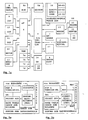
- FIG. 1a shows a block diagram of the franking machine according to the invention with a printer module 1 for a fully electronically generated franking image, with at least one input element 2 having a plurality of actuators, a display unit 3, a MODEM 23 producing the communication with a data center, further input means 21 or balance 22 which are coupled to a controller 6 via an I / O control module 4 and to nonvolatile memories 5a, 5b and 9, 10 and 11, respectively, for data including the variable and constant parts of the franking image and programs for processing the image Data related to the mailing service which is to be requested from the carrier.
- a character memory 9 supplies the necessary pressure data for the variable parts of the franking image to a volatile working memory 7.
- the control device 6 has a microprocessor ⁇ P connected to the input / output control module 4, with the character memory 9, with the volatile random access memory 7 and nonvolatile random access memories 5a, 5b (with internal nonvolatile tariff memory) or (dashed lines) with an additional nonvolatile tariff memory 16, with a nonvolatile main memory 10 and program memory 11, with the motor of a transport or feed device, if necessary with strip release 12, an encoder (Coding disc) 13 and with a clock / date module 8 is in communication.
- the memory chip which comprises the non-volatile main memory 5b, may for example be an EEPROM, which is secured against removal by at least one additional measure, for example adhering to the printed circuit board, sealing or casting with epoxy resin.
- the storage of the postage fee tables can be realized separately or, for example, within the non-volatile memory 5a by providing special storage areas.
- the individual memory can be realized in several physically separate or not shown combined in a few modules.
- the tariff table valid in the future will be stored in the appropriately provided memory area 16-01 or the valid tariff table will be stored accordingly in the separately provided memory area 16-02.
- the available storage capacity in non-volatile memory is 20 kbytes, which is best used by space-efficient storage management.
- the nonvolatile tariff memory is preferably a battery-backed C-MOS RAM device. In a preferred embodiment variant, it includes a third memory area 16-03, in which the checksum formed for the respective desired postage rate table is stored, stored in memory of a version number.
- the retrieval of the postage rate table data from the data center takes place, if necessary or in connection with the remote recharge of the franking machine with a credit (postage for the purpose of Nach Bentechnik), the security measures of the credit-Nach Jardintechnik be used.
- the postage fee table data are initially stored temporarily in the memory area 7d of the volatile random access memory RAM 7 of the postage meter machine.
- the microprocessor 6 can now form a checksum on the content of the postage fee table data and transmit via modem 23 to the data center DC via a communication network or by radio.
- the data center has modems 33 which are connected to a server 32 which accesses a database 31.
- the requesting franking machine identifies itself at the data center with its PIN (Postage request identification number) and transmits the version number for the purpose of finding a new postage rate table in the data base DB 31 of the data center, wherein a postage rate table is assigned to the transmitted version number.
- the server 32 is programmed to check the proper transmission and error-free buffering of service data based on the checksum, which will be explained in more detail with reference to the 3a and b.
- FIG. 1b shows details of the block diagram of the electronic franking machine for a variant with OTP (One Time Programmable Processor) in the control device, which is described in principle in German patent application DE 19534530 A1 with the title: Method for securing data and program code of an electronic franking machine , as well as in more detail in the German patent application DE 19731304.3-53 with the title: method for statistics mode reload and for statistical recording according to statistical classes in the storage of a data set were explained.
- the CPU 6a forms the checksum based on the transmitted and volatile cached table.
- the intermediate storage of the transmitted table can also be done, for example, in the internal main memory iRAM 6b instead of in the volatile main memory RAM 7 or using both main memories.
- FIG. 1c shows a block diagram of the electronic franking machine for a variant with postage calculating balance.
- the tariff memory 16 and the postage calculator are part of the postage calculating balance 22a here.
- the latter uses the modem 23 of the franking machine for communication with the data center.
- a marking of the stored data is registered as valid, as a note that in the data center, a registration for payment of the service takes place.
- a bit is set for the purpose of marking either in a secure area or corresponding MAC-secured data stored.
- the microprocessor uses only validly regitrated data for the postage calculation.
- the data center will register (step 240) the loading and that upon receiving the load instruction, a loading (step 140) of the postage fee table data into a non-volatile memory of the postage computer will occur.
- the communication from the data center via modem directly with the postage meter or postage calculating scale or indirectly via the postage meter for postage-calculating balance take place.
- the postage computer is arranged according to US 5,606,508 within the electronic postage meter and a balance is connected only for weight transmission with the electronic postage meter.
- a postage calculating balance is equipped with an electronic postage calculator.
- the postage value can already be determined by the postage calculating balance and entered in the franking machine on the basis of the measured weight.
- a variant provides that the postage computer is integrated in the terminal or is arranged separately from the terminal. It is envisaged that the intermediate storage takes place in the volatile random access memory RAM 7 in order to form a checksum by means of the microprocessor 6.
- the checksum is formed by the postage calculator on the contents of the table according to a known algorithm, which is stored in the program memory 11.
- the information transmitted to the data center preferably contains the version number and a checksum via the postage fee table data in a predetermined mathematical link or an encrypted one Checksum or a signature. For encryption, known summetric or asymmetrical algorithms are used.
- a second variant of the arrangement is equipped with an OTP processor and allows the formation of a DES-encrypted checksum, wherein the symmetric DES algorithm (Data Encryption Standard) and the secret DES key are securely stored in the postage meter.
- a checksum can be transmitted from the separate postage corrector to the postage meter machine, which has a secure housing and is protected by special measures from being tampered with.
- the franking machine then forms a DES-encrypted checksum, the DES key required for this purpose being securely stored in the franking machine in a manner known per se.
- the other variant is characterized in that the postage computer is integrated in a scale or is arranged separately from the terminal.
- the postage calculator contains a program memory with an asymmetrical encryption algorithm and with a public key. The latter, which does not need to be specially protected unlike a secret key, can therefore also be stored non-volatile in a memory of the scale.
- the unbalanced encryption algorithm is the RSA algorithm named after its inventors (R.Rivest, A.Shamir, L.Adleman). This is advantageous if no secured housing to protect the key is available.
- an RSA encrypted checksum is formed in the balance using an RSA key stored in the balance as a public key that does not need to be stored in a secure manner.
- FIG. 2 shows a flow chart for the secure transmission of data to a terminal.
- the data center starts in step 200 and provides new postage fee tables in step 210 below.
- the terminal is, for example, a franking machine which is started at power-on (step 100).
- the franking machine contains a postage calculator, which forms request data for new postage fee table data in step 110.
- an automatic forms request data in order to be able to access current tables when the time for new postage fee table data approaches.
- This automatic function depends on the carrier set and the date supplied by the clock / date module 8 of the postage meter machine.
- the automatic can be realized in the postage computer and / or in the memory cells of the clock / date module 8.
- the postage calculator can be integrated into a postage calculating balance 22a, which is interfaced with the franking machine.
- the communication on the side of the terminal i. the postage meter machine with a data center, for example, comprises two transactions.
- the first transaction 120 begins by sending the request data to request the new postage fee schedule table data from the data center and concludes with receiving and buffering the requested postage fee schedule table data in a volatile random access memory RAM 7d.
- a communication (step 220) of the data center with the terminal comprising receiving the request data in the data center and sending the requested postage fee table data to the terminal, i.e. the data center. to the franking machine.
- the second transaction 130 on the side of the terminal begins with forming information in the terminal, ie in the postage meter machine, the information being related to the cached valid new postage rate table data.
- the communication of the terminal with a data center is continued with the transmission of information from the terminal to the data center and receiving the OK message, possibly with a load instruction.
- step 140 the received OK message is executed, possibly loading a new postage fee table data when a valid load instruction has been received. Otherwise, the second communication is repeated if no OK message is received.
- a registration (step 240) of the service in a database of the data center is carried out on the side of the data center for the purposes of billing and debiting or later payment. Then, branch back to step 210.
- the postage meter transmits, in addition to its PIN, a version number and the checksum to the data center, which allow in the data center to uniquely identify the transmitted new rate card data.
- a check of a checksum in the data center is performed before the tariff table data cached in the postage meter machine are recognized as valid.
- the information preferably includes the version number of the table and an encrypted checksum to enable verification of the properly submitted and cached table.
- An encrypted checksum may be used as a digital signature related to the volatile cached valid new postage fee schedule table data. However, further data can be included in the information or encrypted with it.
- FIGS. 3a and 3b show a first and second variant of a flow chart for checking the secure transmission of data to a terminal.
- the encrypted checksum is formed by the postage computer by means of an asymmetrical encryption algorithm in which a public key is stored, as well as an associated private secret key for checking in the data center (PRIVET KEY) which is securely stored and kept secret from a third party.
- PRIVET KEY an associated private secret key for checking in the data center
- PRIVET KEY an associated private secret key for checking in the data center
- the digital signature (SIGNATURE) is sent together with the identification number PIN and the version number (VERSION No.) from the terminal to the data center, which can decrypt the signature with a secret read key (PRIVET KEY) after the unbalanced algorithm (RSA).
- the RATE TABLE CHECK SUM formation can be done before or during communication.
- a prior formation has the advantage that the comparison checksum RATE TABLE CHECK SUM in the database 31 assigned to the version number VERSION-NO. PIN is present and can be called by the server 31 for comparison directly from the database 31.
- the saved computing time of the server 32 is thus advantageously available to the decryption process of the SIGNATURE.
- the decrypted message is with the checksum CHECK SUM identical, which was formed in the postage calculator or terminal from the volatile cached postage rate table. When properly cached, the decrypted checksum CHECK_UM is identical to the formed or stored in the database 31 compare checksum RATE TABLE CHECK SUM.
- DSA digital signature algorithm
- ELGA ELGamal algorithm
- ECSS elliptic curve signature scheme
- the encrypted checksum MAC (Message Authentication Code) is formed by means of a symmetrical encryption algorithm by the franking machine, in which a secret key is stored.
- the encrypted checksum MAC is transmitted to the data center.
- no decryption is carried out in the data center, but an encryption in order to encrypt a checksum derived from the postage fee table to a comparison MAC '.
- the RATE TABLE CHECK SUM formation can be done before or during communication.
- a prior formation has the advantage that the CHECK SUM only has to be called from the database 31 in order to generate the comparison MAC 'from this CHECK SUM by encryption with a secret key SECRET KEY using a symmetric algorithm DES with the aid of the server 32.
- the data center check uses the same SECRET KEY secret key as in the postage meter machine.
- the check in the data center is preferably carried out by means of both MAC's.
- MAC formation preferably a suitable variant of the DES algorithm used.
- a MAC formation the same secret DES key is used in the data center and the postage meter machine. To do this, the secret DES key associated with the PIN identifying the terminal must be securely stored in the database 31.
- the RATE TABLE CHECK SUM formation and the encryption to a comparison MAC can be done together prior to communication.
- the comparison MAC is then stored in the database 31 associated with the PIN and version number and can be retrieved by the server for comparison purposes.
- Newer franking machines use digitally working printing units.
- applicant's metering machines T1000 and JetMail for the first time worldwide have a thermal transfer printer or an inkjet printer.
- the franking stamp imprint therefore advantageously contains an indication of the carrier and / or the service used or planned.
Landscapes
- Physics & Mathematics (AREA)
- General Physics & Mathematics (AREA)
- Engineering & Computer Science (AREA)
- Theoretical Computer Science (AREA)
- Mathematical Physics (AREA)
- Computer Hardware Design (AREA)
- General Engineering & Computer Science (AREA)
- Management, Administration, Business Operations System, And Electronic Commerce (AREA)
- Devices For Checking Fares Or Tickets At Control Points (AREA)
Claims (22)
- Procédé pour le transfert sécurisé de données de service à un terminal, avec une mise à disposition (210) de nouvelles données de service dans la centrale de données pour un traitement ultérieur dans le terminal, se basant sur les données de services, avec un établissement (110) de données de demande pour des données de service dans le terminal, avec une première communication pour l'envoi (120) des données de demande du terminal à la centrale de données, une réception (220) des données de demande dans la centrale de données et transfert de données de service non codifiées au terminal pour la réception et la mise en mémoire des données de service non codifiées demandées dans le terminal durant la première communication de la centrale de donnée et du terminal caractérisé par les étapes suivantes :- Génération d'une information dans le terminal se basant sur les données de service transmises,- Réinjection de l'information à la centrale de données et- Vérification de l'information retransmises dans la centrale de données au moyen d'une information de comparaison générée des données de service et transfert d'un message au terminal en résultat de la vérification.
- Procédé, selon la spécification 1, caractérisé par les étapes suivantes :- Génération de l'information en tant que code se basant sur les données de servise transmises- Réinjection du code à la centrale de données et- Contrôle du code retransmis dans la centrale de données et transfert d'un message au terminal en résultat de la vérification.
- Procédé, selon la spécification 1, caractérisé par les étapes suivantes :- Génération de l'information en tant que somme de contrôle se basant sur les données de service transmises,- Réinjection de la somme de contrôle à la centrale de données et- Vérification de la somme de contrôle retransmise dans la centrale de données au moyen d'une somme de contrôle enregistrée et transfert d'un message-OK au terminal en résultat de la vérification, lors d'une concordance de la somme de contrôle transmises avec une somme de contrôle enregistrée.
- Procédé, selon la spécification 1, caractérisé par les étapes suivantes :- Génération de l'information en tant que code codifié se basant sur les données de service transmises,- Réinjection du code codifié à la centrale de données et- Contrôle du code retransmis dans la centrale de données au moyen d'un code codifié enregistré et transfert d'un message-OK au terminal comme résultat de la vérification, lors d'une concordance du code retransmis avec un code codifié enregistré.
- Procédé, selon la spécification 1, caractérisé par les étapes suivantes :- Génération d'une signature dans le terminal se basant sur une information concernant les données de service transmises, tandis que l'information est codée avec une clé publique par écritue pour la signature,- Réinjection de la signature à la centrale de données et- Contrôle de l'information venant de la signature retransmise dans la centrale de données après le décodage de la signature au moyen d'une clé secrète à lecture seule selon un algorithme asymétrique et après comparaison avec une information enregistrée, transfert d'un message-OK au terminal comme résultat de la vérification, lors d'une concordance de l'information codée venant de la signature retransmise avec une information enregistrée.
- Procédé, selon la spécification 5, caractérisé en ce que, l'information comprend une somme de contrôle.
- Procédé, selon une des spécifications précédentes, caractérisé en ce que, l'information établie comprend un numéro de version et une somme de contrôle.
- Procédé, selon une des spécifications précédentes, caractérisé en ce que l'information établie comprend un numéro de version et une somme de contrôle codée.
- Procédé, selon une des spécifications de 1 à 5, caractérisé en ce que, les données de service comprennent des données du barème de frais de port.
- Procédé, selon une des spécifications de 1 à 5, caractérisé en ce que, la retransmission du code codifié ou non codifié, ou selon le cas de l'information à la centrale de données et son contrôle dans la centrale de données, et le transfert d'un message-OK au terminal a lieu durant une seconde communication (130, 230).
- Procédé, selon une des spécifications de 1 à 5, caractérisé en ce qu'un enregistrement (pas 240) du service s'effectue durant la seconde communication (230) en liaison avec l'envoi du message dans la centrale de données
- Procédé, selon une des spécifications de 1 à 5, caractérisé en ce qu'un message-OK envoyé de la centrale de données est reçu au pas (130) durant la seconde communication ainsi que, le message-OK reçu est exécuté dans le terminal au pas suivant (140) et que, le terminal ou le calculateur de frais de port est commuté dans un mode d'exploitation.
- Procédé, selon une des spécifications de 1 à 5 et 12, caractérisé en ce que, la première communication avec stockage des données de service demandées au pas (120) contient une mémoire intermédiaire des données de services demandées, en ce que l'information transmise du terminal à la central de données est rapportée aux nouvelles données de service en mémoire intermédiaire valides durant la seconde communication au pas (130) et, en ce que le message-OK envoyé, durant la seconde communication (230) du côté de la centrale de données, comprend une instruction de chargement au terminal, de charger les nouvelles données de service dans une mémoire non volatile d'un module de traitement et, en ce qu'un chargement (pas 140) des données de service s'effectue dans la mémoire non volatile du module de traitement, après réception du message-OK avec instruction de chargement dans le terminal.
- Procédé, selon la spécification 12, caractérisé en ce que, l'exécution du message-OK reçu comprend un marquage des données enregistrées comme valide.
- Procédé, selon les spécifications de 1 à 5, caractérisé en ce que, les données de service comprennent de nouvelles données du barème de frais de port, qui sont mises à disposition (210) dans la centrale de données pour un calcul des frais de port ultérieur, et que, l'envoi d'un message-OK, durant la seconde communication (230) de la centrale de données avec le terminal, englobant une réception et un contrôle de l'information dans la centrale de données au moyen d'une information de comparaison générée des données du barème de frais de port, se trouve aussi être un envoi d'une instruction de chargement au terminal, afin de charger les nouvelles données du barème des frais de port dans une mémoire non volatile d'un calculateur des frais de port.
- Procédé, selon la spécification 15, caractérisé en ce qu'un enregistrement (pas 240) du chargement s'effectue après l'envoi de l'instruction de chargement dans la centrale de données et qu'un chargement (pas 140) des données du barème des frais de port a lieu dans une mémoire non volatile du calculateur des frais de port, après réception de l'instruction de chargement.
- Disposition pour la mise en oeuvre du procédé, selon la spécification 1, avec au moins des médias d'entrée et de sortie (1, 2, 3, 4, 21, 23), une mémoire de programme (11), un microprocesseur (6) et des mémoires (5a 5b, 16) pour la mémorisation non volatile de données de service et avec une mémoire centrale volatile (7) dans le terminal, caractérisée en ce que, le terminal est connecté avec un calculateur de frais de port et en ce que, le microprocesseur du terminal ou du calculateur des frais de port est programmé, afin- de procéder à une mémorisation des nouvelles données du barème des frais de port dans la mémoire du terminal ou selon le cas du calculateur des frais de port, et d'établir une somme de contrôle via les nouvelles données du barème des frais de port enregistrées et de les communiquer à la centrale de données ainsi que- d'exécuter un message-OK reçu et de commuter le terminal ou le calculateur des frais de port dans un mode d'exploitation.
- Disposition, selon la spécification 17, caractérisée en ce que, le microprocesseur du terminal ou du calculateur des frais de port est programmé afin:- d'effectuer une bufférisation des nouvelles données du barème des frais de port dans la mémoire centrale volatile du terminal ou selon le cas du calculateur des frais de port et d'établir une somme de contrôle via les nouvelles données du barème des frais de port biffurisées et de les communiquer à la centrale de données, ainsi que- d'exécuter une instruction de chargement de la centrale de données au terminal lors de la réception d'un message-OK, de charger les nouvelles données du barème des frais de port dans une mémoire non volatile (5a, 5b, 16) d'un calculateur des frais de port, puis de commuter le terminal ou le calculateur des frais de port dans un mode d'exploitation.
- Disposition, selon une des spécifications précédentes 17 ou 18, caractérisée en ce que, le calculateur de frais de port est intégré dans un terminal ou est aménagé à part du terminal.
- Disposition, selon une des spécifications précédentes 17 ou 18, caractérisée en ce que le calculateur des frais de port est intégré dans une balance ou est aménagé à part du terminal.
- Disposition, selon la spécification 19, caractérisée en ce que, le terminal est une machine à affranchir le courrier, tandis que la somme de contrôle est communiquée du calculateur des frais de port à l'affranchisseuse et, en ce qu'un algorithme symétrique de chiffrement pour l'établissement d'une somme de contrôle chiffrée et, qu'une clé secrète sont sauvegardés dans la machine à affranchir le courrier, tandis que la clé secrète est la même qui est utilisée dans la centrale de données.
- Disposition, selon la spécification 20, caractérisée en ce que, le calculateur des frais de port est développé pour établir les sommes de contrôle, qu'un algorithme asymétrique de chiffrement pour l'établissement d'une somme de contrôle chiffrée, et qu'une clé publique sont stockés dans la balance, tandis que la clé publique n'est pas mémorisée avec certitude, tandis qu'une clé secrète privée apparentée est utilisée pour le contrôle de la somme de contrôle chiffrée dans la centrale de données, laquelle y est sauvegardée et est gardée secrète par un tiers.
Applications Claiming Priority (2)
| Application Number | Priority Date | Filing Date | Title |
|---|---|---|---|
| DE19830055A DE19830055B4 (de) | 1998-06-29 | 1998-06-29 | Verfahren zur sicheren Übertragung von Dienstdaten an ein Endgerät und Anordnung zur Durchführung des Verfahrens |
| DE19830055 | 1998-06-29 |
Publications (3)
| Publication Number | Publication Date |
|---|---|
| EP0969420A2 EP0969420A2 (fr) | 2000-01-05 |
| EP0969420A3 EP0969420A3 (fr) | 2000-12-13 |
| EP0969420B1 true EP0969420B1 (fr) | 2006-06-14 |
Family
ID=7873073
Family Applications (1)
| Application Number | Title | Priority Date | Filing Date |
|---|---|---|---|
| EP99250182A Expired - Lifetime EP0969420B1 (fr) | 1998-06-29 | 1999-06-11 | Procédé pour sécuriser la transmission de données de service à un terminal et dispositif pour la mise en oeuvre de ce procédé |
Country Status (3)
| Country | Link |
|---|---|
| US (1) | US7577617B1 (fr) |
| EP (1) | EP0969420B1 (fr) |
| DE (2) | DE19830055B4 (fr) |
Families Citing this family (11)
| Publication number | Priority date | Publication date | Assignee | Title |
|---|---|---|---|---|
| DE19857778A1 (de) * | 1998-12-04 | 2000-06-08 | Francotyp Postalia Gmbh | Verfahren zum Verarbeiten veränderbarer Dienstdatenstrukturen und Displaytexten in einem Verarbeitungsmodul und Anordnung zur Durchführung des Verfahrens |
| DE10309817A1 (de) * | 2003-03-05 | 2004-09-23 | Francotyp-Postalia Ag & Co. Kg | Verfahren zum sicheren Datenaustausch |
| DE102004014427A1 (de) * | 2004-03-19 | 2005-10-27 | Francotyp-Postalia Ag & Co. Kg | Verfahren für ein servergesteuertes Sicherheitsmanagement von erbringbaren Dienstleistungen und Anordnung zur Bereitstellung von Daten nach einem Sicherheitsmanagement für ein Frankiersystem |
| US20120303533A1 (en) * | 2011-05-26 | 2012-11-29 | Michael Collins Pinkus | System and method for securing, distributing and enforcing for-hire vehicle operating parameters |
| US20130060721A1 (en) | 2011-09-02 | 2013-03-07 | Frias Transportation Infrastructure, Llc | Systems and methods for pairing of for-hire vehicle meters and medallions |
| US8751409B2 (en) * | 2011-09-09 | 2014-06-10 | Psi Systems, Inc. | System and method for securely disseminating and managing postal rates |
| US20130253999A1 (en) | 2012-03-22 | 2013-09-26 | Frias Transportation Infrastructure Llc | Transaction and communication system and method for vendors and promoters |
| EP3435338B1 (fr) * | 2013-01-29 | 2024-08-07 | Quadient Technologies France | Système de gestion de dates |
| US9992175B2 (en) * | 2016-01-08 | 2018-06-05 | Moneygram International, Inc. | Systems and method for providing a data security service |
| AT519476B1 (de) * | 2017-04-05 | 2018-07-15 | Ait Austrian Inst Tech Gmbh | Verfahren zur Erstellung und Verteilung von kryptographischen Schlüsseln |
| GB2607289A (en) * | 2021-05-28 | 2022-12-07 | Mastercard International Inc | Data management and encryption in a distributed computing system |
Family Cites Families (19)
| Publication number | Priority date | Publication date | Assignee | Title |
|---|---|---|---|---|
| US4097923A (en) | 1975-04-16 | 1978-06-27 | Pitney-Bowes, Inc. | Remote postage meter charging system using an advanced microcomputerized postage meter |
| US4138735A (en) * | 1977-01-31 | 1979-02-06 | Pitney-Bowes, Inc. | System for remotely resetting postage rate memories |
| DE2820658A1 (de) * | 1978-05-11 | 1979-11-15 | Pitney Bowes | Vorrichtung und verfahren zur portoausstattung einer mikrocomputergekoppelten frankiermaschine |
| US4253158A (en) * | 1979-03-28 | 1981-02-24 | Pitney Bowes Inc. | System for securing postage printing transactions |
| DE3061088D1 (en) * | 1979-04-02 | 1982-12-23 | Motorola Inc | Method of providing security of data on a communication path |
| FR2584557B1 (fr) * | 1985-07-02 | 1989-07-28 | Smh Alcatel | Systeme de telecontrole pour machines a affranchir |
| US4802218A (en) * | 1986-11-26 | 1989-01-31 | Wright Technologies, L.P. | Automated transaction system |
| US4864618A (en) * | 1986-11-26 | 1989-09-05 | Wright Technologies, L.P. | Automated transaction system with modular printhead having print authentication feature |
| US4933849A (en) | 1987-07-16 | 1990-06-12 | Pitney Bowes | Security system for use with an indicia printing authorization device |
| US5008827A (en) * | 1988-12-16 | 1991-04-16 | Pitney Bowes Inc. | Central postage data communication network |
| US5778348A (en) * | 1991-12-24 | 1998-07-07 | Pitney Bowes Inc. | Remote activation of rating capabilities in a computerized parcel manifest system |
| DE4213278C2 (de) | 1992-04-16 | 1998-02-19 | Francotyp Postalia Gmbh | Anordnung zum Frankieren von Postgut |
| US5490077A (en) | 1993-01-20 | 1996-02-06 | Francotyp-Postalia Gmbh | Method for data input into a postage meter machine, arrangement for franking postal matter and for producing an advert mark respectively allocated to a cost allocation account |
| US5448641A (en) * | 1993-10-08 | 1995-09-05 | Pitney Bowes Inc. | Postal rating system with verifiable integrity |
| DE4422263A1 (de) * | 1994-06-24 | 1996-01-04 | Francotyp Postalia Gmbh | Verfahren zum Abstimmen des Datenbestandes zwischen einer elektronischen Frankiermaschine und einem Datenzentrum |
| US5715164A (en) * | 1994-12-14 | 1998-02-03 | Ascom Hasler Mailing Systems Ag | System and method for communications with postage meters |
| DE4447404C2 (de) | 1994-12-23 | 1998-08-20 | Francotyp Postalia Gmbh | Verfahren zur Dateneingabe in eine Waage und Anordnung zur Durchführung des Verfahrens |
| DE19534530A1 (de) | 1995-09-08 | 1997-03-13 | Francotyp Postalia Gmbh | Verfahren zur Absicherung von Daten und Programmcode einer elektronischen Frankiermaschine |
| DE19617473A1 (de) * | 1996-05-02 | 1997-11-06 | Francotyp Postalia Gmbh | Verfahren und Anordnung zur Datenverarbeitung in einem Postverarbeitungssystem mit einer Frankiermaschine |
-
1998
- 1998-06-29 DE DE19830055A patent/DE19830055B4/de not_active Expired - Fee Related
-
1999
- 1999-06-11 EP EP99250182A patent/EP0969420B1/fr not_active Expired - Lifetime
- 1999-06-11 DE DE59913544T patent/DE59913544D1/de not_active Expired - Lifetime
- 1999-06-28 US US09/340,782 patent/US7577617B1/en not_active Expired - Fee Related
Also Published As
| Publication number | Publication date |
|---|---|
| DE19830055A1 (de) | 1999-12-30 |
| US7577617B1 (en) | 2009-08-18 |
| EP0969420A3 (fr) | 2000-12-13 |
| DE19830055B4 (de) | 2005-10-13 |
| DE59913544D1 (de) | 2006-07-27 |
| EP0969420A2 (fr) | 2000-01-05 |
Similar Documents
| Publication | Publication Date | Title |
|---|---|---|
| EP0944027B1 (fr) | Machine à affranchir et un procédé pour générer des données valables pour affranchir | |
| EP0724141B1 (fr) | Méthode d'entrées de données pour une balance | |
| DE3613007B4 (de) | System zur Ermittlung von nicht-abgerechneten Drucken | |
| DE19731304B4 (de) | Verfahren zur Statistikmodusnachladung und zur statistischen Erfassung nach Statistikklassen bei der Speicherung eines Datensatzes | |
| DE69631025T2 (de) | System und Verfahren zur Wiederherstellung im Falle einer Katastrophe in einem offenen Zählsystem | |
| DE3712181C2 (de) | Frankiermaschinennachladesystem | |
| DE69636617T2 (de) | Verfahren und System zum Nachweisen von Transaktionen mit hinterherigem Drucken und Verarbeiten des Postens | |
| DE69634944T2 (de) | Sichere Benutzerbeglaubigung für elektronischen Handel unter Verwendung eines Wertezählersystems | |
| DE3712092A1 (de) | Nachladesystem fuer frankiermaschinen | |
| EP0762337A2 (fr) | Procédé et dispositif pour augmenter la protection contre la manipulation de données critiques | |
| EP0969420B1 (fr) | Procédé pour sécuriser la transmission de données de service à un terminal et dispositif pour la mise en oeuvre de ce procédé | |
| EP0930586B1 (fr) | Dispositif et méthode pour l'échange de données entre une machine d'affranchissement et des cartes à puce | |
| DE19757653C2 (de) | Verfahren und postalisches Gerät mit einer Chipkarten-Schreib/Leseeinheit zum Nachladen von Änderungsdaten per Chipkarte | |
| DE10305730B4 (de) | Verfahren zum Überprüfen der Gültigkeit von digitalen Freimachungsvermerken | |
| DE60015907T2 (de) | Verfahren und Vorrichtung zur Erzeugung von Nachrichten welche eine prüfbare Behauptung enthalten dass eine Veränderliche sich innerhalb bestimmter Grenzwerte befindet | |
| DE69930202T2 (de) | Verfahren zur Begrenzung der Schlüsselbenutzung in einem Frankiersystem welches kryptographisch gesicherte Briefmarken produziert | |
| EP1001383B1 (fr) | Dispositif et procédé pour stocker des données d'utilisation d'un terminal | |
| EP0991025B1 (fr) | Procédé d'entrée de données dans un calculateur d'affranchissement et dispositif pour la mise en oeuvre de ce procédé | |
| DE69636360T2 (de) | Auf Transaktionen mit geschlossener Schleife basierendes Rechnungs- und Bezahlungssystem für Postsendungen mit durch Freigabe der Postversandinformation ausgelöster Bezahlung des Beförderers durch eine dritte Partei | |
| EP1202223B1 (fr) | Machine postale et procédé pour l'initialisation | |
| EP1577840A2 (fr) | Procédé de gestion à l'aide d'un serveur pour le contrôle de la sécurité des services et dispositif pour fournir des données en fonction de la gestion de la sécurité dans un système d'affranchissement | |
| EP1486028B1 (fr) | Procede et dispositif permettant de creer des documents infalsifiables verifiables | |
| DE19534527C2 (de) | Verfahren zur Erhöhung der Manipulationssicherheit von kritischen Daten | |
| EP1855252B1 (fr) | Agencement et procédé destinés à la fabrication d'un affranchissement | |
| DE29522056U1 (de) | Anordnung zur Erhöhung der Manipulationssicherheit von kritischen Daten |
Legal Events
| Date | Code | Title | Description |
|---|---|---|---|
| PUAI | Public reference made under article 153(3) epc to a published international application that has entered the european phase |
Free format text: ORIGINAL CODE: 0009012 |
|
| AK | Designated contracting states |
Kind code of ref document: A2 Designated state(s): CH DE FR GB IT LI |
|
| AX | Request for extension of the european patent |
Free format text: AL;LT;LV;MK;RO;SI |
|
| PUAL | Search report despatched |
Free format text: ORIGINAL CODE: 0009013 |
|
| AK | Designated contracting states |
Kind code of ref document: A3 Designated state(s): AT BE CH CY DE DK ES FI FR GB GR IE IT LI LU MC NL PT SE |
|
| AX | Request for extension of the european patent |
Free format text: AL;LT;LV;MK;RO;SI |
|
| 17P | Request for examination filed |
Effective date: 20010412 |
|
| AKX | Designation fees paid |
Free format text: CH DE FR GB IT LI |
|
| RAP1 | Party data changed (applicant data changed or rights of an application transferred) |
Owner name: FRANCOTYP-POSTALIA AG & CO. KG |
|
| RAP1 | Party data changed (applicant data changed or rights of an application transferred) |
Owner name: FRANCOTYP-POSTALIA GMBH |
|
| GRAP | Despatch of communication of intention to grant a patent |
Free format text: ORIGINAL CODE: EPIDOSNIGR1 |
|
| GRAS | Grant fee paid |
Free format text: ORIGINAL CODE: EPIDOSNIGR3 |
|
| GRAA | (expected) grant |
Free format text: ORIGINAL CODE: 0009210 |
|
| AK | Designated contracting states |
Kind code of ref document: B1 Designated state(s): CH DE FR GB IT LI |
|
| REG | Reference to a national code |
Ref country code: GB Ref legal event code: FG4D Free format text: NOT ENGLISH |
|
| REG | Reference to a national code |
Ref country code: CH Ref legal event code: EP |
|
| REG | Reference to a national code |
Ref country code: CH Ref legal event code: NV Representative=s name: ROTTMANN, ZIMMERMANN + PARTNER AG |
|
| REF | Corresponds to: |
Ref document number: 59913544 Country of ref document: DE Date of ref document: 20060727 Kind code of ref document: P |
|
| GBT | Gb: translation of ep patent filed (gb section 77(6)(a)/1977) |
Effective date: 20060913 |
|
| ET | Fr: translation filed | ||
| PLBE | No opposition filed within time limit |
Free format text: ORIGINAL CODE: 0009261 |
|
| STAA | Information on the status of an ep patent application or granted ep patent |
Free format text: STATUS: NO OPPOSITION FILED WITHIN TIME LIMIT |
|
| 26N | No opposition filed |
Effective date: 20070315 |
|
| REG | Reference to a national code |
Ref country code: CH Ref legal event code: PFA Owner name: FRANCOTYP-POSTALIA GMBH Free format text: FRANCOTYP-POSTALIA GMBH#TRIFTWEG 21-26#16547 BIRKENWERDER (DE) -TRANSFER TO- FRANCOTYP-POSTALIA GMBH#TRIFTWEG 21-26#16547 BIRKENWERDER (DE) |
|
| PGFP | Annual fee paid to national office [announced via postgrant information from national office to epo] |
Ref country code: CH Payment date: 20120622 Year of fee payment: 14 Ref country code: DE Payment date: 20120404 Year of fee payment: 14 |
|
| PGFP | Annual fee paid to national office [announced via postgrant information from national office to epo] |
Ref country code: FR Payment date: 20120705 Year of fee payment: 14 Ref country code: GB Payment date: 20120622 Year of fee payment: 14 |
|
| PGFP | Annual fee paid to national office [announced via postgrant information from national office to epo] |
Ref country code: IT Payment date: 20120627 Year of fee payment: 14 |
|
| REG | Reference to a national code |
Ref country code: CH Ref legal event code: PL |
|
| GBPC | Gb: european patent ceased through non-payment of renewal fee |
Effective date: 20130611 |
|
| REG | Reference to a national code |
Ref country code: FR Ref legal event code: ST Effective date: 20140228 |
|
| REG | Reference to a national code |
Ref country code: DE Ref legal event code: R119 Ref document number: 59913544 Country of ref document: DE Effective date: 20140101 |
|
| PG25 | Lapsed in a contracting state [announced via postgrant information from national office to epo] |
Ref country code: GB Free format text: LAPSE BECAUSE OF NON-PAYMENT OF DUE FEES Effective date: 20130611 Ref country code: DE Free format text: LAPSE BECAUSE OF NON-PAYMENT OF DUE FEES Effective date: 20140101 Ref country code: CH Free format text: LAPSE BECAUSE OF NON-PAYMENT OF DUE FEES Effective date: 20130630 Ref country code: LI Free format text: LAPSE BECAUSE OF NON-PAYMENT OF DUE FEES Effective date: 20130630 |
|
| PG25 | Lapsed in a contracting state [announced via postgrant information from national office to epo] |
Ref country code: IT Free format text: LAPSE BECAUSE OF NON-PAYMENT OF DUE FEES Effective date: 20130611 Ref country code: FR Free format text: LAPSE BECAUSE OF NON-PAYMENT OF DUE FEES Effective date: 20130701 |