EP0972051B1 - Rns-abhängige rns-polymerase, die vorzugsweise anhand einer rna-matrix funktioniert und ein promoter-abhängiger transkriptionsprozess , der diese rns-abhängige rns-polymerase benutzt. - Google Patents
Rns-abhängige rns-polymerase, die vorzugsweise anhand einer rna-matrix funktioniert und ein promoter-abhängiger transkriptionsprozess , der diese rns-abhängige rns-polymerase benutzt. Download PDFInfo
- Publication number
- EP0972051B1 EP0972051B1 EP98917263A EP98917263A EP0972051B1 EP 0972051 B1 EP0972051 B1 EP 0972051B1 EP 98917263 A EP98917263 A EP 98917263A EP 98917263 A EP98917263 A EP 98917263A EP 0972051 B1 EP0972051 B1 EP 0972051B1
- Authority
- EP
- European Patent Office
- Prior art keywords
- rna
- rna polymerase
- segment
- sequence
- polymerase
- Prior art date
- Legal status (The legal status is an assumption and is not a legal conclusion. Google has not performed a legal analysis and makes no representation as to the accuracy of the status listed.)
- Expired - Lifetime
Links
- 230000035897 transcription Effects 0.000 title claims abstract description 73
- 238000013518 transcription Methods 0.000 title claims abstract description 73
- 230000001419 dependent effect Effects 0.000 title claims abstract description 20
- 238000000034 method Methods 0.000 title claims description 52
- 108060004795 Methyltransferase Proteins 0.000 title claims description 10
- 239000011159 matrix material Substances 0.000 title abstract description 46
- 230000008569 process Effects 0.000 title description 4
- 102000004163 DNA-directed RNA polymerases Human genes 0.000 claims abstract description 126
- 108090000626 DNA-directed RNA polymerases Proteins 0.000 claims abstract description 125
- 108090000623 proteins and genes Proteins 0.000 claims abstract description 78
- 239000002773 nucleotide Substances 0.000 claims abstract description 40
- 125000003729 nucleotide group Chemical group 0.000 claims abstract description 40
- 102000004169 proteins and genes Human genes 0.000 claims abstract description 34
- 230000035772 mutation Effects 0.000 claims abstract description 22
- 102000040430 polynucleotide Human genes 0.000 claims abstract description 17
- 108091033319 polynucleotide Proteins 0.000 claims abstract description 17
- 239000002157 polynucleotide Substances 0.000 claims abstract description 16
- 239000003153 chemical reaction reagent Substances 0.000 claims abstract description 13
- 108091032973 (ribonucleotides)n+m Proteins 0.000 claims description 135
- 108020004414 DNA Proteins 0.000 claims description 63
- 101710137500 T7 RNA polymerase Proteins 0.000 claims description 53
- 102000004190 Enzymes Human genes 0.000 claims description 38
- 108090000790 Enzymes Proteins 0.000 claims description 38
- 235000018102 proteins Nutrition 0.000 claims description 29
- 150000001413 amino acids Chemical class 0.000 claims description 17
- 230000000694 effects Effects 0.000 claims description 17
- 239000013598 vector Substances 0.000 claims description 17
- 241000588724 Escherichia coli Species 0.000 claims description 13
- 235000001014 amino acid Nutrition 0.000 claims description 12
- 229940024606 amino acid Drugs 0.000 claims description 12
- 238000009396 hybridization Methods 0.000 claims description 11
- 230000000977 initiatory effect Effects 0.000 claims description 11
- 108010065868 RNA polymerase SP6 Proteins 0.000 claims description 9
- 241000700605 Viruses Species 0.000 claims description 9
- 235000004279 alanine Nutrition 0.000 claims description 9
- 108010028263 bacteriophage T3 RNA polymerase Proteins 0.000 claims description 9
- 230000000295 complement effect Effects 0.000 claims description 9
- 239000013604 expression vector Substances 0.000 claims description 9
- QNAYBMKLOCPYGJ-REOHCLBHSA-N L-alanine Chemical compound C[C@H](N)C(O)=O QNAYBMKLOCPYGJ-REOHCLBHSA-N 0.000 claims description 8
- 230000002194 synthesizing effect Effects 0.000 claims description 8
- 239000004475 Arginine Substances 0.000 claims description 7
- 108091028043 Nucleic acid sequence Proteins 0.000 claims description 7
- 108091081021 Sense strand Proteins 0.000 claims description 7
- 125000000539 amino acid group Chemical group 0.000 claims description 7
- ODKSFYDXXFIFQN-UHFFFAOYSA-N arginine Natural products OC(=O)C(N)CCCNC(N)=N ODKSFYDXXFIFQN-UHFFFAOYSA-N 0.000 claims description 7
- 239000000523 sample Substances 0.000 claims description 7
- DHMQDGOQFOQNFH-UHFFFAOYSA-N Glycine Chemical compound NCC(O)=O DHMQDGOQFOQNFH-UHFFFAOYSA-N 0.000 claims description 6
- 238000011144 upstream manufacturing Methods 0.000 claims description 6
- KDXKERNSBIXSRK-UHFFFAOYSA-N Lysine Natural products NCCCCC(N)C(O)=O KDXKERNSBIXSRK-UHFFFAOYSA-N 0.000 claims description 5
- 239000004472 Lysine Substances 0.000 claims description 5
- MTCFGRXMJLQNBG-UHFFFAOYSA-N Serine Natural products OCC(N)C(O)=O MTCFGRXMJLQNBG-UHFFFAOYSA-N 0.000 claims description 4
- 230000002255 enzymatic effect Effects 0.000 claims description 4
- MTCFGRXMJLQNBG-REOHCLBHSA-N (2S)-2-Amino-3-hydroxypropansäure Chemical compound OC[C@H](N)C(O)=O MTCFGRXMJLQNBG-REOHCLBHSA-N 0.000 claims description 3
- 239000004471 Glycine Substances 0.000 claims description 3
- OUYCCCASQSFEME-QMMMGPOBSA-N L-tyrosine Chemical compound OC(=O)[C@@H](N)CC1=CC=C(O)C=C1 OUYCCCASQSFEME-QMMMGPOBSA-N 0.000 claims description 3
- 102000003960 Ligases Human genes 0.000 claims description 3
- 108090000364 Ligases Proteins 0.000 claims description 3
- 239000000203 mixture Substances 0.000 claims description 3
- OUYCCCASQSFEME-UHFFFAOYSA-N tyrosine Natural products OC(=O)C(N)CC1=CC=C(O)C=C1 OUYCCCASQSFEME-UHFFFAOYSA-N 0.000 claims description 3
- ODKSFYDXXFIFQN-BYPYZUCNSA-P L-argininium(2+) Chemical compound NC(=[NH2+])NCCC[C@H]([NH3+])C(O)=O ODKSFYDXXFIFQN-BYPYZUCNSA-P 0.000 claims description 2
- AGPKZVBTJJNPAG-WHFBIAKZSA-N L-isoleucine Chemical compound CC[C@H](C)[C@H](N)C(O)=O AGPKZVBTJJNPAG-WHFBIAKZSA-N 0.000 claims description 2
- ROHFNLRQFUQHCH-YFKPBYRVSA-N L-leucine Chemical compound CC(C)C[C@H](N)C(O)=O ROHFNLRQFUQHCH-YFKPBYRVSA-N 0.000 claims description 2
- KDXKERNSBIXSRK-YFKPBYRVSA-N L-lysine Chemical compound NCCCC[C@H](N)C(O)=O KDXKERNSBIXSRK-YFKPBYRVSA-N 0.000 claims description 2
- AYFVYJQAPQTCCC-GBXIJSLDSA-N L-threonine Chemical compound C[C@@H](O)[C@H](N)C(O)=O AYFVYJQAPQTCCC-GBXIJSLDSA-N 0.000 claims description 2
- KZSNJWFQEVHDMF-BYPYZUCNSA-N L-valine Chemical compound CC(C)[C@H](N)C(O)=O KZSNJWFQEVHDMF-BYPYZUCNSA-N 0.000 claims description 2
- ROHFNLRQFUQHCH-UHFFFAOYSA-N Leucine Natural products CC(C)CC(N)C(O)=O ROHFNLRQFUQHCH-UHFFFAOYSA-N 0.000 claims description 2
- 239000013614 RNA sample Substances 0.000 claims description 2
- AYFVYJQAPQTCCC-UHFFFAOYSA-N Threonine Natural products CC(O)C(N)C(O)=O AYFVYJQAPQTCCC-UHFFFAOYSA-N 0.000 claims description 2
- 239000004473 Threonine Substances 0.000 claims description 2
- KZSNJWFQEVHDMF-UHFFFAOYSA-N Valine Natural products CC(C)C(N)C(O)=O KZSNJWFQEVHDMF-UHFFFAOYSA-N 0.000 claims description 2
- 229960000310 isoleucine Drugs 0.000 claims description 2
- AGPKZVBTJJNPAG-UHFFFAOYSA-N isoleucine Natural products CCC(C)C(N)C(O)=O AGPKZVBTJJNPAG-UHFFFAOYSA-N 0.000 claims description 2
- 239000004474 valine Substances 0.000 claims description 2
- 125000003607 serino group Chemical group [H]N([H])[C@]([H])(C(=O)[*])C(O[H])([H])[H] 0.000 claims 1
- 230000015572 biosynthetic process Effects 0.000 abstract description 11
- 238000003786 synthesis reaction Methods 0.000 abstract description 11
- 238000001514 detection method Methods 0.000 abstract description 9
- 238000011002 quantification Methods 0.000 abstract description 4
- 241000701867 Enterobacteria phage T7 Species 0.000 abstract description 3
- 102000053602 DNA Human genes 0.000 description 22
- 230000014509 gene expression Effects 0.000 description 17
- 230000003321 amplification Effects 0.000 description 13
- 238000003199 nucleic acid amplification method Methods 0.000 description 13
- 239000000047 product Substances 0.000 description 13
- 238000000746 purification Methods 0.000 description 12
- 210000004027 cell Anatomy 0.000 description 10
- 238000006243 chemical reaction Methods 0.000 description 10
- 239000012634 fragment Substances 0.000 description 10
- 235000011178 triphosphate Nutrition 0.000 description 9
- 239000001226 triphosphate Substances 0.000 description 9
- 102000040650 (ribonucleotides)n+m Human genes 0.000 description 8
- 230000000692 anti-sense effect Effects 0.000 description 8
- RAXXELZNTBOGNW-UHFFFAOYSA-N imidazole Natural products C1=CNC=N1 RAXXELZNTBOGNW-UHFFFAOYSA-N 0.000 description 8
- 239000013615 primer Substances 0.000 description 8
- -1 ribonucleoside triphosphates Chemical class 0.000 description 8
- 108020004682 Single-Stranded DNA Proteins 0.000 description 7
- 239000013599 cloning vector Substances 0.000 description 7
- 150000002500 ions Chemical class 0.000 description 7
- ZHNUHDYFZUAESO-UHFFFAOYSA-N Formamide Chemical compound NC=O ZHNUHDYFZUAESO-UHFFFAOYSA-N 0.000 description 6
- BPHPUYQFMNQIOC-NXRLNHOXSA-N isopropyl beta-D-thiogalactopyranoside Chemical compound CC(C)S[C@@H]1O[C@H](CO)[C@H](O)[C@H](O)[C@H]1O BPHPUYQFMNQIOC-NXRLNHOXSA-N 0.000 description 6
- 238000002703 mutagenesis Methods 0.000 description 6
- 231100000350 mutagenesis Toxicity 0.000 description 6
- 102000039446 nucleic acids Human genes 0.000 description 6
- 108020004707 nucleic acids Proteins 0.000 description 6
- 150000007523 nucleic acids Chemical class 0.000 description 6
- 238000000636 Northern blotting Methods 0.000 description 5
- 230000006870 function Effects 0.000 description 5
- 101150109249 lacI gene Proteins 0.000 description 5
- 239000002777 nucleoside Substances 0.000 description 5
- 239000002245 particle Substances 0.000 description 5
- 241000894006 Bacteria Species 0.000 description 4
- 108010014303 DNA-directed DNA polymerase Proteins 0.000 description 4
- 102000016928 DNA-directed DNA polymerase Human genes 0.000 description 4
- 108091027305 Heteroduplex Proteins 0.000 description 4
- 108700009124 Transcription Initiation Site Proteins 0.000 description 4
- 230000001580 bacterial effect Effects 0.000 description 4
- 230000003197 catalytic effect Effects 0.000 description 4
- 238000010276 construction Methods 0.000 description 4
- 238000001962 electrophoresis Methods 0.000 description 4
- 238000002474 experimental method Methods 0.000 description 4
- 230000002349 favourable effect Effects 0.000 description 4
- 108010083127 phage repressor proteins Proteins 0.000 description 4
- 230000010076 replication Effects 0.000 description 4
- 239000002342 ribonucleoside Substances 0.000 description 4
- ATHGHQPFGPMSJY-UHFFFAOYSA-N spermidine Chemical compound NCCCCNCCCN ATHGHQPFGPMSJY-UHFFFAOYSA-N 0.000 description 4
- 241001515965 unidentified phage Species 0.000 description 4
- QFVHZQCOUORWEI-UHFFFAOYSA-N 4-[(4-anilino-5-sulfonaphthalen-1-yl)diazenyl]-5-hydroxynaphthalene-2,7-disulfonic acid Chemical compound C=12C(O)=CC(S(O)(=O)=O)=CC2=CC(S(O)(=O)=O)=CC=1N=NC(C1=CC=CC(=C11)S(O)(=O)=O)=CC=C1NC1=CC=CC=C1 QFVHZQCOUORWEI-UHFFFAOYSA-N 0.000 description 3
- 108091034117 Oligonucleotide Proteins 0.000 description 3
- 230000006819 RNA synthesis Effects 0.000 description 3
- 102000006382 Ribonucleases Human genes 0.000 description 3
- 108010083644 Ribonucleases Proteins 0.000 description 3
- 108091028664 Ribonucleotide Proteins 0.000 description 3
- 238000001042 affinity chromatography Methods 0.000 description 3
- 239000005547 deoxyribonucleotide Substances 0.000 description 3
- 125000002637 deoxyribonucleotide group Chemical group 0.000 description 3
- 238000000338 in vitro Methods 0.000 description 3
- 238000010348 incorporation Methods 0.000 description 3
- 239000011777 magnesium Substances 0.000 description 3
- 229920002704 polyhistidine Polymers 0.000 description 3
- 239000012429 reaction media Substances 0.000 description 3
- 239000002336 ribonucleotide Substances 0.000 description 3
- 125000002652 ribonucleotide group Chemical group 0.000 description 3
- 238000012163 sequencing technique Methods 0.000 description 3
- 230000037432 silent mutation Effects 0.000 description 3
- 238000002415 sodium dodecyl sulfate polyacrylamide gel electrophoresis Methods 0.000 description 3
- 238000010186 staining Methods 0.000 description 3
- 238000012360 testing method Methods 0.000 description 3
- 230000002103 transcriptional effect Effects 0.000 description 3
- 230000003612 virological effect Effects 0.000 description 3
- 238000001262 western blot Methods 0.000 description 3
- QKNYBSVHEMOAJP-UHFFFAOYSA-N 2-amino-2-(hydroxymethyl)propane-1,3-diol;hydron;chloride Chemical compound Cl.OCC(N)(CO)CO QKNYBSVHEMOAJP-UHFFFAOYSA-N 0.000 description 2
- 108091035707 Consensus sequence Proteins 0.000 description 2
- KCXVZYZYPLLWCC-UHFFFAOYSA-N EDTA Chemical compound OC(=O)CN(CC(O)=O)CCN(CC(O)=O)CC(O)=O KCXVZYZYPLLWCC-UHFFFAOYSA-N 0.000 description 2
- 102100031780 Endonuclease Human genes 0.000 description 2
- 108010042407 Endonucleases Proteins 0.000 description 2
- 108060002716 Exonuclease Proteins 0.000 description 2
- 102100034343 Integrase Human genes 0.000 description 2
- OAICVXFJPJFONN-UHFFFAOYSA-N Phosphorus Chemical compound [P] OAICVXFJPJFONN-UHFFFAOYSA-N 0.000 description 2
- 108010066717 Q beta Replicase Proteins 0.000 description 2
- 108020004518 RNA Probes Proteins 0.000 description 2
- 239000003391 RNA probe Substances 0.000 description 2
- 108010092799 RNA-directed DNA polymerase Proteins 0.000 description 2
- 240000004808 Saccharomyces cerevisiae Species 0.000 description 2
- 235000014680 Saccharomyces cerevisiae Nutrition 0.000 description 2
- XSQUKJJJFZCRTK-UHFFFAOYSA-N Urea Chemical compound NC(N)=O XSQUKJJJFZCRTK-UHFFFAOYSA-N 0.000 description 2
- 238000000376 autoradiography Methods 0.000 description 2
- 230000008901 benefit Effects 0.000 description 2
- 239000012472 biological sample Substances 0.000 description 2
- UDSAIICHUKSCKT-UHFFFAOYSA-N bromophenol blue Chemical compound C1=C(Br)C(O)=C(Br)C=C1C1(C=2C=C(Br)C(O)=C(Br)C=2)C2=CC=CC=C2S(=O)(=O)O1 UDSAIICHUKSCKT-UHFFFAOYSA-N 0.000 description 2
- 238000010367 cloning Methods 0.000 description 2
- 102000013165 exonuclease Human genes 0.000 description 2
- 238000000605 extraction Methods 0.000 description 2
- 238000010438 heat treatment Methods 0.000 description 2
- 239000012528 membrane Substances 0.000 description 2
- 108020004999 messenger RNA Proteins 0.000 description 2
- 238000013508 migration Methods 0.000 description 2
- 230000005012 migration Effects 0.000 description 2
- 229910052698 phosphorus Inorganic materials 0.000 description 2
- 239000011574 phosphorus Substances 0.000 description 2
- 229920002401 polyacrylamide Polymers 0.000 description 2
- 230000037452 priming Effects 0.000 description 2
- 230000002285 radioactive effect Effects 0.000 description 2
- 238000000527 sonication Methods 0.000 description 2
- 229940063673 spermidine Drugs 0.000 description 2
- 230000005758 transcription activity Effects 0.000 description 2
- 230000005026 transcription initiation Effects 0.000 description 2
- 230000007704 transition Effects 0.000 description 2
- NLIVDORGVGAOOJ-MAHBNPEESA-M xylene cyanol Chemical compound [Na+].C1=C(C)C(NCC)=CC=C1C(\C=1C(=CC(OS([O-])=O)=CC=1)OS([O-])=O)=C\1C=C(C)\C(=[NH+]/CC)\C=C/1 NLIVDORGVGAOOJ-MAHBNPEESA-M 0.000 description 2
- OAKPWEUQDVLTCN-NKWVEPMBSA-N 2',3'-Dideoxyadenosine-5-triphosphate Chemical compound C1=NC=2C(N)=NC=NC=2N1[C@H]1CC[C@@H](CO[P@@](O)(=O)O[P@](O)(=O)OP(O)(O)=O)O1 OAKPWEUQDVLTCN-NKWVEPMBSA-N 0.000 description 1
- HRPVXLWXLXDGHG-UHFFFAOYSA-N Acrylamide Chemical compound NC(=O)C=C HRPVXLWXLXDGHG-UHFFFAOYSA-N 0.000 description 1
- 229930024421 Adenine Natural products 0.000 description 1
- GFFGJBXGBJISGV-UHFFFAOYSA-N Adenine Chemical compound NC1=NC=NC2=C1N=CN2 GFFGJBXGBJISGV-UHFFFAOYSA-N 0.000 description 1
- DCXYFEDJOCDNAF-UHFFFAOYSA-N Asparagine Natural products OC(=O)C(N)CC(N)=O DCXYFEDJOCDNAF-UHFFFAOYSA-N 0.000 description 1
- 108010077805 Bacterial Proteins Proteins 0.000 description 1
- 108091003079 Bovine Serum Albumin Proteins 0.000 description 1
- 101100119767 Caenorhabditis elegans fat-4 gene Proteins 0.000 description 1
- 101100468762 Caenorhabditis elegans ric-3 gene Proteins 0.000 description 1
- 102000053642 Catalytic RNA Human genes 0.000 description 1
- 108090000994 Catalytic RNA Proteins 0.000 description 1
- 241000700198 Cavia Species 0.000 description 1
- 241000700199 Cavia porcellus Species 0.000 description 1
- 108020004705 Codon Proteins 0.000 description 1
- 108020004394 Complementary RNA Proteins 0.000 description 1
- 241000557626 Corvus corax Species 0.000 description 1
- 108010008286 DNA nucleotidylexotransferase Proteins 0.000 description 1
- 102100029764 DNA-directed DNA/RNA polymerase mu Human genes 0.000 description 1
- 241000991587 Enterovirus C Species 0.000 description 1
- 108700039691 Genetic Promoter Regions Proteins 0.000 description 1
- NYHBQMYGNKIUIF-UUOKFMHZSA-N Guanosine Chemical compound C1=NC=2C(=O)NC(N)=NC=2N1[C@@H]1O[C@H](CO)[C@@H](O)[C@H]1O NYHBQMYGNKIUIF-UUOKFMHZSA-N 0.000 description 1
- 101710203526 Integrase Proteins 0.000 description 1
- 108010061833 Integrases Proteins 0.000 description 1
- 108010015268 Integration Host Factors Proteins 0.000 description 1
- FFEARJCKVFRZRR-BYPYZUCNSA-N L-methionine Chemical compound CSCC[C@H](N)C(O)=O FFEARJCKVFRZRR-BYPYZUCNSA-N 0.000 description 1
- 229930193140 Neomycin Natural products 0.000 description 1
- 108091093105 Nuclear DNA Proteins 0.000 description 1
- 239000004677 Nylon Substances 0.000 description 1
- 229920002594 Polyethylene Glycol 8000 Polymers 0.000 description 1
- 108010021757 Polynucleotide 5'-Hydroxyl-Kinase Proteins 0.000 description 1
- 102000008422 Polynucleotide 5'-hydroxyl-kinase Human genes 0.000 description 1
- 108090000951 RNA polymerase sigma 70 Proteins 0.000 description 1
- 239000013616 RNA primer Substances 0.000 description 1
- 101100273253 Rhizopus niveus RNAP gene Proteins 0.000 description 1
- 241001468001 Salmonella virus SP6 Species 0.000 description 1
- 241001474728 Satyrodes eurydice Species 0.000 description 1
- 108010063499 Sigma Factor Proteins 0.000 description 1
- FAPWRFPIFSIZLT-UHFFFAOYSA-M Sodium chloride Chemical compound [Na+].[Cl-] FAPWRFPIFSIZLT-UHFFFAOYSA-M 0.000 description 1
- 241001080024 Telles Species 0.000 description 1
- 108020005038 Terminator Codon Proteins 0.000 description 1
- 229920004890 Triton X-100 Polymers 0.000 description 1
- 108020000999 Viral RNA Proteins 0.000 description 1
- JLCPHMBAVCMARE-UHFFFAOYSA-N [3-[[3-[[3-[[3-[[3-[[3-[[3-[[3-[[3-[[3-[[3-[[5-(2-amino-6-oxo-1H-purin-9-yl)-3-[[3-[[3-[[3-[[3-[[3-[[5-(2-amino-6-oxo-1H-purin-9-yl)-3-[[5-(2-amino-6-oxo-1H-purin-9-yl)-3-hydroxyoxolan-2-yl]methoxy-hydroxyphosphoryl]oxyoxolan-2-yl]methoxy-hydroxyphosphoryl]oxy-5-(5-methyl-2,4-dioxopyrimidin-1-yl)oxolan-2-yl]methoxy-hydroxyphosphoryl]oxy-5-(6-aminopurin-9-yl)oxolan-2-yl]methoxy-hydroxyphosphoryl]oxy-5-(6-aminopurin-9-yl)oxolan-2-yl]methoxy-hydroxyphosphoryl]oxy-5-(6-aminopurin-9-yl)oxolan-2-yl]methoxy-hydroxyphosphoryl]oxy-5-(6-aminopurin-9-yl)oxolan-2-yl]methoxy-hydroxyphosphoryl]oxyoxolan-2-yl]methoxy-hydroxyphosphoryl]oxy-5-(5-methyl-2,4-dioxopyrimidin-1-yl)oxolan-2-yl]methoxy-hydroxyphosphoryl]oxy-5-(4-amino-2-oxopyrimidin-1-yl)oxolan-2-yl]methoxy-hydroxyphosphoryl]oxy-5-(5-methyl-2,4-dioxopyrimidin-1-yl)oxolan-2-yl]methoxy-hydroxyphosphoryl]oxy-5-(5-methyl-2,4-dioxopyrimidin-1-yl)oxolan-2-yl]methoxy-hydroxyphosphoryl]oxy-5-(6-aminopurin-9-yl)oxolan-2-yl]methoxy-hydroxyphosphoryl]oxy-5-(6-aminopurin-9-yl)oxolan-2-yl]methoxy-hydroxyphosphoryl]oxy-5-(4-amino-2-oxopyrimidin-1-yl)oxolan-2-yl]methoxy-hydroxyphosphoryl]oxy-5-(4-amino-2-oxopyrimidin-1-yl)oxolan-2-yl]methoxy-hydroxyphosphoryl]oxy-5-(4-amino-2-oxopyrimidin-1-yl)oxolan-2-yl]methoxy-hydroxyphosphoryl]oxy-5-(6-aminopurin-9-yl)oxolan-2-yl]methoxy-hydroxyphosphoryl]oxy-5-(4-amino-2-oxopyrimidin-1-yl)oxolan-2-yl]methyl [5-(6-aminopurin-9-yl)-2-(hydroxymethyl)oxolan-3-yl] hydrogen phosphate Polymers Cc1cn(C2CC(OP(O)(=O)OCC3OC(CC3OP(O)(=O)OCC3OC(CC3O)n3cnc4c3nc(N)[nH]c4=O)n3cnc4c3nc(N)[nH]c4=O)C(COP(O)(=O)OC3CC(OC3COP(O)(=O)OC3CC(OC3COP(O)(=O)OC3CC(OC3COP(O)(=O)OC3CC(OC3COP(O)(=O)OC3CC(OC3COP(O)(=O)OC3CC(OC3COP(O)(=O)OC3CC(OC3COP(O)(=O)OC3CC(OC3COP(O)(=O)OC3CC(OC3COP(O)(=O)OC3CC(OC3COP(O)(=O)OC3CC(OC3COP(O)(=O)OC3CC(OC3COP(O)(=O)OC3CC(OC3COP(O)(=O)OC3CC(OC3COP(O)(=O)OC3CC(OC3COP(O)(=O)OC3CC(OC3COP(O)(=O)OC3CC(OC3CO)n3cnc4c(N)ncnc34)n3ccc(N)nc3=O)n3cnc4c(N)ncnc34)n3ccc(N)nc3=O)n3ccc(N)nc3=O)n3ccc(N)nc3=O)n3cnc4c(N)ncnc34)n3cnc4c(N)ncnc34)n3cc(C)c(=O)[nH]c3=O)n3cc(C)c(=O)[nH]c3=O)n3ccc(N)nc3=O)n3cc(C)c(=O)[nH]c3=O)n3cnc4c3nc(N)[nH]c4=O)n3cnc4c(N)ncnc34)n3cnc4c(N)ncnc34)n3cnc4c(N)ncnc34)n3cnc4c(N)ncnc34)O2)c(=O)[nH]c1=O JLCPHMBAVCMARE-UHFFFAOYSA-N 0.000 description 1
- 230000002159 abnormal effect Effects 0.000 description 1
- 229960000643 adenine Drugs 0.000 description 1
- 125000003295 alanine group Chemical group N[C@@H](C)C(=O)* 0.000 description 1
- 229960000723 ampicillin Drugs 0.000 description 1
- AVKUERGKIZMTKX-NJBDSQKTSA-N ampicillin Chemical compound C1([C@@H](N)C(=O)N[C@H]2[C@H]3SC([C@@H](N3C2=O)C(O)=O)(C)C)=CC=CC=C1 AVKUERGKIZMTKX-NJBDSQKTSA-N 0.000 description 1
- 238000004458 analytical method Methods 0.000 description 1
- 229960001230 asparagine Drugs 0.000 description 1
- 235000009582 asparagine Nutrition 0.000 description 1
- 125000000613 asparagine group Chemical group N[C@@H](CC(N)=O)C(=O)* 0.000 description 1
- 238000003556 assay Methods 0.000 description 1
- 229940098773 bovine serum albumin Drugs 0.000 description 1
- 239000004202 carbamide Substances 0.000 description 1
- 230000001413 cellular effect Effects 0.000 description 1
- 230000009920 chelation Effects 0.000 description 1
- 239000003184 complementary RNA Substances 0.000 description 1
- 238000007796 conventional method Methods 0.000 description 1
- 125000004122 cyclic group Chemical group 0.000 description 1
- 230000009089 cytolysis Effects 0.000 description 1
- 239000007857 degradation product Substances 0.000 description 1
- 238000012217 deletion Methods 0.000 description 1
- 230000037430 deletion Effects 0.000 description 1
- 229940009976 deoxycholate Drugs 0.000 description 1
- KXGVEGMKQFWNSR-LLQZFEROSA-N deoxycholic acid Chemical compound C([C@H]1CC2)[C@H](O)CC[C@]1(C)[C@@H]1[C@@H]2[C@@H]2CC[C@H]([C@@H](CCC(O)=O)C)[C@@]2(C)[C@@H](O)C1 KXGVEGMKQFWNSR-LLQZFEROSA-N 0.000 description 1
- 239000003599 detergent Substances 0.000 description 1
- 238000003745 diagnosis Methods 0.000 description 1
- 239000000539 dimer Substances 0.000 description 1
- 238000012172 direct RNA sequencing Methods 0.000 description 1
- 241001493065 dsRNA viruses Species 0.000 description 1
- 238000005516 engineering process Methods 0.000 description 1
- 239000001963 growth medium Substances 0.000 description 1
- 208000006454 hepatitis Diseases 0.000 description 1
- 231100000283 hepatitis Toxicity 0.000 description 1
- 150000002460 imidazoles Chemical class 0.000 description 1
- 230000001939 inductive effect Effects 0.000 description 1
- 239000003999 initiator Substances 0.000 description 1
- 238000003780 insertion Methods 0.000 description 1
- 230000037431 insertion Effects 0.000 description 1
- 230000003993 interaction Effects 0.000 description 1
- 238000002955 isolation Methods 0.000 description 1
- 239000006166 lysate Substances 0.000 description 1
- 229910052749 magnesium Inorganic materials 0.000 description 1
- UEGPKNKPLBYCNK-UHFFFAOYSA-L magnesium acetate Chemical compound [Mg+2].CC([O-])=O.CC([O-])=O UEGPKNKPLBYCNK-UHFFFAOYSA-L 0.000 description 1
- 239000011654 magnesium acetate Substances 0.000 description 1
- 229940069446 magnesium acetate Drugs 0.000 description 1
- 235000011285 magnesium acetate Nutrition 0.000 description 1
- 238000012423 maintenance Methods 0.000 description 1
- 239000003550 marker Substances 0.000 description 1
- 229910021645 metal ion Inorganic materials 0.000 description 1
- 229930182817 methionine Natural products 0.000 description 1
- 244000005700 microbiome Species 0.000 description 1
- 108091064355 mitochondrial RNA Proteins 0.000 description 1
- 238000012986 modification Methods 0.000 description 1
- 230000004048 modification Effects 0.000 description 1
- 238000001823 molecular biology technique Methods 0.000 description 1
- 229940126619 mouse monoclonal antibody Drugs 0.000 description 1
- 239000003471 mutagenic agent Substances 0.000 description 1
- 231100000707 mutagenic chemical Toxicity 0.000 description 1
- 230000003505 mutagenic effect Effects 0.000 description 1
- 210000004897 n-terminal region Anatomy 0.000 description 1
- 229960004927 neomycin Drugs 0.000 description 1
- 229920001778 nylon Polymers 0.000 description 1
- 230000003287 optical effect Effects 0.000 description 1
- 230000008520 organization Effects 0.000 description 1
- 244000045947 parasite Species 0.000 description 1
- 230000003071 parasitic effect Effects 0.000 description 1
- 230000007170 pathology Effects 0.000 description 1
- 239000013612 plasmid Substances 0.000 description 1
- 229920001223 polyethylene glycol Polymers 0.000 description 1
- 108090000765 processed proteins & peptides Proteins 0.000 description 1
- 230000001737 promoting effect Effects 0.000 description 1
- 230000001105 regulatory effect Effects 0.000 description 1
- 230000003362 replicative effect Effects 0.000 description 1
- 238000011160 research Methods 0.000 description 1
- 210000003705 ribosome Anatomy 0.000 description 1
- 108091092562 ribozyme Proteins 0.000 description 1
- 239000011780 sodium chloride Substances 0.000 description 1
- 239000007858 starting material Substances 0.000 description 1
- 238000006467 substitution reaction Methods 0.000 description 1
- 230000005029 transcription elongation Effects 0.000 description 1
- 230000005030 transcription termination Effects 0.000 description 1
- 238000013519 translation Methods 0.000 description 1
- UNXRWKVEANCORM-UHFFFAOYSA-N triphosphoric acid Chemical compound OP(O)(=O)OP(O)(=O)OP(O)(O)=O UNXRWKVEANCORM-UHFFFAOYSA-N 0.000 description 1
- GPRLSGONYQIRFK-MNYXATJNSA-N triton Chemical compound [3H+] GPRLSGONYQIRFK-MNYXATJNSA-N 0.000 description 1
Images


Classifications
-
- C—CHEMISTRY; METALLURGY
- C12—BIOCHEMISTRY; BEER; SPIRITS; WINE; VINEGAR; MICROBIOLOGY; ENZYMOLOGY; MUTATION OR GENETIC ENGINEERING
- C12Q—MEASURING OR TESTING PROCESSES INVOLVING ENZYMES, NUCLEIC ACIDS OR MICROORGANISMS; COMPOSITIONS OR TEST PAPERS THEREFOR; PROCESSES OF PREPARING SUCH COMPOSITIONS; CONDITION-RESPONSIVE CONTROL IN MICROBIOLOGICAL OR ENZYMOLOGICAL PROCESSES
- C12Q1/00—Measuring or testing processes involving enzymes, nucleic acids or microorganisms; Compositions therefor; Processes of preparing such compositions
- C12Q1/68—Measuring or testing processes involving enzymes, nucleic acids or microorganisms; Compositions therefor; Processes of preparing such compositions involving nucleic acids
- C12Q1/6844—Nucleic acid amplification reactions
- C12Q1/6865—Promoter-based amplification, e.g. nucleic acid sequence amplification [NASBA], self-sustained sequence replication [3SR] or transcription-based amplification system [TAS]
-
- C—CHEMISTRY; METALLURGY
- C12—BIOCHEMISTRY; BEER; SPIRITS; WINE; VINEGAR; MICROBIOLOGY; ENZYMOLOGY; MUTATION OR GENETIC ENGINEERING
- C12N—MICROORGANISMS OR ENZYMES; COMPOSITIONS THEREOF; PROPAGATING, PRESERVING, OR MAINTAINING MICROORGANISMS; MUTATION OR GENETIC ENGINEERING; CULTURE MEDIA
- C12N9/00—Enzymes; Proenzymes; Compositions thereof; Processes for preparing, activating, inhibiting, separating or purifying enzymes
- C12N9/10—Transferases (2.)
- C12N9/12—Transferases (2.) transferring phosphorus containing groups, e.g. kinases (2.7)
- C12N9/1241—Nucleotidyltransferases (2.7.7)
- C12N9/127—RNA-directed RNA polymerase (2.7.7.48), i.e. RNA replicase
Definitions
- the subject of the invention is a transcription method, making it possible to synthesize RNA strands complementary to an RNA template, as well as new RNA polymerases making it possible to implement this method.
- the method of the invention leads to the amplification of RNA present in small amounts in a biological sample, and thus allows the detection and / or quantification of the RNA of the sample, or the sequencing of the product of the amplification, especially in the field of microbiology and virology, and more generally in the field of medical diagnosis.
- the method of the invention can also be used in the synthesis of RNA probes.
- RNA viruses such as HIV and HCV. It is also known that in various pathologies, it may be interesting to follow the variations in gene expression, and therefore messenger RNA synthesis.
- the PCR method which makes it possible to cyclically amplify a DNA target, uses a single enzyme but requires the realization of temperature cycles, generally at three different temperatures.
- the PCR method can be adapted to amplify an RNA target by adding additional enzymatic activity of the dependent RNA DNA polymerase, further complicating this method.
- NASBA / TMA amplification method has the advantage of being an isothermal method, but requires the implementation of three enzymatic activities (RNA-dependent DNA polymerase, RNase H, and DNA-dependent RNA polymerase) carried by two or three enzymes.
- RNAp RNA RNA-dependent RNA polymerase RNA polymerases
- DNA-dependent RNA polymerases are capable of transcribing single-stranded RNA in the presence of a double-stranded DNA promoter.
- some of these mutation-transformed enzymes are capable of synthesizing a transcript with a higher yield when the template consists of RNA than when the template consists of DNA.
- transcription refers to the synthesis of several RNA strands in the presence of a polynucleotide template and ribonucleoside triphosphates, in an appropriate reaction medium and under conditions allowing the catalytic activity of an RNA polymerase to exercise.
- the transcription is performed by synthesis of a copy, complementary and antiparallel, of the matrix.
- the strand of the matrix that is copied is called a transcribed strand or a template strand.
- RNA synthesis progresses in the 5 '- 3' direction.
- RNA polymerases are known to function under the control of a promoter.
- a promoter is a double-stranded nucleotide sequence recognized for RNA polymerase and necessary for initiation of transcription.
- the first nucleotide transcribed on the template strand, linked by its 3 'end to the 5' end of one of the promoter strands, is designated +1.
- the promoter strand that is linked to the template strand is called antisense strand.
- the other strand of the promoter, complementary to the antisense strand, and hybridized thereto, is called the sense strand.
- the successive nucleotides that are located on the promoter side, relative to nucleotide +1, are, starting from +1, numbered -1, -2, -3, etc.
- the position - 1 thus corresponds to the 5 'end of the antisense strand of the promoter, and to the 3' end of the sense strand.
- some authors include the nucleotide sequence corresponding to the region where transcription begins (in particular the sequence from +1 to +6, for which a consensus sequence can generally be defined) in the definition of the promoter sequence.
- the "upstream” region is traditionally referred to as the region which, relative to the +1 position, is on the promoter side. (positions indicated by negative numbers), and region “downstream” the region located on the side of the copied matrix (positions indicated by positive numbers), so that the downstream direction then corresponds to the direction 3'-5 'on the strand matrix, and in the 5'-3 'direction on the neosynthesized RNA strand.
- the template strand is not necessarily linked to the 5 'end of the antisense strand of the promoter. But in this case it must be hybridized to a complementary and antiparallel strand (non-matrix strand) itself linked at its 5 'end to the 3' end of the sense strand of the promoter; see ZHOU, W. and DOETSCH PW, Biochemistry 33, 14926-14934 (1994) and ZHOU, W. et al. Cell 82, 577-585 (1995). In such a case, the transcription can begin in any position, ranging from +1 to +24, corresponding to the 3 'end of the template strand or the hybridized template strand portion on the non-template strand.
- phage RNA polymerases are very simple enzymes. Among these, the best known are the bacteriophage RNA polymerases T7, T3 and SP6.
- the bacteriophage RNA polymerase has been cloned; see especially US Patent 4,952,496. These enzymes are very homologous to each other and are formed by a single subunit.
- Specific natural promoters of phage RNA polymerases T7, T3 and SP6 are well known. Sequencing of the entire bacteriophage T7 genome (Dunn et al., J.
- phage RNA polymerases are part of a family of RNA polymerases which recognize promoters having a consensus sequence of the position - 17 at the + 6 position, and in particular of the position - 17 at the position - 1.
- RNA polymerases capable of transcribing RNA under the control of a promoter, which are described in the present application, can transcribe RNA without important sequence specificity. It is known, however, that some transcription start sequences, particularly from position + 1 to position +6, are more favorable than others to obtain transcripts of expected length with a given phage RNA polymerase, in the case of DNA transcription; see, for example, Milligan JF et al., Nucleic Acids Research, 15 , 8783-8798 (1987).
- the RNA-capable RNA polymerases which are described in the present application can also function with variable yields depending on the sequence of the transcription start region.
- sequences that are most suitable for a given RNA polymerase can be determined, if necessary, by simple routine experiments similar to those described by Milligan et al. in the article just mentioned.
- the method of trancription of the invention allows, if necessary, either to begin transcription in a favorable region of the RNA to be transcribed, or to provide a reagent-promoter that already contains a transcription start region having a favorable sequence for a given RNA polymerase.
- the general conditions for hybridization of nucleotide strands are known, and particular conditions can easily be determined by routine experiments for strands of given sequence.
- the conditions allowing the operation of the RNA polymerase activity in the presence of ribonucleoside triphosphates can also be easily determined by the experiment, possibly with the aid of the indications provided in the experimental section below.
- the 3 'end of the first segment corresponds to the -1 position in the transcriptional system used.
- the first segment contains a sufficient number of nucleotides to be able, in the hybridized state, to act as a promoter for an RNA polymerase. According to a particular embodiment, the first segment contains at least 9 nucleotides.
- the third segment may be the same length as the first segment. It may also be shorter or longer, but its 5 'end must correspond to the -1 position (i.e. the position immediately preceding the transcription start position in the case where the template strand is bound to the promoter), when it is hybridized on the first segment.
- the reagent can be used in particular to transcribe an RNA whose 3 'end region, or a region close to the 3' end, has a known sequence, and in which in this case the second nucleotide segment of the first strand is constructed such that said RNA near its 3 'end is capable of hybridization with at least a part of the sequence of said second nucleotide segment.
- the 3 'end of the portion of the RNA to be transcribed that is hybridized to the second segment may be contiguous to the 5' end of the third segment, or it may be removed by a number x of nucleotides (counted on the second segment), x representing zero or an integer from 1 to 24.
- the length of the second segment is greater than x, to ensure the attachment of the RNA template to be transcribed, by hybridization on a downstream region of the second segment.
- the fourth segment containing, for example, from 1 to 18 nucleotides, and in particular from 1 to 12 nucleotides, preferably has a sequence chosen to promote the start of transcription for a given RNA polymerase (see in particular the experimental part below).
- the fourth segment can be made especially of DNA. Its sequence can be complementary to the upstream region of the second segment which faces it and to which it is then hybridized. In this case, the choice of the sequence of the region 5 'of the second segment is dictated by the choice of the sequence of the fourth segment. It is not necessary that the fourth segment be linked to the third segment since in any case its correct positioning in order to favor the beginning of the transcription can be ensured by its hybridization with the second segment. However, in a particular embodiment, the fourth segment is linked to the third segment.
- the 3 'end of the portion of the target RNA which is hybridized to the second segment may be removed from the 5' end of the fourth segment by a number of nucleotides equal to x, as defined above. .
- the second segment contains a number of nucleotides at least equal to the sum of the number of nucleotides of the fourth segment, if present, and the number of nucleotides of said sequence of the second segment that is capable of hybridization with said region of the RNA to be transcribed.
- the transcription method of the invention can be carried out with a wild-type RNA polymerase of virus or phage, and in particular with a RNA polymerase chosen from the RNA polymerase family, mentioned above, which includes the T7 RNA polymerase, T3 RNA polymerase and SP6 RNA polymerase.
- RNA polymerases known to be DNA-dependent, were also capable of transcribing an RNA template, possibly by selecting (for example by means of the fourth segment described above), a sequence promoting the start of the transcription.
- RNA-dependent RNA polymerase activity makes it possible for the first time to have RNA polymerases capable of transcribing RNA under the control of a promoter, from the +1 position, and in the absence of associated protein factor.
- the method of the invention can also be carried out with mutated RNA polymerases which will be described in more detail below.
- mutated RNA polymerases which will be described in more detail below.
- the advantage of these mutated RNA polymerases is that some of them are able to perform the transcription with a better yield when the matrix consists of RNA than when the matrix consists of a comparable DNA (that is, that is, containing the deoxyribonucleotides A, C, G instead of the ribonucleotides A, C, G, respectively, and containing the deoxyribonucleotide T in place of the ribonucleotide U).
- the invention also relates to the use of an RNA polymerase capable of transcribing an RNA template, in dependence a promoter, in the absence of auxiliary protein factor, in a method of transcription of a template strand comprising a target RNA sequence wherein said RNA polymerase is selected from T7 RNA, SP6 RNA polymerase and RNAs mutated polymerases as defined above.
- the template strand may consist of RNA, or may consist of DNA in the transcription start region, followed by RNA.
- the invention also relates to the use of an RNA polymerase capable of transcribing an RNA template, under the control of a promoter, in the absence of auxiliary protein factor, in a method of transcription of a template strand comprising an RNA target sequence, wherein said template strand consists of RNA at least between the +5 position and the 5 'end of the target, said RNA polymerase being a wild-type virus or phage RNA polymerase.
- the template strand therefore consists of RNA from one of the positions +1 to +5, and can therefore consist of DNA from the +1 position to the +2, +3 or +4 position.
- the article by S. Leary et al . mentioned below describes the transcription of a DNA template for positions +1 to +6 and then RNA for positions 7 and following, with T3 RNA polymerase.
- the invention also relates to RNA-dependent RNA polymerases (RNApRNAd), obtained by modification of DNA-dependent RNA polymerases, and which are capable of synthesizing RNA strands complementary to an RNA template.
- RNApRNAd RNA-dependent RNA polymerases
- They can be used, for example, in the sequencing of RNA, the synthesis of RNA probes, and the amplification techniques allowing in particular the detection and the quantification of RNA.
- RNApRNAs are not suitable for use as polymerases in several applications because they have acquired a strong discriminatory capacity with respect to their specific template RNA.
- these enzymes are not well characterized. For the most part, they form supra-molecular complexes composed of both viral and cellular factors; these complexes, which are generally associated with membranes, are difficult to purify and are unstable during isolation (BN Fields, DM Knipe, Virology , Vols 1 and 2, Raven Press, New York, (1990), GP Pfeifer, R. Drouin, GP Holmquist, Mutat. Res. Fundam. Mol. Mech. Mutagen. 288 , 39 (1993)).
- the enzyme Q ⁇ replicase is the best characterized. This enzyme is composed of 4 subunits, 3 of which are host factors (M. Kajitani, A. Ishihama, Nucleic Acids Res 19 , 1063 (1991)). The enzyme Q ⁇ has been isolated; it shows good processivity and is capable of carrying out cyclic reactions (PM Lizardi, CE Guerra, H. Lomeli, I. Tussie-Luna, FR Kramer, Bio / Technology 6 , 1197 (1988)). However, this enzyme remains very limited in its applications because it only recognizes as a matrix a restricted class of highly structured RNA molecules (VD Axelrod, E. Brown, C. Priano, DR Mills, Virology 184 , 595 (1991) ).
- RNApRNAd was partially characterized. It is the enzyme of the LA virus of Saccharomyces cerevisiae. This polymerase, which has been cloned, is necessary for the assembly of the viral particle; it first binds to the longer strand RNA and then induces the assembly of the proteins of the particle (Fujimura T., Esteban R., LM Esteban, RB Wickner, Cell 62 , 819 (1990)). At least three factors are known to associate with viral particles. These factors are necessary for RNA replication, transcription, and consistent maintenance of the particle (Fujimura, T., RB Wickner, Molec Cell Biol., 7 , 420 (1987)).
- RNApRNAd for which it has been shown an extended matrix acceptability is the polio virus enzyme (J. Plotch, O. Palant, Y. Gluzman, J. Virol 63 , 216 (1989)).
- this enzyme system priming is dependent on either an unidentified host factor or the addition of a poly (U) oligonucleotide. Since priming with a poly (U) oligonucleotide is not, however, selective for the matrix, many products of different sizes are synthesized, especially products having twice the length of the matrix. In addition, sequential synthesis of plus and minus strands has not been demonstrated (SJ Plotch, O. Palant, Y. Gluzman, J.
- the T3 and T7 bacteriophage enzymes are capable of using RNA as a template under particular conditions.
- T3 tDNA-RNA can transcribe a single-stranded RNA template (ie the messenger RNA of the neomycin resistance gene) if it is ligated to the antisense strand of the T3 promoter including the + 1 initiation sequence to +6 (Leary S., HJ Baum, ZG Loewy, Gene 106 , 93 (1991)).
- T7 RNA polymerase can transcribe, from one end to the other, an RNA template in the absence of the promoter sequence (M. Chamberlin, J. Ring, J.
- the wild-type T7NApADNd is able to carry out the elongation of an RNA primer on a single-stranded DNA template, in the absence of a promoter (SS Daube and PH von Hippel, Biochemistry 33 , 340 ( 1994)).
- RNA polymerase a 98 kDa monomeric enzyme
- BA Moffatt, JJ Dunn, FW Studier, J. Mol Biol 173, 265 (1984) This monomeric polymerase has all the essential properties of an RNA polymerase, i.e., recognition of a promoter, transcription initiation, elongation and termination (M. Chamberlin, T. Ryan, The Enzymes XV , 87 ( 1982)).
- the catalytic activity requires few elements, namely a matrix, ribonucleoside triphosphates and divalent Mg 2+ ion, and it does not require any protein auxiliary factor to initiate or terminate transcription, unlike other RNA polymerases (M. Chamberlin, T. Ryan, The Enzymes XV , 87 (1982)).
- T7 RNA polymerase gene has made it possible to identify and define regions or residues involved in the polymerase function.
- a mutagenesis strategy involved exchanging elements between the T7 RNA polymerase and its close cousin the T3 RNA polymerase whose amino acid sequence is 82% identical (KE Joho, LB Gross, NJ McGraw, C. Raskin, WT McAllister J. Mol Biol 215 , 31 (1990)). This strategy led to the identification of elements of the polymerase involved in the recognition of the promoter. It has been shown, for example, that the substitution of a single amino acid in the T3 (or T7) enzyme allows the mutated enzyme to specifically recognize the heterologous T7 (or T3) promoter (CA Raskin, G. Diaz). K.
- T7 RNA polymerase was crystallized and its structure determined at a resolution of 3.3 ⁇ (R. Sousa, Y. Chung, JP Rose, B. -C. Wang, Nature 364 , 593 (1993)). From this structural study, sequence alignments (KE Joho, LB Gross, NJ McGraw, C. Raskin, WT McAllister, J. Mol Biol 215 , 31 (1990), S. Mungal, BM Steinberg, LB Taichman J. Virol 66 , 3220 (1992), WT McAllister, CA Raskin, Molec Microbiol 10 , 1 (1993)) and mutagenesis studies (D. Patra, EMLafer, R. Sousa, J. Mol Biol. .
- T7 RNA polymerase can be divided into two functional domains: a promoter recognition domain and a catalytic domain (R. Sousa, YJ Chung, JP Rose, B. -C. Wang, Nature 364 , 593 (1993), WT McAllister Cell Molec Biol Res 39 , 385 (1993)).
- Asparagine 748 of T7 RNA polymerase has been shown to interact with nucleotides -10 and -11 in the promoter sequence, an interaction shown to be responsible for promoter specificity (CA Raskin, G. Diaz, K. Joho, WT McAllister, J. Mol Biol 228 , 506 (1922)). It has been suggested that a sigma-type interaction between T7 polymerase and its promoter may exist in the bacteriophage system. Indeed, a sigma-type sequence, corresponding to the 2.4 region of sigma, ie the sigma region interacting with the "Pribnow box" (TATAATG sequence recognized by the E. coli sigma 70 transcription factor) (C. Waldburger , T.
- the region 230 to 250 has sequence homologies with the E.coli ⁇ repressor (McGraw, NJ, Bailey, JN, Cleaves, GR, Dembinski, DR, Gocke, CR, Joliffe, LK, MacWright, RS and McAllister, WT Nucleic Acids Res. 13 , 6753 (1985)).
- E.coli ⁇ repressor McGraw, NJ, Bailey, JN, Cleaves, GR, Dembinski, DR, Gocke, CR, Joliffe, LK, MacWright, RS and McAllister, WT Nucleic Acids Res. 13 , 6753 (1985)
- the catalytic domain consists of a pocket resulting from placing several dispersed regions on the primary structure (R. Sousa, Y. Chung, JP Rose, B.-C. Wang, Nature 364 , 593 (1993), WT McAllister, CA Raskin, Molec Microbiol 10 , 1 (1993) D. Moras, Nature 364 , 572 (1993)).
- This pocket contains in particular several conserved motifs among which motifs A and C are best conserved in polymerases (Poch, O., Sauvaget, I., Delarue, M. and Tordo, N. EMBO J. 8 , 3867 (1989) Delarue, M., Poch, O., Tordo, N. and Moras, D.
- a third motif, motif B is conserved in RNA and DNA-dependent DNA polymerases, while a different B 'motif (both for sequence and apparent structure) exists in RNA and DNA-dependent RNA polymerases (Poch , O., Sauvaget, I., Delarue, M. and Tordo, N. EMBO J. 8 , 3867 (1989), Delarue, M., Poch, O., Tordo, N. and Moras, D. Protein Engineering 3 , 461 (1990), LA Kohlstaedt, J. Wang, JM Friedman, PA Rice, TA Steitz, Science 256 , 1783 (1992), McAllister WT, CA Raskin, Molec Microbiol , 10 , 1 (1993)).
- One aspect of the present invention is based on the discovery that certain mutated DNA-dependent RNA polymerases are capable of transcribing single-stranded or double-stranded RNA in the presence of a double-stranded DNA promoter.
- these mutant enzymes are not very capable of or incapable of transcribing single or double-stranded DNA in the presence of a double-stranded DNA promoter. They are therefore preferably or strictly RNA-dependent.
- Their use is particularly interesting in cases where it is desired to selectively transcribe the RNA, in particular when the starting biological sample contains or may contain DNA having a sequence identical or similar to that of the RNA. amplify.
- the subject of the invention is therefore an RNA polymerase capable of transcribing a polynucleotide segment of interest of any sequence contained in a polynucleotide template, by synthesizing, in the presence of said matrix, and under the control of a promoter, a transcription product containing an RNA sequence complementary to the sequence of said polynucleotide segment of interest, characterized in that it is mutated and capable of synthesizing said transcription product with a better yield when said sequence of interest contained in the matrix consists of RNA than when said sequence of interest contained in the matrix consists of DNA.
- the invention relates in particular to an RNA polymerase defined as above, such that the ratio of the yield of transcripts of a DNA template to the yield of RNA template transcripts, expressed as a%, is less than 95%. , in particular less than 85% and in particular less than 70%.
- the subject of the invention is in particular an RNA polymerase as defined above, characterized in that the ratio of the yield of the transcription product of the RNA template to the yield of the transcription product of the DNA template is at least equal to 2. , and in particular at least 10.
- the “yield” of transcription is the molar ratio of the amount of transcript to the amount of polynucleotide template originally present. This yield can be easily determined by experiment, by introducing into the reaction medium a predetermined amount of the polynucleotide template. For the comparison of the yields obtained with a DNA template and an RNA template, it is obviously necessary that the conditions other than those of the nature of the matrix are comparable.
- RNA polymerase of the invention is capable of transcribing a polyribonucleotide matrix of any sequence, and it is distinguished therefrom Q ⁇ -replicase. It preferentially or exclusively transcribes an RNA template, and it differs in this respect from known phage DNA-dependent RNA polymerases.
- RNA polymerases of the invention unlike the known natural dsRNA pRNAs, are in particular RNA polymerases capable of functioning without associated protein cofactor (s). They may, however, be in the form of multimers, and in particular dimers.
- RNA polymerases of the invention are therefore generally obtained from RNA polymerases themselves capable of functioning without protein cofactors.
- RNA polymerases of the invention may especially be RNA polymerases derived by mutation of a DNA-dependent RNA polymerase of virus or phage, and in particular of a DNA polymerase of an E.coli phage.
- a DNA-dependent RNA polymerase of virus or phage and in particular of a DNA polymerase of an E.coli phage.
- phages of E. coli mention may be made especially of T3, T7 and SP6.
- RNA polymerase according to the invention may have a protein sequence homology greater than 50%, and in particular greater than 80% with a wild-type RNA polymerase of the family of DNA-dependent RNA polymerases including T7 RNA polymerase, T3. RNA polymerase and SP6 RNA polymerase.
- polymerases of the invention mention will be made in particular of those which contain at least one mutation in a region corresponding to the amino acid sequence 625-652 of T7 RNA polymerase, and in particular those which have the composition of an RNA polymerase DNA-dependent wild type, except that they comprise at least one mutation in said region.
- mutation is meant here the replacement, deletion or insertion of an amino acid.
- the amino acid replaced is, for example, arginine or lysine.
- the replacement amino acid may be chosen in particular among alanine, valine, leucine, isoleucine, glycine, threonine or serine. It is understood that the term "amino acid” here designates, by abuse of language, an amino acid residue engaged in a peptide bond.
- the peptide sequence of T7 RNA polymerase has been referred to above.
- the numbering of the amino acid residues adopted here is that described by Dunn, J. J. and Studier, F.W. J. Mol. Biol. 148 (4), 303-330 (1981), and by Stahl, S.J. and Zinn, K., J. Mol. Biol. 148 (4), 481-485 (1981).
- the invention also relates to a process for obtaining an RNA polymerase as defined above, characterized in that: a) a gene coding for a wild-type RNA polymerase is obtained in a known manner, b) that the one carries out at least one mutation on said gene, c) that the mutated gene obtained is inserted into an expression vector, d) said vector is expressed in a host cell to obtain an RNA mutant polymerase and e) that selected from mutated RNA polymerases are those which have at least one of the properties of an RNA polymerase as defined above.
- a modular gene for T7 ARNpADNd was prepared, this gene resulting from the assembly of different cassettes (see example 1 and FIG. 1).
- the modular gene thus defined is characterized by the fact that it contains 10 cassettes bordered by unique restriction sites in the cloning vector.
- each cassette bordered by unique restriction sites, are characterized by the fact that each cassette comprises a region of interest, in particular those involved in promoter recognition (region having a homology with the ⁇ factor of E. coli , region showing homology to the E. coli ⁇ repressor, region conferring promoter specificity) and those involved in the catalytic site (motif A, motif B, motif C).
- cassettes derived from gene 1 T7 ARNpADNd were obtained using conventional molecular biology techniques (FM Ausubel, R. Brent, RE guitarist, DD Moore, JG Seidman, et al, Current Protocols in Molecular Biology (Current Protocols, 1993)), including PCR, which introduced restriction sites by silent site mutagenesis, and subcloning into a cloning vector.
- the modular gene thus obtained is characterized by the presence of restriction sites bordering the cassettes, these restriction sites being the Nco I site (-2, + 4), Bcl I (218,223), Hind III (539,544), SacI (776,781 ), PstI (1587, 1592), BglII (1811, 1816), NdeI (1865, 1870), XhoI (1951, 1956), ClaI (2305, 2310), SalI (2497, 2502), XbaI (2660, 2665). ; position 1, in nucleic acids, corresponds to the adenine of the initiator ATG codon and position 2652 to the third base of the terminator codon TAA.
- the NdeI site 2504, 2509) was destroyed.
- the modular gene, cloned into a pGNEX cloning vector derived from pGEM-1 in which the polylinker was replaced by a An adapter containing the Nco I, EcoRI, XbaI restriction sites constitutes the basic support for subsequent mutagenesis. This is made possible by the fact that each cassette containing a region of interest is bordered by unique restriction sites in the cloning vector.
- mutant genes have been prepared that encode at least one amino acid modified in motif B of the wild-type enzyme, for example with alanine (A) in place of arginine (R) at position 627 and / or an alanine (A) in place of a serine (S) at position 628 and / or an alanine (A) in place of a lysine (K) at position 631 and / or an alanine (A) at place an arginine (R) in position 632 and / or an alanine (A) in place of a tyrosine (Y) at position 639.
- alanine (A) in place of arginine (R) at position 627 and / or an alanine (A) in place of a serine (S) at position 628 and / or an alanine (A) in place of a lysine (K) at position 631 and / or an alanine (A) at place an arginine (
- Mutant genes have also been obtained which encode a polymerase whose 625VTRSVTKRSVMTLAYGSKEFGFRQQVLD652 region comprising motif B has been replaced in whole or in part by the homologous region B 'present in certain dependent RNA polymerases, in particular those of the hepatitis virus polymerases.
- C NCGYRRCRASGVLTTSCGNTLTCYI
- yeast integrase 32 HNTTLGIPQGSVVSPILCNIFLDKL.
- the expression of the recombinant T7 pRNA proteins in bacterial strain BL21 represents up to 30% of the total proteins of the bacterium. Proteins solubilized in a deoxycholate buffer containing a high saline concentration are deposited on a column TALON (Clontech) allowing the specific purification by chelation with the protein ion having a polyhistidine tail. 130 to 2200 ⁇ g of polymerases are thus obtained for 20 ml of culture, with a purity higher than 95% as indicated (i) by staining with Coomassie blue (Example 1, FIG. 3), (ii) by Western analysis.
- the subject of the invention is also the use of an RNA polymerase as defined above, in a method of transcription of a polynucleotide segment of interest having any sequence, said segment, of RNA type, being contained in a matrix polynucleotide, for the purpose of synthesizing, in the presence of said matrix, a transcription product containing an RNA sequence complementary to the sequence of said polynucleotide segment of interest.
- said use is characterized in that said polynucleotide template comprises, upstream of said polynucleotide segment of interest, a promoter recognized by said RNA polymerase, and that said transcription product is a complementary RNA of a matrix sequence starting at a transcription initiation site for said promoter.
- RNA polymerases of the invention can be used in particular to carry out (i) isothermal RNA target amplification, (ii) direct RNA sequencing and (iii) RNA synthesis of particular interest (for example probes, ribozymes, etc.).
- RNA polymerases of the invention are capable of incorporating modified bases into the neo-synthesized strand, which facilitates in particular the quantification or the use of said strand.
- the invention relates in particular to the use of these recombinant enzymes thus expressed and purified in a method for synthesizing RNA from an RNA template, under the control of a promoter.
- Example 2 The enzymes thus purified were evaluated, in a promoter-dependent context, on different matrices (Example 2, FIG. 4 on the one hand, and Example 3, FIG. 6, on the other hand), in particular a matrix comprising a single-stranded RNA. .
- a mutated polymerase obtained according to the invention is capable of generating a specific transcript of the right size, in particular on a single-stranded RNA template.
- Example 3 shows that the wild-type enzyme actually has the property of transcribing an RNA template.
- Example 2 shows that a mutated polymerase obtained according to the invention is capable of generating a specific transcript of the correct size on a single-stranded RNA template, and Example 3 shows that in fact the corresponding wild-type polymerase is able to generate a specific transcript of the right size on RNA templates regardless of their sequence.
- a mutated polymerase is incapable, unlike the wild-type polymerase, of generating a good size transcript on a single-stranded or double-stranded DNA template. If the Mg 2+ ion present in the reaction medium is replaced by the Mn 2+ ion, the mutated enzyme, on a single-stranded RNA template, does not generate, under these conditions, a specific transcript of the correct size, but is however capable of generating large quantities of abortive products. Such a mutated polymerase is further able to displace an RNA / RNA hybrid.
- Example 1 Construction of the T7 RNA polymerase gene in modular form; expression and purification of T7 RNA polymerase.
- Point mutations are created by sequential PCR (FM Ausubel, R. Brent, Kingston RE, DD Moore, JG Seidman, et al, Current Protocols in Molecular Biology (Current Protocols, 1993)) (or double PCR), similarly the restriction sites were introduced: the internal primers contain the mutation to be introduced; the external primers frame the region to be mutated and contain the restriction sites delimiting this region in the modular gene. This mutated cassette is then cloned into the modular gene. Synthetic oligonucleotides can also replace a complete cassette.
- Figure 1 illustrates the amplification strategy for the construction of the modular gene of T7 RNA polymerase.
- A Division of T7 RNA polymerase gene (vertical arrows) relative to regions of interest. The regions noted from 1 to 6 are: 1, homology with a part of the E. coli sigma factor ; 2, homology with the lambda repressor of E. coli ; 3, pattern A; 4, pattern B; 5, promoter specificity of phage polymerases; 6, pattern C.
- the extension by overlapping PCR leads to 5 fragments containing 3 restriction sites (F1 to F5).
- Sub-cloning means subcloning.
- Each fragment thus generated (F1 to F5) is cloned into the vector pCRII. E, EcoRI.
- FIG. 2 illustrates the structure of the expression vector pMR containing the modular gene of T7 RNA polymerase.
- Ptac tac promoter (black box); RBS1-MC-RBS2, minicistron surrounded by 2 ribosome binding sites (white arrow); (His) 6T7RNAPcas, modular gene for T7 RNA polymerase (gray arrow); rrnB T1 T2, strong transcription terminators (dotted box); bla, ampicillin resistance gene (black arrow); pMB1 ori / M132 ori-, origins of replication (fine white box); lacI q , gene coding for the lacI q repressor (striped arrow); some restriction sites are indicated, including new sites introduced by mutagenesis (underlined).
- FIG. 3 shows the electrophoretic profiles obtained to analyze the expression and purification of T7 RNA polymerase.
- the bacterial lysates are prepared from 1 ml taken from 30 ml of culture to control the expression of the T7 RNA polymerase in the presence (+) or absence (-) of IPTG.
- T7 RNA polymerases are extracted from 20 ml of the same culture. The soluble fraction is loaded on the purification column (lane L) and the T7 RNA polymerase is eluted (lane E) by an imidazole gradient. M, molecular weight marker. The proteins are visualized on a 10% SDS-PAGE gel by staining with Coomassie blue. The arrow indicates the position of the T7 RNA polymerase.
- the matrix systems used in this example are shown schematically in FIG. 4.
- the single-stranded DNA transcription system comprises a template strand (a) of 50 bases of sequence 3'ATTATGCTGAGTGATATCCCAACCGGCGTCACAAGTGAGTACCAATACCGS 'and hybridized positions -17 to +1 to the non-promoter strand.
- the double-stranded DNA transcription system comprises the template strand (a) hybridized to the non-template strand (c) of the sequence'TAATACGACTCACTATAGGGTTGGCCGCAGTGTTCACTCATGGTTATGGC3 '.
- the single-stranded RNA transcription system is formed of a hybrid DNA strand of positions -17 to -1 and RNA of positions +1 to +33 of sequence 3'ATTATGCTGAGTGATATCCCAACCGGCGUCACAAGUGAGUACCAAUACCG5 ', hybridized to the non-template promoter strand (b).
- the complete transcripts expected on the three systems are 33 bases.
- the reactions are carried out in 20 ⁇ l of buffer derived from that described by JF Milligan, DR Groebe, GW Witherell, Uhlenbeck OC, Nucleic Acids Res. 25, 8783 (1987), namely 40 mM Tris-HCl, pH 8.1, 1 mM spermidine, 8% PEG (g / V), 0.01% triton (V / V), 5 ⁇ g / 100 ⁇ l BSA, 1 ⁇ l (40 ⁇ l) of porcine RNAguard (Pharmacia Biotech), UTP 12.5 ⁇ M, at 32 P UTP 0.5 ⁇ Ci (Amersham, 10 mCi / ml 400Ci / mmol) 0.4 mM of the three ribonucleoside triphosphate A, G, C, Mg (OAc) 2 6 mM .
- buffer derived from that described by JF Milligan, DR Groebe, GW Witherell, Uhlenbeck OC, Nucleic
- the matrix concentration is fixed at 10 11 copies of each strand in 20 .mu.l of reaction.
- the wild-type T7 RNA polymerase is used at 0.5 ⁇ M (100 ng / 20 ⁇ l), the T7 R627A mutated T7 RNA polymerase at 3.65 ⁇ M (730 ng / 20 ⁇ l).
- the reactions are denatured for 5 minutes at 65 ° C. in a heating block and then progressively reduced to 37 ° C.
- the reactions are initiated by adding the polymerases, incubated for 1 hour at 37 ° C.
- formamide blue 2x (90% formamide, 25 mM EDTA, 0.02% xylene cyanol, bromophenol blue). 0.02%) and denatured for 5 minutes at 95 ° C. 20 .mu.l of each reaction are deposited on denaturing gel (20% acrylamide, 7M urea, 1X TBE), then after migration the gel is autoradiographed at -70 ° C. on Biomax MR film (Kodak). The results (electrophoresis profiles) are presented in FIG.
- Mutated T7 RNA polymerase R627A exhibits residual transcription activity on double-stranded DNA (well 2), characterized by the presence of a major transcript smaller than the expected transcript, and the presence in small amounts of abortive products. On single-stranded DNA (well 3), this abnormal size transcript disappears, while the quantity of abortive products increases.
- the wild-type enzyme makes it possible to obtain specific transcripts in the presence of DNA templates (wells 5 and 6), this enzyme also having better transcription activity on the template. Double-stranded DNA (well 5) as on the single-stranded DNA template (well 6); for these two matrices, the wild-type enzyme induces the synthesis of numerous abortive transcripts.
- T7 RNA polymerase obtained is purified as in Example 1 by affinity chromatography according to the method described by Arnaud N. et al., Gene , 199 , 149-156 (1997).
- the purified T7 RNA polymerase has a specific activity of about 200 U / ⁇ g.
- sequence matrices 1, 2 and 3 of Table 1 are referred to as Group 1, Group 2 and Group 3 matrices, respectively.
- Sequence No. 4 recognizes the 3 'end of the transcripts obtained with the Groups 1 and 3 templates
- Sequence No. 5 recognizes the 3' end of the Group 2 template transcripts.
- the probes are labeled with a ⁇ 32 P ATP by T4 polynucleotide kinase or with an ⁇ 32 P ddATP by a deoxynucleotide terminal transferase.
- the reactions are carried out in a volume of 20 ⁇ l containing 40 ⁇ M / M Tris-HCl, ImM spermidine 50 ⁇ g / ml bovine serum albumin, 0.01% (v / v) Triton X100, 80 mg / ml PEG 8000, 1 ⁇ l RNAguard (Pharmacia), 6 mM magnesium acetate, 10 11 copies of the template and non-template strands, the nucleoside triphosphates required for transcription and the labeled nucleoside triphosphates as indicated.
- the labeled nucleoside triphosphate is ⁇ 32 P ATP
- concentrations of 0.4 mM UTP, CTP and GTP, 12.5 ⁇ M ATP and 0.5 ⁇ Ci ⁇ 32 P ATP New England Nuclear-Dupont, 800 Ci / mmol
- concentrations of 0.4 mM ATP, CTP and GTP, 12.5 ⁇ M ATP and 0.5 ⁇ Ci ⁇ 32 P UTP are used (Amersham, 400 Ci / mmol ).
- the labeled nucleoside triphosphate is ⁇ 32 P GTP
- concentrations of 0.4 mM ATP, UTP, CTP and GTP are used, and 20 ⁇ Ci ⁇ 32 P GTP (Amersham, 5000 Ci / mmol).
- the samples are heated for 5 minutes at 70 ° C and then slowly cooled to 37 ° C to allow hybridization of template and non-template strands.
- 260 ⁇ g T7 RNA polymerase is then added and incubated for 1 hour at 37 ° C. Reactions were stopped by adding an equal volume of 2X buffer (90% formamide, 25mM EDTA, 0.02% xylene cyanol, 0.02% bromophenol blue).
- 2X buffer 90% formamide, 25mM EDTA, 0.02% xylene cyanol, 0.02% bromophenol blue.
- the transcripts are analyzed by electrophoresis, after heating for 5 minutes at 95 ° C, on a denaturing gel at 20% polyacrylamide, and examined by autoradiography.
- the reactions are carried out under the same conditions but without the labeled nucleotides.
- the samples after migration on a 20% denaturing polyacrylamide gel, are transferred to a nylon membrane (Appligene) and the transcripts are detected by the appropriate labeled probe and examined by autoradiography.
- the first type of template (RNA + 18) has been defined to study the ability of T7 RNA polymerase to transcribe an RNA template during the so-called processive phase.
- This first type of matrix comprises a double-stranded promoter followed downstream by a chimeric DNA-RNA sequence whose transition is located 18 bases downstream of the transcription initiation site.
- RNA + 1 The second type of template (RNA + 1) was defined to study the ability of T7 RNA polymerase to transcribe an RNA template during the transcription start phase.
- This second type of matrix comprises a double-stranded promoter followed by an RNA sequence.
- the third type of template which serves as a comparison, comprises a double-stranded promoter followed downstream of a DNA sequence.
- the DNA, RNA + 18 and RNA + 1 matrices can be either single-stranded (m), double-stranded heteroduplex (bhe), or double-stranded homoduplex (bho).
- the double-stranded homoduplex RNA + 18 matrix forms an RNA-RNA duplex from the +18 position.
- the double-stranded homoduplex RNA + 1 matrix forms an RNA-RNA duplex from the start site of the transcription.
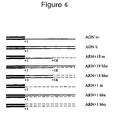
- the various transcription systems which have just been mentioned are shown schematically in the appended FIG. 6 in which, for each double-stranded system, the upper strand is the non-matrix strand and the lower strand is the matrix strand.
- the double-stranded DNA promoter region is represented by a thick line.
- the DNA strands are represented by a thin line, the RNA strands are represented by a broken line.
- the +1 sign corresponds to the transcription start site.
- the +18 indication corresponds to the eighteenth base downstream of the transcription start site.
- the letter m means single-stranded; the letter b means double-stranded; bhe means double-stranded heteroduplex; and bho means double-stranded homoduplex.
- the transcription systems of FIG. 6 were used with each of the matrices, or, as the case may be, with some of the matrices of Table 1.
- the matrices of group 1, using sequence No. 1, correspond to a promoter sequence of Double-stranded DNA followed by a +1 to +6 consensus initiation region (Dunn and Studier, J. Mol Biol., 166, 477-535, 1983) itself followed by a sequence of twenty six bases in downstream.
- Group 2 matrices correspond to a double-stranded DNA promoter sequence followed by a non-favorable sequence, since it may allow early termination of transcription (Martin et al., Biochemistry, 27 , 3966-3974, 1988).
- the matrices of group 3 correspond to the same unfavorable initiation sequence as group 2, followed by the same downstream sequence as group 1.
- T7 RNA polymerase is capable of transcription initiation on different RNA templates and is capable of fully transcribing these templates.
- Example 2 results from the fact that the detection by the Northern Blot technique is in this case 40 times more sensitive than the detection technique used in Example 2, as has been reported here. above in the description.
- T7 RNA polymerase is able to transcribe an RNA-RNA duplex. No increase in the number of abortive transcripts is observed with the homoduplex RNA + 1 template.
- the transcription of homo- or hetero-duplex double-stranded matrices is broadly similar. In the case of group 2 +18 RNA matrices, more transcripts of the expected size are obtained with the homoduplex system than with the heteroduplex system.
- the presence of the non-template strand influences the efficiency of transcription. Indeed, the transcription yield is increased on the single-stranded matrices, as shown, on the one hand, by the increase in the number of good transcripts and, on the other hand, the fact that an initiation event is more frequently associated with the synthesis of a complete transcript. However, with the group 2 matrices, the single-strand system does not give better results.
- the T7 RNA polymerase has a transcriptional activity on an RNA template, in the presence of a double-stranded DNA promoter.
- the observed transcriptional yield is only 10 to 100 times lower than on a DNA template.
Landscapes
- Chemical & Material Sciences (AREA)
- Life Sciences & Earth Sciences (AREA)
- Health & Medical Sciences (AREA)
- Organic Chemistry (AREA)
- Wood Science & Technology (AREA)
- Zoology (AREA)
- Engineering & Computer Science (AREA)
- Bioinformatics & Cheminformatics (AREA)
- Molecular Biology (AREA)
- Genetics & Genomics (AREA)
- Microbiology (AREA)
- Proteomics, Peptides & Aminoacids (AREA)
- Biotechnology (AREA)
- Biochemistry (AREA)
- General Engineering & Computer Science (AREA)
- General Health & Medical Sciences (AREA)
- Medicinal Chemistry (AREA)
- Chemical Kinetics & Catalysis (AREA)
- Physics & Mathematics (AREA)
- Analytical Chemistry (AREA)
- Biophysics (AREA)
- Biomedical Technology (AREA)
- Immunology (AREA)
- Enzymes And Modification Thereof (AREA)
- Measuring Or Testing Involving Enzymes Or Micro-Organisms (AREA)
- Micro-Organisms Or Cultivation Processes Thereof (AREA)
- Preparation Of Compounds By Using Micro-Organisms (AREA)
Claims (31)
- Amplifikationsverfahren einer RNA-Zielsequenz durch eine Promotor-abhängige Transkription in einer RNA-Probe, die die Zielsequenz einschließt, wobei die Probe in Kontakt kommt- mit einem Reagens, das in der Lage ist, mit der RNA, die die Zielsequenz enthält, zu hybridisieren,- und mit einem Enzymsystem, das eine RNA-abhängige RNA-Polymeraseaktivität umfasst,unter Bedingungen, die die Hybridisierung des Reagens mit der RNA, die die Zielsequenz umfasst, erlauben, und unter Bedingungen, die das Funktionieren der RNA-abhängigen RNA-Polymeraseaktivität erlauben; wobei das Reagens enthält(i) einen ersten Nukleotidstrang, umfassend: a) einen ersten Nukleotidabschnitt, der in der Lage ist, die Rolle des codierenden Strangs eines Promotors für die RNA-Polymeraseaktivität zu spielen und b) stromabwärts des ersten Abschnitts einen zweiten Nukleotidabschnitt, der eine Sequenz umfasst, die in der Lage ist, mit einer Region der RNA zu hybridisieren, und(ii) auf dem ersten Strang im hybridisierten Zustand, einen zweiten Nukleotidstrang, der einen dritten Nukleotidabschnitt umfasst, der in der Lage ist, mit dem ersten Abschnitt so zu hybridisieren, dass mit ihm ein funktioneller doppelsträngiger Promotor gebildet wird;und wobei die RNA-Polymeraseaktivität in der Lage ist, in Gegenwart des auf die Matrix hybridisierten Reagens, in Abwesenheit eines assoziierten Proteinfaktors und in Abwesenheit einer Ligaseaktivität eine RNA-Matrix zu transkribieren.
- Verfahren nach Anspruch 1, wobei der dritte Abschnitt stromaufwärts von einem vierten Nukleotidabschnitt flankiert ist, der kürzer ist als der zweite Abschnitt des ersten Strangs.
- Verfahren nach Anspruch 2, wobei der vierte Abschnitt mit einem gegenüberliegenden Teil des zweiten Abschnitts hybridisieren kann.
- Verfahren nach einem der Ansprüche 2 und 3, wobei der vierte Abschnitt des zweiten Strangs unter denjenigen ausgewählt ist, deren Sequenz die Initiation der Transkription für die RNA-Polymerase erleichtert.
- Verfahren nach einem der Ansprüche 2 bis 4, wobei der zweite Abschnitt des ersten Strangs eine Anzahl von Nukleotiden enthält, die wenigstens der Summe der Anzahl an Nukleotiden des vierten Abschnitts, sofern er anwesend ist, und der Anzahl von Nukleotiden der Sequenz des zweiten Abschnitts, die zur Hybridisierung mit der Region der RNA in der Lage ist, entspricht.
- Verfahren nach einem der vorhergehenden Ansprüche, wobei der erste und dritte Abschnitt aus DNA bestehen.
- Verfahren nach einem der vorhergehenden Ansprüche, wobei der vierte Abschnitt aus DNA besteht.
- Verfahren nach einem der vorhergehenden Ansprüche, wobei die RNA-Polymerase eine Wildtyp-RNA-Polymerase aus Virus oder Phage ist.
- Verfahren nach Anspruch 8, wobei die RNA-Polymerase aus der Familie der RNA-Polymerasen, einschließend der T7-RNA-Polymerase, der T3-RNA-Polymerase und der SP6-RNA-Polymerase, ausgewählt ist.
- Verfahren nach Anspruch 8, wobei sich die RNA-Polymerase durch Mutation von einer RNA-Polymerase aus der Familie der RNA-Polymerasen, einschließend der T7-, der T3- und der SP6-RNA-Polymerasen, ableitet.
- Verfahren nach Anspruch 10, wobei die RNA-Polymerase mindestens eine Mutation in der Region entsprechend der Aminosäuresequenz 625 bis 652 der T7-RNA-Polymerase enthält.
- Verfahren nach Anspruch 11, wobei die RNA-Polymerase in der Lage ist, eine Polynukleotid-Zielsequenz mit einer besseren Ausbeute zu transkribieren, wenn die Zielsequenz aus RNA statt aus DNA besteht.
- Verfahren nach einem der vorhergehenden Ansprüche, wobei das Enzymsystem ausschließlich eine RNA-Polymeraseaktivität enthält.
- RNA-Polymerase, die bei dem Verfahren nach einem der vorhergehenden Ansprüche verwendbar ist, die in der Lage ist, eine interessierende Polynukleotid-Zielsequenz aus einer beliebigen, in einer Polynukleotidmatrix enthaltenen Sequenz unter der Abhängigkeit eines Promotors zu transkribieren, wobei in Gegenwart der Matrix und in Abwesenheit eines assoziierten Proteinfaktors ein Transkriptionsprodukt, das eine zu dieser Sequenz komplementäre RNA-Sequenz umfasst, synthetisiert wird, wobei die RNA-Polymerase mutiert ist und in der Lage ist, das Transkriptionsprodukt mit einer besseren Ausbeute zu synthetisieren, wenn die Zielsequenz der Matrix aus RNA statt aus DNA besteht.
- RNA-Polymerase nach dem vorhergehenden Anspruch, wobei das Verhältnis der Ausbeute an Transkriptionsprodukt der RNA-Matrix und der Ausbeute an Transkriptionsprodukt der DNA-Matrix größer als 2 und insbesondere größer als 10 ist.
- RNA-Polymerase nach einem der Ansprüche 14 bis 15, dadurch gekennzeichnet, dass sie sich durch Mutation von einer RNA-Polymerase aus Virus oder Phage ableitet.
- RNA-Polymerase nach Anspruch 16, dadurch gekennzeichnet, dass der Phage ein Phage von E. coli ist.
- RNA-Polymerase nach einem der Ansprüche 14 bis 17, dadurch gekennzeichnet, dass sie eine Proteinsequenzhomologie von über 50 %, insbesondere von über 80 % zu einer Wiltyp-RNA-Polymerase aus der Familie der DNA-abhängigen RNA-Polymerasen, einschließlich der T7-RNA-Polymerase, der T3-RNA-Polymerase und der SP6-RNA-Polymerase, aufweist.
- RNA-Polymerase nach Anspruch 18, dadurch gekennzeichnet, dass sie mindestens eine Mutation in einer Region enthält, die der Aminosäuresequenz 625 bis 652 der T7-RNA-Polymerase entspricht.
- RNA-Polymerase nach Anspruch 19, dadurch gekennzeichnet, dass sie die Zusammensetzung einer DNA-abhängigen Wildtyp-RNA-Polymerase aufweist, mit der Ausnahme, dass sie in dieser Region mindestens eine Mutation enthält.
- RNA-Polymerase nach einem der Ansprüche 19 bis 20, dadurch gekennzeichnet, dass sie mindestens eine Mutation an einer Stelle umfasst, die einer der Stellen 627, 628, 631 und 639 der Aminosäuresequenz der T7-RNA-Polymerase entspricht.
- RNA-Polymerase nach einem der Ansprüche 19 bis 21, dadurch gekennzeichnet, dass die Mutation den Ersatz eines Aminosäurerests, ausgewählt aus Arginin, Lysin, Serin und Tyrosin, der Wildtyp-RNA-Polymerase durch einen anderen Aminosäurerest umfasst.
- RNA-Polymerase nach Anspruch 22, dadurch gekennzeichnet, dass die ersetzte Aminosäure Arginin oder Lysin ist und/oder dass der andere Aminosäurerest ein Alanin-, Valin-, Isoleucin-, Glycin-, Threonin- oder Serinrest ist.
- RNA-Polymerase nach einem der Ansprüche 19 bis 23, dadurch gekennzeichnet, dass die Mutation den Ersatz der gesamten Region oder eines Teils der Region durch eine homologe Region, die in einer Wildtyp-RNA-abhängigen Polymerase vorhanden ist, umfasst.
- Gen, das eine RNA-Polymerase, wie in einem der Ansprüche 14 bis 24 definiert, codiert.
- Expressionsvektor, in den ein Gen, wie in dem vorhergehenden Anspruch definiert, inseriert ist, der zur Expression der RNA-Polymerase in einer Wirtszelle in der Lage ist.
- Wirtszelle, die einen Expressionsvektor, wie in dem vorhergehenden Anspruch definiert, enthält.
- Verfahren zum Erhalten einer RNA-Polymerase, wie in einem der Ansprüche 14 bis 24 definiert, dadurch gekennzeichnet: a) dass ein Gen, das eine Wildtyp-RNA-Polymerase codiert, auf bekannte Weise erhalten wird, b) dass mindestens eine Mutation auf dem Gen durchgeführt wird, c) dass das erhaltene mutierte Gen in einen Expressionsvektor inseriert wird, d) dass der Vektor in einer Wirtszelle exprimiert wird, um eine mutierte RNA-Polymerase zu erhalten und e) dass aus den mutierten RNA-Polymerasen diejenigen ausgewählt werden, die die Eigenschaften einer RNA-Polymerase, wie in einem der Ansprüche 14 bis 15 definiert, aufweisen.
- Verwendung einer RNA-Polymerase, die in der Lage ist, eine RNA-Matrix unter der Abhängigkeit eines Promotors in Abwesenheit eines assoziierten Proteinfaktors durch ein Transkriptionsverfahren eines Matrixstrangs, der eine RNA-Zielsequenz umfasst, zu transkribieren, wobei die RNA-Polymerase aus der T7-RNA-Polymerase, der SP6-RNA-Polymerase und den RNA-Polymerasen nach einem der Ansprüche 14 bis 24 ausgewählt ist.
- Verwendung einer RNA-Polymerase, die in der Lage ist, eine RNA-Matrix unter der Abhängigkeit eines Promotors in Abwesenheit eines assoziierten Proteinfaktors durch ein Transkriptionsverfahren eines Matrixstrangs, der eine RNA-Zielsequenz umfasst, zu transkribieren, wobei der Matrixstrang aus RNA mindestens zwischen der Stelle +5 und dem 5'-Ende der Zielsequenz besteht, wobei die RNA-Polymerase eine Wildtyp-RNA-Polymerase aus Virus oder Phage ist.
- Verwendung nach dem vorhergehenden Anspruch, wobei die RNA-Polymerase aus den T7-, T3- und SP6-RNA-Polymerasen ausgewählt ist.
Applications Claiming Priority (3)
| Application Number | Priority Date | Filing Date | Title |
|---|---|---|---|
| FR9704166 | 1997-04-04 | ||
| FR9704166A FR2761695B1 (fr) | 1997-04-04 | 1997-04-04 | Arn polymerase fonctionnant preferentiellement sur matrice d'arn, sa preparation et son utilisation |
| PCT/FR1998/000635 WO1998045449A1 (fr) | 1997-04-04 | 1998-03-27 | Arn-polymerase arn-dependante fonctionnant preferentiellement sur matrice d'arn et procede de transcription d'arn sous la dependance d'un promoteur avec ledit arn polymerase arn-dependante |
Publications (2)
| Publication Number | Publication Date |
|---|---|
| EP0972051A1 EP0972051A1 (de) | 2000-01-19 |
| EP0972051B1 true EP0972051B1 (de) | 2007-04-11 |
Family
ID=9505551
Family Applications (1)
| Application Number | Title | Priority Date | Filing Date |
|---|---|---|---|
| EP98917263A Expired - Lifetime EP0972051B1 (de) | 1997-04-04 | 1998-03-27 | Rns-abhängige rns-polymerase, die vorzugsweise anhand einer rna-matrix funktioniert und ein promoter-abhängiger transkriptionsprozess , der diese rns-abhängige rns-polymerase benutzt. |
Country Status (10)
| Country | Link |
|---|---|
| US (2) | US6828127B2 (de) |
| EP (1) | EP0972051B1 (de) |
| JP (1) | JP4004072B2 (de) |
| AT (1) | ATE359369T1 (de) |
| AU (1) | AU7052898A (de) |
| CA (1) | CA2286343C (de) |
| DE (1) | DE69837535T2 (de) |
| ES (1) | ES2285766T3 (de) |
| FR (1) | FR2761695B1 (de) |
| WO (1) | WO1998045449A1 (de) |
Families Citing this family (8)
| Publication number | Priority date | Publication date | Assignee | Title |
|---|---|---|---|---|
| EP1261696B1 (de) | 2000-03-07 | 2005-05-04 | bioMerieux B.V. | Rna polymerase mutanten mit erhöhter thermostabilität |
| US7074558B2 (en) * | 2001-06-07 | 2006-07-11 | Pbi Technology, Inc. | Nucleic acid amplification using an RNA polymerase and DNA/RNA mixed polymer intermediate products |
| FR2828509B1 (fr) | 2001-08-08 | 2003-11-21 | D Lascaud Ets | Panneau isolant thermique |
| ATE464381T1 (de) * | 2004-12-23 | 2010-04-15 | Ge Healthcare Bio Sciences | Rna-amplifikation auf ligationsbasis |
| CN107460177B (zh) * | 2016-06-06 | 2021-08-17 | 张海生 | 可利用化学修饰核苷酸的rna聚合酶突变体 |
| CN110494567B (zh) | 2017-03-28 | 2024-07-12 | 味之素株式会社 | 生产rna的方法 |
| JP2023517540A (ja) * | 2020-03-03 | 2023-04-26 | ロケットヴァックス アーゲー | コロナウイルスに対して保護するためのワクチン産生のための完全合成長鎖核酸 |
| CN115558664A (zh) * | 2021-07-27 | 2023-01-03 | 上海兆维科技发展有限公司 | 一种rna的制备方法、合成蛋白质的方法以及转录反应液 |
Family Cites Families (7)
| Publication number | Priority date | Publication date | Assignee | Title |
|---|---|---|---|---|
| DE659881C (de) | 1936-04-25 | 1938-05-14 | I G Farbenindustrie Akt Ges | Verfahren zur Herstellung von Dehydrobinaphthylendiimin und seinen Substitutionsprodukten |
| EP0446305B1 (de) | 1988-12-05 | 1996-05-08 | The Salk Institute For Biological Studies | Systeme für amplifikation/nachweis von nukleinsäuren |
| US5122457A (en) | 1989-10-19 | 1992-06-16 | Schering Corporation | Expression systems utilizing bacteriophage t7 promoters, gene sequences, and t7 rna polymerase |
| FR2708288B1 (fr) | 1993-07-26 | 1995-09-01 | Bio Merieux | Procédé d'amplification d'acides nucléiques par transcription utilisant le déplacement, réactifs et nécessaire pour la mise en Óoeuvre de ce procédé. |
| FR2714062B1 (fr) | 1993-12-22 | 1996-02-16 | Bio Merieux | Promoteur modifié pour ARN polymérase, sa préparation et ses applications. |
| AU709292B2 (en) * | 1995-06-07 | 1999-08-26 | Gen-Probe Incorporated | Methods and kits for determining pre-amplification levels of a nucleic acid target sequence from post-amplification levels of product |
| EP0859833B1 (de) * | 1995-09-27 | 2006-03-01 | Emory University | Rekombinante rna-replikase von hepatitis-c-virus |
-
1997
- 1997-04-04 FR FR9704166A patent/FR2761695B1/fr not_active Expired - Lifetime
-
1998
- 1998-03-27 AT AT98917263T patent/ATE359369T1/de not_active IP Right Cessation
- 1998-03-27 JP JP54244098A patent/JP4004072B2/ja not_active Expired - Lifetime
- 1998-03-27 ES ES98917263T patent/ES2285766T3/es not_active Expired - Lifetime
- 1998-03-27 DE DE69837535T patent/DE69837535T2/de not_active Expired - Lifetime
- 1998-03-27 US US09/402,131 patent/US6828127B2/en not_active Expired - Lifetime
- 1998-03-27 CA CA002286343A patent/CA2286343C/fr not_active Expired - Lifetime
- 1998-03-27 WO PCT/FR1998/000635 patent/WO1998045449A1/fr not_active Ceased
- 1998-03-27 AU AU70528/98A patent/AU7052898A/en not_active Abandoned
- 1998-03-27 EP EP98917263A patent/EP0972051B1/de not_active Expired - Lifetime
-
2004
- 2004-09-15 US US10/940,964 patent/US7595180B2/en not_active Expired - Fee Related
Non-Patent Citations (2)
| Title |
|---|
| KONARSKA M.M.; SHARP P.A.: "REPLICATION OF RNA BY THE DNA-DEPENDENT RNA POLYMERASE OF PHAGE T7", CELL, vol. 57, no. 3, 5 May 1989 (1989-05-05), UNITED STATES, pages 423 - 431, XP007901016 * |
| LEARY S.L.; BAUM H.J.; LOEWY Z.G.: "DNA-dependent RNA polymerase from bacteriophage T3 transcribes and amplifies an RNA template in vitro", GENE, vol. 106, no. 1, 30 September 1991 (1991-09-30), NETHERLANDS, pages 93 - 96, XP000919219, ISSN: 0378-1119 * |
Also Published As
| Publication number | Publication date |
|---|---|
| FR2761695A1 (fr) | 1998-10-09 |
| DE69837535D1 (de) | 2007-05-24 |
| US20020119449A1 (en) | 2002-08-29 |
| CA2286343A1 (fr) | 1998-10-15 |
| JP2001507942A (ja) | 2001-06-19 |
| AU7052898A (en) | 1998-10-30 |
| US7595180B2 (en) | 2009-09-29 |
| CA2286343C (fr) | 2008-12-23 |
| DE69837535T2 (de) | 2007-12-13 |
| JP4004072B2 (ja) | 2007-11-07 |
| FR2761695B1 (fr) | 1999-09-24 |
| WO1998045449A1 (fr) | 1998-10-15 |
| US20050069933A1 (en) | 2005-03-31 |
| US6828127B2 (en) | 2004-12-07 |
| ATE359369T1 (de) | 2007-05-15 |
| ES2285766T3 (es) | 2007-11-16 |
| EP0972051A1 (de) | 2000-01-19 |
Similar Documents
| Publication | Publication Date | Title |
|---|---|---|
| JP4634799B2 (ja) | 耐熱性逆転写酵素およびその使用法 | |
| EP0721988B1 (de) | Chimärisches Oligonukleotid und dessen Verwendung zur Herstellung von Nukleinsäure-Transkripten | |
| CA2145533C (fr) | Procede d'amplification d'acides nucleiques par transcription utilisant le deplacement, reactifs et necessaire pour la mise en oeuvre de ce procede | |
| EP1385963B1 (de) | Von rna polymerasen abstammende polypeptide und ihre verwendungen | |
| CN106164261A (zh) | 适用于高温核酸合成的新颖逆转录酶 | |
| EP2077322B1 (de) | Verfahren und Kit zur Amplifikation von heteropolymerer oder poly(C)- RNA | |
| CZ293217B6 (cs) | Rekombinantní, tepelně stálá DNA polymeráza, způsob její přípravy a kit, který ji obsahuje | |
| EP0972051B1 (de) | Rns-abhängige rns-polymerase, die vorzugsweise anhand einer rna-matrix funktioniert und ein promoter-abhängiger transkriptionsprozess , der diese rns-abhängige rns-polymerase benutzt. | |
| JP4450867B2 (ja) | 等温増幅方法およびそれに用いる等温増幅用キット | |
| Sun et al. | Characterization of RNA products associated with or aborted by a viral RNA-dependent RNA polymerase | |
| EP1242586B1 (de) | Rna-polymerasen aus bacteriophagen phi6 - phi14 und deren anwendungen | |
| EP0659881A1 (de) | Modifizierter Promotor für die RNA-Polymerase, seinen Herstellung und Anwendungen | |
| JP5641939B2 (ja) | 変異型逆転写dnaポリメラーゼ | |
| JP5099455B2 (ja) | エマルジョンを用いたrnaの選択的増幅法 | |
| EP1137804B9 (de) | Kennzeichnung einer substanz mittels eines reportergens und sequenzen, die für die in vitro expression des reportergens notwendig sind | |
| EP1678300B1 (de) | Verfahren zur herstellung einer vollängen-cdna durch ligation eines adapters mit einem kohäsiven ende | |
| KR100689795B1 (ko) | 복합체 형성 방법 | |
| JPWO2010061922A1 (ja) | 新規MutSタンパク質およびそれを用いた変異の判定方法 |
Legal Events
| Date | Code | Title | Description |
|---|---|---|---|
| PUAI | Public reference made under article 153(3) epc to a published international application that has entered the european phase |
Free format text: ORIGINAL CODE: 0009012 |
|
| 17P | Request for examination filed |
Effective date: 19991025 |
|
| AK | Designated contracting states |
Kind code of ref document: A1 Designated state(s): AT BE CH DE DK ES FI FR GB GR IE IT LI LU MC NL PT SE |
|
| RIN1 | Information on inventor provided before grant (corrected) |
Inventor name: MALLET, FRANCOIS Inventor name: MANDRAND, BERNARD Inventor name: MCALLISTER, WILLIAM Inventor name: ORIOL, GUY Inventor name: ARNAUD-BARBE, NADEGE Inventor name: CHEYNET-SAUVION, VALERIE |
|
| 17Q | First examination report despatched |
Effective date: 20040105 |
|
| GRAP | Despatch of communication of intention to grant a patent |
Free format text: ORIGINAL CODE: EPIDOSNIGR1 |
|
| GRAS | Grant fee paid |
Free format text: ORIGINAL CODE: EPIDOSNIGR3 |
|
| GRAA | (expected) grant |
Free format text: ORIGINAL CODE: 0009210 |
|
| AK | Designated contracting states |
Kind code of ref document: B1 Designated state(s): AT BE CH DE DK ES FI FR GB GR IE IT LI LU MC NL PT SE |
|
| PG25 | Lapsed in a contracting state [announced via postgrant information from national office to epo] |
Ref country code: FI Free format text: LAPSE BECAUSE OF FAILURE TO SUBMIT A TRANSLATION OF THE DESCRIPTION OR TO PAY THE FEE WITHIN THE PRESCRIBED TIME-LIMIT Effective date: 20070411 |
|
| REG | Reference to a national code |
Ref country code: GB Ref legal event code: FG4D Free format text: NOT ENGLISH |
|
| REG | Reference to a national code |
Ref country code: CH Ref legal event code: EP |
|
| REG | Reference to a national code |
Ref country code: IE Ref legal event code: FG4D Free format text: LANGUAGE OF EP DOCUMENT: FRENCH |
|
| REF | Corresponds to: |
Ref document number: 69837535 Country of ref document: DE Date of ref document: 20070524 Kind code of ref document: P |
|
| REG | Reference to a national code |
Ref country code: CH Ref legal event code: NV Representative=s name: KIRKER & CIE S.A. |
|
| PG25 | Lapsed in a contracting state [announced via postgrant information from national office to epo] |
Ref country code: SE Free format text: LAPSE BECAUSE OF FAILURE TO SUBMIT A TRANSLATION OF THE DESCRIPTION OR TO PAY THE FEE WITHIN THE PRESCRIBED TIME-LIMIT Effective date: 20070711 |
|
| GBT | Gb: translation of ep patent filed (gb section 77(6)(a)/1977) |
Effective date: 20070627 |
|
| PG25 | Lapsed in a contracting state [announced via postgrant information from national office to epo] |
Ref country code: PT Free format text: LAPSE BECAUSE OF FAILURE TO SUBMIT A TRANSLATION OF THE DESCRIPTION OR TO PAY THE FEE WITHIN THE PRESCRIBED TIME-LIMIT Effective date: 20070911 |
|
| NLV1 | Nl: lapsed or annulled due to failure to fulfill the requirements of art. 29p and 29m of the patents act | ||
| REG | Reference to a national code |
Ref country code: ES Ref legal event code: FG2A Ref document number: 2285766 Country of ref document: ES Kind code of ref document: T3 |
|
| PG25 | Lapsed in a contracting state [announced via postgrant information from national office to epo] |
Ref country code: AT Free format text: LAPSE BECAUSE OF FAILURE TO SUBMIT A TRANSLATION OF THE DESCRIPTION OR TO PAY THE FEE WITHIN THE PRESCRIBED TIME-LIMIT Effective date: 20070411 |
|
| REG | Reference to a national code |
Ref country code: IE Ref legal event code: FD4D |
|
| PG25 | Lapsed in a contracting state [announced via postgrant information from national office to epo] |
Ref country code: NL Free format text: LAPSE BECAUSE OF FAILURE TO SUBMIT A TRANSLATION OF THE DESCRIPTION OR TO PAY THE FEE WITHIN THE PRESCRIBED TIME-LIMIT Effective date: 20070411 Ref country code: IE Free format text: LAPSE BECAUSE OF FAILURE TO SUBMIT A TRANSLATION OF THE DESCRIPTION OR TO PAY THE FEE WITHIN THE PRESCRIBED TIME-LIMIT Effective date: 20070411 Ref country code: DK Free format text: LAPSE BECAUSE OF FAILURE TO SUBMIT A TRANSLATION OF THE DESCRIPTION OR TO PAY THE FEE WITHIN THE PRESCRIBED TIME-LIMIT Effective date: 20070411 |
|
| PLBE | No opposition filed within time limit |
Free format text: ORIGINAL CODE: 0009261 |
|
| STAA | Information on the status of an ep patent application or granted ep patent |
Free format text: STATUS: NO OPPOSITION FILED WITHIN TIME LIMIT |
|
| 26N | No opposition filed |
Effective date: 20080114 |
|
| PG25 | Lapsed in a contracting state [announced via postgrant information from national office to epo] |
Ref country code: GR Free format text: LAPSE BECAUSE OF FAILURE TO SUBMIT A TRANSLATION OF THE DESCRIPTION OR TO PAY THE FEE WITHIN THE PRESCRIBED TIME-LIMIT Effective date: 20070712 |
|
| BERE | Be: lapsed |
Owner name: BIO MERIEUX Effective date: 20080331 |
|
| PG25 | Lapsed in a contracting state [announced via postgrant information from national office to epo] |
Ref country code: MC Free format text: LAPSE BECAUSE OF NON-PAYMENT OF DUE FEES Effective date: 20080331 |
|
| PG25 | Lapsed in a contracting state [announced via postgrant information from national office to epo] |
Ref country code: BE Free format text: LAPSE BECAUSE OF NON-PAYMENT OF DUE FEES Effective date: 20080331 |
|
| PG25 | Lapsed in a contracting state [announced via postgrant information from national office to epo] |
Ref country code: LU Free format text: LAPSE BECAUSE OF NON-PAYMENT OF DUE FEES Effective date: 20080327 |
|
| REG | Reference to a national code |
Ref country code: FR Ref legal event code: PLFP Year of fee payment: 19 |
|
| REG | Reference to a national code |
Ref country code: FR Ref legal event code: PLFP Year of fee payment: 20 |
|
| PGFP | Annual fee paid to national office [announced via postgrant information from national office to epo] |
Ref country code: CH Payment date: 20170327 Year of fee payment: 20 Ref country code: FR Payment date: 20170327 Year of fee payment: 20 |
|
| PGFP | Annual fee paid to national office [announced via postgrant information from national office to epo] |
Ref country code: GB Payment date: 20170327 Year of fee payment: 20 |
|
| PGFP | Annual fee paid to national office [announced via postgrant information from national office to epo] |
Ref country code: IT Payment date: 20170324 Year of fee payment: 20 |
|
| PGFP | Annual fee paid to national office [announced via postgrant information from national office to epo] |
Ref country code: DE Payment date: 20170329 Year of fee payment: 20 |
|
| PGFP | Annual fee paid to national office [announced via postgrant information from national office to epo] |
Ref country code: ES Payment date: 20170328 Year of fee payment: 20 |
|
| REG | Reference to a national code |
Ref country code: DE Ref legal event code: R071 Ref document number: 69837535 Country of ref document: DE |
|
| REG | Reference to a national code |
Ref country code: GB Ref legal event code: PE20 Expiry date: 20180326 |
|
| REG | Reference to a national code |
Ref country code: CH Ref legal event code: PL |
|
| PG25 | Lapsed in a contracting state [announced via postgrant information from national office to epo] |
Ref country code: GB Free format text: LAPSE BECAUSE OF EXPIRATION OF PROTECTION Effective date: 20180326 |
|
| REG | Reference to a national code |
Ref country code: ES Ref legal event code: FD2A Effective date: 20200806 |
|
| PG25 | Lapsed in a contracting state [announced via postgrant information from national office to epo] |
Ref country code: ES Free format text: LAPSE BECAUSE OF EXPIRATION OF PROTECTION Effective date: 20180328 |