EP0973181A1 - Elektrolyt, Photozelle und photoelektrochemische Zelle - Google Patents
Elektrolyt, Photozelle und photoelektrochemische Zelle Download PDFInfo
- Publication number
- EP0973181A1 EP0973181A1 EP99113723A EP99113723A EP0973181A1 EP 0973181 A1 EP0973181 A1 EP 0973181A1 EP 99113723 A EP99113723 A EP 99113723A EP 99113723 A EP99113723 A EP 99113723A EP 0973181 A1 EP0973181 A1 EP 0973181A1
- Authority
- EP
- European Patent Office
- Prior art keywords
- group
- electrolyte
- photoelectric conversion
- represent
- conversion device
- Prior art date
- Legal status (The legal status is an assumption and is not a legal conclusion. Google has not performed a legal analysis and makes no representation as to the accuracy of the status listed.)
- Granted
Links
- OXCHTPAFSKXKKP-UHFFFAOYSA-N CC(C1)C2C1CCC2 Chemical compound CC(C1)C2C1CCC2 OXCHTPAFSKXKKP-UHFFFAOYSA-N 0.000 description 1
- 0 CCN(*)c1ccccc1* Chemical compound CCN(*)c1ccccc1* 0.000 description 1
- CTQNGGLPUBDAKN-UHFFFAOYSA-N Cc1c(C)cccc1 Chemical compound Cc1c(C)cccc1 CTQNGGLPUBDAKN-UHFFFAOYSA-N 0.000 description 1
Images
Classifications
-
- H—ELECTRICITY
- H01—ELECTRIC ELEMENTS
- H01G—CAPACITORS; CAPACITORS, RECTIFIERS, DETECTORS, SWITCHING DEVICES, LIGHT-SENSITIVE OR TEMPERATURE-SENSITIVE DEVICES OF THE ELECTROLYTIC TYPE
- H01G9/00—Electrolytic capacitors, rectifiers, detectors, switching devices, light-sensitive or temperature-sensitive devices; Processes of their manufacture
- H01G9/20—Light-sensitive devices
- H01G9/2004—Light-sensitive devices characterised by the electrolyte, e.g. comprising an organic electrolyte
- H01G9/2009—Solid electrolytes
-
- C—CHEMISTRY; METALLURGY
- C09—DYES; PAINTS; POLISHES; NATURAL RESINS; ADHESIVES; COMPOSITIONS NOT OTHERWISE PROVIDED FOR; APPLICATIONS OF MATERIALS NOT OTHERWISE PROVIDED FOR
- C09B—ORGANIC DYES OR CLOSELY-RELATED COMPOUNDS FOR PRODUCING DYES, e.g. PIGMENTS; MORDANTS; LAKES
- C09B23/00—Methine or polymethine dyes, e.g. cyanine dyes
- C09B23/0075—Methine or polymethine dyes, e.g. cyanine dyes the polymethine chain being part of an heterocyclic ring
-
- C—CHEMISTRY; METALLURGY
- C09—DYES; PAINTS; POLISHES; NATURAL RESINS; ADHESIVES; COMPOSITIONS NOT OTHERWISE PROVIDED FOR; APPLICATIONS OF MATERIALS NOT OTHERWISE PROVIDED FOR
- C09B—ORGANIC DYES OR CLOSELY-RELATED COMPOUNDS FOR PRODUCING DYES, e.g. PIGMENTS; MORDANTS; LAKES
- C09B23/00—Methine or polymethine dyes, e.g. cyanine dyes
- C09B23/10—The polymethine chain containing an even number of >CH- groups
- C09B23/105—The polymethine chain containing an even number of >CH- groups two >CH- groups
-
- C—CHEMISTRY; METALLURGY
- C09—DYES; PAINTS; POLISHES; NATURAL RESINS; ADHESIVES; COMPOSITIONS NOT OTHERWISE PROVIDED FOR; APPLICATIONS OF MATERIALS NOT OTHERWISE PROVIDED FOR
- C09B—ORGANIC DYES OR CLOSELY-RELATED COMPOUNDS FOR PRODUCING DYES, e.g. PIGMENTS; MORDANTS; LAKES
- C09B23/00—Methine or polymethine dyes, e.g. cyanine dyes
- C09B23/10—The polymethine chain containing an even number of >CH- groups
- C09B23/107—The polymethine chain containing an even number of >CH- groups four >CH- groups
-
- C—CHEMISTRY; METALLURGY
- C09—DYES; PAINTS; POLISHES; NATURAL RESINS; ADHESIVES; COMPOSITIONS NOT OTHERWISE PROVIDED FOR; APPLICATIONS OF MATERIALS NOT OTHERWISE PROVIDED FOR
- C09B—ORGANIC DYES OR CLOSELY-RELATED COMPOUNDS FOR PRODUCING DYES, e.g. PIGMENTS; MORDANTS; LAKES
- C09B57/00—Other synthetic dyes of known constitution
- C09B57/007—Squaraine dyes
-
- H—ELECTRICITY
- H01—ELECTRIC ELEMENTS
- H01G—CAPACITORS; CAPACITORS, RECTIFIERS, DETECTORS, SWITCHING DEVICES, LIGHT-SENSITIVE OR TEMPERATURE-SENSITIVE DEVICES OF THE ELECTROLYTIC TYPE
- H01G9/00—Electrolytic capacitors, rectifiers, detectors, switching devices, light-sensitive or temperature-sensitive devices; Processes of their manufacture
- H01G9/20—Light-sensitive devices
- H01G9/2027—Light-sensitive devices comprising an oxide semiconductor electrode
- H01G9/2031—Light-sensitive devices comprising an oxide semiconductor electrode comprising titanium oxide, e.g. TiO2
-
- H—ELECTRICITY
- H01—ELECTRIC ELEMENTS
- H01M—PROCESSES OR MEANS, e.g. BATTERIES, FOR THE DIRECT CONVERSION OF CHEMICAL ENERGY INTO ELECTRICAL ENERGY
- H01M6/00—Primary cells; Manufacture thereof
- H01M6/14—Cells with non-aqueous electrolyte
- H01M6/16—Cells with non-aqueous electrolyte with organic electrolyte
- H01M6/162—Cells with non-aqueous electrolyte with organic electrolyte characterised by the electrolyte
- H01M6/164—Cells with non-aqueous electrolyte with organic electrolyte characterised by the electrolyte by the solvent
-
- H—ELECTRICITY
- H01—ELECTRIC ELEMENTS
- H01M—PROCESSES OR MEANS, e.g. BATTERIES, FOR THE DIRECT CONVERSION OF CHEMICAL ENERGY INTO ELECTRICAL ENERGY
- H01M2300/00—Electrolytes
- H01M2300/0085—Immobilising or gelification of electrolyte
-
- H—ELECTRICITY
- H01—ELECTRIC ELEMENTS
- H01M—PROCESSES OR MEANS, e.g. BATTERIES, FOR THE DIRECT CONVERSION OF CHEMICAL ENERGY INTO ELECTRICAL ENERGY
- H01M6/00—Primary cells; Manufacture thereof
- H01M6/14—Cells with non-aqueous electrolyte
- H01M6/18—Cells with non-aqueous electrolyte with solid electrolyte
- H01M6/181—Cells with non-aqueous electrolyte with solid electrolyte with polymeric electrolytes
-
- H—ELECTRICITY
- H10—SEMICONDUCTOR DEVICES; ELECTRIC SOLID-STATE DEVICES NOT OTHERWISE PROVIDED FOR
- H10K—ORGANIC ELECTRIC SOLID-STATE DEVICES
- H10K85/00—Organic materials used in the body or electrodes of devices covered by this subclass
- H10K85/30—Coordination compounds
-
- H—ELECTRICITY
- H10—SEMICONDUCTOR DEVICES; ELECTRIC SOLID-STATE DEVICES NOT OTHERWISE PROVIDED FOR
- H10K—ORGANIC ELECTRIC SOLID-STATE DEVICES
- H10K85/00—Organic materials used in the body or electrodes of devices covered by this subclass
- H10K85/30—Coordination compounds
- H10K85/311—Phthalocyanine
-
- H—ELECTRICITY
- H10—SEMICONDUCTOR DEVICES; ELECTRIC SOLID-STATE DEVICES NOT OTHERWISE PROVIDED FOR
- H10K—ORGANIC ELECTRIC SOLID-STATE DEVICES
- H10K85/00—Organic materials used in the body or electrodes of devices covered by this subclass
- H10K85/30—Coordination compounds
- H10K85/341—Transition metal complexes, e.g. Ru(II)polypyridine complexes
- H10K85/344—Transition metal complexes, e.g. Ru(II)polypyridine complexes comprising ruthenium
-
- H—ELECTRICITY
- H10—SEMICONDUCTOR DEVICES; ELECTRIC SOLID-STATE DEVICES NOT OTHERWISE PROVIDED FOR
- H10K—ORGANIC ELECTRIC SOLID-STATE DEVICES
- H10K85/00—Organic materials used in the body or electrodes of devices covered by this subclass
- H10K85/60—Organic compounds having low molecular weight
- H10K85/649—Aromatic compounds comprising a hetero atom
- H10K85/652—Cyanine dyes
-
- Y—GENERAL TAGGING OF NEW TECHNOLOGICAL DEVELOPMENTS; GENERAL TAGGING OF CROSS-SECTIONAL TECHNOLOGIES SPANNING OVER SEVERAL SECTIONS OF THE IPC; TECHNICAL SUBJECTS COVERED BY FORMER USPC CROSS-REFERENCE ART COLLECTIONS [XRACs] AND DIGESTS
- Y02—TECHNOLOGIES OR APPLICATIONS FOR MITIGATION OR ADAPTATION AGAINST CLIMATE CHANGE
- Y02E—REDUCTION OF GREENHOUSE GAS [GHG] EMISSIONS, RELATED TO ENERGY GENERATION, TRANSMISSION OR DISTRIBUTION
- Y02E10/00—Energy generation through renewable energy sources
- Y02E10/50—Photovoltaic [PV] energy
- Y02E10/542—Dye sensitized solar cells
Definitions
- This invention relates to a novel electrolyte, a photoelectric conversion device comprising the electrolyte and a semiconductor, and a photo-electrochemical cell comprising the photoelectric conversion device.
- the proposed cell comprises a work electrode serving as a negative electrode which is composed of an electrically conductive substrate and a porous thin film of titanium dioxide spectrally sensitized with a ruthenium complex (photosensitive layer), a charge transporting layer, and a counter electrode.
- the charge transporting layer is made of a redox system serving for charge transport between the negative electrode and the counter electrode, i.e., a positive electrode.
- the photo-electrochemical cell disclosed in the U.S. Patent is a wet type solar cell using an aqueous solution containing an electrolyte salt, such as potassium iodide, (i.e., an electrolytic solution) as a charge transporting layer.
- an electrolyte salt such as potassium iodide
- an electrolytic solution i.e., an electrolytic solution
- This system is promising in that a high energy conversion efficiency can be attained at a low cost.
- the hole transporting layer comprises an electrolyte solution containing a low-boiling solvent in a large proportion, such as a potassium iodide aqueous solution, there is a fear that the cell will be short of the electrolytic solution due to evaporation in long-term use to have a seriously deteriorated photoelectric conversion efficiency or fail to function as a device.
- JP-A-9-27352 teaches a photo-electrochemical cell having a solid electrolyte comprising crosslinked polyethylene oxide
- J. Phys. Chem ., vol. 99, pp. 1701-1703 (1995) proposes a photo-electrochemical cell using polyacrylonitrile based polymer gel electrolyte.
- the photo-electrochemical cells using these solid electrolytes have turned out to have poor photoelectric (conversion) characteristics, especially a low short circuit current density, and insufficient durability.
- An object of the invention is to provide a novel electrolyte [including a solid electrolyte and a liquid electrolyte (i.e., electrolytic solution)], a photoelectric conversion device, and a photo-electrochemical cell excellent in photoelectric (conversion) characteristics and durability.
- a novel electrolyte including a solid electrolyte and a liquid electrolyte (i.e., electrolytic solution)
- a photoelectric conversion device i.e., electrolytic solution
- the electrolyte (including a solid electrolyte and a liquid electrolyte (i.e., electrolytic solution)] according to the present invention contains a compound represented by formula (I) (hereinafter simply referred to a compound (I)) and/or a compound represented by formula (II) (hereinafter simply referred to as a compound (II)) as a solvent. It is preferred for the electrolyte to contain a polymer. It is still preferred that the electrolyte containing the polymer be a gel electrolyte.
- the electrolyte of the invention is particularly useful in lithium ion secondary batteries, photoelectric conversion devices using semiconductors, such as CCD cameras, and photo-electrochemical cells. It is particularly suitable for use in photo-electrochemical cells using semiconductors.
- the compounds (I) and (II) are high-boiling organic solvents, which, when used in an electrolyte in the above-described applications, provide a photoelectric conversion device with excellent performance, particularly excellent photoelectric characteristics, while preventing deterioration of the performance of element due to evaporation of a solvent.
- the compounds (I) and (II) provide a photo-electrochemical cell which has excellent photoelectric characteristics (e.g., a high short circuit current density) and excellent durability (e.g., freedom from reduction in short circuit current density with time) as compared with one using an electrolyte containing conventional solvents.
- the compounds (I) and (II) it is preferred for the compounds (I) and (II) to have a boiling point of 200°C or higher, particularly 250°C or higher. From the standpoint of photoelectric characteristics, such as a short circuit current density and a conversion efficiency, it is preferred for the compounds (I) and (II) to have a low viscosity and a high dielectric constant. To have a low viscosity leads to an improvement in ion mobility. To have a high dielectric constant brings about an increase in effective carrier concentration.
- R 1 and R 2 each independently represent a substituted or unsubstituted and straight-chain or branched alkyl group, which preferably contains 1 to 20 carbon atoms (e.g., methyl, ethyl, propyl, butyl, isopropyl, hexyl, t-octyl, benzyl, 2-ethoxyethyl or 2-butoxyethyl); a substituted or unsubstituted and straight-chain or branched alkenyl group, which preferably contains 2 to 20 carbon atoms (e.g., vinyl or allyl); or a substituted or unsubstituted mono- or polycyclic aryl group, which preferably contains 6 to 20 carbon atoms (e.g., phenyl, 4-methoxyphenyl, 4-cyanophenyl or 1-naphthyl).
- R 1 and R 2 each preferably represent an alkyl group. They may be the same or different but are
- R 3 in formulae (I) and (II) represents a cyano group, an alkoxycarbonyl group, an acyloxy group, a carbonamido group, a phosphoric acid group, a phosphono group, a phosphino group, a phosphoryl group, a carbamoyl group, a urethane group, a urea group, a carbonate group, a sulfonamido group, a sulfamoyl group, a sulfoxide group, a sulfone group, a sulfonyl group, a nitro group, an alkoxy group, an aryloxy group or a hydroxyl group; and E in formulae (I) and (II) represents a single bond, an alkylene group, an alkenylene group or an arylene group.
- R 3 may have a substituent.
- the alkylene or alkenylene group as represented by E may be substituted or unsubstituted and be either a straight-chain or a branched chain.
- the arylene group as E may be monocyclic or polycyclic and may be substituted or unsubstituted.
- E is preferably an alkylene group having 1 to 8 carbon atoms, still preferably an unsubstituted alkylene group having 1 to 8 carbon atoms, particularly preferably a methylene group, an ethylene group, a propylene group or a butylene group.
- R 3 is preferably a cyano group, an alkoxycarbonyl group, an acyloxy group, a phosphoric acid group, a phosphono group, a phosphino group, a phosphoryl group, a carbonate group, a sulfoxide group, a sulfone group, an alkoxy group or a hydroxyl group, still preferably a cyano group, an alkoxycarbonyl group, an acyloxy group, a phosphoric acid group, a phosphoryl group, a carbonate group or an alkoxy group.
- a cyano group is the most preferred.
- a, b and c each independently represent 0 or 1. It is preferred that a be 1; b be 1; and c be 0.
- D represents -O-, -OC(O)- (the direction of bonding is no object) or -OC(O)O-, preferably -OC(O)- or -OC(O)O-, still preferably -OC(O)-.
- R 4 in formula (II) represents a heterocyclic group or an alkyl, alkenyl or aryl group having a heterocyclic group; wherein the heterocyclic group may be substituted or unsubstituted and may be monocyclic or polycyclic, the alkyl or alkenyl group may be straight or branched, and the aryl group may be monocyclic or polycyclic.
- R 4 is preferably an alkyl group containing 1 to 8 carbon atoms and having a heterocyclic group bonded to the terminal carbon atom.
- the heterocyclic group is preferably a 5- or 6-membered saturated heterocyclic group.
- Preferred examples of the heterocyclic group as R 4 or as the heterocyclic moiety of R 4 are a tetrahydrofuran ring, a 1,4-dioxane ring, a tetrahydropyran ring, an ethylene carbonate ring, a propylene carbonate ring, an imidazolidinone ring, a pyrrolidone ring, an oxazolidinone ring, and a tetrahydrothiophene ring. Still preferred are a tetrahydrofuran ring, an ethylene carbonate ring, a pyrrolidone ring, and an oxazolidinone ring. A condensed ring composed of these heterocyclic rings is also preferred
- R 4 Of the compounds (I) and (II), the compounds (I) are preferred.
- Preferred examples of the polymer which is preferably used in the electrolyte of the present invention include polyethylene glycol, polyethylene oxide, polypropylene oxide, polyacrylic esters, polymethacrylic esters, polyvinyl alcohol, polyacrylamide, polyallylamine, polyphosphazene, polysilane, polysiloxane, polyvinyl chloride, polyacrylonitrile, polyethylene, polystyrene, polyvinylpyridine, polyvinylimidazole, polypropylene, polyester, polyamide, polyfluoroethylene, and polyvinylidene fluoride, and copolymers comprising two or more of the monomers constituting these homopolymers.
- Polymers comprising the above-enumerated homo- or copolymer as a main chain and an oxyethylene group, an oxypropylene group, a heterocyclic group, a cyano group, a carbonate group, etc. as a side chain are also preferred.
- main chain structures are polyethylene oxide, polypropylene oxide, polyacrylic esters, polymethacrylic acid esters, polyvinyl alcohol, polyacrylamide, polyallylamine, polysilane, polyacrylonitrile, polystyrene, polyvinylpyridine, polyvinylimidazole, polyfluoroethylene, polyvinylidene fluoride, and their copolymers.
- Polyacrylonitrile and polyvinylidene fluoride are particularly preferred.
- the electrolyte comprising the polymer and the compound (I) and/or (II) be a gel electrolyte from the standpoint of durability and mechanical strength.
- gel as used herein means a state of a substance in which colloidal particles or a polymeric molecules lose their independent mobility because of their mutual action and gather to make a solidified structure.
- polyacrylonitrile or polyvinylidene fluoride as referred to above as a preferred polymer or to use a polymer having a crosslinked structure, i.e., a crosslinked polymer.
- crosslinked polymer as used herein is intended to mean a polymer having, as a whole, a three-dimensional network structure formed by crosslinking.
- a crosslinked structure is usually formed by using a crosslinking agent having a polyfunctional group, such as glycerol, methylenebisacrylamide, oligoethylene glycol diacrylates, and alkyl diacrylates.
- the main chain of the crosslinked polymers preferably includes those described above.
- the crosslinked polymer useful in the present invention preferably include those represented by formula (III): wherein R 51 represents a hydrogen atom, an alkyl group or an aryl group; Z 51 represents a monovalent organic group having at least one group selected from the group consisting of a heterocyclic group, a cyano group, a carbonate group, -(CH 2 CH 2 O) n52 -R 52 , and -[CH 2 CH(CH 3 )O] n53 -R 53 ; L 51 represents -COO-, -OCO-, -CONR 54 - or -NR 54 CO-; n51 represents 0 or 1; R 52 , R 53 , and R 54 each represent a hydrogen atom, an alkyl group, a cycloalkyl group, an alkenyl group or an aryl group; n52 and n53 each represent an integer of 1 to 30; G represents a repeating unit derived from a compound containing an ethylenically unsatur
- the alkyl or alkenyl group may be substituted or unsubstituted and may be straight or branched, and the aryl group, heterocyclic group or cycloalkyl group may be substituted or unsubstituted and may have a condensed structure.
- R 51 represents a hydrogen atom, alkyl group (preferably an alkyl group having 1 to 18 carbon atoms, e.g., methyl, ethyl, isopropyl, t-octyl, benzyl, trifluoromethyl or ethoxyethyl) or an aryl group (preferably an aryl group having 6 to 18 carbon atoms, e.g., phenyl, 4-methylphenyl or 2-naphthyl).
- R 51 is preferably a hydrogen atom or a methyl group.
- Z 51 represents a monovalent organic group containing a heterocyclic group (preferably a heterocyclic group having 1 to 18 carbon atoms, e.g., an ethylene carbonate ring, a propylene carbonate ring, an imdazolidinone ring, a pyrrolidone ring, a succinimide ring, an oxazolidone ring, an imidazole ring or a pyridine ring, still preferably an ethylene carbonate ring, a pyrrolidone ring, an imidazolidinone ring, an oxazolidone ring, an imidazole ring or a pyridine ring), a cyano group, a carbonate group, -(CH 2 CH 2 O) n52 -R 52 , or -[CH 2 CH(CH 3 )O] n53 -R 53 (wherein n52 and n53 each represent an integer of 1 to 30, preferably 1 to 20, still preferably 1 to 10).
- R 52 and R 53 each represent a hydrogen atom, an alkyl group (the preference described for the alkyl group as R 51 applies), an alkenyl group (preferably an alkenyl group having 2 to 18 carbon atoms, e.g., allyl or vinyl), a cycloalkyl group (preferably a cycloalkyl group having 3 to 18 carbon atoms, e.g., cyclohexyl or cyclopentyl) or an aryl group (the preference described for the aryl group as R 51 applies).
- R 52 and R 53 each preferably represent a hydrogen atom or an alkyl group having 1 to 8 carbon atoms.
- Z 51 is preferably one of a heterocyclic group, a cyano group, a carbonate group, -(CH 2 CH 2 O) n52 -R 52 , and -[CH 2 CH(CH 3 )O] n53 -R 53 , or a combination of one of them and an alkyl group, an alkyleneoxy group or an aryl group.
- L 51 represents -COO-, -OCO-, -CONR 54 - or -NR 54 CO-, preferably -COO- or -CONR 54 -, still preferably -COO-. It is preferred that -COO- be bonded to Z 51 at the oxygen atom thereof and that -CONR 54 - be bonded to Z 51 at the nitrogen atom thereof.
- R 54 is preferably an alkyl group having 1 to 8 carbon atoms or a hydrogen atom.
- n51 is 0 or 1.
- the proportion d of the repeating unit containing Z 51 in the total repeating units of the crosslinked polymer of formula (III) is 5 to 99% by weight, preferably 20 to 95% by weight. Two or more different kinds of the Z 51 -containing repeating units may be used in combination.
- G represents a repeating unit derived from a compound having an ethylenically unsaturated group.
- the compounds from which G is derived include esters or amides derived from acrylic acids or ⁇ -alkylacrylic acids (e.g., methacrylic acid), such as N-isopropylacrylamide, N-n-butylacrylamide, N-t-butylacrylamide, N,N-dimethylacrylamide, N-methylmethacrylamide, acrylamide, 2-acrylamido-2-methylpropanesulfonic acid, acrylamidopropyltrimethylammonium chloride, methacrylamide, diacetonacrylamide, N-methylolacrylamide, N-methylolmethacrylamide, methyl acrylate, ethyl acrylate, n-propyl acrylate, isopropyl acrylate, 2-methyl-2-nitropropyl acrylate, n-butyl acrylate, isobutyl acrylate,
- ethylenically unsaturated compounds can be used either individually or as a combination thereof. Additional examples of useful ethylenically unsaturated compounds are given in Research Disclosure , No. 1955 (Jul., 1980).
- the proportion e of the repeating unit G in the total repeating units of the crosslinked polymer of formula (III) is 0 to 70% by weight, preferably 0 to 50% by weight.
- J represents a repeating unit derived from a compound containing two or more ethylenically unsaturated groups per molecule.
- preferred compounds containing two or more ethylenically unsaturated groups per molecule include divinylbenzene, 4,4'-isopropylidenediphenylene diacrylate, 1,3-butylene diacrylate, 1,3-butylene dimethacrylate, 1,4-cyclohexylenedimethylene dimethacrylate, diethylene glycol dimethacrylate, diisopropylidene glycol dimethacrylate, divinyloxymethane, ethylene glycol diacrylate, ethylene glycol dimethacrylate, diethylene glycol diacrylate, ethylidene diacrylate, ethylidene dimethacrylate, allyl acrylate, allyl methacrylate, 1,6-diacrylamidohexane, N,N'-methylenebisacrylamide, N,N'-(1,2-
- the proportion f of the repeating unit J in the total repeating units of the crosslinked polymer of formula (III) is 0.5 to 50% by weight, preferably 1.0 to 30% by weight.
- the polymers which can be used in the electrolyte of the invention preferably have a weight average molecular weight of 1000 or more, particularly 2000 or more.
- Non-limiting specific examples of the polymer which can be used in the invention are shown below.
- subscript symbol n indicates degree of polymerization
- other subscript symbols, e.g., d, e, and f, represent the weight ratios of the respective units.
- the polymers to be used in the invention are synthesized by radical polymerization that is a general method for polymer synthesis as described in T. Ohtsu and M. Kinoshita, KOBUNSHI NO JIKKENHO , Kagaku Dojin or T. Ohtsu, Kouza Jugou Han-no-ron 1 Radical Polymerization (I) , Kagaku Dojin.
- Radical polymerization can be induced by heat, light or electron rays or electrochemically. Heat-induced radical polymerization is preferred.
- Polymerization initiators preferably used in heat-induced radical polymerization include azo initiators, such as 2,2'-azobisisobutyronitrile, 2,2'-azobis(2,4-dimethylvaleronitrile), dimethyl 2,2'-azobis(2-methylpropionate), and dimethyl 2,2'-azobisisobutyrate; and peroxide initiators, such as lauryl peroxide, benzoyl peroxide, and t-butyl peroctoate.
- the polymerization initiator is preferably used in an amount of 0.01 to 20% by weight, particularly 0.1 to 10% by weight, based on the total monomers.
- the polymer is preferably used in a concentration of 0.02 to 50% by weight, still preferably 0.1 to 30% by weight, particularly preferably 1 to 20% by weight, in the electrolyte.
- concentration 0.02 to 50% by weight, still preferably 0.1 to 30% by weight, particularly preferably 1 to 20% by weight, in the electrolyte.
- gelation tends to be insufficient for securing stability of the performance as a photo-electrochemical cell.
- higher concentrations reduction in initial performance of a photo-electrochemical cell, especially photoelectric current density, can result.
- the electrolyte [including a solid electrolyte and a liquid electrolyte (i.e., electrolytic solution)] of the invention comprises electrolyte components.
- Examples of useful electrolyte components include a metal iodide, such as LiI, NaI, KI, CsI or CaI 2 ; an iodine salt of a quaternary ammonium compound (e.g., an imidazolium compound, a pyridinium compound or a tetraalkylammonium compound); Br 2 and a metal bromide, such as LiBr, NaBr, KBr, CsBr or CaBr 2 ; Br 2 and a bromine salt of a quaternary ammonium compound, such as a tetraalkylammonium bromide or pyridinium bromide; a metal complex, such as a ferrocyananate-ferricyanate or a ferrocene-ferricinium ion; a sulfur compound, such as poly(sodium sulfite) or an alkylthiol-alkyl disulfide; a viologen dye; hydro
- a metal iodide such as LiI, NaI, KI, CsI or CaI 2
- an iodine salt of an imidazolium compound such as LiI, NaI, KI, CsI or CaI 2
- an iodine salt of a imidazolium compound such as LiI, NaI, KI, CsI or CaI 2
- an iodine salt of a pyridinium compound e.g., pyridinium iodide
- an iodine salt of a tetraalkylammonium compound e.g., pyridinium iodide
- the electrolyte component is preferably used in a concentration of 0.05 mol/l of 1.5 mol/l, particularly 0.1 mol/l to 0.8 mol/l.
- Iodine can be added to the electrolyte to previously form a redox pair.
- iodine is preferably added in a concentration of 0.01 to 0.2 mol/l, which will bring about improved effects.
- concentration of the electrolyte component diminishes, the function as an electron carrier tends to be insufficient. Higher concentrations of the electrolyte component than necessary would not bring about further improvement in effect and, moreover, result in reduction of photoelectric current density due to an elevation of viscosity.
- the gel electrolyte according to the invention contains a gelling agent having a molecular weight of 1000 or less.
- the gelling agent used in the invention is a compound capable of solidifying (gelling) a whole system when added in a concentration of 500 g/l or less in an organic solvent
- gel generally means a state of a substance in which colloidal particles or a polymeric molecules lose their independent mobility because of their mutual action and gather to make a solidified structure.
- any compound can be used as a gelling agent as long as it has a molecular weight of 1000 or less, usually 100 or more, and is capable of solidifying (gelatinizing) an organic solvent when present in a concentration of 500 g/l or less, usually 0.1 g/l or more.
- Useful gelling agents include those which undergo self association in a solution to form a gel structure through secondary interaction that is not covalent bonding, such as hydrogen bonding, electrostatic mutual action, coordinate bonding, van der Waals force, and ⁇ - ⁇ electron mutual action.
- gelling agents shown above particularly preferred are amino acid derivatives G-3, G-4 and G-9 and twin type amino acid derivatives G-7 and G-10.
- the gelling agent is preferably present in a gel electrolyte in concentrations of 0.2 to 500 g/l, particularly 0.5 to 300 g/l, to enhance the effects of the invention. In lower concentrations, gelation tends to be insufficient for securing stability of the performance as a photoelectric conversion device. In higher concentrations, reduction in initial performance of a photo-electric conversion device, especially photoelectric current density, can result.
- the photo-electrochemical cell comprises a semiconductor responsive to radiations, a charge transporting layer, and a counter electrode.
- the semiconductor serves as a photoreceptor that absorbs light to generate electrons and positive holes, and the charge transporting layer contains the electrolyte of the invention.
- the photo-electrochemical cell preferably comprises a photoelectric conversion device composed of an electrically conductive substrate having a semiconductor layer (photosensitive layer) thereon, a charge transporting layer containing the electrolyte of the invention, preferably the gel electrolyte, and a counter electrode.
- the charge transporting layer containing the electrolyte preferably has a thickness of 0.001 to 200 ⁇ m, particularly 0.1 to 100 ⁇ m.
- the semiconductor which can be used in the invention includes simple substance semiconductors, e.g., Si or Ge, compound semiconductors, such as metal chalcogenides (e.g., oxides, sulfides, and selenides), and perovskite semiconductors.
- the metal chalcogenides include an oxide of titanium, tin, zinc, iron, tungsten, zirconium, hafnium, strontium, indium, cerium, yttrium, lanthanum, vanadium, niobium or tantalum; a sulfide of cadmium, zinc, lead, silver, antimony or bismuth; a selenide of cadmium or lead; and cadmium telluride.
- compound semiconductors include a phosphide of zinc, potassium, indium or cadmium, gallium arsenide, copper indium selenide, and copper indium sulfide.
- the perovskite semiconductors include strontium titanate, calcium titanate, sodium titanate, barium titanate, and potassium niobate.
- Preferred semiconductors for use in the invention include Si, TiO 2 , SnO 2 , Fe 2 O 3 , WO 3 , ZnO, Nb 2 O 5 , CdS, ZnS, Pbs, Bi 2 S 3 , CdSe, GaP, InP, GaAs, CdTe, CuInS 2 , and CuInSe 2 . Still preferred are TiO 2 , ZnO, SnO 2 , Fe 2 O 3 , WO 3 , Nb 2 O 5 , CdS, PbS, CdSe, InP, GaAs, CuInS 2 , and CuInSe 2 .
- the semiconductor may be a single crystal or polycrystalline.
- a single crystal is preferred for conversion efficiency, while a polycrystalline semiconductor is preferred from the standpoint of production cost, supply of raw materials, and an energy payback time.
- Finely particulate semiconductors having a particle size on the order of nanometers to microns are particularly preferred.
- the particulate semiconductors preferably have an average primary particle size of 5 to 200 nm, particularly 8 to 100 nm, in terms of a projected circle-equivalent diameter.
- the semiconductor particles in a dispersed state preferably have an average particle size of 0.01 to 100 ⁇ m.
- the particulate semiconductors particularly metal oxide semiconductors
- dyes For example, TiO 2 , ZnO, SnO 2 , Fe 2 O 3 , WO 3 , and Nb 2 O 5 are preferred for semiconductors to be dye-sensitized.
- TiO 2 is particularly preferred to be dye-sensitized.
- the photoelectric conversion device using dye-sensitized semiconductor particles is preferably composed of an electrically conductive substrate, a layer of semiconductor particles having adsorbed thereon a dye (a photosensitive layer), the photosensitive layer being provided on the conductive substrate, an electrolyte containing the compound (I) or (II) (preferably the compound (I) or (II) having a boiling point of 200°C or higher, particularly 250°C or higher), and a counter electrode.
- the electrically conductive substrate includes a substrate made of a conductive material, such as metal, and a nonconductive substrate made of glass or plastics having on the surface thereof an electrical conductor layer.
- Preferred conductors for use in the latter type of conductive substrates include metals (e.g., platinum, gold, silver, copper, aluminum, rhodium, and indium), carbon, and electrically conducting metal oxides (e.g., indium-tin composite oxide and F-doped tin oxide).
- a conductive glass substrate obtained by depositing F-doped tin dioxide on a transparent substrate made of inexpensive soda-lime float glass.
- the conductor layer preferably has a thickness of about 0.02 to 10 ⁇ m.
- the conductive substrate preferably has as low a surface resistivity as possible.
- a desirable surface resistivity is 100 ⁇ /cm 2 or smaller, particularly 40 ⁇ /cm 2 or smaller. While not limiting, the practical minimal surface resistivity is about 0.1 ⁇ /cm 2 .
- the conductive substrate be substantially transparent to light.
- substantially transparent means that the light transmission is at least 10%, preferably 50% or more, still preferably 70% or more.
- a glass or plastic substrate having an electrically conductive metal oxide layer is preferred as a transparent substrate.
- the amount of the conductive metal oxide is preferably 0.01 to 100 g/m 2 .
- the transparent conductive substrate is preferably used in such a manner that incident light enters from the side of the glass or plastic substrate.
- the semiconductor particles are applied to the conductive substrate by, for example, a method comprising coating the conductive substrate with a dispersion or colloidal solution of the semiconductor particles or a sol-gel process comprising applying a precursor of the semiconductor particles onto the conductive substrate and hydrolyzing the precursor with moisture in air to form a particulate semiconductor film.
- a dispersion of the semiconductor particles is prepared by the above-mentioned sol-gel process, a method comprising grinding and dispersing a semiconductor in a mortar, or a method comprising wet grinding and dispersing a semiconductor in a mill.
- a synthetic semiconductor as precipitated in a solvent in the form of fine particles can also be used as such.
- Useful dispersing media include water and various organic solvents, such as methanol, ethanol, isopropyl alcohol, dichloromethane, acetone, acetonitrile, and ethyl acetate.
- organic solvents such as methanol, ethanol, isopropyl alcohol, dichloromethane, acetone, acetonitrile, and ethyl acetate.
- a polymer, a surface active agent, an acid, a chelating agent, and the like may be added as a dispersing aid.
- the semiconductor particles it is preferable for the semiconductor particles to have a large surface area so that they may adsorb as large an amount of a dye as possible.
- the surface area of the semiconductor particles in the state applied to the conductive substrate is preferably 10 times or more, still preferably 100 times or more, the projected area.
- the upper limit of the surface area is, while not limited, practically about 1000 times the projected area.
- the thickness of the particulate semiconductor layer increases, the amount of the supported dye per unit projected area increases to show increased ability of capturing light, but the distance of diffusion of generated electrons also increases, which results in an increased loss due to re-coupling of charges. Accordingly, there is a favorable thickness range for the particulate semiconductor layer, which is typically from 0.1 to 100 ⁇ m. Where the device is used in a photo-electrochemical cell, the thickness is preferably 1 to 30 ⁇ m, still preferably 3 to 20 ⁇ m. It is preferred that the semiconductor particles applied to the substrate be calcined so that the particles may be brought into electronic contact among themselves to secure improved film strength and improved adhesion to the substrate.
- a preferred calcined temperature is 40°C or higher and lower than 700°C, particularly from 40 to 650°C.
- the calcining time is usually from 10 minutes to about 10 hours.
- the calcined particulate semiconductor layer can be subjected to chemical plating with a titanium tetrachloride aqueous solution or electrochemical plating with a titanium trichloride aqueous solution.
- the amount of the semiconductor particles to be applied is preferably 0.5 to 500 g/m 2 , still preferably 5 to 100 g/m 2 .
- the dye which can be used in the present invention preferably includes metal complex dyes and/or polymethine dyes. It is preferred for the dye to have an appropriate interlocking group for linking to the surface of the semiconductor particles.
- Preferred interlocking groups include -COOH, -SO 3 H, a cyano group, -P(O)(OH) 2 , -OP(O)(OH) 2 , and chelating groups having pi conductivity, such as oxime, dioxime, hydroxyquinoline, salicylate and ⁇ -keto-enolate groups. Particularly preferred of them are -COOH, -P(O)(OH) 2 , and -OP(O)(OH) 2 .
- the interlocking group may be in the form of a salt with an alkali metal, etc. or an intramolecular salt.
- the methine chain of a polymethine dye has an acidic group as in the case where the methine chain forms a squarylium ring or a croconium ring, that moiety can be used as a interlocking group.
- the metal complex dyes preferably include ruthenium complex dyes. Those represented by formula (IV) are still preferred.
- (Y 1 ) p RuB a B b B c wherein Y 1 represents a ligand selected from the group consisting of Cl, SCN, H 2 O, Br, I, CN, -NCO and SeCN; p represents an integer of 0 to 2 (preferably 2); and B a , B b , and B c each represent an organic ligand selected from B-1 to B-8 shown below.
- R a represents a hydrogen atom, a halogen atom, a substituted or unsubstituted alkyl group having 1 to 12 carbon atoms, a substituted or unsubstituted aralkyl group having 7 to 12 carbon atoms or a substituted or unsubstituted aryl group having 6 to 12 carbon atoms.
- the alkyl group and the alkyl moiety of the aralkyl group may be either straight or branched, and the aryl group and the aryl moiety of the aralkyl group may be either monocyclic or polycyclic (a condensed ring).
- the ruthenium complex dyes useful in the present invention include those described in U.S. Patents 4,927,721, 4,684,537, 5,084,365, 5,350,644, 5,463,057, and 5,525,440 and JP-A-7-249790. Specific examples of the ruthenium complex dyes represented by formula (IV) are tabulated below. No.
- the polymethine dyes preferably include those represented by formulae (V) and (VI) shown below.
- R b and R f each represent a hydrogen atom, an alkyl group, an aryl group or a heterocyclic group
- R c , R d , and R e each represent a hydrogen atom or a substituent
- R b , R c , R d , R e , and R f may appropriately be taken together to form a ring
- X 11 and X 12 each represent a nitrogen atom, an oxygen atom, a sulfur atom, a selenium atom or a tellurium atom
- n11 and n13 each represent an integer of 0 to 2
- n12 represents an integer of 1 to 6.
- the compound of formula (V) may have a counter ion in agreement with the charge quantity of the whole molecule.
- the alkyl, aryl, and heterocyclic groups may have a substituent; the alkyl group may be straight or branched; the aryl and heterocyclic groups may be monocyclic or polycyclic (a condensed ring); and the ring formed of R b , R c , R d , R e , and R f may have a substituent and may be monocyclic or polycyclic.
- Z a represents a non-metal atomic group necessary to form a nitrogen-containing heterocyclic group
- R g represents an alkyl group or an aryl group
- Q represents a mono- or polymethine group necessary to complete a (poly)methine dye
- X 13 represents a counter ion in balance
- n14 represents a number of from 0 up to 10 that is necessary to neutralize the charge of the molecule.
- the nitrogen-containing heterocyclic ring formed by Za may have a substitutent and may be a single ring or a condensed ring; the alkyl or aryl groups may have a substituent; the alkyl group may be straight or branched; and the aryl group may be monocyclic or polycyclic (a condensed ring).
- the dye represented by formula (VI) preferably includes those represented by formulae (VII-a) through (VII-d): wherein R 11 , R 12 , R 13 , R 14 , R 15 , R 21 , R 22 , R 23 , R 24 , R 31 , R 32 , R 33 , R 41 , R 42 , and R 43 each represent a hydrogen atom, an alkyl group, an aryl group or a heterocyclic group; Y 11 , Y 12 , Y 21 , Y 22 , Y 31 , Y 32 , Y 33 , Y 34 , Y 35 , Y 41 , Y 42 , Y 43 , Y 44 , Y 45 , and Y 46 each represent an oxygen atom, a sulfur atom, a selenium atom, a tellurium atom, -CR 16 R 17 - or -NR 18 -; R 16 , R 17 , and R 18 each represent a hydrogen
- the compounds represented by formulae (VII-a) through (VII-d) may have a counter ion in agreement with the charge quantity of the whole molecule.
- the alkyl, aryl, and heterocyclic groups may have a substituent; the alkyl group may be straight or branched; and the aryl or heterocyclic group may be monocyclic or polycyclic (a condensed ring).
- the compounds of formulae (V) and (VI) can be synthesized in accordance with the methods described, e.g., in F.M. Harmer, Heterocyclic Compounds-Cyanine Dyes and Related Compounds , John Wiley & Sons, New York & London (1964); D.M. Sturmer, Heterocyclic Compounds-Special topics in heterocyclic chemistry , Ch. 18, ⁇ 14, Items 482-515, John Wiley & Sons, New York & London (1977); Rodd's Chemistry of Carbon Compounds , 2nd Ed., vol. IV, part B, Ch. 15, Items 369-422, Elsevier Science Publishing Co., Inc., New York (1977); and British Patent 1,077,611.
- Adsorption of the dye onto semiconductor particles is usually effected by immersing well-dried semiconductor particles in a dye solution for several hours at room temperature or, as taught in JP-A-7-249790, while refluxing.
- Dye adsorption may be carried out either before or after applying the semiconductor particles to the substrate or simultaneously with application of the semiconductor particles.
- the unadsorbed dye is preferably removed by washing.
- dye adsorption is preferably conducted after the calcining. It is particularly preferred that the dye be adsorbed quickly before water is adsorbed to the surface of the calcined semiconductor layer.
- the dyes may be used either individually or as a combination of two or more thereof. Where the dye-sensitized photoelectric conversion device is for a photo-electrochemical cell, the dyes to be combined can be selected so as to maximize the breadth of the wavelength region for photoelectric conversion.
- the dye or dyes are preferably present in an amount of 0.01 to 100 mmol per m 2 of the substrate and 0.01 to 1 mmol per gram of the semiconductor particles. With too small an amount of the dye, the sensitizing effect would be insufficient. If the dye is used in too large an amount, the non-adsorbed dye will float only to reduce the sensitizing effect.
- a colorless compound may be adsorbed together with the dye so as to lessen the interaction among dye molecules, such as association.
- Hydrophobic compounds such as carboxyl-containing steroid compounds (e.g., cholic acid) can be used for this purpose.
- the surface of the semiconductor particles can be treated with an amine, such as pyridine, 4-t-butylpyridine or polyvinylpyridine.
- the amine can be used as such where it is liquid, or as dissolved in an organic solvent.
- the electrolyte of the invention that contains the polymer can be prepared by dissolving the polymer in the solvent of formula (I) or (II), and applying or infiltrating the resulting electrolytic solution to or into the semiconductor layer (electrode).
- the electrolyte containing the polymer can also be obtained by preparing a solution of monomers providing a desired polymer in the solvent of formula (I) or (II), applying or infiltrating the monomer solution to or into the semiconductor electrode, and causing the monomers to polymerize.
- a gel electrolyte is to be prepared, particularly where a crosslinked polymer is used, it is preferably formed by preparing a solution from the monomers, a polymerization initiator, other electrolyte components, and the solvent, applying the monomer solution to the electrode by casting, coating, dipping, impregnation or a like method to form a sol electrolyte layer, and causing the monomers to polymerize to make the sol into gel.
- Additives such as coating improvers (e.g., a leveling agent) can be added to the coating monomer solution.
- Methods for coating with the monomer solution include spin coating, dip coating, air knife coating, curtain coating, roller coating, wire bar coating, gravure coating, extrusion coating by use of a hopper (see U.S. Patent 2,681,294), and multilayer simultaneous coating (see U.S. Patents 2,761,418, 3,508,947, and 2,761,791).
- radical polymerization is carried out at a temperature appropriately decided according to the half decay temperature of the initiator, the heat resistance temperature of the dye, and the like, preferably 10 to 150°C, for a period properly selected according to the reaction conditions such as temperature.
- a substance in a reduced state such as iodine
- a substance in a reduced state such as iodine
- introduction of a substance in a reduced state, such as iodine can be performed by, for example, putting a semiconductor electrode having a gel electrolyte and the substance (e.g., iodine) in a closed container thereby to let the substance diffuse into the gel electrolyte. It is possible to introduce a substance in a reduced state (e.g., iodine) into a device by applying the substance to the counter electrode by coating or vacuum deposition.
- the counter electrode functions as a positive electrode.
- the counter electrode usually has a conductive substrate, such as those described above for use in the semiconductor electrode, but a substrate is not always required as far as sufficient strength is secured. For achieving air tightness, use of a substrate is advantageous, though.
- At least one of the conductive substrate of the semiconductor electrode and the counter electrode must be substantially transparent so that incident light can reach the photosensitive layer. It is preferred for the photo-electrochemical cell of the invention that the conductive substrate of the semiconductor electrode be transparent and that light be incident upon this side. In this case, it is still preferred that the counter electrode have light reflecting properties.
- the counter electrode that can be used in photo-electrochemical cells includes glass or plastic having metal or a conductive oxide deposited thereon. Metal can be deposited by vacuum evaporation, sputtering or a like technique for thin film formation to obtain a deposit thickness of 5 ⁇ m or less, preferably 5 nm to 3 ⁇ m.
- a preferred counter electrode is a glass plate having platinum deposited thereon by vacuum evaporation or a metal thin film formed by vacuum evaporation or sputtering.
- the photosensitive layer may have a single layer structure or a multilayer structure as designed according to the end use.
- a single photosensitive layer may have a dye of a kind or a mixture of two or more kinds of dyes.
- the photo-electrochemical cell of the invention may have its sides sealed with a polymer, an adhesive, etc. to prevent deterioration by oxidation.
- reaction product was purified by column chromatography on silica gel using a 1:2 to 1:1 mixed solvent of ethyl acetate and hexane as an eluent to give 17.0 g (yield: 66.9%) of liquid compound S-2.
- Electrically conductive glass having an F-doped tin oxide coat (TCO Glass-U, produced by Asahi Glass Co., Ltd., surface resistivity: about 30 ⁇ /cm 2 ) was cut to squares with 20 mm-sides.
- the titanium dioxide dispersion prepared in (1) was applied with a glass bar to the conductive side of 8 glass pieces at a time in the following manner.
- An adhesive tape was stuck to one end (over a 3 mm width from the edge) of the conductive surface of each glass piece, and 8 glass pieces were arrayed in two lines without gap to make a 4 cm wide and 8 cm long strip with their adhesive tape-stuck edges making both sides (8 cm long) of the strip as spacers.
- the coating weight of the titanium dioxide particles was adjusted to 20 g/m 2 . After coating, the adhesive tape was removed. The coating layer was air-dried at room temperature for 1 day and then calcined in an electric muffle furnace (Model FP-32, manufactured by Yamato Kagaku) at 450°C for 30 minutes. After being cooled out of the furnace, the coated glass substrates were immersed in a 3 ⁇ 10 -4 mol/l ethanol solution of the dye shown in Table 3 below for 3 hours. The amount of the dye coated was selected appropriately from 0.1 to 10 mmol/m 2 according to the dye.
- the dyed glass substrates were then immersed in 4-t-butylpyridine for 15 minutes, washed with ethanol, and dried spontaneously to obtain a dye-sensitized TiO 2 electrode substrate.
- the thickness of the dye-sensitized TiO 2 layer (photosensitive layer) thus formed was 10 ⁇ m.
- An electrolytic solution was prepared by dissolving the supporting electrolyte shown in Table 3 and iodine in the organic solvent shown in Table 3 in concentrations of 0.65 mol/l and 0.05 mol/l, respectively.
- the electrode substrate prepared in the above item 2), and a Pt-deposited glass substrate of the same size (2 cm ⁇ 2 cm) were brought into contact with the electrode layer 3 and the Pt deposit layer 6 facing each other.
- the electrolytic solution was introduced into the gap between the glass substrates by making use of capillarity so as to penetrate into the TiO 2 electrode.
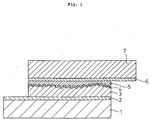
- photo-electrochemical cells 301 to 330 composed of a conductive glass substrate (glass 1 having a conductor layer 2), a TiO 2 electrode 3, a dye layer 4, an electrolytic solution 5, a Pt layer 6, and glass 7.
- the conductive glass 1 and the Pt-deposited glass 7 were connected by means of alligator clips, and the cell was irradiated with pseudo-sunlight containing no ultraviolet rays having an intensity of 86 mW/cm 2 which was obtained by cutting light from a 500 W xenon lamp (produced by Ushio Inc.) through AM1.5 Filter (produced by Oriel) and a sharp cut filter (Kenko L-42).
- the generated electricity was measured with a current-voltage meter (Keithley Model SMU238) to obtain an open circuit voltage (V OC ), a short circuit current density (J SC ), a fill factor (FF), and a conversion efficiency ( ⁇ ).
- the results in Table 4 prove that the cells of the invention, in which the high-boiling compound (I) or (II) is used as a solvent of the electrolytic solution, are less susceptible to deterioration in photoelectric conversion characteristics irrespective of the kinds of the sensitizing dye and the supporting electrolyte as compared with the comparative cells using conventional organic solvents having a relatively low-boiling point. It is also ascertained that the cells of the invention are excellent in initial performance, such as a short circuit current density and conversion efficiency.
- a titanium dioxide dispersion was prepared in the same manner as in Example 3.
- a TiO 2 electrode substrate was prepared in the same manner as in Example 3.
- the TiO 2 electrode prepared in the above item 2) and a Pt-deposited glass substrate of the same size were brought into contact with the electrode layer 3 and the Pt deposit layer 6 facing each other.
- An electrolytic solution was prepared by dissolving the supporting electrolyte shown in Table 5 below in the organic solvent shown in Table 5 in a concentration of 0.5 mol/l. Monomers providing the polymer shown in Table 5 were added to the solution in an amount of 10% by weight based on the total organic solvent, and 2,2'-azobisisobutyronitrile was added thereto in an amount of 0.5% by weight based on the total organic solvent. After bubbling argon gas through the solution for 5 minutes, the solution was infiltrated into the TiO 2 electrode by making use of osmotic pressure. The electrode was heated at 85°C in an argon atmosphere to gelatinize (polymerize) the solution.
- photo-electrochemical cells 401 to 428 composed of a conductive glass substrate (glass 1 having a conductor layer 2), a TiO 2 electrode 3, a dye layer 4, an electrolytic layer 5, a Pt layer 6, and glass 7, as shown in Fig. 1.
- a photo-electrochemical cell A was prepared in the same manner as described above, except that an electrolytic solution prepared by dissolving 0.05 mol/l of iodine and 0.5 mol/l of lithium iodide in a 90/10 (by volume) mixed solvent of acetonitrile and 3-methyl-2-oxazolidinone was introduced into the gap between the glass substrates by making use of capillarity.
- a photo-electrochemical cell B was prepared in accordance with JP-A-9-27352 as follows. Lithium iodide (500 mg) was dissolved in a mixture consisting of 1 g of hexaethylene glycol methacrylate (Blenmer PE350, produced by Nippon Yushikagaku K.K.), 1 g of ethylene glycol, and 20 mg of 2-hydroxy-2-methyl-1-phenyl-propan-1-one (Darocure 1173, produced by Chiba-Geigy (Japan) Ltd.) as a polymerization initiator.
- the solution was applied to the dye-sensitized TiO 2 electrode substrate (2 cm ⁇ 2 cm) prepared in the same manner as described above.
- the resulting coated electrode was placed under reduced pressure to remove air bubbles in the impregnated electrode and to promote penetration of the monomers.
- the coated electrode was irradiated with ultraviolet light to cause the monomers to polymerize to form uniform polymer gel in the voids of the porous TiO 2 electrode.
- the electrode was exposed to iodine for 30 minutes to make iodine diffuse into the polymer to obtain a photo-electrochemical cell B.
- a photo-electrochemical cell C was prepared in the same manner as for the cell B in accordance with JP-A-9-27352, except that the dye-sensitized TiO 2 electrode substrate was coated with a monomer solution prepared by dissolving 500 mg of lithium iodide in a mixture consisting of 1 g of hexaethylene glycol methacrylate (Blenmer PE350), 100 mg of ethylene glycol diacrylate, 3 g of propylene carbonate (solvent capable of dissolving the electrolyte), and 20 mg of 2-hydroxy-2-methyl-1-phenyl-propan-1-one (Darocure 1173).
- a monomer solution prepared by dissolving 500 mg of lithium iodide in a mixture consisting of 1 g of hexaethylene glycol methacrylate (Blenmer PE350), 100 mg of ethylene glycol diacrylate, 3 g of propylene carbonate (solvent capable of dissolving the electrolyte), and 20 mg of 2-hydroxy
- the results in Table 6 prove that the cells of the invention, in which a gel electrolyte containing the high-boiling compound (I) or (II) and the polymer is used, are less susceptible to deterioration of photoelectric conversion characteristics irrespective of the kinds of the sensitizing dye and the supporting electrolyte as compared with the comparative cells using a conventional gel electrolyte containing a relatively low-boiling point organic solvent. It is also ascertained that the cells of the invention are excellent in initial performance such as a short circuit current density and conversion efficiency.
- the cells of the invention have a high short circuit current density and excellent photoelectric conversion characteristics and hardly deteriorate when used for a long period of time.
- the results in Table 8 prove that the cells of the invention, in which a gel electrolyte containing the high-boiling compound (I) or (II) and the gelling agent is used, are less susceptible to deterioration of photoelectric conversion characteristics irrespective of the kinds of the sensitizing dye and the supporting electrolyte as compared with the comparative cells using a conventional gel electrolyte containing a relatively low-boiling point organic solvent. It is also ascertained that the cells of the invention are excellent in initial performance such as a short circuit current density and conversion efficiency.
- comparison with cell A also proves the resistance of the cells of the invention against deterioration of photoelectric conversion characteristics
- comparison with cell B shows that the cells of the invention have a high short circuit current density and excellent photoelectric characteristics.
- the novel electrolyte and the photoelectric conversion device and photo-electrochemical cell having excellent photoelectric conversion characteristics and less deterioration of the photoelectric conversion characteristics in long-term use can be obtained by the present invention.
Landscapes
- Chemical & Material Sciences (AREA)
- Engineering & Computer Science (AREA)
- Organic Chemistry (AREA)
- Power Engineering (AREA)
- Chemical Kinetics & Catalysis (AREA)
- Electrochemistry (AREA)
- Microelectronics & Electronic Packaging (AREA)
- Manufacturing & Machinery (AREA)
- General Chemical & Material Sciences (AREA)
- Hybrid Cells (AREA)
- Photovoltaic Devices (AREA)
Applications Claiming Priority (4)
| Application Number | Priority Date | Filing Date | Title |
|---|---|---|---|
| JP10219777A JP2000036332A (ja) | 1998-07-17 | 1998-07-17 | 電解液、光電変換素子および光再生型光電気化学電池 |
| JP21977798 | 1998-07-17 | ||
| JP10286006A JP2000100486A (ja) | 1998-09-21 | 1998-09-21 | 電解質および光電気化学電池 |
| JP28600698 | 1998-09-21 |
Publications (2)
| Publication Number | Publication Date |
|---|---|
| EP0973181A1 true EP0973181A1 (de) | 2000-01-19 |
| EP0973181B1 EP0973181B1 (de) | 2002-10-09 |
Family
ID=26523333
Family Applications (1)
| Application Number | Title | Priority Date | Filing Date |
|---|---|---|---|
| EP99113723A Expired - Lifetime EP0973181B1 (de) | 1998-07-17 | 1999-07-13 | Photozelle und photoelektrochemische Zelle |
Country Status (3)
| Country | Link |
|---|---|
| EP (1) | EP0973181B1 (de) |
| AT (1) | ATE225982T1 (de) |
| DE (1) | DE69903381T2 (de) |
Cited By (8)
| Publication number | Priority date | Publication date | Assignee | Title |
|---|---|---|---|---|
| WO2000065617A3 (en) * | 1999-04-23 | 2001-08-09 | Imperial College | Photoelectrochemical cell with a solid electrolyte |
| WO2002033765A3 (en) * | 2000-10-18 | 2003-10-02 | Mitsui Du Pont Polychemical | Gel-type polymer electrolyte and use thereof |
| SG103298A1 (en) * | 2000-06-16 | 2004-04-29 | Nisshin Spinning | Polymer battery and method of manufacture |
| EP1137022A3 (de) * | 2000-03-24 | 2005-06-29 | Fuji Photo Film Co., Ltd. | Farbstoffsensibilisierte Halbleiterteilchen und photoelektrische Zelle |
| EP1300899A3 (de) * | 2001-10-04 | 2006-03-29 | Dainichiseika Color & Chemicals Mfg. Co. Ltd. | Vorläufer von hochmolekularem Gelbildner für Elektrolyt |
| CN113012947A (zh) * | 2021-02-07 | 2021-06-22 | 中国科学院福建物质结构研究所 | 一种水系固态电解质的制备方法及其应用 |
| US20220181692A1 (en) * | 2019-09-04 | 2022-06-09 | Murata Manufacturing Co., Ltd. | Electrolytic solution for secondary battery, and secondary battery |
| US11377562B2 (en) * | 2016-07-28 | 2022-07-05 | Council Of Scientific & Industrial Research | Squaraine dyes and applications thereof |
Citations (7)
| Publication number | Priority date | Publication date | Assignee | Title |
|---|---|---|---|---|
| JPS61227377A (ja) * | 1985-04-02 | 1986-10-09 | Showa Denko Kk | 非水系二次電池 |
| EP0462935A1 (de) * | 1990-06-19 | 1991-12-27 | Sandoz Ag | 2-Tetrahydrofuran-Enantiomerderivate, Zwischenprodukte davon und ihre Herstellung |
| US5294502A (en) * | 1993-04-02 | 1994-03-15 | Valence Technology, Inc. | Cyclic ethers, solid electrolytes containing such ethers and electrolytic cells produced therefrom |
| WO1997044842A1 (en) * | 1996-05-24 | 1997-11-27 | Sri International | Nonflammable/self-extinguishing electrolytes for batteries |
| JPH1055820A (ja) * | 1996-08-08 | 1998-02-24 | Kao Corp | 二次電池用非水電解液 |
| JPH10189039A (ja) * | 1996-12-25 | 1998-07-21 | Mitsui Chem Inc | 非水電解液及び非水電解液二次電池 |
| JPH10189040A (ja) * | 1996-12-25 | 1998-07-21 | Mitsui Chem Inc | 非水電解液及び非水電解液二次電池 |
-
1999
- 1999-07-13 DE DE69903381T patent/DE69903381T2/de not_active Expired - Fee Related
- 1999-07-13 AT AT99113723T patent/ATE225982T1/de not_active IP Right Cessation
- 1999-07-13 EP EP99113723A patent/EP0973181B1/de not_active Expired - Lifetime
Patent Citations (7)
| Publication number | Priority date | Publication date | Assignee | Title |
|---|---|---|---|---|
| JPS61227377A (ja) * | 1985-04-02 | 1986-10-09 | Showa Denko Kk | 非水系二次電池 |
| EP0462935A1 (de) * | 1990-06-19 | 1991-12-27 | Sandoz Ag | 2-Tetrahydrofuran-Enantiomerderivate, Zwischenprodukte davon und ihre Herstellung |
| US5294502A (en) * | 1993-04-02 | 1994-03-15 | Valence Technology, Inc. | Cyclic ethers, solid electrolytes containing such ethers and electrolytic cells produced therefrom |
| WO1997044842A1 (en) * | 1996-05-24 | 1997-11-27 | Sri International | Nonflammable/self-extinguishing electrolytes for batteries |
| JPH1055820A (ja) * | 1996-08-08 | 1998-02-24 | Kao Corp | 二次電池用非水電解液 |
| JPH10189039A (ja) * | 1996-12-25 | 1998-07-21 | Mitsui Chem Inc | 非水電解液及び非水電解液二次電池 |
| JPH10189040A (ja) * | 1996-12-25 | 1998-07-21 | Mitsui Chem Inc | 非水電解液及び非水電解液二次電池 |
Non-Patent Citations (6)
| Title |
|---|
| DATABASE INSPEC [online] INSTITUTE OF ELECTRICAL ENGINEERS, STEVENAGE, GB; GRATZEL M: "Titanium dioxide solar cells", XP002118483, Database accession no. 4606838 * |
| N. PAPAGEORGIOU, Y. ATHANASSOV, M. ARMAND, P. BONHÔTE, H. PETTERSSON, A. AZAM, M. GRÄTZEL: "The Performance and Stability of Ambient Temperature Molten Salts for Solar Cell Applications", J. ELECTROCHEM. SOC., vol. 143, no. 10, October 1996 (1996-10-01), pages 3099 - 3108, XP002118482 * |
| PATENT ABSTRACTS OF JAPAN vol. 011, no. 070 (E - 485) 3 March 1987 (1987-03-03) * |
| PATENT ABSTRACTS OF JAPAN vol. 1998, no. 06 30 April 1998 (1998-04-30) * |
| PATENT ABSTRACTS OF JAPAN vol. 1998, no. 12 31 October 1998 (1998-10-31) * |
| SCHWEIZERISCHE TECHNISCHE ZEITSCHRIFT, 15 DEC. 1993, SWITZERLAND, vol. 90, no. 12, pages 32 - 33, 35, XP002118375, ISSN: 0040-151X * |
Cited By (11)
| Publication number | Priority date | Publication date | Assignee | Title |
|---|---|---|---|---|
| WO2000065617A3 (en) * | 1999-04-23 | 2001-08-09 | Imperial College | Photoelectrochemical cell with a solid electrolyte |
| EP1137022A3 (de) * | 2000-03-24 | 2005-06-29 | Fuji Photo Film Co., Ltd. | Farbstoffsensibilisierte Halbleiterteilchen und photoelektrische Zelle |
| SG103298A1 (en) * | 2000-06-16 | 2004-04-29 | Nisshin Spinning | Polymer battery and method of manufacture |
| WO2002033765A3 (en) * | 2000-10-18 | 2003-10-02 | Mitsui Du Pont Polychemical | Gel-type polymer electrolyte and use thereof |
| AU2001295953B2 (en) * | 2000-10-18 | 2007-03-22 | E.I. Du Pont De Nemours And Company | Gel-type polymer electrolyte and use thereof |
| KR100866242B1 (ko) | 2000-10-18 | 2008-10-30 | 듀폰-미츠이 폴리케미칼 가부시키가이샤 | 겔형 중합체 전해질 및 그의 용도 |
| EP1300899A3 (de) * | 2001-10-04 | 2006-03-29 | Dainichiseika Color & Chemicals Mfg. Co. Ltd. | Vorläufer von hochmolekularem Gelbildner für Elektrolyt |
| KR100607347B1 (ko) * | 2001-10-04 | 2006-07-28 | 다이니치 세이카 고교 가부시키가이샤 | 전해액용 고분자 겔화제 전구체, 그 제조방법, 전해액용 고분자 겔화제 및 그 제조방법 |
| US11377562B2 (en) * | 2016-07-28 | 2022-07-05 | Council Of Scientific & Industrial Research | Squaraine dyes and applications thereof |
| US20220181692A1 (en) * | 2019-09-04 | 2022-06-09 | Murata Manufacturing Co., Ltd. | Electrolytic solution for secondary battery, and secondary battery |
| CN113012947A (zh) * | 2021-02-07 | 2021-06-22 | 中国科学院福建物质结构研究所 | 一种水系固态电解质的制备方法及其应用 |
Also Published As
| Publication number | Publication date |
|---|---|
| DE69903381T2 (de) | 2003-06-18 |
| ATE225982T1 (de) | 2002-10-15 |
| DE69903381D1 (de) | 2002-11-14 |
| EP0973181B1 (de) | 2002-10-09 |
Similar Documents
| Publication | Publication Date | Title |
|---|---|---|
| EP0986080B1 (de) | Verfahren zur Herstellung eines ein vernetztes Polymer enthaltenden Elektrolyten und einer den Elektrolyt verwendenden photoelektrochemischen Zelle | |
| EP0924724B1 (de) | Photoelektrische Umwandlungsvorrichtung und photoelektrochemische Zelle | |
| EP1091373B1 (de) | Photoelektrische Umwandlungsanordnung und photoelektrochemische Zelle | |
| EP1075005B1 (de) | Elektrolytzusammensetzung und photolektrochemische Zelle | |
| US6291763B1 (en) | Photoelectric conversion device and photo cell | |
| EP1089305B1 (de) | Elektrolyt-Zusammensetzung, photoelektrische Umwandlungsvorrichtung und photoelektrochemische Zelle | |
| JP4363553B2 (ja) | 電解質組成物、光電変換素子および光電気化学電池 | |
| JP4620224B2 (ja) | 電解質組成物 | |
| JP2001243995A (ja) | 光電変換素子および光電池 | |
| WO2006126861A9 (en) | Solid-state electrolyte composition containing liquid crystal materials and dye-sensitized solar cells using thereof | |
| JP4111360B2 (ja) | ゲル電解質、光電気化学電池用ゲル電解質および光電気化学電池 | |
| EP0973181B1 (de) | Photozelle und photoelektrochemische Zelle | |
| EP1134759A2 (de) | Elektrolytzusammensetzung für photoelektrochemische Zellen | |
| EP1139357B1 (de) | Photoelektrochemische Zelle | |
| JP2000223167A (ja) | 光電変換素子および光電気化学電池 | |
| CN103503099B (zh) | 光电元件 | |
| EP1020881A2 (de) | Photoelektrochemische Zelle | |
| JP2000036608A (ja) | ゲル電解質、光電変換素子および光再生型光電気化学電池 | |
| EP1385182B1 (de) | Pyridiniumverbindungen und ihre Verwendung in einer photoelektrochemischen Zelle | |
| JP2000100486A (ja) | 電解質および光電気化学電池 | |
| JP2000100487A (ja) | 電解質、光電変換素子および光電気化学電池 | |
| JP2002042909A (ja) | 光電変換素子および光電池 | |
| JP2000251532A (ja) | 電解質、光電変換素子および光電気化学電池 | |
| JP2000100485A (ja) | 電解質および光電気化学電池 | |
| JP4392776B2 (ja) | 光電変換素子、光電池及び太陽電池モジュール |
Legal Events
| Date | Code | Title | Description |
|---|---|---|---|
| PUAI | Public reference made under article 153(3) epc to a published international application that has entered the european phase |
Free format text: ORIGINAL CODE: 0009012 |
|
| AK | Designated contracting states |
Kind code of ref document: A1 Designated state(s): AT BE CH CY DE DK ES FI FR GB GR IE IT LI LU MC NL PT SE |
|
| AX | Request for extension of the european patent |
Free format text: AL;LT;LV;MK;RO;SI |
|
| 17P | Request for examination filed |
Effective date: 20000413 |
|
| AKX | Designation fees paid |
Free format text: AT BE CH CY DE DK ES FI FR GB GR IE IT LI LU MC NL PT SE |
|
| 17Q | First examination report despatched |
Effective date: 20010529 |
|
| GRAG | Despatch of communication of intention to grant |
Free format text: ORIGINAL CODE: EPIDOS AGRA |
|
| RTI1 | Title (correction) |
Free format text: PHOTOELECTRIC CONVERSION DEVICE AND PHOTOELECTROCHEMICAL CELL |
|
| RTI1 | Title (correction) |
Free format text: PHOTOELECTRIC CONVERSION DEVICE AND PHOTOELECTROCHEMICAL CELL |
|
| GRAG | Despatch of communication of intention to grant |
Free format text: ORIGINAL CODE: EPIDOS AGRA |
|
| GRAH | Despatch of communication of intention to grant a patent |
Free format text: ORIGINAL CODE: EPIDOS IGRA |
|
| GRAH | Despatch of communication of intention to grant a patent |
Free format text: ORIGINAL CODE: EPIDOS IGRA |
|
| GRAA | (expected) grant |
Free format text: ORIGINAL CODE: 0009210 |
|
| AK | Designated contracting states |
Kind code of ref document: B1 Designated state(s): AT BE CH CY DE DK ES FI FR GB GR IE IT LI LU MC NL PT SE |
|
| PG25 | Lapsed in a contracting state [announced via postgrant information from national office to epo] |
Ref country code: NL Free format text: LAPSE BECAUSE OF FAILURE TO SUBMIT A TRANSLATION OF THE DESCRIPTION OR TO PAY THE FEE WITHIN THE PRESCRIBED TIME-LIMIT Effective date: 20021009 Ref country code: LI Free format text: LAPSE BECAUSE OF FAILURE TO SUBMIT A TRANSLATION OF THE DESCRIPTION OR TO PAY THE FEE WITHIN THE PRESCRIBED TIME-LIMIT Effective date: 20021009 Ref country code: IT Free format text: LAPSE BECAUSE OF FAILURE TO SUBMIT A TRANSLATION OF THE DESCRIPTION OR TO PAY THE FEE WITHIN THE PRESCRIBED TIME-LIMIT;WARNING: LAPSES OF ITALIAN PATENTS WITH EFFECTIVE DATE BEFORE 2007 MAY HAVE OCCURRED AT ANY TIME BEFORE 2007. THE CORRECT EFFECTIVE DATE MAY BE DIFFERENT FROM THE ONE RECORDED. Effective date: 20021009 Ref country code: GR Free format text: LAPSE BECAUSE OF FAILURE TO SUBMIT A TRANSLATION OF THE DESCRIPTION OR TO PAY THE FEE WITHIN THE PRESCRIBED TIME-LIMIT Effective date: 20021009 Ref country code: FR Free format text: LAPSE BECAUSE OF FAILURE TO SUBMIT A TRANSLATION OF THE DESCRIPTION OR TO PAY THE FEE WITHIN THE PRESCRIBED TIME-LIMIT Effective date: 20021009 Ref country code: FI Free format text: LAPSE BECAUSE OF FAILURE TO SUBMIT A TRANSLATION OF THE DESCRIPTION OR TO PAY THE FEE WITHIN THE PRESCRIBED TIME-LIMIT Effective date: 20021009 Ref country code: CH Free format text: LAPSE BECAUSE OF FAILURE TO SUBMIT A TRANSLATION OF THE DESCRIPTION OR TO PAY THE FEE WITHIN THE PRESCRIBED TIME-LIMIT Effective date: 20021009 Ref country code: BE Free format text: LAPSE BECAUSE OF FAILURE TO SUBMIT A TRANSLATION OF THE DESCRIPTION OR TO PAY THE FEE WITHIN THE PRESCRIBED TIME-LIMIT Effective date: 20021009 Ref country code: AT Free format text: LAPSE BECAUSE OF FAILURE TO SUBMIT A TRANSLATION OF THE DESCRIPTION OR TO PAY THE FEE WITHIN THE PRESCRIBED TIME-LIMIT Effective date: 20021009 |
|
| REF | Corresponds to: |
Ref document number: 225982 Country of ref document: AT Date of ref document: 20021015 Kind code of ref document: T |
|
| REG | Reference to a national code |
Ref country code: GB Ref legal event code: FG4D |
|
| REG | Reference to a national code |
Ref country code: CH Ref legal event code: EP |
|
| REG | Reference to a national code |
Ref country code: IE Ref legal event code: FG4D |
|
| REF | Corresponds to: |
Ref document number: 69903381 Country of ref document: DE Date of ref document: 20021114 |
|
| PG25 | Lapsed in a contracting state [announced via postgrant information from national office to epo] |
Ref country code: SE Free format text: LAPSE BECAUSE OF FAILURE TO SUBMIT A TRANSLATION OF THE DESCRIPTION OR TO PAY THE FEE WITHIN THE PRESCRIBED TIME-LIMIT Effective date: 20030109 Ref country code: PT Free format text: LAPSE BECAUSE OF FAILURE TO SUBMIT A TRANSLATION OF THE DESCRIPTION OR TO PAY THE FEE WITHIN THE PRESCRIBED TIME-LIMIT Effective date: 20030109 Ref country code: DK Free format text: LAPSE BECAUSE OF FAILURE TO SUBMIT A TRANSLATION OF THE DESCRIPTION OR TO PAY THE FEE WITHIN THE PRESCRIBED TIME-LIMIT Effective date: 20030109 |
|
| NLV1 | Nl: lapsed or annulled due to failure to fulfill the requirements of art. 29p and 29m of the patents act | ||
| REG | Reference to a national code |
Ref country code: CH Ref legal event code: PL |
|
| PG25 | Lapsed in a contracting state [announced via postgrant information from national office to epo] |
Ref country code: ES Free format text: LAPSE BECAUSE OF FAILURE TO SUBMIT A TRANSLATION OF THE DESCRIPTION OR TO PAY THE FEE WITHIN THE PRESCRIBED TIME-LIMIT Effective date: 20030429 |
|
| PG25 | Lapsed in a contracting state [announced via postgrant information from national office to epo] |
Ref country code: LU Free format text: LAPSE BECAUSE OF NON-PAYMENT OF DUE FEES Effective date: 20030713 Ref country code: GB Free format text: LAPSE BECAUSE OF NON-PAYMENT OF DUE FEES Effective date: 20030713 Ref country code: CY Free format text: LAPSE BECAUSE OF FAILURE TO SUBMIT A TRANSLATION OF THE DESCRIPTION OR TO PAY THE FEE WITHIN THE PRESCRIBED TIME-LIMIT Effective date: 20030713 |
|
| PG25 | Lapsed in a contracting state [announced via postgrant information from national office to epo] |
Ref country code: IE Free format text: LAPSE BECAUSE OF NON-PAYMENT OF DUE FEES Effective date: 20030714 |
|
| PG25 | Lapsed in a contracting state [announced via postgrant information from national office to epo] |
Ref country code: MC Free format text: LAPSE BECAUSE OF NON-PAYMENT OF DUE FEES Effective date: 20030731 |
|
| EN | Fr: translation not filed | ||
| PLBE | No opposition filed within time limit |
Free format text: ORIGINAL CODE: 0009261 |
|
| STAA | Information on the status of an ep patent application or granted ep patent |
Free format text: STATUS: NO OPPOSITION FILED WITHIN TIME LIMIT |
|
| 26N | No opposition filed |
Effective date: 20030710 |
|
| GBPC | Gb: european patent ceased through non-payment of renewal fee |
Effective date: 20030713 |
|
| REG | Reference to a national code |
Ref country code: IE Ref legal event code: MM4A |
|
| PGFP | Annual fee paid to national office [announced via postgrant information from national office to epo] |
Ref country code: DE Payment date: 20090619 Year of fee payment: 11 |
|
| PG25 | Lapsed in a contracting state [announced via postgrant information from national office to epo] |
Ref country code: DE Free format text: LAPSE BECAUSE OF NON-PAYMENT OF DUE FEES Effective date: 20110201 |
|
| REG | Reference to a national code |
Ref country code: DE Ref legal event code: R119 Ref document number: 69903381 Country of ref document: DE Effective date: 20110201 |