EP0974378A2 - Textile pour revêtement de balle de tennis et procédé pour sa fabrication - Google Patents
Textile pour revêtement de balle de tennis et procédé pour sa fabrication Download PDFInfo
- Publication number
- EP0974378A2 EP0974378A2 EP99305154A EP99305154A EP0974378A2 EP 0974378 A2 EP0974378 A2 EP 0974378A2 EP 99305154 A EP99305154 A EP 99305154A EP 99305154 A EP99305154 A EP 99305154A EP 0974378 A2 EP0974378 A2 EP 0974378A2
- Authority
- EP
- European Patent Office
- Prior art keywords
- fabric
- pattern
- dimensional pattern
- warp
- felt
- Prior art date
- Legal status (The legal status is an assumption and is not a legal conclusion. Google has not performed a legal analysis and makes no representation as to the accuracy of the status listed.)
- Granted
Links
Images




Classifications
-
- B—PERFORMING OPERATIONS; TRANSPORTING
- B32—LAYERED PRODUCTS
- B32B—LAYERED PRODUCTS, i.e. PRODUCTS BUILT-UP OF STRATA OF FLAT OR NON-FLAT, e.g. CELLULAR OR HONEYCOMB, FORM
- B32B5/00—Layered products characterised by the non- homogeneity or physical structure, i.e. comprising a fibrous, filamentary, particulate or foam layer; Layered products characterised by having a layer differing constitutionally or physically in different parts
- B32B5/22—Layered products characterised by the non- homogeneity or physical structure, i.e. comprising a fibrous, filamentary, particulate or foam layer; Layered products characterised by having a layer differing constitutionally or physically in different parts characterised by the presence of two or more layers which are next to each other and are fibrous, filamentary, formed of particles or foamed
- B32B5/24—Layered products characterised by the non- homogeneity or physical structure, i.e. comprising a fibrous, filamentary, particulate or foam layer; Layered products characterised by having a layer differing constitutionally or physically in different parts characterised by the presence of two or more layers which are next to each other and are fibrous, filamentary, formed of particles or foamed one layer being a fibrous or filamentary layer
- B32B5/26—Layered products characterised by the non- homogeneity or physical structure, i.e. comprising a fibrous, filamentary, particulate or foam layer; Layered products characterised by having a layer differing constitutionally or physically in different parts characterised by the presence of two or more layers which are next to each other and are fibrous, filamentary, formed of particles or foamed one layer being a fibrous or filamentary layer another layer next to it also being fibrous or filamentary
-
- A—HUMAN NECESSITIES
- A63—SPORTS; GAMES; AMUSEMENTS
- A63B—APPARATUS FOR PHYSICAL TRAINING, GYMNASTICS, SWIMMING, CLIMBING, OR FENCING; BALL GAMES; TRAINING EQUIPMENT
- A63B39/00—Hollow non-inflatable balls, i.e. having no valves
- A63B39/06—Special coverings
-
- B—PERFORMING OPERATIONS; TRANSPORTING
- B32—LAYERED PRODUCTS
- B32B—LAYERED PRODUCTS, i.e. PRODUCTS BUILT-UP OF STRATA OF FLAT OR NON-FLAT, e.g. CELLULAR OR HONEYCOMB, FORM
- B32B3/00—Layered products comprising a layer with external or internal discontinuities or unevennesses, or a layer of non-planar shape; Layered products comprising a layer having particular features of form
- B32B3/26—Layered products comprising a layer with external or internal discontinuities or unevennesses, or a layer of non-planar shape; Layered products comprising a layer having particular features of form characterised by a particular shape of the outline of the cross-section of a continuous layer; characterised by a layer with cavities or internal voids ; characterised by an apertured layer
- B32B3/266—Layered products comprising a layer with external or internal discontinuities or unevennesses, or a layer of non-planar shape; Layered products comprising a layer having particular features of form characterised by a particular shape of the outline of the cross-section of a continuous layer; characterised by a layer with cavities or internal voids ; characterised by an apertured layer characterised by an apertured layer, the apertures going through the whole thickness of the layer, e.g. expanded metal, perforated layer, slit layer regular cells B32B3/12
-
- B—PERFORMING OPERATIONS; TRANSPORTING
- B32—LAYERED PRODUCTS
- B32B—LAYERED PRODUCTS, i.e. PRODUCTS BUILT-UP OF STRATA OF FLAT OR NON-FLAT, e.g. CELLULAR OR HONEYCOMB, FORM
- B32B5/00—Layered products characterised by the non- homogeneity or physical structure, i.e. comprising a fibrous, filamentary, particulate or foam layer; Layered products characterised by having a layer differing constitutionally or physically in different parts
- B32B5/02—Layered products characterised by the non- homogeneity or physical structure, i.e. comprising a fibrous, filamentary, particulate or foam layer; Layered products characterised by having a layer differing constitutionally or physically in different parts characterised by structural features of a fibrous or filamentary layer
- B32B5/024—Woven fabric
-
- B—PERFORMING OPERATIONS; TRANSPORTING
- B32—LAYERED PRODUCTS
- B32B—LAYERED PRODUCTS, i.e. PRODUCTS BUILT-UP OF STRATA OF FLAT OR NON-FLAT, e.g. CELLULAR OR HONEYCOMB, FORM
- B32B5/00—Layered products characterised by the non- homogeneity or physical structure, i.e. comprising a fibrous, filamentary, particulate or foam layer; Layered products characterised by having a layer differing constitutionally or physically in different parts
- B32B5/02—Layered products characterised by the non- homogeneity or physical structure, i.e. comprising a fibrous, filamentary, particulate or foam layer; Layered products characterised by having a layer differing constitutionally or physically in different parts characterised by structural features of a fibrous or filamentary layer
- B32B5/06—Layered products characterised by the non- homogeneity or physical structure, i.e. comprising a fibrous, filamentary, particulate or foam layer; Layered products characterised by having a layer differing constitutionally or physically in different parts characterised by structural features of a fibrous or filamentary layer characterised by a fibrous or filamentary layer mechanically connected, e.g. by needling to another layer, e.g. of fibres, of paper
-
- D—TEXTILES; PAPER
- D03—WEAVING
- D03D—WOVEN FABRICS; METHODS OF WEAVING; LOOMS
- D03D27/00—Woven pile fabrics
-
- D—TEXTILES; PAPER
- D04—BRAIDING; LACE-MAKING; KNITTING; TRIMMINGS; NON-WOVEN FABRICS
- D04H—MAKING TEXTILE FABRICS, e.g. FROM FIBRES OR FILAMENTARY MATERIAL; FABRICS MADE BY SUCH PROCESSES OR APPARATUS, e.g. FELTS, NON-WOVEN FABRICS; COTTON-WOOL; WADDING ; NON-WOVEN FABRICS FROM STAPLE FIBRES, FILAMENTS OR YARNS, BONDED WITH AT LEAST ONE WEB-LIKE MATERIAL DURING THEIR CONSOLIDATION
- D04H1/00—Non-woven fabrics formed wholly or mainly of staple fibres or like relatively short fibres
- D04H1/04—Non-woven fabrics formed wholly or mainly of staple fibres or like relatively short fibres from fleeces or layers composed of fibres having existing or potential cohesive properties, e.g. natural fibres, prestretched or fibrillated artificial fibres
- D04H1/08—Non-woven fabrics formed wholly or mainly of staple fibres or like relatively short fibres from fleeces or layers composed of fibres having existing or potential cohesive properties, e.g. natural fibres, prestretched or fibrillated artificial fibres and hardened by felting; Felts or felted products
- D04H1/24—Covers felted on to three-dimensional [3D] articles
-
- D—TEXTILES; PAPER
- D04—BRAIDING; LACE-MAKING; KNITTING; TRIMMINGS; NON-WOVEN FABRICS
- D04H—MAKING TEXTILE FABRICS, e.g. FROM FIBRES OR FILAMENTARY MATERIAL; FABRICS MADE BY SUCH PROCESSES OR APPARATUS, e.g. FELTS, NON-WOVEN FABRICS; COTTON-WOOL; WADDING ; NON-WOVEN FABRICS FROM STAPLE FIBRES, FILAMENTS OR YARNS, BONDED WITH AT LEAST ONE WEB-LIKE MATERIAL DURING THEIR CONSOLIDATION
- D04H1/00—Non-woven fabrics formed wholly or mainly of staple fibres or like relatively short fibres
- D04H1/40—Non-woven fabrics formed wholly or mainly of staple fibres or like relatively short fibres from fleeces or layers composed of fibres without existing or potential cohesive properties
- D04H1/44—Non-woven fabrics formed wholly or mainly of staple fibres or like relatively short fibres from fleeces or layers composed of fibres without existing or potential cohesive properties the fleeces or layers being consolidated by mechanical means, e.g. by rolling
- D04H1/46—Non-woven fabrics formed wholly or mainly of staple fibres or like relatively short fibres from fleeces or layers composed of fibres without existing or potential cohesive properties the fleeces or layers being consolidated by mechanical means, e.g. by rolling by needling or like operations to cause entanglement of fibres
Definitions
- This invention relates to a textile for use in the manufacture of tennis balls and to a method of manufacturing the same.
- tennis balls are manufactured with the use of a textile having a felted surface. This means that the outer surface of the ball presents a layer of entangled fibres.
- the felt has a significant influence on the flight characteristics and feel of a tennis ball.
- a large number of attempts have been made to propose other types, (generally cheaper or having an increased resistance to wear) of non-felted tennis ball covering but they have been found unsuccessful to equal the feel and characteristic of the felted fabric and to replace the classic felted covering.
- US Patent No. 4,874,169 describes a game ball having various types of depressions on one of its hemisphere.
- One particular ball is a tennis ball (see Fig. 5) having one hemisphere covered with a standard tennis ball covering and another covered by a plastic-like smooth material having grooves radiating from its pole.
- US Patent No 4,616,828 describes a tennis ball having a deep groove extending in the rubber spherical core of the ball in order to control the air turbulence during the ball trajectory.
- a non-felted fabric made of woven synthetic filaments or fibres. These synthetic filaments are woven so as define a series of rectangular areas.
- a problem with the modern game of tennis is that as players become more and more powerful, less skill is needed to play the game.
- the game is fast and rarely are more than two or three shots played in a rally. This makes the games less enjoyable for spectators.
- felted tennis ball covering which would allow for greater control over the flight of the tennis ball. More particularly it would be desirable to have a felted tennis covering which, when applied to a tennis ball, alters substantially the flight and/or rebound characteristics when spin is imparted by the player to the ball. This would allow tennis players by imparting spin to various degrees to cause the ball to vary its course to a differing extent as it flies through the air and also to achieve a greater deviation from the expected path of the ball's rebound from the court.
- the present invention provides with a fabric for use as a tennis ball covering said fabric having a felted outer surface composed of entangled fibres, said outer surface being provided with a three dimensional pattern thereon.
- a fabric for use as a tennis ball covering said fabric having a felted outer surface composed of entangled fibres, said outer surface being provided with a three dimensional pattern thereon.
- said three dimensional pattern comprises a series of depressed and non-depressed areas.
- the fabric is a woven fabric comprising interlaced warp and weft threads and wherein said three dimensional pattern is generated by the variation of the interlacing frequency of said warp and weft threads.
- the fabric has depressed areas and non-depressed areas and the depressed areas are created by increasing the frequency of the interlacing of warp and weft threads.
- the non-depressed areas may be created by the weft threads interlacing every 5 to 10 warp threads and the depressed area are created by the weft threads interlacing 1 to 3 warp threads.
- the three dimensional pattern be generated by the variation in the entanglement rate of the fibres of the felted outer surface.
- variation in the entanglement rate is produced by needle felting techniques.
- the fabric comprises at least a support layer and an outer layer, said outer layer having a pattern cut through it and being affixed on the support layer to create said three dimensional pattern.
- the support layer includes a scrim and constitutes between 40 and 70% of the weight of the fabric.
- the fabric be provided with a pattern of regular indentations on the surface of the fabric.
- the pattern can be a pattern of dimples, eventually circular in shape.
- the indentations may be to between 30% and 70% of the full thickness of the fabric and each indentation may have a diameter which is at its widest part between 5mm and 20mm.
- indentations be separated by a portion of full thickness textile.
- the three dimensional pattern be formed on the fabric before the fabric is applied to a tennis ball.
- the invention also provides various methods of manufacturing a fabric according to the first aspect of the invention. For example it is preferred to manufacture a fabric of the invention by interlacing warp and weft threads and generating a three dimensional pattern by varying the interlacing frequency of said warp and weft threads. According to another method a three dimensional pattern is created on a fabric of the invention by varying the entanglement rate of the fibres of the felted outer surface.
- a further method to manufacture a fabric of the invention comprises providing at least a support layer and an outer layer, said outer layer having a pattern cut through it and affixing said outer layer on the support layer to create said three dimensional pattern.
- the material usually used to cover a tennis ball is a felted fabric which can be either non-woven or woven.
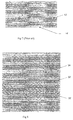
- woven felt like the one shown in Fig 1 is preferred in order to achieve covering of a better quality and in particular wear-resistance.
- the standard woven felt 10 shown in Fig. 1 consists of a cotton warp yarn 12 and a wool/nylon weft yarn 14 which are woven together.
- An outer surface of entangled fibres 16 gives the fabric 10 a felted appearance.
- the felted surface 16 is the outer or playing surface, once the woven felt 10 is used to cover a tennis ball.
- each weft yarn 14 interlaces every six warp yarn 12. This frequency may vary from five to ten warp yarns or threads 12 and is typically seven.
- a woven felt 10 as the one shown in Fig 1 is uniform and typically between 2.5 and 3.8mm. However the thickness depends on the end product style and the measurement method carried out.
- Tennis balls can be made to curve in flight by imparting spin due to the physical phenomenon known as the "Magnus Effect".
- Air is a fluid medium. When a ball flies through the air its passage displaces the air but it also carries some air with it close to the surface of the ball. This is known as the "boundary layer". If the ball is spinning it imparts a spinning motion to the air in the boundary layer. The motion imparted to the boundary layer affects the way the air flow separates from the surface at the rear of the ball. Boundary layer separation is delayed on the side of the ball which is moving in the same direction as the free air flow, and occurs prematurely on the side moving against the free air flow. The turbulent wake of the ball is thus moved towards the side of the ball moving against the free air flow resulting in the flow past the ball being deflected and the resulting change momentum flux causes a force in the opposite direction.
- Fig 2 is a schematic diagram representing a tennis ball 2 travelling from left to right and spinning in a clockwise direction and shows the resultant Magnus force on the ball 2.
- the ball 2 would be deflected downward by the Magnus Force.
- the strength of the Magnus effect is in direct proportion to the rate of spin, the speed of the ball 2, the density of the air and the thickness of the boundary layer.
- a felted covering associated with the patterned surface of the tennis ball increases the thickness of the boundary layer around the ball and also helps to increase the friction between the racquet and the ball when the ball is struck.
- the combination of the thicker boundary layer together with the player's ability to impart increased spin due to better 'grip' on the ball increases the Magnus Force and thus the degree of 'curve' imparted to the ball.
- Figs 3 & 4 show a piece of fabric 20 according to a first embodiment of the invention which, like the standard fabric 10, preferably comprises a cotton warp yarn 22 and a wool/nylon weft yarn 24 which are woven together.
- a surface of entangled fibres (not shown but of a structure similar to the one shown in Fig 1) is present on the outer surface and gives to the fabric 20 a felted appearance.
- a series of depressions or dimples 28 are provided on the surface of the fabric.
- the dimples 28 are provided on the fabric regularly, and the felt 20 has a pattern of 10mm circular dimples 28 at 12mm centres.
- the dimples 28 are provided in parallel rows 22 and each row 22 is offset from the next by 6mm.
- Such dimensions have been found to give to the ball particularly good properties but it is within the scope of the invention to cover variations in these dimensions and other indentation patterns. Possible methods of forming dimples 28 will be discussed below.
- Fig 4 shows a schematic cross section of a the fabric 20 shown in Fig 3 and the depressions in the surface. Such depressions are formed by the dimples 28 in the original piece of woven felt. At their deepest point, the dimples of Fig 3 and 4 are approximately 1.5mm deep. The full thickness of the fabric 20 shown in Figs 3 and 4 is preferably about 3.5mm.
- Fig 3 Also clearly visible in Fig 3 is the shape of a ball dumbbell 24 which is to be cut from the piece of woven felt 20, for eventually covering a tennis ball.
- a distribution or pattern of dimples 28 on the ball is overall irregular.
- the fabric according to the invention can be made according to known techniques in the art. However the following techniques are much preferred as they give fabrics particular characteristics, such as feel and resistance to wear.
- Fig 1 shows a standard woven felt fabric 10 used to cover a tennis ball.
- Fig 5 shows another standard woven felt fabric 10' used for covering a tennis ball wherein the finishing process of raising and milling has not been carried out yet and no felted layer is present.
- the standard woven felt fabric 10 or 10' used for a tennis ball usually uses a 'sateen' weave or modification thereof. With this form of weave long 'floats' of woollen spun weft yarn 14 or 14' are produced.
- weft threads 14 or 14' may 'float' over warp threads 12 or 12' interfacing with only one warp thread 12 or 12' in six (like the fabric 10 shown in Fig 1) or in eight (like the fabric 10' shown in Fig 6).
- the weft threads 14 or 14' lie predominantly to one side of the fabric 10 or 10' and eventually form the outer surface of the fabric 10 or 10' and thus the outer (playing) surface of the tennis ball.
- weft threads 14 or 14' lie predominantly on the outer surface of the fabric 10 or 10' and the warp threads 12 or 12' predominantly on the back.
- Each weft thread 14' is interlaced with different warp threads 12' until a pattern repeat is achieved. Then, raising and milling steps are performed to "finish" the fabric 10 and 10' and gives it the felted cover 16 (not shown in Fig 5).
- Fig 7 illustrates a typical design structure of the woven tennis ball felt fabric 10' shown in Fig 6 when viewed from the top surface.
- Weft threads 14' ' float' over the warp threads 12' interfacing with every eighth warp thread 12'.
- the interlacings of the threads 12' and 14' form a conventional herringbone pattern.
- a three dimensional pattern in a tennis ball woven felt is produced by modifying the woven construction of a conventional woven felt to generate areas of tighter yarn interlacing compared to the remaining area or ground of the fabric.
- Fig 6 is a schematic cross-sectional diagram of a portion of a woven patterned felt fabric 30 according to the second embodiment of the invention showing an indented area 35 where the weft thread 34 is interlaced alternately with each warp thread 32. In so doing the weft thread 34 is held more tightly into the ground of the fabric 30 in this section creating a three dimensional pattern or indentation 35 in the surface.
- the difference between the ground and the indentation 35 is usually exaggerated during the finishing processes (raising and milling steps) to produce the desired characteristics.
- Fig 8 illustrates an enlargement of the appearance of the woven patterned tennis ball felt fabric 30' similar to the one shown in Fig 6 viewed from the top surface.
- this fabric 30' the 'ground' of the fabric 30' is shown with the weft threads 34' 'floating' over the warp thread 32' and interlacing, in this example, with the warp threads 32' at intervals of nine threads 32'.
- Also visible are areas of 'plain' weave 35' where the warp thread 32' interlaces each weft thread 34' alternately creating a more heavily interlaced 'motif' 35'.
- the fabric of Fig 6 differs from the fabric of Fig 8 only by the fact that in Fig 6 the weft thread 34 interlace warp thread 32 at an interval of eight threads 32 instead of nine as in Fig 8.
- Figs 6 and 8 show that in these example the pattern is predominantly one of circular indentations 35 and 35'.
- the fabric 30' shown in Fig 8 gives, due to weft way shrinkage during the finishing process, an indented 'motif' of approximately 0.75 centimetres diameter in the finished felt with a spacing of 5 to 7mm of normal felt between each indentation.
- the layout of the interfacings it is possible, if required, to alter the shape and/or size of the motif.
- the fabric 30' may have a pattern of 7mm circular indentations at 12mm centres.
- the indentations 35' are provided in parallel rows each row offset from the next by 6mm. At their deepest point, the dimples may be approximately 1.5mm deep. The full felt thickness may be 3.5mm deep.
- An alternative method of producing a patterned tennis ball felt according a third embodiment of the invention is to apply a patterned needling technique either to a standard woven felt or to a felt made by non-woven technologies which is acceptable for tennis ball covering.
- the method is applied either after completing, or part way through, the conventional tennis felt manufacturing process.
- a sheet of such felt is passed through a needfelting machine, i.e. a needleloom, which contains a reciprocating board.
- the board extends across the full width of the felt and is set with barbed or forked needles which project from the board in a specific pattern. As the needleboard reciprocates the needles penetrate the felt catching fibres or small clumps of fibre and pushing them into the body of the felt.
- the needleboard is then raised clear of the felt which is then drawn through the machine a specific distance before the cycle is repeated.
- Fig 9 shows a possible needleboard layout set up to produce a pattern of circular indentations similar to the one shown in Fig 3.
- the needles 50 (which are represented as small black dots) are set in a pattern which repeats over 6 rows. Rows 1, 2 and 3 each have a different configuration of needles 50. This configuration is then repeated in rows 4, 5 and 6 with the needle pattern in each row being offset one place. After each needling cycle the needles are withdrawn and the felt drawn forward through two rows. Thus, the needled pattern from row 1 has the pattern from row 3 and then row 5 superimposed. The pattern from row 2 has the pattern from row 4 and row 6 superimposed.
- the needle patterns from rows 1, 3 and 5 or rows 2, 4 and 6 combine to produce the desired symmetrical indentation or 'dimple' in the felt, each indentation having been produced by a total of 15 needles 50. It is desirable that the process be repeated several times by following groups of 6 needle rows which repeat the process and reinforce the effect produced by the groups before them.
- Fig 10 is a schematic showing the needling pattern of a single indentation 45 after the 3 rows needling cycle has been completed. As shown in Fig 10, after the first needling cycle this indentation 45 will constitute in a series of vertical depressed lines. However, successive cycles will give to the indentation 45 the general "dimpled” pattern.
- “d” is the general diameter of the depression 45;
- NP is the Needle Path length covered by each needle 50;
- NW Needle Tracking Width or the width of the depression created by each needle 50 during its cycle.
- protuberances instead of depressions may be formed on the playing surface of the felt by processing the felt through the patterned needling machine from the back side. This could be a modification of the needling process already described.
- a further alternative method of producing a patterned tennis ball felt is described as follows. This method is appropriate for producing patterned felt using non-woven technology. With this method two separate layers of standard needle felt material are produced and subsequently needled together. Preferably, one, the bottom layer, contains the support scrim, while the second, top or outer layer, contains no scrim. Each layer can be structured for fibre content, weight and needling density to optimise the end product performance.
- the bottom layer, including the scrim will constitute between 40% and 70% by weight of the material.
- the scrim will be warp knitted from polyamide or polyester filament yarn.
- the top layer is processed through a stamping or die-cutting machine which punches out sections of material in a pre-determined pattern forming a punched fibre matrix.
- the hole size, shape and pattern punched out can be altered according to the requirements for the finished material.
- the punched holes are circular in shape with a diameter of between 5mm and 20mm.
- the holes are punched in a regular pattern.
- the holes so punched are separated by material with a width of between 50% and 150% of the diameter of the holes.
- Fig 11 shows a view of a possible punched piece of pre-needled top layer of a felted fabric 41, advantageously a felt.
- the felt 41 has a pattern of 10mm circular holes 43 punched from it at 15mm centres.
- the holes 43 are set in parallel rows each row offset by 7.5mm.
- the overall appearance of the fabric 40 is similar to the one shown in Fig 3. Obviously, in other embodiments these dimensions will vary depending on the desired hole shape and pattern.
- the two layers of felt, the bottom layer containing the scrim and the top layer containing the punched holes, are then needled together to form a single composite material.
- Fig 12 shows a cross sectional representation of the two layers of pre-needled felt being brought together to form the composite fabric 40.
- the outer layer 41 is punched with holes 43.
- the bottom layer contains the scrim 47.
- the composite needled fabric 40 may, if required, be subjected to finishing processes to enhance the aesthetic and wear characteristics of the felt and ball.
- a further possibility would be to pass a piece of felt through a conventional Calendering Machine. This would involve passing the felt between heated rolls under pressure. The roll pressing on the top (i.e playing) surface of the felt would have a embossed pattern which would be a "negative" of that required for the felt. The pressure and heat applied would compress the felt and set it into the desired pattern.
- the dimples may be provided using conventional textile patterning techniques.
- the textile patterning process described in US-A-5404626 (known as the MILLITEX process) may be used.
- these two last methods ie the Millitex process and the compression process are less preferred.
- Fig 13 represents a cross-sectional schematic view of a woven fabric 50 made according to the invention having the preferred circular dimples 58 in the felted layer 56.
- Fig 13 aims to represent the general profile of such dimples 58.
- the actual structure of the fabric 50, and especially the felted layer 56, may vary depending of the method used to manufacture it.
- Woven felt produced as described above thus can be used by the ball manufacturer without any significant modification to the covering process.
- the back side of the fabric is smooth enough to be coated with adhesive in the conventional manner and dumbbell shapes, when cut, can be fitted to the ball core using standard semi-automatic covering equipment.
- Tennis balls made using the textile of the present invention have significant advantages over known tennis balls, for example because of the improved flight characteristics. Tennis players can exercise a far greater degree of control over the ball, and hence their game.
Landscapes
- Engineering & Computer Science (AREA)
- Textile Engineering (AREA)
- Mechanical Engineering (AREA)
- Health & Medical Sciences (AREA)
- General Health & Medical Sciences (AREA)
- Physical Education & Sports Medicine (AREA)
- Woven Fabrics (AREA)
- Decoration Of Textiles (AREA)
- Yarns And Mechanical Finishing Of Yarns Or Ropes (AREA)
- Adornments (AREA)
- Nonwoven Fabrics (AREA)
Applications Claiming Priority (2)
| Application Number | Priority Date | Filing Date | Title |
|---|---|---|---|
| GBGB9813966.0A GB9813966D0 (en) | 1998-06-30 | 1998-06-30 | Textile |
| GB9813966 | 1998-06-30 |
Publications (3)
| Publication Number | Publication Date |
|---|---|
| EP0974378A2 true EP0974378A2 (fr) | 2000-01-26 |
| EP0974378A3 EP0974378A3 (fr) | 2001-05-16 |
| EP0974378B1 EP0974378B1 (fr) | 2004-12-15 |
Family
ID=10834544
Family Applications (1)
| Application Number | Title | Priority Date | Filing Date |
|---|---|---|---|
| EP99305154A Expired - Lifetime EP0974378B1 (fr) | 1998-06-30 | 1999-06-30 | Textile pour revêtement de balle de tennis et procédé pour sa fabrication |
Country Status (6)
| Country | Link |
|---|---|
| US (1) | US6227992B1 (fr) |
| EP (1) | EP0974378B1 (fr) |
| JP (1) | JP4368461B2 (fr) |
| AT (1) | ATE284738T1 (fr) |
| DE (1) | DE69922591T2 (fr) |
| GB (1) | GB9813966D0 (fr) |
Cited By (1)
| Publication number | Priority date | Publication date | Assignee | Title |
|---|---|---|---|---|
| EP1114887A3 (fr) * | 1999-12-24 | 2002-11-06 | Milliken Industrials Limited | Etoffe de revêtement pour balle de tennis et procédé pour sa production |
Families Citing this family (10)
| Publication number | Priority date | Publication date | Assignee | Title |
|---|---|---|---|---|
| US10118696B1 (en) | 2016-03-31 | 2018-11-06 | Steven M. Hoffberg | Steerable rotating projectile |
| US10493327B2 (en) | 2017-03-14 | 2019-12-03 | Wilson Sporting Goods Co. | Tennis ball having a core with internal material shift lines |
| US10549159B2 (en) * | 2017-03-14 | 2020-02-04 | Wilson Sporting Goods Co. | Tennis ball having a core with aerodynamic patterns |
| US11712637B1 (en) | 2018-03-23 | 2023-08-01 | Steven M. Hoffberg | Steerable disk or ball |
| US11951360B2 (en) | 2018-08-28 | 2024-04-09 | Wilson Sporting Goods Co. | Tennis ball |
| US10918913B2 (en) | 2018-08-28 | 2021-02-16 | Wilson Sporting Goods Co. | Tennis ball |
| US11192001B2 (en) | 2020-02-11 | 2021-12-07 | Wilson Sporting Goods Co. | Tennis ball having a thermoplastic core |
| US12599814B2 (en) | 2020-02-11 | 2026-04-14 | Wilson Sporting Goods Co. | Tennis ball having a thermoplastic core |
| US11426637B2 (en) * | 2020-02-11 | 2022-08-30 | Wilson Sporting Goods Co. | Tennis ball having a thermoplastic core |
| US11247103B2 (en) | 2020-02-11 | 2022-02-15 | Wilson Sporting Goods Co. | Tennis ball having a thermoplastic core |
Citations (3)
| Publication number | Priority date | Publication date | Assignee | Title |
|---|---|---|---|---|
| US1376778A (en) | 1919-08-05 | 1921-05-03 | Spalding & Bros Ag | Tennis-ball and process of making same |
| US4616828A (en) | 1985-02-01 | 1986-10-14 | Haythornthwaite James Alan | Tennis ball |
| US4874169A (en) | 1983-12-02 | 1989-10-17 | Litchfield Peter G | Ball |
Family Cites Families (15)
| Publication number | Priority date | Publication date | Assignee | Title |
|---|---|---|---|---|
| US1287766A (en) | 1918-07-31 | 1918-12-17 | Spalding & Bros Ag | Tennis-ball. |
| US1547339A (en) * | 1924-09-18 | 1925-07-28 | Maclellan Kenneth | Sports ball |
| US2023673A (en) * | 1934-03-22 | 1935-12-10 | A D Ellis Mills Inc | Tennis ball cover |
| GB441874A (en) * | 1934-07-26 | 1936-01-27 | Edward Powis | Improvements in and relating to the manufacture of tennis balls |
| US2109223A (en) * | 1935-01-02 | 1938-02-22 | Hartman F Schmidt | Woven fabric |
| US2423827A (en) * | 1945-01-12 | 1947-07-15 | Albany Felt Co | Tennis ball cover cloth |
| US2952063A (en) * | 1955-08-17 | 1960-09-13 | Slazengers Ltd | Tennis balls and their coverings |
| FR1158200A (fr) * | 1955-08-23 | 1958-06-11 | Slazengers Ltd | Procédé de fabrication de balles de tennis recouvertes d'étoffe |
| US3065520A (en) * | 1959-01-08 | 1962-11-27 | Helen C Schmidt | Tennis ball fabric |
| US3558413A (en) * | 1968-01-24 | 1971-01-26 | Albany Int Corp | Tennis ball cover cloth |
| ZA746542B (en) * | 1973-10-19 | 1975-11-26 | Dunlop Ltd | Cloth |
| US4234643A (en) * | 1978-05-30 | 1980-11-18 | The Meyercord Co. | Tennis ball marking decalcomania |
| DE3417539A1 (de) * | 1984-05-11 | 1985-11-14 | Gerhard 6433 Philippsthal Bohn | Stoffbahn |
| US5374059A (en) * | 1991-01-14 | 1994-12-20 | Huang; Ben | Shock absorbing grip for racquets and the like |
| US5404626A (en) | 1993-10-25 | 1995-04-11 | Milliken Research Corporation | Method and apparatus to create an improved moire fabric by utilizing pressurized heated gas |
-
1998
- 1998-06-30 GB GBGB9813966.0A patent/GB9813966D0/en not_active Ceased
-
1999
- 1999-06-30 EP EP99305154A patent/EP0974378B1/fr not_active Expired - Lifetime
- 1999-06-30 AT AT99305154T patent/ATE284738T1/de not_active IP Right Cessation
- 1999-06-30 JP JP18590099A patent/JP4368461B2/ja not_active Expired - Fee Related
- 1999-06-30 DE DE69922591T patent/DE69922591T2/de not_active Expired - Fee Related
- 1999-06-30 US US09/343,351 patent/US6227992B1/en not_active Expired - Fee Related
Patent Citations (3)
| Publication number | Priority date | Publication date | Assignee | Title |
|---|---|---|---|---|
| US1376778A (en) | 1919-08-05 | 1921-05-03 | Spalding & Bros Ag | Tennis-ball and process of making same |
| US4874169A (en) | 1983-12-02 | 1989-10-17 | Litchfield Peter G | Ball |
| US4616828A (en) | 1985-02-01 | 1986-10-14 | Haythornthwaite James Alan | Tennis ball |
Cited By (2)
| Publication number | Priority date | Publication date | Assignee | Title |
|---|---|---|---|---|
| EP1114887A3 (fr) * | 1999-12-24 | 2002-11-06 | Milliken Industrials Limited | Etoffe de revêtement pour balle de tennis et procédé pour sa production |
| US6677257B2 (en) | 1999-12-24 | 2004-01-13 | Milliken Industrials Limited | Fabric for tennis ball covering and method for manufacturing the same |
Also Published As
| Publication number | Publication date |
|---|---|
| US6227992B1 (en) | 2001-05-08 |
| EP0974378A3 (fr) | 2001-05-16 |
| ATE284738T1 (de) | 2005-01-15 |
| JP4368461B2 (ja) | 2009-11-18 |
| DE69922591T2 (de) | 2005-12-22 |
| DE69922591D1 (de) | 2005-01-20 |
| EP0974378B1 (fr) | 2004-12-15 |
| JP2000027049A (ja) | 2000-01-25 |
| GB9813966D0 (en) | 1998-08-26 |
Similar Documents
| Publication | Publication Date | Title |
|---|---|---|
| EP1114887B1 (fr) | Etoffe de revêtement pour balle de tennis et procédé pour sa production | |
| US6227992B1 (en) | Textile for tennis ball covering and method for manufacturing the same | |
| US9200390B2 (en) | Buffer substrate and use thereof | |
| US4061804A (en) | Non-directional rectangular filaments and products | |
| US4381805A (en) | Simulated grass pile fabric | |
| US4616828A (en) | Tennis ball | |
| US3396970A (en) | Tennis ball including needle punched fabric cover | |
| JPS6278281A (ja) | 高強力柔軟皮革様物の製造方法 | |
| US5830092A (en) | Tennis ball fabric | |
| US20030129913A1 (en) | Non-woven fabric | |
| USRE29303E (en) | Tennis ball including needle punched fabric cover | |
| WO2023281056A1 (fr) | Surface de sport, son utilisation et son procédé de fabrication | |
| CN115874344B (zh) | 一种仿梭织单面机针织面料及其制作方法 | |
| US2952063A (en) | Tennis balls and their coverings | |
| US2023673A (en) | Tennis ball cover | |
| JPH0713344B2 (ja) | シート状物の製造方法 | |
| CN217455208U (zh) | 抗起球针织坯布 | |
| CN216040069U (zh) | 一种具有仿棉手感且吸湿速干的运动短t恤 | |
| CN1050307C (zh) | 运动用球拍 | |
| CN218985961U (zh) | 一种防钻绒羽绒面料 | |
| JP2002325673A (ja) | 敷 物 | |
| CN215826121U (zh) | 一种耐磨面料 | |
| US20260015788A1 (en) | Manufacturing method for screen fabric of screen-golf and screen fabric thereby | |
| JPH0559635A (ja) | ジヤカード織毛布の製造方法 | |
| JP4467757B2 (ja) | テニスボール |
Legal Events
| Date | Code | Title | Description |
|---|---|---|---|
| PUAI | Public reference made under article 153(3) epc to a published international application that has entered the european phase |
Free format text: ORIGINAL CODE: 0009012 |
|
| AK | Designated contracting states |
Kind code of ref document: A2 Designated state(s): AT BE CH CY DE DK ES FI FR GB GR IE IT LI LU MC NL PT SE |
|
| AX | Request for extension of the european patent |
Free format text: AL;LT;LV;MK;RO;SI |
|
| PUAL | Search report despatched |
Free format text: ORIGINAL CODE: 0009013 |
|
| AK | Designated contracting states |
Kind code of ref document: A3 Designated state(s): AT BE CH CY DE DK ES FI FR GB GR IE IT LI LU MC NL PT SE |
|
| AX | Request for extension of the european patent |
Free format text: AL;LT;LV;MK;RO;SI |
|
| 17P | Request for examination filed |
Effective date: 20011115 |
|
| AKX | Designation fees paid |
Free format text: AT BE CH CY DE DK ES FI FR GB GR IE IT LI LU MC NL PT SE |
|
| 17Q | First examination report despatched |
Effective date: 20031016 |
|
| GRAP | Despatch of communication of intention to grant a patent |
Free format text: ORIGINAL CODE: EPIDOSNIGR1 |
|
| GRAA | (expected) grant |
Free format text: ORIGINAL CODE: 0009210 |
|
| GRAS | Grant fee paid |
Free format text: ORIGINAL CODE: EPIDOSNIGR3 |
|
| AK | Designated contracting states |
Kind code of ref document: B1 Designated state(s): AT BE CH CY DE DK ES FI FR GB GR IE IT LI LU MC NL PT SE |
|
| PG25 | Lapsed in a contracting state [announced via postgrant information from national office to epo] |
Ref country code: NL Free format text: LAPSE BECAUSE OF FAILURE TO SUBMIT A TRANSLATION OF THE DESCRIPTION OR TO PAY THE FEE WITHIN THE PRESCRIBED TIME-LIMIT Effective date: 20041215 Ref country code: LI Free format text: LAPSE BECAUSE OF FAILURE TO SUBMIT A TRANSLATION OF THE DESCRIPTION OR TO PAY THE FEE WITHIN THE PRESCRIBED TIME-LIMIT Effective date: 20041215 Ref country code: IT Free format text: LAPSE BECAUSE OF FAILURE TO SUBMIT A TRANSLATION OF THE DESCRIPTION OR TO PAY THE FEE WITHIN THE PRESCRIBED TIME-LIMIT;WARNING: LAPSES OF ITALIAN PATENTS WITH EFFECTIVE DATE BEFORE 2007 MAY HAVE OCCURRED AT ANY TIME BEFORE 2007. THE CORRECT EFFECTIVE DATE MAY BE DIFFERENT FROM THE ONE RECORDED. Effective date: 20041215 Ref country code: FI Free format text: LAPSE BECAUSE OF FAILURE TO SUBMIT A TRANSLATION OF THE DESCRIPTION OR TO PAY THE FEE WITHIN THE PRESCRIBED TIME-LIMIT Effective date: 20041215 Ref country code: CH Free format text: LAPSE BECAUSE OF FAILURE TO SUBMIT A TRANSLATION OF THE DESCRIPTION OR TO PAY THE FEE WITHIN THE PRESCRIBED TIME-LIMIT Effective date: 20041215 Ref country code: BE Free format text: LAPSE BECAUSE OF FAILURE TO SUBMIT A TRANSLATION OF THE DESCRIPTION OR TO PAY THE FEE WITHIN THE PRESCRIBED TIME-LIMIT Effective date: 20041215 Ref country code: AT Free format text: LAPSE BECAUSE OF FAILURE TO SUBMIT A TRANSLATION OF THE DESCRIPTION OR TO PAY THE FEE WITHIN THE PRESCRIBED TIME-LIMIT Effective date: 20041215 |
|
| REG | Reference to a national code |
Ref country code: GB Ref legal event code: FG4D Ref country code: CH Ref legal event code: EP |
|
| REG | Reference to a national code |
Ref country code: IE Ref legal event code: FG4D |
|
| REF | Corresponds to: |
Ref document number: 69922591 Country of ref document: DE Date of ref document: 20050120 Kind code of ref document: P |
|
| PG25 | Lapsed in a contracting state [announced via postgrant information from national office to epo] |
Ref country code: SE Free format text: LAPSE BECAUSE OF FAILURE TO SUBMIT A TRANSLATION OF THE DESCRIPTION OR TO PAY THE FEE WITHIN THE PRESCRIBED TIME-LIMIT Effective date: 20050315 Ref country code: GR Free format text: LAPSE BECAUSE OF FAILURE TO SUBMIT A TRANSLATION OF THE DESCRIPTION OR TO PAY THE FEE WITHIN THE PRESCRIBED TIME-LIMIT Effective date: 20050315 Ref country code: DK Free format text: LAPSE BECAUSE OF FAILURE TO SUBMIT A TRANSLATION OF THE DESCRIPTION OR TO PAY THE FEE WITHIN THE PRESCRIBED TIME-LIMIT Effective date: 20050315 |
|
| PG25 | Lapsed in a contracting state [announced via postgrant information from national office to epo] |
Ref country code: ES Free format text: LAPSE BECAUSE OF FAILURE TO SUBMIT A TRANSLATION OF THE DESCRIPTION OR TO PAY THE FEE WITHIN THE PRESCRIBED TIME-LIMIT Effective date: 20050326 |
|
| NLV1 | Nl: lapsed or annulled due to failure to fulfill the requirements of art. 29p and 29m of the patents act | ||
| PG25 | Lapsed in a contracting state [announced via postgrant information from national office to epo] |
Ref country code: MC Free format text: LAPSE BECAUSE OF NON-PAYMENT OF DUE FEES Effective date: 20050630 Ref country code: LU Free format text: LAPSE BECAUSE OF NON-PAYMENT OF DUE FEES Effective date: 20050630 Ref country code: IE Free format text: LAPSE BECAUSE OF NON-PAYMENT OF DUE FEES Effective date: 20050630 Ref country code: CY Free format text: LAPSE BECAUSE OF FAILURE TO SUBMIT A TRANSLATION OF THE DESCRIPTION OR TO PAY THE FEE WITHIN THE PRESCRIBED TIME-LIMIT Effective date: 20050630 |
|
| REG | Reference to a national code |
Ref country code: CH Ref legal event code: PL |
|
| PLBE | No opposition filed within time limit |
Free format text: ORIGINAL CODE: 0009261 |
|
| STAA | Information on the status of an ep patent application or granted ep patent |
Free format text: STATUS: NO OPPOSITION FILED WITHIN TIME LIMIT |
|
| 26N | No opposition filed |
Effective date: 20050916 |
|
| ET | Fr: translation filed | ||
| REG | Reference to a national code |
Ref country code: IE Ref legal event code: MM4A |
|
| PG25 | Lapsed in a contracting state [announced via postgrant information from national office to epo] |
Ref country code: PT Free format text: LAPSE BECAUSE OF NON-PAYMENT OF DUE FEES Effective date: 20050515 |
|
| PGFP | Annual fee paid to national office [announced via postgrant information from national office to epo] |
Ref country code: FR Payment date: 20090617 Year of fee payment: 11 |
|
| PGFP | Annual fee paid to national office [announced via postgrant information from national office to epo] |
Ref country code: GB Payment date: 20090625 Year of fee payment: 11 Ref country code: DE Payment date: 20090629 Year of fee payment: 11 |
|
| GBPC | Gb: european patent ceased through non-payment of renewal fee |
Effective date: 20100630 |
|
| REG | Reference to a national code |
Ref country code: FR Ref legal event code: ST Effective date: 20110228 |
|
| PG25 | Lapsed in a contracting state [announced via postgrant information from national office to epo] |
Ref country code: DE Free format text: LAPSE BECAUSE OF NON-PAYMENT OF DUE FEES Effective date: 20110101 |
|
| PG25 | Lapsed in a contracting state [announced via postgrant information from national office to epo] |
Ref country code: FR Free format text: LAPSE BECAUSE OF NON-PAYMENT OF DUE FEES Effective date: 20100630 |
|
| PG25 | Lapsed in a contracting state [announced via postgrant information from national office to epo] |
Ref country code: GB Free format text: LAPSE BECAUSE OF NON-PAYMENT OF DUE FEES Effective date: 20100630 |