EP0974448A1 - Appareillage et procédé de fabrication de pneumatiques - Google Patents
Appareillage et procédé de fabrication de pneumatiques Download PDFInfo
- Publication number
- EP0974448A1 EP0974448A1 EP99113761A EP99113761A EP0974448A1 EP 0974448 A1 EP0974448 A1 EP 0974448A1 EP 99113761 A EP99113761 A EP 99113761A EP 99113761 A EP99113761 A EP 99113761A EP 0974448 A1 EP0974448 A1 EP 0974448A1
- Authority
- EP
- European Patent Office
- Prior art keywords
- drum
- lateral
- receiving surface
- carcass reinforcement
- profile
- Prior art date
- Legal status (The legal status is an assumption and is not a legal conclusion. Google has not performed a legal analysis and makes no representation as to the accuracy of the status listed.)
- Granted
Links
- 238000004519 manufacturing process Methods 0.000 title claims abstract description 45
- 230000002787 reinforcement Effects 0.000 claims description 77
- 239000000203 mixture Substances 0.000 claims description 36
- 238000000034 method Methods 0.000 claims description 31
- 238000005096 rolling process Methods 0.000 claims description 9
- 238000000151 deposition Methods 0.000 claims description 7
- 238000002156 mixing Methods 0.000 claims description 7
- 238000003825 pressing Methods 0.000 claims description 6
- 238000011161 development Methods 0.000 claims description 2
- 230000018109 developmental process Effects 0.000 claims description 2
- 230000008021 deposition Effects 0.000 claims 3
- 239000012528 membrane Substances 0.000 description 19
- 239000011324 bead Substances 0.000 description 16
- 239000000047 product Substances 0.000 description 14
- 241001417494 Sciaenidae Species 0.000 description 7
- 238000006073 displacement reaction Methods 0.000 description 5
- 239000000470 constituent Substances 0.000 description 3
- 239000013256 coordination polymer Substances 0.000 description 2
- 238000000605 extraction Methods 0.000 description 2
- 238000009434 installation Methods 0.000 description 2
- 230000000284 resting effect Effects 0.000 description 2
- 239000004753 textile Substances 0.000 description 2
- 238000004026 adhesive bonding Methods 0.000 description 1
- 239000011248 coating agent Substances 0.000 description 1
- 238000000576 coating method Methods 0.000 description 1
- 230000001419 dependent effect Effects 0.000 description 1
- 239000004744 fabric Substances 0.000 description 1
- 230000002349 favourable effect Effects 0.000 description 1
- 230000014759 maintenance of location Effects 0.000 description 1
- 239000003607 modifier Substances 0.000 description 1
- 230000000149 penetrating effect Effects 0.000 description 1
- 230000003014 reinforcing effect Effects 0.000 description 1
- 239000011265 semifinished product Substances 0.000 description 1
- 238000004073 vulcanization Methods 0.000 description 1
Images




Classifications
-
- B—PERFORMING OPERATIONS; TRANSPORTING
- B29—WORKING OF PLASTICS; WORKING OF SUBSTANCES IN A PLASTIC STATE IN GENERAL
- B29D—PRODUCING PARTICULAR ARTICLES FROM PLASTICS OR FROM SUBSTANCES IN A PLASTIC STATE
- B29D30/00—Producing pneumatic or solid tyres or parts thereof
- B29D30/06—Pneumatic tyres or parts thereof (e.g. produced by casting, moulding, compression moulding, injection moulding, centrifugal casting)
- B29D30/08—Building tyres
-
- B—PERFORMING OPERATIONS; TRANSPORTING
- B29—WORKING OF PLASTICS; WORKING OF SUBSTANCES IN A PLASTIC STATE IN GENERAL
- B29D—PRODUCING PARTICULAR ARTICLES FROM PLASTICS OR FROM SUBSTANCES IN A PLASTIC STATE
- B29D30/00—Producing pneumatic or solid tyres or parts thereof
- B29D30/06—Pneumatic tyres or parts thereof (e.g. produced by casting, moulding, compression moulding, injection moulding, centrifugal casting)
- B29D30/08—Building tyres
- B29D30/20—Building tyres by the flat-tyre method, i.e. building on cylindrical drums
- B29D30/24—Drums
- B29D30/244—Drums for manufacturing substantially cylindrical tyre components with cores or beads, e.g. carcasses
- B29D30/248—Drums of the undercut type without toroidal expansion, e.g. with provisions for folding down the plies, for positioning the beads under the surface of the drum
-
- B—PERFORMING OPERATIONS; TRANSPORTING
- B29—WORKING OF PLASTICS; WORKING OF SUBSTANCES IN A PLASTIC STATE IN GENERAL
- B29D—PRODUCING PARTICULAR ARTICLES FROM PLASTICS OR FROM SUBSTANCES IN A PLASTIC STATE
- B29D30/00—Producing pneumatic or solid tyres or parts thereof
- B29D30/06—Pneumatic tyres or parts thereof (e.g. produced by casting, moulding, compression moulding, injection moulding, centrifugal casting)
- B29D30/08—Building tyres
- B29D30/20—Building tyres by the flat-tyre method, i.e. building on cylindrical drums
- B29D30/32—Fitting the bead-rings or bead-cores; Folding the textile layers around the rings or cores
-
- B—PERFORMING OPERATIONS; TRANSPORTING
- B29—WORKING OF PLASTICS; WORKING OF SUBSTANCES IN A PLASTIC STATE IN GENERAL
- B29D—PRODUCING PARTICULAR ARTICLES FROM PLASTICS OR FROM SUBSTANCES IN A PLASTIC STATE
- B29D30/00—Producing pneumatic or solid tyres or parts thereof
- B29D30/06—Pneumatic tyres or parts thereof (e.g. produced by casting, moulding, compression moulding, injection moulding, centrifugal casting)
- B29D30/08—Building tyres
- B29D30/20—Building tyres by the flat-tyre method, i.e. building on cylindrical drums
- B29D30/32—Fitting the bead-rings or bead-cores; Folding the textile layers around the rings or cores
- B29D2030/3214—Locking the beads on the drum; details of the drum in the bead locking areas, e.g. drum shoulders
-
- B—PERFORMING OPERATIONS; TRANSPORTING
- B29—WORKING OF PLASTICS; WORKING OF SUBSTANCES IN A PLASTIC STATE IN GENERAL
- B29D—PRODUCING PARTICULAR ARTICLES FROM PLASTICS OR FROM SUBSTANCES IN A PLASTIC STATE
- B29D30/00—Producing pneumatic or solid tyres or parts thereof
- B29D30/06—Pneumatic tyres or parts thereof (e.g. produced by casting, moulding, compression moulding, injection moulding, centrifugal casting)
- B29D30/08—Building tyres
- B29D30/20—Building tyres by the flat-tyre method, i.e. building on cylindrical drums
- B29D30/32—Fitting the bead-rings or bead-cores; Folding the textile layers around the rings or cores
- B29D2030/3221—Folding over means, e.g. bladders or rigid arms
- B29D2030/3228—Folding over means, e.g. bladders or rigid arms using one bladder acting on each side of the drum
-
- B—PERFORMING OPERATIONS; TRANSPORTING
- B29—WORKING OF PLASTICS; WORKING OF SUBSTANCES IN A PLASTIC STATE IN GENERAL
- B29D—PRODUCING PARTICULAR ARTICLES FROM PLASTICS OR FROM SUBSTANCES IN A PLASTIC STATE
- B29D30/00—Producing pneumatic or solid tyres or parts thereof
- B29D30/06—Pneumatic tyres or parts thereof (e.g. produced by casting, moulding, compression moulding, injection moulding, centrifugal casting)
- B29D30/08—Building tyres
- B29D30/20—Building tyres by the flat-tyre method, i.e. building on cylindrical drums
- B29D30/32—Fitting the bead-rings or bead-cores; Folding the textile layers around the rings or cores
- B29D2030/3221—Folding over means, e.g. bladders or rigid arms
- B29D2030/3235—Folding over means, e.g. bladders or rigid arms using two or more bladders acting on each side of the drum
Definitions
- the present invention relates to a method of manufacturing tires and drums assembly allowing the implementation of the process.
- the invention relates more particularly to the manufacture of tires comprising a carcass reinforcement and, in the beads, at least one reinforcing rod around which the carcass reinforcement is wound up forming a reversal so that, contrary to what is generally carried out, the inversion of the carcass reinforcement is disposed between the rod and the carcass reinforcement itself.
- Certain manufacturing processes use assembly drums having in particular shoulders against which the rod is brought in describing an axial movement.
- the rod is held against the shoulder by simply gluing the products together or by a accessory device.
- Such drums can directly use rods or semi-finished products manufactured separately and constituted by the rod radially surmounted by a rubber mix profile.
- rod-complex a rod single or a rod surmounted by a rubber mix profile, comprising optionally additionally a rod coating product such as another mixing profile rubbery or a rubber mat comprising cables.
- Patent application EP 99/107552 filed on April 15, 1999 describes a drum with two grooves for positioning a rod, and designed for production of such a tire, as well as a suitable method. This drum belongs to the category of drums sometimes called flat drums.
- Patent application BP 99/107551 filed April 15, 1999 describes a drum similar to the previous one, except that it is specially designed for the manufacture of a tire with rods of diameters different in each of the beads.
- the invention aims to propose, still for the manufacture of a tire using rod complexes and in which the inversion of the carcass reinforcement is positioned between the rod and said frame, assembly drums of the so-called “semi-core” type ", Also called” shoulders ", that is to say drums devoid of throats positioning for rods.
- the invention also provides suitable methods for these shoulder drums.
- both sides of the drum are designed the same way, so that the other of the lateral ends of the carcass reinforcement is also placed vertically of one and cantilevered with respect to another first cylindrical bearing surface, arranged axially on the other side, also coaxial and of diameter smaller than the surface of main reception.
- the end of the carcass reinforcement is raised radially by pressing radially outward in an area of said end located axially externally to the rubber mix profile.
- the invention also finds advantage in being used when the the tire beads are symmetrical or have different diameters.
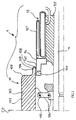
- the apparatus 1 comprises an assembly drum 10 mounted on a shaft 11, a device roll-up 12, a device (not shown) for feeding the translatable rod-complex axially to and from the drum 10, leaving free the volume inside the rod complexes.
- the rod complex feeding device can take the form by example of a ring carrying rod complex attachment fingers, or of a ring with magnetic attachment or a crown.
- the equipment also includes a device comprising folding fingers 13, shown diagrammatically in FIG. 4B. This last can be integrated with the rod complex supply device.
- the rolling-up device 12 disposed axially outside the drum 10, comprises a support 122 slidably mounted on the shaft 11.
- the roll-up device 12 also includes inflatable membranes 121 carried by said support 122.
- the assembly drum 10 has a main receiving surface 101, generally cylindrical, and has at least one shoulder 102.
- the main receiving surface 101 consists of segments 103 juxtaposed circumferentially in the working position of the drum and mounted, by means of rods 105, with radial displacement relative to supports 104, mounted on the shaft 11.
- the segments 103 make it possible to retract radially the drum 10 for the extraction (axially) of the carcasses produced on said drum.
- the segments 103 constitute a system of several adjacent segments circumferentially, the circumferentially lateral faces of some (B) being converging inside the drum (let's call them by convention “the vaults”), and the faces circumferentially side of the others (A) being convergent outside the drum (let's call them by convention "the keys”).
- the vaults the circumferentially lateral faces of some (B) being converging inside the drum (let's call them by convention “the vaults”), and the faces circumferentially side of the others (A) being convergent outside the drum (let's call them by convention "the keys”).
- This drum 10 therefore has only one radial working position used for the assembly of a tire casing, and a single retracted position for extraction of the carcass.
- the drum 10 also has a lateral protuberance 106 integral with said drum 10 and fixed on the latter, having a generally cylindrical support surface 107, of diameter lower than that of the main receiving surface 101, so that the shoulder 102 remains cleared to allow the installation of the rod complex on said shoulder by a lateral approach.
- the shape of the radial section of the segments 103 i.e. the shape of the surface exterior constituted by the main receiving surface 101 extended by the shoulders 102 may vary somewhat. For example, it may be less square at the shoulders, as appears for example in US Patent 1,911,594. That is to say that the shoulders may be slightly inclined with respect to the radial direction, without presenting of portion included in a plane perpendicular to the axis. Seen in radial section, the shoulders are then bent enough, while keeping rounded connections.
- the apparatus 1 also includes a crown lateral 14 (14 ') coaxial with said drum 10, having a bearing surface 141 (141') generally cylindrical, with a diameter smaller than that of the lateral protuberance 106. This lateral crown 14 is (14 ') mounted on the shaft 11 and is axially movable relative to the drum 10, as explained below.
- the side ring 14 is mounted on the device rolling up 12 axially internally with respect to the center of the apparatus 1, and is secured in axial translation of said device
- the diameter of the bearing surface 141 of the lateral crown 14 is less than the internal diameter of the segments 103 in their position of work to allow its retraction under said segments.
- the axial displacement of the rolling-up device 12 makes it possible, in fact, to actuate the lateral crown 14 between a transversely advanced position, shown in Figure 1, where the latter exceeds axially of the drum 10 and a retracted position where the lateral ring 14 is hidden by the drum 10.
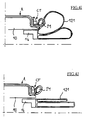
- the lateral crown 14 ′ is mounted on the assembly drum 10 radially under the lateral protuberance 106, and with possible axial translation relative to the segments 103 between an advanced position where it protrudes axially relative to the lateral protuberance 106 at above the roll-up device 12 and a retracted position under the lateral protuberance 106.
- This arrangement allows the length of the membrane actually used to be adjusted. for rolling up, the lateral crown 14 'being susceptible, during the movement of axial sliding, partially covering the roll-up device. Indeed, during a expansion of the rolling-up membranes 121, the lateral crown 14 'being in position advanced, the membranes do not act on the products placed on the lateral protuberance 106 as will be seen in more detail in the description of the manufacturing process.
- the different means used to control the rotation around the axis of rotation of the various elements of the apparatus do not require detailed explanations. Let's point out simply that it is necessary to control in rotation not only the drum 10, but also preferably the roll-up device 12 because it also serves as a laying surface for various constituent products of the tire to be manufactured.
- the rotation control of the rolling-up device 12 can come directly from the shaft 11, or else the device for rolling up can be engaged on demand on the drum 10, for example by a chamber inflatable tubular 109 inserted on the bearing surface 141, on the axially inner side of this one.
- the clutch of the rolling-up device 12 is then inflated.
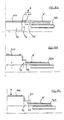
- FIGS. 4A to 4J schematically illustrate this method in the first embodiment of the invention according to the first variant of the apparatus 1 shown in Figure 1, the setting implementing the method with the second variant of the apparatus 1 easily deduced from this one.
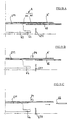
- the drum 10 being in the working position and the lateral crown 14 in deployed position, that is to say axially separated, it is deposited on the receiving surface main 101 a rubber tablecloth called the NI "inner tablecloth”, then a textile cables, called “carcass ply” NC. All of these NI and NC layers constitute what is collectively called here “carcass reinforcement” A.
- the end A 'of the carcass reinforcement A protrudes axially from the main receiving surface 101 and overhangs the lateral protuberance 106 and the lateral crown 14, as well as part of the roll-up membranes.
- the end A ′ of the carcass reinforcement A is then folded radially inwards, on respectively the bearing surface 107 of the lateral protuberance 106, the bearing surface 141 of the lateral crown 14 and partially on the membranes 121 using the fingers of folding down 13, as shown in FIG. 4B.
- the carcass ply can also be laid in slight tension.
- the propensity for the resulting shrinkage spontaneously causes diametrical retension of ends A ', which can be completed by a folding down as described above or a rolling, to correctly apply said carcass reinforcement to the surfaces of reception and support.
- a rubber mix profile is deposited.
- This profile P1 has in the example described a front section the shape of a quadrilateral but we can consider other forms of section.
- the roll-up membranes are then inflated, which raise the end A 'situated radially. axially externally to the lateral crown 14 and therefore to the profile P1. So the area of the raised end A 'rotates around the profile P1 so that the latter is oriented substantially radially, as shown in Figures 4D and 4E. Note at passage that at least the portion of the membranes 121 in contact with the carcass reinforcement A is chosen and / or treated so that the carcass reinforcement A does not stick to said portion (for example example because its surface is covered with a suitable textile fabric).
- the roll-up membranes 121 are then deflated, the raised end A ′ remaining in its substantially radially oriented position, and is brought together axially, thanks to the rod-complex supply device, a rod-complex CT.
- the rod complex CT is constituted in this example by a rod T of section square, made of wires or cables, radially surmounted by a mixing profile rubbery P2.
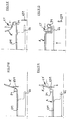
- the CT rod complex is brought axially until it is pressed against the end AT'. We then continue the axial approximation of the rod complex CT thus entraining with it the end A 'which is turned over, and passing above the section P1 covered by a part of the end A '. The CT rod complex is thus brought together until it comes into contact with the shoulder 102 via the inverted end A ′, which is thus found between the rod T and the carcass reinforcement A, as seen in FIG. 4G.
- the deposit of the rod rod complex CT on the inversion of the end A 'of the reinforcement carcass A is thus carried out directly above the second cylindrical bearing surface 107 coaxial, disposed between the main receiving surface 101 and the first bearing surface 141 (or 141 '), the diameter of the main receiving surface 101 being greater than that of the second bearing surface, itself greater than the diameter of the first bearing surface (see also 741, 711, 751 below).
- the lateral crown 14 is then moved axially towards the center (plane CP), which retracts under the lateral protuberance 106 the first bearing surface 141 (141 'in the variant illustrated in Figure 3), so that the section P1 surrounded by the carcass reinforcement A is now just over the rolling membranes 121 (Figure 4H).
- the roll-up membranes 121 are inflated again, this time making a tilting of the profile P1 (FIG. 4I) against the rod complex, or at least which raises it radially somewhat from the rod rod complex and help to press it laterally against the CT rod complex.
- the apparatuses 5, 6, 7 respectively comprise an assembly drum 50, 60, 70, radially expandable, comprises a central body 51, 61, 71 mounted on a shaft 52, 62, 72, having a receiving surface 511, 611, 711 of the products to be assembled and the shoulders 514, 614, 714.
- These devices 5, 6, 7 also include a system for feeding the rod complexes, not shown, axially translatable to the drum 50, 60, 70 leaving the diameter free interior of the rod complexes as described for the previous example. But unlike in the previous example, the devices 5, 6, 7 are used here without folding fingers, as will be understood on reading the manufacturing process using these equipment.
- drums 50, 60, 70 described in this exemplary embodiment of the invention being symmetrical with respect to a plane P represented in FIGS. 5, 6, 7, we will not describe in the following the description as the half-drums located to the right of the plane P in said figures.
- the choice of drums described here does not limit the scope of the invention to drums symmetrical.
- the central body 51 (61, 71) comprises an axially displaceable half-body 512 (612, 712) around the shaft 52 (62, 72) in order to adjust the spacing of the bead wires of the tire to be produced, and a central ring 513 (613, 713) fixed axially relative to the shaft 52 (62, 72).
- the half-body 512 (612, 712) and the central crown 513 (613, 713) are constituted by a plurality of lateral segments 522 (622, 722) and central 523 (623, 723) respectively in vis-a-vis.
- the lateral segments 522 (622, 722) are juxtaposed circumferentially around of the shaft 52 (62, 72) and, similarly, the central segments 523 (623, 723) are juxtaposed circumferentially around the shaft 52 (62, 72).
- each lateral segment 522 (622, 722) is guided relative to the central segment 523 (623, 723) opposite by means of a rod 515 (615, 715), one of which end crosses the central segment 523 (623, 723) and the other end of which is mounted at sliding in a bore 516 (616, 716) carried by the lateral segment 522 (622, 722) in vis-a-vis.
- the segments 522 (622, 722) are radially movable under the action of an inflatable expansion chamber 517 (617, 717) disposed under said lateral segments 522 (622, 722). Lateral segments 522 (622, 722) entrain in their radial movement the central segments 523 (623, 723) of the central crown 513 (613, 713), which are integral in radial displacement with the segments lateral 522 (622, 722) via the rods 515 (615, 715).
- Platelets 518 (618, 718) are fixed by screws on the segments 523 (623, 723) of the central crown 513 (613, 713). These plates 518 (618, 718) cover at least partially the segments 522 (622, 722) of the half-body 512 (612, 712) in order to ensure a continuity between the central crown 513 (613, 713) and said half-body 512 (612, 712) for the products to be assembled regardless of the axial position of the half-body 512 (612, 712).
- the central crown 513 (613, 713) also makes it possible to ensure axial retention of the inserts 518 (618, 718) during the radial expansion of the drum 50 (60, 70). Of course, we can consider elements other than expansion chambers in order to achieve expansion radial of the drum.
- the receiving surface 511 (611, 711) of the products to be assembled is thus constituted by all the external surfaces of the plates 518 (618, 718) and of the zones of the segments 522 (622, 722) not covered by said plates 518 (618, 718).
- the drum 50 (60) has a radially expandable lateral protuberance 54 (64), integral with the body 51 (61) and having a bearing surface 541 (641) of the products to to assemble.
- the lateral protuberance 54 (64) is juxtaposed coaxially with the shoulder 514 (614) of the body 51 (61) and forms a bearing surface 541 (641) of diameter smaller than that of said main receiving surface 511 (611).
- a possible realization of the protuberance lateral 54 (64) consists in forming it in the form of segments respectively coming in extension of the segments 522 (622) of the half-body 512 (612). We can also, without depart from the scope of the invention, consider that the lateral protuberance 54 (64) is an element reported relative to body 51 (61).
- the apparatus 5 (6) comprises a rolling-up device 55 (65) mounted on the shaft 52 (62) axially externally to the lateral protuberance 54 (64).
- This roll-up device 55 (65) can be constituted, as in the example of the apparatus 1, by membranes of roll up.
- a roll-up device 55 (65) has been chosen comprising lifting fingers; the term “finger” is understood to mean a profile of small cross section.
- the roll-up device 55 (65) is independent of the drum 50 (60) and can be axially translated, however it can also be envisaged that this device is integral with the drum 50 (60) in which case it is advantageous to use the segments 522 (622) of the half-body (512, 612) as respective supports for the lifting fingers.
- the roll-up device 55 (65) therefore comprises a plurality of lifting fingers 551 (651), of rectangular section (if seen radially), distributed circularly around the shaft 52 (62) and extending in radial directions.
- lifting fingers 551 (651) are arranged axially outwardly relative to the center of drum 50 (60), a short distance from the free end of the lateral protuberance 54 (64), and respectively have a contact surface 552 (652) of the products to to assemble.
- the lifting fingers 551 (651) are mounted with possible radial displacement respectively on a cylindrical support 553 (653) mounted in axial translation on the shaft 52 (62) by means of cylinders 554 (654).
- each lifting finger 551 (651) carries an axial extension 558 (658) on which is fixed, by means of screws, the jack 554 (654) corresponding which slides radially in a housing 555 (655) carried by the cylindrical support 553 (653).
- the lifting fingers 551 (651) can be deployed radially outwards from the drum 50 (60) from a rest position to a deployed position. And, in order to ensure the return of the lifting fingers 551 (651) to the rest position, an elastic belt of recall 559 (659) surrounds all of the axial extensions 558 (658).
- lifting fingers 551 thus offer the products to be assembled a plurality of contact surfaces 552 (652) discontinuous and distributed circumferentially.
- the free ends of the lifting fingers 551 (651), that is to say radially external to the drum 50 (60), are constituted by a roller 557 (657) mounted free in rotation about an axis and which thus carries the contact surface 552 (652).
- This pebble 557 (657) avoids creating tension in the products raised during deployment of the lifting fingers 551 (651) ensuring, in this phase, a contact "Rolling" between fingers and products.
- the drum 50 carries expansion means 57, which comprise in particular the expansion chambers 517, towards two distinct expanded positions and which allow to reach its two positions successively.
- expansion means 57 comprise in particular the expansion chambers 517
- the drum can take three distinct stable positions, characterized by three circumferential developments different than a rope wrapped around the main receiving surface.
- the expansion means 57 comprise a ring Control 572 mounted on a support ring 573, the two rings being mounted on the shaft 52 and disposed axially outside the body 51 near the free end of the lateral protuberance 54.
- the support ring 573 carries an inner cylindrical shoulder 573 'which cooperates with the control ring 572.
- the control ring 572 is rotatably mounted relative to the body 51 of the drum 50, the support ring 573 being integral in rotation with said body 51.
- the lateral protuberance 54 carries at least one pin engagement 542 in a cam 574 carried by the control ring 572 and, simultaneously, in a light 575 oriented in a radial direction and carried by the support ring 573.
- each of the segments constituting the protuberance side 54 carries an engagement pin in a cam and a corresponding light.
- the expanded position accessible to the drum 51 is dependent on the angular position of the control ring 572. Indeed, depending on the rotation of the control ring 572 and therefore from its angular position and that of the cams 574, the engagement pins 542 have a different radial positioning range, which therefore limits the radial expansion of the drum 50, the slots 575 ensuring the radially guiding of the engagement pins 542.
- each cam 574 has a shape resembling a Z, the possible positions of the corresponding engagement pin 542 in each side of the Z corresponding to the three positions of the drum 50, that is to say one position retracted, an intermediate expanded position and a maximum expanded position.
- the drum 50 being in the contracted position, the surface of reception 511 the layers NI and NC constituting the carcass reinforcement A.
- the end A 'of the carcass reinforcement extends axially from the receiving surface 511 and covers the lateral protuberance 54 as well as the lifting fingers 551 of the roll-up device 55.
- the end A ′ of the carcass reinforcement A is then folded over respectively the bearing surface 541 of the lateral protuberance 541 by making a first expansion of the drum 50 thanks to the control rings 572 and support 573.
- the expansion of the drum 50 in the intermediate position makes it possible to press the end A ′ on the bearing surface 541 and that formed by the contact surfaces 557 of the roll up 55.
- the rubber mix profile is deposited P1 on the area of the end A ′ of the carcass reinforcement A disposed on the bearing surface 541 of the lateral protuberance 54.
- the lifting fingers 551 are then deployed radially to the deployed position in which the contact surfaces 557 substantially constitute a cylindrical surface of diameter greater than the diameter of the bearing surface 541 so that the fingers 551 are raised radially the end A 'located axially outside the lateral protuberance 54 and therefore to profile P1.
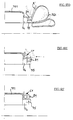
- the raised end area A ' rotates around the profile P1 so that the latter is oriented substantially radially, as shown in the Figure 10D.
- the rod complex is brought together axially, thanks to the rod-complex supply device CT until pressing on the latter from end A '.
- the lifting fingers 551 can be recalled in the rest position thanks to the elastic belt 559 and we continue the axial approximation of the rod complex CT thus resulting with it the end A 'which is turned over, and passing above the section P1 covered by a part of the end A ', as seen in Figure 10F. Note, however, that we can also recall fingers 551 before pressing the end A 'on the rod complex.
- the control ring is then actuated simultaneously in advance of the rod complex CT 572 in order to bring the drum 50 into its maximum expanded position.
- the radial expansion of the resulting bearing surface 541 raises radially the profile P1 relative to the CT rod complex (see Figure 10G).
- the apparatus 6 comprises in addition to the elements already described (namely the drum 60, the shaft 62, the lateral protuberance 64 integral with the drum 60 and the roll-up device 65) an axially movable ferrule 66, for example mounted on the shaft 62.
- This ferrule 66 has a diameter substantially identical to that of the receiving surface 611 and is mounted, in a translatable manner relative to the shaft 62, between a retracted position and a position for covering the surface 641 of the lateral protuberance 64 in which the ferrule 66 covers said surface 541 as shown in FIG. 6.
- the presence of the ferrule 66 provides a firm support for the installation of a rubber mix profile.
- the ferrule 66 is carried by a support 67 mounted on the shaft 62.
- the support 67 comprises a outer ring 671, concentric with the shaft 62 and which covers the ferrule 66 in the position retracted from the latter.
- the diameter of the outer ring 671 is chosen closest possible from that of ferrule 66, to allow the passage of the rod complex above of the outer ring.
- the support 67 is mounted axially displaceable on the shaft 62 so in particular, to facilitate disassembly operations or access to the drum 60.
- the support 67 carries a chamber annular 672 concentric with the shaft 62 inside which axially slides a piston 673 for actuating the ferrule 66, connected to the latter by a connecting rod 674, rotatably mounted around the axis 674A, itself mounted on the support 67.
- the connection of the connecting rod 674 with the ferrule 66 is produced by mounting an axis integral with a bearing 675, said penetrating axis in an elongated orifice 674B arranged at one end of the rod 674.
- the bearing 675 is also sliding relative to the outer ring 671, which provides guidance in translation of the ferrule 66.
- the drum 60 has in this example only two working positions: a position retracted corresponding to the deflated position of the inflation bladder expansion chamber 617 and an expanded position to the inflated position of the expansion chamber 617.
- a position retracted corresponding to the deflated position of the inflation bladder expansion chamber 617 and an expanded position to the inflated position of the expansion chamber 617.
- the roll-up device it is preferable to use a roll-up device using fingers 651 linkage, described above, with the roll-up membranes. Indeed, as the showed in more detail the description of the process, the roll-up device must be capable a large radial displacement, which is more easily achievable with fingers lifting.
- FIGS. 11A to 11G schematically illustrate this process in the third mode of realization of the invention using the apparatus 6.
- the drum 60 being in the contracted position and the ferrule 66 in the position transversely advanced and covering the lateral protuberance 64, it is deposited on the surface receiving 611 the layers NI and NC constituting the carcass reinforcement A, the end A 'of the carcass reinforcement A resting on the ferrule 66.
- the ferrule 66 is not essential for installing the carcass reinforcement A as shown in the examples previous.
- the rubber mix profile P1 is then deposited on the area of the end A ′ of the carcass reinforcement A disposed on the ferrule 66. It is for this removal that it is very favorable to have a support under the end A ′ of the carcass reinforcement A.
- the lifting fingers 651 are deployed radially which raise the end A 'radially located axially outside the lateral protuberance 64 and therefore the profile P1. So the raised end area A 'rotates around profile P1 so that this the latter is oriented substantially radially, as shown in FIG. 11D.
- the rod complex is brought together axially, thanks to the rod-complex supply device CT until pressing on the latter from end A '.
- the lifting fingers 651 can be recalled in the rest position thanks to the elastic belt 659 and we then continue the axial approximation of the rod complex CT which thus results with it the end A 'which is thus turned over, and passes over the section P1 covered by part of the end A ', as seen in Figure 11F.
- the drum 70 also includes a first ring and an intermediate ring, mounted on the shaft 72, respectively 75 and 74, the intermediate ring 74 being arranged between one of the shoulders 714 of the body 71 (appearing clearly in the expanded position said central body 71) and the first ring 75.
- Each of the first ring and intermediate ring 74, 75 has a bearing surface for the products to be assembled, which are will name with reference to the crowns first bearing surface 751 for the first crown and second bearing surface 741 for the intermediate ring 74.
- the two rings 74, 75 are integral in axial translation with the central body 71 and radially expandable individually and independently of said body, thanks to a expansion chamber 742 and 752 respectively. It is possible to envisage using other means expansion than the rooms listed above.
- the outer diameters of the first ring and of the intermediate ring 75, 74 i.e. the diameters of the first and second bearing surfaces 751, 741 in the retracted position crowns 75, 74 are substantially identical to the diameter of the receiving surface 711 in the retracted position of the central body 71, and the diameter of the first bearing surface 751 in expanded position of the crown 75 is less than the diameter of the second bearing surface 741 also in the expanded position of the intermediate crown 74, which is itself less than the diameter of the receiving surface 711 in the expanded position of the central body 71.
- the apparatus 7 comprises a rolling-up device 76 mounted on the shaft 72 axially externally to the first ring 75.
- This rolling-up device 76 can be formed, as in the previous examples, by rolling up membranes or fingers lifting.
- FIGS. 12A to 12F schematically illustrate this method in the fourth mode of realization of the invention using the apparatus 7.
- the central body 71 and the two rings 75 and 74 being respectively in retracted position, deposit on the receiving surface 711 the layers NI and NC constituting the carcass reinforcement A, the end A 'of the carcass reinforcement A resting on the first and the second bearing surfaces 751 and 741 of the rings 75, 74 and protruding axially outwardly of these.
- the rubber mixture profile P1 is then deposited on the area of the end A 'of the carcass reinforcement A disposed on the first bearing surface 741, as shown in the figure 12C.
- the roll-up membranes 761 are then deflated and, thanks to the supply device for rod-complex, the CT-rod complex is brought together axially until the the end A 'on the latter. We then continue the axial approximation of the rod complex CT thus bringing with it the end A 'which is turned over, and passing above the profile P1 covered by part of the end A '.
- the CT rod complex is thus brought together up to its contact with the shoulder 714 via the inverted end A ', which is thus found between the rod T and the carcass reinforcement A, as seen in the figure 12E.
- the expansion chamber 752 is then inflated in order to bring the first bearing surface 751 bearing the profile P1 with the same diameter as that of the second bearing surface 741 bearing the rod complex CT, which raises the profile P1 radially with respect to the rod complex CT (see Figure 12F).
Landscapes
- Engineering & Computer Science (AREA)
- Mechanical Engineering (AREA)
- Manufacturing & Machinery (AREA)
- Tyre Moulding (AREA)
- Tires In General (AREA)
Abstract
Description
- à appliquer ces extrémités contre les épaulements du tambour généralement à l'aide de doigts de rabattage déplacés axialement.
- puis à positionner les complexes-tringle contre les épaulements du tambour,
- enfin à actionner des dispositifs de retroussage, généralement constitués par des vessies gonflables, afin de relever les extrémités de l'armature de carcasse sur les complexes-tringle et de réaliser ainsi un retournement de l'armature de carcasse autour desdits complexes-tringle sans modifier leur positionnement.
- déposer une armature de carcasse sur une surface de réception principale généralement cylindrique, l'une au moins des extrémités latérales de l'armature de carcasse étant déposée à l'aplomb d'une et en porte-à-faux par rapport à une première surface d'appui cylindrique, coaxiale et de diamètre inférieur à la surface de réception principale,
- déposer un profilé de mélange caoutchouteux sur cette extrémité de l'armature de carcasse,
- retourner ladite extrémité latérale autour du profilé de mélange caoutchouteux tout en maintenant ledit profilé substantiellement immobile.
- déposer un complexe-tringle sur le retournement ainsi réalisé et axialement à l'intérieur de l'endroit de dépose du profilé.
- en relevant radialement ladite extrémité de sorte qu'elle soit orientée sensiblement radialement,
- puis en rapprochant axialement le complexe-tringle vers le centre de l'armature de carcasse jusqu'à l'appui de l'extrémité sur le complexe-tringle,
- et en poursuivant le rapprochement axial du complexe-tringle qui passe au-dessus du profilé de mélange caoutchouteux.
- déposer une armature de carcasse sur une surface de réception principale généralement cylindrique, l'une au moins des extrémités latérales de l'armature de carcasse étant déposée à l'aplomb d'une première surface d'appui cylindrique, coaxiale à la surface de réception principale.
- déposer un profilé de mélange caoutchouteux sur cette extrémité de l'armature de carcasse,
- retourner ladite extrémité latérale autour du profilé de mélange caoutchouteux tout en maintenant ledit profilé substantiellement immobile,
- déposer un complexe-tringle sur le retournement ainsi réalisé et axialement à l'intérieur de l'endroit de dépose du profilé. Comme évoqué ci-dessus, en pratique, les deux extrémités latérales de l'armature de carcasse font l'objet de manipulations si pas en tous points identiques (car il peut s'agir de fabriquer des pneumatiques dont le diamètres des tringles n'est pas le même dans chacun des bourrelets), du moins semblables en leur principe.
- la figure 1 est une coupe axiale partielle d'un appareillage pour la fabrication de pneumatique selon un premier mode de réalisation de l'invention,
- la figure 2 est une coupe partielle selon le plan P, du tambour de l'appareillage représenté sur la figure 1,
- la figure 3 est une coupe axiale partielle d'un appareillage selon une variante du premier mode de réalisation de l'invention,
- les figures 4A à 4J sont des représentations schématiques en coupe axiale partielle illustrant les différentes phases de la fabrication d'un pneumatique avec l'appareillage selon le premier mode de réalisation de l'invention,
- la figure 5 est une coupe axiale partielle d'un appareillage pour la fabrication de pneumatique selon un deuxième mode de réalisation de l'invention,
- la figure 6 est une coupe axiale partielle d'un appareillage pour la fabrication de pneumatique selon un troisième mode de réalisation de l'invention,
- la figure 7 est une coupe axiale partielle d'un appareillage pour la fabrication de pneumatique selon un quatrième mode de réalisation de l'invention,
- la figure 8 est une coupe transversale de l'appareillage représenté sur la figure 5 selon la ligne VIII de ladite figure 5.
- la figure 9 est une coupe axiale partielle de l'appareillage illustré à la figure 6, pris dans une configuration différente,
- les figures 10A à 10G sont des représentations schématiques en coupe axiale partielle illustrant les différentes phases de la fabrication d'un pneumatique avec l'appareillage selon le deuxième mode de réalisation de l'invention.
- les figures 11A à 11G sont des représentations schématiques en coupe axiale partielle illustrant les différentes phases de la fabrication d'un pneumatique avec l'appareillage selon le troisième mode de réalisation de l'invention.
- les figures 12A à 12F sont des représentations schématiques en coupe axiale partielle illustrant les différentes phases de la fabrication d'un pneumatique avec l'appareillage selon le quatrième mode de réalisation de l'invention.
- en position de repos desdits doigts, inférieur ou égal au diamètre de la surface d'appui 541 de la protubérence latérale 54 dans la position expansée intermédiaire du tambour 50,
- et en position déployée, supérieur au diamètre de la surface d'appui 541 de la protubérence latérale 54 dans la position expansée intermédiaire du tambour 50.
- en position de repos desdits doigts, inférieur à celui de surface de réception 611 en position contractée du tambour 61 afin de permettre le déploiement de la virole 66,
- et en position avancée, supérieur à celui de la surface de réception 611 en position contractée du tambour 61.
Claims (32)
- Procédé de fabrication d'un pneumatique, comportant les étapes suivantes:déposer une armature de carcasse (A) sur une surface de réception principale généralement cylindrique (101, 511, 611, 711), l'une au moins des extrémités latérales (A') de l'armature de carcasse (A) étant déposée à l'aplomb d'une et en porte-à-faux par rapport à une première surface d'appui (141, 141', 541, 66, 751) cylindrique, coaxiale et de diamètre inférieur à la surface de réception principale (101, 511, 611, 711),déposer un profilé de mélange caoutchouteux (P1) sur cette extrémité (A') de l'armature de carcasse (A),retourner ladite extrémité latérale (A') autour du profilé de mélange caoutchouteux (P1) tout en maintenant ledit profilé substantiellement immobile,déposer un complexe-tringle (CT) sur le retournement ainsi réalisé et axialement à l'intérieur de l'endroit de dépose du profilé.
- Procédé selon la revendication 1, complété par l'étape subséquente suivante :dilater radialement le profilé de mélange caoutchouteux (P1) recouvert par le retournement de l'armature de carcasse (A) par rapport au complexe-tringle (CT).
- Procédé selon la revendication 1, dans lequel l'autre des extrémités latérales de l'armature de carcasse (A) est également déposée à l'aplomb d'une et en porte-à-faux par rapport à une autre première surface d'appui cylindrique, disposée axialement de l'autre côté, également coaxiale et de diamètre inférieur à la surface de réception principale (101, 511, 611, 711).
- Procédé selon la revendication 1, comportant une étape consistant à rabattre ladite extrémité latérale (A') de l'armature de carcasse (A) radialement vers l'intérieur.
- Procédé selon la revendication 1, dans lequel le retournement de l'extrémité (A') de l'armature de carcasse (A) autour du profilé de mélange caoutchouteux (P1) est réalisé:en relevant radialement ladite extrémité (A') de sorte qu'elle soit orientée sensiblement radialement,puis en rapprochant axialement le complexe-tringle (CT) vers le centre de l'armature de carcasse (A) jusqu'à l'appui de l'extrémité (A') sur le complexe-tringle (CT),et en poursuivant le rapprochement axial du complexe-tringle (CT) qui passe au-dessus du profilé de mélange caoutchouteux (P1).
- Procédé selon la revendication 5, dans lequel on relève radialement l'extrémité (A') de l'armature de carcasse (A) en appuyant radialement vers l'extérieur dans une zone de ladite extrémité (A') située axialement extérieurement au profilé de mélange caoutchouteux (P1).
- Procédé selon l'une quelconque des revendications 1 à 6, dans lequel le dépôt du complexe-tringle (CT) sur le retournement de l'extrémité (A') de l'armature de carcasse (A) est effectué à l'aplomb d'une deuxième surface d'appui cylindrique (107, 741) coaxiale, disposée entre la surface de réception principale (101, 711) et la première surface d'appui (141, 141', 751), le diamètre de la surface de réception principale (101, 711) étant supérieur à celui de la deuxième surface d'appui (107, 741), lui-même supérieur au diamètre de la première surface d'appui (141, 141', 751).
- Procédé selon la revendication 2, dans lequel la dilatation du profilé de mélange caoutchouteux (P1) par rapport au complexe-tringle (CT) est réalisée :en escamotant la première surface d'appui (141, 141'),et en actionnant un dispositif de retroussage (12) disposé sous le profilé de mélange caoutchouteux (P1) recouvert par le retournement de l'armature de carcasse (A).
- Procédé selon la revendication 2, dans lequel le dépôt du complexe-tringle (CT) sur le retournement de l'extrémité (A') de l'armature de carcasse (A) est effectué à l'aplomb d'une deuxième surface d'appui cylindrique (107, 741) coaxiale, disposée entre la surface de réception principale (101, 711) et la première surface d'appui (141, 141', 751), le diamètre de la surface de réception principale (101, 711) étant supérieur à celui de la deuxième surface d'appui (107, 741), lui-même supérieur au diamètre de la première surface d'appui (141, 141', 751) et la dilatation radiale du profilé de mélange caoutchouteux (P1) par rapport au complexe-tringle (CT) est réalisée en effectuant une expansion de la première surface d'appui (751) jusqu'au diamètre de la deuxième surface d'appui (741).
- Procédé de fabrication d'un pneumatique, comportant les étapes suivantes:déposer une armature de carcasse (A) sur une surface de réception principale généralement cylindrique (101, 511, 611, 711), l'une au moins des extrémités latérales (A') de l'armature de carcasse (A) étant déposée à l'aplomb d'une première surface d'appui (141, 141', 541, 66, 751) cylindrique, coaxiale à la surface de réception principale (101, 511, 611, 711),déposer un profilé de mélange caoutchouteux (P1) sur cette extrémité (A') de l'armature de carcasse (A),retourner ladite extrémité latérale (A') autour du profilé de mélange caoutchouteux (P1) tout en maintenant ledit profilé substantiellement immobile,déposer un complexe-tringle (CT) sur le retournement ainsi réalisé et axialement à l'intérieur de l'endroit de dépose du profilé.
- Procédé selon la revendication 10, complété par l'étape subséquente suivante:dilater radialement le profilé de mélange caoutchouteux (P1) recouvert par le retournement de l'armature de carcasse (A) par rapport au complexe-tringle (CT).
- Procédé selon la revendication 10, dans lequel l'autre des des extrémités latérales de l'armature de carcasse (A) est également déposée à l'aplomb d'une et en porte-à-faux par rapport à une autre première surface d'appui cylindrique, disposée axialement de l'autre côté, également coaxiale et de diamètre inférieur à la surface de réception principale (101, 511, 611, 711).
- Procédé selon la revendication 10, dans lequel le retournement de l'extrémité (A') de l'armature de carcasse (A) autour du profilé de mélange caoutchouteux (P1) est réalisé:en relevant radialement ladite extrémité (A') de sorte qu'elle soit orientée sensiblement radialement.puis en rapprochant axialement le complexe-tringle (CT) vers le centre de l'armature de carcasse (A) jusqu'à l'appui de l'extrémité (A') sur le complexe-tringle (CT),et en poursuivant le rapprochement axial du complexe-tringle (CT) qui passe au-dessus du profilé de mélange caoutchouteux (P1).
- Procédé selon la revendication 13, dans lequel on relève radialement l'extrémité (A') de l'armature de carcasse (A) en appuyant radialement vers l'extérieur dans une zone de ladite extrémité (A') située axialement extérieurement au profilé de mélange caoutchouteux (P1).
- Procédé selon l'une quelconque des revendications 10 à 14, dans lequel le dépôt du complexe-tringle (CT) sur le retournement de l'extrémité (A') de l'armature de carcasse (A) est effectué à l'aplomb d'une deuxième surface d'appui cylindrique (107, 741) coaxiale, disposée entre la surface de réception principale (101, 711) et la première surface d'appui (141, 141', 751), le diamètre de la surface de réception principale (101, 711) étant supérieur à celui de la deuxième surface d'appui (107, 741), lui-même supérieur au diamètre de la première surface d'appui (141, 141', 751).
- Procédé selon la revendication 15, dans lequel la dilatation radiale du profilé de mélange caoutchouteux (P1) par rapport au complexe-tringle (CT) est réalisé :en escamotant la première surface d'appui (141, 141'),et en actionnant un dispositif de retroussage (12) disposé sous le profilé de mélange caoutchouteux (P1) recouvert par le retournement de l'armature de carcasse (A).
- Procédé selon la revendication 16, caractérisé par le fait que la dilatation du profilé de mélange caoutchouteux (P1) par rapport au complexe-tringle (CT) est réalisé en effectuant une expansion de la première surface d'appui (751) jusqu'au diamètre de la deuxième surface d'appui (741).
- Procédé selon la revendication 11, dans lequel la dilatation radiale du profilé de mélange caoutchouteux (P1) par rapport au complexe-tringle (CT) est réalisé par une expansion de la surface de réception (511), la première surface d'appui (541) étant solidaire de la surface de réception (511) et de diamètre inférieur à celui de ladite surface de réception.
- Procédé selon l'une quelconque des revendications 10 à 17, dans lequel le retournement de l'extrémité (A') de l'armature de carcasse (A) autour du profilé de mélange caoutchouteux (P1) est précédé par une opération d'escamotage de la première surface d'appui (66), et complété par l'étape consistant essentiellement à dilater radialement le profilé de mélange caoutchouteux (P1) recouvert par le retournement de l'armature de carcasse (A) par rapport au complexe-tringle (CT) en causant une expansion de la surface de réception (611) simultanément à une expansion d'une deuxième surface d'appui (641) du retournement de l'armature de carcasse (A).
- Appareillage (1) pour la fabrication d'un pneumatique, ledit appareillage comportant un tambour à épaulement (10) présentant une surface de réception principale (101) généralement cylindrique pour recevoir les produits à assembler, ladite surface de réception principale étant escamotable radialement, ledit tambour comportant un épaulement (102) axialement aux bords latéraux de ladite surface de réception principale (101), ledit tambour (10) étant monté sur un arbre (11), ledit appareillage comportant en outre au moins une couronne latérale associée (14, 14'), mobile axialement, montée coaxialement au tambour (10), ledit tambour (10) comportant une protubérence latérale (106) juxtaposée coaxialement à l'un de ses épaulements (102) au moins, ladite couronne latérale (14, 14') pouvant glisser axialement au moins partiellement sous ladite protubérence latérale, ladite protubérence latérale (106) formant une surface d'appui (107) quasi-cylindrique dont le diamètre extérieur est inférieur au diamètre de la surface de réception principale (101), ladite couronne latérale (14, 14') ayant une surface extérieure (141, 141') sensiblement cylindrique suceptible de dépasser axialement extérieurement de la protubérence latérale (106).
- Appareillage selon la revendication 20, dans lequel ladite surface extérieure (141, 141') peut être escamotée en totalité sous la la protubérence latérale (106).
- Appareillage selon la revendication 20 ou 21, comportant au moins un dispositif de retroussage (12) disposé axialement extérieurement à la couronne latérale (14), le dispositif de retroussage (12) étant solidaire en translation axiale de cette dernière.
- Appareillage selon la revendication 20, comportant au moins un dispositif de retroussage (12) disposé axialement extérieurement au tambour (10), la couronne latérale (14') étant portée par ledit tambour (10) et étant suceptible, lors dudit mouvement de glissement axial, de recouvrir partiellement le dispositif de retroussage (12).
- Appareillage (6) pour la fabrication d'un pneumatique, ledit appareillage comportant un tambour à épaulement (60) présentant une surface de réception principale (611) généralement cylindrique pour recevoir les produits à assembler, ladite surface de réception principale étant escamotable radialement, ledit tambour (60) étant monté sur un arbre (62), ledit appareillage comportant en outre au moins une virole (66) mobile axialement, montée sur l'arbre (62), ledit tambour (60) comportant au moins une protubérence latérale (64) juxtaposée à un des épaulements (614) au moins, ladite protubérence latérale (64) formant une surface d'appui (641) quasi-cylindrique dont le diamètre extérieur est inférieur au diamètre de la surface de réception principale (611), la virole (66) étant susceptible de recouvrir la surface (641) de la protubérence latérale (64).
- Appareillage selon la revendication 24, dans lequel ledit tambour comporte un épaulement (614) axialement aux bords latéraux de ladite surface de réception principale (611).
- Appareillage selon l'une des revendications 20 à 25, dans lequel les épaulements dudit tambour sont inclinés par rapport à la direction radiale, sans présenter de portion comprise dans un plan perpendiculaire à l'axe.
- Tambour à épaulement (50) pour la fabrication d'unpneumatique, ledit tambour ayant un corps central (51) présentant une surface de réception principale généralement cylindrique (511), pour recevoir les produits à assembler, ladite surface de réception principale étant escamotable radialement, ledit tambour comportant un épaulement (514) axialement aux bords latéraux de ladite surface de réception principale (511), ledit corps central (51) étant monté sur un arbre (52), ledit tambour comportant des moyens d'expansion (57) du tambour (50) vers deux positions expansées distinctes, de sorte que le tambour puisse prendre trois positions stables distinctes par trois développements circonférentiels différents d'une corde enroulée autour de la surface de réception principale.
- Tambour selon la revendication 27, comportant une protubérence latérale (54) juxtaposée coaxialement à l'un de ses épaulements (514) au moins, solidaire de ce dernier, ladite protubérence latérale (54) étant de diamètre extérieur inférieur à celui de la surface de réception (511).
- Tambour à épaulement (70) pour la fabrication d'un pneumatique, ledit tambour ayant un corps central (71) présentant une surface de réception principale (711) généralement cylindrique, pour recevoir les produits à assembler, ladite surface de réception principale étant escamotable radialement, ledit corps central (71) étant monté sur un arbre (72), ledit tambour (70) comportant au moins une couronne latérale et une couronne intermédiaire (75, 74) montées sur l'arbre (72), la couronne intermédiaire (74) étant disposée entre l'un des épaulement (714) du corps central (71) et la couronne latérale (75), les couronnes intermédiaire et latérale (74, 75) étant solidaires en translation axiale du corps central (71) et étant expansibles radialement individuellement et indépendamment dudit corps central (71).
- Tambour selon la revendication 29, comportant un épaulement (714) axialement aux bords latéraux de ladite surface de réception principale (711).
- Tambour selon la revendication 29 ou 30, dans lequel les diamètres extérieurs de la couronne latérale et de la couronne intermédiaire (75, 74), en position rétractée de ces dernières, sont sensiblement identiques au diamètre de la surface de réception (711) en position rétractée du corps (71), et que le diamètre extérieur de la couronne latérale (75) en position expansée de cette dernière est inférieur au diamètre extérieur de la couronne intermédiaire (74) également en position expansée de cette dernière, qui est lui-même inférieur au diamètre de la surface de réception (711) en position expansée du corps (71).
- Tambour selon l'une des revendications 27 à 31, dans lequel les épaulements sont inclinés par rapport à la direction radiale, sans présenter de portion comprise dans un plan perpendiculaire à l'axe.
Applications Claiming Priority (2)
| Application Number | Priority Date | Filing Date | Title |
|---|---|---|---|
| FR9809594 | 1998-07-23 | ||
| FR9809594A FR2781412A1 (fr) | 1998-07-23 | 1998-07-23 | Procede de fabrication de pneumatiques |
Publications (2)
| Publication Number | Publication Date |
|---|---|
| EP0974448A1 true EP0974448A1 (fr) | 2000-01-26 |
| EP0974448B1 EP0974448B1 (fr) | 2004-05-06 |
Family
ID=9529070
Family Applications (1)
| Application Number | Title | Priority Date | Filing Date |
|---|---|---|---|
| EP99113761A Expired - Lifetime EP0974448B1 (fr) | 1998-07-23 | 1999-07-14 | Appareillage et procédé de fabrication de pneumatiques |
Country Status (8)
| Country | Link |
|---|---|
| EP (1) | EP0974448B1 (fr) |
| KR (1) | KR100641591B1 (fr) |
| CN (1) | CN1193871C (fr) |
| BR (1) | BR9902890A (fr) |
| CA (1) | CA2278412A1 (fr) |
| DE (1) | DE69916938T2 (fr) |
| ES (1) | ES2219955T3 (fr) |
| FR (1) | FR2781412A1 (fr) |
Cited By (6)
| Publication number | Priority date | Publication date | Assignee | Title |
|---|---|---|---|---|
| WO2004037522A1 (fr) * | 2002-10-28 | 2004-05-06 | Pirelli Pneumatici S.P.A. | Procede et appareil de fabrication de pneumatiques pour roues de vehicules |
| WO2004037523A1 (fr) * | 2002-10-28 | 2004-05-06 | Pirelli Pneumatici S.P.A. | Procede et appareil de fabrication de pneumatique de roues de vehicule |
| WO2004060644A1 (fr) * | 2002-12-30 | 2004-07-22 | Societe De Technologie Michelin | Appareil de fabrication de pneus et procede d'assemblage |
| WO2004060642A3 (fr) * | 2002-12-30 | 2004-11-04 | Michelin Soc Tech | Dispositif de production de pneu et procede d'assemblage |
| US6827119B2 (en) | 2002-03-11 | 2004-12-07 | The Goodyear Tire & Rubber Company | Radially expansible tire assembly drum and method for forming tires |
| JP2008307865A (ja) * | 2007-06-18 | 2008-12-25 | Bridgestone Corp | タイヤ成型装置及びタイヤ成型方法 |
Families Citing this family (3)
| Publication number | Priority date | Publication date | Assignee | Title |
|---|---|---|---|---|
| EP1729951B1 (fr) * | 2004-03-31 | 2009-01-21 | Pirelli Tyre S.p.A. | Procede et dispositif de confection de pneumatiques pour roues de vehicule |
| CN100355555C (zh) * | 2005-07-27 | 2007-12-19 | 天津市橡塑机械研究所有限公司 | 大型工程子午线轮胎四段组合成型机组 |
| CN1323828C (zh) * | 2005-09-08 | 2007-07-04 | 三角轮胎股份有限公司 | 工程子午胎坯胎的成型方法 |
Citations (5)
| Publication number | Priority date | Publication date | Assignee | Title |
|---|---|---|---|---|
| US1911594A (en) * | 1926-08-23 | 1933-05-30 | Paul A Frank | Tire building drum |
| US2605198A (en) * | 1946-08-14 | 1952-07-29 | Wingfoot Corp | Tire building machine and method |
| US2951526A (en) * | 1956-10-02 | 1960-09-06 | Goodyear Tire & Rubber | Tire building machine |
| LU43253A1 (fr) * | 1962-02-28 | 1963-04-26 | ||
| DE2511160A1 (de) * | 1975-03-14 | 1976-09-23 | Continental Gummi Werke Ag | Vorrichtung zum aufbauen einer karkasse fuer fahrzeugluftreifen |
-
1998
- 1998-07-23 FR FR9809594A patent/FR2781412A1/fr active Pending
-
1999
- 1999-07-14 DE DE69916938T patent/DE69916938T2/de not_active Expired - Fee Related
- 1999-07-14 ES ES99113761T patent/ES2219955T3/es not_active Expired - Lifetime
- 1999-07-14 EP EP99113761A patent/EP0974448B1/fr not_active Expired - Lifetime
- 1999-07-22 BR BR9902890-5A patent/BR9902890A/pt not_active Application Discontinuation
- 1999-07-22 CA CA002278412A patent/CA2278412A1/fr not_active Abandoned
- 1999-07-23 KR KR1019990029953A patent/KR100641591B1/ko not_active Expired - Fee Related
- 1999-07-23 CN CNB99111499XA patent/CN1193871C/zh not_active Expired - Fee Related
Patent Citations (5)
| Publication number | Priority date | Publication date | Assignee | Title |
|---|---|---|---|---|
| US1911594A (en) * | 1926-08-23 | 1933-05-30 | Paul A Frank | Tire building drum |
| US2605198A (en) * | 1946-08-14 | 1952-07-29 | Wingfoot Corp | Tire building machine and method |
| US2951526A (en) * | 1956-10-02 | 1960-09-06 | Goodyear Tire & Rubber | Tire building machine |
| LU43253A1 (fr) * | 1962-02-28 | 1963-04-26 | ||
| DE2511160A1 (de) * | 1975-03-14 | 1976-09-23 | Continental Gummi Werke Ag | Vorrichtung zum aufbauen einer karkasse fuer fahrzeugluftreifen |
Cited By (8)
| Publication number | Priority date | Publication date | Assignee | Title |
|---|---|---|---|---|
| US6827119B2 (en) | 2002-03-11 | 2004-12-07 | The Goodyear Tire & Rubber Company | Radially expansible tire assembly drum and method for forming tires |
| WO2004037522A1 (fr) * | 2002-10-28 | 2004-05-06 | Pirelli Pneumatici S.P.A. | Procede et appareil de fabrication de pneumatiques pour roues de vehicules |
| WO2004037523A1 (fr) * | 2002-10-28 | 2004-05-06 | Pirelli Pneumatici S.P.A. | Procede et appareil de fabrication de pneumatique de roues de vehicule |
| CN100418750C (zh) * | 2002-10-28 | 2008-09-17 | 倍耐力轮胎公司 | 制造车轮充气轮胎的方法与装置 |
| CN100441404C (zh) * | 2002-10-28 | 2008-12-10 | 倍耐力轮胎公司 | 用于制造车轮充气轮胎的方法和设备 |
| WO2004060644A1 (fr) * | 2002-12-30 | 2004-07-22 | Societe De Technologie Michelin | Appareil de fabrication de pneus et procede d'assemblage |
| WO2004060642A3 (fr) * | 2002-12-30 | 2004-11-04 | Michelin Soc Tech | Dispositif de production de pneu et procede d'assemblage |
| JP2008307865A (ja) * | 2007-06-18 | 2008-12-25 | Bridgestone Corp | タイヤ成型装置及びタイヤ成型方法 |
Also Published As
| Publication number | Publication date |
|---|---|
| DE69916938T2 (de) | 2005-05-04 |
| KR20000011923A (ko) | 2000-02-25 |
| CA2278412A1 (fr) | 2000-01-23 |
| EP0974448B1 (fr) | 2004-05-06 |
| DE69916938D1 (de) | 2004-06-09 |
| KR100641591B1 (ko) | 2006-11-02 |
| ES2219955T3 (es) | 2004-12-01 |
| CN1249236A (zh) | 2000-04-05 |
| FR2781412A1 (fr) | 2000-01-28 |
| BR9902890A (pt) | 2000-04-11 |
| CN1193871C (zh) | 2005-03-23 |
Similar Documents
| Publication | Publication Date | Title |
|---|---|---|
| EP0906186B1 (fr) | Tambour d'assemblage d'un pneumatique | |
| JP4943702B2 (ja) | 高クラウン単一ステージタイヤ組立てドラム | |
| EP1674249A1 (fr) | Procédé de fabrication d'un pneu utilisant un tambour pour la confection de pneus en une étape comprenant une coronne à grande élévation | |
| EP0974448B1 (fr) | Appareillage et procédé de fabrication de pneumatiques | |
| EP0953434B1 (fr) | Tambour d'assemblage pour la fabrication de pneumatiques | |
| EP0953435B1 (fr) | Procédé de fabrication de pneumatiques et tambour d'assemblage permettant la mise en oeuvre du procédé | |
| KR101440897B1 (ko) | 차륜용 타이어를 제조하는 공정 및 장치 | |
| EP0718090B1 (fr) | Tambour d'assemblage de pneumatique | |
| CA2128558C (fr) | Procede et machine de confection de pneumatiques | |
| US6506274B1 (en) | Apparatus and method for manufacture of tires | |
| FR2467685A1 (fr) | Appareil a confectionner des pneumatiques | |
| US6408919B2 (en) | Method and apparatus for manufacturing tires | |
| EP0844066B1 (fr) | Fabrication d'un renforcement pour pneumatique au moyen de deux demi-renforcements de carcasse | |
| EP1347874B1 (fr) | Tambour d'assemblage pour la fabrication de pneumatiques | |
| FR2781411A1 (fr) | Moule pour pneumatique de vehicule, et presse de vulcanisation adaptee pour recevoir un tel moule | |
| US20030041975A1 (en) | Apparatus and method for manufacture of tires | |
| JP2001038821A (ja) | タイヤの製造装置およびタイヤの製造方法 | |
| WO2000023260A1 (fr) | Procede de fabrication d'un pneumatique sans tringle | |
| EP1864787A1 (fr) | Procédé de fabrication d'un pneumatique autoporteur et dispositifs pour la fabrication d'un tel pneumatique | |
| EP1623820B1 (fr) | Dispositif d'enroulage d'un manchon cylindrique autour d'un anneau torique | |
| CN100418750C (zh) | 制造车轮充气轮胎的方法与装置 | |
| WO2021191555A1 (fr) | Tambour de confection d'un adaptateur de pneumatique sur une jante | |
| WO2011073045A1 (fr) | Dispositif et procede d'assemblage d'une ebauche de pneumatique | |
| JPH053825B2 (fr) |
Legal Events
| Date | Code | Title | Description |
|---|---|---|---|
| PUAI | Public reference made under article 153(3) epc to a published international application that has entered the european phase |
Free format text: ORIGINAL CODE: 0009012 |
|
| AK | Designated contracting states |
Kind code of ref document: A1 Designated state(s): DE ES FR GB IT |
|
| AX | Request for extension of the european patent |
Free format text: AL;LT;LV;MK;RO;SI |
|
| 17P | Request for examination filed |
Effective date: 20000726 |
|
| AKX | Designation fees paid |
Free format text: DE ES FR GB IT |
|
| 17Q | First examination report despatched |
Effective date: 20011205 |
|
| GRAP | Despatch of communication of intention to grant a patent |
Free format text: ORIGINAL CODE: EPIDOSNIGR1 |
|
| GRAS | Grant fee paid |
Free format text: ORIGINAL CODE: EPIDOSNIGR3 |
|
| GRAA | (expected) grant |
Free format text: ORIGINAL CODE: 0009210 |
|
| AK | Designated contracting states |
Kind code of ref document: B1 Designated state(s): DE ES FR GB IT |
|
| REG | Reference to a national code |
Ref country code: GB Ref legal event code: FG4D Free format text: NOT ENGLISH |
|
| REF | Corresponds to: |
Ref document number: 69916938 Country of ref document: DE Date of ref document: 20040609 Kind code of ref document: P |
|
| GBT | Gb: translation of ep patent filed (gb section 77(6)(a)/1977) |
Effective date: 20040810 |
|
| REG | Reference to a national code |
Ref country code: ES Ref legal event code: FG2A Ref document number: 2219955 Country of ref document: ES Kind code of ref document: T3 |
|
| PLBE | No opposition filed within time limit |
Free format text: ORIGINAL CODE: 0009261 |
|
| STAA | Information on the status of an ep patent application or granted ep patent |
Free format text: STATUS: NO OPPOSITION FILED WITHIN TIME LIMIT |
|
| 26N | No opposition filed |
Effective date: 20050208 |
|
| PGFP | Annual fee paid to national office [announced via postgrant information from national office to epo] |
Ref country code: ES Payment date: 20050727 Year of fee payment: 7 |
|
| REG | Reference to a national code |
Ref country code: ES Ref legal event code: FD2A Effective date: 20060715 |
|
| PGFP | Annual fee paid to national office [announced via postgrant information from national office to epo] |
Ref country code: GB Payment date: 20070711 Year of fee payment: 9 |
|
| PG25 | Lapsed in a contracting state [announced via postgrant information from national office to epo] |
Ref country code: ES Free format text: LAPSE BECAUSE OF NON-PAYMENT OF DUE FEES Effective date: 20060715 |
|
| PGFP | Annual fee paid to national office [announced via postgrant information from national office to epo] |
Ref country code: DE Payment date: 20080717 Year of fee payment: 10 |
|
| PGFP | Annual fee paid to national office [announced via postgrant information from national office to epo] |
Ref country code: IT Payment date: 20080730 Year of fee payment: 10 Ref country code: FR Payment date: 20080718 Year of fee payment: 10 |
|
| GBPC | Gb: european patent ceased through non-payment of renewal fee |
Effective date: 20080714 |
|
| PG25 | Lapsed in a contracting state [announced via postgrant information from national office to epo] |
Ref country code: GB Free format text: LAPSE BECAUSE OF NON-PAYMENT OF DUE FEES Effective date: 20080714 |
|
| REG | Reference to a national code |
Ref country code: FR Ref legal event code: ST Effective date: 20100331 |
|
| PG25 | Lapsed in a contracting state [announced via postgrant information from national office to epo] |
Ref country code: FR Free format text: LAPSE BECAUSE OF NON-PAYMENT OF DUE FEES Effective date: 20090731 |
|
| PG25 | Lapsed in a contracting state [announced via postgrant information from national office to epo] |
Ref country code: DE Free format text: LAPSE BECAUSE OF NON-PAYMENT OF DUE FEES Effective date: 20100202 |
|
| PG25 | Lapsed in a contracting state [announced via postgrant information from national office to epo] |
Ref country code: IT Free format text: LAPSE BECAUSE OF NON-PAYMENT OF DUE FEES Effective date: 20090714 |