EP0974932A2 - Adaptive Videokomprimierung - Google Patents
Adaptive Videokomprimierung Download PDFInfo
- Publication number
- EP0974932A2 EP0974932A2 EP99304700A EP99304700A EP0974932A2 EP 0974932 A2 EP0974932 A2 EP 0974932A2 EP 99304700 A EP99304700 A EP 99304700A EP 99304700 A EP99304700 A EP 99304700A EP 0974932 A2 EP0974932 A2 EP 0974932A2
- Authority
- EP
- European Patent Office
- Prior art keywords
- block
- particular block
- classification
- spatial domain
- scale factor
- Prior art date
- Legal status (The legal status is an assumption and is not a legal conclusion. Google has not performed a legal analysis and makes no representation as to the accuracy of the status listed.)
- Withdrawn
Links
Images



Classifications
-
- H—ELECTRICITY
- H04—ELECTRIC COMMUNICATION TECHNIQUE
- H04N—PICTORIAL COMMUNICATION, e.g. TELEVISION
- H04N19/00—Methods or arrangements for coding, decoding, compressing or decompressing digital video signals
- H04N19/10—Methods or arrangements for coding, decoding, compressing or decompressing digital video signals using adaptive coding
- H04N19/102—Methods or arrangements for coding, decoding, compressing or decompressing digital video signals using adaptive coding characterised by the element, parameter or selection affected or controlled by the adaptive coding
- H04N19/124—Quantisation
-
- H—ELECTRICITY
- H04—ELECTRIC COMMUNICATION TECHNIQUE
- H04N—PICTORIAL COMMUNICATION, e.g. TELEVISION
- H04N19/00—Methods or arrangements for coding, decoding, compressing or decompressing digital video signals
- H04N19/10—Methods or arrangements for coding, decoding, compressing or decompressing digital video signals using adaptive coding
- H04N19/134—Methods or arrangements for coding, decoding, compressing or decompressing digital video signals using adaptive coding characterised by the element, parameter or criterion affecting or controlling the adaptive coding
- H04N19/136—Incoming video signal characteristics or properties
- H04N19/14—Coding unit complexity, e.g. amount of activity or edge presence estimation
-
- H—ELECTRICITY
- H04—ELECTRIC COMMUNICATION TECHNIQUE
- H04N—PICTORIAL COMMUNICATION, e.g. TELEVISION
- H04N19/00—Methods or arrangements for coding, decoding, compressing or decompressing digital video signals
- H04N19/10—Methods or arrangements for coding, decoding, compressing or decompressing digital video signals using adaptive coding
- H04N19/134—Methods or arrangements for coding, decoding, compressing or decompressing digital video signals using adaptive coding characterised by the element, parameter or criterion affecting or controlling the adaptive coding
- H04N19/154—Measured or subjectively estimated visual quality after decoding, e.g. measurement of distortion
-
- H—ELECTRICITY
- H04—ELECTRIC COMMUNICATION TECHNIQUE
- H04N—PICTORIAL COMMUNICATION, e.g. TELEVISION
- H04N19/00—Methods or arrangements for coding, decoding, compressing or decompressing digital video signals
- H04N19/10—Methods or arrangements for coding, decoding, compressing or decompressing digital video signals using adaptive coding
- H04N19/169—Methods or arrangements for coding, decoding, compressing or decompressing digital video signals using adaptive coding characterised by the coding unit, i.e. the structural portion or semantic portion of the video signal being the object or the subject of the adaptive coding
- H04N19/17—Methods or arrangements for coding, decoding, compressing or decompressing digital video signals using adaptive coding characterised by the coding unit, i.e. the structural portion or semantic portion of the video signal being the object or the subject of the adaptive coding the unit being an image region, e.g. an object
- H04N19/176—Methods or arrangements for coding, decoding, compressing or decompressing digital video signals using adaptive coding characterised by the coding unit, i.e. the structural portion or semantic portion of the video signal being the object or the subject of the adaptive coding the unit being an image region, e.g. an object the region being a block, e.g. a macroblock
-
- H—ELECTRICITY
- H04—ELECTRIC COMMUNICATION TECHNIQUE
- H04N—PICTORIAL COMMUNICATION, e.g. TELEVISION
- H04N19/00—Methods or arrangements for coding, decoding, compressing or decompressing digital video signals
- H04N19/60—Methods or arrangements for coding, decoding, compressing or decompressing digital video signals using transform coding
Definitions
- the present invention relates to digital image processing and, more particularly to the variable quantization compression of images for improved perceptual quality.
- FIG. 1 illustrates a flow diagram of the baseline JPEG encoder 100 for a given image block.
- the JPEG baseline encoder 100 partitions each color plane of the image into 8 x 8 blocks which are transformed into the frequency domain using the Discrete Cosine Transform (DCT) 110.
- DCT Discrete Cosine Transform
- X i denote the i'th 8 x 8 block of the image and Y i denote the corresponding block obtained after DCT transformation.
- the AC components of block Y i which include all elements except Y i [0, 0], are then quantized 120 by dividing with the corresponding element from an encoding quantization table Q 140, as follows: where [ ⁇ ] denotes rounding to the nearest integer.
- the DC component Y i [0,0] is handled slightly differently as detailed in Wallace ( ibidem ).
- the quantized block Y' i is then entropy coded 130, typically using either a default or user specified Huffman code.
- the quantization table used for encoding can be specified by the user and included in the encoded bit stream.
- baseline JPEG allows only a single quantization table to be used for the entire image. Compressing an image that contains blocks with very different characteristics and yet using the same quantization scheme for each block is clearly a sub-optimal strategy. In fact, this is one of the main reasons for the common artifacts seen in reconstructed images obtained after JPEG compression and decompression.
- JPEG Part-3 provides the necessary syntax to allow rescaling of quantization matrix Q on a block by block basis by means of scale factors that can be used to uniformly vary the quantization step sizes on a block by block basis.
- the scaling operation is not performed on the DC coefficient Y [0, 0], which is quantized in the same manner as baseline JPEG.
- the remaining 63 AC coefficients Y [ u, v ] are quantized as follows: Where QScale is a parameter that can take on values from 1 to 112 (default 16).
- the decoder needs the value of QScale used by the encoding process to correctly recover the quantized AC coefficients.
- the standard specifies the exact syntax by which the encoder can specify change in QScale values. If no such change is signaled then the decoder continues using the QScale value that is in current use.
- the overhead incurred in signaling a change in the scale factor is approximately 15 bits depending on the Huffman table being employed.
- E h horizontal energy
- E v vertical energy
- E d diagonal energy
- E a avg ( E h , E v , E d )
- E m min ( E h , E v , E d )
- E M max ( E h , E v , E d )
- E m/M ratio of E m and E M
- E a represents the average high frequency energy of the block, and is used to distinguish between low activity blocks and high activity blocks.
- Low activity (smooth) blocks satisfy the relationship, E a ⁇ T 1 , where T 1 is a small constant.
- High activity blocks are further classified into texture blocks and edge blocks. Texture blocks are detected under the assumption that they have relatively uniform energy distribution in comparison with edge blocks. Specifically, a block is deemed to be a texture block if it satisfies the conditions: E a > T 1 , E m > T 2 , and E m/M > T 3 , where T 1 , T 2 and T 3 are experimentally determined constants. All blocks which fail to satisfy the smoothness and texture tests are classified as edge blocks.
- Tan, Pang and Ngan have developed an algorithm for variable quantization for the H.263 video coding standard. (See, S. H. Tan, K. K. Pang and and K. N. Ngan. Classified perceptual coding with adaptive quantization. IEEE Trans. Circuits and Systems for Video Tech ., 6(4):375-388, 1996.) They compute quantization scale factors for a macroblock based on a perceptual classification in the DCT domain. Macroblocks are classified as flat, edge, texture or fine-texture. The classification algorithm first computes the texture energy T E (k) of the k'th macro-block to be where H -1 ( f ) is a weighting function modeling the sensitivity of the Human Visual System (HVS) and ⁇ and ⁇ are constants. After computing the texture energy, macro-block classification is done by a complex process which may often require more than one pass of the data.
- variable quantization image compression technique that can improve the fidelity of compressed digital images by decreasing the artifacts introduced for a given compression ratio.
- a process and apparatus is described to improve the fidelity of compressed images by computing a scaling value for each block based on a perceptual classification performed in the spatial domain.
- This provides a computationally simple way to reduce artifacts by computing appropriate block-variable scale factors for the quantization tables used in frequency domain-based compression schemes such as the the JPEG compression standard.
- a scale factor for a block is determined based on computations performed in the spatial domain, such computations can be made in parallel with the Discrete Cosine Transform (DCT) computation, thereby providing the same throughput in hardware or parallel processing software as can be obtained by baseline JPEG.
- DCT Discrete Cosine Transform
- QScale values for each block processed by the encoder are computed using the fact that the human visual system is less sensitive to quantization errors in highly active regions of the image. Quantization errors are frequently more perceptible in blocks that are smooth or contain a single dominant edge. Hence, a few simple features for each block are computed prior to quantization. These features are used to classify the block as either synthetic, smooth, edge or texture. A QScale value is then computed, and a simple activity measure computed for the block, based on this classification.
- One key distinguishing characteristic of the classification scheme is its computational simplicity, facilitating implementation in hardware and software.
- the calculations require only simple additions, comparisons and shift operations and do not require any floating point operations.
- the memory requirements are very small. For example, fewer than 256 bytes are needed in addition to the memory requirements of baseline JPEG.
- FIG. 2 is a block diagram illustrating an apparatus 200 for processing a digital image using an image compression scheme that practices image compression artifact reduction according to the present invention.
- a raw digital color or monochrome image 220 is acquired 210.
- Raw color image 220 typically undergoes space transformation and interpolation (not shown) before being compressed 230, which yields compressed image 240.
- Final image 260 is then decompressed 250 from compressed image 240 so that final image 260 can be output 270.
- image compression artifact reduction scheme can be practiced on any digital image.
- image acquisition 210 can be performed by a facsimile or scanning apparatus.
- output of final image 270 can be performed by any known image output device, (e.g., a printer or display device).
- image output device e.g., a printer or display device.
- JPEG algorithm will be used in the example, it is to be understood that the image compression artifact reduction scheme can be practiced on any similar compression.
- This invention includes a computationally simple way to compute appropriate block-variable scale factors for the quantization tables used in the JPEG compression standard in order to reduce artifacts.
- QScale values for each block processed by the encoder are computed using the fact that the human visual system is less sensitive to quantization errors in highly active-regions of the image. Quantization errors are frequently more perceptible in blocks that are smooth or contain a single dominant edge. Hence, a few simple features for each block are computed prior to quantization. These features are used to classify the block as either synthetic, smooth, edge or texture. A QScale value is then computed based on this classification and a simple activity measure computed for the block.
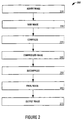
- FIG. 3 is a flow diagram illustrating a JPEG Part-3 compliant encoder that practices image compression artifact reduction according to the present invention. As such, encoder 300 is suitable for use in the apparatus of Figure 2.
- the encoder 300 computes the QScale value for each block based on a perceptual classification performed in the spatial domain.
- the QScale value is then used to obtain the quantization table for the given block.
- FIG. 4 is a flow chart illustrating a block classification procedure 400 suitable for use in the encoder of Figure 3.
- Q smooth , Q edge and Q texture are look-up tables with 32 entries and a , B , R , T flat , T high , T zero , S flat , S synthetic and S high_texture are constants.
- the classification employs computation of the following quantities for each 8 x 8 luminance block:
- classification begins by first examining the number of zero differences along rows and columns as computed in Equation 3 above. As depicted in 420, if this value exceeds a threshold the block is considered a synthetic block. For natural images, the presence of noise typically ensures that a majority of adjacent pixels (along rows or columns) do not have identical values. If the block is not synthetic then classification proceeds by examining the sum of the absolute differences taken along rows and columns ( Sad ), computed as in Equation 2 above. As depicted in 430, if the Sad value for a block is less than a threshold T flat the block is considered a Flat block. As depicted in 440, if Sad is larger than threshold T high_texture , the block is considered High Texture.
- Sad lies between T flat and T high_texture . If Sad lies between T flat and T high_texture , then the algorithm compares Sad with the Absolute sum of differences ( Asd ) as computed in Equation 1 above. As depicted in 450, if Asd is much smaller than Sad then the block is classified as a texture block. In a texture block, differences will oscillate in sign and their sum taken with and without signs will differ greatly.
- the block is not classified as a texture block then the value of the Maximum absolute difference ( Mad ) computed as in Equation 4 above is compared to Sad . If the block is an edge block, it will have only a few large differences and the Mad value will contribute significantly to Sad . Hence, as depicted in 460, if Mad is larger than a fixed percentage of Sad , the block is deemed an edge block. Otherwise, if this is not the case then the block is considered a smooth block, as depicted in 470.
- step 480 if the difference between the new QScale value and the QScale value for the previous block does not exceed threshold R , the QScale value is reset to that of the previous block.
- the final step 480 is an optional step that eliminates the additional overhead introduced to signal a change of QScale value in the case where there is a trivial change.
- the QScale value is computed by means of look up table designed for each class.
- the Sad value for the block is used to index the look-up table.
- the look-up tables were designed experimentally for each class, by determining the finest quantization levels that resulted in visible artifacts in blocks of different classification and at different activity levels.
Landscapes
- Engineering & Computer Science (AREA)
- Multimedia (AREA)
- Signal Processing (AREA)
- Compression Of Band Width Or Redundancy In Fax (AREA)
- Compression Or Coding Systems Of Tv Signals (AREA)
Applications Claiming Priority (2)
| Application Number | Priority Date | Filing Date | Title |
|---|---|---|---|
| US09/119,860 US20010043754A1 (en) | 1998-07-21 | 1998-07-21 | Variable quantization compression for improved perceptual quality |
| US119860 | 1998-07-21 |
Publications (2)
| Publication Number | Publication Date |
|---|---|
| EP0974932A2 true EP0974932A2 (de) | 2000-01-26 |
| EP0974932A3 EP0974932A3 (de) | 2001-02-07 |
Family
ID=22386819
Family Applications (1)
| Application Number | Title | Priority Date | Filing Date |
|---|---|---|---|
| EP99304700A Withdrawn EP0974932A3 (de) | 1998-07-21 | 1999-06-16 | Adaptive Videokomprimierung |
Country Status (3)
| Country | Link |
|---|---|
| US (1) | US20010043754A1 (de) |
| EP (1) | EP0974932A3 (de) |
| JP (1) | JP2000059782A (de) |
Cited By (3)
| Publication number | Priority date | Publication date | Assignee | Title |
|---|---|---|---|---|
| EP1139290A3 (de) * | 2000-03-30 | 2007-10-10 | Canon Kabushiki Kaisha | Bildverarbeitungsvorrichtung und -verfahren |
| WO2010005360A1 (en) * | 2008-07-08 | 2010-01-14 | Scalado Ab | Method for compressing images and a format for compressed images |
| CN113378981A (zh) * | 2021-07-02 | 2021-09-10 | 湖南大学 | 基于域适应的噪音场景图像分类方法及系统 |
Families Citing this family (8)
| Publication number | Priority date | Publication date | Assignee | Title |
|---|---|---|---|---|
| US7430330B2 (en) * | 2001-01-16 | 2008-09-30 | Hamilton Chris H | Method and apparatus for optimizing a JPEG image using regionally variable compression levels |
| US20020131645A1 (en) * | 2001-01-16 | 2002-09-19 | Packeteer Incorporated | Method and apparatus for optimizing a JPEG image using regionally variable compression levels |
| US7397953B2 (en) * | 2001-07-24 | 2008-07-08 | Hewlett-Packard Development Company, L.P. | Image block classification based on entropy of differences |
| US6987889B1 (en) * | 2001-08-10 | 2006-01-17 | Polycom, Inc. | System and method for dynamic perceptual coding of macroblocks in a video frame |
| US7302107B2 (en) * | 2003-12-23 | 2007-11-27 | Lexmark International, Inc. | JPEG encoding for document images using pixel classification |
| KR20070046852A (ko) * | 2004-08-13 | 2007-05-03 | 코닌클리케 필립스 일렉트로닉스 엔.브이. | 혼합된 그래픽 및 비디오 소스의 압축을 위한 시스템 및방법 |
| US7574055B2 (en) * | 2004-09-07 | 2009-08-11 | Lexmark International, Inc. | Encoding documents using pixel classification-based preprocessing and JPEG encoding |
| KR100980354B1 (ko) | 2006-05-17 | 2010-09-06 | 후지쯔 가부시끼가이샤 | 화상 압축 장치, 압축 방법 및 프로그램을 기록한 기록매체 및 화상 복원 장치, 복원 방법 및 프로그램을 기록한 기록 매체 |
Family Cites Families (1)
| Publication number | Priority date | Publication date | Assignee | Title |
|---|---|---|---|---|
| US5128757A (en) * | 1990-06-18 | 1992-07-07 | Zenith Electronics Corporation | Video transmission system using adaptive sub-band coding |
-
1998
- 1998-07-21 US US09/119,860 patent/US20010043754A1/en not_active Abandoned
-
1999
- 1999-06-16 EP EP99304700A patent/EP0974932A3/de not_active Withdrawn
- 1999-07-13 JP JP11199054A patent/JP2000059782A/ja active Pending
Cited By (5)
| Publication number | Priority date | Publication date | Assignee | Title |
|---|---|---|---|---|
| EP1139290A3 (de) * | 2000-03-30 | 2007-10-10 | Canon Kabushiki Kaisha | Bildverarbeitungsvorrichtung und -verfahren |
| WO2010005360A1 (en) * | 2008-07-08 | 2010-01-14 | Scalado Ab | Method for compressing images and a format for compressed images |
| US8600181B2 (en) | 2008-07-08 | 2013-12-03 | Mobile Imaging In Sweden Ab | Method for compressing images and a format for compressed images |
| CN113378981A (zh) * | 2021-07-02 | 2021-09-10 | 湖南大学 | 基于域适应的噪音场景图像分类方法及系统 |
| CN113378981B (zh) * | 2021-07-02 | 2022-05-13 | 湖南大学 | 基于域适应的噪音场景图像分类方法及系统 |
Also Published As
| Publication number | Publication date |
|---|---|
| US20010043754A1 (en) | 2001-11-22 |
| JP2000059782A (ja) | 2000-02-25 |
| EP0974932A3 (de) | 2001-02-07 |
Similar Documents
| Publication | Publication Date | Title |
|---|---|---|
| US6845180B2 (en) | Predicting ringing artifacts in digital images | |
| US6259823B1 (en) | Signal adaptive filtering method and signal adaptive filter for reducing blocking effect and ringing noise | |
| CN1186942C (zh) | 基于方差的自适应块大小dct图像压缩 | |
| JP5107495B2 (ja) | 品質ベースのイメージ圧縮 | |
| US6246719B1 (en) | Temporal tile staggering for block based video compression | |
| JP4870743B2 (ja) | デジタルイメージに対する選択的なクロミナンスデシメーション | |
| KR101437182B1 (ko) | Dc 천이 아티팩트에 대한 양자화 조정 | |
| KR101323066B1 (ko) | 텍스처 레벨에 기반한 양자화 조정 | |
| Kaur et al. | A review of image compression techniques | |
| US20050100235A1 (en) | System and method for classifying and filtering pixels | |
| US20030007698A1 (en) | Configurable pattern optimizer | |
| JPH10327334A (ja) | リンギングノイズの減少のための信号適応フィルタリング方法及び信号適応フィルター | |
| JP2006157910A (ja) | ブロッキング効果を除去するためのフィルタリング方法及びその装置 | |
| AU2002315160A1 (en) | Configurable pattern optimizer | |
| WO1991018479A1 (en) | Block adaptive linear predictive coding with adaptive gain and bias | |
| JP4391641B2 (ja) | 画像が圧縮されているかどうかを検出する方法 | |
| US20010043754A1 (en) | Variable quantization compression for improved perceptual quality | |
| US20020191695A1 (en) | Interframe encoding method and apparatus | |
| JP3105335B2 (ja) | 画像の直交変換符号化による圧縮・伸張方法 | |
| Xia et al. | Visual sensitivity-based low-bit-rate image compression algorithm | |
| KR20020055864A (ko) | 칼라 정지영상의 부호화 및 복호화 방법 | |
| Memon et al. | Method for variable quantization in JPEG for improved perceptual quality | |
| Farvardin et al. | Adaptive DCT coding of images using entropy-constrained trellis coded quantization | |
| JPH0974561A (ja) | 適応領域分割画像符号化方式 | |
| Huang et al. | Segmentation-based hybrid coding using luminance masking |
Legal Events
| Date | Code | Title | Description |
|---|---|---|---|
| PUAI | Public reference made under article 153(3) epc to a published international application that has entered the european phase |
Free format text: ORIGINAL CODE: 0009012 |
|
| AK | Designated contracting states |
Kind code of ref document: A2 Designated state(s): DE FR GB |
|
| AX | Request for extension of the european patent |
Free format text: AL;LT;LV;MK;RO;SI |
|
| RIN1 | Information on inventor provided before grant (corrected) |
Inventor name: TRETTEN, DANIEL R. Inventor name: MEMON, NASIR |
|
| PUAL | Search report despatched |
Free format text: ORIGINAL CODE: 0009013 |
|
| AK | Designated contracting states |
Kind code of ref document: A3 Designated state(s): AT BE CH CY DE DK ES FI FR GB GR IE IT LI LU MC NL PT SE |
|
| AX | Request for extension of the european patent |
Free format text: AL;LT;LV;MK;RO;SI |
|
| RAP1 | Party data changed (applicant data changed or rights of an application transferred) |
Owner name: HEWLETT-PACKARD COMPANY, A DELAWARE CORPORATION |
|
| 17P | Request for examination filed |
Effective date: 20010702 |
|
| AKX | Designation fees paid |
Free format text: DE FR GB |
|
| 17Q | First examination report despatched |
Effective date: 20030915 |
|
| STAA | Information on the status of an ep patent application or granted ep patent |
Free format text: STATUS: THE APPLICATION IS DEEMED TO BE WITHDRAWN |
|
| 18D | Application deemed to be withdrawn |
Effective date: 20040326 |