EP0976702B1 - Verfahren zur inhibierung der polymerisierung von vinylverbindungen - Google Patents
Verfahren zur inhibierung der polymerisierung von vinylverbindungen Download PDFInfo
- Publication number
- EP0976702B1 EP0976702B1 EP99114625A EP99114625A EP0976702B1 EP 0976702 B1 EP0976702 B1 EP 0976702B1 EP 99114625 A EP99114625 A EP 99114625A EP 99114625 A EP99114625 A EP 99114625A EP 0976702 B1 EP0976702 B1 EP 0976702B1
- Authority
- EP
- European Patent Office
- Prior art keywords
- weight
- water
- compound
- acrylic acid
- oxyl
- Prior art date
- Legal status (The legal status is an assumption and is not a legal conclusion. Google has not performed a legal analysis and makes no representation as to the accuracy of the status listed.)
- Expired - Lifetime
Links
- 238000000034 method Methods 0.000 title claims abstract description 95
- 238000006116 polymerization reaction Methods 0.000 title claims abstract description 93
- -1 vinyl compound Chemical class 0.000 title claims abstract description 83
- 229920002554 vinyl polymer Polymers 0.000 title claims abstract description 64
- 230000002401 inhibitory effect Effects 0.000 title claims abstract description 43
- XLYOFNOQVPJJNP-UHFFFAOYSA-N water Substances O XLYOFNOQVPJJNP-UHFFFAOYSA-N 0.000 claims abstract description 96
- 150000001875 compounds Chemical class 0.000 claims abstract description 77
- CERQOIWHTDAKMF-UHFFFAOYSA-N Methacrylic acid Chemical compound CC(=C)C(O)=O CERQOIWHTDAKMF-UHFFFAOYSA-N 0.000 claims abstract description 25
- 230000002194 synthesizing effect Effects 0.000 claims abstract description 6
- 239000000203 mixture Substances 0.000 claims description 4
- CBOIHMRHGLHBPB-UHFFFAOYSA-N hydroxymethyl Chemical compound O[CH2] CBOIHMRHGLHBPB-UHFFFAOYSA-N 0.000 claims description 3
- 238000004519 manufacturing process Methods 0.000 abstract description 14
- 150000002148 esters Chemical class 0.000 abstract description 12
- NIXOWILDQLNWCW-UHFFFAOYSA-N 2-Propenoic acid Natural products OC(=O)C=C NIXOWILDQLNWCW-UHFFFAOYSA-N 0.000 description 91
- SMZOUWXMTYCWNB-UHFFFAOYSA-N 2-(2-methoxy-5-methylphenyl)ethanamine Chemical compound COC1=CC=C(C)C=C1CCN SMZOUWXMTYCWNB-UHFFFAOYSA-N 0.000 description 88
- YXFVVABEGXRONW-UHFFFAOYSA-N Toluene Chemical compound CC1=CC=CC=C1 YXFVVABEGXRONW-UHFFFAOYSA-N 0.000 description 36
- 239000007864 aqueous solution Substances 0.000 description 24
- 239000003112 inhibitor Substances 0.000 description 20
- 239000007788 liquid Substances 0.000 description 20
- 238000004821 distillation Methods 0.000 description 15
- 238000010992 reflux Methods 0.000 description 15
- 239000007789 gas Substances 0.000 description 14
- 239000002904 solvent Substances 0.000 description 12
- 125000000391 vinyl group Chemical group [H]C([*])=C([H])[H] 0.000 description 12
- 230000000977 initiatory effect Effects 0.000 description 11
- 229920000642 polymer Polymers 0.000 description 11
- 239000000243 solution Substances 0.000 description 11
- QTBSBXVTEAMEQO-UHFFFAOYSA-N Acetic acid Chemical compound CC(O)=O QTBSBXVTEAMEQO-UHFFFAOYSA-N 0.000 description 9
- MYMOFIZGZYHOMD-UHFFFAOYSA-N Dioxygen Chemical compound O=O MYMOFIZGZYHOMD-UHFFFAOYSA-N 0.000 description 9
- 229910001882 dioxygen Inorganic materials 0.000 description 9
- 230000000694 effects Effects 0.000 description 9
- UZFMOKQJFYMBGY-UHFFFAOYSA-N 4-hydroxy-TEMPO Chemical group CC1(C)CC(O)CC(C)(C)N1[O] UZFMOKQJFYMBGY-UHFFFAOYSA-N 0.000 description 8
- QIGBRXMKCJKVMJ-UHFFFAOYSA-N Hydroquinone Chemical compound OC1=CC=C(O)C=C1 QIGBRXMKCJKVMJ-UHFFFAOYSA-N 0.000 description 8
- NTIZESTWPVYFNL-UHFFFAOYSA-N Methyl isobutyl ketone Chemical compound CC(C)CC(C)=O NTIZESTWPVYFNL-UHFFFAOYSA-N 0.000 description 8
- UIHCLUNTQKBZGK-UHFFFAOYSA-N Methyl isobutyl ketone Natural products CCC(C)C(C)=O UIHCLUNTQKBZGK-UHFFFAOYSA-N 0.000 description 8
- 239000003795 chemical substances by application Substances 0.000 description 8
- 238000009835 boiling Methods 0.000 description 6
- 230000005764 inhibitory process Effects 0.000 description 6
- 239000002994 raw material Substances 0.000 description 6
- 239000011541 reaction mixture Substances 0.000 description 6
- 239000000126 substance Substances 0.000 description 6
- VVQNEPGJFQJSBK-UHFFFAOYSA-N Methyl methacrylate Chemical compound COC(=O)C(C)=C VVQNEPGJFQJSBK-UHFFFAOYSA-N 0.000 description 5
- 238000007254 oxidation reaction Methods 0.000 description 5
- WSGDRFHJFJRSFY-UHFFFAOYSA-N 4-oxo-TEMPO Chemical compound CC1(C)CC(=O)CC(C)(C)N1[O] WSGDRFHJFJRSFY-UHFFFAOYSA-N 0.000 description 4
- HGINCPLSRVDWNT-UHFFFAOYSA-N Acrolein Chemical compound C=CC=O HGINCPLSRVDWNT-UHFFFAOYSA-N 0.000 description 4
- 230000000052 comparative effect Effects 0.000 description 4
- 239000012046 mixed solvent Substances 0.000 description 4
- 230000003647 oxidation Effects 0.000 description 4
- 229950000688 phenothiazine Drugs 0.000 description 4
- QQONPFPTGQHPMA-UHFFFAOYSA-N propylene Natural products CC=C QQONPFPTGQHPMA-UHFFFAOYSA-N 0.000 description 4
- 125000004805 propylene group Chemical group [H]C([H])([H])C([H])([*:1])C([H])([H])[*:2] 0.000 description 4
- 230000015572 biosynthetic process Effects 0.000 description 3
- 230000003197 catalytic effect Effects 0.000 description 3
- 230000007423 decrease Effects 0.000 description 3
- 239000012535 impurity Substances 0.000 description 3
- 239000000047 product Substances 0.000 description 3
- 238000000746 purification Methods 0.000 description 3
- 238000011084 recovery Methods 0.000 description 3
- 230000006641 stabilisation Effects 0.000 description 3
- 238000011105 stabilization Methods 0.000 description 3
- 238000003786 synthesis reaction Methods 0.000 description 3
- WJFKNYWRSNBZNX-UHFFFAOYSA-N 10H-phenothiazine Chemical compound C1=CC=C2NC3=CC=CC=C3SC2=C1 WJFKNYWRSNBZNX-UHFFFAOYSA-N 0.000 description 2
- BAPJBEWLBFYGME-UHFFFAOYSA-N Methyl acrylate Chemical compound COC(=O)C=C BAPJBEWLBFYGME-UHFFFAOYSA-N 0.000 description 2
- QYTDEUPAUMOIOP-UHFFFAOYSA-N TEMPO Chemical group CC1(C)CCCC(C)(C)N1[O] QYTDEUPAUMOIOP-UHFFFAOYSA-N 0.000 description 2
- QVGXLLKOCUKJST-UHFFFAOYSA-N atomic oxygen Chemical compound [O] QVGXLLKOCUKJST-UHFFFAOYSA-N 0.000 description 2
- ORTQZVOHEJQUHG-UHFFFAOYSA-L copper(II) chloride Chemical compound Cl[Cu]Cl ORTQZVOHEJQUHG-UHFFFAOYSA-L 0.000 description 2
- 230000006698 induction Effects 0.000 description 2
- 229910052760 oxygen Inorganic materials 0.000 description 2
- 239000001301 oxygen Substances 0.000 description 2
- 230000002035 prolonged effect Effects 0.000 description 2
- 239000012495 reaction gas Substances 0.000 description 2
- CBCKQZAAMUWICA-UHFFFAOYSA-N 1,4-phenylenediamine Chemical compound NC1=CC=C(N)C=C1 CBCKQZAAMUWICA-UHFFFAOYSA-N 0.000 description 1
- RKMGAJGJIURJSJ-UHFFFAOYSA-N 2,2,6,6-tetramethylpiperidine Chemical class CC1(C)CCCC(C)(C)N1 RKMGAJGJIURJSJ-UHFFFAOYSA-N 0.000 description 1
- GOXQRTZXKQZDDN-UHFFFAOYSA-N 2-Ethylhexyl acrylate Chemical compound CCCCC(CC)COC(=O)C=C GOXQRTZXKQZDDN-UHFFFAOYSA-N 0.000 description 1
- OMIGHNLMNHATMP-UHFFFAOYSA-N 2-hydroxyethyl prop-2-enoate Chemical compound OCCOC(=O)C=C OMIGHNLMNHATMP-UHFFFAOYSA-N 0.000 description 1
- VHSHLMUCYSAUQU-UHFFFAOYSA-N 2-hydroxypropyl methacrylate Chemical compound CC(O)COC(=O)C(C)=C VHSHLMUCYSAUQU-UHFFFAOYSA-N 0.000 description 1
- GWZMWHWAWHPNHN-UHFFFAOYSA-N 2-hydroxypropyl prop-2-enoate Chemical compound CC(O)COC(=O)C=C GWZMWHWAWHPNHN-UHFFFAOYSA-N 0.000 description 1
- MTJGVAJYTOXFJH-UHFFFAOYSA-N 3-aminonaphthalene-1,5-disulfonic acid Chemical compound C1=CC=C(S(O)(=O)=O)C2=CC(N)=CC(S(O)(=O)=O)=C21 MTJGVAJYTOXFJH-UHFFFAOYSA-N 0.000 description 1
- NLHHRLWOUZZQLW-UHFFFAOYSA-N Acrylonitrile Chemical compound C=CC#N NLHHRLWOUZZQLW-UHFFFAOYSA-N 0.000 description 1
- GZSWADFIMUCBQM-UHFFFAOYSA-N CCCCC([S-])=[S+]CCCC.CCCCC([S-])=[S+]CCCC.[Cu+2] Chemical compound CCCCC([S-])=[S+]CCCC.CCCCC([S-])=[S+]CCCC.[Cu+2] GZSWADFIMUCBQM-UHFFFAOYSA-N 0.000 description 1
- RYGMFSIKBFXOCR-UHFFFAOYSA-N Copper Chemical compound [Cu] RYGMFSIKBFXOCR-UHFFFAOYSA-N 0.000 description 1
- JIGUQPWFLRLWPJ-UHFFFAOYSA-N Ethyl acrylate Chemical compound CCOC(=O)C=C JIGUQPWFLRLWPJ-UHFFFAOYSA-N 0.000 description 1
- WOBHKFSMXKNTIM-UHFFFAOYSA-N Hydroxyethyl methacrylate Chemical compound CC(=C)C(=O)OCCO WOBHKFSMXKNTIM-UHFFFAOYSA-N 0.000 description 1
- VQTUBCCKSQIDNK-UHFFFAOYSA-N Isobutene Chemical group CC(C)=C VQTUBCCKSQIDNK-UHFFFAOYSA-N 0.000 description 1
- STNJBCKSHOAVAJ-UHFFFAOYSA-N Methacrolein Chemical compound CC(=C)C=O STNJBCKSHOAVAJ-UHFFFAOYSA-N 0.000 description 1
- 150000001299 aldehydes Chemical class 0.000 description 1
- ICQFAQGXJAVDED-UHFFFAOYSA-N benzene-1,4-diol;4-(methylamino)phenol Chemical compound OC1=CC=C(O)C=C1.CNC1=CC=C(O)C=C1.CNC1=CC=C(O)C=C1 ICQFAQGXJAVDED-UHFFFAOYSA-N 0.000 description 1
- 230000005587 bubbling Effects 0.000 description 1
- CQEYYJKEWSMYFG-UHFFFAOYSA-N butyl acrylate Chemical compound CCCCOC(=O)C=C CQEYYJKEWSMYFG-UHFFFAOYSA-N 0.000 description 1
- 239000006227 byproduct Substances 0.000 description 1
- 239000003054 catalyst Substances 0.000 description 1
- 238000006243 chemical reaction Methods 0.000 description 1
- 229910052802 copper Inorganic materials 0.000 description 1
- 239000010949 copper Substances 0.000 description 1
- 229960003280 cupric chloride Drugs 0.000 description 1
- 238000000354 decomposition reaction Methods 0.000 description 1
- 230000001934 delay Effects 0.000 description 1
- 238000004090 dissolution Methods 0.000 description 1
- 238000005516 engineering process Methods 0.000 description 1
- 230000002708 enhancing effect Effects 0.000 description 1
- 229960004337 hydroquinone Drugs 0.000 description 1
- 229940071125 manganese acetate Drugs 0.000 description 1
- UOGMEBQRZBEZQT-UHFFFAOYSA-L manganese(2+);diacetate Chemical compound [Mn+2].CC([O-])=O.CC([O-])=O UOGMEBQRZBEZQT-UHFFFAOYSA-L 0.000 description 1
- 125000005395 methacrylic acid group Chemical group 0.000 description 1
- 238000002156 mixing Methods 0.000 description 1
- 238000012986 modification Methods 0.000 description 1
- 230000004048 modification Effects 0.000 description 1
- 150000002832 nitroso derivatives Chemical class 0.000 description 1
- 150000007524 organic acids Chemical class 0.000 description 1
- 235000005985 organic acids Nutrition 0.000 description 1
- 239000003960 organic solvent Substances 0.000 description 1
- 230000001590 oxidative effect Effects 0.000 description 1
- PNJWIWWMYCMZRO-UHFFFAOYSA-N pent‐4‐en‐2‐one Natural products CC(=O)CC=C PNJWIWWMYCMZRO-UHFFFAOYSA-N 0.000 description 1
- 150000002989 phenols Chemical class 0.000 description 1
- OJMIONKXNSYLSR-UHFFFAOYSA-N phosphorous acid Chemical compound OP(O)O OJMIONKXNSYLSR-UHFFFAOYSA-N 0.000 description 1
- 229910052698 phosphorus Inorganic materials 0.000 description 1
- 239000011574 phosphorus Substances 0.000 description 1
- 230000000379 polymerizing effect Effects 0.000 description 1
- 238000001556 precipitation Methods 0.000 description 1
- NHARPDSAXCBDDR-UHFFFAOYSA-N propyl 2-methylprop-2-enoate Chemical compound CCCOC(=O)C(C)=C NHARPDSAXCBDDR-UHFFFAOYSA-N 0.000 description 1
- 238000007670 refining Methods 0.000 description 1
- 230000001105 regulatory effect Effects 0.000 description 1
- 229940116351 sebacate Drugs 0.000 description 1
- CXMXRPHRNRROMY-UHFFFAOYSA-L sebacate(2-) Chemical compound [O-]C(=O)CCCCCCCCC([O-])=O CXMXRPHRNRROMY-UHFFFAOYSA-L 0.000 description 1
- 230000000087 stabilizing effect Effects 0.000 description 1
- 238000010186 staining Methods 0.000 description 1
Classifications
-
- C—CHEMISTRY; METALLURGY
- C08—ORGANIC MACROMOLECULAR COMPOUNDS; THEIR PREPARATION OR CHEMICAL WORKING-UP; COMPOSITIONS BASED THEREON
- C08F—MACROMOLECULAR COMPOUNDS OBTAINED BY REACTIONS ONLY INVOLVING CARBON-TO-CARBON UNSATURATED BONDS
- C08F2/00—Processes of polymerisation
- C08F2/38—Polymerisation using regulators, e.g. chain terminating agents, e.g. telomerisation
-
- C—CHEMISTRY; METALLURGY
- C07—ORGANIC CHEMISTRY
- C07B—GENERAL METHODS OF ORGANIC CHEMISTRY; APPARATUS THEREFOR
- C07B63/00—Purification; Separation; Stabilisation; Use of additives
- C07B63/04—Use of additives
-
- C—CHEMISTRY; METALLURGY
- C07—ORGANIC CHEMISTRY
- C07C—ACYCLIC OR CARBOCYCLIC COMPOUNDS
- C07C51/00—Preparation of carboxylic acids or their salts, halides or anhydrides
- C07C51/42—Separation; Purification; Stabilisation; Use of additives
- C07C51/50—Use of additives, e.g. for stabilisation
Definitions
- the present invention relates to a method for inhibiting polymerization of a vinyl compound. More particularly, the present invention relates to a method for effectively inhibiting the polymerization of (meth)acrylic acid or esters of (meth)acrylic acid during their storage, transportation and production.
- Vinyl compounds such as (meth)acrylic acid (i.e., acrylic acid or methacrylic acid), esters of (meth)acrylic acid, and acrylonitrile are prone to be naturally polymerized by light or heat due to the vinyl bond they have. Therefore, there have been proposed to use various polymerization inhibitors in order to inhibit polymerization of (meth)acrylic acid or esters of (meth)acrylic acid during their storage, transportation or production process.
- Japanese Examined Patent Publication No. 4-14121 discloses a method for inhibiting polymerization of vinyl compounds using an N-oxyl compound such as bis-(2,2,6,6-tetramethyl-4-piperidino oxyl) sebacate.
- the inventors of the present application have studied the stability of a vinyl compound during storage or transportation after addition of the above-mentioned N-oxyl compound, and found that the concentration of the N-oxyl compound gradually decreases in contact with the vinyl compound, and it is difficult to prevent polymerization of vinyl compounds for a prolonged time.
- Japanese Examined Patent Publication No. 45-1054 discloses a method for inhibiting polymerization of acrylic acid using an N-oxyl compound such as tertiary-butyl nitroxide and 4-hydroxy-2,2,6,6-tetramethyl-4-piperidino oxyl alone, gives better polymerization inhibiting effect than that of the conventionally known hydroquinone, phenothiazine, and cupric chloride etc.
- Japanese Examined Patent Publication No. 54-3853 discloses a method for inhibiting the polymerization using 4-hydroxy-2,2,6,6-tetramethylpiperidino oxyl or 2,2,6,6-tetramethylpiperidino oxyl in the production process of methacrylic acid from methacrolein using a gas containing oxygen in an organic solvent.
- Japanese Examined Patent Publication No. 58-46496 discloses a method for inhibiting polymerization of (meth)acrylic acid or esters of (meth)acrylic acid, using 3-oxo-2,2,5,5-tetramethyl pyrolidino oxyl or 4-acetoxy-2,2,6,6-tetramethylpiperidino oxyl.
- Chinese Patent CN 1052847A discloses a method for inhibiting polymerization of acrylic acid and esters of acrylic acid, using 4-hydroxy-2,2,6,6-tetramethylpiperidino oxyl alone or used in combination with hydroquinone, which is shown to be higher than the effect of combined use of copper dibutyldithiocarboxylate and hydroquinone.
- Japanese Unexamined Patent Publication No. 6-345681 discloses a method for inhibiting polymerization of acrylic acid and esters of acrylic acid, using N-oxyl compounds such as 2,2,6,6-tetramethylpiperidino oxyl, and 4,4',4"-tris-(2,2,6,6-tetramethylpiperidino oxyl) phosphite in combination with phenol compounds such as hydroquinone, and phenothiazine compound.
- N-oxyl compounds such as 2,2,6,6-tetramethylpiperidino oxyl, and 4,4',4"-tris-(2,2,6,6-tetramethylpiperidino oxyl) phosphite
- phenol compounds such as hydroquinone, and phenothiazine compound.
- Japanese Unexamined Patent Publication No. 9-316026 discloses a method for inhibiting polymerization of acrylic acid and esters of acrylic acid during its production, particularly during distillation process, using an N-oxyl compound in combination with phosphorus compound.
- EP-A-0 685 447 discloses a method for inhibiting the polymerization of (meth)acrylic acid and esters thereof by using a N-oxyl compound in combination with at least one selected from manganese salt compounds, copper salt compounds, 2,2,6,6-tetramethylpiperidine compounds and nitroso compounds.
- EP-A-0 620 206 discloses a method for inhibiting polymerization of (meth)acrylic acid by using a polymerization inhibitor made up of a N-oxyl compound, a phenol compound and a phenothiazine compound.
- N-oxyl compounds according to the conventional polymerization inhibiting technology for example, to prevent polymerization during distillation of crude acrylic acid, an N-oxyl compound is dissolved in acrylic acid and the solution is . transferred to a distilling column by a pump.
- vinyl compounds such as (meth)acrylic acid and ester of (meth)acrylic acid
- a method for inhibiting polymerization of a vinyl compound during its storage and/or its transportation is characterized by the coexisting of:
- the presence of the N-oxyl compound can inhibit polymerization of the vinyl compound more effectively.
- a method for inhibiting polymerization of a vinyl compound comprises the steps of:
- the vinyl compound has a vinyl bond which is liable to cause polymerization.
- the N-oxyl compound includes any water soluble N-oxyl compounds.
- the present invention is directed to inhibition of polymerization of (meth)acrylic acid and esters of (meth)acrylic acid.
- Acrylic esters include methyl acrylate, ethyl acrylate, butyl acrylate, 2-ethylhexyl acrylate, 2-hydroxyethyl acrylate, 2-hydroxypropyl acrylate and the like.
- methacrylic esters include methyl methacrylate, propyl methacrylate, 2-hydroxyethyl methacrylate, 2-hydroxypropyl methacrylate and the like.
- 2,2,6,6-tetramethylpiperidino oxyls include 4-hydroxy-2,2,6,6-tetramethylpiperidino oxyl, 4-oxo-2,2,6,6-tetramethylpiperidino oxyl, 4-carboxy-2,2,6,6-tetramethylpiperidino oxyl, and the like.
- preferably used are 4-hydroxy-2,2,6,6-tetramethylpiperidino oxyl, 4-oxo-2,2,6,6-tetramethylpiperidino oxyl, and the like, and particularly preferably used is 4-hydroxy-2,2,6,6-tetramethylpiperidino oxyl.
- These N-oxyl compounds may be used singly or at least two of these compounds may be used in combination. In this case, the mixing ratio may be appropriately decided.
- an N-oxyl compound may be preferably added in an amount of 0.0005 parts by weight or more, more preferably 0.001 parts by weight or more, to 100 parts by weight of a vinyl compound in order to ensure sufficient stabilization effects.
- the amount may be preferably to set an upper limit up to 0.1 parts by weight, more preferably up to 0.03 parts by weight.
- the adding amount of water may be adjusted in accordance with the solubility of water in the vinyl compound. It may be, however, preferable to dissolve 0.01 parts by weight or more of water to 100 parts by weight of the vinyl compound, more preferably 0.02 parts by weight or more, more preferably 0.05 parts by weight or more. To assure the inhibiting effect, on the other hand, the upper limit amount of water is set at 2 parts by weight. If the adding amount of water is less than 0.01 parts by weight, it is difficult to regulate the concentration of the N-oxyl compound to a specified value, resulting in decomposition of the N-oxyl compound and consequently insufficient inhibition effect. While too much water will lower the stabilization effect thereof, as water promotes the polymerization of the vinyl compound, therefore the amount of water added shall be up to 2 parts by weight.
- N-oxyl compound and water to a vinyl compound is not limited to a fixed sequence, but may be changed desirably. However, it may be preferable that an N-oxyl compound is firstly dissolved in water and then the resulting N-oxyl compound aqueous solution is added to a vinyl compound. Also, it may be possible to add an N-oxyl compound into a mixture of a vinyl compound and water. In this way, there coexist three components, i.e., N-oxyl compound, vinyl compound and water. It could be presumed that this coexistence of the three components exerts the polymerization inhibiting effect.
- the present invention may be applicable to vinyl compounds which contain impurities as by-product in the production process, or impurities contained in the starting raw materials of a vinyl compound.
- impurities e.g., organic acids such as acetic acid, aldehydes such as acrolein, for example, the inhibiting effect can be attainable.
- polymerization inhibitors such as phenothiazine, methoquinone, copper dialkyldithiocarbamate, manganese acetate, and p-phenylenediamine, in addition to the inventive polymerization inhibitor.
- the decrease in the concentration of the N-oxyl compound can be suppressed for a prolonged time.
- the coexistence of an N-oxyl compound and a specific amount of water in a vinyl compound delays the time for initiating polymerization more than the conventional inhibitors, thus inhibiting polymerization of a vinyl compound in the storage or transportation more effectively.
- a vinyl compound in a process of recovery, purification and synthesis is kept from polymerizing by dissolving an N-oxyl compound in water, and adding the solution into the vinyl compound.
- acrylic acid is produced from a reaction gas obtained by two stage catalytic oxidation reaction of propylene by the processes of: (1) collecting an acrylic acid in the form of an aqueous solution by making a reaction mixture gas containing acrylic acid in contact with water; (2) distilling the acrylic acid aqueous solution in the presence of an azeotropic solvent and recovering crude acrylic acid; and (3) purifying the crude acrylic acid.
- the purifying process (3) includes distillation of separating substances having low boiling points such as acetic acid, distillation of separating substances having low boiling points such as unreacted acrolein, and distillation of separating substances having high boiling points.
- the present invention is applicable for inhibition of polymerization of acrylic acid in any of the above-mentioned processes, i.e., (1) collecting process, (2) recovering process, and (3) purifying process.
- an aqueous solution of an N-oxyl compound is not limited to a particular manner, but may be carried out in a desired manner.
- the aqueous solution of N-oxyl compound may be directly introduced into a vinyl compound in each process.
- it may be introduced into a supply line or a refluxing line.
- An aqueous solution of an N-oxyl compound may be added only in the collecting process (1), or in each of the processes of collecting process (1), recovering process (2) and purifying process (3) (including various distillations). It may be preferable to add the aqueous solution in each process or each distillation stage.
- the lower limit of adding amount of N-oxyl compound may be set at 0.0005 parts by weight, more preferably 0.001 parts by weight, more preferably 0.002 parts by weight to 100 parts by weight of a vinyl compound in each process.
- the upper limit may be preferable to set at 0.1 parts by weight, more preferably 0.03 parts by weight, more preferably 0.02 parts by weight to 100 parts by weight of vinyl compound in each process.
- the adding amount of N-oxyl compound is less than 0.0005 parts by weight, the necessary polymerization inhibiting effect cannot be attained. In particular, if the operation temperature is more than 100°C, the inhibiting effect noticeably lowers. On the other hand, if an N-oxyl compound is added more than 0.1 parts by weight, the product of acrylic acid is liable to be stained.
- the amount of water in which an N-oxyl compound is dissolved may be changed in accordance with the kind and the amount of an N-oxyl compound used as well as the kind of process. However, it may be preferable to set the lower limit at 0.0005 parts by weight, more preferably 0.001 parts by weight, more preferably 0.002 parts by weight to 100 parts by weight of a vinyl compound in each process. If the amount of water is more than 10 parts by weight, on the other hand, the purity of the product of acrylic acid undesirably lowers. Accordingly, the upper limit for water may be set at 10 parts by weight, preferably 1 part by weight, more preferably 0.2 part by weight.
- the concentration of an N-oxyl compound in an N-oxyl compound aqueous solution may be regulated in accordance with the kind of N-oxyl compound or the allowable amount of water. However, it may be preferable to set the upper limit at around 80 percent of the saturation solubility of the N-oxyl compound in water at a normal temperature to prevent precipitation of the N-oxyl compound in a tank storing the N-oxyl compound aqueous solution.
- the lower limit of the concentration of a N-oxyl compound depends on the amount of the N-oxyl compound to be added or the characteristic performance of an adding apparatus. However, it may be preferable to set the lower limit at around 0.1 weight percent.
- the effect of inhibiting polymerization of a vinyl compound in the production process according to the present invention is not obtained simply because water coexists with the N-oxyl compound in each process or in each distillation stage.
- the use of water as a solvent for N-oxyl compound which means the N-oxyl compound is dissolved in water first and the aqueous solution is then added to the above-described process, is significant condition to exert the effect of inhibiting polymerization of a vinyl compound in the production process.
- the collecting process (1) water is introduced to collect an acrylic acid.
- the acrylic acid aqueous solution is introduced and distilled. Accordingly, water exists in each process location or tower.
- the case in which an N-oxyl compound is added in the form of an aqueous solution inhibits polymerization of acrylic acid more effectively than the case in which the N-oxyl compound is added in the form of an acrylic acid solution (see Example 5 and Comparative Example 2). Accordingly, it could be seen that the addition of an N-oxyl compound in the form of an aqueous solution, which is in accordance with a method of the present invention, enhances the polymerization inhibiting effect of N-oxyl compound.
- the amount of water may be 1 - 1000 times by weight that of an N-oxyl compound
- the amount of water in the purifying process (3), may be 1 - 200 times by weight that of an N-oxyl compound in a distillation stage for separating substances having a low boiling point, and it is 1 - 50 times by weight in a distillation stage for separating substances having a high boiling point.
- molecular oxygen may be used concurrently, thereby enhancing the inhibition of polymerization of a vinyl compounds.
- molecular oxygen may be supplied from the bottom of a stripper tower or reboiler in the form of gas. It may be preferable to supply molecular oxygen in an amount of 0.1 percent by volume or more with respect to the amount of evaporated vinyl compound. This is because of the fact that if it is less than 0.1 percent by volume, remarkable effect cannot be attainable.
- the upper limit of molecular oxygen to be supplied may be determined based on the operation performance of distilling equipment. However, a large amount of supply requires reconstruction of the equipment. Accordingly, it may be preferable to supply molecular oxygen in not more than 1.0 percent by volume.
- the present invention may be applicable to other vinyl compounds.
- production means the reaction process of a vinyl compound, and the above-mentioned processes (1) - (3). Further, such terms include a modification of the above-mentioned process and any additional distilling process for separating a substance having a specified boiling point and the like.
- acrylic acid these terms respectively correspond to an oxidation process of propylene, recovering, purifying and synthesizing processes of acrylic acid.
- methacrylic acid these terms respectively correspond to processes of separating, collecting, refining methacrylic acid from a reaction gas containing methacrylic acid obtained by catalytic gas phase oxidation of isobutylene.
- (meth)acrylic ester these terms respectively correspond to processes of esterifying and purifying in addition to the above-mentioned processes of (meth)acrylic acid.
- the concentration of 4H-TEMPO in acrylic acid was measured in a process similar to that of Example 1, except that the amount of water added was 0.03 parts by weight to 100 parts by weight of the acrylic acid. The results are as follows: About 60% of the initial concentration of 4H-TEMPO still remained after 2 hours and about 34% of the initial concentration of 4H-TEMPO still remained after 10 hours. Initial amount 300 ppm After 30 minutes 204 ppm After 2 hours 174 ppm After 10 hours 103 ppm
- the concentration of 4H-TEMPO in acrylic acid was measured in a process similar to that of Example 1, except that the amount of water added was 0.1 parts by weight to 100 parts by weight of the acrylic acid. The results are as follows: About 80% of the initial concentration of 4H-TEMPO still remained after 2 hours and About 60% of the initial concentration of 4H-TEMPO still remained after 10 hours. Initial amount 300 ppm After 30 minutes 275 ppm After 2 hours 243 ppm After 10 hours 180 ppm
- the concentration of 4H-TEMPO in acrylic acid was measured in a process similar to that of Example 1, except that the amount of water added was 0.005 parts by weight to 100 parts of the acrylic acid.
- the results are as follows: The concentration of 4H-TEMPO reduced to one third of the initial concentration after 2 hours and about 3% of the initial concentration of 4H-TEMPO remained after 10 hours.
- the induction time can be extended longer than before, and polymerization can be more effectively inhibited.
- Propylene was subjected to gas phase oxidation using a gas containing molecular oxygen in the presence of an oxidizing catalyst to give a reaction mixture gas comprising 0.68 kg/hr of acrylic acid, 0.02 kg/hr of acetic acid and 0.45 kg/hr of water.
- the reaction mixture gas was introduced to a gas collecting tower in which a cascade mini ring (inner diameter of 14 mm) was packed by a height of 6000 mm, a gas blow-off tube was provided at the top of the tower, a reaction mixture gas supply pipe at the lower part of the tower, and a tower bottom liquid extract pipe at the bottom of the tower, and the collection operation of the reaction mixture gas was carried out using water as an absorbing liquid.
- 4-hydroxy-2,2,6,6-tetramethylpiperidino oxyl aqueous solution was used as a polymerization inhibitor and an aqueous solution thereof was introduced at 0.02 kg/hr from the top of the tower.
- the amount of the polymerization inhibitor used was 0.003 parts by weight to 100 parts by weight of the acrylic acid and the amount of water used was 2.9 parts by weight to 100 parts by weight of the acrylic acid.
- the operation was carried out at the tower top temperature of 63°C, tower bottom temperature of 67°C and acrylic acid aqueous solution of 0.6 kg/hr was obtained through the bottom of the tower in the stationary state.
- the polymerization inhibition effect was confirmed by the viscosity of the liquid taken out through the bottom of the tower and the examination of the overhauled tower.
- the operation was carried out continuously under the above-mentioned conditions for about 20 days and always stable condition was obtained and no generation of a polymer was found at all when the collecting tower was examined after the operation was stopped.
- the collection operation was carried out in the same way as that used in Example 4 except that 4-hydroxy-2,2,6,6-tetramethylpiperidino oxyl was used as a polymerization inhibitor which was dissolved in acrylic acid and added.
- Acrylic acid aqueous solution was distilled using a packed tower having an outlet pipe, a refluxing liquid supply pipe and a polymerization inhibitor solution supply pipe at the top of the tower, a raw material supply pipe at the middle of the tower, and a kettle, a tower bottom liquid extract pipe and an oxygen supply pipe at the bottom of the tower.
- the acrylic acid aqueous solution was an acrylic acid aqueous solution containing 30% by weight of water which was obtained by contacting water with a reaction mixture gas obtained by catalytic gas phase oxidation of propylene.
- the acrylic acid aqueous solution was supplied to the above-mentioned packed tower at 100 ml/hr. Distillation was carried out using toluene as a refluxing liquid, under such conditions that tower top pressure of 190 mmHg, tower top temperature of 50°C, and tower bottom temperature of 100°C.
- a polymerization inhibitor of a given amount was added to and dissolved in a solvent as shown in Table 2, then the obtained polymerization inhibiting solution was added from the top of the tower into the packed tower and oxygen gas of 0.3% by volume based on the amount of the evaporated acrylic acid vapor was supplied to the bottom of the tower.
- the amount of the polymerization inhibitor added was based on the amount of the acrylic acid supplied to the packed tower.
- the composition of the liquid taken out from the bottom of the tower in the steady state comprised 97% by weight of acrylic acid, 0.02% by weight of water and 2.98% by weight of others. As the refluxing liquid, the distilled oil phase was recycled and used.
- Polymerization inhibitor (Note 1) Solvent used for dissolving the polymerization inhibitor (Note 2) Amount of produced polymer (g) Kind Amount (ppm) 1 4H-TEMPO 100 Water 0.9 2 Same as above 50 Water 1.7 3 Same as above 100 Refluxing liquid (toluene) 3.8 4 Same as above 100 Acrylic acid 5.8 5 4-Oxo-TEMPO 100 Water 0.8 6 Same as above 100 Refluxing liquid (toluene) 4.0 7 Same as above 100 Acrylic acid 6.1 (Note 1) The amount of polymerization inhibiting agent was based on weight to 100 parts by weight of acrylic acid. (Note 2) Each solvent was supplied in an amount of 0.82 parts by weight to 100 parts by weight of acrylic acid in the raw material.
- Table 2 The abbreviations used in Table 2 represent the following compounds. The same abbreviations are made in Tables 3, 4, and 5.
- 4H-TEMPO 4-hydroxy-2,2,6,6-tetramethylpiperidino oxyl
- 4-Oxo-TEMPO 4-oxo-2,2,6,6-tetramethylpiperidino oxyl.
- Polymerization inhibitor (Note 1) Solvent used for dissolving the polymerization inhibitor (Note 2) Amount of produced polymer (g) Kind Amount (ppm) 1 4H-TEMPO 100 Water 0.3 2 Same as above 50 Water 0.9 3 Same as above 100 Refluxing liquid (methyl isobutyl ketone + toluene) 2.4 4 Same as above 100 Acrylic acid 3.7 5 4-Oxo-TEMPO 100 Water 0.3 6 Same as above 100 Refluxing liquid (methyl isobutyl ketone + toluene) 2.9 7 Same as above 100 Acrylic acid 4.1 (Note 1) The amount of polymerization inhibiting agent was based on weight to 100 parts by weight of acrylic acid. (Note 2) Each solvent was supplied in an amount of 0.82 parts by weight to 100 parts by weight of acrylic acid in the raw material.
- Polymerization inhibitor (Note 1) Solvent used for dissolving the polymerization inhibitor (Note 2) Amount of produced polymer (g) Kind Amount (ppm) 1 4H-TEMPO 100 Water 0.2 2 Same as above 50 Water 0.7 3 Same as above 100 Refluxing liquid (methyl methacrylate + toluene) 2.1 4 Same as above 100 Acrylic acid 3.5 5 4-Oxo-TEMPO 100 Water 0.3 6 Same as above 100 Refluxing liquid (methyl methacrylate + toluene) 2.8 7 Same as above 100 Acrylic acid 4.5 (Note 1) The amount of polymerization inhibiting agent was based on weight to 100 parts by weight of acrylic acid. (Note 2) Each solvent was supplied in an amount of 0.82 parts by weight to 100 parts by weight of acrylic acid in the raw material.
- the induction time can be extended longer than before, and polymerization can be more effectively inhibited.
Landscapes
- Chemical & Material Sciences (AREA)
- Organic Chemistry (AREA)
- Engineering & Computer Science (AREA)
- Oil, Petroleum & Natural Gas (AREA)
- Health & Medical Sciences (AREA)
- Chemical Kinetics & Catalysis (AREA)
- Medicinal Chemistry (AREA)
- Polymers & Plastics (AREA)
- Organic Low-Molecular-Weight Compounds And Preparation Thereof (AREA)
- Polymerisation Methods In General (AREA)
- Hydrogenated Pyridines (AREA)
Claims (12)
- Verfahren zur Inhibierung der Polymerisation einer Vinylverbindung während ihrer Lagerung und/oder ihrem Transport, gekennzeichnet durch das Koexistieren von:i) der Vinylverbindung,ii) einer wasserlöslichen N-Oxylverbindung undiii) 0,01 bis 2 Gew.-Teile Wasser bezüglich 100 Gew.-Teile der Vinylverbindung.
- Verfahren nach Anspruch 1, wobei die wasserlösliche N-Oxylverbindung und das Wasser zu der Vinylverbindung hinzugefügt werden.
- Verfahren nach Anspruch 1, wobei das Wasser zu einem Gemisch der wasserlöslichen N-Oxylverbindung und der Vinylverbindung hinzugefügt wird.
- Verfahren nach Anspruch 1, wobei die wasserlösliche N-Oxylverbindung zu einem Gemisch des Wassers und der Vinylverbindung hinzugefügt wird.
- Verfahren nach einem der Ansprüche 1 bis 4, wobei die Vinylverbindung eine (Meth)acrylsäure ist.
- Verfahren nach einem der Ansprüche 1 bis 5, wobei die wasserlösliche N-Oxylverbindung in 0,0005 bis 0,1 Gew.-Teile auf 100 Gew.-Teile der Vinylverbindung hinzugefügt wird.
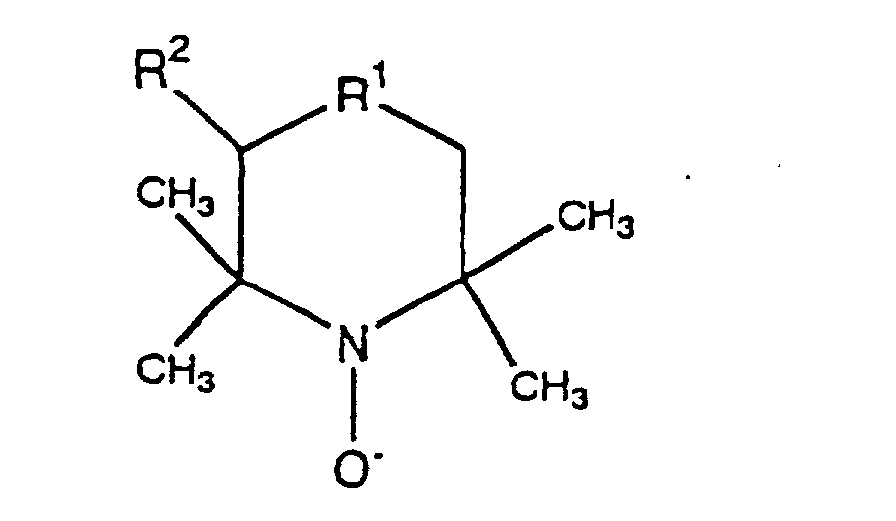
- Verfahren nach einem der Ansprüche 1 bis 6, wobei die N-Oxylverbindung eine oder mehrere Arten, ausgewählt aus der Gruppe, bestehend aus N-Oxylverbindungen, dargestellt durch die folgende allgemeine Formel, istworin R1 CHOH, CHCH2OH, CHCH2CH2OH, CHOCH2OH, CHOCH2CH2OH, CHCOOH oder C=O darstellt, R2 H oder CH2OH darstellt.

- Verfahren nach einem der Ansprüche 1 bis 7, wobei die wasserlösliche N-Oxylverbindung und Wasser zu einer Vinylverbindung im Verlauf der Lagerung und/oder des Transports zugefügt werden.
- Verfahren zur Inhibierung der Polymerisation einer Vinylverbindung, umfassend die Schritte:(i) des Auflösens einer N-Oxylverbindung in Wasser, wobei die Menge an Wasser 1 bis 1000 mal das Gewicht der N-Oxylverbindung ist, die Menge an Wasser 0,0005 bis 10 Gew.-Teile pro 100 Gew.-Teile der Vinylverbindung ist, und die Menge der N-Oxylverbindung 0,0005 bis 0,1 Gew.-Teile pro 100 Gew.-Teile der Vinylverbindung ist, und(ii) des Zugebens der Lösung zu einer Vinylverbindung in einem Verfahren des Gewinnens, Reinigens und/oder Synthetisierens der Vinylverbindung.
- Verfahren nach Anspruch 9, wobei die Vinylverbindung eine (Meth)acrylsäure ist.
- Verfahren nach Anspruch 9 oder 10, wobei die N-Oxylverbindung eine oder mehrere Arten, ausgewählt aus der Gruppe, bestehend aus N-Oxylverbindungen, dargestellt durch die folgende allgemeine Formel, istworin R1 CHOH, CHCH2OH, CHCH2CH2OH, CHOCH2OH, CHOCH2CH2OH, CHCOOH oder C=O darstellt, R2 H oder CH2OH darstellt.
- Verfahren nach einem der Ansprüche 9 bis 11, wobei die Lösung in einer Sammelphase, einer Destillationsphase und/oder einer Reinigungsphase des Verfahrens des Gewinnens, Reinigens und/oder Synthetisierens der Vinylverbindung hinzugefügt wird.
Applications Claiming Priority (4)
| Application Number | Priority Date | Filing Date | Title |
|---|---|---|---|
| JP21050598 | 1998-07-27 | ||
| JP21050698 | 1998-07-27 | ||
| JP21050598 | 1998-07-27 | ||
| JP21050698 | 1998-07-27 |
Publications (2)
| Publication Number | Publication Date |
|---|---|
| EP0976702A1 EP0976702A1 (de) | 2000-02-02 |
| EP0976702B1 true EP0976702B1 (de) | 2003-10-22 |
Family
ID=26518095
Family Applications (1)
| Application Number | Title | Priority Date | Filing Date |
|---|---|---|---|
| EP99114625A Expired - Lifetime EP0976702B1 (de) | 1998-07-27 | 1999-07-26 | Verfahren zur inhibierung der polymerisierung von vinylverbindungen |
Country Status (10)
| Country | Link |
|---|---|
| US (1) | US6664418B1 (de) |
| EP (1) | EP0976702B1 (de) |
| JP (1) | JP4146040B2 (de) |
| KR (1) | KR100417098B1 (de) |
| CN (1) | CN1202050C (de) |
| BR (1) | BR9902992B1 (de) |
| DE (1) | DE69912203T2 (de) |
| ID (1) | ID23835A (de) |
| MY (1) | MY118573A (de) |
| TW (1) | TW495518B (de) |
Families Citing this family (11)
| Publication number | Priority date | Publication date | Assignee | Title |
|---|---|---|---|---|
| DE19926758A1 (de) * | 1999-06-11 | 2000-12-14 | Basf Ag | Verfahren zur Verhinderung unerwünschter Polymerisation in einem ethylenisch ungesättigte Verbindungen enthaltenden Stoffgemisch |
| JP4171570B2 (ja) | 2000-05-22 | 2008-10-22 | 株式会社トクヤマ | 高純度アルキルアダマンチルエステルの製造方法 |
| JP4048076B2 (ja) † | 2001-07-10 | 2008-02-13 | 株式会社日本触媒 | ミカエル型付加物の分解方法 |
| FR2829130A1 (fr) * | 2001-08-30 | 2003-03-07 | Atofina | Stabilisation de l'acroleine |
| JP5334390B2 (ja) * | 2007-02-16 | 2013-11-06 | 株式会社日本触媒 | ビニル基含有化合物の重合防止剤および重合防止方法 |
| JP5675184B2 (ja) * | 2010-06-18 | 2015-02-25 | 伯東株式会社 | ビニル化合物の重合防止剤組成物ならびにこれを用いたビニル化合物の重合防止方法 |
| JP5752579B2 (ja) * | 2011-12-09 | 2015-07-22 | 伯東株式会社 | 安定化された4−オキソ−2,2,6,6−テトラメチルピペリジン−1−オキシル含有組成物、ビニル化合物の重合禁止剤組成物、及びこれを用いたビニル化合物の重合禁止方法 |
| JP6166050B2 (ja) * | 2013-02-01 | 2017-07-19 | 株式会社日本触媒 | エーテルダイマー組成物および重合体 |
| JP6282353B2 (ja) * | 2014-09-26 | 2018-02-21 | 富士フイルム株式会社 | (メタ)アクリレート化合物の製造方法、(メタ)アクリレート化合物の精製方法および、(メタ)アクリレート化合物 |
| JP6705120B2 (ja) * | 2015-03-26 | 2020-06-03 | 三菱ケミカル株式会社 | アクリル酸及びそのエステルの重合防止方法 |
| JP6475783B2 (ja) * | 2017-06-22 | 2019-02-27 | 株式会社日本触媒 | エーテルダイマー組成物および重合体 |
Family Cites Families (19)
| Publication number | Priority date | Publication date | Assignee | Title |
|---|---|---|---|---|
| GB1127127A (en) | 1966-04-26 | 1968-09-11 | Bp Chem Int Ltd | Stabilization of acrylic acid |
| BE789433A (fr) * | 1971-09-30 | 1973-01-15 | Bp Chemical Ltd | Procede pour eliminer de l'acrylonitrile les inhibiteurs a based'un piperidine-n-oxyde |
| SU1310384A1 (ru) | 1976-02-20 | 1987-05-15 | Институт Химической Физики Ан Ссср | Способ получени метакриловой кислоты |
| JPS5846496B2 (ja) | 1979-09-07 | 1983-10-17 | 大阪有機化学工業株式会社 | α,β−不飽和カルボン酸エステルのポツプコ−ン重合防止法 |
| JPS6036501A (ja) | 1983-08-10 | 1985-02-25 | Adeka Argus Chem Co Ltd | ビニル重合禁止剤 |
| CN1025560C (zh) | 1989-04-15 | 1994-08-03 | 北京东方化工厂 | 丙烯酸及丙烯酸酯类的阻聚方法 |
| JP2725593B2 (ja) * | 1993-04-15 | 1998-03-11 | 株式会社日本触媒 | (メタ)アクリル酸およびそのエステルの重合防止方法 |
| US5322960A (en) * | 1993-04-15 | 1994-06-21 | Nippon Shokubai Co., Ltd. | Method for inhibiting polymerization of (meth) acrylic acid and esters thereof |
| JP2725638B2 (ja) * | 1994-06-02 | 1998-03-11 | 株式会社日本触媒 | (メタ)アクリル酸およびそのエステルの重合防止方法 |
| TW294658B (de) * | 1994-06-02 | 1997-01-01 | Nippon Catalytic Chem Ind | |
| US5728872A (en) | 1994-06-27 | 1998-03-17 | Lutz Riemenschneider | Stabilized acrylic acid compositions |
| CZ290225B6 (cs) | 1996-05-27 | 2002-06-12 | Mitsubishi Chemical Corporation | Způsob inhibice polymerace kyseliny (meth)akrylové a jejich esterů |
| JPH09316026A (ja) * | 1996-05-27 | 1997-12-09 | Mitsubishi Chem Corp | (メタ)アクリル酸及びそのエステルの重合防止方法 |
| JP3825518B2 (ja) * | 1996-12-16 | 2006-09-27 | 三菱化学株式会社 | (メタ)アクリル酸及びそのエステルの重合防止方法 |
| JP3826435B2 (ja) * | 1996-06-26 | 2006-09-27 | 三菱化学株式会社 | アクリル酸又はメタクリル酸の精製法 |
| US5877344A (en) * | 1997-06-13 | 1999-03-02 | Ciba Specialty Chemicals Corporation | Polymerization inhibition of acrylates using blends of nitroxides |
| US5932735A (en) * | 1997-06-13 | 1999-08-03 | Ciba Specialty Chemicals Corporation | Derivatives of 1-oxyl-4-hydroxy-2,2,6,6-tetramethylpiperidine as polymerization inhibitors for (meth)acrylate monomers |
| JP3207144B2 (ja) * | 1997-12-10 | 2001-09-10 | 伯東株式会社 | 重合禁止剤組成物 |
| CA2337032C (en) * | 1998-07-14 | 2008-12-02 | Glen Thomas Cunkle | Derivatives of 1-oxyl-4-hydroxy- or 4-amino-2,2,6,6-tetramethylpiperidine as polymerization inhibitors for (meth)acrylate monomers |
-
1999
- 1999-07-23 KR KR10-1999-0030049A patent/KR100417098B1/ko not_active Ceased
- 1999-07-26 EP EP99114625A patent/EP0976702B1/de not_active Expired - Lifetime
- 1999-07-26 MY MYPI99003131A patent/MY118573A/en unknown
- 1999-07-26 TW TW088112597A patent/TW495518B/zh not_active IP Right Cessation
- 1999-07-26 DE DE69912203T patent/DE69912203T2/de not_active Expired - Lifetime
- 1999-07-27 JP JP21253299A patent/JP4146040B2/ja not_active Expired - Lifetime
- 1999-07-27 CN CNB99111146XA patent/CN1202050C/zh not_active Expired - Lifetime
- 1999-07-27 ID IDP990709D patent/ID23835A/id unknown
- 1999-07-27 US US09/361,183 patent/US6664418B1/en not_active Expired - Lifetime
- 1999-07-27 BR BRPI9902992-8A patent/BR9902992B1/pt not_active IP Right Cessation
Also Published As
| Publication number | Publication date |
|---|---|
| KR100417098B1 (ko) | 2004-02-05 |
| BR9902992A (pt) | 2000-05-02 |
| EP0976702A1 (de) | 2000-02-02 |
| BR9902992B1 (pt) | 2011-08-23 |
| CN1243115A (zh) | 2000-02-02 |
| JP2000103763A (ja) | 2000-04-11 |
| ID23835A (id) | 2000-05-25 |
| DE69912203T2 (de) | 2004-07-29 |
| TW495518B (en) | 2002-07-21 |
| MY118573A (en) | 2004-12-31 |
| CN1202050C (zh) | 2005-05-18 |
| DE69912203D1 (de) | 2003-11-27 |
| US6664418B1 (en) | 2003-12-16 |
| KR20000011937A (ko) | 2000-02-25 |
| JP4146040B2 (ja) | 2008-09-03 |
Similar Documents
| Publication | Publication Date | Title |
|---|---|---|
| KR970010462B1 (ko) | (메타)아크릴산 및 그의 에스테르의 중합방지방법 | |
| JP2725593B2 (ja) | (メタ)アクリル酸およびそのエステルの重合防止方法 | |
| US5728872A (en) | Stabilized acrylic acid compositions | |
| EP1041062B1 (de) | Verfahren zur Reinigung von (Meth)acrylsäure | |
| KR0151366B1 (ko) | (메트)아크릴산 및 그의 에스테르의 중합을 방지하는 방법 | |
| EP0976702B1 (de) | Verfahren zur inhibierung der polymerisierung von vinylverbindungen | |
| EP0810196B1 (de) | Verfahren zur Polymerisationsinhibierung von (Meth-)Acrylsäure und ihrer Ester | |
| JP2001348359A (ja) | (メタ)アクリル酸およびそのエステルの重合防止方法ならびにこれらの製造方法 | |
| JPH0848650A (ja) | (メタ)アクリル酸およびそのエステルの重合防止方法 | |
| US7300555B2 (en) | Method for the rectifying separation of liquids containing (meth)acrylic monomers in a rectification column | |
| JP4601772B2 (ja) | (メタ)アクリル酸およびそのエステルの重合防止方法ならびにこれらの製造方法 | |
| JP4456730B2 (ja) | (メタ)アクリル酸またはそのエステルの重合防止方法ならびにこれらの製造方法 | |
| EP1114813B1 (de) | Verfahren zur Stabilisierung von N-Oxylverbindungen in Vinylverbindungen | |
| EP1264819A1 (de) | Verfahren zur Inhibierung der Polymerisation von einem Vinylverbindung | |
| JP3825518B2 (ja) | (メタ)アクリル酸及びそのエステルの重合防止方法 | |
| JPH09316026A (ja) | (メタ)アクリル酸及びそのエステルの重合防止方法 | |
| JP2008222702A (ja) | ビニル基含有化合物の重合防止剤および重合防止方法 | |
| JP2002234858A (ja) | α,β−不飽和カルボン酸及びそのエステルの重合防止方法 | |
| JP2001151704A (ja) | リン不含重合禁止剤組成物、その使用、安定化法並びに重合禁止剤組成物を含有する物質混合物 | |
| JPS6150937A (ja) | カルボン酸アンモン水溶液からカルボン酸の製造法 | |
| JP4601120B2 (ja) | アクリル酸の製造方法 | |
| US20100130766A1 (en) | Polymerization inhibition method | |
| JPS6314752A (ja) | メタクリル酸の精製方法 | |
| US20040210078A1 (en) | Satbilisation of ethylenically-unsaturated compounds with amidoximes | |
| JP3312638B2 (ja) | (メタ)アクリル酸の重合防止剤組成物および該組成物を用いた(メタ)アクリル酸の重合防止方法 |
Legal Events
| Date | Code | Title | Description |
|---|---|---|---|
| PUAI | Public reference made under article 153(3) epc to a published international application that has entered the european phase |
Free format text: ORIGINAL CODE: 0009012 |
|
| AK | Designated contracting states |
Kind code of ref document: A1 Designated state(s): BE DE FR |
|
| AX | Request for extension of the european patent |
Free format text: AL;LT;LV;MK;RO;SI |
|
| 17P | Request for examination filed |
Effective date: 20000706 |
|
| AKX | Designation fees paid |
Free format text: BE DE FR |
|
| 17Q | First examination report despatched |
Effective date: 20020307 |
|
| GRAH | Despatch of communication of intention to grant a patent |
Free format text: ORIGINAL CODE: EPIDOS IGRA |
|
| GRAS | Grant fee paid |
Free format text: ORIGINAL CODE: EPIDOSNIGR3 |
|
| GRAA | (expected) grant |
Free format text: ORIGINAL CODE: 0009210 |
|
| AK | Designated contracting states |
Kind code of ref document: B1 Designated state(s): BE DE FR |
|
| REF | Corresponds to: |
Ref document number: 69912203 Country of ref document: DE Date of ref document: 20031127 Kind code of ref document: P |
|
| ET | Fr: translation filed | ||
| PLBI | Opposition filed |
Free format text: ORIGINAL CODE: 0009260 |
|
| PLAX | Notice of opposition and request to file observation + time limit sent |
Free format text: ORIGINAL CODE: EPIDOSNOBS2 |
|
| 26 | Opposition filed |
Opponent name: BASF AKTIENGESELLSCHAFTPATENTE, MARKEN UND LIZENZE Effective date: 20040721 |
|
| PLAX | Notice of opposition and request to file observation + time limit sent |
Free format text: ORIGINAL CODE: EPIDOSNOBS2 |
|
| PLBB | Reply of patent proprietor to notice(s) of opposition received |
Free format text: ORIGINAL CODE: EPIDOSNOBS3 |
|
| PLCK | Communication despatched that opposition was rejected |
Free format text: ORIGINAL CODE: EPIDOSNREJ1 |
|
| PLBN | Opposition rejected |
Free format text: ORIGINAL CODE: 0009273 |
|
| STAA | Information on the status of an ep patent application or granted ep patent |
Free format text: STATUS: OPPOSITION REJECTED |
|
| 27O | Opposition rejected |
Effective date: 20070515 |
|
| PLAB | Opposition data, opponent's data or that of the opponent's representative modified |
Free format text: ORIGINAL CODE: 0009299OPPO |
|
| REG | Reference to a national code |
Ref country code: FR Ref legal event code: PLFP Year of fee payment: 18 |
|
| REG | Reference to a national code |
Ref country code: FR Ref legal event code: PLFP Year of fee payment: 19 |
|
| REG | Reference to a national code |
Ref country code: FR Ref legal event code: PLFP Year of fee payment: 20 |
|
| PGFP | Annual fee paid to national office [announced via postgrant information from national office to epo] |
Ref country code: BE Payment date: 20180614 Year of fee payment: 20 Ref country code: FR Payment date: 20180612 Year of fee payment: 20 |
|
| PGFP | Annual fee paid to national office [announced via postgrant information from national office to epo] |
Ref country code: DE Payment date: 20180710 Year of fee payment: 20 |
|
| REG | Reference to a national code |
Ref country code: DE Ref legal event code: R071 Ref document number: 69912203 Country of ref document: DE |
|
| REG | Reference to a national code |
Ref country code: BE Ref legal event code: MK Effective date: 20190726 |