EP0977329B1 - Langwelliger Halbleiterlaser mit Oberflächenplasmon-Wellenleiter - Google Patents
Langwelliger Halbleiterlaser mit Oberflächenplasmon-Wellenleiter Download PDFInfo
- Publication number
- EP0977329B1 EP0977329B1 EP99305717A EP99305717A EP0977329B1 EP 0977329 B1 EP0977329 B1 EP 0977329B1 EP 99305717 A EP99305717 A EP 99305717A EP 99305717 A EP99305717 A EP 99305717A EP 0977329 B1 EP0977329 B1 EP 0977329B1
- Authority
- EP
- European Patent Office
- Prior art keywords
- layer
- laser
- active region
- cladding
- region
- Prior art date
- Legal status (The legal status is an assumption and is not a legal conclusion. Google has not performed a legal analysis and makes no representation as to the accuracy of the status listed.)
- Expired - Lifetime
Links
- 239000004065 semiconductor Substances 0.000 title claims description 23
- 239000002184 metal Substances 0.000 claims description 31
- 229910052751 metal Inorganic materials 0.000 claims description 31
- 238000005253 cladding Methods 0.000 claims description 26
- 229910000530 Gallium indium arsenide Inorganic materials 0.000 claims description 16
- 239000010931 gold Substances 0.000 claims description 10
- 238000004476 mid-IR spectroscopy Methods 0.000 claims description 9
- KDLHZDBZIXYQEI-UHFFFAOYSA-N Palladium Chemical compound [Pd] KDLHZDBZIXYQEI-UHFFFAOYSA-N 0.000 claims description 8
- 238000001413 far-infrared spectroscopy Methods 0.000 claims description 7
- 230000005855 radiation Effects 0.000 claims description 6
- PCHJSUWPFVWCPO-UHFFFAOYSA-N gold Chemical compound [Au] PCHJSUWPFVWCPO-UHFFFAOYSA-N 0.000 claims description 2
- 229910052737 gold Inorganic materials 0.000 claims description 2
- 229910052763 palladium Inorganic materials 0.000 claims description 2
- 238000005086 pumping Methods 0.000 claims description 2
- RTAQQCXQSZGOHL-UHFFFAOYSA-N Titanium Chemical compound [Ti] RTAQQCXQSZGOHL-UHFFFAOYSA-N 0.000 claims 1
- 239000002131 composite material Substances 0.000 claims 1
- 239000010936 titanium Substances 0.000 claims 1
- 229910052719 titanium Inorganic materials 0.000 claims 1
- 230000003287 optical effect Effects 0.000 description 14
- 239000000463 material Substances 0.000 description 12
- 239000000758 substrate Substances 0.000 description 11
- 230000007704 transition Effects 0.000 description 8
- 150000002739 metals Chemical class 0.000 description 6
- 239000006185 dispersion Substances 0.000 description 5
- 230000008901 benefit Effects 0.000 description 4
- 238000000034 method Methods 0.000 description 4
- 230000035515 penetration Effects 0.000 description 4
- 238000010521 absorption reaction Methods 0.000 description 3
- 230000008878 coupling Effects 0.000 description 3
- 238000010168 coupling process Methods 0.000 description 3
- 238000005859 coupling reaction Methods 0.000 description 3
- 238000005033 Fourier transform infrared spectroscopy Methods 0.000 description 2
- 230000009471 action Effects 0.000 description 2
- 238000013459 approach Methods 0.000 description 2
- 238000004364 calculation method Methods 0.000 description 2
- 230000007423 decrease Effects 0.000 description 2
- 230000000694 effects Effects 0.000 description 2
- 238000002347 injection Methods 0.000 description 2
- 239000007924 injection Substances 0.000 description 2
- 238000004519 manufacturing process Methods 0.000 description 2
- 238000005259 measurement Methods 0.000 description 2
- 239000000203 mixture Substances 0.000 description 2
- 238000001451 molecular beam epitaxy Methods 0.000 description 2
- 238000012545 processing Methods 0.000 description 2
- 230000001902 propagating effect Effects 0.000 description 2
- 238000000926 separation method Methods 0.000 description 2
- 238000001228 spectrum Methods 0.000 description 2
- 230000005428 wave function Effects 0.000 description 2
- RYGMFSIKBFXOCR-UHFFFAOYSA-N Copper Chemical compound [Cu] RYGMFSIKBFXOCR-UHFFFAOYSA-N 0.000 description 1
- 241000408659 Darpa Species 0.000 description 1
- WHXSMMKQMYFTQS-UHFFFAOYSA-N Lithium Chemical compound [Li] WHXSMMKQMYFTQS-UHFFFAOYSA-N 0.000 description 1
- 229910052581 Si3N4 Inorganic materials 0.000 description 1
- 229910052783 alkali metal Inorganic materials 0.000 description 1
- 150000001340 alkali metals Chemical class 0.000 description 1
- 230000002547 anomalous effect Effects 0.000 description 1
- 229910052785 arsenic Inorganic materials 0.000 description 1
- RQNWIZPPADIBDY-UHFFFAOYSA-N arsenic atom Chemical compound [As] RQNWIZPPADIBDY-UHFFFAOYSA-N 0.000 description 1
- 230000004888 barrier function Effects 0.000 description 1
- 238000004891 communication Methods 0.000 description 1
- 229910052802 copper Inorganic materials 0.000 description 1
- 239000010949 copper Substances 0.000 description 1
- 230000001419 dependent effect Effects 0.000 description 1
- 238000000151 deposition Methods 0.000 description 1
- 230000008021 deposition Effects 0.000 description 1
- 238000009792 diffusion process Methods 0.000 description 1
- 239000002019 doping agent Substances 0.000 description 1
- 230000005672 electromagnetic field Effects 0.000 description 1
- 230000005281 excited state Effects 0.000 description 1
- 238000002474 experimental method Methods 0.000 description 1
- 229910052734 helium Inorganic materials 0.000 description 1
- 239000001307 helium Substances 0.000 description 1
- SWQJXJOGLNCZEY-UHFFFAOYSA-N helium atom Chemical compound [He] SWQJXJOGLNCZEY-UHFFFAOYSA-N 0.000 description 1
- 239000012585 homogenous medium Substances 0.000 description 1
- 229910052744 lithium Inorganic materials 0.000 description 1
- 239000011159 matrix material Substances 0.000 description 1
- 239000013307 optical fiber Substances 0.000 description 1
- 230000003647 oxidation Effects 0.000 description 1
- 238000007254 oxidation reaction Methods 0.000 description 1
- 230000010287 polarization Effects 0.000 description 1
- 230000000644 propagated effect Effects 0.000 description 1
- 238000011160 research Methods 0.000 description 1
- 238000004088 simulation Methods 0.000 description 1
- 239000007787 solid Substances 0.000 description 1
- 239000000243 solution Substances 0.000 description 1
- 230000003595 spectral effect Effects 0.000 description 1
- 238000012546 transfer Methods 0.000 description 1
- 230000005641 tunneling Effects 0.000 description 1
Images


Classifications
-
- H—ELECTRICITY
- H01—ELECTRIC ELEMENTS
- H01S—DEVICES USING THE PROCESS OF LIGHT AMPLIFICATION BY STIMULATED EMISSION OF RADIATION [LASER] TO AMPLIFY OR GENERATE LIGHT; DEVICES USING STIMULATED EMISSION OF ELECTROMAGNETIC RADIATION IN WAVE RANGES OTHER THAN OPTICAL
- H01S5/00—Semiconductor lasers
- H01S5/10—Construction or shape of the optical resonator, e.g. extended or external cavity, coupled cavities, bent-guide, varying width, thickness or composition of the active region
-
- B—PERFORMING OPERATIONS; TRANSPORTING
- B82—NANOTECHNOLOGY
- B82Y—SPECIFIC USES OR APPLICATIONS OF NANOSTRUCTURES; MEASUREMENT OR ANALYSIS OF NANOSTRUCTURES; MANUFACTURE OR TREATMENT OF NANOSTRUCTURES
- B82Y20/00—Nanooptics, e.g. quantum optics or photonic crystals
-
- H—ELECTRICITY
- H01—ELECTRIC ELEMENTS
- H01S—DEVICES USING THE PROCESS OF LIGHT AMPLIFICATION BY STIMULATED EMISSION OF RADIATION [LASER] TO AMPLIFY OR GENERATE LIGHT; DEVICES USING STIMULATED EMISSION OF ELECTROMAGNETIC RADIATION IN WAVE RANGES OTHER THAN OPTICAL
- H01S5/00—Semiconductor lasers
- H01S5/30—Structure or shape of the active region; Materials used for the active region
- H01S5/32—Structure or shape of the active region; Materials used for the active region comprising PN junctions, e.g. hetero- or double- heterostructures
- H01S5/323—Structure or shape of the active region; Materials used for the active region comprising PN junctions, e.g. hetero- or double- heterostructures in AIIIBV compounds, e.g. AlGaAs-laser, InP-based laser
-
- H—ELECTRICITY
- H01—ELECTRIC ELEMENTS
- H01S—DEVICES USING THE PROCESS OF LIGHT AMPLIFICATION BY STIMULATED EMISSION OF RADIATION [LASER] TO AMPLIFY OR GENERATE LIGHT; DEVICES USING STIMULATED EMISSION OF ELECTROMAGNETIC RADIATION IN WAVE RANGES OTHER THAN OPTICAL
- H01S5/00—Semiconductor lasers
- H01S5/30—Structure or shape of the active region; Materials used for the active region
- H01S5/34—Structure or shape of the active region; Materials used for the active region comprising quantum well or superlattice structures, e.g. single quantum well [SQW] lasers, multiple quantum well [MQW] lasers or graded index separate confinement heterostructure [GRINSCH] lasers
- H01S5/3401—Structure or shape of the active region; Materials used for the active region comprising quantum well or superlattice structures, e.g. single quantum well [SQW] lasers, multiple quantum well [MQW] lasers or graded index separate confinement heterostructure [GRINSCH] lasers having no PN junction, e.g. unipolar lasers, intersubband lasers, quantum cascade lasers
- H01S5/3402—Structure or shape of the active region; Materials used for the active region comprising quantum well or superlattice structures, e.g. single quantum well [SQW] lasers, multiple quantum well [MQW] lasers or graded index separate confinement heterostructure [GRINSCH] lasers having no PN junction, e.g. unipolar lasers, intersubband lasers, quantum cascade lasers intersubband lasers, e.g. transitions within the conduction or valence bands
-
- H—ELECTRICITY
- H01—ELECTRIC ELEMENTS
- H01S—DEVICES USING THE PROCESS OF LIGHT AMPLIFICATION BY STIMULATED EMISSION OF RADIATION [LASER] TO AMPLIFY OR GENERATE LIGHT; DEVICES USING STIMULATED EMISSION OF ELECTROMAGNETIC RADIATION IN WAVE RANGES OTHER THAN OPTICAL
- H01S2301/00—Functional characteristics
- H01S2301/14—Semiconductor lasers with special structural design for lasing in a specific polarisation mode
- H01S2301/145—TM polarisation
-
- H—ELECTRICITY
- H01—ELECTRIC ELEMENTS
- H01S—DEVICES USING THE PROCESS OF LIGHT AMPLIFICATION BY STIMULATED EMISSION OF RADIATION [LASER] TO AMPLIFY OR GENERATE LIGHT; DEVICES USING STIMULATED EMISSION OF ELECTROMAGNETIC RADIATION IN WAVE RANGES OTHER THAN OPTICAL
- H01S5/00—Semiconductor lasers
- H01S5/10—Construction or shape of the optical resonator, e.g. extended or external cavity, coupled cavities, bent-guide, varying width, thickness or composition of the active region
- H01S5/1046—Comprising interactions between photons and plasmons, e.g. by a corrugated surface
Definitions
- This invention relates generally to long wavelength semiconductor lasers and, more particularly, to such lasers which incorporate a waveguide based on surface plasmons.
- the divergence experienced by a light beam propagating in a homogenous medium may be dramatically reduced in a multi-layered dielectric structure with appropriate choice of the materials and thicknesses of the layers.
- This effect is commonly used wherever guiding or confinement of the light beam is necessary, such as in optical fibers, solid-state optical waveguides or semiconductor lasers.
- the latter typically utilize a dielectric slab or rib/ridge waveguide structure to guide electromagnetic modes within the optical cavity resonator and to increase the overlap of the guided mode field with the laser active region.
- These guided modes are described as solutions of eigenvalue equations derived from Maxwell's equations with the proper set of boundary conditions given by the waveguide structure.
- a typical dielectric waveguide is based on refractive index contrast between a waveguide core (which includes the laser active region) and a pair of cladding regions; that is, the core, which has a relatively high refractive index, is sandwiched between cladding regions, which have a relatively lower refractive index.
- the ratio of the core/cladding refractive indices, the thickness of the core, and the polarization of the electro-magnetic field determine the transverse dimension (the full width at half maximum (FWHM) of the mode intensity profile in a direction normal to the layers) and confinement factor ⁇ of the guided mode.
- ⁇ is in general defined as the fraction of the area under the guided mode intensity profile that overlaps the active region.
- the transverse dimension of the confined modes is proportional to the effective wavelength of the radiation in the dielectric structure. Therefore, if we neglect the wavelength dispersion of the refractive indices, the propagation characteristics of the structure are preserved if the layer thicknesses are scaled linearly with the wavelength. For semiconductor lasers with emission wavelength in the mid-infrared (IR) or even far-IR, growth of very thick core and cladding layers is then required to efficiently confine the electromagnetic modes.
- IR mid-infrared
- cladding layers e.g., > 10-20 ⁇ m
- the cladding layer thickness can be reduced by introducing a highly doped layer into the outermost part of the waveguide, with a doping concentration such that the plasma frequency approaches that of the optical mode.
- the highly doped layer plays a "crucial role” in suppressing the coupling between the lasing mode (propagating in a conventional dielectric waveguide) and the "high-loss plasmon mode"(that might otherwise have propagated along the metal contact interface). That is, the laser is designed to suppress, not support, the plasmon mode.
- a long wavelength (e.g., mid-IR to far-IR) semiconductor laser comprises an active region and at least one cladding region characterized in that the cladding region includes a light guiding interface between two materials that have dielectric constants opposite in sign. Consequently, the guided modes are transverse magnetic polarized surface waves (i.e., surface plasmons) which propagate along the interface without the need for a traditional dielectric cladding.
- the interface is formed between a semiconductor layer and a metal layer.
- the semiconductor layer may be part of the active region or may be separate from it.
- the complex refractive index of the metal layer has an imaginary component that is much larger than its real component.
- our laser includes a QC active region sandwiched between a pair of cladding regions one of which is a guiding interface based on surface plasmons and the other of which is a dielectric (e.g., semiconductor) structure.
- a QC active region sandwiched between a pair of cladding regions one of which is a guiding interface based on surface plasmons and the other of which is a dielectric (e.g., semiconductor) structure.
- FIG. 1 has not been drawn to scale.
- the symbol A stands for Angstroms
- electric current it stands for Amperes.
- a long wavelength semiconductor laser 10 comprises an active region 12 and at least one guiding interface 14 that is based on surface plasmons.
- Interface 14 is formed by a pair of layers 14.1 and 14.2 which have dielectric constants opposite in sign.
- layer 14.1 comprises a semiconductor having a positive dielectric constant
- layer 14.2 comprises a metal having a negative dielectric constant.
- Layer 14.1 may be part of the active region, or it may be separate therefrom; e.g., it may be one or more layers that facilitate making electrical contact to the laser or facilitate processing the laser.
- layer 14.2 is a metal, it may also serve as an electrical contact.
- the imaginary component of the complex refractive index of layer 14.2 is much larger than its real component.
- the guided modes in the active region are supported, at least in part, by electromagnetic surface waves (surface plasmons) at metal-semiconductor interface 14.
- electromagnetic surface waves surface plasmons
- a dielectric cladding may be used on the lower side of the active region to provide additional optical confinement.
- the guided modes are transverse-magnetic (TM) modes that propagate at the interface 14 and overlap the active region 12. Because the interface 14 provides the desired guiding along the top of the active region, the conventional multi-layered dielectric cladding above the active region is omitted.
- the omission of low refractive index material (as would be found in such a cladding) between the active region and the guiding interface 14 allows the peak intensity of the lasing mode to be located essentially at (or very near to) the interface 14. (See, FIG. 2 which shows the peak intensity to be at the interface 14.)
- the lasing mode and the plasmon mode are tightly coupled; i.e., the plasmon mode is supported.
- the total thickness of the semiconductor layers that have to be grown is considerably reduced (e.g., by a factor of 2.5 in one embodiment of our invention).
- MBE molecular beam epitaxy
- This feature of our invention leads to several advantages.
- First, reduced growth time means shorter production cycles and lower cost.
- Second, thinner device structures have reduced thermal resistance (i.e., a thinner device tends to have better thermal coupling to its heat sink).
- the attenuation coefficient ⁇ can be written as: where n and k are, respectively, the real and imaginary part of the complex refractive index of the metal, n d is the refractive index of the dielectric, and ⁇ is the optical wavelength in a vacuum.
- n and k are, respectively, the real and imaginary part of the complex refractive index of the metal
- n d is the refractive index of the dielectric
- ⁇ is the optical wavelength in a vacuum.
- Its complex refractive index at an 11.3 ⁇ m wavelength, corresponding to the emission frequency of one of our laser structures, is n c 3.85 + i 49.2.
- using the complex refractive index of gold we would obtain ⁇ ⁇ 30 cm -1 . Both calculations apply to ideal bulk semiconductor-metal interfaces.
- Equation (1) provides only qualitative guidance for the choice of the metal.
- the significant difference is the substrate beneath the active region that has a lower refractive index than the latter.
- the substrate strongly reduces the penetration of the mode into the semiconductor material, enhances the overlap factor with the active region, and increases the mode-intensity at the interface.
- a numerical calculation based on the well-known transfer matrix method has been used. The results are presented in FIG. 2. Note, these waveguides achieve a clear enhancement of the overlap factor ( ⁇ ⁇ 70 %) over a regular slab waveguide ( ⁇ ⁇ 40 %) with the same thickness of the waveguide core.
- the active region 12 is bounded on its upper side by the guiding interface 14 and on its lower side by a substrate 18 that serves as a dielectric cladding; i.e., a semiconductor region having a lower refractive index than the active region.
- layer 16 disposed between the active region and the substrate, typically has a refractive index greater than that of the substrate and greater than that of the active region and, as such, serves to enhance confinement of the lasing mode to the active region.
- the refractive index of the active region is a weighted average of the refractive indices of its various layers.
- the laser 10 is a ridge waveguide laser, in which case the active region 12, the guiding interface 14 and the layer 16 are formed in an elongated mesa.
- the mesa in turn is formed on a substrate 18.
- layer 14.1 illustratively comprises a contact-facilitating layer which also serves to protect the active region during processing (e.g., to protect an Al-containing active region from oxidation).
- the active region is disposed in an optical cavity resonator which may be formed by any of several techniques well known in the art; e.g., by a pair of parallel cleaved facets, a distributed feedback grating, a distributed Bragg reflector, or a combination of them.
- suitable pumping energy is applied to the active region, it generates lasing radiation in the form of stimulated emission which propagates within the resonator in a direction perpendicular to the plane of FIG. 1.
- the laser 10 is pumped electrically by means of contact 20 formed on the bottom of substrate 18 and by metal layer 24 that contacts the top of the mesa.
- an insulating layer 22 separates metal layer 24 from the underlying semiconductor.
- Layers 22 and 24 are patterned to form an opening in which layer 14.2 is deposited.
- layer 14.2 may also serve as an electrical contact.
- metal layers 14.2 and 24 are depicted as being separate layers (e.g., of different materials), they may be a single, continuos layer of the same material, as long as layer 14.2 has the above-described characteristics for providing waveguiding based on surface plasmons.
- a DFB grading could be formed in layer 14.2, thereby taking advantage of the strong coupling between the active region and the mode guided by the interface 14.
- the active region 12 comprises a QC active region.
- the term QC active region includes a multiplicity of essentially identical radiative transition (RT) regions and a multiplicity of injection / relaxation (I / R) regions interleaved with the RT regions.
- the RT regions which include quantum well regions interleaved with barrier regions, as well as the I/R regions each comprise a multiplicity of semiconductor layers. At least some of the layers of each I/R region are doped, but in any case the I/R regions as well as the RT regions are unipolar.
- the term QC active region is intended to embrace both diagonal lasing transitions as well as vertical lasing transitions.
- Diagonal transitions involve radiative transitions between upper and lower laser energy levels or states where the wave functions (the moduli squared) corresponding to the levels are substantially localized in different quantum wells of the same RT region. See, US Patent No. 5,457,709.
- the excited and lower energy states are both substantially in the same quantum well of a single RT region. See, US Patent No. 5,509,025. Both types of lasing transitions are also described in an article by F. Capasso et al., Solid State Communications, Vol. 102, No. 2-3, pp. 231-236 (1997).
- the I/R regions of a vertical transition QC laser may include minibands and a minigap between the minibands to form an effective Bragg reflector for electrons in the excited state and to ensure swift electron escape from the lower states.
- a superlattice laser can also benefit from implementation in accordance with our invention.
- a superlattice laser the wavefunctions of the laser levels are spread over a multiplicity of quantum wells within each RT region.
- Laser action is achieved through unipolar injection by inter miniband transport or tunneling. See, G. Scamarcio et al., Science, Vol. 276, pp. 773-776 (1997).
- samples D2295 and D2361 various materials, dopants, concentrations, dimensions, operating conditions, process steps and other parameters are provided by way of illustration only and, unless expressly stated otherwise, are not intended to limit the scope of our invention.
- undoped means that a particular semiconductor layer or region is not intentionally doped; i.e., any doping of such a region or layer is relatively low and typically results from residual or background doping in the chamber used to grow the layers of the device.
- the laser structure shown in FIG. 1 corresponds to that of sample D2295 (Table I) and comprised a 700 nm thick InGaAs buffer layer (Si doped to about 6 ⁇ 10 16 cm -3 ) sandwiched between an optional first digitally graded layer (about 25 nm thick), grown on a low-doped ( ⁇ 2 ⁇ 10 17 cm -3 ) InP substrate, and a second digitally graded layer (about 17 nm thick), grown on the buffer layer.
- RT region each period being about 24 nm thick; ⁇ ⁇ 11.4 ⁇ m
- I/R region each period being a third digitally graded layer about 31 nm thick
- the digitally graded layers each of which comprised alternating layers of InAlAs and InGaAs, are well known in the art, as described for example by F. Capasso et al. in US Patent No. 5,509,025 issued on April 16, 1996.
- the growth sequence was completed with a pair of InGaAs layers: first a ⁇ 50 nm thick layer doped with Si to about 4 ⁇ 10 17 cm -3 and lastly a ⁇ 10 nm thick layer highly doped with Sn to about 1 ⁇ 10 20 cm -3 . Together the last two layers are shown as layer 14.1 in FIG. 1.
- sample D2361 (Table II) was similar to that of D2295 but contained 35 periods of the corresponding RT and I/R regions, was designed to lase at a center wavelength of ⁇ ⁇ 8 ⁇ m, and omitted the first digitally graded layer. Although the latter is optional in these QC lasers, it may be advantageous in reducing the internal voltage drop across the devices.
- the lasers were fabricated as ⁇ 10-20 ⁇ m wide, deep-etched, ridge waveguide devices. Si 3 N 4 was used for electrical insulating layer 22 on the side-walls of the mesas and in the field of the device.
- metal layer 14.2 comprised about 100-300 ⁇ of Pd
- metal layer 24 comprised about 30 nm of Ti on about 300 nm of Au. Other thicknesses of all of these metals may also be suitable. Both metal layers were e-beam evaporated.
- Layer 14.2 was deposited directly onto the surface of the highly doped InGaAs layer and into a ⁇ 10 ⁇ m wide elongated window on top of the mesa that had been left open during deposition of the electrical top contact (Ti/Au metal layer 24). This procedure was utilized because the Pd layer by itself did not prove to be a suitable electrical contact. In contrast, in laser D2361, Pd was not used; i.e., Ti/Au was used for both layer 14.2 and layer 24. Thus, the Ti/Au layer simultaneously acted as an electrical contact and formed the guiding interface 14 for the surface plasmon modes. In this case, the Au layer contacted layer 14.1 (i.e., the highly doped InGaAs layer). Non-alloyed Ge/Au/Ag/Au was applied to the InP substrate as back-contact 20.
- the lasers were cleaved into bars approximately 0.75 to 3 mm long, wire-bonded, soldered to a copper heat sink and mounted inside a helium flow cryostat. Measurements were performed with current pulses (about 50 ns pulse width with about 5 kHz repetition rate) applied across contacts 24 and 20. Calibrated HgCdTe-detectors were used to detect the light output from the lasers. Spectral measurements were performed using a Fourier Transform Infrared (FTIR) spectrometer.
- FTIR Fourier Transform Infrared
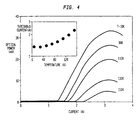
- the threshold current density was J th ⁇ 11 kA/cm 2 at 10 K, and laser action was observed up to ⁇ 110 K.
- ⁇ derived from the spectrum shown in the inset to FIG. 3
- n mod 1/(2 ⁇ L)
- the threshold current density at 4 K is about 4 kA cm -2 .
- the highest operating temperature was about 150 K with an output power exceeding approximately 5 mW.
Landscapes
- Physics & Mathematics (AREA)
- Optics & Photonics (AREA)
- Condensed Matter Physics & Semiconductors (AREA)
- General Physics & Mathematics (AREA)
- Electromagnetism (AREA)
- Chemical & Material Sciences (AREA)
- Engineering & Computer Science (AREA)
- Nanotechnology (AREA)
- Life Sciences & Earth Sciences (AREA)
- Biophysics (AREA)
- Crystallography & Structural Chemistry (AREA)
- Semiconductor Lasers (AREA)
Claims (10)
- Halbleiterlaser, der folgendes umfaßt:dadurch gekennzeichnet, daßEin aktives Gebiet (12), das als Reaktion auf das Anlegen von Pumpenergie daran stimulierte Emission von Strahlung bei einer Mittenwellenlänge im Mittel-IR bis Fern-IR-Bereich erzeugen kann, und mindestens ein Mantelgebiet zum Begrenzen der Strahlung auf das aktive Gebiet,
das mindestens eine Mantelgebiet eine erste und zweite Schicht (14.1, 14.2) umfaßt, die eine führende Grenzfläche (14) dazwischen bilden, wobei die Grenzfläche mit der Strahlung interagiert, um Oberflächenplasmonen zu unterstützen. - Laser nach Anspruch 1, wobei das aktive Gebiet ein aktives Quantenkaskadengebiet umfaßt,
wobei das mindestens eine Mantelgebiet ein erstes und zweites Mantelgebiet umfaßt, die auf gegenüberliegenden Seiten des aktiven Gebiets angeordnet sind,
wobei das erste Mantelgebiet (16) eine dielektrische Struktur mit einem Brechungsindex umfaßt, die unter dem des aktiven Gebiets liegt, und
wobei das zweite Mantelgebiet die erste und zweite Schicht, die die führende Grenzfläche dazwischen bilden, umfaßt, und wobei bei der Mittenwellenlänge die erste Schicht eine negative Dielektrizitätskonstante und die zweite Schicht eine positive Dielektrizitätskonstante aufweisen und die imaginäre Komponente des komplexen Brechungsindexes der ersten Schicht viel größer ist als die reale Komponente des Indexes. - Laser nach Anspruch 1, wobei bei der Mittenwellenlänge die erste Schicht eine negative Dielektrizitätskonstante aufweist und die zweite Schicht eine positive Dielektrizitätskonstante umfaßt, wobei die zweite Schicht zwischen dem aktiven Gebiet und der ersten Schicht angeordnet ist.
- Laser nach Anspruch 3, wobei die imaginäre Komponente des komplexen Brechungsindexes der ersten Schicht viel größer ist als die reale Komponente des Indexes.
- Laser nach Anspruch 2 oder 4, wobei die erste Schicht ein Metall und die zweite Schicht einen Halbleiter umfaßt und/oder
die erste Schicht auch einen elektrischen Kontakt zu dem Laser bildet und/oder die erste Schicht Palladium umfaßt
oder einen Verbundwerkstoff umfaßt, der eine Schicht aus Titan und eine Schicht aus Gold enthält. - Laser nach Anspruch 2 oder 5, wobei die zweite Schicht Teil des aktiven Gebiets ist oder von dem aktiven Gebiet getrennt ist und/oder eine Kontakterleichterungsschicht umfaßt.
- Laser nach Anspruch 1, wobei der Laser so ausgelegt ist, daß er bei einer Wellenlänge über etwa 20 µm arbeitet.
- Laser nach Anspruch 7, wobei das aktive Gebiet ein aktives Quantenkaskadengebiet umfaßt und/oder eine mehrschichtige InAlAs/InGaAs-Struktur umfaßt.
- Laser nach Anspruch 1, wobei der Laser ein Paar Mantelgebiete umfaßt, die auf gegenüberliegenden Seiten des aktiven Gebiets angeordnet sind, wobei eines der Mantelgebiete eine dielektrische Struktur mit einem Brechungsindex umfaßt, der unter dem des aktiven Gebiets liegt, und die andere die führende Oberflächenplasmonengrenzfläche umfaßt.
- Laser nach Anspruch 1 oder 2, wobei das mindestens eine Mantelgebiet oder das zweite Mantelgebiet so ausgelegt ist, daß die Spitzenintensität des Lasermoduls der Strahlung im wesentlichen an der Grenzfläche liegt.
Applications Claiming Priority (2)
| Application Number | Priority Date | Filing Date | Title |
|---|---|---|---|
| US09/124,295 US6301282B1 (en) | 1998-07-29 | 1998-07-29 | Long wavelength semiconductor lasers incorporating waveguides based on surface plasmons |
| US124295 | 1998-07-29 |
Publications (3)
| Publication Number | Publication Date |
|---|---|
| EP0977329A2 EP0977329A2 (de) | 2000-02-02 |
| EP0977329A3 EP0977329A3 (de) | 2001-12-05 |
| EP0977329B1 true EP0977329B1 (de) | 2005-03-02 |
Family
ID=22413999
Family Applications (1)
| Application Number | Title | Priority Date | Filing Date |
|---|---|---|---|
| EP99305717A Expired - Lifetime EP0977329B1 (de) | 1998-07-29 | 1999-07-20 | Langwelliger Halbleiterlaser mit Oberflächenplasmon-Wellenleiter |
Country Status (4)
| Country | Link |
|---|---|
| US (1) | US6301282B1 (de) |
| EP (1) | EP0977329B1 (de) |
| JP (1) | JP3545970B2 (de) |
| DE (1) | DE69923890T2 (de) |
Families Citing this family (26)
| Publication number | Priority date | Publication date | Assignee | Title |
|---|---|---|---|---|
| US6534798B1 (en) * | 1999-09-08 | 2003-03-18 | California Institute Of Technology | Surface plasmon enhanced light emitting diode and method of operation for the same |
| US6501783B1 (en) | 2000-02-24 | 2002-12-31 | Lucent Technologies Inc. | Distributed feedback surface plasmon laser |
| US6563852B1 (en) * | 2000-05-08 | 2003-05-13 | Lucent Technologies Inc. | Self-mode-locking quantum cascade laser |
| JP4599546B2 (ja) * | 2001-03-12 | 2010-12-15 | 独立行政法人科学技術振興機構 | 低次元プラズモン発光装置 |
| ITTO20020274A1 (it) * | 2002-03-27 | 2003-09-29 | Infm Istituto Nazionela Per La | Laser thz a semiconduttore incorporante guida d'onda a confinamento plasmonico controllato. |
| US6829269B2 (en) | 2002-05-21 | 2004-12-07 | University Of Massachusetts | Systems and methods using phonon mediated intersubband laser |
| FR2845208A1 (fr) * | 2002-10-01 | 2004-04-02 | Thales Sa | Composants optoelectroniques a guidage de l'onde optique par ruban metallique |
| US7092421B2 (en) * | 2003-08-30 | 2006-08-15 | Lucent Technologies Inc. | Unipolar, intraband optoelectronic transducers with micro-cavity resonators |
| JP4130163B2 (ja) * | 2003-09-29 | 2008-08-06 | 三洋電機株式会社 | 半導体発光素子 |
| US7170142B2 (en) * | 2003-10-03 | 2007-01-30 | Applied Materials, Inc. | Planar integrated circuit including a plasmon waveguide-fed Schottky barrier detector and transistors connected therewith |
| US7558307B2 (en) * | 2004-02-16 | 2009-07-07 | Sharp Kabushiki Kaisha | Semiconductor laser device, semiconductor laser device manufacturing method, optical disk apparatus and optical transmission system |
| JP4857027B2 (ja) * | 2006-05-31 | 2012-01-18 | キヤノン株式会社 | レーザ素子 |
| JP4873746B2 (ja) * | 2006-12-21 | 2012-02-08 | キヤノン株式会社 | 発振素子 |
| JP4871816B2 (ja) * | 2007-08-31 | 2012-02-08 | キヤノン株式会社 | レーザ素子 |
| US8373153B2 (en) * | 2009-05-26 | 2013-02-12 | University Of Seoul Industry Cooperation Foundation | Photodetectors |
| US8809834B2 (en) | 2009-07-06 | 2014-08-19 | University Of Seoul Industry Cooperation Foundation | Photodetector capable of detecting long wavelength radiation |
| US8929417B2 (en) | 2009-12-21 | 2015-01-06 | The Board Of Regents Of The University Of Oklahoma | Semiconductor interband lasers and method of forming |
| WO2012015990A2 (en) * | 2010-07-27 | 2012-02-02 | The Regents Of The University Of California | Plasmon lasers at deep subwavelength scale |
| JP5740125B2 (ja) * | 2010-09-29 | 2015-06-24 | 株式会社東芝 | 半導体発光素子 |
| US8805147B2 (en) * | 2011-05-17 | 2014-08-12 | Canon Kabushiki Kaisha | Waveguide, apparatus including the waveguide, and method of manufacturing the waveguide |
| US9088126B2 (en) | 2013-10-17 | 2015-07-21 | The Trustees Of Princeton University | Single-mode quantum cascade lasers with enhanced tuning range |
| US9337617B2 (en) | 2014-02-24 | 2016-05-10 | The Board Of Regents Of The University Of Oklahoma | Tunable semiconductor lasers |
| JP2015222811A (ja) * | 2014-05-01 | 2015-12-10 | 住友電気工業株式会社 | 量子カスケード半導体レーザ、量子カスケード半導体レーザを作製する方法 |
| US9728671B2 (en) | 2014-11-14 | 2017-08-08 | International Business Machines Corporation | Monolithic nano-cavity light source on lattice mismatched semiconductor substrate |
| US11067749B2 (en) * | 2019-11-21 | 2021-07-20 | Globalfoundries U.S. Inc. | Waveguides with cladding layers of gradated refractive index |
| US20220344902A1 (en) * | 2021-04-22 | 2022-10-27 | Intraband LLC | Semiconductor Laser Structure for Higher-Order Mode Suppression |
Family Cites Families (9)
| Publication number | Priority date | Publication date | Assignee | Title |
|---|---|---|---|---|
| JPS52109884A (en) * | 1976-03-11 | 1977-09-14 | Nec Corp | Stripe type hetero junction semoonductor laser |
| US4765705A (en) * | 1983-03-11 | 1988-08-23 | Gte Laboratories Incorporated | Grating surface plasmon coupler |
| US4482779A (en) * | 1983-04-19 | 1984-11-13 | The United States Of America As Represented By The Administrator Of National Aeronautics And Space Administration | Inelastic tunnel diodes |
| US4877301A (en) * | 1987-10-09 | 1989-10-31 | Ricoh Company, Ltd. | Covered optical waveguide having an inlet opening |
| JP2563379B2 (ja) * | 1987-10-09 | 1996-12-11 | 株式会社リコー | 光ピックアップ |
| US5568504A (en) * | 1992-12-03 | 1996-10-22 | Siemens Aktiengesellschaft | Surface-emitting laser diode |
| US5457709A (en) | 1994-04-04 | 1995-10-10 | At&T Ipm Corp. | Unipolar semiconductor laser |
| US5509025A (en) | 1994-04-04 | 1996-04-16 | At&T Corp. | Unipolar semiconductor laser |
| US5502787A (en) | 1995-05-22 | 1996-03-26 | At&T Corp. | Article comprising a semiconductor waveguide structure |
-
1998
- 1998-07-29 US US09/124,295 patent/US6301282B1/en not_active Expired - Lifetime
-
1999
- 1999-07-20 EP EP99305717A patent/EP0977329B1/de not_active Expired - Lifetime
- 1999-07-20 DE DE69923890T patent/DE69923890T2/de not_active Expired - Lifetime
- 1999-07-27 JP JP21262699A patent/JP3545970B2/ja not_active Expired - Fee Related
Also Published As
| Publication number | Publication date |
|---|---|
| EP0977329A2 (de) | 2000-02-02 |
| DE69923890D1 (de) | 2005-04-07 |
| JP3545970B2 (ja) | 2004-07-21 |
| JP2000138420A (ja) | 2000-05-16 |
| EP0977329A3 (de) | 2001-12-05 |
| DE69923890T2 (de) | 2005-12-29 |
| US6301282B1 (en) | 2001-10-09 |
Similar Documents
| Publication | Publication Date | Title |
|---|---|---|
| EP0977329B1 (de) | Langwelliger Halbleiterlaser mit Oberflächenplasmon-Wellenleiter | |
| Tredicucci et al. | Single-mode surface-plasmon laser | |
| Sirtori et al. | GaAs/Al x Ga 1− x As quantum cascade lasers | |
| Faist et al. | Distributed feedback quantum cascade lasers | |
| Faist et al. | Continuous wave operation of a vertical transition quantum cascade laser above T= 80 K | |
| Colombelli et al. | Far-infrared surface-plasmon quantum-cascade lasers at 21.5 μm and 24 μm wavelengths | |
| Faist et al. | Vertical transition quantum cascade laser with Bragg confined excited state | |
| CA2331194C (en) | Distributed feedback surface plasmon laser | |
| Sirtori et al. | Low-loss Al-free waveguides for unipolar semiconductor lasers | |
| Strasser et al. | GaAs/AlGaAs superlattice quantum cascade lasers at λ≈ 13 μ m | |
| Mahler et al. | High-performance operation of single-mode terahertz quantum cascade lasers with metallic gratings | |
| EP0964488B1 (de) | Verbesserter Quantumcascadelaser | |
| Tredicucci et al. | Surface plasmon quantum cascade lasers at λ∼ 19 μ m | |
| EP1500176B1 (de) | Thz-halbleiterlaser mit einem gesteuerten plasmon-confinement-wellenleiter | |
| EP0867990B1 (de) | Gegenstand der einen mit einem elektrischen Feld abstimmbaren Halbleiterlaser enthält | |
| EP0744801A1 (de) | Vorrichtung mit einer Halbleiterwellenleiterstruktur | |
| Gauthier-Lafaye et al. | Intersubband stimulated emission in GaAs/AlGaAs quantum wells: pump-probe experiments using a two-color free-electron laser | |
| Tredicucci et al. | Terahertz quantum cascade lasers—first demonstration and novel concepts | |
| Ulrich et al. | Long wavelength (15 and 23 μm) GaAs/AlGaAs quantum cascade lasers | |
| Faist et al. | Continuous wave operation of quantum cascade lasers based on vertical transitions at λ= 4.6 μm | |
| Barbieri et al. | Gain measurements on GaAs-based quantum cascade lasers using a two-section cavity technique | |
| Scamarcio et al. | Long-wavelength interminiband Fabry-Pérot and distributed feedback quantum cascade lasers | |
| Tredicucci et al. | Advances in THz quantum cascade lasers: fulfilling the application potential | |
| Tredicucci et al. | Terahertz quantum cascade lasers | |
| Cendejas et al. | Cavity length scaling of quantum cascade lasers for single-mode emission and low heat dissipation, room temperature, continuous wave operation |
Legal Events
| Date | Code | Title | Description |
|---|---|---|---|
| PUAI | Public reference made under article 153(3) epc to a published international application that has entered the european phase |
Free format text: ORIGINAL CODE: 0009012 |
|
| AK | Designated contracting states |
Kind code of ref document: A2 Designated state(s): AT BE CH CY DE DK ES FI FR GB GR IE IT LI LU MC NL PT SE Kind code of ref document: A2 Designated state(s): DE FR GB |
|
| AX | Request for extension of the european patent |
Free format text: AL;LT;LV;MK;RO;SI |
|
| PUAL | Search report despatched |
Free format text: ORIGINAL CODE: 0009013 |
|
| RIC1 | Information provided on ipc code assigned before grant |
Free format text: 7H 01S 5/10 A, 7H 01S 5/34 B, 7H 01S 5/30 B |
|
| AK | Designated contracting states |
Kind code of ref document: A3 Designated state(s): AT BE CH CY DE DK ES FI FR GB GR IE IT LI LU MC NL PT SE |
|
| AX | Request for extension of the european patent |
Free format text: AL;LT;LV;MK;RO;SI |
|
| 17P | Request for examination filed |
Effective date: 20020522 |
|
| AKX | Designation fees paid |
Free format text: DE FR GB |
|
| 17Q | First examination report despatched |
Effective date: 20040213 |
|
| GRAP | Despatch of communication of intention to grant a patent |
Free format text: ORIGINAL CODE: EPIDOSNIGR1 |
|
| GRAS | Grant fee paid |
Free format text: ORIGINAL CODE: EPIDOSNIGR3 |
|
| GRAA | (expected) grant |
Free format text: ORIGINAL CODE: 0009210 |
|
| AK | Designated contracting states |
Kind code of ref document: B1 Designated state(s): DE FR GB |
|
| REG | Reference to a national code |
Ref country code: GB Ref legal event code: FG4D |
|
| RIN1 | Information on inventor provided before grant (corrected) |
Inventor name: SIRTORI, CARLO Inventor name: FAIST, JEROME Inventor name: SIVCO, DEBORAH LEE Inventor name: HUTCHINSON, ALBERT LEE Inventor name: GMACHL, CLAIRE F. Inventor name: YI CHO, ALFRED Inventor name: CAPASSO, FEDERICO |
|
| REG | Reference to a national code |
Ref country code: IE Ref legal event code: FG4D |
|
| REF | Corresponds to: |
Ref document number: 69923890 Country of ref document: DE Date of ref document: 20050407 Kind code of ref document: P |
|
| ET | Fr: translation filed | ||
| PLBE | No opposition filed within time limit |
Free format text: ORIGINAL CODE: 0009261 |
|
| STAA | Information on the status of an ep patent application or granted ep patent |
Free format text: STATUS: NO OPPOSITION FILED WITHIN TIME LIMIT |
|
| 26N | No opposition filed |
Effective date: 20051205 |
|
| REG | Reference to a national code |
Ref country code: GB Ref legal event code: 732E Free format text: REGISTERED BETWEEN 20131121 AND 20131127 |
|
| REG | Reference to a national code |
Ref country code: FR Ref legal event code: CD Owner name: ALCATEL-LUCENT USA INC. Effective date: 20131122 |
|
| REG | Reference to a national code |
Ref country code: FR Ref legal event code: GC Effective date: 20140410 |
|
| REG | Reference to a national code |
Ref country code: FR Ref legal event code: RG Effective date: 20141015 |
|
| REG | Reference to a national code |
Ref country code: FR Ref legal event code: PLFP Year of fee payment: 17 |
|
| REG | Reference to a national code |
Ref country code: FR Ref legal event code: PLFP Year of fee payment: 18 |
|
| REG | Reference to a national code |
Ref country code: FR Ref legal event code: PLFP Year of fee payment: 19 |
|
| PGFP | Annual fee paid to national office [announced via postgrant information from national office to epo] |
Ref country code: GB Payment date: 20170719 Year of fee payment: 19 Ref country code: DE Payment date: 20170724 Year of fee payment: 19 Ref country code: FR Payment date: 20170724 Year of fee payment: 19 |
|
| REG | Reference to a national code |
Ref country code: DE Ref legal event code: R119 Ref document number: 69923890 Country of ref document: DE |
|
| REG | Reference to a national code |
Ref country code: GB Ref legal event code: 732E Free format text: REGISTERED BETWEEN 20190131 AND 20190206 |
|
| GBPC | Gb: european patent ceased through non-payment of renewal fee |
Effective date: 20180720 |
|
| PG25 | Lapsed in a contracting state [announced via postgrant information from national office to epo] |
Ref country code: GB Free format text: LAPSE BECAUSE OF NON-PAYMENT OF DUE FEES Effective date: 20180720 Ref country code: FR Free format text: LAPSE BECAUSE OF NON-PAYMENT OF DUE FEES Effective date: 20180731 Ref country code: DE Free format text: LAPSE BECAUSE OF NON-PAYMENT OF DUE FEES Effective date: 20190201 |