EP0978588A2 - Bande pour la fabrication du papier - Google Patents
Bande pour la fabrication du papier Download PDFInfo
- Publication number
- EP0978588A2 EP0978588A2 EP99115597A EP99115597A EP0978588A2 EP 0978588 A2 EP0978588 A2 EP 0978588A2 EP 99115597 A EP99115597 A EP 99115597A EP 99115597 A EP99115597 A EP 99115597A EP 0978588 A2 EP0978588 A2 EP 0978588A2
- Authority
- EP
- European Patent Office
- Prior art keywords
- belt
- resin layer
- base layer
- side edge
- opposite side
- Prior art date
- Legal status (The legal status is an assumption and is not a legal conclusion. Google has not performed a legal analysis and makes no representation as to the accuracy of the status listed.)
- Granted
Links
- 239000011347 resin Substances 0.000 claims abstract description 102
- 229920005989 resin Polymers 0.000 claims abstract description 102
- 238000000227 grinding Methods 0.000 claims description 10
- 238000000034 method Methods 0.000 claims description 9
- 238000004519 manufacturing process Methods 0.000 claims description 2
- 238000009434 installation Methods 0.000 abstract 1
- 239000003921 oil Substances 0.000 description 23
- 239000010687 lubricating oil Substances 0.000 description 16
- 230000000052 comparative effect Effects 0.000 description 13
- 229920000728 polyester Polymers 0.000 description 7
- 229920002803 thermoplastic polyurethane Polymers 0.000 description 7
- 239000004744 fabric Substances 0.000 description 6
- 230000000694 effects Effects 0.000 description 5
- XLYOFNOQVPJJNP-UHFFFAOYSA-N water Substances O XLYOFNOQVPJJNP-UHFFFAOYSA-N 0.000 description 5
- 239000011248 coating agent Substances 0.000 description 3
- 238000000576 coating method Methods 0.000 description 3
- 238000007757 hot melt coating Methods 0.000 description 3
- 239000007788 liquid Substances 0.000 description 3
- 238000005299 abrasion Methods 0.000 description 2
- 238000010276 construction Methods 0.000 description 2
- 210000004907 gland Anatomy 0.000 description 2
- 238000005259 measurement Methods 0.000 description 2
- 239000003595 mist Substances 0.000 description 2
- 238000005507 spraying Methods 0.000 description 2
- 239000002351 wastewater Substances 0.000 description 2
- 230000002411 adverse Effects 0.000 description 1
- 230000008602 contraction Effects 0.000 description 1
- 230000001595 contractor effect Effects 0.000 description 1
- 230000007423 decrease Effects 0.000 description 1
- 230000001419 dependent effect Effects 0.000 description 1
- 238000010586 diagram Methods 0.000 description 1
- 238000001035 drying Methods 0.000 description 1
- 230000002708 enhancing effect Effects 0.000 description 1
- 238000011144 upstream manufacturing Methods 0.000 description 1
Images



Classifications
-
- D—TEXTILES; PAPER
- D21—PAPER-MAKING; PRODUCTION OF CELLULOSE
- D21F—PAPER-MAKING MACHINES; METHODS OF PRODUCING PAPER THEREON
- D21F3/00—Press section of machines for making continuous webs of paper
- D21F3/02—Wet presses
- D21F3/0209—Wet presses with extended press nip
- D21F3/0218—Shoe presses
- D21F3/0227—Belts or sleeves therefor
-
- Y—GENERAL TAGGING OF NEW TECHNOLOGICAL DEVELOPMENTS; GENERAL TAGGING OF CROSS-SECTIONAL TECHNOLOGIES SPANNING OVER SEVERAL SECTIONS OF THE IPC; TECHNICAL SUBJECTS COVERED BY FORMER USPC CROSS-REFERENCE ART COLLECTIONS [XRACs] AND DIGESTS
- Y10—TECHNICAL SUBJECTS COVERED BY FORMER USPC
- Y10S—TECHNICAL SUBJECTS COVERED BY FORMER USPC CROSS-REFERENCE ART COLLECTIONS [XRACs] AND DIGESTS
- Y10S162/00—Paper making and fiber liberation
- Y10S162/901—Impermeable belts for extended nip press
-
- Y—GENERAL TAGGING OF NEW TECHNOLOGICAL DEVELOPMENTS; GENERAL TAGGING OF CROSS-SECTIONAL TECHNOLOGIES SPANNING OVER SEVERAL SECTIONS OF THE IPC; TECHNICAL SUBJECTS COVERED BY FORMER USPC CROSS-REFERENCE ART COLLECTIONS [XRACs] AND DIGESTS
- Y10—TECHNICAL SUBJECTS COVERED BY FORMER USPC
- Y10T—TECHNICAL SUBJECTS COVERED BY FORMER US CLASSIFICATION
- Y10T428/00—Stock material or miscellaneous articles
- Y10T428/19—Sheets or webs edge spliced or joined
- Y10T428/192—Sheets or webs coplanar
- Y10T428/195—Beveled, stepped, or skived in thickness
-
- Y—GENERAL TAGGING OF NEW TECHNOLOGICAL DEVELOPMENTS; GENERAL TAGGING OF CROSS-SECTIONAL TECHNOLOGIES SPANNING OVER SEVERAL SECTIONS OF THE IPC; TECHNICAL SUBJECTS COVERED BY FORMER USPC CROSS-REFERENCE ART COLLECTIONS [XRACs] AND DIGESTS
- Y10—TECHNICAL SUBJECTS COVERED BY FORMER USPC
- Y10T—TECHNICAL SUBJECTS COVERED BY FORMER US CLASSIFICATION
- Y10T428/00—Stock material or miscellaneous articles
- Y10T428/24—Structurally defined web or sheet [e.g., overall dimension, etc.]
- Y10T428/24479—Structurally defined web or sheet [e.g., overall dimension, etc.] including variation in thickness
- Y10T428/24488—Differential nonuniformity at margin
-
- Y—GENERAL TAGGING OF NEW TECHNOLOGICAL DEVELOPMENTS; GENERAL TAGGING OF CROSS-SECTIONAL TECHNOLOGIES SPANNING OVER SEVERAL SECTIONS OF THE IPC; TECHNICAL SUBJECTS COVERED BY FORMER USPC CROSS-REFERENCE ART COLLECTIONS [XRACs] AND DIGESTS
- Y10—TECHNICAL SUBJECTS COVERED BY FORMER USPC
- Y10T—TECHNICAL SUBJECTS COVERED BY FORMER US CLASSIFICATION
- Y10T428/00—Stock material or miscellaneous articles
- Y10T428/29—Coated or structually defined flake, particle, cell, strand, strand portion, rod, filament, macroscopic fiber or mass thereof
-
- Y—GENERAL TAGGING OF NEW TECHNOLOGICAL DEVELOPMENTS; GENERAL TAGGING OF CROSS-SECTIONAL TECHNOLOGIES SPANNING OVER SEVERAL SECTIONS OF THE IPC; TECHNICAL SUBJECTS COVERED BY FORMER USPC CROSS-REFERENCE ART COLLECTIONS [XRACs] AND DIGESTS
- Y10—TECHNICAL SUBJECTS COVERED BY FORMER USPC
- Y10T—TECHNICAL SUBJECTS COVERED BY FORMER US CLASSIFICATION
- Y10T428/00—Stock material or miscellaneous articles
- Y10T428/29—Coated or structually defined flake, particle, cell, strand, strand portion, rod, filament, macroscopic fiber or mass thereof
- Y10T428/2904—Staple length fiber
-
- Y—GENERAL TAGGING OF NEW TECHNOLOGICAL DEVELOPMENTS; GENERAL TAGGING OF CROSS-SECTIONAL TECHNOLOGIES SPANNING OVER SEVERAL SECTIONS OF THE IPC; TECHNICAL SUBJECTS COVERED BY FORMER USPC CROSS-REFERENCE ART COLLECTIONS [XRACs] AND DIGESTS
- Y10—TECHNICAL SUBJECTS COVERED BY FORMER USPC
- Y10T—TECHNICAL SUBJECTS COVERED BY FORMER US CLASSIFICATION
- Y10T428/00—Stock material or miscellaneous articles
- Y10T428/29—Coated or structually defined flake, particle, cell, strand, strand portion, rod, filament, macroscopic fiber or mass thereof
- Y10T428/2904—Staple length fiber
- Y10T428/2907—Staple length fiber with coating or impregnation
Definitions
- This invention relates to papermaking, and specifically to a papermaking belt, such as a shoe press belt to be used on an open type shoe press paper machine, or a sheet transfer belt.
- a "shoe press belt” passes around a plurality of rolls and runs through a nip between a press roll and a shoe.
- a wet paper sheet sandwiched between felt belts, moves through the nip with the shoe press belt, and is compressed between the press roll and the shoe to squeeze out water.
- a transfer belt For high speed operation of a paper machine, a transfer belt is used. A wet paper sheet produced on a forming wire belt is separated from the forming wire belt by a felt pickup belt wound around a pickup roll provided with suction glands. The wet paper sheet, adhering to the outer surface of the felt pickup belt, is conveyed to a press nip formed by upper and lower press rolls, between the felt pickup belt and a sheet transfer belt. When the wet paper sheet is compressed in the press nip, water is transferred from the wet paper sheet to the felt pickup belt. After passing through the press nip, the felt pickup belt is separated from the wet paper sheet.
- the wet paper sheet is then conveyed further by the sheet transfer belt to a second press nip.
- the sheet transfer belt has a flat, smooth, water-impermeable surface, preventing rewetting of the paper sheet, which would occurs if a felt belt were used.
- the wet paper sheet is squeezed again at the second press nip between the sheet transfer belt and another felt press belt.
- This nip may be formed either by two press rolls or by a press roll and a shoe in combination with a press belt.
- the sheet transfer belt is separated from a wet paper sheet by a guide roll.
- the wet paper sheet is carried by the sheet transfer belt or by a felt belt, which prevent the wet paper sheet from breaking and make it possible to form the wet paper sheet at a high speed.
- a lubricating oil is sprayed by an oil spraying device onto the inner surface of the shoe press belt at a position immediately ahead of the shoe to reduce friction between the inner surface of the shoe press belt and the shoe.
- the lubricating oil is scraped off the belt by a scraper and an oil removing brush, both disposed beyond the shoe.
- a belt of this type will be referred to as "one-surface coated belt”.
- Belts recently introduced into the market have a base layer, a resin layer formed on the inner surface of the base layer, and a thin resin layer formed on the outer surface, with a view to enhancing abrasion resistance and draining performance.
- a belt of this type will be referred to as "outside-covered one-surface coated belt”.
- Papermaking belts for achieving closed draw recently introduced into the market have a construction opposite to that of the outside-covered one-surface coated belt.
- a belt of this type will be referred to as "inside-covered, one-surface coated belt”.
- the edges of the one-surfaced coated belt, the outside-covered, one-surface coated belt and the inside-covered, one-surface coated belt have a tendency to curl toward the resin layer side while the belt is in use.
- the transfer belt also has a tendency to curl toward the resin layer side. This tendency to curl is caused by the greater shrinkage of the resin layer relative to the shrinkage of the adjoining base layer.
- the shrinkage of a resin layer formed by a hot melt coating process is even greater than that of a resin layer formed by a liquid resin application.
- One-surface coated belts are disclosed in Japanese Patent Publications Nos. 38477/1988, 15398/1988 and 64639/1991 and Japanese Unexamined Patent Publication Nos. 82988/1992 and 311591/1993, but no mention is made of the curling of the side edges of the belts.
- the general object of this invention is to solve one or more of the aforementioned problems. It is also an object of the invention to provide a papermaking belt for use as an open type shoe press belt of a one-surface coated type or an outside covered, one-surfaced coated type or a sheet transfer belt of a one-surface coated type or an inside-coated, one-surfaced coated type, comprising a base layer and a resin layer, and capable of reducing or preventing the curling of side edges thereof due to the difference in thermal shrinkage between the base layer and the resin layer.
- a papermaking belt of a one-surfaced coated type for use as an open type shoe press belt or a sheet transfer belt comprises a base layer and a resin layer formed on the outer or the inner surface of the base layer when the papermaking belt is mounted on a paper machine, and the resin layer is formed so that the thickness of opposite side edge parts thereof is smaller than that of a middle part thereof to suppress the differential shrinkage effect intrinsic to one-surface coated belts.
- a papermaking belt of an outside-covered one-surface coated type or an inside-covered one-surface coated type comprises a base layer, a thin resin layer formed on one of the surfaces of the base layer when the paper-making belt is mounted on a paper machine, and a thick resin layer formed on the other surface of the base layer.
- the thickness of the thick resin layer decreases widthwise front a middle part of the thick resin layer toward the side edges of the same to suppress the differential contraction effect which is also intrinsic to outside-covered one-surface coated belts and inside-covered one-surface coated belts.
- FIG. 4 which illustrates a conventional open type shoe press paper machine
- a shoe press belt 43 is wound around a plurality of rolls so as to run past a nip between a top (press) roll 41 and a shoe 42.
- a wet paper sheet 46 sandwiched between a top felt belt 44 and a bottom felt belt 45, is compressed between the top roll 41 and the shoe 42, and water is thereby squeezed out of the wet paper sheet.
- a sheet transfer belt 55 may be used as illustrated in FIG. 5.
- the sheet transfer belt exercises closed draw to enable high speed operation of the paper machine.
- a wet paper sheet 46 is formed on a forming wire belt 50. Between a couch roll 51 and a turning roll 52, the wet paper sheet 46 is separated from the forming wire belt 50 by a felt pickup belt 53 wound around a pickup roll 54 provided with suction glands. The wet paper sheet 46, adhering to the outer surface of the pickup felt belt 53, is conveyed to a press nip N between the pickup felt belt 53 and a sheet transfer belt 55.
- the pickup felt belt 53 is in contact with, and extends partway around, a top press roll 57
- the sheet transfer belt 55 is in contact with, and extends partway around, a bottom press roll 56.
- the wet paper sheet 46 is conveyed by the sheet transfer belt 55 toward a second press nip N-2.
- the sheet transfer belt 55 has a flat, smooth surface impermeable to water, and hence there is no rewetting of the wet paper sheet 46, which would occur if a felt belt were used.
- the wet paper sheet 46 is squeezed again at the second press nip N-2 by a top press roll 60, a bottom press roll 61, a press felt belt 59 and a sheet transfer belt 55.
- a shoe and a press belt may be substituted for the bottom press roll 61.
- the sheet transfer belt 55 is separated from a wet paper sheet 46 by another guide roll 58' and the wet paper sheet 46 is delivered to a drying section.
- the wet paper sheet 46 is carried by the sheet transfer belt 55 or a felt belt. These belts prevent the wet paper sheet from being broken, and hence the wet paper sheet 46 can be formed at a high speed.
- a lubricating oil is sprayed by an oil spraying device 47 onto the inner surface of the shoe press belt 43 at a position immediately upstream of the shoe 42 to reduce friction between the inner surface of the shoe press belt 43 and the shoe 42.
- the lubricating oil sprayed onto the inner surface of the shoe press belt 43 is scraped off the shoe press belt 43 by a scraper 48 and an oil removing brush 49, both disposed downstream with respect to the location of the shoe 42.
- most papermaking belts formerly used on the open type shoe press paper machine (e.g. the shoe press belt 43) have a one-surface coated belt comprising a base layer 43a and a resin layer 43b coating the lower surface, i.e., the surface of the base layer 43a on the shoe-contacting side of the belt.
- outside-covered, one-surface coated belts recently introduced into the market have a base layer 43a, a resin layer 43b formed on the inner surface of the base layer 43a, and a thin resin layer 43c formed on the outer surface of the base layer 43a, i.e. the felt belt-contacting surface.
- the objective of this belt structure is to enhance abrasion resistance and draining performance.
- Single edged parts A and B of each of the one-surface coated belts, the outside-covered, one-surfaced coated belt and the inside-covered, one-surfaced coated belt have a tendency to curl toward the side of the resin layer on the side of the shoe as indicated by chain lines in FIGs. 7(a) and 7(b).
- the tendency to curl occurs while the belt is in use due to stress induced therein by the difference in heat shrinkage between the base layer and the resin layer during the manufacture of the belt. i.e., an effect analogous to the bimetal effect.
- a transfer belt having an outer surface which comes into direct contact with a wet paper sheet to convey the same has a tendency to curl toward the side of the resin layer as indicated by chain lines in FIGs. 7(c) and 7(d).
- a liquid resin of a single-component type or a two-component type is applied to the base layer.
- the resin layer shrinks as it hardens.
- the shrinkage of a resin layer formed by a hot melt coating process is even greater than that of a resin layer formed by liquid resin, and therefore the side edge parts of a belt provided with a resin layer formed by a hot melt coating process curl greatly.
- the degree of curling in a belt is in the range of about 30 to about 100 mm in general. If the values C1 and C2 are 70 mm or greater, gaps G are formed between the scraper 48 and the inner surface of the belt as shown in FIG. 8. Therefore, the scraper 48 is unable to scrape the lubricating oil satisfactorily from the inner surface of the belt. It has been determined empirically that the widths L1 and L2 (FIG. 6) of curled side edge parts are about 100 mm.
- lubricating oil is scraped off the shoe press belt with a scraper 48. If the lubricating oil is not scraped off satisfactorily, the oil remaining on the inner surface of the belt is transferred from the belt to a roll R(FIG. 4) disposed below the scraper and the lubricating oil adhering to the roll R is scattered centrifugally as an oil mist around the paper machine as the roll R rotates. Consequently, the consumption of the lubricating oil increases, costs increase, equipment and the environment around the paper machine becomes soiled with lubricating oil, and waste water will also contain lubricating oil.
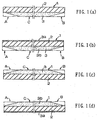
- a belt 1, of the one-surface coated type comprises a base layer 2, and a resin layer 3 formed on the inner surface of the base layer 2, i.e., a surface of the base layer 2 on the shoe side of the belt.
- a resin layer 3 formed on the inner surface of the base layer 2, i.e., a surface of the base layer 2 on the shoe side of the belt.
- opposite side edge parts A and B are thinner than the middle part C.
- a belt 1, of the outside-covered one-surface coated type comprises a base layer 2, a thin resin layer 3 formed on the outer surface of the base layer 2, and a thick resin layer 3b formed on the inner surface of the base layer 2, i.e., a surface of the base layer 2 on the shoe side of the belt.
- a thick resin layer 3b formed on the inner surface of the base layer 2, i.e., a surface of the base layer 2 on the shoe side of the belt.
- opposite side edge parts A and B are thinner than the middle part C.
- a belt 1, of the one-surface coated type comprises a base layer 2, a resin layer 3 formed on the outer surface of the base layer 2, i.e., a surface of the base layer 2 on the side of a felt belt.
- a resin layer 3 formed on the outer surface of the base layer 2, i.e., a surface of the base layer 2 on the side of a felt belt.
- opposite side edge parts A and B are thinner than the middle part C.
- a belt 1, of an inside-covered one-surface coated type comprises a base layer 2, a thin resin layer 3a formed on the inner surface of the base layer 2, and a thick resin layer 3b formed on the outer surface of the base layer 2.
- a thick resin layer 3b formed on the outer surface of the base layer 2.
- opposite side edge parts A and B are thinner than the middle part C.
- the base layer 2 is a double fabric of a 3/1-1/3 weave, provided with batting woven from, for example, 0.4 mm diameter polyester monofilament yarns as warp yarns and weft yarns, and having an intermediate layer of 3000 d polyester multifilament yarns.
- the resin layer 3 of the one-surface coated belt, the inner thick resin layer 3b of the outside-covered, one-surface coated belt, and the outer thick resin layer 3b of the inside-covered, one-surface coated belt may be formed of a urethane resin.
- the opposite side edge parts A and B of the resin layer are thinner than the middle part C to suppress the curling of the side edge parts of the belt.
- the opposite side edge parts of the resin layer are finished by grinding to form parts A and B in a thickness smaller than that of the middle part C.
- the opposite side edge parts A and B of the resin layer may, or course, be finished by any of various suitable alternative processes other than grinding.
- a base layer consisting of a 1.9 mm thick double fabric of a 3/1-1/3 weave provided with batting, woven from 0.4 mm diameter polyester monofilament yarns as warp yarns and weft yarns, and having an intermediate layer of 3000 d polyester multifilament yarns.
- the inner surface of the double fabric i.e., the surface on the shoe side of the belt, was impregnated with a urethane resin to form a resin layer on the inner surface of the double fabric so that the thickness of a structure consisting of the double fabric and the resin layer was 3.5 mm.
- the urethane resin was set by heat, and the resin layer thus set was ground.
- FIG. 2(a) which shows a first comparative example
- the resin layer was ground so that the total thickness of the structure consisting of the double fabric and the resin layer was 3.0 mm (the resin layer being 1.1 mm thick) to obtain a one-surface coated, shoe press belt.
- the comparative shoe press belt was obtained by turning the one surface-coated belt inside out.
- FIG. 2(b) illustrates a first working example of a belt in accordance with the invention.
- FIG. 2(b) using a one-surface coated belt similar to the one-surface coated belt in the comparative example of FIG. 2(a), opposite side edge parts of the resin layer, 100 mm in width, were ground to a thickness of 0.5 mm, which is smaller by 0.6 mm than the thickness of the middle part of the resin layer.
- the shoe press belt was obtained by turning the one-surface coated belt inside out after grinding.
- FIG. 2(c) illustrates a second working example of a belt in accordance with the invention.
- each of the opposite side edge parts of the resin layer 100 mm in width, was ground on a slope so that the thickness of the resin layer at the side edges was 0.5 mm and the thickness of the same at a position at 100 mm from the side edge was equal to that of the middle part of the resin layer.
- the shoe press belt was obtained by turning the one-surface coated belt inside out after grinding.
- the degrees of curling (C1 and C2 illustrated in FIG. 6) of side edge parts of the one-surface coated belts in the first comparative example and the first and second working examples were measured.
- the degree of curling on both sides (C1 and C2) was 60 mm with the first comparative example, 10 mm with the first working example and 20 mm with the second working example.
- the one-surface coated belts in the first and second working examples exhibited satisfactory belt turning performance, and loading the belts into the paper machine was facilitated because the opposite side edges were not curled.
- a 2.8 mm thick base layer was formed by combining an outer layer of 0.4 mm diameter polyester monofilament yarns arranged widthwise, an intermediate layer of 0.4 mm diameter polyester monofilament yarns arranged longitudinally, and an inner layer of 6000 d multifilament polyester yarns arranged widthwise.
- a urethane resin was applied to one surface of the base layer so that the urethane resin infiltrated into the base layer to a depth of 0.2 mm.
- the base layer was impregnated with urethane resin, and a 1.5 mm thick resin layer was formed on the opposite surface of the base layer.
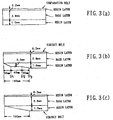
- the urethane resin that was applied to the base layer was hardened by heat, and the resin layer was ground to produce a 4.0 mm thick, belt. After grinding, the belt was turned inside-out to produce the outside-covered, one-surface coated shoe press belt, shown in FIG. 3(a) as a second comparative example.
- each of two opposite side edge parts 100 mm in width, was ground so that the thickness of the resin layer at the side edge is zero mm, the resin layer is inclined from the side edge to a line p1 at a distance of 30 mm from the edge, the resin layer is horizontal, with a thickness of 0.5 mm, between the line p1 and a line p2 at a distance of 40 mm from the line p1, the resin layer is inclined from the line p2 to a line p3 at a distance of 30 mm from the line p2, and the thickness of the resin layer on the line p3 is equal to the thickness of the middle part of the resin layer.
- FIG. 3(b) shows a shoe press belt obtained by turning the belt inside out after grinding.
- each of two opposite side edge parts, 100 mm in width, of the resin layer was ground on a slope so that the thickness of the resin layer at the side edge was zero mm and the thickness of the same at a position 100 mm from the side edge was equal to that of a middle part.
- FIG. 3(c) shows the shoe press belt obtained by turning the belt inside-out after grinding.
- the degrees of curling (C1 and C2 in FIG. 6) of the belts in the second comparative example and the third and fourth working examples were measured.
- the degree of curling of the belt of the second comparative example (FIG. 3(a)) was 55 mm
- the degree of curling of the belt in the third working example (FIG. 3(b))
- the degree or curling of the belt in the fourth working example (FIG. 3(c)) was 20 mm.
- the belts in the third and fourth working examples were subjected to tests on a practical paper machine. No particular problems occurred. There was a concern that the side edge parts of the belts in might be separated from a scraper after passing a shoe and that the oil adhering to those parts might not be scraped off because the opposite side edge parts of the belts are finished by grinding. However, no such problem was observed because the difference in thickness between the side edge parts and the middle part of the belts was small. The oil could be scraped off the side edge parts of the belts satisfactorily by the scraper, and the oil remaining on the side edge parts could be removed by a brush disposed beyond the scraper in the running direction of the belts.
- each belt whether it be for use as an open type shoe press belt or as a sheet transfer belt, comprises a base layer and a resin layer overlying or underlying the base layer when the belt is mounted on a paper machine.
- the resin layer is formed so that the thickness of its opposite side edge parts is smaller than that of its middle part, the terms “side” and “middle” referring to positions separated from one another in the widthwise direction, i.e. a direction parallel to the upper and lower faces of the belt and perpendicular to its running direction.
- side edge parts having a thickness less than that of the middle part suppresses the differential shrinkage or contraction analogous to the "bimetal" effect, intrinsic to one-surface coated belts. Consequently, the curling of the opposite side edge parts of the belt can be reduced greatly.
- the belt comprises a base layer, a thin resin layer formed on one of the surfaces of the base layer when the papermaking belt is mounted on a paper machine, And a thick resin layer formed on the other surface of the base layer.
- the thick resin layer is formed so that the thickness of the opposite side edge parts thereof is smaller than that of the middle part. Therefore, the differential shrinkage phenomenon is also greatly reduced in this type of belt and difficulties caused by curling of the opposite side edge parts of the belts can be avoided.
- the one-surface coated belt comprising a base layer and a resin layer coating the outer or the inner surface of the base layer, the outside-covered, one-surface coated belt, and the inside-covered, one-surface coated belt in accordance with the invention are also satisfactory in turning performance and readily loaded into a paper machine.
Landscapes
- Paper (AREA)
- Laminated Bodies (AREA)
Applications Claiming Priority (4)
| Application Number | Priority Date | Filing Date | Title |
|---|---|---|---|
| JP23657998 | 1998-08-06 | ||
| JP23657998 | 1998-08-06 | ||
| JP12850399 | 1999-05-10 | ||
| JP12850399A JP3787458B2 (ja) | 1998-08-06 | 1999-05-10 | 抄紙用ベルト |
Publications (3)
| Publication Number | Publication Date |
|---|---|
| EP0978588A2 true EP0978588A2 (fr) | 2000-02-09 |
| EP0978588A3 EP0978588A3 (fr) | 2001-01-17 |
| EP0978588B1 EP0978588B1 (fr) | 2004-02-25 |
Family
ID=26464150
Family Applications (1)
| Application Number | Title | Priority Date | Filing Date |
|---|---|---|---|
| EP99115597A Expired - Lifetime EP0978588B1 (fr) | 1998-08-06 | 1999-08-06 | Bande pour la fabrication du papier |
Country Status (10)
| Country | Link |
|---|---|
| US (1) | US6709552B2 (fr) |
| EP (1) | EP0978588B1 (fr) |
| JP (1) | JP3787458B2 (fr) |
| CN (1) | CN1119455C (fr) |
| AT (1) | ATE260362T1 (fr) |
| CA (1) | CA2279781C (fr) |
| DE (1) | DE69914982T2 (fr) |
| ES (1) | ES2216389T3 (fr) |
| ID (1) | ID25889A (fr) |
| TW (1) | TW455640B (fr) |
Cited By (9)
| Publication number | Priority date | Publication date | Assignee | Title |
|---|---|---|---|---|
| WO2002048456A1 (fr) * | 2000-12-13 | 2002-06-20 | Yamauchi Corporation | Courroie elastique servant a fabriquer du papier |
| WO2002090649A1 (fr) * | 2001-04-27 | 2002-11-14 | Yamauchi Corporation | Courroie pour presse a sabot |
| EP1333121A1 (fr) * | 2002-02-02 | 2003-08-06 | Voith Paper Patent GmbH | Calandre et procédé pour le fonctionnement d'une calandre |
| WO2003071030A1 (fr) * | 2002-02-23 | 2003-08-28 | Voith Fabrics Patent Gmbh | Courroie de machine a papier |
| WO2003085195A1 (fr) * | 2002-04-11 | 2003-10-16 | Yamauchi Corporation | Courroies de compression de chaussures et dispositif a comprimer les chaussures utilisant ces courroies |
| WO2003085196A1 (fr) * | 2002-04-11 | 2003-10-16 | Yamauchi Corporation | Courroies de pressage et dispositif de pressage a sabot utilisant ces courroies |
| EP1662041A4 (fr) * | 2003-09-04 | 2007-03-14 | Yamauchi Corp | Toile de presse et cylindre de presse a sabot de formation |
| EP1653001A4 (fr) * | 2003-08-07 | 2007-10-03 | Yamauchi Corp | Bande de presse, procede de production de cette bande et rouleau de presse a sabot utilisant ladite bande |
| EP3133206A1 (fr) * | 2015-08-20 | 2017-02-22 | Ichikawa Co., Ltd. | Bande de transfert d'une bande de papier humide |
Families Citing this family (18)
| Publication number | Priority date | Publication date | Assignee | Title |
|---|---|---|---|---|
| US20050081570A1 (en) * | 2002-02-23 | 2005-04-21 | Voith Fabrics Patent Gmbh | Paper machine belt |
| JP3795002B2 (ja) * | 2002-10-04 | 2006-07-12 | ヤマウチ株式会社 | シュープレス用弾性スリーブ、シュープレス用弾性スリーブの製造方法およびシュープレスロール |
| US7014735B2 (en) * | 2002-12-31 | 2006-03-21 | Albany International Corp. | Method of fabricating a belt and a belt used to make bulk tissue and towel, and nonwoven articles and fabrics |
| US7005044B2 (en) * | 2002-12-31 | 2006-02-28 | Albany International Corp. | Method of fabricating a belt and a belt used to make bulk tissue and towel, and nonwoven articles and fabrics |
| AU2004286319A1 (en) * | 2003-11-03 | 2005-05-12 | Albany International Corp. | Belt with variable grooves |
| US7395680B2 (en) * | 2004-07-20 | 2008-07-08 | Federal Mogul Worldwide, Inc. | Self-curling knitted sleeve and method of fabrication |
| TW200624617A (en) * | 2004-07-20 | 2006-07-16 | Federal Mogul World Wide Inc | Self-curling sleeve |
| JP2006274448A (ja) * | 2005-03-04 | 2006-10-12 | Yamauchi Corp | プレスベルトおよびシュープレスロール |
| JP2007039823A (ja) * | 2005-08-01 | 2007-02-15 | Ichikawa Co Ltd | 製紙用フェルト |
| DE102005046812A1 (de) * | 2005-09-30 | 2007-04-05 | Voith Patent Gmbh | Band zum Überführen einer herzustellenden Faserstoffbahn |
| JP4883629B2 (ja) | 2007-03-13 | 2012-02-22 | イチカワ株式会社 | 湿紙搬送用ベルト |
| JP4516610B2 (ja) * | 2008-02-08 | 2010-08-04 | イチカワ株式会社 | シュープレス用ベルト |
| JP2008310343A (ja) * | 2008-07-17 | 2008-12-25 | Konica Minolta Holdings Inc | 光学フィルムの製造方法とハードコート層付き光学フィルム |
| JP5731773B2 (ja) * | 2010-09-02 | 2015-06-10 | ヤマウチ株式会社 | プレスベルト及びシュープレスロール並びにプレスベルトの製造方法 |
| EP3988153B1 (fr) | 2015-03-31 | 2024-04-24 | Fisher & Paykel Healthcare Limited | Interface utilisateur pour l'alimentation en gaz à une voie respiratoire |
| US10185259B2 (en) * | 2016-03-18 | 2019-01-22 | Ricoh Company, Ltd. | Endless belt, fixing device, image forming apparatus, and method of manufacturing endless belt |
| CN121668497A (zh) | 2016-08-11 | 2026-03-17 | 费雪派克医疗保健有限公司 | 可塌缩导管、患者接口和头戴具连接器 |
| FR3069254B1 (fr) * | 2017-07-21 | 2019-10-18 | Allimand | Machine et procede de fabrication d’une feuille a base de debris de vegetaux avec une unite de pressage sous la forme d’une presse a sabot |
Citations (5)
| Publication number | Priority date | Publication date | Assignee | Title |
|---|---|---|---|---|
| JPH01120708U (fr) | 1988-02-08 | 1989-08-16 | ||
| JPH01143672U (fr) | 1988-03-25 | 1989-10-02 | ||
| JPH057050U (ja) | 1991-07-19 | 1993-02-02 | セイレイ工業株式会社 | コンバインの排藁処理部への搬送切替装置 |
| JPH05311591A (ja) | 1992-04-30 | 1993-11-22 | Ichikawa Woolen Textile Co Ltd | シュープレス用ベルト |
| JPH0642178U (ja) | 1992-11-09 | 1994-06-03 | 株式会社小森コーポレーション | 印刷機のインキ装置用振りローラ駆動装置 |
Family Cites Families (14)
| Publication number | Priority date | Publication date | Assignee | Title |
|---|---|---|---|---|
| JPS5667348A (en) * | 1979-11-08 | 1981-06-06 | Mitsuboshi Belting Ltd | Rubber composition |
| US4330023A (en) * | 1980-08-18 | 1982-05-18 | Beloit Corporation | Extended nip press |
| JPS62220741A (ja) * | 1986-03-22 | 1987-09-28 | Mitsuboshi Belting Ltd | ロ−エツジコグ付vベルトおよびその製造方法 |
| JPS6315398A (ja) | 1986-07-07 | 1988-01-22 | 株式会社東芝 | 状態監視用端末装置 |
| JPS6338477A (ja) | 1986-07-31 | 1988-02-19 | 株式会社 白惣 | 金属製野球用バツト |
| US4877472A (en) * | 1988-10-31 | 1989-10-31 | Beloit Corporation | Method of making a bearing blanket |
| JP3173610B2 (ja) | 1989-07-31 | 2001-06-04 | 富士通テン株式会社 | 内燃機関のアイドル回転速度制御装置 |
| JP3080640B2 (ja) | 1990-07-20 | 2000-08-28 | 市川毛織株式会社 | 広幅ニッププレス用加圧ベルト |
| US5208087A (en) * | 1991-10-08 | 1993-05-04 | Albany International Corp. | Spiral construction for a long nip press belt |
| US5744237A (en) | 1993-02-19 | 1998-04-28 | Hoechst Celanese Corporation | Heterofilaments for cord reinforcement in rubber goods |
| US5753369A (en) | 1994-07-27 | 1998-05-19 | Mitsuboshi Belting Ltd. | Power transmission belt |
| DE4443598C2 (de) * | 1994-12-07 | 2000-05-25 | Voith Sulzer Papiermasch Gmbh | Verfahren zur Herstellung eines Preßmantels |
| DE4445472C2 (de) * | 1994-12-20 | 2000-05-11 | Voith Sulzer Papiermasch Gmbh | Preßmantel für eine Preßvorrichtung zur Entwässerung einer Papierbahn |
| JP3094120B2 (ja) * | 1996-06-21 | 2000-10-03 | 三ツ星ベルト株式会社 | 背面帆布付きvリブドベルト |
-
1999
- 1999-05-10 JP JP12850399A patent/JP3787458B2/ja not_active Expired - Fee Related
- 1999-08-04 TW TW088113297A patent/TW455640B/zh not_active IP Right Cessation
- 1999-08-06 EP EP99115597A patent/EP0978588B1/fr not_active Expired - Lifetime
- 1999-08-06 CN CN99117609A patent/CN1119455C/zh not_active Expired - Fee Related
- 1999-08-06 ID IDP990768D patent/ID25889A/id unknown
- 1999-08-06 ES ES99115597T patent/ES2216389T3/es not_active Expired - Lifetime
- 1999-08-06 CA CA002279781A patent/CA2279781C/fr not_active Expired - Fee Related
- 1999-08-06 AT AT99115597T patent/ATE260362T1/de active
- 1999-08-06 DE DE69914982T patent/DE69914982T2/de not_active Expired - Lifetime
-
2001
- 2001-06-13 US US09/880,299 patent/US6709552B2/en not_active Expired - Lifetime
Patent Citations (5)
| Publication number | Priority date | Publication date | Assignee | Title |
|---|---|---|---|---|
| JPH01120708U (fr) | 1988-02-08 | 1989-08-16 | ||
| JPH01143672U (fr) | 1988-03-25 | 1989-10-02 | ||
| JPH057050U (ja) | 1991-07-19 | 1993-02-02 | セイレイ工業株式会社 | コンバインの排藁処理部への搬送切替装置 |
| JPH05311591A (ja) | 1992-04-30 | 1993-11-22 | Ichikawa Woolen Textile Co Ltd | シュープレス用ベルト |
| JPH0642178U (ja) | 1992-11-09 | 1994-06-03 | 株式会社小森コーポレーション | 印刷機のインキ装置用振りローラ駆動装置 |
Cited By (15)
| Publication number | Priority date | Publication date | Assignee | Title |
|---|---|---|---|---|
| US6921461B2 (en) | 2000-12-13 | 2005-07-26 | Yamauchi Corporation | Elastic belt for papermaking |
| WO2002048456A1 (fr) * | 2000-12-13 | 2002-06-20 | Yamauchi Corporation | Courroie elastique servant a fabriquer du papier |
| WO2002090649A1 (fr) * | 2001-04-27 | 2002-11-14 | Yamauchi Corporation | Courroie pour presse a sabot |
| US7097741B2 (en) | 2001-04-27 | 2006-08-29 | Yamauchi Corporation | Belt for shoe press |
| EP1333121A1 (fr) * | 2002-02-02 | 2003-08-06 | Voith Paper Patent GmbH | Calandre et procédé pour le fonctionnement d'une calandre |
| WO2003071030A1 (fr) * | 2002-02-23 | 2003-08-28 | Voith Fabrics Patent Gmbh | Courroie de machine a papier |
| WO2003085196A1 (fr) * | 2002-04-11 | 2003-10-16 | Yamauchi Corporation | Courroies de pressage et dispositif de pressage a sabot utilisant ces courroies |
| WO2003085195A1 (fr) * | 2002-04-11 | 2003-10-16 | Yamauchi Corporation | Courroies de compression de chaussures et dispositif a comprimer les chaussures utilisant ces courroies |
| AU2003220868B2 (en) * | 2002-04-11 | 2008-01-17 | Yamauchi Corporation | Shoe press belts and shoe press device using the belts |
| US7326321B2 (en) | 2002-04-11 | 2008-02-05 | Yamauchi Corporation | Shoe press belts and shoe press device using the belts |
| EP1653001A4 (fr) * | 2003-08-07 | 2007-10-03 | Yamauchi Corp | Bande de presse, procede de production de cette bande et rouleau de presse a sabot utilisant ladite bande |
| US7611608B2 (en) | 2003-08-07 | 2009-11-03 | Yamauchi Corporation | Press belt, process for producing the same and shoe press roll using the press belt |
| EP1662041A4 (fr) * | 2003-09-04 | 2007-03-14 | Yamauchi Corp | Toile de presse et cylindre de presse a sabot de formation |
| US7704350B2 (en) | 2003-09-04 | 2010-04-27 | Yamauchi Corporation | Press belt and shoe press roll |
| EP3133206A1 (fr) * | 2015-08-20 | 2017-02-22 | Ichikawa Co., Ltd. | Bande de transfert d'une bande de papier humide |
Also Published As
| Publication number | Publication date |
|---|---|
| ES2216389T3 (es) | 2004-10-16 |
| ATE260362T1 (de) | 2004-03-15 |
| EP0978588A3 (fr) | 2001-01-17 |
| JP2000110090A (ja) | 2000-04-18 |
| TW455640B (en) | 2001-09-21 |
| DE69914982D1 (de) | 2004-04-01 |
| CA2279781A1 (fr) | 2000-02-06 |
| CN1119455C (zh) | 2003-08-27 |
| CN1245846A (zh) | 2000-03-01 |
| ID25889A (id) | 2000-11-09 |
| JP3787458B2 (ja) | 2006-06-21 |
| US20020028317A1 (en) | 2002-03-07 |
| EP0978588B1 (fr) | 2004-02-25 |
| US6709552B2 (en) | 2004-03-23 |
| DE69914982T2 (de) | 2005-01-05 |
| CA2279781C (fr) | 2008-01-22 |
Similar Documents
| Publication | Publication Date | Title |
|---|---|---|
| CA2279781C (fr) | Courroie de fabrication du papier | |
| AU643588B2 (en) | Spiral construction for a long nip press belt | |
| US5397438A (en) | Method and device for reduction and equalization of transverse shrinkage of paper in single-wire draw in a drying section | |
| PL153824B1 (en) | A bearing blanket for an extended nip press. | |
| AU735121B2 (en) | Use of a transfer belt for a soft tissue paper machine | |
| MXPA05006473A (es) | Tela industrial con superficie recubierta de silicona. | |
| CA2142283C (fr) | Toile de formation | |
| FI110012B (fi) | Telapäällystelaite | |
| US6786243B2 (en) | Monofilament structure to monitor fabric abrasion | |
| FI121431B (fi) | Paperikoneessa käytettävä kudosrakenne ja menetelmä sen valmistamiseksi | |
| US5466339A (en) | Method of making and using a paper maker felt | |
| EP1378601B1 (fr) | Bande pour presse à patin | |
| US8449723B2 (en) | Shoe press belt | |
| EP1075567B1 (fr) | Machine et procede de fabrication pour papier doux | |
| JP4185091B2 (ja) | 抄紙用シュープレスベルト | |
| AU2003213043B2 (en) | Papermaker's Nip Thickening Fabric | |
| US5791029A (en) | Blanket construction for a compressive shrinkage apparatus | |
| JPS6219426Y2 (fr) |
Legal Events
| Date | Code | Title | Description |
|---|---|---|---|
| PUAI | Public reference made under article 153(3) epc to a published international application that has entered the european phase |
Free format text: ORIGINAL CODE: 0009012 |
|
| AK | Designated contracting states |
Kind code of ref document: A2 Designated state(s): AT BE CH CY DE DK ES FI FR GB GR IE IT LI LU MC NL PT SE |
|
| AX | Request for extension of the european patent |
Free format text: AL;LT;LV;MK;RO;SI |
|
| PUAL | Search report despatched |
Free format text: ORIGINAL CODE: 0009013 |
|
| AK | Designated contracting states |
Kind code of ref document: A3 Designated state(s): AT BE CH CY DE DK ES FI FR GB GR IE IT LI LU MC NL PT SE |
|
| AX | Request for extension of the european patent |
Free format text: AL;LT;LV;MK;RO;SI |
|
| 17P | Request for examination filed |
Effective date: 20010209 |
|
| AKX | Designation fees paid |
Free format text: AT BE CH CY DE DK ES FI FR GB GR IE IT LI LU MC NL PT SE |
|
| 17Q | First examination report despatched |
Effective date: 20030123 |
|
| GRAP | Despatch of communication of intention to grant a patent |
Free format text: ORIGINAL CODE: EPIDOSNIGR1 |
|
| GRAS | Grant fee paid |
Free format text: ORIGINAL CODE: EPIDOSNIGR3 |
|
| GRAA | (expected) grant |
Free format text: ORIGINAL CODE: 0009210 |
|
| AK | Designated contracting states |
Kind code of ref document: B1 Designated state(s): AT BE CH CY DE DK ES FI FR GB GR IE IT LI LU MC NL PT SE |
|
| PG25 | Lapsed in a contracting state [announced via postgrant information from national office to epo] |
Ref country code: LI Free format text: LAPSE BECAUSE OF FAILURE TO SUBMIT A TRANSLATION OF THE DESCRIPTION OR TO PAY THE FEE WITHIN THE PRESCRIBED TIME-LIMIT Effective date: 20040225 Ref country code: CY Free format text: LAPSE BECAUSE OF FAILURE TO SUBMIT A TRANSLATION OF THE DESCRIPTION OR TO PAY THE FEE WITHIN THE PRESCRIBED TIME-LIMIT Effective date: 20040225 Ref country code: CH Free format text: LAPSE BECAUSE OF FAILURE TO SUBMIT A TRANSLATION OF THE DESCRIPTION OR TO PAY THE FEE WITHIN THE PRESCRIBED TIME-LIMIT Effective date: 20040225 Ref country code: BE Free format text: LAPSE BECAUSE OF FAILURE TO SUBMIT A TRANSLATION OF THE DESCRIPTION OR TO PAY THE FEE WITHIN THE PRESCRIBED TIME-LIMIT Effective date: 20040225 |
|
| REG | Reference to a national code |
Ref country code: GB Ref legal event code: FG4D |
|
| REG | Reference to a national code |
Ref country code: CH Ref legal event code: EP |
|
| REG | Reference to a national code |
Ref country code: IE Ref legal event code: FG4D |
|
| REF | Corresponds to: |
Ref document number: 69914982 Country of ref document: DE Date of ref document: 20040401 Kind code of ref document: P |
|
| PG25 | Lapsed in a contracting state [announced via postgrant information from national office to epo] |
Ref country code: GR Free format text: LAPSE BECAUSE OF FAILURE TO SUBMIT A TRANSLATION OF THE DESCRIPTION OR TO PAY THE FEE WITHIN THE PRESCRIBED TIME-LIMIT Effective date: 20040525 Ref country code: DK Free format text: LAPSE BECAUSE OF FAILURE TO SUBMIT A TRANSLATION OF THE DESCRIPTION OR TO PAY THE FEE WITHIN THE PRESCRIBED TIME-LIMIT Effective date: 20040525 |
|
| REG | Reference to a national code |
Ref country code: SE Ref legal event code: TRGR |
|
| PG25 | Lapsed in a contracting state [announced via postgrant information from national office to epo] |
Ref country code: LU Free format text: LAPSE BECAUSE OF NON-PAYMENT OF DUE FEES Effective date: 20040806 Ref country code: IE Free format text: LAPSE BECAUSE OF NON-PAYMENT OF DUE FEES Effective date: 20040806 |
|
| PG25 | Lapsed in a contracting state [announced via postgrant information from national office to epo] |
Ref country code: MC Free format text: LAPSE BECAUSE OF NON-PAYMENT OF DUE FEES Effective date: 20040831 |
|
| REG | Reference to a national code |
Ref country code: CH Ref legal event code: PL |
|
| REG | Reference to a national code |
Ref country code: ES Ref legal event code: FG2A Ref document number: 2216389 Country of ref document: ES Kind code of ref document: T3 |
|
| ET | Fr: translation filed | ||
| PLBE | No opposition filed within time limit |
Free format text: ORIGINAL CODE: 0009261 |
|
| STAA | Information on the status of an ep patent application or granted ep patent |
Free format text: STATUS: NO OPPOSITION FILED WITHIN TIME LIMIT |
|
| 26N | No opposition filed |
Effective date: 20041126 |
|
| REG | Reference to a national code |
Ref country code: IE Ref legal event code: MM4A |
|
| PG25 | Lapsed in a contracting state [announced via postgrant information from national office to epo] |
Ref country code: PT Free format text: LAPSE BECAUSE OF NON-PAYMENT OF DUE FEES Effective date: 20040725 |
|
| REG | Reference to a national code |
Ref country code: FR Ref legal event code: PLFP Year of fee payment: 17 |
|
| REG | Reference to a national code |
Ref country code: FR Ref legal event code: PLFP Year of fee payment: 18 |
|
| REG | Reference to a national code |
Ref country code: FR Ref legal event code: PLFP Year of fee payment: 19 |
|
| PGFP | Annual fee paid to national office [announced via postgrant information from national office to epo] |
Ref country code: NL Payment date: 20170712 Year of fee payment: 19 |
|
| PGFP | Annual fee paid to national office [announced via postgrant information from national office to epo] |
Ref country code: GB Payment date: 20170802 Year of fee payment: 19 Ref country code: ES Payment date: 20170906 Year of fee payment: 19 Ref country code: DE Payment date: 20170801 Year of fee payment: 19 Ref country code: FI Payment date: 20170809 Year of fee payment: 19 Ref country code: IT Payment date: 20170824 Year of fee payment: 19 Ref country code: FR Payment date: 20170714 Year of fee payment: 19 |
|
| PGFP | Annual fee paid to national office [announced via postgrant information from national office to epo] |
Ref country code: SE Payment date: 20170810 Year of fee payment: 19 Ref country code: AT Payment date: 20170725 Year of fee payment: 19 |
|
| REG | Reference to a national code |
Ref country code: DE Ref legal event code: R119 Ref document number: 69914982 Country of ref document: DE |
|
| REG | Reference to a national code |
Ref country code: SE Ref legal event code: EUG |
|
| REG | Reference to a national code |
Ref country code: NL Ref legal event code: MM Effective date: 20180901 |
|
| REG | Reference to a national code |
Ref country code: AT Ref legal event code: MM01 Ref document number: 260362 Country of ref document: AT Kind code of ref document: T Effective date: 20180806 |
|
| GBPC | Gb: european patent ceased through non-payment of renewal fee |
Effective date: 20180806 |
|
| PG25 | Lapsed in a contracting state [announced via postgrant information from national office to epo] |
Ref country code: FI Free format text: LAPSE BECAUSE OF NON-PAYMENT OF DUE FEES Effective date: 20180806 Ref country code: AT Free format text: LAPSE BECAUSE OF NON-PAYMENT OF DUE FEES Effective date: 20180806 |
|
| PG25 | Lapsed in a contracting state [announced via postgrant information from national office to epo] |
Ref country code: SE Free format text: LAPSE BECAUSE OF NON-PAYMENT OF DUE FEES Effective date: 20180807 |
|
| PG25 | Lapsed in a contracting state [announced via postgrant information from national office to epo] |
Ref country code: NL Free format text: LAPSE BECAUSE OF NON-PAYMENT OF DUE FEES Effective date: 20180901 |
|
| PG25 | Lapsed in a contracting state [announced via postgrant information from national office to epo] |
Ref country code: DE Free format text: LAPSE BECAUSE OF NON-PAYMENT OF DUE FEES Effective date: 20190301 Ref country code: IT Free format text: LAPSE BECAUSE OF NON-PAYMENT OF DUE FEES Effective date: 20180806 |
|
| PG25 | Lapsed in a contracting state [announced via postgrant information from national office to epo] |
Ref country code: FR Free format text: LAPSE BECAUSE OF NON-PAYMENT OF DUE FEES Effective date: 20180831 |
|
| REG | Reference to a national code |
Ref country code: ES Ref legal event code: FD2A Effective date: 20190918 |
|
| PG25 | Lapsed in a contracting state [announced via postgrant information from national office to epo] |
Ref country code: ES Free format text: LAPSE BECAUSE OF NON-PAYMENT OF DUE FEES Effective date: 20180807 Ref country code: GB Free format text: LAPSE BECAUSE OF NON-PAYMENT OF DUE FEES Effective date: 20180806 |