EP0979503B1 - Stimmentransformation nach einer zielstimme - Google Patents
Stimmentransformation nach einer zielstimme Download PDFInfo
- Publication number
- EP0979503B1 EP0979503B1 EP98916753A EP98916753A EP0979503B1 EP 0979503 B1 EP0979503 B1 EP 0979503B1 EP 98916753 A EP98916753 A EP 98916753A EP 98916753 A EP98916753 A EP 98916753A EP 0979503 B1 EP0979503 B1 EP 0979503B1
- Authority
- EP
- European Patent Office
- Prior art keywords
- voice
- pitch
- target
- signal
- spectral envelope
- Prior art date
- Legal status (The legal status is an assumption and is not a legal conclusion. Google has not performed a legal analysis and makes no representation as to the accuracy of the status listed.)
- Expired - Lifetime
Links
- 230000001755 vocal effect Effects 0.000 title claims description 63
- 230000009466 transformation Effects 0.000 title abstract description 22
- 238000000034 method Methods 0.000 claims abstract description 78
- 230000003595 spectral effect Effects 0.000 claims abstract description 62
- 230000005284 excitation Effects 0.000 claims abstract description 57
- 230000001131 transforming effect Effects 0.000 claims abstract description 5
- 239000011295 pitch Substances 0.000 description 69
- 238000004458 analytical method Methods 0.000 description 14
- 238000010183 spectrum analysis Methods 0.000 description 13
- 230000015572 biosynthetic process Effects 0.000 description 12
- 238000003786 synthesis reaction Methods 0.000 description 12
- 238000012545 processing Methods 0.000 description 9
- 238000005070 sampling Methods 0.000 description 9
- 238000012937 correction Methods 0.000 description 8
- 238000010586 diagram Methods 0.000 description 8
- 230000008569 process Effects 0.000 description 8
- 238000001228 spectrum Methods 0.000 description 8
- 238000012546 transfer Methods 0.000 description 8
- 238000013507 mapping Methods 0.000 description 7
- 238000006467 substitution reaction Methods 0.000 description 5
- 238000006243 chemical reaction Methods 0.000 description 4
- 238000000605 extraction Methods 0.000 description 4
- 238000012986 modification Methods 0.000 description 4
- 230000004048 modification Effects 0.000 description 4
- 230000006835 compression Effects 0.000 description 3
- 238000007906 compression Methods 0.000 description 3
- 230000001934 delay Effects 0.000 description 3
- 238000001914 filtration Methods 0.000 description 3
- 230000002123 temporal effect Effects 0.000 description 3
- 238000012935 Averaging Methods 0.000 description 2
- 230000003044 adaptive effect Effects 0.000 description 2
- 238000013459 approach Methods 0.000 description 2
- 230000008859 change Effects 0.000 description 2
- 238000001514 detection method Methods 0.000 description 2
- 230000000694 effects Effects 0.000 description 2
- 230000003278 mimic effect Effects 0.000 description 2
- 238000011160 research Methods 0.000 description 2
- 238000000844 transformation Methods 0.000 description 2
- 238000012952 Resampling Methods 0.000 description 1
- 230000003321 amplification Effects 0.000 description 1
- 230000008901 benefit Effects 0.000 description 1
- 238000004364 calculation method Methods 0.000 description 1
- 238000004891 communication Methods 0.000 description 1
- 230000000295 complement effect Effects 0.000 description 1
- 239000002131 composite material Substances 0.000 description 1
- 238000000354 decomposition reaction Methods 0.000 description 1
- 230000003111 delayed effect Effects 0.000 description 1
- 238000005516 engineering process Methods 0.000 description 1
- 238000007429 general method Methods 0.000 description 1
- 230000007774 longterm Effects 0.000 description 1
- 239000000203 mixture Substances 0.000 description 1
- 238000003199 nucleic acid amplification method Methods 0.000 description 1
- 230000000737 periodic effect Effects 0.000 description 1
- 230000009467 reduction Effects 0.000 description 1
- 230000004044 response Effects 0.000 description 1
- 230000000717 retained effect Effects 0.000 description 1
- 230000033764 rhythmic process Effects 0.000 description 1
- 230000001360 synchronised effect Effects 0.000 description 1
Images


Classifications
-
- G—PHYSICS
- G10—MUSICAL INSTRUMENTS; ACOUSTICS
- G10L—SPEECH ANALYSIS TECHNIQUES OR SPEECH SYNTHESIS; SPEECH RECOGNITION; SPEECH OR VOICE PROCESSING TECHNIQUES; SPEECH OR AUDIO CODING OR DECODING
- G10L13/00—Speech synthesis; Text to speech systems
- G10L13/02—Methods for producing synthetic speech; Speech synthesisers
- G10L13/033—Voice editing, e.g. manipulating the voice of the synthesiser
-
- G—PHYSICS
- G10—MUSICAL INSTRUMENTS; ACOUSTICS
- G10H—ELECTROPHONIC MUSICAL INSTRUMENTS; INSTRUMENTS IN WHICH THE TONES ARE GENERATED BY ELECTROMECHANICAL MEANS OR ELECTRONIC GENERATORS, OR IN WHICH THE TONES ARE SYNTHESISED FROM A DATA STORE
- G10H1/00—Details of electrophonic musical instruments
- G10H1/36—Accompaniment arrangements
- G10H1/361—Recording/reproducing of accompaniment for use with an external source, e.g. karaoke systems
- G10H1/366—Recording/reproducing of accompaniment for use with an external source, e.g. karaoke systems with means for modifying or correcting the external signal, e.g. pitch correction, reverberation, changing a singer's voice
-
- G—PHYSICS
- G10—MUSICAL INSTRUMENTS; ACOUSTICS
- G10H—ELECTROPHONIC MUSICAL INSTRUMENTS; INSTRUMENTS IN WHICH THE TONES ARE GENERATED BY ELECTROMECHANICAL MEANS OR ELECTRONIC GENERATORS, OR IN WHICH THE TONES ARE SYNTHESISED FROM A DATA STORE
- G10H2210/00—Aspects or methods of musical processing having intrinsic musical character, i.e. involving musical theory or musical parameters or relying on musical knowledge, as applied in electrophonic musical tools or instruments
- G10H2210/325—Musical pitch modification
- G10H2210/331—Note pitch correction, i.e. modifying a note pitch or replacing it by the closest one in a given scale
-
- G—PHYSICS
- G10—MUSICAL INSTRUMENTS; ACOUSTICS
- G10H—ELECTROPHONIC MUSICAL INSTRUMENTS; INSTRUMENTS IN WHICH THE TONES ARE GENERATED BY ELECTROMECHANICAL MEANS OR ELECTRONIC GENERATORS, OR IN WHICH THE TONES ARE SYNTHESISED FROM A DATA STORE
- G10H2250/00—Aspects of algorithms or signal processing methods without intrinsic musical character, yet specifically adapted for or used in electrophonic musical processing
- G10H2250/055—Filters for musical processing or musical effects; Filter responses, filter architecture, filter coefficients or control parameters therefor
- G10H2250/061—Allpass filters
- G10H2250/065—Lattice filter, Zobel network, constant resistance filter or X-section filter, i.e. balanced symmetric all-pass bridge network filter exhibiting constant impedance over frequency
-
- G—PHYSICS
- G10—MUSICAL INSTRUMENTS; ACOUSTICS
- G10H—ELECTROPHONIC MUSICAL INSTRUMENTS; INSTRUMENTS IN WHICH THE TONES ARE GENERATED BY ELECTROMECHANICAL MEANS OR ELECTRONIC GENERATORS, OR IN WHICH THE TONES ARE SYNTHESISED FROM A DATA STORE
- G10H2250/00—Aspects of algorithms or signal processing methods without intrinsic musical character, yet specifically adapted for or used in electrophonic musical processing
- G10H2250/541—Details of musical waveform synthesis, i.e. audio waveshape processing from individual wavetable samples, independently of their origin or of the sound they represent
- G10H2250/545—Aliasing, i.e. preventing, eliminating or deliberately using aliasing noise, distortions or artifacts in sampled or synthesised waveforms, e.g. by band limiting, oversampling or undersampling, respectively
-
- G—PHYSICS
- G10—MUSICAL INSTRUMENTS; ACOUSTICS
- G10L—SPEECH ANALYSIS TECHNIQUES OR SPEECH SYNTHESIS; SPEECH RECOGNITION; SPEECH OR VOICE PROCESSING TECHNIQUES; SPEECH OR AUDIO CODING OR DECODING
- G10L21/00—Speech or voice signal processing techniques to produce another audible or non-audible signal, e.g. visual or tactile, in order to modify its quality or its intelligibility
- G10L21/003—Changing voice quality, e.g. pitch or formants
- G10L21/007—Changing voice quality, e.g. pitch or formants characterised by the process used
- G10L21/013—Adapting to target pitch
- G10L2021/0135—Voice conversion or morphing
Definitions
- This invention relates to the transformation of a person's voice according to a target voice. More particularly, this invention relates to a transformation system where recorded information of the target voice can be used to guide the transformation process. It further relates to the transformation of a singer's voice to adopt certain characteristics of a target singer's voice, such as pitch and other prosodic factors.
- ADR Automatic Dialogue Replacement
- Karaoke We have chosen to describe the karaoke application because of the additional demands for accurate pitch processing in such a system but the same principles apply for a spoken-word system.
- Karaoke allows the participants to sing songs made popular by other artists.
- the songs produced for karaoke have the vocal track removed leaving behind only the musical accompaniment.
- karaoke is the second largest leisure activity, after dining out.
- the singer tries to mimic the style and sound of the artist who originally made the recording.
- This desire for voice transformation is not limited to karaoke but is also important for impersonators who might mimic, for example, Elvis Presley performing one of his songs.
- the inventors have found that the important characterizing parameters for successful voice conversion to a specified target depend on the target singer. For some singers, the pitch contour at the onset of notes (for example the "scooping" style of Presley) is critical. Other singers may be recognized more for the "growl” in their voice (e.g. Louis Armstrong). The style of vibrato is another important factor of voice individuality. These examples all involve prosodic factors as the key characterizing features. While physiological factors are also important, we have found that the transformation of physiological parameters need not be exact in order to achieve a convincing identity transformation. For example it may be enough to transform the perceived vocal-tract length without having to transform the individual formant locations and bandwidths.
- WO 93/18505 describes a vocal transformation wherein wherein the spectral envelope of the target voice is combined with the excitation signal of the source voice, but the excitation signal of the target voice is not modified or otherwise used.
- WO 93/18505 describes a vocal transformation wherein wherein the spectral envelope of the target voice is combined with the excitation signal of the source voice, but the excitation signal of the target voice is not modified or otherwise used.
- the present invention provides a method and apparatus for transforming the vocal characteristics of a source singer into those of a target singer.
- the invention relies on the decomposition of a signal from a source singer into excitation and vocal tract resonance components. It further relies on the replacement of the excitation signal of the source singer with an excitation signal derived from a target singer.
- This disclosure also presents methods of shifting the timbre of the source stager into that of the target singer by modifying the vocal tract resonance model. Additionally, pitch-shifting methods may be used to modify the pitch contour to better track the pitch of the source singer.
- the excitation component and pitch contour of the vocal signal of the target singer are first obtained. This is done by essentially extracting the excitation signal and pitch data from the target singer's voice and storing them for use in the vocal transformer.
- the invention allows the transformation of voice either with or without pitch correction to match the pitch of the target singer.
- the source singer's vocal signal is converted from analog to digital data, and then separated into segments. For each segment, a voicing detector is used to determine whether the signal contains voiced or unvoiced data. If the signal contains unvoiced data, the signal is sent to the digital to analog converter to be played on the speaker. If the segment contains voiced data, the signal is analyzed to determine the shape of the spectral envelope which is then used to produce a time-varying synthesis filter.
- the spectral envelope may first be transformed, then used to create the time-varying synthesis filter.
- the transformed vocal signal is then created by passing the target excitation signal through the synthesis filter.
- the amplitude envelope of the untransformed source vocal signal is used to shape the amplitude envelope of the transformed source vocal.
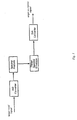
- a target vocal signal is first converted to digital data. This step is, of course, not required if the input signal is already presented in digital format.
- the first step is to perform spectral analysis on the target vocal signal.
- the spectral envelope is determined and used to create a time-varying filter for the purpose of flattening the spectral envelope of the target vocal signal.
- the method used for performing spectral analysis could employ various techniques from the prior art for generating a spectral model. These spectral analysis techniques include all-pole modeling methods such as linear prediction (see for example, P. Strobach, "Linear Prediction Theory", Springer-Verlag, 1990), adaptive filtering (see J. I. Makhoul and L.K. Cosell, "Adaptive Lattice Analysis of Speech," IEEE Trans. Acoustics, Speech, Signal Processing, vol. 29, pp.
- the preferred embodiment uses the autocorrelation method of linear prediction because of its computational simplicity and stability properties.
- the target voice signal is first separated into analysis segments.
- the autocorrelation method generates P reflection coefficients k i . These reflection coefficients can be used directly in either an all-pole synthesis digital lattice filter or an all-zero analysis digital lattice filter.
- the order of the spectral analysis P depends on the sample rate and other parameters as described in J. Markel and A.H. Gray Jr., Linear Prediction of Speech, Springer-Verlag, 1976.
- the alternative direct-form implementation for this all-pole method has a time-domain difference equation of the form: where y(k) is the current filter output sample value, x(k) is the current input sample value, and the a(i)'s are the coefficients of the direct-form filter. These coefficients a(i) are computed from the values of the reflection coefficients k i .
- the corresponding z-domain transfer function for the all-pole synthesis is:
- the complementary all-zero analysis filter has a difference equation given by: and a z-domain transfer function given by:
- the target vocal signal is processed by an analysis filter to compute an excitation signal having a flattened spectrum which is suitable for vocal transformation applications.
- this excitation signal can either be computed in real time or it can be computed beforehand and stored for later use.
- the excitation signal derived from the target may be stored in a compressed form where only the information essential to reproducing the character of the target singer are stored.
- the target excitation signal it is possible to further process the target excitation signal in order to make the system more forgiving of timing errors made by the source singer. For example, when the source singer sings a particular song his phrasing may be slightly different from the target singer's phrasing of that song. If the source singer begins singing a word slightly before the target singer did in his recording of the song there would be no excitation signal available to generate the output until the point where the target singer began the word. The source singer would perceive that the system is unresponsive and would find the delay annoying. Even if the alignment of the words is accurate it is unlikely that the unvoiced segments from the source singer will line up exactly with the unvoiced segments for the target singer.
- the output would sound quite unnatural if the excitation from an unvoiced portion of the target singer's signal was applied to generate a voiced segment in the output.
- the goal of this enhanced processing is to extend the excitation signal into the silent region before and after each word in the song and to identify unvoiced regions within the words and provide voiced excitation for those segments.
- voiced regions which may not be suitable for the transformation process.
- nasal sounds may have regions in the frequency spectrum with very little energy.
- the process of providing voiced excitation signal during unvoiced regions can be extended to include these unsuitably voiced regions in order to make the system even more forgiving of timing errors.
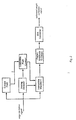
- the enhanced excitation processing system is shown in Figure 2.
- the target excitation signal is separated into segments which are classified as being either voiced or unvoiced.
- voicing detection is accomplished by examining the following parameters: average segment power, average low-band segment power, and zero crossings per segment. If the total average power for a segment is less than a 60 db below the recent maximum average power level, the segment is declared silent. If the number of zero crossings exceeds 8/ms, the segment is declared unvoiced. If the number of zero crossings are less than 5/ms, the segment is declared voiced. Finally, if the ratio of low-band average power to total band average power is less than 0.25, the segment is declared unvoiced. Otherwise it is declared voiced.
- the voicing detector can be enhanced to include the ability to detect regions which are not suitably voiced (e.g. nasals).
- Methods for detecting nasals include methods based on LPC gain (nasal sounds tend to have a large LPC gain).
- General methods for detecting unsuitably voiced regions are based on looking for harmonics with very low relative energy.
- Unvoiced or silent segments, and unsuitably voiced segments are then filled in with substituted voiced data from appropriate voiced regions (for example, from previous and subsequent voiced regions) or from a code book of data representing appropriate voiced sounds.
- the code book consists of a set of data derived directly from one or more target signals, or indirectly, for example from a parametric model.
- the substitution with voiced data can be accomplished.
- the goal is to create avoiced signal having a pitch contour which blends with the bounding pitch contour in a meaningful way (for example, for singing, the substituted notes should sound good with the background music).
- an interpolated pitch contour may be calculated automatically, using, for example, cubic spline interpolation.
- the pitch contour is first computed using spline interpolation, and then any portions which are deemed unsatisfactory are fixed manually by an operator. Once a suitable pitch contour is obtained, the gaps in the waveform left due to removal of unvoiced or unsuitably voiced regions must be filled in at the interpolated pitch value. There are several methods for doing this.
- samples from appropriate voiced segments are copied into the gap and then pitch shifted using the interpolated pitch contour.
- One method for performing the pitch shifting operation is formant corrected pitch shifting, for example, PSOLA (pitch synchronous overlap and add), the Lent method (cf. Lent, An Efficient Method for Pitch Shifting Digitally Sampled Sounds. Computer Music Journal,Vol. 13, No. 4, Winter 1989 and Gibson, et al.) or the modified method disclosed in Gibson et al., United States Patent No. 5,231,671.
- the candidate wavelets can be obtained from any appropriate place in the target signal.
- a code book may be used to store candidate wavelets or segments for use during substitution. When substitution is needed, the code book may be searched to find segments which provide a good match to the surrounding data, and these segments can then be pitch shifted to the interpolated target pitch.
- sinusoidal synthesis is used to morph between the waveforms on either side of the gap.
- Sinusoidal synthesis has been used extensively in fields such as speech compression (see, for example, D.W. Griffin and J.S. Lim, "Multiband excitation vocoder,” IEEE Trans. Acoustics, Speech, and Signal Processing, vol. 36, pp. 1223 - 1235, August, 1988).
- speech compression sinusoidal synthesis is used to reduce the number of bits required to represent a signal segment. For these applications, the pitch contour over a segment is usually interpolated using quadratic or cubic interpolation.
- the pitch contour, w ( n ) is determined (automatically or manually by an operator). Then spectral analysis using the Fast Fourier Transform (FFT) with peak picking (see, for example, R. J. McAulay and T.F.
- FFT Fast Fourier Transform
- the random pitch component, r k ( t ), is obtained by sampling a random variable having a variance which is determined for each harmonic by computing the difference between the predicted phase and measured phase for signal segments adjacent to the gap to be synthesized, and setting the variance proportional to this value.
- the amplitude envelope of the target excitation signal is flattened using automatic gain compensation.
- the excitation signal can also be a composite signal which is generated from a plurality of target vocal signals.
- the excitation signal could contain harmony, duet, or accompaniment parts.
- excitation signals from a male singer and a female singer singing a duet in harmony could each be processed as described above.
- the excitation signal which is used by the apparatus would then be the sum of these excitation signals.
- the transformed vocal signal which is generated by the apparatus would therefore contain both harmony parts with each part having characteristics (e.g., pitch, vibrato, and breathiness) derived from the respective target vocal signals.
- the resulting basic or enhanced target excitation signal and pitch data are then typically stored, usually for later use in a vocal transformer.
- the unprocessed target vocal signal may be stored and the target excitation signal generated when needed.
- the enhancement of the excitation could be entirely rule-based or the pitch contour and other controls for generating the excitation signal during silent and unvoiced segments could be stored along with the unprocessed target vocal signal.
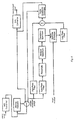
- a block of source vocal signal samples is analyzed to determine whether they are voiced or unvoiced.
- the number of samples contained in this block would typically correspond to a time span of approximately 20 milliseconds. e.g., for a sample rate of 40 kHz, a 20 ms block would contain 800 samples.
- This analysis is repeated on a periodic or pitch-synchronous basis to obtain a current estimate of the time-varying spectral envelope. This repetition period may be of lesser time duration than the temporal extent of the block of samples, implying that successive analyses would use overlapping blocks of vocal samples.
- the block of samples are determined to represent unvoiced input, the block is not further processed and is presented to the digital to analog converter for presentation to the output speaker. If the block of samples is determined to represent voiced input, a spectral analysis is performed to obtain an estimate of the envelope of the frequency spectrum of the vocal signal.
- the optional section for modification of the spectral envelope alters the frequency spectrum of the envelope obtained from the Spectral Analysis block. Five methods for spectral modification are contemplated.
- a first method is to modify the original spectral envelope by applying a conformal mapping to the z-domain transfer function in equation (2).
- Conformal mapping modifies the transfer function, resulting in a new transfer function of the form:
- a second method is to find the singularities (i.e., poles and zeros) of the digital filter transfer function, to then modify the location of any or all of these singularities, and then to use these new singularities to generate a new digital filter having the desired spectral characteristics.
- This second method applied to vocal signal modifications is known in the prior art.
- a third method for modifying the spectral envelope which obviates the need for a separate Modify Spectral Envelope step, is to modify the temporal extent of the blocks of vocal signals prior to the spectral analysis. This results in the spectral envelope obtained as a result of the spectral analysis being a frequency-scaled version of the unmodified spectral envelope.
- the relationship between time scaling and frequency scaling is described mathematically by the following property of the Fourier transform: where the left side of the equation is the time-scaled signal and the right side of the equation is the resulting frequency-scaled spectrum. for example, if the existing analysis block is 800 samples in length (representing 20 ms of the signal), an interpolation method could be used to generate 880 samples from these samples.
- a fourth method would involve manipulating a frequency-transformed representation of the signal as described in S. Seneff, System to independently modify excitation and/or spectrum of speech waveform without explicit pitch extraction, IEEE Trans. Acoustics, Speech, Signal Processing, Vol. 30, August 1982, the contents of which are incorporated herein by reference.
- a fifth method is to decompose the digital filter transfer function (which may have a high order) into a number of lower-order sections. Any of these lower-order sections could then be modified using the previously-described methods.
- modifying the low-frequency portion of the spectral envelope which can be accomplished by employing the aforementioned methods for modifying the spectral envelope.
- the low-frequency portion of the spectral envelope can be modified directly by using methods two or four.
- Methods one and three can also be used for this purpose if the target vocal signal is split into a low-frequency component (e.g., less than or equal to 1.5 kHz) and a high-frequency component (e.g., greater than 1.5 kHz).
- a separate spectral analysis can then be undertaken for both components as shown in Figure 7.
- the spectral envelope from the lower-frequency analysis would then be modified in accordance to the difference in pitches or difference in the location of the spectral peaks.
- the unmodified source spectral envelope may have a peak near 400 Hz and, without a peak near 200 Hz, there would be a smaller gain near 200 Hz, resulting in the first problem noted above.
- the preferred embodiment modifies the low-frequency portion of the spectral envelope in the following manner:
- the apparatus can be used to modify only the low-frequency spectral envelope or only the high-frequency spectral envelope. In this way, it can modify the low-frequency resonances without affecting the timbre of the high-frequency resonances or it can change only the timbre of the high-frequency resonances. It is also possible to modify both of these spectral envelopes concurrently.
- Another method which can be used to alleviate the aforementioned problems regarding the low-frequency region of the spectral envelope is to increase the bandwidth of the spectral peaks. This can be accomplished by applying techniques from prior art such as:
- High-fidelity digital audio systems typically employ higher sampling rates than are used in speech analysis or coding systems. This is because, with speech, most of the dominant spectral components have frequencies less than 10 kHz.
- the aforementioned order of the spectral analysis P can be reduced if the signal is split into high-frequency (e.g., greater than 10 kHz) and low-frequency (e.g. less than or equal to 10 kHz) signals by using digital filters. This low-frequency signal can then be down-sampled to a lower sampling rate before the spectral analysis and will therefore require a lower order of analysis.
- the input vocal signal is sampled at a high rate of over 40 kHz.
- the signal is then split into two equal-width frequency bands, as shown in Figure 8.
- the low-frequency portion is decimated and then analyzed in order to generate the reflection coefficients k i .
- the excitation signal is also sampled at this high rate and then filtered using an interpolated lattice filter (i.e., a lattice filter where the unit delays are replaced by two unit delays).
- This signal is then post-filtered by a lowpass filter to remove the spectral image of the interpolated lattice filter and gain compensation is applied.
- the resulting signal is the low-frequency component of the transformed vocal signal.
- the interpolated filtering technique is used rather than the more conventional downsample-filter-upsample method since it completely eliminates distortion due to aliasing in the resampling process.
- the need for an interpolated lattice filter would be obviated if the excitation signal was sampled at a lower rate matching the decimated rate.
- the invention would use two different sampling rates concurrently thereby reducing the computational demands.
- the final output signal is obtained by summing a gain-compensated high-frequency signal and the transformed low-frequency component. This method can be applied in conjunction with the method illustrated in Figure 7.
- the spectral envelope can therefore be modified by a plurality of methods and also through combinations of these methods.
- the modified spectral envelope is then used to generate a time-varying synthesis digital filter having the corresponding frequency response.
- this digital filter is applied to the target excitation signal which was generated as a result of the excitation signal extraction processing step.
- the preferred embodiment implements this filter using a lattice digital filter.
- the output of this filter is the discrete-time representation of the desired transformed vocal signal.
- each level is computed using the following recursive algorithm:
- the amplitude envelope to be applied to the current output frame is also computed using a recursive algorithm:
- This algorithm uses delayed values of L s and L e to compensate for processing delays within the system.
- the frame-to-frame values of A s are linearly interpolated across the frames to generate a smoothly-varying amplitude envelope.
- Each sample from the Apply Spectral Envelope block is multiplied by this time-varying envelope.
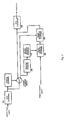
- Figure 4 illustrates the case where the pitch of the source vocal signal is to be retained.
- the pitch of the source vocal signal is determined.
- a method for doing so is disclosed in Gibson, et al., United States Patent No. 4,688,464, the contents of which are incorporated herein by reference.
- the target excitation signal is then pitch shifted by the amount required to track the pitch of the source vocal signal before applying the modified or unmodified source spectral envelope to the excitation signal.
- a method of pitch shifting suitable for this purpose is disclosed in Gibson et al., United States Patent No. 5,567,901, the contents of which are incorporated herein by reference.
- the pitch detection process may also use long-term averaging when computing pitch shift amounts. Pitch data is averaged over ranges between 50 ms and 500 ms depending on the characteristics of the target singer. The averaging calculation is reset whenever a new note is detected. In some applications the pitch of the target excitation is shifted by a fixed amount, to accomplish a key change, and the pitch of the source singer is ignored.
Landscapes
- Engineering & Computer Science (AREA)
- Physics & Mathematics (AREA)
- Acoustics & Sound (AREA)
- Multimedia (AREA)
- Audiology, Speech & Language Pathology (AREA)
- Health & Medical Sciences (AREA)
- Computational Linguistics (AREA)
- Human Computer Interaction (AREA)
- Electrophonic Musical Instruments (AREA)
- Containers And Packaging Bodies Having A Special Means To Remove Contents (AREA)
- Vehicle Body Suspensions (AREA)
- Electrically Operated Instructional Devices (AREA)
- Compression, Expansion, Code Conversion, And Decoders (AREA)
- Steroid Compounds (AREA)
- Transition And Organic Metals Composition Catalysts For Addition Polymerization (AREA)
Claims (15)
- Verfahren zum Umformen der Stimmeigenschaften einer Quellenstimme, um die Stimmeigenschaften einer Zielstimme zu übernehmen, unter Verwendung der Spektralhüllkurve der Quellenstimme, gekennzeichnet durch das Kombinieren der Spektralhüllkurve mit einem Anregungssignal, das von einer Aufzeichnung der Zielstimme abgeleitet wird.
- Verfahren nach Anspruch 1, welches ferner durch das Modifizieren der Spektralhüllkurve der Quellenstimme, damit sie der Spektralhüllkurve der Zielstimme genauer entspricht, gekennzeichnet ist.
- Verfahren nach Anspruch 1, welches femer durch das Modifizieren der Spektralhüllkurve der Quellenstimme, um Unterschiede der Tonhöhe zwischen der Quellenstimme und der Zielstimme zu berücksichtigen, gekennzeichnet ist.
- Verfahren nach Anspruch 1, wobei das Anregungssignal durch Abflachen der Spektralhüllkurve der Aufzeichnung erhalten wird.
- Verfahren nach Anspruch 1, wobei der Schritt des Ableitens des Anregungssignals durch den Schritt des Austauschens von stimmlosen, ungeeignet stimmhaften und ruhigen Segmenten in der Aufzeichnung gegen stimmhafte Daten gekennzeichnet ist.
- Verfahren nach Anspruch 5, wobei die stimmhaften Daten aus stimmhaften Segmenten in der Aufzeichnung abgeleitet werden.
- Verfahren entweder nach Anspruch 5 oder 6, welches femer den Schritt des Modifizierens der Tonhöhe der stimmhaften Daten umfaßt.
- Verfahren nach Anspruch 1, wobei das Anregungssignal in einem komprimierten Format gespeichert wird.
- Verfahren nach Anspruch 1, welches ferner dadurch gekennzeichnet ist, daß das Anregungssignal in einem Datenformat gespeichert wird, das eine Information umfaßt, die zumindest eines der folgenden Merkmale des Anregungssignals beschreibt: Tonhöhenkontur, Stimmritzeneigenschaften.
- Verfahren nach Anspruch 1, wobei stimmlose Segmente des Signals, die sich aus der Kombination ergeben, hinsichtlich Unterschieden zwischen der Quellenstimme und der Zielstimme eingestellt werden.
- Verfahren nach Anspruch 1, wobei das Kombinieren selektiv für ein oder mehrere Frequenzbänder durchgeführt wird.
- Verfahren nach Anspruch 1, welches ferner gekennzeichnet ist durch das Einstellen der Tonhöhe des Stimmsignals, das sich aus dem Schritt des Kombinierens ergibt, um kurzzeitige Tonhöheneigenschaften, die von der Aufzeichnung abgeleitet werden, und die langzeitigeren Tonhöheneigenschaften der Quellenstimme zu integrieren.
- Verfahren nach Anspruch 1, welches ferner durch Anwenden der Amplitudenhüllkurve der Quellenstimme auf die Stimme, die sich aus der Kombination ergibt, gekennzeichnet ist.
- Verfahren zum Umformen der Stimmeigenschaften einer Quellenstimme, um die Stimmeigenschaften einer Vielzahl von Zielstimmen zu übernehmen, unter Verwendung der Spektralhüllkurve der Quellenstimme, gekennzeichnet durch das Kombinieren der Spektralhüllkurve mit den Anregungssignalen, die von Aufzeichnungen der Zielstimmen abgeleitet werden.
- Verfahren nach einem der Ansprüche 1 bis 14, welches ferner dadurch gekennzeichnet ist, daß die Stimmen Singstimmen sind.
Applications Claiming Priority (3)
| Application Number | Priority Date | Filing Date | Title |
|---|---|---|---|
| US08/848,050 US6336092B1 (en) | 1997-04-28 | 1997-04-28 | Targeted vocal transformation |
| US848050 | 1997-04-28 | ||
| PCT/CA1998/000406 WO1998049670A1 (en) | 1997-04-28 | 1998-04-27 | Targeted vocal transformation |
Publications (2)
| Publication Number | Publication Date |
|---|---|
| EP0979503A1 EP0979503A1 (de) | 2000-02-16 |
| EP0979503B1 true EP0979503B1 (de) | 2003-02-26 |
Family
ID=25302206
Family Applications (1)
| Application Number | Title | Priority Date | Filing Date |
|---|---|---|---|
| EP98916753A Expired - Lifetime EP0979503B1 (de) | 1997-04-28 | 1998-04-27 | Stimmentransformation nach einer zielstimme |
Country Status (7)
| Country | Link |
|---|---|
| US (1) | US6336092B1 (de) |
| EP (1) | EP0979503B1 (de) |
| JP (1) | JP2001522471A (de) |
| AT (1) | ATE233424T1 (de) |
| AU (1) | AU7024798A (de) |
| DE (1) | DE69811656T2 (de) |
| WO (1) | WO1998049670A1 (de) |
Cited By (1)
| Publication number | Priority date | Publication date | Assignee | Title |
|---|---|---|---|---|
| CN102227770A (zh) * | 2009-07-06 | 2011-10-26 | 松下电器产业株式会社 | 音质变换装置、音高变换装置及音质变换方法 |
Families Citing this family (112)
| Publication number | Priority date | Publication date | Assignee | Title |
|---|---|---|---|---|
| JPH10319947A (ja) * | 1997-05-15 | 1998-12-04 | Kawai Musical Instr Mfg Co Ltd | 音域制御装置 |
| TW430778B (en) * | 1998-06-15 | 2001-04-21 | Yamaha Corp | Voice converter with extraction and modification of attribute data |
| GB2350228B (en) | 1999-05-20 | 2001-04-04 | Kar Ming Chow | An apparatus for and a method of processing analogue audio signals |
| US6836761B1 (en) * | 1999-10-21 | 2004-12-28 | Yamaha Corporation | Voice converter for assimilation by frame synthesis with temporal alignment |
| US6463412B1 (en) * | 1999-12-16 | 2002-10-08 | International Business Machines Corporation | High performance voice transformation apparatus and method |
| US6581030B1 (en) * | 2000-04-13 | 2003-06-17 | Conexant Systems, Inc. | Target signal reference shifting employed in code-excited linear prediction speech coding |
| JP4296714B2 (ja) * | 2000-10-11 | 2009-07-15 | ソニー株式会社 | ロボット制御装置およびロボット制御方法、記録媒体、並びにプログラム |
| WO2002037471A2 (en) * | 2000-11-03 | 2002-05-10 | Zoesis, Inc. | Interactive character system |
| US6829577B1 (en) * | 2000-11-03 | 2004-12-07 | International Business Machines Corporation | Generating non-stationary additive noise for addition to synthesized speech |
| IL140082A0 (en) * | 2000-12-04 | 2002-02-10 | Sisbit Trade And Dev Ltd | Improved speech transformation system and apparatus |
| AUPR433901A0 (en) * | 2001-04-10 | 2001-05-17 | Lake Technology Limited | High frequency signal construction method |
| JP3709817B2 (ja) * | 2001-09-03 | 2005-10-26 | ヤマハ株式会社 | 音声合成装置、方法、及びプログラム |
| JP2003181136A (ja) * | 2001-12-14 | 2003-07-02 | Sega Corp | 音声制御方法 |
| US20030154080A1 (en) * | 2002-02-14 | 2003-08-14 | Godsey Sandra L. | Method and apparatus for modification of audio input to a data processing system |
| US6950799B2 (en) * | 2002-02-19 | 2005-09-27 | Qualcomm Inc. | Speech converter utilizing preprogrammed voice profiles |
| KR100880480B1 (ko) * | 2002-02-21 | 2009-01-28 | 엘지전자 주식회사 | 디지털 오디오 신호의 실시간 음악/음성 식별 방법 및시스템 |
| US20030182106A1 (en) * | 2002-03-13 | 2003-09-25 | Spectral Design | Method and device for changing the temporal length and/or the tone pitch of a discrete audio signal |
| US7191134B2 (en) * | 2002-03-25 | 2007-03-13 | Nunally Patrick O'neal | Audio psychological stress indicator alteration method and apparatus |
| US20030187663A1 (en) | 2002-03-28 | 2003-10-02 | Truman Michael Mead | Broadband frequency translation for high frequency regeneration |
| GB0209770D0 (en) * | 2002-04-29 | 2002-06-05 | Mindweavers Ltd | Synthetic speech sound |
| JP3941611B2 (ja) * | 2002-07-08 | 2007-07-04 | ヤマハ株式会社 | 歌唱合成装置、歌唱合成方法及び歌唱合成用プログラム |
| US8073157B2 (en) * | 2003-08-27 | 2011-12-06 | Sony Computer Entertainment Inc. | Methods and apparatus for targeted sound detection and characterization |
| US8947347B2 (en) | 2003-08-27 | 2015-02-03 | Sony Computer Entertainment Inc. | Controlling actions in a video game unit |
| US7783061B2 (en) | 2003-08-27 | 2010-08-24 | Sony Computer Entertainment Inc. | Methods and apparatus for the targeted sound detection |
| US7809145B2 (en) * | 2006-05-04 | 2010-10-05 | Sony Computer Entertainment Inc. | Ultra small microphone array |
| US8233642B2 (en) * | 2003-08-27 | 2012-07-31 | Sony Computer Entertainment Inc. | Methods and apparatuses for capturing an audio signal based on a location of the signal |
| US7803050B2 (en) * | 2002-07-27 | 2010-09-28 | Sony Computer Entertainment Inc. | Tracking device with sound emitter for use in obtaining information for controlling game program execution |
| US8160269B2 (en) | 2003-08-27 | 2012-04-17 | Sony Computer Entertainment Inc. | Methods and apparatuses for adjusting a listening area for capturing sounds |
| US8139793B2 (en) * | 2003-08-27 | 2012-03-20 | Sony Computer Entertainment Inc. | Methods and apparatus for capturing audio signals based on a visual image |
| US9174119B2 (en) | 2002-07-27 | 2015-11-03 | Sony Computer Entertainement America, LLC | Controller for providing inputs to control execution of a program when inputs are combined |
| GB2392358A (en) * | 2002-08-02 | 2004-02-25 | Rhetorical Systems Ltd | Method and apparatus for smoothing fundamental frequency discontinuities across synthesized speech segments |
| FR2843479B1 (fr) * | 2002-08-07 | 2004-10-22 | Smart Inf Sa | Procede de calibrage d'audio-intonation |
| WO2004027753A1 (en) * | 2002-09-17 | 2004-04-01 | Koninklijke Philips Electronics N.V. | Method of synthesis for a steady sound signal |
| US6915224B2 (en) * | 2002-10-25 | 2005-07-05 | Jung-Ching Wu | Method for optimum spectrum analysis |
| US20040138876A1 (en) * | 2003-01-10 | 2004-07-15 | Nokia Corporation | Method and apparatus for artificial bandwidth expansion in speech processing |
| JP4076887B2 (ja) * | 2003-03-24 | 2008-04-16 | ローランド株式会社 | ボコーダ装置 |
| EP1687803A4 (de) * | 2003-11-21 | 2007-12-05 | Agency Science Tech & Res | Verfahren und vorrichtung für melodierepräsentation und -vergleich für das abrufen von musik |
| US7412377B2 (en) * | 2003-12-19 | 2008-08-12 | International Business Machines Corporation | Voice model for speech processing based on ordered average ranks of spectral features |
| DE102004012208A1 (de) * | 2004-03-12 | 2005-09-29 | Siemens Ag | Individualisierung von Sprachausgabe durch Anpassen einer Synthesestimme an eine Zielstimme |
| FR2868587A1 (fr) * | 2004-03-31 | 2005-10-07 | France Telecom | Procede et systeme de conversion rapides d'un signal vocal |
| FR2868586A1 (fr) * | 2004-03-31 | 2005-10-07 | France Telecom | Procede et systeme ameliores de conversion d'un signal vocal |
| JP4649888B2 (ja) * | 2004-06-24 | 2011-03-16 | ヤマハ株式会社 | 音声効果付与装置及び音声効果付与プログラム |
| US7117147B2 (en) * | 2004-07-28 | 2006-10-03 | Motorola, Inc. | Method and system for improving voice quality of a vocoder |
| DE102004048707B3 (de) * | 2004-10-06 | 2005-12-29 | Siemens Ag | Verfahren zur Stimmenkonversion für ein Sprachsynthesesystem |
| US7825321B2 (en) * | 2005-01-27 | 2010-11-02 | Synchro Arts Limited | Methods and apparatus for use in sound modification comparing time alignment data from sampled audio signals |
| JP4645241B2 (ja) * | 2005-03-10 | 2011-03-09 | ヤマハ株式会社 | 音声処理装置およびプログラム |
| DE602005015419D1 (de) * | 2005-04-07 | 2009-08-27 | Suisse Electronique Microtech | Verfahren und Vorrichtung zur Sprachkonversion |
| US7716052B2 (en) * | 2005-04-07 | 2010-05-11 | Nuance Communications, Inc. | Method, apparatus and computer program providing a multi-speaker database for concatenative text-to-speech synthesis |
| US20080161057A1 (en) * | 2005-04-15 | 2008-07-03 | Nokia Corporation | Voice conversion in ring tones and other features for a communication device |
| US20060235685A1 (en) * | 2005-04-15 | 2006-10-19 | Nokia Corporation | Framework for voice conversion |
| JP2009501958A (ja) * | 2005-07-21 | 2009-01-22 | コーニンクレッカ フィリップス エレクトロニクス エヌ ヴィ | オーディオ信号修正 |
| JP2007140200A (ja) * | 2005-11-18 | 2007-06-07 | Yamaha Corp | 語学学習装置およびプログラム |
| CN101351841B (zh) * | 2005-12-02 | 2011-11-16 | 旭化成株式会社 | 音质转换系统 |
| CN101004911B (zh) * | 2006-01-17 | 2012-06-27 | 纽昂斯通讯公司 | 用于生成频率弯曲函数及进行频率弯曲的方法和装置 |
| JP4241736B2 (ja) * | 2006-01-19 | 2009-03-18 | 株式会社東芝 | 音声処理装置及びその方法 |
| US20070213987A1 (en) * | 2006-03-08 | 2007-09-13 | Voxonic, Inc. | Codebook-less speech conversion method and system |
| US7831420B2 (en) * | 2006-04-04 | 2010-11-09 | Qualcomm Incorporated | Voice modifier for speech processing systems |
| US20110014981A1 (en) * | 2006-05-08 | 2011-01-20 | Sony Computer Entertainment Inc. | Tracking device with sound emitter for use in obtaining information for controlling game program execution |
| US20080120115A1 (en) * | 2006-11-16 | 2008-05-22 | Xiao Dong Mao | Methods and apparatuses for dynamically adjusting an audio signal based on a parameter |
| JP4966048B2 (ja) * | 2007-02-20 | 2012-07-04 | 株式会社東芝 | 声質変換装置及び音声合成装置 |
| US8907193B2 (en) * | 2007-02-20 | 2014-12-09 | Ubisoft Entertainment | Instrument game system and method |
| US20080200224A1 (en) | 2007-02-20 | 2008-08-21 | Gametank Inc. | Instrument Game System and Method |
| US7974838B1 (en) * | 2007-03-01 | 2011-07-05 | iZotope, Inc. | System and method for pitch adjusting vocals |
| US8131549B2 (en) * | 2007-05-24 | 2012-03-06 | Microsoft Corporation | Personality-based device |
| US8086461B2 (en) | 2007-06-13 | 2011-12-27 | At&T Intellectual Property Ii, L.P. | System and method for tracking persons of interest via voiceprint |
| US8706496B2 (en) * | 2007-09-13 | 2014-04-22 | Universitat Pompeu Fabra | Audio signal transforming by utilizing a computational cost function |
| CN101399044B (zh) * | 2007-09-29 | 2013-09-04 | 纽奥斯通讯有限公司 | 语音转换方法和系统 |
| US8311831B2 (en) * | 2007-10-01 | 2012-11-13 | Panasonic Corporation | Voice emphasizing device and voice emphasizing method |
| US8015002B2 (en) | 2007-10-24 | 2011-09-06 | Qnx Software Systems Co. | Dynamic noise reduction using linear model fitting |
| US8606566B2 (en) * | 2007-10-24 | 2013-12-10 | Qnx Software Systems Limited | Speech enhancement through partial speech reconstruction |
| US8326617B2 (en) | 2007-10-24 | 2012-12-04 | Qnx Software Systems Limited | Speech enhancement with minimum gating |
| US20090222268A1 (en) * | 2008-03-03 | 2009-09-03 | Qnx Software Systems (Wavemakers), Inc. | Speech synthesis system having artificial excitation signal |
| ES2898865T3 (es) * | 2008-03-20 | 2022-03-09 | Fraunhofer Ges Forschung | Aparato y método para sintetizar una representación parametrizada de una señal de audio |
| JP5038995B2 (ja) * | 2008-08-25 | 2012-10-03 | 株式会社東芝 | 声質変換装置及び方法、音声合成装置及び方法 |
| US9120016B2 (en) | 2008-11-21 | 2015-09-01 | Ubisoft Entertainment | Interactive guitar game designed for learning to play the guitar |
| TWI394142B (zh) * | 2009-08-25 | 2013-04-21 | Inst Information Industry | 歌聲合成系統、方法、以及裝置 |
| KR20110028095A (ko) * | 2009-09-11 | 2011-03-17 | 삼성전자주식회사 | 실시간 화자 적응을 통한 음성 인식 시스템 및 방법 |
| US9058797B2 (en) | 2009-12-15 | 2015-06-16 | Smule, Inc. | Continuous pitch-corrected vocal capture device cooperative with content server for backing track mix |
| EP2518723A4 (de) * | 2009-12-21 | 2012-11-28 | Fujitsu Ltd | Sprachsteuerung und sprachsteuerungsverfahren |
| US8996364B2 (en) | 2010-04-12 | 2015-03-31 | Smule, Inc. | Computational techniques for continuous pitch correction and harmony generation |
| US9601127B2 (en) * | 2010-04-12 | 2017-03-21 | Smule, Inc. | Social music system and method with continuous, real-time pitch correction of vocal performance and dry vocal capture for subsequent re-rendering based on selectively applicable vocal effect(s) schedule(s) |
| US10930256B2 (en) | 2010-04-12 | 2021-02-23 | Smule, Inc. | Social music system and method with continuous, real-time pitch correction of vocal performance and dry vocal capture for subsequent re-rendering based on selectively applicable vocal effect(s) schedule(s) |
| WO2011151956A1 (ja) * | 2010-06-04 | 2011-12-08 | パナソニック株式会社 | 声質変換装置及びその方法、母音情報作成装置並びに声質変換システム |
| JP5510852B2 (ja) * | 2010-07-20 | 2014-06-04 | 独立行政法人産業技術総合研究所 | 声色変化反映歌声合成システム及び声色変化反映歌声合成方法 |
| US9866731B2 (en) | 2011-04-12 | 2018-01-09 | Smule, Inc. | Coordinating and mixing audiovisual content captured from geographically distributed performers |
| WO2013077843A1 (en) * | 2011-11-21 | 2013-05-30 | Empire Technology Development Llc | Audio interface |
| JP5772739B2 (ja) * | 2012-06-21 | 2015-09-02 | ヤマハ株式会社 | 音声処理装置 |
| US9159310B2 (en) | 2012-10-19 | 2015-10-13 | The Tc Group A/S | Musical modification effects |
| US9104298B1 (en) | 2013-05-10 | 2015-08-11 | Trade Only Limited | Systems, methods, and devices for integrated product and electronic image fulfillment |
| GB201315142D0 (en) * | 2013-08-23 | 2013-10-09 | Ucl Business Plc | Audio-Visual Dialogue System and Method |
| JP6433650B2 (ja) * | 2013-11-15 | 2018-12-05 | 国立大学法人佐賀大学 | 気分誘導装置および気分誘導プログラムならびにコンピュータの動作方法 |
| JP6616962B2 (ja) * | 2015-05-13 | 2019-12-04 | 日本放送協会 | 信号処理装置及びプログラム |
| US11488569B2 (en) | 2015-06-03 | 2022-11-01 | Smule, Inc. | Audio-visual effects system for augmentation of captured performance based on content thereof |
| US10157408B2 (en) | 2016-07-29 | 2018-12-18 | Customer Focus Software Limited | Method, systems, and devices for integrated product and electronic image fulfillment from database |
| US11310538B2 (en) | 2017-04-03 | 2022-04-19 | Smule, Inc. | Audiovisual collaboration system and method with latency management for wide-area broadcast and social media-type user interface mechanics |
| WO2018187360A2 (en) | 2017-04-03 | 2018-10-11 | Smule, Inc. | Audiovisual collaboration method with latency management for wide-area broadcast |
| US10614826B2 (en) * | 2017-05-24 | 2020-04-07 | Modulate, Inc. | System and method for voice-to-voice conversion |
| US10248971B2 (en) | 2017-09-07 | 2019-04-02 | Customer Focus Software Limited | Methods, systems, and devices for dynamically generating a personalized advertisement on a website for manufacturing customizable products |
| CN107863095A (zh) * | 2017-11-21 | 2018-03-30 | 广州酷狗计算机科技有限公司 | 音频信号处理方法、装置和存储介质 |
| JP7147211B2 (ja) * | 2018-03-22 | 2022-10-05 | ヤマハ株式会社 | 情報処理方法および情報処理装置 |
| US10791404B1 (en) * | 2018-08-13 | 2020-09-29 | Michael B. Lasky | Assisted hearing aid with synthetic substitution |
| CN111383646B (zh) | 2018-12-28 | 2020-12-08 | 广州市百果园信息技术有限公司 | 一种语音信号变换方法、装置、设备和存储介质 |
| US11228469B1 (en) * | 2020-07-16 | 2022-01-18 | Deeyook Location Technologies Ltd. | Apparatus, system and method for providing locationing multipath mitigation |
| JP2023546989A (ja) | 2020-10-08 | 2023-11-08 | モジュレイト インク. | コンテンツモデレーションのためのマルチステージ適応型システム |
| CN112382271B (zh) * | 2020-11-30 | 2024-03-26 | 北京百度网讯科技有限公司 | 语音处理方法、装置、电子设备和存储介质 |
| CN116110424B (zh) * | 2021-11-11 | 2025-07-15 | 腾讯科技(深圳)有限公司 | 一种语音带宽扩展方法及相关装置 |
| WO2023152803A1 (ja) * | 2022-02-08 | 2023-08-17 | ファナック株式会社 | 音声認識装置、及びコンピュータが読み取り可能な記録媒体 |
| US12341619B2 (en) | 2022-06-01 | 2025-06-24 | Modulate, Inc. | User interface for content moderation of voice chat |
| US12424204B1 (en) | 2022-08-23 | 2025-09-23 | Gn Hearing A/S | Speech recognition hearing device with multiple supportive detection inputs |
| US20250191599A1 (en) * | 2023-12-07 | 2025-06-12 | Microsoft Technology Licensing, Llc | System and Method for Secure Speech Feature Extraction |
| US12444393B1 (en) * | 2025-04-17 | 2025-10-14 | Eidol Corporation | Systems, devices, and methods for dynamic synchronization of a prerecorded vocal backing track to a live vocal performance |
| US12620380B1 (en) | 2025-10-06 | 2026-05-05 | Eidol Corporation | Systems, devices, and methods for dynamic synchronization of a prerecorded vocal backing track to a vocal performance |
Family Cites Families (48)
| Publication number | Priority date | Publication date | Assignee | Title |
|---|---|---|---|---|
| US3600516A (en) * | 1969-06-02 | 1971-08-17 | Ibm | Voicing detection and pitch extraction system |
| US3539701A (en) | 1967-07-07 | 1970-11-10 | Ursula A Milde | Electrical musical instrument |
| US3929051A (en) | 1973-10-23 | 1975-12-30 | Chicago Musical Instr Co | Multiplex harmony generator |
| US3999456A (en) | 1974-06-04 | 1976-12-28 | Matsushita Electric Industrial Co., Ltd. | Voice keying system for a voice controlled musical instrument |
| US3986423A (en) | 1974-12-11 | 1976-10-19 | Oberheim Electronics Inc. | Polyphonic music synthesizer |
| US4004096A (en) * | 1975-02-18 | 1977-01-18 | The United States Of America As Represented By The Secretary Of The Army | Process for extracting pitch information |
| CA1056504A (en) | 1975-04-02 | 1979-06-12 | Visvaldis A. Vitols | Keyword detection in continuous speech using continuous asynchronous correlation |
| US4076960A (en) | 1976-10-27 | 1978-02-28 | Texas Instruments Incorporated | CCD speech processor |
| US4279185A (en) | 1977-06-07 | 1981-07-21 | Alonso Sydney A | Electronic music sampling techniques |
| US4142066A (en) | 1977-12-27 | 1979-02-27 | Bell Telephone Laboratories, Incorporated | Suppression of idle channel noise in delta modulation systems |
| US4508002A (en) | 1979-01-15 | 1985-04-02 | Norlin Industries | Method and apparatus for improved automatic harmonization |
| US4311076A (en) | 1980-01-07 | 1982-01-19 | Whirlpool Corporation | Electronic musical instrument with harmony generation |
| US4387618A (en) | 1980-06-11 | 1983-06-14 | Baldwin Piano & Organ Co. | Harmony generator for electronic organ |
| JPS5748791A (en) | 1980-09-08 | 1982-03-20 | Nippon Musical Instruments Mfg | Electronic musical instrument |
| CH657468A5 (de) | 1981-02-25 | 1986-08-29 | Clayton Found Res | Bedienungsgeraet an einem mit wenigstens einem synthesizer versehenen elektronischen musikinstrument. |
| US4464784A (en) | 1981-04-30 | 1984-08-07 | Eventide Clockworks, Inc. | Pitch changer with glitch minimizer |
| JPS58102298A (ja) | 1981-12-14 | 1983-06-17 | キヤノン株式会社 | 電子機器 |
| JPS58208914A (ja) | 1982-05-31 | 1983-12-05 | Toshiba Ii M I Kk | オーディオ用記録媒体の記録再生装置およびそれに使用する記録媒体 |
| US4561102A (en) * | 1982-09-20 | 1985-12-24 | At&T Bell Laboratories | Pitch detector for speech analysis |
| US4802223A (en) | 1983-11-03 | 1989-01-31 | Texas Instruments Incorporated | Low data rate speech encoding employing syllable pitch patterns |
| US5005204A (en) | 1985-07-18 | 1991-04-02 | Raytheon Company | Digital sound synthesizer and method |
| US4688464A (en) | 1986-01-16 | 1987-08-25 | Ivl Technologies Ltd. | Pitch detection apparatus |
| US4771671A (en) | 1987-01-08 | 1988-09-20 | Breakaway Technologies, Inc. | Entertainment and creative expression device for easily playing along to background music |
| JPH0670876B2 (ja) | 1987-02-10 | 1994-09-07 | ソニー株式会社 | 光学ディスク及び光学ディスク再生装置 |
| US5048390A (en) | 1987-09-03 | 1991-09-17 | Yamaha Corporation | Tone visualizing apparatus |
| KR930010396B1 (ko) | 1988-01-06 | 1993-10-23 | 야마하 가부시끼가이샤 | 악음신호 발생장치 |
| US4991218A (en) | 1988-01-07 | 1991-02-05 | Yield Securities, Inc. | Digital signal processor for providing timbral change in arbitrary audio and dynamically controlled stored digital audio signals |
| US4915001A (en) | 1988-08-01 | 1990-04-10 | Homer Dillard | Voice to music converter |
| US4998960A (en) | 1988-09-30 | 1991-03-12 | Floyd Rose | Music synthesizer |
| CN1013525B (zh) * | 1988-11-16 | 1991-08-14 | 中国科学院声学研究所 | 认人与不认人实时语音识别的方法和装置 |
| JP2853147B2 (ja) * | 1989-03-27 | 1999-02-03 | 松下電器産業株式会社 | 音程変換装置 |
| US5029509A (en) | 1989-05-10 | 1991-07-09 | Board Of Trustees Of The Leland Stanford Junior University | Musical synthesizer combining deterministic and stochastic waveforms |
| JPH037995A (ja) * | 1989-06-05 | 1991-01-16 | Matsushita Electric Works Ltd | 歌音声合成データの作成装置 |
| US5092216A (en) * | 1989-08-17 | 1992-03-03 | Wayne Wadhams | Method and apparatus for studying music |
| US5194681A (en) * | 1989-09-22 | 1993-03-16 | Yamaha Corporation | Musical tone generating apparatus |
| JPH04158397A (ja) * | 1990-10-22 | 1992-06-01 | A T R Jido Honyaku Denwa Kenkyusho:Kk | 声質変換方式 |
| US5054360A (en) | 1990-11-01 | 1991-10-08 | International Business Machines Corporation | Method and apparatus for simultaneous output of digital audio and midi synthesized music |
| JP3175179B2 (ja) | 1991-03-19 | 2001-06-11 | カシオ計算機株式会社 | デジタルピッチシフター |
| US5231671A (en) * | 1991-06-21 | 1993-07-27 | Ivl Technologies, Ltd. | Method and apparatus for generating vocal harmonies |
| US5428708A (en) * | 1991-06-21 | 1995-06-27 | Ivl Technologies Ltd. | Musical entertainment system |
| JP3435168B2 (ja) * | 1991-11-18 | 2003-08-11 | パイオニア株式会社 | 音程制御装置及び方法 |
| WO1993018505A1 (en) | 1992-03-02 | 1993-09-16 | The Walt Disney Company | Voice transformation system |
| US5765127A (en) * | 1992-03-18 | 1998-06-09 | Sony Corp | High efficiency encoding method |
| JP3197975B2 (ja) * | 1993-02-26 | 2001-08-13 | 株式会社エヌ・ティ・ティ・データ | ピッチ制御方法及び装置 |
| US5536902A (en) | 1993-04-14 | 1996-07-16 | Yamaha Corporation | Method of and apparatus for analyzing and synthesizing a sound by extracting and controlling a sound parameter |
| US5644677A (en) | 1993-09-13 | 1997-07-01 | Motorola, Inc. | Signal processing system for performing real-time pitch shifting and method therefor |
| US5567901A (en) * | 1995-01-18 | 1996-10-22 | Ivl Technologies Ltd. | Method and apparatus for changing the timbre and/or pitch of audio signals |
| JP3102335B2 (ja) | 1996-01-18 | 2000-10-23 | ヤマハ株式会社 | フォルマント変換装置およびカラオケ装置 |
-
1997
- 1997-04-28 US US08/848,050 patent/US6336092B1/en not_active Expired - Fee Related
-
1998
- 1998-04-27 AT AT98916753T patent/ATE233424T1/de not_active IP Right Cessation
- 1998-04-27 WO PCT/CA1998/000406 patent/WO1998049670A1/en not_active Ceased
- 1998-04-27 DE DE69811656T patent/DE69811656T2/de not_active Expired - Fee Related
- 1998-04-27 JP JP54644398A patent/JP2001522471A/ja active Pending
- 1998-04-27 EP EP98916753A patent/EP0979503B1/de not_active Expired - Lifetime
- 1998-04-27 AU AU70247/98A patent/AU7024798A/en not_active Abandoned
Cited By (1)
| Publication number | Priority date | Publication date | Assignee | Title |
|---|---|---|---|---|
| CN102227770A (zh) * | 2009-07-06 | 2011-10-26 | 松下电器产业株式会社 | 音质变换装置、音高变换装置及音质变换方法 |
Also Published As
| Publication number | Publication date |
|---|---|
| US6336092B1 (en) | 2002-01-01 |
| JP2001522471A (ja) | 2001-11-13 |
| AU7024798A (en) | 1998-11-24 |
| DE69811656T2 (de) | 2003-10-16 |
| EP0979503A1 (de) | 2000-02-16 |
| ATE233424T1 (de) | 2003-03-15 |
| DE69811656D1 (de) | 2003-04-03 |
| WO1998049670A1 (en) | 1998-11-05 |
Similar Documents
| Publication | Publication Date | Title |
|---|---|---|
| US6336092B1 (en) | Targeted vocal transformation | |
| EP2881947B1 (de) | Spektrale hüllkurve und gruppenverzögerungsinferenzsystem sowie sprachsignalsynthesesystem für sprachanalyse / synthese | |
| JP3985814B2 (ja) | 歌唱合成装置 | |
| Slaney et al. | Automatic audio morphing | |
| EP2264696B1 (de) | Stimmveränderung mit Extrahierung und Modifizierung von Stimmparametern | |
| US8706496B2 (en) | Audio signal transforming by utilizing a computational cost function | |
| JP5961950B2 (ja) | 音声処理装置 | |
| JP4265501B2 (ja) | 音声合成装置およびプログラム | |
| WO1997034289A1 (en) | System for automatically morphing audio information | |
| Grofit et al. | Time-scale modification of audio signals using enhanced WSOLA with management of transients | |
| Bonada et al. | Singing voice synthesis combining excitation plus resonance and sinusoidal plus residual models | |
| Wright et al. | Analysis/synthesis comparison | |
| JP2904279B2 (ja) | 音声合成方法および装置 | |
| Ruinskiy et al. | Stochastic models of pitch jitter and amplitude shimmer for voice modification | |
| Violaro et al. | A hybrid model for text-to-speech synthesis | |
| JP5573529B2 (ja) | 音声処理装置およびプログラム | |
| JP4430174B2 (ja) | 音声変換装置及び音声変換方法 | |
| JP3447221B2 (ja) | 音声変換装置、音声変換方法、および音声変換プログラムを記録した記録媒体 | |
| Bonada et al. | Spectral approach to the modeling of the singing voice | |
| JP3502268B2 (ja) | 音声信号処理装置及び音声信号処理方法 | |
| Fabig et al. | Transforming singing voice expression-the sweetness effect | |
| Verfaille et al. | Adaptive digital audio effects | |
| JP2000010597A (ja) | 音声変換装置及び音声変換方法 | |
| Bonada et al. | Improvements to a sample-concatenation based singing voice synthesizer | |
| JPH09160595A (ja) | 音声合成方法 |
Legal Events
| Date | Code | Title | Description |
|---|---|---|---|
| PUAI | Public reference made under article 153(3) epc to a published international application that has entered the european phase |
Free format text: ORIGINAL CODE: 0009012 |
|
| 17P | Request for examination filed |
Effective date: 19991021 |
|
| AK | Designated contracting states |
Kind code of ref document: A1 Designated state(s): AT BE CH CY DE DK ES FI FR GB GR IE IT LI LU MC NL PT SE |
|
| 17Q | First examination report despatched |
Effective date: 20010619 |
|
| GRAH | Despatch of communication of intention to grant a patent |
Free format text: ORIGINAL CODE: EPIDOS IGRA |
|
| GRAH | Despatch of communication of intention to grant a patent |
Free format text: ORIGINAL CODE: EPIDOS IGRA |
|
| GRAA | (expected) grant |
Free format text: ORIGINAL CODE: 0009210 |
|
| RIC1 | Information provided on ipc code assigned before grant |
Ipc: 7G 10L 21/00 B Ipc: 7G 10H 1/36 A |
|
| AK | Designated contracting states |
Designated state(s): AT BE CH CY DE DK ES FI FR GB GR IE IT LI LU MC NL PT SE |
|
| PG25 | Lapsed in a contracting state [announced via postgrant information from national office to epo] |
Ref country code: NL Free format text: LAPSE BECAUSE OF FAILURE TO SUBMIT A TRANSLATION OF THE DESCRIPTION OR TO PAY THE FEE WITHIN THE PRESCRIBED TIME-LIMIT Effective date: 20030226 Ref country code: LI Free format text: LAPSE BECAUSE OF FAILURE TO SUBMIT A TRANSLATION OF THE DESCRIPTION OR TO PAY THE FEE WITHIN THE PRESCRIBED TIME-LIMIT Effective date: 20030226 Ref country code: IT Free format text: LAPSE BECAUSE OF FAILURE TO SUBMIT A TRANSLATION OF THE DESCRIPTION OR TO PAY THE FEE WITHIN THE PRESCRIBED TIME-LIMIT;WARNING: LAPSES OF ITALIAN PATENTS WITH EFFECTIVE DATE BEFORE 2007 MAY HAVE OCCURRED AT ANY TIME BEFORE 2007. THE CORRECT EFFECTIVE DATE MAY BE DIFFERENT FROM THE ONE RECORDED. Effective date: 20030226 Ref country code: GR Free format text: LAPSE BECAUSE OF FAILURE TO SUBMIT A TRANSLATION OF THE DESCRIPTION OR TO PAY THE FEE WITHIN THE PRESCRIBED TIME-LIMIT Effective date: 20030226 Ref country code: FR Free format text: LAPSE BECAUSE OF NON-PAYMENT OF DUE FEES Effective date: 20030226 Ref country code: FI Free format text: LAPSE BECAUSE OF FAILURE TO SUBMIT A TRANSLATION OF THE DESCRIPTION OR TO PAY THE FEE WITHIN THE PRESCRIBED TIME-LIMIT Effective date: 20030226 Ref country code: CH Free format text: LAPSE BECAUSE OF FAILURE TO SUBMIT A TRANSLATION OF THE DESCRIPTION OR TO PAY THE FEE WITHIN THE PRESCRIBED TIME-LIMIT Effective date: 20030226 Ref country code: BE Free format text: LAPSE BECAUSE OF FAILURE TO SUBMIT A TRANSLATION OF THE DESCRIPTION OR TO PAY THE FEE WITHIN THE PRESCRIBED TIME-LIMIT Effective date: 20030226 Ref country code: AT Free format text: LAPSE BECAUSE OF FAILURE TO SUBMIT A TRANSLATION OF THE DESCRIPTION OR TO PAY THE FEE WITHIN THE PRESCRIBED TIME-LIMIT Effective date: 20030226 |
|
| REG | Reference to a national code |
Ref country code: GB Ref legal event code: FG4D |
|
| REG | Reference to a national code |
Ref country code: CH Ref legal event code: EP |
|
| REG | Reference to a national code |
Ref country code: IE Ref legal event code: FG4D |
|
| REF | Corresponds to: |
Ref document number: 69811656 Country of ref document: DE Date of ref document: 20030403 Kind code of ref document: P |
|
| PG25 | Lapsed in a contracting state [announced via postgrant information from national office to epo] |
Ref country code: LU Free format text: LAPSE BECAUSE OF NON-PAYMENT OF DUE FEES Effective date: 20030427 Ref country code: CY Free format text: LAPSE BECAUSE OF FAILURE TO SUBMIT A TRANSLATION OF THE DESCRIPTION OR TO PAY THE FEE WITHIN THE PRESCRIBED TIME-LIMIT Effective date: 20030427 |
|
| PG25 | Lapsed in a contracting state [announced via postgrant information from national office to epo] |
Ref country code: IE Free format text: LAPSE BECAUSE OF NON-PAYMENT OF DUE FEES Effective date: 20030428 |
|
| PG25 | Lapsed in a contracting state [announced via postgrant information from national office to epo] |
Ref country code: MC Free format text: LAPSE BECAUSE OF NON-PAYMENT OF DUE FEES Effective date: 20030430 |
|
| PG25 | Lapsed in a contracting state [announced via postgrant information from national office to epo] |
Ref country code: SE Free format text: LAPSE BECAUSE OF FAILURE TO SUBMIT A TRANSLATION OF THE DESCRIPTION OR TO PAY THE FEE WITHIN THE PRESCRIBED TIME-LIMIT Effective date: 20030526 Ref country code: PT Free format text: LAPSE BECAUSE OF FAILURE TO SUBMIT A TRANSLATION OF THE DESCRIPTION OR TO PAY THE FEE WITHIN THE PRESCRIBED TIME-LIMIT Effective date: 20030526 Ref country code: DK Free format text: LAPSE BECAUSE OF FAILURE TO SUBMIT A TRANSLATION OF THE DESCRIPTION OR TO PAY THE FEE WITHIN THE PRESCRIBED TIME-LIMIT Effective date: 20030526 |
|
| NLV1 | Nl: lapsed or annulled due to failure to fulfill the requirements of art. 29p and 29m of the patents act | ||
| PG25 | Lapsed in a contracting state [announced via postgrant information from national office to epo] |
Ref country code: ES Free format text: LAPSE BECAUSE OF FAILURE TO SUBMIT A TRANSLATION OF THE DESCRIPTION OR TO PAY THE FEE WITHIN THE PRESCRIBED TIME-LIMIT Effective date: 20030828 |
|
| PLBE | No opposition filed within time limit |
Free format text: ORIGINAL CODE: 0009261 |
|
| STAA | Information on the status of an ep patent application or granted ep patent |
Free format text: STATUS: NO OPPOSITION FILED WITHIN TIME LIMIT |
|
| EN | Fr: translation not filed | ||
| REG | Reference to a national code |
Ref country code: IE Ref legal event code: MM4A |
|
| 26N | No opposition filed |
Effective date: 20031127 |
|
| PGFP | Annual fee paid to national office [announced via postgrant information from national office to epo] |
Ref country code: GB Payment date: 20050425 Year of fee payment: 8 |
|
| PGFP | Annual fee paid to national office [announced via postgrant information from national office to epo] |
Ref country code: DE Payment date: 20050601 Year of fee payment: 8 |
|
| PG25 | Lapsed in a contracting state [announced via postgrant information from national office to epo] |
Ref country code: GB Free format text: LAPSE BECAUSE OF NON-PAYMENT OF DUE FEES Effective date: 20060427 |
|
| PG25 | Lapsed in a contracting state [announced via postgrant information from national office to epo] |
Ref country code: DE Free format text: LAPSE BECAUSE OF NON-PAYMENT OF DUE FEES Effective date: 20061101 |
|
| GBPC | Gb: european patent ceased through non-payment of renewal fee |
Effective date: 20060427 |