EP0979676A1 - Procédé et dispositif pour le traitement mécanique d'un flux de matériaux - Google Patents
Procédé et dispositif pour le traitement mécanique d'un flux de matériaux Download PDFInfo
- Publication number
- EP0979676A1 EP0979676A1 EP19980115222 EP98115222A EP0979676A1 EP 0979676 A1 EP0979676 A1 EP 0979676A1 EP 19980115222 EP19980115222 EP 19980115222 EP 98115222 A EP98115222 A EP 98115222A EP 0979676 A1 EP0979676 A1 EP 0979676A1
- Authority
- EP
- European Patent Office
- Prior art keywords
- coarse
- fine
- fraction
- material flow
- granulator
- Prior art date
- Legal status (The legal status is an assumption and is not a legal conclusion. Google has not performed a legal analysis and makes no representation as to the accuracy of the status listed.)
- Withdrawn
Links
- 239000000463 material Substances 0.000 title claims abstract description 64
- 238000000034 method Methods 0.000 title claims abstract description 27
- 238000000926 separation method Methods 0.000 claims description 18
- 239000002184 metal Substances 0.000 claims description 14
- 229910052751 metal Inorganic materials 0.000 claims description 14
- 230000029087 digestion Effects 0.000 claims description 12
- 239000002131 composite material Substances 0.000 claims description 11
- 150000002739 metals Chemical class 0.000 claims description 10
- 239000000428 dust Substances 0.000 claims description 9
- 239000004033 plastic Substances 0.000 claims description 7
- 229920003023 plastic Polymers 0.000 claims description 7
- 239000002245 particle Substances 0.000 claims description 4
- 230000001419 dependent effect Effects 0.000 claims description 2
- 238000002360 preparation method Methods 0.000 claims description 2
- 238000011144 upstream manufacturing Methods 0.000 claims description 2
- 239000002905 metal composite material Substances 0.000 claims 1
- 238000010298 pulverizing process Methods 0.000 abstract 3
- 238000004064 recycling Methods 0.000 abstract 1
- 238000012216 screening Methods 0.000 description 7
- XEEYBQQBJWHFJM-UHFFFAOYSA-N Iron Chemical compound [Fe] XEEYBQQBJWHFJM-UHFFFAOYSA-N 0.000 description 5
- 239000007789 gas Substances 0.000 description 4
- 229910052742 iron Inorganic materials 0.000 description 2
- 239000000203 mixture Substances 0.000 description 2
- 230000008439 repair process Effects 0.000 description 2
- 239000000126 substance Substances 0.000 description 2
- 238000010586 diagram Methods 0.000 description 1
- 230000005611 electricity Effects 0.000 description 1
- 238000000605 extraction Methods 0.000 description 1
- 238000001125 extrusion Methods 0.000 description 1
- 239000002737 fuel gas Substances 0.000 description 1
- 238000012423 maintenance Methods 0.000 description 1
- 230000007257 malfunction Effects 0.000 description 1
- JTJMJGYZQZDUJJ-UHFFFAOYSA-N phencyclidine Chemical class C1CCCCN1C1(C=2C=CC=CC=2)CCCCC1 JTJMJGYZQZDUJJ-UHFFFAOYSA-N 0.000 description 1
- 238000010079 rubber tapping Methods 0.000 description 1
- 239000002966 varnish Substances 0.000 description 1
Images




Classifications
-
- B—PERFORMING OPERATIONS; TRANSPORTING
- B29—WORKING OF PLASTICS; WORKING OF SUBSTANCES IN A PLASTIC STATE IN GENERAL
- B29B—PREPARATION OR PRETREATMENT OF THE MATERIAL TO BE SHAPED; MAKING GRANULES OR PREFORMS; RECOVERY OF PLASTICS OR OTHER CONSTITUENTS OF WASTE MATERIAL CONTAINING PLASTICS
- B29B17/00—Recovery of plastics or other constituents of waste material containing plastics
- B29B17/02—Separating plastics from other materials
-
- B—PERFORMING OPERATIONS; TRANSPORTING
- B03—SEPARATION OF SOLID MATERIALS USING LIQUIDS OR USING PNEUMATIC TABLES OR JIGS; MAGNETIC OR ELECTROSTATIC SEPARATION OF SOLID MATERIALS FROM SOLID MATERIALS OR FLUIDS; SEPARATION BY HIGH-VOLTAGE ELECTRIC FIELDS
- B03B—SEPARATING SOLID MATERIALS USING LIQUIDS OR USING PNEUMATIC TABLES OR JIGS
- B03B9/00—General arrangement of separating plant, e.g. flow sheets
- B03B9/06—General arrangement of separating plant, e.g. flow sheets specially adapted for refuse
- B03B9/061—General arrangement of separating plant, e.g. flow sheets specially adapted for refuse the refuse being industrial
-
- B—PERFORMING OPERATIONS; TRANSPORTING
- B29—WORKING OF PLASTICS; WORKING OF SUBSTANCES IN A PLASTIC STATE IN GENERAL
- B29B—PREPARATION OR PRETREATMENT OF THE MATERIAL TO BE SHAPED; MAKING GRANULES OR PREFORMS; RECOVERY OF PLASTICS OR OTHER CONSTITUENTS OF WASTE MATERIAL CONTAINING PLASTICS
- B29B17/00—Recovery of plastics or other constituents of waste material containing plastics
- B29B17/02—Separating plastics from other materials
- B29B2017/0213—Specific separating techniques
- B29B2017/0217—Mechanical separating techniques; devices therefor
- B29B2017/0231—Centrifugating, cyclones
-
- B—PERFORMING OPERATIONS; TRANSPORTING
- B29—WORKING OF PLASTICS; WORKING OF SUBSTANCES IN A PLASTIC STATE IN GENERAL
- B29B—PREPARATION OR PRETREATMENT OF THE MATERIAL TO BE SHAPED; MAKING GRANULES OR PREFORMS; RECOVERY OF PLASTICS OR OTHER CONSTITUENTS OF WASTE MATERIAL CONTAINING PLASTICS
- B29B17/00—Recovery of plastics or other constituents of waste material containing plastics
- B29B17/02—Separating plastics from other materials
- B29B2017/0213—Specific separating techniques
- B29B2017/0217—Mechanical separating techniques; devices therefor
- B29B2017/0237—Mechanical separating techniques; devices therefor using density difference
- B29B2017/0241—Mechanical separating techniques; devices therefor using density difference in gas, e.g. air flow
-
- B—PERFORMING OPERATIONS; TRANSPORTING
- B29—WORKING OF PLASTICS; WORKING OF SUBSTANCES IN A PLASTIC STATE IN GENERAL
- B29B—PREPARATION OR PRETREATMENT OF THE MATERIAL TO BE SHAPED; MAKING GRANULES OR PREFORMS; RECOVERY OF PLASTICS OR OTHER CONSTITUENTS OF WASTE MATERIAL CONTAINING PLASTICS
- B29B17/00—Recovery of plastics or other constituents of waste material containing plastics
- B29B17/02—Separating plastics from other materials
- B29B2017/0213—Specific separating techniques
- B29B2017/0268—Separation of metals
- B29B2017/0272—Magnetic separation
-
- B—PERFORMING OPERATIONS; TRANSPORTING
- B29—WORKING OF PLASTICS; WORKING OF SUBSTANCES IN A PLASTIC STATE IN GENERAL
- B29K—INDEXING SCHEME ASSOCIATED WITH SUBCLASSES B29B, B29C OR B29D, RELATING TO MOULDING MATERIALS OR TO MATERIALS FOR MOULDS, REINFORCEMENTS, FILLERS OR PREFORMED PARTS, e.g. INSERTS
- B29K2105/00—Condition, form or state of moulded material or of the material to be shaped
- B29K2105/06—Condition, form or state of moulded material or of the material to be shaped containing reinforcements, fillers or inserts
- B29K2105/065—Condition, form or state of moulded material or of the material to be shaped containing reinforcements, fillers or inserts containing impurities
-
- B—PERFORMING OPERATIONS; TRANSPORTING
- B29—WORKING OF PLASTICS; WORKING OF SUBSTANCES IN A PLASTIC STATE IN GENERAL
- B29K—INDEXING SCHEME ASSOCIATED WITH SUBCLASSES B29B, B29C OR B29D, RELATING TO MOULDING MATERIALS OR TO MATERIALS FOR MOULDS, REINFORCEMENTS, FILLERS OR PREFORMED PARTS, e.g. INSERTS
- B29K2705/00—Use of metals, their alloys or their compounds, for preformed parts, e.g. for inserts
-
- B—PERFORMING OPERATIONS; TRANSPORTING
- B29—WORKING OF PLASTICS; WORKING OF SUBSTANCES IN A PLASTIC STATE IN GENERAL
- B29L—INDEXING SCHEME ASSOCIATED WITH SUBCLASS B29C, RELATING TO PARTICULAR ARTICLES
- B29L2031/00—Other particular articles
- B29L2031/34—Electrical apparatus, e.g. sparking plugs or parts thereof
- B29L2031/3462—Cables
-
- B—PERFORMING OPERATIONS; TRANSPORTING
- B29—WORKING OF PLASTICS; WORKING OF SUBSTANCES IN A PLASTIC STATE IN GENERAL
- B29L—INDEXING SCHEME ASSOCIATED WITH SUBCLASS B29C, RELATING TO PARTICULAR ARTICLES
- B29L2031/00—Other particular articles
- B29L2031/707—Cables, i.e. two or more filaments combined together, e.g. ropes, cords, strings, yarns
-
- Y—GENERAL TAGGING OF NEW TECHNOLOGICAL DEVELOPMENTS; GENERAL TAGGING OF CROSS-SECTIONAL TECHNOLOGIES SPANNING OVER SEVERAL SECTIONS OF THE IPC; TECHNICAL SUBJECTS COVERED BY FORMER USPC CROSS-REFERENCE ART COLLECTIONS [XRACs] AND DIGESTS
- Y02—TECHNOLOGIES OR APPLICATIONS FOR MITIGATION OR ADAPTATION AGAINST CLIMATE CHANGE
- Y02W—CLIMATE CHANGE MITIGATION TECHNOLOGIES RELATED TO WASTEWATER TREATMENT OR WASTE MANAGEMENT
- Y02W30/00—Technologies for solid waste management
- Y02W30/50—Reuse, recycling or recovery technologies
- Y02W30/52—Mechanical processing of waste for the recovery of materials, e.g. crushing, shredding, separation or disassembly
-
- Y—GENERAL TAGGING OF NEW TECHNOLOGICAL DEVELOPMENTS; GENERAL TAGGING OF CROSS-SECTIONAL TECHNOLOGIES SPANNING OVER SEVERAL SECTIONS OF THE IPC; TECHNICAL SUBJECTS COVERED BY FORMER USPC CROSS-REFERENCE ART COLLECTIONS [XRACs] AND DIGESTS
- Y02—TECHNOLOGIES OR APPLICATIONS FOR MITIGATION OR ADAPTATION AGAINST CLIMATE CHANGE
- Y02W—CLIMATE CHANGE MITIGATION TECHNOLOGIES RELATED TO WASTEWATER TREATMENT OR WASTE MANAGEMENT
- Y02W30/00—Technologies for solid waste management
- Y02W30/50—Reuse, recycling or recovery technologies
- Y02W30/62—Plastics recycling; Rubber recycling
Definitions
- the invention relates to a method for mechanical processing a flow of material to be recycled, in particular Composites containing metal, in which in a first crushed the composites and finely crushed and separated in the following further steps become.
- the invention further relates to a device for mechanical Preparation of a material flow from recyclable in particular metal-containing composites with at least one coarse granulator and at least one downstream of the coarse granulator and a plurality of conveying and separation devices.
- Composites containing metal i.e. metals that do more or less closely related to other materials and the for example coated, vapor-coated, co-extruded or are welded, require special treatment in order to be freed from these layers.
- metals i.e. metals that do more or less closely related to other materials and the for example coated, vapor-coated, co-extruded or are welded, require special treatment in order to be freed from these layers.
- cables and wires that are connected be delivered with coarse scrap.
- EP 0 751 831 B1 describes a method and a device known for treating composite elements. With this The process becomes a material flow comprising composite elements fed to a coarse shredder and divided into parts between 5 and 30 mm grain size pre-crushed. The pre-shredded Parts are crushed in a digester and open minded, d. H. into its individual components disassembled and as a mixture of further processing fed.
- a disadvantage of the known method is that the entire Material flow is guided over the digester, so that the unlocking unit is correspondingly voluminous must be and the digestion unit correspondingly expensive is.
- the object of the present invention is therefore the known To improve procedures so that the cost of expensive digestion unit can be reduced.
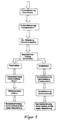
- This object is achieved in that before the crushing of the material flow from a wind sifter into a heavy coarse fraction and a light fine fraction is divided, which are treated separately.
- the material flow is arranged in two in parallel Coarse granulators roughly crushed.
- the fine fraction is arranged in two parallel to each other Accelerators or digesters that as Rotors are designed, finely crushed and disrupted.
- the coarse fraction in at least one fine granulator open minded.
- the coarse fraction is primarily materials, the plugged, screwed, pressed or similar are interconnected. These materials don't have to be separated with the help of the rotor, with them enough usually the digestion by simple shredding in one Fine granulator. By tapping the coarse fraction necessary size, drive power, Repair susceptibility and wear of the rotor Reduce fine fraction significantly.
- the coarse fraction can be inexpensive Fine granulator must be prepared and not be treated in a more expensive rotor. As a result, a cost reduction for these substances is up to 50% possible.
- Another object of the invention is that from EP 0751 831 B1 known device to improve so that the method for the mechanical processing of composite materials more effectively and can be carried out more cheaply.
- This object is achieved in that between the coarse granulator and disintegration unit a wind sifter is arranged, through which the material flow depends on the weight into a fine fraction and a coarse fraction can be divided.
- the wind classifier for the two fractions at least a digester downstream, via which the Fractions can be processed independently of one another are.
- the digestion unit assigned to the fine fraction designed as a rotor.
- the fine fraction which is primarily material acts that anodizes, varnishes, coexdrodes, vaporizes or connected in a similar way, is via the Open-minded rotor, which makes it smaller and cheaper can be because it does not contain the coarse fraction must become.
- the digestion unit assigned to the coarse fraction trained as a fine granulator.
- the coarse fraction is primarily materials acts, which is plugged, screwed, pressed or similar are connected to each other by simple Shredding open in the low-cost fine granulator.
- the air classifier has a distribution chamber which is in vertical direction below has a grid over which the Material flow is conductive, the air classifier from below can be acted upon by an air flow which are the lighter pieces of material that make up the fine fraction lifted and blown out of the air classifier can.
- an air flow which are the lighter pieces of material that make up the fine fraction lifted and blown out of the air classifier can.
- In an upper area is the vertical air flow deflectable in a horizontal direction.
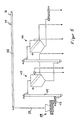
- a device for the mechanical processing of composite materials consists essentially of a rotor shear (1), a first coarse granulator (2), a second coarse granulator (3), an FE separator (4) and an air classifier (5).
- the rotor shear (1) is fed via a conveyor device, which as first conveyor belt (6) is formed, a material flow (7) fed.
- a material flow (7) fed in the rotor shear (1) the material flow (7) pre-shredded in lengths between about 40 mm and about 80 mm.
- the material flow (7) is from the rotor shear via second conveyor belt (8) and a third conveyor belt (9) to the Coarse granulators (2, 3) promoted.
- a fourth conveyor belt (10) conveys the material flow (7) to the first coarse granulator (2) or to the second coarse granulator (3).
- the coarse granulators (2, 3) the parts of the material flow (7) on a Length roughly crushed between about 10 mm and about 40 mm.
- the material flow (7) is parallel via conveyor belts (11) arranged coarse granulators (2, 3) to form a first selection belt (12) promoted.
- the FE cutting device (4) At the end of the first selection band (12) is the FE cutting device (4) arranged. Here are overband magnets (13) sorted out iron components (14) from the material flow (7). This leaves only other metals in the material flow (7) back, which will be dealt with further. From the first selection band (12) the remaining parts of the material flow migrate (7) on a buffer belt (15). In this buffer band (15) the parts of the material flow (7) in mechanical Vibrations offset, so that coarser parts of finer Separate dust particles. The dust parts are in corresponding Sieved (16). The remaining material flow (7) conveyed to the air classifier (5) via a further conveyor belt (17).
- the air classifier (5) has a distribution chamber (18) in which the material flow (7) is initiated. At her in vertical The distribution chamber (18) points towards the lower end Grid (19) through which the material flow (7) can be conducted.
- the air classifier (5) or the distribution chamber (18) is from below can be acted upon with an air flow (20).
- the lighter material parts (21) are raised by one Cross flow (22) deflected and via an outlet chamber (23) blown out as a fine fraction (24).
- the heavier parts of the Material flow (7) fall due to their own weight or their density down as a coarse fraction (25) from the distribution chamber (18) out.
- the wind sifter is used for further processing of the coarse fraction (25) (5) two unlocking units arranged parallel to each other (58) or accelerator (26) downstream.
- the accelerators (26) are designed as a first rotor (27) and as a parallel second rotor (28) is formed.
- the fine fraction (24) becomes one from the air classifier (5) Divider (29) promoted.
- the remaining part of the first partial flow (30) is fed to the first rotor (27).
- the first partial flow (30) further crushed and open-minded and a subordinate Cyclone (34) fed.
- the remaining ones are in the cyclone (34) Parts of the first partial flow (30) in rotary movements transferred.
- the heavy parts fall outwards, while the light parts sink in the middle and on one Conveyor belt (35) are promoted.
- a second partial flow (36) passes from the divider (29) via screen decks (37), screw conveyor (38), heavy part separator (39) too to the second rotor (28) and further via a cyclone (40) the conveyor belt (35).
- the cyclones (34, 40) are for dust extraction connected with dust filters (41, 42).
- the remaining one Part of the fine fraction (24) is further via the conveyor belt (35) Separation stages supplied. So join that Conveyor belt (35) on further screen decks (59), the remaining one Part of the fine fraction (24) via a screw conveyor (43) and a conveyor (44) to a filter device (45) Separation device is promoted.
- the screening device (45) is a further screening device (46) downstream. Further separation devices can be used for further gradual separation be subordinated.
- the wind sifter is used for further processing of the coarse fraction (5) a fine granulator (47) downstream.
- the coarse fraction (25) is fed to the fine granulator (47) via a conveyor belt (48).
- the coarse fraction (25) is in the fine granulator (47) crushed and disrupted and on a conveyor belt (49) a selection belt (50) supplied, in which by overband magnets (51) sorted out iron components or Fe metals (14) become.
- overband magnets (51) sorted out iron components or Fe metals (14) become.
- the remaining part of the coarse fraction (25) fed to a screen deck (52) and via a screw conveyor (53) and a conveyor (54) as a screening device (55) trained separation device.
- a second screening device is connected to the screening device (55) (56) which, via a second conveyor (57) with the first screening device is connected.
- additional separators can be installed downstream.
- a separation follows the fine granulator (47) which is similar to the separation of the fine fraction, namely, there is first a separation according to plastic and metal parts instead.
- Fine granulator a separation of heavy and light plastic parts and a separation of heavy and light metal parts instead of.
- the yardstick is the respective density of the separating materials.
- non-marketable plastics become thermal recycled, for example, in a not shown Rotary kiln to be carbonized. After all, it can emerging gas are still cleaned and then sent to gas companies are sold as fuel gas. It is also possible, to convert the resulting gas into a gas engine, i.e. in convert electrical energy.
- Recyclable plastics are one as finished products Subject to extrusion process or sold as regranulate.
Landscapes
- Engineering & Computer Science (AREA)
- Environmental & Geological Engineering (AREA)
- Mechanical Engineering (AREA)
- Processing Of Solid Wastes (AREA)
- Combined Means For Separation Of Solids (AREA)
Priority Applications (1)
| Application Number | Priority Date | Filing Date | Title |
|---|---|---|---|
| EP19980115222 EP0979676A1 (fr) | 1998-08-13 | 1998-08-13 | Procédé et dispositif pour le traitement mécanique d'un flux de matériaux |
Applications Claiming Priority (1)
| Application Number | Priority Date | Filing Date | Title |
|---|---|---|---|
| EP19980115222 EP0979676A1 (fr) | 1998-08-13 | 1998-08-13 | Procédé et dispositif pour le traitement mécanique d'un flux de matériaux |
Publications (1)
| Publication Number | Publication Date |
|---|---|
| EP0979676A1 true EP0979676A1 (fr) | 2000-02-16 |
Family
ID=8232454
Family Applications (1)
| Application Number | Title | Priority Date | Filing Date |
|---|---|---|---|
| EP19980115222 Withdrawn EP0979676A1 (fr) | 1998-08-13 | 1998-08-13 | Procédé et dispositif pour le traitement mécanique d'un flux de matériaux |
Country Status (1)
| Country | Link |
|---|---|
| EP (1) | EP0979676A1 (fr) |
Citations (4)
| Publication number | Priority date | Publication date | Assignee | Title |
|---|---|---|---|---|
| DE3002227A1 (de) * | 1980-01-23 | 1981-07-30 | Felten & Guilleaume Carlswerk AG, 5000 Köln | Verfahren zur rueckgewinnung von kaschierten und unkaschierten schichtstoffabfaellen |
| DE4244449A1 (de) * | 1992-12-23 | 1994-06-30 | Wemex Ingenieurbuero Ges Fuer | Verfahren und Vorrichtung zur mechanischen Separation metallhaltiger Kunststoffgemische und -verbunde |
| WO1995025595A1 (fr) * | 1994-03-23 | 1995-09-28 | Rudolf Engel | Procede et dispositif pour le traitement d'elements composites |
| US5535945A (en) * | 1995-02-27 | 1996-07-16 | Basf Corportion | Carpet recycling process and system |
-
1998
- 1998-08-13 EP EP19980115222 patent/EP0979676A1/fr not_active Withdrawn
Patent Citations (5)
| Publication number | Priority date | Publication date | Assignee | Title |
|---|---|---|---|---|
| DE3002227A1 (de) * | 1980-01-23 | 1981-07-30 | Felten & Guilleaume Carlswerk AG, 5000 Köln | Verfahren zur rueckgewinnung von kaschierten und unkaschierten schichtstoffabfaellen |
| DE4244449A1 (de) * | 1992-12-23 | 1994-06-30 | Wemex Ingenieurbuero Ges Fuer | Verfahren und Vorrichtung zur mechanischen Separation metallhaltiger Kunststoffgemische und -verbunde |
| WO1995025595A1 (fr) * | 1994-03-23 | 1995-09-28 | Rudolf Engel | Procede et dispositif pour le traitement d'elements composites |
| EP0751831A1 (fr) * | 1994-03-23 | 1997-01-08 | Rudolf Engel | Procede et dispositif pour le traitement d'elements composites |
| US5535945A (en) * | 1995-02-27 | 1996-07-16 | Basf Corportion | Carpet recycling process and system |
Similar Documents
| Publication | Publication Date | Title |
|---|---|---|
| DE69212707T2 (de) | Einrichtung zum Zerkleinern von gebrauchten Fahrzeugreifen und dergleichen sowie Trennen von Metallteilen von Nichtmetallteilen von diesem zerkleinerten Material | |
| DE2520358A1 (de) | Verfahren zum rueckgewinnen der bestandteile von schrott und vorrichtung zum ausueben des verfahrens | |
| EP0524396B1 (fr) | Procédé et dispositif pour la récupération des rebuts d'appareils | |
| EP2089201A1 (fr) | Procédé de réduction de matériaux composites | |
| WO2010072276A1 (fr) | Procédé et dispositif pour désagréger de la matière minérale à broyer | |
| DE19726105A1 (de) | Verfahren und Anlage zur Aufbereitung von Elektronik-Schrott und zur Anreicherung verwertbarer, insbesondere Edelmetalle enthaltender Bestandteile | |
| EP0912310B1 (fr) | Procede et dispositif pour le traitement de matieres plastiques mixtes | |
| EP0427305A1 (fr) | Procédé et dispositif de tri | |
| DE2842259C2 (de) | Verfahren und Sortieranlage zur trockenen Sortierung eines körnigen Gemisches aus Feststoffkomponenten | |
| EP0747126B1 (fr) | Procédé et dispositif pour le traitement de matières fibreuses, en particulier des déchets de laine minerale, comportant des fibres et des matières étrangères | |
| EP0282943A2 (fr) | Procédé et dispositif pour récupérer du verre de déchets de verre | |
| EP1020224A1 (fr) | Procédé et dispositif pour le traitement de déchets avec séparation pneumatique en plusieures étapes des fractions légères à partir d'une matière séchée | |
| EP3227027A1 (fr) | Procédé de traitement de composants électriques et électroniques pour la récupération de matériaux | |
| DE4205309A1 (de) | Verfahren zur aufbereitung von reststoffen aus altautomobilen | |
| EP4408632A2 (fr) | Dispositif et procédé de traitement de bois de récupération, en particulier pour la fabrication de panneaux de matériau | |
| DE3313872C1 (de) | Verfahren und Anlage zur Aufbereitung von mit einer Oberflaechenbeschichtung versehenen Metallteilen | |
| DE3907445C2 (fr) | ||
| EP0623390A1 (fr) | Procédé et installation pour le traitement mécanique de mélanges de déchets | |
| DE19915481A1 (de) | Verfahren zur Gewinnung organischer und anorganischer Bestandteile aus Materialien einer Shredderleichtfraktion sowie Anlage zur Durchführung eines entsprechenden Verfahrens | |
| DE10336802B4 (de) | Verfahren und Anlage zum Trennen und Sortieren insbesondere von vorzerkleinerten Stoffen | |
| EP0330046A2 (fr) | Procédé de récupération de matières plastiques à partir de déchets métaux/plastiques | |
| DE102012204050B4 (de) | Vorrichtung und Verfahren zum Bearbeiten von Silizium-Stücken | |
| DE4309671C1 (de) | Vorrichtung zur Aufbereitung von Baustoffabfällen | |
| DE19635472C2 (de) | Verfahren und Einrichtung zur Aufbereitung eines metallhaltigen Gemenges von Altmaterialien | |
| EP4163025B1 (fr) | Dispositif et procédé de décomposition de matières composites et de leurs mélanges en composants de matières séparés |
Legal Events
| Date | Code | Title | Description |
|---|---|---|---|
| PUAI | Public reference made under article 153(3) epc to a published international application that has entered the european phase |
Free format text: ORIGINAL CODE: 0009012 |
|
| AK | Designated contracting states |
Kind code of ref document: A1 Designated state(s): AT BE CH CY DE DK ES FI FR GB GR IE IT LI LU MC NL PT SE |
|
| AX | Request for extension of the european patent |
Free format text: AL;LT;LV;MK;RO;SI |
|
| RAP1 | Party data changed (applicant data changed or rights of an application transferred) |
Owner name: TRIMBORN, STEFAN Owner name: SPENGLER, CHRISTIAN |
|
| AKX | Designation fees paid |
Owner name: TRIMBORN, STEFAN |
|
| STAA | Information on the status of an ep patent application or granted ep patent |
Free format text: STATUS: THE APPLICATION IS DEEMED TO BE WITHDRAWN |
|
| 18D | Application deemed to be withdrawn |
Effective date: 20000817 |
|
| REG | Reference to a national code |
Ref country code: DE Ref legal event code: 8566 |