EP0980160A1 - Multirate, Multikode CDMA Übertragung für ein zellulares Mobilfunksystem - Google Patents
Multirate, Multikode CDMA Übertragung für ein zellulares Mobilfunksystem Download PDFInfo
- Publication number
- EP0980160A1 EP0980160A1 EP99400943A EP99400943A EP0980160A1 EP 0980160 A1 EP0980160 A1 EP 0980160A1 EP 99400943 A EP99400943 A EP 99400943A EP 99400943 A EP99400943 A EP 99400943A EP 0980160 A1 EP0980160 A1 EP 0980160A1
- Authority
- EP
- European Patent Office
- Prior art keywords
- length
- spreading
- sequences
- sub
- sequence
- Prior art date
- Legal status (The legal status is an assumption and is not a legal conclusion. Google has not performed a legal analysis and makes no representation as to the accuracy of the status listed.)
- Granted
Links
- 230000001413 cellular effect Effects 0.000 title claims abstract description 15
- 230000005540 biological transmission Effects 0.000 title claims abstract description 10
- 238000001228 spectrum Methods 0.000 claims abstract description 8
- 238000012545 processing Methods 0.000 claims description 5
- 238000001514 detection method Methods 0.000 claims description 4
- 238000010586 diagram Methods 0.000 description 13
- 238000000034 method Methods 0.000 description 3
- 238000004891 communication Methods 0.000 description 2
- 230000002452 interceptive effect Effects 0.000 description 2
- 108010003272 Hyaluronate lyase Proteins 0.000 description 1
- 238000013459 approach Methods 0.000 description 1
- 238000012986 modification Methods 0.000 description 1
- 230000004048 modification Effects 0.000 description 1
- 238000009877 rendering Methods 0.000 description 1
- 230000003595 spectral effect Effects 0.000 description 1
Images

Classifications
-
- H—ELECTRICITY
- H04—ELECTRIC COMMUNICATION TECHNIQUE
- H04J—MULTIPLEX COMMUNICATION
- H04J13/00—Code division multiplex systems
-
- H—ELECTRICITY
- H04—ELECTRIC COMMUNICATION TECHNIQUE
- H04B—TRANSMISSION
- H04B1/00—Details of transmission systems, not covered by a single one of groups H04B3/00 - H04B13/00; Details of transmission systems not characterised by the medium used for transmission
- H04B1/69—Spread spectrum techniques
- H04B1/707—Spread spectrum techniques using direct sequence modulation
-
- H—ELECTRICITY
- H04—ELECTRIC COMMUNICATION TECHNIQUE
- H04B—TRANSMISSION
- H04B2201/00—Indexing scheme relating to details of transmission systems not covered by a single group of H04B3/00 - H04B13/00
- H04B2201/69—Orthogonal indexing scheme relating to spread spectrum techniques in general
- H04B2201/707—Orthogonal indexing scheme relating to spread spectrum techniques in general relating to direct sequence modulation
- H04B2201/70703—Orthogonal indexing scheme relating to spread spectrum techniques in general relating to direct sequence modulation using multiple or variable rates
Definitions
- the present invention is generally concerned with spread spectrum communication systems, i.e. systems in which spectrum spreading is applied to a sequence of data to be transmitted, on transmission, using a spreading code, and, conversely, despreading is effected on reception, in order to find the original sequence.
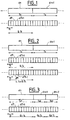
- An alternative representation of the spread sequence of length Q.N is (d1. c Q , d2. c Q , ...dN. c Q ) where d1. c Q represents the product of the symbol d1 by the spreading code c Q .
- a more general approach to spreading consists in having a different spreading code for each symbol of the input sequence, in which case the resulting spread sequence can be expressed in the form: being the spreading code associated with the symbol d1. All the spreading codes preferably have the same length Q so that the resulting spread sequence has the length Q.N.
- dn and dn+1 correspond to two successive symbols of a non-spread incoming sequence
- d'l and d'l+1 correspond to two successive basic symbols (or "chips") of the same spread symbol of the incoming sequence.
- One benefit of the above systems is enabling a plurality of users to share the same frequency band by allocating different users different codes.
- CDMA Code Division Multiple Access
- a spread sequence is generally scrambled prior to transmission using a scrambling code (or sequence), for various reasons including in particular improved protection against interference, or to assure the confidentiality of the information transmitted.
- the scrambling sequence can be a very long, typically pseudo-random sequence.
- a sequence of this kind protects against interfering signals by rendering them random, at least over the duration of said scrambling sequence.
- the scrambling sequence can also be a short sequence, typically of length L equal to the length Q of the spreading code (or an integer multiple thereof), as shown in Figure 2, which uses the same type of representation as Figure 1, and in which d"l and d"l+1 designate two successive basic symbols (or "chips") of the same spread and scrambled symbol of the incoming sequence.
- Figure 2 which uses the same type of representation as Figure 1, and in which d"l and d"l+1 designate two successive basic symbols (or "chips") of the same spread and scrambled symbol of the incoming sequence.
- Interference between users in the same cell can be reduced by using a decoding algorithm at the receiver enabling interfering signals to be identified as such and therefore rejected, in particular on the basis of the signals received and a knowledge of the codes of the various users.
- decoding algorithms are so-called subtractive detection algorithms or joint-detection algorithms. If all the cyclostationary signals have the same short period, it is in particular possible to use algorithms exploiting their cyclostationary nature. Such algorithms are described, for example, in the article "Interference Rejection in Digital Wireless Communications", IEEE Signal Processing Magazine, May 1997, pp. 37-62.
- allocating the user a plurality of codes of length Qm if the capacity of a single code of length Qm is exceeded is known per se .
- a technique of the above kind has the particular disadvantage of leading to some complexity of implementation.
- Another technique known per se which avoids the above disadvantage, is to reduce the length of the code allocated to the user so that the user continues to transmit on only one code in order to increase the bit rate of the data to be transmitted by that user for the same allocated frequency band (i.e. for the same duration Tc).
- Figure 3 summarizes the principle of a technique of this kind, and uses the same type of representation as Figures 1 and 2, but for two different bit rates of the incoming sequence, respectively identified by suffices 1 and 2, in this instance for three successive symbols dn, dn+1 and dn+2 of the incoming sequence, the symbol period corresponding to Ts1 for symbol dn and Ts2 for symbols dn+1 and dn+2, and the code length corresponding to Q1 for symbol dn and Q2 for symbols dn+1 and dn+2.
- the problem is that some algorithms, in particular decoding algorithms and especially the decoding algorithms referred to above, cannot, without modification, accept codes of different length for different users (whether at the same time or at different times).
- a particular aim of the present invention is to provide a solution to this problem avoiding the need to modify such algorithms to enable them to accept codes of different length.
- the present invention therefore consists in a spectrum spreading or despreading device, in particular for transmission in a code division multiple access cellular mobile radio system, the device being essentially characterized in that it includes, for spreading or despreading an incoming sequence by means of a spreading code of length Q:
- the present invention consists in a device for despreading an incoming sequence using K respective spreading codes of respective length Qk (with 1 ⁇ k ⁇ K), the device being characterized in that it includes, for despreading the incoming sequence using each of the spreading codes of length Qk (1 ⁇ k ⁇ K) :
- the present invention consists in a device for spreading K incoming sequences using K respective spreading codes of respective length Qk (with 1 ⁇ k ⁇ K), the device being characterized in that it includes, for spreading the kth incoming sequence by means of the spreading code of length Qk (1 ⁇ k ⁇ K) :
- said K spreading codes having a length less than or equal to a predetermined maximal length Qmax, said length Q0 is less than or equal to Qmax.
- the device further includes processor means receiving the spread or despread sub-sequences obtained for the K codes.
- said means for processing the despread sub-sequences obtained in this way for the K codes includes means for implementing a joint detection algorithm.
- the present invention also has for its object a mobile station (or mobile terminal), as well as an entity, in particular base transceiver station, for a cellular mobile radiocommunication system , comprising a spreading or despreading device of the above kind.
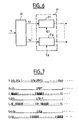
- the transmitter shown in Figure 4 includes:
- the receiver shown in Figure 5 includes:
- the device in accordance with the invention shown in Figure 6 includes, for spreading or despreading an incoming sequence S using a spreading code C of length Q:
- Said sub-sequences S1 to Sp and said codes C 1 to C p are determined so that the sequence that would be obtained by superposing the various spread or despread sub-sequences obtained in this way is the same as that which would be obtained by spreading or despreading the incoming sequence by means of the code C of length Q.
- Figure 7 shows one example of the operation of a device of the above kind.
- the incoming sequence S concerned is formed of the symbols: d1, ..., dp, ...d2p, ...etc.
- the sequence S1 is formed of the symbols: d1, dp+1, d2p+1, ...etc.
- the sequence S2 is formed of the symbols: d2, dp+2, d2p+2, ...etc. ...
- the sequence Sp is formed of the symbols: dp, d2p, d3p, ...etc.
- the device in accordance with the invention is used in particular in the despreading means 9 from Figure 5.
- the device in accordance with the invention can be used in a base transceiver station or in a mobile terminal to despread an incoming data sequence, not only by means of the spreading code allocated to a given user (or by means of one of the codes allocated to that user if they are allocated more than code), but also by means of the codes allocated to other users (and possibly other codes allocated to the user in question), in order to use a decoding algorithm such as those mentioned hereinabove.
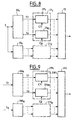
- a device for despreading an incoming sequence by means of K respective spreading codes of respective length Qk includes, as shown in Figure 8, for despreading the incoming sequence by means of each of the K spreading codes:
- said sub-sequences and said spreading codes which are applied to them are determined so that the sequence that would be obtained by superposing the despread sub-sequences obtained in this way is the same as that which would be obtained by despreading the incoming sequence by means of the code of length Qk, and said length Q0 is common to the K codes.
- the device in accordance with the invention used on transmission in particular on transmission in a code division multiple access cellular mobile radio system, can be used in the spreading means 2 from Figure 4.
- the device in accordance with the invention can be used in a base transceiver station to spread different incoming data sequences corresponding to different users served by that base transceiver station; it can also be used in a mobile terminal, by allocating different spreading codes to that user.
- a device for spreading K incoming sequences such as S1 to SK using K respective spreading codes of respective length Qk includes, as shown in Figure 9:
- said sub-sequences and said spreading codes which are applied to them are determined so that the sequence that would be obtained by superposing the spread sub-sequences obtained in this way is the same as that which would be obtained by spreading the incoming sequence by means of the code of length Qk, and said length Q0 is common to the K codes.
Landscapes
- Engineering & Computer Science (AREA)
- Computer Networks & Wireless Communication (AREA)
- Signal Processing (AREA)
- Mobile Radio Communication Systems (AREA)
Applications Claiming Priority (2)
| Application Number | Priority Date | Filing Date | Title |
|---|---|---|---|
| FR9810344 | 1998-08-12 | ||
| FR9810344A FR2782426B1 (fr) | 1998-08-12 | 1998-08-12 | Dispositif d'etalement ou de desetalement de spectre, notamment pour la transmission dans un systeme cellulaire de radiocommunications mobiles du type a acces multiple par repartition de codes |
Publications (2)
| Publication Number | Publication Date |
|---|---|
| EP0980160A1 true EP0980160A1 (de) | 2000-02-16 |
| EP0980160B1 EP0980160B1 (de) | 2002-04-17 |
Family
ID=9529628
Family Applications (1)
| Application Number | Title | Priority Date | Filing Date |
|---|---|---|---|
| EP99400943A Expired - Lifetime EP0980160B1 (de) | 1998-08-12 | 1999-04-19 | Multirate, Multikode CDMA Übertragung für ein zellulares Mobilfunksystem |
Country Status (7)
| Country | Link |
|---|---|
| US (1) | US7023830B1 (de) |
| EP (1) | EP0980160B1 (de) |
| JP (1) | JP3210917B2 (de) |
| CN (1) | CN1154376C (de) |
| DE (1) | DE69901276T2 (de) |
| ES (1) | ES2174578T3 (de) |
| FR (1) | FR2782426B1 (de) |
Cited By (1)
| Publication number | Priority date | Publication date | Assignee | Title |
|---|---|---|---|---|
| EP1480364A4 (de) * | 2002-02-28 | 2005-09-21 | Fujitsu Ltd | Für cdma verwendete kommunikationseinrichtung |
Families Citing this family (4)
| Publication number | Priority date | Publication date | Assignee | Title |
|---|---|---|---|---|
| EP1380184B1 (de) * | 2001-04-06 | 2007-01-24 | Nokia Corporation | Positionsbestimmungsverfahren und -system |
| US6741653B2 (en) | 2002-07-01 | 2004-05-25 | Interdigital Technology Corporation | Data detection for codes with non-uniform spreading factors |
| US7903973B1 (en) * | 2005-12-23 | 2011-03-08 | Lockheed Martin Corporation | Dynamic temporal duration optical transmission privacy |
| CN106161299B (zh) | 2015-03-24 | 2019-02-15 | 中兴通讯股份有限公司 | 一种数据传输方法及装置 |
Citations (2)
| Publication number | Priority date | Publication date | Assignee | Title |
|---|---|---|---|---|
| US5555268A (en) * | 1994-01-24 | 1996-09-10 | Fattouche; Michel | Multicode direct sequence spread spectrum |
| EP0818901A2 (de) * | 1996-07-12 | 1998-01-14 | Lucent Technologies Inc. | Multicode-Empfänger mit Vielfachzugriff durch Codemultiplex |
Family Cites Families (9)
| Publication number | Priority date | Publication date | Assignee | Title |
|---|---|---|---|---|
| JP2734953B2 (ja) * | 1993-12-16 | 1998-04-02 | 日本電気株式会社 | Cdma受信装置 |
| JP3202125B2 (ja) * | 1994-03-10 | 2001-08-27 | 沖電気工業株式会社 | 符号分割多元接続システム |
| US5841768A (en) * | 1996-06-27 | 1998-11-24 | Interdigital Technology Corporation | Method of controlling initial power ramp-up in CDMA systems by using short codes |
| JP2800797B2 (ja) * | 1996-08-12 | 1998-09-21 | 日本電気株式会社 | スペクトル拡散通信方式 |
| JP3317866B2 (ja) * | 1996-12-20 | 2002-08-26 | 富士通株式会社 | スペクトル拡散通信システム |
| US5943331A (en) * | 1997-02-28 | 1999-08-24 | Interdigital Technology Corporation | Orthogonal code synchronization system and method for spread spectrum CDMA communications |
| US6393047B1 (en) * | 1998-06-16 | 2002-05-21 | Telefonaktiebolaget Lm Ericsson (Publ) | Quadriphase spreading codes in code division multiple access communications |
| KR100442661B1 (ko) * | 1998-11-02 | 2004-10-14 | 삼성전자주식회사 | 이동통신시스템의단부호생성장치및방법 |
| US6430213B1 (en) * | 1999-05-26 | 2002-08-06 | The Aerospace Corporation | Coherent adaptive subcarrier modulation method |
-
1998
- 1998-08-12 FR FR9810344A patent/FR2782426B1/fr not_active Expired - Fee Related
-
1999
- 1999-04-15 US US09/291,324 patent/US7023830B1/en not_active Expired - Lifetime
- 1999-04-19 DE DE69901276T patent/DE69901276T2/de not_active Expired - Lifetime
- 1999-04-19 EP EP99400943A patent/EP0980160B1/de not_active Expired - Lifetime
- 1999-04-19 ES ES99400943T patent/ES2174578T3/es not_active Expired - Lifetime
- 1999-07-27 JP JP21168999A patent/JP3210917B2/ja not_active Expired - Fee Related
- 1999-08-12 CN CNB991177169A patent/CN1154376C/zh not_active Expired - Lifetime
Patent Citations (2)
| Publication number | Priority date | Publication date | Assignee | Title |
|---|---|---|---|---|
| US5555268A (en) * | 1994-01-24 | 1996-09-10 | Fattouche; Michel | Multicode direct sequence spread spectrum |
| EP0818901A2 (de) * | 1996-07-12 | 1998-01-14 | Lucent Technologies Inc. | Multicode-Empfänger mit Vielfachzugriff durch Codemultiplex |
Non-Patent Citations (1)
| Title |
|---|
| AZAD H ET AL: "MULTIRATE SPREAD SPECTRUM DIRECT SEQUENCE CDMA TECHNIQUES", IEE COLLOQUIUM ON SPREAD SPECTRUM TECHNIQUES FOR RADIO COMMUNICATIONS SYSTEMS (DIGEST NO.95), 27 APRIL '93, 15 April 1994 (1994-04-15), pages 4/1 - 4/05, XP000570787 * |
Cited By (3)
| Publication number | Priority date | Publication date | Assignee | Title |
|---|---|---|---|---|
| EP1480364A4 (de) * | 2002-02-28 | 2005-09-21 | Fujitsu Ltd | Für cdma verwendete kommunikationseinrichtung |
| EP2367331A1 (de) * | 2002-02-28 | 2011-09-21 | Fujitsu Limited | CDMA Kommunikationsgerät |
| US8526399B2 (en) | 2002-02-28 | 2013-09-03 | Fujitsu Limited | Communications device used in CDMA |
Also Published As
| Publication number | Publication date |
|---|---|
| FR2782426B1 (fr) | 2000-09-15 |
| DE69901276D1 (de) | 2002-05-23 |
| FR2782426A1 (fr) | 2000-02-18 |
| ES2174578T3 (es) | 2002-11-01 |
| US7023830B1 (en) | 2006-04-04 |
| CN1154376C (zh) | 2004-06-16 |
| DE69901276T2 (de) | 2002-10-31 |
| CN1258176A (zh) | 2000-06-28 |
| JP3210917B2 (ja) | 2001-09-25 |
| JP2000068898A (ja) | 2000-03-03 |
| EP0980160B1 (de) | 2002-04-17 |
Similar Documents
| Publication | Publication Date | Title |
|---|---|---|
| US7457345B2 (en) | Spread-spectrum transceiver | |
| US6891816B2 (en) | Spread spectrum communication system using DECT protocol | |
| KR100445842B1 (ko) | Cdma통신방법및스펙트럼확산통신시스템 | |
| CA2221910C (en) | System and method for spread spectrum code position modulation and wireless local area network employing the same | |
| AU2001294864B2 (en) | Hybrid spread-spectrum technique for expanding channel capacity | |
| EP0878930A1 (de) | Verfahren zur codegenerierung und verfahren zur codeauswahl | |
| EP0857376B1 (de) | Datenübertragungsverfahren, Sender und Empfänger | |
| US6574269B1 (en) | Asymmetric orthogonal codes for wireless system receivers with multiplication-free correlators | |
| EP0980159B1 (de) | Gerät ermöglichend verschiedene Spreizfaktoren mit Erhaltung eines gemeinsamen Verschlüsselungskodes | |
| EP1046241B1 (de) | Verfahren unter verwendung von kodebuchindexierung zum erreichen hoher bitdichten in ds-cdma-ss nachrichtenübertragungssystem | |
| EP1300972B1 (de) | Codemultiplex-kommunikationssystem und codemultiplex-kommunikationsgerät | |
| EP0980160B1 (de) | Multirate, Multikode CDMA Übertragung für ein zellulares Mobilfunksystem | |
| US7076007B1 (en) | Data transmission method using repeated sets of spreading sequences, corresponding transmitter and receiver | |
| US20020191566A1 (en) | Method of cellular communication | |
| US20020122468A1 (en) | Quasi orthogonal hybrid walsh-PN codes for CDMA application in HF modems | |
| EP0999668A2 (de) | Verfahren und Vorrichtung zur Veränderung der Kanalanzahl in Spreizspektrumkommunikationssystemen | |
| US20090073898A1 (en) | Method and apparatus for code division duplexing | |
| US6556558B1 (en) | Transmission method for use in a multiple access radiocommunication system | |
| US6134263A (en) | Method for using spreading code sequency to achieve high bit densities in a direct-sequence spread spectrum communication system | |
| Schotten | New non-linear families of code-sequences with correlation properties better than linear families | |
| Ingale et al. | Various Correlation Properties of Orthogonal Spreading Codes for CDMA Technique | |
| JPH05219008A (ja) | スペクトル拡散通信方式 | |
| CA2620101A1 (en) | Quadriphase spreading codes in code division multiple access communications | |
| MXPA00001879A (en) | Downlink channel handling within a spread spectrum communications system | |
| KR20010074572A (ko) | 고속 데이터 신호의 무선 전송을 위한 신호 처리 방법 및시스템 |
Legal Events
| Date | Code | Title | Description |
|---|---|---|---|
| PUAI | Public reference made under article 153(3) epc to a published international application that has entered the european phase |
Free format text: ORIGINAL CODE: 0009012 |
|
| 17P | Request for examination filed |
Effective date: 19990429 |
|
| AK | Designated contracting states |
Kind code of ref document: A1 Designated state(s): DE ES FI FR GB IT SE |
|
| AX | Request for extension of the european patent |
Free format text: AL;LT;LV;MK;RO;SI |
|
| AKX | Designation fees paid |
Free format text: DE ES FI FR GB IT SE |
|
| 17Q | First examination report despatched |
Effective date: 20010222 |
|
| GRAG | Despatch of communication of intention to grant |
Free format text: ORIGINAL CODE: EPIDOS AGRA |
|
| REG | Reference to a national code |
Ref country code: GB Ref legal event code: IF02 |
|
| GRAG | Despatch of communication of intention to grant |
Free format text: ORIGINAL CODE: EPIDOS AGRA |
|
| GRAH | Despatch of communication of intention to grant a patent |
Free format text: ORIGINAL CODE: EPIDOS IGRA |
|
| GRAH | Despatch of communication of intention to grant a patent |
Free format text: ORIGINAL CODE: EPIDOS IGRA |
|
| GRAA | (expected) grant |
Free format text: ORIGINAL CODE: 0009210 |
|
| AK | Designated contracting states |
Kind code of ref document: B1 Designated state(s): DE ES FI FR GB IT SE |
|
| PG25 | Lapsed in a contracting state [announced via postgrant information from national office to epo] |
Ref country code: FI Free format text: LAPSE BECAUSE OF FAILURE TO SUBMIT A TRANSLATION OF THE DESCRIPTION OR TO PAY THE FEE WITHIN THE PRESCRIBED TIME-LIMIT Effective date: 20020417 |
|
| REF | Corresponds to: |
Ref document number: 69901276 Country of ref document: DE Date of ref document: 20020523 |
|
| PG25 | Lapsed in a contracting state [announced via postgrant information from national office to epo] |
Ref country code: SE Free format text: LAPSE BECAUSE OF FAILURE TO SUBMIT A TRANSLATION OF THE DESCRIPTION OR TO PAY THE FEE WITHIN THE PRESCRIBED TIME-LIMIT Effective date: 20020717 |
|
| ET | Fr: translation filed | ||
| REG | Reference to a national code |
Ref country code: ES Ref legal event code: FG2A Ref document number: 2174578 Country of ref document: ES Kind code of ref document: T3 |
|
| PLBE | No opposition filed within time limit |
Free format text: ORIGINAL CODE: 0009261 |
|
| STAA | Information on the status of an ep patent application or granted ep patent |
Free format text: STATUS: NO OPPOSITION FILED WITHIN TIME LIMIT |
|
| 26N | No opposition filed |
Effective date: 20030120 |
|
| PGFP | Annual fee paid to national office [announced via postgrant information from national office to epo] |
Ref country code: ES Payment date: 20040423 Year of fee payment: 6 |
|
| PG25 | Lapsed in a contracting state [announced via postgrant information from national office to epo] |
Ref country code: ES Free format text: LAPSE BECAUSE OF NON-PAYMENT OF DUE FEES Effective date: 20050420 |
|
| REG | Reference to a national code |
Ref country code: ES Ref legal event code: FD2A Effective date: 20050420 |
|
| REG | Reference to a national code |
Ref country code: FR Ref legal event code: CD |
|
| REG | Reference to a national code |
Ref country code: GB Ref legal event code: 732E Free format text: REGISTERED BETWEEN 20131114 AND 20131120 |
|
| REG | Reference to a national code |
Ref country code: FR Ref legal event code: GC Effective date: 20140717 |
|
| REG | Reference to a national code |
Ref country code: FR Ref legal event code: RG Effective date: 20141016 |
|
| REG | Reference to a national code |
Ref country code: FR Ref legal event code: PLFP Year of fee payment: 17 |
|
| REG | Reference to a national code |
Ref country code: FR Ref legal event code: PLFP Year of fee payment: 18 |
|
| REG | Reference to a national code |
Ref country code: FR Ref legal event code: PLFP Year of fee payment: 19 |
|
| REG | Reference to a national code |
Ref country code: FR Ref legal event code: PLFP Year of fee payment: 20 |
|
| PGFP | Annual fee paid to national office [announced via postgrant information from national office to epo] |
Ref country code: DE Payment date: 20180420 Year of fee payment: 20 |
|
| PGFP | Annual fee paid to national office [announced via postgrant information from national office to epo] |
Ref country code: IT Payment date: 20180423 Year of fee payment: 20 Ref country code: FR Payment date: 20180420 Year of fee payment: 20 |
|
| PGFP | Annual fee paid to national office [announced via postgrant information from national office to epo] |
Ref country code: GB Payment date: 20180418 Year of fee payment: 20 |
|
| REG | Reference to a national code |
Ref country code: DE Ref legal event code: R071 Ref document number: 69901276 Country of ref document: DE |
|
| REG | Reference to a national code |
Ref country code: GB Ref legal event code: PE20 Expiry date: 20190418 |
|
| PG25 | Lapsed in a contracting state [announced via postgrant information from national office to epo] |
Ref country code: GB Free format text: LAPSE BECAUSE OF EXPIRATION OF PROTECTION Effective date: 20190418 |