EP0981239A2 - Méthode pour un système de communication à répartition d'appel automatique - Google Patents
Méthode pour un système de communication à répartition d'appel automatique Download PDFInfo
- Publication number
- EP0981239A2 EP0981239A2 EP99115248A EP99115248A EP0981239A2 EP 0981239 A2 EP0981239 A2 EP 0981239A2 EP 99115248 A EP99115248 A EP 99115248A EP 99115248 A EP99115248 A EP 99115248A EP 0981239 A2 EP0981239 A2 EP 0981239A2
- Authority
- EP
- European Patent Office
- Prior art keywords
- terminal
- workstation
- group
- identification information
- agent
- Prior art date
- Legal status (The legal status is an assumption and is not a legal conclusion. Google has not performed a legal analysis and makes no representation as to the accuracy of the status listed.)
- Withdrawn
Links
- 238000009826 distribution Methods 0.000 title claims abstract description 21
- 238000000034 method Methods 0.000 title claims abstract description 19
- 238000004891 communication Methods 0.000 title claims description 29
- 230000005540 biological transmission Effects 0.000 claims description 3
- 238000003825 pressing Methods 0.000 claims description 3
- 230000008878 coupling Effects 0.000 claims description 2
- 238000010168 coupling process Methods 0.000 claims description 2
- 238000005859 coupling reaction Methods 0.000 claims description 2
- 239000003795 chemical substances by application Substances 0.000 description 44
- 230000006870 function Effects 0.000 description 8
- 238000010586 diagram Methods 0.000 description 6
- 238000005516 engineering process Methods 0.000 description 6
- 230000008569 process Effects 0.000 description 4
- 239000008186 active pharmaceutical agent Substances 0.000 description 3
- MOVRNJGDXREIBM-UHFFFAOYSA-N aid-1 Chemical compound O=C1NC(=O)C(C)=CN1C1OC(COP(O)(=O)OC2C(OC(C2)N2C3=C(C(NC(N)=N3)=O)N=C2)COP(O)(=O)OC2C(OC(C2)N2C3=C(C(NC(N)=N3)=O)N=C2)COP(O)(=O)OC2C(OC(C2)N2C3=C(C(NC(N)=N3)=O)N=C2)COP(O)(=O)OC2C(OC(C2)N2C(NC(=O)C(C)=C2)=O)COP(O)(=O)OC2C(OC(C2)N2C3=C(C(NC(N)=N3)=O)N=C2)COP(O)(=O)OC2C(OC(C2)N2C3=C(C(NC(N)=N3)=O)N=C2)COP(O)(=O)OC2C(OC(C2)N2C3=C(C(NC(N)=N3)=O)N=C2)COP(O)(=O)OC2C(OC(C2)N2C(NC(=O)C(C)=C2)=O)COP(O)(=O)OC2C(OC(C2)N2C3=C(C(NC(N)=N3)=O)N=C2)COP(O)(=O)OC2C(OC(C2)N2C3=C(C(NC(N)=N3)=O)N=C2)COP(O)(=O)OC2C(OC(C2)N2C3=C(C(NC(N)=N3)=O)N=C2)COP(O)(=O)OC2C(OC(C2)N2C(NC(=O)C(C)=C2)=O)COP(O)(=O)OC2C(OC(C2)N2C3=C(C(NC(N)=N3)=O)N=C2)COP(O)(=O)OC2C(OC(C2)N2C3=C(C(NC(N)=N3)=O)N=C2)COP(O)(=O)OC2C(OC(C2)N2C3=C(C(NC(N)=N3)=O)N=C2)CO)C(O)C1 MOVRNJGDXREIBM-UHFFFAOYSA-N 0.000 description 3
- 230000004044 response Effects 0.000 description 3
- 230000008859 change Effects 0.000 description 2
- 238000013500 data storage Methods 0.000 description 2
- 230000011664 signaling Effects 0.000 description 2
- 238000003860 storage Methods 0.000 description 2
- 238000006243 chemical reaction Methods 0.000 description 1
- 238000013480 data collection Methods 0.000 description 1
- 230000000694 effects Effects 0.000 description 1
- 239000011159 matrix material Substances 0.000 description 1
- 230000007246 mechanism Effects 0.000 description 1
- 230000002093 peripheral effect Effects 0.000 description 1
- 238000002360 preparation method Methods 0.000 description 1
Images


Classifications
-
- H—ELECTRICITY
- H04—ELECTRIC COMMUNICATION TECHNIQUE
- H04M—TELEPHONIC COMMUNICATION
- H04M3/00—Automatic or semi-automatic exchanges
- H04M3/42—Systems providing special services or facilities to subscribers
- H04M3/50—Centralised arrangements for answering calls; Centralised arrangements for recording messages for absent or busy subscribers ; Centralised arrangements for recording messages
- H04M3/51—Centralised call answering arrangements requiring operator intervention, e.g. call or contact centers for telemarketing
Definitions
- ACD Automatic Call Distribution Function
- ACD Automatic Call Distribution Function
- ACD Automatic Call Distribution
- agent terminals the communication system with one as automatic Call distribution designated function equipped.
- ACD Automatic Call Distribution
- An automatic Call distribution are a specific phone number that represents a so-called service number, a group of Assigned to agent terminals. So it's one, for example such a service number in a company several, e.g. B. Answering places assigned.
- the service number represents a specific service communication connection.
- the associated end devices are referred to as agents Served clerks as a response group for the Editing, e.g. B. are responsible for customer calls.
- Automatic call distribution systems are often operated in parallel with the communication system. This means that your own infrastructure will then be required.
- call center applications computer systems with the simplest implementation in the form of a personal computer are used to adaptively support the communication system.
- Such a communication system with integrated ACD functionality is, for example, published in Net, 46 (1992), Issue 3, page 109 ff. "Known.
- the object of the invention is, in particular the establishment of small and medium-sized communication systems of the agent terminals included in the automatic call distribution in a simple way. This task is solved by the features of claim 1.
- each through the transmission identification information only of this one thereby assigned to a specific group and by one of subsequent outgoing from the same workstation Transmitting another identification information the coupling of this terminal concerned to that of this new one Identification information assigned group made is, if necessary, the variable assignment of a Workstation terminal to different agents and / or Groups can be performed. (Claim 2) So it can be in different Time spans other agents in different Groups work on the same workstation terminal. It are therefore not for every agent and for every group own workstation terminals required.
- the agent can be advantageous from any one Workstation terminal in different groups Sign in.
- claim 3 is implemented by an algorithm simultaneous registration with one and the same identification information prevented on different devices. However, it is immediately after entering an end identifier the same terminal within the same group or for one another group by entering another acting Assign identification information identifying agents.
- the group-dynamically independent registration followed by agents that the respective identification information after entering a specific requirement code or as requested over a given one Dialog menu can be transmitted from any selectable terminal is. So this terminal in question is the System opposite as the workstation terminal of the concerned Agents defined.
- the end identifier is simple by pressing an appropriately programmed function key to make.
- the block diagram according to FIG 1 shows a communication system, for example a communication system of medium size, with the function automatic call distribution "in the technical field known as ACD.
- the central control unit ST contains a corresponding control program structure ACD, with the aid of which the necessary switching processes are carried out for incoming calls relating to a so-called service number.
- FIG. 1 in which only the components necessary for understanding the invention are shown as a central component of, for example, the private communication system KS, the switching matrix KF Public communication system VS leading lines AL connectable.
- the switching network is under the control influence of the central system control ST, which in addition to the central processor CPU contains a memory device SPE and a clock unit TG.
- the central processor controls all switching processes and ensures preparation and allocation of tax data.
- Access to an outside line AL is via the interface LS.
- This can include an ISDN part, for example.
- the periphery of the communication system KS is supplemented by a signaling unit SE, which is available for supplying characters to the communication system.
- Line connection devices symbolized by the line connection device LT, are present in the communication system KS. These each contain subscriber line modules SLM.
- the subscriber line modules are each connected to one of the communication terminals FE via subscriber line lines ASL. They are basically intended either for the connection of analogue or for the connection of digital communication terminals.
- the digital voice information supplied by the respective communication terminal is passed on to the switching network KF via a multiplexing device MUX.
- the line connection devices LT are controlled in terms of switching technology by the system control ST.
- Each line connection device can be connected to the system controller via a signaling channel SK.
- the clock signals offered by the system controller are distributed to the line connection devices via a clock line TL.
- the unit TG symbolizes
- the system processor CPU of the system control ST has access to the information stored in the storage device SPE.
- This storage device is basically in the program memory PS and divided into the data storage DS.
- the program memory PS include the operating system BS and those to him regarding peripheral technology, operational technology, of security technology and switching technology Programs saved.
- the operating system BS coordinates the variety typical for the communication system KS of quasi-occurring and also to be done Individual tasks. Its main job is in Dependency on arriving or within the control panel formed incentives to the system processor CPU that the Actual system control unit is processing instructions assign. These involve a reaction on the incentives in question. For every possible incentive there is therefore an incentive-specific system control Processing instruction available as respective program module stored in the program memory PS is.
- the switching program module VT indicated for the other modules.
- ACD is the module that is symbolic for the Realization of in connection with the automatic call distribution total necessary tax processes.
- the memory part DS is the database DB as a subunit the area KD indicated. In this memory area are the so-called customer data stored.
- the data storage DS serves among other things, the inclusion of temporary data for program sequence control. It also takes over data those during a connection establishment initiated by a terminal or queried during a call or be generated.
- DH For each of the telephone terminals FE shown is closed its control a line program module adapted to the respective terminal available, the PS in the program memory the DH module is symbolized. Any of these existing modules DH offers a system-standardized interface to the switching technology Structural level by the already mentioned Mediation procedure program module VT represents is. The exchange of information between the two mentioned Structural or control levels take place by means of defined Messages, for example, about the indicated software bus structure SB are transmitted. This can be considered integral Part of the operating system.
- Automatic call distribution is an integral part of the communication system in the same way as other features.
- the ACD functionality is for the incoming Telephone traffic prevailing, this telephone traffic is generally of a factual nature.
- the caller wants e.g. B. not a specific one via a service number known to him Speak person, but use a service. This can be done by clerks responsible for editing of customer calls are responsible, in certain answering groups be structured. Within the for accessibility a service response group responsible z. B. the connections in the order of their arrival assigned to the longest free workstation terminal. This then ensures an even utilization of this Workstation terminals operated by so-called agents are achieved. In connection with such a call distribution mechanism announcements and / or waiting announcements are common.
- a group-dynamic and station-independent registration or deregistration such employees commonly referred to as agents, possible.
- agents such employees
- Such an agent so one ACD participant represents the special functionality are assigned identification information from the system administration Assigned to AID.
- This identification information in turn represents a specific ACD response group GR.
- the assignment of the identification information on the one hand to the agent and on the other hand to the Group is z. B. stored in the data memory. This for example, list L kept in database DB is over to create and change the system administration.
- a such list - is provided on the example of two answering groups GRx and GRy, in the given Way the identification information AID1 to AIDn are assigned - symbolically indicated in the block diagram of FIG.
- Next to the respective answering group is one Identification information of a particular agent from the total assigned agents Aa to Az assigned. Like the list entries an agent can do more can be assigned as identification information. This is intended for agent Aa, for example. This Agent can therefore both for the group GRy and for the Group GRx operate. However, this is not the same Time possible, but this can only work in different periods. By means of an agent it will be assigned further identification information enables an agent to connect to the same device to work for another group.
- An agent who wants to work on a terminal logs on to the system from the terminal. After entering a key figure or via a service menu, the agent in question can use the log-in procedure.
- the relevant processes up to the assignment to a group are shown in the flow diagram according to FIG. 2.
- After entering the identification information AID1, which is assigned, for example, to the agent Aa it is then available to the relevant group GRy if the terminal FE1 in question has not already been used by another agent.
- the entry in the list e.g. B. coupled the identification information AID1 for the agent Aa to the group GRy. Based on the registration made, the agent Aa with the terminal FE1 is assigned to the ACD group GRy.
- the procedure carried out results in a configuration which variably assigns the relevant agents to a group for a specific time. This assignment takes place until Log-off ". After this logout, which can also take place using a predetermined procedure, the agent is no longer available for this respective ACD group.
- the linkage of the identification information AID characterizing the agent to the relevant terminal becomes Saved permanently so that the agent can log on to the same device again after the system has been reset. This link is released after the agent has logged off from this relevant device. This logout could also be carried out by pressing an appropriately assigned function key.
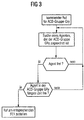
- the flowchart according to FIG 3 shows how a incoming call, the z. B. based on a selected service number assigned to the ACD group GRy, assigned to a terminal becomes. After accepting the corresponding call then this z. B. by an appropriate search within of the agents actively registered for this group allocated, which is the longest free. For this corresponding Allocation can also be based on other criteria.
- system integrated ACD solution if needed a statistical Data collection can be made. The activity is not tied to a specific job. A group member can change this job flexibly if necessary or leave and work in another room continue.
Landscapes
- Business, Economics & Management (AREA)
- Marketing (AREA)
- Engineering & Computer Science (AREA)
- Signal Processing (AREA)
- Telephonic Communication Services (AREA)
Applications Claiming Priority (2)
| Application Number | Priority Date | Filing Date | Title |
|---|---|---|---|
| DE19837225 | 1998-08-17 | ||
| DE19837225 | 1998-08-17 |
Publications (2)
| Publication Number | Publication Date |
|---|---|
| EP0981239A2 true EP0981239A2 (fr) | 2000-02-23 |
| EP0981239A3 EP0981239A3 (fr) | 2003-08-06 |
Family
ID=7877769
Family Applications (1)
| Application Number | Title | Priority Date | Filing Date |
|---|---|---|---|
| EP99115248A Withdrawn EP0981239A3 (fr) | 1998-08-17 | 1999-08-02 | Méthode pour un système de communication à répartition d'appel automatique |
Country Status (1)
| Country | Link |
|---|---|
| EP (1) | EP0981239A3 (fr) |
Cited By (1)
| Publication number | Priority date | Publication date | Assignee | Title |
|---|---|---|---|---|
| CN107690037A (zh) * | 2016-08-23 | 2018-02-13 | 平安科技(深圳)有限公司 | 名单分配方法和装置 |
Family Cites Families (5)
| Publication number | Priority date | Publication date | Assignee | Title |
|---|---|---|---|---|
| US5274700A (en) * | 1989-11-27 | 1993-12-28 | Unifi Communications Corporation | Methods of automatically rerouting an incoming telephone call placed over a network |
| US5742675A (en) * | 1995-09-26 | 1998-04-21 | Telefonaktiebolaget Lm Ericsson | Method and apparatus for automatically distributing calls to available logged-in call handling agents |
| US5778060A (en) * | 1996-04-19 | 1998-07-07 | At&T Corp | Work at home ACD agent network with cooperative control |
| US5796791A (en) * | 1996-10-15 | 1998-08-18 | Intervoice Limited Partnership | Network based predictive dialing |
| WO1998025387A2 (fr) * | 1996-12-03 | 1998-06-11 | Northern Telecom Limited | Centre telephonique avec integration de bases de donnees pour prise en charge par des operateurs |
-
1999
- 1999-08-02 EP EP99115248A patent/EP0981239A3/fr not_active Withdrawn
Cited By (1)
| Publication number | Priority date | Publication date | Assignee | Title |
|---|---|---|---|---|
| CN107690037A (zh) * | 2016-08-23 | 2018-02-13 | 平安科技(深圳)有限公司 | 名单分配方法和装置 |
Also Published As
| Publication number | Publication date |
|---|---|
| EP0981239A3 (fr) | 2003-08-06 |
Similar Documents
| Publication | Publication Date | Title |
|---|---|---|
| DE69730173T2 (de) | Anrufverteilungsnetzwerk mit Lokal-Vertreter mit kooperativer Steuerung | |
| DE19644210C2 (de) | Verfahren zur Verarbeitung ankommender Telefonanrufe | |
| DE4005365A1 (de) | Sprachdaten-steuersystem | |
| EP0306693B1 (fr) | Système de communication numérique à structure modulaire | |
| DE19626131A1 (de) | Verfahren zum Einbringen eines Telekommunikations-Dienstes sowie Dienst-Einheit, Dienstrechner, Endgerät und Kommunikationsnetz | |
| EP0762784B1 (fr) | Procédé pour fournir des données d'abonnés pour des services dans un réseau de télécommunications | |
| EP0813330A2 (fr) | Procédé d'établissement de connexion, central de commutation, processeur de service et réseau de communication | |
| DE69728101T2 (de) | Anrufverteilungsvorrichtung | |
| EP0535601B1 (fr) | Procédé pour l'établissement de connexions de conférence dans un système de communication à commande par processeur | |
| EP0557777B1 (fr) | Système de télécommunication commandé par programme avec option de rappel automatique | |
| EP0529343B1 (fr) | Méthode d'établir une liaison de communication entre un terminal de communication, connectée à un central de communication, et plusieurs terminaux | |
| EP0535602B1 (fr) | Procédé pour faire fonctionner un système de communication avec commande programmée dans lequel une demande de connexion est signalée simultanément dans plusieurs terminaux de communication | |
| EP0720399B1 (fr) | Méthode de commande du mode de fonctionnement d'un appareil mobile associé à un système de communication à commande programmée | |
| DE3542969A1 (de) | Verfahren zur aktivierung von merkmalen in digital durchschaltenden fernmelde-, insbesondere fernsprechvermittlungsanlagen | |
| EP0820179A2 (fr) | Méthode pour commander l'accès à des informations stockées dans un support d'enregistrement par l'intermédiaire d'un terminal connecté à un système de communication | |
| EP1440558B1 (fr) | Procede et dispositif pour former des groupes d'abonnes dans un reseau de communication | |
| EP0866594B1 (fr) | Système de communication, en particulier système de communication privé à commande par programme dans lequel une fonction de calendrier est réalisée | |
| EP1404096B1 (fr) | Méthode et dispositif de telecommunication pour l'acquisition d'information par des centres d'appels répartis dans plusieurs commutateurs d'une réseau de communications | |
| DE19706794C2 (de) | Programmgesteuertes Nebenstellenkommunikationssystem mit der Möglichkeit einer Anrufübernahme | |
| EP0707404B1 (fr) | Procédé pour la réception des appels dans un système de communication | |
| DE19706780A1 (de) | Kommunikationssystem, das die Möglichkeit der Anrufumleitung bietet | |
| EP0861007B1 (fr) | Procédé d'acheminement d'appels dans un système de communication | |
| DE3818086A1 (de) | Verfahren zur durchfuehrung von konferenzverbindungen in einem rechnergesteuerten kommunikationssystem | |
| EP0981241A1 (fr) | Méthode de traitement des appels arrivants au système de communication | |
| EP1172992A2 (fr) | Concept de tâche de groupe |
Legal Events
| Date | Code | Title | Description |
|---|---|---|---|
| PUAI | Public reference made under article 153(3) epc to a published international application that has entered the european phase |
Free format text: ORIGINAL CODE: 0009012 |
|
| AK | Designated contracting states |
Kind code of ref document: A2 Designated state(s): AT BE CH CY DE DK ES FI FR GB GR IE IT LI LU MC NL PT SE |
|
| AX | Request for extension of the european patent |
Free format text: AL;LT;LV;MK;RO;SI |
|
| PUAL | Search report despatched |
Free format text: ORIGINAL CODE: 0009013 |
|
| AK | Designated contracting states |
Designated state(s): AT BE CH CY DE DK ES FI FR GB GR IE IT LI LU MC NL PT SE |
|
| AX | Request for extension of the european patent |
Extension state: AL LT LV MK RO SI |
|
| RIC1 | Information provided on ipc code assigned before grant |
Ipc: 7H 04M 3/51 B Ipc: 7H 04M 3/523 B Ipc: 7H 04M 3/50 A |
|
| 17P | Request for examination filed |
Effective date: 20030707 |
|
| AKX | Designation fees paid |
Designated state(s): DE GB IT |
|
| 17Q | First examination report despatched |
Effective date: 20071122 |
|
| STAA | Information on the status of an ep patent application or granted ep patent |
Free format text: STATUS: THE APPLICATION IS DEEMED TO BE WITHDRAWN |
|
| 18D | Application deemed to be withdrawn |
Effective date: 20100327 |