EP0982292B1 - Verfahren zur Herstellung von Monoacyl-hydrazinen unter Verwendung von Carbonsäuren - Google Patents
Verfahren zur Herstellung von Monoacyl-hydrazinen unter Verwendung von Carbonsäuren Download PDFInfo
- Publication number
- EP0982292B1 EP0982292B1 EP99306408A EP99306408A EP0982292B1 EP 0982292 B1 EP0982292 B1 EP 0982292B1 EP 99306408 A EP99306408 A EP 99306408A EP 99306408 A EP99306408 A EP 99306408A EP 0982292 B1 EP0982292 B1 EP 0982292B1
- Authority
- EP
- European Patent Office
- Prior art keywords
- alkyl
- phenyl
- independently selected
- alkoxy
- hydrogen atom
- Prior art date
- Legal status (The legal status is an assumption and is not a legal conclusion. Google has not performed a legal analysis and makes no representation as to the accuracy of the status listed.)
- Expired - Lifetime
Links
- 238000000034 method Methods 0.000 title claims description 39
- 150000001735 carboxylic acids Chemical class 0.000 title description 5
- 238000002360 preparation method Methods 0.000 title description 5
- 125000001997 phenyl group Chemical group [H]C1=C([H])C([H])=C(*)C([H])=C1[H] 0.000 claims description 112
- -1 cyano, 5-methyl-6-chromanyl Chemical group 0.000 claims description 96
- 125000004435 hydrogen atom Chemical group [H]* 0.000 claims description 76
- 125000004178 (C1-C4) alkyl group Chemical group 0.000 claims description 47
- 125000001309 chloro group Chemical group Cl* 0.000 claims description 47
- 125000006526 (C1-C2) alkyl group Chemical group 0.000 claims description 45
- 125000005843 halogen group Chemical group 0.000 claims description 45
- 125000001424 substituent group Chemical group 0.000 claims description 42
- 125000006536 (C1-C2)alkoxy group Chemical group 0.000 claims description 41
- 125000000217 alkyl group Chemical group 0.000 claims description 39
- 125000001153 fluoro group Chemical group F* 0.000 claims description 39
- 125000004414 alkyl thio group Chemical group 0.000 claims description 31
- 125000000229 (C1-C4)alkoxy group Chemical group 0.000 claims description 30
- 150000001732 carboxylic acid derivatives Chemical class 0.000 claims description 30
- 238000006243 chemical reaction Methods 0.000 claims description 29
- OAKJQQAXSVQMHS-UHFFFAOYSA-N Hydrazine Chemical compound NN OAKJQQAXSVQMHS-UHFFFAOYSA-N 0.000 claims description 23
- DGAQECJNVWCQMB-PUAWFVPOSA-M Ilexoside XXIX Chemical compound C[C@@H]1CC[C@@]2(CC[C@@]3(C(=CC[C@H]4[C@]3(CC[C@@H]5[C@@]4(CC[C@@H](C5(C)C)OS(=O)(=O)[O-])C)C)[C@@H]2[C@]1(C)O)C)C(=O)O[C@H]6[C@@H]([C@H]([C@@H]([C@H](O6)CO)O)O)O.[Na+] DGAQECJNVWCQMB-PUAWFVPOSA-M 0.000 claims description 20
- 125000005077 diacylhydrazine group Chemical group 0.000 claims description 19
- 150000001768 cations Chemical class 0.000 claims description 18
- 125000002887 hydroxy group Chemical group [H]O* 0.000 claims description 18
- 229910052751 metal Inorganic materials 0.000 claims description 18
- 239000002184 metal Substances 0.000 claims description 18
- 125000004209 (C1-C8) alkyl group Chemical group 0.000 claims description 17
- 125000002496 methyl group Chemical group [H]C([H])([H])* 0.000 claims description 17
- 150000003839 salts Chemical class 0.000 claims description 17
- WHXSMMKQMYFTQS-UHFFFAOYSA-N Lithium Chemical compound [Li] WHXSMMKQMYFTQS-UHFFFAOYSA-N 0.000 claims description 16
- ZLMJMSJWJFRBEC-UHFFFAOYSA-N Potassium Chemical compound [K] ZLMJMSJWJFRBEC-UHFFFAOYSA-N 0.000 claims description 16
- 229910052744 lithium Inorganic materials 0.000 claims description 16
- 229910052700 potassium Inorganic materials 0.000 claims description 16
- 239000011591 potassium Substances 0.000 claims description 16
- 229910052708 sodium Inorganic materials 0.000 claims description 16
- 239000011734 sodium Substances 0.000 claims description 16
- JYEUMXHLPRZUAT-UHFFFAOYSA-N 1,2,3-triazine Chemical group C1=CN=NN=C1 JYEUMXHLPRZUAT-UHFFFAOYSA-N 0.000 claims description 15
- QMNWYGTWTXOQTP-UHFFFAOYSA-N 1h-triazin-6-one Chemical compound O=C1C=CN=NN1 QMNWYGTWTXOQTP-UHFFFAOYSA-N 0.000 claims description 14
- 125000004093 cyano group Chemical group *C#N 0.000 claims description 12
- 125000000094 2-phenylethyl group Chemical group [H]C1=C([H])C([H])=C(C([H])=C1[H])C([H])([H])C([H])([H])* 0.000 claims description 11
- 125000001797 benzyl group Chemical group [H]C1=C([H])C([H])=C(C([H])=C1[H])C([H])([H])* 0.000 claims description 11
- 239000006227 byproduct Substances 0.000 claims description 11
- 125000001624 naphthyl group Chemical group 0.000 claims description 11
- 125000004076 pyridyl group Chemical group 0.000 claims description 11
- 125000001544 thienyl group Chemical group 0.000 claims description 11
- 125000002541 furyl group Chemical group 0.000 claims description 7
- 125000000999 tert-butyl group Chemical group [H]C([H])([H])C(*)(C([H])([H])[H])C([H])([H])[H] 0.000 claims description 7
- 125000006530 (C4-C6) alkyl group Chemical group 0.000 claims description 6
- 125000004860 4-ethylphenyl group Chemical group [H]C1=C([H])C(=C([H])C([H])=C1*)C([H])([H])C([H])([H])[H] 0.000 claims description 6
- 150000002429 hydrazines Chemical class 0.000 claims description 6
- 125000003854 p-chlorophenyl group Chemical group [H]C1=C([H])C(*)=C([H])C([H])=C1Cl 0.000 claims description 6
- 125000004179 3-chlorophenyl group Chemical group [H]C1=C([H])C(*)=C([H])C(Cl)=C1[H] 0.000 claims description 4
- OYPRJOBELJOOCE-UHFFFAOYSA-N Calcium Chemical compound [Ca] OYPRJOBELJOOCE-UHFFFAOYSA-N 0.000 claims description 4
- 229910052788 barium Inorganic materials 0.000 claims description 4
- DSAJWYNOEDNPEQ-UHFFFAOYSA-N barium atom Chemical compound [Ba] DSAJWYNOEDNPEQ-UHFFFAOYSA-N 0.000 claims description 4
- 229910052792 caesium Inorganic materials 0.000 claims description 4
- TVFDJXOCXUVLDH-UHFFFAOYSA-N caesium atom Chemical compound [Cs] TVFDJXOCXUVLDH-UHFFFAOYSA-N 0.000 claims description 4
- 239000011575 calcium Substances 0.000 claims description 4
- 229910052791 calcium Inorganic materials 0.000 claims description 4
- 125000000040 m-tolyl group Chemical group [H]C1=C([H])C(*)=C([H])C(=C1[H])C([H])([H])[H] 0.000 claims description 4
- 238000000746 purification Methods 0.000 claims description 4
- WEVYAHXRMPXWCK-UHFFFAOYSA-N Acetonitrile Chemical compound CC#N WEVYAHXRMPXWCK-UHFFFAOYSA-N 0.000 description 24
- SJRJJKPEHAURKC-UHFFFAOYSA-N N-Methylmorpholine Chemical compound CN1CCOCC1 SJRJJKPEHAURKC-UHFFFAOYSA-N 0.000 description 21
- 125000003118 aryl group Chemical group 0.000 description 14
- HEMHJVSKTPXQMS-UHFFFAOYSA-M sodium hydroxide Inorganic materials [OH-].[Na+] HEMHJVSKTPXQMS-UHFFFAOYSA-M 0.000 description 13
- ZMANZCXQSJIPKH-UHFFFAOYSA-N Triethylamine Chemical compound CCN(CC)CC ZMANZCXQSJIPKH-UHFFFAOYSA-N 0.000 description 12
- 239000002253 acid Substances 0.000 description 12
- 239000000047 product Substances 0.000 description 12
- 125000003710 aryl alkyl group Chemical group 0.000 description 11
- 239000002585 base Substances 0.000 description 10
- 239000003153 chemical reaction reagent Substances 0.000 description 10
- MGNCLNQXLYJVJD-UHFFFAOYSA-N cyanuric chloride Chemical compound ClC1=NC(Cl)=NC(Cl)=N1 MGNCLNQXLYJVJD-UHFFFAOYSA-N 0.000 description 10
- 239000002904 solvent Substances 0.000 description 10
- 125000000753 cycloalkyl group Chemical group 0.000 description 9
- JIHQDMXYYFUGFV-UHFFFAOYSA-N 1,3,5-triazine Chemical compound C1=NC=NC=N1 JIHQDMXYYFUGFV-UHFFFAOYSA-N 0.000 description 8
- 230000015572 biosynthetic process Effects 0.000 description 8
- GPIQOFWTZXXOOV-UHFFFAOYSA-N 2-chloro-4,6-dimethoxy-1,3,5-triazine Chemical compound COC1=NC(Cl)=NC(OC)=N1 GPIQOFWTZXXOOV-UHFFFAOYSA-N 0.000 description 6
- XEKOWRVHYACXOJ-UHFFFAOYSA-N Ethyl acetate Chemical compound CCOC(C)=O XEKOWRVHYACXOJ-UHFFFAOYSA-N 0.000 description 6
- KWYUFKZDYYNOTN-UHFFFAOYSA-M Potassium hydroxide Chemical compound [OH-].[K+] KWYUFKZDYYNOTN-UHFFFAOYSA-M 0.000 description 6
- KRKNYBCHXYNGOX-UHFFFAOYSA-N citric acid Chemical compound OC(=O)CC(O)(C(O)=O)CC(O)=O KRKNYBCHXYNGOX-UHFFFAOYSA-N 0.000 description 6
- 125000001072 heteroaryl group Chemical group 0.000 description 6
- 150000001805 chlorine compounds Chemical class 0.000 description 5
- 239000012044 organic layer Substances 0.000 description 5
- NGNBDVOYPDDBFK-UHFFFAOYSA-N 2-[2,4-di(pentan-2-yl)phenoxy]acetyl chloride Chemical compound CCCC(C)C1=CC=C(OCC(Cl)=O)C(C(C)CCC)=C1 NGNBDVOYPDDBFK-UHFFFAOYSA-N 0.000 description 4
- 0 C*CN(*)N* Chemical compound C*CN(*)N* 0.000 description 4
- QOSSAOTZNIDXMA-UHFFFAOYSA-N Dicylcohexylcarbodiimide Chemical compound C1CCCCC1N=C=NC1CCCCC1 QOSSAOTZNIDXMA-UHFFFAOYSA-N 0.000 description 4
- MZRVEZGGRBJDDB-UHFFFAOYSA-N N-Butyllithium Chemical compound [Li]CCCC MZRVEZGGRBJDDB-UHFFFAOYSA-N 0.000 description 4
- JUJWROOIHBZHMG-UHFFFAOYSA-N Pyridine Chemical compound C1=CC=NC=C1 JUJWROOIHBZHMG-UHFFFAOYSA-N 0.000 description 4
- 150000008064 anhydrides Chemical class 0.000 description 4
- WPYMKLBDIGXBTP-UHFFFAOYSA-N benzoic acid Chemical compound OC(=O)C1=CC=CC=C1 WPYMKLBDIGXBTP-UHFFFAOYSA-N 0.000 description 4
- DKPFZGUDAPQIHT-UHFFFAOYSA-N butyl acetate Chemical compound CCCCOC(C)=O DKPFZGUDAPQIHT-UHFFFAOYSA-N 0.000 description 4
- VMKJWLXVLHBJNK-UHFFFAOYSA-N cyanuric fluoride Chemical compound FC1=NC(F)=NC(F)=N1 VMKJWLXVLHBJNK-UHFFFAOYSA-N 0.000 description 4
- 239000000203 mixture Substances 0.000 description 4
- PDVYABOBMALASJ-UHFFFAOYSA-N n'-tert-butyl-4-chlorobenzohydrazide Chemical compound CC(C)(C)NNC(=O)C1=CC=C(Cl)C=C1 PDVYABOBMALASJ-UHFFFAOYSA-N 0.000 description 4
- 230000000269 nucleophilic effect Effects 0.000 description 4
- BWHMMNNQKKPAPP-UHFFFAOYSA-L potassium carbonate Chemical compound [K+].[K+].[O-]C([O-])=O BWHMMNNQKKPAPP-UHFFFAOYSA-L 0.000 description 4
- 239000002002 slurry Substances 0.000 description 4
- 239000000243 solution Substances 0.000 description 4
- MUQNAPSBHXFMHT-UHFFFAOYSA-N tert-butylhydrazine Chemical compound CC(C)(C)NN MUQNAPSBHXFMHT-UHFFFAOYSA-N 0.000 description 4
- QTBSBXVTEAMEQO-UHFFFAOYSA-N Acetic acid Chemical compound CC(O)=O QTBSBXVTEAMEQO-UHFFFAOYSA-N 0.000 description 3
- YMWUJEATGCHHMB-UHFFFAOYSA-N Dichloromethane Chemical compound ClCCl YMWUJEATGCHHMB-UHFFFAOYSA-N 0.000 description 3
- PMZURENOXWZQFD-UHFFFAOYSA-L Sodium Sulfate Chemical compound [Na+].[Na+].[O-]S([O-])(=O)=O PMZURENOXWZQFD-UHFFFAOYSA-L 0.000 description 3
- 230000008878 coupling Effects 0.000 description 3
- 238000010168 coupling process Methods 0.000 description 3
- 238000005859 coupling reaction Methods 0.000 description 3
- 150000002148 esters Chemical class 0.000 description 3
- 229940042795 hydrazides for tuberculosis treatment Drugs 0.000 description 3
- 239000000463 material Substances 0.000 description 3
- JPHNWUMYNZVUFT-UHFFFAOYSA-N n'-tert-butyl-3-methoxy-2-methylbenzohydrazide Chemical compound COC1=CC=CC(C(=O)NNC(C)(C)C)=C1C JPHNWUMYNZVUFT-UHFFFAOYSA-N 0.000 description 3
- 229910052938 sodium sulfate Inorganic materials 0.000 description 3
- 235000011152 sodium sulphate Nutrition 0.000 description 3
- 239000007787 solid Substances 0.000 description 3
- 238000003756 stirring Methods 0.000 description 3
- JKAPWXKZLYJQJJ-UHFFFAOYSA-N 2,4-dichloro-6-methoxy-1,3,5-triazine Chemical compound COC1=NC(Cl)=NC(Cl)=N1 JKAPWXKZLYJQJJ-UHFFFAOYSA-N 0.000 description 2
- WPAYYYDSSCOEHN-UHFFFAOYSA-N 2-chloro-4,6-diphenoxy-1,3,5-triazine Chemical compound N=1C(OC=2C=CC=CC=2)=NC(Cl)=NC=1OC1=CC=CC=C1 WPAYYYDSSCOEHN-UHFFFAOYSA-N 0.000 description 2
- OLCKRGCUQOKQCM-UHFFFAOYSA-N 2-fluoro-1,3,5-triazine Chemical compound FC1=NC=NC=N1 OLCKRGCUQOKQCM-UHFFFAOYSA-N 0.000 description 2
- JPCISVSOTKMFPG-UHFFFAOYSA-N 3-methoxy-2-methylbenzoic acid Chemical compound COC1=CC=CC(C(O)=O)=C1C JPCISVSOTKMFPG-UHFFFAOYSA-N 0.000 description 2
- LQIZSBKWIKPSCT-UHFFFAOYSA-N 4-chloro-n'-methylbenzohydrazide Chemical compound CNNC(=O)C1=CC=C(Cl)C=C1 LQIZSBKWIKPSCT-UHFFFAOYSA-N 0.000 description 2
- FHLLMNAAJMLCIX-UHFFFAOYSA-N 4-chloro-n'-phenylbenzohydrazide Chemical compound C1=CC(Cl)=CC=C1C(=O)NNC1=CC=CC=C1 FHLLMNAAJMLCIX-UHFFFAOYSA-N 0.000 description 2
- XRHGYUZYPHTUJZ-UHFFFAOYSA-N 4-chlorobenzoic acid Chemical compound OC(=O)C1=CC=C(Cl)C=C1 XRHGYUZYPHTUJZ-UHFFFAOYSA-N 0.000 description 2
- HIMMCCJEMMCUJS-UHFFFAOYSA-N 4-fluorotriazine Chemical compound FC1=CC=NN=N1 HIMMCCJEMMCUJS-UHFFFAOYSA-N 0.000 description 2
- 239000005711 Benzoic acid Substances 0.000 description 2
- BVKZGUZCCUSVTD-UHFFFAOYSA-M Bicarbonate Chemical compound OC([O-])=O BVKZGUZCCUSVTD-UHFFFAOYSA-M 0.000 description 2
- BVKZGUZCCUSVTD-UHFFFAOYSA-L Carbonate Chemical compound [O-]C([O-])=O BVKZGUZCCUSVTD-UHFFFAOYSA-L 0.000 description 2
- RTZKZFJDLAIYFH-UHFFFAOYSA-N Diethyl ether Chemical compound CCOCC RTZKZFJDLAIYFH-UHFFFAOYSA-N 0.000 description 2
- 239000007818 Grignard reagent Substances 0.000 description 2
- VEXZGXHMUGYJMC-UHFFFAOYSA-N Hydrochloric acid Chemical compound Cl VEXZGXHMUGYJMC-UHFFFAOYSA-N 0.000 description 2
- UIIMBOGNXHQVGW-UHFFFAOYSA-M Sodium bicarbonate Chemical class [Na+].OC([O-])=O UIIMBOGNXHQVGW-UHFFFAOYSA-M 0.000 description 2
- UIIMBOGNXHQVGW-DEQYMQKBSA-M Sodium bicarbonate-14C Chemical compound [Na+].O[14C]([O-])=O UIIMBOGNXHQVGW-DEQYMQKBSA-M 0.000 description 2
- FAPWRFPIFSIZLT-UHFFFAOYSA-M Sodium chloride Chemical compound [Na+].[Cl-] FAPWRFPIFSIZLT-UHFFFAOYSA-M 0.000 description 2
- 150000004703 alkoxides Chemical class 0.000 description 2
- 125000003545 alkoxy group Chemical group 0.000 description 2
- 150000004791 alkyl magnesium halides Chemical class 0.000 description 2
- 150000001412 amines Chemical class 0.000 description 2
- 235000010233 benzoic acid Nutrition 0.000 description 2
- 125000000113 cyclohexyl group Chemical group [H]C1([H])C([H])([H])C([H])([H])C([H])(*)C([H])([H])C1([H])[H] 0.000 description 2
- 230000007613 environmental effect Effects 0.000 description 2
- 238000000605 extraction Methods 0.000 description 2
- 238000001914 filtration Methods 0.000 description 2
- 238000004817 gas chromatography Methods 0.000 description 2
- 150000004795 grignard reagents Chemical class 0.000 description 2
- XLYOFNOQVPJJNP-UHFFFAOYSA-M hydroxide Chemical compound [OH-] XLYOFNOQVPJJNP-UHFFFAOYSA-M 0.000 description 2
- 239000002917 insecticide Substances 0.000 description 2
- 239000000543 intermediate Substances 0.000 description 2
- 238000002955 isolation Methods 0.000 description 2
- FRIJBUGBVQZNTB-UHFFFAOYSA-M magnesium;ethane;bromide Chemical compound [Mg+2].[Br-].[CH2-]C FRIJBUGBVQZNTB-UHFFFAOYSA-M 0.000 description 2
- OYOBYDFJCUAPSC-UHFFFAOYSA-N n'-tert-butyl-2-ethyl-3-methoxybenzohydrazide Chemical compound CCC1=C(OC)C=CC=C1C(=O)NNC(C)(C)C OYOBYDFJCUAPSC-UHFFFAOYSA-N 0.000 description 2
- AMEHWLNTLLNOPN-UHFFFAOYSA-N n'-tert-butyl-3-ethoxy-2-ethylbenzohydrazide Chemical compound CCOC1=CC=CC(C(=O)NNC(C)(C)C)=C1CC AMEHWLNTLLNOPN-UHFFFAOYSA-N 0.000 description 2
- JZMLVUDWQBQYOT-UHFFFAOYSA-N n'-tert-butyl-3-ethoxy-2-methylbenzohydrazide Chemical compound CCOC1=CC=CC(C(=O)NNC(C)(C)C)=C1C JZMLVUDWQBQYOT-UHFFFAOYSA-N 0.000 description 2
- YKWLOFDSMMILOG-UHFFFAOYSA-N n'-tert-butyl-4-ethylbenzohydrazide Chemical compound CCC1=CC=C(C(=O)NNC(C)(C)C)C=C1 YKWLOFDSMMILOG-UHFFFAOYSA-N 0.000 description 2
- DNQRRIURJFBNFP-UHFFFAOYSA-N n'-tert-butyl-5-methyl-3,4-dihydro-2h-chromene-6-carbohydrazide Chemical compound C1CCOC2=CC=C(C(=O)NNC(C)(C)C)C(C)=C21 DNQRRIURJFBNFP-UHFFFAOYSA-N 0.000 description 2
- VVBDSQGSYHSLSZ-UHFFFAOYSA-N n'-tert-butylbenzohydrazide Chemical compound CC(C)(C)NNC(=O)C1=CC=CC=C1 VVBDSQGSYHSLSZ-UHFFFAOYSA-N 0.000 description 2
- VLKZOEOYAKHREP-UHFFFAOYSA-N n-Hexane Chemical class CCCCCC VLKZOEOYAKHREP-UHFFFAOYSA-N 0.000 description 2
- 150000002825 nitriles Chemical class 0.000 description 2
- 239000012454 non-polar solvent Substances 0.000 description 2
- 150000007530 organic bases Chemical class 0.000 description 2
- 125000004430 oxygen atom Chemical group O* 0.000 description 2
- 239000002798 polar solvent Substances 0.000 description 2
- 229910000027 potassium carbonate Inorganic materials 0.000 description 2
- LPNYRYFBWFDTMA-UHFFFAOYSA-N potassium tert-butoxide Chemical compound [K+].CC(C)(C)[O-] LPNYRYFBWFDTMA-UHFFFAOYSA-N 0.000 description 2
- 239000002244 precipitate Substances 0.000 description 2
- 125000002924 primary amino group Chemical group [H]N([H])* 0.000 description 2
- UMJSCPRVCHMLSP-UHFFFAOYSA-N pyridine Natural products COC1=CC=CN=C1 UMJSCPRVCHMLSP-UHFFFAOYSA-N 0.000 description 2
- 239000000376 reactant Substances 0.000 description 2
- 239000011541 reaction mixture Substances 0.000 description 2
- 238000010992 reflux Methods 0.000 description 2
- 150000003335 secondary amines Chemical class 0.000 description 2
- CDBYLPFSWZWCQE-UHFFFAOYSA-L sodium carbonate Substances [Na+].[Na+].[O-]C([O-])=O CDBYLPFSWZWCQE-UHFFFAOYSA-L 0.000 description 2
- 229910000029 sodium carbonate Inorganic materials 0.000 description 2
- QDRKDTQENPPHOJ-UHFFFAOYSA-N sodium ethoxide Chemical compound [Na+].CC[O-] QDRKDTQENPPHOJ-UHFFFAOYSA-N 0.000 description 2
- 229910052717 sulfur Inorganic materials 0.000 description 2
- 238000003786 synthesis reaction Methods 0.000 description 2
- 150000003512 tertiary amines Chemical class 0.000 description 2
- 238000005406 washing Methods 0.000 description 2
- XLYOFNOQVPJJNP-UHFFFAOYSA-N water Substances O XLYOFNOQVPJJNP-UHFFFAOYSA-N 0.000 description 2
- DIIIISSCIXVANO-UHFFFAOYSA-N 1,2-Dimethylhydrazine Chemical compound CNNC DIIIISSCIXVANO-UHFFFAOYSA-N 0.000 description 1
- ADMTUGZFHLWYAU-UHFFFAOYSA-N 2,2-dimethylpropylhydrazine Chemical compound CC(C)(C)CNN ADMTUGZFHLWYAU-UHFFFAOYSA-N 0.000 description 1
- NGSOWKPBNFOQCR-UHFFFAOYSA-N 2-methylpropylhydrazine Chemical compound CC(C)CNN NGSOWKPBNFOQCR-UHFFFAOYSA-N 0.000 description 1
- LVJAZWNACGZVRQ-UHFFFAOYSA-N 3-methylbutylhydrazine Chemical compound CC(C)CCNN LVJAZWNACGZVRQ-UHFFFAOYSA-N 0.000 description 1
- AQECUUPLGRRRTJ-UHFFFAOYSA-N 6-methylheptylhydrazine Chemical compound CC(C)CCCCCNN AQECUUPLGRRRTJ-UHFFFAOYSA-N 0.000 description 1
- VEXZGXHMUGYJMC-UHFFFAOYSA-M Chloride anion Chemical compound [Cl-] VEXZGXHMUGYJMC-UHFFFAOYSA-M 0.000 description 1
- CPELXLSAUQHCOX-UHFFFAOYSA-N Hydrogen bromide Chemical compound Br CPELXLSAUQHCOX-UHFFFAOYSA-N 0.000 description 1
- QAOWNCQODCNURD-UHFFFAOYSA-L Sulfate Chemical compound [O-]S([O-])(=O)=O QAOWNCQODCNURD-UHFFFAOYSA-L 0.000 description 1
- NINIDFKCEFEMDL-UHFFFAOYSA-N Sulfur Chemical compound [S] NINIDFKCEFEMDL-UHFFFAOYSA-N 0.000 description 1
- 150000008065 acid anhydrides Chemical class 0.000 description 1
- 150000007513 acids Chemical class 0.000 description 1
- 238000005917 acylation reaction Methods 0.000 description 1
- 125000004183 alkoxy alkyl group Chemical group 0.000 description 1
- 150000001408 amides Chemical class 0.000 description 1
- 238000004458 analytical method Methods 0.000 description 1
- 125000001246 bromo group Chemical group Br* 0.000 description 1
- 150000001244 carboxylic acid anhydrides Chemical class 0.000 description 1
- 239000007822 coupling agent Substances 0.000 description 1
- 125000001995 cyclobutyl group Chemical group [H]C1([H])C([H])([H])C([H])(*)C1([H])[H] 0.000 description 1
- 125000001511 cyclopentyl group Chemical group [H]C1([H])C([H])([H])C([H])([H])C([H])(*)C1([H])[H] 0.000 description 1
- 125000005448 ethoxyethyl group Chemical group [H]C([H])([H])C([H])([H])OC([H])([H])C([H])([H])* 0.000 description 1
- 125000005745 ethoxymethyl group Chemical group [H]C([H])([H])C([H])([H])OC([H])([H])* 0.000 description 1
- 125000001495 ethyl group Chemical group [H]C([H])([H])C([H])([H])* 0.000 description 1
- 239000000706 filtrate Substances 0.000 description 1
- 239000007789 gas Substances 0.000 description 1
- CNKHSLKYRMDDNQ-UHFFFAOYSA-N halofenozide Chemical compound C=1C=CC=CC=1C(=O)N(C(C)(C)C)NC(=O)C1=CC=C(Cl)C=C1 CNKHSLKYRMDDNQ-UHFFFAOYSA-N 0.000 description 1
- IXCSERBJSXMMFS-UHFFFAOYSA-N hydrogen chloride Substances Cl.Cl IXCSERBJSXMMFS-UHFFFAOYSA-N 0.000 description 1
- 229910000041 hydrogen chloride Inorganic materials 0.000 description 1
- 125000002883 imidazolyl group Chemical group 0.000 description 1
- 230000000749 insecticidal effect Effects 0.000 description 1
- 125000002346 iodo group Chemical group I* 0.000 description 1
- 125000000959 isobutyl group Chemical group [H]C([H])([H])C([H])(C([H])([H])[H])C([H])([H])* 0.000 description 1
- 125000001972 isopentyl group Chemical group [H]C([H])([H])C([H])(C([H])([H])[H])C([H])([H])C([H])([H])* 0.000 description 1
- 125000001449 isopropyl group Chemical group [H]C([H])([H])C([H])(*)C([H])([H])[H] 0.000 description 1
- 230000001404 mediated effect Effects 0.000 description 1
- 125000004184 methoxymethyl group Chemical group [H]C([H])([H])OC([H])([H])* 0.000 description 1
- HDZGCSFEDULWCS-UHFFFAOYSA-N monomethylhydrazine Chemical compound CNN HDZGCSFEDULWCS-UHFFFAOYSA-N 0.000 description 1
- 125000004108 n-butyl group Chemical group [H]C([H])([H])C([H])([H])C([H])([H])C([H])([H])* 0.000 description 1
- 125000001280 n-hexyl group Chemical group C(CCCCC)* 0.000 description 1
- 125000004123 n-propyl group Chemical group [H]C([H])([H])C([H])([H])C([H])([H])* 0.000 description 1
- 125000001971 neopentyl group Chemical group [H]C([*])([H])C(C([H])([H])[H])(C([H])([H])[H])C([H])([H])[H] 0.000 description 1
- 125000004433 nitrogen atom Chemical group N* 0.000 description 1
- 239000012038 nucleophile Substances 0.000 description 1
- 238000005897 peptide coupling reaction Methods 0.000 description 1
- HKOOXMFOFWEVGF-UHFFFAOYSA-N phenylhydrazine Chemical compound NNC1=CC=CC=C1 HKOOXMFOFWEVGF-UHFFFAOYSA-N 0.000 description 1
- 229940067157 phenylhydrazine Drugs 0.000 description 1
- 238000001556 precipitation Methods 0.000 description 1
- 102000004196 processed proteins & peptides Human genes 0.000 description 1
- 108090000765 processed proteins & peptides Proteins 0.000 description 1
- KJAQRHMKLVGSCG-UHFFFAOYSA-N propan-2-ylhydrazine Chemical compound CC(C)NN KJAQRHMKLVGSCG-UHFFFAOYSA-N 0.000 description 1
- 125000003373 pyrazinyl group Chemical group 0.000 description 1
- 125000000714 pyrimidinyl group Chemical group 0.000 description 1
- 230000009257 reactivity Effects 0.000 description 1
- 239000012047 saturated solution Substances 0.000 description 1
- 125000002914 sec-butyl group Chemical group [H]C([H])([H])C([H])([H])C([H])(*)C([H])([H])[H] 0.000 description 1
- 239000011780 sodium chloride Substances 0.000 description 1
- 239000011593 sulfur Substances 0.000 description 1
- 125000004434 sulfur atom Chemical group 0.000 description 1
- 125000004213 tert-butoxy group Chemical group [H]C([H])([H])C(O*)(C([H])([H])[H])C([H])([H])[H] 0.000 description 1
- 125000001425 triazolyl group Chemical group 0.000 description 1
- 239000002699 waste material Substances 0.000 description 1
Classifications
-
- C—CHEMISTRY; METALLURGY
- C07—ORGANIC CHEMISTRY
- C07C—ACYCLIC OR CARBOCYCLIC COMPOUNDS
- C07C243/00—Compounds containing chains of nitrogen atoms singly-bound to each other, e.g. hydrazines, triazanes
- C07C243/24—Hydrazines having nitrogen atoms of hydrazine groups acylated by carboxylic acids
-
- C—CHEMISTRY; METALLURGY
- C07—ORGANIC CHEMISTRY
- C07C—ACYCLIC OR CARBOCYCLIC COMPOUNDS
- C07C241/00—Preparation of compounds containing chains of nitrogen atoms singly-bound to each other, e.g. hydrazines, triazanes
- C07C241/04—Preparation of hydrazides
Definitions
- This invention relates to an improved process for the preparation of monoacylhydrazines, some of which are useful intermediates in the synthesis of diacylhydrazine insecticides.
- the overall process to the diacylhydrazine insecticides is therefore improved.
- Acylhydrazines are typically prepared by coupling a hydrazine with an acid chloride which has been generated from the parent carboxylic acid. This method of preparation is well known and is described in various patents such as US 4,985,461, January 15, 1991. While acid chlorides are highly reactive, they suffer from several disadvantages. The primary disadvantage is economic; though technically simple, conversion of a carboxylic acid to an acid chloride usually adds over $2/1b to the cost of the product. Acid chlorides are corrosive and water-reactive, which presents problems in handling these materials. The environmental impact of this chemistry is also a problem. The hydrogen chloride by-product generated during acid chloride formation and during the process to form the acylhydrazide must be scrubbed and the resulting salts disposed of.
- Carboxylic acid anhydrides can be utilized as alternatives to acid chlorides in procedures to form hydrazides as described in EP 0 638 545 A1, published February 15, 1995. However, this procedure is often problematic. If the carboxylic acid is converted to a symmetric anhydride, one equivalent of carboxylic acid is lost as the by-product of the reaction. While expensive acids may be isolated and reconverted to the anhydride, the additional processing required may be costly. If the acid is sufficiently expensive, a mixed anhydride may be prepared from an inexpensive material such as acetic acid. However, it is unlikely that only one of the acid components will couple with the hydrazine, thus resulting in a mixture of hydrazide products being obtained.
- N,N'-dicyclohexylcarbodiimide (DCC) and other similar reagents are also used as peptide coupling agents which promotes a variety of acylation reactions between carboxylic acids and nucleophiles.
- DCC N,N'-dicyclohexylcarbodiimide
- these reagents are expensive and form by-products which are difficult to separate from the desired product.
- This invention comprises the preparation of hydrazides via a triazine-mediated coupling of carboxylic acids with hydrazines.
- This invention overcomes the disadvantages of using acid chlorides or acid anhydrides by utilizing carboxylic acids which are more stable and less expensive reagents. Furthermore, this methodology allows the formation of the desired hydrazide with high selectivity. No isomeric or diacylated products were detected.
- this invention provides a process comprising the reaction of a carboxylic acid or salt thereof with hydrazine or salt or hydrate thereof, or a substituted hydrazine or salt or hydrate thereof in the presence of a triazine substituted with at least one chloro or fluoro to produce a hydroxytriazine and a monoacylhydrazine or substituted monoacylhydrazine according to the reaction wherein
- alkyl refers to either a straight chain (C 1 -C 8 )alkyl such as, but not limited to, methyl, ethyl, n -propyl, n -butyl, n -hexyl and n -octyl or a branched chain (C 3 -C 8 )alkyl such as, but not limited to, isopropyl, isobutyl, sec -butyl, tert -butyl, neopentyl, isoamyl, ⁇ -methylneopentyl and isooctyl.
- C 1 -C 8 straight chain
- alkyl refers to either a straight chain (C 1 -C 8 )alkyl such as, but not limited to, methyl, ethyl, n -propyl, n -butyl, n -hexyl and n -octyl or a branched
- Cycloalkyl is a cyclo(C 4 -C 8 )alkyl, such as cyclobutyl, cyclopentyl, cyclohexyl and cyclohexyl, all of which may be optionally substituted with alkyl and halo.
- Halo is fluoro, chloro, bromo or iodo.
- Alkoxy is a (C 1 -C 4 )alkyl appended to an oxygen atom and includes, for example, methoxy, ethoxy, n -propoxy, isopropoxy, n-butoxy and tert -butoxy.
- Alkoxyalkyl is, for example, a (C 1 -C 2 )alkoxy(C 1 -C 2 )alkyl such as methoxymethyl, ethoxymethyl and ethoxyethyl.
- Alkylthio is a (C 1 -C 4 )alkyl appended to a sulfur atom and includes, for example, methylthio, ethylthio and isopropylthio.
- Aryl is phenyl, phenyl substituted with from one to three substituents, preferably alkyl, halo, alkoxy and cyano, or naphthyl.
- Heteroaryl is a 5- or 6-membered aromatic ring containing 1-3 nitrogen atoms, for example, pyridyl, pyrazinyl, pyrimidinyl, triazinoyl, imidazolyl or triazolyl, or a 5-membered aromatic ring containing a sulfur or oxygen atom, for example thienyl or furyl, all of which may be substituted with alkyl or halo.
- Aralkyl is ar(C 1 -C 4 )alkyl and includes, for example, benzyl and phenethyl, the aromatic ring portion of which may be further substituted with 1-2 substituents selected from alkyl, halo and cyano.
- 5-Methyl-6-chromanyl is defined as the moiety having the formula which is attached to another group at position (6).
- this invention provides a process comprising the reaction of a carboxylic acid or salt thereof with hydrazine or salt or hydrate thereof, or a substituted hydrazine or salt or hydrate thereof in the presence of a triazine substituted with at least one chloro or fluoro to produce a hydroxytriazine and a monoacylhydrazine or substituted monoacylhydrazine according to the reaction wherein
- the desired monoacylhydrazine can be purified, if desired, by removal of the hydroxytriazine by-product.
- These means of purification are known to those with ordinary skill in the art and include removing the hydroxytriazine from the monoacylhydrazine product by various combinations of extractions, washings and/or filtration such as those described in the Examples which follow.
- any salt of a carboxylic acid i.e., any carboxylate anion, or any carboxylic acid may be utilized. If a carboxylic acid is utilized as the reagent, a base is utilized to prepare the carboxylate anion.
- the base may be either inorganic, for example, a hydroxide such as sodium or potassium hydroxide, a carbonate such as sodium or potassium carbonate, or a bicarbonate such as sodium bicarbonate, or organic, for example, an amine such as N-methylmorpholine (NMM), triethylamine (TEA) or pyridine, an alkoxide such as potassium tert -butoxide or sodium ethoxide, an alkyllithium such as n-butyllithium, or an alkylmagnesium halide (Grignard reagent) such as ethylmagnesium bromide.
- a hydroxide such as sodium or potassium hydroxide
- a carbonate such as sodium or potassium carbonate
- a bicarbonate such as sodium bicarbonate
- organic for example, an amine such as N-methylmorpholine (NMM), triethylamine (TEA) or pyridine, an alkoxide such as potassium tert -butoxid
- any chlorotriazine or fluorotriazine reagent is acceptable.
- suitable triazine reagents include, but are not limited to, 2,4,6-trichloro-1,3,5-triazine (cyanuric chloride), 2,4-dichloro-6-methoxy-1,3,5-triazine, 2-chloro-4,6-dimethoxy-1,3,5-triazine, 2-chloro-4,6-diphenoxy-1,3,5-triazine and 2,4,6-trifluoro-1,3,5-triazine (cyanuric fluoride).
- a monochloro or monofluoro 1,3,5-triazine When a monochloro or monofluoro 1,3,5-triazine is used, one molar equivalent of carboxylic acid is used per molar equivalent of triazine. If the 1,3,5-triazine is sited with a combination of two chloro and/or fluoro, it is generally most convenient to use two molar equivalents of carboxylic acid per molar equivalent of triazine. If the 1,3,5-triazine is sited with a combination of three chloro and/or fluoro, it is generally convenient to use three molar equivalents of carboxylic acid per molar equivalent of triazine.
- hydrazines their hydrate or their corresponding acid addition salts such as the hydrochloride, hydrobromide or sulfate can be used in the process of this invention.
- hydrazines include, but are not limited to, hydrazine, methylhydrazine, N,N'-dimethylhydrazine, phenylhydrazine, isopropylhydrazine, tert -butylhydrazine, neopentylhydrazine, ⁇ -methylneopentylhydrazine, isobutylhydrazine, isopentylhydrazine, isooctylhydrazine and their corresponding hydrate or an acid addition salt.
- Nitriles such as acetonitrile, or esters, such as n-butyl acetate, are preferred solvents.
- Non-polar solvents can be utilized, but the isolation of the monoacylhydrazine from the hydroxytriazine by-product is more difficult because of solubility factors.
- reaction temperature under which the reaction is performed will depend upon the solvent chosen and the stability of the hydrazine reactant. Usually a range of from -20°C to 150°C is convenient. Preferred are temperatures in the 0°C to 50°C range.
- the carboxylic acid, solvent and 1,3,5-triazine are added to a suitable reactor, followed by a non-nucleophilic base, such as a tertiary amine, to convert the acid to the carboxylate anion.
- a non-nucleophilic base such as a tertiary amine
- sodium hydroxide or a nucleophilic organic base such as a primary or secondary amine
- the addition order is carboxylic acid, solvent and base followed by addition of the 1,3,5-triazine.
- the mixture is generally held for 15 minutes to 2 hours before addition of the hydrazine and another 30 minutes to 3 hours after the hydrazine addition to complete the reaction.
- the monoacylhydrazine formed according to the process of this invention hereinabove described may be reacted with a second carboxylic acid or salt thereof in the presence of a triazine substituted with at least one chloro or fluoro to produce a hydroxytriazine and a diacylhydrazine or substituted diacylhydrazine according to the reaction wherein
- the second embodiment of this invention provides a process comprising the reaction of the monoacylhydrazine formed according to the process of this invention hereinabove described with a second carboxylic acid or salt thereof in the presence of a triazine substituted with at least one chloro or fluoro to produce a hydroxytriazine and a diacylhydrazine or substituted diacylhydrazine according to the reaction wherein
- the desired diacylhydrazine can be purified, if desired, by removal of the hydroxytriazine by-product.
- These means of purification are known to those with ordinary skill in the art and include removing the hydroxytriazine from the diacylhydrazine product by various combinations of extractions, washings and/or filtration.
- any salt of a carboxylic acid i.e., any carboxylate anion, or any carboxylic acid may be utilized. If a carboxylic acid is utilized as the reagent, a base is utilized to prepare the carboxylate anion.
- the base may be either inorganic, for example, a hydroxide such as sodium or potassium hydroxide, a carbonate such as sodium or potassium carbonate, or a bicarbonate such as sodium bicarbonate, or organic, for example, an amine such as N-methylmorpholine (NMM), triethylamine (TEA) or pyridine, an alkoxide such as potassium tert -butoxide or sodium ethoxide, an alkyllithium such as n -butyllithium, or an alkylmagnesium halide (Grignard reagent) such as ethylmagnesium bromide.
- a hydroxide such as sodium or potassium hydroxide
- a carbonate such as sodium or potassium carbonate
- a bicarbonate such as sodium bicarbonate
- organic for example, an amine such as N-methylmorpholine (NMM), triethylamine (TEA) or pyridine, an alkoxide such as potassium tert -but
- any chlorotriazine or fluorotriazine reagent is acceptable.
- suitable triazine reagents include, but are not limited to, 2,4,6-trichloro-1,3,5-triazine (cyanuric chloride), 2,4-dichloro-6-methoxy-1,3,5-triazine, 2-chloro-4,6-dimethoxy-1,3,5-triazine, 2-chloro-4,6-diphenoxy-1,3,5-triazine and 2,4,6-trifluoro-1,3,5-triazine (cyanuric fluoride).
- a monochloro or monofluoro 1,3,5-triazine When a monochloro or monofluoro 1,3,5-triazine is used, one molar equivalent of carboxylic acid is used per molar equivalent of triazine. If the 1,3,5-triazine is sited with a combination of two chloro and/or fluoro, it is generally most convenient to use two molar equivalents of carboxylic acid per molar equivalent of triazine. If the 1,3,5-triazine is sited with a combination of three chloro and/or fluoro, it is generally convenient to use three molar equivalents of carboxylic acid per molar equivalent of triazine.
- monoacylhydrazines can be used in the process of the second embodiment of this invention.
- monoacylhydrazines include, but are not limited to, N-benzoyl-N'- tert -butylhydrazine, N-(4-ethylbenzoyl)-N'- tert- butylhydrazine, N-(4-chlorobenzoyl)-N'- tert -butylhydrazine, N-(4-chlorobenzoyl)-N'-phenylhydrazine, N-(4-chlorobenzoyl)-N'-methylhydrazine, N-(3-methoxy-2-methylbenzoyl)-N'- tert -butylhydrazine, N-(3-ethoxy-2-methylbenzoyl)-N' -tert -butylhydrazine, N-(2-ethyl-3-methoxybenzoyl
- Nitriles such as acetonitrile, or esters, such as n-butyl acetate, are preferred solvents.
- Non-polar solvents can be utilized, but the isolation of the diacylhydrazine from the hydroxytriazine by-product is more difficult because of solubility factors.
- reaction temperature under which the reaction is performed will depend upon the solvent chosen and the stability of the hydrazine reactant. Usually a range of from 0°C to 150°C is convenient. A convenient temperature is that which is obtained under reflux conditions.
- the carboxylic acid, solvent and 1,3,5-triazine are added to a suitable reactor, followed by a non-nucleophilic base, such as a tertiary amine, to convert the acid to the carboxylate anion.
- a non-nucleophilic base such as a tertiary amine
- sodium hydroxide or a nucleophilic organic base such as a primary or secondary amine
- the addition order is carboxylic acid, solvent and base followed by addition of the 1,3,5-triazine.
- the mixture is generally held for 15 minutes to 2 hours before addition of the monoacylhydrazine and another 3 to 48 hours after the monoacylhydrazine addition to complete the reaction.
- the monoacylhydrazine formed according to the process of this invention hereinabove in the first embodiment described may be reacted with a carboxylic acid chloride to produce a diacylhydrazine or substituted diacylhydrazine according to the reaction wherein
- the third embodiment of this invention provides a process comprising the reaction of the monoacylhydrazine formed according to the process of this invention hereinabove described in the first embodiment with a carboxylic acid chloride to produce a diacylhydrazine or substituted diacylhydrazine according to the reaction wherein
- Examples of such monoacylhydrazines include, but are not limited to, N-benzoyl-N'- tert -butylhydrazine, N-(4-ethylbenzoyl)-N' -tert -butylhydrazine, N-(4-chlorobenzoyl)-N'- tert -butylhydrazine, N-(4-chlorobenzoyl)-N'-phenylhydrazine, N-(4-chlorobenzoyl)-N'-methylhydrazine, N-(3-methoxy-2-methylbenzoyl)-N'- tert -butylhydrazine, N-(3-ethoxy-2-methylbenzoyl)-N'- tert -butylhydrazine, N-(2-ethyl-3-methoxybenzoyl)-N'- tert -butylhydrazine, N-(
- Example 1 Formation of N-( p -Chlorobenzoyl)-N'- tert -Butylhvdrazine from- tert -Butylhydrazine and p -Chlorobenzoic Acid in the Presence of 2-Chloro-4,6-Dimethoxy-1,3,5-Triazine
- the reaction was judged to be complete after 1 h at 5 °C.
- the solvent was removed under reduced pressure, and the white residue was dissolved in ethyl acetate and water.
- the organic layer was washed successively with 10% citric acid solution, saturated sodium bicarbonate solution, and water.
- the organic layer was dried over sodium sulfate and concentrated in vacuo .
- the residue was dried under vacuum to yield the desired product (1.22 g, 85%) as a white solid. No isomer or diacylated product was detected by GC analysis.
- Example 2 Formation of N - (3 -Methoxy-2 -Methylbenzoyl)-N' -tert -Butylhydrazine from tert -Butylhydrazine and 3-Methoxy-2-Methylbenzoic Acid in the Presence of 2,4,6-Trichloro-1,3,5-Triazine
- Example 3 Formation of N-( p -Chlorobenzoyl)-N'-Benzoyl-N'- tert -Butylhydrazine from N-( p -Chlorobenzoyl) -N'- tert -Butylhydrazine and Benzoic Acid in the Presence of 2-Chloro-4,6-Dimethoxy-1,3,5-Triazine
Landscapes
- Chemical & Material Sciences (AREA)
- Organic Chemistry (AREA)
- Plural Heterocyclic Compounds (AREA)
- Organic Low-Molecular-Weight Compounds And Preparation Thereof (AREA)
- Low-Molecular Organic Synthesis Reactions Using Catalysts (AREA)
Claims (14)
- Verfahren, umfassend die Reaktion einer Carbonsäure oder eines Salzes davon mit einem Hydrazin oder einem Salz oder Hydrat davon oder einem substituierten Hydrazin oder einem Salz oder Hydrat davon in Gegenwart eines mit wenigstens einem Chloratom oder Fluoratom substituierten Triazins, um ein Hydroxytriazin und ein Monoacylhydrazin oder ein substituiertes Monoacylhydrazin gemäß folgender Reaktionsgleichung herzustellen:wobei
 R1 ein Wasserstoffatom, (C1-C8)-Alkyl, Cyclo(C5-C6)-alkyl, Naphthyl, Phenyl, Phenyl, substituiert mit einem bis drei Substituenten unabhängig voneinander ausgewählt aus (C1-C4)-Alkyl, (C1-C4)-Alkoxy, (C1-C2)-Alkoxy-(C1-C2)-alkyl, (C1-C4)-Alkylthio, Halo und Cyano, 5-Methyl-6-chromanyl, Furyl, Thienyl, Pyridyl oder Benzyl darstellt,R2 (C1-C4)-Alkyl, Phenyl, Phenyl, substituiert mit einem bis drei Substituenten unabhängig voneinander ausgewählt aus (C1-C4)-Alkyl, (C1-C4)-Alkoxy, (C1-C2)-Alkoxy-(C1-C2)-alkyl, (C1-C4)-Alkylthio, Halo und Cyano, Benzyl oder Phenethyl darstellt,R3, R4 und R5 unabhängig/voneinander ausgewählt sind aus einem Wasserstoffatom, (C1-C8)-Alkyl, Cyclo(C5-C6)-alkyl, Phenyl, Phenyl, substituiert mit einem bis drei Substituenten unabhängig voneinander ausgewählt aus (C1-C4)-Alkyl, (C1-C4)-Alkoxy, (C1-C2)-Alkoxy-(C1-C2)-alkyl, (C1-C4)-Alkylthio, Halo und Cyano, Benzyl oder Phenethyl,M ein Wasserstoffatom oder ein Metallkation ausgewählt aus Natrium, Kalium, Lithium, Calcium, Cäsium und Barium darstellt,n 1 oder 2 ist,X Fluor oder Chlor darstellt,jedes Y unabhängig voneinander ausgewählt ist aus Fluor, Chlor, R2 und OR2, undjedes Z unabhängig voneinander ausgewählt ist aus Hydroxy, R2 und OR2.
 - Verfahren nach Anspruch 1, wobeiR1 Phenyl, Phenyl, substituiert mit einem bis zwei Substituenten unabhängig voneinander ausgewählt aus (C1-C4)-Alkyl, (C1-C4)-Alkoxy, (C1-C2)-Alkoxy-(C1-C2)-alkyl, (C1-C4)-Alkylthio, Halo und Cyano, oder 5-Methyl-6-chromanyl darstellt,R2 (C1-C4)-Alkyl oder Phenyl darstellt,R3 und R5 unabhängig voneinander ein Wasserstoffatom oder Methyl darstellen,R4 ein Wasserstoffatom, Phenyl, geradkettiges (C1-C4)-Alkyl oder verzweigtkettiges (C3-C8)-Alkyl darstellt,M ein Wasserstoffatom oder ein Metallkation ausgewählt aus Natrium, Kalium und Lithium darstellt,n 1 ist,X Fluor oder Chlor darstellt,jedes Y unabhängig voneinander ausgewählt ist aus Fluor, Chlor und OR2, undjedes Z unabhängig voneinander ausgewählt ist aus Hydroxy und OR2.
- Verfahren nach Anspruch 2, wobeiR1 Phenyl, Phenyl, substituiert mit einem bis zwei Substituenten unabhängig voneinander ausgewählt aus (C1-C2)-Alkyl, (C1-C2)-Alkoxy und Halo, oder 5-Methyl-6-chromanyl darstellt,R2 (C1-C2)-Alkyl oder Phenyl darstellt,R3 und R5 jeweils ein Wasserstoffatom darstellen,R4 ein verzweigtkettiges (C4-C6)-Alkyl, Methyl oder Phenyl darstellt,M ein Wasserstoffatom oder ein Metallkation ausgewählt aus Natrium, Kalium und Lithium darstellt,n 1 ist,X Chlor oder Fluor darstellt,jedes Y unabhängig voneinander ausgewählt ist aus Fluor, Chlor und OR2, undjedes Z unabhängig voneinander ausgewählt ist aus Hydroxy und OR2.
- Verfahren nach Anspruch 3, wobeiR1 Phenyl, 4-Ethylphenyl, 4-Chlorphenyl, 3-Methoxy-2-methylphenyl, 3-Ethoxy-2-methylphenyl, 2-Ethyl-3-methoxyphenyl, 3-Ethoxy-2-ethylphenyl oder 5-Methyl-6-chromanyl darstellt,R2 Methyl darstellt,R3 und R5 jeweils ein Wasserstoffatom darstellen,R4 tert-Butyl darstellt,M ein Wasserstoffatom oder ein Metallkation ausgewählt aus Natrium, Kalium und Lithium darstellt,n 1 ist,X Chlor darstellt,jedes Y unabhängig voneinander ausgewählt ist aus Chlor und OR2, undjedes Z unabhängig voneinander ausgewählt ist aus Hydroxy und OR2.
- Verfahren nach einem der vorhergehenden Ansprüche, das weiter die Reinigung des Monoacylhydrazins durch Entfernung des Hydroxytriazinnebenprodukts umfasst.
- Verfahren nach Anspruch 1, das weiterhin die Reaktion des Monoacylhydrazins mit einer zweiten Carbonsäure oder einem Salz davon in Gegenwart eines mit wenigstens einem Chloratom oder Fluoratom substituierten Triazins umfasst, um ein Hydroxytriazin und ein Diacylhydrazin oder ein substituiertes Diacylhydrazin gemäß folgender Reaktionsgleichung herzustellen:wobei
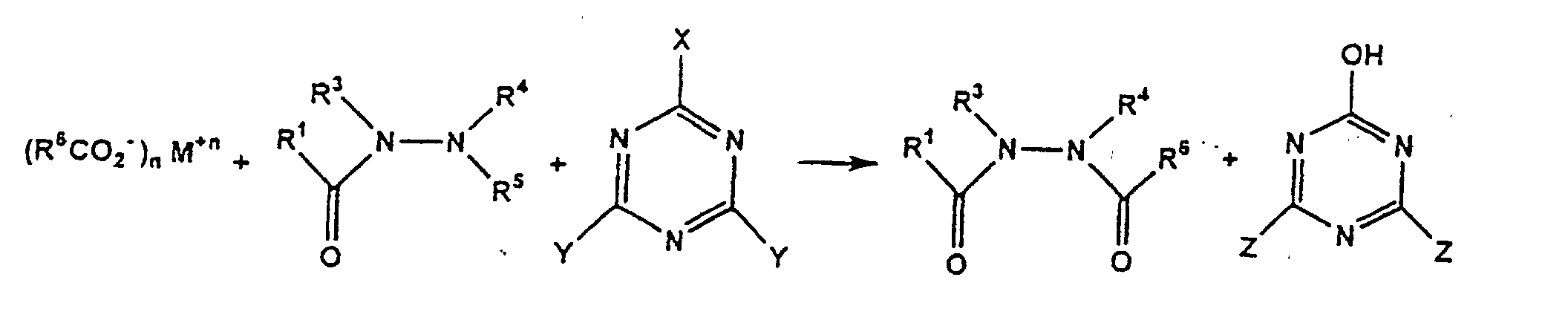 R1 ein Wasserstoffatom, (C1-C8)-Alkyl, Cyclo(C5-C6)-alkyl, Naphthyl, Phenyl, Phenyl, substituiert mit einem bis drei Substituenten unabhängig voneinander ausgewählt aus (C1-C4)-Alkyl, (C1-C4)-Alkoxy, (C1-C2)-Alkoxy-(C1-C2)-alkyl, (C1-C4)-Alkylthio, Halo und Cyano, 5-Methyl-6-chromanyl, Furyl, Thienyl, Pyridyl oder Benzyl darstellt,R2 (C1-C4)-Alkyl, Phenyl, Phenyl, substituiert mit einem bis drei Substituenten unabhängig voneinander ausgewählt aus (C1-C4)-Alkyl, (C1-C4)-Alkoxy, (C1-C2)-Alkoxy-(C1-C2)-alkyl, (C1-C4)-Alkylthio, Halo und Cyano, Benzyl oder Phenethyl darstellt,R3 und R4 unabhängig voneinander ausgewählt sind aus einem Wasserstoffatom, (C1-C8)-Alkyl, Cyclo(C5-C6)-alkyl, Phenyl, Phenyl, substituiert mit einem bis drei Substituenten unabhängig voneinander ausgewählt aus (C1-C4)-Alkyl, (C1-C4)-Alkoxy, (C1-C2)-Alkoxy-(C1-C2)-alkyl, (C1-C4)-Alkylthio, Halo und Cyano, Benzyl oder Phenethyl,R5 ein Wasserstoffatom darstellt,R6 ein Wasserstoffatom, (C1-C8)-Alkyl, Cyclo(C5-C6)-alkyl, Naphthyl, Phenyl, Phenyl, substituiert mit einem bis drei Substituenten unabhängig voneinander ausgewählt aus (C1-C4)-Alkyl, (C1-C4)-Alkoxy, (C1-C2)-Alkoxy-(C1-C2)-alkyl, (C1-C4)-Alkylthio, Halo und Cyano, Furyl, Thienyl, Pyridyl oder Benzyl darstellt,M ein Wasserstoffatom oder ein Metallkation ausgewählt aus Natrium, Kalium, Lithium, Calcium, Cäsium und Barium darstellt,n 1 oder 2 ist,X Fluor oder Chlor darstellt,jedes Y unabhängig voneinander ausgewählt ist aus Fluor, Chlor, R2 und OR2, undjedes Z unabhängig voneinander ausgewählt ist aus Hydroxy, R2 und OR2.
 - Verfahren nach Anspruch 6, wobeiR1 Phenyl, Phenyl, substituiert mit einem bis zwei Substituenten unabhängig voneinander ausgewählt aus (C1-C4)-Alkyl, (C1-C4)-Alkoxy, (C1-C2)-Alkoxy-(C1-C2)-alkyl, (C1-C4)-Alkylthio, Halo und Cyano, oder 5-Methyl-6-chromanyl darstellt,R2 (C1-C4)-Alkyl oder Phenyl darstellt,R3 ein Wasserstoffatom oder Methyl darstellt,R4 ein Wasserstoffatom, Phenyl, geradkettiges (C1-C4)-Alkyl oder verzweigtkettiges (C3-C8)-Alkyl darstellt,R5 ein Wasserstoffatom darstellt,R6 Phenyl oder Phenyl, substituiert mit einem bis zwei Substituenten unabhängig voneinander ausgewählt aus (C1-C4)-Alkyl, (C1-C4)-Alkoxy, (C1-C2)-Alkoxy-(C1-C2)-alkyl, (C1-C4)-Alkylthio, Halo und Cyano, darstellt,M ein Wasserstoffatom oder ein Metallkation ausgewählt aus Natrium, Kalium und Lithium darstellt,n 1 ist,X Fluor oder Chlor darstellt,jedes Y unabhängig voneinander ausgewählt ist aus Fluor, Chlor und OR2, undjedes Z unabhängig voneinander ausgewählt ist aus Hydroxy und OR2.
- Verfahren nach Anspruch 7, wobeiR1 Phenyl, Phenyl, substituiert mit einem bis zwei Substituenten unabhängig voneinander ausgewählt aus (C1-C2)-Alkyl, (C1-C2)-Alkoxy und Halo, oder 5-Methyl-6-chromanyl darstellt,R2 (C1-C2)-Alkyl oder Phenyl darstellt,R3 und R5 jeweils ein Wasserstoffatom darstellen,R4 ein verzweigtkettiges (C4-C6)-Alkyl, Methyl oder Phenyl darstellt,R6 Phenyl oder Phenyl, substituiert mit einem oder zwei Substituenten unabhängig voneinander ausgewählt aus (C1-C2)-Alkyl, (C1-C2)-Alkoxy und Halo, darstellt,M ein Wasserstoffatom oder ein Metallkation ausgewählt aus Natrium, Kalium und Lithium darstellt,n 1 ist,X Chlor oder Fluor darstellt,jedes Y unabhängig voneinander ausgewählt ist aus Fluor, Chlor und OR2, undjedes Z unabhängig voneinander ausgewählt ist aus Hydroxy und OR2.
- Verfahren nach Anspruch 8, wobeiR1 Phenyl, 4-Ethylphenyl, 4-Chlorphenyl, 3-Methoxy-2-methylphenyl, 3-Ethoxy-2-methylphenyl, 2-Ethyl-3-methoxyphenyl, 3-Ethoxy-2-ethylphenyl oder 5-Methyl-6-chromanyl darstellt,R2 Methyl darstellt,R3 und R5 jeweils ein Wasserstoffatom darstellen,R4 tert-Butyl darstellt,R6 Phenyl, 3-Methylphenyl, 3,5-Dimethylphenyl, 3-Chlorphenyl, 3,5-Dichlorphenyl oder 3-Chlor-5-methylphenyl darstellt,M ein Wasserstoffatom oder ein Metallkation ausgewählt aus Natrium, Kalium und Lithium darstellt,n 1 ist,X Chlor darstellt,jedes Y unabhängig voneinander ausgewählt ist aus Chlor und OR2, undjedes Z unabhängig voneinander ausgewählt ist aus Hydroxy und OR2.
- Verfahren nach einem der Ansprüche 6, 7, 8 oder 9, das weiter das Aufreinigen des Diacylhydrazins durch Entfernung des Hydroxytriazinnebenprodukts umfasst.
- Verfahren nach Anspruch 1, das weiter die Reaktion des Monoacylhydrazins mit einem Carbonsäurechlorid umfasst, um ein Diacylhydrazin oder ein substituiertes Diacylhydrazin gemäß folgender Reaktionsgleichung herzustellen:wobei
 R1 ein Wasserstoffatom, (C1-C8)-Alkyl, Cyclo(C5-C6)-alkyl, Naphthyl, Phenyl, Phenyl, substituiert mit einem bis drei Substituenten unabhängig voneinander ausgewählt aus (C1-C4)-Alkyl, (C1-C4)-Alkoxy, (C1-C2)-Alkoxy-(C1-C2)-alkyl; (C1-C4)-Alkylthio, Halo und Cyano, 5-Methyl-6-chromanyl, Furyl, Thienyl, Pyridyl oder Benzyl darstellt,R3 und R4 unabhängig voneinander ausgewählt sind aus einem Wasserstoffatom, (C1-C8)-Alkyl, Cyclo(C5-C6)-alkyl, Phenyl, Phenyl, substituiert mit einem bis drei Substituenten unabhängig voneinander ausgewählt aus (C1-C4)-Alkyl, (C1-C4)-Alkoxy, (C1-C2)-Alkoxy-(C1-C2)-alkyl, (C1-C4)-Alkylthio, Halo und Cyano, Benzyl oder Phenethyl,R5 ein Wasserstoffatom darstellt, undR6 ein Wasserstoffatom, (C1-C8)-Alkyl, Cyclo(C5-C6)-alkyl, Naphthyl, Phenyl, Phenyl, substituiert mit einem bis drei Substituenten unabhängig voneinander ausgewählt aus (C1-C4)-Alkyl, (C1-C4)-Alkoxy, (C1-C2)-Alkoxy-(C1-C2)-alkyl, (C1-C4)-Alkylthio, Halo und Cyano, Furyl, Thienyl, Pyridyl oder Benzyl darstellt.
 - Verfahren nach Anspruch 11, wobeiR1 Phenyl, Phenyl, substituiert mit einem bis zwei Substituenten unabhängig voneinander ausgewählt aus (C1-C4)-Alkyl, (C1-C4)-Alkoxy, (C1-C2)-Alkoxy-(C1-C2)-alkyl, (C1-C4)-Alkylthio, Halo und Cyano, oder 5-Methyl-6-chromanyl darstellt,R3 ein Wasserstoffatom oder Methyl darstellt,R4 ein Wasserstoffatom, Phenyl, geradkettiges (C1-C4)-Alkyl oder verzweigtkettiges (C3-C8)-Alkyl darstellt,R5 ein Wasserstoffatom darstellt, undR6 Phenyl oder Phenyl, substituiert mit einem bis zwei Substituenten unabhängig voneinander ausgewählt aus (C1-C4)-Alkyl, (C1-C4)-Alkoxy, (C1-C2)-Alkoxy-(C1-C2)-alkyl, (C1-C4)-Alkylthio, Halo und Cyano, darstellt.
- Verfahren nach Anspruch 12, wobeiR1 Phenyl, Phenyl, substituiert mit einem bis zwei Substituenten unabhängig voneinander ausgewählt aus (C1-C2)-Alkyl, (C1-C2)-Alkoxy und Halo, oder 5-Methyl-6-chromanyl darstellt,R3 und R5 jeweils ein Wasserstoffatom darstellen,R4 ein verzweigtkettiges (C4-C6)-Alkyl, Methyl oder Phenyl darstellt, undR6 Phenyl oder Phenyl, substituiert mit einem bis zwei Substituenten unabhängig voneinander ausgewählt aus (C1-C2)-Alkyl, (C1-C2)-Alkoxy und Halo, darstellt.
- Verfahren nach Anspruch 13, wobeiR1 Phenyl, 4-Ethylphenyl, 4-Chlorphenyl, 3-Methoxy-2-methylphenyl, 3-Ethoxy-2-methylphenyl, 2-Ethyl-3-methoxyphenyl, 3-Ethoxy-2-ethylphenyl oder 5-Methyl-6-chromanyl darstellt,R3 und R5 jeweils ein Wasserstoffatom darstellen,R4 tert-Butyl darstellt, undR6 Phenyl, 3-Methylphenyl, 3,5-Dimethylphenyl, 3-Chlorphenyl, 3,5-Dichlorphenyl oder 3-Chlor-5-methylphenyl darstellt.
Applications Claiming Priority (2)
| Application Number | Priority Date | Filing Date | Title |
|---|---|---|---|
| US9805998P | 1998-08-27 | 1998-08-27 | |
| US98059 | 1998-08-27 |
Publications (3)
| Publication Number | Publication Date |
|---|---|
| EP0982292A2 EP0982292A2 (de) | 2000-03-01 |
| EP0982292A3 EP0982292A3 (de) | 2001-01-10 |
| EP0982292B1 true EP0982292B1 (de) | 2003-03-26 |
Family
ID=22266688
Family Applications (1)
| Application Number | Title | Priority Date | Filing Date |
|---|---|---|---|
| EP99306408A Expired - Lifetime EP0982292B1 (de) | 1998-08-27 | 1999-08-13 | Verfahren zur Herstellung von Monoacyl-hydrazinen unter Verwendung von Carbonsäuren |
Country Status (10)
| Country | Link |
|---|---|
| US (1) | US6096890A (de) |
| EP (1) | EP0982292B1 (de) |
| JP (1) | JP2000086607A (de) |
| KR (1) | KR100593319B1 (de) |
| CN (1) | CN1219752C (de) |
| AU (1) | AU752209B2 (de) |
| BR (1) | BR9903939A (de) |
| DE (1) | DE69906197T2 (de) |
| IL (1) | IL131396A (de) |
| TW (1) | TW593287B (de) |
Cited By (1)
| Publication number | Priority date | Publication date | Assignee | Title |
|---|---|---|---|---|
| CN102863355A (zh) * | 2012-09-24 | 2013-01-09 | 浙江禾田化工有限公司 | 一种n-(3-甲氧基-2-甲基苯甲酰基)-n’-叔丁基肼的提纯方法 |
Families Citing this family (6)
| Publication number | Priority date | Publication date | Assignee | Title |
|---|---|---|---|---|
| MXPA04000224A (es) | 2001-07-10 | 2005-07-25 | 4Sc Ag | Novedosos compuestos como agentes antiinflamatorios, inmunomoduladores y antiproliferativos. |
| US7338969B2 (en) | 2002-03-08 | 2008-03-04 | Quonova, Llc | Modulation of pathogenicity |
| US7335779B2 (en) | 2002-03-08 | 2008-02-26 | Quonova, Llc | Modulation of pathogenicity |
| CN108947866A (zh) * | 2018-08-11 | 2018-12-07 | 安康学院 | N-(2-甲基-3-苯基苯甲酰基)-n’-叔丁基肼及其合成方法 |
| CN113387835B (zh) * | 2021-06-24 | 2022-10-18 | 济南健丰化工有限公司 | 一种合成3-羟基丁酰肼的方法 |
| CN118831647A (zh) * | 2023-04-25 | 2024-10-25 | 中国科学院上海有机化学研究所 | 杂环羧酸酰基肼类配体及其在铜催化芳基卤代物偶联反应中的用途 |
Family Cites Families (2)
| Publication number | Priority date | Publication date | Assignee | Title |
|---|---|---|---|---|
| US4985461A (en) * | 1985-10-21 | 1991-01-15 | Rohm And Haas Company | Insecticidal N'-substituted-N,N'-diacylhydrazines |
| IL110427A (en) * | 1993-08-11 | 1998-10-30 | Rohm & Haas | Process for the preparation of 1,2-diacyl-T-2-alkyl hydrazides |
-
1999
- 1999-08-13 EP EP99306408A patent/EP0982292B1/de not_active Expired - Lifetime
- 1999-08-13 AU AU44442/99A patent/AU752209B2/en not_active Ceased
- 1999-08-13 DE DE69906197T patent/DE69906197T2/de not_active Expired - Fee Related
- 1999-08-13 IL IL131396A patent/IL131396A/en not_active IP Right Cessation
- 1999-08-25 US US09/383,158 patent/US6096890A/en not_active Expired - Fee Related
- 1999-08-26 BR BR9903939-7A patent/BR9903939A/pt not_active Application Discontinuation
- 1999-08-27 KR KR1019990035922A patent/KR100593319B1/ko not_active Expired - Fee Related
- 1999-08-27 JP JP11240976A patent/JP2000086607A/ja active Pending
- 1999-08-27 CN CNB991192540A patent/CN1219752C/zh not_active Expired - Fee Related
- 1999-08-27 TW TW088114728A patent/TW593287B/zh not_active IP Right Cessation
Cited By (1)
| Publication number | Priority date | Publication date | Assignee | Title |
|---|---|---|---|---|
| CN102863355A (zh) * | 2012-09-24 | 2013-01-09 | 浙江禾田化工有限公司 | 一种n-(3-甲氧基-2-甲基苯甲酰基)-n’-叔丁基肼的提纯方法 |
Also Published As
| Publication number | Publication date |
|---|---|
| IL131396A (en) | 2007-02-11 |
| KR100593319B1 (ko) | 2006-06-28 |
| IL131396A0 (en) | 2001-01-28 |
| DE69906197D1 (de) | 2003-04-30 |
| EP0982292A3 (de) | 2001-01-10 |
| KR20000017600A (ko) | 2000-03-25 |
| BR9903939A (pt) | 2000-09-12 |
| TW593287B (en) | 2004-06-21 |
| CN1219752C (zh) | 2005-09-21 |
| CN1248576A (zh) | 2000-03-29 |
| US6096890A (en) | 2000-08-01 |
| AU752209B2 (en) | 2002-09-12 |
| AU4444299A (en) | 2000-03-09 |
| JP2000086607A (ja) | 2000-03-28 |
| EP0982292A2 (de) | 2000-03-01 |
| DE69906197T2 (de) | 2003-10-23 |
Similar Documents
| Publication | Publication Date | Title |
|---|---|---|
| KR100549091B1 (ko) | 트리아졸린티온 유도체의 제조방법 | |
| MXPA00003448A (es) | Procedimiento para la obtencion de derivados de triazolintiona. | |
| EP0982292B1 (de) | Verfahren zur Herstellung von Monoacyl-hydrazinen unter Verwendung von Carbonsäuren | |
| JPH06179661A (ja) | モノ−及びジアリールトリアジンの製造方法 | |
| KR100549805B1 (ko) | 트리아졸린티온 유도체의 제조방법 | |
| Sajjadifar et al. | Boron sulfuric acid as an efficient heterogeneous catalyst for the synthesis of 1-substituted 1H-1, 2, 3, 4-tetrazoles in polyethylene glycol | |
| JPH0745474B2 (ja) | 1−ヒドロキシ−2−ピリドンの製造法 | |
| JPH05262749A (ja) | 6−トリフルオロメチル−1,3,5トリアジン誘導体の製造方法 | |
| EP0046635B1 (de) | Verfahren zur Herstellung von Cimetidin | |
| MXPA99007673A (en) | Process for substitute hydrazides used carboxylium | |
| US5663365A (en) | Process for the preparation of pyrazolones | |
| US5767314A (en) | Selective acylation of monoalkylhydrazines | |
| PL153449B1 (en) | Procedure for the production of mercaptoacyloproline | |
| EP0952143B1 (de) | Metallsalz katalysiertes Verfahren zur Gewinnung von Oxazolinen und nachträgliche Herstellung von Chloroketonen | |
| EP0278542B1 (de) | Verfahren zur Herstellung von Tetrazolderivaten | |
| JPH1135563A (ja) | アゾール−1−イルアルキルニトリル類の製造法 | |
| JP3276522B2 (ja) | グアナミン類の製造方法 | |
| EP0155492B1 (de) | Herstellung von 1-Alkyl-3,5-diphenylpyrazolen | |
| KR100539725B1 (ko) | 피롤의 새로운 알킬화 반응 | |
| GB2317614A (en) | Production of Aminophenol | |
| JPH11158114A (ja) | 1−ヘキサデシルオキシ−4−ピバロイルオキシベンゼン誘導体の製造方法 | |
| JPH0421666B2 (de) | ||
| JPH1135564A (ja) | アゾール−1−イルアルキルニトリル類の製造法 | |
| CZ66299A3 (cs) | Syntéza beta-ketoesteru hydrazonu reakcí s diazoesterem | |
| EA003286B1 (ru) | Способ получения солей цианобензиламинов |
Legal Events
| Date | Code | Title | Description |
|---|---|---|---|
| PUAI | Public reference made under article 153(3) epc to a published international application that has entered the european phase |
Free format text: ORIGINAL CODE: 0009012 |
|
| 17P | Request for examination filed |
Effective date: 19990823 |
|
| AK | Designated contracting states |
Kind code of ref document: A2 Designated state(s): CH DE FR GB IT LI |
|
| AX | Request for extension of the european patent |
Free format text: AL;LT;LV;MK;RO;SI |
|
| PUAL | Search report despatched |
Free format text: ORIGINAL CODE: 0009013 |
|
| AK | Designated contracting states |
Kind code of ref document: A3 Designated state(s): AT BE CH CY DE DK ES FI FR GB GR IE IT LI LU MC NL PT SE |
|
| AX | Request for extension of the european patent |
Free format text: AL;LT;LV;MK;RO;SI |
|
| RIC1 | Information provided on ipc code assigned before grant |
Free format text: 7C 07C 241/04 A, 7C 07C 243/24 B, 7C 07C 241/02 B |
|
| AKX | Designation fees paid |
Free format text: CH DE FR GB IT LI |
|
| RAP1 | Party data changed (applicant data changed or rights of an application transferred) |
Owner name: DOW AGROSCIENCES LLC |
|
| GRAG | Despatch of communication of intention to grant |
Free format text: ORIGINAL CODE: EPIDOS AGRA |
|
| 17Q | First examination report despatched |
Effective date: 20020528 |
|
| GRAG | Despatch of communication of intention to grant |
Free format text: ORIGINAL CODE: EPIDOS AGRA |
|
| GRAH | Despatch of communication of intention to grant a patent |
Free format text: ORIGINAL CODE: EPIDOS IGRA |
|
| GRAH | Despatch of communication of intention to grant a patent |
Free format text: ORIGINAL CODE: EPIDOS IGRA |
|
| GRAA | (expected) grant |
Free format text: ORIGINAL CODE: 0009210 |
|
| AK | Designated contracting states |
Designated state(s): CH DE FR GB IT LI |
|
| REG | Reference to a national code |
Ref country code: GB Ref legal event code: FG4D |
|
| REG | Reference to a national code |
Ref country code: CH Ref legal event code: EP |
|
| REG | Reference to a national code |
Ref country code: CH Ref legal event code: NV Representative=s name: FIAMMENGHI-FIAMMENGHI |
|
| REF | Corresponds to: |
Ref document number: 69906197 Country of ref document: DE Date of ref document: 20030430 Kind code of ref document: P |
|
| ET | Fr: translation filed | ||
| PLBE | No opposition filed within time limit |
Free format text: ORIGINAL CODE: 0009261 |
|
| STAA | Information on the status of an ep patent application or granted ep patent |
Free format text: STATUS: NO OPPOSITION FILED WITHIN TIME LIMIT |
|
| 26N | No opposition filed |
Effective date: 20031230 |
|
| PGFP | Annual fee paid to national office [announced via postgrant information from national office to epo] |
Ref country code: DE Payment date: 20070615 Year of fee payment: 9 |
|
| PGFP | Annual fee paid to national office [announced via postgrant information from national office to epo] |
Ref country code: CH Payment date: 20070614 Year of fee payment: 9 |
|
| PGFP | Annual fee paid to national office [announced via postgrant information from national office to epo] |
Ref country code: GB Payment date: 20070731 Year of fee payment: 9 |
|
| PGFP | Annual fee paid to national office [announced via postgrant information from national office to epo] |
Ref country code: IT Payment date: 20070711 Year of fee payment: 9 |
|
| PGFP | Annual fee paid to national office [announced via postgrant information from national office to epo] |
Ref country code: FR Payment date: 20070621 Year of fee payment: 9 |
|
| REG | Reference to a national code |
Ref country code: CH Ref legal event code: PL |
|
| GBPC | Gb: european patent ceased through non-payment of renewal fee |
Effective date: 20080813 |
|
| REG | Reference to a national code |
Ref country code: FR Ref legal event code: ST Effective date: 20090430 |
|
| PG25 | Lapsed in a contracting state [announced via postgrant information from national office to epo] |
Ref country code: LI Free format text: LAPSE BECAUSE OF NON-PAYMENT OF DUE FEES Effective date: 20080831 Ref country code: CH Free format text: LAPSE BECAUSE OF NON-PAYMENT OF DUE FEES Effective date: 20080831 |
|
| PG25 | Lapsed in a contracting state [announced via postgrant information from national office to epo] |
Ref country code: IT Free format text: LAPSE BECAUSE OF NON-PAYMENT OF DUE FEES Effective date: 20080813 Ref country code: FR Free format text: LAPSE BECAUSE OF NON-PAYMENT OF DUE FEES Effective date: 20080901 Ref country code: DE Free format text: LAPSE BECAUSE OF NON-PAYMENT OF DUE FEES Effective date: 20090303 |
|
| PG25 | Lapsed in a contracting state [announced via postgrant information from national office to epo] |
Ref country code: GB Free format text: LAPSE BECAUSE OF NON-PAYMENT OF DUE FEES Effective date: 20080813 |