EP0983277B1 - Polyboratcoinitiatoren für photopolymerisation - Google Patents
Polyboratcoinitiatoren für photopolymerisation Download PDFInfo
- Publication number
- EP0983277B1 EP0983277B1 EP98925595A EP98925595A EP0983277B1 EP 0983277 B1 EP0983277 B1 EP 0983277B1 EP 98925595 A EP98925595 A EP 98925595A EP 98925595 A EP98925595 A EP 98925595A EP 0983277 B1 EP0983277 B1 EP 0983277B1
- Authority
- EP
- European Patent Office
- Prior art keywords
- substituted
- unsubstituted
- alkyl
- phenyl
- halo
- Prior art date
- Legal status (The legal status is an assumption and is not a legal conclusion. Google has not performed a legal analysis and makes no representation as to the accuracy of the status listed.)
- Expired - Lifetime
Links
- 0 C*c1ccc(*C)c2ccccc12 Chemical compound C*c1ccc(*C)c2ccccc12 0.000 description 10
Classifications
-
- C—CHEMISTRY; METALLURGY
- C07—ORGANIC CHEMISTRY
- C07F—ACYCLIC, CARBOCYCLIC OR HETEROCYCLIC COMPOUNDS CONTAINING ELEMENTS OTHER THAN CARBON, HYDROGEN, HALOGEN, OXYGEN, NITROGEN, SULFUR, SELENIUM OR TELLURIUM
- C07F5/00—Compounds containing elements of Groups 3 or 13 of the Periodic Table
- C07F5/02—Boron compounds
- C07F5/027—Organoboranes and organoborohydrides
-
- C—CHEMISTRY; METALLURGY
- C08—ORGANIC MACROMOLECULAR COMPOUNDS; THEIR PREPARATION OR CHEMICAL WORKING-UP; COMPOSITIONS BASED THEREON
- C08F—MACROMOLECULAR COMPOUNDS OBTAINED BY REACTIONS ONLY INVOLVING CARBON-TO-CARBON UNSATURATED BONDS
- C08F2/00—Processes of polymerisation
- C08F2/46—Polymerisation initiated by wave energy or particle radiation
- C08F2/48—Polymerisation initiated by wave energy or particle radiation by ultraviolet or visible light
- C08F2/50—Polymerisation initiated by wave energy or particle radiation by ultraviolet or visible light with sensitising agents
-
- G—PHYSICS
- G03—PHOTOGRAPHY; CINEMATOGRAPHY; ANALOGOUS TECHNIQUES USING WAVES OTHER THAN OPTICAL WAVES; ELECTROGRAPHY; HOLOGRAPHY
- G03F—PHOTOMECHANICAL PRODUCTION OF TEXTURED OR PATTERNED SURFACES, e.g. FOR PRINTING, FOR PROCESSING OF SEMICONDUCTOR DEVICES; MATERIALS THEREFOR; ORIGINALS THEREFOR; APPARATUS SPECIALLY ADAPTED THEREFOR
- G03F7/00—Photomechanical, e.g. photolithographic, production of textured or patterned surfaces, e.g. printing surfaces; Materials therefor, e.g. comprising photoresists; Apparatus specially adapted therefor
- G03F7/004—Photosensitive materials
- G03F7/027—Non-macromolecular photopolymerisable compounds having carbon-to-carbon double bonds, e.g. ethylenic compounds
- G03F7/028—Non-macromolecular photopolymerisable compounds having carbon-to-carbon double bonds, e.g. ethylenic compounds with photosensitivity-increasing substances, e.g. photoinitiators
- G03F7/029—Inorganic compounds; Onium compounds; Organic compounds having hetero atoms other than oxygen, nitrogen or sulfur
Definitions
- the invention relates to mono- and polyborate compounds derived from polyboranes, to their use as photoinitiators in combination with electron acceptors, and to photopolymerizable compositions comprising the photoinitiators of the invention.
- Monoborate compounds in association with ionic dyes have been described in the prior art as photoinitiators.
- US Patents 4 772 530, 4 772 541 and 5 151 520 describe monocyclic triarylalkylborate anions with cationic dyes, such as cyanines, rhodamines, etc., as counterions. These compounds are employed as photoinitiators.
- cationic transition metal complexes are used together with triarylalkylborate anions in photopolymerizable compositions.
- novel polyborate compounds are suitable as coinitiators in combination with electron acceptor compounds as initiators for the photopolymerization of ethylenically unsaturated compounds.
- the electron acceptor compound may already be present as an ionic constituent in the borate compounds of the invention.
- the invention provides compounds of the formula I and II in which
- Aromatic hydrocarbons as may be present in the compounds of the invention may, for example, contain one or more, especially one or two, heteroatoms.
- suitable heteroatoms are N, P, O or S, preferably N or O.
- aromatic hydrocarbon radicals are phenyl, ⁇ - and ⁇ -naphthyl, stilbenyl, biphenyl, o-, m-, p-terphenyl, triphenylphenyl, binaphthyl, anthracyl, phenanthryl, pyrenyl, furan-2-yl or furan-3-yl, thiophen-2-yl or thiophen-3-yl, pyridin-2-yl, or pyridin-3-yl, quinolyl or isoquinolyl.
- aromatic hydrocarbon radicals are anthracyl, fluorenyl, thianthryl, xanthyl, acridinyl, phenazinyl, phenothiazinyl, phenoxathiinyl, phenoxazinyl.
- Stilbenyl is Biphenyl is o-, m- or p-terphenyl are Triphenylphenyl is Binaphthyl is Anthracyl is or Phenanthryl is Pyrenyl is Furanyl is furan-2-yl or furan-3-yl. Thiophenyl is thiophen-2-yl or thiophen-3-yl. Pyridinyl is pyridin-2-yl, pyridin-3-yl or pyridin-4-yl.
- Quinolinyl is Isoquinolinyl is Substituted radicals phenyl, stilbenyl, biphenyl, o-, m- or p-terphenyl, triphenylphenyl, naphthyl, binaphthyl, anthracyl, phenanthryl, pyrenyl, ferrocenyl, furanyl, thiophenyl, pyridinyl, quinolinyl or isoquinolinyl are substituted 1 to 4 times, for example 1, 2 or 3 times, especially 2 or 3 times.
- C 1 -C 12 alkyl is linear or branched and is, for example, C 1 -C 8 -, C 1 -C 6 - or C 1 -C 4 alkyl.
- Examples are methyl, ethyl, propyl, isopropyl, n-butyl, sec-butyl, iso-butyl, tert-butyl, pentyl, hexyl, heptyl, 2,4,4-trimethylpentyl, 2-ethylhexyl, octyl, nonyl, decyl or dodecyl.
- C 1 -C 8 alkyl especially C 1 -C 6 alkyl, preferably C 1 -C 4 alkyl.
- C 3 -C 12 cycloalkyl is for example cyclopropyl, cyclopentyl, cyclohexyl, cyclooctyl, cyclododecyl, especially cyclopentyl, cyclohexyl and cyclododecyl, preferably cyclohexyl, cyclooctyl and cyclododecyl, in particular cyclohexyl and cyclooctyl.
- C 1 -C 12 alkoxy is linear or branched and is for example C 1 -C 8 -, C 1 -C 6 - or C 1 -C 4 alkoxy.
- Examples are methoxy, ethoxy, propoxy, isopropoxy, n-butyloxy, sec-butyloxy, iso-butyloxy, tert-butyloxy, pentyloxy, hexyloxy, heptyloxy, 2,4,4-trimethylpentyloxy, 2-ethylhexyloxy, octyloxy, nonyloxy, decyloxy or dodecyloxy, especially methoxy, ethoxy, propoxy, isopropoxy, n-butyloxy, sec-butyloxy, iso-butyloxy, tert-butyloxy, preferably methoxy.
- Halo is fluoro, chloro, bromo and iodo, especially fluoro, chloro and bromo, preferably chloro and fluoro. If C 1 -C 12 alkyl is substituted one or more times by halo, then there are for example 1 to 3 or or 1 or 2 halo substitutents on the alkyl radical. Preference is given to CCl 3 and CF 3 , especially CF 3 .
- Phenyl-C 1 -C 6 alkyl is for example benzyl, phenylethyl, ⁇ -methylbenzyl, phenylpentyl, phenylhexyl or ⁇ , ⁇ -dimethylbenzyl, especially benzyl.
- Substituted phenyl-C 1 -C 6 alkyl is substituted one to four times, for example once, twice or three times, especially twice or three times, on the phenyl ring.
- C 1 -C 12 dialkylamino is a dialkylamino radical which can contain a total of up to 12 carbon atoms.
- the two alkyl radicals on the nitrogen atom may contain a different number of carbon atoms. Examples are dimethylamino, diethylamino, ethylmethylamino, dipropylamino, dipentylamino, dibutylamino, dihexylamino, ethyldecylamino, preferably dimethylamino.
- R 8 and R 9 or R 8 ' and R 9 ' together with the nitrogen atom to which they are attached, form a 5- or 6-membered ring which may additionally contain oxygen or sulfur atoms, this ring can be saturated or unsaturated.
- this ring can be saturated or unsaturated. Examples are morpholine, piperidine, thiazoline, oxazole, oxazine rings, especially morpholine rings.
- X as C 1 -C 20 alkylene is linear or branched alkylene such as methylene, ethylene, propylene, 1-methylethylene, 1,1-dimethylethylene, butylene, 1-methylpropylene, 2-methylpropylene, pentylene, hexylene, heptylene, octylene, nonylene, decylene, dodecylene, tetradecylene, hexadecylene or octadecylene.
- X is C 1 -C 12 alkylene, e.g. ethylene, decylene, or
- the alkylene radicals C x H 2x , C y H 2y , C z H 2z and C o H 2o are also linear or branched.
- X as C 2 -C 20 alkylene which is interrupted one or more times by -O-, -S(O) p - or -NR 16 - is, for example, interrupted 1-9 times, e.g. 1-7, 1-5, 1-3 or 1 or 2 times by -O-, -S(O) p - or -NR 16 -.
- X is C 1 -C 20 alkylene which is interrupted by one or more aromatic hydrocarbons or other heterocycles where the aromatic hydrocarbons are unsubstituted or substituted 1 to 5 times by halo, (BR 1 R 2 R 3 ) - Z + or BR 4 R 5 , unsubstituted or (BR 1 R 2 R 3 ) - Z + - or BR 4 R 5 -substituted C 1 -C 6 alkyl, or by unsubstituted or (BR 1 R 2 R 3 ) - Z + - or BR 4 R 5 -substituted C 1 -C 12 alkoxy or by unsubstituted or (BR 1 R 2 R 3 ) - Z + - or BR 4 R 5 -substituted C 1 -C 12 dialkylamino, then this means, for example, that X is an alkylene of the following formulae III - IX: in which n is a number from 1 to 6 and
- C 3 -C 12 cycloalkylene is, for example, C 3 -C 10 -, C 5 -C 12 -, C 5 -C 10 -, C 6 -C 12 - or C 6 -C 8 cycloalkylene and is, for example, cyclopropylene, cyclopentylene, cyclohexylene, cyclooctylene, cyclododecylene, especially cyclopentylene, cyclooctylene and cyclohexylene, preferably cyclohexylene and cyclooctylene.
- C 3 -C 12 cycloalkylene is also, however, for example, structural units where x and y independently of one another are 0-6 and the sum of x+y ⁇ 6, or where x and y independently of one another are 0-7 and the sum of x+y ⁇ 7.
- C 3 -C 12 cycloalkylene are, for example, bicyclic cycloalkylenes, such as the following structures, for example: or else C 1 -C 12 alkyl-substituted cycloalkylene, such as for example.
- polycycloalkylene denotes the sequential arrangement of identical or different cycloalkylene rings having up to 50 carbon atoms, e.g.: where z1 is a number from 2 to 8.
- C 2 -C 8 alkenylene can be mono- or polyunsaturated and can be linear or branched radicals and is, for example, ethenylene, 1-propenylene, 1-butenylene, 3-butenylene, 2-butenylene, 1,3-pentadienylene, 5-hexenylene or 7-octenylene.
- isomeric compounds Depending on which radicals are employed as X it is possible for isomeric compounds to be formed.
- the invention provides all of the isomers. Photoinitiator effectiveness is generally independent of the particular isomeric form.
- Radicals suitable as a counterion Z + to the negative borate in the formula I are in general those which are able to form positive ions. Examples of these are alkali metals, especially lithium or sodium, quatemary ammonium compounds, especially ammonium or tetraalkylammonium, dye cations or cationic transition metal coordination complex compounds.
- tetraalkylammonium examples include, in particular, tetramethylammonium or tetra-butylammonium, although trisalkylammonium ions, e.g. trimethylammonium, are also suitable.
- Suitable phosphonium and ammonium counterions are those of the formulae + PR w R x R y R z and + NR w R x R y R z , where R w , R x , R y , and R z independently of one another are hydrogen, unsubstituted or substituted alkyl, cycloalkyl, alkenyl, phenyl or phenylalkyl.
- Substituents for these alkyl, cycloalkyl, alkenyl, phenyl or phenylalkyl radicals are, for example, halide, hydroxyl, heterocycloalkyl (e.g. epoxy, aziridyl, oxetanyl, furanyl, pyrrolidinyl, pyrrolyl, thiophenyl, tetrahydrofuranyl, etc.), dialkylamino, amino, carboxyl, alkyl- and arylcarbonyl and aryloxy- and alkoxycarbonyl.
- the tetravalent nitrogen may also be part of a 5- or 6-membered ring, in which case this ring may in turn be fused to other ring systems. These systems may also contain additional heteroatoms, such as S, N, O,
- the tetravalent nitrogen may also be part of a polycyclic ring system, for example azoniapropellane. These systems may also contain further heteroatoms, such as S, N, O.
- counterions Z + are polyammonium salts and polyphosphonium salts, especially the bis salts, in which it is possible for the same substituents to be present as described above for the "mono" compounds.
- ammonium salts and phopshonium salts may also be substituted by neutral dyes (e.g. thioxanthenes, thioxanthones, coumarins, ketocoumarins, etc.).
- neutral dyes e.g. thioxanthenes, thioxanthones, coumarins, ketocoumarins, etc.
- Such salts are obtained by the reaction of the ammonium salts and phosphonium salts, substituted by reactive groups (e.g. epoxy, amino, hydroxy, etc.), with appropriate derivatives of neutral dyes.
- reactive groups e.g. epoxy, amino, hydroxy, etc.
- ammonium salts and phosphonium salts which are suitable as the counterions Z + can also be substituted by colourless electron acceptors (e.g. benzophenones): Examples of these are (from International Bio-Synthetics) ®QUANTACURE ABQ ®QUANTACURE BPQ and ®QUANTACURE BTC
- quaternary ammonium compounds are, for example, trimethylcetylammonium or cetylpyridinium.
- ions to be used as positive counterions Z + in the compound of the formula I include the following: in which D is P, N or S and R is an alkyl or aryl radical.
- ions which can be employed as positive counterions Z + to the borate are onium ions, for example iodonium or sulfonium ions.
- examples of such counterions to the borate are radicals of the formula as described, for example in EP 555058 and EP 690074.
- suitable counterions for the borates of the invention are cations of the formula in which R g is an alkyl radical, especially ethyl, or is benzyl and where the aromatic ring can carry further substituents.
- Further suitable counterions are halonium ions, especially diaryliodonium ions, as described for example in EP 334056 and EP 562897.
- cations of ferrocenium salts are also suitable, as described in EP 94915 and EP 109851, for example
- Other suitable "onium” cations such as ammonium, phosphonium, sulfonium, iodonium, selonium, arsonium, tellonium, bismuthonium, are described, for example in Japanese Patent Application Hei 6 266 102.
- cationic transition metal complex compounds which are suitable as counterion are described in US Patent 4 954 414.
- Suitable dyes are cations of triarylmethanes, for example Malachite Green, indolines, thiazines, for example Methylene Blue, xanthones, thioxanthones, oxazines, acridines, cyanines, rhodamines, phenazines, for example safranin, preferably cyanines and thioxanthones.
- divalent dyes in other words for example those having two positive charges, in which case then two borate units of the formula I or II of the invention, or else a combination of a borate of the formula I or II of the invention with another known borate, are used as anions. Examples of divalent cationic dyes are given in JP Kokai Hei 4-146 905.
- Some of the compounds of the invention exhibit good stability to acid and can therefore also be employed in acidic formulation, and also, for example, in combination with dyes containing acid groups.
- the borates of the formula I and II of the invention are prepared, for example, by 1. addition of one or, respectively, 2 equivalents of an organometallic reagent onto a corresponding borane (la, lla) and 2. optional subsequent cation exchange reaction.
- the definitions of the radicals R 1 -R 5 , R 1 '-R 3 ', X and Z are as indicated above.
- M is a metal atom, for example Li, Mg etc.
- G is an anion.
- the reaction conditions for working with organometallic reagents are generally familiar to the skilled worker.
- the reaction is judiciously carried out in an inert organic solvent, for example an ether or aliphatic hydrocarbon, such as diethyl ether, tetrahydrofuran or hexane.
- Suitable organometallic reagents for preparing the bisborates of the invention are, for example, the lithium compounds of the corresponding aliphatic and aromatic hydrocarbon radicals. It is likewise possible, for example, to use Grignard reagents, zinc or sodium.
- the reaction with the organometallic reagent is judiciously carried out with exclusion of air in an inert gas atmosphere, for example under nitrogen.
- the reaction is generally performed with cooling to 0°C or below followed by heating to room temperature. It is judicious to stir the reaction mixture.
- the products are isolated and purified by methods likewise generally known to the skilled worker, such as chromatography, recrystallization, etc., for example. Thus, for example, impurities are judiciously removed by washing the product with a boiling solvent, followed by filtration. It is also possible to obtain the borates directly from solution during the preparation of the polyborane precursors, without isolating them beforehand.
- the preparation of the compounds of the invention generally gives rise to isomer mixtures. These can be resolved by methods which are customary in the art and known to the skilled worker, or else can be employed as initiator directly, in the form of the isomer mixture.
- the compounds of the formula I or II of the invention comprise a dye radical as the cation
- these compounds are prepared by cation exchange reaction of a corresponding borate salt with a dye.
- borate salts suitable for the exchange are the sodium, lithium, magnesium, ammonium or tetraalkylammonium salts.
- Another preparation method for compounds of the formula I or II starts from poly(dialkoxyboryl), poly(diaryloxyboryl) or poly(dihaloboryl) compounds as intermediates. This reaction is depicted in the equation below: The definitions of the radicals R 3 , X, Z and G are as indicated above. Hal is halo, R an organic radical.
- a third variant of preparing the borates of the invention is the addition reaction of dimetallated compounds with triarylboranes (Negishi et al J. Org. Chem. 1990, 55 , 5406).
- dilithiated reagents are employed by way of example in the equation, it is possible to employ a wide range of dimetallated compounds in this reaction.
- the definitions of the radicals R 1 , R 2 , R 3 , X, Z and G are as indicated above.
- the borates of the invention having the general structure II are formed if, for example, a mixed primary/secondary poly(dialkoxy-, diaryloxy- or dihaloboryl) compound is reacted with an ortho-substituted aryl-Grignard reagent.
- the presence of the ⁇ -alkyl group prevents the introduction of the third aryl radical, and so the monoborate is formed.
- diarylhaloboranes or diarylalkoxyboranes used as starting materials can be obtained, for example, by the procedures of Haubold et al ( J . Organomet. Chem. 1986, 315 , 1), Nöth et al. ( J . Organomet. Chem. 1968, 11, 399), Köster et al. ( Inorg. Synth. 19, 14, 152) and Cole et al. ( Organometallics 1992, 11 , 652) or by methods described in Boranes in Organic Chemistry ; Cornell University Press, Ithaca, New York, 1972; A. Pelter, K. Smith and H. C. Brown, Borane Reagents; Academic Press, London, 1988).
- Poly(dialkoxyboryl), poly(diaryloxyboryl) or poly(dihaloboryl) compounds are obtainable, for example, by the reaction of a dimetallated compound (Negishi et al. J. Org. Chem. 1990, 55 , 5406) with a trialkoxy- or triaryloxyborane (Brown et al. Organometallics 1983, 2, 1316).
- Poly(dialkoxyboryl), poly(diaryloxyboryl) or poly(dihaloboryl) compounds are also obtainable, for example, by the comproportionation of trialkoxy- or triaryloxyboranes (Brown et al. J . Amer. Chem. Soc.
- R 1 , R 2 and R 3 independently of one another are unsubstituted phenyl or phenyl which is substituted by unsubstituted or halo-substituted C 1 -C 6 alkyl, OR 6 , S(O) p NR 8 R 9 or C(O)NR 8 R 9 ;
- R 1 ', R 2 ', R 3 ', R 4 and R 5 have one of the meanings of R 1 - R 3 , where the radicals R 1 ', R 2 ', R 3 ', R 4 and R 5 can also be substituted ortho to the bond to the borate atom;
- R 6 , R 7 , R 8 and R 9 are C 1 -C 12 alkyl or phenyl; or R 8 and R 9 , together with the nitrogen atom to which they are attached, form a 5- or 6-membered ring which may additionally contain oxygen atoms;
- X is C 1 -C 20 al
- Z is a mono- or divalent dye cation or metal complex, sulfonium, sulfoxonium or iodonium cation, or Z is a UV absorber compound which is able to form cations, or Z is a metal cation of group I of the Periodic Table, or Z is a cation MY b + , where M is a metal of group II of the Periodic Table and Y b is alkoxy or halo, or Z is an ammonium salt or phosphonium salt.
- R 1 , R 2 and R 3 are unsubstituted or halo-, OR 6 - or C 1 -C 4 alkyl-substituted phenyl; R 6 is C 1 -C 4 alkyl; X is C 2 -C 6 alkylene, C 2 -C 6 alkylene interrupted by phenylene, or C 6 -C 12 cycloalkylene unsubstituted or substituted by (BR 1 R 2 R 3 ) - Z + ; and Z is a tetraalkylammonium or sulfonium cation.
- R 1 , R 2 and R 3 are unsubstituted or halo-substituted phenyl;
- X is a C 2 -C 6 alkylene and
- Z is a tetraalkylammonium cation.
- the compounds of the invention are suitable as coinitiators for the photochemical polymerization of compounds having ethylenically unsaturated double bonds.
- This photoinitiating effect requires the concomitant use of an electron acceptor compound. Only where the counterion Z + in the compounds of the formula I of the invention is able to function as an electron acceptor is the addition of a separate electron acceptor compound unnecessary for photocuring.
- the invention therefore also provides a photoinitiator comprising (A) at least one compound of the formula I or II as coinitiator and (B) at least one, electron acceptor compound, where the electron acceptor compound (B) can also be a constituent of the radical Z + of the formula I.
- the ratio of (A):(B) is for example from 10:1 to 1:10. In order to increase the reactivity it is judicious to add the borate component of the invention (A) in excess; therefore, the ratio of 10:1 is preferred. If (B) is a constituent of the radical Z in the formula I or II, the ratio of (A):(B) is judiciously 1:1 or 1:0.5 if divalent cationic dye is used as Z. Alternatively, it is possible in addition to the borates of formula I or II of the invention to add other prior art borate salts to the abovementioned mixtures. These may be either monoborate or bisborate or borate-borane compounds.
- borate salts are described, for example, in US 4772530, US 4772541, GB 2307473, GB 2307472, GB 2307474 and EP 775706.
- the borates of the invention can be employed in mixtures, of any desired proportion, with the known borates; for example, in a ratio of from 10:1 to1:10.
- Examples of substances employed as electron acceptor compounds (B) are sensitizers, such as thioxanthones, camphorquinones, reaction accelerators, such as amines, thiols, etc., or dyes or UV absorbers.
- sensitizers such as thioxanthones, camphorquinones, reaction accelerators, such as amines, thiols, etc.
- reaction accelerators such as amines, thiols, etc.
- dyes or UV absorbers dyes or UV absorbers.
- Other examples of suitable electron acceptor compounds are transition metal complex compounds or dyes.
- Suitable transition metal complex compounds are described, for example, in US Patent 4954414; examples are bis(2,2'-bipyridine)(4,4'-dimethyl-2,2'-bipyridine)ruthenium, tris(4,4'-dimethyl-2,2'-bipyridine)ruthenium, tris(4,4'-dimethyl-2,2'-bipyridine)iron, tris(2,2',2"-terpyridine)ruthenium, tris(2,2'-bipyridine)ruthenium and bis(2,2'-bipyridine)-(5-chloro-1,10-phenanthroline)ruthenium.
- Suitable dyes which can be added as electron acceptor compounds are described, for example, in US 5151520.
- triarylmethane such as Malachite Green, indolines, thiazines, for example Methylene Blue, xanthones, thioxanthones, oxazines, acridines or phenazines, for example safranin.
- Particularly suitable dyes are Malachite Green, Methylene Blue, Safranin O, rhodamines of the formula in which R is alkyl or aryl radicals and R' is hydrogen, an alkyl or aryl radical, examples being Rhodamine B, Rhodamine 6G or Violamine R, and also Sulforhodamine B or Sulforhodamine G.
- Suitable dyes are neutral dyes, such as fluorones as are described by Neckers et al. in J. Polym. Sci., Part A, Poly. Chem, 1995, 33, 1691-1703. is of particular interest, as are other neutral dyes.
- Preferred cyanines are those in which Y a in the above formula is C(CH 3 ) 2 or S.
- dyes which absorb in the IR region such as those, for example, that are described in EP 438123.
- the following dye compounds are suitable: in which D is P, N or S and R is an alkyl or aryl radical.
- Preferred compounds are those of the above formula in which DR 3 is N(CH 3 ) 3 , N(C 2 H 5 ) 3 or P(C 6 H 5 ) 3 .
- the abovementioned pyridinium compounds may also be substituted in the aromatic pyridinium ring.
- Suitable dyes can be found, for example, in US Patent 4902604. These are azulene dyes. Of particular interest as component (B) for the photoinitiators of the invention are the compounds 1-18 indicated in the table in columns 10 and 11 of that patent. Examples of further suitable dyes are merocyanine dyes as described, for example, in US Patent 4950581 from column 6, line 20 to column 9, line 57.
- component (B) are O-alkylated aromatic nitrogen-heterocyclic amine oxide cation salts (quinolinium salts), e.g. dyes of the formula XX in which
- the y radicals R 1a can be different. The same applies for y radicals Y a .
- the numerical values for the index y in this application for the group (Y a ) y and (R 1a ) y are to be regarded as independent of one another.
- the cation of the above formula can also be the radical Z + in the compounds of the formulae I and 11.
- the compounds are prepared by 1. oxidation of an aromatic nitrogen-heterocyclic compound having a methylene radical in one or more of positions 2, 4 and 6, relative to the ring nitrogen, to give the amine oxide; 2. reaction of the amine oxide with Y a -substituted benzaldehyde, catalysed by alkali; 3. alkylation of the resulting product. Similar compounds as well as their preparation are, for example, described in WO 97/42227.
- component (B) for the compounds or photoinitiators of the invention it is also possible to use coumarin compounds. Examples thereof are given in US Patent 4950581 in column 11, line 20 to column 12, line 42. Also suitable as component (B) is camphorquinone, and derivatives thereof. Other suitable components (B) are xanthones or thioxanthones as described, for example, in US Patent 4950581, column 12, line 44 to column 13, line 15. Neutral dyes are also suitable as component (B). As component (B) it is also possible to employ anionic dye compounds. Suitable examples include Rose Bengal, eosine or fluorescein.
- Preferred photoinitiators of the invention are those in which the electron acceptor compound (B) is a dye or UV absorber.
- the electron acceptor compound (B) is a dye or UV absorber.
- the UV absorber is a thioxanthone derivative, coumarin, benzophenone, a benzophenone derivative or a hexaarylbisimidazole derivative
- the dye is a cyanine dye or a dye which loses or changes its colour in the course of irradiation.
- Examples of such colour-changing dyes are cyanine dyes and pyrylium dyes or the above-described O-alkylated aromatic nitrogen-heterocyclic amine oxide cation salts (quinolinium salts).
- Suitable hexaarylbisimidazole derivatives are described, for example, in US Patents 3784557, 4252887, 4311783, 4459349, 4410621 and 4622286.
- 2-o-chlorophenyl-substituted derivatives such as 2,2'-bis(o-chlorophenyl)-4,4',5,5'-tetraphenyl-1,1'-bisimidazole.
- Other UV absorbers which are suitable in this context are, for example, polycyclic aromatic hydrocarbons, such as anthracene or pyrene, and the triazines described in EP 137452, DE 2718254 and DE 2243621.
- triazines are given in US Patent 4950581, column 14, line 60 to column 18, line 44.
- trihalomethyltriazines such as 2,4-bis(trichloromethyl)-6-(4-styrylphenyl)-s-triazine.
- electron acceptors (B) are benzopteridinediones (described in JP Hei 02 113002), substituted benzophenones (e.g.
- the photoinitiator systems of the invention may also comprise further borate salts (A 1 ) as coinitiators.
- suitable coinitiators A 1 are compounds of the formula XXI and XXIa in which R a , R b , R c and R d independently of one another are phenyl or another aromatic hydrocarbon, with or without heteroatoms, where these aromatic radicals are unsubstituted or substituted 1-5 times by unsubstituted or OR 23 - or R 24 R 25 N-substituted C 1 -C 20 alkyl, or by C 2 -C 20 alkyl, which may be interrupted by one or more radicals O, S(O) p or NR 26 , or the aromatic radicals are substituted by OR 23 , R 23 S(O) p , R 23 S(O) 2 O, R 24 R 25 N, R 23 OC(O), R 24 R
- the photoinitiators can be used for the photopolymerization of ethylenically unsaturated compounds and of mixtures which comprise such compounds. This use can also be practiced in combination with another photoinitiator and/or other additives.
- the invention therefore also provides photopolymerizable compositions comprising
- borate compounds of the formula I or II of the invention with sensitizers (i.e. energy transfer agents).
- sensitizers i.e. energy transfer agents.
- highly effective combinations include, in particular, those with two or more different sensitizers, such as mixtures of the borate compounds of the invention with onium salts and thioxanthones or coumarins or dyes.
- Preferred onium salts in these mixtures are diphenyliodonium hexafluorophosphate, (p-octyloxyphenyl)(phenyl)iodonium hexafluorophosphate, or corresponding other anions of these compounds, such as the halides, for example; and, in addition, sulfonium salts, such as triarylsulfonium salts (CYRACURE® UVI 6990, CYRACURE® UVI-6974 from Union Carbide; DEGACURE® Kl 85 from Degussa or SP-150 and SP-170 from Asahi Denka).
- mixtures of the borates of the invention with onium salts and thioxanthones or dyes and ⁇ -amino ketones are highly effective.
- a preferred example is the mixture of the borate compounds of the invention with diaryliodonium hexafluorophosphate or (p-octyloxyphenyl)(phenyl)iodonium hexafluorophosphate, isopropylthioxanthone and (4-methylthiobenzoyl)methyl-1-morpholinoethane.
- the invention therefore additionally provides a composition comprising in addition to components (a) and (b) at least one neutral, anionic or cationic dye or a thioxanthone compound and an onium compound.
- the abovementioned onium compounds are preferred.
- the invention additionally provides a composition comprising in addition to components (a) and (b) at least one neutral, anionic or cationic dye and an onium compound and a free-radical photoinitiator (d), especially an ⁇ -amino ketone compound.
- the photoinitiator systems of the invention may additionally comprise various other components such as, for example, various combinations of the components (1) to (8), which are described in detail in EP 747771:
- the unsaturated compounds may include one or more olefinic double bonds. They may be of low (monomeric) or high (oligomeric) molecular mass.
- monomers containing a double bond are alkyl or hydroxyalkyl acrylates or methacrylates, such as methyl, ethyl, butyl, 2-ethylhexyl and 2-hydroxyethyl acrylate, isobornyl acrylate, methyl methacrylate and ethyl methacrylate. Silicone acrylates are also of interest.
- acrylonitrile acrylamide, methacrylamide, N-substituted (meth)acrylamides
- vinyl esters such as vinyl acetate
- vinyl ethers such as isobutyl vinyl ether, styrene, alkyl- and halostyrenes
- N-vinylpyrrolidone vinyl chloride and vinylidene chloride.
- Examples of monomers containing two or more double bonds are the diacrylates of ethylene glycol, propylene glycol, neopentyl glycol, hexamethylene glycol and of bisphenol A, and 4,4'-bis(2-acryloyloxyethoxy)diphenylpropane, trimethylolpropane triacrylate, pentaerythritol triacrylate or tetraacrylate, vinyl acrylate, divinylbenzene, divinyl succinate, diallyl phthalate, triallyl phosphate, trialtyl isocyanurate or tris(2-acryloylethyl) isocyanurate.
- polyunsaturated compounds of relatively high molecular mass examples include acrylicized epoxy resins, acrylicized polyesters, polyesters containing vinyl ether or epoxy groups, and also polyurethanes and polyethers.
- unsaturated oligomers are unsaturated polyester resins, which are usually prepared from maleic acid, phthalic acid and one or more diols and have molecular weights of from about 500 to 3000.
- oligomers which carry vinyl ether groups and of polymers as described in WO 90/01512.
- copolymers of vinyl ether and maleic a-cid-functionalized monomers are also suitable.
- Unsaturated oligomers of this kind can also be referred to as prepolymers.
- esters of ethylenically unsaturated carboxylic acids and polyols or polyepoxides and polymers having ethylenically unsaturated groups in the chain or in side groups, for example unsaturated polyesters, polyamides and polyurethanes and copolymers thereof, alkyd resins, polybutadiene and butadiene copolymers, polyisoprene and isoprene copolymers, polymers and copolymers containing (meth)acrylic groups in side chains, and also mixtures of one or more such polymers.
- unsaturated carboxylic acids are acrylic acid, methacrylic acid, crotonic acid, itaconic acid, cinnamic acid, and unsaturated fatty acids such as linolenic acid or oleic acid.
- Acrylic and methacrylic acid are preferred.
- Suitable polyols are aromatic and, in particular, aliphatic and cycloaliphatic polyols.
- aromatic polyols are hydroquinone, 4,4'-dihydroxybiphenyl, 2,2-di(4-hydroxy-phenyl)-propane, and also novolaks and resols.
- polyepoxides are those based on the abovementioned polyols, especially the aromatic polyols, and epichlorohydrin.
- Other suitable polyols are polymers and copolymers containing hydroxyl groups in the polymer chain or in side groups, examples being polyvinyl alcohol and copolymers thereof or polyhydroxyalkyl methacrylates or copolymers thereof.
- Further suitable polyols are oligoesters having hydroxyl end groups.
- aliphatic and cycloaliphatic polyols are alkylenediols having preferably 2 to 12 carbon atoms, such as ethylene glycol, 1,2- or 1,3-propanediol, 1,2-, 1,3- or 1,4-butanediol, pentanediol, hexanediol, octanediol, dodecanediol, diethylene glycol, triethylene glycol, polyethylene glycols having molecular weights of preferably from 200 to 1500, 1,3-cyclo-pentanediol, 1,2-, 1,3- or 1,4-cyclohexanediol, 1,4-dihydroxymethylcyclohexane, glycerol, tris( ⁇ -hydroxyethyl)amine, trimethylolethane, trimethylolpropane, pentaerythritol, dipentaerythritol and sorbitol.
- the polyols may be partially or completely esterified with one or with different unsaturated carboxylic acids, and in partial esters the free hydroxyl groups may be modified, for example etherified or esterified with other carboxylic acids.
- esters are:
- component (a) are the amides of identical or different, unsaturated carboxylic acids with aromatic, cycloaliphatic and aliphatic polyamines having preferably 2 to 6, especially 2 to 4, amino groups.
- polyamines are ethylenediamine, 1,2- or 1,3-propylenediamine, 1,2-, 1,3- or 1,4-butylenediamine, 1,5-pentylenediamine, 1,6-hexylenediamine, octylenediamine, dodecylenediamine, 1,4-diaminocyclohexane, isophoronediamine, phenytenediamine, bisphenylenediamine, di- ⁇ -aminoethyl ether, diethylenetriamine, triethylenetetramine, di( ⁇ -aminoethoxy)- or di( ⁇ -aminopropoxy)ethane.
- Suitable polyamines are polymers and copolymers, preferably with additional amino groups in the side chain, and oligoamides having amino end groups.
- unsaturated amides are methylenebisacrylamide, 1,6-hexamethylenebisacrylamide, diethylenetriaminetrismethacrylamide, bis(methacrylamidopropoxy)ethane, ⁇ -methacrylamidoethyl methacrylate and N-[( ⁇ -hydroxyethoxy)ethyl)acrylamide.
- Suitable unsaturated polyesters and polyamides are derived, for example, from maleic acid and from diols or diamines. Some of the maleic acid can be replaced by other dicarboxylic acids. They can be used together with ethylenically unsaturated comonomers, for example styrene.
- the polyesters and polyamides may also be derived from dicarboxylic acids and from ethylenically unsaturated diols or diamines, especially from those with relatively long chains of, for example, 6 to 20 Carbon atoms.
- Examples of potyurethanes are those composed of saturated or unsaturated diisocyanates and of unsaturated or, respectively, saturated diols.
- Polybutadiene and polyisoprene, and copolymers thereof, are known.
- suitable comonomers are olefins, such as ethylene, propene, butene and hexene, (meth)acrylates, acrylonitrile, styrene or vinyl chloride.
- Polymers with (meth)acrylate groups in the side chain are likewise known.
- They may, for example, be reaction products of epoxy resins based on novolaks with (meth)acrylic acid, or may be homo- or copolymers of vinyl alcohol or hydroxyalkyl derivatives thereof which are esterified with (meth)acrylic acid, or may be homo- and copolymers of (meth)acrylates which are esterified with hydroxyalkyl (meth)acrylates.
- the photopolymerizable compounds can be used alone or in any desired mixtures. It is preferred to use mixtures of polyol (meth)acrylates.
- Binders can also be added to the novel compositions, and this is particularly expedient when the photopolymerizable compounds are liquid or viscous substances.
- the quantity of binder may, for example, be 5-95 %, preferably 10-90 % and especially 40-90 %, by weight relative to the overall solids content.
- the choice of binder is made depending on the field of application and on properties required for this field, such as the capacity for development in aqueous and organic solvent systems, adhesion to substrates and sensitivity to oxygen.
- Suitable binders are polymers having a molecular weight of about 5000 to 2000000, preferably 10000 to 1000000.
- suitable binders are polymers having a molecular weight of about 5000 to 2000000, preferably 10000 to 1000000.
- suitable binders are polymers having a molecular weight of about 5000 to 2000000, preferably 10000 to 1000000.
- suitable binders are polymers having a molecular weight of about 5000 to 2000000, preferably 10000 to 1000000.
- suitable binders are polymers having a molecular weight of about 5000 to 2000000, preferably 10000 to 1000000.
- suitable binders are polymers having a molecular weight of about 5000 to 2000000, preferably 10000 to 1000000.
- suitable binders are polymers having a molecular weight of about 5000 to 2000000, preferably 10000 to 1000000.
- suitable binders are polymers having a molecular weight of about 5000 to 2000000, preferably 10000 to 1000000
- the unsaturated compounds can also be used as a mixture with non-photopolymerizable, film-forming components. These may, for example, be physically drying polymers or solutions thereof in organic solvents, for instance nitrocellulose or cellulose acetobutyrate. They may also, however, be chemically and/or thermally curable (heat-curable) resins, examples being polyisocyanates, polyepoxides and melamine resins.
- heat-curable resins at the same time is important for use in systems known as hybrid systems, which are photopolymerized in a first stage and then crosslinked by means of thermal aftertreatment in a second stage.
- the photopolymerizable mixtures may include various additives (d).
- additives include thermal inhibitors, which are intended to prevent premature polymerization, examples being hydroquinone, hydroquinone derivatives, p-methoxyphenol, ⁇ -naphthol or sterically hindered phenols, such as 2,6-di-tert-butyl-p-cresol.
- copper compounds such as copper naphthenate, stearate or octoate
- phosphorus compounds for example triphenylphosphine, tributylphosphine, triethyl phosphite, triphenyl phosphite or tribenzyl phosphite
- quaternary ammonium compounds such as tetramethylammonium chloride or trimethylbenzylammonium chloride, or hydroxylamine derivatives, for example N-diethylhydroxylamine.
- UV absorbers which can be added in a small quantity are UV absorbers, for example those of the hydroxyphenylbenzotriazole, hydroxyphenylbenzophenone, oxalamide or hydroxyphenyl-s-triazine type. These compounds can be used individually or in mixtures, with or without sterically hindered amines (HALS). Examples of such UV absorbers and light stabilizers are
- amines for example triethanolamine, N-methyldiethanolamine, p-dimethylaminobenzoate or Michler's ketone.
- the action of the amines can be intensified by the addition of aromatic ketones of the benzophenone type.
- amines which can be used as oxygen scavengers are substituted N,N-dialkylanilines, as are described in EP 339841.
- Other accelerators, coinitiators and autoxidizers are, for example, thiols, thioethers, disulfides and phosphines, as described, for example, in EP 438123 and GB 2180358.
- the curing process can be assisted, in particular, by compositions which are pigmented (for example with titanium dioxide), and also by adding a component which under thermal conditions forms free radicals, for example an azo compound such as 2,2'-azobis- (4-methoxy-2,4-dimethylvaleronitrile), a triazene, diazo sulfide, pentazadiene or a peroxy compound, for instance a hydroperoxide or peroxycarbonate, for example t-butyl hydroperoxide, as described for example in EP 245639.
- a component which under thermal conditions forms free radicals for example an azo compound such as 2,2'-azobis- (4-methoxy-2,4-dimethylvaleronitrile), a triazene, diazo sulfide, pentazadiene or a peroxy compound, for instance a hydroperoxide or peroxycarbonate, for example t-butyl hydroperoxide, as described for example in EP 245639.
- optical brighteners are optical brighteners, fillers, pigments, dyes, wetting agents or levelling assistants.
- fillers pigments, dyes, wetting agents or levelling assistants.
- levelling assistants are appropriate to add glass microspheres or pulverized glass fibres, as described for example in US 5013768.
- the amount of the additional additives (d) used depends on the particular intended use of the composition and is within the customary range known to the skilled worker.
- compositions comprising as component (a) at least one ethylenically unsaturated photopolymerizable compound which is emulsified or dissolved in water.
- a prepolymer dispersion is understood as being a dispersion of water and at least one prepolymer dispersed therein.
- the concentration of water in these systems is, for example, from 5 to 80% by weight, in particular from 30 to 60% by weight.
- the concentration of the radiation-curable prepolymer or prepolymer mixture is, for example, from 95 to 20% by weight, in particular from 70 to 40% by weight.
- the sum of the percentages given for water and prepolymer is in each case 100, with auxiliaries and additives being added in varying quantities depending on the intended use.
- the radiation-curable, film-forming prepolymers which are dispersed in water and are often also dissolved are mono- or polyfunctional, ethylenically unsaturated prepolymers which are known per se for aqueous prepolymer dispersions, can be initiated by free radicals and have a content of, for example, from 0.01 to 1.0 mol of polymerizable double bonds per 100 g of prepolymer and an average molecular weight of, for example, at least 400, in particular from 500 to 10 000. Prepolymers with higher molecular weights, however, may also be considered depending on the intended application.
- Use is made, for example, of polyesters containing polymerizable C-C double bonds and having an acid number of not more than 10, of polyethers containing polymerizable C-C double bonds, of hydroxyl-containing reaction products of a polyepoxide, containing at least two epoxide groups per molecule, with at least one ⁇ , ⁇ -ethylenically unsaturated carboxylic acid, of polyurethane (meth)acrylates and of acrylic copolymers which contain ⁇ , ⁇ -ethylenically unsaturated acrylic radicals, as are described in EP 12339. Mixtures of these prepolymers can likewise be used.
- polymerizable prepolymers described in EP 33896 which are thioether adducts of polymerizable prepolymers having an average molecular weight of at least 600, a carboxyl group content of from 0.2 to 15% and a content of from 0.01 to 0.8 mol of polymerizable C-C double bonds per 100 g of prepolymer.
- thioether adducts of polymerizable prepolymers having an average molecular weight of at least 600, a carboxyl group content of from 0.2 to 15% and a content of from 0.01 to 0.8 mol of polymerizable C-C double bonds per 100 g of prepolymer.
- Other suitable aqueous dispersions, based on specific alkyl (meth)acrylate polymers, are described in EP 41125, and suitable water-dispersible, radiation-curable prepolymers of urethane acrylates can be found in DE 2936039.
- dispersion auxiliaries emulsifiers, antioxidants, light stabilizers, dyes, pigments, fillers, for example talc, gypsum, silicic acid, rutile, carbon black, zinc oxide, iron oxides, reaction accelerators, levelling agents, lubricants, wetting agents, thickeners, matting agents, antifoams and other auxiliaries customary in paint technology.
- Suitable dispersion auxiliaries are water-soluble organic compounds which are of high molecular mass and contain polar groups, examples being polyvinyl alcohols, polyvinylpyrrolidone and cellulose ethers.
- Emulsifiers which can be used are nonionic emulsifiers and, if desired, ionic emulsifiers as well.
- the quantity of photoinitiator in the photopolymerizable compositions is expediently from 0.05 to 15% by weight, preferably from 0.1 to 5% by weight, based on the composition.
- photoinitiator is meant here all of the photoinitiators present in the composition, in other words component (b) and also, if present, additional photoinitiators (c).
- mixures of two or more of the photoinitiators of the invention may be of advantage to use mixures of two or more of the photoinitiators of the invention.
- mixtures with other known photoinitiators for example mixtures with benzophenone, benzophenone derivatives, acetophenone, acetophenone derivatives, for example ⁇ -hydroxycycloalkyl phenyl ketones, phenylglyoxalates, dialkoxyacetophenones, ⁇ -hydroxy- or ⁇ -aminoacetophenones, 4-aroyl-1,3-dioxolanes, benzoin alkyl ethers and benzil ketals, camphorquinones, mono-, bis- and trisacylphosphine oxides, titanocenes or ferrocenes.
- photoinitiators are: 1-(4-dodecylbenzoyl)-1-hydroxy-1-methyiethane, 1-(4-isopropylbenzoyl)-1-hydroxy-1-methylethane, 1-benzoyl-1-hydroxy-1-methylethane, 1-[4-(2-hydroxyethoxy)benzoyl]-1-hydroxy-1-methylethane, 1 -[4-(acryloyloxyethoxy)benzoyl]-1-hydroxy-1-methylethane, diphenyl ketone, phenyl 1-hydroxy-cyclohexyl ketone, (4-morpholinobenzoyl)-1-benzyl-1-dimethylaminopropane, 1 -(3,4-di-methoxyphenyl)-2-benzyl-2-dimethylamino-butan-1-one, (4-methylthiobenzoyl)-1-methyl-1-morpholinoethane, benzil dimethyl ketal,
- Suitable additional photoinitiators can be found in US Patent 4950581 column 20, line 35 to column 21, line 35.
- triazine compounds for example the triazines described in EP 137452, in DE 2718254 and in DE 2243621.
- Further suitable triazines can be found in US Patent 4950581, column 14, line 60 to column 18, line 44.
- trihaiomethyltriazines for example 2,4-bis(trichloromethyl)-6-(4-styrylphenyl)-s-triazine.
- novel photoinitiators are employed in hybrid systems, use is made, in addition to the novel free-radical hardeners, of cationic photoinitiators, for example peroxide compounds, such as benzoyl peroxide (other suitable peroxides are described in US Patent 4950581 column 19, lines 17-25), aromatic sulfonium, phosphonium or iodonium salts (as described for example in US Patent 4950581, column 18, line 60 to column 19, line 10) or cyctopentadienyl-arene-iron(II) complex salts, for example ( ⁇ 6 -isopropylbenzene)-( ⁇ 5 -cyclopentadienyl)iron(II) hexafluorophosphate, oxime sulfonates, as described for example in EP 780729 or EP 571330, or disulfones or imido sulfonates such as Compositions comprising as additional photoinitiator (c) a
- compositions in which as further additive (d) a readily reducible compound, especially a halogenated hydrocarbon is used are, for example, halogenated hydrocarbons such as, in particular,
- readily reducible compounds are, for example, halogenated hydrocarbons such as, in particular,
- readily reducible compound is to be understood in this context as including compounds as described in US Patent 4950581, examples including iodonium salts, sulfonium salts, and other onium salt compounds (as described for example in EP 726497), organic peroxides, compounds having carbon-halide bonds (trichloromethyltriazines), heterocyclic sulfur compounds, and other photoinitiators ( ⁇ -amino ketones).
- examples of other additives are heterocycles as described in the Patents and Patent Applications US 5168032, JP 02 244050, JP 02 054268, JP 01 017048 and DE 383308.
- antioxidants examples include aromatic imines, described in US 5079126, and aromatic diazo compounds, described in US 5200292 (e.g. iminoquinone diazides), thiols, described in US 4937159 and thiols and N,N-dialkylanilines, described in US 4874685. It is also possible to employ two or more of the stated electron acceptors and additives in combination.
- the photopolymerizable compositions can be used for various purposes, for example as printing ink, as a clear finish, as a white finish, for example for wood or metal, as a coating material, inter alia for paper, wood, metal or plastic, as a powder coating, as a daylight-curable coating for roadmarking and the marking of buildings, for photographic reproduction techniques, for holographic recording materials, for image recording techniques or for producing printing plates which can be developed with organic solvents or with aqueous alkalis, for producing masks for screen printing, as dental filling compositions, as adhesives, including pressure-sensitive adhesives, as laminating resins, as etch resists or permanent resists, and as solder masks for electronic circuits, as photostructurable dielectrics, for producing three-dimensional articles by mass curing (UV curing in transparent moulds) or by the stereolithography technique, as is described, for example, in US Patent 4575330, for producing composite materials (for example styrenic polyesters, which may if desired contain glass fibres and/
- interference gratings for producing optical lenses (e.g. contact lenses, Fresnel lenses), for coating or sealing electronic components, or as coatings for optical fibres.
- optical lenses e.g. contact lenses, Fresnel lenses
- the compounds of the invention may additionally be employed as initiators for emulsion, bead or suspension polymerizations, as polymerization initiators for fixing ordered states of liquid-crystalline monomers and oligomers, or as initiators for fixing dyes on organic materials.
- polyunsaturated monomers which additionally include a monounsaturated monomer as well. It is the prepolymer here which primarily dictates the properties of the coating film, and by varying it the skilled worker is able to influence the properties of the cured film.
- the polyunsaturated monomer functions as a crosslinking agent which renders the film insoluble.
- the monounsaturated monomer functions as a reactive diluent, which is used to reduce the viscosity without the need to employ a solvent.
- Unsaturated polyester resins are usually used in two-component (two-pack) systems together with a monounsaturated monomer, preferably with styrene.
- a monounsaturated monomer preferably with styrene.
- specific onecomponent systems are often used, for example polymaleimides, polychalcones or polyimides, as described in DE 2308830.
- the compounds of the invention and mixtures thereof can also be used as free-radical photoinitiators or photoinitiating systems for radiation-curable powder coatings.
- the powder coatings can be based on solid resins and monomers containing reactive double bonds, for example maleates, vinyl ethers, acrylates, acrylamides and mixtures thereof.
- a free-radically UV-curable powder coating can be formulated by mixing unsaturated polyester resins with solid acrylamides (for example methyl methylacrylamidoglycolate) and a novel free-radical photoinitiator, such formulations being as described, for example, in the paper "Radiation Curing of Powder Coating", Conference Proceedings, Radtech Europe 1993 by M. Wittig and Th. Gohmann.
- Free-radically UV-curable powder coatings can also be formulated by mixing unsaturated polyester resins with solid acrylates, methacrylates or vinyl ethers and with a novel photoinitiator (or photoinitiator mixture).
- the powder coatings may also comprise binders as are described, for example, in DE 4228514 and in EP 636669.
- the UV-curable powder coatings may additionally comprise white or coloured pigments.
- rutiletitanium dioxide can be employed in concentrations of up to 50% by weight in order to give a cured powder coating of good hiding power.
- the procedure normally comprises electrostatic or tribostatic spraying of the powder onto the substrate, for example metal or wood, melting of the powder by heating, and, after a smooth film has formed, radiation-curing of the coating with ultraviolet and/or visible light, using for example medium-pressure mercury lamps, metal halide lamps or xenon lamps.
- a particular advantage of the radiation-curable powder coatings over their heat-curable counterparts is that the flow time after melting of the powder particles can be delayed if desired in order to ensure the formation of a smooth, high-gloss coating.
- radiation-curable powder coatings can be formulated to melt at lower temperatures without the unwanted effect of shortening their lifetime. For this reason, they are also suitable as coatings for heat-sensitive substrates, for example wood or plastics.
- the powder coating formulations may also include UV absorbers. Appropriate examples are listed above in sections 1.-8.
- the photocurable compositions of the invention are suitable, for example, as coating materials for substrates of all kinds, for example wood, textiles, paper, ceramic, glass, plastics such as polyesters, polyethylene terephthalate, polyolefins or cellulose acetate, especially in the form of films, and also metals such as Al, Cu, Ni, Fe, Zn, Mg or Co and GaAs, Si or SiO 2 to which it is intended to apply a protective layer or, by means of imagewise exposure, to generate a reproduced image.
- substrates of all kinds for example wood, textiles, paper, ceramic, glass, plastics such as polyesters, polyethylene terephthalate, polyolefins or cellulose acetate, especially in the form of films, and also metals such as Al, Cu, Ni, Fe, Zn, Mg or Co and GaAs, Si or SiO 2 to which it is intended to apply a protective layer or, by means of imagewise exposure, to generate a reproduced image.
- Coating of the substrates can be carried out by applying to the substrate a liquid composition, a solution or a suspension.
- a liquid composition a solution or a suspension.
- the choice of solvent and the concentration depend principally on the type of composition and on the coating technique.
- the solvent should be inert, i.e. it should not undergo a chemical reaction with the components and should be able to be removed again, after coating, in the course of drying.
- suitable solvents are ketones, ethers and esters, such as methyl ethyl ketone, isobutyl methyl ketone, cyclopentanone, cyclohexanone, N-methylpyrrolidone, dioxane, tetrahydrofuran, 2-methoxyethanol, 2-ethoxyethanol, 1-methoxy-2-propanol, 1,2-dimethoxyethane, ethyl acetate, n-butyl acetate and ethyl 3-ethoxypropionate.
- ketones such as methyl ethyl ketone, isobutyl methyl ketone, cyclopentanone, cyclohexanone, N-methylpyrrolidone, dioxane, tetrahydrofuran, 2-methoxyethanol, 2-ethoxyethanol, 1-methoxy-2-propanol, 1,2-dimethoxyethane, ethyl acetate, n-
- the solution is applied uniformly to a substrate by means of known coating techniques, for example by spin coating, dip coating, knife coating, curtain coating, brushing, spraying, especially by electrostatic spraying, and reverse-roll coating, and also by means of electrophoretic deposition. It is also possible to apply the photosensitive layer to a temporary, flexible support and then to coat the final substrate, for example a copper-clad circuit board, by transferring the layer via lamination.
- coat thickness The quantity applied (coat thickness) and the nature of the substrate (layer support) are dependent on the desired field of application.
- the range of coat thicknesses generally comprises values from about 0.1 ⁇ m to more than 100 ⁇ m.
- the radiation-sensitive compositions of the invention find application as negative resists, having a very high photosensitivity and being able to be developed in an aqueous alkaline medium without swelling. They are suitable as photoresists for electronics (electroplating resist, etch resist, solder resist), for the production of printing plates, such as offset, flexographic and relief printing plates or screen printing for the production of inking stamps, for use in chemical milling or as a microresist in the production of integrated circuits.
- the formulations can additionally be used as photostructurable dielectrics, encapsulation materials and insulating layers in the production of computer chips, circuit boards and other electrical or electronic components.
- the compounds of the invention can be employed in particular in systems which comprise not only the free-radically polymerizable components but also polyimide precursors (described, for example, in EP 119162).
- polyimide precursors described, for example, in EP 119162.
- the possible layer supports, and the processing conditions of the coated substrates, are just as varied.
- compositions and compounds of the invention are also used to produce single-layer or multilayer materials for image recording or image reproduction (copying, repography), which may be in one or more colours. These materials can also be employed in colourproofing systems.
- image recording or image reproduction copying, repography
- formulations which comprise microcapsules and a thermal step may follow the exposure step for producing the image.
- Substrates used for photographic information recording include, for example, films of polyester, cellulose acetate or polymer-coated papers; substrates for offset printing formes are specially treated aluminium, substrates for producing printed circuits are copper-clad laminates, and substrates for producing integrated circuits are silicon wafers.
- the layer thicknesses for photographic materials and offset printing formes are generally from about 0.5 ⁇ m to 10 ⁇ m, while for printed circuits they are from 1 ⁇ m to about 100 ⁇ m.
- the solvent is removed, generally by drying, to leave a coat of the photoresist on the substrate.
- imagewise exposure includes both exposure through a photomask comprising a predetermined pattern, for example a slide, exposure by means of a laser beam, which for example is moved under computer control over the surface of the coated substrate and in this way produces an image, and irradiation with computer-controlled electron beams. It is also possible to use masks formed from liquid crystals, which are driven pixel by pixel in order to generate digital images, as is described, for example, by A. Bertsch, J.Y. Jezequel, J.C. Andre in Journal of Photochemistry and Photobiology A: Chemistry 1997, 107, pp. 275-281 and by K.-P. Nicolay in Offset Printing 1997, 6, pp. 34-37.
- thermal treatment for a short time. In this case only the exposed sections are thermally cured.
- the temperatures employed are generally 50-150°C, preferably 80-130°C; the period of thermal treatment is in general between 0.25 and 10 minutes.
- the photocurable composition may additionally be used in a process for producing printing plates or photoresists as is described, for example, in DE-A-40 13 358. In such a process the composition is exposed for a short time to visible light with a wavelength of at least 400 nm, without a mask, prior to, simultaneously with or following imagewise irradiation.
- the unexposed areas of the photosensitive coating are removed with a developer in a manner known per se.
- compositions of the invention can be developed by aqueous alkalis.
- aqueous-alkaline developer solutions are aqueous solutions of tetraalkylammonium hydroxides or of alkali metal silicates, phosphates, hydroxides and carbonates. Minor quantities of wetting agents and/or organic solvents may also be added, if desired, to these solutions. Examples of typical organic solvents, which may be added to the developer liquids in small quantities, are cyclohexanone, 2-ethoxyethanol, toluene, acetone and mixtures of such solvents.
- Photocuring is of great importance for printing inks, since the drying time of the binder is a critical factor for the production rate of graphic products, and should be in the order of magnitude of fractions of seconds.
- UV-curable inks are particularly important for screen and offset printing.
- the compounds of the invention can also be used in UV-curing inkjet inks.
- the mixtures of the invention are also highly suitable for producing printing plates.
- This application uses, for example, mixtures of soluble linear polyamides or styrene/butadiene and/or styrene/isoprene rubber, polyacrylates or polymethyl methacrylates containing carboxyl groups, polyvinyl alcohols or urethane acrylates with photopolymerizable monomers, for example acrylamides and/or methacrylamides, or acrylates and /or methacrylates, and a photoinitiator. Films and plates of these systems (wet or dry) are exposed over the negative (or positive) of the printed original, and the uncured parts are subsequently washed out using an appropriate solvent or aqueous solutions.
- photocuring is employed is the coating of metals, in the case, for example, of the coating of metal plates and tubes, cans or bottle caps, and photocuring of polymer coatings, for example of floor or wall coverings based on PVC.
- Examples of the photocuring of paper coatings are the colourless varnishing of labels, record sleeves and book covers.
- the composite composition consists of a self-supporting matrix material, for example a glass fibre fabric, or alternatively, for example, plant fibres [cf. K.-P. Mieck, T. Reussmann in Kunststoffe 85 (1995), 366-370], which is impregnated with the photocuring formulation.
- Shaped parts comprising composite compositions, when produced using the compounds of the invention, attain a high level of mechanical stability and resistance.
- the compounds of the invention can also be employed as photocuring agents in moulding, impregnating and coating compositions as are described, for example, in EP 7086.
- compositions are fine coat resins, which are subject to stringent requirements regarding curing activity and yellowing resistance, and fibre-reinforced mouldings, such as, for example, light diffusing panels which are planar or have lengthwise or crosswise corrugation.
- Techniques for producing such mouldings such as hand lay-up, spray lay-up, centrifugal casting or filament winding, are described, for example, by P.H. Sel-den in "Glasfaserver fertile Kunststoffe", page 610, Springer Verlag Berlin-Heidelberg-New York 1967.
- articles which can be produced by these techniques are boats, fibre board or chipboard panels with a double-sided coating of glass fibre-reinforced plastic, pipes, containers, etc.
- moulding, impregnating and coating compositions are UP resin gel coats for mouldings containing glass fibres (GRP), such as corrugated sheets and paper laminates.
- Paper laminates may be based on urea resins or melamine resins.
- the gel coat Prior to production of the laminate, the gel coat is produced on a support (for example a film).
- the photocurable compositions of the invention can also be used for casting resins or for embedding articles, for example electronic components, etc. They can additionally be employed for lining cavities and pipes. Curing is carried out using medium-pressure mercury lamps as are conventional in UV curing. However, there is also particular interest in less intense lamps, for example of the type TL 40W/03 or TL 40W/05.
- the intensity of these lamps corresponds approximately to that of sunlight. It is also possible to use direct sunlight for curing.
- a further advantage is that the composite composition can be removed from the light source in a partly cured, plastic state and can be shaped, with full curing taking place subsequently.
- compositions and compounds of the invention can also be used to produce holograms, optical wave guides and optical switches, utilizing the generation of a difference in the refractive index between exposed and unexposed regions.
- photocurable compositions for imaging techniques and for the optical production of information carriers is also important.
- Application of the photocurable layer to metal can also be carried out by electrodeposition.
- the exposed areas are polymeric through crosslinking and are therefore insoluble and remain on the support. Appropriate coloration produces visible images.
- the support is a metallized layer
- the metal can, following exposure and development, be etched away at the unexposed areas or reinforced by electroplating. In this way it is possible to produce printed electronic circuits and photoresists.
- the compounds and photoinitiator systems of the invention can also be used as toners in a formulation as described, for example, in JP Kokai Hei 7-140718. Furthermore, the compounds and photoinitiator systems of the invention can be used for decolouring coloured materials, as is described, for example, in JP Kokai Hei 6-299106, or for the photobleaching of image recording materials, as is described, for example, in JP Kokai Hei 5-61247 or JP Kokai Hei 2-190383. The compounds and photoinitiator systems of the invention can be used still further in image recording materials as described, for example, in US patents 4842980, 4865942 or 4532 200.
- the photosensitivity of the compositions of the invention extends in general from about 200 nm through the UV region into the infrared region (about 20 000 nm, in particular 1200 nm) and therefore spans a very broad range.
- Suitable radiation is present, for example, in sunlight or light from artificial light sources. Consequently, a large number of very different types of light source are employed. Both point sources and arrays ("lamp carpets”) are suitable.
- Examples are carbon arc lamps, xenon arc lamps, medium-, high- and low-pressure mercury lamps, possibly doped with metal halides (metal-halogen lamps), microwave-excited metal vapour lamps, excimer lamps, superactinic fluorescent tubes, fluorescent lamps, argon incandescent lamps, electronic flashlamps, photographic floodlamps, light-emitting diodes (LEDs), electron beams and X-rays, produced by means of synchrotrons or laser plasma.
- the distance between the lamp and the substrate to be exposed in accordance with the invention may vary depending on the intended application and the type and output of the lamp, and may be, for example, from 2 cm to 150 cm.
- Laser light sources for example excimer lasers, are especially suitable.
- Lasers in the visible region or in the IR region can also be employed.
- the high sensitivity of the materials of the invention and the possibility of adapting the dye to the laser line are very advantageous.
- this method it is possible to produce printed circuits in the electronics industry, lithographic offset printing plates or relief printing plates, and also photographic and holographic image-recording materials and storage media.
- the invention also provides a process for the photopolymerization of non-volatile monomeric, oligomeric or polymeric compounds containing at least one ethylenically unsaturated double bond, which comprises adding at least one photoinitiator as described above to said compounds and curing the mixture with electromagnetic radiation, especially light having a wavelength ranging from 200 nm up to and including the infrared region.
- the invention additionally provides a process as described above for preparing pigmented and unpigmented paints and varnishes, powder coatings, printing inks, printing plates, adhesives, dental compositions, optical waveguides, optical switches, colourproofing systems, glass fibre cable coatings, screen printing stencils, resist materials, composite compositions, decolouring systems, including decolouring systems for image recording materials, for image recording materials using microcapsules, for encapsulating electrical and electronic components, for producing magnetic recording materials, for producing three-dimensional objects by stereolithography, for photographic reproductions, and for producing image recording material, especially for holographic recordings.
- the invention also provides for the use of the above-described composition for preparing pigmented and unpigmented paints and varnishes, powder coatings, printing inks, printing plates, adhesives, dental compositions, optical waveguides, optical switches, colourproofing systems, glass fibre cable coatings, screen printing stencils, resist materials, composite compositions, decolouring systems, including decolouring systems for image recording materials, for image recording materials using microcapsules, for encapsulating electrical and electronic components, for producing magnetic recording materials, for producing three-dimensional objects by stereolithography, for photographic reproductions, and image recording material, especially halographic recordings.
- the invention additionally provides a coated substrate which is coated on at least one surface with a composition as described above, and a process for the photographic production of relief images, in which a coated substrate is subjected to imagewise exposure and then the unexposed portions are removed with a solvent.
- Imagewise exposure means either a) exposure through a mask or b) exposure by means of a movable laser beam. Of particular interest in this context is the laser beam exposure already mentioned above.
- the polyborate compounds of the invention are reactive and in particular are also highly suitable as coinitiators in acidic formulations, since they exhibit good stability to acid.
- Bis(tetrabutylammonium)-1,6-hexylene-bis(triphenyl)borate The compound is obtained by the method described in Example 1, using tetrabutylammonium bromide instead of tetramethylammonium chloride and 1-brombenzene instead of 1-bro-mo-3-fluorobenzene. In addition, the treatment with boiling methanol is omitted.
- the title product with a melting point > 230°C, is obtained in a yield of 44%.
- Examples 3-7 are prepared by a method similar to that described in Example 1 but replacing tetramethylammonium chloride in each case by the onium chloride of the respective cation.
- the compounds are listed in Table 1 below.
- Examples 8 to 20 are prepared by the general method set out below using the respective diolefins, trisolefins and onium chlorides. The compounds and their physical data are set out in Table 2.
- Stage 1 Bis- or tris(dibromoborane-dimethyl sulfides)
- a diolefin or 0.33 equivalent of a triolefin is added dropwise at room temperature to a 1M solution of HBBr 2 -S(CH 3 ) 2 in methylene chloride.
- the reaction mixture is heated at reflux until the olefin absorbances in the 1 H-NMR spectrum have disappeared (about 5-24 h).
- Concentration of the methylene chloride gives a viscous resin consisting of an isomer mixture (cis and trans isomers and also regioisomers) of bis- or tris(dibromoboranes) in the form of their dimethyl sulfide complexes.
- a photocurable composition is prepared by mixing the following components: 10.0 g of dipentaerythritol monohydroxypentaacrylate (®SR399, Sartomer Co.) 15.0 g of tripropylene glycol diacrylate (Sartomer Co.) 15.0 g of N-vinylpyrrolidone (Fluka) 10.0 g of trismethylolpropane triacrylate (Degussa) 50.0 g of urethane acrylate (®Actylan AJ 20, cios Nationale des Poudres et Explosifs) 0.3 g of levelling assistant (®Byk 300, Byk-Mallinckrodt)
- Portions of this composition are mixed with 0.4 %, based on the overall amount, of the borate compound of the invention and with 0.3 % of a coinitiator. All operations are performed under red light.
- the samples to which the initiator has been added are applied to a 200 ⁇ m aluminium foil.
- the thickness of the dry layer is about 60 ⁇ m.
- To this film there is applied a 76 ⁇ m thick polyester film, over which a standardized test negative having 21 steps of different optical density (Stouffer wedge) is placed.
- the sample is covered with a second UV-transparent film and is pressed on a metal plate by means of vacuum.
- Exposure is carried out in a first test series for 5 seconds, in a second series for 10 seconds and in a third series for 20 seconds, using an MO61/5kW lamp at a distance of 30 cm. Following exposure, the films and the mask are removed and the exposed layer is developed in ethanol for 10 seconds at 23°C in an ultrasound bath. Drying is carried out at 40°C in a convection oven for 5 minutes.
- the sensitivity of the initiator system used is characterized by indicating the last wedge step which was reproduced without tack. The higher the number of steps, the more sensitive the system test. The results are summarized in Table 3. Compound from Example Coinitiator Number of cured steps 5 s 10 s 20 s 2 A 6 9 11 1 B 7 10 12
- a photocurable composition is prepared by mixing the following components: ' Solids content 150.30 g of ®Scripset 540 (30% strength solution of polystyrene-maleic anhydride copolymer in acetone); Monsanto 45.1 g 48.30 g of trimethylolpropane triacrylate 48.3 g 6.60 g of polyethylene glyco) diacrylate 6.6 g 100.0 g
- Portions of this composition are mixed with in each case 0.4% of the borate compound of the invention from Example 1 and 0.3 % o-chlorohexaarylbisimidazole*, based on the solids content of the composition. All operations are peformed under red light.
- the samples to which initiator has been added are applied in a thickness of 150 ⁇ m to 300 ⁇ m aluminium foil.
- the solvent is removed in a convection oven by heating at 60°C for 15 minutes.
- Over the liquid layer there is placed a 76 ⁇ m thick polyester film, and, atop this film, a standardized test negative with 21 steps of different optical density (Stouffer wedge). Over this wedge a second polyester film is applied and the resulting laminate is fixed on a metal plate.
- the sample is then exposed using an MO61/5kW lamp at a distance of 30 cm, for 10 seconds in a first test series, 20 seconds in a second test series and 40 seconds in a third test series. Following exposure, the films and the mask are removed and the exposed layer is developed with a 0.85% strength aqueous solution of sodium carbonate for 120 seconds in an ultrasound bath and then is dried in a convection oven at 60°C for 15 minutes.
- the sensitivity of the initiator system used is characterized by indicating the last wedge step which was reproduced without tack. The higher the number of steps, the more sensitive the system. The results are indicated in Table 5. * o-chlorohexaarylbisimidazole Compound from Example Coinitiator Number of cured steps after 10 s 20 s 40 s 1 * 3 6 9
- Example 23 A formulation is prepared in the same way as for Example 23. The tests are also carried out as described in Example 23. The compounds tested, the coinitiators used and the results are set out in Table 6. Compound from Example Coinitiator Number of cured steps after 10 s 20 s 40 s 15 A 10 13 15 19 A 9 12 14 17 A 11 13 15
- a photocurable composition is prepared by mixing the following components: 37.64 g of pentaerythritol triacrylate, (®Sartomer SR 444, Sartomer Company, Westchester) 10.76 g of hexamethoxymethylmelamine (®Cymel 301, American Cyanamid, USA) 47.30 g of thermoplastic polyacrylate with carboxyl groups (®Carboset 525, B.F.Goodrich) 4.30 g of polyvinylpyrrolidone PVP (GAF, USA) 100.00 g of this composition are mixed with 319.00 g of methylene chloride and 30.00 g of methanol.
- pentaerythritol triacrylate (®Sartomer SR 444, Sartomer Company, Westchester) 10.76 g of hexamethoxymethylmelamine (®Cymel 301, American Cyanamid, USA) 47.30 g of thermoplastic polyacrylate with carboxyl groups (®Carboset 525, B
- Portions of this composition are mixed with in each case 0.4% of the borate compound of the invention and 0.3% of a coinitiator, based on the solids content of the composition. All operations are performed under red light.
- the samples to which initiator has been added are applied to 300 ⁇ m aluminium plates using a 200 ⁇ m spiral-wound doctor blade. The dry layer thickness is about 35 ⁇ m.
- the solvent is removed in a convection oven by heating at 60°C for 15 minutes. Over the liquid layer there is placed a 76 ⁇ m thick polyester film and, atop this film, a standardized test negative with 21 steps of different optical density (Stouffer wedge) is applied.
- the sample is covered with a second UV-transparent film and is pressed on a metal plate by means of vacuum.
- the sample is then exposed using an MO61/5kW lamp at a distance of 30 cm, for 10 seconds in a first test series, 20 seconds in a second test series and 40 seconds in a third test series. Following exposure, the films and the mask are removed, the exposed layer is developed with 0.85% strength aqueous sodium carbonate solution in a spray developer for 240 seconds, and then dried in a convection oven at 60°C for 15 minutes.
- the sensitivity of the initiator system used is characterized by indicating the last wedge step reproduced without tack. The higher the number of steps, the more sensitive the system.
- Table 7 Compound from Example Coinitiator Number of cured steps after 10 s 20 s 40 s 2 A 10 12 14 1 A 9 11 13 1 B 7 9 11
- Example 25 A formulation is prepared as in Example 25. The tests are also carried out as described in Example 25. The compounds tested, the coinitiators used and the results are set out in Table 8. Compound from Example Coinitiator Number of cured steps after 10 s 20 s 40 s 11 F 10 12 14 11 G 9 11 13 11 H 8 10 12 16 G 11 13 15 16 F 9 11 13 16 H 9 11 13
Landscapes
- Chemical & Material Sciences (AREA)
- Organic Chemistry (AREA)
- Physics & Mathematics (AREA)
- Inorganic Chemistry (AREA)
- Polymers & Plastics (AREA)
- Medicinal Chemistry (AREA)
- Health & Medical Sciences (AREA)
- Chemical Kinetics & Catalysis (AREA)
- Spectroscopy & Molecular Physics (AREA)
- General Physics & Mathematics (AREA)
- Polymerisation Methods In General (AREA)
- Materials For Photolithography (AREA)
- Holo Graphy (AREA)
Claims (23)
- Verbindungen der Formel I und IIworin
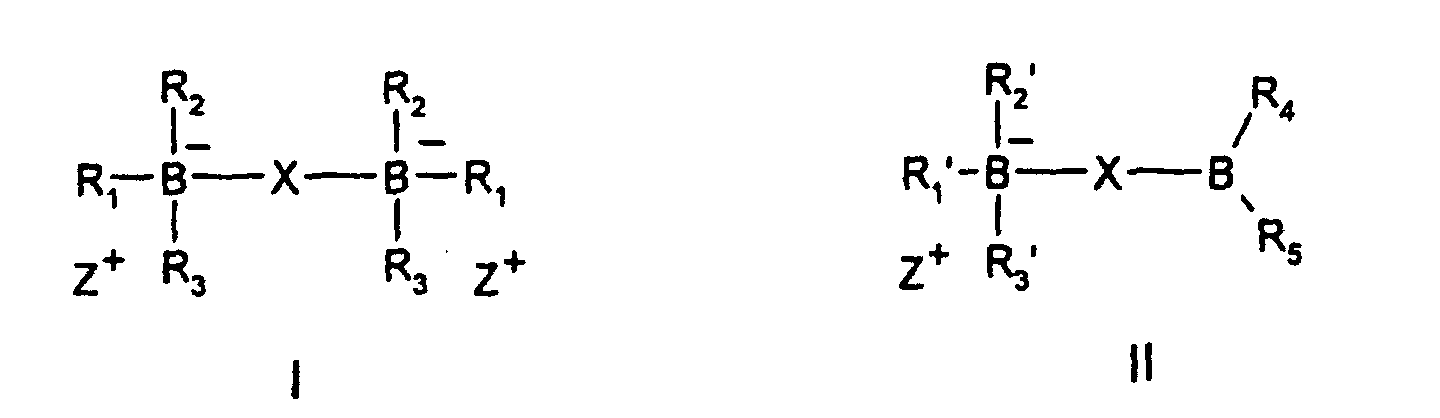 R1, R2 und R3 unabhängig voneinander für Phenyl oder einen anderen aromatischen Kohlenwasserstoff stehen, wobei diese Reste unsubstituiert oder mit unsubstituiertem oder mit Halogen, OR6 oder/und NR8R9 substituiertem C1-C6-Alkyl, OR6, S(O)pR7, OS(O)2R7, NR8R9, S(O)pNR8R9, C(O)NR8R9, SiR11R12R13, P(O)qR14R15, Halogen odersubstituiert sind,
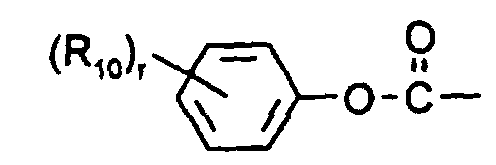
wobei keiner der Reste R1-R3 einen in ortho-Stellung zu der Bindung zum Boratatom substituierten Phenylrest oder anderen in ortho-Stellung zum Boratatom sterisch gehinderten aromatischen Kohlenwasserstoff darstellt;p 0, 1 oder 2 ist;q 0 oder 1 ist;r für eine Zahl von 0 bis 5 steht;R1', R2' und R3' eine der Bedeutungen von R1-R3 haben, wobei die Reste R1', R2' und R3' auch in ortho-Stellung zu der Bindung zum Boratatom substituiert sein können;R4 und R5 OH oder OR6 sind oder eine der Bedeutungen von R1- R3 haben, wobei die Reste R4 und R5 auch in ortho-Stellung zu der Bindung zum Boratatom substituiert sein können;R6 und R7 unabhängig voneinander C3-C12-Cycloalkyl, C2-C8-Alkenyl, unsubstituiertes oder mit C1-C12-Alkoxy oder Halogen substituiertes C1-C12-Alkyl, unsubstituiertes oder 1- bis 5-fach mit C1-C6-Alkyl, C1-C12-Alkoxy oder Halogen substituiertes Phenyl oder unsubstituiertes oder 1- bis 5-fach mit C1-C6-Alkyl, C1-C12-Alkoxy oder Halogen substituiertes Phenyl-C1-C6alkyl sind;R8, R9, R11, R12, R13, R14 und R15 unabhängig voneinander eine der Bedeutungen von R6 haben, oder R8 und R9 zusammen mit dem N-Atom, an welches sie gebunden sind, einen 5-oder 6-gtiedrigen Ring, der zusätzlich noch O- oder S-Atome enthalten kann, bilden;R10 für Wasserstoff oder C1-C12-Alkyl steht;X C1-C20-Alkylen, welches unsubstituiert oder mit OR6', S(O)pR7', OS(O)2R7', NR8'R9', C(O)NR8'R9', SiR11'R12'R13', P(O)qR14'R15', Halogen, (BR1R2R3)-Z+, BR4R5, Phenyl odersubstituiert ist bedeutet, wobei der Phenylrest unsubstituiert oder 1-bis 5-fach mit Halogen, oder mit unsubstituiertem oder mit (BR1R2R3)-Z+ oder BR4R5 substituiertem C1-C12-Alkyl, oder mit unsubstituiertem oder mit (BR1R2R3)-Z+ oder BR4R5 substituiertem C1-C12-Dialkylamino, oder mit unsubstituiertem oder mit (BR1R2R3)-Z+ oder BR4R5 substituiertem C1-C12-Alkoxy substituiert ist,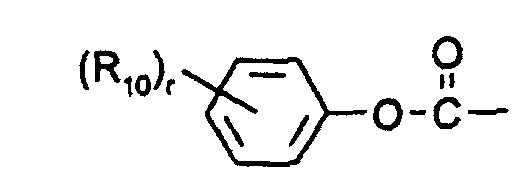
oder X C2-C20-Alkylen, welches durch eine oder mehrere Gruppe -O-, -S(O)p-, -NR16-, -OSiR17R18O-, -SiR17R18- unterbrochen ist bedeutet,
oder X C2-C20-Alkylen, welches durch einen oder mehrere aroma ische Kohlenwasserstoffe oder andere Heterozyklen unterbrochen ist, bedeutet, wobei die aromatischen Kohlenwasserstoffe unsubstituiert oder 1- bis 5-fach mit Halogen (BR1R2R3)-Z+ oder BR4R5, unsubstituiertem oder mit (BR1R2R3)-Z+ oder BR4R5 substituiertem C1-C6-Alkyl, oder mit unsubstituiertem oder mit (BR1R2R3)-Z+ oder BR4R5 substituiertem C1-C12-Alkoxy oder mit unsubstituiertem oder mit (BR1R2R3)-Z+ oder BR4R5 substituiertem C1-C12-Dialkylamino substituiert sind;
oder X C3-C12-Cycloalkylen oder C2-C8-Alkenylen ist, wobei diese Reste unsubstituiert oder mit OR6', S(O)pR7', OS(O)2R7', NR8-R9', C(O)NR8'R9', SiR11'R12'R13', P(O)qR14'R15', Halogen, C1-C12-Alkyl, (BR1R2R3)-Z , BR4R5 oder Phenyl odersubstituiert sind, wobei der Phenylrest unsubstituiert oder 1-5-fach mit Halogen, unsubstituiertem oder mit (BR1R2R3)-Z+ oder BR4R5 substituiertem C1-C12-Alkyl, oder mit unsubstituiertem oder mit (BR1R2R3)-Z+ oder BR4R5 substituiertem C1-C12-Dialkylamino, oder mit unsubstituiertem oder mit (BR1R2R3)-Z+ oder BR4R5 substituiertem C1-C12-Alkoxy substituiert ist; oder X C3-C12-Cycloalkylen oder C2-C8-Alkenylen, welches durch eine oder mehrere Gruppen -O-, -S(O)p-, -NR16-, -OSiR17R18O-, -SiR17R18- unterbrochen ist, bedeutet; oder X einen Rest der Formel X - XVII darstellt



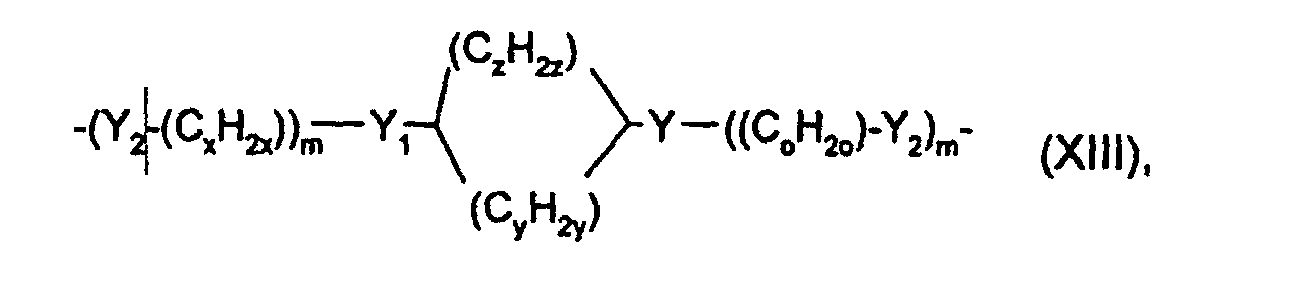

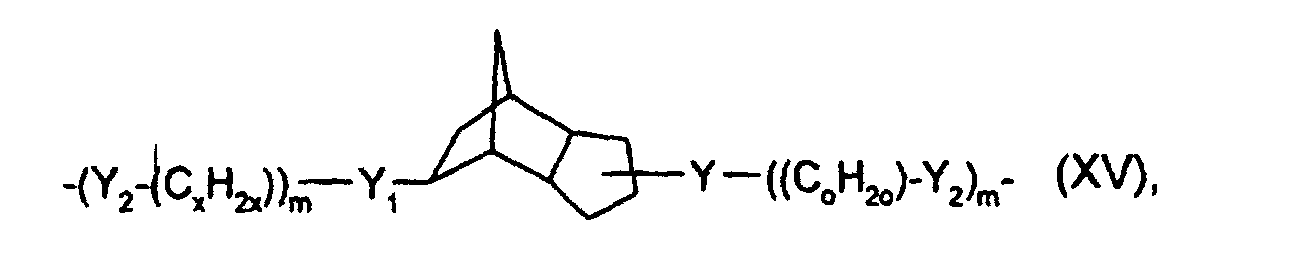
 oder X Polycycloatkylen bedeutet;
 x, y, z und o unabhängig voneinander für eine Zahl von 0 bis 8 stehen, wobei die Cycloalkylringe in den Formeln (X) und (XIII) jeweils nicht mehr als 12 C-Atome enthalten;m eine Zahl von 1 bis 6 bedeutet;R6' und R7' unabhängig voneinander C1-C12-Alkyl, welches unsubstituiert oder mit unsubstituiertem oder mit (BR1R2R3)-Z+ oder BR4R5 substituiertem C1-C12-Alkoxy, oder unsubstituiertem oder mit (BR1R2R3)-Z+ oder BR4R5 substituiertem C1-C12-Dialkylamino, oder Halogen, (BR1R2R3)-Z+ oder BR4R5 substituiert ist, bedeuten, oder R6' und R7' unsubstituiertes oder mit C1-C12-Alkoxy, C1-C12-Dialkylamino, Halogen, (BR1R2R3)-Z+ oder BR4R5 substituiertes C3-C12-Cycloalkyl bedeuten,
oder R6' und R7' unsubstituiertes oder 1- bis 5-fach mit Halogen substituiertes Phenyl bedeuten oder R6' und R7', Phenyl, welches mit unsubstituiertem oder mit (BR1R2R3)-Z+ oder BR4R5 substituiertem C1-C6-Alkyl, unsubstituiertem oder mit (BR1R2R3)-Z+ oder BR4R5 substituiertem C1-C12-Alkoxy, unsubstituiertem oder mit (BR1R2R3)-Z+ oder BR4R5 substituiertem C1-C12-Dialkylamino substituiert ist, sind,
oder R6' und R7' unsubstituiertes oder 1- bis 5-fach mit Halogen substituiertes Phenyl-C1-C6alkyl bedeuten, oder R6' und R7' Phenyl-C1-C6-alkyl, welches mit unsubstituiertem oder mit (BR1R2R3)-Z+ oder BR4R5 substituiertem C1-C6-Alkyl oder unsubstituiertem oder mit (BR1R2R3)-Z+ oder BR4R5 substituiertem C1-C12-Alkoxy oder unsubstituiertem oder mit (BR1R2R3)-Z+ oder BR4R5 substituiertem C1-C12-Dialkylamino substituiert ist, darstellen;R8', R9', R11', R12', R13', R14' und R15' unabhängig voneinander eine der Bedeutungen von R6' haben oder R8' und R9' zusammen mit dem N-Atom, an welches sie gebunden sind, einen 5-oder 6-gliedrigen Ring, der zusätzlich noch O- oder S-Atome enthalten kann, bilden;R16 Wasserstoff ist oder eine der Bedeutungen von R6' hat;R17 und R18 eine der Bedeutungen von R6' haben;Y, Y1 und Y2 unabhängig voneinder eine direkte Bindung, O, S, SO2, NR16, SiR17R18 oder -CR19R20- darstellen;R19 und R20 unabhängig voneinander für Wasserstoff oder C1-C12-Alkxl stehen; undZ+ für einen Rest steht, welcher positive lonen bilden kann. - Verbindungen der Formel I und II nach Anspruch 1, worinR1, R2 und R3 unabhängig voneinander für unsubstituiertes Phenyl oder mit unsubstituiertem oder mit Halogen substituiertem C1-C6-Alkyl, OR6, S(O)pNR8R9 oder C(O)NR8R9, substituiertes Phenyl stehen,R1', R2', R3', R4 und R5 eine der Bedeutungen von R1-R3 haben, wobei die Reste R1', R2', R3', R4 und R5 auch in ortho-Stellung zu der Bindung zum Boratatom substituiert sein können;R6, R7, R8 und R9 C1-C12-Alkyl oder Phenyl sind;
oder R8 und R9 zusammen mit dem N-Atom, an welches sie gebunden sind, einen 5- oder 6-gliedrigen Ring, der zusätzlich noch O-Atome enthalten kann, bilden;X C1-C20-Alkylen oder C1-C20-Alkylen, welches durch eine oder mehrere Gruppen -O-, SO2- oder SiR11'R12'R13' unterbrochen ist bedeutet, oder X ein Alkylen der folgenden Formeln III - IX darstellt:

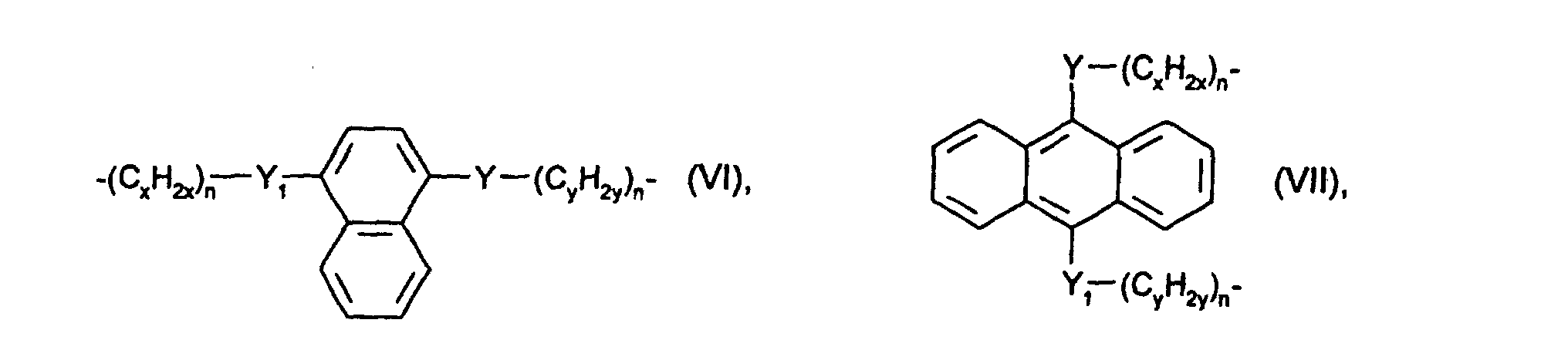
 worin n für eine Zahl von 1 bis 6 steht und die Phenylringe mit C1-C12-Alkoxy substitutiert sein können, oder X C3-C12-Cycloalkylen ist, welches unsubstituiert oder mit (BR1R2R3)-Z+ oder C1-C12-Alkyl substituiert ist;
 x, y, und z unabhängig voneinander eine Zahl von 0 bis 8 darstellen, mit der Massgabe, dass x, y, und z nicht alle gleichzeitig 0 bedeuten; undY, Y1 und Y2 unabhängig voneinder eine direkte Bindung oder O darstellen.
- Verbindungen nach Anspruch 1, worin Z ein mono- oder divalentes Farbstoff- oder Metallkomplex-, Sulfonium-, Sulfoxonium- oder lodonium-Kation ist oder Z für eine UV-Absorber-Verbindung, die Kationen bilden kann, steht, oder Z für ein Metallkation der Gruppe 1 des Periodensystems steht, oder Z ein Kation MYb + darstellt, wobei M ein Metall der II Gruppe des Periodensystems darstellt und Yb für Alkoxy oder Halogen steht, oder Z ein Ammonium- oder Phosphoniumsalz ist.
- Verbindungen der Formel I nach Anspruch 1, worin R1, R2 und R3 für unsubstituiertes oder mit Halogen, OR6 oder C1-C4-Alkyl substituiertes Phenyl stehen, R6 C1-C4-Alkyl ist, X für C2-C6-Alkylen, C2-C6-Alkylen unterbrochen durch Phenylen oder unsubstituiertes oder mit (BR1R2R3)-Z+ substituiertes C6-C12-Cycloalkylen steht und Z ein Tetraalkylammonium- oder Sulfoniumkation ist.
- Photoinitiator enthaltend (A) mindestens eine Verbindung der Formel I oder II nach Anspruch 1 als Coinitiator und (B) mindestens eine Elektronenakzeptor-Verbindung, wobei die Elektronenakzeptor-Verbindung (B) auch Bestandteil des Restes Z+ der Formel I sein kann.
- Photoinitiator nach Anspruch 5, worin die Elektronenakzeptor-Verbindung (B) ein Farbstoff oder ein UV-Absorber ist.
- Photoinitiator nach Anspruch 6, worin der UV-Absorber ein Thioxanthonderivat, Coumarin, Benzophenon, ein Benzophenonderivat oder ein Hexaarylbisimidazolderivat ist.
- Photoinitiator nach Anspruch 6, worin der Farbstoff ein Cyaninfarbstoff oder Chinoliniumfarbstoff ist.
- Photoinitiator nach Anspruch 6, worin der Farbstoff ein Farbstoff ist, der während oder nach der Bestrahlung seine Farbe verändert oder verliert.
- Photoinitiator nach Anspruch 5, enthaltend zusätzlich zum Coinitiator (A) eine weitere Boratverbindung (A1) als Coinitiator.
- Zusammensetzung enthaltend(a) mindestens eine ethylenisch ungesättigte photopolymerisierbare Verbindung und(b) mindestens einen Photoinitiator nach einem der Ansprüche 5-10.
- Zusammensetzung nach Anspruch 11, enthaltend neben der Komponente (b) noch einen weiteren Photoinitator (c) und/oder weitere Additive (d).
- Zusammensetzung nach Anspruch 12, enthaltend als weiteren Photoinitiator (c) mindestens ein Titanocen, ein Ferrocen, ein Benzophenon, einen Benzoinalkylether, ein Benzilketal, ein 4-Aroyl-1,3-dioxolan, ein Dialkoxyacetophenon, ein α-Hydroxy- oder α-Aminoacetophenon, ein α-Hydroxycycloalkyl-phenylketon, einen Phenylglyoxalsäureester oder Derivate davon, ein Xanthon, ein Thioxanthon, ein Anthrachinon, ein anderes Borat oder ein Mono-, Bis- oder Trisacylphosphinoxid oder Mischungen davon, insbesondere eine α-Aminoketonverbindung.
- Zusammensetzung nach Anspruch 11, enthaltend zusätzlich zu den Komponenten (a) und (b) noch mindestens einen neutralen, anionischen oder kationischen Farbstoff oder eine Thioxanthonverbindung und eine Oniumverbindung.
- Zusammensetzung nach Anspruch 14, enthaltend zusätzlich einen radikalischen Photoinitiator (c), insbesonders eine α-Aminoketonverbindung.
- Zusammensetzung nach Anspruch 12, worin als weiteres Additiv (d) eine leicht reduzierbare Verbindung, insbesondere ein halogenierter Kohlenwasserstoff, eingesetzt wird.
- Zusammensetzung nach einem der Ansprüche 11-16, enthaltend 0,05 bis 15, insbesondere 0,2 bis 5 Gew.-%, der Komponente (b), bzw. der Komponenten (b) + (c), bezogen auf die Zusammensetzung.
- Verfahren zur Photopolymerisation von nichtflüchtigen monomeren, oligomeren oder polymeren Verbindungen mit mindestens einer ethylenisch ungesättigten Doppelbindung, dadurch gekennzeichnet, dass den oben genannten Verbindungen mindestens ein Photoinitiator nach einem der Ansprüche 5-10 zugegeben wird und die Mischung durch Bestrahlen mit elektromagnetischer Strahlung gehärtet wird.
- Verwendung einer Zusammensetzung nach einem der Ansprüche 11-17 zur Herstellung von pigmentierten und nichtpigmentierten Lacken, Pulverlacken, Druckfarben, Druckplatten, Klebem, Dentalmassen, Lichtwellenleitem, optischen Schaltern, Farbprüfsystemen, Glasfaserkabelbeschichtungen, Siebdruckschablonen, Resistmaterialien, Verbundmassen, Entfärbersystemen, Entfärbenden Systemen für Bildaufzeichnungsmaterialien, für Bildaufzeichnungsmaterialien unter Verwendung von Mikrokapseln, zur Verkapselung elektrischer und elektronischer Bauteile, zur Herstellung von magnetischen Aufzeichnungsmaterialien, zur Herstellung von dreidimensionalen Objekten mittels Stereolithographie, für photographische Reproduktionen, sowie als Bildaufzeichnungsmaterial, insbesondere für holographische Aufzeichnungen.
- Verwendung von Verbindungen der Formel 1 und II in Tonermaterialien.
- Verfahren nach Anspruch 18 zur Herstellung von pigmentierten und nichtpigmentierten Lacken, Pulverlacken, Druckfarben, Druckplatten, Klebern, Dentalmassen, Lichtwellenleitern, optischen Schaltern, Farbprüfsystemen, Glasfaserkabelbeschichtungen, Siebdruckschablonen, Resistmaterialien, Verbundmassen, Entfärbersystemen, Entfärbenden Systemen für Bildaufzeichnungsmaterialien, für Bildaufzeichnungsmaterialien unter Verwendung von Mikrokapseln, zur Verkapselung elektrischer und elektronischer Bauteile, zur Herstellung von magnetischen Aufzeichnungsmaterialien, zur Herstellung von dreidimesnionalen Objekten mittels Stereolithographie, für photographische Reproduktionen, sowie zur Herstellung von Bildaufzeichnungsmaterial, insbesondere für holographische Aufzeichnungen.
- Beschichtetes Substrat, das auf mindestens einer Oberfläche mit einer Zusammensetzung nach einem der Ansprüche 11-16 beschichtet ist.
- Verfahren zur photographischen Herstellung von Reliefabbildungen, dadurch gekennzeichnet, dass ein beschichtetes Substrat nach Anspruch 22 entweder a) durch eine Maske bildmässig belichtet wird oder b) mittels eines beweglichen Laserstrahls (ohne Maske) belichtet wird und anschliessend die unbelichteten Anteile mit einem Lösungsmittel entfernt werden.
Applications Claiming Priority (3)
| Application Number | Priority Date | Filing Date | Title |
|---|---|---|---|
| CH120597 | 1997-05-23 | ||
| CH120597 | 1997-05-23 | ||
| PCT/EP1998/002817 WO1998052952A1 (en) | 1997-05-23 | 1998-05-13 | Polyborate coinitiators for photopolymerization |
Publications (2)
| Publication Number | Publication Date |
|---|---|
| EP0983277A1 EP0983277A1 (de) | 2000-03-08 |
| EP0983277B1 true EP0983277B1 (de) | 2003-01-22 |
Family
ID=4204965
Family Applications (1)
| Application Number | Title | Priority Date | Filing Date |
|---|---|---|---|
| EP98925595A Expired - Lifetime EP0983277B1 (de) | 1997-05-23 | 1998-05-13 | Polyboratcoinitiatoren für photopolymerisation |
Country Status (7)
| Country | Link |
|---|---|
| US (1) | US6087062A (de) |
| EP (1) | EP0983277B1 (de) |
| JP (1) | JP2001527565A (de) |
| AU (1) | AU7764998A (de) |
| DE (1) | DE69810922D1 (de) |
| TW (1) | TW412540B (de) |
| WO (1) | WO1998052952A1 (de) |
Families Citing this family (23)
| Publication number | Priority date | Publication date | Assignee | Title |
|---|---|---|---|---|
| TW455616B (en) * | 1997-11-03 | 2001-09-21 | Ciba Sc Holding Ag | New quinolinium dyes and borates, combinations thereof as photoinitiator compositions and photopolymerizable compositions comprising these photoinitiators |
| US6767654B2 (en) * | 1999-01-08 | 2004-07-27 | Chisso Corporation | Organic electroluminescent device |
| US6587628B1 (en) | 1999-11-22 | 2003-07-01 | 3M Innovative Properties Company | Optical fiber with improved strength in high humidity/high temperature environments |
| NZ530128A (en) * | 2001-06-15 | 2008-10-31 | Univ Melbourne | Boron-based wood preservatives and treatment of wood with boron-based preservatives |
| JP4244274B2 (ja) * | 2001-09-27 | 2009-03-25 | 富士フイルム株式会社 | 光重合性組成物及び記録材料 |
| US6895156B2 (en) | 2001-10-09 | 2005-05-17 | 3M Innovative Properties Company | Small diameter, high strength optical fiber |
| JP4233853B2 (ja) * | 2002-11-25 | 2009-03-04 | 株式会社メニコン | 眼用レンズのマーキング方法 |
| US7875321B2 (en) * | 2002-12-11 | 2011-01-25 | Agfa Graphics Nv | Preparation of flexographic printing plates using ink jet recording |
| JP2005275273A (ja) * | 2004-03-26 | 2005-10-06 | Fuji Photo Film Co Ltd | ホログラム記録材料、ホログラム記録方法及び光記録媒体 |
| BRPI0617591A2 (pt) * | 2005-10-07 | 2011-08-02 | Dow Global Technologies Inc | sistemas para iniciar polimerização via radical livre, composição polimerizável de duas partes, método de polimerização, método para ligar dois ou mais substratos entre si, método para modificar a superfìcie de um polìmero de baixa energia superficial, método para revestir um substrato, composição de revestimento e laminado |
| US7883826B2 (en) * | 2006-12-07 | 2011-02-08 | Eastman Kodak Company | Negative-working radiation-sensitive compositions and imageable materials |
| US20080308003A1 (en) * | 2007-06-13 | 2008-12-18 | Krol Andrew M | UV inkjet resist |
| KR101225127B1 (ko) * | 2009-08-18 | 2013-01-22 | 주식회사 엘지화학 | 신규한 화합물, 이를 포함하는 촉매 조성물 및 이를 이용한 고리형 올레핀계 중합체의 제조방법 |
| GB2476976A (en) | 2010-01-18 | 2011-07-20 | Lintfield Ltd | Protected aryl ketones and their use as photoinitiators |
| EP2450893A1 (de) * | 2010-11-08 | 2012-05-09 | Bayer MaterialScience AG | Photopolymer-Formulierung zur Herstellung holographischer Medien mit hoch vernetzten Matrixpolymeren |
| US9022562B2 (en) | 2011-08-05 | 2015-05-05 | Nitto Denko Corporation | Optical element for correcting color blindness |
| JP5831103B2 (ja) * | 2011-09-29 | 2015-12-09 | 富士ゼロックス株式会社 | 静電荷像現像用トナー、静電荷像現像用現像剤、トナーカートリッジ、プロセスカートリッジ、画像形成装置及び画像形成方法 |
| US8931930B2 (en) | 2013-01-29 | 2015-01-13 | Nitto Denko Corporation | Optical element for correcting color blindness |
| WO2015091427A1 (de) * | 2013-12-20 | 2015-06-25 | Bayer Materialscience Ag | Holographische medien mit verbesserter lichtempfindlichkeit |
| WO2017051182A1 (en) | 2015-09-25 | 2017-03-30 | Photocentric Limited | Methods for making an object and formulations for use in said methods |
| US11626336B2 (en) * | 2019-10-01 | 2023-04-11 | Qualcomm Incorporated | Package comprising a solder resist layer configured as a seating plane for a device |
| US20230051188A1 (en) * | 2019-12-18 | 2023-02-16 | 3M Innovative Properties Company | Composition including unsaturated polyester resin, epoxy resin, and photoinitiator and method of using the same |
| WO2025014051A1 (ko) * | 2023-07-10 | 2025-01-16 | 서울대학교산학협력단 | 자외선 차단성 접착제 조성물, 이를 이용한 접착제 수지의 제조방법 및 이를 이용하여 제조된 접착 필름 |
Family Cites Families (11)
| Publication number | Priority date | Publication date | Assignee | Title |
|---|---|---|---|---|
| US2872479A (en) * | 1955-06-30 | 1959-02-03 | Callery Chemical Co | Preparation of organoboron compounds |
| US3163679A (en) * | 1959-11-17 | 1964-12-29 | Ziegler Karl | Process for the production of alkali boron tetraalkyls |
| US3311662A (en) * | 1962-11-30 | 1967-03-28 | American Potash & Chem Corp | Tetraarylboron compounds |
| US4772541A (en) * | 1985-11-20 | 1988-09-20 | The Mead Corporation | Photohardenable compositions containing a dye borate complex and photosensitive materials employing the same |
| US4772530A (en) * | 1986-05-06 | 1988-09-20 | The Mead Corporation | Photosensitive materials containing ionic dye compounds as initiators |
| US5151520A (en) * | 1985-11-20 | 1992-09-29 | The Mead Corporation | Cationic dye-triarylmonoalkylorate anion complexes |
| US4954414A (en) * | 1988-11-08 | 1990-09-04 | The Mead Corporation | Photosensitive composition containing a transition metal coordination complex cation and a borate anion and photosensitive materials employing the same |
| US5055372A (en) * | 1990-04-23 | 1991-10-08 | The Mead Corporation | Photohardenable composition containing borate salts and ketone initiators |
| EP0710663A1 (de) * | 1994-11-01 | 1996-05-08 | Japan Polyolefins Co., Ltd. | Borenthaltende Verbindung, sein Polymer, diese Polymer und ein Metallocen enthaltender Katalysator und ein Verfahren zur Herstellung eines Polyolefins |
| TW466256B (en) * | 1995-11-24 | 2001-12-01 | Ciba Sc Holding Ag | Borate photoinitiator compounds and compositions comprising the same |
| DE19622207A1 (de) * | 1996-06-03 | 1997-12-04 | Hoechst Ag | Chemische Verbindung |
-
1998
- 1998-05-13 AU AU77649/98A patent/AU7764998A/en not_active Abandoned
- 1998-05-13 WO PCT/EP1998/002817 patent/WO1998052952A1/en not_active Ceased
- 1998-05-13 EP EP98925595A patent/EP0983277B1/de not_active Expired - Lifetime
- 1998-05-13 DE DE69810922T patent/DE69810922D1/de not_active Expired - Lifetime
- 1998-05-13 JP JP54990298A patent/JP2001527565A/ja active Pending
- 1998-05-19 US US09/081,430 patent/US6087062A/en not_active Expired - Fee Related
- 1998-05-22 TW TW087107929A patent/TW412540B/zh not_active IP Right Cessation
Also Published As
| Publication number | Publication date |
|---|---|
| EP0983277A1 (de) | 2000-03-08 |
| TW412540B (en) | 2000-11-21 |
| JP2001527565A (ja) | 2001-12-25 |
| DE69810922D1 (en) | 2003-02-27 |
| WO1998052952A1 (en) | 1998-11-26 |
| US6087062A (en) | 2000-07-11 |
| AU7764998A (en) | 1998-12-11 |
Similar Documents
| Publication | Publication Date | Title |
|---|---|---|
| US5952152A (en) | Borate coinitiators for photopolymerization | |
| US6096794A (en) | Quinolinium dyes and borates in photopolymerizable compositions | |
| US5932393A (en) | Borate photoinitiators from monoboranes | |
| US6011180A (en) | Acid-stable borates for photopolymerization | |
| US6087062A (en) | Polyborate coinitiators for photopolymerization | |
| US5807905A (en) | Borate photoinitiators from polyboranes | |
| US6090865A (en) | Polymerizable composition | |
| MXPA98009066A (en) | New colors of quinolinio and boratos encomposiciones fotopolimerizab | |
| MXPA98009065A (en) | Polymerize composition |
Legal Events
| Date | Code | Title | Description |
|---|---|---|---|
| PUAI | Public reference made under article 153(3) epc to a published international application that has entered the european phase |
Free format text: ORIGINAL CODE: 0009012 |
|
| 17P | Request for examination filed |
Effective date: 19990909 |
|
| AK | Designated contracting states |
Kind code of ref document: A1 Designated state(s): DE FR GB |
|
| GRAG | Despatch of communication of intention to grant |
Free format text: ORIGINAL CODE: EPIDOS AGRA |
|
| 17Q | First examination report despatched |
Effective date: 20020514 |
|
| GRAG | Despatch of communication of intention to grant |
Free format text: ORIGINAL CODE: EPIDOS AGRA |
|
| GRAH | Despatch of communication of intention to grant a patent |
Free format text: ORIGINAL CODE: EPIDOS IGRA |
|
| GRAH | Despatch of communication of intention to grant a patent |
Free format text: ORIGINAL CODE: EPIDOS IGRA |
|
| GRAA | (expected) grant |
Free format text: ORIGINAL CODE: 0009210 |
|
| AK | Designated contracting states |
Kind code of ref document: B1 Designated state(s): DE FR GB |
|
| PG25 | Lapsed in a contracting state [announced via postgrant information from national office to epo] |
Ref country code: FR Free format text: LAPSE BECAUSE OF FAILURE TO SUBMIT A TRANSLATION OF THE DESCRIPTION OR TO PAY THE FEE WITHIN THE PRESCRIBED TIME-LIMIT Effective date: 20030122 |
|
| REG | Reference to a national code |
Ref country code: GB Ref legal event code: FG4D |
|
| REF | Corresponds to: |
Ref document number: 69810922 Country of ref document: DE Date of ref document: 20030227 Kind code of ref document: P |
|
| PG25 | Lapsed in a contracting state [announced via postgrant information from national office to epo] |
Ref country code: DE Free format text: LAPSE BECAUSE OF FAILURE TO SUBMIT A TRANSLATION OF THE DESCRIPTION OR TO PAY THE FEE WITHIN THE PRESCRIBED TIME-LIMIT Effective date: 20030423 |
|
| PG25 | Lapsed in a contracting state [announced via postgrant information from national office to epo] |
Ref country code: GB Free format text: LAPSE BECAUSE OF NON-PAYMENT OF DUE FEES Effective date: 20030513 |
|
| PLBE | No opposition filed within time limit |
Free format text: ORIGINAL CODE: 0009261 |
|
| STAA | Information on the status of an ep patent application or granted ep patent |
Free format text: STATUS: NO OPPOSITION FILED WITHIN TIME LIMIT |
|
| EN | Fr: translation not filed | ||
| GBPC | Gb: european patent ceased through non-payment of renewal fee |
Effective date: 20030513 |
|
| 26N | No opposition filed |
Effective date: 20031023 |