EP0983474B1 - Latentwärmekörper - Google Patents
Latentwärmekörper Download PDFInfo
- Publication number
- EP0983474B1 EP0983474B1 EP98921427A EP98921427A EP0983474B1 EP 0983474 B1 EP0983474 B1 EP 0983474B1 EP 98921427 A EP98921427 A EP 98921427A EP 98921427 A EP98921427 A EP 98921427A EP 0983474 B1 EP0983474 B1 EP 0983474B1
- Authority
- EP
- European Patent Office
- Prior art keywords
- latent heat
- bodies
- heat body
- microwave
- active substance
- Prior art date
- Legal status (The legal status is an assumption and is not a legal conclusion. Google has not performed a legal analysis and makes no representation as to the accuracy of the status listed.)
- Expired - Lifetime
Links
- 238000005338 heat storage Methods 0.000 claims abstract description 134
- 239000011232 storage material Substances 0.000 claims abstract description 125
- 239000012876 carrier material Substances 0.000 claims abstract description 104
- 239000013543 active substance Substances 0.000 claims abstract description 55
- 239000012188 paraffin wax Substances 0.000 claims abstract description 38
- 238000000034 method Methods 0.000 claims description 32
- XLYOFNOQVPJJNP-UHFFFAOYSA-N water Substances O XLYOFNOQVPJJNP-UHFFFAOYSA-N 0.000 claims description 26
- 239000000463 material Substances 0.000 claims description 25
- 239000000835 fiber Substances 0.000 claims description 22
- 238000010438 heat treatment Methods 0.000 claims description 22
- 238000003860 storage Methods 0.000 claims description 22
- 230000008569 process Effects 0.000 claims description 18
- 238000001816 cooling Methods 0.000 claims description 17
- 239000007788 liquid Substances 0.000 claims description 16
- 239000011888 foil Substances 0.000 claims description 15
- 239000004744 fabric Substances 0.000 claims description 12
- 235000013305 food Nutrition 0.000 claims description 11
- 239000004743 Polypropylene Substances 0.000 claims description 10
- 239000002480 mineral oil Substances 0.000 claims description 9
- 239000004033 plastic Substances 0.000 claims description 9
- 229920003023 plastic Polymers 0.000 claims description 9
- 229920000642 polymer Polymers 0.000 claims description 9
- -1 polypropylene Polymers 0.000 claims description 9
- 229920001155 polypropylene Polymers 0.000 claims description 9
- 238000004026 adhesive bonding Methods 0.000 claims description 8
- 229920001971 elastomer Polymers 0.000 claims description 8
- 235000010446 mineral oil Nutrition 0.000 claims description 8
- 230000005855 radiation Effects 0.000 claims description 8
- 239000000919 ceramic Substances 0.000 claims description 7
- 239000004753 textile Substances 0.000 claims description 6
- 230000006835 compression Effects 0.000 claims description 5
- 238000007906 compression Methods 0.000 claims description 5
- 238000009413 insulation Methods 0.000 claims description 5
- 229910052751 metal Inorganic materials 0.000 claims description 5
- 239000002184 metal Substances 0.000 claims description 5
- 229920003043 Cellulose fiber Polymers 0.000 claims description 4
- 238000005520 cutting process Methods 0.000 claims description 4
- 239000011521 glass Substances 0.000 claims description 4
- 238000000227 grinding Methods 0.000 claims description 4
- 239000011490 mineral wool Substances 0.000 claims description 4
- 239000000843 powder Substances 0.000 claims description 4
- 239000005060 rubber Substances 0.000 claims description 4
- 241001465754 Metazoa Species 0.000 claims description 3
- 239000003795 chemical substances by application Substances 0.000 claims description 2
- 239000003245 coal Substances 0.000 claims description 2
- 239000006260 foam Substances 0.000 claims description 2
- 229910052500 inorganic mineral Inorganic materials 0.000 claims description 2
- 150000002739 metals Chemical class 0.000 claims description 2
- 239000011707 mineral Substances 0.000 claims description 2
- 239000002562 thickening agent Substances 0.000 claims description 2
- 239000005030 aluminium foil Substances 0.000 claims 1
- 229910010272 inorganic material Inorganic materials 0.000 claims 1
- 239000011147 inorganic material Substances 0.000 claims 1
- 239000005445 natural material Substances 0.000 claims 1
- 230000008719 thickening Effects 0.000 claims 1
- 238000004519 manufacturing process Methods 0.000 abstract description 11
- 230000036961 partial effect Effects 0.000 description 57
- 239000011094 fiberboard Substances 0.000 description 21
- 235000013361 beverage Nutrition 0.000 description 19
- 230000000694 effects Effects 0.000 description 19
- 239000000654 additive Substances 0.000 description 18
- 239000010410 layer Substances 0.000 description 18
- 229920001577 copolymer Polymers 0.000 description 13
- 238000012546 transfer Methods 0.000 description 13
- 230000000996 additive effect Effects 0.000 description 10
- 230000008901 benefit Effects 0.000 description 8
- 230000015572 biosynthetic process Effects 0.000 description 7
- 238000009826 distribution Methods 0.000 description 7
- 238000005755 formation reaction Methods 0.000 description 7
- 239000007787 solid Substances 0.000 description 7
- XAGFODPZIPBFFR-UHFFFAOYSA-N aluminium Chemical compound [Al] XAGFODPZIPBFFR-UHFFFAOYSA-N 0.000 description 6
- 230000008859 change Effects 0.000 description 6
- 239000013078 crystal Substances 0.000 description 6
- 230000009471 action Effects 0.000 description 5
- 238000007792 addition Methods 0.000 description 5
- 229910052782 aluminium Inorganic materials 0.000 description 5
- 230000006399 behavior Effects 0.000 description 5
- 238000010276 construction Methods 0.000 description 5
- 238000005470 impregnation Methods 0.000 description 5
- 239000000203 mixture Substances 0.000 description 5
- 239000000126 substance Substances 0.000 description 5
- 239000000806 elastomer Substances 0.000 description 4
- 238000001704 evaporation Methods 0.000 description 4
- 230000008020 evaporation Effects 0.000 description 4
- 230000014759 maintenance of location Effects 0.000 description 4
- 239000011159 matrix material Substances 0.000 description 4
- 238000002844 melting Methods 0.000 description 4
- 230000008018 melting Effects 0.000 description 4
- 238000012549 training Methods 0.000 description 4
- XSQUKJJJFZCRTK-UHFFFAOYSA-N Urea Chemical compound NC(N)=O XSQUKJJJFZCRTK-UHFFFAOYSA-N 0.000 description 3
- 229920002522 Wood fibre Polymers 0.000 description 3
- 239000004202 carbamide Substances 0.000 description 3
- 229920006037 cross link polymer Polymers 0.000 description 3
- 239000012530 fluid Substances 0.000 description 3
- 239000006261 foam material Substances 0.000 description 3
- 239000000499 gel Substances 0.000 description 3
- 239000003921 oil Substances 0.000 description 3
- 238000012545 processing Methods 0.000 description 3
- 238000007789 sealing Methods 0.000 description 3
- 238000002791 soaking Methods 0.000 description 3
- 239000001993 wax Substances 0.000 description 3
- 239000002025 wood fiber Substances 0.000 description 3
- VSKJLJHPAFKHBX-UHFFFAOYSA-N 2-methylbuta-1,3-diene;styrene Chemical compound CC(=C)C=C.C=CC1=CC=CC=C1.C=CC1=CC=CC=C1 VSKJLJHPAFKHBX-UHFFFAOYSA-N 0.000 description 2
- 229920000742 Cotton Polymers 0.000 description 2
- 241000282326 Felis catus Species 0.000 description 2
- 239000004952 Polyamide Substances 0.000 description 2
- PPBRXRYQALVLMV-UHFFFAOYSA-N Styrene Chemical compound C=CC1=CC=CC=C1 PPBRXRYQALVLMV-UHFFFAOYSA-N 0.000 description 2
- 239000002250 absorbent Substances 0.000 description 2
- 229920001400 block copolymer Polymers 0.000 description 2
- FACXGONDLDSNOE-UHFFFAOYSA-N buta-1,3-diene;styrene Chemical compound C=CC=C.C=CC1=CC=CC=C1.C=CC1=CC=CC=C1 FACXGONDLDSNOE-UHFFFAOYSA-N 0.000 description 2
- 230000001427 coherent effect Effects 0.000 description 2
- 239000002131 composite material Substances 0.000 description 2
- 238000007334 copolymerization reaction Methods 0.000 description 2
- 238000002425 crystallisation Methods 0.000 description 2
- 230000008025 crystallization Effects 0.000 description 2
- 238000013461 design Methods 0.000 description 2
- 238000011161 development Methods 0.000 description 2
- 238000009792 diffusion process Methods 0.000 description 2
- 230000003203 everyday effect Effects 0.000 description 2
- 238000011049 filling Methods 0.000 description 2
- 239000003063 flame retardant Substances 0.000 description 2
- 230000006870 function Effects 0.000 description 2
- 239000008187 granular material Substances 0.000 description 2
- 229920001903 high density polyethylene Polymers 0.000 description 2
- 239000004700 high-density polyethylene Substances 0.000 description 2
- 230000006872 improvement Effects 0.000 description 2
- 230000003993 interaction Effects 0.000 description 2
- 238000002156 mixing Methods 0.000 description 2
- 229920002647 polyamide Polymers 0.000 description 2
- 229920005996 polystyrene-poly(ethylene-butylene)-polystyrene Polymers 0.000 description 2
- 230000004044 response Effects 0.000 description 2
- 238000000926 separation method Methods 0.000 description 2
- 229920000468 styrene butadiene styrene block copolymer Polymers 0.000 description 2
- 230000007704 transition Effects 0.000 description 2
- 238000009827 uniform distribution Methods 0.000 description 2
- 238000003466 welding Methods 0.000 description 2
- 229910018072 Al 2 O 3 Inorganic materials 0.000 description 1
- VGGSQFUCUMXWEO-UHFFFAOYSA-N Ethene Chemical compound C=C VGGSQFUCUMXWEO-UHFFFAOYSA-N 0.000 description 1
- 239000005977 Ethylene Substances 0.000 description 1
- 241000208202 Linaceae Species 0.000 description 1
- 235000004431 Linum usitatissimum Nutrition 0.000 description 1
- 239000004677 Nylon Substances 0.000 description 1
- 241001494479 Pecora Species 0.000 description 1
- 239000004793 Polystyrene Substances 0.000 description 1
- 241000219000 Populus Species 0.000 description 1
- 229910004298 SiO 2 Inorganic materials 0.000 description 1
- 229920006328 Styrofoam Polymers 0.000 description 1
- GEIAQOFPUVMAGM-UHFFFAOYSA-N ZrO Inorganic materials [Zr]=O GEIAQOFPUVMAGM-UHFFFAOYSA-N 0.000 description 1
- 230000002745 absorbent Effects 0.000 description 1
- 238000010521 absorption reaction Methods 0.000 description 1
- 230000001133 acceleration Effects 0.000 description 1
- 239000002253 acid Substances 0.000 description 1
- 150000007513 acids Chemical class 0.000 description 1
- 239000011149 active material Substances 0.000 description 1
- 230000006978 adaptation Effects 0.000 description 1
- 239000012790 adhesive layer Substances 0.000 description 1
- 235000013405 beer Nutrition 0.000 description 1
- 238000005452 bending Methods 0.000 description 1
- 239000008280 blood Substances 0.000 description 1
- 210000004369 blood Anatomy 0.000 description 1
- 239000001913 cellulose Substances 0.000 description 1
- 229920002678 cellulose Polymers 0.000 description 1
- 238000005253 cladding Methods 0.000 description 1
- 239000002817 coal dust Substances 0.000 description 1
- 239000011248 coating agent Substances 0.000 description 1
- 238000000576 coating method Methods 0.000 description 1
- 239000004020 conductor Substances 0.000 description 1
- 230000003247 decreasing effect Effects 0.000 description 1
- 239000000428 dust Substances 0.000 description 1
- 230000005670 electromagnetic radiation Effects 0.000 description 1
- BXOUVIIITJXIKB-UHFFFAOYSA-N ethene;styrene Chemical class C=C.C=CC1=CC=CC=C1 BXOUVIIITJXIKB-UHFFFAOYSA-N 0.000 description 1
- 230000005284 excitation Effects 0.000 description 1
- 238000007667 floating Methods 0.000 description 1
- 230000009969 flowable effect Effects 0.000 description 1
- 239000003365 glass fiber Substances 0.000 description 1
- 230000005484 gravity Effects 0.000 description 1
- 230000036541 health Effects 0.000 description 1
- 239000012456 homogeneous solution Substances 0.000 description 1
- 238000007654 immersion Methods 0.000 description 1
- 239000011810 insulating material Substances 0.000 description 1
- 230000001788 irregular Effects 0.000 description 1
- 229940057995 liquid paraffin Drugs 0.000 description 1
- 230000007774 longterm Effects 0.000 description 1
- 238000012423 maintenance Methods 0.000 description 1
- 150000002734 metacrylic acid derivatives Chemical class 0.000 description 1
- 239000002557 mineral fiber Substances 0.000 description 1
- 150000002790 naphthalenes Chemical class 0.000 description 1
- 230000006855 networking Effects 0.000 description 1
- 229920001778 nylon Polymers 0.000 description 1
- 230000003287 optical effect Effects 0.000 description 1
- 238000005457 optimization Methods 0.000 description 1
- 210000000056 organ Anatomy 0.000 description 1
- 239000011368 organic material Substances 0.000 description 1
- 230000000399 orthopedic effect Effects 0.000 description 1
- 238000013021 overheating Methods 0.000 description 1
- 239000005022 packaging material Substances 0.000 description 1
- 238000005192 partition Methods 0.000 description 1
- 239000002985 plastic film Substances 0.000 description 1
- 229920006255 plastic film Polymers 0.000 description 1
- 229920002239 polyacrylonitrile Polymers 0.000 description 1
- 229920000728 polyester Polymers 0.000 description 1
- 229920000098 polyolefin Polymers 0.000 description 1
- 229920002223 polystyrene Polymers 0.000 description 1
- 229920002635 polyurethane Polymers 0.000 description 1
- 239000004814 polyurethane Substances 0.000 description 1
- 238000002360 preparation method Methods 0.000 description 1
- 230000001681 protective effect Effects 0.000 description 1
- 238000011084 recovery Methods 0.000 description 1
- 238000005057 refrigeration Methods 0.000 description 1
- 230000001172 regenerating effect Effects 0.000 description 1
- 230000002940 repellent Effects 0.000 description 1
- 239000005871 repellent Substances 0.000 description 1
- 230000002441 reversible effect Effects 0.000 description 1
- 230000000630 rising effect Effects 0.000 description 1
- 238000005204 segregation Methods 0.000 description 1
- 239000010454 slate Substances 0.000 description 1
- 235000021055 solid food Nutrition 0.000 description 1
- 238000007711 solidification Methods 0.000 description 1
- 230000008023 solidification Effects 0.000 description 1
- 125000006850 spacer group Chemical group 0.000 description 1
- 239000008261 styrofoam Substances 0.000 description 1
- 230000009182 swimming Effects 0.000 description 1
- 230000002195 synergetic effect Effects 0.000 description 1
- 229920003002 synthetic resin Polymers 0.000 description 1
- 239000000057 synthetic resin Substances 0.000 description 1
- 125000000383 tetramethylene group Chemical group [H]C([H])([*:1])C([H])([H])C([H])([H])C([H])([H])[*:2] 0.000 description 1
- 229920001169 thermoplastic Polymers 0.000 description 1
- 229920001187 thermosetting polymer Polymers 0.000 description 1
- 239000004416 thermosoftening plastic Substances 0.000 description 1
- 239000013008 thixotropic agent Substances 0.000 description 1
- 230000036962 time dependent Effects 0.000 description 1
- 229920000428 triblock copolymer Polymers 0.000 description 1
- 239000011800 void material Substances 0.000 description 1
- 238000005491 wire drawing Methods 0.000 description 1
- 210000002268 wool Anatomy 0.000 description 1
Images




Classifications
-
- F—MECHANICAL ENGINEERING; LIGHTING; HEATING; WEAPONS; BLASTING
- F28—HEAT EXCHANGE IN GENERAL
- F28D—HEAT-EXCHANGE APPARATUS, NOT PROVIDED FOR IN ANOTHER SUBCLASS, IN WHICH THE HEAT-EXCHANGE MEDIA DO NOT COME INTO DIRECT CONTACT
- F28D20/00—Heat storage plants or apparatus in general; Regenerative heat-exchange apparatus not covered by groups F28D17/00 or F28D19/00
- F28D20/02—Heat storage plants or apparatus in general; Regenerative heat-exchange apparatus not covered by groups F28D17/00 or F28D19/00 using latent heat
- F28D20/023—Heat storage plants or apparatus in general; Regenerative heat-exchange apparatus not covered by groups F28D17/00 or F28D19/00 using latent heat the latent heat storage material being enclosed in granular particles or dispersed in a porous, fibrous or cellular structure
-
- C—CHEMISTRY; METALLURGY
- C09—DYES; PAINTS; POLISHES; NATURAL RESINS; ADHESIVES; COMPOSITIONS NOT OTHERWISE PROVIDED FOR; APPLICATIONS OF MATERIALS NOT OTHERWISE PROVIDED FOR
- C09K—MATERIALS FOR MISCELLANEOUS APPLICATIONS, NOT PROVIDED FOR ELSEWHERE
- C09K5/00—Heat-transfer, heat-exchange or heat-storage materials, e.g. refrigerants; Materials for the production of heat or cold by chemical reactions other than by combustion
- C09K5/02—Materials undergoing a change of physical state when used
- C09K5/06—Materials undergoing a change of physical state when used the change of state being from liquid to solid or vice versa
- C09K5/063—Materials absorbing or liberating heat during crystallisation; Heat storage materials
-
- Y—GENERAL TAGGING OF NEW TECHNOLOGICAL DEVELOPMENTS; GENERAL TAGGING OF CROSS-SECTIONAL TECHNOLOGIES SPANNING OVER SEVERAL SECTIONS OF THE IPC; TECHNICAL SUBJECTS COVERED BY FORMER USPC CROSS-REFERENCE ART COLLECTIONS [XRACs] AND DIGESTS
- Y02—TECHNOLOGIES OR APPLICATIONS FOR MITIGATION OR ADAPTATION AGAINST CLIMATE CHANGE
- Y02E—REDUCTION OF GREENHOUSE GAS [GHG] EMISSIONS, RELATED TO ENERGY GENERATION, TRANSMISSION OR DISTRIBUTION
- Y02E60/00—Enabling technologies; Technologies with a potential or indirect contribution to GHG emissions mitigation
- Y02E60/14—Thermal energy storage
Definitions
- Ceramic fibers, mineral wool, plastic fibers and other useful fibers such as cotton or sheep's wool are also particularly suitable.
- Ceramic fibers used preferably consist essentially of Al 2 O 3 , SiO 2 , ZrO 2 and organic admixtures, the proportions of the components being able to vary widely. Depending on the proportions selected, the density of the ceramic fibers also fluctuates and is preferably in a range between 150 and 400 kg / m 3 .
- mineral wool preference is given to using rock wool with and without the addition of thermosetting synthetic resins, which may also contain glass fiber. The density fluctuates depending on the composition chosen in the individual case and is preferably in a range between 200 and 300 kg / m 3 .
- Plastic fibers suitable as carrier material elements preferably have base materials such as polyester, polyamide, polyurethane, polyacrylonitrile or polyolefins.
- the latent heat storage material can also be a paraffin, as described in DE-OS 43 07 065.
- the An additive can be added to latent heat storage material. which leads to thick fluid. It can be here Usual thixotropy agent can be used. Even in warmed state, in which is usually a liquefaction given the latent heat storage material is then still a heavy liquid, in the sense a gelatinous consistency. Even at an unintentional severing Latent heat storage body does not come yet or not to a significant extent to a leak from Latent heat storage material.
- the carrier structure preferably consists of one Single fiber composite fiber body.
- fiberboard can be used, however, relatively soft fiberboard is preferred are. Hardboard can only do that to a small extent Absorb latent heat storage material.
- the fibers are preferably self-absorbent. When watering one Fiberboard with a latent heat storage material Paraffin-based, the fibers absorb paraffin full, are "waxed". In addition, the Capillary spaces between the fibers with the latent heat storage material filled.
- a nonwoven for example a carrier material usual absorbent fleece, as it is about to soak up Oil, acids or other liquids are commercially available is. In particular, it can be made entirely of polypropylene fibers existing fleece.
- Latent heat storage material essential that the desired paraffin retention in the latent heat body using the above described carrier material already with a mass fraction less than 5% of the copolymer Latent heat storage material can be achieved.
- One advantage of the invention is that given that with decreasing mass fraction of Copolymers the mass fraction of paraffins in the Total mass of the latent heat storage material increases and thereby a higher with unchanged total mass Heat capacity can be achieved.
- a liquid is used as the heat transfer medium, can the latent heat partial body in their mass density be set in such a way that they are in the heat transfer medium to be held in suspense. In this way the cavities formed are maintained, whereby however, a further acceleration of the heat exchange with the latent heat partial bodies due to their flow-related Circulation can be achieved.
- a liquid Heat transfer medium are, for example, water or oils and in addition also useful other liquids. Even when using a gaseous heat transfer medium, e.g. Air, a resimentation of the in the common envelope contained latent heat partial body counteracted by a specifically induced flow become a constant floating or circulation the latent heat partial body leads.
- the latent heat partial body can be favored, each with a larger surface in relation to the weight of a respective latent heat partial body is realized. For example, it is thought of a flake-like configuration of the latent heat partial body. Otherwise, the latent heat partial body one or more of the aforementioned features exhibit.
- a latent heat body designed as above can, as already mentioned, as a floor element in underfloor heating can be installed.
- a first application consists of a plate heat exchanger, which has such latent heat bodies as plates.
- the plate elements can then be used on both sides Medium are applied.
- a plate element can also be individual in spiral form be trained. For training and maintenance the spiral shape, but what about flat plate elements are between the layers spacers arranged. These are designed like a lattice in such a way that flow paths are open are.
- Good flowability means that essential prerequisite that the Latent heat storage material under the self-priming Influence of the capillary-like receiving spaces of the carrier material penetrates into the recording rooms when it comes on this is introduced.
- the carrier material e.g. soaked in liquefied latent heat storage material become.
- Introducing the liquefied latent heat storage material to self-priming capillary Recording spaces of the carrier material can, for example be accomplished in that the carrier material immersed in liquefied latent heat storage material becomes.
- favoring in the inclusion to be influenced For example, the latent heat storage material continuously supplied with thermal energy to favor liquefaction. Farther can use the liquefied latent heat storage material Pressure can be applied, causing the self-employed Inclusion of the latent heat storage material in the capillary Recording rooms of the carrier material also is favored.
- the self-priming effect of the recording rooms of the Carrier material for liquids is based on the already capillary-like formation of the Recording rooms.
- the inventive method for Manufacture of a latent heat body can be done by these Connections for setting a desired one, in particular the greatest possible self-priming effect the recording rooms regarding the latent heat storage material be proceeded so that a carrier material with the highest possible surface tension is selected and that the individual carrier material elements inner capillaries with preferably low radii of curvature have and / or external shapes with narrow Radii of curvature, especially also sharp edges or Have corners.
- the carrier material is preferably made of individual carrier material elements, for example by Gluing, put together, at least between the carrier material elements capillary-like receiving spaces be formed.
- the procedure is with latent heat storage material soaked carrier material in a number of latent heat partial bodies cut up, cutting up by sawing and / or cutting and / or tearing or even after others known separation process can take place.
- a carrier material Fibreboard made of cellulose fibers with previously liquefied Paraffin-based latent heat storage material soak and the soaked carrier material in elongated, especially in strip-like latent heat partial bodies to saw.
- Another variant could be e.g. a nonwoven selected as the carrier material soaking in latent heat storage material in one Desired number of comparatively smaller latent heat sub-bodies tear up, the latter a flake-like or have a different shape can.
- a latent heat body which contains such a microwave-active substance has the advantage that, compared to heat transfer by means of short-wave radiation, considerably shorter periods of time are required for the supply of a certain amount of energy and accordingly faster heating is possible.
- the microwave-active substance is contained evenly distributed in the latent heat body, so that a corresponding uniform heating can also be observed.
- a uniform distribution does not necessarily also require a homogeneous distribution in the sense of the invention, since uniform heating of the latent heat body, which is sufficient for technical applications, can also be achieved due to heat conduction processes if the microwave-active substance is sufficiently close to one another across the latent heat body distributed.
- carrier material elements contain the microwave-active substance
- the microwave-active substance is contained in capillary-like receiving spaces between the carrier material elements, for example, by gluing to form a carrier material, or in capillary-like receiving spaces within the carrier elements, or that the microwave-active substance is contained in cavities.
- a uniform distribution of the microwave-active substance in the latent heat body is supported in that the microwave-active substance is contained therein in a powdery and / or granular and / or fibrous form.
- the microwave-active substance is to be taken up in the cavities of the latent-heat body formed between latent heat partial bodies, larger, coherent structures of the microwave-active substance can also be advantageous, the dimensions of which can also be of a comparable size to that of the latent heat body.
- a grid-like mesh or network made of a microwave-active substance is provided, which is provided integrated in the latent heat body.
- the microwave-active substance may be expedient for the microwave-active substance to be a liquid, at least at the operating temperature of the latent heat body, all flowable media being included in this context.
- microwave-active substance granular glass bodies, granular plastics, mineral fibers, ceramic fibers, coal dust, metal, in particular aluminum powder and a wire, which is also preferably formed from a metal and which can be further processed into a grid-like mesh, are mentioned as examples.
- the fiberboard 2 is a soft fiberboard that with a paraffin latent heat storage material is filled. The filling is made in the form of an impregnation.
- the fibreboard is a fiberboard made of poplar wood fibers, which is comparatively soft when not soaked. However, other cellulose fibers can also be used.
- the fibreboard When not soaked, the fibreboard has a density of approx. 200kg / m 3 . Fiberboard in the density range of 150-300 kg / m 3 is preferred in the unimpregnated state. When impregnated, the fiberboard has a density of approx. 700kg / m 3 . A range of approx. 550-800 kg / m 3 is preferred here.
- the volume fraction of paraffin in the structure matrix is approximately 50%, the mass fraction of the paraffin or latent heat storage material in the matrix is approximately 68%.
- the casing 3 consists of an aluminum foil. It can also be a polypropylene film.
- FIG. It is a latent heat storage 4, in which a plurality of latent heat bodies 1 hanging vertically are arranged.
- the latent heat storage 4 can for example, air flows through it. He can in in the same way but also flowed through by water. This is then in a known manner in the Latent heat bodies 1 the heat stored and in a row then when flowing through with a relatively colder heat transfer medium returned again.
- a latent heat body 40 are all suitable in this context of the embodiments described in the application. According to the illustration, it is provided that at Lower housing 32 attached upper housing 33 the bottom of the upper housing in the area of the recess 35 parallel to the surface in contact with the latent heat bodies 40 stands, so that a good heat transfer between the Animal feed and the latent heat body is given.
- the 6, 7 described feed container can also accommodate additional food types not mentioned in detail become.
- FIG. 9a shows a top view of a heating / cooling ceiling 44 in the expanded state.
- Fig. 9b which is a rolled-up state the ceiling 44 shows in a side view, the ceiling 44 consists of two arranged parallel to each other Fabric layers 45, 45 ', between which a number individually in protective covers, not shown welded latent heat body 46 is sewn.
- FIGS. 9a, 9b are the fabric layers 45, 45 'by seams 47 on the edge and intermediate seams 48 between the latent heat bodies 46 linked together so that an inner cohesion without the risk of latent heat bodies slipping 46 arises.
- the shown heating / cooling cover 44 can be used, for example, as a baby blanket or accident blanket Find application. Flexible are therefore preferred Latent heat bodies 46 are used there, in the case of their carrier material it can be a fleece. While in Fig. 9a in a plan view only a section of a Spread heat / cooling blanket 44 is shown there Fig. 9b in a side view a rolled up Line up a full blanket again. Deviating of the embodiment shown are also training with different form, number and arrangement of Latent heat bodies 46 possible.
- FIG. 10 shows a further application example Top view of a glove 49, in between inner and outer fabric layers, not shown Latent heat bodies 50, 50 'are sewn in.
- Latent heat bodies 50, 50 'are sewn in are also preferred flexible latent heat body used, their carrier material can be a fleece.
- FIG. 11 shows an insole 51 for a shoe. It is then proposed to use a preferably flexible one Properties having latent heat body 52 in a To weld film 53, being on the top and / or Bottom of the sole 52 not shown further Sole layers can be attached. Doing so the bottom of the sole prefers structured layers Materials such as foam or rubber are used be, the slipping of the insole 51 in Prevent shoe. On the top of the sole 51 can preferably textile, for example also padded Fabric layers are used to ensure comfort increase additionally.
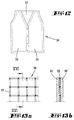
- FIG. 13b is a preferred application of a memory element 13a based on a sectional view shown along the section line XVI-XVI.
- the Storage element 58 is then vertical parallel to the surface between two spaced wall elements 60, 60 'arranged.
- Embodiment are also different designs from Network structures possible.
- FIG. 14 uses a schematic sketch to describe a preferred one Use of a latent heat body according to the invention 61 as a storage element for a solar evaporator 62.
- the solar evaporator then has an outer housing 63 on the upper side with high-energy radiation, for example, solar radiation Cover 64, for example a glass plate, closed is.
- an insulating layer 65 is arranged, which consists of conventional Insulating materials, for example polystyrene, are produced can be.
- the side walls of the outer housing with appropriate Insulating layers are equipped.
- About one Inlet 66 is preferably water 67 in the housing initiated, with a desired level under Application of a safety valve 68, which is - as shown - can be a swimmer, is not exceeded.
- a safety valve 68 which is - as shown - can be a swimmer, is not exceeded.
- a feed line 71 air preferably blown in, which is above the water level enriched with water vapor and due to the resulting overpressure through a line 72 in a Consumer escapes 73, which is shown in the Use case is a composter.
- the for the evaporation of the water becomes necessary energy the container by means of the cover 64 energetic radiation supplied.
- a film 79 Not from the surface of the latent heat storage material enclosed by the container part 77 78 is covered by a film 79, which in the manner with the edge of the container part 77 is connected that the latent heat storage material 78 not in the liquefied state from the beverage cooler 74 can emerge.
- the attachment of the film 79 at the edge of the container part 77 can with suitable fasteners 80 done. 15 is as such Fastening the edge of the container part 77 comprehensive profile chosen that runs along extends the entire length of the edge and for example through continuous adhesive layers 81, 82, or in another connecting and sealing way with which Foil 79 and the edge of the container part 77 connected is.
- the fastening element chosen as the profile 80 which in addition to a sealing effect optical function can also be an immediate Sealing between the film 79 and the edge of the container part 77 may be provided. It is preferably provided that the dimensions of the film 79 in stretched Condition exceed the edge distance of the container part 77, so the film 79 wavy or in the initial position wrinkled or overlapping itself more or less irregular on the surface of the latent heat storage material extends. Exemplary shows the sectional view of Fig. 15 shows an arrangement of the film 79 with slats 83.
- a cooling device for example a refrigerator or freezer
- Fig. 16 an arrangement is achieved in which the Beverage container 75 almost completely different from that on it adjacent film 79 and the adjacent latent heat storage material is surrounded.
- the beverage container. 75 stands with the predominant part of it Outer surface via the film 79 in direct heat exchange with the cooled latent heat storage material 78. Because of the very good possible heat conduction from the beverage container into the latent heat storage material becomes a very rapid cooling of the beverage container and the beverage included in it. After a desired cooling of the beverage container or beverage has been reached, the beverage container removed from the beverage cooler. In connection this depends on the deformability the film 79 and the material properties, in particular the surface tension and viscosity, the latent heat storage material 78 to a time-dependent recovery of the latent heat storage material.
- the latent heat storage material can be made from paraffin without a carrier material to achieve advantageous properties one or more of the previously described Contain additives.
Landscapes
- Chemical & Material Sciences (AREA)
- Engineering & Computer Science (AREA)
- Thermal Sciences (AREA)
- Physics & Mathematics (AREA)
- Materials Engineering (AREA)
- Combustion & Propulsion (AREA)
- Organic Chemistry (AREA)
- Dispersion Chemistry (AREA)
- Mechanical Engineering (AREA)
- General Engineering & Computer Science (AREA)
- Chemical Kinetics & Catalysis (AREA)
- Thermotherapy And Cooling Therapy Devices (AREA)
- Building Environments (AREA)
- Central Heating Systems (AREA)
- Packages (AREA)
- Air-Conditioning For Vehicles (AREA)
- Table Equipment (AREA)
- Professional, Industrial, Or Sporting Protective Garments (AREA)
- Chemical Or Physical Treatment Of Fibers (AREA)
- Laminated Bodies (AREA)
- Heating, Cooling, Or Curing Plastics Or The Like In General (AREA)
- Lining Or Joining Of Plastics Or The Like (AREA)
- Steroid Compounds (AREA)
- Electrodes For Cathode-Ray Tubes (AREA)
- Resistance Heating (AREA)
- Physical Or Chemical Processes And Apparatus (AREA)
Description
Im weiteren ist auch eine Vorteilhaftigkeit hinsichtlich des bereits angesprochenen Ausdehnungsverhaltens bei Phasenänderung gegeben. Das Strukturadditiv ist in dem Latentwärmespeichermaterial vorzugsweise homogen gelöst. Im einzelnen haben sich Strukturadditive wie solche auf Basis von Polyalkylmetacrylaten (PA-MA) und Polyalkylacrylaten (PAA) als Einzelkomponenten oder in Kombination bewährt. Ihre kristallmodifizierende Wirkung wird dadurch hervorgerufen, daß die Polymermoleküle in die wachsenden Paraffinkristalle mit eingebaut werden und das Weiterwachsen dieser Kristallform verhindert wird. Aufgrund des Vorliegens der Polymermoleküle auch in assoziierter Form in der homogenen Lösung in Paraffin können auf die speziellen Assoziate Paraffine aufwachsen. Es werden Hohlkegel gebildet, die nicht mehr zur Bildung von Netzwerken befähigt sind. Aufgrund der synergistischen Wirkungsweise dieses Strukturadditives auf das Kristallisationsverhalten der Paraffine wird eine Hohlraumbildung und damit eine Verbesserung der Durchströmbarkeit des Wärmespeichermediums Paraffin (beispielsweise für in dem Latentwärmespeicherkörper eingeschlossene Luft oder Wasserdampf oder für verflüssigte Phasen des Latentwärmespeichermaterials, d. h. des Paraffins selbst) gegenüber nicht derartig compoundierten Paraffinen erreicht. Allgemein eignen sich als Strukturadditive auch Ethylen, Venylacetat-Copolymere (E, VA ), Ethylen-Propylen-Copolymere (OCP), Dien-Styrol-Copolymere sowohl als Einzelkomponenten als auch im Gemisch sowie alkylierte Naphthaline (Paraflow). Der Anteil der Strukturadditive fängt bei einem Bruchteil von Gewichtsprozenten, realistischerweise etwa bei 0.01 Gewichtsprozent an und zeigt insbesondere bis zu einem Anteil von etwa einem Gewichtsprozent spürbare Veränderungen im Sinne einer Verbesserung.
Wenn die Polymere keine Elastomere sind, führen sie zu keiner Erhöhung der Flexibilität und verhindern nur, gegebenenfalls zusätzlich, ein Auslaufen. Vorzugsweise handelt es sich um hochausraffiniertes Mineralöl. Beispielsweise ein Mineralöl, welches man üblicherweise auch als Weißöl bezeichnet. Bei den Polymeren handelt es sich um vernetzte Polymere, die durch Copolymerisation hergestellt sind. Die vernetzten Polymere bilden mit dem Mineralöl durch Ausbildung eines dreidimensiona-. len Netzwerkes oder durch ihre physikalische Vernetzung (Knollenstruktur) eine gelartige Struktur. Diese Gele besitzen eine hohe Flexibilität bei gleichzeitiger Stabilität gegenüber einwirkenden mechanischen Kräften. Das Paraffin wird im flüssigen Zustand in diese Struktur eingeschlossen. Bei dem Phasenwechsel, der Kristallisation, werden die entstehenden Paraffinkristalle von der Gelstruktur umgeben, so daß sich eine flexible Gesamtmischung ergibt.
- Fig. 1
- einen Querschnitt durch einen Latentwärmekörper auf Basis einer Faserplatte;
- Fig. 2
- einen Latentwärmespeicher mit darin angeordneten Latentwärmespeicherkörpern;
- Fig. 3
- eine Fassade mit Latentwärmespeicherkörpern;
- Fig. 4
- einen Vertikalschnitt durch einen mobilen Speicherheizkörper mit Latentwärmekörpern;
- Fig. 5
- einen Horizontalschnitt durch einen Transportbehälter für medizinische Zwecke mit Latentwärmekörpern;
- Fig. 6
- einen Vertikalschnitt durch einen Hundefutterbehälter mit Latentwärmekörper;
- Fig. 7
- einen Vertikalschnitt durch einen Katzenfutterbehälter mit Latentwärmekörper;
- Fig. 8a
- eine Draufsicht auf ein Speicherelement für Luft-/Wasserwärmetauscher mit eingeschweißten Latentwärmekörpern;
- Fig. 8b
- eine Seitenansicht des Speicherelements gemäß Fig. 11a in zusammengeklappter Anordnung;
- Fig. 9a
- . eine Draufsicht auf eine Wärme-/Kühldecke mit darin eingenähten eingeschweißten Latentwärmekörpern;
- Fig. 9b
- eine Seitenansicht der Wärme-/Kühldecke gemäß Fig. 12a in einer zusammengerollten Anordnung;
- Fig. 10
- einen Handschuh mit darin integrierten eingeschweißten Latentwärmekörpern;
- Fig. 11
- eine Schuhsohle in einer Ausbildung in einer Folie als eingeschweißter Latentwärmekörper;
- Fig. 12
- eine Weste mit darin integrierten, in Folie eingeschweißten Latentwärmekörpern,
- Fig. 13a
- eine Draufsicht auf einen Latentwärmekörper als Speicherelement für Bauwerke in einer Ausführung als getränkte Netzstruktur;
- Fig. 13b
- eine Seitenansicht des Speicherelementes nach Fig. 16a in einer Anordnung zwischen zwei Wandelementen;
- Fig. 14
- einen Solarverdunster mit Latentwärmekörper für einen Komposter;
- Fig. 15
- einen Vertikalschnitt durch einen Hundefutterbehälter mit einem Latentwärmekörper, der eine Vielzahl Latentwärmekörperteile beinhaltet.
Eine solche Faserplatte kann auch als Luft-Wärmeüberträger- oder Wasser-Wärmeüberträgerplatte wie auch als Wandspeicherplatte zum Einsatz kommen.
Es wird weiterhin vorgeschlagen, daß die Schweißnähte 43' zwischen benachbarten Latentwärmekörpern 41 als bevorzugte Biege- oder Knickbereiche ausgebildet sind, so daß das Speicherelement 41 für verschiedene Anwendungsfälle in unterschiedliche Gebrauchsformen gebracht werden kann, ohne dabei die Latentwärmekörper 42 zu beschädigen.
Unter Umkehrung seines Wirkungsprinzips ist ebenso vorstellbar, daß zunächst eine Erwärmung des Latentwärmespeichermaterials in einer Heizeinrichtung, beispielsweise in einem Ofen, erfolgt und daß nach Entnahme aus der Heizeinrichtung eine Anwendung zur Erwärmung von Gegenständen, beispielsweise von Behältern mit festen oder flüssigen Nahrungsmitteln, erfolgt. Weiterhin besteht die Möglichkeit, anstelle einer gemäß Fig. 15, 16 mit Flächenüberschuß gegenüber der Behälteröffnung bemessenen Folie 79 eine Folie zu verwenden, die bereits im unbelasteten Zustand einen im wesentlichen gestreckten Verlauf besitzt und bei Gewichtsbelastung durch einen zu kühlenden bzw. zu erwärmenden Körper dessen Einsinken in das Behälterinnere aufgrund ihrer leichten Dehnbarkeit erlaubt.
Claims (69)
- Latentwärmekörper (1) mit in einem Aufnahmeräume aufweisenden Trägermaterial aufgenommenem Latentwärmespeichermaterial wie z.B. Paraffin dadurch gekennzeichnet, daß das Trägermaterial aus Fasern aus einem organischen Kunststoff- oder Naturmaterial oder aus einem anorganischen Material wie Keramikfasern oder Mineralwolle oder aus textilen Werkstoffen besteht und daß das Trägermaterial aus einzelnen Trägermaterialelementen beispielsweise durch Verklebung zusammengesetzt ist, wobei zwischen den Trägermaterialelementen kapillarartige Aufnahmeräume für das Latentwärmespeichermaterial ausgebildet sind.
- Latentwärmekörper nach Anspruch 1, dadurch gekennzeichnet, daß das Trägermaterial eine Faserplatte aus Zellulose-Fasern ist.
- Latentwärmekörper nach einem oder mehreren der vorhergehenden Ansprüche, dadurch gekennzeichnet, daß der Latentwärmekörper (1) eine Umhüllung aufweist.
- Latentwärmekörper nach einem oder mehreren der vorhergehenden Ansprüche, dadurch gekennzeichnet, daß die Umhüllung aus einem Folienmaterial besteht.
- Latentwärmekörper nach einem oder mehreren der vorhergehenden Ansprüche, dadurch gekennzeichnet, daß die Umhüllung aus einer Aluminiumfolie besteht.
- Latentwärmekörper nach einem oder mehreren der vorhergehenden Ansprüche, dadurch gekennzeichnet, daß die Umhüllung aus einer Polypropylenfolie besteht.
- Latentwärmekörper nach den Merkmalen des Oberbegriffs des Anspruches 1 oder einem oder mehreren der vorhergehenden Ansprüche, dadurch gekennzeichnet, daß das Trägermaterial ein Vlies ist.
- Latentwärmekörper nach einem oder mehreren der vorhergehenden Ansprüche, dadurch gekennzeichnet, daß das Trägermaterial etwa mit dem Zwei- bis Zehnfachen des Eigengewichtes mit Latentwärmespeichermaterial getränkt ist.
- Latentwärmekörper nach einem oder mehreren der vorhergehenden Ansprüche, dadurch gekennzeichnet, daß der Latentwärmekörper als Plattenkörper in einem Wärmetauscher angeordnet ist.
- Latentwärmekörper nach einem oder mehreren der vorhergehenden Ansprüche, dadurch gekennzeichnet, daß der Latentwärmekörper spiralförmig ausgebildet ist.
- Latentwärmekörper nach einem oder mehreren der vorhergehenden Ansprüche, dadurch gekennzeichnet, daß die Kapillaren außenflächig des Trägermaterials durch Verschleifen oder dergleichen verschlossen sind.
- Latentwärmekörper nach einem oder mehreren der vorhergehenden Ansprüche, dadurch gekennzeichnet, daß die Fasern untereinander verleimt sind.
- Latentwärmekörper nach einem oder mehreren der vorhergehenden Ansprüche, dadurch gekennzeichnet, daß die Faserplatte eine unter geringem Druck hergestellte flexible Faserplatte ist.
- Latentwärmekörper nach einem oder mehreren der vorhergehenden Ansprüche, dadurch gekennzeichnet, daß das Latentwärmespeichermaterial mit einer Verdickungsflussigkeit ausgerüstet ist.
- Latentwärmekörper nach einem oder mehreren der vorhergehenden Ansprüche, dadurch gekennzeichnet, daß das Verdickungsmittel ein verzögernd wirkendes Mittel ist.
- Latentwärmekörper nach einem oder mehreren der vorhergehenden Ansprüche, dadurch gekennzeichnet, daß das Latentwärmespeichermaterial einen Anteil an Polymeren enthält.
- Latentwärmekörper nach einem oder mehreren der vorhergehenden Ansprüche, dadurch gekennzeichnet, daß das Mineralöl hochraffiniertes Mineralöl ist.
- Latentwärmekörper nach einem oder mehreren der vorhergehenden Ansprüche, dadurch gekennzeichnet, daß das Mineralöl einen Anteil von circa 10-50% des Latentwärmespeichermaterials darstellt.
- Latentwärmekörper nach einem oder mehreren der vorhergehenden Ansprüche, dadurch gekennzeichnet, daß der Massenanteil der Polymere am Latentwärmespeichermaterial nicht mehr als 5 % beträgt.
- Mobiler Speicherheizkörper (14) mit Latentwärmekörpern(18), dadurch gekennzeichnet, daß die Latentwärmekörper nach einem oder mehreren der Ansprüche 1 bis 19 ausgebildet sind und daß die Latentwärmekörper (18) in Wärmeaustausch mit einem Heizelement (17) und in weiterem Wärmeaustausch mit einem äußeren Gehäuse (15) stehen.
- Transportbehälter (19) mit Latentwärmekörpern (24, 25), dadurch gekennzeichnet, daß die Latentwärmekörper nach einem oder mehreren der Ansprüche 1 bis 19 ausgebildet sind und daß die Latentwärmekörper (24, 25) zwischen einem Innenbehälter (22) und einem davon beabstandeten Außengehäuse (21) schichtweise und flächenparallel zu den Wandungen des Außengehäuses (21) und des Innenbehälters (22) angeordnet sind.
- Transportbehälter (19) nach Anspruch 21, dadurch gekennzeichnet, daß die Latentwärmekörper (24, 25) Latentwärmespeichermaterial unterschiedlicher Phasenumwandlungstemperaturen beinhalten.
- Futterbehälter (26) mit einem Latentwärmekörper (30), dadurch gekennzeichnet, daß der Latentwärmekörper nach einem oder mehreren der Ansprüche 1 bis 19 ausgebildet ist und daß ein Außengehäuse (27) oberseitig eine Ausformung (28) als Aufnahme für Futter (29), insbesondere für Hundefutter, aufweist und daß die wärmeleitfähige Wandung der Ausformung (28) .auf der dem Futter (29) gegenüberliegenden Oberfläche in Wärmeaustausch mit dem Latentwärmekörper (30) steht.
- Futterbehälter (31) mit einem Latentwärmekörper (40), dadurch gekennzeichnet, daß der Latentwärmekörper nach einem oder mehreren der Ansprüche 1 bis 19 ausgebildet ist und daß in einem Untergehäuse (32) mit einer Wärmedämmung (38) eine Ausnehmung (39) für den Latentwärmekörper (40) ausgebildet ist und daß auf das Untergehäuse (32) ein Obergehäuse (33) mit einer Ausformung (35) für Futter (36) aufgesetzt ist, wobei das Futter (36) über eine bodenseitige wärmeleitfähige Wandung (37) der Ausformung (35) in Wärmeaustausch mit dem Latentwärmekörper (40) steht.
- Speicherelement für Luft-/Wasserwärmetauscher (41) mit Latentwärmekörpern (42), dadurch gekennzeichnet, daß die Latentwärmekörper nach einem oder mehreren der Ansprüche 1 bis 19 ausgebildet sind und daß die Latentwärmekörper in benachbarter Anordnung zwischen die Latentwärmekörper überdeckenden Einschweißfolien (41') angeordnet und mittels Schweißnähten (43, 43') zwischen den Einschweißfolien (41') vollständig eingeschlossen sind, wobei zwischen benachbarten Latentwärmekörpern (42) verlaufende Schweißnähte (43') als bevorzugte Verformungsbereiche ausgebildet sind.
- Wärme-/Kühldecke (44) mit Latentwärmekörpern (46), dadurch gekennzeichnet, daß die Latentwärmekörper nach einem oder mehreren der Ansprüche 1 bis 19 ausgebildet sind und daß die Latentwärmekörper zueinander benachbart zwischen im wesentlichen flächenparallel angeordneten Gewebelagen (45, 45') angeordnet sind und mittels Nähten (47, 48) zwischen den Gewebelagen (45, 45') gehalten sind.
- Handschuh (49) mit Latentwärmekörpern (50, 50'), dadurch gekennzeichnet, daß die Latentwärmekörper nach einem oder mehreren der Ansprüche 1 bis 19 ausgebildet sind und daß die Latentwärmekörper zwischen inneren und äußeren Gewebeschichten des Handschuhes eingenäht sind.
- Einlegesohle (51) für Schuhe mit einem Latentwärmekörper (52), dadurch gekennzeichnet, daß der Latentwärmekörper nach einem oder mehreren der Ansprüche 1 bis 19 ausgebildet ist und daß die Kontur des Latentwärmekörpers (52) im wesentlichen der Kontur der Einlegesohle (51) entspricht.
- Einlegesohle nach Anspruch 28, dadurch gekennzeichnet, daß an der Ober- und/oder Unterseite des Latentwärmekörpers (52) weitere Materialschichten, insbesondere Schaumstoff-, Gummi- und/oder textile Gewebelagen, befestigt sind.
- Weste (54) mit Latentwärmekörpern (55, 56, 57), dadurch gekennzeichnet, daß die Latentwärmekörper nach einem oder mehreren der Ansprüche 1 bis 19 ausgebildet sind und daß die Latentwärmekörper zwischen inneren und äußeren Gewebeschichten der Weste eingenäht sind.
- Als Speicherelement (58) für Bauwerke ausgebildeter Latentwärmekörper, dadurch gekennzeichnet, daß der Latentwärmekörper nach einem oder mehreren der Ansprüche 1 bis 19 ausgebildet ist und daß das Trägermaterial (59) eine äußere Gitterstruktur aufweist und für diffundierenden Wasserdampf durchlässig ist.
- Solarverdunster (62) mit einem oder mehreren Latentwärmekörpern als Speicherelementen, dadurch gekennzeichnet, daß die Latentwärmekörper nach einem oder mehreren der Ansprüche 1 bis 19 ausgebildet sind und daß der oder die Latentwärmekörper in einer umgebenden Flüssigkeit (67) in einem Außengehäuse (63) angeordnet sind, das einen Zulauf (66) für die Flüssigkeit, eine zuleitung (71) für ein Gas, eine Ableitung (72) für mit Dampf der Flüssigkeit beladenes Gas zu einem Verbraucher (73) und eine für energiereiche Strahlung durchlässige Abdeckung (64) aufweist.
- Solarverdunster (62) nach Anspruch 32, dadurch gekennzeichnet, daß es sich bei dem Gas um Luft handelt.
- Solarverdunster (62) nach einem oder beiden der Ansprüche 32 und 33, dadurch gekennzeichnet, daß es sich bei der Flüssigkeit (67) um Wasser handelt.
- Solarverdunster (62) nach einem oder mehreren der Ansprüche 32 bis 34, dadurch gekennzeichnet, daß der Verbraucher (73) ein Komposter ist.
- Solarverdunster (62) nach einem oder mehreren der Ansprüche 32 bis 35, dadurch gekennzeichnet, daß ein Sicherheitsventil (68) zur Aufrechterhaltung eines vorgewählten Flüssigkeitspegels im Außengehäuse (63) vorgesehen ist.
- Latentwärmekörper (1) nach einem oder mehreren der Ansprüche 1 bis 19, dadurch gekennzeichnet, daß der Latentwärmekörper (1) eine Anzahl Latentwärmeteilkörper (84) enthält, wobei ein Latentwärmeteilkörper (84) ein Trägermaterialteil (85) und das in kapillarartigen Aufnahmeräumen des Trägermaterialteils (85) aufgenommene Latentwärmespeichermaterial (78) enthält.
- Latentwärmekörper (1) nach Anspruch 37, dadurch gekennzeichnet, daß die Latentwärmeteilkörper (84) von einer gemeinsamen Umhüllung, die insbesondere Merkmale von einem oder mehreren der Ansprüche 4 bis. 6 aufweist, umgeben sind.
- Latentwärmekörper (1) nach einem der beiden Ansprüche 37 und 38, dadurch gekennzeichnet, daß das Volumenverhältnis von Latentwärmekörper (1) zu Latentwärmeteilkörper (84) zumindest den Wert Zehn besitzt.
- Latentwärmekörper (1) nach einem oder mehreren der Ansprüche 37 bis 39, dadurch gekennzeichnet, daß der Latentwärmeteilkörper (84) eine Umhüllung (3) enthält.
- Latentwärmekörper (1) nach einem oder mehreren der Ansprüche 37 bis 40, dadurch gekennzeichnet, daß der Latentwärmekörper (1) Latentwärmeteilkörper (84) verschiedener Größenabmessungen beinhaltet.
- Latentwärmekörper (1) nach einem oder mehreren der Ansprüche 37 bis 41, dadurch gekennzeichnet, daß der Latentwärmekörper (1) Latentwärmeteilkörper (84) verschiedener Formen beinhaltet.
- Latentwärmekörper (1) nach einem oder mehreren der Ansprüche 37 bis 42, dadurch gekennzeichnet, daß der Latentwärmeteilkörper (84) eine langgestreckte Form aufweist.
- Latentwärmekörper (1) nach einem oder mehreren der Ansprüche 37 bis 43, dadurch gekennzeichnet, daß der Latentwärmeteilkörper (84) eine flockenartige Form besitzt.
- Verfahren zur Herstellung eines Latentwärmekörpers (1) mit in einem Aufnahmeräume aufweisenden Trägermaterial aufgenommenen Latentwärmespeichermaterial (78) auf Paraffinbasis, dadurch gekennzeichnet, daß das Latentwärmespeichermaterial (78) verflüssigt wird und daß das vorher verflüssigte Latentwärmespeichermaterial (78) an selbstansaugende kapillarartige Aufnahmeräume des Trägermaterials (86) herangeführt wird.
- Verfahren nach Anspruch 45, dadurch gekennzeichnet, daß das Trägermaterial (86) aus einzelnen aus Fasern gebildeten Trägermaterialelementen, beispielsweise durch Verkleben, zusammengesetzt wird, wobei zwischen den Trägermaterialelementen die kapillarartigen Aufnahmeräume gebildet werden.
- Verfahren nach einem oder beiden der Ansprüche 45 und 46, dadurch gekennzeichnet, daß das mit Latentwärmespeichermaterial (78) getränkte Trägermaterial (86) in eine Anzahl von Latentwärmeteilkörper (84) zertrennt wird.
- Verfahren nach Anspruch 47, dadurch gekennzeichnet, daß das Zertrennen von getränktem Trägermaterial (86) durch Sägen und/oder Schneiden und/oder Reißen erfolgt.
- Verfahren nach einem oder mehreren der Ansprüche 45 bis 48, dadurch gekennzeichnet, daß der Latentwärmekörper und/oder der Latentwärmeteilkörper (84) gepreßt wird.
- Verfahren nach einem oder mehreren der Ansprüche 45 bis 49, dadurch gekennzeichnet, daß der Latentwärmeteilkörper (84) mit einer Umhüllung (3) versehen wird.
- Verfahren nach einem oder mehreren der Ansprüche 45 bis 50, dadurch gekennzeichnet, daß die Latentwärmeteilkörper (84) des Latentwärmekörpers (1) mit einer sie gemeinsam umgebenden Umhüllung (3) versehen werden.
- Verfahren nach Anspruch 51, dadurch gekennzeichnet, daß der Preßvorgang für eine Anzahl von Latentwärmeteilkörper (84) in der gemeinsamen Umhüllung (3) gemeinsam erfolgt.
- Latentwärmekörper nach einem oder mehreren der Ansprüche 1 bis 19 und/oder 37 bis 44, dadurch gekennzeichnet, daß in dem Latentwärmekörper ein mikrowellenaktiver Stoff enthalten ist.
- Latentwärmekörper nach Anspruch 53, dadurch gekennzeichnet, daß der mikrowellenaktive Stoff gleichmäßig im Latentwärmekörper verteilt ist.
- Latentwärmekörper nach einem oder beiden Ansprüchen 53 und 54, dadurch gekennzeichnet, daß Trägermaterialelemente den mikrowellenaktiven Stoff enthalten.
- Latentwärmekörper nach einem oder mehreren der Ansprüche 53 bis 55, dadurch gekennzeichnet, daß der mikrowellenaktive Stoff in kapillarartigen Aufnahmeräumen enthalten ist.
- Latentwärmekörper nach einem oder mehreren der Ansprüche 53 bis 56, dadurch gekennzeichnet, daß der mikrowellenaktive Stoff in Hohlräumen zwischen Latentwärmeteilkörpern enthalten ist.
- Latentwärmekörper nach einem oder mehreren der Ansprüche 53 bis 57, dadurch gekennzeichnet, daß der mikrowellenaktive Stoff eine pulverartige Form aufweist.
- Latentwärmekörper nach einem oder mehreren der Ansprüche 53 bis 58, dadurch gekennzeichnet, daß der mikrowellenaktive Stoff eine granulatartige Form aufweist.
- Latentwärmekörper nach einem oder mehreren der Ansprüche 53 bis 59, dadurch gekennzeichnet, daß der mikrowellenaktive Stoff eine faserartige Form aufweist.
- Latentwärmekörper nach einem oder mehreren der Ansprüche 53 bis 60, dadurch gekennzeichnet, daß der mikrowellenaktive Stoff eine gitterartige Form aufweist.
- Latentwärmekörper nach einem oder mehreren der Ansprüche 53 bis 61, dadurch gekennzeichnet, daß der mikrowellenaktive Stoff bei Gebrauchstemperatur des Latentwärmekörpers eine Flüssigkeit ist.
- Latentwärmekörper nach einem oder mehreren der Ansprüche 53 bis 62, dadurch gekennzeichnet, daß der mikrowellenaktive Stoff aus einer oder mehreren der Werkstoffgruppen Gläser, Kunststoffe, Mineralstoffe, Metalle, Kohle, Keramik ausgewählt ist.
- Verfahren nach einem oder mehreren der Ansprüche 45 bis 52, dadurch gekennzeichnet, daß dem Latentwärmekörper ein mikrowellenaktiver Stoff zugesetzt wird.
- Verfahren nach Anspruch 64, dadurch gekennzeichnet, daß der mikrowellenaktive Stoff im Latentwärmekörper gleichmäßig verteilt wird.
- Verfahren nach einem oder beiden der Ansprüche 64 und 65 dadurch gekennzeichnet, daß der mikrowellenaktive Stoff Trägermaterialelementen bei deren Herstellung zugesetzt wird.
- Verfahren nach einem oder mehreren der Ansprüche 64 bis 66, dadurch gekennzeichnet, daß der mikrowellenaktive Stoff beim Zusammensetzen des Trägermaterials aus Trägermaterialelementen in dabei gebildeten kapillarartigen Aufnahmeräumen eingelagert wird.
- Verfahren nach einem oder beiden der Ansprüche 64 und 67, dadurch gekennzeichnet, daß der mikrowellenaktive Stoff in Hohlräumen zwischen Latentwärmeteilkörpern eingelagert wird.
- Verfahren nach einem oder mehreren der Ansprüche 64 bis 68, dadurch gekennzeichnet, daß der mikrowellenaktive Stoff dem Latentwärmespeichermaterial zugesetzt wird, bevor das Latentwärmespeichermaterial an die kapillarartigen Aufnahmeräume des Trägermaterials herangeführt wird.
Priority Applications (1)
| Application Number | Priority Date | Filing Date | Title |
|---|---|---|---|
| SI9830072T SI0983474T1 (en) | 1997-05-21 | 1998-04-03 | Latent heat body |
Applications Claiming Priority (7)
| Application Number | Priority Date | Filing Date | Title |
|---|---|---|---|
| DE19721270 | 1997-05-21 | ||
| DE19721270 | 1997-05-21 | ||
| DE19805028 | 1998-02-09 | ||
| DE19805028 | 1998-02-09 | ||
| DE19813562A DE19813562A1 (de) | 1997-05-21 | 1998-03-27 | Latentwärmekörper |
| DE19813562 | 1998-03-27 | ||
| PCT/EP1998/001956 WO1998053264A1 (de) | 1997-05-21 | 1998-04-03 | Latentwärmekörper |
Publications (2)
| Publication Number | Publication Date |
|---|---|
| EP0983474A1 EP0983474A1 (de) | 2000-03-08 |
| EP0983474B1 true EP0983474B1 (de) | 2001-08-08 |
Family
ID=27217393
Family Applications (1)
| Application Number | Title | Priority Date | Filing Date |
|---|---|---|---|
| EP98921427A Expired - Lifetime EP0983474B1 (de) | 1997-05-21 | 1998-04-03 | Latentwärmekörper |
Country Status (20)
| Country | Link |
|---|---|
| EP (1) | EP0983474B1 (de) |
| JP (1) | JP2001527635A (de) |
| CN (1) | CN1261432A (de) |
| AT (1) | ATE204071T1 (de) |
| AU (1) | AU730134B2 (de) |
| BR (1) | BR9809649A (de) |
| CA (1) | CA2290393A1 (de) |
| DK (1) | DK0983474T3 (de) |
| ES (1) | ES2159434T3 (de) |
| GR (1) | GR3037052T3 (de) |
| HU (1) | HUP0003353A3 (de) |
| IL (1) | IL133001A0 (de) |
| NO (1) | NO995732L (de) |
| NZ (1) | NZ500732A (de) |
| PL (1) | PL336940A1 (de) |
| PT (1) | PT983474E (de) |
| RU (1) | RU2194937C2 (de) |
| SK (1) | SK158699A3 (de) |
| TR (1) | TR199902811T2 (de) |
| WO (1) | WO1998053264A1 (de) |
Cited By (3)
| Publication number | Priority date | Publication date | Assignee | Title |
|---|---|---|---|---|
| EP2295918A1 (de) | 2002-06-03 | 2011-03-16 | ARCADIS Bouw en Vastgoed Vestiging | Verfahren zur Wärme- und Kälteversorgung eines Raumes und Gebäudes mit einer Mehrzahl von Räumen |
| DE102012016540A1 (de) * | 2012-08-17 | 2014-02-20 | Saint-Gobain Isover G+H Ag | Verfahren zur Mikrowellenaushärtung von mit Bindemittel versetzter Mineralwolle |
| EP3961141A4 (de) * | 2019-04-23 | 2023-01-18 | Tomoegawa Co., Ltd. | Wärmespeichereinheit |
Families Citing this family (30)
| Publication number | Priority date | Publication date | Assignee | Title |
|---|---|---|---|---|
| CA2330630A1 (en) * | 1998-04-29 | 1999-11-04 | Schumann Sasol Gmbh | Microwave-activated latent heat accumulator bodies |
| DK1108193T3 (da) | 1998-08-20 | 2002-07-01 | Schuemann Sasol Gmbh | Latent varmelegeme med porestruktur og fremgangsmåde til dettes fremstilling |
| RU2172910C1 (ru) * | 2000-07-06 | 2001-08-27 | ЗАО "Техэнергоресурсы" | Теплозащитный элемент и теплозащитная одежда |
| EP1590418B1 (de) | 2003-01-02 | 2011-12-14 | Rubitherm Technologies Gmbh | Latentwärmespeichermaterial und verfahren zur herstellung eines latentwärmespeichermaterials |
| JP4617106B2 (ja) * | 2003-09-05 | 2011-01-19 | エスケー化研株式会社 | 蓄熱体 |
| DE502005001199D1 (de) * | 2005-08-13 | 2007-09-20 | H & H Celcon Gmbh | Verfahren zur Erhöhung der Wärmespeicherkapazität von Bausteinen aus einem Kalzium-Silikat-Material sowie Baustein aus einem Kalzium-Silikat-Material |
| JP2007169858A (ja) * | 2005-12-26 | 2007-07-05 | Aitosu Kk | 作業用衣服 |
| GB0808930D0 (en) * | 2008-05-16 | 2008-06-25 | Sunamp Ltd | Energy Storage system |
| DE102009034654A1 (de) * | 2009-07-24 | 2011-01-27 | J. Eberspächer GmbH & Co. KG | Latentwärmespeicher und zugehöriges Herstellungsverfahren |
| JP5619435B2 (ja) * | 2010-02-26 | 2014-11-05 | 三菱重工業株式会社 | 蓄熱部材及びその製造方法 |
| RU2425297C1 (ru) * | 2010-03-16 | 2011-07-27 | Открытое акционерное общество "Научно-исследовательский институт точных приборов" | Теплообменник |
| RU2470058C2 (ru) * | 2011-03-21 | 2012-12-20 | Российская Федерация, От Имени Которой Выступает Министерство Промышленности И Торговли Российской Федерации | Способ изготовления гибкого теплоаккумулирующего материала |
| FR2979885B1 (fr) * | 2011-09-14 | 2013-10-04 | Hutchinson | Structure de carrosserie de vehicule automobile electrique ou hybride, ce vehicule et procede de controle/ modification de la temperature de son habitacle. |
| KR20130031114A (ko) | 2011-09-20 | 2013-03-28 | 현대자동차주식회사 | 차량용 헤드램프의 습기발생 방지 장치 |
| US20140014289A1 (en) * | 2012-07-11 | 2014-01-16 | Kraton Polymers U.S. Llc | Enhanced-efficiency energy recovery ventilation core |
| JP6211770B2 (ja) * | 2013-01-22 | 2017-10-11 | 永大産業株式会社 | 木質ボード |
| JP6091904B2 (ja) * | 2013-01-22 | 2017-03-08 | 永大産業株式会社 | 木質ボードおよびその製造方法 |
| JP6091950B2 (ja) * | 2013-03-19 | 2017-03-08 | 永大産業株式会社 | 木質ボードおよびその製造方法 |
| FR3007329B1 (fr) * | 2013-06-20 | 2017-04-21 | Valeo Systemes Thermiques | Element destine au refroidissement de l'air d'un vehicule automobile |
| CN103705041A (zh) * | 2013-12-12 | 2014-04-09 | 梅宝军 | 相变储能电热毯 |
| CN103743274A (zh) * | 2013-12-30 | 2014-04-23 | 上海誉德动力技术集团有限公司 | 应用于地源热泵的跨季节土壤蓄能装置 |
| CN103900404A (zh) * | 2014-04-23 | 2014-07-02 | 四川省建筑设计研究院 | 一种供热稳定的板式相变蓄热换热器 |
| TW201704008A (zh) * | 2015-05-29 | 2017-02-01 | 漢高智慧財產控股公司 | 用於熱管理之系統及其使用方法 |
| SG11201805883YA (en) * | 2016-01-25 | 2018-08-30 | Demac S A | Device for treating arthritis and osteoarthritis in extremities and chronic inflammations and for reducing muscular pain and tension |
| RU2634927C1 (ru) * | 2016-05-20 | 2017-11-08 | федеральное государственное бюджетное образовательное учреждение высшего образования "Дагестанский государственный технический университет" | Устройство для отвода теплоты от элементов рэа, работающих в режиме повторно-кратковременных тепловыделений |
| BE1024318B1 (nl) * | 2016-06-30 | 2018-01-30 | Probalco Bvba | Met fase-overgangsmateriaal gevulde pouch en werkwijze voor het vervaardigen daarvan |
| CN108088297A (zh) * | 2017-11-06 | 2018-05-29 | 上海交通大学 | 一种组装式分区域模块化相变储热器及其制备 |
| KR102132923B1 (ko) * | 2018-02-21 | 2020-07-13 | 조영근 | 원적외선, 음이온 방출 기능 및 축열성을 갖는 조립식 온돌바닥용 축열 패널 |
| DE102019118422B3 (de) * | 2019-07-08 | 2021-01-07 | Otto Bock Healthcare Products Gmbh | Aktuator und Wärmespeicher für Aktuator |
| DE102024119669A1 (de) * | 2024-07-10 | 2026-01-15 | Forschungs- und Transferzentrum Leipzig e.V. an der Hochschule für Technik, Wirtschaft und Kultur Leipzig (HTWK Leipzig) | Latentwärmespeicher und Verfahren zum Betrieb |
Family Cites Families (13)
| Publication number | Priority date | Publication date | Assignee | Title |
|---|---|---|---|---|
| DE8408966U1 (de) * | 1984-06-20 | Meinass, Ulrich W., 2120 Lüneburg | Kälte- und Wärmeträgerkissen | |
| US3603106A (en) * | 1969-03-27 | 1971-09-07 | John W Ryan | Thermodynamic container |
| DE3038723A1 (de) * | 1980-10-14 | 1982-05-06 | L. & C. Steinmüller GmbH, 5270 Gummersbach | Waermespeichermasse fuer regenerativen waermeaustausch |
| FR2536155A1 (fr) * | 1982-11-17 | 1984-05-18 | Saint Gobain Isover | Element stockeur d'energie, procede de fabrication et son utilisation |
| JPS618597A (ja) * | 1984-06-21 | 1986-01-16 | Sumitomo Chem Co Ltd | 蓄熱材パネル用中空板状体および蓄熱材パネルの製造方法 |
| US4931333A (en) * | 1985-09-23 | 1990-06-05 | Henry D Lindley | Thermal packaging assembly |
| US4765393A (en) * | 1986-09-26 | 1988-08-23 | Baxter Keith M | Thermally regenerative hot beverage container |
| US4807696A (en) * | 1987-12-10 | 1989-02-28 | Triangle Research And Development Corp. | Thermal energy storage apparatus using encapsulated phase change material |
| DE4021492C3 (de) * | 1990-07-05 | 1997-09-04 | Deutsche Forsch Luft Raumfahrt | Hochtemperatur-Latentwärmespeicher mit einem Speicherbehälter |
| US5314005A (en) * | 1991-11-25 | 1994-05-24 | Reuven Dobry | Particulate heating/cooling agents |
| JPH0675435U (ja) * | 1993-04-09 | 1994-10-25 | 東亜技研株式会社 | 蓄熱マット |
| US5390791A (en) * | 1993-10-18 | 1995-02-21 | Medicool, Inc. | Temperature controlled medecine carrier |
| JPH0921592A (ja) * | 1995-07-04 | 1997-01-21 | Fuji Electric Co Ltd | 潜熱蓄熱カプセル |
-
1998
- 1998-04-03 ES ES98921427T patent/ES2159434T3/es not_active Expired - Lifetime
- 1998-04-03 WO PCT/EP1998/001956 patent/WO1998053264A1/de not_active Ceased
- 1998-04-03 DK DK98921427T patent/DK0983474T3/da active
- 1998-04-03 AU AU74289/98A patent/AU730134B2/en not_active Ceased
- 1998-04-03 SK SK1586-99A patent/SK158699A3/sk unknown
- 1998-04-03 RU RU99127321/06A patent/RU2194937C2/ru active
- 1998-04-03 TR TR1999/02811T patent/TR199902811T2/xx unknown
- 1998-04-03 AT AT98921427T patent/ATE204071T1/de not_active IP Right Cessation
- 1998-04-03 HU HU0003353A patent/HUP0003353A3/hu unknown
- 1998-04-03 JP JP54984498A patent/JP2001527635A/ja active Pending
- 1998-04-03 CA CA002290393A patent/CA2290393A1/en not_active Abandoned
- 1998-04-03 PL PL98336940A patent/PL336940A1/xx unknown
- 1998-04-03 BR BR9809649-4A patent/BR9809649A/pt unknown
- 1998-04-03 CN CN98806489A patent/CN1261432A/zh active Pending
- 1998-04-03 EP EP98921427A patent/EP0983474B1/de not_active Expired - Lifetime
- 1998-04-03 NZ NZ500732A patent/NZ500732A/en unknown
- 1998-04-03 PT PT98921427T patent/PT983474E/pt unknown
- 1998-04-03 IL IL13300198A patent/IL133001A0/xx unknown
-
1999
- 1999-11-22 NO NO995732A patent/NO995732L/no not_active Application Discontinuation
-
2001
- 2001-10-30 GR GR20010401924T patent/GR3037052T3/el not_active IP Right Cessation
Cited By (4)
| Publication number | Priority date | Publication date | Assignee | Title |
|---|---|---|---|---|
| EP2295918A1 (de) | 2002-06-03 | 2011-03-16 | ARCADIS Bouw en Vastgoed Vestiging | Verfahren zur Wärme- und Kälteversorgung eines Raumes und Gebäudes mit einer Mehrzahl von Räumen |
| DE102012016540A1 (de) * | 2012-08-17 | 2014-02-20 | Saint-Gobain Isover G+H Ag | Verfahren zur Mikrowellenaushärtung von mit Bindemittel versetzter Mineralwolle |
| EP3961141A4 (de) * | 2019-04-23 | 2023-01-18 | Tomoegawa Co., Ltd. | Wärmespeichereinheit |
| US12104857B2 (en) | 2019-04-23 | 2024-10-01 | Tomoegawa Co., Ltd. | Heat storage unit |
Also Published As
| Publication number | Publication date |
|---|---|
| HUP0003353A2 (hu) | 2001-02-28 |
| SK158699A3 (en) | 2000-06-12 |
| EP0983474A1 (de) | 2000-03-08 |
| WO1998053264A1 (de) | 1998-11-26 |
| PT983474E (pt) | 2002-01-30 |
| RU2194937C2 (ru) | 2002-12-20 |
| ATE204071T1 (de) | 2001-08-15 |
| NO995732D0 (no) | 1999-11-22 |
| GR3037052T3 (en) | 2002-01-31 |
| IL133001A0 (en) | 2001-03-19 |
| PL336940A1 (en) | 2000-07-17 |
| CN1261432A (zh) | 2000-07-26 |
| TR199902811T2 (xx) | 2000-04-21 |
| BR9809649A (pt) | 2000-07-11 |
| AU730134B2 (en) | 2001-02-22 |
| NO995732L (no) | 2000-01-20 |
| JP2001527635A (ja) | 2001-12-25 |
| HUP0003353A3 (en) | 2001-05-28 |
| AU7428998A (en) | 1998-12-11 |
| NZ500732A (en) | 2001-09-28 |
| ES2159434T3 (es) | 2001-10-01 |
| CA2290393A1 (en) | 1998-11-26 |
| DK0983474T3 (da) | 2001-12-03 |
Similar Documents
| Publication | Publication Date | Title |
|---|---|---|
| EP0983474B1 (de) | Latentwärmekörper | |
| DE19813562A1 (de) | Latentwärmekörper | |
| US7941970B2 (en) | Combination-cell foam floating island | |
| DE1928694A1 (de) | Masse mit einem waermespeichernden Stoff | |
| DE3733768A1 (de) | Phasenaenderndes thermische energie speicherndes material | |
| DE2738254A1 (de) | Verfahren und vorrichtung zum verbessern des waermeaustauschs an der unterirdisch verlegten waermezufuehrleitung einer zur raumheizung oder -kuehlung dienenden waermepumpe | |
| DE69326238T2 (de) | Formbarer schaumstoff mit reversiblen warmespeicherungseigenschaften | |
| DE10303334A1 (de) | Zusammensetzung zur kontrollierten Temperierung durch Phasenwechsel, deren Herstellung und Verwendung | |
| EP1224897B1 (de) | Vorrichtung zum Warm- oder Kalthalten eines Temperierguts | |
| DE102010061741A1 (de) | Suspension enthaltend Phasenwechselmaterial und Graphitpartikel und Behältnis mit Suspension | |
| EP1108193B1 (de) | Latentwärmekörper mit porenstruktur und verfahren zu dessen herstellung | |
| DE19858794A1 (de) | Latentwärmekörper mit Porenstruktur und Verfahren zu dessen Herstellung | |
| DE69702519T2 (de) | Wärmepackung | |
| DE10058101A1 (de) | Latentwärmespeicherkörper, Verfahren zur Herstellung eines Latentwärmespeicherkörpers, Verfahren zur Herstellung eines folienartigen Latenwärmespeicherkörpers und Verfahren zum Beschichten eines Trägermaterials | |
| DE10102250A1 (de) | Latenwärmespeichermaterial, Schallabsorber und Biofilter | |
| DE10332463A1 (de) | Kühl- und Warmhalteakku aus Melamin/Formaldehyd-Schaumstoff | |
| EP1080161B1 (de) | Mikrowellenaktivierbare latentwärmespeicherkörper | |
| AT509335B1 (de) | Latentwärmespeicher mit klimatisierungskörpern | |
| WO2002008353A2 (de) | Latentwärmespeichermaterial, schallabsorber und biofilter | |
| DE102011010823A1 (de) | Wärmespeichermodul | |
| DE9002035U1 (de) | Medizinischer Kühlverband zur Behandlung menschlicher Körperpartien | |
| DE102011001942A1 (de) | Matratzenartiges Auflageelement | |
| HK1029165A (en) | Latent heat body | |
| DE20320026U1 (de) | Fahrzeuginnenraumkomponente mit Wärmespeichermittel | |
| AT4174U1 (de) | Wärmedämmendes, flexibles flächengebilde |
Legal Events
| Date | Code | Title | Description |
|---|---|---|---|
| PUAI | Public reference made under article 153(3) epc to a published international application that has entered the european phase |
Free format text: ORIGINAL CODE: 0009012 |
|
| 17P | Request for examination filed |
Effective date: 19991209 |
|
| AK | Designated contracting states |
Kind code of ref document: A1 Designated state(s): AT BE CH DE DK ES FI FR GB GR IE IT LI LU NL PT SE |
|
| RAX | Requested extension states of the european patent have changed |
Free format text: RO PAYMENT 19991209;SI PAYMENT 19991209 |
|
| GRAG | Despatch of communication of intention to grant |
Free format text: ORIGINAL CODE: EPIDOS AGRA |
|
| 17Q | First examination report despatched |
Effective date: 20000817 |
|
| GRAG | Despatch of communication of intention to grant |
Free format text: ORIGINAL CODE: EPIDOS AGRA |
|
| GRAG | Despatch of communication of intention to grant |
Free format text: ORIGINAL CODE: EPIDOS AGRA |
|
| GRAH | Despatch of communication of intention to grant a patent |
Free format text: ORIGINAL CODE: EPIDOS IGRA |
|
| GRAH | Despatch of communication of intention to grant a patent |
Free format text: ORIGINAL CODE: EPIDOS IGRA |
|
| RAP1 | Party data changed (applicant data changed or rights of an application transferred) |
Owner name: SCHUEMANN SASOL GMBH |
|
| GRAA | (expected) grant |
Free format text: ORIGINAL CODE: 0009210 |
|
| AK | Designated contracting states |
Kind code of ref document: B1 Designated state(s): AT BE CH DE DK ES FI FR GB GR IE IT LI LU NL PT SE |
|
| AX | Request for extension of the european patent |
Free format text: RO PAYMENT 19991209;SI PAYMENT 19991209 |
|
| REF | Corresponds to: |
Ref document number: 204071 Country of ref document: AT Date of ref document: 20010815 Kind code of ref document: T |
|
| REG | Reference to a national code |
Ref country code: CH Ref legal event code: EP |
|
| REG | Reference to a national code |
Ref country code: IE Ref legal event code: FG4D Free format text: GERMAN |
|
| REF | Corresponds to: |
Ref document number: 59801183 Country of ref document: DE Date of ref document: 20010913 |
|
| REG | Reference to a national code |
Ref country code: ES Ref legal event code: FG2A Ref document number: 2159434 Country of ref document: ES Kind code of ref document: T3 |
|
| REG | Reference to a national code |
Ref country code: CH Ref legal event code: NV Representative=s name: R. A. EGLI & CO. PATENTANWAELTE |
|
| ET | Fr: translation filed | ||
| REG | Reference to a national code |
Ref country code: DK Ref legal event code: T3 |
|
| GBT | Gb: translation of ep patent filed (gb section 77(6)(a)/1977) |
Effective date: 20011115 |
|
| REG | Reference to a national code |
Ref country code: GB Ref legal event code: IF02 |
|
| REG | Reference to a national code |
Ref country code: PT Ref legal event code: SC4A Free format text: AVAILABILITY OF NATIONAL TRANSLATION Effective date: 20011107 |
|
| REG | Reference to a national code |
Ref country code: GR Ref legal event code: EP Ref document number: 20010401924 Country of ref document: GR |
|
| PGFP | Annual fee paid to national office [announced via postgrant information from national office to epo] |
Ref country code: GB Payment date: 20020315 Year of fee payment: 5 Ref country code: FR Payment date: 20020315 Year of fee payment: 5 Ref country code: ES Payment date: 20020315 Year of fee payment: 5 Ref country code: DK Payment date: 20020315 Year of fee payment: 5 |
|
| PGFP | Annual fee paid to national office [announced via postgrant information from national office to epo] |
Ref country code: FI Payment date: 20020318 Year of fee payment: 5 |
|
| PGFP | Annual fee paid to national office [announced via postgrant information from national office to epo] |
Ref country code: SE Payment date: 20020319 Year of fee payment: 5 Ref country code: IE Payment date: 20020319 Year of fee payment: 5 Ref country code: BE Payment date: 20020319 Year of fee payment: 5 |
|
| PG25 | Lapsed in a contracting state [announced via postgrant information from national office to epo] |
Ref country code: LU Free format text: LAPSE BECAUSE OF NON-PAYMENT OF DUE FEES Effective date: 20020403 |
|
| PGFP | Annual fee paid to national office [announced via postgrant information from national office to epo] |
Ref country code: PT Payment date: 20020409 Year of fee payment: 5 |
|
| PLBE | No opposition filed within time limit |
Free format text: ORIGINAL CODE: 0009261 |
|
| STAA | Information on the status of an ep patent application or granted ep patent |
Free format text: STATUS: NO OPPOSITION FILED WITHIN TIME LIMIT |
|
| 26N | No opposition filed | ||
| PG25 | Lapsed in a contracting state [announced via postgrant information from national office to epo] |
Ref country code: GR Free format text: LAPSE BECAUSE OF NON-PAYMENT OF DUE FEES Effective date: 20021105 |
|
| PG25 | Lapsed in a contracting state [announced via postgrant information from national office to epo] |
Ref country code: IE Free format text: LAPSE BECAUSE OF NON-PAYMENT OF DUE FEES Effective date: 20030403 Ref country code: GB Free format text: LAPSE BECAUSE OF NON-PAYMENT OF DUE FEES Effective date: 20030403 Ref country code: FI Free format text: LAPSE BECAUSE OF NON-PAYMENT OF DUE FEES Effective date: 20030403 |
|
| PG25 | Lapsed in a contracting state [announced via postgrant information from national office to epo] |
Ref country code: SE Free format text: LAPSE BECAUSE OF NON-PAYMENT OF DUE FEES Effective date: 20030404 Ref country code: ES Free format text: LAPSE BECAUSE OF NON-PAYMENT OF DUE FEES Effective date: 20030404 |
|
| PG25 | Lapsed in a contracting state [announced via postgrant information from national office to epo] |
Ref country code: DK Free format text: LAPSE BECAUSE OF NON-PAYMENT OF DUE FEES Effective date: 20030430 Ref country code: BE Free format text: LAPSE BECAUSE OF NON-PAYMENT OF DUE FEES Effective date: 20030430 |
|
| BERE | Be: lapsed |
Owner name: *SCHUMANN SASOL G.M.B.H. Effective date: 20030430 |
|
| PG25 | Lapsed in a contracting state [announced via postgrant information from national office to epo] |
Ref country code: PT Free format text: LAPSE BECAUSE OF NON-PAYMENT OF DUE FEES Effective date: 20031031 |
|
| GBPC | Gb: european patent ceased through non-payment of renewal fee |
Effective date: 20030403 |
|
| EUG | Se: european patent has lapsed | ||
| REG | Reference to a national code |
Ref country code: DK Ref legal event code: EBP |
|
| PG25 | Lapsed in a contracting state [announced via postgrant information from national office to epo] |
Ref country code: FR Free format text: LAPSE BECAUSE OF NON-PAYMENT OF DUE FEES Effective date: 20031231 |
|
| REG | Reference to a national code |
Ref country code: FR Ref legal event code: ST Ref country code: PT Ref legal event code: MM4A Free format text: LAPSE DUE TO NON-PAYMENT OF FEES Effective date: 20031031 |
|
| REG | Reference to a national code |
Ref country code: IE Ref legal event code: MM4A |
|
| REG | Reference to a national code |
Ref country code: ES Ref legal event code: FD2A Effective date: 20030404 |
|
| PG25 | Lapsed in a contracting state [announced via postgrant information from national office to epo] |
Ref country code: IT Free format text: LAPSE BECAUSE OF NON-PAYMENT OF DUE FEES Effective date: 20050403 |
|
| PGFP | Annual fee paid to national office [announced via postgrant information from national office to epo] |
Ref country code: DE Payment date: 20060405 Year of fee payment: 9 |
|
| PGFP | Annual fee paid to national office [announced via postgrant information from national office to epo] |
Ref country code: NL Payment date: 20060406 Year of fee payment: 9 Ref country code: AT Payment date: 20060406 Year of fee payment: 9 |
|
| PGFP | Annual fee paid to national office [announced via postgrant information from national office to epo] |
Ref country code: CH Payment date: 20060407 Year of fee payment: 9 |
|
| REG | Reference to a national code |
Ref country code: CH Ref legal event code: PL |
|
| NLV4 | Nl: lapsed or anulled due to non-payment of the annual fee |
Effective date: 20071101 |
|
| PG25 | Lapsed in a contracting state [announced via postgrant information from national office to epo] |
Ref country code: NL Free format text: LAPSE BECAUSE OF NON-PAYMENT OF DUE FEES Effective date: 20071101 Ref country code: DE Free format text: LAPSE BECAUSE OF NON-PAYMENT OF DUE FEES Effective date: 20071101 |
|
| PG25 | Lapsed in a contracting state [announced via postgrant information from national office to epo] |
Ref country code: CH Free format text: LAPSE BECAUSE OF NON-PAYMENT OF DUE FEES Effective date: 20070430 Ref country code: LI Free format text: LAPSE BECAUSE OF NON-PAYMENT OF DUE FEES Effective date: 20070430 Ref country code: AT Free format text: LAPSE BECAUSE OF NON-PAYMENT OF DUE FEES Effective date: 20070403 |