EP0984271A2 - Appareil d'éclairage pour l'observation de défauts de surface sur des surfaces brilliantes, en particulier sur des carrosseries peintes de voitures automobiles - Google Patents
Appareil d'éclairage pour l'observation de défauts de surface sur des surfaces brilliantes, en particulier sur des carrosseries peintes de voitures automobiles Download PDFInfo
- Publication number
- EP0984271A2 EP0984271A2 EP99250304A EP99250304A EP0984271A2 EP 0984271 A2 EP0984271 A2 EP 0984271A2 EP 99250304 A EP99250304 A EP 99250304A EP 99250304 A EP99250304 A EP 99250304A EP 0984271 A2 EP0984271 A2 EP 0984271A2
- Authority
- EP
- European Patent Office
- Prior art keywords
- lighting
- light
- lights
- lighting system
- observation
- Prior art date
- Legal status (The legal status is an assumption and is not a legal conclusion. Google has not performed a legal analysis and makes no representation as to the accuracy of the status listed.)
- Withdrawn
Links
- 230000007547 defect Effects 0.000 title claims description 8
- 238000005286 illumination Methods 0.000 title abstract description 6
- 238000009826 distribution Methods 0.000 claims abstract description 24
- 238000001514 detection method Methods 0.000 claims description 12
- 238000005070 sampling Methods 0.000 claims description 9
- 230000004313 glare Effects 0.000 claims description 7
- 238000007689 inspection Methods 0.000 claims description 2
- 230000005855 radiation Effects 0.000 claims description 2
- 230000003287 optical effect Effects 0.000 claims 1
- 230000003716 rejuvenation Effects 0.000 claims 1
- 230000008439 repair process Effects 0.000 description 4
- 101100390736 Danio rerio fign gene Proteins 0.000 description 2
- 101100390738 Mus musculus Fign gene Proteins 0.000 description 2
- 239000003086 colorant Substances 0.000 description 2
- 238000012550 audit Methods 0.000 description 1
- 230000009286 beneficial effect Effects 0.000 description 1
- 230000000694 effects Effects 0.000 description 1
- 238000003384 imaging method Methods 0.000 description 1
- 238000009434 installation Methods 0.000 description 1
- 230000007794 irritation Effects 0.000 description 1
- 239000000203 mixture Substances 0.000 description 1
- 238000005498 polishing Methods 0.000 description 1
- 230000000007 visual effect Effects 0.000 description 1
Images





Classifications
-
- G—PHYSICS
- G01—MEASURING; TESTING
- G01N—INVESTIGATING OR ANALYSING MATERIALS BY DETERMINING THEIR CHEMICAL OR PHYSICAL PROPERTIES
- G01N21/00—Investigating or analysing materials by the use of optical means, i.e. using sub-millimetre waves, infrared, visible or ultraviolet light
- G01N21/84—Systems specially adapted for particular applications
- G01N21/88—Investigating the presence of flaws or contamination
- G01N21/8803—Visual inspection
-
- G—PHYSICS
- G01—MEASURING; TESTING
- G01N—INVESTIGATING OR ANALYSING MATERIALS BY DETERMINING THEIR CHEMICAL OR PHYSICAL PROPERTIES
- G01N21/00—Investigating or analysing materials by the use of optical means, i.e. using sub-millimetre waves, infrared, visible or ultraviolet light
- G01N21/84—Systems specially adapted for particular applications
- G01N21/88—Investigating the presence of flaws or contamination
- G01N21/8806—Specially adapted optical and illumination features
Definitions
- the invention relates to a lighting system for Sampling of surface defects on shiny ones Surfaces, especially painted automobile bodies.
- the lights fulfill a double function, on the one hand is used for the detection of topographic errors on the otherwise smooth body surface Lighting structure provided that itself reproduced on the body as a luminance structure, due to faults this is regular in itself Structure errors can be detected and on the other hand the same lights provide basic lighting provided the repair work enables.
- the bodies must also be non-topographical Surface defects are checked at which no warpage or deformation of the surface take place, such as color errors, cloudiness, Places that are emaciated or grinding points and the same. These errors are only clearly recognizable, if it has no luminance structure be overlaid.
- the lighting systems according to the state of the art therefore have the disadvantage that the basic lighting overlaid by the structure of the lamp images and a sample of the non-topographic Surface defects therefore only in relatively small fields between the lamp images is possible. Furthermore, these systems are for the provision sufficiently bright general lighting needed high luminance of the lamps, by one strong physiological and psychological glare with direct insight, for example in opposite lying lights occurs, disadvantageous. In addition arise on bright bodies so high luminance that the lighting structures of the lighting system are no longer sufficiently rich in contrast. Becomes therefore the basic brightness of the system is dimmed where will also depict the lights on the body darker and the contrast is again for one good detection is not sufficient. In the state of the art were therefore lamps of different light colors used to contrast the luminance on white surfaces replace with a color contrast. By changing the light color the basic lighting again has the disadvantage that color recognition is no longer required Accuracy is possible.
- the invention is therefore based on the object Lighting system to create the above Avoids disadvantages and a good visibility of topographic and non-topographic types of errors allowed with good accuracy.
- the lighting system delivers two basically different lighting components, namely one component, the one Illumination structure to recognize the topographical Provides bugs and a component that basic lighting to identify the other faults and the color allows.
- the first component is from a luminaire arrangement with a lighting structure generated that turns out to be a luminance structure with light-dark edges on the body depicts and from a first observation direction recognizable for the detection of topographic types of errors is. This is aligned at an angle to the surface.
- the lamp arrangement can essentially be arranged in a tunnel shape around the body, both overhead and to the side of the body as well as possibly in the floor area.
- the basic lighting which is the second lighting component is designed according to the invention such that for a person in work position none or as few reflections as possible from the lighting structure be recognizable on the body and continue the second lighting component is also dimensioned so that in vertical viewing directions, e.g. no direct glare to the opposite side either and if possible no reflected glare occurs.
- the lights for the second lighting component for work area lighting and sampling non-topographical types of error show a light distribution at which the light rays at least in a main beam direction, preferably below 45 ° hit the body surface. It points the light distribution at least in those levels, which is the direction of observation perpendicular to the surface (second observation direction) contain a narrow Bundling up.
- luminaires with punctiform or compact lamps can be realized, their light intensity distribution at least in the main beam direction are.
- Such light sources have very high ones Luminance and are therefore particularly suitable To make grinding and polishing errors recognizable.
- lights with elongated Light sources e.g. To use fluorescent lamps whose light intensity distributions only in the Main beam direction are closely bundled. These lamps have lower luminance levels, so that the caused Glare is reduced.
- These lamps have lower luminance levels, so that the caused Glare is reduced.
- Color matching required light colors with fluorescent lamps can realize better.
- Can be beneficial be a mixture between the two types of luminaires, so that the advantages of both systems can be used. It is also possible to alternate both systems or switchable to use.
- the lights for the second lighting component can essentially parallel to the longitudinal axis or be arranged to the direction of transport, also other installation geometries are possible, e.g. a Arrangement in the vertical direction or overhead laterally in addition to the body and also in the floor area.
- the lighting arrangement for the first lighting component and the lighting arrangement for the second lighting component can be combined in one lighting arrangement or in two separate lighting arrangements, the latter possibility increasing the flexibility.
- the luminance of the light-emitting surfaces of the lamp arrangement for the first lighting component for the detection of topographic errors can be chosen to be as low as possible in such a way that direct glare is avoided, but there is a sufficient contrast of the luminance structure recognizable on the surface.
- the luminance should preferably be less than 10,000 cd / m 2 and particularly preferably less than 5000 cd / m 2 .
- the light intensity of the luminaire arrangement for the second lighting component can be chosen so large that the illuminance of the surface seen from the second direction of observation is sufficiently high for the matching, which is the case, for example, at 500 lx and larger.
- the lights of the light arrangements for both components therefore only radiate at oblique angles so that the person concerned by choosing their Angle perpendicular to the surface or at an angle to Surface can consciously decide whether to make mistakes in a uniformly illuminated field without irritation wants to recognize by luminance structures, so non-topographical errors, or whether topographical Errors should be recognizable, which are characterized by a Deformation of the surface and for its detection the imaging of a luminance structure is required becomes.
- the lights have to be used for structural lighting no contribution to basic or general lighting deliver, so their luminance can so far be reduced that glare be avoided. Is the luminance of the structural lighting sufficient on very bright bodies because of the through the basic lighting (second lighting component) caused high luminance for error detection the basic lighting, which is in the immediate vicinity of the body, be dimmed so that the luminance on the body an illustration of the lighting structure not prevented.
- the lights may be the first Lighting component for the delivery of the luminance structure shielded again at very flat angles are pleasant to the overall impression of the room to design.
- Fig. 1 shows schematically a body 1 in section and lights 6 in Roof area, which are arranged side by side and illuminate the roof of the body from an oblique direction 8. Furthermore, are next to the body Lights 5 arranged one above the other, the side illuminate the body 1 from an oblique direction 7.
- An observer who is a human person or also an electronic or visual recording device, like a sensor device or a camera can be observed the roof area from the vertical to this arranged viewing direction 2.2
- Side area from the arranged perpendicular to the side area Viewing direction 3.2 and the lower area from the viewing direction 4.2, which is also vertical to the area.
- the directions of observation correspond the direction of view during repair work and at the matching of surface properties without topographical Effects.
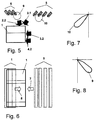
- FIG. 7 An exemplary light intensity distribution 10 of the lights 5, 6 is shown in Fig. 7, it can be seen that the lamp in their main beam direction obliquely on the surface the body is directed.
- the lights 5, 6 are preferably as linear luminaires with fluorescent lamps trained, but they can also be used as point lights or as a combination thereof his.
- the light distribution is 10 closely bundled, this narrowly bundled light distribution is provided in levels that are the second Direction of observation designated direction perpendicular included to the body.
- Fig. 2 shows the top view on the body 1 with the laterally arranged Lights 5 and the roof lights 6.
- the direction of lighting 7 is obliquely on the side of the body directed, the lighting direction 8 is at an angle the roof straightened.
- Fig. 7 Due to the light intensity distribution according to Fig. 7 is viewed vertically (second observation direction) a lighting structure in the work area not visible. This lighting structure could become visible when the direction of observation in Mirror angle of those hitting the body Radiation would be. This is shown by way of example in FIG. 3, in which, compared to Fig. 1, the lights 6 are arranged on the opposite side, so that they have a light distribution 9 corresponding Fig. 8 have.
- the direction of observation is 2.1 directed obliquely to the roof surface, creating the lighting structure the lights 6 as on the roof surface Luminance structure shown with light-dark edges can be seen. This allows topographical Surface defects can be detected.
- Fig. 9 are obliquely radiating lights, the one Have light intensity distribution 12 according to FIG. 10, arranged in the floor area, which in turn as Long-field lights or light strips are designed can.
- the light exit surfaces appear for the observer with line of sight 4.2 for sampling of non-topographical errors dark, i.e. a lighting structure is not visible, while from the viewing direction 4.1 a luminance structure is recognizable so that topographical errors can be found.
- Fig. 11 shows in section the body 1 with a Illumination geometry according to FIG. 1 in combination with Fig. 9, but now symmetrical on both Sides of the body 1.
- second viewing direction 2.2, 3.2, 4.2
- oblique viewing directions first Direction of observation
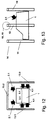
- Figs. 12 to 14 is another embodiment in section, in side view and in Shown top view, here especially lights for the first lighting component for detection of topographical errors are also shown can however also luminaires according to the Exemplary embodiments according to FIGS. 1 to 11 are provided be the second lighting component form and to match non-topographical Serve errors.
- the lamp arrangement according to FIGS. 12 to 14 has light strips, each in layers across are arranged to the longitudinal axis of the body 1 and themselves at a predetermined distance, for example Repeat 1 to 3 m.
- the Light strips are on a semi-tunnel-shaped frame 13, 14, 15, which is U-shaped in the exemplary embodiment is formed, but also arched or polygonal can be arranged.
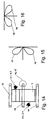
- the light strips in vertical Alignment 13.1, 13.3 have one in the 14 corresponding light intensity distribution 16, 17 accordingly Fig. 15 so that it faces the side the body 1 according to FIG. 14 after both Illuminate sides at an angle.
- the horizontal light strips according to 13.2 have a luminous intensity distribution 16 and illuminate the roof area 13 obliquely to both Pages.
- the body is made of Directions 2.1 and in the side area from the directions 3.1 and 4.1 obliquely to the surface of the body 1 observed (first observation direction).
- first observation direction In the light strips form in these directions vertical alignment 13.1 and 13.3 and horizontal Alignment 13.2 transverse to the longitudinal axis of the body on the shiny surface of the body from (first lighting component). This allows the topographical errors are observed.
- the light intensity distributions can also be one-sided, e.g. at the end of a transport route or an audit place. Appear from the opposite side the lights 13.1 and 13.3 dark, only under oblique insight are both in direct view as well as in the figure above the body surface the maxima of the light distribution 16 and 17 or 18 and 19 effective.
- Figs. 17 and 18 are further exemplary embodiments for arranging lights for the first Illumination component shown.
- 17 are Lights 20 and 21 for the first lighting component to detect topographical errors on the bottom Body side designed as light fields and lie across the longitudinal axis of the body.
- Out the oblique first observation direction 4.1 are the for example over the entire surface at least in directions on the body diffuse light fields trained lights as patterns and to recognize them afford because of the orientation of their light emitting Surfaces perpendicular to the side wall of the body only a small contribution to illuminance and therefore do not reduce contrast detection.
- the lights shown in plan view in FIG. 18 22, 23 for the first lighting component Detection of topographical errors on the lower side of the body are as e.g. all over at least in Diffuse beaming directions on the body
- Light strips in the floor parallel to the longitudinal axis of the body attached and their luminance structure can be recognized from the observation directions 4.1. As above, they perform because of the direction of their light-emitting surfaces perpendicular to the side wall the body only makes a small contribution to the illuminance, therefore they do not diminish the Contrast detection.
- the light strips 22 and 23 can also be interrupted.
- Figs. 19 and 20 is the body 1 in section and shown in side view.
- the viewing directions 2.1 can by the of the lights 24-27 presented stripes on the horizontal surfaces topographic errors are recognized.
- the light strips 24 and 25 or 26 and 27 lie one above the other and their light-emitting surfaces, those of the lights 22, 23 correspond to both vertically Sandblast below as well as horizontally to the side.
- 4.1 topographical errors can be seen here can be recognized in the lower part of the page.
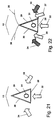
- Figs. 21 to 23 are special lights for the first lighting component, i.e. for generation represented by luminance structures, as in Embodiment according to FIGS. 12-14 used can be. These lights can be parallel or be aligned transversely to the longitudinal axis of the body.
- 21 is in front of an elongated Light source 31, which is designed as a fluorescent lamp an opaque screen 28 can be arranged, those in the direction of the normal 32 to the surface the body is aligned.
- On the bezel 28 is a hood 29, 30 put on, the two to each other has a tapered side surface 29, 30, which creates a triangular cross section for the lamp results.
- the top can also be flattened.
- the side surfaces are translucent and can be translucent or prismatic or the like.
- the body facing surface of the lamp 13 in the by the the side surfaces 29, 30 included angular range is opaque, it performs in this Towards no contribution to illuminance the area of the body to be patterned. Practical Experiments have shown that this is an essential one Improvement in contrast detection is achieved that is also sufficient for light-colored bodies.
- the Luminaire appears dimmed from direction 32 and from oblique lateral direction 33, 34 are the light-emitting surfaces 29, 30 visible. This be from the interior by the at least one Lamp 31 backlit. Because the light emitting Taper surfaces 30 and 29 Luminaire in the one specified by the side surfaces Angular area around the direction 32 dark. In particular this lamp is suitable to avoid errors to recognize particularly flat viewing angles. Close to the surface at steep observation angles in the direction 32, the surfaces 29 and 30 shorten and are only visible as narrow lines.
- the light emitting Side surfaces 29 and 30 dispensed with and the lamp 31 shielded by the aperture 39 is arranged directly behind the lamp 31 essentially V-shaped and curved reflectors 40 and 41 steered in the desired direction. While the reflectors are designed accordingly at angles 37 and 38, which in this case by the diaphragm edge is specified, still remain dark, they appear full at angles 33 and 34 illuminated.
- the reflectors can only be arranged on one side, as well 21 and 22 also only one light-emitting surface included.
Landscapes
- Physics & Mathematics (AREA)
- Health & Medical Sciences (AREA)
- Life Sciences & Earth Sciences (AREA)
- Chemical & Material Sciences (AREA)
- Analytical Chemistry (AREA)
- Biochemistry (AREA)
- General Health & Medical Sciences (AREA)
- General Physics & Mathematics (AREA)
- Immunology (AREA)
- Pathology (AREA)
- Non-Portable Lighting Devices Or Systems Thereof (AREA)
- Investigating Materials By The Use Of Optical Means Adapted For Particular Applications (AREA)
Applications Claiming Priority (2)
| Application Number | Priority Date | Filing Date | Title |
|---|---|---|---|
| DE1998139882 DE19839882C2 (de) | 1998-09-02 | 1998-09-02 | Beleuchtungsanlage zur Abmusterung von Oberflächenfehlern an lackierten Automobilkarosserien |
| DE19839882 | 1998-09-02 |
Publications (2)
| Publication Number | Publication Date |
|---|---|
| EP0984271A2 true EP0984271A2 (fr) | 2000-03-08 |
| EP0984271A3 EP0984271A3 (fr) | 2000-05-10 |
Family
ID=7879486
Family Applications (1)
| Application Number | Title | Priority Date | Filing Date |
|---|---|---|---|
| EP99250304A Withdrawn EP0984271A3 (fr) | 1998-09-02 | 1999-09-01 | Appareil d'éclairage pour l'observation de défauts de surface sur des surfaces brilliantes, en particulier sur des carrosseries peintes de voitures automobiles |
Country Status (2)
| Country | Link |
|---|---|
| EP (1) | EP0984271A3 (fr) |
| DE (1) | DE19839882C2 (fr) |
Cited By (1)
| Publication number | Priority date | Publication date | Assignee | Title |
|---|---|---|---|---|
| CN112147153A (zh) * | 2020-10-28 | 2020-12-29 | 江苏善果缘智能科技有限公司 | 一种用于产品表面疵点检测的led照明光源构建方法 |
Families Citing this family (6)
| Publication number | Priority date | Publication date | Assignee | Title |
|---|---|---|---|---|
| DE10122313A1 (de) * | 2001-05-08 | 2002-11-21 | Wolfgang P Weinhold | Verfahren und Vorrichtung zur berührungsfreien Untersuchung eines Gegenstandes, insbesondere hinsichtlich dessen Oberflächengestalt |
| DE10163960A1 (de) * | 2001-12-23 | 2003-07-03 | Der Kluth Decke Und Licht Gmbh | Beleuchtungsvorrichtung für die Qualitätskontrolle |
| DE10242620B3 (de) | 2002-09-13 | 2004-04-15 | Dr.Ing.H.C. F. Porsche Ag | Verfahren und Vorrichtung zum visuellen Erkennen von Farbglanzabweichungen |
| DE10261865A1 (de) * | 2002-12-20 | 2004-07-15 | Uwe Braun Sonnenlichtleitsysteme Lichtsysteme Gmbh | Verfahren, Vorrichtung und Computerprogramm zur optischen Oberflächenerfassung |
| DE102005031490A1 (de) * | 2005-07-04 | 2007-02-01 | Massen Machine Vision Systems Gmbh | Kostengünstige multi-sensorielle Oberflächeninspektion |
| GB2578807B (en) | 2019-08-09 | 2020-12-16 | Degould Ltd | Vehicle imaging station |
Family Cites Families (8)
| Publication number | Priority date | Publication date | Assignee | Title |
|---|---|---|---|---|
| DE3418317C1 (de) * | 1984-05-17 | 1985-01-31 | Daimler-Benz Ag, 7000 Stuttgart | Prüfraum zur Überprüfung der Oberfläche von Fahrzeugkarosserien |
| DE3613137C1 (en) * | 1986-04-18 | 1987-11-05 | Daimler Benz Ag | Test room for checking the glossy (lustrous) surface of vehicle bodies for defects |
| DE4041166C2 (de) * | 1990-12-21 | 1995-09-07 | Licentia Gmbh | Prüfraum zur visuellen Qualitätskontrolle hochglänzender Oberflächen |
| JPH08184567A (ja) * | 1994-10-05 | 1996-07-16 | Musco Corp | 鏡面反射性又は半鏡面反射性表面を点検するための装置及び方法 |
| DE19519777A1 (de) * | 1995-05-30 | 1996-12-12 | Siemens Ag | Oberflächenkontrolleuchte |
| JP2976869B2 (ja) * | 1995-12-28 | 1999-11-10 | 日産自動車株式会社 | 表面欠陥検査装置 |
| US5686987A (en) * | 1995-12-29 | 1997-11-11 | Orfield Associates, Inc. | Methods for assessing visual tasks to establish desirable lighting and viewing conditions for performance of tasks; apparatus; and, applications |
| DE29724018U1 (de) * | 1996-08-22 | 1999-09-02 | Dr.-Ing. Willing GmbH, 96110 Scheßlitz | Vorrichtung zur visuellen Inspektion der Oberflächenbeschaffenheit von Abmusterungsflächen größerer Abmessung |
-
1998
- 1998-09-02 DE DE1998139882 patent/DE19839882C2/de not_active Expired - Fee Related
-
1999
- 1999-09-01 EP EP99250304A patent/EP0984271A3/fr not_active Withdrawn
Non-Patent Citations (1)
| Title |
|---|
| None |
Cited By (1)
| Publication number | Priority date | Publication date | Assignee | Title |
|---|---|---|---|---|
| CN112147153A (zh) * | 2020-10-28 | 2020-12-29 | 江苏善果缘智能科技有限公司 | 一种用于产品表面疵点检测的led照明光源构建方法 |
Also Published As
| Publication number | Publication date |
|---|---|
| DE19839882C2 (de) | 2001-03-08 |
| EP0984271A3 (fr) | 2000-05-10 |
| DE19839882A1 (de) | 2000-04-06 |
Similar Documents
| Publication | Publication Date | Title |
|---|---|---|
| EP1378771B1 (fr) | Eclairage intérieur | |
| DE69200494T2 (de) | Leuchte zum Schaffen eines Hauptbündels und eines Teilbündels. | |
| EP1043542B1 (fr) | Système d' éclairage pour installation au plafond ou au mur d' une pièce | |
| DE10311072B4 (de) | Fahrzeugleuchte mit LED-Lichtquellen | |
| DE10006410A1 (de) | Leuchte | |
| EP1205352A2 (fr) | Dispositif d'éclairage | |
| EP0920616B1 (fr) | Dispositif d'inspection visuelle de la structure superficielle de surfaces d'echantillonnage de dimensions importantes | |
| DE102004002251A1 (de) | Leuchte mit verschiedenfarbigen Lichtquellen sowie einer Lichtleiterplatte zum Abgeben von Mischlicht | |
| EP3207308B1 (fr) | Wallwasher | |
| DE29909282U1 (de) | Leuchte | |
| EP1338845A2 (fr) | Luminaire | |
| DE19839882C2 (de) | Beleuchtungsanlage zur Abmusterung von Oberflächenfehlern an lackierten Automobilkarosserien | |
| DE20317444U1 (de) | Beleuchtungsvorrichtung, insbesondere für Straßen, Wege, Plätze o.dgl. | |
| DE10011378B4 (de) | Hohllichtleiterleuchte mit indirekter Lichtabstrahlung | |
| DE602004005872T2 (de) | Beleuchtung und methode zur beleuchtung | |
| DE102014215481A1 (de) | Leuchte für eine Arbeitsumgebung, insbesondere zum Prüfen der Oberfläche von Werkstücken | |
| DE102011080247B4 (de) | Leuchte mit einer Reflektorvorrichtung | |
| DE1275493B (de) | Strassenleuchte | |
| EP0947827A1 (fr) | Dispositif pour l'inspection visuelle de surfaces de corps situées dans des plans différents | |
| EP0516976A2 (fr) | Balise lumineuse | |
| DE4041166A1 (de) | Beleuchtungsanlage zur visuellen qualitaetskontrolle hochglaenzender oberflaechen | |
| DE10231531B4 (de) | Schutzrohrleuchte | |
| AT507160B1 (de) | Längliche beleuchtungsanordnung mit gleichmässiger lichtabgabe | |
| EP4168711B1 (fr) | Ensemble d'émission de lumière, et luminaire | |
| DE3515827A1 (de) | Diffus strahlende beleuchtungsquelle |
Legal Events
| Date | Code | Title | Description |
|---|---|---|---|
| PUAI | Public reference made under article 153(3) epc to a published international application that has entered the european phase |
Free format text: ORIGINAL CODE: 0009012 |
|
| AK | Designated contracting states |
Kind code of ref document: A2 Designated state(s): AT BE CH CY DE DK ES FI FR GB GR IE IT LI LU MC NL PT SE |
|
| AX | Request for extension of the european patent |
Free format text: AL;LT;LV;MK;RO;SI |
|
| PUAL | Search report despatched |
Free format text: ORIGINAL CODE: 0009013 |
|
| AK | Designated contracting states |
Kind code of ref document: A3 Designated state(s): AT BE CH CY DE DK ES FI FR GB GR IE IT LI LU MC NL PT SE |
|
| AX | Request for extension of the european patent |
Free format text: AL;LT;LV;MK;RO;SI |
|
| RIC1 | Information provided on ipc code assigned before grant |
Free format text: 7G 01N 21/88 A, 7F 21V 7/00 B |
|
| 17P | Request for examination filed |
Effective date: 20001020 |
|
| AKX | Designation fees paid |
Free format text: AT BE CH CY DE DK ES FI FR GB GR IE IT LI LU MC NL PT SE |
|
| RAP1 | Party data changed (applicant data changed or rights of an application transferred) |
Owner name: FORCHHEIM & WILLING GMBH |
|
| 17Q | First examination report despatched |
Effective date: 20040308 |
|
| STAA | Information on the status of an ep patent application or granted ep patent |
Free format text: STATUS: THE APPLICATION IS DEEMED TO BE WITHDRAWN |
|
| 18D | Application deemed to be withdrawn |
Effective date: 20040720 |