EP0984651B1 - Verfahren and Vorrichtung zur Nachrichtenübertragung in einem Netzwerk - Google Patents
Verfahren and Vorrichtung zur Nachrichtenübertragung in einem Netzwerk Download PDFInfo
- Publication number
- EP0984651B1 EP0984651B1 EP99401641A EP99401641A EP0984651B1 EP 0984651 B1 EP0984651 B1 EP 0984651B1 EP 99401641 A EP99401641 A EP 99401641A EP 99401641 A EP99401641 A EP 99401641A EP 0984651 B1 EP0984651 B1 EP 0984651B1
- Authority
- EP
- European Patent Office
- Prior art keywords
- base station
- station
- mode
- functioning
- mobile station
- Prior art date
- Legal status (The legal status is an assumption and is not a legal conclusion. Google has not performed a legal analysis and makes no representation as to the accuracy of the status listed.)
- Expired - Lifetime
Links
- 238000004891 communication Methods 0.000 title claims abstract description 156
- 238000000034 method Methods 0.000 title claims abstract description 57
- 230000008859 change Effects 0.000 claims description 23
- 238000012545 processing Methods 0.000 claims description 6
- 238000004590 computer program Methods 0.000 claims description 5
- 238000012360 testing method Methods 0.000 description 146
- 238000010586 diagram Methods 0.000 description 12
- 230000006870 function Effects 0.000 description 8
- 230000005540 biological transmission Effects 0.000 description 7
- 230000000694 effects Effects 0.000 description 7
- 238000012546 transfer Methods 0.000 description 7
- 230000003247 decreasing effect Effects 0.000 description 4
- 230000009977 dual effect Effects 0.000 description 2
- 238000003780 insertion Methods 0.000 description 2
- 230000037431 insertion Effects 0.000 description 2
- 230000008569 process Effects 0.000 description 2
- 230000001360 synchronised effect Effects 0.000 description 2
- 101000771640 Homo sapiens WD repeat and coiled-coil-containing protein Proteins 0.000 description 1
- 102100029476 WD repeat and coiled-coil-containing protein Human genes 0.000 description 1
- 230000015556 catabolic process Effects 0.000 description 1
- 230000001413 cellular effect Effects 0.000 description 1
- 238000001514 detection method Methods 0.000 description 1
- 230000000977 initiatory effect Effects 0.000 description 1
- 238000012423 maintenance Methods 0.000 description 1
- 238000005259 measurement Methods 0.000 description 1
- 238000013508 migration Methods 0.000 description 1
- 230000005012 migration Effects 0.000 description 1
- 238000010295 mobile communication Methods 0.000 description 1
- 238000001228 spectrum Methods 0.000 description 1
- 230000003068 static effect Effects 0.000 description 1
- 239000000725 suspension Substances 0.000 description 1
Images










Classifications
-
- H—ELECTRICITY
- H04—ELECTRIC COMMUNICATION TECHNIQUE
- H04W—WIRELESS COMMUNICATION NETWORKS
- H04W84/00—Network topologies
- H04W84/18—Self-organising networks, e.g. ad-hoc networks or sensor networks
- H04W84/20—Leader-follower arrangements
-
- H—ELECTRICITY
- H04—ELECTRIC COMMUNICATION TECHNIQUE
- H04L—TRANSMISSION OF DIGITAL INFORMATION, e.g. TELEGRAPHIC COMMUNICATION
- H04L9/00—Cryptographic mechanisms or cryptographic arrangements for secret or secure communications; Network security protocols
- H04L9/40—Network security protocols
-
- H—ELECTRICITY
- H04—ELECTRIC COMMUNICATION TECHNIQUE
- H04W—WIRELESS COMMUNICATION NETWORKS
- H04W12/00—Security arrangements; Authentication; Protecting privacy or anonymity
- H04W12/03—Protecting confidentiality, e.g. by encryption
-
- H—ELECTRICITY
- H04—ELECTRIC COMMUNICATION TECHNIQUE
- H04W—WIRELESS COMMUNICATION NETWORKS
- H04W12/00—Security arrangements; Authentication; Protecting privacy or anonymity
- H04W12/50—Secure pairing of devices
-
- H—ELECTRICITY
- H04—ELECTRIC COMMUNICATION TECHNIQUE
- H04M—TELEPHONIC COMMUNICATION
- H04M2250/00—Details of telephonic subscriber devices
- H04M2250/08—Details of telephonic subscriber devices home cordless telephone systems using the DECT standard
-
- H—ELECTRICITY
- H04—ELECTRIC COMMUNICATION TECHNIQUE
- H04W—WIRELESS COMMUNICATION NETWORKS
- H04W40/00—Communication routing or communication path finding
- H04W40/24—Connectivity information management, e.g. connectivity discovery or connectivity update
- H04W40/246—Connectivity information discovery
-
- H—ELECTRICITY
- H04—ELECTRIC COMMUNICATION TECHNIQUE
- H04W—WIRELESS COMMUNICATION NETWORKS
- H04W88/00—Devices specially adapted for wireless communication networks, e.g. terminals, base stations or access point devices
-
- H—ELECTRICITY
- H04—ELECTRIC COMMUNICATION TECHNIQUE
- H04W—WIRELESS COMMUNICATION NETWORKS
- H04W88/00—Devices specially adapted for wireless communication networks, e.g. terminals, base stations or access point devices
- H04W88/02—Terminal devices
-
- H—ELECTRICITY
- H04—ELECTRIC COMMUNICATION TECHNIQUE
- H04W—WIRELESS COMMUNICATION NETWORKS
- H04W88/00—Devices specially adapted for wireless communication networks, e.g. terminals, base stations or access point devices
- H04W88/08—Access point devices
Definitions
- the present invention concerns a method and device for communicating on a network. It applies in particular to local wireless networks with centralised architecture, for which each communication is organised between a so-called base communication station, also referred to as the "fixed part”, and a mobile communication station, also referred to as the "portable part”.
- base communication station also referred to as the "fixed part”
- mobile communication station also referred to as the "portable part”.
- a base station supplies a synchronisation signal to all the mobile stations in the network.
- the set of stations (the base station and one or more mobile stations) which thus synchronise themselves with each other, constitutes a cell.
- the document US-A-5 598 407 is known, which describes a local wireless network using the European DECT standard.
- the network consists there of a fixed base station and mobile stations. In the absence of a central station, no communication is possible between the mobile stations present in the network.
- the document US-A-5 551 066 is also known, which describes a local wireless network in which the master node can be changed dynamically.
- Document US-A-4 935 927 discloses a wireless digital telephone system containing at least one emulated base station plus one or more subscriber stations, the emulated base station comprising a station similar to the subscriber station but having the capability of initiating a synchronization process.
- Document EP-A- 0 798 909 discloses a wireless telephone having a base station and a mobile element.
- Document DE-A-196 45 731 disdoses a method for searching a base station.
- Document US-A-5 040 205 discloses a multi-channel cordless telephone system with a plurality of handset units and base units.
- Document WO-A-96 03823 discloses a hierarchical communication system providing intelligent data, program and processing migration.
- Document EP-A-0 766 415 discloses a mobile radio communication device with synchronization and maintenance control means.
- Document EP-A-0 462 782 discloses a receiver for a cellular mobile radio communication system.
- Document EP-A-0 260 763 discloses a mobile radio transmission system comprising a plurality of base stations.
- Document EP-A-0 711 057 discloses a cordless telephone arranged for operating with multiple portable units in a frequency hopping system.
- Document US-A-5 606 560 discloses a method and apparatus increasing spectrum efficiency in a wireless communication system having base stations which may be positioned to operate within range of one another.
- the present invention aims to remedy the above-mentioned drawback by enabling a mobile station, in the absence of a base station, to fulfil the role of base station.
- a network can be established even in the absence of a permanent base station.
- Another aim of the invention is to make it possible to establish a local wireless network dynamically in the absence of a base station.
- the present invention relates, according to a first aspect, to a method of communicating between communication stations adapted to communicate with each other when at least one of said communication stations supplies a control signal, said station then functioning in "base station” mode and the stations not supplying a control signal then functioning in "mobile station” mode, characterised in that it includes, performed by at least one communication station initially functioning in base station mode:
- this station can take the role of base station in order to determine whether at least one communication station functioning in mobile station mode is in a position to communicate with it.
- said communication station performs:
- the said station performs a waiting operation, during which it does not change functioning mode.
- said station adopts successively the role of base station and of mobile station, which enables it to enter into contact with any communication station, whether the latter is functioning in mobile station mode or in base station mode.
- the present invention relates to a device for communicating between communication stations adapted to communicate with each other when at least one of the said communication stations supplies a control signal, said station then functioning in "base station” mode and the stations not supplying a control signal then functioning in "mobile station” mode, characterised in that it has, in at least one communication station functioning initially in base station mode, a processing means adapted:
- the invention also relates to a network, a computer, a camera, a facsimile machine, a photographic apparatus, a television receiver, a printer, a scanner and an audio/video player, characterised in that they have a device as briefly disclosed above.
- the invention also relates to:
- the term “communication device” designates part of a communication station allowing it to behave, in a communication network, as a base station or as a mobile station, in accordance, on the one hand, with the DECT standard and, on the other hand, with the different operating modes described with reference to the accompanying drawings.
- the term “communication device” designates the whole communication station which includes it.
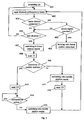
- Figure 1 describes the procedure of locking a mobile station onto a signal transmitted by a base station, as known in the prior art.
- a mobile station When a mobile station is powered up, it goes into an internal initialisation state 101. Next, during an operation 102, the mobile station goes into reception mode on the next channel (there are ten of them) in the frequency band allocated for communications in accordance with the DECT standard (that is to say 1880 to 1900 MHz), seeking a signal transmitted by a base station which is suitable to it.
- operation 102 When operation 102 is first iterated, it is the first channel which is chosen. When, before performing operation 102, the last channel is considered, it is the first channel which is chosen, during operation 102.
- the mobile station listens out on the radio channel under consideration, for a predetermined period, in order to detect a synchronisation pulse coming from a base station.
- the mobile station thus determines whether or not a base station is using the channel under consideration for sending a synchronisation signal.
- test 103 When the result of test 103 is negative, during a test 104, the mobile station determines whether or not the channel under consideration is the last one. When the result of test 104 is negative, operation 102 is reiterated. When the result of test 104 is positive, during an operation 105, the mobile station goes into standby mode and then, during an operation 107, it waits for a predetermined period T0 (which can be a decreasing function of the energy resources of the mobile station), before reiterating operation 102.
- T0 which can be a decreasing function of the energy resources of the mobile station
- the mobile station determines whether or not it has a right of access to the base station which sends the synchronisation signal.
- the mobile station can obtain the information broadcast by the base station, every multi-frame (each multi-frame being composed of sixteen frames with a duration of ten milliseconds).
- the information broadcast by the base station there is notably the so-called "ARI” parameter (initials of the words “Access Rights Identity”) which defines the access rights to the base station under consideration.
- ARI initials of the words "Access Rights Identity”
- Each mobile station having at least one identity referred to as "PARK” (initials of the words "Portable Access Rights Key”), it is the correspondence between at least one of the "PARK” identities and the "ARI" parameter which is tested during test 108.
- test 104 is performed.
- the mobile station locks onto the base station which is sending the synchronisation signal detected on the channel under consideration.
- the mobile station can obtain the information broadcast by the base station whose ARI parameter corresponds with at least one of its "PARK" identities.
- the mobile station can then initiate or accept a connection by means of the base station onto which the mobile station is locked.
- the mobile station can then communicate with the other mobile stations which are also locked onto the same base station and with the base station itself, in particular when the latter supplies an access point to another network, for example by telephone.
- FIG. 2 depicts, in one and the same local area 200, different communication devices in accordance with the present invention:
- the communication devices 201, 204 and 205 support the DECT GAP standard, and comply with the type "A" data profile, relating to data transfers up to a rate of 24 kilobits per second.
- the communication device 201 also complies with the type "AB" data profile, relating to the transfer of data up to a rate of 552 kilobits per second, but can switch into base station mode only following a manual operation by the user.
- Each device according to the present invention, 201, 204 and 205 operates, by default, in accordance with the description of Figure 1, that is to say, at the time of initialisation, it goes into mobile station functioning mode.
- each communication device according to the present invention 201, 204 or 205, has, connected together by a bus 301:
- the controllers 306 and 309 and the DECT base band unit 302 consist in fact of a processor and an operating program stored in the read-only memory 305.
- the DECT base band unit 302 is of a known type and is adapted to exploit all the capabilities of the DECT standard known up to the time of the present invention.
- the controller 306 is adapted to implement the method of the invention and in particular the flow diagrams illustrated in the figures.
- the energy level controller 309 is intended to evaluate the available energy level, in a known fashion, in order to determine timing values (see below).
- the random access memory 304 stores, in registers which, for convenience, each bear the same name as the data which they contain:
- the read-only memory 305 stores, in registers which, for convenience, each bear the same name as the data which they contain:
- the read-only memory 305 constitutes a means of storing information which can be read by a computer or a microprocessor, storing instructions of a computer program characterised in that it implements the method of the invention.
- the read-only memory 305 is removable, partially or totally, and has for example a magnetic strip, a flash memory, a diskette or a fixed-memory compact disc (CD-ROM).
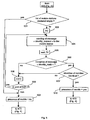
- the communication device listens to the radio channel under consideration, for a predetermined period, in order to detect a synchronisation pulse coming from a base station (including the case of another communication device behaving as a base station). The communication device thus determines whether or not a base station is using the channel under consideration for sending a synchronisation signal.
- test 403 When the result of test 403 is negative, during a test 404, the communication device determines whether or not the channel under consideration is the last. When the result of test 404 is negative, operation 402 is reiterated.
- test 403 determines whether or not it has a right of access to the base station which is sending the synchronisation signal, as described with regard to operation 108 ( Figure 1).
- test 405 When the result of test 405 is negative, the communication device performs test 404. When the result of test 405 is positive, during an operation 406, identical to operation 109 ( Figure 1), the communication device locks onto the base station which is sending the synchronisation signal detected on the channel under consideration.
- the communication device can obtain the information broadcast by the base station whose ARI parameter corresponds with at least one of its "PARK" identities.
- the communication device can also initiate or accept a connection by means of the base station onto which the device is locked.
- the communication device can then communicate on the one hand with the other mobile stations and the communication devices according to the present invention which behave as a mobile station, and which are also locked onto the same base station, and on the other hand with the base station itself or with the communication device which is behaving as a base station.
- the controller 306 of the communication device causes this communication device to switch into base station mode.
- this base station functioning mode it sends, at regular time slots, with a duration less than the predetermined duration of test 403, a synchronisation signal, on one of the DECT channels.
- the duration of the regular time slot is, according to the DECT standard, 160 milliseconds.
- the communication device allows a time T1 to pass (for example one minute), operation 408, whilst continuing its functioning as a base station, before performing a test 409, during which it determines whether mobile stations are synchronised with it (see detail of test 409 in Figure 5).
- the controller 306 causes the functioning mode to switch into mobile station mode, and then the communication device allows a predetermined time T2 to pass (for example as a decreasing function of the available energy evaluated by the energy level controller 309), operation 412, before renewing operation 402.
- the communication device When the result of test 409 is positive, during an operation 413, the communication device allows a predetermined time T3 to pass (for example as an increasing function of the available energy evaluated by the energy level controller 309), whilst continuing its functioning in base station mode, before performing a test 414, during which the communication device determines whether or not at least one communication with a mobile station is active.
- a test 414 during which the communication device determines whether or not at least one communication with a mobile station is active.
- the controller 306 causes the communication device to switch from base station mode to mobile station mode.
- the communication device reiterates operation 402.
- the communication device when, in base station functioning mode, the communication device does not detect any communication with a mobile station, it goes into mobile station functioning mode.
- the purpose of the latter arrangements is to cause the base station to return to mobile station mode before once again seeking whether another base station can be detected.
- each communication device able to function in base station mode is informed of the identity of each communication device and of each mobile station able to communicate with it.
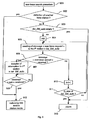
- the communication device first of all performs a test 501 ( Figure 5), during which the controller 306 determines whether or not the list of mobile stations able to communicate with the communication device is empty.
- a test 501 Figure 5
- the controller 306 determines whether or not the list of mobile stations able to communicate with the communication device is empty.
- the result of test 501 is positive
- the result of test 409 is negative
- operation 502. When the result of test 501 is negative, during an operation 503, a temporary variable l , which serves as an indicator on said list, is initialised to the value "0".
- the communication device sends, to the network, a message requesting an answer to the device identified by the l th identifier of the list.
- the communication device allows a predetermined time T4 to pass, operation 505, before performing a test 506, during which it determines whether or not an answer message has been sent by a communication device.
- the device determines whether the identity of the device which sent the answer message corresponds to the identity of the device which was called during operation 504.
- the result of test 507 is positive, the result of test 409 is positive, operation 510.
- the result of test 507 is negative, or when the result of test 506 is negative, during an operation 508, the value of the variable I is incremented.
- the communication device determines whether or not the value of the variable I is less than or equal to the size of the list.
- operation 504 is reiterated.
- the result of test 509 is negative, the result of test 409 is negative, operation 502.
- the following procedure is used: when a mobile station detects a base station and locks onto this base station, the mobile station sends to the base station a message representing its identity and its capabilities (see below). The base station can then update a list of mobiles present in the cell. Conversely, when a mobile station leaves the cell (that is to say the area of coverage of the base station) or before switching off, it sends to the base station a message indicating that it is terminating its access rights.
- Figure 6 depicts the structure of information concerning the operational mode capability of a station in the network.
- This information can be transmitted in DECT protocol messages using a field reserved for the transfer of non-standardised information, referred to in the standard as "escape-to-proprietary".
- non-standardised information is used solely in the following messages in the standard:
- the first octet 601 of the field described in Figure 6 indicates that the information elements which follow are non-standardised information to be sent within a DECT protocol message.
- the second octet 602 contains the information octet number to be transmitted.
- the third octet 603 indicates that the octets 604 and 605 contain an EMC ("Equipment Manufacturer Code") parameter, which serves to identify the manufacturer using this proprietary information.
- EMC Equipment Manufacturer Code
- Octet 606 represents the operational capability CO (identical to its value, in the embodiment described and depicted) of the device which acts as a mobile station.
- the position bit 8 (on the left) of the information octets 607 to 610 takes one of the values:
- Figure 7 describes how a mobile station obtains rights of access to a base station and how it terminates its rights of access.
- the access rights procedure enables a base station and a mobile station to exchange their respective identities and information concerning the capabilities of the mobile station.
- the mobile station initiates the procedure by sending, to the base station, a message "access_rights_request” which contains notably the capabilities of the mobile station in the field "terminal capability".
- profile indicator profile indicator
- slot type parameter slot type capability
- a base station When a base station receives a message " access_rights_request”, if the mobile station is authorised to access the resources of the base station, the latter returns a message “access_rights_accept”, and adds, in the table of the declared mobile stations, the information concerning the mobile station which sent the message "access_rights_request”.
- the parameters IP and TS are read in the field “Terminal Capability" of the message “access_rights_request”, whilst the parameters CO , CM, RM, CP and DM are read in the field “escape to proprietary” described in Figure 6.
- a mobile station wishes to terminate its access rights to a base station, it sends a message 803 " access _ rights_terminate_request”.
- the base station then erases the information concerning this mobile station in its table_SM and returns a message "access_nights_terminate_accept” 804. The mobile station can then no longer use the resources of the base station.
- Figure 8A illustrates how a mobile station attaches itself to or detaches itself from a base station.
- a mobile station When a mobile station enters the cell of a base station over which the mobile station has obtained access rights, it must initiate a procedure of attachment to the base station. By this procedure, the mobile station indicates to the base station that it is ready to receive calls.
- the mobile station sends to the base station a message "Locate_request” 811 which contains information concerning notably the identity and capabilities of the communication station and the possibility of sending non-standardised information. With the message “Locate_request” 811, it is possible to transfer to the base station the same information as with the message "access_rights_request". If a mobile station has important changes to its parameters (for example memory space still available) compared with the time of the access right procedure, it can use the field "escape to proprietary" as defined in Figure 6, to inform the base station thereof.
- a base station When a base station receives a message "Locate_request” 811, it verifies that the mobile station is identified in its “table_SM” and, in the affirmative, returns a message “Locate_accept” 812. The base station then uses the information contained in its "table_SM", the table of the declared mobile stations, in order to insert the mobile station under consideration in the appropriate list, List_SM_auto, if its operational capability CO is equal to SB / SM_auto, List _ SM_manual if its operational capability CO is equal to SB / SM_manual or List_SM_direct if its operational capability is equal to SM / SM_direct.
- the reverse procedure to attachment is detachment.
- a mobile station leaves the cell or is switched off, it sends a message "detach" 813 to the base station, which then withdraws the mobile station from the list corresponding to its operational capability.
- the base station then periodically sends a request for a procedure of updating its location (or its attachment), by means of a message "MM_info_suggest” 821, whose field “info_type” is equal to "locate_suggest”.
- the procedure of updating the location of a mobile station is identical to the attachment procedure, the messages 822 and 823 being respectively identical to the messages 811 and 812.
- the list list_SM_auto contains all the mobile stations present in the cell and having the capability of switching automatically between base station mode and mobile station mode.
- the lisf_SM_auto is classified according to the decreasing capability of the mobile stations of becoming a base station: the first element in the list concerns the mobile station which has the best capability of becoming a base station.
- the base station takes into account all the parameters stored in the table_SM_auto (CM, RM, CP, IP, TS, DM, ... according to the first and second aspects of the invention; CM, RM, CP, IP, TS, DM, CF, CE, IR, ... according to the third to sixth aspects of the invention).
- the list_SM_manual is sorted in the same way as the list _ SM _ auto. These lists can be used in the following situations:
- the base station then chooses the first mobile station in the list_SM_auto. If the list_SM_auto is empty, or if none of the stations in the list list_SM_auto is suitable, the base station can have recourse to the first mobile station represented in the list_SM_manual. It must then transmit a message which triggers the display or sending of a signal to the mobile station chosen in order to warn the user that a change of functioning mode at the mobile station under consideration is required.
- the base station uses the list_SM_direct so that the communications internal to the cell each involving at least one station represented in this list are directly organised by this station.
- Figures 9 and 10 illustrate how a base station in activity (referred to as “initial”) finds a replacement base station (referred to as “final”), for example when the initial base station can no longer fulfil its role as base station (switching off or automatic or manual switching to mobile station mode).
- the initial base station commences with a test 902 during which it determines whether or not another base station is present (as illustrated in Figure 1).
- the procedure is complete, with success, since the mobile stations which communicate with the initial base station will be able to replace the latter for their communications and the initial base station changes functioning mode and becomes a mobile station, operation 912.
- the initial base station determines whether or not the list_SM_auto is empty.
- the procedure is ended, having failed, since no mobile station can take the role of base station. The user is then informed that, if the base station ceases its activity, all the communications will be suspended, operation 913.
- variable I is initialised to the value "0".
- the initial base station sends a message "new_base_request" to the l th mobile station in the list_SM_auto.
- the initial base station waits for a sufficient period of time to enable a mobile station in accordance with the device which is the object of the present invention to reply, before performing a test 906.
- the initial base station determines whether or not it has received, from the mobile station under consideration, a message "new_base_accept”.
- the initial base station determines whether or not it has received, from the mobile station under consideration, a data transfer acknowledgement message.
- the result of test 908 is negative, it is reiterated.
- the initial base station changes operating mode, operation 912, and the base station change operation is ended, on the initial base station side, with success.
- the initial base station When the result of test 906 is negative, the initial base station considers that the allocation of the base station role has been refused by the l th station in the list list_SM_auto. Then, during an operation 910, the value of the variable l is incremented by 1. Then, during a test 911, the initial base station determines whether or not the value of the variable I is greater than or equal to the number of mobile stations represented in the list_SM_auto.
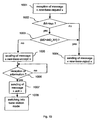
- Figure 10 illustrates the procedure of changing base station on the part of a mobile station, when, during a test 1001, it determines that a message "new_base_request” has been received from the base station and is intended for the mobile station under consideration.
- the mobile station determines whether or not its operating capability CO has one of the values SB / SM_auto or SB / SM_manual, determining whether or not the value of the information "BA" is "true”.
- a message "new_base_reject” is sent by the mobile station under consideration to the base station in order to indicate to it that the allocation of the base station role has been refused. Then the procedure is ended, without the mobile station having switched into base station functioning mode.
- the mobile station determines whether its available memory capacity MD is strictly less than the value MD_N1 stored in the read-only memory 305.
- This value MD _ N1 corresponds in fact to a minimum available memory capacity for taking the base station role.
- operation 1004 When the result of test 1003 is positive, operation 1004 is performed.
- the mobile station sends a message accepting the role of base station "new_base_accept", to the initial base station. Then, during a test 1006, the mobile station determines whether it has received, from the initial base station, the necessary information for taking the base station role, that is to say all the information stored in the lists list_SM_auto, list_SM_manual and list_SM_direct, and in the table table_SM.
- test 1006 When the result of test 1006 is negative, it is reiterated.
- the mobile station sends, to the base station, an acknowledgement of receipt of the information. Then, during an operation 1008, the mobile station changes functioning mode and becomes a base station. The procedure is then ended.
- test 1003 is supplemented by:
- the initial base station uses static criteria, that is to say which do not immediately change value according to the change in the network or mobile stations, in order to choose a replacement base station, whilst the mobile station envisaged as the future base station can accept or refuse the role of new base station, using dynamic criteria, that is to say taking into account immediately any change in the state of the mobile station which would prevent its activity as a base station.
- Figures 11 and 12 illustrate how, at the initiative of a station which is initially a mobile station, a change in base station can be effected. For example, when such a mobile station has locked onto the initial base station, following its being powered up, and when this mobile station is a candidate for being a base station (for example because it supports all the variants and the most extensive modes of the DECT standard), a test 1101 is positive. Otherwise, this procedure is ended. When the result of test 1101 is positive, during an operation 1102, the mobile station listens to the channel known, in the DECT standard, under the name of " Q ". On this channel, in fact, the initial base station regularly broadcasts information which may be useful to mobile stations and, in particular, information concerning the DECT profiles which it supports.
- the mobile station determines whether or not it has better capabilities of being a base station than the initial base station. When the result of test 1103 is negative, the procedure is ended. When the result of test 1103 is positive, during an operation 1104, the mobile station sends a message "chg_base_request", which means change in base required, to the initial base station, and then allows a sufficient period to pass for the base station to be able, if it is in accordance with the communication device of the present invention, to send a message in answer.
- chg_base_request which means change in base required
- the mobile station determines whether or not it has received, in return, from the base station, a message "chg_base_accept", which means acceptance of change in base.
- chg_base_accept means acceptance of change in base.
- the initial base station When the result of test 1202 is negative, during an operation 1203, the initial base station sends, to the mobile station under consideration, a message "chg_base_reject”. Then the procedure is ended.
- the result of test 1202 is positive, during an operation 1204, the initial base station sends, to the mobile station under consideration, a message "chg_base_accept”. Then, during a test 1205, the initial base station determines whether or not there is an active connection.
- test 1205 When the result of test 1205 is positive, it is reiterated. When the result of test 1205 is negative, during an operation 1206, the base station sends, to the mobile station under consideration, the information stored in the table table_SM, and in the lists list_SM_auto, list_SM_manual and list _ SM _ direct.
- the initial base station determines whether or not it has received, from the mobile station under consideration, a message acknowledging the data transfer. When the result of test 1207 is negative, it is reiterated. When the result of test 1207 is positive, during an operation 1208, the initial base station changes operating mode and starts to function in mobile station mode, and the operation of changing base station is ended with success.
- the base station In order to collect information concerning the capability of the mobile stations present in the network of operating in base station mode, the base station according to the present invention uses a message of the broadcast type illustrated in Figure 14A. The base station thus interrogates all the mobile stations in order to obtain the following information:
- a first type of message 1401 is a request from the base station broadcast to all the mobile stations, which includes the following fields:
- the type field 1403 CT and length field 1404 CL can take different values, making it possible to specify to the different mobile stations how to respond to the request and according to which criteria, the latter being specified by the fields 1405 to 1406.
- each mobile station When the information transmitted in the field 1403 CT is equal to "0", each mobile station must without delay send its capability of acting as a base station and, if the value contained in the field 1404 CL is non-nil, each mobile station must return the value of the parameters specified in the request.
- each mobile station When the information transmitted in the field 1403 CT is equal to "1", each mobile station must send its capability of acting as a base station after a period whose value represents the value of the capability of the mobile station of becoming a base station, and, if the value contained in the field 1404 CL is non-nil, each mobile station must return the value of the parameters specified in the request.
- the measurement of the capability of the mobile station of becoming a base station is determined in accordance with the answer time described below.
- the parameters represented by the fields 1405 to 1406 include:
- the message 1411 "broadcast_SB_ans” (in Figure 14B, which means approximately “answer to the message broadcast by the base station", concerns the answer of the different mobile stations to the base station.
- This message 1411 is sent using the oriented connection mode. It includes the following fields:
- the answer field 1414 CR can take the following values:
- An absence of answer to the message 1401, on the part of a mobile station, is considered to be an answer whose answer field CR would be "reject", when a predetermined period of time has elapsed.
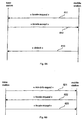
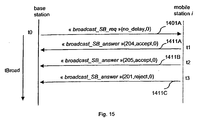
- Figure 15 represents an exchange of messages between the base station and each mobile station having the capability of becoming a base station.
- the message 1401 is broadcast by the base station at regular time slots, for example every minute.
- Each of the mobile stations according to the present invention then answers by return (that is to say without waiting), in the form of messages 1411A, 1411B or 1411C.
- the mobile stations 204, 205 and 201 answer, the first two with an answer field CR of the "accept” type and the last with an answer field CR of the " rejec t" type.
- each mobile station determines whether or not its operating code is one of the codes " SB / SM_auto" or "SB / SM_manual”, and, in the affirmative, whether its available memory capacity is greater than the predetermined value MD_N1.
- the above three periods are equal to 10 milliseconds (the period of a DECT frame for which the answer period is always a multiple of the period of a DECT frame).
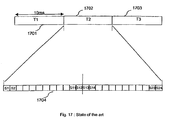
- Figure 17 shows that the messages are transmitted according to a predetermined timing.
- Each communication cycle 1701, 1702 or 1703 lasts 10 milliseconds and is divided into twelve equal time slots. For a communication, one or more time slots for each cycle are allocated in a fixed manner.
- Figure 18A depicts the state of the art for establishing a connection internal to a cell.
- Figure 18A shows the route of an internal communication between a mobile station 1802 and a mobile station 1803. This communication passes through a base station 1801. The information which pass at time t over the link between the mobile station 1802 and the base station 1801 next passes over the link between the base station 1801 and the mobile station 1803. There is therefore a duplication of the information and a dual occupation of the communication medium of the cell for two transmissions of the same information.
- This dual occupation of the communication medium is not critical when the information transmitted is voice information.
- the duplication of the links, of the information and of the occupation of the communication medium may saturate the cell and block a request for connection to the outside of the cell.
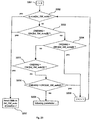
- Figure 19 shows, in the form of a flow diagram, how the creation of a new cell is implemented or the mobile stations are put in direct communication.
- the base station 1804 When, during an operation 1901, the base station 1804 receives a call request internal to the cell, from a mobile station 1806 and intended for a mobile station 1805, it performs a test 1902 during which it determines:
- the base station determines whether or not at least one of the mobile stations 1805 or 1806 has a current connection.
- test 1904 When the result of test 1904 is positive, operation 1903 is performed.
- the base station determines whether or not the mobile stations 1805 and 1806 are both in the list SM_direct.
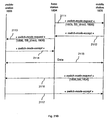
- the base station sends, to each of the mobile stations 1805 and 1806, a message "switch-mode-request" in order to indicate to them to switch into direct communication mode, and to indicate to them the identity of the mobile station which constitutes their interlocutor (see Figure 21B).
- the base station 1804 determines whether or not the mobile station 1805 is in the list_SM_auto.
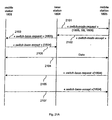
- the base station 1804 sends to the mobile station 1805 a message "switch-mode-request" 2101 ( Figure 21A) in order to indicate to it that it should switch into base station mode and sends it the identity of the mobile station 1806 so that the mobile station 1805 allocates access rights to it.
- the base station 1804 on reception of a message "switch-mode-accept" 2102 from the mobile station 1805, the base station 1804 sends to the mobile station 1806 a message "switch-base-request" 2103 containing the identity of the base station 1805, in order to indicate to the mobile station 1806 that it should synchronise itself with the new base station 1805 (see Figure 21A).
- a test 1909 is performed (see below).
- the base station 1804 determines whether or not the mobile station 1806 is in the list_SM_auto.
- the base station 1804 sends to the mobile station 1806 a message "switch-mode-request" 2101 in order to indicate to it that it should switch into base station mode and sends it the identity of the mobile station 1805 so that the mobile station 1806 allocates access rights to it.
- the base station 1804 on reception of a message "switch-mode-accept" 2102 from the mobile station 1806, the base station 1804 sends to the mobile station 1805 a message "switch-base-request" 2103 containing the identity of the base station 1806, in order to indicate to the mobile station 1805 that it should synchronise itself with the new base station 1806.
- an operation 1911 is performed (see below).
- the base station determines whether or not the number of slots which remain available is strictly less than the number of slots necessary for the requested communication.
- operation 1903 is performed.
- the temporary variable k is initialised to the value "0".
- the base station determines whether or not the value of the variable k is strictly less than the size of the list list_SM_auto.
- operation 1903 is performed. It should be noted here that the performance of operation 1903 does not guarantee the setting up of the communication, rejection procedures being provided, in accordance with the known state of the art.
- the base station determines whether or not the k th station in the list list_SM_auto has a current connection.
- test 1914 When the result of test 1914 is positive, during an operation 1915, the value of the variable k is incremented by 1. Then test 1913 is reiterated.
- the base station 1804 sends, to the mobile station identified at the k th position in the list lisf_SM_auto, here the mobile station 1810, a message "switch-mode-request", and then, if the mobile station under consideration 1810 agrees to take the role of the new base station, the initial base station 1804 sends, to each of the mobile stations 1805 and 1806, a message "switch-base-request", indicating the identity of the new base station 1810 so that each of the mobile stations 1805 and 1806 synchronises itself with the new base station 1810 (see Figure 22).
- the new base station 1810 once again switches into mobile station functioning mode.
- the mobile station 1810 refuses to change communication mode, by sending a message “switch-mode-reject", or by not responding to the message "switch-mode-request", operation 1915 is performed by the base station 1804.
- the base station 1804 first of all sends, to one of the mobile stations involved in the communication to be set up (for example the station 1805), a message 2111 "switch-mode-request", indicating the requested communication mode (direct communication mode) and indicating the identity of the other mobile station.
- the base station 1804 On reception of a message "switch-mode-accept" 2112 from the mobile station (station 1805 in our example) for which the message "switch-mode-request” 2111 was intended, the base station 1804 sends, to the other mobile station involved in the communication (station 1806 in our example), a message "switch-mode-request” 2113 indicating the requested communication mode (direct communication mode) and indicating the identity of the other mobile station.
- the two mobile stations On reception of a message "switch-mode-accept" 2114 from the mobile station (station 1806 in our example) for which the message "switch-mode-request" was intended, the two mobile stations switch into direct communication mode.
- the station 1805 sends, to the station 1806, a message "switch-mode-request” 2116 and receives in return a message “switch-mode-accept” 2117, and the two stations 1805 and 1806 then switch into mobile station mode.
- the base station 1804 On reception of a message "switch-base-accept" 2208 in return, the base station 1804 sends, to the mobile station 1805, a message "switch-base-request" 2204.
- Each of the messages 2203 and 2204 indicates, to each of the mobile stations, that the new base station which concerns them is station 1810.
- the mobile stations 1806 and 1805 then communicate data to each other, through the new base station 1810.
- the new base station 1810 sends, to the mobile station 1806, a message "switch-base-request” 2207 and, to the mobile station 1805, a message “switch-base-request” 2208, indicating to each of the mobile stations that the new base station is the station 1804.
- Figure 23 describes a flow diagram for classifying mobile stations having a capability of switching automatically into base station mode, as a function of criteria defining this capability of becoming a base station.
- the procedure illustrated in Figure 23 is executed by a base station when a new mobile station (hereinafter designated SMk) joins itself to a cell and sends a message illustrated in Figure 6.
- SMk new mobile station
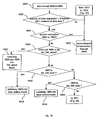
- the controller 306 of the base station effects an initialisation of the temporary variable I to the value "0". Then, during a test 3202, the controller 306 determines whether or not the value of the temporary variable l is greater than or equal to the size of the list list_SM_auto. When the result of test 3202 is positive, during an operation 3207, the identity of the mobile station SMk is inserted at position I in the list list_SM_auto, and the classification procedure is terminated.
- the controller 306 determines whether or not the maximum transmission rate of the station SMk is strictly greater than the maximum rate of the l th station of the list list_SM_auto.
- operation 3207 is performed.
- the controller 306 determines whether or not the maximum transmission rate of the station SMk is strictly less than the maximum rate of the l th station in the list list_SM_auto.
- test 3204 When the result of test 3204 is positive, during an operation 3208, the value of the temporary variable l is incremented by 1 and test 3202 is reiterated.
- the controller 306 determines whether or not the memory capacity of the station SMk is strictly greater than the memory capacity of the I th station in the list list_SM_auto.
- operation 3207 is performed.
- the controller 306 determines whether or not the memory capacity of the station SMk is strictly less than the memory capacity of the I th station in the list list_SM_auto.
- test 3206 When the result of test 3206 is positive, operation 3208 is performed.
- the result of test 3206 When the result of test 3206 is negative, a new parameter for the capability of becoming a base station is considered and tests similar to tests 3203 and 3204, or 3205 and 3206, are performed, considering this new parameter in place of the maximum transmission rate (tests 3203 and 3204) or memory capacity (tests 3205 and 3206). Naturally, the parameters tested are tested in decreasing order of importance.
- operation 3207 When the last parameter has been considered with once again a negative result for the two tests concerning it, operation 3207 is performed.
Landscapes
- Engineering & Computer Science (AREA)
- Computer Security & Cryptography (AREA)
- Computer Networks & Wireless Communication (AREA)
- Signal Processing (AREA)
- Mobile Radio Communication Systems (AREA)
- Data Exchanges In Wide-Area Networks (AREA)
- Communication Control (AREA)
- Telephonic Communication Services (AREA)
- Information Transfer Between Computers (AREA)
Claims (20)
- Verfahren zur Kommunikation zwischen Kommunikationsstationen, die angepasst sind, um miteinander zu kommunizieren, wenn zumindest eine der Kommunikationsstationen ein Steuersignal liefert, wobei diese Station dann in einem Modus "Basisstation" arbeitet und die Stationen, die kein Steuersignal liefern, dann in einem Modus "Mobilstation" arbeiten, dadurch gekennzeichnet, dass es folgende Vorgänge umfasst, die von zumindest einer Kommunikationsstation durchgeführt werden, welche anfänglich im Basisstationsmodus arbeitet:- einen Vorgang (409) zum Bestimmen der Anwesenheit einer im Mobilstationsmodus arbeitenden Station, und- einen Vorgang (411) zum Umschalten in den Mobilstationsmodus, während dem diese Station in den Mobilstationsmodus eintritt, wenn während des Anwesenheitsbestimmungsvorgangs (409) bestimmt wird, dass keine Station im Mobilstationsmodus arbeitet.
- Kommunikationsverfahren gemäß Anspruch 1, dadurch gekennzeichnet, dass es für zumindest eine Kommunikationsstation, die im Mobilstationsmodus arbeitet, die folgenden Vorgänge umfasst:- einen Vorgang (403) zum Bestimmen der Anwesenheit einer im Basisstationsmodus arbeitenden Station, und- einen Vorgang (407) zum Umschalten in den Basisstationsmodus, während dem diese Station in den Basisstationsmodus eintritt, wenn während des Anwesenheitsbestimmungsvorgangs bestimmt wird, dass keine Station im Basisstationsmodus arbeitet.
- Kommunikationsverfahren gemäß Anspruch 1, dadurch gekennzeichnet, dass diese Kommunikationsstation folgend auf den Vorgang (411) zum Umschalten in den Mobilstationsmodus durchführt:- einen Vorgang (403) zum Bestimmen der Anwesenheit einer im Basisstationsmodus arbeitenden Station, und- einen Vorgang (407) zum Umschalten in den Basisstationsmodus, während dem diese Station in den Basisstationsmodus eintritt, wenn während des Anwesenheitsbestimmungsvorgangs bestimmt wird, dass keine Station im Basisstationsmodus arbeitet.
- Kommunikationsverfahren gemäß einem der Ansprüche 2 und 3, dadurch gekennzeichnet, dass diese Station zwischen zwei aufeinander folgenden Vorgängen (403), die die Anwesenheit einer im Basisstationsmodus arbeitenden Station bestimmen, einen Wartevorgang (408, 412, 413) durchführt, während dem sie den Arbeitsmodus nicht ändert.
- Vorrichtung zur Kommunikation zwischen Kommunikationsstationen, die angepasst sind, um miteinander zu kommunizieren, wenn zumindest eine der Kommunikationsstationen ein Steuersignal liefert, wobei diese Station dann in einem Modus "Basisstation" arbeitet und die Stationen, die kein Steuersignal liefern, dann in einem Modus "Mobilstation" arbeiten, dadurch gekennzeichnet, dass sie in zumindest einer Kommunikationsstation, welche anfänglich im Basisstationsmodus arbeitet, eine Verarbeitungseinrichtung (306) aufweist, die angepasst ist zum:- Bestimmen der möglichen Anwesenheit einer im Mobilstationsmodus arbeitenden Station, und- Umschalten in den Mobilstationsmodus, wenn sie bestimmt hat, dass keine Station im Mobilstationsmodus arbeitet.
- Kommunikationsvorrichtung gemäß Anspruch 5, dadurch gekennzeichnet, dass ihre Verarbeitungseinrichtung (306), wenn sie im Mobilstationsmodus arbeitet, angepasst ist zum:- Bestimmen der möglichen Anwesenheit einer im Basisstationsmodus arbeitenden Station, und- Umschalten in den Basisstationsmodus, wenn sie bestimmt hat, dass keine Station im Basisstationsmodus arbeitet.
- Kommunikationsvorrichtung gemäß Anspruch 5, dadurch gekennzeichnet, dass die Verarbeitungseinrichtung (306), nachdem in den Mobilstationsmodus umgeschaltet wurde, angepasst ist zum:- Bestimmen der möglichen Anwesenheit einer im Basisstationsmodus arbeitenden Station, und- Umschalten in den Basisstationsmodus, wenn sie bestimmt hat, dass keine Station im Basisstationsmodus arbeitet.
- Kommunikationsvorrichtung gemäß einem der Ansprüche 6 und 7, dadurch gekennzeichnet, dass die Verarbeitungseinrichtung (306) angepasst ist, um zwischen zwei Umschaltungen für eine vorbestimmte Zeitdauer zu warten, ohne den Arbeitsmodus zu ändern.
- Netzwerk, dadurch gekennzeichnet, dass es zumindest zwei Vorrichtungen gemäß einem der Ansprüche 5 bis 8 aufweist.
- Telefon, dadurch gekennzeichnet, dass es eine Vorrichtung gemäß einem der Ansprüche 5 bis 8 aufweist.
- Fotoapparat, dadurch gekennzeichnet, dass er eine Vorrichtung gemäß einem der Ansprüche 5 bis 8 aufweist.
- Drucker, dadurch gekennzeichnet, dass er eine Vorrichtung gemäß einem der Ansprüche 5 bis 8 aufweist.
- Scanner, dadurch gekennzeichnet, dass er eine Vorrichtung gemäß einem der Ansprüche 5 bis 8 aufweist.
- Kamera, dadurch gekennzeichnet, dass sie eine Vorrichtung gemäß einem der Ansprüche 5 bis 8 aufweist.
- Computer, dadurch gekennzeichnet, dass er eine Vorrichtung gemäß einem der Ansprüche 5 bis 8 aufweist.
- Faxgerät, dadurch gekennzeichnet, dass es eine Vorrichtung gemäß einem der Ansprüche 5 bis 8 aufweist.
- Fernsehempfänger, dadurch gekennzeichnet, dass er eine Vorrichtung gemäß einem der Ansprüche 5 bis 8 aufweist.
- Audio-/Videoabspielgerät, dadurch gekennzeichnet, dass es eine Vorrichtung gemäß einem der Ansprüche 5 bis 8 aufweist.
- Einrichtung (305) zum Speichern von Informationen, die von einem Computer oder einem Mikroprozessor gelesen werden kann, wobei sie Anweisungen eines Computerprogramms speichert, dadurch gekennzeichnet, dass sie ein Kommunikationsverfahren gemäß einem der Ansprüche 1 bis 4 implementiert.
- Einrichtung (305) zum Speichern von Informationen, die teilweise oder vollständig abnehmbar ist und von einem Computer oder einem Mikroprozessor gelesen werden kann, wobei sie Anweisungen eines Computerprogramms speichert, dadurch gekennzeichnet, dass sie ein Kommunikationsverfahren gemäß einem der Ansprüche 1 bis 4 implementiert.
Priority Applications (1)
| Application Number | Priority Date | Filing Date | Title |
|---|---|---|---|
| EP06075172A EP1653708B1 (de) | 1998-07-28 | 1999-07-01 | Verfahren und Vorrichtung zur Nachrichtenübertragung in einem Netzwerk |
Applications Claiming Priority (8)
| Application Number | Priority Date | Filing Date | Title |
|---|---|---|---|
| FR9809627A FR2781955A1 (fr) | 1998-07-28 | 1998-07-28 | Procede et dispositif de communication sur un reseau |
| FR9809632 | 1998-07-28 | ||
| FR9809629A FR2781957A1 (fr) | 1998-07-28 | 1998-07-28 | Procede et dispositif de communication sur un reseau |
| FR9809627 | 1998-07-28 | ||
| FR9809629 | 1998-07-28 | ||
| FR9809632A FR2781960A1 (fr) | 1998-07-28 | 1998-07-28 | Procede et dispositif de communication sur un reseau |
| FR9810470 | 1998-08-17 | ||
| FR9810470A FR2782432A1 (fr) | 1998-08-17 | 1998-08-17 | Procede et dispositif de communication confidentielle sur un reseau |
Related Child Applications (1)
| Application Number | Title | Priority Date | Filing Date |
|---|---|---|---|
| EP06075172A Division EP1653708B1 (de) | 1998-07-28 | 1999-07-01 | Verfahren und Vorrichtung zur Nachrichtenübertragung in einem Netzwerk |
Publications (4)
| Publication Number | Publication Date |
|---|---|
| EP0984651A2 EP0984651A2 (de) | 2000-03-08 |
| EP0984651A3 EP0984651A3 (de) | 2000-11-29 |
| EP0984651B1 true EP0984651B1 (de) | 2006-03-01 |
| EP0984651B8 EP0984651B8 (de) | 2006-06-21 |
Family
ID=27447027
Family Applications (2)
| Application Number | Title | Priority Date | Filing Date |
|---|---|---|---|
| EP06075172A Expired - Lifetime EP1653708B1 (de) | 1998-07-28 | 1999-07-01 | Verfahren und Vorrichtung zur Nachrichtenübertragung in einem Netzwerk |
| EP99401641A Expired - Lifetime EP0984651B8 (de) | 1998-07-28 | 1999-07-01 | Verfahren and Vorrichtung zur Nachrichtenübertragung in einem Netzwerk |
Family Applications Before (1)
| Application Number | Title | Priority Date | Filing Date |
|---|---|---|---|
| EP06075172A Expired - Lifetime EP1653708B1 (de) | 1998-07-28 | 1999-07-01 | Verfahren und Vorrichtung zur Nachrichtenübertragung in einem Netzwerk |
Country Status (5)
| Country | Link |
|---|---|
| US (1) | US6574452B1 (de) |
| EP (2) | EP1653708B1 (de) |
| JP (1) | JP3984763B2 (de) |
| AT (1) | ATE319272T1 (de) |
| DE (1) | DE69930091T2 (de) |
Families Citing this family (38)
| Publication number | Priority date | Publication date | Assignee | Title |
|---|---|---|---|---|
| DE69940685D1 (de) * | 1998-07-28 | 2009-05-20 | Canon Kk | Verfahren und Vorrichtung zur Nachrichtenübertragung in einem Netzwerk |
| EP1033896A3 (de) * | 1999-03-04 | 2000-10-18 | Canon Kabushiki Kaisha | Verfahren und Vorrichtung zur Nachrichtkommunikation in einem Netzwerk und Systeme zu ihrer Durchführung |
| DE19952900B4 (de) * | 1999-11-03 | 2011-05-12 | Deutsche Telekom Ag | Verfahren zur Kommunikation von schnurlosen Telefonen untereinander |
| EP1120959A1 (de) * | 2000-01-24 | 2001-08-01 | Canon Research Centre France S.A. | Verfahren und Gerät für die Ressourcenverwaltung eines Rechnerkommunikationssystems um ein Rechnerdokument zu verarbeiten |
| JP3707991B2 (ja) * | 2000-04-12 | 2005-10-19 | シャープ株式会社 | 通信装置及び方法並びにこれに利用される記憶媒体 |
| US7546337B1 (en) | 2000-05-18 | 2009-06-09 | Aol Llc, A Delaware Limited Liability Company | Transferring files |
| JP3421639B2 (ja) * | 2000-06-01 | 2003-06-30 | 富士通株式会社 | 複数の無線通信部を有する情報処理装置におけるrf信号干渉を防止するための通信監視制御 |
| US7366779B1 (en) | 2000-06-19 | 2008-04-29 | Aol Llc, A Delaware Limited Liability Company | Direct file transfer between subscribers of a communications system |
| DE10035824A1 (de) * | 2000-07-22 | 2002-02-14 | Sennheiser Electronic | System zur Steuerung von mobilen, drahtlos mit einer Zentraleinheit verbundenen Sende- und/oder Empfangsvorrichtungen |
| US7107075B2 (en) * | 2000-08-25 | 2006-09-12 | Bellsouth Intellectual Property Corporation | Wireless communications methods and systems using a remote, self-contained communications antenna unit |
| EP1202145B1 (de) * | 2000-10-27 | 2005-02-09 | Invensys Systems, Inc. | Feldgerät mit einem Sender und/oder Empfänger zur drahtlosen Datenübertragung |
| CN1312955C (zh) | 2000-12-11 | 2007-04-25 | 夏普株式会社 | 无线通信系统 |
| US20020085520A1 (en) * | 2001-01-04 | 2002-07-04 | Uwe Sydon | Cordless communication system providing optimum spectral usage for wireless networks |
| US20020107016A1 (en) * | 2001-02-05 | 2002-08-08 | Hanley Richard R. | Communication system for automatic identification and electronic purchasing of broadcast contents |
| JP3858746B2 (ja) * | 2001-05-08 | 2006-12-20 | ソニー株式会社 | 無線通信システム、無線通信制御装置及び無線通信制御方法、並びにコンピュータ・プログラム |
| JP3700839B2 (ja) * | 2001-08-30 | 2005-09-28 | ソニー株式会社 | 無線通信装置及び無線通信装置の制御方法、並びにコンピュータ・プログラム |
| US6993306B2 (en) * | 2002-01-22 | 2006-01-31 | Broadcom Corporation | Determination and processing for fractional-N programming values |
| US8667105B1 (en) * | 2002-06-26 | 2014-03-04 | Apple Inc. | Systems and methods facilitating relocatability of devices between networks |
| JP3730599B2 (ja) * | 2002-06-27 | 2006-01-05 | 株式会社東芝 | サーバ装置および状態制御方法 |
| GB2425692B (en) | 2002-08-15 | 2007-03-21 | Iml Ltd | A participant response system and method |
| US7366532B2 (en) * | 2003-10-09 | 2008-04-29 | Motorola, Inc. | Group call management through receive/transmit synchronization |
| DE102005009504B3 (de) * | 2005-03-02 | 2006-03-09 | Fraunhofer-Gesellschaft zur Förderung der angewandten Forschung e.V. | Mobilteil und Basisstation für ein Kommunikationsprotokoll mit einer Normal-Anmeldung und einer Ad-hoc-Anmeldung |
| JP4868835B2 (ja) * | 2005-11-28 | 2012-02-01 | キヤノン株式会社 | 通信経路の設定方法、通信装置、及びプログラム |
| JP4976776B2 (ja) * | 2006-07-31 | 2012-07-18 | キヤノン株式会社 | 通信装置、通信方法、並びに当該通信方法をコンピュータに実行させるためのコンピュータプログラム |
| JP5071123B2 (ja) * | 2008-01-25 | 2012-11-14 | 富士通株式会社 | Itシステム |
| JP5065977B2 (ja) * | 2008-04-15 | 2012-11-07 | 株式会社エヌ・ティ・ティ・ドコモ | 無線端末、無線基地局及び無線通信システム |
| JP5235777B2 (ja) * | 2009-05-15 | 2013-07-10 | キヤノン株式会社 | 通信装置、通信装置の制御方法、プログラム |
| US8676183B2 (en) * | 2010-12-29 | 2014-03-18 | Openpeak Inc. | Method and apparatus for controlling de-subscription of a master device at a base station |
| US9077756B1 (en) * | 2012-03-05 | 2015-07-07 | Symantec Corporation | Limiting external device access to mobile computing devices according to device type and connection context |
| JP6184105B2 (ja) * | 2013-01-25 | 2017-08-23 | キヤノン株式会社 | 通信装置、通信装置の制御方法、プログラム |
| US9591692B2 (en) | 2013-05-10 | 2017-03-07 | Elwha Llc | Dynamic point to point mobile network including destination device aspects system and method |
| US20140335781A1 (en) * | 2013-05-10 | 2014-11-13 | Elwha Llc | Dynamic Point to Point Mobile Network System and Method |
| US9763166B2 (en) | 2013-05-10 | 2017-09-12 | Elwha Llc | Dynamic point to point mobile network including communication path monitoring and analysis aspects system and method |
| US9559766B2 (en) | 2013-05-10 | 2017-01-31 | Elwha Llc | Dynamic point to point mobile network including intermediate device aspects system and method |
| US9832728B2 (en) | 2013-05-10 | 2017-11-28 | Elwha Llc | Dynamic point to point mobile network including origination user interface aspects system and method |
| US20150127593A1 (en) * | 2013-11-06 | 2015-05-07 | Forever Identity, Inc. | Platform to Acquire and Represent Human Behavior and Physical Traits to Achieve Digital Eternity |
| WO2015140920A1 (ja) * | 2014-03-18 | 2015-09-24 | 富士通株式会社 | 無線通信システム、端末、及び、処理方法 |
| WO2016059960A1 (ja) * | 2014-10-17 | 2016-04-21 | ソニー株式会社 | 装置 |
Family Cites Families (23)
| Publication number | Priority date | Publication date | Assignee | Title |
|---|---|---|---|---|
| US4056779A (en) * | 1976-04-05 | 1977-11-01 | Motorola, Inc. | Vehicular repeater |
| US4675863A (en) | 1985-03-20 | 1987-06-23 | International Mobile Machines Corp. | Subscriber RF telephone system for providing multiple speech and/or data signals simultaneously over either a single or a plurality of RF channels |
| GB2195513B (en) | 1986-09-18 | 1990-12-19 | Philips Electronic Associated | Radio system |
| US4935927A (en) | 1987-11-20 | 1990-06-19 | International Mobile Machines Corporation | Base station emulator |
| JP3003131B2 (ja) | 1989-01-18 | 2000-01-24 | ソニー株式会社 | コードレステレホン |
| US5790536A (en) | 1989-01-31 | 1998-08-04 | Norand Corporation | Hierarchical communication system providing intelligent data, program and processing migration |
| ATA78889A (de) | 1989-04-04 | 1994-02-15 | Siemens Ag Oesterreich | Schnurlos-telefonsystem mit mobilteilen und feststationen |
| JP2610691B2 (ja) | 1990-04-06 | 1997-05-14 | シャープ株式会社 | 通信装置 |
| EP0462782B1 (de) * | 1990-06-16 | 1995-03-01 | Nec Corporation | Empfänger für ein zelluloses Mobilfunkübertragungssystem |
| JPH0831909B2 (ja) | 1990-06-18 | 1996-03-27 | 松下電器産業株式会社 | コードレス留守番電話装置 |
| US5260993A (en) | 1992-04-06 | 1993-11-09 | Motorola, Inc. | Queuing apparatus and method for a cordless communication transceiver |
| TW239910B (de) | 1992-08-21 | 1995-02-01 | Motorola Inc | |
| FI98686C (fi) * | 1993-11-01 | 1998-07-22 | Nokia Telecommunications Oy | Menetelmä suorakanavalla liikennöivän tilaaja-aseman hallitsemiseksi radiojärjestelmässä ja radiojärjestelmä |
| AU1974795A (en) | 1994-03-03 | 1995-09-18 | Proxim, Inc. | Frequency hopping medium access control protocol |
| US5809417A (en) * | 1994-07-05 | 1998-09-15 | Lucent Technologies Inc. | Cordless telephone arranged for operating with multiple portable units in a frequency hopping system |
| US5606560A (en) * | 1994-09-23 | 1997-02-25 | Motorola, Inc. | Between a base station and a portable device |
| JP3432335B2 (ja) * | 1995-06-27 | 2003-08-04 | 株式会社東芝 | 移動無線通信装置 |
| DE19612355C1 (de) * | 1996-03-28 | 1997-10-16 | Hagenuk Telecom Gmbh | Vorrichtung zur Telekommunikation |
| FI962312A7 (fi) * | 1996-05-31 | 1997-12-01 | Teleste Viestintae Oy | Puhelinjärjestelmä |
| US5857144A (en) * | 1996-08-09 | 1999-01-05 | Ericsson, Inc. | In-band vehicular repeater for trunked radio system |
| US6047160A (en) * | 1996-08-29 | 2000-04-04 | Ericsson Inc. | Transportable base station for a trunked radio communication system |
| US6169880B1 (en) * | 1996-10-16 | 2001-01-02 | Ericsson Inc. | Method and system of load sharing and prioritization of radio repeaters |
| DE19645731A1 (de) * | 1996-11-06 | 1998-05-07 | Siemens Ag | Verfahren zum Aufsuchen einer verfügbaren Basisstation |
-
1999
- 1999-07-01 EP EP06075172A patent/EP1653708B1/de not_active Expired - Lifetime
- 1999-07-01 AT AT99401641T patent/ATE319272T1/de not_active IP Right Cessation
- 1999-07-01 EP EP99401641A patent/EP0984651B8/de not_active Expired - Lifetime
- 1999-07-01 DE DE69930091T patent/DE69930091T2/de not_active Expired - Lifetime
- 1999-07-01 US US09/345,968 patent/US6574452B1/en not_active Expired - Lifetime
- 1999-07-28 JP JP21430999A patent/JP3984763B2/ja not_active Expired - Fee Related
Also Published As
| Publication number | Publication date |
|---|---|
| US6574452B1 (en) | 2003-06-03 |
| JP2000082989A (ja) | 2000-03-21 |
| EP0984651A2 (de) | 2000-03-08 |
| EP0984651B8 (de) | 2006-06-21 |
| EP1653708B1 (de) | 2011-10-05 |
| ATE319272T1 (de) | 2006-03-15 |
| EP0984651A3 (de) | 2000-11-29 |
| DE69930091T2 (de) | 2006-08-17 |
| EP1653708A2 (de) | 2006-05-03 |
| DE69930091D1 (de) | 2006-04-27 |
| JP3984763B2 (ja) | 2007-10-03 |
| EP1653708A3 (de) | 2006-05-17 |
Similar Documents
| Publication | Publication Date | Title |
|---|---|---|
| EP0984651B1 (de) | Verfahren and Vorrichtung zur Nachrichtenübertragung in einem Netzwerk | |
| EP0984652B1 (de) | Verfahren und Vorrichtung zur Nachrichtenübertragung in einem Netzwerk | |
| CN1887021B (zh) | 将处于p2p通信模式的用户终端切换到其链路性能比激活小区的链路性能高出一预定值的小区的方法、用户终端和网络 | |
| CN101765058B (zh) | 用于多媒体广播/组播业务的频率选择方法及其移动终端 | |
| US5864759A (en) | Radio telephones and methods of operation | |
| CN100508657C (zh) | 小区重新选择信令方法 | |
| CN103442453B (zh) | 用于状态/模式转移的方法和设备 | |
| EP1533948A1 (de) | Kommunikationsverfahren, kommunikationsgerät und kommunikationssystem | |
| EP1627545A1 (de) | Verfahren und einrichtung zum sanften umschalten | |
| JP2002368681A (ja) | 無線通信ネットワーク | |
| KR20020080351A (ko) | 패킷 데이터 서비스의 효율적 자원 관리를 위한 무선 통신방법, 시스템 및 그의 타이머 설정 회로 | |
| KR100272109B1 (ko) | 효율적 무선 자원 할당을 위한 무선통신 장치 및 그 운용 방법 | |
| US5794148A (en) | Method of making a channel exit decision in a communication system | |
| CN111465070A (zh) | 一种实现5g信号平稳显示的方法 | |
| JPH114476A (ja) | 移動通信システム及びそのトラヒック収集制御方法並びにトラヒック収集制御プログラムを記録した記録媒体 | |
| US6603750B1 (en) | Rehash timer for packet data communications | |
| KR20040037826A (ko) | 단말기의 요청에 의한 수직적인 셀 전환 장치 및 방법 | |
| KR100399015B1 (ko) | 이동무선통신시스템의도약패턴변경방법 | |
| JPH0970064A (ja) | 無線通信方法 | |
| EP0788286A2 (de) | Funkhandgerät und Betriebsverfahren dazu | |
| JPH09294291A (ja) | 無線通信網の接続制御方法 | |
| WO2001093619A1 (en) | A method and an arrangement for selecting a radio access unit in a radio communication system | |
| HK1087293B (en) | Cell reselection signalling method | |
| FR2781955A1 (fr) | Procede et dispositif de communication sur un reseau | |
| FR2781956A1 (fr) | Procede et dispositif de communication sur un reseau |
Legal Events
| Date | Code | Title | Description |
|---|---|---|---|
| PUAI | Public reference made under article 153(3) epc to a published international application that has entered the european phase |
Free format text: ORIGINAL CODE: 0009012 |
|
| AK | Designated contracting states |
Kind code of ref document: A2 Designated state(s): AT BE CH CY DE DK ES FI FR GB GR IE IT LI LU MC NL PT SE |
|
| AX | Request for extension of the european patent |
Free format text: AL;LT;LV;MK;RO;SI |
|
| PUAL | Search report despatched |
Free format text: ORIGINAL CODE: 0009013 |
|
| AK | Designated contracting states |
Kind code of ref document: A3 Designated state(s): AT BE CH CY DE DK ES FI FR GB GR IE IT LI LU MC NL PT SE |
|
| AX | Request for extension of the european patent |
Free format text: AL;LT;LV;MK;RO;SI |
|
| 17P | Request for examination filed |
Effective date: 20010426 |
|
| AKX | Designation fees paid |
Free format text: AT BE CH CY DE DK ES FI FR GB GR IE IT LI LU MC NL PT SE |
|
| 17Q | First examination report despatched |
Effective date: 20031127 |
|
| GRAP | Despatch of communication of intention to grant a patent |
Free format text: ORIGINAL CODE: EPIDOSNIGR1 |
|
| GRAS | Grant fee paid |
Free format text: ORIGINAL CODE: EPIDOSNIGR3 |
|
| GRAA | (expected) grant |
Free format text: ORIGINAL CODE: 0009210 |
|
| AK | Designated contracting states |
Kind code of ref document: B1 Designated state(s): AT BE CH CY DE DK ES FI FR GB GR IE IT LI LU MC NL PT SE |
|
| REG | Reference to a national code |
Ref country code: GB Ref legal event code: FG4D Free format text: NOT ENGLISH |
|
| REG | Reference to a national code |
Ref country code: CH Ref legal event code: EP |
|
| REG | Reference to a national code |
Ref country code: GB Ref legal event code: ERR Free format text: NOTIFICATION HAS BEEN RECEIVED FROM THE EUROPEAN PATENT OFFICE THAT THE PUBLICATION LANGUAGE IS ACTUALLY ENGLISH |
|
| REG | Reference to a national code |
Ref country code: IE Ref legal event code: FG4D |
|
| REF | Corresponds to: |
Ref document number: 69930091 Country of ref document: DE Date of ref document: 20060427 Kind code of ref document: P |
|
| RBV | Designated contracting states (corrected) |
Designated state(s): CH DE FR GB LI |
|
| REG | Reference to a national code |
Ref country code: CH Ref legal event code: NV Representative=s name: BOVARD AG PATENTANWAELTE |
|
| NLV1 | Nl: lapsed or annulled due to failure to fulfill the requirements of art. 29p and 29m of the patents act | ||
| ET | Fr: translation filed | ||
| PLBE | No opposition filed within time limit |
Free format text: ORIGINAL CODE: 0009261 |
|
| STAA | Information on the status of an ep patent application or granted ep patent |
Free format text: STATUS: NO OPPOSITION FILED WITHIN TIME LIMIT |
|
| 26N | No opposition filed |
Effective date: 20061204 |
|
| REG | Reference to a national code |
Ref country code: CH Ref legal event code: PL |
|
| REG | Reference to a national code |
Ref country code: CH Ref legal event code: AEN Free format text: LE BREVET A ETE REACTIVE SELON LA DEMANDE DE POURSUITE DE LA PROCEDURE DU 19.03.2007. |
|
| REG | Reference to a national code |
Ref country code: CH Ref legal event code: PFA Owner name: CANON KABUSHIKI KAISHA Free format text: CANON KABUSHIKI KAISHA#30-2, 3-CHOME, SHIMOMARUKO, OHTA-KU#TOKYO (JP) -TRANSFER TO- CANON KABUSHIKI KAISHA#30-2, 3-CHOME, SHIMOMARUKO, OHTA-KU#TOKYO (JP) |
|
| PGFP | Annual fee paid to national office [announced via postgrant information from national office to epo] |
Ref country code: CH Payment date: 20110718 Year of fee payment: 13 |
|
| PGFP | Annual fee paid to national office [announced via postgrant information from national office to epo] |
Ref country code: FR Payment date: 20120808 Year of fee payment: 14 |
|
| REG | Reference to a national code |
Ref country code: CH Ref legal event code: PL |
|
| REG | Reference to a national code |
Ref country code: FR Ref legal event code: ST Effective date: 20140331 |
|
| PG25 | Lapsed in a contracting state [announced via postgrant information from national office to epo] |
Ref country code: LI Free format text: LAPSE BECAUSE OF NON-PAYMENT OF DUE FEES Effective date: 20130731 Ref country code: CH Free format text: LAPSE BECAUSE OF NON-PAYMENT OF DUE FEES Effective date: 20130731 |
|
| PG25 | Lapsed in a contracting state [announced via postgrant information from national office to epo] |
Ref country code: FR Free format text: LAPSE BECAUSE OF NON-PAYMENT OF DUE FEES Effective date: 20130731 |
|
| PGFP | Annual fee paid to national office [announced via postgrant information from national office to epo] |
Ref country code: DE Payment date: 20170731 Year of fee payment: 19 Ref country code: GB Payment date: 20170726 Year of fee payment: 19 |
|
| REG | Reference to a national code |
Ref country code: DE Ref legal event code: R119 Ref document number: 69930091 Country of ref document: DE |
|
| GBPC | Gb: european patent ceased through non-payment of renewal fee |
Effective date: 20180701 |
|
| PG25 | Lapsed in a contracting state [announced via postgrant information from national office to epo] |
Ref country code: GB Free format text: LAPSE BECAUSE OF NON-PAYMENT OF DUE FEES Effective date: 20180701 Ref country code: DE Free format text: LAPSE BECAUSE OF NON-PAYMENT OF DUE FEES Effective date: 20190201 |