EP0984709B1 - Antimikrobielle bürste - Google Patents
Antimikrobielle bürste Download PDFInfo
- Publication number
- EP0984709B1 EP0984709B1 EP98921027A EP98921027A EP0984709B1 EP 0984709 B1 EP0984709 B1 EP 0984709B1 EP 98921027 A EP98921027 A EP 98921027A EP 98921027 A EP98921027 A EP 98921027A EP 0984709 B1 EP0984709 B1 EP 0984709B1
- Authority
- EP
- European Patent Office
- Prior art keywords
- brush
- antimicrobial agent
- antimicrobial
- bristles
- polymeric
- Prior art date
- Legal status (The legal status is an assumption and is not a legal conclusion. Google has not performed a legal analysis and makes no representation as to the accuracy of the status listed.)
- Expired - Lifetime
Links
Images

Classifications
-
- A—HUMAN NECESSITIES
- A46—BRUSHWARE
- A46D—MANUFACTURE OF BRUSHES
- A46D1/00—Bristles; Selection of materials for bristles
-
- A—HUMAN NECESSITIES
- A46—BRUSHWARE
- A46B—BRUSHES
- A46B11/00—Brushes with reservoir or other means for applying substances, e.g. paints, pastes, water
-
- A—HUMAN NECESSITIES
- A46—BRUSHWARE
- A46B—BRUSHES
- A46B11/00—Brushes with reservoir or other means for applying substances, e.g. paints, pastes, water
- A46B11/0003—Brushes with reservoir or other means for applying substances, e.g. paints, pastes, water containing only one dose of substance, e.g. single-use toothbrushes
Definitions
- This invention relates generally to antimicrobial brushes, and more particularly to brushes having antimicrobial compounds or chemicals embedded in either the handle or bristles or both, especially in a toothbrush.
- Elimination of tooth decay and/or periodontal disease caused by bacteria is important to dental hygiene. After a toothbrush has been used, a large number of bacteria cling to the bristles and onto the body of the toothbrush, even after the brush has been rinsed. Additionally, bacteria and fungi from other environmental sources within the bathroom can contaminate the toothbrush. These bacteria and fungi can grow and multiply on toothbrush bristles, handles, and the interface between the two while the toothbrush is being stored between uses. The bristles and the interface can be difficult to clean and over time significant levels of microbial contamination can build in this area.
- a self-sterilizing toothbrush is described in White et al., U.S. Patent No. 2,216,333, and includes a combination of a water soluble salt (e.g., sodium carbonate) with an anti-microbial agent (e.g., sulfur). The two are fused to a solid hard body and attached to the head of the toothbrush at the base of the bristles. When exposed to water, the sodium carbonate dissolves, forming an alkaline solution that in turn dissolves some sulfur, which kills bacteria. Kent, U.S. Patent No. 5,061,106, describes including capsules or microspheres in the tuft holes in which the bristles of a toothbrush are mounted.
- a water soluble salt e.g., sodium carbonate
- an anti-microbial agent e.g., sulfur
- the capsules include a disinfectant or medicant that is released during use.
- Tseng et al. U.S. Patent No. 5,340,581 describes a sustained-release matrix for dental application.
- the matrix includes an anti-microbial agent that is released over time when the matrix is exposed to water.
- the matrix may also include a colorant and a water-leachable substance to cause the matrix to change color corresponding with the depletion of the agent in the matrix.
- antimicrobial agents exist, the majority are not appropriate for contact with the delicate mucosal tissues of the mouth on a repeated basis. Furthermore, topical treatments of the fiber on plastic handles or bristles are not durable and are removed through the abrasive process of toothbrushing. What is needed is an antimicrobial agent which can be incorporated into the body, head or handle of the brush at the time of manufacture, which is free from toxic effect and is durable over the lifespan of the brush.
- US-A-5,141,290 discloses a toothbrush of the type having a plastic head and bristles terminating in the head and extending therefrom in an array.
- the toothbrush comprises an antibacterial composition embedded in pores created in the plastic head, which antibacterial composition is slowly releasable from the toothbrush into the buccal cavity during repeated use thereof during the life of the brush.
- US-A-5,503,840 discloses an antimicrobial composition of titanium dioxide, barium sulfate, zinc oxide particles, and mixtures thereof having successive coatings of silver, in some cases a coating of zinc and/or copper compounds such as zinc oxide, copper (II) oxide and zinc silicate; silicon dioxide; alumina; and a dispersion aid such as dioctyl azelate.
- the present invention is a brush having antimicrobial characteristics that inhibit bacterial growth.
- the antimicrobial agents, compounds or chemicals are embedded in either the body or bristles or both of the brush.
- the present invention is a method of manufacturing a brush having antimicrobial characteristics that inhibit bacterial growth.
- An antimicrobial additive is incorporated in resin concentrate form into the amorphous zones of the molecular structure of the polymer from which brush handles are injection molded, thereby incorporating the antimicrobial agent into the brush handle.
- the high levels of antimicrobial additive in the body of the brush, incorporated in the manner above, results in substantive controlled migration from the body to the bristles, until a point of equilibrium is reached.
- the invention is suitable for any brush in which bristles are embedded or inserted in plastic, including, without limitation, toothbrushes, hair brushes, scrub brushes, toilet bowl brushes, cosmetic brushes, lip-color brushes, etc.
- the principal object of the invention is to provide a brush having antimicrobial protection for the brush bristles, the interface between the brush handle and the bristles, and the handle itself, in a cost-effective, non-toxic, durable way.
- Another object of the invention is to provide antimicrobial protection that allows for controlled migration of an anti-microbial agent throughout a polymer.
- Another object of the invention is to provide a brush having an antimicrobial agent which is insoluble in water, thereby preventing any leaching of the agent during use of the brush.
- Another object of the invention is to provide a brush in which an antimicrobial agent can migrate on demand from the body of the brush to the bristle as abrasion removes the agent from the bristle surface.
- the present invention is described as a toothbrush, the present invention is not intended to be limited to toothbrushes and may be applied to brushes having polymer bodies, handles or heads and nylon or other synthetic bristles attached to the brush body. Further, dyes and color may be incorporated into the polymer to produce toothbrushes and other brushes of varying colors.
- the brush includes a broad spectrum antimicrobial agent associated therewith to inhibit bacterial, fungal, viral and other pathogen growth.
- the brush has a body with an elongate handle and a head, a bristle portion characterized by gatherings of bristles attached to the head of the body, and an antimicrobial agent integrally associated with the brush.
- an antimicrobial agent is associated or incorporated into the polymeric material from which the brush is made.
- an effective amount of an antimicrobial substance e.g., 5-chloro-2-(2,4-dichlorophenoxy) phenol
- levels of active ingredients or antimicrobial substance range from 1000 to 5000 parts per million (ppm) by weight. These levels are substantially higher than would otherwise be required for antimicrobial efficacy in order to enhance migration from the brush body into nylon bristles.
- the brush having the antimicrobial agent therein is further resistant to growth of fungus, yeast, virus, and gram positive and gram negative bacteria including S. aureus, E. coli, K. pneumoniae, and Salmonella.
- the antimicrobial substance which is non-toxic and free of heavy metal, may be a chlorinated phenol (e.g., 5-chloro-2-(2,4-dichlorophenoxy)phenol).
- An alternative antimicrobial agent is polyhexamethylene biguanide hydrochloride (PHMB).
- PHMB polyhexamethylene biguanide hydrochloride
- Other chemical compounds having known antimicrobial characteristics may also be used in the present invention.
- the preferred method of associating the antimicrobial agent with the brush is to incorporate the antimicrobial agent into a synthetic, polymeric master batch prior to forming the brush body.
- 5-chloro-2-(2,4-dichlorophenoxy)phenol was incorporated in resin-concentrated form into the amorphous zones of the polymers from which toothbrush bodies were injection-molded.
- the handles were tested for antimicrobial efficacy using AATCC method 147, or Kirby-Bauer method in which, after a predetermined period of time, the zone of inhibition of the organism is measured in millimeters. The antimicrobial characteristics of the toothbrush handles were found to be very efficacious.
- Materials used for the bristle compositions are preferably nylon, such as 6-nylon, 6,6-nylon, 6,10-nylon, 12-nylon and 4,6-nylon. More preferably, the bristle composition is 6,12-nylon.
- Nylon used to form the bristles is a difficult material to incorporate antimicrobial agents because of the high temperatures associated with producing and forming nylon and because of the crystalline structure of nylon.
- antimicrobial agents are incorporated into the brush body to migrate into the bristles.
- the antimicrobial agent incorporated into the brush body is characterized in that the agent moves from areas of high concentrations of agent to low concentrations of agent.
- the antimicrobial additive chosen was essentially insoluble in water which prevented any leaching of the compound during use.
- the selected antimicrobial agent migrates across the interface between the brush body and the bristles into the bristles when incorporated using the method described herein. Incorporating an appropriate amount of antimicrobial agent into the brush body is important. High concentrations of antimicrobial agent incorporated into the brush body can result in degradation of the physical properties of the polymer composing the brush body. Low concentrations of antimicrobial agent incorporated into the brush body minimize the migration of antimicrobial agent to the bristles.
- the appropriate concentration range of antimicrobial agent in the brush body is necessary to effectively provide nontoxic, antimicrobial protection to the brush without sacrificing desirable physical properties of the polymer used to form the brush body.
- the brush body can be made from polymers such as polypropylene, styrene, polystyrene, polyethylene, ultra high molecular weight polyethylene, acrylonitrile-butadienestyrene (ABS), polyester, polyester elastomer, polyester urethane, ethylene/propylene alloy, silicone, polyvinyl chloride, chlorinated polyvinyl chloride, polyvinylidene fluoride, vinyl esters, cellulose acetate proprionate (CAP), polycarbonate, polyolefin alloy, thermoplastic and thermosetting plastic.
- the brush body is preferably made from polypropylene, styrene, ABS, PVC, CAP, polyethylene, Monoprene or Santoprene (a polyolefin alloy of Monsanto Chemical).
- Incorporating antimicrobial agent into the polymer during manufacture of the polymer is difficult because of the high temperatures and varying physical parameters involved.
- Organic antimicrobial agents typically have a vaporization point less than the temperatures involved during manufacture of the polymer.
- 5-chloro-2-(2,4-dichlorophenoxy)phenol has a range of liquid phase from about 57,2°C (135°F) to about 73,8°C (165°F) and a vaporization point of about 204,4°C (400°F), whereas the temperatures associated with forming plastic are typically above 204,4°C (400°F).
- the agent typically vaporizes and does not become incorporated into the polymer.
- the antimicrobial agent may cross-link with the polymer.
- Cross-linking of the antimicrobial agent with the polymer is undesirable because the physical properties of the polymer can be degraded.
- cross-linking prevents the migration of antimicrobial agent through the polymer of the brush body and eventually to the bristles through the interface of the body with the bristles.
- the nylon bristles are attached to the brush body at the brush head.
- the nylon bristles are preferably left untreated prior to attachment to the brush head and are preferably attached to the brush head by insertion, a staking process using friction to hold bristles in place.
- the preferred method of associating the antimicrobial agent with the brush body is to incorporate the agent into a synthetic polymeric master batch containing approximately 10% active ingredient prior to forming the brush body.
- the antimicrobial agent in concentrate pellet form is added as a component to the mixture comprising the synthetic polymeric material in a let-down ratio which results in a final concentration of active ingredient of from about 0.005 percent to about 2.0 percent by weight.
- the active antimicrobial biocidal or biostatic agent preferably comprises from about 0.15 percent to about 0.25 percent by weight of the synthetic polymer into which the agent is incorporated.
- the resulting synthetic polymeric mixture is injection molded or formed by any other molding process (e.g., compression or extrusion) to provide the brush body.
- an antimicrobial toothbrush in accordance with the present invention has a body 12 with an elongate handle 14 and a head 16, a bristle portion 18 characterized by gatherings of bristles attached to the head 16 of the toothbrush body 12, and an antimicrobial agent integrally associated with the toothbrush.
- the bristle portion 18 is attached to the head 16 at an interface 20 of the bristle portion 18 and the head 16.
- an antimicrobial additive 5-chloro-2-(2,4-dichlorophenoxy)phenol, is embedded into the toothbrush body 12 during manufacture of the body 12.
- the process uses a synthetic master batch of polymer pellets.
- the antimicrobial agent to be introduced to the polymer is preferably encapsulated with polymer during master batch production.
- the active ingredient survives incorporation into the toothbrush body 12.
- the pellets created during the master batch production contain 10% of the active additive or antimicrobial agent.
- the encapsulated material is combined with the typical polymer pellets, and the resulting polymer is formed into a toothbrush body 12 using molding methods such as injection molding.
- the resulting polymer in the toothbrush body that is formed has a known concentration of antimicrobial agent.
- a range of from about 0.1% to about 0.5% of antimicrobial agent in the resulting polymer is preferred.
- the preferable range of antimicrobial agent incorporated into the polymer is from about 0.15% to 0.25%. Because of the encapsulation of the antimicrobial agent, the antimicrobial agent survives heating process and is incorporated into the amorphous zones of the polymer. The characteristics of the antimicrobial agent allow the agent to migrate through the polymer to the surface of the toothbrush body 12 from the amorphous zones until equilibrium of the agent's internal vapor pressure is reached.
- the antimicrobial agent on the surface of the toothbrush is removed by friction, or other means more antimicrobial agent will move to the surface until the agent's internal vapor pressure is once again at equilibrium.
- the antimicrobial agent melts at approximately 65,56 °C (150°F), and loses its biocidal properties when heated above 204,4°C (400°F).
- the antimicrobial agent loses none of its biocidal properties in the formed toothbrush body 12.
- the nylon bristles are preferably left untreated prior to insertion into sockets on the toothbrush head 16. After insertion, a staking process using friction to hold bristles in place, the finished toothbrushes were again tested. This time the bristles were removed and tested after 14 days.
- the bristles were found to be significantly antimicrobial by providing zones of inhibition at the base, middle and top portions of the bristle despite the division of the material types used for the handle 14 and the bristle portion 18. For example, using a polypropylene handle and nylon bristles, permanent migration of the antimicrobial agent onto the molecular structure of the nylon bristles had occurred.
- the toothbrush body 12 By producing the toothbrush body 12 using a molding method combined with high levels of antimicrobial additive in the toothbrush body 12, this unexpectedly resulted in substantive migration of antimicrobial agent from the toothbrush body 12, across the interface 20 of the bristle portion 18 and the head 16, and into the bristle portion 18.
- the antimicrobial characteristics were durable due to the reservoir of active ingredient present in the handle 14 which could migrate on demand to the bristle portion 18 as abrasion removes the antimicrobial agent from the bristle surface.
- the antimicrobial additive chosen was essentially insoluble in water which prevented any leaching of the compound during use.
- the antimicrobial agent migrates through the polymer material to the exposed surface thereof from the amorphous zones of the polymer until equilibrium of the internal vapor pressure is reached. If the antimicrobial substance on the surface of the toothbrush or the bristles 18 is removed by friction, or other means, antimicrobial agent moves to the surface until the agent's internal vapor pressure is once again at equilibrium.
- Tables 1-4b show the results of testing the materials of our toothbrush body and bristles under the conditions and by the tests specified.
- the AATCC results clearly indicate that the materials are well suited for antimicrobial toothbrush applications and that antimicrobial agent, 5-chloro-2-(2,4-dichlorophenoxy) phenol, survives incorporation into the materials of the toothbrush body. Further, the results show that the antimicrobial characteristics of our toothbrush body and bristles are very efficacious.
- NZ No zone.
- NI No inhibition of growth under the sample.
- I Inhibition of growth under the sample.
- mm Zone of inhibition reported in millimeters. Table 1 Sample Identification Staphylococcus aureus Klebsiella pneumoniae 5966-Tooth Brush Bristles I/4 mm I/6 mm 5967-Tooth Brush Bristles I/24 mm I/32 mm 5968-Tooth Brush Handle I/22 mm I/18 mm
- Table 1 shows the results of test method AATCC 147 for nylon toothbrush bristles and polypropylene toothbrush body.
- the samples were placed in nutrient broth containing test organisms, Staphylococcus aureus and Klebsiella pneumoniae, and incubated at 37°C for 18 to 24 hours.
- Antimicrobial agent 5-chloro-2-(2,4-dichlorophenoxy)phenol, was incorporated only into the body and then the bristles were inserted into the toothbrush head. The results show that the antimicrobial agent survived incorporation into the toothbrush body. Additionally, the results show migration of the antimicrobial agent from the polypropylene toothbrush handle to the nylon bristles despite the difference in materials.
- Table 2 shows the results of test method AATCC 147 for toothbrush bodies formed of different polymers incorporating antimicrobial agent, 5-chloro-2-(2,4-dichlorophenoxy)phenol, therein and nylon bristles that were attached to the toothbrush head.
- the samples were placed in nutrient broth containing test organisms, Staphylococcus aureus and Klebsiella pneumoniae, and incubated at 37°C for 18 to 24 hours.
- the bristles were segmented to demonstrate the varying concentrations of migrated antimicrobial agent throughout the bristles.
- the results show that the antimicrobial agent survived incorporation into toothbrush handles of different types of polymer (i.e., Santoprene and CAP).
- Table 3 shows the results of test method AATCC 147 for toothbrush handles formed of CAP incorporating different concentrations of antimicrobial agent, 5-chloro-2-(2,4-dichlorophenoxy)phenol.
- the samples were placed in nutrient broth containing test organisms, Staphylococcus aureus and Klebsiella pneumoniae, and incubated at 37°C for 18 to 24 hours. The results show that as the concentration of incorporated antimicrobial agent is increased in the handle, more bacteria growth is inhibited.
- Tables 4a and 4b show the antimicrobial properties of toothbrush bristles after insertion into a toothbrush body treated with 2,000 ppm of antimicrobial agent, 5-chloro-2-(2,4-dichlorophenoxy)phenol. A portion of the bristles were cut from the head of the toothbrush. This portion was then cut again to provide a lower portion and an upper portion. The lower and upper portions and a section of the handle were placed on inoculated petri dishes of Staphylococcus aureus (Table 4a) and Klebsiella pneumoniae (Table 4b), incubated for 24 hours, and observed for zones of inhibition around the samples.
- Table 4a Staphylococcus aureus
- Table 4b Klebsiella pneumoniae
- results show that the incorporated antimicrobial agent migrates through handles made of polypropylene and CAP, and migrates to a greater degree in the polypropylene handles. Additionally, the results show that the incorporated antimicrobial agent migrates to a greater degree through the nylon bristles from the polypropylene handle than from the CAP handle.
- the present invention particularly relates to toothbrushes having polymer bodies, handles or heads, and nylon or other synthetic bristles embedded in the toothbrush body, it is possible to incorporate an antimicrobial agent into the polymer bodies of many types of brushes having nylon or other synthetic bristles embedded in the brush body.
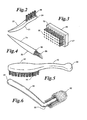
- FIG. 2 is an antimicrobial cosmetic brush according to the present invention.
- Cosmetic brushes are generally used to apply make-up or cosmetics to a person's face.
- the cosmetic brush has a body 21 with an elongate handle 22 and a head 24, a bristle portion 26 attached to the head 24, and an antimicrobial agent integrally associated with the cosmetic brush.
- an antimicrobial agent By incorporating an antimicrobial agent into the polymer body 21 of the cosmetic brush, infectious agents such as bacteria, germs or other pathogens contacting the cosmetic brush can be inactivated.
- FIG. 3 is an antimicrobial scrub brush according to the present invention.
- Scrub brushes are generally used to abrade tissue surfaces, such as skin, in order to breakup and remove contaminants.
- the scrub brush has a body 27 with an elongate handle 28 and a head 30, a bristle portion 32 attached to the head 30, and an antimicrobial agent integrally associated with the scrub brush.
- an antimicrobial agent By incorporating an antimicrobial agent into the polymer body 27 of the scrub brush, contaminants, such as germs and bacteria, that remain on the scrub brush are inactivated.
- FIG. 4 is an antimicrobial lip-color brush according to the present invention.
- Lip-color brushes are generally used to apply lip-color or lip-stick to a person's lips.
- the lip-color brush has a body 33 with an elongate handle 34 and a head 36, a bristle portion 38 attached to the head 36, and an antimicrobial agent integrally associated with the lip-color brush.
- an antimicrobial agent By incorporating an antimicrobial agent into the polymer body 33 of the lip-color brush, infection-causing agents, such as bacteria and viruses, remaining on the lip-color brush are inactivated.
- FIG. 5 is an antimicrobial hair brush according to the present invention.
- Hair brushes are generally used for hair care, such as detangling hair and removing dead hair follicles.
- the hair brush has a body 39 with an elongate handle 40 and a head 42, a bristle portion 44 attached to the head 42, and an antimicrobial agent integrally associated with the hair brush.
- an antimicrobial agent By incorporating an antimicrobial agent into the polymer body of the hair brush, bacteria, germs and viruses remaining on the hair brush are inactivated.
- FIG. 6 is an antimicrobial toilet bowl brush according to the present invention.
- Toilet bowl brushes are generally used to remove waste and cleanse toilet bowls.
- the toilet bowl brush has a body 46 with an elongate handle 48 and a head 50, a bristle portion 52 attached to the head 50, and an antimicrobial agent integrally associated with the toilet bowl brush.
- an antimicrobial agent By incorporating an antimicrobial agent into the polymer body of the toilet bowl brush, waste remaining on the toilet bowl brush are decontaminated.
- the present invention also provides anti-microbial protection that allows for controlled migration of an anti-microbial agent throughout a polymer.
- the present invention also provides a brush having an antimicrobial agent which is insoluble in water, thereby preventing any leaching of the agent during use of the brush.
- the present invention also provides a brush in which an antimicrobial agent can migrate on demand from the body of the brush to the bristle as abrasion removes the agent from the bristle surface.
Landscapes
- Brushes (AREA)
Claims (9)
- Eine Bürste, die antimikrobielle Charakteristika aufweist, die folgende Merkmale aufweist:einen Körper (12; 21; 27; 33; 39; 46), der einen Polymergriff (14; 22; 28; 34; 40; 48) und einen Polymerkopf (16; 24; 30; 36; 42; 50) aufweist, wobei der Polymergriff und der Polymerkopf aus einem Polymermaterial gebildet sind, das amorphe Zonen aufweist;eine Mehrzahl von synthetischen Borsten, die in dem Polymerkopf (16; 24; 30; 36; 42; 50) des Körpers eingebettet sind, wobei die synthetischen Borsten aus einem synthetischen Material gebildet sind;eine Grenzfläche zwischen dem Körper und der Mehrzahl von Polymerborsten; undein antimikrobielles Mittel, das dem Körper (12; 21; 27; 33; 39; 46) zugeordnet ist, dadurch gekennzeichnet, dass das antimikrobielle Mittel nicht ausgelaugt wird, dass das antimikrobielle Mittel in die amorphen Zonen des Polymers des Körpers (12; 21; 27; 33; 39; 46) eingegliedert ist, und dass das antimikrobielle Mittel eine gesteuerte Migration durch die amorphen Zonen des Polymermaterials des Körpers über die Grenzfläche zwischen dem Körper und den synthetischen Borsten und in das synthetische Material jeder der synthetischen Borsten aufweist.
- Eine Bürste gemäß Anspruch 1, bei der das antimikrobielle Mittel eine gesteuerte Migration durch das Polymermaterial aufweist, wenn ein Ungleichgewicht von Dampfdruck des antimikrobiellen Mittels einen Ausgleich erfordert.
- Eine Bürste gemäß Anspruch 1 oder 2, bei der das antimikrobielle Mittel ein chloriertes Phenol ist.
- Eine Bürste gemäß einem der Ansprüche 1 bis 3, bei der das antimikrobielle Mittel aus der Gruppe ausgewählt ist, die 5Chlor-2-(2,4-Dichlorphenoxy)Phenol und Polyhexamethylen-Biguanid-Hydrochlorid umfasst.
- Eine Bürste gemäß Anspruch 1, bei der das antimikrobielle Mittel in dem Polymermaterial in einer Menge von etwa 0,005 Gewichtsprozent bis etwa 2 Gewichtsprozent vorhanden ist.
- Eine Bürste gemäß Anspruch 1, bei der das antimikrobielle Mittel in dem Polymermaterial in einer Menge von etwa 0,15 Gewichtsprozent bis etwa 0,25 Gewichtsprozent vorhanden ist.
- Eine Bürste gemäß Anspruch 1 oder 2, bei der das Polymermaterial, das den Körper (12; 21; 27; 33; 39; 46) bildet, aus der Gruppe ausgewählt ist, die Polypropylen, Styren, Polystyren, Polyethylen, Ultrahochmolekulargewicht-Polyethylen, Acrylnitril-Butadien-Styren, Polyester, Polyesterelastomer, Polyesterurethan, eine Ethylen/Propylen-Legierung, Silikon, Polyvinylchlorid, chloriertes Polyvinylchlorid, Polyvinylidenfluorid, Vinylester, Celluloseacetatpropionat, Polycarbonat, eine Polyolefin-Legierung, Thermoplast und wärmehärtbaren Kunststoff umfasst.
- Eine Bürste gemäß einem der Ansprüche 1 bis 6, bei der die Bürste zum Fördern von Mundhygiene dient.
- Eine Bürste gemäß Anspruch 8, bei der das Polymermaterial, das den Körper (12; 21; 27; 33; 39; 46) bildet, aus der Gruppe ausgewählt ist, die Polypropylen, Styren, Polyvinylchlorid, Celluloseacetatpropionat, Polyethylen, Acrylnitril-Butadien-Styren, Santopren und Monopren umfasst.
Applications Claiming Priority (3)
| Application Number | Priority Date | Filing Date | Title |
|---|---|---|---|
| US85501997A | 1997-05-12 | 1997-05-12 | |
| US855019 | 1997-05-12 | ||
| PCT/US1998/009328 WO1998051189A1 (en) | 1997-05-12 | 1998-05-07 | Antimicrobial brush |
Publications (3)
| Publication Number | Publication Date |
|---|---|
| EP0984709A1 EP0984709A1 (de) | 2000-03-15 |
| EP0984709A4 EP0984709A4 (de) | 2005-01-12 |
| EP0984709B1 true EP0984709B1 (de) | 2006-08-23 |
Family
ID=25320140
Family Applications (1)
| Application Number | Title | Priority Date | Filing Date |
|---|---|---|---|
| EP98921027A Expired - Lifetime EP0984709B1 (de) | 1997-05-12 | 1998-05-07 | Antimikrobielle bürste |
Country Status (7)
| Country | Link |
|---|---|
| US (1) | US6108847A (de) |
| EP (1) | EP0984709B1 (de) |
| AT (1) | ATE336921T1 (de) |
| AU (1) | AU729156B2 (de) |
| DE (1) | DE69835671T2 (de) |
| ES (1) | ES2268773T3 (de) |
| WO (1) | WO1998051189A1 (de) |
Cited By (1)
| Publication number | Priority date | Publication date | Assignee | Title |
|---|---|---|---|---|
| US11607027B2 (en) | 2019-05-13 | 2023-03-21 | Wayne Carrick | Toothbrush and case |
Families Citing this family (62)
| Publication number | Priority date | Publication date | Assignee | Title |
|---|---|---|---|---|
| US6108850A (en) * | 1997-06-03 | 2000-08-29 | Mclaughlin; Gerald | Accelerated method and instrumentation for whitening teeth |
| US6138315A (en) * | 1998-01-13 | 2000-10-31 | Chesebrough-Pond's Usa Co., Divison Of Conopco, Inc. | Antimicrobial active compounds |
| DE19802142A1 (de) * | 1998-01-22 | 1999-07-29 | Otto Geb Kg | Polymerzusammensetzung, ihre Herstellung, ihre Weiterverarbeitung zu Behältnissen, insbesondere zu Lager- und Transportbehältnissen und Entsorgungsbehältnissen sowie die Verwendung von Phenolen zum Schutz des Behälterinhaltes in kunststoffenthaltenden Materialien, insbesondere aber in hieraus hergestellten Entsorgungsbehältnissen |
| US7168574B2 (en) * | 1999-04-22 | 2007-01-30 | King Technology | Dual filter |
| US6497936B1 (en) | 1999-06-14 | 2002-12-24 | Mannington Mills, Inc. | Method and apparatus for dyeing and treating yarns |
| DE10024223A1 (de) * | 2000-05-17 | 2001-11-22 | J E Faller Gmbh Buerstenfabrik | Bürste und Verfahren zu ihrer Herstellung |
| WO2002087388A1 (de) * | 2001-04-30 | 2002-11-07 | Klaus Neufeld | Behälter für reinigungsgeräte sowie einschubkörper, zahnbürste und speicherkörper |
| US20050000346A1 (en) * | 2001-05-04 | 2005-01-06 | Hartley Howard A. | Slicer with antimicrobial impregnated surfaces |
| US7160508B2 (en) * | 2001-09-05 | 2007-01-09 | The Gillette Company | Personal care products having elastomeric portions |
| JP2005514980A (ja) * | 2002-01-15 | 2005-05-26 | ザ ジレット カンパニー | 振動口内手入れ装置 |
| US20030134255A1 (en) * | 2002-01-15 | 2003-07-17 | The Gillette Company | Vibrating oral care device |
| KR20040108727A (ko) * | 2002-04-11 | 2004-12-24 | 가부시키가이샤 챠플로오즈 코포레이션 | 칫솔 |
| US20040211018A1 (en) * | 2002-07-03 | 2004-10-28 | Albert Canton | Multi-layer bristle |
| US20040037314A1 (en) * | 2002-08-23 | 2004-02-26 | Spear Stephen L. | Method and communication network for cross coding between codecs |
| US20060184189A1 (en) * | 2002-11-15 | 2006-08-17 | Lorin Olson | Cap for a dermal tissue lancing device |
| US20040112400A1 (en) * | 2002-12-16 | 2004-06-17 | Avon Products, Inc. | Applicator brush with improved bristles |
| US20040154115A1 (en) * | 2003-01-02 | 2004-08-12 | Spectrum Surgical Instruments, Inc. | Surgical instrument cleaning brush |
| US7578460B2 (en) * | 2003-06-17 | 2009-08-25 | Emerson Electric Co. | Food waste disposer having antimicrobial components |
| US6922865B1 (en) | 2004-02-05 | 2005-08-02 | Audley Logan, Sr. | Toilet scrubber |
| US20050246849A1 (en) * | 2004-05-10 | 2005-11-10 | Minkler Douglas J | Sanitizing handle for cleaning tool |
| US20050258093A1 (en) * | 2004-05-24 | 2005-11-24 | Microban Products Company | Antimicrobial activated carbon and method of making |
| US20060272113A1 (en) * | 2005-06-03 | 2006-12-07 | Cato Stefanie Y | Double sided toothbrush for cleaning teeth |
| US8092110B2 (en) | 2005-08-26 | 2012-01-10 | Colgate-Palmolive Company | Oral care instrument including an oral care agent |
| US20070143912A1 (en) * | 2005-12-27 | 2007-06-28 | Thorp Dale N | Drain-Clearing Device and System |
| US20070151061A1 (en) * | 2005-12-30 | 2007-07-05 | Gregory Mink | Applicator brush with cylindrical ferrule and angled tip |
| US7895698B2 (en) * | 2006-12-18 | 2011-03-01 | Fm Brush Co., Inc. | Applicator brush |
| FR2912417A1 (fr) * | 2007-02-08 | 2008-08-15 | Hexis Sa | Methode de protection antimicrobienne d'une surface d'un objet a l'aide d'un film plastique auto adhesif antimicorbien |
| US8065773B2 (en) * | 2007-04-02 | 2011-11-29 | Bard Access Systems, Inc. | Microbial scrub brush |
| US8336152B2 (en) * | 2007-04-02 | 2012-12-25 | C. R. Bard, Inc. | Insert for a microbial scrubbing device |
| US9192449B2 (en) | 2007-04-02 | 2015-11-24 | C. R. Bard, Inc. | Medical component scrubbing device with detachable cap |
| US8696820B2 (en) * | 2008-03-31 | 2014-04-15 | Bard Access Systems, Inc. | Method of removing a biofilm from a surface |
| US8104132B2 (en) * | 2008-09-26 | 2012-01-31 | Fm Brush Company, Inc. | Applicator brush |
| US8069523B2 (en) * | 2008-10-02 | 2011-12-06 | Bard Access Systems, Inc. | Site scrub brush |
| US20100132731A1 (en) * | 2008-12-01 | 2010-06-03 | Matthew Waitesmith | Ergonomic Cosmetic Brush |
| KR20120004495A (ko) * | 2009-04-01 | 2012-01-12 | 씨. 알. 바드, 인크. | 미생물 세정 장치 |
| EP2713747B1 (de) | 2011-05-24 | 2023-02-22 | Agienic, Inc. | Zusammensetzungen und verfahren für antimikrobielle metallnanopartikel |
| US9155310B2 (en) | 2011-05-24 | 2015-10-13 | Agienic, Inc. | Antimicrobial compositions for use in products for petroleum extraction, personal care, wound care and other applications |
| US9221081B1 (en) | 2011-08-01 | 2015-12-29 | Novellus Systems, Inc. | Automated cleaning of wafer plating assembly |
| US9988734B2 (en) | 2011-08-15 | 2018-06-05 | Lam Research Corporation | Lipseals and contact elements for semiconductor electroplating apparatuses |
| US9228270B2 (en) | 2011-08-15 | 2016-01-05 | Novellus Systems, Inc. | Lipseals and contact elements for semiconductor electroplating apparatuses |
| US10066311B2 (en) | 2011-08-15 | 2018-09-04 | Lam Research Corporation | Multi-contact lipseals and associated electroplating methods |
| US20140326192A1 (en) * | 2011-11-30 | 2014-11-06 | Coventry University | Antimicrobial animal product |
| WO2013148890A1 (en) | 2012-03-28 | 2013-10-03 | Novellus Systems, Inc. | Methods and apparatuses for cleaning electroplating substrate holders |
| TWI609100B (zh) | 2012-03-30 | 2017-12-21 | 諾發系統有限公司 | 使用反向電流除鍍以清洗電鍍基板夾持具 |
| DE102012106164B3 (de) * | 2012-07-10 | 2013-08-08 | Thorsten Brenner | Reinigungsgerät |
| WO2014054911A2 (ko) * | 2012-10-04 | 2014-04-10 | 비비씨 주식회사 | 칫솔모 제조방법 및 이를 이용한 칫솔 |
| US9746427B2 (en) | 2013-02-15 | 2017-08-29 | Novellus Systems, Inc. | Detection of plating on wafer holding apparatus |
| US10416092B2 (en) | 2013-02-15 | 2019-09-17 | Lam Research Corporation | Remote detection of plating on wafer holding apparatus |
| US9078723B1 (en) * | 2013-12-20 | 2015-07-14 | Armor Dental, Corp. | Dental oral shield device and system |
| WO2015138212A1 (en) | 2014-03-11 | 2015-09-17 | Michael Todd Lp | Personal care appliance |
| US10959510B2 (en) * | 2014-10-09 | 2021-03-30 | David Hyun Jong Cho | Toothbrush structure |
| USD757441S1 (en) * | 2014-12-09 | 2016-05-31 | F.S. Korea Industries Inc | Cosmetic brush head |
| US10058351B2 (en) | 2015-03-19 | 2018-08-28 | Michael Todd Beauty Lp | Personal care appliance |
| US10053793B2 (en) | 2015-07-09 | 2018-08-21 | Lam Research Corporation | Integrated elastomeric lipseal and cup bottom for reducing wafer sticking |
| US11103057B2 (en) | 2017-11-27 | 2021-08-31 | Colgate-Palmolive Company | Oral care implement |
| US11536805B2 (en) | 2018-06-25 | 2022-12-27 | Silc Technologies, Inc. | Optical switching for tuning direction of LIDAR output signals |
| USD900480S1 (en) | 2018-08-01 | 2020-11-03 | Fm Brush Co., Inc. | Angled chisel brush |
| EP3886994B1 (de) | 2018-11-27 | 2025-10-08 | Colgate-Palmolive Company | Mundpflegegerät mit einer lösekomponente |
| US11553783B2 (en) | 2019-11-08 | 2023-01-17 | Jacob Koby Ohayon | Interchangeable broom bristle with releasable agent |
| US11982743B2 (en) | 2021-04-29 | 2024-05-14 | Silc Technologies, Inc. | Reducing size of LIDAR system control assemblies |
| US12541009B2 (en) | 2021-06-17 | 2026-02-03 | Silc Technologies, Inc. | Scanning multiple LIDAR system output signals |
| WO2025096564A1 (en) | 2023-10-30 | 2025-05-08 | Ascend Performance Materials Operations Llc | Antimicrobial/antiviral brushes |
Family Cites Families (9)
| Publication number | Priority date | Publication date | Assignee | Title |
|---|---|---|---|---|
| US2216333A (en) | 1936-06-13 | 1940-10-01 | White | Antisepticized brush |
| US3857934A (en) * | 1971-02-02 | 1974-12-31 | Herculite Protective Fab | Activated polymer materials and process for making same |
| US5238749A (en) * | 1986-03-27 | 1993-08-24 | Clinitex Corporation | Antimicrobial coating process and product |
| US5061106A (en) | 1988-03-08 | 1991-10-29 | Colgate-Palmolive Company | Toothbrush with slow release of disinfectant and antibacterial agents and method of manufacturing the same |
| JPH0669408B2 (ja) * | 1988-03-16 | 1994-09-07 | デンタル化学株式会社 | 歯 ブ ラ シ |
| IL94294A (en) * | 1990-05-04 | 1992-11-15 | Hamivreshet Brush Factory Kibb | Toothbrush |
| US5503840A (en) * | 1991-08-09 | 1996-04-02 | E. I. Du Pont De Nemours And Company | Antimicrobial compositions, process for preparing the same and use |
| US5340581A (en) | 1991-08-23 | 1994-08-23 | Gillette Canada, Inc. | Sustained-release matrices for dental application |
| JPH06154030A (ja) * | 1993-07-06 | 1994-06-03 | Dentaru Kagaku Kk | 抗菌性アパタイトおよびそれを含有する抗菌性樹脂 |
-
1998
- 1998-05-07 EP EP98921027A patent/EP0984709B1/de not_active Expired - Lifetime
- 1998-05-07 ES ES98921027T patent/ES2268773T3/es not_active Expired - Lifetime
- 1998-05-07 AT AT98921027T patent/ATE336921T1/de not_active IP Right Cessation
- 1998-05-07 WO PCT/US1998/009328 patent/WO1998051189A1/en not_active Ceased
- 1998-05-07 AU AU73725/98A patent/AU729156B2/en not_active Ceased
- 1998-05-07 DE DE69835671T patent/DE69835671T2/de not_active Expired - Lifetime
-
1999
- 1999-05-10 US US09/309,029 patent/US6108847A/en not_active Expired - Lifetime
Cited By (1)
| Publication number | Priority date | Publication date | Assignee | Title |
|---|---|---|---|---|
| US11607027B2 (en) | 2019-05-13 | 2023-03-21 | Wayne Carrick | Toothbrush and case |
Also Published As
| Publication number | Publication date |
|---|---|
| WO1998051189A1 (en) | 1998-11-19 |
| DE69835671T2 (de) | 2007-08-23 |
| AU729156B2 (en) | 2001-01-25 |
| AU7372598A (en) | 1998-12-08 |
| ATE336921T1 (de) | 2006-09-15 |
| DE69835671D1 (de) | 2006-10-05 |
| US6108847A (en) | 2000-08-29 |
| ES2268773T3 (es) | 2007-03-16 |
| EP0984709A4 (de) | 2005-01-12 |
| EP0984709A1 (de) | 2000-03-15 |
Similar Documents
| Publication | Publication Date | Title |
|---|---|---|
| US6108847A (en) | Antimicrobial brush | |
| US5061106A (en) | Toothbrush with slow release of disinfectant and antibacterial agents and method of manufacturing the same | |
| EP0818160B1 (de) | Zahnbürstenzubehör | |
| US6267590B1 (en) | Antimicrobial dental products | |
| US6138315A (en) | Antimicrobial active compounds | |
| Nelson-Filho et al. | Evaluation of the contamination and disinfection methods of toothbrushes used by 24-to 48-month-old children | |
| KR100257842B1 (ko) | 마모 지시 매트릭스 | |
| EP1228717B1 (de) | Antimikrobielle und desodorierende Kosmetikbürste und Verfahren zu deren Herstellung | |
| WO2014054911A2 (ko) | 칫솔모 제조방법 및 이를 이용한 칫솔 | |
| CN1551735A (zh) | 具有包括抗菌剂的弹性部分的个人护理用品 | |
| US5633083A (en) | Toothbrush | |
| US6123477A (en) | Device and method for disinfecting the brush heads of toothbrushes | |
| EP0332026B1 (de) | Zahnbürste mit langsamer Abgabe von desinfizierenden und anti-bakteriellen Mitteln und Verfahren zu deren Herstellung | |
| US3920836A (en) | Sanitizing plastic material | |
| US5141290A (en) | Toothbrush | |
| EP0413833B1 (de) | Zahnbürste | |
| US3919410A (en) | Sanitizing plastic material | |
| EP1458419B1 (de) | Antimikrobieller kontaktlinsenbehälter | |
| CA2104462A1 (en) | Oral and personal hygiene articles containing active agents bonded to the surface thereof | |
| CN210901888U (zh) | 一种抗菌牙刷 | |
| EP0050438B1 (de) | Biozides Material | |
| KR100700662B1 (ko) | 항균 칫솔모 | |
| RU2845114C1 (ru) | Устройство для чистки съемных пластинчатых протезов | |
| JPH04361702A (ja) | ブラシ | |
| KR20040003756A (ko) | 항균성 칫솔 |
Legal Events
| Date | Code | Title | Description |
|---|---|---|---|
| PUAI | Public reference made under article 153(3) epc to a published international application that has entered the european phase |
Free format text: ORIGINAL CODE: 0009012 |
|
| 17P | Request for examination filed |
Effective date: 19991111 |
|
| AK | Designated contracting states |
Kind code of ref document: A1 Designated state(s): AT BE CH CY DE DK ES FI FR GB GR IE IT LI LU MC NL PT SE |
|
| A4 | Supplementary search report drawn up and despatched |
Effective date: 20041125 |
|
| RIC1 | Information provided on ipc code assigned before grant |
Ipc: 7A 46D 9/06 B Ipc: 7A 46B 9/04 B Ipc: 7A 46D 3/00 A |
|
| 17Q | First examination report despatched |
Effective date: 20050317 |
|
| GRAP | Despatch of communication of intention to grant a patent |
Free format text: ORIGINAL CODE: EPIDOSNIGR1 |
|
| GRAS | Grant fee paid |
Free format text: ORIGINAL CODE: EPIDOSNIGR3 |
|
| GRAA | (expected) grant |
Free format text: ORIGINAL CODE: 0009210 |
|
| AK | Designated contracting states |
Kind code of ref document: B1 Designated state(s): AT BE CH CY DE DK ES FI FR GB GR IE IT LI LU MC NL PT SE |
|
| PG25 | Lapsed in a contracting state [announced via postgrant information from national office to epo] |
Ref country code: NL Free format text: LAPSE BECAUSE OF FAILURE TO SUBMIT A TRANSLATION OF THE DESCRIPTION OR TO PAY THE FEE WITHIN THE PRESCRIBED TIME-LIMIT Effective date: 20060823 Ref country code: LI Free format text: LAPSE BECAUSE OF FAILURE TO SUBMIT A TRANSLATION OF THE DESCRIPTION OR TO PAY THE FEE WITHIN THE PRESCRIBED TIME-LIMIT Effective date: 20060823 Ref country code: IT Free format text: LAPSE BECAUSE OF FAILURE TO SUBMIT A TRANSLATION OF THE DESCRIPTION OR TO PAY THE FEE WITHIN THE PRESCRIBED TIME-LIMIT;WARNING: LAPSES OF ITALIAN PATENTS WITH EFFECTIVE DATE BEFORE 2007 MAY HAVE OCCURRED AT ANY TIME BEFORE 2007. THE CORRECT EFFECTIVE DATE MAY BE DIFFERENT FROM THE ONE RECORDED. Effective date: 20060823 Ref country code: FI Free format text: LAPSE BECAUSE OF FAILURE TO SUBMIT A TRANSLATION OF THE DESCRIPTION OR TO PAY THE FEE WITHIN THE PRESCRIBED TIME-LIMIT Effective date: 20060823 Ref country code: CH Free format text: LAPSE BECAUSE OF FAILURE TO SUBMIT A TRANSLATION OF THE DESCRIPTION OR TO PAY THE FEE WITHIN THE PRESCRIBED TIME-LIMIT Effective date: 20060823 Ref country code: BE Free format text: LAPSE BECAUSE OF FAILURE TO SUBMIT A TRANSLATION OF THE DESCRIPTION OR TO PAY THE FEE WITHIN THE PRESCRIBED TIME-LIMIT Effective date: 20060823 Ref country code: AT Free format text: LAPSE BECAUSE OF FAILURE TO SUBMIT A TRANSLATION OF THE DESCRIPTION OR TO PAY THE FEE WITHIN THE PRESCRIBED TIME-LIMIT Effective date: 20060823 |
|
| REG | Reference to a national code |
Ref country code: GB Ref legal event code: FG4D |
|
| REG | Reference to a national code |
Ref country code: CH Ref legal event code: EP |
|
| REG | Reference to a national code |
Ref country code: IE Ref legal event code: FG4D |
|
| REF | Corresponds to: |
Ref document number: 69835671 Country of ref document: DE Date of ref document: 20061005 Kind code of ref document: P |
|
| PG25 | Lapsed in a contracting state [announced via postgrant information from national office to epo] |
Ref country code: SE Free format text: LAPSE BECAUSE OF FAILURE TO SUBMIT A TRANSLATION OF THE DESCRIPTION OR TO PAY THE FEE WITHIN THE PRESCRIBED TIME-LIMIT Effective date: 20061123 Ref country code: DK Free format text: LAPSE BECAUSE OF FAILURE TO SUBMIT A TRANSLATION OF THE DESCRIPTION OR TO PAY THE FEE WITHIN THE PRESCRIBED TIME-LIMIT Effective date: 20061123 |
|
| PG25 | Lapsed in a contracting state [announced via postgrant information from national office to epo] |
Ref country code: PT Free format text: LAPSE BECAUSE OF FAILURE TO SUBMIT A TRANSLATION OF THE DESCRIPTION OR TO PAY THE FEE WITHIN THE PRESCRIBED TIME-LIMIT Effective date: 20070124 |
|
| ET | Fr: translation filed | ||
| NLV1 | Nl: lapsed or annulled due to failure to fulfill the requirements of art. 29p and 29m of the patents act | ||
| REG | Reference to a national code |
Ref country code: CH Ref legal event code: PL |
|
| REG | Reference to a national code |
Ref country code: ES Ref legal event code: FG2A Ref document number: 2268773 Country of ref document: ES Kind code of ref document: T3 |
|
| PLBE | No opposition filed within time limit |
Free format text: ORIGINAL CODE: 0009261 |
|
| STAA | Information on the status of an ep patent application or granted ep patent |
Free format text: STATUS: NO OPPOSITION FILED WITHIN TIME LIMIT |
|
| 26N | No opposition filed |
Effective date: 20070524 |
|
| PG25 | Lapsed in a contracting state [announced via postgrant information from national office to epo] |
Ref country code: MC Free format text: LAPSE BECAUSE OF NON-PAYMENT OF DUE FEES Effective date: 20070531 |
|
| PG25 | Lapsed in a contracting state [announced via postgrant information from national office to epo] |
Ref country code: GR Free format text: LAPSE BECAUSE OF FAILURE TO SUBMIT A TRANSLATION OF THE DESCRIPTION OR TO PAY THE FEE WITHIN THE PRESCRIBED TIME-LIMIT Effective date: 20061124 |
|
| PGFP | Annual fee paid to national office [announced via postgrant information from national office to epo] |
Ref country code: IE Payment date: 20080515 Year of fee payment: 11 |
|
| PG25 | Lapsed in a contracting state [announced via postgrant information from national office to epo] |
Ref country code: LU Free format text: LAPSE BECAUSE OF NON-PAYMENT OF DUE FEES Effective date: 20070507 Ref country code: CY Free format text: LAPSE BECAUSE OF FAILURE TO SUBMIT A TRANSLATION OF THE DESCRIPTION OR TO PAY THE FEE WITHIN THE PRESCRIBED TIME-LIMIT Effective date: 20060823 |
|
| PG25 | Lapsed in a contracting state [announced via postgrant information from national office to epo] |
Ref country code: IE Free format text: LAPSE BECAUSE OF NON-PAYMENT OF DUE FEES Effective date: 20090507 |
|
| PGFP | Annual fee paid to national office [announced via postgrant information from national office to epo] |
Ref country code: DE Payment date: 20140724 Year of fee payment: 17 |
|
| PGFP | Annual fee paid to national office [announced via postgrant information from national office to epo] |
Ref country code: GB Payment date: 20140723 Year of fee payment: 17 Ref country code: ES Payment date: 20140730 Year of fee payment: 17 Ref country code: FR Payment date: 20140723 Year of fee payment: 17 |
|
| PGFP | Annual fee paid to national office [announced via postgrant information from national office to epo] |
Ref country code: IT Payment date: 20140724 Year of fee payment: 17 |
|
| REG | Reference to a national code |
Ref country code: DE Ref legal event code: R119 Ref document number: 69835671 Country of ref document: DE |
|
| GBPC | Gb: european patent ceased through non-payment of renewal fee |
Effective date: 20150507 |
|
| PG25 | Lapsed in a contracting state [announced via postgrant information from national office to epo] |
Ref country code: IT Free format text: LAPSE BECAUSE OF NON-PAYMENT OF DUE FEES Effective date: 20150507 |
|
| REG | Reference to a national code |
Ref country code: FR Ref legal event code: ST Effective date: 20160129 |
|
| PG25 | Lapsed in a contracting state [announced via postgrant information from national office to epo] |
Ref country code: DE Free format text: LAPSE BECAUSE OF NON-PAYMENT OF DUE FEES Effective date: 20151201 Ref country code: GB Free format text: LAPSE BECAUSE OF NON-PAYMENT OF DUE FEES Effective date: 20150507 |
|
| PG25 | Lapsed in a contracting state [announced via postgrant information from national office to epo] |
Ref country code: FR Free format text: LAPSE BECAUSE OF NON-PAYMENT OF DUE FEES Effective date: 20150601 |
|
| REG | Reference to a national code |
Ref country code: ES Ref legal event code: FD2A Effective date: 20160627 |
|
| PG25 | Lapsed in a contracting state [announced via postgrant information from national office to epo] |
Ref country code: ES Free format text: LAPSE BECAUSE OF NON-PAYMENT OF DUE FEES Effective date: 20150508 |