EP0985391A2 - Verbandmaterial auf Folienbasis - Google Patents
Verbandmaterial auf Folienbasis Download PDFInfo
- Publication number
- EP0985391A2 EP0985391A2 EP99116456A EP99116456A EP0985391A2 EP 0985391 A2 EP0985391 A2 EP 0985391A2 EP 99116456 A EP99116456 A EP 99116456A EP 99116456 A EP99116456 A EP 99116456A EP 0985391 A2 EP0985391 A2 EP 0985391A2
- Authority
- EP
- European Patent Office
- Prior art keywords
- film
- adhesive
- dressing material
- dressing
- handle
- Prior art date
- Legal status (The legal status is an assumption and is not a legal conclusion. Google has not performed a legal analysis and makes no representation as to the accuracy of the status listed.)
- Withdrawn
Links
Images
Classifications
-
- A—HUMAN NECESSITIES
- A61—MEDICAL OR VETERINARY SCIENCE; HYGIENE
- A61L—METHODS OR APPARATUS FOR STERILISING MATERIALS OR OBJECTS IN GENERAL; DISINFECTION, STERILISATION OR DEODORISATION OF AIR; CHEMICAL ASPECTS OF BANDAGES, DRESSINGS, ABSORBENT PADS OR SURGICAL ARTICLES; MATERIALS FOR BANDAGES, DRESSINGS, ABSORBENT PADS OR SURGICAL ARTICLES
- A61L15/00—Chemical aspects of, or use of materials for, bandages, dressings or absorbent pads
- A61L15/16—Bandages, dressings or absorbent pads for physiological fluids such as urine or blood, e.g. sanitary towels, tampons
- A61L15/22—Bandages, dressings or absorbent pads for physiological fluids such as urine or blood, e.g. sanitary towels, tampons containing macromolecular materials
- A61L15/26—Macromolecular compounds obtained otherwise than by reactions only involving carbon-to-carbon unsaturated bonds; Derivatives thereof
-
- A—HUMAN NECESSITIES
- A61—MEDICAL OR VETERINARY SCIENCE; HYGIENE
- A61F—FILTERS IMPLANTABLE INTO BLOOD VESSELS; PROSTHESES; DEVICES PROVIDING PATENCY TO, OR PREVENTING COLLAPSING OF, TUBULAR STRUCTURES OF THE BODY, e.g. STENTS; ORTHOPAEDIC, NURSING OR CONTRACEPTIVE DEVICES; FOMENTATION; TREATMENT OR PROTECTION OF EYES OR EARS; BANDAGES, DRESSINGS OR ABSORBENT PADS; FIRST-AID KITS
- A61F13/00—Bandages or dressings; Absorbent pads
- A61F13/02—Adhesive bandages or dressings
- A61F13/023—Adhesive bandages or dressings wound covering film layers without a fluid retention layer
-
- A—HUMAN NECESSITIES
- A61—MEDICAL OR VETERINARY SCIENCE; HYGIENE
- A61F—FILTERS IMPLANTABLE INTO BLOOD VESSELS; PROSTHESES; DEVICES PROVIDING PATENCY TO, OR PREVENTING COLLAPSING OF, TUBULAR STRUCTURES OF THE BODY, e.g. STENTS; ORTHOPAEDIC, NURSING OR CONTRACEPTIVE DEVICES; FOMENTATION; TREATMENT OR PROTECTION OF EYES OR EARS; BANDAGES, DRESSINGS OR ABSORBENT PADS; FIRST-AID KITS
- A61F13/00—Bandages or dressings; Absorbent pads
- A61F2013/00361—Plasters
- A61F2013/00795—Plasters special helping devices
- A61F2013/00817—Plasters special helping devices handles or handling tabs
-
- A—HUMAN NECESSITIES
- A61—MEDICAL OR VETERINARY SCIENCE; HYGIENE
- A61F—FILTERS IMPLANTABLE INTO BLOOD VESSELS; PROSTHESES; DEVICES PROVIDING PATENCY TO, OR PREVENTING COLLAPSING OF, TUBULAR STRUCTURES OF THE BODY, e.g. STENTS; ORTHOPAEDIC, NURSING OR CONTRACEPTIVE DEVICES; FOMENTATION; TREATMENT OR PROTECTION OF EYES OR EARS; BANDAGES, DRESSINGS OR ABSORBENT PADS; FIRST-AID KITS
- A61F13/00—Bandages or dressings; Absorbent pads
- A61F2013/00361—Plasters
- A61F2013/00855—Plasters pervious to air or vapours
- A61F2013/00868—Plasters pervious to air or vapours thin film
-
- Y—GENERAL TAGGING OF NEW TECHNOLOGICAL DEVELOPMENTS; GENERAL TAGGING OF CROSS-SECTIONAL TECHNOLOGIES SPANNING OVER SEVERAL SECTIONS OF THE IPC; TECHNICAL SUBJECTS COVERED BY FORMER USPC CROSS-REFERENCE ART COLLECTIONS [XRACs] AND DIGESTS
- Y10—TECHNICAL SUBJECTS COVERED BY FORMER USPC
- Y10T—TECHNICAL SUBJECTS COVERED BY FORMER US CLASSIFICATION
- Y10T428/00—Stock material or miscellaneous articles
- Y10T428/14—Layer or component removable to expose adhesive
-
- Y—GENERAL TAGGING OF NEW TECHNOLOGICAL DEVELOPMENTS; GENERAL TAGGING OF CROSS-SECTIONAL TECHNOLOGIES SPANNING OVER SEVERAL SECTIONS OF THE IPC; TECHNICAL SUBJECTS COVERED BY FORMER USPC CROSS-REFERENCE ART COLLECTIONS [XRACs] AND DIGESTS
- Y10—TECHNICAL SUBJECTS COVERED BY FORMER USPC
- Y10T—TECHNICAL SUBJECTS COVERED BY FORMER US CLASSIFICATION
- Y10T428/00—Stock material or miscellaneous articles
- Y10T428/14—Layer or component removable to expose adhesive
- Y10T428/1476—Release layer
-
- Y—GENERAL TAGGING OF NEW TECHNOLOGICAL DEVELOPMENTS; GENERAL TAGGING OF CROSS-SECTIONAL TECHNOLOGIES SPANNING OVER SEVERAL SECTIONS OF THE IPC; TECHNICAL SUBJECTS COVERED BY FORMER USPC CROSS-REFERENCE ART COLLECTIONS [XRACs] AND DIGESTS
- Y10—TECHNICAL SUBJECTS COVERED BY FORMER USPC
- Y10T—TECHNICAL SUBJECTS COVERED BY FORMER US CLASSIFICATION
- Y10T428/00—Stock material or miscellaneous articles
- Y10T428/14—Layer or component removable to expose adhesive
- Y10T428/1486—Ornamental, decorative, pattern, or indicia
-
- Y—GENERAL TAGGING OF NEW TECHNOLOGICAL DEVELOPMENTS; GENERAL TAGGING OF CROSS-SECTIONAL TECHNOLOGIES SPANNING OVER SEVERAL SECTIONS OF THE IPC; TECHNICAL SUBJECTS COVERED BY FORMER USPC CROSS-REFERENCE ART COLLECTIONS [XRACs] AND DIGESTS
- Y10—TECHNICAL SUBJECTS COVERED BY FORMER USPC
- Y10T—TECHNICAL SUBJECTS COVERED BY FORMER US CLASSIFICATION
- Y10T428/00—Stock material or miscellaneous articles
- Y10T428/14—Layer or component removable to expose adhesive
- Y10T428/149—Sectional layer removable
-
- Y—GENERAL TAGGING OF NEW TECHNOLOGICAL DEVELOPMENTS; GENERAL TAGGING OF CROSS-SECTIONAL TECHNOLOGIES SPANNING OVER SEVERAL SECTIONS OF THE IPC; TECHNICAL SUBJECTS COVERED BY FORMER USPC CROSS-REFERENCE ART COLLECTIONS [XRACs] AND DIGESTS
- Y10—TECHNICAL SUBJECTS COVERED BY FORMER USPC
- Y10T—TECHNICAL SUBJECTS COVERED BY FORMER US CLASSIFICATION
- Y10T428/00—Stock material or miscellaneous articles
- Y10T428/24—Structurally defined web or sheet [e.g., overall dimension, etc.]
- Y10T428/24777—Edge feature
-
- Y—GENERAL TAGGING OF NEW TECHNOLOGICAL DEVELOPMENTS; GENERAL TAGGING OF CROSS-SECTIONAL TECHNOLOGIES SPANNING OVER SEVERAL SECTIONS OF THE IPC; TECHNICAL SUBJECTS COVERED BY FORMER USPC CROSS-REFERENCE ART COLLECTIONS [XRACs] AND DIGESTS
- Y10—TECHNICAL SUBJECTS COVERED BY FORMER USPC
- Y10T—TECHNICAL SUBJECTS COVERED BY FORMER US CLASSIFICATION
- Y10T428/00—Stock material or miscellaneous articles
- Y10T428/24—Structurally defined web or sheet [e.g., overall dimension, etc.]
- Y10T428/24777—Edge feature
- Y10T428/24793—Comprising discontinuous or differential impregnation or bond
Definitions
- the invention relates to a dressing material based on film, which is self-adhesive on one side is equipped and on which at least one non-sticky handle is molded
- Adhesive-coated carrier systems which detach from the carrier on pull are known. She are usually based on elastic systems, which are often laminates.
- DE-OS 27 28 346 describes such an adhesive tape, which consists of a stretchable film and an adhesive based on A-B-A block copolymers.
- the all-over laminate is easy to remove from the surface by stretching.
- the Adhesive is applied all over. A handle to stretch the bonded tape is not scheduled.
- DE-OS 195 31 696 describes an adhesive film laminate which consists of a stretchable Carrier and an acrylic adhesive is produced.
- WO 95/06691 discloses a removable adhesive tape which is a foam Has carrier material.
- WO 92/11333 describes a non-destructive removable system, which has a high Tear resistance.
- DE 40 26 755 A1 discloses a bandage material based on film, which is covered on one side with a support material which is the same size as the film and has at least one grip strip, and is provided with a self-adhesive layer on the other side.
- the handle strips for removing the carrier material are arranged within its circumference.
- Preferably only one grip bar is attached to the carrier material.
- DE 43 14 834 C2 describes a bandage material based on film which is covered on one side with a backing material which is the same size as the film and has at least one grip strip and is provided with a self-adhesive layer on the other side.
- the handle strips for removing the carrier material are arranged within its circumference.
- Preferably only one grip bar is attached to the carrier material.
- an adhesive tape section which consists of an adhesive exists, which is covered on one side with a thin cover film. On the opposite side are two further sections of a film on the adhesive available, so that there are two handles in the edge area, the middle of which Adhesive tape section can be detached from the substrate by pulling in the bonding plane can.
- the object of the invention is to overcome the disadvantages known from the prior art avoid and to provide a film-based dressing material that is one-sided is self-adhesive and can be stretched easily and painlessly the application can be peeled off on the skin.
- a dressing material based on film wherein the film consists of polyurethane, the film self-adhesive on one side is equipped and wherein at least one non-sticky handle is molded onto the film is so that the dressing material after application by pulling on the handle Direction of the bond plane is removable from the surface.
- the bandage film itself consists of elastic, thermoplastic polyurethanes, such as them are described in DE-C 19 34 710 and are characterized by good skin tolerance as well as oxygen and water vapor permeability. Particularly advantageous aliphatic polyester urethanes have been found.
- a preferred film is about 30 to 40 microns thick, transparent, has an elongation at break of over 450% and a water vapor permeability of over 500 g / m 2 in 24 hours at 38 ° C and 95% relative humidity according to DAB.
- the thickness of the film can be between about 15 to 300, preferably 15 to 80 microns, the weight accordingly between about 15 to 350 g / m 2 , preferably 15 to 100 g / m 2 , the maximum tensile force longitudinally between about 5 to 100 N / cm, preferably 2 to 40 N / cm, and the elongation at break is between about 100 to 1000%.
- the adhesion of the film to the carrier material which only needs to be low (approx. 0.01 to 0.5 N / cm, preferably 0.01 to 0.05 N / cm), is preferably effected in that the thin film is produced directly on the carrier by casting, knife coating, extrusion or other known methods of film making. If necessary, the backing material roughened on the coating side or another adhesion-promoting treatment be subjected. An adhesion-promoting coating can also be advantageous.
- the handles are in particular at the edge of the film, so that the Production of the dressing material is not further complicated. Preferably only one Handle available. By pulling the handle essentially in the direction of At the bonding level, the film is stretched and at the same time surprisingly dissolves painless from the underlying skin.
- the handler can use as little sealing paper as possible for the individually punched plaster or use other packaging material, folded so that it on the side of the film that is not coated with the adhesive.
- the film is on one side with a Carrier material covered, which has the same size as the film and at least one Has grip bar.
- the carrier material which has a supporting effect for the film, when the Dressing remains on this and is only subsequently removed, is preferably made of a polyethylene film of about 80 ⁇ m in thickness, which is light on its side towards the film is roughened and therefore matt, but still translucent.
- the surface of the film can be smooth, roughened or slightly embossed.
- the handle strips preferably consist of an LDPE film (low density polyethylene film) 80 ⁇ m thick. In order to be clearly visible, for example, it is colored blue and matt embossed on the outside due to the better grip.
- LDPE film low density polyethylene film
- the thickness can vary between 10 and 300 ⁇ m, the weight between 10 and 350 g / m 2 .
- the surface can be matt, glossy, rough, smooth or printed.
- the maximum longitudinal tensile force can vary between approximately 3 and 100 N / cm, depending on the material, and the resulting elongation can vary between 5 and 500%.
- the attachment of the handle strips to the carrier material can depend on the material and Processing machines are carried out in various ways, preferably by gluing or welding.
- the gluing takes place, for example, in such a way that between the backing material and the grip strip in the area to be glued a strip a double-sided adhesive tape is introduced or a Adhesive coating from a hot melt or a self-adhesive Solvent or dispersion.
- the handle strips can extend over the entire length or width of the dressing, they can also be flush on at least one side edge.
- the grip strips can be arranged within the perimeter of the dressing material, but they can also protrude beyond the edge of the dressing material.
- the grip strips preferably consist of an LDPE film.
- only one grip strip is attached to the carrier material. Then it has proven to be advantageous if the grip strip is fastened to the carrier material in a narrow strip-like edge area and has a free grip area of at least about 5 mm on one side to the left or right thereof, or if the grip strip is in a central narrow, strip-shaped region on the carrier material is attached and on both sides thereof has a free grip area of at least about 5 mm in width.
- the adhesive layer on the film preferably has, for example, an adhesive force on steel about 2 to 4 N / cm, the test material, because the film is very stretchy, for the Measurement must be reinforced on the back with an inelastic adhesive film.
- the measurement itself was based on DAB 9.
- the dressing material can be used as such, but it can also be used in addition a customary absorbent wound dressing can be applied in the middle in a suitable width, which is smaller than the adhesive surface so that it can be used directly as a wound dressing.
- Such a bandage with all-round gluing is particularly advantageous because it is germ-tight and is waterproof.
- the dressing material has a Tensile load of 10 N / cm has an elongation of greater than 10% to 3000%, especially preferably 20% to 1000%.
- the dressing material according to the invention consists of an anionic aliphatic Polyester polyurethane dispersion film (Impranil ® DLN dispersion from Bayer), and in the dimension 50 x 50 mm.
- the film has a thickness of 0.1 mm.
- the film is cross-linked on one side with a skin-compatible adhesive layer Polyacrylic acid derivatives coated.
- the dressing material should be removed from the skin by pulling on a non-adhesive handle with the dimensions 10 x 50 mm present on one of the edges of the film. By pulling, the film is removed, so that the dressing material can be accepted without pain.
- the dressing material according to the invention is analogous to Example 1 from a polyurethane gel Cutinova thin "® from Beiersdorf AG, which is additionally covered with the polyester-polyurethane dispersion film (Impranil ® DLN dispersion from Bayer) from Example 2.
- This wound dressing is also painlessly removed after application possible by glue-free on one of the edges of the film Handle with the dimensions 10 x 50 mm is pulled.
Landscapes
- Health & Medical Sciences (AREA)
- Public Health (AREA)
- Engineering & Computer Science (AREA)
- Chemical & Material Sciences (AREA)
- Veterinary Medicine (AREA)
- Life Sciences & Earth Sciences (AREA)
- Animal Behavior & Ethology (AREA)
- General Health & Medical Sciences (AREA)
- Vascular Medicine (AREA)
- Heart & Thoracic Surgery (AREA)
- Biomedical Technology (AREA)
- Chemical Kinetics & Catalysis (AREA)
- Hematology (AREA)
- Materials Engineering (AREA)
- Epidemiology (AREA)
- Materials For Medical Uses (AREA)
Abstract
Description
Die DE 43 14 834 C2 beschreibt ein Verbandmaterial auf Folienbasis, das auf der einen Seite mit einem Trägermaterial abgedeckt ist, das die gleiche Größe wie die Folie besitzt und mindestens eine Griffleiste aufweist, und auf der anderen Seite mit einer selbstklebenden Schicht versehen ist. Die Griffleisten zur Entfernung des Trägermaterials sind innerhalb seiner Umfangsbegrenzung angeordnet. Vorzugsweise ist nur eine Griffleiste auf dem Trägermaterial angebracht.
Bei beiden der oben erwähnten Verbänden stellt sich nach der Applizierung das Problem, diese von der Hat abzulösen, weil diese vollflächig verklebt sind. Der Patient ist daher gezwungen, im Randbereich der Folie ein Stück derselben von der Haut abzuheben, indem er beispielsweise mit dem Fingernagel unter die Folie geht. Dieses Vorgehen ist zum einen sehr unbefriedigend, kann zum anderen insbesondere bei größeren Wunden und der damit einhergehenden gereizten Haut schmerzhaft sein.
- Dicke:
- 30 - 300 µm
- Gewicht:
- 30-350 g/m2
- Höchstzugkraft längs:
- 5 - 100 N/cm
- Reißdehnung längs:
- 10 - 3000%
Die Griffleisten können innerhalb der Umfassungsbegrenzung des Verbandmaterials angeordnet sein, sie können aber auch über den Rand des Verbandmaterials hinausstehen.
Vorzugsweise bestehen die Griffleisten aus einer LDPE-Folie.
Vorteilhafterweise ist nur eine Griffleiste auf dem Trägermaterial angebracht. Dann hat es sich als vorteilhaft erwiesen, wenn die Griffleiste in einem schmalen streifenförmigen Randbereich auf dem Trägermaterial befestigt ist und einseitig links oder rechts davon einen freien Anfaßbereich von mindestens etwa 5 mm aufweist beziehungsweise wenn die Griffleiste in einem mittigen schmalen, streifenförmigen Bereich auf dem Trägermaterial befestigt ist und zweiseitig davon einen freien Anfaßbereich von mindestens etwa 5 mm Breite aufweist.
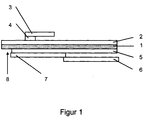
- (1)
- die Folie,
- (2)
- den Träger,
- (3)
- die Griffleiste,
- (4)
- eine Klebeschicht zur Befestigung der Griffleiste am Träger,
- (5)
- die Selbstklebeschicht,
- (6) und (7)
- die Schutzabdeckungen für die Selbstklebeschicht und
- (8)
- der an der Folie angeformte Anfasser.
Durch das Ziehen kommt es zum Entkleben der Folie, so daß das Verbandmaterial schmerzfrei angenommen werden kann.

Claims (5)
- Verbandmaterial auf Folienbasis, wobei die Folie aus Polyurethan besteht, wobei die Folie einseitig selbstklebend ausgerüstet ist und wobei an der Folie zumindest ein nicht klebender Anfasser angeformt ist, so daß das Verbandmaterial nach der Applizierung durch Ziehen am Anfasser in Richtung der Verklebungsebene vom Untergrund ablösbar ist.
- Verbandmaterial gemäß Anspruch 1, dadurch gekennzeichnet, daß die Folie auf der einen Seite mit einem Trägermaterial abgedeckt ist, das die gleiche Größe wie die Folie besitzt und mindestens eine Griftleiste aufweist.
- Verbandmaterial gemäß Anspruch 1 und 2, dadurch gekennzeichnet, daß auf der klebenden Seite eine Wundaufiage angeordnet ist, welche kleiner als die Klebefläche ist.
- Verbandmaterial gemäß Anspruch 1 bis 3, dadurch gekennzeichnet, daß die selbstklebende Seite mit einer abziehbaren Schutzabdeckung versehen ist.
- Verbandmaterial gemäß Anspruch 1 bis 4, dadurch gekennzeichnet, daß die Folie bei einer Zugbelastung von 10 N/cm eine Dehnung von größer 10% bis 3000% aufweist, besonders bevorzugt 20% bis 1000%.
Applications Claiming Priority (2)
| Application Number | Priority Date | Filing Date | Title |
|---|---|---|---|
| DE19841550 | 1998-09-11 | ||
| DE19841550A DE19841550A1 (de) | 1998-09-11 | 1998-09-11 | Verbandmaterial auf Folienbasis |
Publications (2)
| Publication Number | Publication Date |
|---|---|
| EP0985391A2 true EP0985391A2 (de) | 2000-03-15 |
| EP0985391A3 EP0985391A3 (de) | 2000-08-02 |
Family
ID=7880590
Family Applications (1)
| Application Number | Title | Priority Date | Filing Date |
|---|---|---|---|
| EP99116456A Withdrawn EP0985391A3 (de) | 1998-09-11 | 1999-08-21 | Verbandmaterial auf Folienbasis |
Country Status (4)
| Country | Link |
|---|---|
| US (1) | US6495230B1 (de) |
| EP (1) | EP0985391A3 (de) |
| AU (1) | AU4463499A (de) |
| DE (1) | DE19841550A1 (de) |
Cited By (7)
| Publication number | Priority date | Publication date | Assignee | Title |
|---|---|---|---|---|
| WO2002089719A1 (en) * | 2001-05-02 | 2002-11-14 | 3M Innovative Properties Company | Tapered stretch removable adhesive articles and methods |
| WO2002072162A3 (en) * | 2001-01-17 | 2003-04-03 | 3M Innovative Properties Co | Stretch removable adhesive articles and methods |
| WO2003017899A3 (en) * | 2001-08-21 | 2003-11-27 | 3M Innovative Properties Co | Stretch removable adhesive articles and methods |
| EP1400251A1 (de) * | 2001-01-17 | 2004-03-24 | 3M Innovative Properties Company | Durch Dehnung entfernbare adhäsive Artikel und Methoden |
| DE10312452A1 (de) * | 2003-03-20 | 2004-09-30 | Lohmann & Rauscher Gmbh & Co. Kg | Wundversorgungsprodukt mit Abziehhilfe und Verfahren zur Herstellung desselben |
| WO2007090592A1 (de) * | 2006-02-07 | 2007-08-16 | Paul Hartmann Ag | Folienverband mit verbesserter applikationshilfe |
| EP2482774A4 (de) * | 2009-09-30 | 2014-05-28 | Moelnlycke Health Care Ab | Verfahren zur anbringung von greiflaschen an der trägerschicht eines folienverbands |
Families Citing this family (50)
| Publication number | Priority date | Publication date | Assignee | Title |
|---|---|---|---|---|
| US7214847B1 (en) | 1997-09-22 | 2007-05-08 | Argentum Medical, L.L.C. | Multilayer conductive appliance having wound healing and analgesic properties |
| US6087549A (en) | 1997-09-22 | 2000-07-11 | Argentum International | Multilayer laminate wound dressing |
| US8801681B2 (en) | 1995-09-05 | 2014-08-12 | Argentum Medical, Llc | Medical device |
| US8455710B2 (en) | 1997-09-22 | 2013-06-04 | Argentum Medical, Llc | Conductive wound dressings and methods of use |
| US6861570B1 (en) | 1997-09-22 | 2005-03-01 | A. Bart Flick | Multilayer conductive appliance having wound healing and analgesic properties |
| US5814094A (en) | 1996-03-28 | 1998-09-29 | Becker; Robert O. | Iontopheretic system for stimulation of tissue healing and regeneration |
| DE19950295A1 (de) * | 1999-10-19 | 2001-04-26 | Beiersdorf Ag | Verbandmaterial auf Folienbasis mit Aufdruck |
| US6831205B2 (en) * | 1999-11-29 | 2004-12-14 | Clozex Medical, Llc | Bandage for wound or incision closure |
| EP1260565B1 (de) * | 2001-05-11 | 2006-03-29 | Nitto Denko Corporation | Druckempfindliches Klebeband zum Fixieren einer Gelenkpartie und Anwendungsverfahren |
| DE10148273A1 (de) * | 2001-09-28 | 2003-04-24 | Tesa Ag | Schönheitspflaster |
| DE10207776A1 (de) * | 2002-02-23 | 2003-09-04 | Tesa Ag | Verfahren zur Herstellung eines partiell beschichteten Pflasters |
| US20040204740A1 (en) * | 2003-04-14 | 2004-10-14 | Weiser Leslie Philipp | Method and apparatus for closing wounds without sutures |
| US7981136B2 (en) * | 2003-04-14 | 2011-07-19 | Weiser Leslie P | Wound closure device |
| US20070094852A1 (en) * | 2003-05-27 | 2007-05-03 | Yen-Ping Sun | Waterproof zipper |
| TWI220106B (en) * | 2003-05-27 | 2004-08-11 | Sun Yen Ping | Method for producing zipper with waterproof layer lined in the cloth belt and product thereof |
| AU2004248138B2 (en) | 2003-05-29 | 2009-09-03 | The Scripps Research Institute | Targeted delivery to legumain-expressing cells |
| US7838718B2 (en) * | 2003-07-24 | 2010-11-23 | Clozex Medical, Llc | Device for laceration or incision closure |
| US7414168B2 (en) * | 2003-07-24 | 2008-08-19 | Clozex Medical Llc | Device for laceration or incision closure |
| US7354446B2 (en) * | 2003-07-24 | 2008-04-08 | Clozex Medical, Llc | Device for laceration or incision closure |
| US8636763B2 (en) * | 2003-07-24 | 2014-01-28 | Clozex Medical, Llc | Device for laceration or incision closure |
| DE10337879B4 (de) * | 2003-08-18 | 2007-01-11 | Silu Verwaltung Ag | Sebstklebendes Band |
| US7332641B2 (en) | 2003-10-10 | 2008-02-19 | Clozex Medical Llc | Interlaced compositions and methods of production |
| FR2870113B1 (fr) * | 2004-05-12 | 2006-08-04 | Alexis Butavand | Dispositif d'enlevement du film de renfort des pansements adhesifs medicaux a film mince en polyurethane au moyen d'un adhesif integre au pansement |
| US7563941B2 (en) * | 2004-09-10 | 2009-07-21 | Clozex Medical, Llc | Modular wound dressing system |
| DE102005009635A1 (de) * | 2005-03-03 | 2006-09-07 | Paul Hartmann Ag | Folienverband mit Applikationshilfe |
| DE102005009634A1 (de) * | 2005-03-03 | 2006-09-07 | Paul Hartmann Ag | Folienverband mit verbesserter Applikationshilfe |
| US20060232059A1 (en) * | 2005-04-14 | 2006-10-19 | Fortune Robert G M | Thermochromic decals for moist or wet environments with changing temperatures |
| US8105353B2 (en) | 2005-08-09 | 2012-01-31 | Clozex Medical, Llc | Wound closure kit and method of using the same |
| US20070038246A1 (en) * | 2005-08-09 | 2007-02-15 | Clozex Medical, Llc | Four component wound closure device with locking strip |
| US20070208232A1 (en) * | 2006-03-03 | 2007-09-06 | Physiowave Inc. | Physiologic monitoring initialization systems and methods |
| US7668588B2 (en) * | 2006-03-03 | 2010-02-23 | PhysioWave, Inc. | Dual-mode physiologic monitoring systems and methods |
| US8200320B2 (en) * | 2006-03-03 | 2012-06-12 | PhysioWave, Inc. | Integrated physiologic monitoring systems and methods |
| KR101499080B1 (ko) | 2006-08-03 | 2015-03-06 | 더 보드 오브 트러스티스 오브 더 리랜드 스탠포드 쥬니어 유니버시티 | 반흔 및/또는 켈로이드의 치료 또는 예방을 위한 디바이스 및 붕대와 그것을 위한 방법 및 키트 |
| US9358009B2 (en) | 2007-08-03 | 2016-06-07 | Neodyne Biosciences, Inc. | Skin straining devices and methods |
| US8592640B2 (en) | 2009-08-11 | 2013-11-26 | Neodyne Biosciences, Inc. | Devices and methods for dressing applicators |
| US20090082710A1 (en) * | 2007-09-26 | 2009-03-26 | Vitaris Ronald F | Delivery system for a wound dressing |
| US20100106120A1 (en) * | 2008-10-24 | 2010-04-29 | 3M Innovative Properties Company | Wound dressing |
| US8581017B2 (en) * | 2008-10-24 | 2013-11-12 | 3M Innovative Properties Company | Conformable wound dressing |
| BR112012008536B1 (pt) * | 2009-10-13 | 2017-10-10 | Bayer Cropscience Lp | Method for coating felipe cotton garments, cargo coating, process for intensifying garment germination, and use of the fabrics so obtained |
| WO2012094648A1 (en) | 2011-01-07 | 2012-07-12 | Neodyne Biosciences, Inc. | Wound or skin treatment devices and methods |
| US20120226214A1 (en) | 2011-03-03 | 2012-09-06 | Neodyne Biosciences, Inc. | Devices and methods for skin tightening |
| US8381498B2 (en) | 2011-07-20 | 2013-02-26 | Marc Irwin Epstein | Method of manufacturing a dressing package |
| US10561359B2 (en) | 2011-12-02 | 2020-02-18 | Neodyne Biosciences, Inc. | Elastic devices, methods, systems and kits for selecting skin treatment devices |
| US8272507B1 (en) | 2011-12-02 | 2012-09-25 | Visionary Products, Inc. | Kit of a plurality of detachable pockets, a detachable pocket, and associated methods |
| US10213350B2 (en) | 2012-02-08 | 2019-02-26 | Neodyne Biosciences, Inc. | Radially tensioned wound or skin treatment devices and methods |
| CA3019513A1 (en) | 2016-03-31 | 2017-10-05 | Senju Usa, Inc. | Adhesive skin patch |
| WO2019216423A1 (ja) * | 2018-05-11 | 2019-11-14 | 日東電工株式会社 | 貼付材 |
| CN114450368A (zh) * | 2019-10-04 | 2022-05-06 | 3M创新有限公司 | 用于可剥离固定的膜背衬 |
| CN115103639B (zh) | 2019-12-10 | 2025-03-18 | 尼欧迪纳生物科学公司 | 注射和输注部位处理装置和方法 |
| US20220379018A1 (en) | 2019-12-10 | 2022-12-01 | Neodyne Biosciences, Inc. | Tensioned infusion systems with removable hubs |
Citations (6)
| Publication number | Priority date | Publication date | Assignee | Title |
|---|---|---|---|---|
| DE2728346A1 (de) | 1976-06-23 | 1978-01-05 | Johnson & Johnson | Klebeband |
| DE4026755A1 (de) | 1990-08-24 | 1992-02-27 | Beiersdorf Ag | Verbandmaterial auf folienbasis |
| WO1992011333A1 (en) | 1990-12-20 | 1992-07-09 | Minnesota Mining And Manufacturing Company | Removable adhesive tape |
| WO1995006691A1 (en) | 1993-08-31 | 1995-03-09 | Minnesota Mining And Manufacturing Company | Removable foam adhesive tape |
| DE19531696A1 (de) | 1995-08-29 | 1997-03-06 | Beiersdorf Ag | Mehrfache Verwendung eines Klebfolien-Laminats |
| DE4314834C2 (de) | 1993-05-05 | 1998-04-30 | Beiersdorf Ag | Verbandmaterial auf Folienbasis |
Family Cites Families (11)
| Publication number | Priority date | Publication date | Assignee | Title |
|---|---|---|---|---|
| NO134790C (no) | 1968-07-09 | 1984-03-22 | Smith & Nephew | Klebende,; trykkfoelsomt, vanndamp-permeabelt produkt for bruk paa hud hos mennesker. |
| US3600616A (en) | 1968-08-01 | 1971-08-17 | Mitsubishi Electric Corp | Clutch motor with electromagnetically operated auxiliary braking means |
| CA1180244A (en) * | 1981-06-10 | 1985-01-02 | Jerome D. Muchin | Delivery system for adhesively affixed copolymer medical coverings |
| US4600001A (en) * | 1984-08-15 | 1986-07-15 | The Kendall Company | Combined wound dressing and delivery means composite |
| DE3809539A1 (de) * | 1988-03-22 | 1989-10-05 | Beiersdorf Ag | Klebematerial fuer medizinische zwecke |
| GB8820563D0 (en) * | 1988-08-31 | 1988-09-28 | Britcair Ltd | Adhesive dressings |
| FR2690617B1 (fr) * | 1992-04-29 | 1994-06-24 | Cbh Textile | Pansement adhesif transparent. |
| FR2711056B1 (fr) * | 1993-10-15 | 1996-01-19 | Hydrex Lab Sa | Pansement adhésif absorbant. |
| DE69629622T2 (de) * | 1995-06-06 | 2004-06-03 | Beiersdorf Ag | Klebeband |
| DE19649728A1 (de) * | 1996-11-30 | 1998-06-18 | Beiersdorf Ag | Klebeband |
| DE19755222A1 (de) * | 1997-12-12 | 1999-06-24 | Beiersdorf Ag | Selbstklebend ausgerüstetes Trägermaterial |
-
1998
- 1998-09-11 DE DE19841550A patent/DE19841550A1/de not_active Withdrawn
-
1999
- 1999-08-20 AU AU44634/99A patent/AU4463499A/en not_active Abandoned
- 1999-08-21 EP EP99116456A patent/EP0985391A3/de not_active Withdrawn
- 1999-09-09 US US09/392,431 patent/US6495230B1/en not_active Expired - Fee Related
Patent Citations (6)
| Publication number | Priority date | Publication date | Assignee | Title |
|---|---|---|---|---|
| DE2728346A1 (de) | 1976-06-23 | 1978-01-05 | Johnson & Johnson | Klebeband |
| DE4026755A1 (de) | 1990-08-24 | 1992-02-27 | Beiersdorf Ag | Verbandmaterial auf folienbasis |
| WO1992011333A1 (en) | 1990-12-20 | 1992-07-09 | Minnesota Mining And Manufacturing Company | Removable adhesive tape |
| DE4314834C2 (de) | 1993-05-05 | 1998-04-30 | Beiersdorf Ag | Verbandmaterial auf Folienbasis |
| WO1995006691A1 (en) | 1993-08-31 | 1995-03-09 | Minnesota Mining And Manufacturing Company | Removable foam adhesive tape |
| DE19531696A1 (de) | 1995-08-29 | 1997-03-06 | Beiersdorf Ag | Mehrfache Verwendung eines Klebfolien-Laminats |
Cited By (11)
| Publication number | Priority date | Publication date | Assignee | Title |
|---|---|---|---|---|
| WO2002072162A3 (en) * | 2001-01-17 | 2003-04-03 | 3M Innovative Properties Co | Stretch removable adhesive articles and methods |
| EP1400251A1 (de) * | 2001-01-17 | 2004-03-24 | 3M Innovative Properties Company | Durch Dehnung entfernbare adhäsive Artikel und Methoden |
| US7078582B2 (en) | 2001-01-17 | 2006-07-18 | 3M Innovative Properties Company | Stretch removable adhesive articles and methods |
| WO2002089719A1 (en) * | 2001-05-02 | 2002-11-14 | 3M Innovative Properties Company | Tapered stretch removable adhesive articles and methods |
| US6894204B2 (en) | 2001-05-02 | 2005-05-17 | 3M Innovative Properties Company | Tapered stretch removable adhesive articles and methods |
| WO2003017899A3 (en) * | 2001-08-21 | 2003-11-27 | 3M Innovative Properties Co | Stretch removable adhesive articles and methods |
| DE10312452A1 (de) * | 2003-03-20 | 2004-09-30 | Lohmann & Rauscher Gmbh & Co. Kg | Wundversorgungsprodukt mit Abziehhilfe und Verfahren zur Herstellung desselben |
| DE10312452B4 (de) * | 2003-03-20 | 2014-12-24 | Lohmann & Rauscher Gmbh & Co. Kg | Verfahren zum Herstellen eines Wundversorgungsproduktes |
| WO2007090592A1 (de) * | 2006-02-07 | 2007-08-16 | Paul Hartmann Ag | Folienverband mit verbesserter applikationshilfe |
| EP2482774A4 (de) * | 2009-09-30 | 2014-05-28 | Moelnlycke Health Care Ab | Verfahren zur anbringung von greiflaschen an der trägerschicht eines folienverbands |
| US9486366B2 (en) | 2009-09-30 | 2016-11-08 | Mölnlycke Health Care Ab | Method of attaching grip tabs to the carrier layer of a film dressing |
Also Published As
| Publication number | Publication date |
|---|---|
| AU4463499A (en) | 2000-03-16 |
| US6495230B1 (en) | 2002-12-17 |
| DE19841550A1 (de) | 2000-03-23 |
| EP0985391A3 (de) | 2000-08-02 |
Similar Documents
| Publication | Publication Date | Title |
|---|---|---|
| EP0985391A2 (de) | Verbandmaterial auf Folienbasis | |
| DE69229019T2 (de) | Kombiniertes System für Klebestreifen und durchsichtige Verbände | |
| DE69420916T2 (de) | Medizinischer Verband mit halbperipherem Auflegungsystem | |
| DE69332580T2 (de) | Medizinischer Verband | |
| EP0076354B2 (de) | Magnetpflaster | |
| DE68925575T2 (de) | Gefaltetes Filmheftpflaster | |
| DE69405228T2 (de) | Selbstklebendes laminat | |
| DE69524612T2 (de) | Hypertropher narbenverband | |
| DE69806621T2 (de) | Verband | |
| DE69707282T2 (de) | Wundverband mit hauptteil und griffteil | |
| DE69229122T2 (de) | 0kklusiver wundverband sowie vorrichtung zum anbringen | |
| DE69009506T2 (de) | Einheit aus einem Klebeverband und einer Verpackung. | |
| DE69305779T2 (de) | Durchsichtiger Klebeverband | |
| DE69434125T2 (de) | Hydrogelwundverband | |
| DE69707280T2 (de) | Dauerhaft deformierbarer verband | |
| DE4314834C2 (de) | Verbandmaterial auf Folienbasis | |
| DE68906352T2 (de) | Selbstklebende Bandage mit Rahmen. | |
| EP0515807B1 (de) | Haftverband für intravenöse Katheter | |
| EP1853210B1 (de) | Folienverband mit verbesserter applikationshilfe | |
| EP0473918B1 (de) | Verbandmaterial auf Folienbasis | |
| EP1093780B1 (de) | Verbandmaterial auf Folienbasis mit Aufdruck | |
| DE3809539A1 (de) | Klebematerial fuer medizinische zwecke | |
| DE69629622T2 (de) | Klebeband | |
| EP1853209B1 (de) | Folienverband mit applikationshilfe | |
| EP1981458B1 (de) | Folienverband mit verbesserter applikationshilfe |
Legal Events
| Date | Code | Title | Description |
|---|---|---|---|
| PUAI | Public reference made under article 153(3) epc to a published international application that has entered the european phase |
Free format text: ORIGINAL CODE: 0009012 |
|
| AK | Designated contracting states |
Kind code of ref document: A2 Designated state(s): AT BE CH CY DE DK ES FI FR GB GR IE IT LI LU MC NL PT SE |
|
| AX | Request for extension of the european patent |
Free format text: AL;LT;LV;MK;RO;SI |
|
| PUAL | Search report despatched |
Free format text: ORIGINAL CODE: 0009013 |
|
| AK | Designated contracting states |
Kind code of ref document: A3 Designated state(s): AT BE CH CY DE DK ES FI FR GB GR IE IT LI LU MC NL PT SE |
|
| AX | Request for extension of the european patent |
Free format text: AL;LT;LV;MK;RO;SI |
|
| 17P | Request for examination filed |
Effective date: 20000803 |
|
| AKX | Designation fees paid |
Free format text: AT BE CH CY DE DK ES FI FR GB GR IE IT LI LU MC NL PT SE |
|
| 17Q | First examination report despatched |
Effective date: 20020719 |
|
| STAA | Information on the status of an ep patent application or granted ep patent |
Free format text: STATUS: THE APPLICATION IS DEEMED TO BE WITHDRAWN |
|
| 18D | Application deemed to be withdrawn |
Effective date: 20021130 |